On 2 October 2007, the United Nations Human Rights Council adopted a resolution deploring the violent repression of peaceful demonstrations in Myanmar and urging the government to stop beating and killing protestors. Later that month, Amnesty International issued a press release condemning Angolan police for unlawful arrests, torture, and killings, and denouncing the government's near-total impunity for these crimes. Later that month The Economist printed an article shaming the dictators of Sudan and Zimbabwe for human rights abuses and discouraging Western governments from negotiating with tyrants. These efforts are commonplace—governments, nongovernmental organizations (NGOs), and the news media often “name and shame” perpetrators of human rights abuses. Are these global publicity efforts followed by better government protections for human rights?Footnote 1
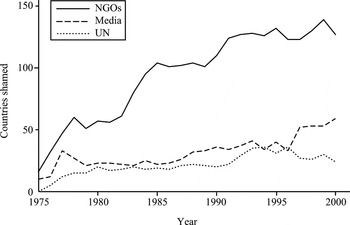
Number of countries shamed over time

Some regard global publicity tactics as cheap talk that perpetrators of human rights abuses ignore. A few worry about unintended consequences—that naming and shaming could aggravate rather than subdue perpetrators. Others believe that shining a spotlight on bad behavior can help sway perpetrators to reform, especially when actors with upright intentions and practices denounce countries for abuses. Anecdotes support each position.
This article offers the first global statistical analysis of the issue.Footnote 2 The focus here is whether international publicity by NGOs, the news media, and the UN is followed by government reductions of murder, torture, indiscriminate killing, forced disappearance, and other forms of political terror, as well as abuses of the electoral process and other violations of political rights.
The evidence shows that naming and shaming is not all cheap talk. On the one hand, governments named and shamed as human rights violators often improve protections for political rights after being publicly criticized—they hold elections or pass legislation to increase political pluralism or participation. On the other hand, naming and shaming rarely is followed by the cessation of political terror and, paradoxically, sometimes is followed by more. Different reasons explain the paradox. One reason is that some governments' capacities for reform vary by types of human rights violations—it may be easier for some governments to reform their legal or political structures, at least on paper, by holding elections or passing legislation to better protect some political rights, than to stop agents of terror that are out of their direct control. Another reason is that some governments abuse human rights strategically—when faced with global pressures for reform, some despots use terror, such as killings or beatings, to counteract the effectiveness of political reforms they make in response to international pressures, such as holding elections.
From Anecdotes to Propositions
Cheap Talk
Plenty of anecdotes support the view that naming and shaming is easy for governments to ignore. Israel is among the most common targets of the global spotlight. In 2000, Amnesty International issued more than two dozen news releases condemning Israel for abusing human rights. The Economist and Newsweek ran articles shaming the government for violations and the UN Commission on Human Rights (UNCHR) passed resolutions to the same effect. Still, human rights abuses continue apace. Israel holds fast company with China, Colombia, Cuba, Indonesia, Iran, Nigeria, Palestine, Russia, and other countries where NGOs, news media, and the UN together shine a spotlight on abuses to no apparent effect. In all of these places and others like them, severe human rights violations persist despite years of global shaming efforts.
Other international human rights policies, such as international criminal tribunals or international treaties, also may fail to prevent abuses or to encourage better practices.Footnote 3 Naming and shaming may be unproductive for many of the same reasons—NGOs and the media lack authority over states and the UNCHR, packed full of despots, lacks legitimacy.Footnote 4 The argument suggests a hypothesis:
H1:
Perpetrators do not change their human rights practices or legislation after they are shamed.
Unintended Consequences
Case study researchFootnote 5 on humanitarian intervention and advocacy warns of the hazards of spotlighting human rights violations: global publicity may also provide incentives for perpetrators to commit abuses. There are at least two circumstances when the spotlight can have that unintended consequence. First, international publicity about human rights abuses may encourage domestic opposition to the abusive government. That opposition may be highly threatening to leaders who use repression to undermine their political opponents and keep power. In that case, the publicity creates incentives for the government to squash citizens' ability to compete for power before they are able to mobilize further. This is especially likely in times of elections, situations that involve independence movements, or territorial disputes. Anecdotes are easy to find. In the recent run-up to parliamentary elections in Ethiopia, government authorities sought to maintain power by intensifying repression—torturing, imprisoning, and harassing critics and opposition.Footnote 6 The same happens in almost every election period in Zimbabwe, where President Robert Mugabe—a leader who follows his international press coverage closelyFootnote 7—cracks down especially hard on his rivals. In 2008, during the election process, Mugabe's thugs beat and tortured Morgan Tsvangirai, the leader of Zimbabwe's opposition Movement for Democratic Change, and persecuted his supporters until Tsvangirai pulled out of the race. Other events may inspire similar reactions. In China, the 2008 Olympics has been cause for shining a spotlight on the government for human rights abuses. It is possible that “the world spotlight will invite those with grievances to try to air them. The government will do its utmost to stop them … and the impact on human rights is likely to be on balance negative.”Footnote 8 Domestic groups may eventually win respect for their rights in the long run, but they may also suffer more abuses in the process of demanding better representation.
Second, nonstate actors such as war lords, militias, and criminal gangs use political terror to challenge state power and win authority or control over resources. Some want to deflect policing of illicit behaviors, such as drug smuggling. Others use acts of violence to attract global publicity. This may help explain why terrorist organizations rush to take responsibility for atrocities, such as the 7 July 2005, bombing attacks in London, where multiple groups claimed the blame to get the world's attention. It may also help explain why groups such as the Movement for the Emancipation of the Niger Delta blow up oil pipelines and take hostages.Footnote 9 Global publicity from NGOs, the news media, or the UN could have the accidental side effect of providing incentives for groups to orchestrate acts of violence large enough to attract the spotlight. Governments sometimes react to these security challenges by repressing human rights even further, setting spirals of violence into motion. Recent bloodshed in Nigeria is an example. The argument also suggests a hypothesis:
H2:
More human rights abuses follow the spotlight.
This hypothesis may be especially likely when leaders perceive that publicity threatens their hold on power or when nonstate actors use terror to gain global exposure.
Suasion
Advocates working to promote respect for human rights understandably hope their publicity efforts cause good government practices, even if the strategy does not work perfectly every time. With this aim in mind, committed advocates name and shame extensively. The NGO Human Rights Watch considers the strategy to be “one of the most effective human rights tools”Footnote 10 to oblige governments, at a minimum, to protect some civil and political rights.Footnote 11 So do many other NGOs and also some members of the United Nations. A U.S. representative to the UNCHR claims that “naming and shaming gross violators of human rights advances the cause.”Footnote 12 The Commission and its replacement are criticized for allowing despots to join,Footnote 13 but the general consensus, even among UN skeptics, is that shining a spotlight on a country's abuses can bring about better practices, especially when those shining the spotlight respect human rights.Footnote 14
These convictions are supported by high-profile cases of success, in which better protections for human rights followed putting the governments of South Africa, Chile, or Eastern European countries in the global spotlight for violations. This suggests a hypothesis.Footnote 15
H3:
Countries put in the global spotlight for human rights abuses adopt better practices and legislation afterward.
This hypothesis may be especially true when spotlights are shone on countries that have ratified global human rights treatiesFootnote 16 and when they are shone on countries, above all, democracies that allow citizens to engage in domestic political protest and peaceful opposition.Footnote 17
The Politics of Shaming
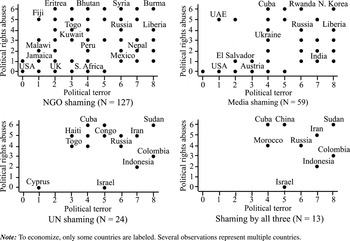
Whether and how naming and shaming works might also depend on when and where the spotlight is shone. Organizations—whether NGOs, news media, or the UN—shine the spotlight selectively. Some countries guilty of horrible abuses never draw much publicity, while others responsible for lesser abuses draw much attention. For instance, political terror has been widespread in Uganda and North Korea for decades, yet these countries receive far less publicity from the international community than do Cuba, China, South Africa, or Turkey, which are more often put in the spotlight for less severe abuses. Figure 2 plots the level of political rights abuses and terror taking place inside countries put in the spotlight by NGOs, the Western news media, and the UN.Footnote 18 These organizations widely publicized human rights abuses in countries repressing political rights and using acts of political terror (shown in the upper right quadrant of each graph), including Colombia, Indonesia, and Iran. In some instances, the same organizations also widely publicized violations in rights-abiding countries (shown in the lower left quadrant of each graph), such as Cyprus, the United Kingdom, and the United States.Footnote 19 In other instances, they chose not to publicize abuses in especially repressive countries, such as Angola.
Human rights abuses of countries shamed in 2000

Fortunately, scholars have done research on the politics of shaming using large samples. Ron, Ramos, and Rodgers examine the factors that shape Amnesty International's publicity tactics on 148 countries from 1986 to 2000. Their statistical analyses show that Amnesty reports more on powerful countries and countries where there is Western government complicity, such as military assistance.Footnote 20 Ramos, Ron, and Thoms study the factors that shape The Economist and Newsweek's reporting on human rights violations for the same countries and years. Their statistical analyses show that these organizations more frequently shame countries with higher levels of human rights abuses, economic development, and population, as well as with more political openness, battle deaths, and stronger civil societies, although these latter effects were less robust. Hafner-Burton and Ron show that this coverage also varies by region, with some areas of the world receiving more Western media attention than others, notably, Latin America.Footnote 21 Likewise, Lebovic and Voeten analyze the actions of the UNCHR from 1977 to 2001. Their statistical findings show that after the Cold War, the UN's shaming was less based on power politics and partisan ties and more on countries' treaty commitments, military capabilities, and active participation in cooperative endeavors such as peacekeeping operations.Footnote 22 Below, the findings of these four studies inform the selection of instrumental variables to model the effects of naming and shaming on repression.
Data
The following analyses consider whether global publicity about human rights violations is followed by better protections for human rights, fewer protections, or no change at all. I consider naming and shaming by three types of organizations—NGOs, news media, and the UN—and two types of repression—political terror and abuses of political rights. I use data on 145 countries, where available, from 1975 to 2000.
Repression
This study employs two measures of repression. The first, which is collected by Cingranelli and Richards and called ciri, measures political terror practices.Footnote 23 They analyze yearly reports from the U.S. State Department's Bureau of Democracy, Human Rights, and Labor that catalog government murder, torture, forced disappearance, political imprisonment, and other acts of political terror. ciri measures a government's annual human rights abuses across 9 levels, coded here from 0 (no violations) to 8 (widespread terror). The second, collected by Freedom House, measures government practices and legislation for political rights, such as a government's abuse of the electoral process, its level of political pluralism and participation, and functioning government.Footnote 24 The political rights variable is coded here from 0 (no violations) to 6 (extreme repression marked by the absence of political rights).
Naming and Shaming
This study considers publicity from global human rights NGOs, global news coverage from widely circulated magazines, and UNCHR resolutions.
ngos:
To gauge naming and shaming by NGO groups, I measure the number of Amnesty International press releases or background reports published on a country in a particular year, a strategy Amnesty has used for years and accelerated about fifteen years ago (see Figure 1).Footnote 25 Ron, Ramos, and Rodgers collected the data using content analysis of all news releases and background reports condemning human rights violations for a particular country in a particular year—in total, more than 13,000 documents.Footnote 26 Press releases are short interventions aimed at the general public to shape perceptions of breaking events. Background reports are longer interventions, often based on in-country research and aimed at human rights professionals, academics, UN officials, and journalists. For instance, in 2000, Amnesty issued eight press releases and eleven background reports on human rights violations taking place in Iran. That country-year observation is equal to nineteen. I log the variable and center it at mean zero. Although Amnesty is not the only human rights NGO using publicity to name and shame perpetrators into respecting human rights, it is one of the world's leading organizations working toward reform and its activities are a suitable measure of Western advocacy-based media coverage.
This measure of advocacy naming and shaming is different from the measures of repression based on the U.S. State Department and Freedom House yearly reports already discussed. The State Department and Freedom House reports describe all countries' human rights practices every year; regardless of the severity of violations, every country receives a repression score if a yearly report was published. Amnesty's background reports and press releases, by contrast, are published episodically and provide information about the intensity of Amnesty's naming and shaming campaigns, not the level of violations countries commit. Figure 2 shows that the two are not perfectly related. Plenty of countries receive horrible scores on the terror and political rights measures of repression but are not serious targets of Amnesty's press releases or background reports. In 2000, for example, eleven countries received the worst score for political terror: Afghanistan, Algeria, China, Colombia, Congo-Kinshasa, Iraq, North Korea, Republic of the Congo, Russia, Sierra Leone, and Sudan. In that same year, Amnesty's top ten most intense naming and shaming campaigns only included three of those: China, Russia, and Sierra Leone. Also on that top ten shaming list were Chile, Saudi Arabia, the United Kingdom, and the United States, all of which ranked low on the repression scales but were put in the spotlight anyway.Footnote 27
The advocacy naming and shaming variable is a first effort to collect cross-national and longitudinal information about Western NGOs' publicity on human rights violations. It does not distinguish among different types of abuses or provide information about advocacy in other parts of the world.Footnote 28
western news media:
To gauge news media naming and shaming I measure whether Newsweek or The Economist have published any articles with the keywords “human rights” in a particular country. Ramos, Ron, and Thoms collected the variables using content analysis of every magazine issue in the sample.Footnote 29 The U.S. edition of Newsweek distributes the news to nearly 20 million people every year; fewer than half are college graduates and their median personal income is around $40,000. The Economist has a readership of just fewer than one million; 95 percent are college-educated and their median personal income is around $150,000.
The Economist and Newsweek are not perfectly representative of all news media reporting on human rights violations. They offer a first glimpse into global media coverage of abuses and Ramos, Ron, and Thoms show their average is a reasonable proxy for Western media interest in particular.Footnote 30 For instance, Newsweek wrote eight articles about human rights violations in Russia in 2000 and The Economist wrote nine. That observation is equal to their average, 8.5, and all other observations that did not receive any media coverage are equal to 0. I log the variable and center it at mean zero. The variable likely underestimates global media exposure of repression because reports not explicitly described in the language of “human rights” are excluded. It does not distinguish among different types of abuses or provide information about media coverage in other parts of the world.Footnote 31
unchr:
To gauge naming and shaming by the UNCHR, I measure whether the Commission targeted a country in a given year (1) or not (0) by passing resolutions condemning human rights violations. Lebovic and Voeten collected the data from UN records.Footnote 32 For example, the UNCHR passed a resolution condemning human rights violations in Somalia in 2000. That observation is equal to 1.
global shaming:
The most important shaming variable in this study measures whether a country is the target of shaming by none (0), one (1), two (2), or all three (3) sources of publicity—NGOs, news media, and the UN. A country that receives a score of 3 is the subject of wide global criticism for its human rights abuses, while a country that receives a score of 1 is the subject of narrower criticism more likely to be motivated by the politics of the shaming organization. I expect that changes in human rights practices, whether for better or for worse, are most likely to follow broad shaming efforts.
Analysis
I first consider the causes of repression by specifying a model informed by previous research:Footnote 33

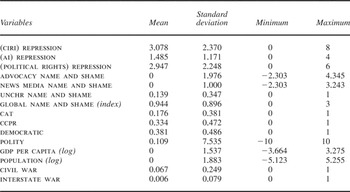
The two repression variables (Y)—one measure of political terror and one measure of political rights abuses—and four shaming variables (Z)—by Amnesty, news media, the UNCHR, and the index of all three—are discussed earlier and summarized in Table 1. X is a matrix of covariates that predict repression for countries i and years t. The matrix includes cat and ccpr, which are binary variables coded 1 if a government has ratified the respective UN treaty designed to protect these types of rights and 0 otherwise. CAT is the Convention Against Torture and CCPR is the Covenant on Civil and Political Rights.
Summary statistics, 1975–2000

Notes:
CAT = Convention Against Torture. CCPR = Covenant on Civil and Political Rights.
Democratic regimes more often protect human rights while undemocratic regimes more often abuse them. Another covariate, democratic, measures a government's regime characteristics using data collected by Jaggers and Gurr in Polity IV. The original variable, polity, ranges from −10 (most autocratic) to 10 (most democratic) and is an index of the competitiveness of a country's chief executive selection, openness to social groups, the level of institutional constraints placed on the executive's authority, the competitiveness of political participation, and the degree to which binding rules govern participation. Here, I use a binary coding to ease interpretation and consider any country with a polity score of 6 or higher to be democratic.Footnote 34
Gross domestic product (GDP) per capita in constant U.S. dollars, gdp per capita, controls for a country's economic prosperity. population controls for a country's total population. Each variable is logged and normalized around mean zero.Footnote 35 To control for political conditions where violence is openly sanctioned by the state, I account for civil war and interstate war. Both are equal to 1 if a country is at war and 0 otherwise.Footnote 36
Y it-p are lagged dependent variables used to correct for autocorrelation over time. I use the Lagrange Multiplier (LM) test for autocorrelation to determine the number of lags to include:Footnote 37

Here, u it and u it−1 are ordinary least squares (OLS) residuals and lagged OLS residuals. I use the t-test of A 2 to test the existence of serial correlation of error terms in the regression. For the terror models, the t-test of A 2 is not significant after adding three lagged dependent variables, Y t−1, Y t−2Y t−3, to (1); for the political right models, the t-test of A 2 is not significant after adding one lagged dependent variable, Y t−1. Thus, I include three lags to correct for autocorrelation of the error terms in the terror models and one lag for the political rights models. λt are fixed-time effects, and μit is a stochastic term.
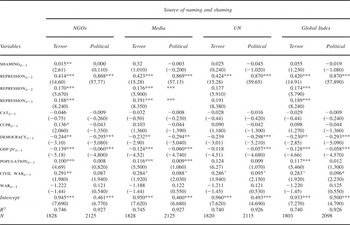
Regression analysis was done in Stata and R.Footnote 38Table 1 summarizes the variables. Table 2 reports the results of the regressions for all four shaming measures on both terror and repression of political rights. Tables 3 and 4 report the results of several additional tests. The period of time between the application of global publicity and the observation of behavior reform is one year. Longer episodes are also tested.
Regression models: Effects of naming and shaming on the level of human rights abuses (terror and political), 1975–2000

Notes:
All models include fixed effects for time. Numbers in parentheses are t-statistics. All tests are two-tailed. +p ≤ .1;
* p ≤ .05;
** p ≤ .01;
*** p ≤ .001.
Findings
Table 2 reports OLS regression estimates. The shaming estimates show that governments are not generally shaping up on terror after they are put in the spotlight. Rather, countries shamed by the global community continue using terror afterward, and those shamed by advocates often use more terror after being placed in the spotlight. By contrast, the estimates for political rights abuses are mainly negative, though they are statistically insignificant.
Next, I separately analyze the component parts of political terror.Footnote 39 To economize, I report on the measure of global shaming only, which is the most likely variable to capture the breadth of international publicity for human rights violations and, thus, to be followed by changes in countries' practices. Each component variable is collected by ciri and measures a specific act of terror—killing, torture, political imprisonment, and disappearance—on a 3-point ordinal scale, from 0 (no violations) to 2 (substantial violations). The OLS estimates of all four specific acts of terror are each positive. They are statistically significant for torture (0.047, p = .006) and disappearances (0.029, p = .017), showing that the global spotlight is often followed by more acts of torture and disappearances. I re-estimate the models using ordered logit and probit. The ordered probit estimates are positive and statistically significant for disappearances (0.147, p = .000) and torture (0.130, p = .004) as well as killings (0.097, p = .051). Ordered logit estimates are similar.Footnote 40
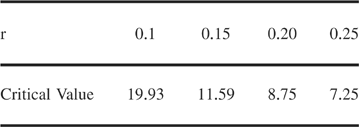
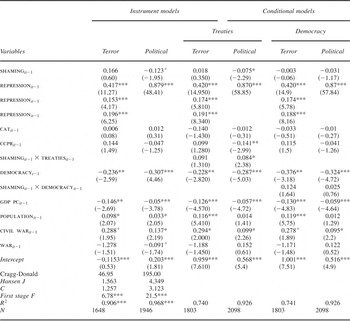
Tables 3 and 4 present the results of several additional tests that merit attention. The first two columns of Table 3 present the results of regressions that account for the politics of naming and shaming, described earlier. Here, I estimate models using two-stage least squares, where the first stage is

and the second stage is equation (1). Q is a matrix of the excluded instruments that predict global shaming but not repression. I choose instruments based on the empirical findings of studies by Lebovic and Voeten; Ron, Ramos, and Rogers; Ramos and Ron; and Hafner-Burton and Ron, discussed already.Footnote 41 For the political terror model, I use a measure of the number of military personnel, logged, coded by the Stockholm International Peace Research Institute and UN participation, measured as the proportion of votes in each year that a country fails to cast in the UN General Assembly as instruments for global shaming. For the political rights abuses model, I also use a measure of U.S. military assistance, logged, and a measure of official development assistance, logged. Cragg-Donald tests show that the instruments are identifiable—the statistics for both models are large (46.95 for the terror model and 195.00 for the political rights model). The Hansen J and C statistics test whether the global shaming variable is endogenous—here, shaming is more endogenous to the political rights model than the terror one, although none of the statistics are significant. The first-stage F statistics (and critical values calculated by Stock and YogoFootnote 42) test whether the instrumental variables are relevant—here, they show that the excluded instruments are more relevant for the model of political rights abuses than for terror. The terror results should thus be interpreted with particular caution, although the two-stage results for both models are largely consistent with the results in Table 2. Countries put widely in the global spotlight for human rights violations are statistically more likely to use terror afterwards but reduce abuses of political rights.Footnote 43 Analysis of the component terror measures shows that torture (0.198, p = .097) and political imprisonment (0.273, p = .098) increase after the spotlight is shined, although these results should also be interpreted with caution because the excluded instruments are identifiable but do not pass the test of relevance (as shown by the first-stage F statistics).
The next four columns of Table 3 present the results of regressions that analyze whether the relationships between shaming and human rights behaviors afterward depend on a country's treaty commitments or regime type. As discussed, success may be most likely when countries put in the spotlight for human rights abuses have ratified global human rights treaties or when their governments are more democratic. Evidence here supports neither claim. Introducing interaction terms between naming and shaming variables and democracy scores or ratification of the CAT or CCPR does not change the results—the democratic countries put in the spotlight do not act better than the undemocratic ones, and countries that have ratified treaties often act worse on political rights after they are shamed. Analysis of the four component measures of terror show that shamed countries that have ratified the CAT are more likely than countries that have not ratified to kill more citizens afterward (0.076, p = .004).Footnote 44
Additional tests: Effects of naming and shaming (global index) on the level of human rights abuses (terror and political), 1975–2000

Notes:
All models include fixed effects for time. Numbers in parentheses are t-statistics. All tests are two-tailed. +p ≤ .1;
* p ≤ .05;
** p ≤ .01;
*** p ≤ .001.
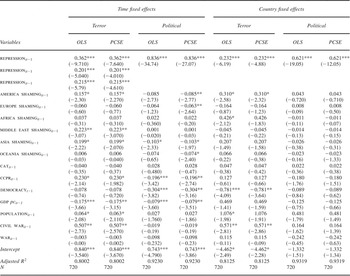
Additional tests: Effects of naming and shaming (global index) on the level of human rights abuses (terror and political), 1984–2000

Notes:
All models include fixed effects for time. Numbers in parentheses are t-statistics. All tests are two-tailed. OLS = ordinary least squares. PCSE = panel-corrected standard error. +p ≤ .1;
* p ≤ .05;
** p ≤ .01;
*** p ≤ .001.
In Table 4, I apply several additional corrections to account for correlations in the panels across time and country. As mentioned before, I use LM tests to determine how many lagged dependent variables are needed to correct for serial correlation of the error terms. Here, PCSE estimation is also used to correct the cross-sectional correlation.Footnote 45 In order to apply the PSCE correction, I need a balanced panel data set and so analyze a reduced sample that includes the forty countries with data on all variables from 1984 to 2000.Footnote 46 I separate the data into different regions so that the number of countries, i, in each region is smaller than the length of time, t. Here, I analyze shaming efforts in the Americas, Europe, Africa, the Middle East, Asia, and Oceania, as defined by Correlates of War (COW). For comparison, I report the OLS results on the same sample. The first four columns display the estimates of a model where λt are fixed effects for years and β3's are set to the different regions. The next four columns display the estimates of a model where fixed effects for countries, δi, are included in equation (1) and β3's are set to the different regions. For the country fixed-effects model of terror, only one lagged dependent variable is needed to pass the LM test, while three lags are needed for the time fixed-effects model.
The estimates for terror are positive and statistically significant and the estimates for political rights abuses are negative and statistically significant in the Americas and in Asia: countries in these regions (that are included in the reduced sample) that are put in the spotlight for abuse use more terror afterward but also reduce violations of political rights. More terror also follows the spotlight in the Middle East, while improvements to political rights also follow the spotlight in Europe and Oceania. The PCSE results are largely consistent with the OLS results, although the regional effects may well be affected by the reduced sample—there are not enough observations on Africa, for example, to identify any patterns there with confidence. Replications on the full sample using OLS (but not PCSE) show similar results with greater confidence.
These initial results are also consistent with other model specifications. Shaming in one year is correlated positively with terror and negatively with political rights abuses in the next year when the models are estimated on a subsample of only those countries subject to global shaming at some point during the period of analysis. The results are similar when I replace the individual shaming variables, described above, with cumulative measures that sum the level of publicity over the entire sample period instead of yearly.Footnote 47 They are also similar when I replace democratic with polity and the ciri measure of terror with an alternative coding, ai, that includes terror committed by nonstate actors as well as governments,Footnote 48 and when I control for the use of economic sanctionsFootnote 49 and exclude the unusual countries that receive the most publicity.Footnote 50 This study also explored time intervals between the application of publicity for violations and the observation of repression practices up to ten years later. Naming and shaming is never clearly followed by reduced political terror and is often followed by more, three (0.163, p = .80) and even five years (0206, p = .012) after the spotlight was shone. A decade later, the relationship is still positive, though insignificant statistically. Political rights abuses, meanwhile, decline three (−0.070, p = .045) and also five years (−0.071, p = .055) after shaming, and a decade later, the relationship is negative but insignificant.
Explanation and Example
Naming and shaming is not just cheap talk. But neither is it a remedy for all abuses. Governments put in the global spotlight for violations often adopt better protections for political rights afterward, but they rarely stop or appear to lessen acts of terror. Worse, terror sometimes increases after publicity.
There are several reasons. One is that, in the face of international pressures to reform, some leaders want improvements but have more capacity to pass and implement legislation protecting political rights than to stop terror. This is because some agents of terror are decentralized outside the leader's control, while the rule of law, at least on paper, is more under state control: many terrorist groups operate independently of government efforts and policies to stop them,Footnote 51 and many police officers and prison guards operate without strong oversight by central government authorities.Footnote 52 In these cases, shaming is often followed by, but does not necessarily cause, government terror. Publicity may nonetheless provoke acts of violence by nonstate actors that governments respond to with more violence.
Another reason is that some abusive leaders adjust their methods of abuse in economical ways in reply to the spotlight, aiming to boost their legitimacy at home or abroad in the least costly way to themselves.Footnote 53 Some dampen down only those abuses that help them to dodge blame for other violations they intend to continue. Others ramp up abuses that allow them to counteract reforms they make to take the edge off international pressure—they make small upgrades to political rights, improving practices or legislation, such as holding an election, to signal conformity with global norms and laws but persist with, or even increase, acts of terror that may help offset the other improvements. A common example is when leaders hold elections but terrorize voters and opposition to reduce their influence.Footnote 54 In these cases, shaming is followed by, but could also provoke, government terror.
Recent events in Nigeria illustrate both types of political processes, capacity and strategic behavior, that may explain the statistical trends presented here. In June 1993, Chief Moshood Abiola, a Yoruba Muslim from southwestern Nigeria, won the presidential election. In July, Nigeria ratified the UN Covenant on Civil and Political Rights—it had signed the Convention Against Torture several years earlier. In November, General Sani Abacha annulled the election, threw Abiola in prison for treason (where he later died), and seized power. During the next five years Abacha jailed his critics, gunned down protesters, and suspended the Constitution. Dissidents were tortured, beaten, and starved. Political prisoners were held without trial, or tried and sentenced before secret martial courts. Criminals were shot without the right to appeal. In 1995, despite pressure from America and Europe, Abacha hanged the novelist Ken Saro-Wiwa and eight others who had campaigned for the rights of the Ogoni people against the devastation of the Niger Delta by oil companies.Footnote 55 He jailed and killed many others during his reign. For Abacha, human rights abuses brought him to power and kept him in charge.
The world shone a spotlight on Nigeria for these abuses. Amnesty International and Human Rights Watch published dozens of press releases and background reports on the atrocities, asking Nigeria to uphold international law and hold elections, Western governments to punish the regime for these abuses, and consumers to pressure oil companies to stop drilling in Nigeria.Footnote 56 The Western news media printed report after report naming these atrocities and shaming the government of Nigeria for committing them. Newsweek called Abacha “Africa's No. 1 outlaw dictator,” while The Economist called him a “despot” that is “repressive, visionless and so corrupt that the parasite of corruption has almost eaten the host.”Footnote 57 Transparency International named Nigeria the most corrupt country on the planet. Meanwhile, the UN passed resolutions expressing deep concern about the human rights situation in Nigeria. The General Assembly repeatedly asked Abacha to restore habeas corpus, release all political prisoners and ensure full respect for the rights of all individuals.Footnote 58 The UNCHR shamed the regime for using acts of terror against political opposition: it asked Abacha to respect the right to life, release political prisoners, among them, Chief Abiola, human rights advocates, and journalists, to hold fair trials, and restore democracy.Footnote 59
Despite the publicity, terror worsened, as Abacha's security forces continued to commit numerous serious human rights abuses, including imprisonment and torture of critics.Footnote 60 While crowds of Nigerians packed bars to watch the fall of Indonesia's President Suharto facing mass demonstrations, Nigerian security forces shot demonstrators—The Economist chalks this up to the “CNN factor,” where global publicity of democracy movements elsewhere gave Nigerian's momentum to protest at home, which led to a government crackdown.Footnote 61 Meanwhile, Abacha became concerned about the global spotlight on him. In reaction to the bad publicity, he issued a video and book, entitled “Not in Our Character,” reassuring listeners that Nigeria's bad image is fabricated by people who “have become instruments or tools of foreign propaganda, a foreign machine to undermine the survival, the stability and subvert the unity of the nation.”Footnote 62 His government organized “spur-of-the-moment” rallies to show the world that Nigerians support their regime. They also held local government elections and made a few other marginal improvements to political rights legislation, all the while terrorizing citizens to keep them from the polls. And then, in the middle of the night, Abacha died of a heart attack.
General Abubakar, head of Nigeria's military, took over the government for eleven months in 1998. He came to power promising to return the country to civilian rule. He released several political prisoners, including Olusegun Obasanjo, who won the presidency in 1998. NGOs, the Western press, and the UN all reacted. Press releases were issued, articles written, and resolutions passed on Nigeria's new democratically elected president—the global spotlight was shone again, this time urging the new president to respect human rights and restore rule of law. Obasanjo made political improvements. He opened public investigations into Nigeria's past human rights abuses. He fired some of the top military and customs officials and took actions to reduce government corruption. He began to restructure the police system. Freedom House reports dramatic improvements in the protection of political rights after Obasanjo took office. Terror, meanwhile, flared up. The new spate of terror was mainly the consequence of ethnic and local fighting, especially in the Niger Delta, where angry groups took up arms against each other. Within a few months of the transition, almost 1,000 people were killed. In the South, many died in clashes between Ibo communities. In the North, fights between Yorubas and Hausas left people dead or homeless.
The statistical analyses here cannot distinguish which political rationale, capacity or strategic behavior, drives this syndrome in which place. Case studies show each has occurred in different countries at different times.Footnote 63 In Nigeria, both played a role. Abacha used terror to maintain his power, making a few meager adjustments to political rights, holding local elections, partly in response to outside pressures. He also instructed government agents to crack down hard on Nigerians to keep them from uprising, sometimes in reaction to the spotlight on him and also other governments, such as Indonesia. While he cracked down on citizens, Abacha ran a public relations campaign in response to global criticism. A similar dynamic is playing out in Zimbabwe, where President Mugabe, responding to international pressures, holds elections but then sends his agents to beat and torture his political opponents and voters who support them. Obasanjo's problem, by contrast, was partly one of capacity. He came to office with some intentions to reform human rights—pressured by the international community and some Nigerians. He was able to pass new laws and partly reform the political system but not to disarm citizens or diffuse the ethnic or religious tensions fueling terror. Terror continues despite the global spotlight. Chile also showed a similar pattern of behavior, when the Pinochet government made a variety of human rights improvements in response to naming and shaming by the international community, while continuing, or even worsening, others.Footnote 64 This paradox has played out in Haiti, El Salvador, Brazil, Bulgaria, Ukraine, Niger, Algeria, Sudan, Turkey, Saudi Arabia, Thailand, Indonesia, and other countries too.
The findings in this study thus provide some evidence of success but also warn of hazards and cheap talk. In a few places, global publicity is followed by more repression in the short term, exacerbating leaders' insecurity and prompting them to use terror, especially when armed opposition groups or elections threaten their monopoly on power. This was likely the case for Abacha in Nigeria and Mugabe in Zimbabwe, where more terror followed the spotlight. Causality is hard to determine with statistical confidence. A variety of data reporting problems could also explain the statistical findings, including problems of scale and conservative reporting practices that present troubles for quantitative analyses of terror generally.Footnote 65 Counterfactual scenarios that are hard to observe could also explain them. Countries subjected to the human rights spotlight may use more terror afterward but less terror than they would have if they were never named and shamed.Footnote 66 One example is the Israeli military's restraint in responding to the Palestinian Intifada.Footnote 67 What is apparent from studies of countries such as Chile and Zimbabwe, though, is that many governments, some driven by strategic behavior and some by capacity problems, act erratically after they are shamed widely by the global community. They make human rights reforms in some areas, holding elections or passing legislation to enhance some features of political participation, but do nothing or even exacerbate the problem in others, allowing or using acts of terror. At least some are making these choices strategically, using terror to offset improvements they make to political rights in response to international pressures.
Conclusion
As human rights idioms become mainstream, global shaming efforts grow. Placing countries in a spotlight for human rights violations, though, is followed by complex politics of human rights abuse and enforcement. This study is a beginning. It shows that governments subjected to global publicity efforts often behave in contradictory ways, reducing some violations of political rights afterward—sometimes because these violations are easier or less costly to temper yet some governments continue or expand their use of political terror—sometimes because terror is less in governments' control or can be used to cancel out other improvements governments make but do not want to work.
Appendix
PCSE estimation for panel-corrected standard errors.Footnote 68
In order to correct the possible cross-section correlation of residuals, Beck and Katz recommend using panel-corrected standard error (PCSE) estimation to estimate the standard errors of residuals. However, in this case, the number of countries (N) is larger than the number of years (T), and their method only applies to the cases where N is smaller than or equal to T.
Thus, I assume that the residuals have the following covariance structure

where m and n are the regions that country i and j belong to.
I organize the residuals from the fitted model according to cluster, so that the residuals from the clusters are (ê 1,ê 2,…, ê N m). (In our case, N m is the number of countries in region m,m = 1,…,6.)
These are vectors with T elements each, and they can be grouped together as a T × N m matrix (the ê i are columns): Em = (ê 1,ê 2,…, ê N m).

The panel-corrected variance/covariance matrix of β̂ is Var(β̂) =