Introduction
The acquisition of the two Spanish translations of be, ser and estar, by adult speakers of English and other languages has been subject to numerous investigations (e.g., various contributions in this Special Issue and references therein). By contrast, very little is known about the acquisition of ser and estar Footnote 1 by Spanish monolinguals or by Spanish–English bilingual children. The goal of the present study is, therefore, twofold: to provide a detailed account of the early acquisition of ser and estar in the language production of a Spanish–English developing bilingual between the ages of 1;6 and 3;0, and to determine if the development of ser and estar is affected by interaction with be.
From a bilingualism perspective, the study of copula acquisition in Spanish is of interest since the child needs to acquire semantic and syntactic contrasts that are not explicitly marked in English. This difference raises questions about the timing of acquisition under pressure from a stronger language, English, in addition to the language-internal questions that have to do with the acquisition of the semantics and syntax of Spanish copulas.Footnote 2
In contrast to previous child language studies which focus mainly or solely on the distribution of ser and estar with predicate adjectives (e.g., Sera, Reference Sera1992; Schmitt, Holtheuer and Miller, Reference Schmitt, Holtheuer and Miller2004; Schmitt and Miller, Reference Schmitt and Miller2007) we consider the full range of syntactic contexts and conceptual frames in which ser and estar may occur.Footnote 3 We provide quantitative information about the overall distribution of copular and auxiliary uses in Spanish and English for the child and for the adults in his environment. This analysis shows a close parallelism between the child's and the adults' productions, thus providing evidence for an acquisition process guided by interactional practices (Rojas Nieto, Reference Rojas Nieto2003). We determine the path of development of the Spanish copulas in the 18 months examined (Spanish MLUw 1.66–5.46; English MLUw 1.66–5.95), and we consider the possibility of language interdependence. In this respect, the analysis indicates that the child realizes at a very early age that Spanish requires him to choose between two options where in English he has only one.
The effect of the input has been the focus of research for both monolingual and bilingual adults and children (e.g., Tomasello, Reference Tomasello1992; Pearson, Fernández, Lewedag and Oller, Reference Pearson, Fernández, Lewedag and Oller1997; Serratrice, Reference Serratrice2002; Silva-Corvalán, Reference Silva-Corvalán, Montrul and Ordóñez2003; Gathercole and Thomas, Reference Gathercole, Thomas and Cohen2005). They all share the same insight that input frequency and/or the nature of the input play an important role in language development, production, and processing. In the case of bilingual first language acquisition (BFLA), i.e., the simultaneous acquisition of two languages from birth, some of the questions raised concern the relationship between input frequency and order of acquisition of linguistic elements; the replication of adult distributional frequencies in the speech of the children; and the interaction of input frequency with other factors that may affect acquisition (e.g., complexity or salience of linguistic elements).
Gathercole and Thomas (Reference Gathercole, Thomas and Cohen2005) have shown that the amount of exposure to the languages in question plays a key role in the timing of acquisition, such that the greater the input in a language, the earlier the child shows evidence of having acquired a particular structure in this language. But once children gain a critical mass of input data on which to extract the relevant patterns, the effect of frequency of exposure disappears. What constitutes a critical mass in the bilingual situations studied, however, remains in need of more precise definition. The present study makes only a preliminary contribution to answering this question by relating development with an overall amount of exposure and use of each language.
Beyond input, a central issue in research on bilingual acquisition has been the nature of the child's linguistic representation of his/her developing languages. In earlier work, the dominant view was that bilingual children pass through a stage during which the two languages are fused in one system (Volterra and Taeschner, Reference Volterra and Taeschner1978). This unitary view has been much criticized since Genesee (Reference Genesee1989) and Meisel (Reference Meisel, Hyltenstam and Obler1989) pointed out some of its weaknesses. Ensuing empirical work (e.g., De Houwer, Reference De Houwer1990; Köppe, Reference Köppe1996; Paradis and Genesee, Reference Paradis and Genesee1996; Deuchar and Quay, Reference Deuchar and Quay2000) has demonstrated that differentiation seems to occur at least from the beginning of early language production, and possibly earlier in the perception of phonological contrasts in the two languages (Paradis, Reference Paradis and Döpke2000).
Recent studies of BFLA have sought to determine which subcomponents of language are affected by cross-language interaction (e.g., Paradis, Reference Paradis and Döpke2000; Müller and Hulk, Reference Müller and Hulk2001; Serratrice, Sorace and Paoli, Reference Serratrice, Sorace and Paoli2004). If both languages are activated in bilingual contexts, transfer phenomena are to be expected. Müller and Hulk (Reference Müller and Hulk2001), for instance, have demonstrated that cross-linguistic influence is manifested when the structures in question involve the interface between syntax and pragmatics. They study object drop by bilinguals who speak a Germanic and a Romance language, and argue that the bilinguals are able to separate the two languages from early on, but that the languages have an influence on each other. In the case of object drop, the effect of the influence is delay in the acquisition of the discourse constraints on object drop in the Romance languages in contact with a less restrictive object-drop Germanic language. Acknowledging individual variation, however, Müller and Hulk invite studies of more bilingual children to test their hypotheses.
One such study is Yip and Matthews's (Reference Yip, Matthews and Cohen2005). It examines null objects in the production of two Cantonese–English bilinguals (age 2;0–3;0). The authors support Müller and Hulk's (Reference Müller and Hulk2001) findings about cross-linguistic influence, but they go further in proposing that language dominance also plays a central role in determining the direction of transfer.
In regard to copulas, Spanish poses a harder task than English for the child: learning when it is grammatically and pragmatically appropriate to use ser or estar. If in bilingual acquisition languages influence each other, and if the direction of the influence is from the dominant to the weaker language, one may expect delayed acquisition of copula differentiation in Spanish and/or unexpected uses of copular constructions in this language by an English–Spanish bilingual. Indeed, the question whether the child's grammar represents a single or a dual system seems to be less important than the examination of the mechanisms involved in the process of dual language acquisition, as well as the identification and explanation of patterns of development. An aim of this study is to shed some light on these processes while at the same time delving into the question of interdependence.
If the language systems develop autonomously, the patterns of acquisition and linguistic representation would match those of monolinguals. Interdependence, on the other hand, would mean that the grammar of one language would influence the grammar of the other language such that there would be identifiable differences in the bilingual's patterns of development in comparison with monolinguals. But while much research has been done on the acquisition of be by English-learning children, there are only two studies that we are aware of that examine copulas in spontaneous speech from Spanish-speaking monolingual infants, Sera (Reference Sera1992) and Ponce Romero (Reference Ponce Romero2006), which could serve as baseline for bilingual studies. Sera's study includes two MadrileniansFootnote 4 from ages 1;6 to 3;6, but during this long period the children produce only 71 copular constructions. Ponce Romero examines a larger corpus of data from a Mexican child, 385 copula utterances produced between 1;9 and 3;5; although her study is still ongoing, it provides a good starting place for some comparisons.
A number of studies that have adopted a usage-based or constructivist perspective on language acquisition (Gathercole, Sebastián and Soto, Reference Gathercole, Sebastián and Soto1999; Rojas Nieto, Reference Rojas Nieto2003; Tomasello, Reference Tomasello2003; Wilson, Reference Wilson2003, among others) have shown that development is gradual and uneven (piecemeal or item-based) and guided by the input that the child receives in concrete acts of communication in which s/he actively participates. Usage-based linguistics holds that the essence of language is its symbolic dimension, i.e., the use of conventional linguistic symbols for purposes of communication (Tomasello, Reference Tomasello2003). Lexicon and grammar are acquired first in specific constructions or syntactic frames with associated conceptual frames or functions. Frames contain a variable part and progressively generalize from simpler constructions into more productive and more complex patterns.
This constructivist account predicts that there will be differences in the rate of acquisition of the different syntactic and conceptual frames of the copulas. For instance, it would be expected that copulative uses would be acquired before auxiliary uses because they correspond to different constructions, and copulative uses are conceptually and syntactically simpler. This expectation is also tied to adult–child communicative practices: questions and answers about what an entity is (and soon after where an entity is located) precede interaction about the activities that entities engage in.
In light of the preceding discussion, and assuming that language learning is guided by a complex interaction of the input with cognitive and linguistic complexity, and with frequency, we expect the following: (a) a close relationship between the child's early use of the copulas and the adult input; (b) the gradual acquisition of the various conceptual and syntactic frames in which copulas occur, advancing from less to more complex constructions; (c) the earlier acquisition of copulas in contexts with strong cue reliability, i.e., in contexts with regular and frequent triggers for the use of ser in opposition to estar (cf. MacWhinney, Reference MacWhinney and MacWhinney1987). Furthermore, we expect that the relatively high frequency of copular constructions, coupled with autonomous systematic development, will inhibit the possible effect that English might have in promoting a one copula system in Spanish.
Method
The data
The data for this study come from a large longitudinal corpus obtained from three Spanish–English bilingual siblings since they were nine months old. The children were observed and recorded regularly (diary notes and audio recordings) using Spanish, English, or both in a variety of natural and uncontrolled discourse contexts and with different interlocutors. Only the eldest boy, Nicolas (also referred to as “Kiko” and “Nico”), an early acquirer, is included in the current study.
Detailed diary notes and three hours of audio-recordings were selected between the ages of 1;6 and 2;11.27. Notes and recordings were made two to four days per week by Silva-Corvalán. They also include adults' utterances addressed to the child. Nicolas was the only child in the home during the age period examined (the second child is 3 years younger). He has grown up in an ethnically mixed home in Los Angeles: his mother is an English-speaking Euro-American, while his father is a bilingual Hispanic.
At Nicolas's home, the “one parent/one language rule” was fairly consistently applied until the child was 3 years old, albeit in a bilingual environment insofar as the parents spoke to each other in English. Nicolas received Spanish input mainly from Silva-Corvalán, his paternal grandmother,Footnote 5 and from his father. Nicolas and Silva-Corvalán spoke almost exclusively in Spanish. He addressed his father in either Spanish or English. Occasionally, Nicolas also interacted in Spanish with his uncles and other Spanish-speaking people in Los Angeles. From time to time he was exposed to children's movies and songs in Spanish. In addition, his family spent one month in a Spanish-speaking country when Nicolas was one year old. Nicolas started attending an English-only daycare center when he was 1;3. It is estimated that, on average, he heard English and Spanish 60% and 40% of the time, respectively, and he used English and Spanish 65% and 35% of the time throughout the period studied.Footnote 6 Based on his life-history and our personal knowledge of the child, we feel confident that his dominant language was English, but his Spanish also appeared to be well-developed for his age.
Data analysis
Drawing on the tradition of variationist research, the complete database between the ages of 1;6 and 2;11.27 was examined to identify the copulative and auxiliary uses of ser, estar and be. A total of 1206 tokens of these verbs were coded: 696 produced by the child, and 510 produced by the adults. The linguistic variables included form used (e.g., be, ser, or estar, copulative or auxiliary), conceptual frame, predicate structure, type of adjective, person and number inflection, tense–mood–aspect, type of error (if any). The external variables were the child's age, and MLU by word (MLUw). MLUw was calculated for English and Spanish, once a month starting at the beginning of each month until 50 utterances in each language were reached (mixed utterances were considered separately; they did not amount to 50 utterances per month). This MLUw is considered to be representative of the MLUw for each month between 1;6 and 3;0.
Ser and estar function as copulas and as auxiliaries (for detailed studies of ser and estar, see Fernández Leborans, Reference Fernández Leborans, Bosque and Demonte1999; Marín, Reference Marín2004). Briefly, ser is used when the predicate is a noun or noun phrase, a prepositional phrase denoting origin, material or possession, an expression of time, and the time or location of an event. Only ser may be used in equational and cleft constructions, and only estar is used when the predicate expresses location of an entity. A large number of adjectives may occur with either copula (e.g., Juan es/está alto “Juan is/is (now) tall”); but some adjectives co-occur only with estar (e.g., lleno “full”, contento “content”), and some under normal conditions co-occur only with ser (e.g., inodoro “odorless”, ambicioso “ambitious”, desconocido “unknown”). As auxiliaries, only ser may occur with past participles in passive constructions, and only estar with present participles in progressive tenses. Estar (and more restrictively ser, as in Es bien conocido “He's well-known”) is used with past participles that function as adjectives. These are the distributions and syntactic functions associated with conceptual frames that the child needs to learn, and that were taken into account in the coding.
Copular constructions fulfill a number of communicative functions, i.e., they occur in what we refer to as “conceptual frames”, created by the entire construction in which the copula occurs.
(i)

(ii)
(iii)
(iv)

Functions are associated with different copulas in Spanish. Both copulas may appear in characterizations and as discourse fillers, but only estar may appear in identifications of non-event locations and manner, and as an auxiliary in progressive constructions, and only ser may appear in the remaining functions listed above. Functions are further associated with various predicate structures in copular constructions:
In questions and answers to questions the predicate may be phonetically unrealized but clearly implied, as in (1).Footnote 7 These were coded as zero predicates.
- (1)
C: ¿Quién estaba en la escuela?
“Who was in school?”
N: Miss Mary estaba [en la escuela].Footnote 8 (1;10.22)
“Miss Mary was [in school].”
Not included in the coding were the child's utterances with a copula that were an exact repetition of an adult's utterance, nor a few utterances that contained a realization that could not clearly be considered a copula. One such case is presented by the homophony between the hesitation marker [ə] and very early copula productions, as in Mommy, ə, ə, ə airplane ['eə'pein], where [ə] could stand for is, it's, an or the, or be the hesitation marker.
With respect to non-target constructions, the coding included non-expected uses of tense, person, and copula choice, and missing copula. In this regard, it is fairly uncontroversial to determine that a copula is missing in such utterances as Bibi aquí “Bibi here” in answer to Where's Bibi? But there are other phonetic contexts that make it impossible to tell if the utterance contains an expressed copula because the last segment of the preceding word or the first segment of the word that follows may cause assimilation of the copula when this is realized as [ə], [e], or [əs], as in Este e tete ['ete'tete] “This (is the) pacifier”, or He('s) sick. Examples of this type were not coded unless the authors agreed that there was a prosodic break that allowed us to identify the presence of a copula, as in [¿'onde e papi?] ¿Dónde está papi? “Where is daddy?”.
There are a number of [noun + adjective] utterances that lack a context that could indicate whether they are an NP or have a missing copula. One such case is Bus grande “Big bus”, which the child may have meant to be Mira el bus grande “Look at the big bus” or Ese bus es grande “That bus is big”. These examples were not coded.
An example like (2), on the other hand, is produced in a context that supports the analysis of a missing copula. In this context, the most plausible interpretation of (2) is that the child has produced a modified version of what the adult has previously said, with a missing copula and determiner. At 1;7.25 está does not yet have a realization including the syllable [ta] (see Table 5).
- (2)
C: Tío Diego no anda en jeep porque está malo.
“Uncle Diego doesn't ride the jeep because it's broken.”
N: Malo jeep. (for Está malo el jeep) (1;7.25)
“Broken jeep.” (for “The jeep is broken”)
Such phonetic realizations of the copulas as [ə], [e], and [əs], that at first seem to be common to Spanish and English utterances, are coded as Spanish when produced in a Spanish context ([e nu:na] es luna “it's the moon”) and as English if produced in an English utterance ([əs mine] “it's mine”) even if no subject appears. This is done for the purpose of quantifying the copular constructions (see the section on results).
Mixed utterances, which are normal and occur at all ages in our data, are not the focus of this study. They were included in the language analyses when the switch did not affect the phenomenon under study. For example, an utterance like He's “cansado” “He's tired” was not included in the Spanish [copula + adjective] analysis, but Está “yummy” “It's yummy” was because the focus is the choice of ser or estar with a predicate adjective, regardless of whether this adjective is produced in Spanish or English.
Several methodological limitations of this study should be mentioned. Firstly, because most of the data come from diary notes it is not possible to consider subtle phonetic features, such as (lack of) voicing of |s|, that could help determine if the very early productions of [əs] correspond to English (with [z]) or Spanish (with [s]), for example. Secondly, the lack of strictly comparable monolingual studies makes it possible to offer only tentative conclusions regarding similarities or differences between the paths and timing of development of copular and auxiliary constructions by monolingual and bilingual children. And thirdly, the study focuses on only one bilingual child whose individual language behavior may very well be different from other bilinguals even if in similar sociolinguistic situations.
Results and discussion
Distributional frequencies
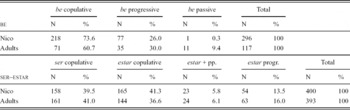
If the input that the child receives from the adults, English or Spanish, has no effect on copula use, then the proportion of copulas in the different structural and conceptual frames should not be similar in the child's and the adults' data. Contrary to this expectation, the results of the overall frequencies of use of ser, estar and be by Nico and in the adults' language addressed to the child display an obvious similarity between the two sets of data, as shown in Table 1.
Frequency of be, ser, and estar in the structural frames studied.

N = number; pp. = past participle forms with adjectival function; progr. = progressive
In regard to be, its use as a copula is the most frequent in the child's and in the adults' data, followed by be in progressive constructions. Only one token of a passive sentence is recorded for Nico at 2;1.28, and eleven passives in the adults' data are variations of the same question What is/are X called?.
The frequencies of ser and estar in the various structural frames in the adults' data are also replicated quite closely in the child's production. In both sets of data, copulative uses have the highest frequency, estar as auxiliary in progressives occurs less frequently, and estar with adjectival participles is the least frequent. Neither ser passives nor adjectival participles with ser appear in the data. This is expected given the infrequent use of ser passives in conversational Spanish, and of adjectival participles with ser in language addressed to children (e.g., arriesgado “risky”, resignado “resigned”). Similar results are reported by Sera (Reference Sera1992) for monolingual Madrilenians aged 1;6–3;6, and by Ponce Romero (Reference Ponce Romero2006) for a Mexican child between 1;9 and 3;5. In their studies, copulative uses far outweigh auxiliary uses of ser and estar.
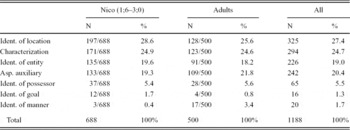
For a comparison of the overall frequency of the various communicative functions of be, ser, and estar between Nico and the adults, we did not differentiate between the English and the Spanish copulas on the assumption that they fulfill the same functions at this age, an assumption supported by the translations of the examples illustrating conceptual frames in the preceding section. We also grouped the auxiliary uses (in passives, progressives, and one occurrence of I'm gonna-future in the adult data); we did not include location of events because there were only three tokens produced by the adults and one by Nico, nor did we include fillers because these were not recorded in the diary every time they occurred. The results are displayed in Table 2.
Frequency of the conceptual frames in which be, ser, and estar occur.

N = number; ident. = identification; asp. = progressive aspect auxiliary
The main motivation for the frequencies presented is the comparison across the two generations. The proportions across frames with respect to the different copulas may only be roughly compared given that not all three verbs fulfill every function, e.g., identification of location is done with estar or be, as are identification of manner and the auxiliary function; identification of an entity, possessor and goal are accomplished with ser and be; and characterization with either of the three copulas.
During the 18 months examined, the match between the communicative functions that be, ser, and estar fulfill in the child's and the adults' data is almost perfect. Placing objects and people in space, and describing or characterizing them appear as the central functions of the copular constructions at this early age (28.6% and 24.9%). Identifying objects and people, and asking about and describing the activities they engage in come second in importance (both functions about 19%). The identification of possessors, goals, and manner appears as the least frequent. Ponce Romero (Reference Ponce Romero2006) also shows that possession has a low frequency, and location a high frequency in her monolingual data.
Only minor differences, which may derive from interactional practices, set the adults apart from the child. For instance, identification of manner takes place when an adult asks the child how he is, to which he answers with a bare adverb, bien or good. Identification of location, on the other hand, is frequently initiated by Nico with the question ¿Dónde está X? or Where's X?
Three of the functions in the coding scheme were not attested in the data: identification of time, origin, and material. Focalizing uses of ser (in cleft and pseudo-cleft constructions) did not appear either. Material is expressed not in copula predicates but in NPs, as in Tengo un caballo de madera “I have a wooden horse”.
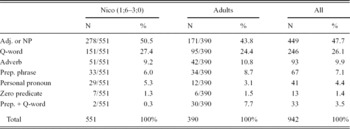
The overall quantitative results for the proportion of the various predicate structures in copular constructions (i.e., auxiliary uses are not included) are presented in Table 3.
Frequency of the types of predicate in copular constructions with be, ser, and estar.

N = number; Adj. = adjective; NP = noun phrase; Prep. = preposition; Q-word = question word
The overall results for types of predicate (adjectives and NPs, adverbs, prepositional phrases, personal pronouns, and zero predicates) are remarkably similar in the two samples. Zero predicates occur only with estar in the child's production (example (1) above), and one of a total of six appeared with ser in the adults' data.
Copulas appear in a range of question-word (Q-word) interrogatives where the Q-word corresponds to the predicate of the matching affirmative construction (¿Dónde está X? “Where is X?” ¿Qué es esto? “What's this?”). These interrogatives are as frequent in Nico's as in the adults' samples (27.4% and 24.4%, respectively), and they occur with similar frequencies in both languages. The relatively high frequency of these interrogatives is related to the preferred communicative functions fulfilled by copular constructions. These questions bring forth the identification of objects and people, their description and location, and the identification of their actions. It is not surprising, then, that they are the first ones to be addressed to the child and the first ones to appear in his production.
The only notable difference displayed in Table 3 concerns the proportion of interrogatives which require that a preposition co-occur with a question word. In this case, the preposition must precede the Q-word in Spanish but it may be stranded in English (¿Con quién estás? “Who are you with?”). Only four interrogatives with a Q-word and a preposition are recorded in the adults' English data (What's this (used) for? in the four cases), and only two occur in the data from Nico, at 2;1 and at 2;11; they are both the same question “What's this for?”. This is a perfect match.
Interrogatives with preposition plus Q-word in Spanish first appear in the adults' data when the child is 1;9.16; at 1;11.3, we record further types with ¿De qué color es/está X? “Of what color is X?” and ¿De quién es X? “Whose X is this?”. The constructions are in the input (26 are recorded), the child understands them, but he does not produce them. This could be due to the complexity that the initial preposition adds to the question, a structure he has not yet encountered in his stronger language. At the same age the child produces questions about location and identity of an entity with an initial Q-word in both languages (with dónde “where” and qué “what”).
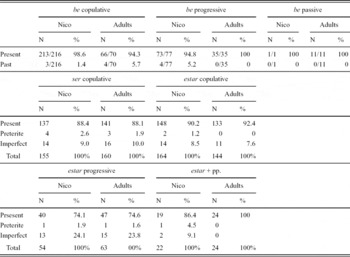
Non-compound Spanish tenses include present, preterite, imperfect, future and conditional in the indicative mood, present and imperfect in the subjunctive mood, imperative, and three non-finite forms: infinitive, present participle and past participle. Of these, ser and estar appear four times in the infinitive in the child's data, three tokens following ir a “going to” in the periphrastic future, as in (3), and one token after a modal verb, as in (4). In addition to these infinitives, only present, preterite, and imperfect forms of ser and estar are used during the period studied (see Table 4).
- (3)
N: Brenny y yo vamos a comer mucho y vamos a ser dinosaurios. (2;10.14)
“Brenny and I are going to eat a lot and we're going to be dinosaurs.”
- (4)
N: [Addressing his dad] Tú no debes estar durmiendo. (2;11.11)
“You shouldn't be sleeping.”
Frequency of be, ser, and estar by tense.

N = number; pp. = past participle with adjectival function
Of the possible English tense forms in which be may be used, the complete data for the 18 months include the bare form be produced a few times by the child and by the adults in the utterance Be careful, two tokens of the infinitive produced by Nico after a semi-modal (see example (5)), one token in a future construction with will, (6), and one in the going to periphrastic future, (7). Table 4 displays the numbers and proportions of the remaining tenses used by Nico and the adults.
(5) N: Do you want to play, do you want to? It has to be like this. (2;2.16)
(6) N: I'll be right back, Bibi. (2;8.10)
(7) N: I'm going to be very angry at you. (2;11.11)
The proportion of the various tenses used by the child closely parallels that of the adults. As expected, the present is by far the most frequent form in which be, ser, and estar are used in both languages. The use of the past forms of be differentiates Nico from the adults. Note that the proportion is almost reversed for copula be (Nico 1.4%, adults 5.7%), and progressive auxiliary be (Nico 5.2%, adults 0%). This reversal is explained by the nature of the communicative exchanges between the child and his mother. Observe example (8): the mother asks the questions in the simple past, the child answers, appropriately, in the progressive.
(8) Mot: Where were you, Nico?
N: I was talking to papi. (2;10.3)
Preterite progressives in the Spanish data are also scarce (Nico 1.9%, adults 1.6%), but imperfect progressives are more abundant (Nico 24.1%, adults 23.8%).
One further difference between Nico and the adults concerns the tenses of the [estar + adjectival participle] construction. No cases are recorded for the adults, and Nico uses three tokens, two in the imperfect and one in the preterite.
In sum, this section has provided ample evidence of the parallelism between the child's and the adults' use of be, ser, and estar during the child's second and third year of life. Similarities are identified in the proportion of different predicates that co-occur with these verbs, in the proportion of tenses in which they appear, and in the proportion of communicative functions performed by the constructions in which they are used.
Placing objects and people in space, identifying objects and people, and describing or characterizing them emerge as the central functions of the copular constructions. Also developed early and used in similar proportion by Nico and the adults is the auxiliary function of be and estar in progressive constructions, which request and provide information about the actions being performed by the child and others around him.
Interrogatives with a simple structure ([Q-word copula/auxiliary X (Y)]) display similar proportions in Nico's and in the adults' samples. By contrast, differences arise in the proportion of interrogatives which require that a preposition co-occur with a question word in Spanish: despite their presence in the input the child does not produce them. In English, only six examples are attested, all with the same interrogative structure (What is X for?), two by the child and four by the adults.
These results support a view of copula acquisition guided by the nature of the interactions that the child enters into with the adults who surround him (Rojas Nieto, Reference Rojas Nieto2003). We know from previous studies that children's use of verbs is highly sensitive to their mothers' use of the verbs (De Villiers, Reference De Villiers1985; Naigles and Hoff-Ginsberg, Reference Naigles and Hoff-Ginsberg1998), and our analysis in addition shows that adults tend to use the same basic patterns repeatedly; thus, it is not surprising that the frequencies of the children's use of copulas reflect the frequencies of the adults' use. The proportions of structural frames, tenses, and communicative functions are matched in the child's and in the adults' data, and support a view of the language input as sufficiently rich and crucial for the relevant patterns to be learned.
The next section focuses on the developmental trajectory of the copulas in Spanish, and secondarily in English. (See Appendix A for a summary.)
Path of development
The earliest stage: From [ə] to [es] and [está]
The development of the Spanish copulas in the 18 months examined advances in a non-linear fashion from realizations [ə], [əs], and [e] that seem to be common to Spanish and English utterances, through a number of intermediate realizations: ['a,'tá, 'hta, 'sta] for está, [e, əs, es, eh] for es, and [e, əs, ɪs] for is, to full or contracted adult-like phonetic realizations, including other persons and tenses. The only realization not registered beyond 1;8.4 is the bare schwa. In the child's data, copulas occur in three of the simple tenses of the indicative mood (present, preterite, and imperfect), and in the infinitive form.
With respect to the development of the English copula, we simply note that be follows what other researchers have found (e.g., Brown, Reference Brown1973; Wilson, Reference Wilson2003), and we observe no obvious timing delays which might have resulted from the simultaneous acquisition of English and Spanish (but see the section on interlanguage influence below). As the children in Brown's and Wilson's studies, Nico produces first copular constructions (MLUw 1.80) and later progressive auxiliary ones (MLUw 2.38), oscillating between presence and absence of be allomorphs in obligatory contexts until age 2;4.19 (MLUw 4.06). Wilson further found that children proceed from the acquisition of single lexically specific units involving a particular lexical item (e.g., he's, it's, that's) to the gradual abstraction of a more general construction type ([closed/open class subject + copula/auxiliary]). This is also the pattern followed by Nico in his acquisition of be.
The early productions of what could be considered Spanish copulas occur in contexts which render their identification as such rather difficult (see the section on coding). There are also single nouns, adjectives, and adverbs in answer to questions that adults frequently ask the child (e.g., ¿Qué es X? “What's X?”, ¿Dónde está X? “Where's X?”). Adults also frequently provide the answers themselves, thus providing numerous examples of copular constructions. As a result, the first child utterance which calls for the occurrence of a copula is a locative interrogative ([¿'oe'mu:ma?] at 1;5.28 (example (9)), where “e” may be a reduced form of está or es, or the last vowel of dónde.
- (9)
N: ¿Dónde está la luna? [¿'oe'mu:ma?] (1;5.28)
“Where's the moon?”
The earliest unambiguous copula, an allomorph of ser, [e], turns up at 1;6.7 while Nico plays with rocks of different sizes. Nico repeats his own utterance several times, see (10), as if he were trying to memorize it, while looking at a larger rock. From 1;6 to 1;7 Nico produces only one adjective type, grande “big”, present in (10).
- (10)
N: Es grande. ['e'ganne] (1;6.7)
“It's big.”
Structure: [copula + adjective]
Function: Characterization
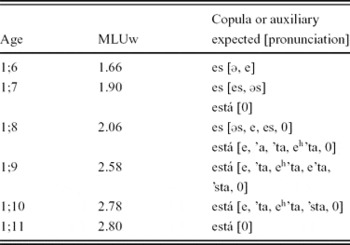
At the earliest stages, (1;7–1;8.16, MLUw 1.66–1.90), Nico uses three allomorphs of what appears to be one copula form for es and is, [ə, əs, es]. Likewise, Krasinski (Reference Krasinski, Ortiz and Lacorte2005) observes that the earliest copula forms used by her bilingual child from about 2;6 to 2;7 were undifferentiated for language.Footnote 9 In Nico's case, we do not mean to suggest that a mixed single system is developing. Indeed, es and is are almost homophonous at an age when voiced [z] is not yet produced; thus these reduced forms may be characteristic of monolingual acquisition of es and is, though not of está (Rojas Nieto, personal communication), yet Nico produces [e] also in contexts of está (see Table 5).Footnote 10
Early pronunciations of Spanish copulas.

In Nico's data, [ə, əs, es] co-occur with predicates in Spanish or English (examples (11)–(13)). The first it's units are recorded at 1;8.16 (It's broken, It's off), the same day the child also produces Es mine “It's mine”. From this age on it's alternates between a pronunciation without the stop and one with a glottal stop preceding the vowel ([ɪs] or [ʔɪs]); adult-like pronunciations of it's appear three months later, at 1;11. Before this age, the stop is not realized either in the unit that's, first recorded at 1;8.14 (That's the moon [ðas ə mun]).
- (11)
N: [es] lion. (1;8.2)
- (12)
N: [es] hombre. (1;8.4)
“It's a man.”
- (13)
N:
At the end of his 19th month (MLUw 1.90), Nico produces two utterances with a clear Spanish es (example (14)), while está [ehta] is attested for the first time at the end of his 20th month (MLUw 2.06), as in (15). Earlier realizations, except the bare schwa, continue to occur beyond these ages.
- (14)
N: No es jugo. Es agua. (1.7.29)
“It's not juice. It's water.”
- (15)
N: Aquí está. (1;8.27)
“Here it is.”
Expansion of conceptual frames and syntactic contexts
Alongside the increase of vocabulary that typically takes place at 1;8, there is an increase in the number of tokens of copulas and an expansion of conceptual frames and their associated syntactic contexts. Besides predicate nominals, we find copulas with prepositional phrases, in questions (16), with pronouns, and one case with an adverb. Progressive constructions appear in the 20th month, but the auxiliary is not expressed, as in (17).Footnote 11 Conceptual frames progress from the identification of entities and their characteristics to identifying their location; from questioning the identity of entities and their location to identifying and questioning their activities (see Appendix A). Other functions appear later, during the third year of life.
- (16)
N: ¿Qué es eso, Bibi? (1;8.21)
“What is that, Bibi?”
- (17)
N: ¿Qué 0 haciendo, Bibi? (1;8.29)
“What 0 you doing, Bibi?”
A variety of nouns and adjectives co-occur with es and está during the 20th month (see the discussion of predicate adjectives below), but only one pronoun, one adverb (aquí “here”), and one prepositional phrase (three cases of [copula + de X], as in (18)).
- (18)
N: Es de la Bibi [es e a bibi]. (1;8.21)
“It's Bibi's.”
Six examples of two question types appear, with and without expressed copulas (as in (16)–(17) above). Estar is expressed three out of seven times in copulative contexts, but not once in five progressive contexts. There is, then, a gradual expansion of linguistic contexts, and a gradual progression toward the stable phonetic expression of the copulas.
Locative interrogatives increase a great deal during the next month (1;9), becoming the most frequent structure for the use of a copula, and alternating between interrogatives with a missing copula and realized 'tá for está (examples (19)–(20)).
- (19)
N: ¿Dónde (e?) / 'ta vacuum? (1;9.16)
“Where (is?) / is the vacuum?”
- (20)
N: ¿Dónde (e?) / 'stá auto ə papi? (1;9.16)
“Where (is?) / is daddy's car?
The game of hide-and-seek provides the situational context for the occurrence of a number of cases of ¿Dónde 'sta X? “Where's X?” with an expressed copula, recorded frequently from 1;9.19 alongside questions about the location of such entities as la luna “the moon”, all occurring with forms of está. But at the beginning of the next month (1;10.1), the child produces again an earlier structure, ¿Dónde (e?) auto ə a Bibi? “Where's Bibi's car?”.Footnote 12
Negative copular constructions become frequent at 1;10. They occur with ser and with estar in combination with different types of subjects and predicates.
During the last two months of the child's second year of life, questioning and identifying locations remain the most frequent frames for the use of estar, followed by characterization, and by progressives. Expectedly, utterances become longer, but the length does not appear to condition the phonetic realization of the copula, as illustrated in (21) and (22), where the longer utterance is the one with an expressed copula.
- (21)
N: No 'sta la Lupe en la casa de la Bibi. (1;10.8)
“Lupe is not in Bibi's house.”
- (22)
N: Tuyo leche 0 la bolsa, Bibi. (1;10.24)
“Your milk (is) in the bag, Bibi.”
Of a total of 45 missing copulas recorded, 26 occur in the three months before age 1;10 (MLUw 1.66–2.58) and only six during this month, in both copular and auxiliary uses of ser and estar (and also be). The last utterance with a missing copula occurs in the child's Spanish data at age 2;3.11 (MLUw 3.14), and in the English data at 2;4.19 (MLUw 4.06). This single example in each language concerns a progressive construction (examples (23)–(24)) and, interestingly, the Spanish token involves a switch from English to Spanish at the point where the auxiliary should have been produced (example (24)).
- (23)
N: Where 0 you going, Bibi? (2;4.19)
- (24)
N: You 0 cortando, Bibi? (2;3.11)
“You 0 cutting, Bibi?”
The first copular construction with the function of identifying a goal or destination appears at 2;4.19 (Ese es para ti, Bibi. “That is for you, Bibi”). Goals or beneficiaries appear earlier in constructions that are not necessarily copulative (Una mitad para mí “One half for me”). The identification of manner appears for the first time with a copula, a form of estoy “(I) am”, at 1;11.10 (example (33) below), but manner is not a frequent frame beyond the formulaic question ¿Cómo estás? “How are you?” which he answers with a single adverb, Bien “Well”. The child does not spontaneously produce this formulaic question in Spanish.
It must also be mentioned that we recorded one example of identification of the place or time of an event (see example (49) and discussion below), a conceptual frame that appears to be acquired after age 3;0.
Development of verb inflections: Tense
Expectedly, the present tense is the first and by far the most frequent form in which be, ser, and estar are used in both languages (see Table 6 and Appendix A). Situational contexts for the use of past tenses are not frequent; forms other than está and es occur only sporadically during the period studied (Silva-Corvalán, Reference Silva-Corvalán, Montrul and Ordóñez2003, discusses the development of tense and aspect in further detail).
Development of person marking.

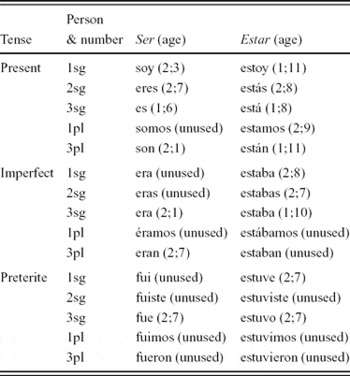
Two preterite forms of estar appear in Nico's and the adults' data: estuve “was-1sg” and estuvo “was-3sg”. Estuvo shows up first at 2;6.8 (example (25)), followed by estuve at 2;7.13; both of these are used in place of the imperfect forms but with the correct person inflection. Three more cases of estuvo-3sg are recorded at 2;7; these are used correctly in the preterite but they incorrectly replace first person singular (example (26)).
- (25)
C: ¿Y encontraste tu tete, Nicolás, dónde estaba (Imp)?
“And you found your pacifier, Nicolás, where was it?”
N: Estuvo (Pret) escondido el tete, Bibi. (2;6.8)
“The pacifier was hidden, Bibi.”
- (26)
N: Porque (yo) no estuvo-3sg muy enfermo. (Yo) Estuvo-3sg un poquito enfermo. (2;7.22)
“Because (I) wasn't very sick. (I) was just a little sick.”
Only one preterite form of ser is used by Nico and the adults: fue (was-3sg).Footnote 13 It is correctly used twice at 2;7 (as in 27), and twice at 2;8.Footnote 14
- (27)
N: ¿Qué fue ese ruido? (2;7.25) [loud noise is heard]
“What was that noise?”
The imperfect of estar (estaba “was-3sg”) occurs first at 1:10.22 (see example (1)); it is recorded again nine months later, at 2;7.11. More uses are recorded from 2;8 on, with first and third person singular subjects.Footnote 15 This lag between the first and later uses of a new form, similar to the “period of silence” in the acquisition of different tenses reported by López Ornat (Reference López Ornat1994), supports the idea that the earliest productions are lexically specific.
Similarly, the first imperfect form of ser (era “was”) is recorded at 2;1.27 (example (28)), but era is not used again until 2;4.16.
- (28)
N: No era Kristine. (2;1.27) “It wasn't Kristine.”
The first progressive utterances, with a missing auxiliary, appear in the 20th month (example (17) above). From the 21st month on, we find progressives occurring with an expressed or a missing auxiliary, mainly in present tense contexts, as in (29). On the other hand, the first imperfect progressive is attested at 2;7.26 (example (30)). The only preterite progressive, at 2;9.12, occurs instead of an imperfect progressive (example (31)).
- (29)
C: ¿Y el tío Fernando?
“And uncle Fernando?”
N: Está durmiendo.
“He's sleeping.”
C: ¿Tú dormiste?
“Did you sleep?”
N: Sí. Papi también 0 durmiendo. (1;11.28)
“Yes. Daddy 0 also sleeping.”
- (30)
N: Un día vio un león así, no estaba durmiendo, porque él pegaba a otros leones y ellos eran buenos. (2;7.26)
“One day he saw a lion like this, it wasn't sleeping, because it was hitting other lions and they were good.”
- (31)
N: Un día, cuando yo estuve-1psg caminando en un bosque . . . (2;9.12)
“One day, when I was walking in the woods . . .” [he's starting to tell a story]
Communicative contexts for the use of the infinitives of ser and estar are absent in the adults' data, and only four tokens are found in the child's data: three cases of ser in periphrastic future constructions and one token of estar in a modalized progressive (examples (3)–(4) above).
Development of verb inflections: Person
The third person singular forms of ser and estar are the first ones to be used. First and second person inflections occur much later (see Table 6). This agrees with the development of the children studied by, for example, Fantini (Reference Fantini1985), Gathercole et al. (Reference Gathercole, Sebastián and Soto1999), and Rojas Nieto (Reference Rojas Nieto2003).Footnote 16
One token of the first person form of ser (soy) appears for the first time at 2;3.16 (example (32)), immediately followed by an utterance with the unit I'm and an adjective in Spanish – a fact that appears to suggest that Yo soy Nicolás may have been learnt as a chunk and that soy is not yet a “productive” form. There are further occurrences of soy at 2;6 and beyond. The pronoun yo is attested for the first time as presented in example (32); pronominal self-reference is accomplished in English up until this age, even used with other Spanish verbs at an earlier age (I tapo “I close (it)”, Silva-Corvalán and Sánchez, Reference Silva-Corvalán, Sánchez, Cameron and Potowski2007). The unit I'm in fully English utterances starts appearing, variably, at 2;1.26.
- (32)
N: Yo soy Nicolás. I'm fuerte. (2;3.16)
“I'm Nicolas. I'm strong.”
The first person singular form estoy occurs at 1;11.10 (example (33)). The next tokens of spontaneous estoy are recorded six and seven months later with diverse predicate types (a period of silence, as with preterite and imperfect); estoy occurs several times after age 2;5.
- (33)
C: ¡Uff! Estoy muy cansada. Estamos muy cansados.
“Uff! I'm very tired. We are very tired.”
N: 'toy cansado, Bibi. (1;11.10)
“I'm tired, Bibi.”
The second person form of estar (estás) appears only once, at 2;8 (example (34)); the second person of ser (eres) starts appearing at 2;7 (example (35)).
- (34)
N: ¿Por qué estás diciendo “¡Fíjate!”? (2;8.12)
“Why are you saying ‘Look!’?”
- (35)
N: Tú eres una mujer. (2;7.4)
“You're a woman.”
The first occurrence of the third person plural form of estar is at 1;11.17 (example (36)). Situational contexts for the use of a plural are not frequent; one appears again at 2;3.27 and from this age on there is at least one occurrence of están in the child's data every month.
- (36)
N: Están comiendo. (1;11.17)
“They're eating.”
The lower frequency of occurrence of plural forms accounts for the fact that person errors involve substituting a singular for a plural form: está instead of están, and estaba for first person plural estábamos (example (37)), a form not used by the child.
- (37)
N: Yo y Dan estaba tirando, estaba, juguetes. (2;11.22)
“Dan and I was (for “were”) throwing, was, toys.”
The first plural form of ser appears at 2;1.26, in the exchange in (38), used even earlier than first and second person singular. Son occurs again about ten days later and beyond.
- (38)
N: That's mermaid? [Pointing at female pictures in clothes catalogue]
C: Parecen, pero no son mermaids.
“They look like it but they're not mermaids.”
N: Son niñas. Son mamis. (2;1.26)
“They're girls. They're mommies.”
The remaining person inflection, first plural, starts to be used toward the end of the third year for estar (estamos “(we) are”) (example (39)). No contexts for the use of the corresponding ser form (somos “(we) are”) are recorded.
- (39)
N: El papi va muy rápido. Estamos adelante de él. Ahora estamos detrás. (2;11.29)
“Daddy is going very fast. We're ahead of him. Now we're behind.”
In the imperfect tense, person is marked first for third person singular for both ser (era), at 2;1, and estar (estaba), at 1;10. By contrast, all other forms are used much later for the first time, at 2;7 (MLUw 5.62).
Several forms are not used during the period studied (see Table 6). Indeed, in the preterite only one form of ser occurs (fue-3psg), and only two of estar (estuve-1sg, estuvo-3sg).
In sum, the developmental trajectory discussed in this section points to a gradual adjustment of the phonetic realizations of the copulas, which by the end of the period studied have reached stable adult-like pronunciations in Spanish (but variable voicing of /s/ in English is). The expansion of the linguistic contexts for the expression of the copulas is also gradual, advancing from lexically specific units to more general construction types; from the identification and characterization of entities to questioning and identifying their location, to referring to their activities. Manner comes in later, only in English, in the formulaic question How are you?, and the identification of goal even later still, at 2;4.
A similar gradual development is noted for the tense and person inflections of the copulas: from present to past tenses, and from third person to first and second person inflections, with some variation between target and non-target forms. Non-target forms include what is also typical of monolingual acquisition: missing copulas, with a longer occurrence of zero copula in the progressive auxiliary function; the use of singular forms for plural ones, of third person inflection for first person. The use of preterite instead of imperfect forms of estar to age 2;9.12, on the other hand, does not appear to be typical, nor does the protracted use of [ə], [e] in está “is” contexts, but confirmation from future monolingual studies is needed.
Selection of copula with predicate adjectives
The distribution of the copulas with adjectives has been examined in numerous studies which have proposed different explanations for the meaning that the copulas would contribute to the construction in which they are inserted (see Woolsey, this volume, for a review of these proposals). Ser has been described as being used with attributes considered permanent, inherent, defining, and not susceptible to change, in contrast with the opposite values for the use of estar.
We will not engage in a discussion of the appropriateness of the various proposals made to account for the semantics of the copulas (see Schmitt et al., Reference Schmitt, Holtheuer and Miller2004; Schmitt and Miller, Reference Schmitt and Miller2007, for evaluations of these theoretical questions). Our study is limited to a small number of frequently-used adjectives used in utterances amenable to an analysis in terms of the concepts of “susceptibility” versus “non-susceptibility to change”. Though possibly oversimplified, this opposition seems to be adequate to explain the choice between ser and estar in Nico's data.
Close to one hundred predicate adjectives are identified in the child's data (see Appendix B). Included are 52 adjective types, classified into five groups: age, color, size, descriptive (the most numerous group), and adjectival participles (second largest group). These and other adjectives also occur as noun modifiers (e.g., Tiene una piedra grande “(He) has a big rock”). Examples (40)–(41) illustrate uses of copula and predicate adjective.
- (40)
N: No es azul, papi. (1;10.12) [showing a red pencil to his dad]
“It's not blue, daddy.”
- (41)
N: El pollo está muy picante. (2;6.24) [eating dinner]
“The chicken is very spicy.”
In example (40), the attribute with ser predicates that the pen which the child shows to his dad is not blue, implying that this individual pen is never of another color; in contrast, in example (41), with estar, the child assigns spiciness to the chicken implying that it is not always so. The choice between ser and estar does not depend only on syntactic or lexical constraints, but also on pragmatic factors. Indeed, the establishment that a given attribute is susceptible to change requires knowledge of the entity to which it is being assigned so that it may be compared with itself at different points in time. In this process, the speaker also needs to evaluate his interlocutor's knowledge of the entity in question (Silva-Corvalán, Reference Silva-Corvalán1986).
Remarkably, given the complexity of the issue, the diversity of adjectives used and the possible effect of English, the child makes only a few errors of copula choice, all before age 2;8. There are occurrences of the reduced neutralized copula e before age 1;10, when está begins to be regularly pronounced as [eh'ta] and ['ta], that may also be copula selection errors, as in (42), especially because 'ta occurs twice the same month in the context of a predicate adjective. From 1;10 on, ser substitutes for estar twice (example (43)) in contexts that imply change (the tractor in (43) has not always been broken, for instance).
- (42)
C: ¿Está mojado Nicolás?
“Is it wet Nicolás?”
N: No. Bibi e mojado. (1;8.27)
“No. Bibi is wet.”
- (43)
N: Es malo el tractor. (1;11.12) [he remembers that his toy tractor is broken]
“The tractor is bad.”
Estar substitutes for ser six times in discourse contexts that do not justify the interpretation of susceptibility to change. One adjective erroneously used with ser (malo “bad”, example (43)) is also used with estar instead of ser in example (44), mistakenly implying that the cat was temporarily bad or sick. Malo is correctly used with ser in (45). The child alternates between target and non-target selections of copula with one other adjective, grande “big”.
- (44)
N: El gato estaba malo. (2;7.16) [talking about “Cinderella”]
“The cat was bad/sick.”
- (45)
N: ¿No son malos los lobos chicos? (2;7.18)
“Aren't little wolves bad?”
The other adjectives that show up with the non-target copula está (corto “short”, linda “pretty”, negro “black”, anaranjada “orange”) occur only once each in a predicate adjective. It is obviously necessary to go beyond age 3;0 to examine the mechanisms of copula selection in this structural context. The six adjectives that occur with the erroneous copula may be used, under the appropriate semantic and pragmatic conditions, with either ser or estar. Indeed, size, color, and descriptive adjectives appear with both copulas in the adults' data (examples (46)–(47) illustrate this with color). With respect to copula selection with adjectives, then, the child receives a weaker cue (MacWhinney, Reference MacWhinney and MacWhinney1987) as compared to the distribution of copulas in other syntactic environments, a fact that contributes to motivating errors of commission.
- (46)
C: La luna es blanca, Nicolás. (1;11.3)
“The moon is white, Nicolas.”
- (47)
C: . . . porque la luz está roja. (1;11.21) [driving home]
“Because the light is red.”
On the other hand, when the cue is regular, no copula selection errors occur. Thus, progressives and adjectival participles (ending in -ado/-ido) are constructed with estar, predicate nominals with ser. Furthermore, once estar stabilizes its pronunciation to include [ta], all but one locative predicate occur with this copula.
Importantly, however, during the age period studied, 49 of the 52 adjective types are used with one or the other copula but not with both, even though 34 types may occur with both (see Appendix B). This lends further support for the idea that learning proceeds gradually from lexically specific constructions, memorized chunks and routines which help the child understand and come to use the ser–estar contrast first in terms of “susceptibility” versus “non-susceptibility to change”, and later in a wider range of situations associated with subtler semantic differences.
Cross-linguistic influence
It has been suggested in the L2 acquisition literature that the formal closeness between es and is makes es a likely candidate to extend to contexts where está is required (Van Patten, Reference VanPatten1985; Lafford and Collentine, Reference Lafford and Collentine1987). In the case of BFLA (bilingual first language acquisition), the effect that the single copula system of English may have on Spanish could in addition be delayed acquisition of the copular and auxiliary constructions compared with the average monolingual pattern of development. The results of the present study provide some evidence in support of this type of influence from English on Spanish.Footnote 17
We hypothesized that delayed acquisition of copula differentiation and/or unexpected uses of copular constructions in Spanish by an English-dominant bilingual were possible. We have found a) a slight delay in the acquisition of estar; b) a few copula choice errors with predicate adjectives, and two with adverbial predicates; and c) some unexpected constructions involving the use of estar: calques of English routines that involve copying the pragmatics of an English construction onto a parallel structure in Spanish; and existential constructions with estar rather than haber “there to be”.
While it is clear that the child realizes at a very early age that Spanish requires him to choose between two options where in English he has only one, there is an early stage (1;7–1;10, up to MLUw 2.78) during which the phonetic realization [e] more appropriately associated with es than with estar persists in the child's data in contexts where monolingual children would have begun to use estar ['ta, 'sta] (Rojas Nieto, personal communication). Location interrogatives are the preferred context for the persistence of “es-type” copula, alternating with estar realizations from age 1;8 (see examples (19)–(20) above). The effect of English influence, then, is delay in the errorless acquisition of the copula not formally similar to the corresponding English one, in adjectival and adverbial predicates that call for the use of estar.
It is also likely that the few copula selection errors with predicate adjectives, unattested in monolingual acquisition (Krasinski, Reference Krasinski, Ortiz and Lacorte2005), may be facilitated by contact with a single-copula language or simply by reduced exposure to Spanish in the bilingual situation. Contact and reduced exposure may also account for the one example of the use of ser instead of estar with a prepositional phrase (example (48)).
- (48)
C: ¿Dónde pusiste tus calcetines?
“Where did you put your socks?”
N: Son en mi drawers. (2;9.2)
“They're in my drawers.”
There is also one token of estar instead of ser in an utterance that identifies the time of an event (example (49)), a conceptual frame that requires the use of ser with a predicate adverb or a prepositional phrase. This type of frame poses to the child the task of differentiating objects from events in a structure (adverbial and prepositional phrase predicates) that is by far more frequently combined with estar. Thus, it offers a weak learning cue to the child.
- (49)
N: Mi cumpleaños está en mayo. (2;7.26)
“My birthday is in May.”
Nico copies the pragmatics of some English routines onto parallel Spanish structures. He produces ¡Aquí estamos! “Here (we) are!” instead of the exclamation ¡Llegamos! “(We've) arrived!” when arriving at a place. This preference is facilitated by the fact that Aquí estamos is a well-constructed Spanish structure, but which can only convey the idea of location and not of arriving at a place. Similarly, in example (50), Nico has transferred the pragmatics of a locative construction in English, “Here is X”, used idiomatically when handing X to someone, to a parallel structure in Spanish. The outcome in Spanish, however, is slightly anomalous because of its indefinite subject. The presentational function of “Here is X” could be expressed as illustrated in (51).
- (50)
N: Aquí está un botón para ti. (2;7.18) [he hands Bibi a button]
“Here is a button for you.”
- (51)
Spanish: Toma este botón. / Este botón es para ti. / Aquí hay un botón para ti.
“Take this button. / This button is for you. / Here there's a button for you.”
We find no evidence of calques from Spanish in the child's English production. A possible candidate would have been a calque of the multifunctional and frequent filler Ya está as “It is” or “That's it” but this does not occur.
In Spanish, sentences that refer to the existence of things are constructed with haber “there to be” in the third person singular.Footnote 18 Nico refers to the existence of things with Hay X “There's X” at age 1;10 but one month later we start recording uses of está instead of hay (example (52)) in alternation with on-target uses of hay (examples (53)–(54)).
- (52)
N: ¿Dónde está más huevos, Bibi? (1;11.21) [looking in bowl for egg-shaped cereal]
“Where's more eggs, Bibi?”
- (53)
N: Hay caracol, Bibi. (1;11.21)
“There's (a) snail, Bibi.”
- (54)
N: ¿Hay jugo en la bag, Bibi? (2;0.3)
“Is there juice in the bag, Bibi?”
Rojas Nieto (personal communication) affirms that in the large monolingual database she has examined (see Rojas Nieto, Reference Rojas Nieto2003) she has not found the uses of está for hay that we find in our bilingual data. The absence of está for hay in monolingual acquisition leads us to believe that this type of substitution may be facilitated by contact with the English existential expression there is; the child may have established a parallelism between is and está, disregarding the expletive subject there in the transfer. Nico's uses of there is are on target, as shown in (55). No effect of Spanish is evident; expletive there is always expressed in English.
- (55)
N: No, there's no more green [color], mommy. (2;4.25)
The substitution of está for hay is also facilitated by language-internal complexity since the difference between these two forms in existential sentences is semantically subtle, dependent on the specificity of the entity whose existence is referred to.Footnote 19 Thus, (52) would be on target if the definiteness of the NP is changed to los huevos “the eggs”.
In addition to the phenomena discussed, the typical processes characteristic of intensive bilingualism are present in the data; e.g., Nico and the adults switch languages in the same turn of speech or across turns; the child also uses nonce borrowings throughout the period studied, mainly from English into Spanish (e.g., bag in (54)), and some from Spanish into English (example (56)).Footnote 20 There are also a number of Spanish and English words used by the child and the adults in both languages, e.g., tete “pacifier”, gramps “grandfather”, nice, awi “booboo”, yummy.
- (56)
N: You're not cansada, Bibi? (2;3.3)
“You're not tired, Bibi?”
Switches between the subject and the copula are not attested, and switches between the copula and the predicate are not frequent: seven cases occur before 2;0, six cases between 2;0 and 2;8, and they are absent in this context beyond this age. Examples (32) and (56) above illustrate.
In sum, this section demonstrates that in a situation that could be described as of “intensive bilingualism”, when bilinguals are called upon to communicate often in one language or the other in rapid succession in response to different interlocutors, different social domains or other factors, a developing bilingual is able to acquire an aspect of his two languages, copular constructions, with only minor traces of cross-linguistic influence. It is likely that the high frequency of occurrence of copular constructions makes possible the smooth progress the child makes in each language to age 3;0.
Final remarks
We articulated at the outset our expectations regarding the mechanisms of acquisition of ser and estar in the early stages. The results of our study highlight the validity of these expectations. In regard to the relationship between the child's and the adults' use of the copulas, we have identified striking parallels. Similarities are found in the proportion of different predicates that co-occur with ser, estar, and be, in the proportion of tenses in which they appear, and in the proportion of communicative functions performed by the constructions in which they are used. Consequently, we have argued that copula acquisition is guided by the nature of the interactions that the child enters into with the adults who surround him. Frequently used basic patterns and specific constructions allow the child to understand the meaning of the copulas in their different structural and communicative contexts, and in turn facilitate their incorporation in the child's own use of language. This is interpreted to be clear evidence of the influence of the input language on the development of autonomous systems in bilingual language acquisition.
In this process of acquisition, conceptual and syntactic frames advance from less to more complex constructions: copula uses are acquired before auxiliary uses, nominal and adverbial predicates are used without errors before adjectival ones, i.e., contexts that offer a stronger cue reliability facilitate earlier acquisition. The outcome suggests a path of acquisition of ser and estar in which the child first learns the complementary distribution of the two copulas in nominal (identification of entities) and adverbial predicates (location of entities). From this, the child assumes that the copulas do not have the same semantics: ser with nominal predicates assigns a permanent identity to entities, estar with adverbial predicates assigns a location to entities, a state that the child knows may be temporary, changeable. Once the permanent–changeable semantic difference between ser and estar is mastered, the child may extend this knowledge to the overlapping contexts of adjectival predicates. Our view does not mean to imply that the child bootstraps the semantics of the copulas through the syntax; indeed, we do not believe that the child separates function from abstract form at the early stage. He learns [copula + nominal] or [copula + adverbial] as lexically-filled units with an associated communicative function, which he may later abstract and generalize to other copular contexts.
The mastery of copula selection with adjectives (and in existential constructions) emerges more slowly, varying between target and non-target forms with adjectives that more frequently allow both copulas (e.g., grande “big”, linda “pretty”, corto “short”, malo “bad”), i.e., that offer weaker cue reliability. Still, the distribution of ser and estar with adjectives shows a lexical selection bias that results in few errors of copula choice (eight tokens of commission errors in 97 predicate adjectives). During the age period studied, most adjectives are used with one or the other copula but not with both in the child's and the adults' data. This is further support for the idea that learning proceeds gradually from lexically specific constructions, memorized chunks and routines which help the child understand and come to use the ser–estar contrast in terms of “susceptibility” versus “non-susceptibility to change”. This is the path that usage-based theories would predict: from specific constructions to gradually abstracting the general semantic and pragmatic rules that constrain the choice of copula with adjectives and in other syntactic contexts.
The trajectory followed by a developing English–Spanish bilingual child is not very different from that of monolinguals. Schmitt and Miller (Reference Schmitt and Miller2007), for instance, study monolingual children and conclude that by age 4;0 children have learned that the two copulas are semantically distinct but have yet to learn the pragmatic implicatures associated with the selection of each copula. Sera (Reference Sera1992) notes that by 3;6 Madrilenians have learned the complementary syntactic distribution of ser and estar but not their semantic nuances.
Commission errors in the choice of copula with adjectives may not be explained as a consequence of influence from English, then. Indeed, we expected that the relatively high frequency of copular constructions would inhibit the possible effect that English might have in promoting a one-copula system in Spanish. Copula omission, and verbal inflection errors are the same types of error made by Nico's monolingual peers at similar stages in development (cf. Hernández Pina, Reference Hernández Pina1990; Sera, Reference Sera1992; Gathercole et al., Reference Gathercole, Sebastián and Soto1999). Compared to monolinguals, however, the child evidences a slightly longer period of use of what appears to be one “shared” copula form in both languages ([ə, əs, e, es]), that is, he appears to pass through an early stage during which the Spanish and English copulas are not phonetically differentiated in every possible context. Furthermore, the child takes a little longer to stabilize his use of estar in locative interrogatives, but in four months, by the end of 1;10 (MLUw 2.78), his use of estar in competition with ser is indistinguishable from that of a monolingual peer. We have also noted that estar “be” is in competition with haber “there to be” in existential constructions, and that in this context English appears to have an effect by facilitating the occurrence of existential constructions with estar instead of haber.
In all cases, the direction of the influence is from English, the dominant language, to Spanish, thus supporting Yip and Matthews's (Reference Yip, Matthews and Cohen2005) thesis that language dominance plays a central role in determining the direction of transfer, or at least that dominance and complexity interact in determining cross-language influence (Kupisch, Reference Kupisch2007).
Even if short, the period of delay in the acquisition of estar bears out the claim that bilingualism causes delay in acquisition (Gathercole, Reference Gathercole, Oller and Eilers2002). Yet some researchers have shown that the bilingual child learns some syntactic structures faster than a monolingual (Meisel, Reference Meisel and Meisel1990; Silva-Corvalán and Sánchez, Reference Silva-Corvalán, Sánchez, Cameron and Potowski2007). The outcome of our study suggests that delay may affect those areas of the grammar at the interface of semantics and pragmatics when the languages do not share the same semantic and pragmatic constraints, i.e., different subcomponents of language are affected differently.
It has been argued that a critical mass of input data has to be accumulated for a child to generalize beyond stored instances (e.g., Bates and Goodman, Reference Bates, Goodman and MacWhinney1999; several contributions in Oller and Eilers, Reference Oller and Eilers2002). But the question of what constitutes “a critical mass” in BFLA is virtually unexplored. This article has identified the stages of development of copular and auxiliary constructions in the speech of a child who shares amount of exposure and use between two languages: English approximately two thirds and Spanish one third of the time. We hope to have shown that this amount of exposure and use is sufficient to enable the learning of two different copula systems. Given that the patterns of acquisition and linguistic representation closely match those of monolinguals, we may affirm that copular constructions develop on the whole autonomously in the language systems of English and Spanish.
Though thorough and exhaustive, this study focuses on only one bilingual child. The big methodological problem that this poses is the question of individual differences in acquisition. Since there exists a proven amount of normal interindividual variation, this case study would be wrong to extend the conclusions to every case of Spanish–English bilingual acquisition, even in similar sociolinguistic conditions. More studies are needed that will include infants with comparable bilingual acquisition histories as well as comparable research methodologies.
Appendix A. Age of appearance of ser and estar forms according to their tense, person, construction frame, and conceptual frame

aAbbreviations: 0 = no copula; adj = adjective; AP = adjective phrase; adv = adverb; APp = adjectival past participle; cop = copula; pl = plural; PP = prepositional phrase; Pprog = present progressive; pres prog = present progressive; S = subject; sg = singular; X = any other language unit (e.g., bien “well”, ti “you”, ahora “now”).
bThis frame includes declaratives, negatives and interrogatives.
cThese frames include declaratives and questions.
dThis includes only questions.
Appendix B. Adjectives used by the child (52 types)
The copula used with the adjective is in parentheses. An asterisk indicates that the copula selected was not appropriate in one or more communicative contexts.