Nonspecific neck (NP) or low back (LBP) pain affect over 70 percent of the general population, and subacute and chronic cases represent a major health, social, and economic burden (Reference Waddell1–Reference Vos, Flaxman and Naghavi6). Costs associated with treating NP and LBP have risen steadily, without improving outcomes (Reference Martin, Deyo and Mirza3;Reference Vos, Flaxman and Naghavi6). In fact, although many treatments are prescribed for NP and LBP, very few have shown efficacy, effectiveness, safety, and cost-effectiveness, while even fewer have shown to have a clinically relevant effect and to be associated with a better prognosis at mid-term (Reference Vos, Flaxman and Naghavi6–Reference Chou and Huffman9). Neuroreflexotherapy (NRT) is one of the few (Reference Airaksinen, Brox and Cedraschi8–Reference Kovacs, Seco, Royuela, Corcoll and Abraria19).
NRT consists of the subcutaneous implantation of surgical devices on trigger points in the back, at the site of the dermatomes clinically involved in each case and on referred points located in the ear (Reference Kovacs, Abraira, Lopez-Abente and Pozo10–Reference Kovacs, Abraira and Muriel17). The devices are extracted approximately 90 days later (Reference Kovacs, Abraira, Lopez-Abente and Pozo10–Reference Kovacs, Abraira and Muriel17). NRT is unrelated to acupuncture, and is assumed to deactivate neurons involved in the mechanisms which prolong pain, neurogenic inflammation, and muscle dysfunction and contracture (Reference Kovacs, Abraira, Lopez-Abente and Pozo10–Reference Urrutia, Burton, Morral, Bonfill and Zanoli13). Inserting the same number of surgical devices <5 mm around the target zones has been used as a “sham” procedure in randomized clinical trials (RCTs), and has shown to have virtually no effect (Reference Kovacs, Abraira, Lopez-Abente and Pozo10;Reference Kovacs, Abraira and Pozo11;Reference Urrutia, Burton, Morral, Bonfill and Zanoli13).
The use of NRT within the routine clinical practice of the Spanish National Health Service (SNHS) began in the Balearic Islands, in 2004. Post-implementation surveillance methods were put in place since inception (Reference Grupo14–Reference Kovacs, Seco, Royuela, Corcoll and Abraria19). The first audit report was issued in 2006, when approximately 1,200 patients had been referred for NRT and 515 had been discharged (Reference Corcoll, Orfila, Tobajas and Alegre15). Positive results in terms of safety, clinical outcomes, cost savings, and patients and physicians’ satisfaction (Reference Kovacs, Llobera and Abraira12;Reference Grupo14–Reference Campillo and Kovacs18) led to a progressive rollout across the SNHS.
When that first audit was conducted, NRT was available in only one geographical area within the SNHS. Data on results obtained in other regions would be informative of the feasibility of generalizing results. The number of patients included in that audit was too low to identify the variables associated with a higher probability of requiring more than one NRT intervention to resolve a pain episode. This is relevant because it is associated with higher application costs. The longest follow-up in previous studies has been 1 year (Reference Kovacs, Llobera and Abraira12), and when the first audit report was published, the period in which the technology had been used in routine practice was too short to inform on the proportion of patients who, after having been discharged, suffered from relapses requiring further referral (Reference Corcoll, Orfila, Tobajas and Alegre15).
Therefore, the objectives of this study were to (a) report results in terms of clinical effectiveness, use of resources, safety, patient satisfaction, and relapses qualifying for a new NRT referral over an 8-year period, once the procedure had been used to treat >10,000 pain episodes across five different regions within the SNHS; and (b) identify factors associated with a higher likelihood of requiring more than one NRT intervention to resolve a single pain episode.
METHODS
Setting
This study was conducted in the Spanish National Health Services in the Balearic Islands (“Ib-Salut”), Asturias (“SESPA”), Cataluña (“CatSalut”), Murcia (“SMS”), and Madrid (“SERMAS”). These Services cover approximately 17.6 million inhabitants, approximately 37.5 percent of the Spanish population (20).
Study Population
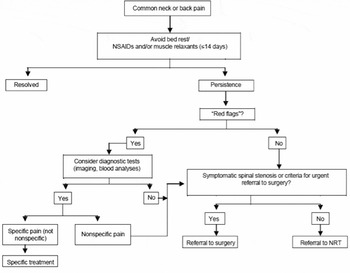
The indication criteria for referral for NRT were (Reference Kovacs, Abraira, Lopez-Abente and Pozo10–Reference Campillo and Kovacs18) as follows: neck (NP), thoracic (TP), or low back (LBP) pain not caused by systemic diseases, direct trauma or fracture; pain severity ≥3 points on a 10-point visual analog scale (VAS) (Reference Huskisson21); and pain lasting ≥14 days despite medication or other treatment. Referral was not considered for patients allergic to metal, those with neurogenic claudication caused by lumbar spinal stenosis, or those showing criteria for urgent referral for surgery, such as signs suggesting cauda equina syndrome (e.g., progressive motor weakness in the legs, sphincter disturbance, saddle anesthesia, or sensory level) (Supplementary Figure 1, which can be viewed online at http://dx.doi.org/10.1017/S0266462314000063) (Reference Waddell1;Reference Airaksinen, Brox and Cedraschi8–Reference Kovacs, Seco, Royuela, Corcoll and Abraria19). Patients with failed back surgery could be referred for NRT, as well as those with “red flags” for systemic diseases in whom the appropriate tests had established that pain was not caused by fractures or systemic diseases (Reference Waddell1).
Intervention
The procedure followed for implementing NRT referral has been previously described in detail (Reference Grupo14;Reference Corcoll, Orfila, Tobajas and Alegre15). Specialized NRT Units were certified in each region, following pre-established standards (22). Each NRT Unit had its own team of certified physicians (23), who had been in full-time NRT practice for between 3 and 23 years. Thirty-minute sessions were organized in the primary care centers in each region, in which the indication criteria for NRT, the corresponding referral protocol (Supplementary Figure 1), and the evidence supporting it were discussed (Reference Grupo14–Reference Pallicer, Corcoll and Orfila16). Patients were referred by their primary care physicians. Physicians in hospital services were also authorized to refer patients for NRT, but only through the primary care physician.
Specialists at the NRT Units confirmed indication criteria, handed the patients a printed form with standardized information on the rationale and characteristics of the procedure, resolved any related query, asked the patients to sign written informed consent forms for undergoing NRT and allowing their data to be used for this study, and carried out the interventions following the pre-established application conditions (Reference Airaksinen, Brox and Cedraschi8–Reference Kovacs, Seco, Royuela, Corcoll and Abraria19;22;23). The specialists advised patients to avoid bed rest, stay as physically active as possible, and reduce drug intake and resume a normal life should pain evolution allow them to do so. They did not implement any other educational measures.
The surgical material implanted was removed approximately 12 weeks after the intervention was performed, or earlier if needed (e.g., skin infection resistant to topical treatment). When the material was removed, adverse events were recorded and indication criteria for performing NRT re-intervention were assessed. Re-intervention was defined as repeating NRT intervention for treating the same pain episode before discharging the patient. Criteria for re-intervention are (Reference Kovacs, Llobera and Abraira12;Reference Corcoll, Orfila, Tobajas and Alegre15): having improved ≥2 VAS points after the previous intervention, pain severity ≥3 VAS points, absence of relevant adverse events, and patient's written consent. Patients not meeting all of these criteria were discharged. NRT re-interventions could be repeated until indication criteria disappeared (e.g., pain below 3 VAS points) or until the procedure failed to further improve pain or disability (Reference Kovacs, Llobera and Abraira12;Reference Corcoll, Orfila, Tobajas and Alegre15). At discharge, specialists advised patients to keep as physically active as possible, including exercise or sport when appropriate.
A pain episode was defined as the time elapsing between the patient seeking care, and discharge following NRT. After being discharged, patients could be referred again if a relapse complying with indication criteria occurred (“new episode”). The difference between a “re-intervention” and a “new episode” is whether the patient had been discharged after the previous NRT intervention.
Referral protocol to neuroreflexotherapy (NRT), within the Spanish National Health Service.

Outcome Assessment
Outcomes were (Reference Deyo, Battie and Beurskens24) pain, disability, adverse events, use of SNHS resources for the current episode, and patient satisfaction. Data were recorded using a registry based on standardized post-implementation surveillance mechanisms (Reference Grupo14–Reference Kovacs, Seco, Royuela, Corcoll and Abraria19).
Patients used previously validated instruments to score pain and disability. Separate 10-cm visual analogue scales (VASs) were used for spinal pain (NP, TP, or LBP) and referred pain (RP) (Reference Huskisson21). The Spanish validated version of the Roland-Morris Questionnaire (RMQ) was used to score LBP-related disability (Reference Kovacs, Llobera and Gil Del Real25). The Neck Disability Index (NDI) was used to assess NP-related disability in patients treated after its Spanish version was validated, in April 2008 (Reference Kovacs, Bago and Royuela26). Value ranges (from best to worst) are 0–10 for VAS, 0–24 for RMQ, and 0–100 for NDI (Reference Huskisson21;Reference Kovacs, Llobera and Gil Del Real25;Reference Kovacs, Bago and Royuela26).
At the analysis phase, the variations in the scores at referral and at discharge were calculated for spinal pain, referred pain, and disability. Because value ranges are different for the NDI and the RMQ, a standardized score for disability was calculated, ranging from 0 to 100 (from better to worse). For NP-related disability, this score corresponded to the NDI score. For LBP-related disability, it corresponded to the percentage of the maximum possible RMQ score.
Two different sets of criteria were used to define “improvement” in SP, RP, and disability. According to the first one, “improvement” was defined as a lower score at discharge than at baseline. The second definition focused on clinically relevant improvements, and only considered reductions in scores which were larger than the minimal clinically important change (MCIC) as “improvement.” MCIC has been established at 30 percent of the baseline value, with a minimum value of 1.5 VAS points for SP and RP, 7 NDI points for NP-related disability, and 2.5 RMQ points for LBP-related disability (Reference Kovacs, Abraira and Royuela27–Reference Pool, Ostelo, Hoving, Bouter and de Vet29). These definitions made it impossible for patients with a baseline score below the cutoff point for a given variable, to show a clinically relevant improvement for that variable. Therefore, these patients were excluded from the analysis on that variable.
“New episode” was defined as referring for NRT a patient who had previously undergone the procedure and had already been discharged. At the analysis phase, the number of patients who suffered from new episodes at the previously treated level (e.g., a new LBP episode in a patient who had been discharged after undergoing NRT for LBP) or at a different one (e.g., a LBP episode in a patient previously discharged after undergoing NRT for NP), was recorded separately.
Use of SNHS resources for the current episode, comprised: number of diagnostic procedures undergone (X-rays, magnetic resonance [MRI] scanner, electromyography [EMG], other), dosage of drugs taken (analgesics, NSAIDs, steroids, muscle relaxants, codeine, other [opioids, other]), number of sessions of physiotherapy/rehabilitation, and spine surgery for the current episode (yes/no). Only resources used within the SNHS were registered (e.g., data on diagnostic procedures potentially performed in private health care were not gathered).
Adverse events detected by patients, primary care physicians, and NRT specialists were recorded.
Patient satisfaction was measured through (a) the number of complaints received through the NRT Unit, primary care centers, or the Health Services; and (b) a standardized questionnaire containing nine questions (Reference Grupo14–Reference Pallicer, Corcoll and Orfila16). Questions addressed patients’ perception of how they were treated (when making their appointment, by auxiliary personnel, and by the physician), operational features (waiting time at the NRT Unit, and comfort and cleanliness of the facility), amount of information on NRT received before undergoing the procedure, physician's ability to manage their problem, physician's skill when performing NRT, overall satisfaction with the care received, and whether they would recommend referral for NRT to a relative with a similar problem. All responses were ordered “best to worst” and offered five possible answers, except those on physician's ability to manage their problem (two possible answers) and the one on recommending referral for NRT (three).
PROCEDURE
According to the Spanish law, this study did not need to be submitted to an Institutional Review Board.
The clinical condition of each patient upon referral for NRT was assessed by the referring primary care physician, who gathered data on duration of pain (days since the first episode and for the current episode, separately); reason for referral (NP, thoracic pain, or LBP); existence of referred pain (yes/no); history of spine surgery; diagnosis of failed surgery syndrome; pain caused by symptomatic disc protrusion or herniation (defined as referred pain being more intense than spinal pain and following a distribution which corresponded to the root compressed by a disc protrusion/herniation on MRI); pain caused by symptomatic lumbar spinal stenosis (defined as referred pain corresponding to the root/s compressed by lumbar spinal stenosis on MRI) (yes/no), “common” or “unspecific” syndrome (defined as no clinical signs of nerve compression on physical examination or MRI); established concomitant diagnosis of fibromyalgia; other comorbidities; diagnostic tests performed within the SNHS (X-rays, MRI scanner, EMG, other, e.g., scintigraphy or discography); imaging findings (“disc degeneration,” “facet joint degeneration,” “scoliosis,” “difference in leg length,” “spondylolisis,” “spondylolisthesis,” “spinal stenosis,” “disc protrusion,” “disc herniation,” “other findings,” or “no findings,” according to radiologists’ reports, either from SNHS or private practices); treatments provided by the SNHS for the current episode (drugs: analgesics, NSAIDs, steroids, muscle relaxants, codeine, other opioids, other drugs; physiotherapy/rehabilitation; surgery); and date of referral to the NRT Unit.
Patients provided data on gender, age (date of birth), whether they were pregnant, employment status (“not qualifying for receiving financial assistance for NP, BP, or LBP,” e.g., housewife, student, or retired; “receiving financial assistance for NP, TP, or LBP,” e.g., sick leave or workers’ compensation benefits; or “working”), involvement in NP, TP, or LBP-related employment claims (e.g., requesting disability pension), and involvement in NP-, TP-, or LBP-related litigation (e.g., traffic accident). From May 2009 onward, they were also requested to provide data on their academic level (less than elementary school, elementary school, high school, university).
The severity of spinal pain (SP), RP, and disability were assessed on each visit to the primary care centers or the specialized NRT Units, and follow-up assessment was scheduled 12 weeks after performing the NRT intervention. All diagnostic and therapeutic procedures undergone after NRT were recorded throughout that period.
At the NRT units, patients asked to complete the questionnaire on satisfaction anonymously and alone. Once they had completed it, patients could deposit the questionnaire in boxes installed in places where it was impossible for the staff to see them, hand it in at their primary care center, or send it by post (for free).
Analysis
Analysis was conducted by a team of biostatisticians working for the SNHS, who had no contact with patients or clinicians (A.R., V.A.). They calculated the absolute and relative frequencies for categorical values. Values for continuous variables were described using their median and percentiles 25 and 75.
To assess which variables were associated with higher odds of undergoing more than one NRT intervention for the same pain episode (i.e., “NRT re-intervention”), a multivariate logistic regression model was developed. Because it was assumed that successive episodes affecting a single patient could be non-independent events, only data from the first pain episode were introduced into the model, and the unit of analysis was the patient (not the pain episode). Re-intervention (yes/no) was the dependent variable, and the maximal model included all the variables which, at the design phase of this study, were considered to potentially be associated with a higher risk for NRT re-intervention: gender, age (in years), baseline score for SP (VAS points), baseline score for RP (VAS points), baseline score for disability (standardized disability score), reason for referral (NP or LBP), time elapsed since the first pain episode (less than 1 year, 1 to < 5 years, 5 to <10 years, ≥10 years), duration of the current episode (“subacute” [14 to 89 days], “chronic” [90 to 364 days], “extremely chronic” [≥ 365 days]) (Reference Corcoll, Orfila, Tobajas and Alegre15;Reference Kovacs, Abraira and Muriel17;Reference Kovacs, Seco, Royuela, Corcoll and Abraria19;Reference Kovacs, Abraira, Zamora and Fernández30;Reference Merskey and Bogduk31), employment status (“not qualifying for receiving financial assistance for NP, BP, or LBP,” “receiving financial assistance for NP or LBP,” or “working”), type of pain (“radicular pain caused by symptomatic disc protrusion/herniation or lumbar spinal stenosis” versus “common NP or LBP”), diagnosis of fibromyalgia, other comorbidities, involvement in employment claims, involvement in litigation, diagnostic tests undertaken before NRT (X-rays, MRI, EMG, other), imaging findings (disc degeneration, facet joint degeneration, scoliosis, spondylolisis, spondylolisthesis, spinal stenosis, disc protrusion/herniation, unspecific syndrome, other findings, no findings), history of spine surgery, failed back syndrome and treatments before referral for NRT (drugs: analgesics, NSAIDs, steroids, muscle relaxants, opioids, and other [physiotherapy/rehabilitation]). Patients were excluded from the model if one or more data on these variables were missing. Patients who underwent NRT for thoracic pain were also excluded from the model, because no instruments for assessing disability derived from thoracic pain have been validated in Spanish. An automatic backward strategy was followed, using the value p > .05 to eliminate variables from the model.
To assess the accuracy of the final model, both their discrimination and calibration were evaluated. Discrimination was assessed with the area under the ROC curve (AUC), whereas the Hosmer-Lemeshow test was used to assess calibration. Stata v12.0 software was used for statistical analysis.
RESULTS
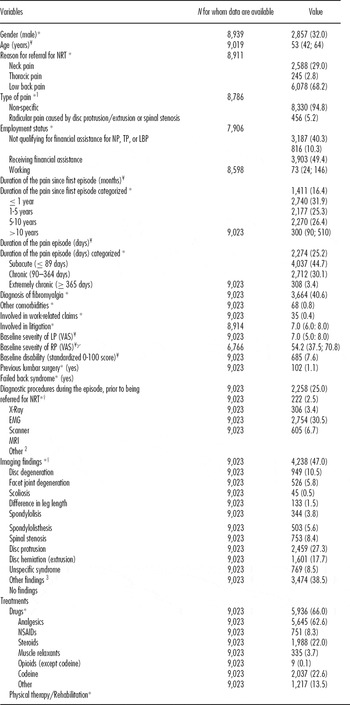
All SNHS patients referred for NRT who complied with indication criteria signed their informed consents. All 9,023 patients who had received NRT and were discharged before June 30, 2012, were included in this study, with no losses to follow-up. Missing data among those provided by the physicians, ranged between 0 percent (for most variables) and 4.7 percent (for “duration of pain since the first episode”). Missing data among those provided by the patients, ranged between 0.4 percent (for “age”) and 25 percent (for “baseline disability”) (Table 1).
Main Patient Characteristics (n = 9,023)

Note. *Frequency (%); ¥Median (P25; P75); ɣBaseline severity of referred pain (RP) among the 6,737 patients who presented RP at baseline. †Diagnostic procedures include only those performed within the Spanish National Health Service. Imaging findings include those described in all the radiologists´ reports (produced in the SNHS and private practice)
LP, Severity of local pain; RP, Severity of referred pain; VAS, Visual Analogue Scale.
1. “Type of pain: “Radicular pain caused by disc protrusion/extrusion or spinal stenosis” if; a) Severity of referred pain ≥ local pain, b) corresponding imaging finding on MRI, c) distribution of pain consistent with the nerve root compressed by the corresponding imaging finding. “Non-specific pain,” if one or more of these criteria were not met.
2. Other diagnostic procedures: scintigraphy, discography, and other.
3. Other imaging findings: annular tear, loss of cervical lordosis, loss of thoracic kiphosis, loss of lumbar lordosis, horizontalization of the sacrum, lumbarization of S1, sacralization of L5.
Patients’ median age was 53 years, and most were women (68 percent), who were referred for chronic (75 percent) low back pain (68 percent). Table 1 shows the main patients’ characteristics, while Supplementary Table 1, which can be viewed online at http://dx.doi.org/10.1017/S0266462314000063, shows the rest.
During the 8-year period, these patients were treated for 11,384 pain episodes. Among the patients who suffered from new episodes, most were referred for NRT twice (1,400) or three times (498) (Supplementary Table 1). Among these, 2,361 new episodes, 1,324 occurred at the same level which had been previously treated, while 1,037 occurred at a different one.
Only 2,154 (18.9 percent) of the 11,384 pain episodes which were treated required more than one NRT intervention (a “NRT re-intervention”) before discharge (Supplementary Table 1).
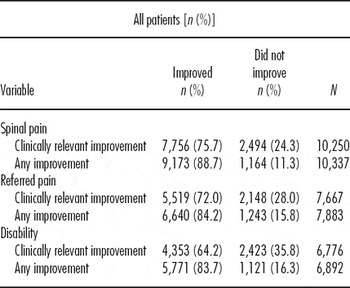
The median (P25;P75) time elapsed between NRT procedure and follow-up assessment was 107 (91;156) days. At follow-up assessment, approximately 89 percent of patients experienced improvement in spinal pain, 84 percent in referred pain, and 84 percent in disability; clinically relevant improvements in these variables were reported by 76 percent, 72 percent, and 64 percent of patients, respectively (Table 2). Results obtained by physicians from different geographical regions were very similar (Supplementary Table 2, which can be viewed online at http://dx.doi.org/10.1017/S0266462314000063).
Patients’ Evolution after NRT

Note. The total number of episodes is 11,384 (in 9,023 patients). Follow-up was planned at 90 days, but the median (P25,P75) duration was actually 106 (91;156) days. Data on “any improvement” are restricted to those patients who provided data on the corresponding variable at baseline and at discharge (e.g., patients who did not score the severity of referred pain at both points in time could not be included). Only patients who reported referred pain were taken into account when calculating the evolution of this variable. Data on “clinically relevant improvement” are restricted to patients who had baseline scores which made it possible to show such an improvement (i.e., baseline scores above the cut-off point for a clinically relevant improvement), 1.5 VAS points for spinal or referred pain, 2.5 RMQ points for LBP-related disability, or 7 NDI-points for NP-related disability.
Only skin-related adverse events were reported, and none required systemic treatment. The most common adverse event was transient skin discomfort, which was reported by 721 (8.0 percent) patients. Adverse events led to early extraction of the surgical material in 307 patients (3.4 percent). Clinical results were worse among these patients (Supplementary Table 3, which can be viewed online at http://dx.doi.org/10.1017/S0266462314000063).
Over 83 percent of patients using drugs at baseline had abandoned them at discharge (Supplementary Table 4, which can be viewed online at http://dx.doi.org/10.1017/S0266462314000063). The number of patients using each type of drug, rehabilitation, and physical therapy sharply decreased after undergoing NRT, as did the number of patients who underwent diagnostic tests. After NRT, only 2 (0.02 percent) patients had to undergo spinal surgery for the condition for which they had been referred for NRT (Supplementary Table 4).
The number of patient complaints was 0, and the questionnaire on patients’ satisfaction was answered by 6,923 patients (76.7 percent). Responses suggest a high degree of satisfaction (Supplementary Table 5, which can be viewed online at http://dx.doi.org/10.1017/S0266462314000063).
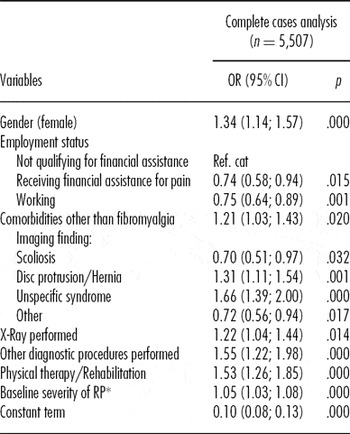
The logistic regression model included data from the 5,507 who met inclusion criteria (not having been referred for NRT for thoracic pain and not having any missing data). Variables associated with a higher risk of having to undergo NRT re-intervention were: being female; not qualifying for receiving financial assistance for NP, BP, or LBP (vs. working or receiving financial assistance for pain); suffering from comorbidities other than fibromyalgia; having undergone X-rays, EMG, or scanner; showing a disc protrusion or hernia on MRI; showing no findings on MRI; having been previously treated for the same pain episode with rehabilitation or physical therapy; and reporting a more severe referred pain at baseline. Conversely, showing scoliosis or “other” radiological findings (e.g., horizontalization of the sacrum, sacralization of L5, lumbarization of S1, or rectification of the lumbar spine) was associated with a lower risk of NRT re-intervention (Table 3). The AUC value was 0.636 (95 percent confidence interval, 0.615–0.654), and the p value in the Hosmer-Lemeshow goodness-of-fit test was 0.129 (Supplementary Table 6, which can be viewed online at http://dx.doi.org/10.1017/S0266462314000063).
Results of the Logistic Regression Model: Variables Associated with a Higher Risk of NRT Re-intervention*

RP = Severity of referred pain measured using a visual analogue scale (range from better to worse; 0–10). Variables introduced in the model were: age; gender; employment status; type of pain; reason for referral for NRT; time elapsed since the first pain episode; duration of the current episode; diagnosis of fibromyalgia; other comorbidities; involvement in employment claims; involvement in litigation; baseline score for LP, RP, and disability; diagnostic tests undertaken: X-Rays, MRI, EMG, and other imaging findings; previous lumbar surgery; treatments used before referral for NRT. The p value in the Hosmer-Lemeshow goodness-of-fit test was .129
DISCUSSION
Results from this study show that, in the current application conditions (Reference Grupo14–Reference Pallicer, Corcoll and Orfila16;22;23), using NRT within the SNHS for treating subacute and chronic NP, TP, and LBP, leads to results that are positive in terms of patients’ clinical evolution, reduction in the use of other health resources, and patient satisfaction. These results are consistent with existing RCTs (Reference Kovacs, Abraira, Lopez-Abente and Pozo10–Reference Urrutia, Burton, Morral, Bonfill and Zanoli13), systematic reviews (Reference Chou and Huffman9;Reference Urrutia, Burton, Morral, Bonfill and Zanoli13), studies in routine practice (Reference Grupo14–Reference Kovacs, Seco, Royuela, Corcoll and Abraria19), and reviews supporting major evidence-based clinical practice guidelines (Reference Airaksinen, Brox and Cedraschi8;Reference Chou and Huffman9).
Results were worse among the 3.4 percent of patients in whom the surgical material implanted during the NRT interventions had to be extracted earlier than planned (Supplementary Table 3). This may be interpreted as suggesting that shorter permanence of this material leads to a smaller clinical effect, and/or that patients experiencing less or no improvement are less likely to tolerate discomfort deriving from its presence in the skin.
According to the results of this study (Table 3), the likelihood of requiring more than one NRT intervention to resolve a pain episode is greater among patients who could be seen as the “worst” cases (those with comorbidities, pain caused by symptomatic disc protrusion or hernia, and more intense referred pain) and among those who have undergone more diagnostic procedures before referral for NRT (e.g., X-rays, scanner, MRI), probably because previous treatments (drugs, physical therapy, and rehabilitation) had failed. The likelihood is also higher among those not qualifying for receiving financial assistance for NP, BP, or LBP, which might be associated with fewer incentives to get back to normal activity. Results from this model make it possible to calculate the risk of requiring more than one NRT procedure for each individual patient, which is valuable for shared decision making (Table 3).
The SNHS is a public organization which provides health care for free, although copayment is applied to drugs. Only a minority of patients (usually in the upper economic class) seek care exclusively through private health care, but patients who are covered by both the SNHS and a private insurance, may use the latter to undergo diagnostic procedures (and, especially, MRIs) prescribed in the SNHS, since waiting time in private practice is seven times shorter than in the SNHS (Reference Kovacs, Arana and Royuela32). Because this study focused on the use of NRT within the SNHS, it only gathered data on use of resources suggesting costs to the Service (i.e., drugs prescribed by physicians working for it, and treatment or diagnostic procedures performed within it). However, all imaging findings were recorded (including those that appeared on MRIs performed in private practice). Data on use of health resources should also be interpreted taking into account that resources used “before NRT” include treatments or diagnostic procedures undergone since the pain episode appeared (median duration [P25;P75]: 300 [90;510] days), while resources used “after NRT” cover the follow-up period (106 [91;156] days) (Supplementary Table 4).
NRT is indicated for treating an ongoing pain episode, and not for preventing relapse (Reference Airaksinen, Brox and Cedraschi8–Reference Kovacs, Seco, Royuela, Corcoll and Abraria19). However, data deriving from post-implementation surveillance during 8 years can be informative on its potential long-term effect. The main concern would be that, despite being effective for treating a single pain episode, it might increase the risk of relapse. This does not appear to be the case. The current study could only identify patients who, after being discharged from NRT, experienced new episodes that met the indication criteria for NRT referral (i.e., pain ≥3 VAS points lasting ≥14 days). Potential mild, self-limited, short episodes would have remained undetected. It is also possible that patients experiencing relapses, which comply with indication criteria for NRT, decided to not consider NRT because they or their physicians were unsatisfied with their previous experience. However, this is not likely because clinical outcome of the first episode was positive (Table 1), side effects were rare and mild, and studies which systematically analyzed satisfaction have found it to be high among referring physicians and patients (Reference Grupo14;Reference Corcoll, Orfila, Tobajas and Alegre15), 96 percent of whom would recommend NRT to a relative with the same condition (Supplementary Table 5). In fact, refusal or reluctance to re-referral were not observed in the studies in which patients were closely monitored (Reference Kovacs, Llobera and Abraira12;Reference Grupo14;Reference Campillo and Kovacs18). Advice to keep as physically active as possible at discharge may have contributed to decreasing the risk of a new episode, but this is standard practice (Reference Airaksinen, Brox and Cedraschi8;Reference Chou and Huffman9), while the number of relapses among these patients was much lower than expected. Among the general population, the annual prevalence estimates for NP range from 12.1 percent to 71.5 percent, with estimates of point prevalence between 30 percent and 50 percent (Reference Manchikanti, Singh, Datta, Cohen and Hirsch33), and the corresponding figures for LBP are 15 percent to 45 percent, with a point prevalence of 30 percent (Reference Waddell1;Reference Andersson and Frymoyer2;Reference Kovacs, Arana and Royuela32). Among acute LBP patients, 54 percent experience at least one recurrence within 6 months after discharge, and 47 percent at least an additional one in the subsequent 18 months (Reference Mehling, Gopisetty and Bartmess34). Therefore, the prevalence among those undergoing NRT should be higher, because the most important factor predicting the appearance of pain episodes is a history of pain (Reference Waddell1;Reference Andersson and Frymoyer2;Reference Manchikanti, Singh, Datta, Cohen and Hirsch33;Reference Stanton, Henschke and Maher35;Reference Kovacs, García, Royuela, González and Abraira36), and this was the case for all patients included in this study. However, during an 8-year period, the proportion of patients referred due to a relapse at the same level, ranged between 6.5 percent (for TP) and 16.4 percent (for NP) (Supplementary Table 1). This suggests that NRT does not increase the risk of experiencing clinically relevant relapses and, in fact, might lower it. Future studies should explore this.
Previous studies with the appropriate design have already assessed the efficacy, effectiveness, and cost-effectiveness of NRT (Reference Kovacs, Abraira, Lopez-Abente and Pozo10–Reference Urrutia, Burton, Morral, Bonfill and Zanoli13). Therefore, the objective of this study was to assess data from post-implementation surveillance in routine practice, and its design might overestimate the size of the clinical effect triggered by the procedure. This study did not include a “control group,” making it impossible to quantify the extent to which natural history, unspecific effects, or treatments other than NRT account for patient evolution. However, the natural history of subacute and especially chronic pain is not positive (Reference Kovacs, Abraira, Lopez-Abente and Pozo10;Reference Kovacs, Abraira and Pozo11;Reference Kovacs, Seco, Royuela, Corcoll and Abraria19;Reference Hayden, Dunn, van der Windt and Shaw37–Reference Verkerk, Luijsterburg and Heymans41). NRT is considered only after conservative treatments have failed for ≥ 14 days, and they had failed for ≥ 3 months among 75 percent of the patients included in this study (and for ≥ 1 year among 30 percent) (Table 1). Previous studies suggest that these treatments do not have a significant influence on patient evolution after NRT (Reference Kovacs, Abraira and Pozo11;Reference Kovacs, Seco, Royuela, Corcoll and Abraria19). Moreover, their use sharply decreased after the procedure was performed (Supplementary Table 4), which does not suggest that they played a major role in subsequent improvement. Unspecific effects may have influenced results, but they appear to be mild and short-lived among Spanish chronic patients (Reference Kovacs, Abraira, Lopez-Abente and Pozo10;Reference Kovacs, Abraira and Pozo11;Reference Urrutia, Burton, Morral, Bonfill and Zanoli13), and the size of the effect observed after NRT in this study is consistent with results from previous double-blind RCTs (Reference Kovacs, Abraira, Lopez-Abente and Pozo10;Reference Kovacs, Abraira and Pozo11). Pain and disability were assessed using self-reported measures. However, these measures have previously shown to be valid and reliable (Reference Huskisson21;Reference Kovacs, Llobera and Gil Del Real25;Reference Kovacs, Bago and Royuela26). No data on psychological variables which may influence patient clinical evolution, such as fear avoidance beliefs or catastrophizing, were gathered in this study. However, these variables have shown to have an either irrelevant or non-existent influence among Spanish patients (Reference Albadalejo, Kovacs and Royuela42–Reference Kovacs, Seco, Royuela, Corcoll and Peña47). Follow-up after NRT was scheduled at only 3 months. However, mechanisms for post-implementation surveillance for this technology have been designed for that period (Reference Grupo14;Reference Corcoll, Orfila, Tobajas and Alegre15), because within the SNHS losses to follow-up dramatically increase afterward (Reference Albadalejo, Kovacs and Royuela42;Reference Kovacs, Fernandez, Cordero, Muriel and González-Luján48), and this period was considered adequate to assess the evolution of a pain episode, since the prognosis of patients (even chronic) has shown to be determined by changes in pain and disability occurring during this period (Reference Heymans, van Buuren and Knol49). Although there were no losses to follow-up, there was a 25 percent missing data for disability (Table 1). However, the evolution of disability was consistent with the evolution of pain severity and use of other health resources, for which missing data were 0–1.2 percent (Table 1) (Supplementary Table 4). Therefore, although the open design of this study may overestimate the effect of NRT, this does not challenge the general sense of results.
In fact, results from this study suggest that, in routine practice, application costs of NRT are likely to be lower, and the savings greater, than in the RCT in which it showed to be cost-effective (Reference Kovacs, Llobera and Abraira12). NRT application costs are higher for patients requiring more than one NRT intervention before discharge. In this study, this was the case for 18.9 percent of the episodes (Supplementary Table 1), while this figure was 44 percent in the RCT in which NRT showed to be cost-effective, probably because most patients included in that RCT were chronic (Reference Kovacs, Llobera and Abraira12), whereas in this study conducted in routine practice 25.2 percent were subacute (Table 1). Therefore, future studies should further explore the cost-effectiveness of NRT in routine practice.
Subacute patients represent only 25.2 percent of those referred for the procedure, while 30.1 percent are referred only after having been in pain for over 1 year (Table 1). This suggests that some primary care physicians may refer patients for NRT only as a “last resort.” Spending cuts may have also incentivized Public Health Services to prioritize “internal” management of patients over referral to “external” institutions. Nevertheless, few other treatments have shown a clinical size effect comparable to the one associated with NRT (Reference Airaksinen, Brox and Cedraschi8;Reference Chou and Huffman9;Reference Kovacs, Seco, Royuela, Corcoll and Abraria19), and none have shown cost-effectiveness within the SNHS (Reference Kovacs, Llobera and Abraira12;Reference Pallicer, Corcoll and Orfila16). Moreover, previous studies have shown that shorter pain duration is associated with a higher probability of improvement after NRT (Reference Kovacs, Abraira and Muriel17), the use of health resources declines sharply following NRT (Supplementary Table 4) (Reference Kovacs, Llobera and Abraira12;Reference Kovacs, Seco, Royuela, Corcoll and Abraria19), and potential savings for subacute patients are higher than for chronic ones. Therefore, measures to increase referral at the subacute phase may improve effectiveness and cost-effectiveness of the procedure and should be implemented, as previously suggested (Reference Kovacs, Abraira and Muriel17).
In countries where NRT is not available, the reported proportion of NP, TP, or LBP patients with pain lasting over 12 weeks who show meaningful improvements within 3 months, is usually within the 30–40 percent range (Reference Mehling, Gopisetty and Bartmess34;Reference Hayden, Dunn, van der Windt and Shaw37;Reference Itz, Geurts, van Kleef and Nelemans38;Reference Scheele, Luijsterburg, Bierma-Zeinstra and Koes40;Reference Verkerk, Luijsterburg and Heymans41), with longer pain duration being associated with a worse prognosis (Reference Waddell1;Reference Kovacs, Seco, Royuela, Corcoll and Abraria19;Reference Mehling, Gopisetty and Bartmess34;Reference Hayden, Dunn, van der Windt and Shaw37;Reference Itz, Geurts, van Kleef and Nelemans38;Reference Scheele, Luijsterburg, Bierma-Zeinstra and Koes40;Reference Verkerk, Luijsterburg and Heymans41). According to the evidence review supporting the current U.S. clinical guideline, NRT is the only non-pharmacological treatment which leads to a “substantial” positive effect in chronic patients with nonspecific LBP (Reference Chou and Huffman9). In fact, patients who have undergone NRT within the SNHS had had pain for a median (P25;P75) duration of 300 (90;510) days (Table 1), but a clinically relevant improvement in pain after the procedure was noticed in over 70 percent of these patients (Table 2). Organizational differences in health care across health systems may also account for these differences in outcome. However, the clinical course of low back pain patients treated in the routine practice of the SNHS where NRT is not available (or when it was not available), is similar to the one observed in the countries where the procedure is not available (Reference Kovacs, Fernandez, Cordero, Muriel and González-Luján48). In fact, NRT is the only procedure used in the SNHS which, in clinical practice, has shown to improve recovery rates at 3 months (Reference Kovacs, Llobera and Abraira12;Reference Kovacs, Seco, Royuela, Corcoll and Abraria19). The 0.02 percent rate of spinal surgery among (subacute and mainly chronic) patients treated with NRT (Supplementary Table 4), also contrasts with the data on surgery in Spain before NRT was implemented (50); in 2002, 10,739 operations for low back pain were performed only in Orthopedic Surgery Departments belonging to the SNHS across nine of the seventeen Spanish regions with a total population of 23 million, without counting the procedures performed in Neurosurgery Departments (and private practice). This further suggests that, as previous studies have shown (Reference Kovacs, Abraira, Lopez-Abente and Pozo10–Reference Urrutia, Burton, Morral, Bonfill and Zanoli13;Reference Corcoll, Orfila, Tobajas and Alegre15;Reference Pallicer, Corcoll and Orfila16;Reference Campillo and Kovacs18;Reference Kovacs, Seco, Royuela, Corcoll and Abraria19), rolling out NRT across the SNHS is likely to be associated with meaningful improvements in effectiveness, safety, and cost-effectiveness.
In fact, within the SNHS, NRT is the only treatment for NP, TP, or LBP which (a) has followed a thorough assessment and implementation process (Reference Kovacs, Abraira, Lopez-Abente and Pozo10–Reference Kovacs, Seco, Royuela, Corcoll and Abraria19;Reference Carragee, Deyo and Kovacs51;52); (b) has been implemented following validated application conditions (Reference Urrutia, Burton, Morral, Bonfill and Zanoli13–Reference Kovacs, Seco, Royuela, Corcoll and Abraria19;22;23); (c) has been subjected to post-implementation surveillance (Reference Grupo14–20); and (d) has shown that it increases the effectiveness of usual treatment (Reference Kovacs, Llobera and Abraira12), is cost-effective (Reference Kovacs, Llobera and Abraira12;Reference Pallicer, Corcoll and Orfila16;Reference Campillo and Kovacs18), leads to results which are consistent with those from previous RCTs and similar across geographical settings (Table 2 and Supplementary Table 3) (Reference Kovacs, Abraira, Lopez-Abente and Pozo10–Reference Kovacs, Seco, Royuela, Corcoll and Abraria19), reduces the use of health resources (Reference Kovacs, Llobera and Abraira12;Reference Pallicer, Corcoll and Orfila16;Reference Campillo and Kovacs18) (Supplementary Table 4) while leading to high satisfaction among physicians and patients (Supplementary Table 5) (Reference Kovacs, Llobera and Abraira12;Reference Grupo14–Reference Pallicer, Corcoll and Orfila16;Reference Campillo and Kovacs18), and is associated with a better mid-term prognosis (Reference Campillo and Kovacs18). Moreover, its use is supported by major systematic reviews and evidence-based clinical guidelines (Reference Airaksinen, Brox and Cedraschi8;Reference Chou and Huffman9;Reference Urrutia, Burton, Morral, Bonfill and Zanoli13). All this supports the generalization of this procedure across the SNHS under the current standardized application conditions (Reference Urrutia, Burton, Morral, Bonfill and Zanoli13–Reference Pallicer, Corcoll and Orfila16;22;23).
Nevertheless, although the first double-blind, RCT on NRT was published in 1993 (Reference Kovacs, Abraira, Lopez-Abente and Pozo10), the procedure was not implemented in routine practice until 2004 (Reference Corcoll, Orfila, Tobajas and Alegre15), and 9 years later, it has only been rolled out to five of the seventeen regions of the SNHS. Some of the reasons which are likely to account for this delay are the dysfunctions which have already been reported concerning the regulation for assessment, appraisal, adoption, and coverage decisions affecting new health technologies in the SNHS (52;Reference Serrano-Aguilar, Kovacs, Cabrera-Hernández, Ramos-Goñi and García-Pérez53), and the fact that the research on this procedure has been funded by a non-profit research Foundation and the SNHS, without involvement from for-profit entities (Reference Kovacs, Abraira, Lopez-Abente and Pozo10–Reference Kovacs, Seco, Royuela, Corcoll and Abraria19). Hence, contrarily to what happens with other technologies within the spine field (Reference Serrano-Aguilar, Kovacs, Cabrera-Hernández, Ramos-Goñi and García-Pérez53–Reference Kmietowicz60); in this case, there are no economically motivated groups lobbying, promoting fast-tracking, or by-passing of the assessment phase, pressing for overuse in routine practice, incentivizing off-label use, or hindering proper post-marketing surveillance.
In conclusion, this study (a) shows that results from NRT in routine practice are consistent with positive results from previous studies, (b) makes it possible to calculate the risk of requiring more than one NRT procedure for each patient, and (c) suggests that it is unlikely that NRT increases the risk of relapse.
The main policy implications which emanate from this study are (a) systematic post-implementation surveillance for a non-pharmacological technology in routine practice within a National Health Service, is feasible; (b) current application conditions and training standards for NRT are valid and make it advisable and feasible to roll out its use across the entire SNHS.
SUPPLEMENTARY MATERIAL
All supplementary materials can be viewed at: http://dx.doi.org/10.1017/S0266462314000063
CONTACT INFORMATION
Carlos Campillo, MD, MPH, PhD (fmkovacs@kovacs.org) Ib-Salut, C/ Reina Esclaramunda, 9. 07003 Palma de Mallorca, Spain
Montserrat Casamitjana, MD, Regió Sanitària de Barcelona. Consorci Sanitari de Barcelona. Servei Català de la Salut (CatSalut). Parc Sanitari Pere Virgili - Edifici Mestral - Esteve Terradas, 30 4ta planta. 08023 Barcelona
Fernando Carrillo-Arias, MD, Director Gerente, Área 4 de Atención Primaria, Servicio Madrileño de Salud (SERMAS), Consejería de Sanidad de Madrid, C/ Doctor Cirajas, 20, 28017 Madrid. Present address: Director Gerente del Hospital Carlos III. Consejería de Sanidad de Madrid. C/ Sinesio Delgado, 10. 28029, Madrid
Ana Royuela, MSc, CIBER Epidemiología y Salud Pública (CIBERESP), Spain; Unidad de Bioestadística Clínica, Hospital Ramón y Cajal, IRICYS, Carretera de Colmenar Viejo, km 9,100. 28034 Madrid. Spain; Spanish Back Pain Research Network
Francisco M. Kovacs, MD, PhD, Director, Spanish Back Pain Research Network; Scientific Department, Kovacs Foundation, Paseo de Mallorca 36, 3°, 1a, 07012 Palma de Mallorca, Spain
Víctor Abraira, PhD, CIBER Epidemiología y Salud Pública (CIBERESP), Spain, Unidad de Bioestadística Clínica, Hospital Ramón y Cajal, IRICYS, Carretera de Colmenar Viejo, km 9,100. 28034 Madrid, Spain, Spanish Back Pain Research Network
CONFLICTS OF INTEREST
Dr. Kovacs reports XX “I have been involved in previous studies on Neuro-reflexotherapy, including randomized controlled trials and studies in routine practice. I chair the Kovacs Foundation, a non for profit research institution which is responsible for 90.5% of the investment in research on neck and back pain in Spain. This Foundation has funded previous studies on neuroreflexotherapy and uses this technology in clinical practice. The income generated from patient care covers healthcare and funds medical research, continuous education for clinicians, and health education programs for patients and the general public. My personal income is not affected by any of these activities or by results from the current study.” The other authors have nothing to disclose.