Introduction
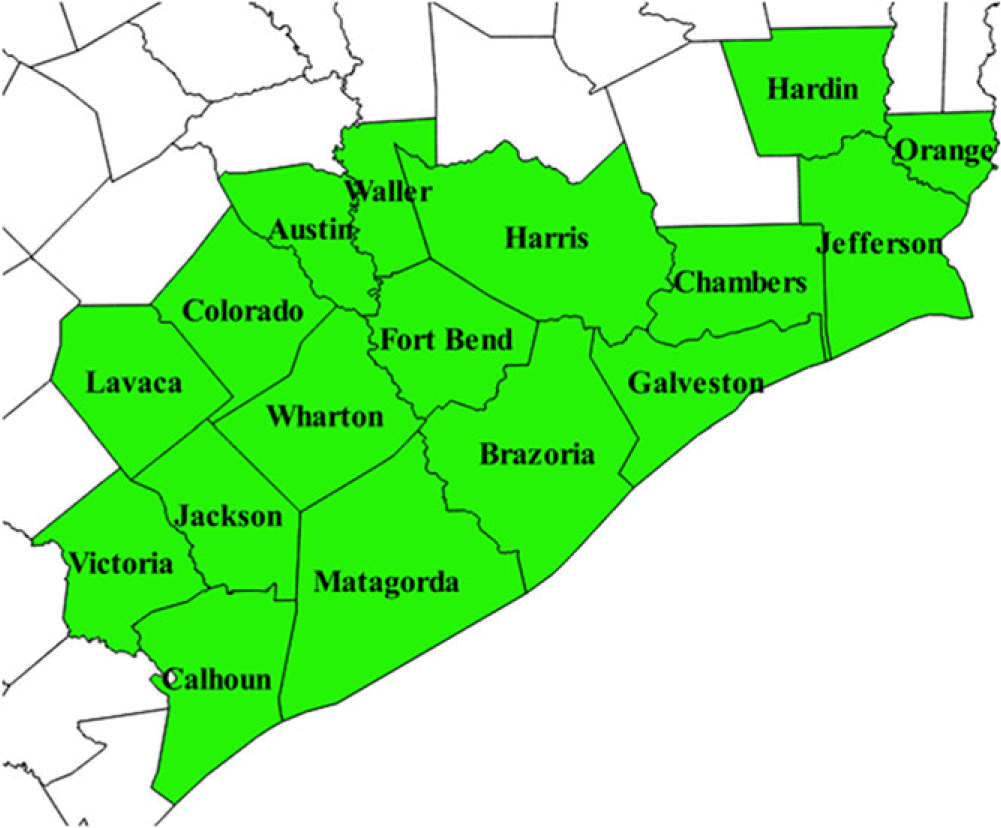
Rice is the staple food for more than half the world’s population (Rao et al. Reference Rao, Johnson, Sivaprasad, Ladha and Mortimer2007). In 2019, the United States produced 5.9 million metric tons of milled rice, which was 1.2% of the global rice production (USDA-FAS 2020). Rice in the United States is mainly grown in five southern states (Arkansas, Louisiana, Mississippi, Missouri, and Texas) and the Sacramento Valley of California (USDA-NASS 2020). Rice production in the United States is highly mechanized, and the vast majority of rice in the southern United States is direct-seeded (i.e., seeded dry, with delayed flooding at about the five- to six-leaf seedling stage) (Hill et al. Reference Hill, Bayer, Bocchi and Clampett1991). Texas is the fifth largest rice-producing state, with 63,536 ha planted and 560,248 metric tons harvested in 2019 (USDA-NASS 2020). In Texas, rice is predominantly grown in two major regions: the Western Rice Belt (areas west of Harris county) and the Eastern Rice Belt (areas east of Harris county) (Figure 1).
Historical rice-growing counties in Texas. The highlighted counties west of Harris County represent the Western Rice Belt and the ones in the east are considered part of the Eastern Rice Belt region.

Problematic weeds known to occur commonly in Texas rice include jungle rice, weedy rice, Leptochloa spp., and Cyperus spp. (D. Bradshaw, personal communication). Jungle rice is highly adapted to rice-growing conditions and is a major weed in rice production worldwide (Holm et al. Reference Holm, Plucknett, Pancho and Herberger1977). This weed is very difficult to control at early stages because it can mimic the rice crop. Weedy rice is an important concern in rice because of the morphological, physiological, and genetic similarities between the two species. Herbicide-resistant Clearfield® rice cultivars, which are resistant to imidazolinone herbicides, allow for selective control of weedy rice in rice, but transfer of resistance from Clearfield® rice to weedy rice through gene flow has limited the use of the Clearfield® rice technology in recent years (Shivrain et al. Reference Shivrain, Burgos, Anders, Rajguru, Moore and Sales2007; Singh et al. Reference Singh, Singh, Black, Boyett, Basu, Gealy, Gbur, Pereira, Scott, Caicedo and Burgos2017). Apart from the two weed species, a mix of Leptochloa spp. and Cyperus spp. has been commonly observed across rice fields in Texas. However, to our knowledge, no systematic investigations have been carried out in rice production systems in Texas to document the nature and extent of current weed issues and research needs.
Statewide stakeholder surveys are useful for gathering information about current weed management practices, monitoring changes to dominant weed species and control practices, and determining research and outreach needs (Webster and Coble Reference Webster and Coble1997). For example, Shaw et al. (Reference Shaw, Givens, Farno, Gerard, Jordan, Johnson, Weller, Young, Wilson and Owen2009) conducted a grower survey in four midwestern and two southern states that was instrumental in gathering information on crop rotation and weed control practices, as well as assessing concerns regarding herbicide resistance. Likewise, routine weed-management surveys conducted in rice, cotton, and soybean production systems in the midsouthern United States have been invaluable for researchers and Cooperative Extension Service (CES) personnel (Norsworthy et al. Reference Norsworthy, Bond and Scott2013; Riar et al. Reference Riar, Norsworthy, Steckel, Stephenson, Eubank and Scott2013; Schwartz-Lazaro et al. Reference Schwartz-Lazaro, Norsworthy, Steckel, Stephenson, Bish, Bradley and Bond2018). These surveys are typically carried out using paper-based questionnaires distributed to stakeholders through surface mails and/or during field days and other events. Online surveys have also been considered wherever feasible (Regnier et al. Reference Regnier, Harrison, Loux, Holloman, Venkatesh, Diekmann, Taylor, Ford, Stoltenberg, Hartzler and Davis2016). These stakeholders include, but are not limited to, growers, crop consultants, industry representatives, agrochemical dealers/distributors, CES agents, and university CES scientists. Some surveys target a specific group of stakeholders—for example, crop consultants (Riar et al. Reference Riar, Norsworthy, Steckel, Stephenson, Eubank and Scott2013).
To obtain robust information regarding important weed species (both common and problematic) infesting specific production systems, the stakeholder surveys can be combined with actual field surveys (Gibson et al. Reference Gibson, Johnson and Hillger2006; Loux and Berry Reference Loux and Berry1991; Norsworthy Reference Norsworthy2003). Although field surveys can reveal common weed escapes, stakeholder surveys typically indicate difficult-to-control weeds. Field surveys are often carried out during late season, before crop harvest, to document weed escapes (Johnson et al. Reference Johnson, Barnes, Gibson and Weller2004; Leeson et al. Reference Leeson, Thomas and Sheard2005). Late-season escapes are weeds that survived previous control measures implemented during the growing season and the weeds that are recruited and established after all control measures have been implemented. Late-season weed escapes contribute to seedbank replenishment, leading to more weed issues in future years (Bagavathiannan and Norsworthy Reference Bagavathiannan and Norsworthy2012). Late-season surveys for weed escapes have been invaluable in understanding weed shifts and problematic weeds. A survey conducted in Indiana soybean revealed the occurrence of late-season escapes of giant ragweed (Ambrosia trifida L.), giant foxtail (Setaria faberi Herrm.), horseweed [Conyza canadensis (L.) Cronquist], and other weed species in approximately 97% of the surveyed fields (Johnson et al. Reference Johnson, Barnes, Gibson and Weller2004). Likewise, field surveys conducted across the Prairie Provinces in western Canada revealed the widespread occurrence of late-season weed escapes in many fields (Leeson et al. Reference Leeson, Thomas and Sheard2005).
Thus, late-season field surveys are useful for understanding emerging weed issues, and combining such knowledge with stakeholder surveys reveals valuable information about current weed issues and research needs. Nevertheless, to our knowledge, such information has never been collected in rice production in Texas through organized surveys. The objectives of this research were to (1) identify common and problematic weeds infesting rice fields in Texas, (2) understand current weed management practices, and (3) prioritize research and educational needs for effective weed management in rice production in Texas.
Materials and Methods
Field Survey
Late-season field surveys were conducted from July to August in 2015 and 2016 across the rice-growing regions in Texas, known as the Texas Rice Belt (Figure 1). The survey locations were selected by observing the presence of levees (indicating rice fields) on a Google® map across the historical rice-growing counties in Texas, using ITN Converter (ITNConv) software (version 1.87; Benichou Software; http://www.benichou-software.com). ITNConv is a route planner and a converter that supports many itinerary file formats. The survey sites were randomly selected in the software without prior knowledge of the fields, following a semistratified survey methodology (Bagavathiannan and Norsworthy Reference Bagavathiannan and Norsworthy2016). The waypoints were converted to an itinerary file (.ITN file type) and loaded into a global positioning system (GPS) device (TomTom International, Amsterdam, the Netherlands) for easy navigation to the predetermined survey sites. If a rice field was not present or no weed escapes were observed at a predetermined site, then the first rice field with weed escapes along the travel route to the next predetermined site was surveyed. In each surveyed field, the percent infestation of each prominent weed species was documented and seed samples were harvested from mature inflorescences for herbicide-resistance evaluations. The GPS coordinates of each survey field were also documented.
Stakeholder Survey
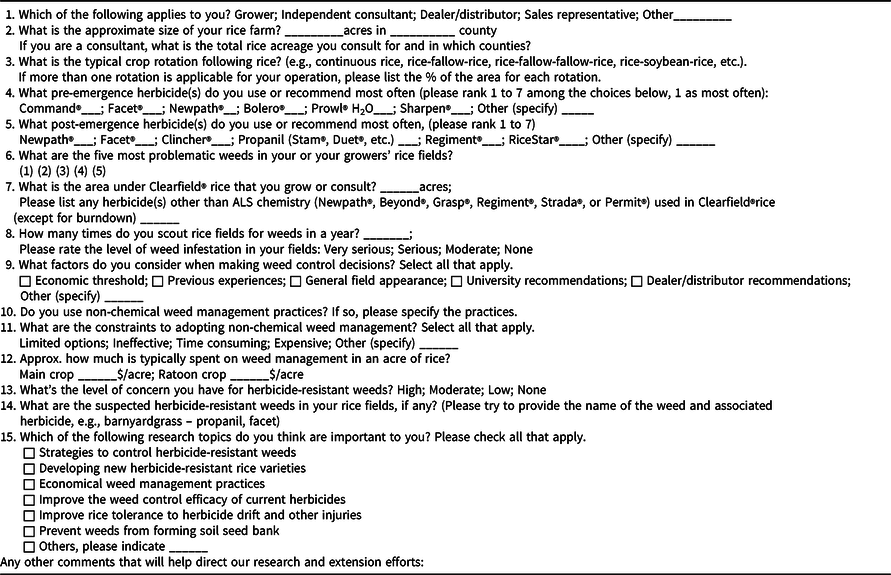
A one-page survey questionnaire was designed (Table 1) to collect weed management information from a broad range of stakeholders involved in rice production in Texas; institutional review board approval (IRB) was received to use the survey (Texas A&M IRB approval no.: IRB2017-0195). Stakeholders included rice growers, consultants, dealers and distributors, sales representatives, and other clientele. Survey questionnaires were distributed to the stakeholders at the Western Rice Belt conference (January 2017) and field days at Eagle Lake, TX (June 2015, 2016), and Beaumont, TX (July 2015, 2016). Completed surveys were collected at the end of the events or through the mail.
Stakeholder questionnaire used to assess weed management in Texas rice production.

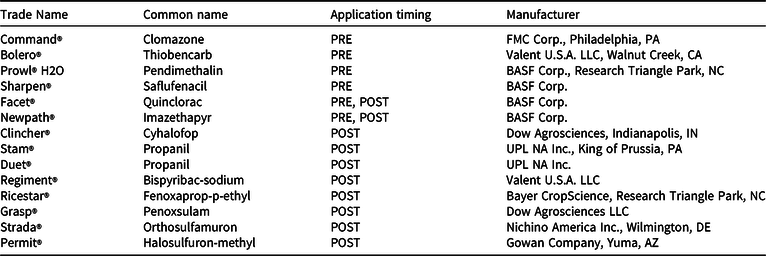
The questionnaire comprised 15 questions related to several aspects of rice production and weed management in Texas. The preliminary questions were related to background information such as the role of the respondent, the location and size of the rice farms they oversee, and the crop rotation used. The respondents were asked to rank the PRE and POST herbicide options most often used or recommended (e.g., if the respondents were crop consultants, dealer/distributors, and so forth) by them from a list of seven PRE options (clomazone [Command®], quinclorac [Facet®], imazethapyr [Newpath®], thiobencarb [Bolero®], pendimethalin [Prowl®], saflufenacil [Sharpen®], or other) and seven POST options (imazethapyr [Newpath®], quinclorac [Facet®], cyhalofop [Clincher®], propanil [Stam® or Duet®], bispyribac-sodium [Regiment®], fenoxaprop [Ricestar® HT], or other) (Table 2). Any herbicide option that was not provided in the list but was used or recommended by the respondent was indicated in the “other” option. Frequency of use for each herbicide, reported as a percentage, was calculated on the basis of the total number of times a herbicide was chosen among all respondents who answered this question.
Details of the herbicides included in the questionnaire survey.

For questions related to problematic weed species, stakeholders were asked to list each species from the most problematic to the least problematic. Points were given on a scale of 1 to 5, where 1 indicated least problematic and 5 indicated most problematic. Total points were calculated for each species for all respondents and then ranked. Information was collected about the acreage of Clearfield® rice managed by the respondent and the use of herbicides other than the imidazolinone herbicides within the Clearfield® rice system. Also, data were obtained on the number of times field scouting was carried out in a year and the level of weed infestation in the field (four levels: very serious, serious, moderate, and none). Respondents were asked to select the factors influencing weed control decisions, including economic threshold, previous experiences, general field appearance, recommendations by the university, and dealer/distributor recommendations. For this question, respondents could choose more than one factor and also specify factors not included in the list.
Questions were asked about nonchemical weed management practices implemented and challenges encountered. Questions also were asked about the level of concern the respondents had for herbicide-resistant weeds, along with details of any suspected herbicide-resistant weed species occurring in their fields. Finally, the respondents were asked to select research topics important to them. These included improved strategies to control herbicide-resistant weeds, developing new herbicide-resistant rice cultivars, economical weed management practices, improving the efficacy of current herbicides, reducing rice injury from herbicides, and weed seedbank management. The respondents also had the option of indicating research topics that were not listed in the questionnaire and were encouraged to provide any additional suggestions that would help direct future research and CES efforts.
Data Analysis
Answers obtained for the survey questionnaire were analyzed on the basis of frequency distribution (Gibson et al. Reference Gibson, Johnson and Hillger2006). Means and standard errors of the mean for frequency distribution were calculated using JMP Pro, version 13 (SAS Institute, Cary, NC). Ranking was assigned to the treatment means on the basis of the total points received for each response (Norsworthy et al. Reference Norsworthy, Smith, Scott and Gbur2007b). The frequency of occurrence and average field infestation (reported as a percentage) for each weed species were calculated using Equations 1 and 2:
 $${\rm{Frequency}}\;{\rm{of}}\;{\rm{occurrence = }}{{{\rm{No}}.{\rm{of}}\;{\rm{fields}}\;{\rm{where}}\;{\rm{the}}\;{\rm{species}}\;{\rm{was}}\;{\rm{present}}} \over {{\rm{Total}}\;{\rm{no}}.{\rm{of}}\;{\rm{fields}}\;{\rm{sampled}}}} \times {\rm{100}}$$
 $${\rm{Average}}\;{\rm{field}}\;{\rm{infestation}}\;(\% ) = {{{\rm{Sum}}\;{\rm{of}}\;\% \;{\rm{area}}\;{\rm{infested}}\;{\rm{by}}\;{\rm{the}}\;{\rm{species}}\;{\rm{in}}\;{\rm{each}}\;{\rm{field}}} \over {{\rm{No}}.\;{\rm{of}}\;{\rm{fields}}\;{\rm{where}}\;{\rm{the}}\;{\rm{species}}\;{\rm{was}}\;{\rm{recorded}}}}$$
In addition, spatial maps were developed using ArcGIS, version 10.5 (Esri, Redlands, CA) to illustrate spatial distribution of prominent weed species across rice production fields in Texas. Two different analyses were performed in ArcGIS. For jungle rice and a combination of all weed species, the extent of weed infestation within each field (i.e., the percent area infested) was illustrated using the interpolation analysis technique based on inverse distance weight (IDW) in ArcGIS. The IDW interpolation determines cell values using a linearly weighted combination of a set of sample points. For weedy rice, the frequency of occurrence among the surveyed fields was shown using kernel density analysis in ArcGIS; weedy rice was only present in few fields and the data points were not sufficient to calculate IDW.
Results and Discussion
Field Survey
Weed escapes were documented during the late-season field surveys. These do not necessarily represent problematic weeds; they comprised weeds that escaped control measures implemented in the growing season. Commonly occurring weeds may not necessarily be viewed as problematic by the stakeholders if control is not difficult. Conversely, weeds that may not be widespread yet are difficult to control are usually considered problematic by the stakeholders.
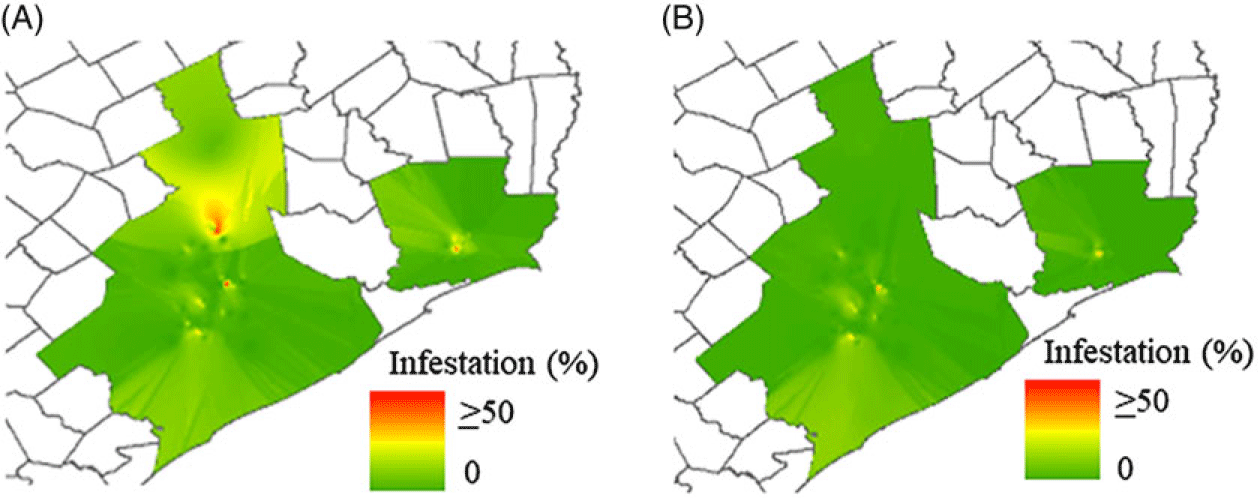
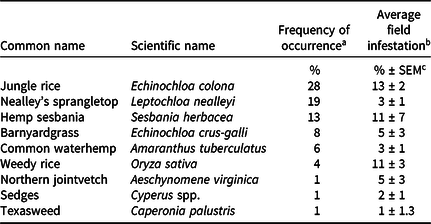
The level of late-season weed infestation prior to rice harvest across the Texas Rice Belt is shown in Figure 2A. Jungle rice, Nealley’s sprangletop, and hemp sesbania were the top three weed species that escaped field-management practices, occurring in 28%, 19%, and 13% of the survey fields, respectively (Table 3). Farmers sometimes refer to jungle rice as “redtop,” because of the reddish purple color of its panicles that are distinctly notable from a distance. Jungle rice had the highest infestation (13% average infestation within a rice field) among all the weed species documented in the late-season field surveys (Table 3). In some fields, jungle rice infestations reached as much as 25% of the entire field area (Figure 2B). The survey also revealed that jungle rice was the most prominent species of Echinochloa in Texas rice; only 8% of the fields had barnyardgrass [E. crus-galli (L.) P. Beauv.] infestation, compared with 28% for jungle rice, with an average infestation level of 5% (Table 3).
ArcGIS maps, based on inverse distance weight, showing late-season field infestation of (A) all weed escapes; and (B) jungle rice. The color gradients represent the percent area of infestation of late-season escapes within a rice field.

Frequency of occurrence and average field distribution of different weed species documented during late-season surveys in rice fields in Texas.

a Percentage of the surveyed fields where the species was present.
b Percent area infested by the species within a rice field, where the species was present.
c Abbreviation: SEM, standard error of the mean.
Nealley’s sprangletop (referred to by farmers as “tighthead”) is a fairly new species to rice production in Texas and Louisiana. It is typically found on roadsides but has moved into rice fields in recent years (Bergeron et al. Reference Bergeron, Webster, McKnight and Rustom2015). Though Nealley’s sprangletop was documented frequently in rice fields (19% of fields), average within-field infestations were low (3%) (Table 3). Hemp sesbania had the second highest field infestation level (approximately 11%) (Table 3). The current field survey did not exclude organic rice fields, wherein hemp sesbania is a difficult-to-control species with high infestation densities (Brian Wiese, personal communication), which could have influenced our results. Hemp sesbania is a leguminous weed with a woody stem and can grow up to 3 m tall at maturity (Lorenzi and Jeffery Reference Lorenzi and Jeffery1987). High competitiveness and shading are the reasons hemp sesbania causes significant crop yield losses (King and Purcell Reference King and Purcell1997).
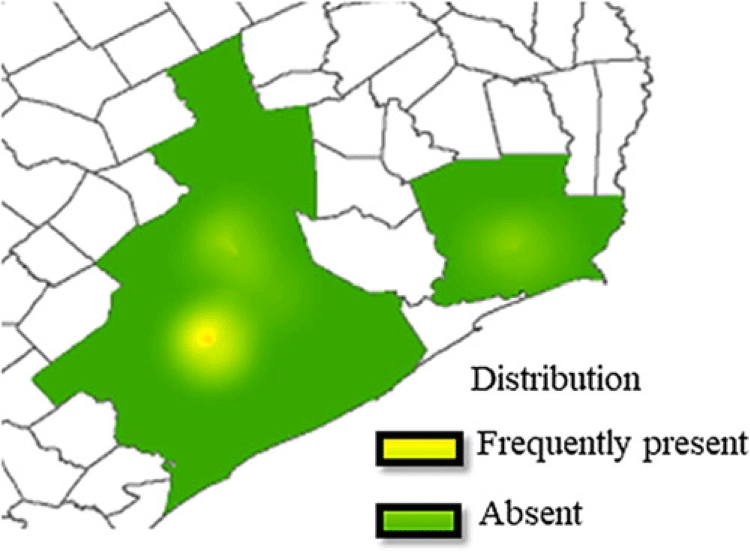
Weedy rice was found in approximately 4% of the surveyed fields (Table 3; Figure 3), with average field infestations at 11%. The weedy rice ecotypes noted during the field surveys were usually tall, growing above the canopy of rice. It was also observed that weedy rice matured later than cultivated rice in some fields (data not shown). Other dominant weed species documented during the late-season field surveys included common waterhemp [Amaranthus tuberculatus (Moq.) J.D. Sauer; present mostly in levees], Texasweed [or sacatrapo; Caperonia palustris (L.) St.-Hil], northern jointvetch [Aeschynomene virginica (L.) Britton, Sterns & Poggenb.], and Cyperus spp. (Table 3). In general, late-season weed escapes were greater in the Western Rice Belt, particularly in Wharton and Colorado counties, compared with the Eastern Rice Belt region.
ArcGIS map, based on kernel density analysis, showing late-season field distribution of weedy rice escapes in rice fields in Texas. The color gradients represent the frequency of weedy rice occurrence in the rice fields in a given area, ranging from green, indicating absent; to red indicating every field in the area.

Weed escapes typically result from inadequate control from management operations conducted during the cropping season. For herbicides, factors such as poor spray coverage, inadequate rate, delayed application timing, lack of an adjuvant, wrong combination of tank-mix herbicides, and unsuitable environmental conditions, among others, can cause a reduction in efficacy and lead to weed escapes (Hartzler and Battles Reference Hartzler and Battles2001; Jordan Reference Jordan1997). Weed escapes or poor weed control can also be attributed to herbicide resistance in those populations.
Stakeholder Survey Responses
Of the 300 survey questionnaires distributed, 108 were returned with usable information, resulting in a 36% response rate. Rice growers (71% of the respondents) and consultants (6%) composed most of the respondents. Colorado and Wharton counties had 26% and 25% of the total respondents, respectively. Colorado, Wharton, and Matagorda counties are the top three rice-producing counties in Texas, constituting 60% of the total rice produced in the state (Pack Reference Pack2017).
Crop rotation
Rice–fallow–rice was the most common rotation practice (55% of fields), followed by rice–fallow–fallow–rice (20%), rice–soybean–rice (12%), and continuous rice (9%). Other rotation practices accounted for the rest (approximately 4%) of the fields, including rice–rice–fallow, rice–corn, rice–grain sorghum, and rice–crawfish–rice. Crop rotation is considered an important weed management practice in rice-based systems (Malik Reference Malik, Burgos and Talbert2010). Unlike the midsouthern United States, where soybean [Glycine max (L.) Merr.] is the most common rotation with rice (Norsworthy et al. Reference Norsworthy, Bond and Scott2013), fallowing is very common in Texas. Poor soil drainage and a lack of economically attractive crop options are the drivers for fallowing after rice in such lands. The fallowed lands are typically used for animal grazing, often for two consecutive years, and then returned to rice in the third year. Research shows that it takes approximately 2 yr to establish a satisfactory pasture following rice (Bray Reference Bray1939). Animal grazing can be an effective nonchemical tool for weed management in the rotational years, because grazing negatively affects the persistence of problematic weeds, including herbicide-resistant biotypes. Moreover, the use of herbicides is completely eliminated in the fallow years, thus there is a general reduction in selection pressure for herbicide-resistance evolution. Soybean is often rotated with rice in lands with sufficient drainage. Approximately 9% of the fields in this study were under continuous rice production. Rice monoculture is preferred by some farmers because of the benefits of specialized production and improved production efficiency. However, monoculture has serious negative consequences for pest control due to a lack of biological and management diversity; moreover, long-term submergence also reduces soil nitrogen supply (Norman et al. Reference Norman, Wilson, Slaton, Smith and Dilday2003).
Weed issues
Stakeholders were asked to rank the top five most problematic weeds they dealt with. Considering difficulty in distinguishing closely related species by stakeholders, some answers were grouped together and presented. For example, both jungle rice and barnyardgrass were referred to as “barnyardgrass” (Echinochloa spp.). Others included Leptochloa spp., Cyperus spp., Amaranthus spp., Commelina spp., and Digitaria spp.
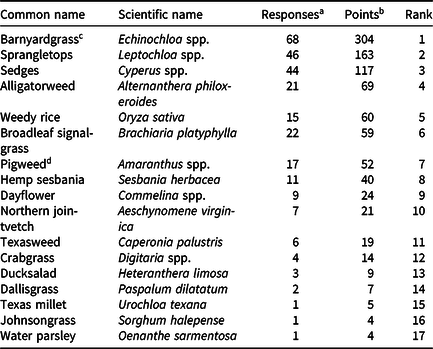
Barnyardgrass (24% of the respondents) and Leptochloa spp. (16% of respondents) were ranked by stakeholders as the top two most problematic rice weeds. Both species appeared frequently among the top five most problematic weed species identified by each respondent and were ranked the top two based on the weighted score (Table 4). The commonly occurring Leptochloa species in rice production in Texas include Nealley’s sprangletop and Amazon sprangletop [L. panicoides (J. Presl) Hitchc.], also known as “loosehead.” Cyperus spp. were ranked as the third most problematic weed group by the stakeholders. Some common Cyperus spp. infesting Texas rice fields include yellow nutsedge (C. esculentus L.), purple nutsedge (C. rotundus L.), rice flatsedge (C. iria L.), and smallflower umbrella sedge (C. difformis L.). Weedy rice and broadleaf signalgrass [Urochloa platyphylla (Munro ex C. Wright) R.D. Webster] were ranked as the fifth and sixth most problematic weed species, respectively.
Ranking of the most problematic weeds in Texas rice by stakeholders.

a Number of responses out of the 108 questionnaires returned.
b Points were calculated by assigning values of 5, 4, 3, 2, and 1 to, respectively, the first, second, third, fourth, and fifth most problematic weed specified by each respondent and then summing all values.
c Jungle rice was the primary species named, but the respondents generally combined jungle rice and barnyardgrass.
d The specific pigweed species occurring in the Texas rice belt is common waterhemp.
Alligatorweed [Alternanthera philoxeroides (Mart.) Griseb.] and Amaranthus spp. were the most problematic broadleaf weeds, ranking fourth and seventh, respectively, among all weed species listed by the stakeholders (Table 4). Alligatorweed is a fast-growing invasive species found in many aquatic environments. It can double its biomass in approximately 50 d (Brown and Spencer Reference Brown and Spencer1973). Alligatorweed is one of the most troublesome rice weeds in Louisiana and Texas (Webster Reference Webster2001), and herbicide options for control are limited (Willingham et al. Reference Willingham, Bagavathiannan, Carson, Cogdill, McCauley and Chandler2015). The predominantly occurring Amaranthus species in the rice production areas of Texas is common waterhemp. It can be a serious issue in rice fields prior to flooding (approximately 6 wk after planting) but continues to flourish on the levees, field edges, and shallow spots. Hemp sesbania and Commelina spp. were ranked eighth and ninth, respectively. Benghal dayflower (C. benghalensis L.) and spreading dayflower (C. diffusa Burm. f.) are also common in this region.
In total, 17 weed species were mentioned by the stakeholders in the lists of their top five most problematic weed species. The list of top 10 weeds included four grass weeds, five broadleaf weeds, and sedges. Twenty-two percent of the respondents reported very serious weed infestation in their fields. Thirty-three percent rated the level of weed infestation as “serious,” and the rest rated it as “moderate.” For the question about the frequency of field scouting, the responses ranged from daily scouting to three or four times per cropping season. However, scouting on a “weekly basis” was the most common answer.
Weed management options
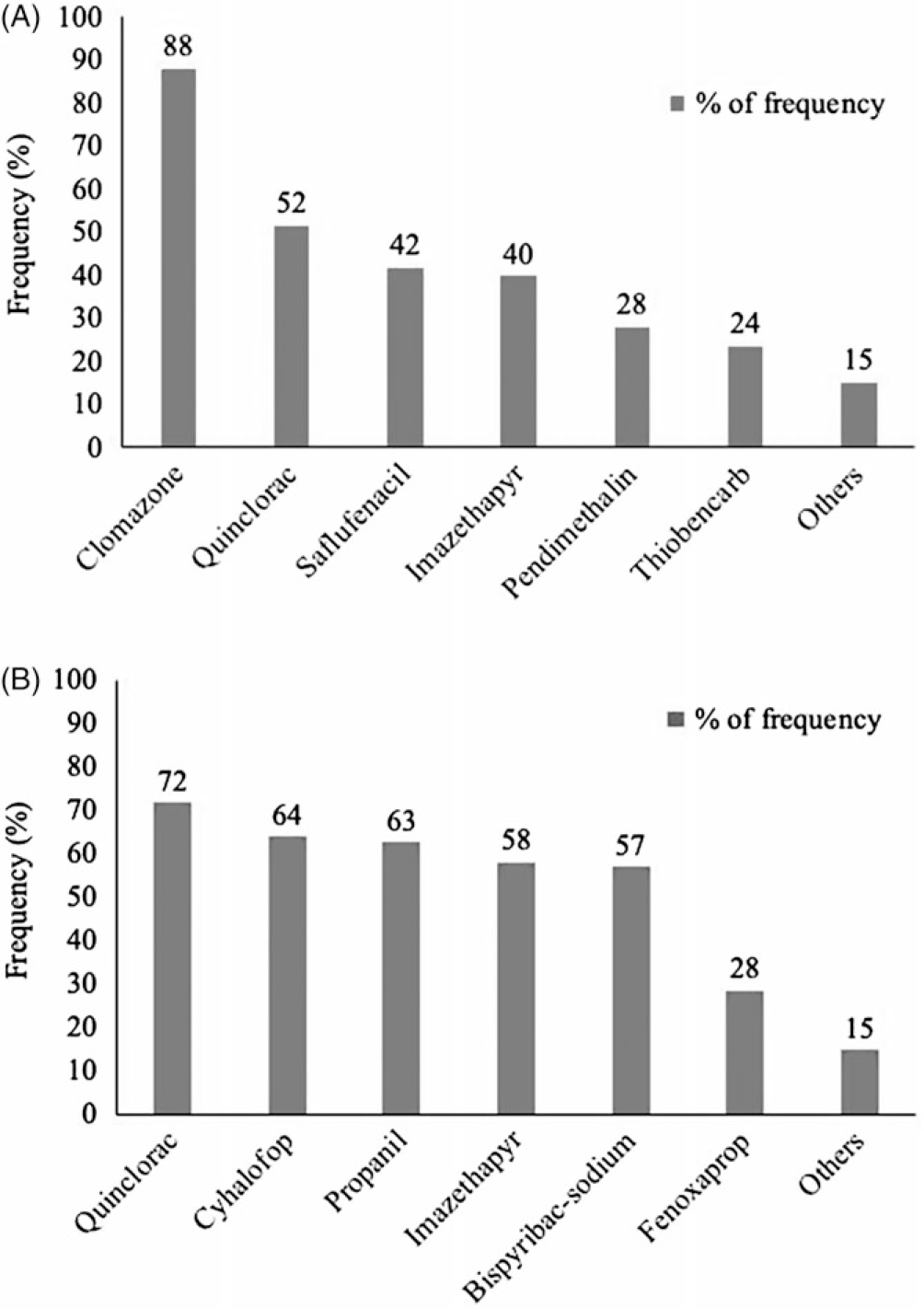
The frequency of use of the listed PRE and POST herbicides was calculated on the basis of the total number of times each herbicide was chosen by respondents (Figure 4). Clomazone (Weed Science Society of America [WSSA] Group 13) was the most popular PRE herbicide; it was used or recommended by 88% of the respondents (Figure 4A). Clomazone was also the most often recommended PRE herbicide in rice production in Arkansas and Mississippi (Norsworthy et al. Reference Norsworthy, Burgos, Scott and Smith2007a, 2013). Clomazone was introduced to U.S. rice production in the 1990s to control annual grasses such as barnyardgrass, broadleaf signalgrass, and Leptochloa spp. It can also suppress some broadleaf weeds, including northern jointvetch and hemp sesbania. The microencapsulated formulation of clomazone was developed and introduced in 1995. This formulation enabled clomazone use on the soil surface, because of its low volatility and limited off-target movement (Bollich et al. Reference Bollich, Jordan, Walker and Burns2000). Clomazone is usually applied PRE, but it can also be tank mixed with POST herbicides to provide extended weed control (Zhang et al. Reference Zhang, Webster and Blouin2005).
The frequency (%) of use of (A) PRE herbicides, including clomazone, quinclorac, saflufenacil, imazethapyr, pendimethalin, thiobencarb, among others; and (B) POST herbicides, including quinclorac, cyhalofop, propanil, imazethapyr, bispyribac-sodium, fenoxaprop, among others. For example, PRE clomazone was used or recommended by 88% of the respondents.

Quinclorac (WSSA Group 4) was the second most popular PRE herbicide, with 52% frequency (Figure 4A). These findings are consistent with reports in Arkansas rice production, where quinclorac was the second most often recommended or used PRE herbicide by 40% of the consultants (Norsworthy et al. Reference Norsworthy, Burgos, Scott and Smith2007a). The mechanism of action of quinclorac is not clear, but it acts in a manner similar to synthetic auxins (Shaner Reference Shaner2014). Quinclorac provides control of annual grasses (e.g., barnyardgrass, jungle rice, and large crabgrass [Digitaria sanguinalis (L.) Scop.]) and certain broadleaf weeds (e.g., eclipta [Eclipta prostrata (L.) L.], northern jointvetch, and hemp sesbania]. It can also control perennial broadleaf weeds such as field bindweed (Convolvulus arvensis L.) and hedge bindweed [Calystegia sepium (L.) R. Br.].
Saflufenacil (WSSA Group 14) was the third most popular PRE herbicide, with 42% frequency (Figure 4A). Saflufenacil inhibits the function of protoporphyrinogen oxidase enzyme, which catalyzes chlorophyll production (Geier et al. Reference Geier, Stahlman and Charvat2009; Grossmann et al. Reference Grossmann, Niggeweg, Christiansen, Looser and Ehrhardt2010). It is used in rice production for controlling broadleaf weeds such as hemp sesbania. Saflufenacil is often mixed with other herbicides (e.g., clomazone, imazethapyr) to improve the weed control spectrum (Camargo et al. Reference Camargo, Senseman, McCauley and Guice2011).
Pendimethalin (WSSA Group 3) was recommended by respondents with 28% frequency; it was ranked as the fifth most popular PRE herbicide. Pendimethalin inhibits seedling root growth by inhibiting the microtubule assembly during mitosis. This herbicide is often used as a delayed PRE option in rice, approximately 3 to 4 d after rice seeding for controlling grasses and some broadleaf weeds. Results of this survey have indicated that PRE herbicides are widely used in rice production in Texas, a trend that is consistent with practices in Arkansas and Mississippi rice (Norsworthy et al. Reference Norsworthy, Bond and Scott2013). PRE herbicides are the foundation for herbicide-resistance management, and their continued use is critical (Norsworthy et al. Reference Norsworthy, Burgos, Scott and Smith2007a; Norsworthy et al. Reference Norsworthy, Ward, Shaw, Llewellyn, Nichols, Webster, Bradley, Frisvold, Powles, Burgos and Witt2012).
With respect to POST herbicides, quinclorac (72% frequency), cyhalofop (64%), propanil (63%), and imazethapyr (58%) were the popular choices by the respondents (Figure 4B). Quinclorac was preferred because it also provides residual weed control. In Arkansas, quinclorac was recommended by 47% of the rice consultants as a POST herbicide option (Norsworthy et al. Reference Norsworthy, Burgos, Scott and Smith2007a). Propanil, a photosystem II inhibitor (WSSA Group 7), has been used in rice production for many years since its first introduction in 1959 (Smith and Hill Reference Smith, Hill, Grayson, Green and Copping1990). It has an excellent selectivity between rice and grass weeds (Frear and Still Reference Frear and Still1968). Rice is naturally tolerant to propanil because of the presence of aryl acylamidase, an endogenous enzyme that can hydrolyze propanil into 3, 4-dichloroaniline, a nonphytotoxic form (Baltazar and Smith Reference Baltazar and Smith1994). Propanil is still in use as an important herbicide in rice production, though its effectiveness has drastically declined due to the evolution of resistance in weeds such as barnyardgrass (Baltazar and Smith Reference Baltazar and Smith1994; Lovelace et al. Reference Lovelace, Talbert, Schmidt, Scherder and Reaper2000). Imazethapyr (WSSA Group 2) is an acetolactate synthase (ALS)-inhibiting herbicide, affecting the biosynthesis of branched-chain amino acids isoleucine, leucine, and valine. It is used in the Clearfield® rice system for controlling weedy rice and other weed species. The current use of POST herbicides in the region is significantly greater compared with their use levels 10 yr ago (Norsworthy et al. Reference Norsworthy, Bond and Scott2013). The increase in POST herbicide use is consistent with the widespread evolution of resistance in weeds such as barnyardgrass to propanil and quinclorac (Malik et al. Reference Malik, Burgos and Talbert2010).
Practice of some form of nonchemical weed control is common in rice production in Texas. Forty-seven respondents (44% of total) who answered this question indicated they adopted nonchemical weed control methods such as preplant tillage (49% of respondents), flooding (36%), stale seedbed (4%), and crop rotation (4%). The stakeholders were also asked to specify the constraints to using nonchemical weed management. Seventy-seven percent of the respondents (n = 37 of 48) felt limited availability of nonchemical options is a barrier. Respondents also noted that nonchemical options are often ineffective (63% of respondents), time consuming (58%), and/or expensive to implement (48%).
Factors influencing weed management decision-making
Of the 79 people who responded to the question about factors influencing weed management decision-making, 72% (n = 57) said they made weed control decisions on the basis of economic threshold, 63% considered weed problems from previous years, 48% based their decision on recommendations from dealers or distributors, 43% on general field appearance, 39% on university/CES agent recommendations, and approximately 10% indicated that management decisions were made on the basis of recommendations by crop consultants, agronomists, or weed management guides. The results of this survey revealed that economic threshold is the top consideration that guides weed management decision-making. When decisions are made on the basis of economic threshold, late-season weed escapes may be neglected because they do not cause direct yield loss in the current year (Bauer and Mortensen Reference Bauer and Mortensen1992). However, late-season weed escapes contribute to soil seedbank replenishment, often leading to increased management expenses in future years (Bagavathiannan and Norsworthy Reference Bagavathiannan and Norsworthy2012).
Herbicide-resistant weeds
With respect to the level of concern for herbicide-resistant weeds, 88% of the respondents (n = 77 of the 87 respondents who answered this question) expressed moderate to high concern, and the rest indicated that they had a low level of concern or no concern at all about the evolution of herbicide-resistant weeds in their fields. The high level of concern expressed by the stakeholders suggests they are already dealing with herbicide-resistant weeds in their fields or are familiar with resistant weeds in their area. Suspected herbicide-resistant weeds listed by the respondents include imazethapyr-resistant weedy rice; propanil-, quinclorac-, clomazone-, and/or imazethapyr-resistant barnyardgrass; glyphosate-resistant sprangletops; and glyphosate- and/or ALS-inhibitor resistant waterhemp.
Herbicide-resistant weeds have been prevalent in rice production in the midsouthern United States for many years. Herbicide-resistant biotypes of weedy rice and barnyardgrass were perceived to be very common in the region (Norsworthy et al. Reference Norsworthy, Bond and Scott2013). ALS-inhibitor resistance in weedy rice was documented within a few years after the commercialization of Clearfield® rice in Arkansas and has been widespread since then (Singh et al. Reference Singh, Singh, Black, Boyett, Basu, Gealy, Gbur, Pereira, Scott, Caicedo and Burgos2017). The utility of the Clearfield® rice technology has been reduced because of gene flow and transfer of herbicide resistance from Clearfield® rice to weedy rice, as well as the evolution of ALS-inhibitor resistance in other weed species (Gealy et al. Reference Gealy, Mitten and Rutger2003; Shivrain et al. Reference Shivrain, Burgos, Anders, Rajguru, Moore and Sales2007). Barnyardgrass resistance to propanil was first reported in Arkansas rice in 1990 (Carey et al. Reference Carey, Hoagland and Talbert1995). It was then reported to be resistant to quinclorcac in Louisiana rice production in 1998 (Heap Reference Heap2018). In 2007, clomazone-resistant barnyardgrass was detected in Arkansas (Norsworthy et al. Reference Norsworthy, Burgos, Scott and Smith2007a). Subsequently, ALS-inhibitor resistance has also become widespread in this species (Rouse et al. Reference Rouse, Burgos, Norsworthy, Tseng, Starkey and Scott2018). Herbicide resistance in Leptochloa spp. and waterhemp were also indicated as a concern, but characterization of field-collected samples would provide more insight into the nature of resistance and alternative control options.
Research and educational needs
The respondents were asked to indicate their perspective on research and CES needs regarding weed issues. Approximately 67% of the respondents emphasized developing new strategies to control herbicide-resistant weeds and rated it as one of the most important research needs. With the prevalence of herbicide-resistant weeds spreading in the U.S. rice production, stakeholders are aware of the importance of effective control using alternative options. Therefore, development of effective strategies to delay the evolution of herbicide-resistant weeds is in high demand. Nearly 57% of the respondents indicated new herbicide-resistant rice varieties as one of the current research needs. Currently, the Clearfield® rice technology is widely used, and the area under Provisia® rice (resistant to the acetyl coenzyme-A-carboxylase–inhibitor herbicide quizalofop-p-butyl; WSSA Group 1) is increasing (Bennett Reference Bennett2017). The latter system was developed for controlling weedy rice and other grass weeds such as barnyardgrass that have evolved resistance to ALS-inhibitor herbicides in the Clearfield® rice system. The stakeholders emphasized the need for additional herbicide-resistant traits in rice to allow for more herbicide options. Fifty-seven percent of the respondents asked for more economical weed management options. Other research areas indicated by the stakeholders include improving weed control efficacy of current herbicides (43% of respondents), improving rice tolerance to injury caused by drift and carryover effects (42%), and preventing weeds from forming a soil seed bank (31%).
Overall, there is a critical need to focus research and CES efforts on developing diverse and integrated weed management strategies that are economical and sustainable. It is also important to protect currently available herbicides through judicious use. Use of multiple-herbicide modes of action can be one of the ways to improve weed management efficacy and reduce the selection for herbicide-resistant weeds. More research and outreach are necessary in this regard.
Acknowledgments
The authors greatly appreciate the growers and crop consultants who assisted with the field surveys and the respondents who took the time to complete the questionnaires. We acknowledge Texas Rice Research Foundation for funding this study. The authors declare that no conflicts of interest exist.