On January 29, 2001, President George W. Bush established the White House Office of Faith-Based and Community Initiatives (OFBCI). This office, along with several executive orders the president signed over his tenure, reflected President Bush's promise to give greater federal support to faith-based groups working domestically and internationally.Footnote 1 Under Bush, the percentage of foreign aid going to faith-based organizations roughly doubled by 2006 (Baron et al. Reference Baron, Canellos, Kranish and Stockman2006). Moreover, between 2001 and 2005, over 98% of such funding went to Christian groups, such as Catholic Relief Services and the Evangelical charity, Samaritan's Purse. The OFBCI and partnerships with faith-based groups continued under President Barack Obama, and, in her Senate confirmation hearing, Secretary of State Hillary Clinton stressed the role of the religious community in assisting with humanitarian efforts (Clinton Reference Clinton2009). In addition to being partners in the distribution of social services, religious leaders often lobby politicians for certain aid programs, as Evangelical leaders did with President Bush regarding HIV/AIDS relief to Africa (Stevenson Reference Stevenson2002; Fletcher Reference Fletcher2006).
Both politicians and religious leaders appeal to religious ideas and partner with religious groups when advocating for and distributing aid. We know less, however, about how the public's preferences regarding aid are shaped by religion. These public preferences are important because there is broad agreement that public support plays a significant role in sustained aid allocations (Milner and Tingley Reference Milner and Tingley2013a). In order to understand the patterns of aid allocation and flows, previous research highlights the different motivations for giving, focusing primarily on recipient need or donor interest. While recipient need is typically measured as a gross domestic product (GDP) per capita, donor interests can vary across time periods, across donor countries, or across types of aid (Maizels and Nissanke Reference Maizels and Nissanke1984). Rarely, however, do studies of public opinion on aid explicitly examine how religion shapes people's preference for aid.
This paper examines the relationship between religion and foreign aid preferences in the United States. I use a conjoint survey that randomizes the attributes of potential recipient countries in order to explore the impact of country-level characteristics on the microfoundations of foreign aid support in the United States. I demonstrate that religion acts as an important determinant of the public's foreign aid preferences. Specifically, I find that this effect of religion can in part be explained by religion's use as a heuristic device. The effect, however, is moderated by respondents’ religious identity, suggesting that the effect is also driven by denominational differences between respondents. In addition to exploring how religion may impact the real-world pattern of aid allocations, this paper uses public attitudes towards foreign aid to provide new insight into the relationships between religion and preferences regarding redistribution.
The organization of this paper is as follows. In the first section, I discuss the recent literature on public opinion, religion, and foreign policy and present two testable hypotheses. I then describe the research design and sampling frame. Next, I present and discuss the results with an eye toward the possible mechanisms through which religion affects aid preferences. I conclude with a discussion of the implications of these results and avenues for future research.
FOREIGN AID, PUBLIC OPINION, AND RELIGION
Research on the patterns of aid allocation and flows identifies two broad categories for donor motivations: recipient need or donor interest. Most of the work on foreign aid allocations posits that donor interests—defined in terms of formal or military alliances, colonial history, and trade flows—explain bilateral economic aid patterns (Maizels and Nissanke Reference Maizels and Nissanke1984; Alesina and Dollar Reference Alesina and Dollar2000; Akram Reference Akram2003; Younas Reference Younas2008; Milner and Tingley Reference Milner and Tingley2011). Other research highlights the impact of non-material factors in shaping donor interest. For instance, Lumsdaine (Reference Lumsdaine1993) and Bechtel, Hainmueller, and Margalit (Reference Bechtel, Hainmueller and Margalit2014) provide evidence for the role of ideational factors and social dispositions, such as conceptions of justice and cosmopolitan orientation, in determining individuals’ support for foreign aid.
The majority of this work assesses the impact of donor interests and redistributive considerations at the country level. More recently, scholars have turned their attention to the domestic politics of foreign aid in the donor countries (Milner and Tingley Reference Milner and Tingley2011; Reference Milner and Tingley2013a; Reference Milner and Tingley2013b; Bechtel, Hainmueller, and Margalit Reference Bechtel, Hainmueller and Margalit2014; Prather Reference Prather2014a). This work examines the impact of both self-interested and ideational factors but at the individual-level. Regarding citizens’ self-interested motivations, Milner and Tingley (Reference Milner and Tingley2011) argue that constituents’ support for foreign aid depends on whether foreign aid spending will benefit them economically. They find that legislators from districts with high numbers of constituents likely to benefit from foreign aid spending are more likely to support aid.
The work of Bechtel, Hainmueller, and Margalit (Reference Bechtel, Hainmueller and Margalit2014) and Prather (Reference Prather2014a), however, highlights citizens’ noneconomic motivations for foreign aid support. Bechtel, Hainmueller, and Margalit (Reference Bechtel, Hainmueller and Margalit2014) find that social dispositions like cosmopolitanism and altruism explain the variation in individual preferences over international redistribution better than the individuals’ economic interests. The authors find that more altruistic and cosmopolitan individuals are significantly more likely to support international redistribution. Prather (Reference Prather2014a) shows that beliefs about the moral obligation of the government are strongly associated with support for aid programs.
Establishing how public opinion is linked to aid is significant for two reasons. First, domestic public opinion—whether economically or non-economically motivated—influences how a donor country defines its own interests or how coalitions in support of foreign aid are formed. Second, there is broad agreement that public support plays an important role in sustained aid allocations, despite remaining disagreement about the public's influence on initial aid decisions (Milner and Tingley Reference Milner and Tingley2013a; Bechtel, Hainmueller, and Margalit Reference Bechtel, Hainmueller and Margalit2014).
This paper explores the impact of a new variable, the recipient country's religion, on public preferences for foreign aid.Footnote 2 While some previous studies have explored the impact of cultural and religious variables at the donor country level (Nelson Reference Nelson1988; Alesina and Dollar Reference Alesina and Dollar2000), no studies of foreign aid have looked directly at the impact of recipient country religion on public preferences for aid.Footnote 3
Existing studies of religion and foreign policy suggest that there are several mechanisms through which religion can shape public opinion on foreign policy or redistributive preferences. First, recipient country religion can act as a heuristic for individuals who are deciding on a policy that will primarily affect people of a particular religious group. Second, respondent religion may shape giving preferences by propagating certain beliefs and establishing norms specific to that religion (Nelson Reference Nelson1988; Warner et al. Reference Warner, Kilinc, Hale, Cohen and Johnson2015). I will discuss each of these mechanisms in turn below.
Religion as a Heuristic
Several recent studies provide evidence for the role of religion in the formation of public attitudes regarding foreign policy. Johns and Davies (Reference Johns and Davies2012) use a survey experiment in the United States and Britain to examine respondents’ willingness to use force against another country, varying the regime type (democracy or autocracy) and dominant faith (Christian or Muslim) of the country. The authors show that dominant religion of a country has a significant effect on popular support for the use of force against that country independent of the country's regime type, with an increase in support for airstrikes against another country when that country is Muslim rather than Christian.Footnote 4
However, because of the nature of the experimental scenario used, it remains unclear whether the effect of a country's majority religion is limited to conflict scenarios or limited to certain religions, such as Islam, rather than other non-Christian religions. Is religion acting solely as a heuristic for threat for those religions that the American public associates with strong negative stereotypes? Or is the effect driven by a positive association with Christianity rather than a negative association with Islam? Few studies on public opinion and foreign policy have explored the role of religious variables outside of the Muslim-Christian context.
Previous public opinion research on Muslim stereotypes and Muslim exceptionalism is mixed. Kam and Kinder (Reference Kam and Kinder2007) find strong evidence that individual-level ethnocentrism, not only bias against Muslims, explains the microfoundations of American public opinion of the War on Terror. Similarly, Kalkan, Layman, and Uslaner (Reference Kalkan, Layman and Uslaner2009) find that American attitudes about Muslims are linked to attitudes about other out-groups, such as other religious minorities, blacks, and homosexuals, both prior to and following 9/11 rather than factors such as threat perception.
On the other hand, Kalkan, Layman, and Uslaner (Reference Kalkan, Layman and Uslaner2009) argue that attitudes towards Muslims are unique in that they are linked to attitudes about both racial and religious minorities as well as cultural minorities. Sides and Gross (Reference Sides and Gross2013) find that many Americans hold specific stereotypes of Muslims. Both Muslims and Muslim-Americans are viewed as more violent and untrustworthy than other subgroups such as whites, blacks, Hispanic-Americans, and Asian-Americans, though, on average, white respondents ranked Muslims and Muslim-Americans as more intelligent than Hispanic-Americans and blacks. The authors argue that policy attitudes are not only formed by one's stereotype of the relevant group, but by the stereotype and the content of the specific policy. Accordingly, those individuals who hold more negative views of Muslims specifically are more likely to support the War on Terror.Footnote 5 Given that there is some evidence from U.S. public opinion research that Muslims, both in the United States and abroad, are subject to particular stereotypes not associated with other subgroups, moving outside of the Muslim-Christian context is especially important for understanding why recipient country religion informs preferences about foreign aid.
This leads to my first hypothesis regarding religion:
H1:
The main religion of a potential recipient country serves as a significant determinant of the U.S. public's foreign aid preferences. This effect manifests in two ways:
H1.A:
Respondents will display an overall preference for Christian countries over Buddhist and Muslim countries.
H1.B:
Muslim countries, in particular, are not preferred as aid recipients because of negative stereotypes associated with Muslims.
Religion as Social Identity and Values
Religious ideas and practices can influence an individual's identity and values.Footnote 6 Specifically, religion teaches individuals values such as generosity, toleration, or even prejudice, while also giving the same individuals an identity linked to a particular community or institution.Footnote 7 For example, Warner et al. (Reference Warner, Kilinc, Hale, Cohen and Johnson2015) find that certain religious beliefs and community practices “influence the propensities of individuals to engage in the production of club and public goods” (p. 190).
Moreover, earlier studies of U.S. public opinion have shown that respondents’ religion is a key factor in predicting support for various foreign policy objectives. This research emphasizes that, despite some notable differences between Protestants and Catholics, the primary cleavage is between Evangelical Protestants on the one hand and Mainline and Black Protestants and Catholics on the other (Jelen Reference Jelen1994; Baumgartner, Francia, and Morris Reference Baumgartner, Francia and Morris2008). Jelen (Reference Jelen1994) argues that, following the First Gulf War, Evangelical Protestants were more likely than other Americans to support an active role for the United States in foreign affairs.
Baumgartner, Francia, and Morris (Reference Baumgartner, Francia and Morris2008) find that respondents’ religion is a significant factor in predicting support for the Bush administration's Middle East policy. Evangelicals, in particular, are strong supporters of a hawkish Middle East policy and are more likely than other Americans to agree that Islam is more violent than other religions. The authors attribute these denominational differences to cues from religious elites, as many religious leaders took strong and public positions on the Iraq War and the War on Terror. Shortle and Gaddie (Reference Shortle and Gaddie2015) find that Christian nationalism, which is higher among self-identified Evangelicals than other religious groups, is strongly associated with anti-Muslim attitudes.
Beyond specific values or beliefs, religious identity may also give individuals a social identity connected to a specific group. Similar to studies of co-ethnicity and co-partisanship, some research shows that individuals express preferences for co-religionists. In an experimental game, Adida, Laitin, and Valfort (Reference Adida, Laitin and Valfort2015) find that participants choose leaders with whom they share a religious background. This is not because of increased trust in the leader or a belief they will receive increased material benefits. Instead, the authors argue, individuals hold a taste-based preference for a leader who shares their religion. In a recent review article, Galen (Reference Galen2012) finds that studies of religion and prosociality consistently show that an individual's prosocial behavior is increased when the target shares the individual's religious identity compared to when the target's religious identity is clearly different.
Given the research on religion as a social identity, I propose a second explanation for the religion effect: differential altruism. In this case, differential altruism manifests as respondent religion moderating the effect that recipient country religion has on preferences. Several studies of religion and redistribution show that religious individuals condition their support for redistribution on whether they or their co-religionists are likely to be the beneficiaries. For instance, Ruffle and Sosis (Reference Ruffle and Sosis2006), using experimental games, find that Israeli kibbutz members display more cooperative behavior when paired with other (anonymous) members of the kibbutz than when they are paired with (anonymous) non-members.Footnote 8 In a cross-national study, Chen and Lind (Reference Chen and Lind2007) show that increased religiosity (measured by religious attendance) is correlated with increased welfare support when the individual is a member of the country's state church and correlated with decreased welfare support when the individual is not a member of the country's state church. This research suggests that religious individuals’ preferences about redistribution are—at least in part—informed by a preference to redistribute to their co-religionists.Footnote 9
With regard to aid, both religious and political leaders often cast the debate about aid in terms of moral obligations and use frames that employ religious rhetoric (Lumsdaine Reference Lumsdaine1993; Kristof Reference Kristof2005; Busby Reference Busby2007). This can both push denominational adherents to adopt certain values and practices, as well as underline a co-religionist social identity. Both suggest that the effect of recipient country religion that I hypothesize above should be moderated by the respondent's religious affiliation and strength of religious identity. This leads to my second hypothesis regarding religion and foreign aid preferences:
H2:
Respondent religion acts as a moderator to the overall effect of recipient country religion. This effect manifests in three ways:
H2.A:
Respondent preferences will vary by religious affiliation.
H2.B:
Respondents prefer a recipient country that shares their religious background.
H2.C:
The strength of respondents’ preferences is moderated by their own religiosity.
SAMPLING FRAME AND RESEARCH DESIGN
The data for this paper comes from a conjoint survey experiment that was fielded twice, once in 2014 and once in 2016. The first version of this survey experiment was conducted on a nationally-diverse sample in June 2014 by Survey Sampling International (SSI). A total of 1,705 respondents completed the SSI survey. For the SSI survey, respondents only completed the choice task three times, resulting in a total of 10,230 observations (six per respondent). The second version of the survey experiment was fielded online through Qualtrics in March 2016.Footnote 10 A total of 1,050 nationally-diverse respondents completed the Qualtrics survey. In the Qualtrics survey, the respondents completed the choice task four times, resulting in 8,400 total observations (eight per respondent). See Table A2 in the Online Appendix for the full descriptive statistics of each survey sample.
The survey experiment I use for this paper follows a conjoint-design format. With this design, I simultaneously vary seven country-level attributes and, given the randomization of the attributes, can identify the average marginal component effect (AMCE) of each attribute's potential values (Hainmueller, Hopkins, and Yamamoto Reference Hainmueller, Hopkins and Yamamoto2014). An example of the experimental prompt is included in Figure A1 in the Online Appendix.
The prompt serves two purposes. First, it states that the aid is cash aid paid directly to the recipient country's government. Since studies show that individual preferences regarding foreign aid are shaped by the type of aid that is given (e.g. cash vs. food aid) and the delivery mechanism (e.g. bilateral vs. multilateral), the prompt controls for those features (Milner and Tingley Reference Milner and Tingley2013b). Second, the prompt introduces the respondents to the choice tasks. On each of the following screens, the respondents are reminded of the program details and asked to select the country they would rather have as a recipient of this U.S. foreign aid program from the two country profiles on each screen.Footnote 11 Each pairwise comparison is displayed on a new screen.
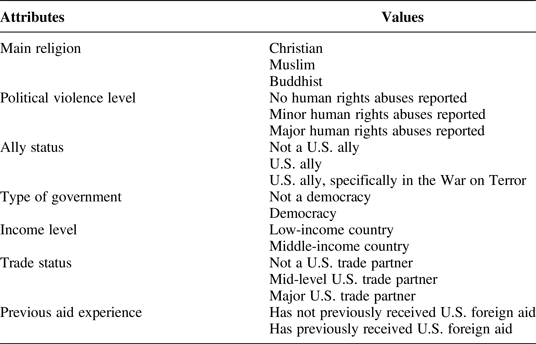
The respondents view a total of four pairs of country profiles. These country profiles consist of seven attributes: main religion, type of government, ally status, income level, trade status, political violence, and previous aid experience. I selected these attributes because the literature on foreign aid emphasizes the importance of these attributes in the allocation of foreign aid. As discussed above, this previous work shows that strategic and economic objectives guide bilateral aid decisions.
Moreover, these attributes allow me to control for stereotypes that respondents may hold about Muslim or Buddhist countries. Given the media prominence of Muslim autocracies such as Egypt, Iran, and Saudi Arabia, the inclusion of the regime type controls for respondents’ perception of Muslim countries as authoritarian. Additionally, the inclusion of the political violence variable is intended to address the widely-held stereotype of Muslims as more violent than others (Sides and Gross Reference Sides and Gross2013).
The order of these attributes was randomized across respondents to eliminate concerns about serial position effects.Footnote 12 Each attribute can take on a range of associated values. For example, the main religion attribute can take on three values: Christian, Buddhist, and Muslim. The values of each country profile are randomly assigned, and all combinations were permitted.Footnote 13 Table 1 lists all of the attributes and their associated values.
Country Attributes and Potential Values

After the respondent views each of the paired country profiles, he/she selects between them.Footnote 14 The respondent is then asked whether he/she would vote for or against aid to each country separately. The dataset is then restructured so that the choice associated with each country profile (chosen/not chosen) is a separate observation, resulting in several observations per respondent. The country profile that is chosen gets a value of 1; the profile not chosen a 0.Footnote 15 Because the values of the attributes of each country profile are randomly selected and the order of the attributes are randomized across respondents, I can identify the average marginal component effect (AMCE), or the causal effect of a country characteristic (attribute value) on the probability that a country will be selected for the aid program, using a linear probability model. The AMCE is the average difference in the probability of a respondent selecting a country profile with one attribute value compared with the attribute value of the reference category for that characteristic (Hainmueller, Hopkins, and Yamamoto Reference Hainmueller, Hopkins and Yamamoto2014).Footnote 16 The linear probability model also facilitates clear comparison of each country characteristic's relative importance.
RESULTS
Following Hainmueller, Hopkins, and Yamamoto (Reference Hainmueller, Hopkins and Yamamoto2014), I use the following linear probability model to estimate the average marginal component effect (AMCE):
Choice = α + I(type of government) β1 + I(ally status) β2 + I(income level) β3 + I(trade status) β4 + I(main religion) β5 + I(political violence) β6 + I(previous aid experience) β7 + ε
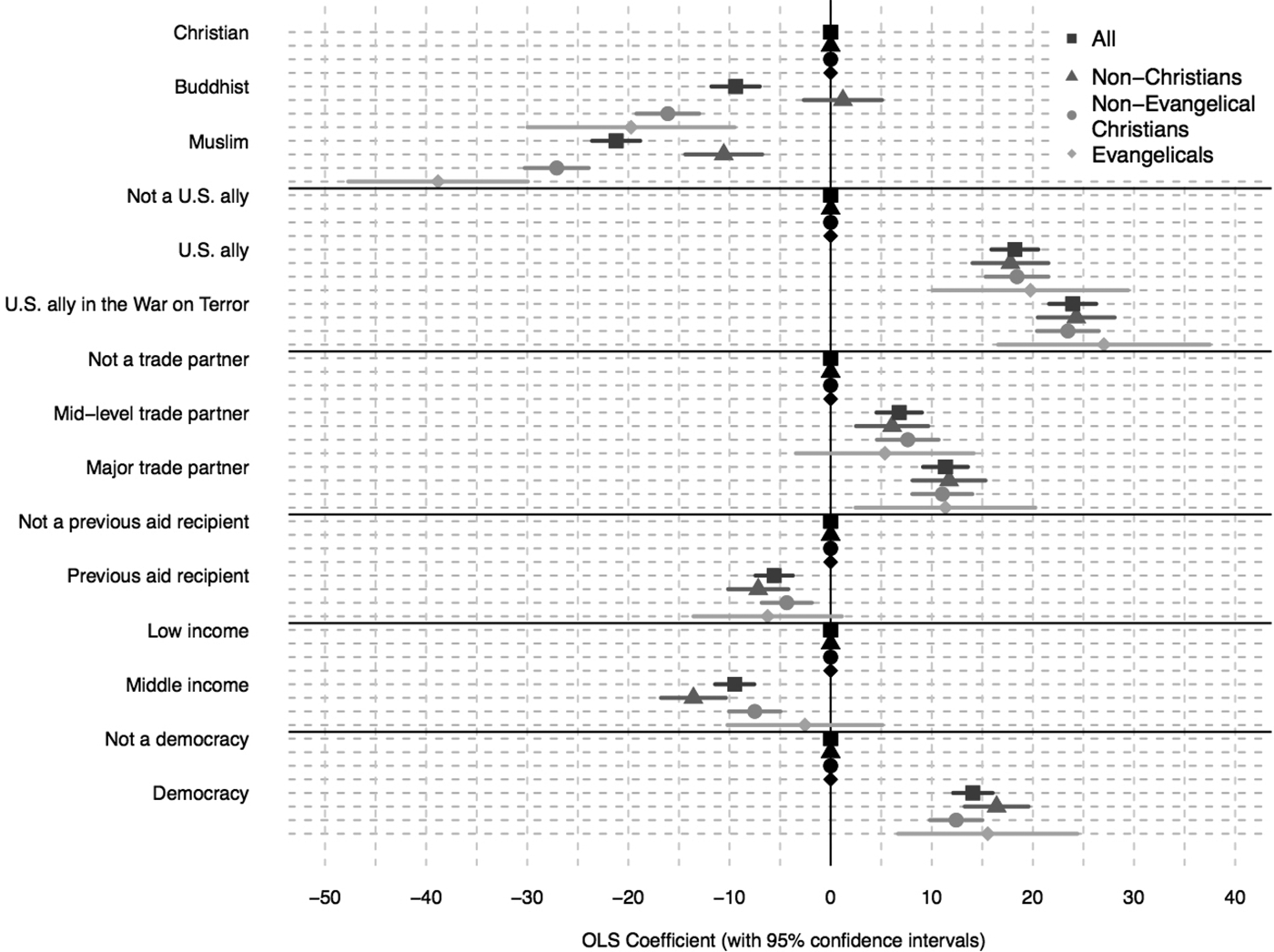
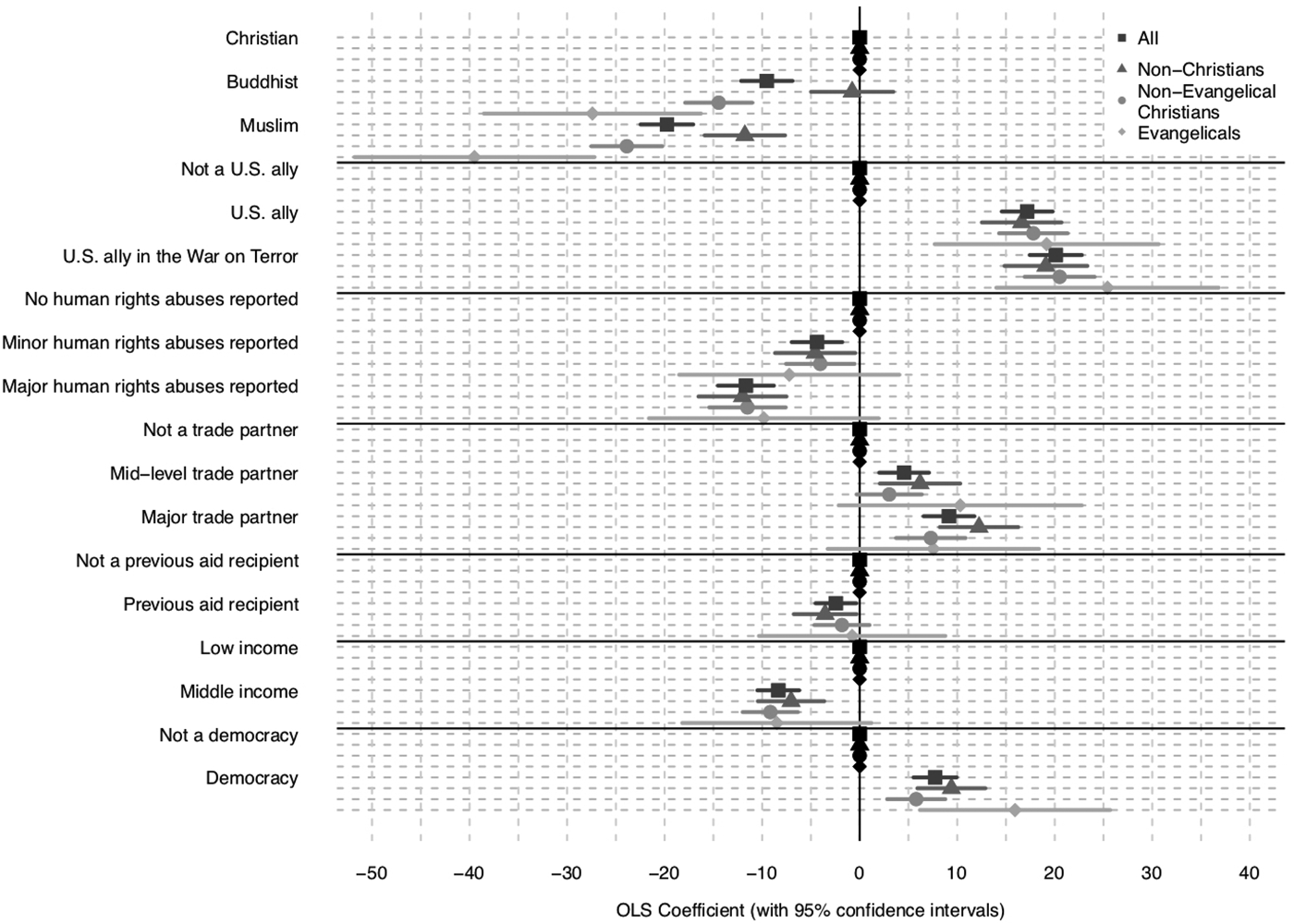
The standard errors are clustered by respondent as an individual's responses are unlikely to be independent of each other across choice tasks. Figure 1 plots the ordinary least squares (OLS) results from the SSI Survey from June 2014. Figure 2 plots the OLS results from the Qualtrics Survey from March 2016. Both plots display the OLS coefficients for all respondents, as well as by the religious identity of the respondent for the three main comparison groups: non-ChristiansFootnote 17, non-Evangelical Christians, and Evangelical Christians. By construction, survey respondents cannot identify as Evangelical non-Christians.
OLS coefficients, SSI Survey, June 2014.

OLS coefficients, Qualtrics Survey, March 2016.

In addition to these coefficient plots, the linear probability results of the SSI survey are reported in Table A3 in the Appendix, while the Qualtrics survey results are reported in Table A4 in the Appendix. The logit results of each survey are also reported in Tables A5 and A6 of the Appendix. These overall results corroborate much of the existing literature on foreign aid. In both the SSI results, as well as the Qualtrics results, being allied with the United States increases the probability that individuals will select that country for an aid program. Being a U.S. ally in the War on Terror further increases the probability that individuals will select that country. Similarly, the probability that individuals will select a country for an aid program increases as the country moves from not being a trade partner to being a mid-level trade partner and, finally, to being a major trade partner. The results also show that low-income countries and democracies are more likely to be preferred for the foreign aid program.Footnote 18
Regarding religion, the results of both surveys suggest that recipient country religion is an important determinant of the public's support for foreign aid to that country. In the SSI results for all respondents, I find that Christian countries are 9.4 percentage points more likely than Buddhist countries to be chosen for a U.S. aid program. This gap increases to over 20 percentage points when Christian countries are contrasted with potential Muslim recipient countries. Similarly, in the Qualtrics results for all respondents, I find that Christian countries are 9.5 percentage points more likely to be selected than Buddhist countries and 19.8 percentage points more likely to be selected than Muslim countries.
Understanding the Religion Effect
Why is support for foreign aid determined by religion? As I outline above, there are several channels through which religion impacts individual aid preferences. First, individuals may use the religion of another individual or group as a heuristic when evaluating those people or groups. I present evidence that the recipient country religion acts as a heuristic, especially in the case of Muslim countries, which are linked to negative stereotypes. Second, religious ideas and practices can influence the beliefs of citizens (Fox Reference Fox2001; Warner and Walker Reference Warner and Walker2011). This includes giving individuals certain values by which to live, as well as connecting them to a particular community and social identity (Wilcox and Sigelman Reference Wilcox and Sigelman2001; Wald, Silverman, and Fridy Reference Wald, Silverman and Fridy2005). I also find evidence in support of this mechanism. Foreign aid preferences do differ among adherents of different religious denominations.
Religion as a Heuristic
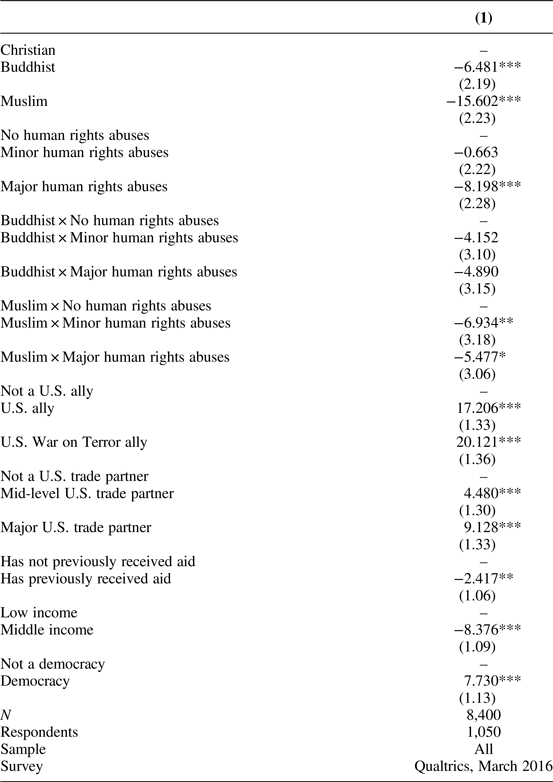
I examine the extent to which recipient country religion is acting as a heuristic for other important country attributes that inform individuals’ aid preferences in two ways. First, in the second version of the survey that I fielded with Qualtrics, I added a political violence variable in order to control for perceptions of country-level violence. Given that the primary negative stereotype of Muslims is that they are more violent than other groups, controlling for different levels of violence helps me to disentangle religion from beliefs about violence (Panagopoulos Reference Panagopoulos2006; Sides and Gross Reference Sides and Gross2013). I find that political violence is also an important determinant of foreign aid preferences.Footnote 19 More importantly, however, from the perspective of how Muslim acts as a negative heuristic is the interaction between recipient country religion and political violence. To further understand the relationship between anti-Muslim sentiments and stereotypes about violence, I calculate the average component interaction effect (ACIE) of recipient country religion with the political violence variable (Hainmueller, Hopkins, and Yamamoto Reference Hainmueller, Hopkins and Yamamoto2014). For Muslim countries, the interaction between recipient country religion and violence was negative and significant, indicating that Muslim countries pay an additional penalty of approximately 6 percentage points when associated with violence. The ACIE for Buddhist and violence is smaller and statistically insignificant. This supports the idea that the association of Islam with violence is a widespread and powerful stereotype that negatively impacts assessments of Muslim majority countries. The linear probability results with this interaction term are reported in Table 2.
AMCEs including interaction with Violence

*p < 0.10, **p < 0.05, ***p < 0.01.
Note: These are linear probability estimates.
Second, I examine how the effect of the recipient country religion variable changes across the education level of respondents. Reliance on heuristics has been found to be higher among less educated individuals (Mondak Reference Mondak1993). This may be because a college education exposes individuals to new ideas and greater tolerance, making them less susceptible to stereotypes (Hainmueller and Hiscox Reference Hainmueller and Hiscox2006).Footnote 20 I find some support for this argument that the effect of recipient country religion is moderated by respondent education. Table A7 of the Online Appendix compares the results of those with a college degree to those without in both the SSI and Qualtrics results. In both results, respondents with a college degree or above are significantly less likely to favor Christian countries than respondents who do not have a college degree. They are also more likely to select a country as an aid recipient when the country is Buddhist or Muslim relative to respondents who do not have a college degree, though, in the Qualtrics sample, this is not significant.
The results of the survey experiment suggest that the effect of recipient country religion is driven in part by country religion acting as a heuristic for the favorability of a potential recipient country. However, returning to Figures 1 and 2, we find that there are starkly different results depending on the religious identity of the respondent. The different responses across religious groups suggest that the effect is not solely driven by country religion acting as a commonly shared informational shortcut.
Religion as Social Identity and Values
Next, I examine how respondents’ religious identities and affiliations also impact their policy preferences. I find that some of the effect of religion in these experiments is driven by differential preferences for giving conditional on the respondent's religious affiliation and, more specifically, a match between the respondent's religion and the recipient country's religion.
In order to examine the differences among different religious affiliations, I break down the results by respondent religion. There is not a large enough sample of Muslim and Buddhist respondents to compare responses of Muslims, Buddhists, and Christians as groups. Instead, I compare the results of individuals who self-identify as non-Evangelical Christian, Evangelical Christian, and a residual category of all others.Footnote 21 While the coefficients for the other recipient country-level attributes remain relatively stable across these different types of respondents, the coefficients on the country's main religion attribute values change significantly when we look at the religious identity of respondents. In both surveys, among non-Christian respondents, Christian countries are approximately 11 percentage points more likely than Muslim countries to be chosen for a U.S. aid program, and Buddhist countries pay no religion penalty relative to Christian countries. For non-Evangelical Christian respondents in the SSI sample, Christian countries are around 16 percentage points more likely to be selected than Buddhist countries and over 27 percentage points more likely to be selected than Muslim countries. Non-Evangelical Christians in the Qualtrics sample are 14.5 percentage points more likely to select a Christian recipient country over a Buddhist one and 23.9 percentage points more likely to select a Christian recipient country over a Muslim one.
Among Evangelical Christian respondents, on the other hand, the preference for giving foreign aid to majority Christian countries is even stronger. In the SSI survey, among self-identified Evangelical Christians, a Muslim country is over 35 percentage points less likely to be chosen for an aid program than its Christian counterpart. Buddhist countries are nearly 20 percentage points less likely to be chosen. As we drill down into the results by respondent religion in the Qualtrics survey, the same pattern as the SSI survey emerges. Among Evangelicals, Christian countries are over 27 percentage points more likely to be selected than Buddhist countries and almost 40 percentage points more likely to be selected than Muslim countries. This provides evidence that certain types of respondents, especially Evangelicals, will express a strong preference for foreign aid to other Christian countries.
These results are significant for several reasons. Although the Evangelicals express a stronger preference for giving to Christian countries, the effect of recipient country religion for either the Buddhist or Muslim treatment is not exclusively driven by Evangelical respondents. Non-Evangelical Christians also express a preference for Christian countries over Buddhist and Muslim countries. Similarly, the preference for Christian countries among Evangelical Christians is not driven solely by the anti-Muslim sentiments described by some researchers (Jelen Reference Jelen1994; Baumgartner, Francia, and Morris Reference Baumgartner, Francia and Morris2008; Shortle and Gaddie Reference Shortle and Gaddie2015). Instead, I find that Evangelicals also prefer a Christian recipient country over Buddhist countries as well as Muslim, although the size of the effect is smaller.
In addition to the non-Christian, non-Evangelical Christian, Evangelical Christian differences, I also contrast the preferences of Protestant and Catholic respondents.Footnote 22 In both surveys, Catholic respondents are less likely to favor Christian countries than Protestant respondents although this is only significant for the Qualtrics sample. Moreover, Catholic respondents in the Qualtrics sample are also 7 percentage points more likely to select a country as an aid recipient when the country is Buddhist or Muslim relative to Protestant respondents. Overall, however, both Catholic and Christian respondents still favor Christian recipient countries overall. Moreover, when Evangelical Protestants are excluded from the analysis, none of the differences between Protestants and Catholics are significant.Footnote 23 These results are displayed in Table A9 in the Appendix. These results provide further evidence that—while the preference for giving to Christian countries is strongest among Evangelicals—non-Evangelical Christian respondents also share a smaller, yet significant preference for Christian recipient countries as well.
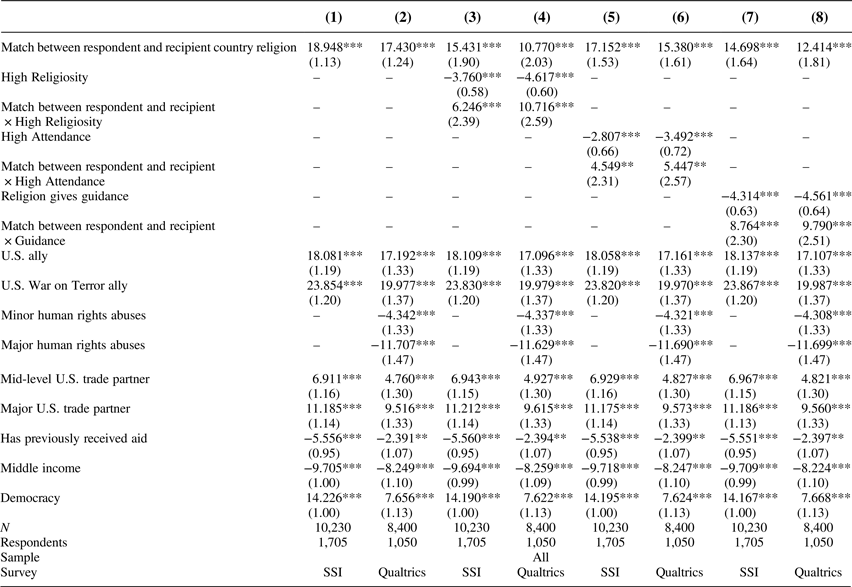
To explore the degree to which differential altruism along co-religionist lines is operating, I create a variable to signify if there is a match between the respondent's religion and the recipient country's religion. This match variable is a dummy that takes the value of 1 when any recipient country religion listed in a profile matches that of the respondent.Footnote 24 Table 3 shows the results from both the SSI and Qualtrics surveys. In the SSI survey, an individual is almost 19 percentage points more likely to select a country as an aid recipient when the country matches his/her religion. Among Qualtrics respondents, an individual is over 17 percentage points more likely to select a country matching his/her religion as an aid recipient.
Effects of Country Attributes on Probability of Being Selected as Aid Recipient: Religion Match and Religiosity

*p < 0.10, **p < 0.05, ***p < 0.01.
Note: These are the linear probability estimates. Reference categories are included in the regressions, but omitted here for space.
Next, I examine how the religion match effect is moderated by the degree of religiosity of the respondent. Using individuals’ responses regarding church attendance and the degree of guidance religion provides in one's life, I create one indicator variable for the respondent if the individual reports attending church once a month or more and another indicator variable if the respondent states that religion provides “quite a bit of guidance” or “a great deal of guidance” in day-to-day life. I also merge these to create a third indicator variable for “high religiosity” and “low religiosity” respondents.Footnote 25 The results, also presented in Table 3, show that the effect is moderated by respondent religiosity, as well as by religious guidance and religious attendance. Columns 3 and 4 of Table 3 indicate that a high religiosity co-religionist displays a stronger preference for a recipient country that matches his/her religion than a low religiosity co-religionist.
DISCUSSION
The results of these two surveys show that religion is a consistent and significant determinant of the U.S. public's preferences regarding foreign aid allocations. Thus, it is natural to ask whether these same patterns manifest themselves in real-world aid flows and what implications these findings have for our understanding of religion and redistributive preferences.
Real-World aid Flows
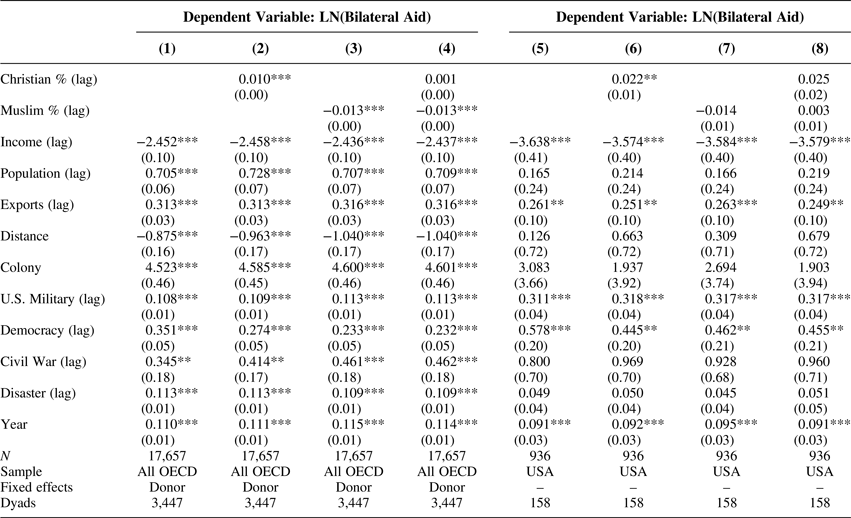
In order to examine if and when U.S. government aid decisions are influenced by recipient country religion, I examine the marginal effects of recipient country religion on OECD and U.S. bilateral aid flows. Because the religious composition of countries is fairly static relative to annual aid flows, it is difficult to identify the effect of recipient country religion on the receipt of aid from annual observational data. Despite this challenge, there is suggestive evidence from real-world aid flow data that links recipient country religion to aid allocations. Using the replication data from Bermeo and Leblang (Reference Bermeo and Leblang2015) and the World Religion Dataset (Maoz and Henderson Reference Maoz and Henderson2013), Table 4 reports the marginal effect of recipient country religion, contrasting the marginal effects of percent Christian and percent Muslim.Footnote 26 The reported marginal effects in Table 4 are estimated using a Tobit model for data that is left censored at zero. Following Bermeo and Leblang (Reference Bermeo and Leblang2015), the models for all OECD countries (models 1–4) include donor fixed effects and robust standard errors clustered on the donor-recipient dyad. The models for the United States (models 5–8) are calculated using robust standard errors clustered on the U.S.-recipient dyad.Footnote 27
Impact of Recipient Country Religion on Aid Flows, 1976–2006: Tobit Estimates

*p < 0.10, **p < 0.05, ***p < 0.01.
Note: The dependent variable is the log of (1 plus) aid commitments from the donor to the recipient. The coefficient estimates reported for these Tobit models are the marginal effects.
Consistent with Bermeo and Leblang (Reference Bermeo and Leblang2015), across models 1–8, bilateral aid commitments decrease as GDP per capita increases. I also find that bilateral aid commitments increase with larger population, higher donor-to-recipient exports, higher U.S. military aid, and higher democracy scores. With regard to religion, in the full OECD analysis, bilateral aid commitments increase as the percent of the population that is Christian increases and decrease as the percent of the population that is Muslim increases. The same pattern holds in the U.S. analysis, although the marginal effect on Muslim population percentage loses its significance. Contrary to Alesina and Dollar (Reference Alesina and Dollar2000) these results are suggestive of a relationship between aid commitments and recipient country religion.
These results indicate that there is a small but significant marginal effect of recipient country religion on real-world aid flows. While these results cannot be linked directly with public opinion, they are also consistent with the large literature that describes how public opinion matters in both democracies and non-democracies and across foreign policy issue areas, including international conflict and foreign economic policy decisions (Fearon Reference Fearon1994; Scheve and Slaughter Reference Scheve and Slaughter2001; Hainmueller and Hiscox Reference Hainmueller and Hiscox2006; Tomz Reference Tomz2007; Weeks Reference Weeks2008). It is important to ask, however, why the real-world effect is not stronger, given the strength of the experimental results.
The Limits of Public Opinion
The first possibility is that public opinion, while significant in other areas, is less consequential for foreign aid policy. Perhaps foreign aid policy falls under the policy instruments that the government uses to achieve specific security or economic objectives rather than to satisfy certain domestic constituents. However, research on domestic audience costs shows that public opinion can be an important determinant of a state's behavior in the international sphere (Tomz Reference Tomz2007; Weeks Reference Weeks2008). In the case of foreign aid specifically, trade and foreign aid policy in the United States must be approved by Congress, whose members’ preferences are shaped by the interests of the legislators’ local constituents and by the legislators’ ideological predispositions. There is significant evidence that religious groups have mobilized around the issue of foreign aid, lobbying the president and Congress for specific types of aid policies and for greater access to federal support for international aid projects (Stevenson Reference Stevenson2002; The New York Times Editorial Desk 2003; Fletcher Reference Fletcher2006).
Moreover, it is not immediately clear that individuals know the majority religion of most potential aid recipient countries and are able to act on these preferences. Unfortunately, I do not have data on what respondents know about actual potential recipient countries. However, in the 2014 Chicago Council public opinion survey on U.S. foreign policy, respondents were asked about their support for aid to African countries, the Ukraine, Israel, Egypt, Afghanistan, Iraq, and Pakistan (Smeltz, Daalder, and Kafura Reference Smeltz, Daalder and Kafura2014). While a majority of respondents favored aid to African countries, the Ukraine, and Israel, a majority wanted to decrease or stop economic aid to the four Muslim majority countries.Footnote 28
The second possible explanation for the discrepancy between the strong results of this experimental study and the weaker evidence found in aid patterns is that the public's preference regarding recipient country religion is only one of several public attitudes that policy-makers take into consideration when developing foreign aid policy. While the public has preferences regarding recipient country religion, the effect of this preference could be moderated by the public's preferences regarding the overall distribution of government aid or geopolitical interests, such as whether a country is allied with the United States.
It could be the case that those individuals whose foreign aid preferences are largely determined by recipient country religion do not—on average—support the distribution of foreign aid in the first place. In order to address this question, in the Qualtrics survey, prior to the survey experiment, I measure the respondent's overall support for foreign aid.Footnote 29 Accordingly, I use the responses to that question to identify individuals as “aid opponents” and “aid supporters.”Footnote 30 Table A10 in the Online Appendix displays the AMCE estimates for aid supporters and aid opponents. Non-Evangelical and Evangelical Christian aid supporters still express a strong preference for giving to Christian countries rather than Buddhist or Muslim countries, and non-Christian aid supporters still display a preference for Christian or Buddhist recipient countries over Muslim recipient countries. This is evidence that among those individuals who support the distribution of foreign aid, there is still an expressed preference for giving to primarily Christian countries among respondents from certain religious denominations.Footnote 31
It may also be the case that geopolitical interests and security concerns override preferences based on recipient country religion. In fact, research suggests that those individuals who hold the strongest anti-Muslim sentiments are also likely to express strong support for the War on Terror.Footnote 32 For example, Kam and Kinder (Reference Kam and Kinder2007) find strong evidence that individual-level ethnocentrism explains the microfoundations of American public opinion regarding the War on Terror, while Sides and Gross (Reference Sides and Gross2013) find that “those who derogate Muslims are more likely to support increased spending on the war on terror, defense, and border security” (p. 591).Footnote 33
To further understand the relationship between anti-Muslim sentiments and other strategic considerations, I calculate the average component interaction effect (ACIE) of recipient country religion with the ally status variable. The results show that Buddhist or Muslim recipient countries that are also allies in the War on Terror are more likely to be selected than Buddhist or Muslim recipient countries that are not War on Terror allies, though these results are only significant in the SSI sample. This suggests that the effect of recipient country religion is partly moderated by the alliance status of that country. The linear probability results for the interaction model are reported in Table A11 of the Online Appendix.
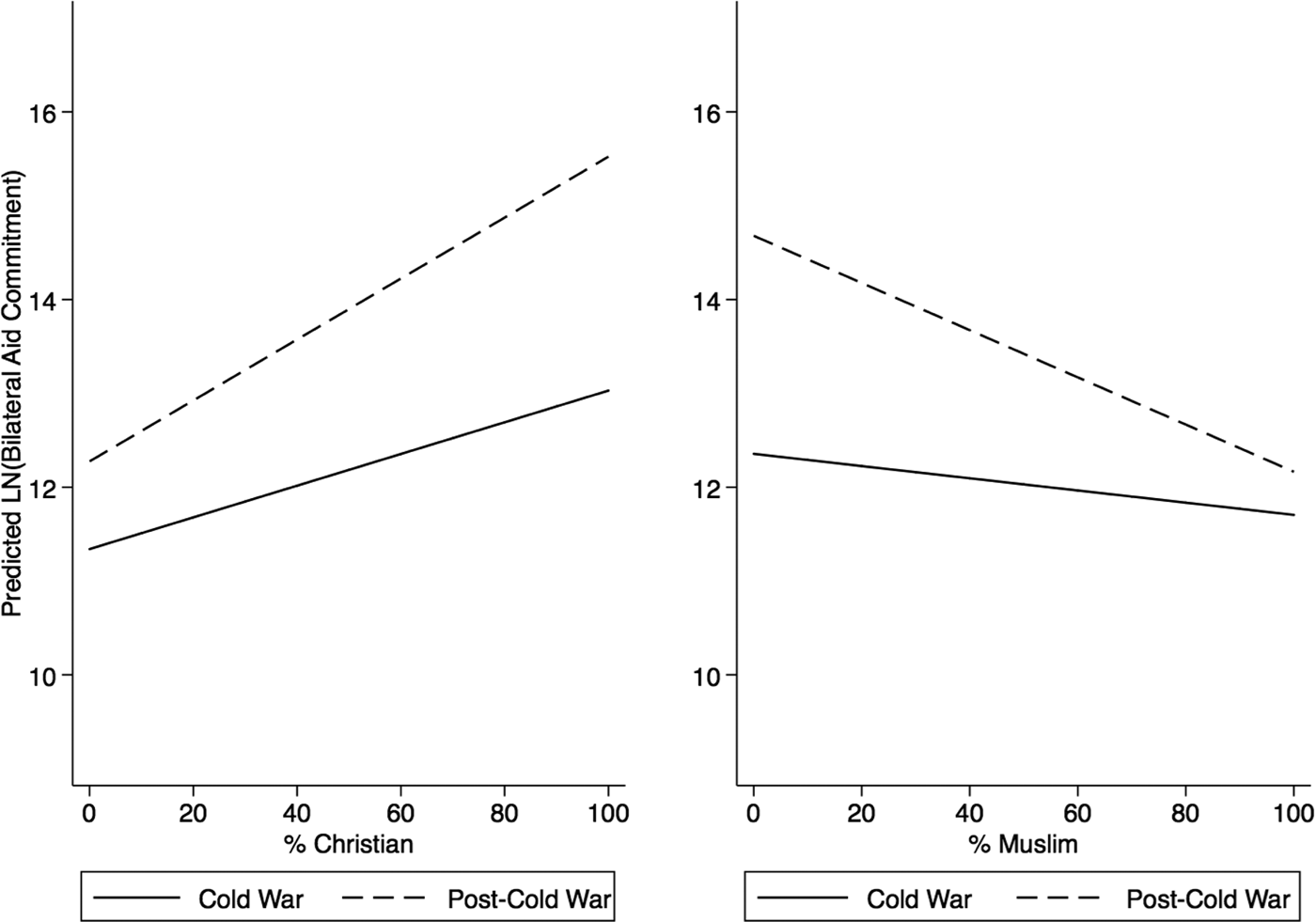
Returning to the real-world aid flows, I also examine the marginal effects of recipient country religion conditional on whether the aid is given during or after the Cold War.Footnote 34 The results, displayed in Figure 3, suggest that recipient country religion had a larger impact on aid flows in the post-Cold War period. In the post-Cold War period, overall bilateral aid commitments are higher but also more dependent on the majority religion of the recipient country. This is consistent with the idea that public preferences regarding religion matter for foreign economic policy primarily in a context in which other major foreign policy objectives, such as preventing the spread of Soviet influence, do not dominate.Footnote 35
Interaction between recipient country religion and Cold War dummy, 1976–2006.

Implications for Redistribution and Avenues for Further Research
The findings of this paper have important implications for several other areas of research on the impact of religion, such as the relationship between religion and redistributive preferences.Footnote 36 Several scholars have examined the relationship between an individual's religion and his/her preferences regarding redistribution. That research shows that voters do not always vote in line with their economic interests as predicted by most one-dimensional spatial models. Often poor voters vote for the more right-leaning parties. Many researchers attribute this voting behavior to the role of a non-economic issue, such as religion, in altering preferences along a second issue dimension (Roemer Reference Roemer1998; De La O and Rodden Reference De La, Ana and Rodden2008).Footnote 37 Scheve and Stasavage (Reference Scheve and Stasavage2006) directly link religion and redistributive preferences, arguing that social spending and religion act as alternative forms of insurance against adverse life events. Accordingly, religious individuals will prefer lower social spending.
Other research indicates that some individuals condition their support for redistribution on whether they or their co-religionists are likely to be the beneficiaries (Ruffle and Sosis Reference Ruffle and Sosis2006; Chen and Lind Reference Chen and Lind2007; Margolis and Sances Reference Margolis and Sances2013). The evidence presented in this paper is consistent with that view and suggests that a preference for redistributing to co-religionists is a policy orientation that can extend from domestic politics into the international realm. More specifically, the results of this conjoint study indicate that religious individuals in the United States are likely to express a preference for giving to co-religionists, which manifests in the international sphere as increased support for foreign aid to Christian majority countries.
This research provides several new insights into the relationship between religion and politics. I find that recipient country religion is a significant determinant of foreign aid preferences, wielding more weight than many other important determinants such as a country's ally or trade status. This finding is significant for two reasons. First, it provides evidence that the majority religion of a recipient country shapes individuals’ preferences outside of the realm of conflict-centered foreign policy.
Second, this study is also the first survey experiment study to show that the public opinion penalty paid by non-Christian countries is not limited to Muslim countries. The inclusion of Buddhist countries provides further evidence for why religion matters. On the one hand, the existence of a large Muslim penalty and a significant interaction between Muslim recipient country and increased violence indicates that recipient country religion acts as a negative heuristic about the potential recipient country and its desirability as an aid recipient. On the other hand, the negative effect of being a non-Christian country also extends to Buddhist countries and is particularly pronounced among Christian respondents, suggesting that respondents also possess a type of differential altruism, or a preference to give to those countries that share their religious identity. In this case, the relationship manifests itself as increased support for aid allocations to Christian recipient countries among Christian respondents in the United States. While more work is needed to determine the full extent of how this impacts real-world aid flows and whether this same relationship holds in donor countries other than the United States, this finding sheds light on how U.S. politicians and religious leaders can appeal to religion to promote or discourage certain foreign economic policies among their constituents.
Supplementary Material
The supplementary material for this article can be found at https://doi.org/10.1017/S1755048318000093