The physiological component of an organism's response to a stressor has been a focus of developmental research because of its potential to inform us about the processes in resilience and in risk for medical or psychiatric disorders (Obradovic, Reference Obradovic2012). In the light of the extensive research that has been conducted into the fetal origins of many of these disorders, we investigated the role of prenatal anxiety in physiological reactivity during infancy.
Of the multiple systems activated in the face of stress, two have received considerable attention: the fast-acting autonomic nervous system and the slower neuroendocrine hypothalamic–pituitary–adrenal (HPA) axis. In this paper we focus on autonomic reactivity and in particular on the parasympathetic response mediated via the vagal nerve. Vagal tone is thought to play a central role in the regulation of social interaction, behavior, emotion, and attention. Porges's (Reference Porges2007) polyvagal theory asserts that engagement with the environment is physiologically mediated by the ventral vagal complex, which effects parasympathetic control of the heart. Pathways originating in the nucleus ambiguus that regulate vagal influence on the heart are linked to those that regulate muscles controlling facial expressions and vocalizing (Porges, Reference Porges2007). The adaptive response to a stress is hypothesized to entail a reduction in vagal tone, mobilizing physiological and psychological resources to underpin effective action without activating flight–fight associated with the sympathetic nervous system. The hypothesis has been supported by findings of associations in children between greater vagal withdrawal and better emotional and behavioral regulation. For example, in a study of 122 children assessed at age 2 years and again at 4.5 years for adjustment, high vagal withdrawal sustained across the period was associated with lower negative emotionality and fewer behavior problems at follow-up (Calkins & Keane, Reference Calkins and Keane2004).
There may however not be a simple relationship between extent of vagal reactivity and adaptation. Recent evolutionary formulations argue that the adaptiveness of physiological or behavioral characteristics depends on the nature of the environmental challenges faced by the organism. Boyce and Ellis (Reference Boyce and Ellis2005) have proposed that physiological reactivity should be reconceptualized as biological sensitivity to context, arguing that high physiological reactivity may be maladaptive in contexts of adversity but adaptive in nurturing and supportive environments (Boyce & Ellis, Reference Boyce and Ellis2005; Ellis, Boyce, Belsky, Bakermans-Kranenburg, & van IJzendoorn, Reference Ellis, Boyce, Belsky, Bakermans-Kranenburg and van IJzendoorn2011). Consistent with this hypothesis, Obradovic and colleagues found that high vagal reactivity exacerbated risk for maladaptation in the context of high family adversity, whereas in the context of low adversity it promoted higher levels of academic achievement, school competence, and prosocial behaviors (Obradovic, Bush, Stamperdahl, Adler, & Boyce Reference Obradovic, Bush, Stamperdahl, Adler and Boyce2010).
Fetal Programming and Variations by Sex of Offspring
The fetal programming hypothesis postulates that adaptations in utero, associated with maternal stress or low fetal nutrition, confer later risk or resilience also in a context-dependent manner. The intrauterine environment provides information to, and programs the fetus in anticipation of, likely future environments. The fetal adaptations are advantageous where there is a match between the anticipated and actual postnatal environments and confer vulnerability where there is a mismatch. The hypothesis was first put forward to account for long-term effects of low birth weight on diabetes and cardiovascular disease (Barker, Reference Barker2007). Barker proposed that low birth weight reflects poor intrauterine nutrition, which leads to fetal changes that are adaptive in subsequent environments of food scarcity. In environments where food is plentiful, however, low birth weight individuals are susceptible to obesity, diabetes, and cardiovascular disease. Fetal origins hypotheses have also been applied to explain associations between low birth weight and adolescent depression (Costello, Worthman, Erkanli, & Angold, Reference Costello, Worthman, Erkanli and Angold2007; Van Lieshout & Boylan, Reference Van Lieshout and Boylan2010) and schizophrenia (Abel et al., Reference Abel, Wicks, Susser, Dalman, Pedersen and Mortensen2010). Associations between prenatal stress and later psychopathology may arise in a similar way. Prospective studies from several different laboratories around the world have shown that if the mother is stressed, anxious, or depressed while pregnant her child is more likely to have symptoms of anxiety or depression, attention-deficit/hyperactivity disorder, or conduct disorder (Glover, Reference Glover2011; Glover & Hill, Reference Glover and Hill2012; O'Connor, Heron, Golding, & Glover, Reference O'Connor, Heron, Golding and Glover2003; Talge, Neal, & Glover, Reference Talge, Neal and Glover2007; Van den Bergh, Mulder, Mennes, & Glover, Reference Van den Bergh, Mulder, Mennes and Glover2005).
Birth weight is commonly interpreted as a reflection of fetal growth that provides an approximate index of a challenging intrauterine environment (Meaney, Szyf, & Seckl, Reference Meaney, Szyf and Seckl2007). In animal studies both low birth weight and prenatal stress are associated with elevated fetal glucocorticoid exposure that causes decreased expression of the glucocorticoid receptor gene in the hippocampus and, as a consequence, impaired feedback regulation of corticosteroids and corticotropin-releasing factor (CRF) resulting in altered regulation of the HPA axis (Seckl, Reference Seckl2008). CRF expression is elevated in brain structures, including the hippocampus, amygdala, and brainstem, leading to elevated HPA and autonomic and emotional reactivity to stress. Fetal programming may therefore contribute to variations in vagal reactivity (Obradovic, Reference Obradovic2012).
Sex differences in postnatal outcomes following exposures to prenatal risk have been described and need to be considered in the account of fetal origins of adaptation and disease. In animal and human studies, sex-dependent physiological, gene expression, and behavioral responses to prenatal stress have been identified (Kajantie & Raikkonen, Reference Kajantie and Raikkonen2010, Mychasiuk, Gibb, & Kolb, Reference Mychasiuk, Gibb and Kolb2011; Weinstock, Reference Weinstock2007, Reference Weinstock2011; Zohar & Weinstock, Reference Zohar and Weinstock2011).Footnote 1 For example, in a number of studies, pregnant rats were exposed to daily random stress during the last gestational week, and behavior was tested in the adult offspring. Female, but not male, offspring showed anxiety-related behaviors (Schulz et al., Reference Schulz, Pearson, Neeley, Berger, Leonard and Adams2011*); reduced exploration of the open arms of an experimental maze, a marker for increased anxiety (Zagron & Weinstock, Reference Zagron and Weinstock2006); and increased length of immobility in the forced swim test, a model of depression (Frye & Wawrzycki, Reference Frye and Wawrzycki2003). Adrenalectomy of the rat mothers eliminated the effect of prenatal stress in female offspring consistent with mediation by effects of maternal corticosteroids on the HPA axis. There is also evidence of sex differences in CRF-activated signaling in brain stem cells and in the regulation of the number of CRF receptors (Bangasser et al., Reference Bangasser, Curtis, Reyes, Bethea, Parastatidis and Ischiropoulos2010). Thus there are several ways in which there may be sex dimorphic consequences of fetal programming for autonomic and behavioral stress reactivity, mediated via altered HPA axis functioning and CRF effects (Seckl, Reference Seckl2008).
Evidence is also accumulating that prenatal risks for offspring psychopathology may differ in males and females. Several studies have reported that prenatal risks are associated with elevated internalizing disorders in females but not males (Costello et al., Reference Costello, Worthman, Erkanli and Angold2007*; Van den Bergh, Van Calster, Smits, Van Huffel, & Lagae, Reference Van den Bergh, Van Calster, Smits, Van Huffel and Lagae2008*; Van Lieshout & Boylan, Reference Van Lieshout and Boylan2010*). Costello et al. found that low birth weight was associated with adolescent depression only in females and only in the presence of major childhood adversities consistent with the context-dependent fetal origins hypothesis. By contrast, associations of prenatal risks with externalizing disorders have commonly been found in males but not females (Rodriguez & Bohlin, Reference Rodriguez and Bohlin2005; Li, Olsen, Vestergaard, & Obel, Reference Li, Olsen, Vestergaard and Obel2010). There may also be differential effects depending on the timing of prenatal exposures, with effects on boys associated with maternal anxiety early in pregnancy but in girls associated with anxiety in late pregnancy (de Bruijn, van Bakel, & van Baar, Reference de Bruijn, van Bakel and van Baar2009). It should be emphasized that not all studies of outcomes following prenatal stress have found convincing sex differences. For example, O'Connor and colleagues in their study of prenatal anxiety and child adjustment, based on the evidence on sex differences available at the time, conducted analyses for males and females separately. They found several differences, but none was supported by a Sex × Prenatal Anxiety interaction (O'Connor, Heron, Golding, Beveridge, & Glover, Reference O'Connor, Heron, Golding, Beveridge and Glover2002; O'Connor et al., Reference O'Connor, Heron, Golding and Glover2003).
Sex differences in responses to adversity are not confined to prenatal exposures. For example, sex differences in physiological markers associated with child maltreatment have been described. In a study of maltreated children attending a summer camp where detailed behavioral and physiological assessments could be made, cortisol levels associated with maltreatment and with internalizing and externalizing symptoms differed markedly between males and females (Cicchetti & Rogosch, Reference Cicchetti and Rogosch2001*). Similarly, differences in patterns of EEG asymmetry, associated with maltreatment and resilience, have been identified in boys and girls (Curtis & Cicchetti, Reference Curtis and Cicchetti2007*).
The Assessment of Vagal Reactivity in Infancy
Studies of physiological reactivity in infancy have made extensive use of the still-face procedure devised by Tronick and colleagues to investigate the infant's capacity for emotional and behavioral regulation in the face of a stressor (Stanley, Murray, & Stein, Reference Stanley, Murray and Stein2004). In this procedure, parents are asked to interact playfully face-to-face for 2 min, followed by 2 min during which the parent becomes impassive, and then a further 2 min when s/he is again responsive. The aim of the procedure is to replicate the inherent normal stress of daily life and social interaction (Tronick, Reference Tronick2006) in order to provide an experimental setting in which to assess behavioral and physiological reactivity likely to be relevant to vulnerability and resilience. Studies of vagal reactivity in the still-face procedure have examined the relationship with maternal sensitivity (Conradt & Ablow, Reference Conradt and Ablow2010; Moore et al., Reference Moore, Hill-Soderlund, Propper, Calkins, Mills-Koonce and Cox2009), maternal anger (Moore, Reference Moore2009), maternal touch (Feldman, Singer, & Zagoory, Reference Feldman, Singer and Zagoory2010), oxytocin administration to fathers (Weisman, Zagoory-Sharon, & Feldman, Reference Weisman, Zagoory-Sharon and Feldman2012), parental discord (Moore, Reference Moore2010), and infant positive affect (Moore & Calkins, Reference Moore and Calkins2004).
In human research, respiratory sinus arrhythmia (RSA) provides a reasonable index of vagal tone, vagal withdrawal being generally computed as the difference between RSA during baseline and during stress conditions. According to Porges (Porges, Reference Porges2007), baseline vagal tone is seen during quiet alert states and in the absence of intense stimulation and concentration. However, experimental conditions for measuring baseline in infants and young children have not been standardized. These have included during sleep or while the parent is reading and not attending to the child (Moore, Reference Moore2010). However, it may be that if a child is not provided with stimulation s/he will seek it by looking around the room or attempting to interact with a parent, and the child may become distressed by the lack of contact. One solution is to provide a low challenge stimulus, such as in Calkins, Graziano, and Keane (Reference Calkins, Graziano and Keane2007), where the baseline episode consisted of a 5-min segment of the videotape ‘‘Spot,’’ a short story about a puppy that explores its neighborhood (Calkins et al., Reference Calkins, Graziano and Keane2007). Uniform methods for calculating vagal withdrawal have not been established across studies either. In relation to the still-face procedure, Moore and Calkins (Reference Moore and Calkins2004) calculated vagal withdrawal as the difference between RSA during the baseline and during the period the mother was unresponsive. In contrast, Moore (Reference Moore2010) calculated successive differences, baseline–social engagement with mother (normal play), social engagement–still face, and still face–reengagement. In view of these variations, we ascertained whether RSA measured during different stimuli contributes to a latent variable that could be considered the individual's baseline vagal tone (Sharp et al., Reference Sharp, Pickles, Meaney, Abbott, Tibu and Hill2012). We then used an approach from psychometrics called differential item functioning in which the influence of the explanatory variables (birth weight for gestational age and prenatal maternal anxiety) on the response under the still-face condition over and above any influence that they may have on the common latent variable is examined, which is a challenging test.
Rationale for This Study
If physiological reactivity is associated with low birth weight and prenatal stress it will be a candidate to mediate fetal programming effects on psychopathology. In this study we examined whether birth weight adjusted for gestational age at birth and prenatal maternal anxiety predicted vagal withdrawal in infants at 29 weeks of age and whether these associations were modified by sex of the infant.
Method
Sample
The participants were members of the Wirral Child Health and Development Study, a prospective epidemiological longitudinal study starting in pregnancy with follow-up when the infants were 29 weeks of age. This uses a two-stage stratified design in which a consecutive general population sample (the “extensive” sample) is used to generate a smaller “intensive” sample stratified by psychosocial risk, and both are followed in tandem. This enables intensive measurement to be employed efficiently with the high-risk subsample, while weighting back to the extensive sample enables general population estimates to be derived. The extensive sample was identified from consecutive first-time mothers who booked for antenatal care at 12 weeks gestation between February 12, 2007, and October 29, 2008. The booking clinic was administered by the Wirral University Teaching Hospital that was the sole provider of universal prenatal care on the Wirral Peninsula, a geographical area bounded on three sides by water. Socioeconomic conditions on the Wirral range between the deprived inner city and affluent suburbs but with very low numbers from ethnic minorities.
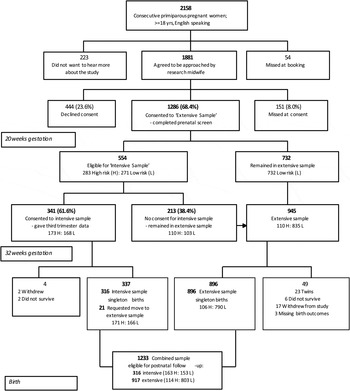
Approval for the procedures was obtained from the Cheshire North and West Research Ethics Committee, UK. The study was introduced to the women by clinic midwives who asked for the potential subjects' agreement to be approached by study research midwives when they returned for ultrasound scanning at 20 weeks gestation. The numbers approached by clinic midwives are shown in Figure 1. After obtaining informed consent, the study midwives administered questionnaires and an interview in the clinic. The subjects' responses to questions about psychological abuse in their current or recent partner relationship (Moffitt et al., Reference Moffitt, Caspi, Margolin, Krueger, Magdol and Silva1997) were used to generate the stratified intensive sample of mothers for more detailed study. The stratification variable was chosen for its known association with a variety of risk factors for early child development. For this study of prenatal anxiety the stratification variable was effective: the mean state anxiety scores (Spielberger, Reference Spielberger1983) in the low- versus high-risk strata were 31.5 (SD = 8.45) versus 35.5 (SD = 11.17, Cohen d = 0.40, p = .001) for a comparison of transformed scores. These intensive sample mothers completed questionnaire measures of anxiety at mean 32.1 (SD = 2.0) weeks of pregnancy. We focus here on those with surviving singleton births from this intensive sample who provided repeat assessments of maternal anxiety and whose infants were assessed for vagal reactivity at mean 29.1 (SD = 3.1) weeks (29 weeks).
Sample recruitment.

Numbers recruited to the extensive and intensive samples are shown in Figure 1. The extensive sample comprised 1,233 women of mean age at recruitment of 26.8 years (SD = 5.8, range = 18–51). There were 316 mothers recruited to the intensive sample at 32 weeks pregnancy, and 270 mothers and infants provided data for this study when the infants were 29 weeks old. Mothers whose infants were assessed at 29 weeks were slightly older than those in the original extensive sample: mean age 27.9 years (SD = 6.2, range = 18–51).
In the extensive sample 41.8% were in the most deprived quintile of UK neighborhoods (Noble et al., Reference Noble, Wright, Dibben, Smith, McLennan and Antila2004), consistent with high levels of deprivation in some parts of the Wirral. A total of 48 women in the extensive sample (3.9%) described themselves as other than White British.
Measures
Partner psychological abuse
Psychological abuse was assessed at 20 weeks pregnancy (N = 1,233) as humiliating, demeaning, or threatening utterances in the partner relationship during the previous year (Moffitt et al., Reference Moffitt, Caspi, Margolin, Krueger, Magdol and Silva1997). The scale is the total from 20 no/yes (coded as 0 = absent, 1 = present) items. Participants first rated these items about their own behavior toward their partner and then about their partner's behavior toward them. This measure has been shown to yield large correlations between self and partner informant reports. The psychological abuse variable used here was the highest of the partner-to-participant and participant-to-partner scores for each family.
Maternal anxiety
Maternal anxiety was assessed during pregnancy and at the time of vagal tone assessments using the State Anxiety Scale (Spielberger, Reference Spielberger1983).
Birth weight
Birth weight was extracted from medical records (N = 1,233). Gestational age at birth was calculated using the actual birth date in relation to the expected date of confinement based on the ultrasound scan at 8–12 weeks gestation. As birth weight is a function of gestational age at birth and fetal growth, the estimate of fetal growth was birth weight in grams divided by the gestational age in weeks at birth. This linear adjustment was appropriate for the limited range of gestational ages within our sample.
RSA (vagal tone)
RSA was computed from an electrocardiograph (ECG) recording made during five procedures described below. The recording was made from three Biopac (Biopac Systems, Inc., USA) pediatric disposable ECG electrodes placed on the infant's back connected to a Biopac Student MP35 acquisition unit box. The cardiac measurements were performed using the 3.9.1 version of the AcqKnowledge data recording software installed on a Windows XP laptop computer. The output was transmitted to the computer and stored for later off-line extraction of heart period data. All assessments were recorded on DVDs using a split-screen procedure, with three video outputs from the cameras and one showing the ECG trace. An electronic timer was also shown on the screen to code timings for procedures. RSA was calculated by Cardioedit software using a procedure developed by Porges (Reference Porges1985). First, R–R (i.e., interbeat) intervals are timed to the nearest millisecond, which results in a time series of consecutive heart periods (HP). Then an algorithm is applied to the sequential interbeat intervals data that uses a third-order 21-point moving polynomial filter (Porges & Bohrer, Reference Porges, Bohrer, Cacioppo and Tassinary1990) that detrends periodicities in HP slower than RSA. A bandpass filter extracts the variance of HP within the frequency band of spontaneous respiration in infants (0.24–1.04 Hz). Finally, RSA is derived by calculating the natural log of this variance and is reported in units of log normal (ms). RSA was assessed over five procedures, the first two of which were intended to attract infant attention without being challenging or stressful.
Procedure 1: The helper–hinderer
The helper–hinderer is an experimental paradigm developed to assess whether infants favor prosocial acts (Hamlin, Wynn, & Bloom, Reference Hamlin, Wynn and Bloom2007). The infant is seated on the mother's lap and views a large display (3 × 5 ft) situated in front of him/her approximately 6 ft away in which a colored shape (square, circle, triangle) with googly eyes is shown either helping another up a slope (helper trial) or hindering another's progress up the slope (hinderer trial). Helping trials and hindering trials are alternated throughout, and the series of learning trials are ended once the infant has shown a predetermined level of habituation to the stimuli or when the maximum number of preset trials has been reached (14 trials). Criterion for habituation was defined on an a priori basis as the point when the mean infant looking time over three consecutive trials had fallen to half the mean looking time observed over the first three trials. Once the learning trials ended, the infant was given a preference task, between the helper-shape or hinderer-shape. Shape and color of the stimuli are counterbalanced across trials. The duration of the learning procedure is not standard but varies depending on how quickly the infant habituates to the presentation of the stimuli. In the current study the mean duration of the procedure was 3.74 min (SD = 1.20, minimum = 0.88 min, maximum = 8.09 min). RSA was calculated for the last 2 min of this procedure to ensure standardization of infants' looking times.
Procedure 2: The novel toy exploration
The novel toy exploration procedure is a 2-min episode in which the infant is presented at a table with a four-facet, triangular pyramid-shaped toy to explore for 2 min while sitting on his or her mother's knees. This has been used in previous studies to assess baseline vagal tone (Calkins & Dedmon, Reference Calkins and Dedmon2000).
Procedures 3, 4, and 5: Still-face procedures
The third, fourth and fifth procedures were conducted with the infant in a high chair facing the mother. They comprised 2 min of face-to-face playful interactions without toys (the “social engagement”), followed by 2 min during which the mother was asked to be unresponsive to her child's communications (the “still face”), after which she became again responsive (the “repair”; Tronick, Als, Adamson, Wise, & Brazelton, Reference Tronick, Als, Adamson, Wise and Brazelton1978). The still face has been used extensively in studies of vagal reactivity (Moore & Calkins, Reference Moore and Calkins2004; Moore et al., Reference Moore, Hill-Soderlund, Propper, Calkins, Mills-Koonce and Cox2009).
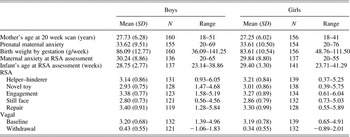
The numbers of infants from whom RSA data were obtained varied between 270 and 247 by condition (Table 1) because the electrodes became detached in 26 infants at various points during the procedures.
Summary of measures on boys and girls in the intensive sample of mothers and infants

Note: RSA, Respiratory sinus arrhythmia.
Variables considered as possible confounders
Perinatal complications
Information was obtained from hospital records of the extensive sample (N = 1,233) to rate items on a weighted scale used extensively in previous studies. Minor complications (scored 1) included induced labor, and more serious complications (scored 3) included labor lasting more than 30 hr and caesarian section. The complete list of complications and the severity ratings for the scale can be found in previous publications (Beck & Shaw, Reference Beck and Shaw2005).
Smoking, drinking, and maternal age
Smoking, drinking, and maternal age were all recorded in the 20 weeks gestation questionnaire with the extensive sample (N = 1,233). Smoking in pregnancy was assessed as none (N = 1,036), up to 10 per day (N = 160) and more than 10 per day (N = 37). In view of the small number reporting more than 10 per day, smoking was included as an absent–present binary variable. Alcohol was recorded as none (N = 950), less than 1 per week (N = 143) and more than 1 per week (N = 40), and so alcohol in pregnancy was also included as a binary variable. Maternal age was recorded in number of months.
Socioeconomic status
Socioeconomic position was measured using the revised English Index of Multiple Deprivation (IMD; Noble et al., Reference Noble, Wright, Dibben, Smith, McLennan and Antila2004) based on data collected from the UK Census in 2001. According to this system, postcode areas in England are ranked from most deprived (IMD = 1) to least deprived (IMD = 32,482), based on deprivation in seven domains: income, employment, health, education and training, barriers to housing and services, living environment, and crime. All mothers were given IMD ranks according to the postcode of the area where they lived and assigned to a quintile based on the UK distribution of deprivation.
Statistical analyses
Preliminary exploratory factor analysis was conducted to determine whether RSA from each of the five procedures contributed to a single latent variable. This supported (see Results Section) a one-factor confirmatory factor structural equation model (SEM) which was estimated in Mplus (Muthén & Muthén, Reference Muthén and Muthén2009) using full maximum likelihood and the auxiliary command, a method which enables participants with incomplete observations to be included under the assumption of the “missingness” being missing at random (Graham, Reference Graham2003). This method therefore yields estimates that account for the sample stratification, but it also accounts for data attrition associated with covariates (child's age, maternal age, neighborhood deprivation index, birth weight for gestational age, prenatal maternal anxiety, postnatal anxiety, birth complications, and smoking and drinking in pregnancy) and for any progressive loss of infant RSA measures across the five conditions for infants with systematically higher or lower RSA.
Model goodness-of-fit was assessed using the comparative fit index, for which values around 0.95 and above are considered good, and the root mean square error, for which values less than 0.05 are considered good. We report p values for single degree of freedom tests from Wald tests, p values for multiple degree of freedom tests from likelihood ratio tests, and confidence intervals (CIs) calculated from the parameter covariance matrix. The standardized estimates reported are from the model in which all observed variables and factors are scaled to have unit variance. Standardized effect estimates for each sex were obtained from models with separate predictor variables for girls and boys.
The sample design was accounted for in the estimates of disaggregated population means displayed in Figure 1 by the use of inverse probability weighting (Lehtonen & Pahkinen, Reference Lehtonen and Pahkinen2004). Pickles, Dunn, and Vasquez-Barquero (Reference Pickles, Dunn and Vasquez-Barquero1995) provide a description specific to the type of design of this study.
Results
Preliminary analyses
Maternal anxiety
Table 1 gives summary statistics for the measures for males and females separately. Prenatal anxiety was correlated (r = .48) with maternal anxiety at the time of the RSA assessment, underlining the need to control for postnatal anxiety when examining the contribution of anxiety during pregnancy.
Gestational age at birth
Gestational ages at birth ranged between 32 and 42 weeks, with only 8 (3%) of the infants assessed at 29 weeks born before 37 weeks.
RSA
The patterns of RSA across the five procedures were very similar in males and females, and there were no significant sex differences in any procedure. Post hoc tests in a repeated measures analysis of variance showed that RSA during the still face was significantly lower than in each of the other four procedures (all values of p < .01) consistent with vagal withdrawal to the stressor.
Principal components analysis of RSA
Principal components analysis yielded one factor with an eigenvalue of 3.54 that explained 70.73% of the total variance. The factor loadings were helper–hinderer, 0.86; novel toy exploration, 0.84; still face–engagement, 0.84; still face, 0.84; and still-face repair, 0.82. Thus, there was strong evidence for one latent variable reflecting an overall level of vagal tone for each individual, which was evident across both low- and high-stress procedures.
Birth weight, prenatal anxiety, and RSA
Application of SEM to the analysis of RSA
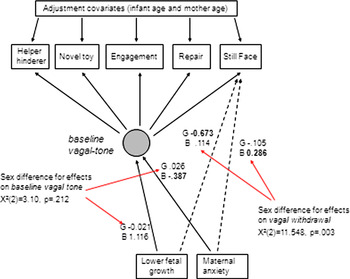
The SEM shown in Figure 2 examined the profile of five RSA measures adjusted for the infant's and mother's ages. In addition, and not shown in that diagram, was the psychological abuse scale score that was used as the basis for sampling stratification of the intensive sample and which in the analysis was allowed to be freely correlated with all the variables in the model. The effect of each risk variable was decomposed into two parts. The first part, shown by the solid arrow, estimated the effect of the risk variable on the general vagal tone factor (shown by the circle), an effect that was shared across the five conditions. The second part, shown by the dotted lines, estimated any additional effect on the vagal tone recorded under the still-face condition, a differential item contrast. These two parts correspond to the effects on a baseline (or average) vagal tone latent scale and the effects on a negative vagal withdrawal scale. These effects, as well as the means of the baseline vagal tone and negative vagal withdrawal, were allowed to be different for female and male infants.
(Color online). Summary of structural equation modeling analysis of effects of fetal growth and maternal anxiety during pregnancy on infants’ baseline vagal tone and vagal response to the still-face (differential item) condition (the negative of vagal withdrawal). Standardized coefficients with bold, p ≤ .05. G, girls; B, boys. The broken lines show differential item effects on the still-face condition. The negative coefficient for the effect of fetal growth in girls (–0.673) reflects increasing vagal withdrawal associated with lower growth. The positive coefficient for the effect of maternal anxiety in boys (0.286) reflects decreasing vagal withdrawal associated with increasing anxiety. Model goodness-of-fit, χ2 (20) = 62.18, comparative fit index = 0.94, root mean square error of approximation = 0.04.

Birth weight for gestational age and vagal tone (RSA)
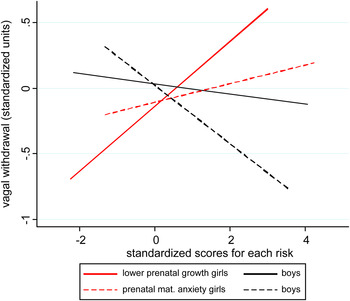
The model of Figure 2 fitted well. When tested together, birth weight for gestational age was not associated with baseline vagal tone in either girls (–0.021, CI = –0.740, 0.698; p = .954) or boys (0.116, CI = –0.502, 0.734; p = .713), and no sex difference in this association was found (interaction p = .779). However, lower birth weight resulted in increased vagal withdrawal in girls (−0.673, CI = –1.132, −0.214; p = .004) but not in boys (0.114, CI = –0.303, 0.530; p = .593), which was a significant sex difference (interaction p = .014).
Prenatal anxiety and vagal tone (RSA)
Maternal anxiety at 32 weeks was associated with baseline vagal tone in boys (−0.387, CI = –0.736, −0.037; p = .030) though not girls (0.026, CI = –0.284, 0.335; p = .871), but this was not a significant sex difference (interaction p = .084). For vagal withdrawal, 32 weeks anxiety was associated with less withdrawal in boys (0.286, CI = 0.042, 0.530; p = .022) but not in girls (–0.105, CI = –0.309, 0.099; p = .314), a sex difference that was significant (p = .016). A test for sex differences over both prenatal risks jointly was significant for vagal withdrawal, χ2 (2), p = .003, but not for baseline vagal tone, χ2 (2), p = .212. The standardized sex specific effects are shown in Figure 3.
(Color online). Regression lines of the interaction between infant sex and prenatal risk showing increasing vagal withdrawal with decreasing fetal growth (g/weeks gestation at birth) in females (red online, solid) but not males (black, sold), and decreasing vagal withdrawal with increasing maternal anxiety in males (black, dashed) but not in females (red online, dashed).

We also checked whether the pattern was the result of association with maternal anxiety contemporaneous with the vagal tone measurement. Contemporaneous maternal anxiety was associated with neither baseline vagal tone (p = .952) nor vagal withdrawal (p = .983) and the effects of birth weight and prenatal maternal anxiety remained as already described (interaction with sex p = .014 for birth weight and p = .016 for prenatal anxiety). Similarly, the interactions remained unchanged by the addition of further covariates to account for possible confounder effects of the child's age, the mother's age, neighborhood deprivation index, obstetric complications, and smoking and drinking in pregnancy (sex by birth weight interaction p = .015, sex by prenatal anxiety interaction p = .019).
Discussion
Low birth weight and maternal prenatal anxiety, both implicated in previous research into the fetal origins of disease, each independently predicted physiological reactivity, assessed as vagal withdrawal to a stressor in infancy. The effects were, however, different in males and females, suggesting contrasting processes in adaptation or vulnerability arising from fetal exposures.
The strengths of the study included general population sampling, prospective study from pregnancy through infancy with good sample retention, and examination of the contribution of prenatal anxiety controlling for postnatal exposure to maternal anxiety. A latent variable approach to the analysis of RSA across contrasting procedures provided strong evidence of an overall level of vagal tone evident in low- and high-stress conditions. This may provide a more robust measure of resting or baseline vagal tone than estimates obtained in previous studies from a wide range of conditions, each with their distinctive drawbacks. The differential item functioning approach provided a strong test of the specificity of impact on vagal withdrawal by first accounting for associations with the general vagal tone latent variable and then testing for any additional association specifically with vagal withdrawal, as defined in the model by the contrast between vagal tone in the still face and the general latent variable.
The findings need to be interpreted with caution in the light of currently available evidence. Although studies consistent with there being sex differences in associations between prenatal risks and later psychopathology were reviewed earlier, they have not been identified consistently (e.g., Barker, Jaffee, Uher, & Maughan, Reference Barker, Jaffee, Uher and Maughan2011). Evidence on mediators of the effects of prenatal stress on metabolic and cardiovascular outcomes later in life points to a role for autonomic reactivity and HPA axis variations, commonly modified by sex differences (Lehtonen & Pahkinen, Reference Lehtonen and Pahkinen2004). However, very little is known about early mediators of the long-term effects on psychopathology of maternal anxiety during pregnancy and low birth weight, and no studies have examined the prospective contributions of vagal reactivity from infancy to adolescence. Even though prospectively measured, we cannot assume causality from the reported associations because, for example, there may be a common genetic contribution to low birth weight, maternal anxiety, and infant vagal reactivity. Although we predicted sex differences from the animal and human evidence on biological effects, it is possible that they arose from processes in the still face. For example, different consequences of early social interaction with mothers in males and females have been described indicating that males may be more affected in the still-face procedure by maternal sensitivity than girls (Warren & Simmens, Reference Warren and Simmens2005; Weinberg, Tronick, Cohn, & Olson, Reference Weinberg, Tronick, Cohn and Olson1999). As a result, maternal sensitivity may be more strongly associated with vagal reactivity in males than in females. A general concern regarding studies reporting statistical interactions is that they run an elevated risk of false positives. This is particularly the case where multiple exploratory analyses of interactions between predictor variables are conducted but less of a concern in studies which, as does this study, examine interactions with sex of infant in the light of the available literature and with a hypothesized direction of effect. Nevertheless the findings must be treated with caution until there has been replication. Furthermore, much remains to be established regarding vagal reactivity in infancy, including its stability across time and its consistency across varying stress reactivity procedures.
Decreasing birth weight was strongly associated with increasing vagal withdrawal in girls, and there was a weak and statistically nonsignificant association in the opposite direction in boys (Figure 2). On the basis of the emergent literature reviewed earlier, this may be expected to confer resilience or vulnerability to lower birth weight females in a context-dependent fashion. Vulnerability, for example, could be seen in the presence of major environmental challenges, such as child maltreatment or parental mental illness. This would be consistent with findings of associations between low birth weight and adolescent depression only in females and in the presence of major childhood adversities (Costello et al., Reference Costello, Worthman, Erkanli and Angold2007). In the presence of more favorable childhood environments, the elevated vagal withdrawal may buffer girls from the effects of low birth weight. Increasing maternal anxiety, by contrast, was associated with decreasing vagal withdrawal in boys and a modest and nonsignificant increase in girls. Decreasing reactivity is likely to be associated with reduced arousal and hence less anxious inhibition of aggression. The later risk for psychiatric disorder may be with antisocial behavior disorders, in particular violence, consistent with associations between low vagal reactivity and externalizing disorders (Boyce et al., Reference Boyce, Quas, Alkon, Smider, Essex and Kupfer2001; Calkins et al., Reference Calkins, Graziano and Keane2007). More broadly, violence in children and adults is associated with indices of low arousal, such as low pulse rate and reduced cortisol reactivity (Brennan & Raine, Reference Brennan and Raine1997; Van Goozen, Fairchild, Snoek, & Harold, Reference Van Goozen, Fairchild, Snoek and Harold2007).
We argued that, because fetal programming hypotheses of medical and behavioral outcomes propose context-dependent effects, we should be looking for context-dependent mediators. Physiological reactivity in general, and vagal reactivity in particular, have context-dependent consequences so are plausible candidates. Our findings were consistent with that possibility. They also fall well short of demonstrating a mediating role. That will require longitudinal study at least into adolescence, with adequate measurement of environmental exposures, in this and other studies. The finding of sex differences opens opportunities to test specific hypotheses regarding sex differences in psychopathology. One of the most striking and yet poorly understood differences is that, in males, disorders associated with environmental risks generally appear early in childhood, while in females they are apparent mainly in adolescence (Rutter, Caspi, & Moffitt, Reference Rutter, Caspi and Moffitt2003). It is possible that elevated vagal withdrawal in low birth weight girls may protect them from emotional and behavioral problems before puberty while subsequently rendering them vulnerable to anxiety and depression if exposed to major adversities (Costello et al., Reference Costello, Worthman, Erkanli and Angold2007). By contrast, decreased vagal withdrawal in boys associated with maternal anxiety in pregnancy may, in the presence of adversities, create early vulnerability to behavior problems.