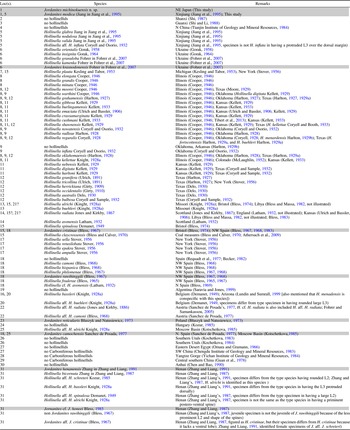
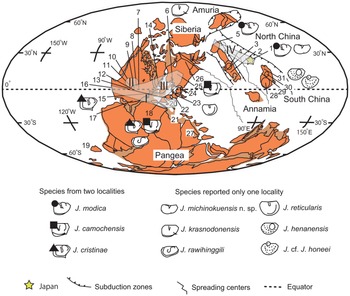
Introduction
Several attempts have been made to reconstruct the paleogeographic position of Japan in the Paleozoic. Tazawa (Reference Tazawa2004) mentioned that Japan originated in a subduction zone of the eastern margin of North China during the Early Ordovician, and the position did not change until the late Permian–Late Jurassic. On the other hand, Ehiro (Reference Ehiro2001) considered Japan as located near South China from the early Paleozoic to the middle Permian or Mesozoic as a “microcontinent.” Isozaki et al. (Reference Isozaki, Maruyama, Aoki, Nakama, Miyashita and Otoh2010) applied age estimation methods using detrital zircons in Paleozoic sedimentary rocks from Japan, compared various zircon ages from adjacent areas and considered the paleogeographic position of Japan. The typical peaks of zircon ages from the Paleozoic of Japan indicate that it originated as arcs outboard from South China (Isozaki et al., Reference Isozaki, Maruyama, Nakata, Yamamoto and Yanai2011). With further data from zircon ages, Isozaki et al. (Reference Isozaki, Aoki, Sakata and Hirata2014) proposed “Greater South China,” which expands from the South China craton to the South Kitakami belt of Japan, via the East China Sea. He also explained that the similarity of brachiopod assemblages between Japan and Northeast China can be explained by the northward extension of Greater South China where Northeast Japan is located (Isozaki, Reference Isozaki2019). Recently, Wakita et al. (Reference Wakita, Nakagawa, Sakata, Tanaka and Oyama2021) collected detrital zircon ages and examined igneous rocks in the West Pacific region. They concluded that Japan initially was situated on the continental margin of Gondwana during the early–middle Paleozoic; then, with the break-up of the Gondwana margin, South China and the Japan arc were separated from Gondwana during the Late Devonian–Carboniferous. Williams et al. (Reference Williams, Wallis, Oji and Lane2014) cautioned that consideration of life strategy and facies control should be factored in when drawing biogeographical conclusions from Japanese lower and middle Paleozoic faunas. They noted widely divergent signals from different groups as evidence for this caution.
Ostracodes are small crustaceans (usually <1 mm) that bear a bivalved calcitic shell. Among them, myodocope ostracodes are benthic or planktonic, and podocope ostracodes are benthic or nectobenthic. Here, I examined podocopes because Recent species are demonstrably useful for defining biogeographical regions (Titterton and Whatley, Reference Titterton, Whatley, Hanai, Ikeya and Ishizaki1988; Tanaka, Reference Tanaka2008) and therefore they are important taxa for reconstructing paleogeography (Schallreuter and Siverter, Reference Schallreuter and Siveter1985; Williams et al., Reference Williams, Floyd, Salas, Siveter, Stone and Vannier2003; Perrier and Siveter, Reference Perrier, Siveter, Harper and Servais2014; Tanaka et al., Reference Tanaka, Siveter and Williams2019; but see Pour et al., Reference Pour, Mohibullah, Williams, Popov and Tolmacheva2011; Mohibullah et al., Reference Mohibullah, Williams, Vandenbroucke, Sabbe and Zalasiewicz2012). In Japan, some Paleozoic ostracodes were described from Southwest Japan (Kuwano, Reference Kuwano1987; Tanaka et al., Reference Tanaka, Ono, Yuan, Ichida and Maeda2012, Reference Tanaka, Ono, Nishimura and Maeda2013, Reference Tanaka, Miyake, Ono, Yuan, Ichida, Maeda and Crasquin2018, Reference Tanaka, Siveter and Williams2019; Stocker et al., Reference Stocker, Komatsu, Tanaka, Williams, Siveter, Bennett, Wallis, Oji, Maekawa, Okura and Vandenbroucke2016; Siveter et al., Reference Siveter, Tanaka, Williams and Männik2018). However, little is known about Paleozoic ostracodes from Northeast Japan, and all the existing works were written before the 1970s using optical photographs only (Ishizaki, Reference Ishizaki1963, Reference Ishizaki1964a, Reference Ishizakib, Reference Ishizaki1967, Reference Ishizaki1968). This study aims to describe the ostracodes from the Pennsylvanian Nagaiwa Formation that previously were studied by Ishizaki (Reference Ishizaki1963, Reference Ishizaki1964b) and consider the paleogeographic position of Japan during the Pennsylvanian based on the ostracode assemblages.
Geological setting
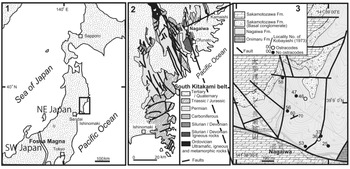
The geology of Japan is subdivided into Southwest Japan and Northeast Japan by a large structural lineament “Fossa Magna” (Koto, Reference Koto1888) (Fig. 1.1). In Northeast Japan, the South Kitakami belt is composed of Ordovician ultramafic, igneous, and metamorphic rocks, Silurian/Devonian igneous rocks, and Paleozoic–Mesozoic sedimentary rocks (Isozaki, et al., Reference Isozaki, Maruyama, Aoki, Nakama, Miyashita and Otoh2010; Kawamura et al., Reference Kawamura, Uchino, Kawamura, Yoshida, Nakagawa and Nagata2013). Carboniferous strata are sporadically distributed in the northern part of Nagaiwa, ~15 km NNW of Ofunato City, Iwate Prefecture, Japan (Fig. 1.2).
Locality map of the Nagaiwa Formation. (1) Northeast Japan (NE Japan) and Southwest Japan (SW Japan) are geologically divided by Fossa Magna. Rectangular box shows area in Figure 1.2. (2) Magnified map of South Kitakami belt showing Paleozoic and Mesozoic (Triassic/Jurassic) rocks that are sporadically distributed and deformed by many faults (map based on Isozaki et al., Reference Isozaki, Maruyama, Aoki, Nakama, Miyashita and Otoh2010, and Kawamura et al., Reference Kawamura, Uchino, Kawamura, Yoshida, Nakagawa and Nagata2013). (3) Detailed geological map of the study area and sample locality. The geological map, sample locality, and each number of sample locality is based on Kobayashi (Reference Kobayashi1973). White circle shows that ostracodes were recovered, shaded circles show that there were no ostracodes. Abbreviation: Fm., Formation; No., Number.

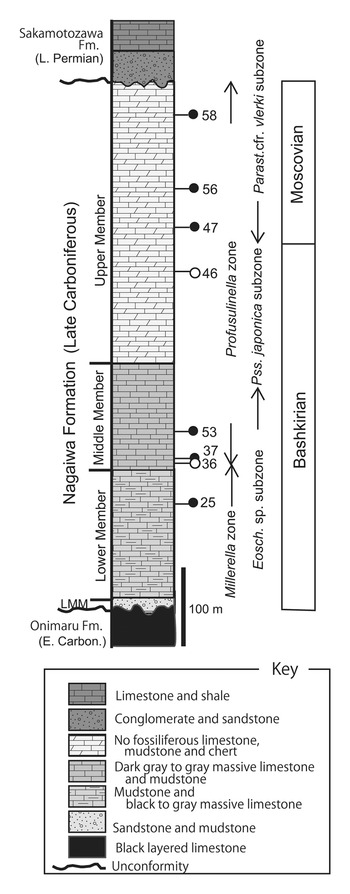
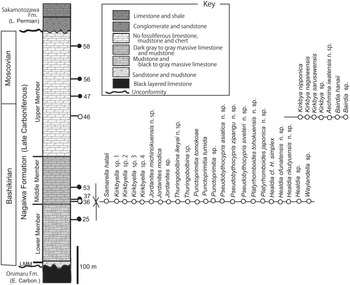
The Nagaiwa Formation unconformably overlies the Mississippian Onimaru Formation and is unconformably covered by the lower Permian Sakamotozawa Formation (Kobayashi, Reference Kobayashi1973). According to Kobayashi (Reference Kobayashi1973), the Nagaiwa Formation is subdivided into Lowermost, Lower, Middle, and Upper members. The Lowermost Member consists of sandstone, mudstone, and no fossils. The Lower Member is composed of mudstone and black to gray massive limestone. The mudstone contains a sponge genus, Chaetetes, and the limestone contains many fossils such as fusulinids, crinoids, calcareous algae, bryozoans, corals, and small foraminifers. The Upper Member mainly consists of non-fossiliferous limestone, mudstone, and chert (Kobayashi, Reference Kobayashi1973). The Middle Member, which is formed of dark-gray to gray massive limestone and mudstone, contains many crinoids and fusulinids; sometimes, gastropods and small foraminifers occur in the limestone, which contains siliceous nodules. Based on the fusulinid biostratigraphy, the Lowermost and Lower members are comparable to the Millerella Zone, and the Middle and Upper members correspond with the Profusulinella Zone, showing that the Nagaiwa Formation was deposited during the early Bashkirian to early Moscovian (Kobayashi, Reference Kobayashi1973).
Materials and methods
Based on the lithologic character and reports of the fossils collected by Kobayashi (Reference Kobayashi1973), I collected eight fossiliferous localities from the Nagaiwa area, Ofunato City, Iwate Prefecture, Northeast Japan (Figs. 1.3, 2). Approximately 2 kg of limestone rocks were collected from each sample locality. Among them, one sample was from the Lower Member at sample locality No. 25 of Kobayashi (Reference Kobayashi1973), which is dark gray massive limestone; three samples (Loc. 38, 37, 53 of Kobayashi, Reference Kobayashi1973) were recovered from the Middle Member and consisted of dark gray massive limestone; and four samples (Loc. 46, 47, 56, 58 of Kobayashi, Reference Kobayashi1973) of light gray dolomitic limestone and some altered mudstones were collected from the Upper Member. The rocks were split into ~2–4 cm3, washed with running water, placed on a 16-mesh (1 mm) sieve attached to a 235-mesh (63 μm) sieve, and arranged in a bucket where the upper sieves were filled with 5% acetic acid. After two weeks, the sieves were picked up and rinsed in water inside a large bucket to remove the acid from residue. The residue was collected into a beaker and dried in an oven at 60°C for one day. The ostracode specimens were picked under a binocular microscope (Olympus SZH10) at ×20 magnification and stored in faunal slides.
Column of the Nagaiwa Formation, fusulinid biostratigraphy, and each horizon of sample locality and number of sample localities (altered Kobayashi, Reference Kobayashi1973). Abbreviations: E, Early; Eosch., Eoschubertella; Fm., Formation; L., Lower; LMM, Lowermost Member; Parast., Parastaffella; Pss., Pseudostafella.

Repositories and institutional abbreviations
Ishizaki's type specimens have been deposited in the Institute of Geology and Paleontology, Tohoku University, Sendai, Miyagi, Japan (IGPS-number); Jiang et al.'s (Reference Jiang, Zhou and Lin1995) types have been deposited in the Xinjiang Petroleum Administration Bureau (Xj-number). All figured specimens reported here have been preserved in the collection of the Tohoku University Museum (IGPS-number).
Systematic paleontology
The terminology of Paleozoic ostracodes follows Vannier et al., Reference Vannier, Siveter and Schallreuter1989.
Class Ostracoda Latreille, Reference Latreille1802
Subclass Podocopida Sars, Reference Sars1866
Order Beyrichiocopida Pokorný, Reference Pokorný1954
Suborder Beyrichicopina Scott, Reference Scott and Moore1961
Superfamily Paraparchitoidea Scott, Reference Scott1959
Family Paraparchitidae Scott, Reference Scott1959
Genus Samarella Polenova, Reference Polenova1952
Type species
Samarella crassa Polenova, Reference Polenova1952 (VNIGRI Z5-116), from the upper part of the Givetian Stage of the central Devonian field, Samarkaya Luka (Syzran), Penza region (Yulovo-Ishim), Russia, by original description.
Samarella hataii Ishizaki, Reference Ishizaki1964
Figure 3.1–3.5
- Reference Ishizaki1964b
Samarella hataii, Ishizaki, p. 37, pl. 1, figs. 10a–c.
- Reference Hanai, Ikeya, Ishizaki, Sekiguchi and Yajima1977
Samarella ? hataii; Hanai et al., p. 15.
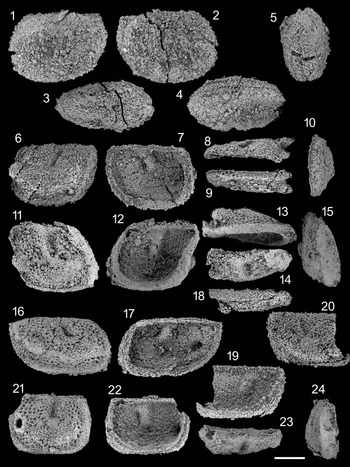
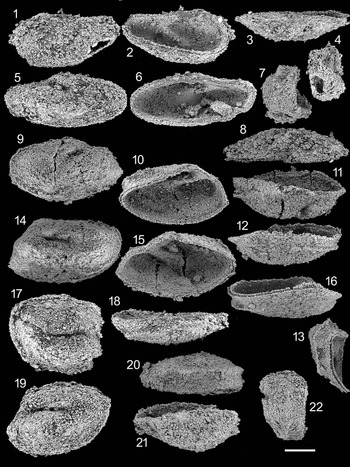
Scanning electron micrographs of ostracodes from the Pennsylvanian Nagaiwa Formation. (1–5) A carapace of Samarella hataii Ishizaki, Reference Ishizaki1964b, IGPS-112670; (1) left lateral view, (2) right lateral view, (3) dorsal view, (4) ventral view, (5) anterior view. (6–10) A right valve of Kirkbyella sp. 1, IGPS-112671; (6) outer lateral view, (7) inner lateral view, (8) dorsal view, (9) ventral view, (10) anterior view. (11–15) A right valve of Kirkbyella sp. 2, IGPS-112673; (11) external view, (12) internal view, (13) ventral view, (14) dorsal view, (15) anterior oblique view. (16–18) A right valve of Kirkbyella sp. 3, IGPS-112674; (16) external view, (17) internal view, (18) dorsal view. (19, 20) A left valve of Kirkbyella sp. 1, IGPS-112672; (19) outer lateral view, (20) inner lateral view. (21–24) A right valve of Kirkbyella sp. 4, IGPS-112675; (21) external lateral view, (22) internal view, (23) dorsal view, (24) anterior view. Scale bar = 200 μm.

Holotype
Holotype, a carapace IGPS-78405; type locality: Nagaiwa, Ofunato City, Iwate Prefecture, Northeast Japan, Bashkirian to Moscovian.
Occurrence
Locality 36 of Kobayashi (Reference Kobayashi1973), Middle Member of the Nagaiwa Formation, Nagaiwa, Japan.
Material
One carapace, length = 640 μm, height = 308 μm, IGPS-112670.
Remarks
Ishizaki (Reference Ishizaki1964b) placed this species into the genus Samarella with some doubt because the adductorial sulcus (S2) is present in the left valve but is missing from the right valve. Hanai et al. (Reference Hanai, Ikeya, Ishizaki, Sekiguchi and Yajima1977) mentioned that the generic identification is questionable. The present study revealed there is no S2 in both valves, showing that Ishizaki's described S2 is the result of compression by fossilization, as he mentioned in the comments on the genus. Furthermore, the right valve overlaps the left valve in the dorsal area, and the left valve overlaps the right valve in the ventral area, which is the definition of the genus Samarella (Polenova, Reference Polenova1952). Samarella hataii is similar to Shivaella suppetia Sohn, Reference Sohn1971, from the Late Mississippian Platy Limestone Member of the Alapah Limestone, Little Chander Lake, Brooks Range, Alaska, USA, in sharing a widely arched umbo with that taxon, but it differs in that it has a widely arched anterior and ventral margins, an acute posterior margin, and no dorsal spine.
Suborder Palaeocopina Henningsmoen, Reference Henningsmoen1953
Superfamily Kirkbyoidea Ulrich and Bassler, Reference Ulrich and Bassler1906
Family Kirkbyidae Ulrich and Bassler, Reference Ulrich and Bassler1906
Genus Kirkbyella Coryell and Booth, Reference Coryell and Booth1933
Type species
Kirkbyella typa Coryell and Booth, Reference Coryell and Booth1933 (Columbia University Paleo. Coll. Cat. No. 27545) from the Pennsylvanian Wayland Shale Member of the Graham Formation, Texas, USA, by original description.
Kirkbyella sp. 1
Figure 3.6–3.10, 3.19, 3.20
Occurrence
Locality 36 of Kobayashi (Reference Kobayashi1973), Middle Member of the Nagaiwa Formation, Nagaiwa, Ofunato City, Iwate Prefecture, Northeast Japan, Bashkirian.
Materials
A right valve, length = 541 μm, height = 406 μm, IGPS-112671; a left valve, height = 332 μm, IGPS-112672.
Remarks
Kirkbyella sp. 1 is similar to Kirkbyella typa Coryell and Booth, Reference Coryell and Booth1933, from the Pennsylvanian Wayland Shale Member of the Graham Formation, Texas, USA; it has a broad bend terminating in a knob-like structure, but K. sp. 1 differs from K. typa in that it has a straight dorsal margin, develops a narrow carina, and has an obliquely extending S2. This species is similar to Kirkbyella pterygia Jiang in Jiang et al., Reference Jiang, Zhou and Lin1995, from the Pennsylvanian Shiqiantan Formation, northern slope of Bogduo Mountain, Xinjiang, China, in that it has a broad bend terminating in a knob-like structure, but it differs in that it has a smooth surface, broadly arched ventral margin, and obliquely extending S2. Kirkbyella sp. 1 is similar to K. sp. of Jiang et al. (Reference Jiang, Zhou and Lin1995), discovered from the Pennsylvanian Dongtujinhe Formation in the Boluohuolo Mountain, Wenquan area, Xinjiang, China, in that it has a smooth surface; however, K. sp. 1 is distinguished by the presence of an obliquely extending S2, a broadly arched ventral margin, and the broad bend terminating in a knob-like structure.
Kirkbyella sp. 2
Figure 3.11–3.15
Occurrence
Locality 36 of Kobayashi (Reference Kobayashi1973), Middle Member of the Nagaiwa Formation, Nagaiwa, Ofunato City, Iwate Prefecture, Northeast Japan, Bashkirian.
Materials
A right valve, length = 541 μm, height = 431 μm, IGPS-112673.
Remarks
Kirkbyella sp. 2 is similar to Kirkbyella typa of Coryell and Booth (Reference Coryell and Booth1933) from the Pennsylvanian Wayland Shale Member of the Graham Formation, Texas, USA, with an undulated dorsal margin, but K. sp. 2 differs from K. typa in that it has an obliquely extending S2, fine reticulation, and a narrowly convex anterior margin. This species is also similar to Kirkbyella pterygia Jiang in Jiang et al., Reference Jiang, Zhou and Lin1995, from the Pennsylvanian Shiqiantan Formation, northern slope of Bogduo Mountain, Xinjiang, China, in that it has a broad bend terminating in a knob-like structure, but it differs in that it has fine reticulation, a sub-parallelogram lateral outline, and an obliquely extending S2. Kirkbyella sp. 2 is similar to K. sp. of Jiang et al. (Reference Jiang, Zhou and Lin1995) discovered in the Pennsylvanian Dongtujinhe Formation in the Boluohuolo Mountain, Wenquan area, Xinjiang, China, in that it has a broad bend terminating in a knob-like structure; however, K. sp. 2 is distinguished by the presence of an obliquely extending S2, a sub-parallelogram lateral outline, and a fine reticulated surface.
Kirkbyella sp. 3
Figure 3.16–3.18
Occurrence
Locality 36 of Kobayashi (Reference Kobayashi1973), Middle Member of the Nagaiwa Formation, Nagaiwa, Ofunato City, Iwate Prefecture, Northeast Japan, Bashkirian.
Materials
A right valve, length = 652 μm, height = 357 μm, IGPS-112674.
Remarks
Kirkbyella sp. 3 has ornamentation that is similar to Kirkbyella sp. 2 from the same locality, but K. sp. 3 differs from K. sp. 2 in its longer and flatter lateral outline. This species is also similar to Kirkbyella pterygia Jiang in Jiang et al., Reference Jiang, Zhou and Lin1995, from the Pennsylvanian Shiqiantan Formation, northern slope of Bogduo Mountain, Xinjiang, China, in that it has a broad bend terminating in a knob-like structure, but it differs in having a fine reticulation, a sub-parallelogram lateral outline, and an obliquely extending S2. Kirkbyella sp. 3 is similar to K. sp. of Jiang et al. (Reference Jiang, Zhou and Lin1995) discovered in the Pennsylvanian Dongtujinhe Formation in the Boluohuolo Mountain, Wenquan area, Xinjiang, China, in having a broad bend terminating in a knob-like structure; however, K. sp. 3 is distinguished by the presence of an obliquely extending S2, a sub-parallelogram lateral outline, and a finely reticulated surface.
Kirkbyella sp. 4
Figure 3.21–3.24
Occurrence
Locality 36 of Kobayashi (Reference Kobayashi1973), Middle Member of the Nagaiwa Formation, Nagaiwa, Ofunato City, Iwate Prefecture, Northeast Japan, Bashkirian.
Material
One right valve, length = 529 μm, height = 369 μm, IGPS-112675.
Remarks
Kirkbyella sp. 4 resembles Kirkbyella typa Coryell and Booth, Reference Coryell and Booth1933, from the Pennsylvanian Wayland Shale, Texas, USA, in that it has a straight but slightly posteriorly elongate S2. Kirkbyella. sp. 4 differs from K. typa in that it has a higher and shorter lateral outline, a straight dorsal margin, and finer ornamentation. Kirkbyella sp. 4 is also similar to Kirkbyella pterygia Jiang in Jiang et al., Reference Jiang, Zhou and Lin1995, from the Pennsylvanian Dongtujinhe Formation at Boluohuolo Mountain, Wenquan area, Xinjiang, China, in that it has a prominent tubercle at the end of the ventral ridge. Kirkbyella sp. 4 differs from K. pterygia in that it has finer ornamentation, a wider flat area along the anterior margin, and a 4:3 length-height ratio in lateral view.
Genus Kirkbya Jones, Reference Jones1859
Type species
Dithyrocaris permiana Jones, Reference Jones1850 (type specimen was not designated), from the Permian limestone of Byer's Quarry northeast England, UK, by original description. Topotype specimens (PM OS 7305–7307) have been deposited in The Natural History Museum, London.
Kirkbya nipponica Ishizaki, Reference Ishizaki1964
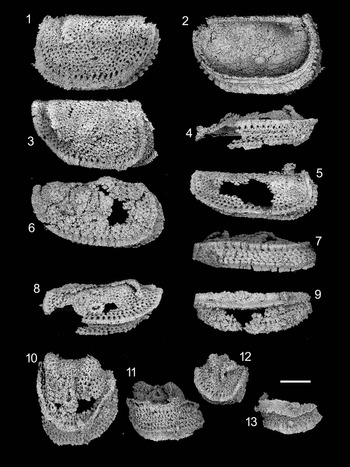
Figure 4.1–4.4
- Reference Ishizaki1964b
Kirkbya nipponica Ishizaki, p. 32, pl. 1, figs. 3a, b.
- Reference Hanai, Ikeya, Ishizaki, Sekiguchi and Yajima1977
Kirkbya? nipponica; Hanai et al., p. 9.
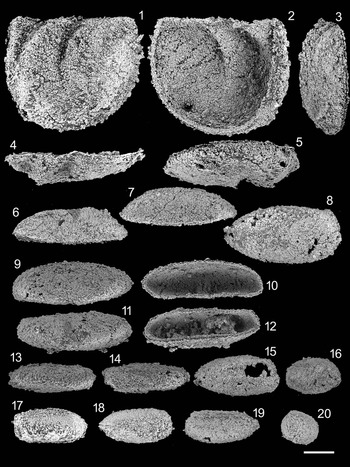
Scanning electron micrographs of ostracodes from the Pennsylvanian Nagaiwa Formation. (1, 2) A left valve of Kirkbya nipponica Ishizaki, Reference Ishizaki1964b, IGPS-112676; (1) external view, (2) internal view; (3, 4) a right valve of Kirkbya nipponica Ishizaki, Reference Ishizaki1964b, IGPS-112677; (3) external view, (4) ventral view. (5) Kirkbya nagaiwensis Ishizaki, Reference Ishizaki1964b, external view of right valve, IGPS-112678. (6, 7) A right valve of Kirkbya sp., IGPS-112682; (6) external view, (7) ventral view. (8–13) Deformed specimens of Kirkbya sarusawensis Ishizaki, Reference Ishizaki1968; (8) lateral view of left valve and (9) its ventral view, IGPS-112679; (10) lateral view of right valve and (11) its ventral view, IGPS-112680, (12) lateral view of juvenile specimen and (13) its ventral view, IGPS-112681. Scale bar = 400 μm.

Types
Holotype, one right valve IGPS-78392; paratype, one left valve IGPS-78398; type locality: Nagaiwa, Ofunato City, Iwate Prefecture, Northeast Japan, lower Bashkirian–lower Moscovian.
Occurrence
Locality 46 of Kobayashi (Reference Kobayashi1973), Upper Member of the Nagaiwa Formation, Nagaiwa, Japan.
Material
One left valve, length = 1560 μm, height = 920 μm, IGPS-112676; one right valve, length = 1540 μm, height = 840 μm, IGPS-112677.
Remarks
Ishizaki (Reference Ishizaki1964b) placed this species in the genus Kirkbya. Hanai et al. (Reference Hanai, Ikeya, Ishizaki, Sekiguchi and Yajima1977) regarded the generic identification as questionable because of the poor preservation of the type specimen. I extracted this species from Loc. 46 of Kobayashi (Reference Kobayashi1973), but many fossil specimens from this locality were deformed by diagenesis. However, present materials show a posterior shoulder and a more acutely curved posterior cardinal angle than anterior ones, and these characteristics are diagnostic of Kirkbya. Kirkbya nipponica is similar to Kirkbya parva Buschmina, Reference Buschmina1975, from the Mississippian of Kamenka Creek, Kolyma, Far East Russia, but K. nipponica differs from K. parva in that it has an acutely curved posterior cardinal angle, a prominent shoulder, and a more rounded lateral outline. Kirkbya nipponica Ishizaki, Reference Ishizaki1964b, is similar to Kirkbya sp. of Ishizaki (Reference Ishizaki1967) from the early Permian Tassobe Formation, South Kitakami Massif, Northeast Japan, by having a straight dorsal margin, but it differs in that it has a prominent anterior shoulder, an acutely curved posterior cardinal angle, and prominent rims.
Kirkbya nagaiwensis Ishizaki, Reference Ishizaki1964
Figure 4.5
- Reference Ishizaki1964b
Kirkbya nagaiwensis Ishizaki, p. 33, pl. 1, figs. 5a, b.
- Reference Hanai, Ikeya, Ishizaki, Sekiguchi and Yajima1977
Kirkbya nagaiwensis; Hanai et al., p. 8.
Holotype
Holotype, one carapace, IGPS-78400; type locality: Nagaiwa, Ofunato City, Iwate Prefecture, Northeast Japan, Bashkirian.
Occurrence
Locality 46 of Kobayashi (Reference Kobayashi1973), Upper Member of the Nagaiwa Formation, Nagaiwa, Japan.
Material
One right valve, length = 1580 μm, height = 580 μm, IGPS-112678.
Remarks
Specimens from this locality were deformed by diagenesis. However, present materials show an elongated lateral outline similar to the type specimen of Ishizaki (Reference Ishizaki1964b). Kirkbya nagaiwensis is similar to Kirkbya punctata Kellett, Reference Kellett1933, from the Pennsylvanian Stanton Limestone, Kansas, USA, in its elongated lateral outline, but it differs in that it has a prominent rim, a rather flat shoulder, and coarser ventral reticulation. Kirkbya nagaiwensis Ishizaki, Reference Ishizaki1964b, is similar to Kirkbya inornatum Roth, Reference Roth1929, from the Carboniferous Wapanucka Limestone Pontotoc County, Oklahoma, USA, in its slightly sinuate ventral margin, but it differs in its reticulation, an acutely curved posterior cardinal angle, and prominent rims. Kirkbya nagaiwensis is also similar to Kirkbya jolliffana Bradfield, Reference Bradfield1935, from the Carboniferous Dornick Hills Formation, northwest of Berwyn, Oklahoma, USA, in its elongated lateral outline, but it differs in having a prominent inner rim (marginal ridge), coarser reticulation, and no nodes on the dorsal area.
Kirkbya sarusawensis Ishizaki, Reference Ishizaki1968
Figure 4.8–4.13
- Reference Ishizaki1968
Kirkbya sarusawensis Ishizaki, p. 13, pl. 1, fig. 7.
- Reference Hanai, Ikeya, Ishizaki, Sekiguchi and Yajima1977
Kirkbya sarusawensis; Hanai et al., p. 9.
- Reference Jiang, Zhou and Lin1995
Kirkbya vivata Jiang in Jiang et al., p. 106, pl. 97, figs. 16, 17.
- Reference Stocker, Komatsu, Tanaka, Williams, Siveter, Bennett, Wallis, Oji, Maekawa, Okura and Vandenbroucke2016
Kirkbya sarusawensis; Stocker et al., p. 101, fig. 4a, d, g.
Holotype
Holotype, one right valve IGPS-78410; type locality: west of Nanatsumori and 1 km north of Sarusawa, Daito Town, Iwate Prefecture, Northeast Japan, the Mississippian Takezawa Formation.
Occurrence
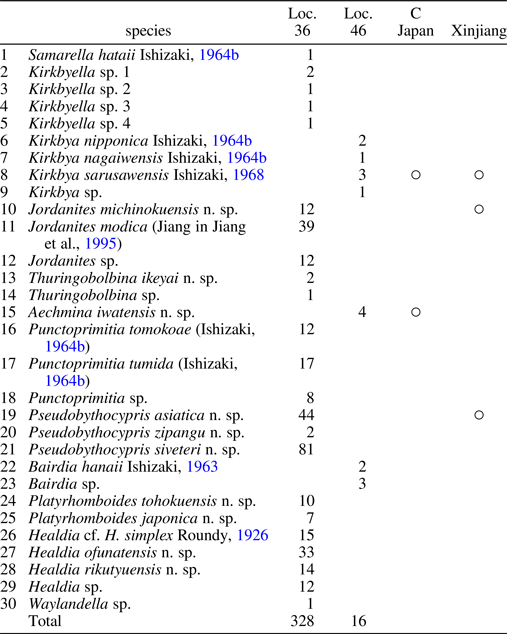
Mississippian Takezawa Formation, Daito Town, Iwate Prefecture, Northeast Japan; Pennsylvanian Azigan Formation, Kunlun Mountain, Xinjiang, China; Pennsylvanian (middle Moscovian) Ichinotani Formation, Mizuboradani Valley, Takayama City, Gifu Prefecture, central Japan; Locality 46 of Kobayashi (Reference Kobayashi1973), Upper Member of the Nagaiwa Formation, Nagaiwa, Japan.
Material
One deformed left valve, IGPS-112679; one deformed right valve, IGPS-112680; one deformed juvenile valve, IGPS-112681.
Remarks
Ishizaki (Reference Ishizaki1968) described this species as new based on its slightly dorsally protruded anterior lobe. Specimens from this locality were deformed by diagenesis. However, these specimens show the anterior lobe lower than the posterior lobe, as opposed to the opposite in Ishizaki's (Reference Ishizaki1968) description. Kirkbya sarusawensis Ishizaki, Reference Ishizaki1968, is similar to Kirkbya knuepferi Kozur, Reference Kozur1985, from the late Permian Nagyvisnyó Formation, Mihalovits Steinbruch, north Hungary, in its less protruded anterior lobe, but it differs in that it has coarse reticulation, a prominent posterior lobe, and a widely arched velate ridge. Kirkbya sarusawensis is also similar to Kirkbya clarocarinata (Knight, Reference Knight1928a) figured by Zhang and Liang (Reference Zhang and Liang1987) from the Pennsylvanian Taiyuan Formation, Xingyang, Henan, South China, in its less protruded anterior lobe, but it differs in that it has an evenly arched velate ridge, a knob-like posterior lobe, and no smooth antero-dorsal area.
Kirkbya sp.
Figure 4.6, 4.7
Occurrence
Locality 46 of Kobayashi (Reference Kobayashi1973), Upper Member of the Nagaiwa Formation, Nagaiwa, Japan.
Material
One right valve, length = 1620 μm, height = 900 μm, IGPS-112682.
Remarks
Kirkbya sp. resembles Kirkbya nipponica Ishizaki, Reference Ishizaki1964b, in its similar lateral outline and prominent rims, but it differs in having a coarser reticulation, a less prominent posterior shoulder, and an anterior lobe.
Order Hollinocopida Henningsmoen, Reference Henningsmoen1965
Suborder Hollinocopina Swartz, Reference Swartz1936
Superfamily Hollinoidea Swartz, Reference Swartz1936
Family Hollinellidae Bless and Jordan, Reference Bless and Jordan1971
Genus Jordanites Bless, Reference Bless1967
Type species
Jordanites rawihinggili Bless, Reference Bless1967 (Geologisch & Mineralogisch Instituut of the Rijksuniversiteit of Leiden, No. Fe361-1) from the Westphalian D (Pennsylvanian) of the Coal-mine, Mosquitera, Asturias, Spain, by original description.
Jordanites modica (Jiang in Jiang et al., Reference Jiang, Zhou and Lin1995)
Figures 5, 6
- Reference Ishizaki1964b
Hollinella tingi; Ishizaki, p. 30, pl. 1, fig. 1.
- Reference Hanai, Ikeya, Ishizaki, Sekiguchi and Yajima1977
Hollinella (Hollinella) tingi; Hanai et al., p. 7.
- Reference Jiang, Zhou and Lin1995
Hollinella modica Jiang in Jiang et al., p. 96, pl. 96, figs. 12–17.
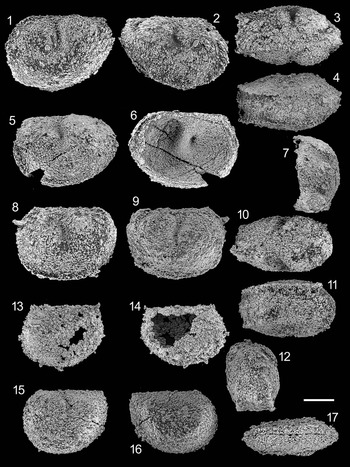
Scanning electron micrographs of ostracodes from the Pennsylvanian Nagaiwa Formation. (1–4) A female carapace of Jordanites modica (Jiang in Jiang et al., Reference Jiang, Zhou and Lin1995), IGPS-112683; (1) left lateral view, (2) right lateral view, (3) dorsal view, (4) ventral view; (5–7) a female left valve of Jordanites modica (Jiang in Jiang et al., Reference Jiang, Zhou and Lin1995), IGPS-112684; (5) external view, (6) internal view, (7) anterior view; (8–12) a male carapace of Jordanites modica (Jiang in Jiang et al., Reference Jiang, Zhou and Lin1995), IGPS-112685; (8) left lateral view, (9) right lateral view, (10) dorsal view, (11) ventral view, (12) anterior view; (13, 14) a juvenile carapace of Jordanites modica (Jiang in Jiang et al., Reference Jiang, Zhou and Lin1995), IGPS-112686; (13) left lateral view, (14) right lateral view; (15–17) a juvenile carapace of Jordanites modica (Jiang in Jiang et al., Reference Jiang, Zhou and Lin1995), IGPS-112687; (15) left lateral view, (16) right lateral view, (17) ventral view. Scale bar = 200 μm.

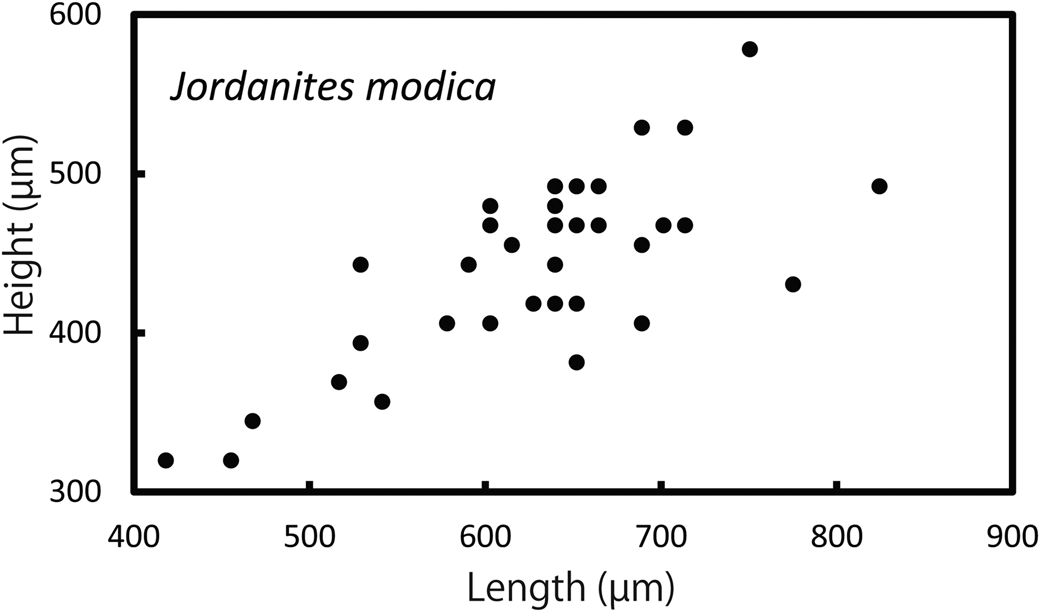
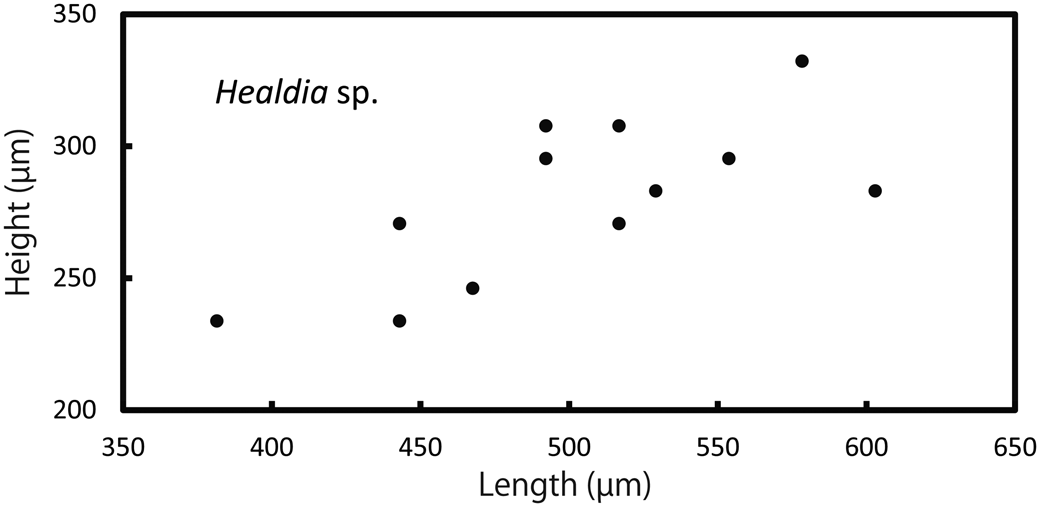
Ontogenetic change of length/height of Jordanites modica (Jiang in Jiang et al., Reference Jiang, Zhou and Lin1995).

Types
Holotype, a complete carapace Xj-1817; paratypes, three carapaces Xj-1819, Xj-1820a, 1820b; type locality: Pennsylvanian Kalawuyi Formation, Tarim Basin, Xinjiang, China.
Occurrence
Pennsylvanian Kalawuyi Formation, Tarim Basin, Xinjiang, China; Locality 36 of Kobayashi (Reference Kobayashi1973), Upper Member of the Nagaiwa Formation, Nagaiwa, Japan.
Material
One female carapace, length = 689 μm, height = 455 μm, IGPS-112683; one female left valve, length = 639 μm, height = 480 μm, IGPS-112684; one male carapace, length = 589 μm, height = 455 μm, IGPS-112685; two juvenile carapaces, length = 529 μm, height = 394 μm, IGPS-112686, length = 517 μm, height = 369 μm, IGPS-112687.
Remarks
The figured specimens in this study have a fused lobe 1 (L1) and lobe 2 (L2), large lobe 3 (L3), and inconspicuous lobe 4 (L4), which is consistent with the generic character of Jordanites designated by Bless (Reference Bless1967). Ishizaki (Reference Ishizaki1964b) identified the specimens from the Nagaiwa Formation as Hollinella tingi Patte, Reference Patte1935, from the Permian of southeastern China, as a result of its outline and ornamentation, but it differs in that it has a straight dorsal margin, rounded lateral outline, fused L1 and L2, and a widely arched anterior margin. Jordanites modica (Jiang in Jiang et al., Reference Jiang, Zhou and Lin1995) is similar to Jordanites rawihinggili Bless, Reference Bless1967, from the Pennsylvanian of Asturias, northwestern Spain, in its sub-quadrate lateral outline, but it differs in that it has ornamentation, a prominent L3, and an acutely arched posterior margin. Jordanites modica is also similar to Jordanites cristinae (Bless, Reference Bless1967) of Asturias, northwestern Spain, in its acutely arched posterior margin, but it differs in that it has a dorsally protruded L3, a dorsally inflated L1, and a more inflated carapace. Jordanites modica (Jiang, Reference Jiang, Zhou and Lin1995) is somewhat similar to Jordanites henanensis Zhang in Zhang and Liang, Reference Zhang and Liang1991, from the Pennsylvanian Taiyuan Formation, Xingyang, Henan, South China, in its prominent L3, but it differs in that it has a subquadrate lateral outline, surface ornamentation, and a prominent L1. Jordanites modica (Jiang in Jiang et al., Reference Jiang, Zhou and Lin1995) is similar to Jordanites reticularis Błaszyk and Natusiewicz, Reference Błaszyk and Natusiewicz1973, from Mississippian samples from a borehole, northwestern Poland, in its sub-quadrate lateral outline, but it differs in that it has a prominent L3, no reticulation, and an acutely arched posterior margin.
Jordanites michinokuensis new species
Figures 7.16–7.23, 8, 9.1–9.4
Types
Holotype, a female left valve IGPS-112688; paratype, a male left valve IGPS-112691; type locality: Locality 36 of Kobayashi (Reference Kobayashi1973), Middle Member of the Nagaiwa Formation, Nagaiwa, Ofunato City, Iwate Prefecture, Northeast Japan, Bashkirian.
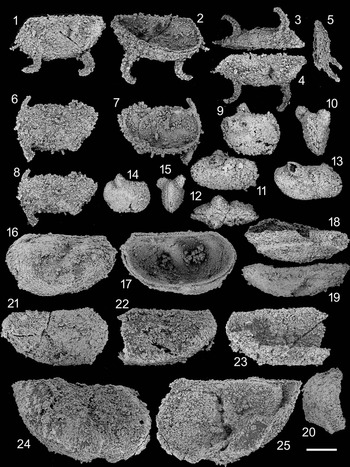
Scanning electron micrographs of ostracodes from the Pennsylvanian Nagaiwa Formation. (1–5) A right valve of Thuringobolbina sp., IGPS-112695; (1) right external view, (2) internal view, (3) ventral view, (4) dorsal view, (5) posterior view. (6, 7) A female left valve of Thuringobolbina ikeyai n. sp., IGPS-112693 (holotype); (6) external lateral view, (7) internal view; (8) an external view of left valve of male Thuringobolbina ikeyai n. sp., IGPS-112694 (paratype). (9, 10) A female carapace of Aechmina iwatensis n. sp., IGPS-112696 (holotype); (9) right side view, (10) posterior view; (11, 12) a male carapace of Aechmina iwatensis n. sp., IGPS-112697 (paratype); (11) right lateral view, (12) dorsal view; (13) a male right valve of Aechmina iwatensis n. sp., IGPS-112698 (paratype); (14, 15) a juvenile carapace of Aechmina iwatensis n. sp., IGPS-112699 (paratype); (14) right lateral view, (15) anterior view. (16–20) A female left valve of Jordanites michinokuensis n. sp., IGPS-112688 (holotype); (16) external lateral view, (17) internal view, (18) ventral view, (19) dorsal view, (20) posterior view; (21) a male right valve of Jordanites michinokuensis n. sp., IGPS-112689 (paratype); (22, 23) a male left valve of Jordanites michinokuensis n. sp., IGPS-112690 (paratype); (22) external lateral view, (23) internal view. (24, 25) A carapace of Jordanites sp., IGPS-112692; (24) left lateral view, (25) right lateral view. Scale bar = 400 μm for (1–15) and 200 μm for (16–25).

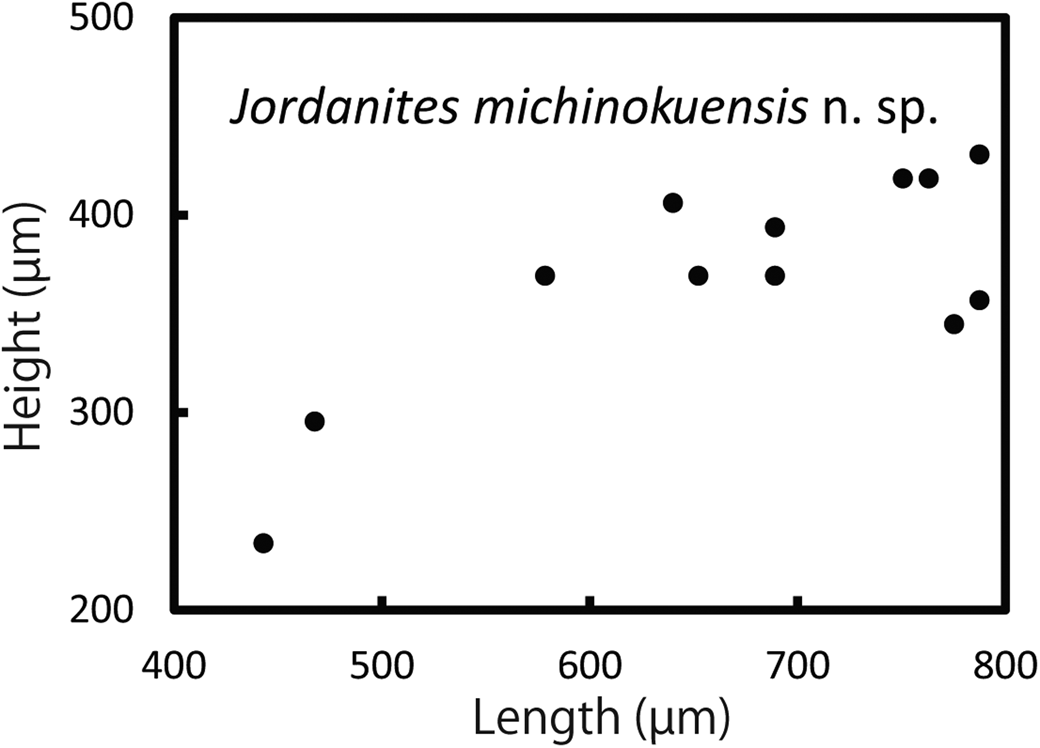
Ontogenetic change of length/height of Jordanites michinokuensis n. sp.

Scanning electron micrographs of ostracodes from the Pennsylvanian Nagaiwa Formation. (1–4) A male left valve of Jordanites michinokuensis n. sp., IGPS-112691 (paratype); (1) external lateral view, (2) internal view, (3) dorsal view, (4) posterior view. (5–8) A right valve of Punctoprimitia tomokoae (Ishizaki, Reference Ishizaki1964b), IGPS-112700; (5) external lateral view, (6) internal view, (7) anterior view, (8) dorsal view. (9–13) A male right valve of Punctoprimitia tumida (Ishizaki, Reference Ishizaki1964b), IGPS-112701; (9) external lateral view, (10) internal view, (11) dorsal view, (12) ventral view, (13) anterior view; (14–16) a male left valve of Punctoprimitia tumida (Ishizaki, Reference Ishizaki1964b), IGPS-112702; (14) external lateral view, (15) internal view, (16) ventral view; (17, 18) a female right valve of Punctoprimitia tumida (Ishizaki, Reference Ishizaki1964b), IGPS-112703; (17) external view, (18) ventral view; (19–22) a female left valve of Punctoprimitia tumida (Ishizaki, Reference Ishizaki1964b), IGPS-112704; (19) external lateral view, (20) ventral view, (21) dorsal view, (22) posterior view. Scale bar = 200 μm.

Diagnosis
Valve sub-quadrate; dorsal margin slightly concave, anterior margin narrowly arched, posterior margin broadly arched in female, narrowly arched in male; smooth surface with straight adductorial sulcus (S2) extending obliquely from one third border of dorsal margin to median area; a broad bend running from mid-anterior area to mid-ventral area.
Occurrence
Only known from the type locality.
Description
Prominent dimorphism. In external lateral view, valve sub-quadrate; dorsal margin slightly concave, anterior margin narrowly arched, ventral margin broadly convex, posterior margin broadly arched in female, narrowly arched in male; smooth surface with straight adductorial sulcus (S2) extending obliquely from one third border of dorsal margin to median area; fused lobe 1 (L1) and lobe 2 (L2), indistinct lobe 3 (L3) and lobe 4 (L4); in female, a broad bend running from mid-anterior area to middle mid-ventral area. In internal lateral view, narrow contact margin, two prominent depressions corresponding to L1 and L3. In dorsal and ventral views, valve half-moon outline, deep S2 in dorsal view, prominent bend parallel to ventral margin.
Etymology
“Michinoku” is an ancient word for northeastern Japan.
Materials
A female left valve, length = 788 μm, height = 431 μm, IGPS-112688 (holotype); a male left valve, length = 689 μm, height = 369 μm, IGPS-112691 (paratype).
Remarks
The genus Jordanites is quite similar to the Hollinella (Bless, Reference Bless1968), but the two genera are distinguished, respectively, by L1 and L2 being fused or not (Bless, Reference Bless1968; Crasquin et al., Reference Crasquin, Forel, Yuan, Nestell and Nestell2018). Hollinella samarensis Polenova, Reference Polenova1952, from the late Givetian, Russian Platform, has fused L1 and L2, and therefore this species is re-designated as Jordanites samarensis (Polenova, Reference Polenova1952) n. comb. in this study. Jordanites michinokuensis n. sp. is similar to J. samarensis (Polenova, Reference Polenova1952) n. comb. from the Russian Platform in its widely convex ventral margin, but it differs in having a slightly concaved dorsal margin, narrowly arched posterior margin, and indistinct L3. This species is also similar to Jordanites krasnodonensis Fohrer in Fohrer et al., Reference Fohrer, Nemyrovska, Samankassou and Ueno2007, from the middle Moscovian (Pennsylvanian) of the Donets Basin, Ukraine, in its indistinct L1, but it differs in that it has an elongate lateral outline, obliquely extending S2, and no postero-ventral spine.
Jordanites sp.
Figure 7.24, 7.25
Occurrence
Locality 36 of Kobayashi (Reference Kobayashi1973), Middle Member of the Nagaiwa Formation, Nagaiwa, Ofunato City, Iwate Prefecture, Northeast Japan, Bashkirian.
Material
One carapace, length = 874 μm, height = 505 μm, IGPS-112692.
Remarks
Jordanites sp. is similar to J. samarensis (Polenova, Reference Polenova1952) n. comb. from the Russian Platform in its widely arched posterior margin, but it differs in that it has an antero-ventrally protruded anterior margin, less prominent L3, and indistinct L1.
Family Hollinidae Swartz, Reference Swartz1936
Genus Thuringobolbina Zagora, Reference Zagora1967
Type species
Thuringobolbina thuringica Zagora, Reference Zagora1967 (?Geological Institute of the University of Jena, Org.-Nr.: P1028, however, the specimen has not been discovered in the collections yet, as noted by Groos-Uffenorde et al., Reference Groos-Uffenorde, Schindler, Becker, Dojen, Brocke and Jansen2022) from the Borehole Beulwitz 12, depth 137–139 m, middle part of the tentaculate nodular limestone (Early Devonian), Thuringia, Germany, by original description.
Thuringobolbina ikeyai new species
Figure 7.6–7.8
Types
Holotype, a female left valve, length = 1046 μm, height = 603 μm, IGPS-112693; paratype, a male left valve, length = 984 μm, height = 468 μm, IGPS-112694; type locality: Locality 36 of Kobayashi (Reference Kobayashi1973), Middle Member of the Nagaiwa Formation, Nagaiwa, Ofunato City, Iwate Prefecture, Northeast Japan, Bashkirian.
Diagnosis
Valve oblate pentagonal outline; dorsal margin slightly sinuate, anterior margin widely arched; long spatula-shaped antero-ventral structure, short fin-shaped postero-ventral projection; surface ornamented by short spines, indistinct adductorial sulcus (S2) with small pit at central area.
Occurrence
Only the type locality.
Description
Prominent dimorphism, female more inflated than male. In external lateral view, valve oblate pentagonal outline; dorsal margin slightly sinuate, anterior margin widely arched, ventral margin broadly convex, postero-ventral straight, postero-dorsal margin convex; anterior and posterior cardinal angle equal; horn-like antero-cardinal spine, long spatula-shaped antero-ventral structure curved postero-ventrally, short fin-shaped postero-ventral projection extending postero-ventrally, triangular protrusion on postero-dorsal margin, several spines developed from mid-anterior margin to posterior margin; surface ornamented by short spines, indistinct adductorial sulcus (S2) with small pit in central area. In internal lateral view, narrow contact margin.
Etymology
In honor of Emeritus Professor Noriyuki Ikeya (Shizuoka University) who was the author's supervisor.
Materials
A female left valve IGPS-112693 (holotype), a male left valve IGPS-112694 (paratype).
Remarks
Thuringobolbina ikeyai n. sp. is similar to Thuringobolbina sibirica Melnikova, Reference Melnikova2000, from the Middle Ordovician sediments from the Nizhnyaya Taimyra River, northern Taimyr Peninsula, Russia, in its anterior cardinal spine and antero-ventral projection, but it differs in that it has a spine, widely arched anterior margin, and sinuate dorsal margin. This species is also similar to Thuringobolbina? blessi Becker and Sánchez de Posada, Reference Becker and Sánchez de Posada1977, from the Early Devonian Moniello Formation, Asturias, northern Spain, in its antero-ventral projection, but it differs in that it has a short postero-ventral projection, postero-dorsal triangle projection, and indistinct S2. Thuringobolbina ikeyai n. sp. is similar to Thuringobolbina? australis Shallreuter, Reference Schallreuter, Hanai, Ikeya and Ishizaki1988, from the Devonian of New South Wales, Australia, in its anterior cardinal spine and antero-ventral projection, but it differs in that it is ornamented by spines, possesses no ventral spine, and has a sinuate dorsal margin.
Thuringobolbina sp.
Figure 7.1–7.5
Occurrence
Locality 36 of Kobayashi (Reference Kobayashi1973), Middle Member of the Nagaiwa Formation, Nagaiwa, Ofunato City, Iwate Prefecture, Northeast Japan, Bashkirian.
Material
One right valve, length =1157 μm, height = 578 μm, IGPS-112695.
Remarks
Thuringobolbina sp. resembles Thuringobolbina? blessi Becker and Sánchez de Posada, Reference Becker and Sánchez de Posada1977, from the Early Devonian Moniello Formation, Asturias, northern Spain, in its oblate pentagonal lateral outline, but it differs in that it has a hook-like projection at the antero-ventral and postero-ventral areas, an obtuse posterior cardinal angle, and a long spine at the postero-ventral end. Thuringobolbina sp. is also similar to Thuringobolbina? australis Shallreuter, Reference Schallreuter, Hanai, Ikeya and Ishizaki1988, from the Devonian of New South Wales, Australia, in its widely arched ventral margin, but it differs in that it has surface ornamentation, no ventral spine, and a sinuate dorsal margin.
Suborder Binodicopina Schallreuter, Reference Schallreuter1972
Family Aechminidae Bouček, Reference Bouček1936
Genus Aechmina Jones and Holl, Reference Jones and Holl1869
Type species
Aechmina cuspidata Jones and Holl, Reference Jones and Holl1869 (a type specimen was not designated and subsequently was assigned by Kempf, Reference Kempf1986) from the Wenlock limestone of Croft's Quarry near West Malvern, England, UK, by original description. After that, A. cuspidata from the Lower Elton Formation, Gorstian Stage from Wenlock Edge, Shropshire, England, was deposited in The Natural History Museum, London (specimen No. PM OS 6640) by Professor David Siveter (University of Leicester) in 1984; this specimen in considered to be the primary reference specimen.
Aechmina iwatensis new species
Figure 7.9–7.15
?Reference Adachi1987 Aechmina sp. C Adachi, p. 4, fig. 2.
Types
Holotype, a female carapace IGPS-112696; paratypes, a male carapace IGPS-112697, a male right valve IGPS-112698, a juvenile carapace IGPS-112699; type locality: Locality 46 of Kobayashi (Reference Kobayashi1973), Upper Member of the Nagaiwa Formation, Nagaiwa, Ofunato City, Iwate Prefecture, Northeast Japan, Bashkirian.
Diagnosis
Carapace sub-ovate; dorsal margin straight, anterior margin widely arched toward mid-anterior, ventral margin slightly sinuate in male, straight in female, posterior margin narrowly arched at one-third height; prominent dorsal lobe backwardly truncated at one-third from anterior end. In dorsal view, left lobe located anteriorly.
Occurrence
Upper Member of the Ichinotani Formation, Mizuyagadani-Valley, Fukuji District, central Japan, Pennsylvanian; Locality 46 of Kobayashi (Reference Kobayashi1973) from Upper Member of the Nagaiwa Formation, Nagaiwa, Ofunato City, Iwate Prefecture, Northeast Japan, lower Bashkirian–lower Moscovian.
Description
Prominent dimorphism. In lateral view, carapace subovate; dorsal margin straight, anterior margin widely arched toward mid-anterior, ventral margin slightly sinuate in long form, straight in female, posterior margin narrowly arched at one-third height, anterior and posterior cardinal angles are equal in female, larger anterior cardinal angle in male; prominent dorsal lobe backwardly truncated at one-third from anterior end. In posterior view, left dorsal lobe is higher than right dorsal lobe. In dorsal view, left lobe is located anteriorly.
Etymology
The species is named after Iwate Prefecture, the local name according to the type locality.
Material
A carapace, length = 755 μm, height = 706 μm, IGPS-112696 (holotype), a long form carapace, length = 891 μm, height = 529 μm, IGPS-112697 (paratype), a long form right valve, length = 843 μm, height = 491 μm, IGPS-112698 (paratype), a juvenile carapace, length = 397 μm, height = 509 μm, IGPS-112699 (paratype).
Remarks
Aechmina iwatensis n. sp. is similar to Aechmina akumame Stocker et al., Reference Stocker, Komatsu, Tanaka, Williams, Siveter, Bennett, Wallis, Oji, Maekawa, Okura and Vandenbroucke2016, from the middle Moscovian (Pennsylvanian) Ichinotani Formation, Fukuji, central Japan; it has a straight dorsal margin, but A. iwatensis n. sp. differs from A. akumame in that it has a sinuate or straight ventral margin, narrowly arched posterior margin, and backwardly truncated dorsal lobe. Aechmina iwatensis n. sp. probably was assigned to Aechmina sp. C of Adachi (Reference Adachi1987) from the Pennsylvanian Ichinotani Formation based on the position of the dorsal knob, although Adachi (Reference Adachi1987) only showed the species with a simple illustration. This species is similar to Aechmina tianshanensis Jiang in Jiang et al., Reference Jiang, Zhou and Lin1995, from the Pennsylvanian Dongtujinhe Formation, Xinjiang, China, in its spineless dorsal lobe, but it differs in its straight or sinuate ventral margin, a narrowly arched posterior margin, and a backwardly truncated dorsal lobe. Aechmina iwatensis n. sp. is also similar to Aechmina sp.? of Dewey (Reference Dewey1983) from the “Middle” Carboniferous of the Port au Port Peninsula, western Newfoundland, Canada, in its backwardly truncated dorsal lobe, but it differs in having a straight dorsal margin, a sinuate or straight ventral margin, and lack of a small knob-like swelling in front of the dorsal lobe. This species is also similar to Aechmina sp. A of Becker and Sánchez de Posada (Reference Becker and Sánchez de Posada1977) from the Early Devonian Moniello Formation, Asturias, northern Spain, in its backwardly truncated dorsal lobe, but differs in that it has a shorter dorsal lobe, a dorsal lobe projected at one-third from the anterior end, and a straight or sinuate ventral margin. Aechmina iwatensis n. sp. is similar to Aechmina serrata (Stewart, Reference Stewart1936) from the Middle Devonian Silica Shale Formation, Ohio, USA, in its straight dorsal margin, but it differs in that it has a sinuate or straight ventral margin, narrowly arched posterior margin, and has a short dorsal lobe.
Order Platycopida Sars, Reference Sars1866
Suborder Kloedenellocopina Scott, Reference Scott and Moore1961
Superfamily Kloedenelloidea Ulrich and Bassler, Reference Ulrich and Bassler1908
Family Kloedenellidae Ulrich and Bassler, Reference Ulrich and Bassler1908
Genus Punctoprimitia Stewart and Hendrix, Reference Stewart and Hendrix1945
Type species
Haploprimitia simplex Stewart, Reference Stewart1936 (Ohio State University, no. 18172) from the Middle Devonian, Blue Shale (Zone 1) of Silica Shale in the quarry at Silica, Ohio, USA, by original description.
Punctoprimitia tomokoae (Ishizaki, Reference Ishizaki1964)
Figure 9.5–9.8
- Reference Ishizaki1964b
Glyptopleurina tomokoae Ishizaki, p. 34, pl. 1, figs. 6a, b, text-fig. 2.
- Reference Ishizaki1968
Glyptopleurina cf. tomokoae; Ishizaki, p. 15, pl. 1, fig. 8.
- Reference Hanai, Ikeya, Ishizaki, Sekiguchi and Yajima1977
Glyptopleurina tomokoae; Hanai et al., p. 14.
Types
Holotype, an adult right valve IGPS-78393; paratype, a left valve IGPS-78403; type locality: Nagaiwa, Ofunato City, Iwate Prefecture, Northeast Japan, lower Bashkirian–lower Moscovian.
Occurrence
Locality 36 of Kobayashi (Reference Kobayashi1973), Middle Member of the Nagaiwa Formation, Nagaiwa, Ofunato City, Iwate Prefecture, Northeast Japan, lower Bashkirian–lower Moscovian.
Material
One right valve, length = 775 μm, height = 369 μm, IGPS-112700.
Remarks
Punctoprimitia tomokoae (Ishizaki, Reference Ishizaki1964b) is similar to Punctoprimitia simplex (Stewart, Reference Stewart1936) from the Middle Devonian Silica Shale Formation, Ohio, USA, in having a slit sulcus, but it differs in that it has an elongated lateral outline, concave dorsal margin, and obliquely extending S2. Punctoprimitia tomokoae is also similar to Punctoprimitia cf. P. simplex Becker and Sánchez de Posada, Reference Becker and Sánchez de Posada1977, from the Early Devonian Moniello Formation, Asturias, northern Spain, in its elongated lateral outline, but it differs in that it has an acutely curved anterior margin, rather flat L2 and L3, and narrowly arched posterior margin.
Punctoprimitia tumida (Ishizaki, Reference Ishizaki1964)
Figure 9.9–9.22
- Reference Ishizaki1964b
Glyptopleurina tumida Ishizaki, p. 35, pl. 1, figs. 7a, b, text-fig. 3.
- Reference Hanai, Ikeya, Ishizaki, Sekiguchi and Yajima1977
Glyptopleurina tumida; Hanai et al., p. 14.
Types
Holotype, a right valve IGPS-78394; paratype, a right valve IGPS-78396; type locality: Nagaiwa, Ofunato City, Iwate Prefecture, Northeast Japan, lower Bashkirian to lower Moscovian.
Occurrence
Locality 36 of Kobayashi (Reference Kobayashi1973), Middle Member of the Nagaiwa Formation, Nagaiwa, Ofunato City, Iwate Prefecture, Northeast Japan, lower Bashkirian–lower Moscovian.
Materials
One male right valve, length = 640 μm, height = 468 μm, IGPS-112701; one male left valve, length = 602 μm, height = 480 μm, IGPS-112702; one female right valve, length = 578 μm, height = 492 μm, IGPS-112703; one female left valve, length = 603 μm, height = 480 μm, IGPS-112704.
Remarks
In the present study, I found a pair of right and left valves with dimorphism: the male is higher from lateral view and flatter from dorsal view than the female. Punctoprimitia tumida (Ishizaki, Reference Ishizaki1964b) is similar to Punctoprimitia simplex (Stewart, Reference Stewart1936) from the Middle Devonian Silica Shale Formation, Ohio, USA, in its rounded lateral outline, but it differs in that it has a narrow S2, an undulated dorsal margin, and an obliquely extending S2. Punctoprimitia tumida is also similar to Punctoprimitia cf. P. simplex Becker and Sánchez de Posada, Reference Becker and Sánchez de Posada1977, from the Early Devonian Moniello Formation, Asturias, northern Spain, in its inflated L2 and L3, but it differs in that it has a higher lateral outline, a rather narrow S2, and a concave dorsal margin.
Punctoprimitia sp.
Figure 10.1–10.5
Occurrence
Locality 36 of Kobayashi (Reference Kobayashi1973), Middle Member of the Nagaiwa Formation, Nagaiwa, Ofunato City, Iwate Prefecture, Northeast Japan, Bashkirian.
Scanning electron micrographs of ostracodes from the Pennsylvanian Nagaiwa Formation. (1–5) A right valve of Punctoprimitia sp., IGPS-112705; (1) external lateral view, (2) internal view, (3) anterior view, (4) dorsal view, (5) ventral view. (6–8) A carapace of Platyrhomboides tohokuensis n. sp., IGPS-112717 (holotype); (6) right lateral view, (7) left side view, (8) dorsal view. (9, 10) A left valve of Platyrhomboides japonica n. sp., IGPS-112718 (holotype); (9) external lateral view, (10) internal view; (11, 12) a right valve of Platyrhomboides japonica n. sp., IGPS-112719 (paratype); (11) external lateral view, (12) internal view; (13–16) a juvenile carapace of Platyrhomboides japonica n. sp., IGPS-112720 (paratype); (13) left lateral view, (14) right lateral view, (15) dorsal view, (16) posterior view. (17–20) A carapace of Waylandella sp., IGPS-112728; (17) right lateral view, (18) dorsal view, (19) ventral view, (20) anterior view. Scale bar = 200 μm.

Material
One right valve, length = 861 μm, height = 726 μm, IGPS-112705.
Remarks
Punctoprimitia sp. is similar to Punctoprimitia simplex (Stewart, Reference Stewart1936) from the Middle Devonian Silica Shale Formation, Ohio, USA; it has a distinct and deep S2, but P. sp. differs from P. simplex in that it has a rounded lateral outline, broadly arched anterior and posterior margins, and a flat postero-dorsal area. Punctoprimitia sp. is also similar to Punctoprimitia cf. P. simplex Becker and Sánchez de Posada, Reference Becker and Sánchez de Posada1977, from the Early Devonian Moniello Formation, Asturias, northern Spain, with its flat postero-dorsal area, but it differs in that it has less inflated L2 and L3, a rather narrow S2, and a straight dorsal margin.
Order Podocopida Müller, Reference Müller1894
Suborder Podocopina Sars, Reference Sars1866
Superfamily Bairdioidea Sars, Reference Sars1888
Family Bairdiocyprididae Shaver, Reference Shaver and Moore1961
Genus Pseudobythocypris Shaver, Reference Shaver1958
Type species
Bythocypris pediformis Knight, Reference Knight1928b (type specimen was not designated) from the Pennsylvanian Henrietta Formation, eastern Missouri, USA, by original description. Shaver (Reference Shaver1958) designated four hypotypes (U.S. National Museum 133377–133380) from the “metatype” slide of Knight (Reference Knight1928b).
Pseudobythocypris asiatica new species
Figures 11.1–11.8, 12
- Reference Jiang, Zhou and Lin1995
Healdia lucida Jiang in Jiang et al., pl. 117, fig. 2.
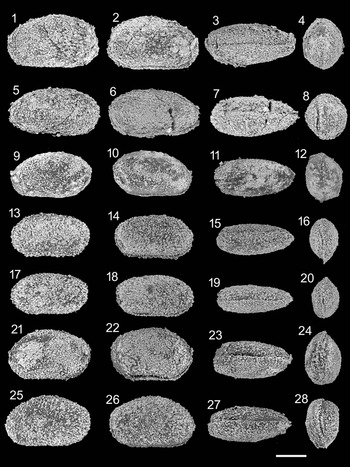
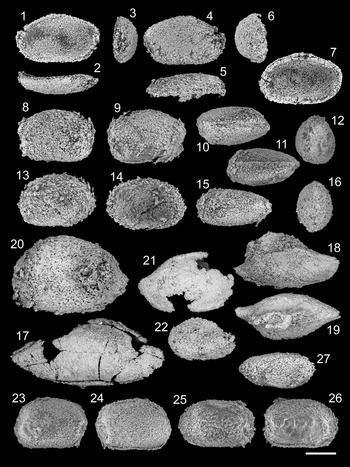
Scanning electron micrographs of ostracodes from the Pennsylvanian Nagaiwa Formation. (1–4) A female carapace of Pseudobythocypris asiatica n. sp., IGPS-112706 (holotype); (1) left lateral view, (2) right lateral view, (3) ventral view, (4) anterior view; (5–8) a male carapace of Pseudobythocypris asiatica n. sp., IGPS-112707 (paratype); (5) left lateral view, (6) right lateral view, (7) ventral view, (8) anterior view. (9–12) A carapace of Healdia sp., IGPS-112727; (9) left lateral view, (10) right lateral view, (11) dorsal view, (12) posterior view. (13–16) A female carapace of Pseudobythocypris siveteri n. sp., IGPS-112708 (holotype); (13) left lateral view, (14) right lateral view, (15) dorsal view, (16) anterior view; (17–20) a male carapace of Pseudobythocypris siveteri n. sp., IGPS-112709 (paratype); (17) left lateral view, (18) right lateral view, (19) ventral view, (20) posterior view. (21–24) A female carapace of Pseudobythocypris zipangu n. sp., IGPS-112710 (holotype); (21) left lateral view, (22) right lateral view, (23) ventral view, (24) posterior view; (25–28) a male carapace of Pseudobythocypris zipangu n. sp., IGPS-112711 (paratype); (25) left lateral view, (26) right lateral view, (27) ventral view, (28) posterior view. Scale bar = 200 μm.

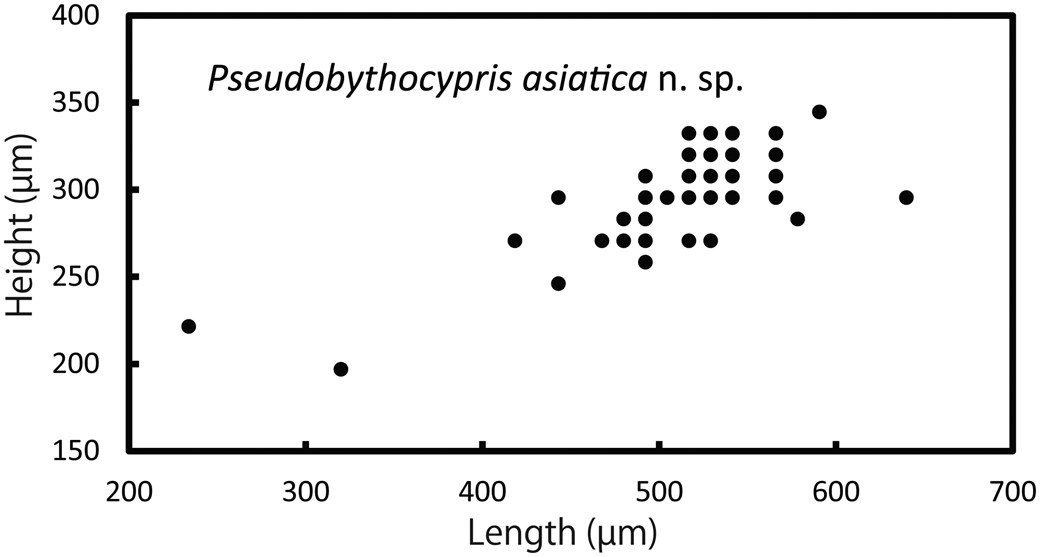
Ontogenetic change of length/height of Pseudobythocypris asiatica n. sp.

Types
Holotype, one female carapace, IGPS-112706; paratypes, a carapace Xj-2090, a male carapace IGPS-112707; type locality: Locality 36 of Kobayashi (Reference Kobayashi1973), Middle Member of the Nagaiwa Formation, Nagaiwa, Ofunato City, Iwate Prefecture, Northeast Japan, lower Bashkirian–lower Moscovian.
Diagnosis
Carapace subovate; dorsal margin arched, anterior margin narrowly arched; longest at mid-height, highest slightly behind mid-length from anterior end. Prominent dimorphism: in lateral view, female more elongated than male; in dorsal and ventral views, posterior area of female more inflated than male; in anterior view, female is more rounded than male.
Occurrence
Pennsylvanian Tahaqi Formation, Kunlun Mountains, Xinjiang, China; locality 36 of Kobayashi (Reference Kobayashi1973), upper Member of the Nagaiwa Formation, Nagaiwa, Japan.
Description
In lateral view, carapace subovate; dorsal margin arched, anterior margin narrowly arched, ventral margin slightly sinuate in right valve, straight in left valve, posterior margin narrowly arched; longest at mid-height, highest slightly behind mid-length from anterior end; left valve larger than right valve, overlap along anterior to lower half of posterior margin via ventral margin. In dorsal and ventral views, carapace fusiform. In anterior view, carapace ovate outline. Prominent dimorphism: in lateral view, female more elongated than male; in dorsal and ventral views, posterior area of female more inflated than male; in anterior view, female is more rounded than male.
Etymology
So named because the species has been reported only from Asia.
Materials
One male carapace, length = 566 μm, height = 332 μm, IGPS-112706 (holotype); one male carapace, length = 640 μm, height = 295 μm, IGPS-112707 (paratype); one possibly male carapace, Xj-2090 (paratype).
Remarks
Jiang in Jiang et al. (Reference Jiang, Zhou and Lin1995) described Healdia lucida from the Pennsylvanian Shiqiantan and Tahaqi formations, Xinjiang, China. He designated one carapace as holotype (Xj-2078) and three carapaces as paratypes (Xj-2078a, 8957, 2090). However, one paratype (Xj-2090) with a straight ventral margin is not Healdia lucida, because H. lucida was described as having a convex ventral margin (Xj-2078, 2078a, 8957).
Pseudobythocypris asiatica n. sp. is similar to Pseudobythocypris pediformis (Knight, Reference Knight1928b) from the Pennsylvanian Henrietta Formation, eastern Missouri, USA, with that taxon sharing an arched dorsal margin, but it differs in that it has a narrowly arched (not protruded) posterior margin, is longest at mid-height, and has a more inflated carapace. This species is also similar to Pseudobythocypris parallela (Knight, Reference Knight1928b) from the Pennsylvanian Henrietta Formation, eastern Missouri, USA, in its elongated lateral outline, but it differs in that its highest point is situated more backwardly from the anterior end, is longest at mid-height, and has a wider arched posterior margin. Pseudobythocypris asiatica n. sp. is similar to P. kellettae (Cordell, Reference Cordell1952) from the Pennsylvanian Bonner Spring Formation and the Canville Limestone from Missouri, USA, in its narrowly arched anterior margin, but it differs in its backwardly located highest point from the anterior end, longest point at mid-height, and a more inflated outline from dorsal view. This species is also similar to P. parallela (Knight, Reference Knight1928b) of Glebovskaya (Reference Glebovskaya1939) from the Pennsylvanian–Permian of Vyarta, northern Ural, Russia, in its straight ventral margin, but it differs in that it has a narrowly arched posterior margin, is longest at mid-height, and has a more acutely arched dorsal margin. Pseudobythocypris asiatica n. sp. is similar to Healdianella darwinuloides Posner, Reference Posner1951, from the Mississippian of the western part of the Moscow Basin in its overlapped left valve from posterior to anterior margin via ventral margin, but it differs in that it has a longer lateral outline, a highest point situated slightly behind mid-length from the anterior end, and a straight ventral margin in the left valve.
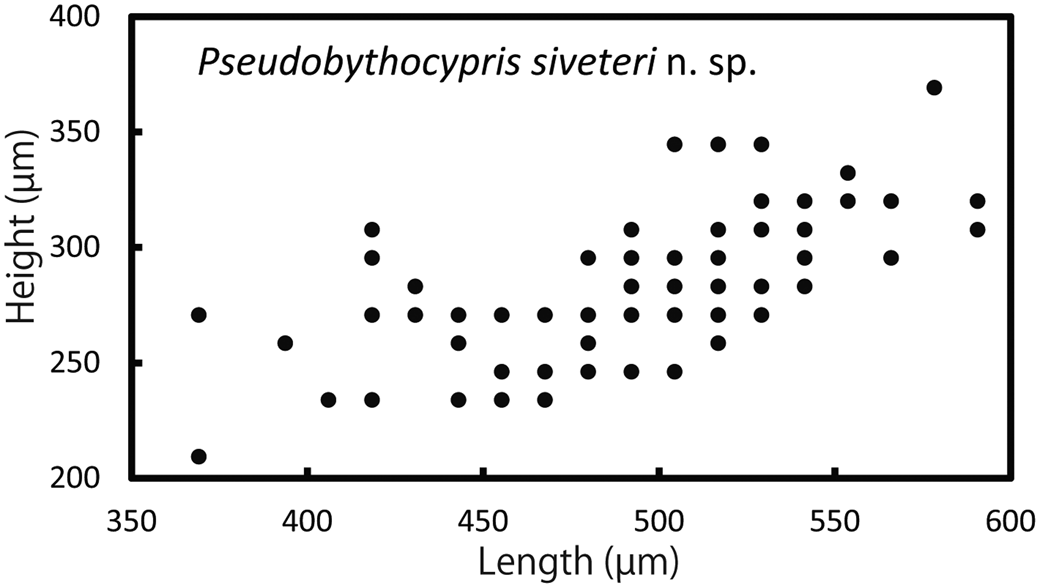
Pseudobythocypris siveteri new species
Figures 11.13–11.20, 13
Types
Holotype, one female carapace, IGPS-112708; paratype, one male carapace IGPS-112709; type locality: Locality 36 of Kobayashi (Reference Kobayashi1973), Middle Member of the Nagaiwa Formation, Nagaiwa, Ofunato City, Iwate Prefecture, Northeast Japan, Bashkirian.
Ontogenetic change of length/height of Pseudobythocypris siveteri n. sp.

Diagnosis
Carapace sub-trapezoidal; anterior margin arched toward antero-ventral direction, posterior margin broadly arched toward postero-ventral direction, protruded two-thirds height from venter; longest at one-third height. In dorsal and ventral views, carapace bullet-shaped.
Occurrence
Only the type locality.
Description
In lateral view, carapace sub-trapezoidal; dorsal margin widely arched, anterior margin arched toward antero-ventral direction, protruded at mid-height from venter, ventral margin straight in left valve, concave at mid-length from anterior end in right valve, posterior margin broadly arched toward postero-ventral direction, protruded two-thirds height from venter; longest at one-third height, highest at mid-length from anterior end; left valve larger than right valve, overlap along all margins, typically prominent overlap at ventral margin. In dorsal and ventral views, carapace bullet-shaped. In posterior view, carapace ovate outline. Prominent dimorphism: in lateral view, female more rounded than male; in dorsal view, female more inflated than male.
Etymology
In honor of Emeritus Professor David J. Siveter (University of Leicester) who is an excellent paleontologist and the author's supervisor.
Materials
One female carapace, length = 492 μm, height = 271 μm, IGPS-112708 (holotype); one male carapace, length = 468 μm, height = 234 μm, IGPS-112709 (paratype).
Remarks
Pseudobythocypris siveteri n. sp. is similar to P. phaseoella (Stover, Reference Stover1956) from the Middle Devonian Windom Shale Member of the Moscow Formation from western New York, USA, in its antero-ventrally truncated anterior margin, but it differs in that it has a more inflated lateral outline, a widely arched dorsal margin, and bullet-shaped outline from the dorsal view. This species is also similar to Pseudobythocypris kellettae (Cordell, Reference Cordell1952) from the Pennsylvanian Galesburg Shale from Missouri, USA, in its overlapped left valve to right valve at the ventral margin, but it differs in that it has a shorter anterior margin, a protruded posterior margin at two-thirds height from venter, and a bullet-shaped outline from the dorsal view. Pseudobythocypris siveteri n. sp. is similar to P. pediformis (Knight, Reference Knight1928b) from the Pennsylvanian upper Fort Scott Limestone of the Henrietta Formation, Missouri, USA, in its protruded anterior margin slightly below mid-height, but it differs in that it has broadly arched anterior and posterior margins, and a bullet-shaped outline from the dorsal view. Pseudobythocypris siveteri n. sp. is also similar to P. deesensis (Bradfield, Reference Bradfield1935) of Shi (Reference Shi, Rui and Hou1987) from the Pennsylvanian Taiyuan Formation, Shanxi, China, in its antero-ventrally directed anterior margin, but it differs in that it has a widely arched posterior margin, more rounded lateral outline, and a bullet-shaped outline from the dorsal view.
Pseudobythocypris zipangu new species
Figure 11.21–11.28
Types
Holotype, one female carapace, IGPS-112710; paratype, one male carapace IGPS-112711; type locality: Locality 36 of Kobayashi (Reference Kobayashi1973), Middle Member of the Nagaiwa Formation, Nagaiwa, Ofunato City, Iwate Prefecture, Northeast Japan, Bashkirian.
Diagnosis
Dorsal margin widely arched, anterior margin equally arched, ventral margin sinuate, concave at one-third distance from anterior end, posterior margin unequally arched; longest at mid-height from venter, highest point slightly forward of mid-length from anterior end. Prominent dimorphism: in lateral view, female more rounded than male.
Occurrence
Only the type locality.
Description
In lateral view, carapace bean-shaped; dorsal margin widely arched, anterior margin equally arched between dorsal and ventral half, protruded anteriorly at mid-height, ventral margin sinuate, concave at one-third distance from anterior end, posterior margin unequally arched between ventral and dorsal margin, postero-ventral margin widely arched, postero-dorsal margin narrowly arched, protruded at one-third of height from venter; longest at mid-height from venter, highest point located slightly forward of mid-length from anterior end. Left valve larger than right valve, overlap along antero-dorsal to postero-dorsal margin via ventral margin. In dorsal and ventral views, carapace rice-shaped. In anterior view, carapace has ovate outline. Prominent dimorphism: in lateral view, female more rounded than male; in dorsal and ventral views, female more inflated than male.
Etymology
According to the book “The Travels of Marco Polo,” Zipangu is located off the east of China, and the palace was made of gold (Komroff, Reference Komroff2001); thus, Zipangu has been considered as Japan, and the palace has been thought to refer to the Chusonji Konjiki-do Temple in Iwate Prefecture (type locality of this species).
Materials
One female carapace, length = 480 μm, height = 320 μm, IGPS-112710 (holotype); one male carapace, length = 468 μm, height = 308 μm, IGPS-112711 (paratype).
Remarks
Pseudobythocypris zipangu n. sp. is similar to P. pecki (Cordell, Reference Cordell1952) from the Pennsylvanian Lawrence Formation from Missouri, USA, in its equally arched anterior margin, but it differs in that it has a protruded posterior margin at one-third height from venter, is longest at mid-height from venter, and does not have an overlapped left valve along dorsal margin of right valve. Pseudobythocypris zipangu n. sp. is also similar to Pseudobythocypris oblongata (Cordell, Reference Cordell1952) from the Pennsylvanian Muncie Creek Shale from Missouri, USA, in its bean-shaped lateral outline, but differs in that it has a sinuate ventral margin, a widely arched postero-ventral margin, and no overlap between left valve and right valve along the dorsal area. Pseudobythocypris zipangu n. sp. is similar to P. cytherellinoides (Kummerow, Reference Kummerow1953) from the Early Devonian Zorgensis Limestone, Trautenstein, Germany, in its bean-shaped lateral outline; it differs in that the left valve overlaps the right valve at anterior and posterior areas, having a sinuate ventral margin, and has an acutely arched anterior margin. This new species is also similar to P. lucasensis (Stewart, Reference Stewart1936) from the Middle Devonian Silica Shale Formation, Ohio, USA, in its bean-shaped lateral outline, but it differs in that it has a widely arched dorsal margin, is highest near mid-length from anterior end and has an acutely arched dorso-posterior margin.
Family Bairdiidae Sars, Reference Sars1888
Genus Bairdia McCoy, Reference McCoy1844
Type species
Bairdia curtus McCoy, Reference McCoy1844 (type specimen was not designated) from the Carboniferous of Ireland by original description. Sohn (Reference Sohn1960) erected a new genus, Orthobairdia, and included B. curta McCoy, Reference McCoy1844, in the genus Orthobairdia. The type species of Orthobairdia is Orthobairdia cestriensis (Ulrich, Reference Ulrich1891), and the lectotype (U.S. National Museum 41789) was designated by Sohn (Reference Sohn1960) among Ulrich's 12 cotype specimens.
Bairdia hanaii Ishizaki, Reference Ishizaki1963
Figure 14.17–14.19
- Reference Ishizaki1963
Bairdia hanaii Ishizaki, p. 165, pl. 4, figs. 1a, b.
- Reference Hanai, Ikeya, Ishizaki, Sekiguchi and Yajima1977
Bairdia hanaii; Hanai et al., p. 16.
Scanning electron micrographs of ostracodes from the Pennsylvanian Nagaiwa Formation. (1–3) A left valve of Healdia cf. H. simplex Roundy, Reference Roundy1926, IGPS-112722; (1) lateral view, (2) dorsal view, (3) anterior view; (4–7) a right valve of Healdia cf. H. simplex Roundy, Reference Roundy1926, IGPS-112721; (4) external lateral view, (5) dorsal view, (6) anterior view, (7) inner view. (8–12) A female carapace of Healdia ofunatensis n. sp., IGPS-112723 (holotype); (8) left lateral view, (9) right lateral view, (10) dorsal view, (11) ventral view, (12) anterior view; (13–16) a male carapace of Healdia ofunatensis n. sp., IGPS-112724 (paratype); (13) left lateral view, (14) right lateral view, (15) dorsal view, (16) anterior view. (17) A carapace in right lateral view of Bairdia hanaii Ishizaki, Reference Ishizaki1963, IGPS-112712; (18, 19) a carapace of Bairdia hanaii Ishizaki, Reference Ishizaki1963, IGPS-112713; (18) right lateral view, (19) ventral view. (20–22) Bairdia sp., (20) left lateral view of carapace IGPS-112714, (21) right lateral view of carapace IGPS-112715, (22) left valve IGPS-112716. (23, 24) A female carapace of Healdia rikutyuensis n. sp., IGPS-112725 (holotype); (23) left lateral view, (24) right lateral view; (25–27) a male carapace of Healdia rikutyuensis n. sp., IGPS-112726 (paratype); (25) left lateral view, (26) right lateral view, (27) dorsal view. Scale bar = 200 μm for (1–16, 20, 22–27). Scale bar = 400 μm for (17–19, 21).

Holotype
Holotype, right IGPS-78380; type locality: Nagaiwa, Hikoroichi Town, Ofunato City, Iwate Prefecture, Japan, the Pennsylvanian Nagaiwa Formation.
Occurrence
Pennsylvanian Nagaiwa Formation, Nagaiwa, Hikoroichi Town, Iwate Prefecture, Northeast Japan; Locality 46 of Kobayashi (Reference Kobayashi1973), Upper Member of the Nagaiwa Formation, Nagaiwa, Japan.
Materials
Two carapaces, length = 2000 μm, height = 870 μm, IGPS-112712, length = 1410 μm, height = 500 μm, IGPS-112713.
Remarks
Bairdia hanaii Ishizaki, Reference Ishizaki1963, is similar to Bairdia aluca Kotschetkova, Reference Kotschetkova1983, from the Pennsylvanian (Bashkirian) Akavasian Horizon, Chalyabinsk region, Kizil, southern Urals, Russia, in its elongated lateral outline, but it differs in that it has an acuminated dorsal margin, a longer posterior process, and a rightward bending posterior process in ventral view. Bairdia hanaii is also similar to Bairdia proxima Tkatscheva in Ivanova et al., Reference Ivanova, Kotschetkova, Stepanaitys and Tkacheva1975, from the Carboniferous deposits, western slope of the North Urals, Russia, in its less elongated lateral outline, but it differs in that it has a longer posterior process, a more antero-ventrally curved anterior margin, and an acuminated dorsal margin.
Bairdia sp.
Figure 14.20–14.22
Occurrence
Locality 46 of Kobayashi (Reference Kobayashi1973), Upper Member of the Nagaiwa Formation, Nagaiwa, Japan.
Material
Two carapaces, length = 777 μm, height = 490 μm, IGPS-112714, length = 1250 μm, height = 783 μm, IGPS-112715; one left valve, length = 510 μm, height = 312 μm, IGPS-112716.
Remarks
Bairdia sp. is similar to Bairdia foveosa Jiang in Jiang et al., Reference Jiang, Zhou and Lin1995, from the Pennsylvanian of Xinjiang, China, in sharing a widely arched anterior margin, but it differs in that it has a widely arched dorsal margin, a dorsally directed posterior end, and is longest at mid-height from anterior end. Bairdia sp. is similar to Bairdia auricula Knight, Reference Knight1928b, from the Pennsylvanian Henrietta Formation, eastern Missouri, USA, in its straight ventral margin, but it differs in that it has widely arched anterior and dorsal margins, a narrower posterior margin, and a short posterior projection.
Family Beecherellidae Ulrich, Reference Ulrich1894
Genus Platyrhomboides Harris, Reference Harris1957
Type species
Platyrhomboides quadratus Harris, Reference Harris1957 (Museum of Comparative Zoology at Harvard University No. 4648) from the Ordovician Bromide Formation, Bromide horizon, 15 feet below top of zone 10 of U.S. Highway, Simpson section, Oklahoma, USA, by original description.
Platyrhomboides tohokuensis new species
Figure 10.6–10.8
Holotype
Holotype, a carapace IGPS-112717: Locality 36 of Kobayashi (Reference Kobayashi1973), Middle Member of the Nagaiwa Formation, Nagaiwa, Ofunato City, Iwate Prefecture, Northeast Japan, Bashkirian.
Diagnosis
Trowel-like carapace. In lateral view, trapezoidal outline; anterior margin protruded toward anterior, posterior margin protruded postero-ventrally, longest at one-fifth height from venter, highest point at two-thirds from anterior end.
Occurrence
Only the type locality.
Description
Trowel-like carapace. In lateral view, trapezoidal outline; dorsal margin straight, anterior margin protruded toward anterior, ventral margin widely arched or straight, posterior margin protruded postero-ventrally, longest at one-fifth height from venter, highest point at two-thirds from anterior end. In ventral view, carapace trowel-like outline, left valve larger than right valve.
Etymology
The provincial name where the type specimens were discovered.
Materials
A carapace, length = 566 μm, height = 271 μm, IGPS-112717 (holotype).
Remarks
The genus Platyrhomboides has been reported from Middle Ordovician–Late Devonian (Becker and Wang, Reference Becker and Wang1992). This report provides the youngest fossil record of the genus, extending the geological time range into the Pennsylvanian. Platyrhomboides tohokuensis n. sp. is similar to Platyrhomboides quadratus Harris, Reference Harris1957, from the Ordovician Bromide Formation, Simpson and West Spring Creek, Oklahoma, USA, in its quadrate lateral outline, but it differs in that it has trowel-like outline in ventral view, a slightly protruded anterior margin, and a widely arched dorsal margin in the left valve. This species is also similar to Platyrhomboides sp. A of Becker and Wang (Reference Becker and Wang1992) from the middle to late Silurian of Shaanxi Province, Inner Mongolia, China, in its straight dorsal margin in the right valve, but it differs in that it has a narrowly arched anterior margin, a widely arched ventral margin, and a shorter dorsal margin. Platyrhomboides tohokuensis n. sp. is similar to Platyrhomboides sp. C of Becker and Wang (Reference Becker and Wang1992) from the Lower Devonian (lower Emsian) in Guangxi, China, in its widely arched ventral margin, but it differs in that it has a protruded anterior margin, a straight dorsal margin in the left valve, and a lower posterior end than that of the anterior.
Platyrhomboides japonica new species
Figures 10.9–10.16
Types
Holotype, a left valve IGPS-112718; paratypes, a right valve IGPS-112719, a juvenile carapace IGPS-112720; type locality: Locality 36 of Kobayashi (Reference Kobayashi1973), Middle Member of the Nagaiwa Formation, Nagaiwa, Ofunato City, Iwate Prefecture, Northeast Japan, Bashkirian.
Diagnosis
Wheat-seed shaped carapace. In lateral view, dorsal margin widely arched in left valve, straight in right valve; anterior margin narrowly arched antero-dorsally, ventral margin widely arched or straight, posterior margin protruded postero-ventrally.
Occurrence
Only the type locality.
Description
Wheat-seed shaped carapace. In lateral view, oblong outline; dorsal margin widely arched in left valve, straight in right valve, anterior margin narrowly arched antero-dorsally, ventral margin widely arched or straight, posterior margin protruded postero-ventrally. In internal view, wide marginal border in right valve. In ventral view, carapace has ship-like outline, left valve larger than right valve. In posterior view, carapace has oblate outline.
Etymology
The name where the type specimens were discovered.
Materials
A left valve, length = 780 μm, height = 270 μm, IGPS-112718 (holotype), a right valve, length = 740 μm, height = 260 μm, IGPS-112719 (paratype), a juvenile carapace, length = 540 μm, height = 180 μm, IGPS-112720 (paratype).
Remarks
The genus Platyrhomboides has been reported from Middle Ordovician–Late Devonian (Becker and Wang, Reference Becker and Wang1992). This report provides the youngest fossil record of the genus with P. tohokuensis n. sp. and extends the geological time range into the Pennsylvanian. Platyrhomboides japonica n. sp. is similar to Platyrhomboides quadratus Harris, Reference Harris1957, from the Ordovician Bromide Formation, Simpson and West Spring Creek, Oklahoma, USA, in its straight or a widely arched ventral margin, but it differs in that it has a widely arched dorsal margin, slightly tapered anterior and posterior margins, and less prominent anterior and posterior cardinal angles. This species is also similar to Platyrhomboides sp. A of Becker and Wang (Reference Becker and Wang1992) from the middle to late Silurian of Shaanxi Province, Inner Mongolia, China, in its straight dorsal margin in right valve, but it differs in that it has narrowly arched anterior margin, broadly arched ventral margin, and less truncated posterior. Platyrhomboides japonica n. sp. is similar to Platyrhomboides sp. B of Becker and Wang (Reference Becker and Wang1992) from the Lower Devonian (lower Emsian) of the Guangxi, China, in its narrowly arched anterior margin, but it differs in that it has a widely arched or a straight ventral margin, a widely arched dorsal margin in the left valve, and a higher posterior end than that of the anterior.
Suborder Metacopina Sylvester-Bradley, Reference Sylvester-Bradley and Moore1961
Superfamily Healdioidea Harlton, Reference Harlton1933
Family Healdiidae Harlton, Reference Harlton1933
Genus Healdia Roundy, Reference Roundy1926
Type species
Healdia simplex Roundy, Reference Roundy1926 (type specimen was not designated) from the Mississippian Graham Formation, Stephens County, Texas, USA, by original description. Kellett (Reference Kellett1935) designated the plesiotype (U.S. National Museum No. 90108) from the Middle Pennsylvanian Stanton Formation, Kansas, USA.
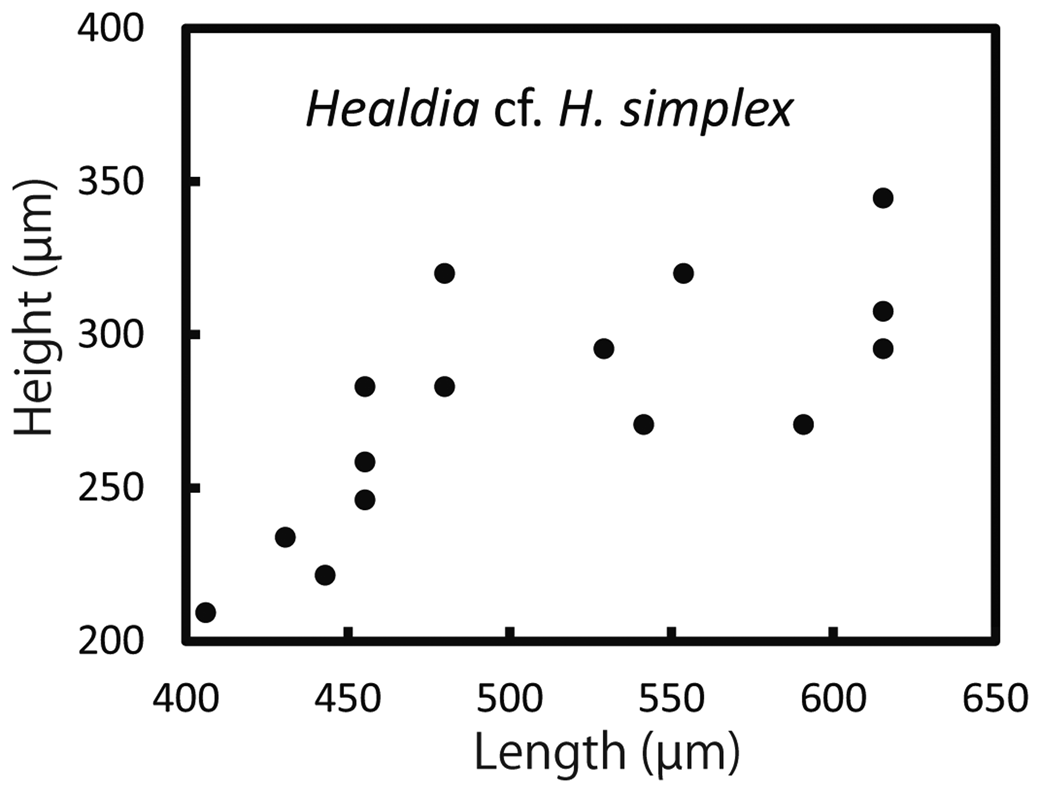
Healdia cf. H. simplex Roundy, Reference Roundy1926
Figures 14.1–14.7, 15
Occurrence
Locality 36 of Kobayashi (Reference Kobayashi1973), Middle Member of the Nagaiwa Formation, Nagaiwa, Ofunato City, Iwate Prefecture, Northeast Japan, Bashkirian.
Ontogenetic change of length/height of Healdia cf. H. simplex Roundy, Reference Roundy1926.

Materials
One right valve, length = 456 μm, height = 258 μm, IGPS-112721; one left valve, length = 529 μm, height = 295 μm, IGPS-112722.
Remarks
Roundy (Reference Roundy1926) described this species from the Pennsylvanian of Graham County, Texas, USA, but did not designate type specimens. Subsequently, in March 1935, Bradfield (Reference Bradfield1935) designated a plesiotype (Indiana University Paleontological Collections No.2098) of Healdia simplex using a complete carapace from the Pennsylvanian of the Ardmore Basin, Oklahoma, USA. Kellett (Reference Kellett1935) designated plesiotypes (U.S. National Museum No. 90108) from the Middle Pennsylvanian Stanton Formation, Kansas, USA, on March 11, 1935. Since the publication date of Bradfield (Reference Bradfield1935) is not precisely known, it is not possible to determine whether or not of Kellett's (Reference Kellett1935) plesiotypes have priority. Bradfield's (Reference Bradfield1935) plesiotype of H. simplex is similar to H. cf. H. simplex in its triangular lateral outline, but it differs in that it has its highest point slightly forward from the mid-length, a straight posterior half of the dorsal margin, and a more dorsally situated maximum length. Kellett's figured plesiotype (Kellett, Reference Kellett1935, pl. 16, fig. 2) of H. simplex of is similar to H. cf. H. simplex in its triangular lateral outline, but it differs in that it has its a straight ventral margin, a straight posterior half of the dorsal margin, and does not have an inflated valve.
Healdia cf. H. simplex is also similar to Healdia magna Jiang in Jiang et al., Reference Jiang, Zhou and Lin1995, from the Pennsylvanian Shiqiantan Formation, Xinjiang, China, in its antero-ventrally protruded anterior margin, but it differs in that it has a longer lateral outline, an unequally arched posterior margin, and its highest point slightly forward of the mid-length from the anterior end. Healdia cf. H. simplex resembles Healdia askynensis Kotschetkova, Reference Kotschetkova1983, from the Pennsylvanian (Bashkirian) Kizil Formation, southern Ural Mountains, Russia, in that it has a depressed postero-ventral area, but H. cf. H. simplex differs from H. askynensis in that its highest point is slightly forward of the mid-length from the anterior end, has a more rounded anterior margin, and has an elongated outline from the dorsal view.
Healdia ofunatensis new species
Figures 14.8–14.16, 16
Holotype
Holotype, one female carapace, IGPS-112723; paratype, one male carapace IGPS-112724, type locality: Locality 36 of Kobayashi (Reference Kobayashi1973), Middle Member of the Nagaiwa Formation, Nagaiwa, Ofunato City, Iwate Prefecture, Northeast Japan, Bashkirian.
Ontogenetic change of length/height of Healdia ofunatensis n. sp..

Diagnosis
Ovate carapace; dorsal margin symmetrically arched, ventral margin sinuate, concaved at mid-length from anterior end; longest at mid-height, highest at mid-length from anterior end; left valve larger than right valve, prominent overlap at ventral and postero-dorsal margins. Rice-shaped outline in dorsal view.
Occurrence
Only the type locality.
Description
In lateral view, ovate carapace; dorsal margin symmetrically arched, anterior margin widely arched toward antero-dorsal direction in left valve, tapered anteriorly in right valve, ventral margin sinuate, concave at mid-length from anterior end, posterior margin widely arched postero-dorsally or protruded at mid-height; longest at mid-height from venter, highest at mid-length from anterior end; left valve larger than right valve, overlap along entire margin, typically prominent overlap at ventral and postero-dorsal margins. In dorsal and ventral views, carapace rice-shaped. In posterior view, carapace has ovate outline. Prominent dimorphism: in lateral view, female more rounded than male; in dorsal view, female more inflated than male; in posterior view, female wider than male.
Etymology
Ofunato, the name of the city where the type specimens were discovered.
Materials
One female carapace, length = 505 μm, height = 332 μm, IGPS-112723 (holotype); one male carapace, length = 504 μm, height = 271 μm, IGPS-112724 (paratype).
Remarks
Healdia ofunatensis n. sp. is similar to Healdia humillis (Bradfield, Reference Bradfield1935) from the Pennsylvanian of the Ardmore Basin, Oklahoma, USA., in its symmetrically arched dorsal margin, but it differs in that it has a sinuate ventral margin, its highest point at mid-height from venter, and prominent overlap at ventral and postero-dorsal margins. Healdia ofunatensis n. sp. is also similar to Healdia yiliensis Jiang in Jiang et al., Reference Jiang, Zhou and Lin1995, from the Pennsylvanian Dongtujinhe Formation, Xinjiang, China, in its lateral outline, but it differs in that it has a protruded dorsal margin, a shorter ventral margin, and rice-shaped outline from dorsal view. Healdia ofunatensis n. sp. is also similar to Healdia ziganensis Kotschetkova, Reference Kotschetkova1983, from the Pennsylvanian (Bashkirian) Tashasta horizon, southern Ural Mountains, Russia, in its symmetrically arched dorsal margin, but it differs in that it has a longer lateral outline, is longest at mid-height from venter, and has a sinuate ventral margin. This species is also similar to Healdia kashirica Kotschetkova, Reference Kotschetkova1985, from the Pennsylvanian (Moscovian) Kashirian horizon, Korenevo Village, Moscow, Russia, in its symmetrically arched dorsal margin, but it differs in that it has a rounded lateral outline, tapered anterior margin in the right valve, and rice-shaped outline from dorsal view.
Healdia rikutyuensis new species
Figure 14.23–14.27
Holotype
Holotype, one female carapace, IGPS-112725; paratype, one male carapace IGPS-112726, type locality: Locality 36 of Kobayashi (Reference Kobayashi1973), Middle Member of the Nagaiwa Formation, Nagaiwa, Ofunato City, Iwate Prefecture, Northeast Japan, Bashkirian.
Diagnosis
Carapace tetragonal outline; dorsal margin widely arched unequally, anterior margin tapered at one-third height from venter, ventral margin sinuate, posterior margin truncated at mid-height from venter; in dorsal and ventral views, carapace pear-shaped.
Occurrence
Only the type locality.
Description
Tetragonal outline in lateral view; dorsal margin widely arched unequally, shorter anterior and longer posterior, anterior margin tapered at one third height from venter, ventral margin sinuate, concave at mid-length from anterior end, posterior margin truncated at mid- height; longest at mid-height from anterior end, highest at one-third length from anterior end; left valve larger than right valve, overlap along entire margin, typically prominent overlap at dorsal and ventral margins; a prominent sulcus at postero-ventral area. In dorsal and ventral views, carapace pear-shaped. Prominent dimorphism: in lateral view, female more rounded than male.
Etymology
The species is named for Rikutyu, the previous name of Iwate Prefecture, acknowledging the type locality.
Materials
One female carapace, length = 529 μm, height = 332 μm, IGPS-112725 (holotype); one male carapace, length = 529 μm, height = 295 μm, IGPS-112726 (paratype).
Remarks
Healdia rikutyuensis n. sp. is similar to Healdia magna Jiang in Jiang et al., Reference Jiang, Zhou and Lin1995, from the Pennsylvanian Shiqiantan Formation, Bogduo Mountain, Xinjiang, China, in its truncated anterior margin, but it differs in that it has a tetragonal lateral outline, a widely arched dorsal margin, and a prominent sulcus at the postero-ventral area. Healdia rikutyuensis n. sp. is also similar to Healdia kashirica Kotschetkova, Reference Kotschetkova1985, from the Pennsylvanian (Moscovian) Kashirian horizon, Korenevo Village, Moscow, Russia, in its truncated posterior margin at mid-height from venter, but it differs in that it has a tetragonal outline in lateral view, a sinuate ventral margin, and its highest point at one-third length from the anterior end. Healdia rikutyuensis n. sp. is similar to Healdia askynensis Kotschetkova, Reference Kotschetkova1983, from the Pennsylvanian (Bashkirian) Kizil Formation, southern Ural Mountains, Russia, in its truncated anterior margin, but it differs in that it has a tetragonal lateral outline, its highest point at one-third length from the anterior end, and a depression at the postero-ventral area. This species is also similar to Healdia ovata Bradfield, Reference Bradfield1935, from the Pennsylvanian Hoxbar Formation, Ardmore, Oklahoma, USA, in its left valve overlapping with the right valve along the dorsal and ventral margins, but it differs in that it has a trapezoidal lateral outline, a depression at the postero-ventral area, and a posterior margin truncated at mid-height from the venter.
Healdia sp.
Figures 11.9–11.12, 17
Occurrence
Locality 36 of Kobayashi (Reference Kobayashi1973), Middle Member of the Nagaiwa Formation, Nagaiwa, Ofunato City, Iwate Prefecture, Northeast Japan, Bashkirian.
Ontogenetic change of length/height of Healdia sp.

Material
One carapace, length = 492 μm, height = 308 μm, IGPS-112727.
Remarks
Healdia sp. resembles Healdia cara Bradfield, Reference Bradfield1935, from the Pennsylvanian Deese? Formation, northeastern Ardmore, Oklahoma, USA, in its straight dorsal margin, but it differs in that it has a postero-dorsally protruded posterior margin, its highest point at two-thirds from the anterior end, and a widely arched anterior margin. This species is also similar to H. ovata Bradfield, Reference Bradfield1935, from the Pennsylvanian Hoxbar Formation, Ardmore, Oklahoma, USA, in its straight ventral margin, but it differs in that it has an antero-ventrally protruded anterior margin, its highest point at two-thirds distance from the anterior end, and a postero-dorsally protruded posterior margin. Healdia sp. is similar to Healdia luculenta Jiang in Jiang et al., Reference Jiang, Zhou and Lin1995, from the Pennsylvanian Xiaohaizi Formation, Xinjiang, China, in its arched dorsal margin, but it differs in that it has a postero-dorsally protruded posterior margin, its highest point at two-thirds from the anterior end, and a sinuate ventral margin.
Genus Waylandella Coryell and Billings, Reference Coryell and Billings1932
Type species
Waylandella spinosa Coryell and Billings, Reference Coryell and Billings1932 (Columbia University Paleontology Collection No. 25233) from the Wayland Shale, the uppermost member of the Graham Formation in North central Texas, USA, by original description.
Waylandella sp.
Figure 10.17–10.20
Occurrence
Locality 36 of Kobayashi (Reference Kobayashi1973), Middle Member of the Nagaiwa Formation, Nagaiwa, Ofunato City, Iwate Prefecture, Northeast Japan, Bashkirian.
Material
One carapace, IGPS-112728.
Remarks
Waylandella sp. resembles Waylandella spinosa (Coryell and Billings, Reference Coryell and Billings1932) from the Pennsylvanian Wayland Shale, Texas, USA, in its antero-ventrally protruded anterior margin, but it differs in that it has an orthogonal posterior cardinal angle, its highest point at mid-length from the venter, and a longer lateral outline. Waylandella sp. is also similar to W. boleensis Jiang in Jiang et al., Reference Jiang, Zhou and Lin1995, from the Pennsylvanian Dongtujinhe Formation, Xinjiang, China, in its elongate lateral outline, but it differs in that it has an antero-ventrally protruded anterior margin, widely arched dorsal margin, and a sinuate ventral margin. Waylandella sp. is similar to W. insolita Jiang in Jiang et al., Reference Jiang, Zhou and Lin1995, from the Pennsylvanian of Xinjiang, China, in its narrowly arched anterior margin, but it differs in that it has an elongate lateral outline, its highest point at mid-length from the anterior end, and a sinuate ventral margin.
Results
Only two of the eight samples contained ostracodes, these being sample locality No. 36 (39°08′51.5′′N, 141°38′56.7′′E) from the Middle Member and sample locality No. 46 (39°09′00.8′′N, 141°38′52.7′′E) from the Upper Member. Furthermore, specimens from sample locality No. 46 were deformed due to diagenesis. Totals of 328 specimens and 16 specimens were extracted from No. 36 and No. 46, respectively (Table 1). Thirty ostracode species, including 12 genera, were identified (Table 1; Fig. 18), most of which were endemic species and 10 of which were new species. The details of each species are provided in the next section. Conodont elements that contain P1 elements of Neognathodus spp. were recovered from localities No. 30 and No. 46, respectively (T. Maekawa, personal communication, March 23, 2022). Neognathodus is an index genus for the Bashkirian–Moscovian, and supports the determination of the age of the Nagaiwa Formation from fusulinids (Kobayashi, Reference Kobayashi1973).
Ostracode assemblages from two sample localities. White circles show that ostracodes were recovered (localities 36 and 46), shaded circles show that there were no ostracodes. Abbreviations: Fm., Formation; L., Lower.

Ostracode species extracted from two sample localities (Loc. 36, Loc. 46) from the late Carboniferous Nagaiwa Formation, Northeast Japan. Each number shows number of specimens; white circles under C Japan (= central Japan) and Xinjiang indicate presence of the species.

Paleoecology of ostracodes from the Nagaiwa Formation
The assemblages from the Middle Member (No. 36) contained many ostracodes, including Samarella hataii, two Kirkbya species, three Jordanites species, two Thuringobolbina species, three Punctoprimitia species, three Pseudobythocypris species, two Platyphomboides species, four Healdia species, and one species of Weylandella. Based on a comparison with European assemblages, the ostracode fauna suggests a marine nearshore environment (Bless, Reference Bless1983). Jordanites, Kirkbya, and Healdia, which have been reported from the Pennsylvanian paralytic coal basins of northern Spain, indicate marine nearshore to shallow offshore environments (Bless, Reference Bless1983). In other localities, Samarella, Thuringobolbina, and Punctopurimitia have been reported from Ordovician (Russia) to Devonian (Russian Platform, northern Spain, Australia, and Ohio) sedimentary deposits. These genera, however, have not been reported previously from the Carboniferous. Thuringobolbina has been reported in non-polyzoan/sponge assemblages from the Devonian Receptaculites Limestone, New South Wales, Australia (Reynolds, Reference Reynolds1978), where the depositional environment seems to be a fairly stable offshore shelf environment. Thuringobolbina has not been reported from other Carboniferous localities; thus, its microhabitat is uncertain.
Compared with ostracode species from the Middle Member, the Upper Member ostracodes are fewer and have low diversity (Fig. 18). Stocker et al. (Reference Stocker, Komatsu, Tanaka, Williams, Siveter, Bennett, Wallis, Oji, Maekawa, Okura and Vandenbroucke2016) first reported a “Eiferian mega-assemblage” from central Japan (the Middle Moscovian Ichinotani Formation) composed of Amphissites, Kirkbya, Bairdia, Aechmina, and Healdia. The Eiferian mega-assemblage typically represents high-energy turbulent conditions in a shallow carbonate platform setting (Becker, Reference Becker1971). In summary, the ostracode assemblages from the two sample localities of the Nagaiwa Formation indicate shallow marine conditions.
Paleogeography of the Pennsylvanian of Japan
Species of Hollinella and Jordanites were widely distributed during the Pennsylvanian in a limited range of marine-nearshore and shallow-offshore environments (Bless, Reference Bless1983) as is the extant podocopid ostracode (Tanaka and Ikeya, Reference Tanaka and Ikeya2002). Seventy-one Hollinella and Jordanites species have been reported from 31 localities in Pennsylvanian strata around the world (Table 2). Q-mode cluster analysis of these globally distributed hollinellid taxa connected by UPGMA (unweighted pair group method with arithmetic mean) using Jaccard coefficient in the software PAST (Hammer et al., Reference Hammer, Harper and Ryan2001) showed that four Hollinellid associations could be recognized (Fig. 19): Association I was characterized by H. bassleri Knight, Reference Knight1928a, at Locs. 16, 20; Association II consists of four localities (Locs. 8, 9, 11, 12) and was characterized by H. grahamensis (Harlton, Reference Harlton1927), H. shawnensis Kellett, Reference Kellett1929, and H. oklahomaensis (Harlton, Reference Harlton1928); Association III was characterized by H. plauta Kesling and Tabor, Reference Kesling and Tabor1953, J. camochensis Sanchez de Posada, Reference Sanchez de Posada1977, and J. cristinae from five localities (Locs. 7, 13, 15, 18, and 25); and Association IV consisted of two localities (Locs. 1, 5) and is characterized by J. modica.
Dendrogram of Q-mode cluster analysis of Hollinellid ostracodes from the Pennsylvanian of the world. Original data are from Table 2 and data matrix, both attached in Supplement 1. Roman numerals correspond to localities in Table 2. Italic number of each node shows the Bootstrap values (n = 1000).

Hollinellid ostracodes from the Pennsylvanian. Location (Loc[s]) numbers correspond to those in Figure 12. Gray-shaded lines show the genus Jordanites.

Three associations (I–III) were distributed around the equatorial region of the Pangea paleocontinent, but association IV was distributed between the eastern part of North China and the South Kitakami belt (Fig. 20). Nine Jordanites species have been reported; with three species in two localities, and six confined to one locality (Fig. 20). Jordanites modica has been reported from Japan (Loc. 1 in Table 2, Fig. 20) and the Tarim Basin (Loc. 5 in Table 2, Fig. 20), but not reported from South China (Locs. 28–32). Jordanites camochensis was found in Spain (Loc. 18) and the Moscow Basin (Loc. 25), Jordanites cristinae has been reported from southern England (Loc. 15) and Spain (Loc. 18). These two species, J. camochensis and J. cristinae, occur in the eastern margin of the Pangea paleocontinent near the equator.
Paleogeographical distribution of shallow-marine Jordanites species during Pennsylvanian. Paleogeographic map is from Torsvik and Cocks (Reference Torsvik, Cocks, Torsvik and Cocks2017). Each Arabic numeral corresponds to the locality number in Table 2, and each Roman numeral (I–IV) shows Hollinellid association detected from Q-mode cluster analysis of Figure 19.

Conclusions
Thirty ostracode species, including 12 genera, have been identified from the Pennsylvanian Nagaiwa Formation, Northeast Japan. The ostracode assemblages from the Nagaiwa Formation indicate a shallow marine environment and are assigned to the Eiferian mega-assemblage which typically represents high-energy turbulent conditions in a shallow carbonate platform setting. The ostracodes from the Nagaiwa Formation show no clear affinities with any other comparably aged fauna.
Acknowledgments
Sincere appreciation is extended to the Ryushin Kogyo Ltd through whose courtesy we were permitted to enter the mine and collect rock samples. I thank two anonymous reviewers and S. Zamora (Editor, Journal of Paleontology) for their constructive comments, kindness, and for checking the English in detail. Special thanks are to J. Nemoto (Tohoku University Museum) for preparing museum numbers and Takumi Maekawa (Osaka Museum of Natural History) for providing conodont data. This study was supported by the Fujiwara Natural History Foundation. I would like to thank Editage (www.editage.com) for English language editing.
Declaration of competing interests
There are no conflicts of interest to declare.
Data availability statement
Data available from the Dryad Digital Repository: https://doi.org/10.5061/dryad.j0zpc86jg