Introduction
Macro minerals such as Ca, P and Mg, and vitamin D (cholecalciferol) are determinants of bone mineralisation and egg shell quality, but other nutrients, including B, may modify use of these nutrients (Naghii et al., Reference NAGHII, TORKAMAN and MOFID2006). B is an integrative element supporting the function of Ca, Mg, and vitamin D (Naghii and Samman, Reference NAGHII and SAMMAN1997b; Kurtoğlu et al., Reference KURTOĞLU, KURTOĞLU and COŞKUN2001) and hence has an important role in mineral metabolism (Devirian and Volpe, Reference DEVIRIAN and VOLPE2003) and is a factor in the development and maintenance of normal bone (Nielsen, Reference NIELSEN1990; McCoy et al., Reference McCOY, IRWIN, KENNY and WILLIAMS1991). Hunt et al. (Reference HUNT, HERBEL and IDSO1994) reported that B acts by at least three different mechanisms under conditions of dietary vitamin D3 deficiency. First, B compensates for perturbations in energy substrate utilisation. Secondly, B enhances the macro mineral content of normal bone, and thirdly, it enhances certain indices of growth cartilage formation independently of vitamin D3. Another hypothesis is that B may play a role in either hydroxylating or extending the half-life of vitamin D3, which in turn would most likely affect bone metabolism and improve bone strength (Hunt and Nielsen, Reference HUNT and NIELSEN1986).
The impact of dietary B on skeletal disorders such as arthritis, rickets, osteoporosis and tibial dycondraplasia is supported by various published research (Hunt and Nielsen, Reference HUNT and NIELSEN1981; Eliot and Edwards, Reference ELIOT and EDWARDS1989). A large number of experiments conducted in humans and model animals involving B supplementation and deprivation demonstrates it links to bone metabolism. However, there is considerably fewer evidence linking B to bone and shell mineralisation, structure and strength in poultry, and even the few trials that exist show conflicting results.
One difficulty in nutritional studies of B is evaluating the individual's background status and requirements, and any deficiency syndrome is not currently recognised. In addition, it B levels in tissues and samples is difficult because of the complexity of the methodology. Because of limited information about dietary (particularly the level of B that was naturally acquired via feed ingredients) and environmental sources, it is understandable that initial boron reserves and extraneous sources during experiments may lead to a variety of outcomes (Rossi et al., Reference ROSSI, MILES, DAMRON and FLUNKER1993; McCoy et al., Reference McCOY, MONTGOMERY, KENNY, IRWIN, WILLIAMS and ORRELL1994; Armstrong et al., Reference ARMSTRONG, SPEARS, CRENSHAW and NIELSEN2000; Küçükyılmaz et al., 2014). Available evidence from earlier studies showed bone can be differently affected by feeding B, both in composition and in mechanical properties (McCoy et al., Reference McCOY, IRWIN, KENNY and WILLIAMS1991, Beattie and MacDonald Reference BEATTIE and MACDONALD1991). Such responses may have occurred because of the different composition of bone in various body sites and the different growth patterns of these types of bone (McCoy et al., Reference McCOY, IRWIN, KENNY and WILLIAMS1991).
Based on evidence showing that increased bioavailability and absorption of dietary B operates in conjunction with increased bone mineralisation and the prevention of osteoporosis (Nielsen et al., Reference NIELSEN, HUNT, MULLEN and HUNT1987; Nielsen, Reference NIELSEN1990; Hunt et al., Reference HUNT, HERBEL and NIELSEN1997), it can be assumed that the beneficial effect of B on bones would be reflected in shell mineralisation as a result of with interactions between B and Ca, P and Mg. However, the available experimental evidence rarely verifies this assumption. However, it has been reported in egg shell mineralisation follows a similar pattern to that observed in bone with regard to the type or degree of response to dietary B.
Published research suggests that other factors, which are currently undetermined, may affect sensitivity and responsiveness of bone and eggshell structure to dietary B. A similar conclusion has been drawn previously concerning B metabolism in general (Nielsen, Reference NIELSEN1998; Devirian and Volpe, Reference DEVIRIAN and VOLPE2003).This article reviews and discusses the result of poultry studies where the effect of B on mineral utilisation and eggshell and bone quality were examined.
The effect of B on the mineral composition of bone
Elemental boron (B) is a relatively inert metalloid that exists as either black monoclinic crystals or yellow-brown amorphous powder when impure at room temperature. However, boron as an element does not occur in nature; it is always found bound to oxygen or in its borate form (Woods, Reference WOODS1994). B has an important biological role that affects the mineral metabolism of humans and animals by interacting with Ca, Mg, Mn, Mo, K, Cu and vitamin D3, all of which are important in bone metabolism (Nielsen, Reference NIELSEN1990; Eliot and Edwards, Reference ELIOT and EDWARDS1992; Hunt et al., Reference HUNT, HERBEL and IDSO1994; Reference HUNT, HERBEL and NIELSEN1997), and seems to affect the metabolism of P in human and animal models (Nielsen et al., Reference NIELSEN, HUNT, MULLEN and HUNT1987; Armstrong and Spears, Reference ARMSTRONG and SPEARS2001). The impact of dietary B intake on bone abnormalities such as arthritis and osteoporosis has also been observed (Nielsen et al., Reference NIELSEN, HUNT, MULLEN and HUNT1987; Travers et al., Reference TRAVERS, RENNIE and NEWNHAM1990; Newnham, Reference NEWNHAM1994; Bai and Hunt, Reference BAI and HUNT1995). This indicates that B can play a vital role in bone development, but animal scientists have yet to determine the exact mechanism by which it functions. In the context of poultry nutrition, the mode of action of B on mineral utilisation by skeletal structure is not currently well characterised.
Mineral composition and ash are the main criteria used for assessing bone density. The bones provide structural support and act as a reservoir for minerals (Mutus et al., Reference MUTUS, KOCABAĞLI, ALP, ACAR, EREN and GEZEN2006). Ca and P levels may increase in response to B supplementation, and consequently, the ash level in bones can be assumed to be indicative of the regulatory role of B supplementation on bone mineralisation, although in practise this effect can vary.
The effects of dietary B on the bone mineral composition in broilers and layer hens have been investigated by several research teams. Eliot and Edwards (Reference ELIOT and EDWARDS1992) reported that dietary supplementation of poultry with 9.5 mg/kg of B for a period of 1 to 16 days may improve bone ash. A similar tendency was observed in chicks fed 300 mg/kg B for 21 days (Rossi et al., Reference ROSSI, MILES, DAMRON and FLUNKER1993). Similarly, Qin and Klandorf (Reference QIN and KLANDORF1991) showed in three experiments that the addition 100 mg B/kg of diet increased the bone ash of broiler breeder hens. Supplementation with 50, 100 and 200 mg/kg B during a 16-week growth period increased tibial bone ash in layer pullets, with the greatest increase observed for supplementation with 50 mg/kg (Wilson and Ruszler, Reference WILSON and RUSZLER1997). Likewise, Kurtoğlu et al. (Reference KURTOĞLU, KURTOĞLU, ÇELIK, KEÇECI and NIZAMLIOĞLU2005) reported significant increases in the tibial Ca levels, but not ash levels, in broilers supplemented with B. In this study, B supplementation at 5 and 25 mg/kg reduced the bone Zn concentration and produced a one-fold increase in the bone B concentration but caused no changes in Cu and Fe. Significant increases in the tibia B, Cu and Zn concentrations were observed when 60, 120 and 240 mg/kg of B were added to the laying hen diet; however, the Ca, Mg and P levels remained unchanged (Olgun et al., Reference OLGUN, YAZGAN and ÇUFADAR2012).
In contrast to the above trials, the majority of studies did not confirm the positive influence of B on the bone mineral composition or ash content. Dietary supplementation of B at 20, 40 and 60 mg/kg induced approximately one-, three- and five-fold increases in the bone B concentration, respectively, without influencing bone ash or other minerals (i.e., Ca, P, Mg, Fe, Cu and Zn), which are assumed to interact with B (Çınar et al., 2011). Wilson and Ruszler (Reference WILSON and RUSZLER1998) failed to find any significant effects of 50, 100, 200 or 400 mg/kg B addition on the bone ash of layer pullets. Another study (Bintaş, Reference BINTAŞ2013) found detrimental effects, reporting that B supplementation at 150 mg/kg diet failed to increase the bone ash in laying hens in later ages (i.e., 64-80 weeks of age). In agreements with this for other species, Armstrong et al. (Reference ARMSTRONG, SPEARS and LLOYD2001) reported that there were no differences in the bone ash of pigs fed diets containing 5 and 15 mg/kg B. In terms of overall detrimental impacts of B, Hunt (Reference HUNT1989) reported that B supplementation of cholecalciferol-adequate diets increased the incidence of tibial dyschondroplasia in broiler chicks. Similarly, the severity of tibial dyschondraplasia could be linearly increased in 21-day old chicks by increasing the B levels (i.e., 0, 20, 40 and 80 mg/kg diet) (Rossi et al., Reference ROSSI, MILES, DAMRON and FLUNKER1993).
Negative effects if B supplementation have been observed in other studies on broiler chickens (Fassani et al., Reference FASSANI, BERTECHINI, BRITO, KATO, FIALHO and GERALDO2004; Yıldız et al., 2013) and layer hens (Wilson and Ruszler, Reference WILSON and RUSZLER1998; Mızrak, 2008; Mızrak et al., 2010; Bintaş, Reference BINTAŞ2013) whereby there was no change in the Ca or P levels of ash in the femur or tibia in association with dietary B supplementation ranging from 30 to 150 mg/kg diet. The percentage weight of the femur and tibia of broiler chickens (Yıldız et al., 2013) and the tibia of layer hens (Kurtoğlu et al., Reference KURTOĞLU, KURTOGLU, SUR, BULUT and ÖNDER2007) did not support the use of supplemental B. Bozkurt et al. (Reference BOZKURT, KÜÇÜKYILMAZ, ÇATLI, ÇINAR, ÇABUK and BINTAŞ2012) found that the Ca and P levels in tibia ash were reduced for broiler chickens at 42 days of age when they were fed a 30 and 60 mg B/kg diet. B supplementation in laying hen diets at 50, 100, 150, 200 and 250 mg/kg was observed to decrease the tibia Ca level while gradually increasing the B concentration up to seven-fold without impacting the bone ash (Kurtoğlu et al., Reference KURTOĞLU, KURTOGLU, SUR, BULUT and ÖNDER2007).
If B was exerting a specific effect, one would predict there to be some consistent effect on the blood serum mineral profile. However, B either had no effect or inconsistent effects on the concentrations of Ca, P, Mg, Fe, Cu and Zn under normal physiological states (Kurtoğlu et al., Reference KURTOĞLU, KURTOGLU, COSKUN, SEKER, BALEVI and CETINGUL2002; Çınar et al., 2011; Bozkurt et al., Reference BOZKURT, KÜÇÜKYILMAZ, ÇATLI, ÇINAR, ÇABUK and BINTAŞ2012; Olgun et al., Reference OLGUN, YAZGAN and ÇUFADAR2012; Küçükyılmaz et al., 2014).
Interactions with other mineral levels in the diet
Comparison of all published data suggests that B might interact with the metabolism of macro minerals Ca, P and Mg (Hunt, Reference HUNT1989; Hunt et al., Reference HUNT, HERBEL and IDSO1994). Studies with broiler chickens have shown that dietary modifications in the Ca and P levels occasionally influence the action of B. Significant interactions in the dietary Ca-P with supplemental B levels for bone ash, Ca and P levels were reported by Bozkurt et al. (Reference BOZKURT, KÜÇÜKYILMAZ, ÇATLI, ÇINAR, ÇABUK and BINTAŞ2012). B did not increase the tibia Ca and P levels but decreased their faecal excretion when the chicks were fed a Ca-P deficient diet with 30 mg/kg B. In a study by Eliot and Edwards (Reference ELIOT and EDWARDS1992), broiler chickens were fed different concentrations of B (0, 5, 10, 20, 40 and 80 mg/kg diet) and two concentrations of Ca (0.65 and 0.90%). The experiment consisted of six trials, each lasting for 21 days. From these experiments, there was no indication that an interaction between B and calcium existed in cockerels.
It may be that the lower a bird's intake of Ca and P, the more deficient it becomes in these macro minerals and the more positive the effect of B on the absorption and utilisation of Ca and P. Another hypothesis to explain the increase in bodily organs and bones may be a reaction of the borate anion with the molybdate assay, which may result an apparent increase in P (Armstrong and Spears, Reference ARMSTRONG and SPEARS2001). Nonetheless, the available data imply that the ability of B to consistently improve bone mineralisation in birds is rather weak. This goes against the hypothesis suggested by Volpe et al. (Reference VOLPE, TAPER and MEACHAM1993) that the dietary intake of Ca and Mg may need to be lower for dietary B to benefit bone mineral density.
Conversely, experiments with B supplementation or deprivation show that birds had markedly improved bone mineral composition when cholecalciferol or Mg were deficient. Kurtoğlu et al. (Reference KURTOĞLU, KURTOĞLU, ÇELIK, KEÇECI and NIZAMLIOĞLU2005) studied the effects of 5 and 25 mg/kg B supplementation in diets with inadequate (6.25 mg/kg) or adequate (50 mg/kg) cholecalciferol content on characteristics of the tibia of 45 day old chicks. B supplementation affected the tibial B, Zn and Ca concentrations but did not have any effect on the tibial Fe or Cu concentrations or the tibia ash. The authors argued that B might be beneficial when the chicks were fed a diet inadequate in vitamin D3. This appears to support the hypothesis by Nielsen (Reference NIELSEN1990) that B may have a pronounced influence on mineral metabolism only when animals are subjected to nutritional or other stressors.
However, conflicting results were obtained in an earlier study by Eliot and Edwards (Reference ELIOT and EDWARDS1992). Four experiments were conducted to determine whether an interaction exists between dietary B, cholecalciferol and Ca. Dietary B supplementation at 5, 10, 20 mg/kg diet did not influence the tibia bone ash in two out of four experiments but significantly decreased the bone ash at 110 ICU/kg cholecalciferol and 0.65% Ca in another experiment. Overall, the results of these experiments paralleled the work of Hegsted et al. (Reference HEGSTED, KENAN and SIVER1989), who reported that supplemental B failed to delay the onset and severity of cholecalciferol deficiency in rats. Küçükyılmaz et al. (2014) reported that a diet supplemented with 75 and 150 mg/kg B from 46 to 65 weeks of age produced no increases in the bone ash and resulted in higher-than-normal mineral deposits in the tibia (i.e., Ca, P, Mg, Fe, Zn and Cu) while increasing the excretion of ash and Ca in the faeces. It can inferred from such findings that B's proposed ability to improve bone mineralisation is questionable in chicks fed nutritionally adequate balanced diets.
The influence of dietary B intake on the mechanical properties of bone in birds
One of the major claims regarding the beneficial effects of B is its ability to improve bone strength and morphometric properties (McCoy et al., Reference McCOY, MONTGOMERY, KENNY, IRWIN, WILLIAMS and ORRELL1994, Naghii et al., Reference NAGHII, TORKAMAN and MOFID2006). However, studies have shown that B only occasionally induces structural changes in bone. Kurtoğlu et al. (Reference KURTOĞLU, KURTOĞLU, ÇELIK, KEÇECI and NIZAMLIOĞLU2005) reported that 5 and 25 mg/kg B in the diet caused significant decreases in the proximal and distal growth plate widths of broilers slaughtered at 45 days of age. After a feeding period of 60 weeks (i.e. 4 to 64 weeks of age), 25 and 50 mg B/kg increased the breaking strength of the femur but not the tibia (Mızrak et al., 2010). This was consistent with the observed increases (P<0.05) in the ash and Ca content of the femur.
Evidence from a more recent study in laying hens suggested that B did not improve bone strength (Küçükyılmaz et al., 2014), whereby bone diameter, cortex thickness, profile area and fracture energy were not influenced by B supplementation of 75 and 150 mg/kg diet. However, significant decreases in the shear force and stress owing to decreased dietary Ca and P levels by 18% could not be ameliorated by B supplementation. No beneficial effects of B on bone breaking strength were reported following B supplementation to typical diets within the range of 20 to 300 mg/kg diet (Rossi et al., Reference ROSSI, MILES, DAMRON and FLUNKER1993; Wilson and Ruszler, Reference WILSON and RUSZLER1995; Bozkurt et al., Reference BOZKURT, KÜÇÜKYILMAZ, ÇATLI, ÇINAR, ÇABUK and BINTAŞ2012).
However, B significantly increased the shear force and shear stress of the tibia and increased the shear fracture energy of the femur in the hens following a feeding program with added 50 and 100 mg B/kg from one day of age to 16 weeks of age (Wilson and Ruszler, Reference WILSON and RUSZLER1997).The effects of B on the strength of the femur, tibia, humerus and radius were determined in hens fed supplemental B (Wilson and Ruszler, Reference WILSON and RUSZLER1998). They fed hens diets which were supplemented with 200 mg/kg daily of B for the 40 weeks period (from 32 to 72 weeks of age). At 72 weeks of age, B supplementation at 200 mg/kg significantly strengthened the shear fracture energy of the tibia (45%) and radius (47%) in hens compared with the control group. The authors concluded that B may decrease the bone brittleness of hens when provided at a concentration of 200 mg/kg. Likewise, Olgun et al. (Reference OLGUN, YAZGAN and ÇUFADAR2012) found that supplementation of diets with 60, 120 and 240 mg/kg of boron significantly increased the thickness of the tibial wall, fracture energy, ultimate shear force and shear stress. Similarly, B supplementation at 25, 50 and 75 mg/kg of diet significantly increased the tibia breaking strength but not the femur breaking strength in layer breeder hens (Mızrak, 2008).
Overall, it is not clear whether such discrepancies among studies may be due to the use of various experimental protocols, which could have differed in terms of the breed, age and reproductive performance of the hens; the composition and nutritive value of the experimental diets. One possible explanation for the lack of an effect of B on bone mineralisation and strength is that B can be naturally acquired from the feed mixture. This naturally occurring B, which was largely not evaluated in relevant works, may have provided for normal bone development and bone strength in birds. In addition, using advanced analyses methods such as dual-energy x-ray absorptiometry (DXA) may improve our comprehension the role of dietary B on bone mechanics (Kim et al., Reference KIM, DONALSON, MITCHELL, KUBENA, NISBET and RICKE2006). Recently, several authors (Korver et al., Reference KORVER, SAUNDERS-BLADES and NADEAU2004; Kim et al., Reference KIM, DONALSON, MITCHELL, KUBENA, NISBET and RICKE2006; Reference KIM, BLOOMFIELD, SUGIYAMA and RICKE2012) postulated that non-invasive methods, such as DXA which measures bone mineral density and bone mineral content, have advantages over traditional methods including ashing, breaking strength, mineral assays and histomorphometry This implies that streamlined experimental protocols, inadequacy of methods used and lack of information on B requirements are the main obstacles in assessing the certain role of B in nutrition of poultry.
In general, the findings obtained from these studies support the hypothesis that B has some biological role in bone development, inducing compositional and structural changes. However, the majority of these studies were not conclusive due the lack of a positive correlation between bone mineralisation and bone strength.
The role of dietary B on egg quality indices
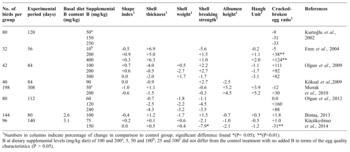
Of particular interest among the claims about the benefits of B is the idea that it can improve eggshell quality (Table 1). B appears to regulate the partitioning of minerals in the bone (Nielsen, Reference NIELSEN1990; Wilson and Ruszler, Reference WILSON and RUSZLER1996), thus, bone quality is closely related with egg production and eggshell quality due to calcium metabolism (Kim et al., Reference KIM, DONALSON, BLOOMFIELD, HOGAN, KUBENA, NISBET and RICKE2007; Reference KIM, BLOOMFIELD, SUGIYAMA and RICKE2012). This has led some researchers to postulate that it might have similar effects on eggshells because they consist mainly of Ca. However, there is no consistent evidence from studies to support this claim. The beneficial effect of B supplementation on the incidence of damaged eggs has been indicated in several studies. As reported by Yeşilbağ and Eren (2008), hens fed diets supplemented with 25, 50 and 100 mg/kg of B produced eggs with higher shell thickness and shell-breaking strength combined with reduced egg shell deformation. In contrast, in a recent study by Küçükyılmaz et al. (2014), the data regarding the eggshell thickness, eggshell weight and breaking strength did support predictions for reduced cracked-broken egg ratio from the use of B in laying hen diets with 75 and 150 mg/kg B supplementation. However, in seven published experiments to date that have measured shell quality in birds provided with B, none have reported an improvement in the shell quality or a reduction in the incidence of shell defects (Table 1) (Kurtoğlu et al., Reference KURTOĞLU, KURTOGLU, COSKUN, SEKER, BALEVI and CETINGUL2002; Eren et al., Reference EREN, UYANIK and KÜÇÜKERSAN2004; Köksal et al., 2009; Olgun et al., Reference OLGUN, ÇUFADAR and YILDIZ2009; Mızrak et al., 2010; Bintaş, Reference BINTAŞ2013). The egg shape index was not affected in these studies, nor was the egg specific gravity, another measure of the eggshell quality (Wilson and Ruszler, Reference WILSON and RUSZLER1998; Kurtoğlu et al., Reference KURTOĞLU, KURTOGLU, COSKUN, SEKER, BALEVI and CETINGUL2002).
The characteristics of eggs laid by hens given diets with supplemental B.

1Numbers in columns indicate percentage of change in comparison to control group; significant difference found *(P< 0.05); **(P<0.01).
B at dietary supplemental levels (mg/kg diet) of 100 and 200a; 5, 50 and 100b; 25 and 100c did not differ from the control treatment with no added B in terms of the egg quality characteristics (P > 0.05).
Haugh units measure the height and robustness of the albumen and is used as an indicator of egg freshness and is related to shelf life. This measurement was found not to be significantly influenced by supplementation with B. Other measurements of egg quality, including yolk and albumen index and specific gravity were similarly not improved by dietary B addition (Eren et al., Reference EREN, UYANIK and KÜÇÜKERSAN2004; Olgun et al., Reference OLGUN, ÇUFADAR and YILDIZ2009; Mızrak et al., 2010; Bintaş, Reference BINTAŞ2013; Küçükyılmaz et al., 2014).
Dietary B has attracted interest because of its potential role in lowering plasma lipid levels (Naghii and Samman, Reference NAGHII and SAMMAN1997a). Results from the study by Hall et al (1989) indicated that B-containing drugs may be of therapeutic benefit to atherosclerosis, because the compounds promoted cholesterol removal from tissues and decreased lipid accumulation. Although several reports have indicated a hypocholestremic effect of B in human subjects and rats (Naghii and Samman, Reference NAGHII and SAMMAN1997a; Reference NAGHII and SAMMAN1997b; Hall et al.,1989), the results from two recent experiments with layer hens were disappointing. As reported by Olgun et al. (Reference OLGUN, YAZGAN and ÇUFADAR2013), table eggs produced by hens fed 120 mg/kg B had markedly higher levels of total cholesterol and lower density lipoproteins than the eggs from untreated controls. Marked increases in the egg yolk cholesterol level were observed in eggs from hens fed B at concentrations of 5, 10, 50, 100, 200 and 400 mg/kg of diet (Yeşilbağ and Eren, 2008).
Overall, there is insufficient evidence in the scientific literature that demonstrated that supplementing laying hen diets with B improves eggshell quality. Eggs with high cholesterol level due to feeding additional B warrants much more studies to clarify this health related issue.
It is useful to add that dietary supplemental cost of B is negligible, e.g. 100 mg B supplementation to kg diet in the form of boric acid costs 0.5 US $ per one ton feed mixture. Hence, even minor improvements in performance of birds in association with normal bone growth could eminently pay off extra expenses derived from supplemental B. To our knowledge, economic benefits of adding dose or cost effective supplemental level has not been the subject of any related study.
Conclusions
The available scientific evidence for a regulatory role of B in terms of bone and eggshell strength is inconsistent and therefore cannot be used to suggest that it has an enhanced function in regulating the mineral metabolism. Data on the balance of Ca, P, Mg, Fe, Cu and Zn are too preliminary to be taken into consideration in either broiler chickens or layer hens. Moreover, the lack of measurement of these elements does not indicate whether there was increased excretion or an increased movement into the bone and soft tissues. The results indicate the need for further examination of components and mechanical properties of bones to ascertain why they respond differently to boron.