


Elections are the building block of democracy. Yet, turnout in local US elections is extraordinarily low. Less than a quarter of the adult population typically votes in elections for mayor and city council (Anzia Reference Anzia2014; Marschall and Lappie Reference Marschall and Lappie2018). More worryingly, the skew in turnout can be severe. Whites, for example, are almost twice as likely as Latinos and Asian Americans to participate in local contests (Hajnal Reference Hajnal2010). The imbalance by education, income, and age is just as stark.
These gaps are particularly troubling given how much is at stake. Every year local governments spend almost $2 trillion. Local governments also provide many core functions—including education, public safety, and transportation—that are critical for individual well-being. In short, a small and unrepresentative set of residents is determining who is elected and how local governments spend their money.
Moving stand-alone, off-cycle local elections so that they are held on the same day as are statewide and national contests represents one simple but potentially consequential reform. The logic is straightforward. Holding local elections concurrently with a national election greatly reduces the cost of participation. Citizens who are already voting for top-of-the-ticket offices need only check off a few more boxes further down the ballot.
Every published study on election timing and turnout shows that using concurrent elections is the single most important change that local governments can undertake to increase turnout (Anzia Reference Anzia2014; Berry and Gersen Reference Berry and Gersen2011; Hajnal Reference Hajnal2010; Holbrook and Weinschenk Reference Holbrook and Weinschenk2014; Kogan, Lavertu, and Peskowitz Reference Kogan, Lavertu and Peskowitz2018; Marschall and Lappie Reference Marschall and Lappie2018). Most show that turnout doubles compared with off-cycle elections.
Concurrent Elections and the Composition of the Vote
But increasing aggregate turnout is not the only objective. To make local democracy more representative, any reform that increases turnout also needs to reduce the skew in who votes.
There are theoretical reasons to expect off-cycle local elections to lead to a less representative electorate. The additional costs associated with stand-alone local elections—voters need to learn the date of their local election, find their local election polling place, and make a specific trip to the polls just to vote on local contests—may not affect all potential voters equally. In particular, we might expect election timing to influence high-propensity voters less than low-propensity voters. For high-propensity voters (who are generally older, white, and higher socioeconomic status), voting is a well-formed habit that is unlikely to be affected by relatively small changes to the costs of voting (Plutzer Reference Plutzer2002). By contrast, even a modest increase in costs could change the calculus and deter participation among occasional voters (who are generally younger, more likely to be minorities, and poorer). As a result, we should expect the electorate during high-cost off-cycle elections to include disproportionately more high-propensity voters like older, white homeowners who have abundant political resources and for low-cost on-cycle elections to draw in relatively more low-propensity voters including younger Americans, racial minorities, and the disadvantaged.
Whether on-cycle elections actually produce a more representative electorate is an empirical question for which there is little existing evidence. States with higher turnout tend to have less of a class bias in participation (Hill and Leighley Reference Hill and Leighley1992), and there are at least some cross-national studies finding that higher turnout is associated with more lower-class participation (Lijphart Reference Lijphart1997). But it is also true that some reforms that seek to expand turnout perversely increase disparities in participation (Berinsky Reference Berinsky2005; Burden et al. Reference Burden, Canon, Mayer and Moynihan2014).
Critically, no published research has compared the composition of voters between on- and off-cycle city elections due to a lack of data on individual voter demographics. The closest are two studies that examine voter composition in school tax referenda (Kogan, Lavertu, and Peskowitz Reference Kogan, Lavertu and Peskowitz2018; Meredith Reference Meredith2009). But their findings may not generalize to municipal candidate elections. Nevertheless, both find that off-cycle tax referenda tend to draw disproportionately older voters. Kogan, Lavertu, and Peskowitz (Reference Kogan, Lavertu and Peskowitz2018) also show that those voting on off-cycle school tax referenda are whiter and more conservative than are voters during on-cycle elections. Several additional studies indirectly infer differences in voter composition by looking at changes in downstream outcomes such as teacher salaries (Anzia Reference Anzia2014; Berry and Gersen Reference Berry and Gersen2011). We simply don’t know whether and how shifting the dates of citywide elections to coincide with statewide contests influences who ultimately votes.
What we do know is that the answer to this question is likely to be important for representation in local government. Recent studies demonstrate that voters and nonvoters in America have increasingly divergent policy preferences, with nonvoters favoring a more liberal, activist agenda (Leighley and Nagler Reference Leighley and Nagler2013). Likewise, research has found that higher turnout is increasingly associated with more liberal policy outcomes and higher support for Democratic candidates (Fraga Reference Fraga2018; Hansford and Gomez Reference Hansford and Gomez2010; Hill and Leighley Reference Hill and Leighley1992). These patterns, coupled with studies showing that voters have more influence over policy than do nonvoters, suggest that who votes and who doesn’t is consequential (Griffin and Newman Reference Griffin and Newsman2005).
Data and Research Design
In this study, we construct a panel of California city elections covering the years 2008 through 2016 to examine how the racial demographics, socioeconomic status, age, and political orientation of voters who turn out to vote in a city change as the timing of elections in that city shifts (Hajnal, Kogan, and Markarian Reference Hajnal, Kogan and Markarian2021). Recognizing the potential endogeneity of timing, our empirical strategy employs city fixed effects and thus leverages within-city variation in voter composition over time.
There are a number of reasons to focus our analysis on California. California is a large state (representing 12% of the national population) with enormous variation across its cities not only in terms of election timing but also in terms of racial and social demographics, institutional design (e.g., city manager vs. mayoral form of government; district vs. at-large elections), and electoral context (e.g., number of candidates, level of competition). Studying a single state also allows us to hold state-level policies constant. Nevertheless, while it is clear that the state has cities that look like most cities around the country, it is equally clear that California is not an exact replica of the nation and we caution about generalizing our results to the nation as a whole.
Our empirical analysis combines three types of data. The first is a list of all decisive city elections in California between 2008 and 2016 derived from the California Elections Data Archive.Footnote 1 This sample includes a little over 2,000 city-by-election date observations, or about four unique local election dates for each of California’s roughly 500 cities. We classify every local election as taking place on the same day as a presidential general election, a midterm general election, or a statewide primary election. All elections that do not occur on one of these statewide election days are coded as being held off cycle.Footnote 2
In our panel, cities that change their election timing over time almost always switch from off- to on-cycle elections. In many cases, cost savings appears to be the main motivation for the shift (Goodman Reference Goodman2016). Cities in California pay the entire cost of stand-alone contests but only a fraction of consolidated elections. A few cities switched to on-cycle elections in response to a 2015 state law. Some cities also hold runoff elections on cycle if no candidate wins a majority at the time of the primary, and whether the runoff is required varies over time. Finally, idiosyncratic reasons like scandal, retirement, or death also sometimes result in cities holding off-cycle special elections.
The second data source is based on the California voter file, which indicates whether or not each voter participated in a given election and includes the age of each registrant. Finally, Catalist LLC, a national microtargeting vendor, supplements the voter file with a variety of racial, demographic, and political data on each voter. Catalist sources some of the variables (including income, wealth, and home ownership) from other commercial sources. In other cases (race, ideology, and partisanship), it combines Census and commercial data in combination with proprietary models to predict values. For our main variables of interest, existing studies suggest that the Catalist estimates are sufficiently precise (Fraga Reference Fraga2018). In the online appendix in sections B, C, and D, we provide additional details on these estimates, offer independent verification of their accuracy, and test to see how our results might be affected by potential measurement errors.
Another potential source of error comes from the fact that our compositional measures are based on the current snapshot of the Catalist voter file. We match voters to the electoral jurisdiction corresponding to their current address. However, a voter we observe today living in one city may have lived in a different city at the time of an earlier election. However, this type of measurement error turns out to be a minor issue. Among the subsample of election dates for which official turnout statistics are available at the municipal level, the correlation between these official figures and the Catalist count is 0.999.
All told, any measurement error in our compositional dependent variables should attenuate our estimates, making it more difficult for us to find significant differences across election dates. Such measurement error cannot explain the significant and substantively large effects we report below.
To ensure that our timing effects are not driven by local demographics, we control for time-varying measures of resident age, income, education, the racial breakdown of the city, and the total population. Likewise, to ensure that election competitiveness is not driving our results, we control for whether or not there is a mayoral election on the ballot, the number of local races on the ballot, the average margin of victory across these races, and the average number of candidates per race.
Timing and Voter Composition
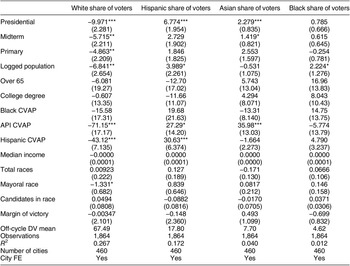
We begin our examination of the effect of timing on the composition of voters in city elections in Table 1 with a focus on race. The table presents fixed effects regression estimates for the effect of election timing on the share of voters in each racial category including all city elections during which at least one local candidate was elected.Footnote 3 That specification exploits variation in local election timing within cities over time.Footnote 4
Election Timing and the Racial Composition of Voters

Note: Robust standard errors clustered by city in parentheses. ***p < 0.01, **p < 0.05, *p < 0.10.
When cities shift to on-cycle elections, we find that the non-Hispanic white share of voters declines, whereas shares of racial and ethnic minorities increase substantially. Whites typically account for more than two thirds of all voters in off-cycle elections but their share of voters decreases by nearly 10 percentage points when local elections are held on the same day as presidential contests, by 5.7 points when they are concurrent with midterm elections, and by 4.9 points when they are held during statewide primaries. Latinos and Asian Americans—the two largest minority groups in California—gain the most from a move to on-cycle elections. The Latino share of voters increases from about 18% in off-cycle elections to just under 25% when these elections are consolidated with presidential contests.
For Asian Americans, their share of the electorate increases by 2.3 percentage points when cities move to the same date as presidential elections and by 1.4 points when cities move to the same date as midterm elections. This might appear to be a substantively small effect, but it’s important to keep in mind that Asian Americans account for only 7.7% of the electorate in off-cycle elections, so this represents increases of 30% and 19%, respectively. We also find that the Black share of voters is substantively unaffected by timing.
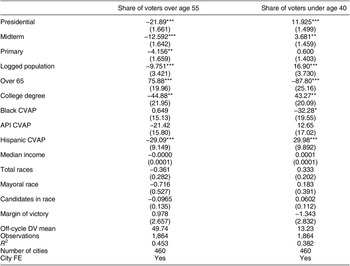
There are even more dramatic effects for age. As Table 2 demonstrates, younger Americans are substantially better represented in on-cycle contests and older Americans’ share of the electorate is substantially reduced during these contests. Although older Americans represent only about a quarter of the population of California cities, they account for nearly half of off-cycle voters. But the share of older voters drops almost 22 points in local elections that coincide with presidential elections, 13 points for midterm elections, and 4 points when local elections are coupled with statewide primaries. At the other end of the age spectrum, the share of younger Americans—the age group least likely to participate in politics—almost doubles during presidential elections, with significant but smaller gains for midterm election dates.
Election Timing and the Age Composition of Voters

Note: Robust standard errors clustered by city in parentheses. ***p < 0.01, **p < 0.05, *p < 0.10.
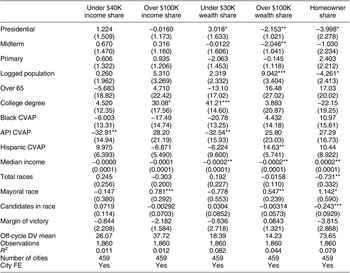
Table 3 examines the effects of election timing on voter socioeconomic status. The results here are not as consistent or robust but there are, nevertheless, signs that moving to on-cycle elections can increase the voice of less advantaged Americans. In particular, local contests that coincide with presidential elections have a larger share of residents with little family wealth (under $30,000) and a significantly smaller share of residents with substantial wealth (over $100,000) as well as a marginally significant smaller share of homeowners.
Election Timing and the Economic Composition of Voters

Note: Robust standard errors clustered by city in parentheses. ***p < 0.01, **p < 0.05, *p < 0.10.
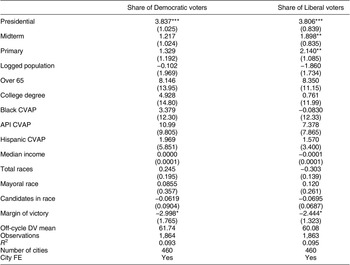
Not surprisingly, given the well-established associations between demographics and partisanship, the effects we have documented have important consequences for political attributes. As Table 4 shows, the share of voters predicted to identify with the Democratic Party grows by 3.8 points during presidential elections. Likewise, the share of voters with liberal leanings increases by 3.8 points during on-cycle presidential elections and by 1.9 points in on-cycle midterm elections.
Election Timing and the Political Composition of Voters

Note: Robust standard errors clustered by city in parentheses. ***p < 0.01, **p < 0.05, *p < 0.10.
A More Representative Electorate?
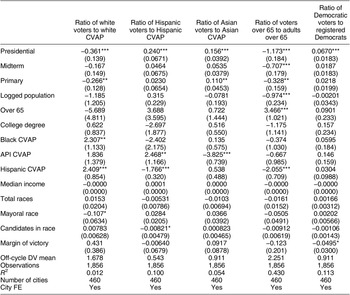
The results so far suggest that on-cycle elections produce an electorate that looks more like the overall California population. But how much does election timing influence the extent to which voters look like the residents of individual cities? To answer this question, we examine a new set of dependent variables that measures representativeness—each group’s share of voters in an election divided by that group’s share of a city’s voting-age population. A value of one corresponds to perfect representation. Larger numbers indicate that a group is proportionately overrepresented, whereas values below one indicate that a group is underrepresented.Footnote 5
The results, reported in Table 5, demonstrate on-cycle elections produce a more representative electorate. Not surprisingly, white voters are overrepresented in off-cycle elections (a ratio of 1.68), but shifting to on-cycle presidential dates reduces this gap. The Latino share of the population is roughly double the group’s share of voters in off-cycle contests. But when local elections are held concurrently with the presidential contest, Latino representation moves closer to parity. On-cycle elections also significantly reduce the underrepresentation of Asian Americans.
Effects are even more pronounced in terms of voter age. Older Americans represent more than twice as many voters as they do adult city residents. But that overrepresentation is reduced by roughly half in on-cycle contests. Finally, Democrats are generally slightly underrepresented in off-cycle elections (a ratio of 0.91) but moving to concurrent local elections produces near-parity (a ratio of 0.98). All of these effects are much smaller and often insignificant for midterm and primary election dates. We again find more limited representational gains for Blacks. In summary, the shift to on-cycle elections and in particular the move to presidential election dates brings us closer to a world where voters begin to look more like the population of city residents.
Election Timing and the Representativeness of Voters

Note: Robust standard errors clustered by city in parentheses. ***p < 0.01, **p < 0.05, *p < 0.10.
Where Does Timing Matter Most?
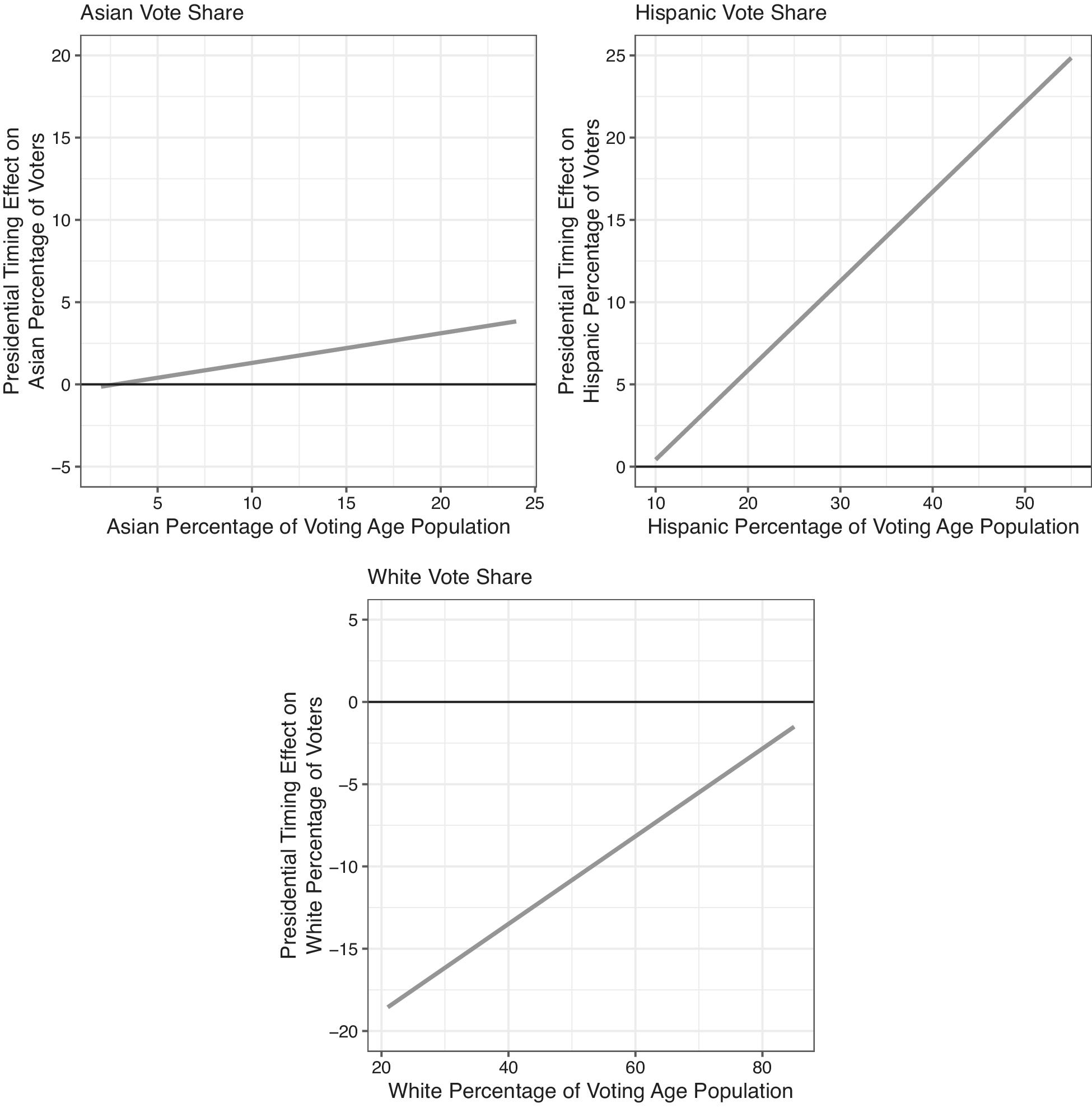
If timing affects voter racial composition, we should see the most pronounced effects in cities where minorities represent a larger share of the population. In Figure 1, we show that this is indeed the case. The figure illustrates how the predicted effect of election timing on voter racial composition varies across cities with different levels of minority population. The figure compares off-cycle with presidential elections, but Section I of the online appendix also reports results for midterm and primary elections.
How Effects of Election Timing on Voter Racial Composition Vary Depending on City Population

The shift to presidential election timing reduces the white share of voters by less than 5 percentage points in cities where whites represent more than 80% of the voting-age population, but the effect is more than 15 percentage points in cities where white residents account for only a quarter of the adult population. Even more dramatically, holding local elections concurrently with presidential contests increases the Latino share of voters by less than 5 percentage points in a city where Latinos account for a fifth of the adult population. But the effect increases to 25 percentage points in a city that is 55% Latino.
Roll Off
Our measures are based on official voting records, which indicate only whether a voter cast a ballot in each election and do not reveal whether the individual marked a vote in any given race. One could, for example, choose to vote in a presidential contest but then “roll off” by failing to mark the ballot for a city contest. If the voters who turn out for high-profile national elections but roll off are disproportionately Democratic, liberal, poor, and young, this could offset much of the demographic shift we documented above.
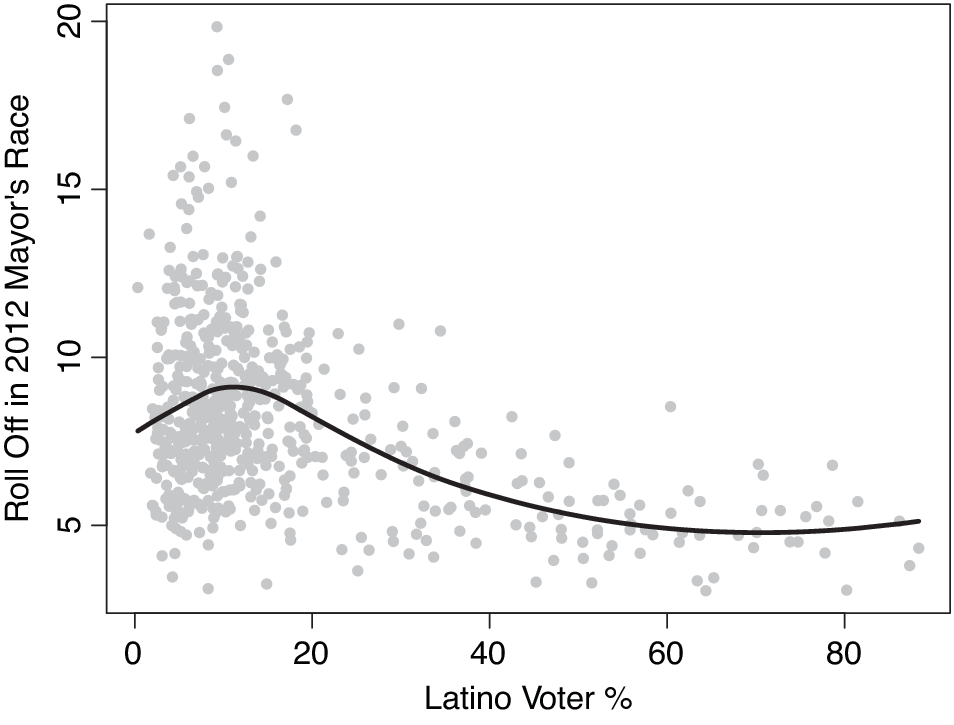
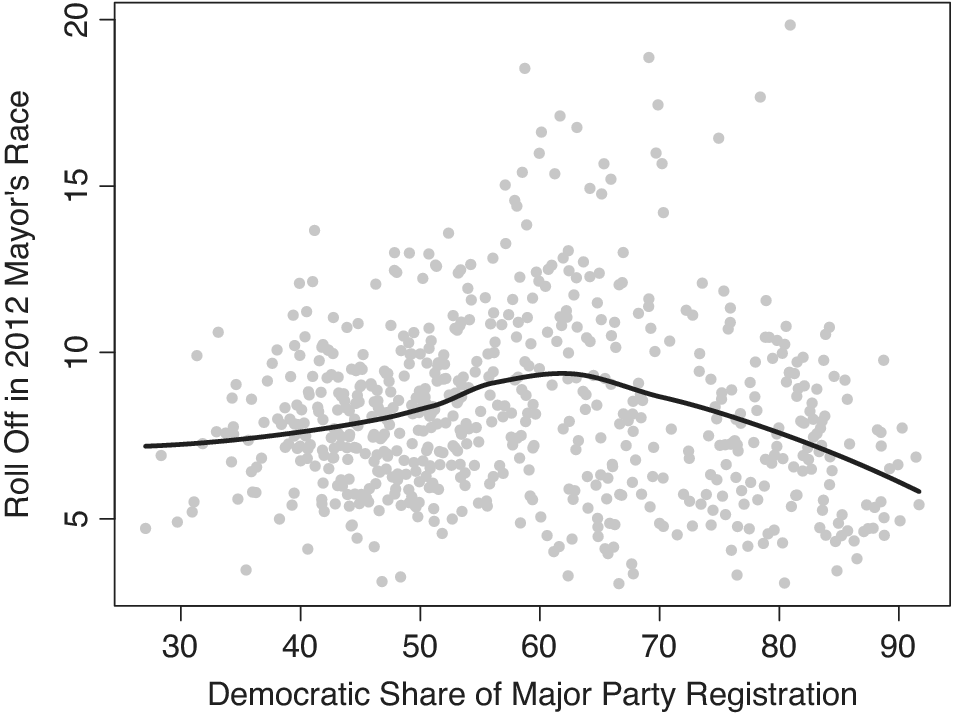
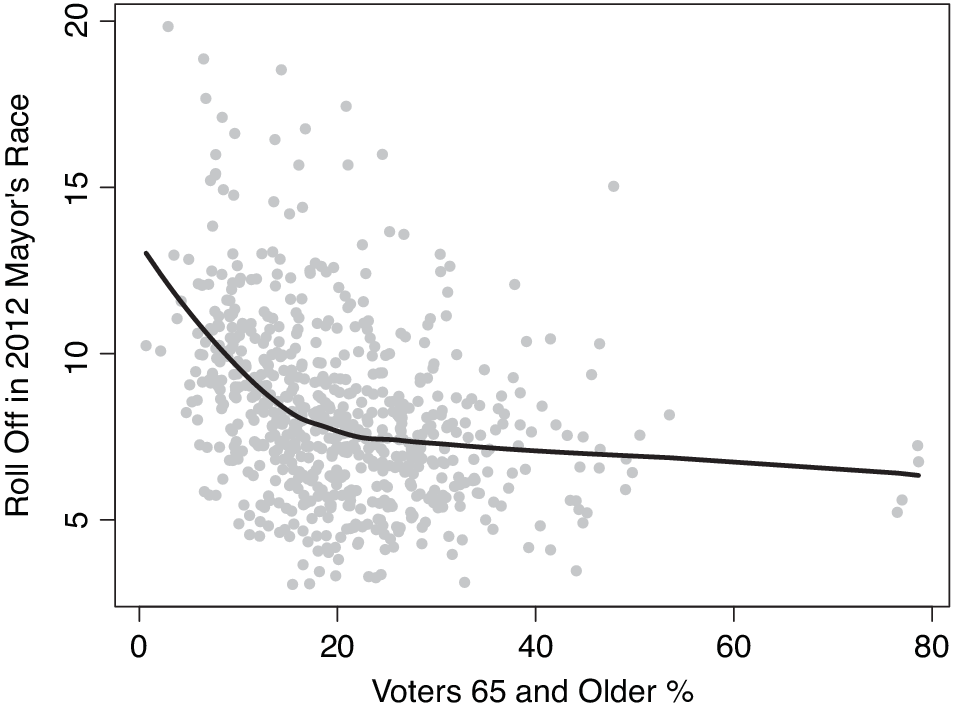
To address this concern, we examined precinct-level returns in San Diego—California’s largest city with on-cycle elections—to see whether ballot roll off there is, in fact, related to race, age, and partisanship. Focusing on turnout in San Diego’s 640 precincts in November 2012, when ballots were cast for both president and mayor, we find no major differences in roll-off rates by race or partisanship (as Figure 2 and 3 help to illustrate) but do find some evidence that younger voters are more likely to skip down-ballot races (as Figure 4 reveals). These age effects are far more modest than the representational gains produced by on-cycle elections, however. More systematic ecological inference models that we detail in the online appendix roughly mirror the patterns in the figures.
Precinct-Level Roll Off in 2012 San Diego Mayoral Election by Latino Voter Share

Precinct-Level Roll Off in 2012 San Diego Mayoral Election by Democratic Share of Voter Registration

Precinct-Level Roll Off in 2012 San Diego Mayoral Election by Share of Voters 65 and Older

Because patterns in San Diego in 2012 might differ from those of contests in other cities, we also examined cross-sectional variation in the level of observed roll off across all cities in the state to see whether roll off is correlated with aggregate voter demographics. Those results, which are displayed in the online appendix, provide no evidence that roll off is greater in more racially diverse or more Democratic cities or in jurisdictions with a younger electorate. All of this suggests that roll off does not undo the representational gains produced through on-cycle elections.
Discussion
We live in a time when the nation is focusing enormous attention on electoral reform. While some efforts limit voter options in the name of preventing fraud, others seek to expand the electorate. As we write this, at least 112 bills expanding voter access are moving through 31 state legislatures and Congress is considering HR1, a major initiative to expand democratic access and equity (Morales-Doyle et al. Reference Morales-Doyle, Adelstein, Zdanys, Lau, Howard and Waldman2021). Almost as many fraud-related measures are actively being considered or passed. In short, there is a real appetite for electoral reform. On-cycle elections is one of the reforms that is getting increasing attention and one that could potentially be rapidly expanded around the country. Three states—California, Arizona, and Nevada—have recently passed laws mandating on-cycle elections. At least two others—Washington state and Tennessee—are considering legislation to do the same. Moreover, with surveys showing that the public strongly favors on-cycle elections, widespread timing reform seems quite possible, if not likely.
For all of these reasons, it is critical that we do more to understand the effects of local election timing. We have shown that moving to on-cycle elections—especially to elections held on the same day as presidential contests—has real potential to alter who participates in local democracy. In California, holding city elections concurrently with statewide and national contests reduces the overrepresentation of whites and older Americans and, to a smaller extent, the well-off. The voters who typically participate the least, and generally have less of a voice in American democracy, gain the most. These patterns make the move to on-cycle elections well worth considering.
But important questions remain. One wonders whether the effects that we see here in California generalize to other states around the country. That we find more pronounced effects on minorities in cities where more minorities live suggests that the representational gains are likely to be greatest in the most diverse jurisdictions. More research is necessary to understand how timing affects democratic outcomes such as who is elected and whether minority candidates fare better when the electorate is broader and more diverse. And finally, are there effects for how cities spend their money and, ultimately, who wins and who loses in local democracy? Ongoing efforts to reform local election timing promise to provide fertile ground for research on these and related questions.
Supplementary Materials
To view supplementary material for this article, please visit http://doi.org/10.1017/S0003055421000915.
Data Availability Statement
Replication materials are available at the American Political Science Review Dataverse: https://doi.org/10.7910/DVN/FBKO6N.
Acknowledgments
We are grateful to Alex Garlick, Anthony Gutierrez, Daniel Smith, and participants of the 2019 Election Sciences, Reform, and Administration Conference for helpful comments on earlier drafts of this manuscript. We thank Robert Lawson and the Yankelovich Center for Social Science Research for their support and Lucas De Abreu Maia for research assistance.
Funding Statement
This research was partially funded by Robert Lawson and the Yankelovich Center for Social Science Research.
Conflict of Interest
The authors declare no ethical issues or conflicts of interest in this research. Hajnal has previously served as an expert witness in litigation involving election timing.
Ethical Standards
The authors affirm this research did not involve human subjects.




Comments
No Comments have been published for this article.