INTRODUCTION
Although small businesses owned by Blacks had historically been uninvolved in the contracting activities of government, this changed in the 1970s as the political power of Black voters was demonstrated in large cities. Maynard Jackson’s election as Mayor of Atlanta in 1973 was the catalyst sparking a profound transformation of the nation’s underappreciated and misunderstood Black business community. Although Atlanta was a majority Black city, Black-owned firms were locked out of public procurement. Mayor Jackson’s strategy to create opportunity for Black entrepreneurs relied upon affirmative action in city contracting (Boston Reference Boston1999). Targeting construction of the Hartsfield International Airport, his goal was to award 25% of the construction contracts to minority-owned businesses. Opposition was intense because Hartsfield was one of the largest construction projects under way in the South in 1974 and building such massive projects required specialized expertise often lacking in Atlanta’s Black contractor pool. Shouting at Mayor Jackson in an open meeting, “Niggers don’t fly planes, what do they know about building airports?” (Boston Reference Boston1999, p. 15), a White contractor captured the spirit of cooperation prevailing between entrenched local contractors and upstart minority newcomers.
Following Atlanta’s lead, many cities headed by Black mayors aggressively steered city contracts to minority business enterprises (MBEs) in the late 1970s. Two types of preferences were widespread: (1) prime contractors were required to allocate a percentage of contract awards to MBE subcontractors; and (2) a specific percentage of overall government contracts was allotted directly to MBE vendors (Rice Reference Rice1991). Journalists have periodically documented the problems encountered by Black-owned firms selling products to government clients. Particularly in construction subcontracting, the seeming success of Black contractors was often portrayed as resting on a foundation of fraud. Some of these problems were indeed real; as one type of abusive practice was exposed, others invariably arose, and this process has continued into the twenty-first century. Some preferential procurement programs functioned effectively as strategies fostering Black-business growth and job creation. In industries where Blacks typically worked as subcontractors, however, actual compliance with requirements for substantive minority utilization was sometimes minimal. This study analyzes how the struggle of Black entrepreneurs to penetrate into mainstream government and corporate procurement markets has unfolded into the twenty-first century.
The opportunity for Black-owned businesses to move beyond traditional personal services and retailing fields and into mainstream markets is the legacy of preferential procurement programs. The realization that exploiting these opportunities entailed transforming Black entrepreneurship fundamentally was immediately apparent to many. The opportunities created by Atlanta’s pioneering program “attracted Blacks out of corporate-sector management, administrative, and executive positions and into entrepreneurial careers” (Boston Reference Boston1999, p. 14). By the 1980s, many billions of procurement dollars were earmarked annually for MBEs at all levels of government. Reflecting their greater political sophistication, in comparison to Latino and Asian entrepreneurs, Black-owned small businesses captured the largest relative share. As this multi-billion dollar market opened up, minority employment in Black-owned firms in the impacted industries soared (Bates Reference Bates2006; Boston Reference Boston1999).
Proceeding sections of this article trace the development of government and corporate preferential procurement programs from the 1970s into the twenty-first century. The nature of the challenges facing Black entrepreneurs seeking government and corporate clients are explored, as are the strategies adopted by specific procurement programs that have effectively integrated minority-owned businesses into public sector supply chains. The success, or lack thereof, of the preferential procurement strategy has been heavily shaped by the choices made by those responsible for administering these programs, more so than the specific program characteristics spelled out in the executive orders and enabling legislation. Major attention is paid in this study to measuring program impacts upon the size and scope of the Black-owned business community, such as: (1) measuring impacts on Black self-employment rates; (2) identifying specific industry types of firms benefitting from their involvement in preferential procurement; and (3) exploring employment impacts. Multiple problems notwithstanding, preferential procurement has, on balance, been highly successful.
THE FORMATIVE YEARS: PEFERENTIAL PROCUREMENT PROGRAM EXPANSION UP TO 1989
The Challenge of Exploiting Emerging Opportunities
Atlanta’s was not the nation’s first preferential procurement program, but it served as the model adopted across the nation. Legislation in 1967 authorized the U.S. Small Business Administration (SBA) to use the procurement process to assist “socially or economically disadvantaged” businesses, and SBA chose to equate disadvantage with minority ownership (Levenson Reference Levenson1980). These programs began in 1969 when SBA used section 8(a) of the Small Business Act to funnel contracts to minority vendors. The guiding philosophy of 8(a) contracting was that MBEs were too weak to compete on their own and thus required protection from competition. A sheltered market was created and socially or economically disadvantaged firms were nurtured until they were strong enough to stand on their own. Section 8(a) procurement contract awards, a modest $9 million in 1969, grew to $768 million in 1978, and reached $2.3 billion in 1983; 96% of the 8(a) companies were minority owned. A 1981 General Accounting Office evaluation found that only 166 of the 4598 firms participating in the 8(a) program since 1969 had graduated as competitive businesses. Numerous shortcomings were flagged, foremost of which was the reality of fifty politically well-connected firms obtaining over 30% of the $5.5 billion of 8(a) contracts awarded between 1969 and 1980. These firms received, on average, $34.5 million each in contract payments (U.S. Comptroller General 1981). The sheltered market features of the 8(a) program were rarely embraced by other government entities.
More important than 8(a) was the Public Works Employment Act (PWEA) of 1977, which required that minority vendors receive at least 10% of the contract awards in federally financed local public works projects. Using the PWEA as the model, the U.S. Department of Transportation (DOT) attached MBE subcontracting requirements to federal grants to state and local governments financing infrastructure, and this was perhaps the single most important federal government policy promoting MBE utilization. Beyond federal requirements, hundreds of preferential programs were established by local and state governments by the mid-1980s targeting successful entrepreneurs, few of whom were economically disadvantaged. Following public sector initiatives, corporations in consumer-oriented industries and government contracting often developed their own programs; the latter did so in response to government requirements. From Pepsi to Lockheed, these efforts proliferated and ultimately surpassed government programs in aggregate dollar amount in terms of providing a broad new customer base for the minority business community (Bates Reference Bates2001).
Government procurement contracts were awarded most often to construction firms, firms producing and distributing goods, and to businesses in skilled-services, including law firms and engineering services providers. Most MBEs in the 1970s were personal services and retailing firms selling products to neighborhood residents. The initial difficulty created by procurement opportunities was the mismatch between the procurement needs of government and the industry distribution of MBEs. Most were in the wrong lines of business and lacked the necessary working capital and bonding capacity to compete successfully for large procurement tasks. In 1972, when Black Enterprise magazine published its first listing of the largest 100 Black-owned firms, aggregate sales for all 100 were $437 million and their customers were most often Black households (Jaynes and Williams, Reference Jaynes and Williams1989). Corresponding sales for the Black 100 largest Black-owned firms by 1995 had grown to $7.4 billion and their customers were largely other businesses and government agencies.
Not all segments of U.S. society were pleased by the rising opportunities available to Black entrepreneurs. Construction contracting dominates state and local government procurement spending.Footnote 1 Transportation construction, observed U.S. Senator Lautenberg, “has historically relied on the old-boy network which, until the last decade, was almost exclusively a White old-boy network… This is an industry that relies heavily on business friendships and relationships established decades, sometimes generations, ago” (Federal Register 1999, p. 21). Skills acquisition does not solve the problem of old-boy networks. The fact that such exclusion was illegal after 1965 had little immediate impact on industry practices. Beneath the laws and union contracts lurked a reality of personal contacts and informal networks limiting minority participation.
Large U.S. cities electing Black mayors in the 1970s spent most of their procurement dollars on construction projects, and their aggressive efforts to involve MBE contractors raised operational difficulties. Although entrenched construction firms resisted admitting minorities either as employees or independent contractors, exclusion was never absolute. Mainstream construction firms willingly hired minorities as unskilled laborers. Minorities in certain skilled trades, as well, were often employed in tasks where work was stigmatized as dangerous (U.S. General Accounting Office 1979). Thus, asbestos removal and roofing were often minority jobs. Chicago was a typical union town; although skilled minority employees were tolerated in some fields, they were almost non-existent in eleven of the city’s nineteen unionized skilled trades in 1970. Pioneering efforts by cities like Atlanta and Philadelphia attempted to break traditional patterns of minority exclusion by requiring construction contract recipients to employ minimum percentages of skilled minorities (25% was common); additionally, prime contractors had to award a fixed percentage of the subcontracts (15%-25%) to MBEs. Prime contractors, preferring to stay within their own networks, went to great lengths to circumvent these requirements.
Within construction firm networks, members know each other and function effectively together (Granovetter and Tilly, Reference Granovetter, Tilly and Smelser1988). Working with network insiders minimizes risks on large and complex jobs involving many subcontractors and operating within tight time constraints. As newcomers and outsiders, MBEs seeking contracts were not members of these networks (Bates and Howell, Reference Bates and Howell1998). Faced with the necessity of hiring MBE subcontractors, mainstream firms won contracts with promises of broad minority participation, but once contracts were in hand, actual minority involvement was often minimal. Use of MBE front firms was initially a common response, but such outright flaunting of government policy intent was risky and often illegal. Front companies took many forms but, in all instances, the minority owner supposedly in charge was doing little or none of the contracted work. Some government entities tolerated front-company abuses and some did not. The same objectives—appearing to meet government requirements while not complying—were often achieved indirectly. One popular approach was to require that MBE subcontractors hire only those employees the prime contractor specified. Prime contractors then placed their own employees on subcontractor payrolls. Another approach was simplicity itself: absent government monitoring, minority firms receiving subcontracts would be given only a fraction of the promised work. A pattern developed whereby the share of procurement work accruing to MBEs—commonly tracked by measuring contract award amounts—was significantly less than the actual dollar payments received by MBE subcontractors (Bates and Williams, Reference Bates and Williams1995).
Atlanta initially claimed stunning success involving MBE vendors in it’s procurement contracting: the minority share rose to 13.5% in 1975, 21% in 1977, and exceeded 30% in later years, according to official sources. An independent examination of contracts confirmed that, although Black contractors had substantially increased their share of city contracts and had captured most of the contracts awarded to MBEs, the total minority share of actual work was in the 15% range (Boston Reference Boston1996). Chicago in the 1980s adopted a variant of Atlanta’s procurement contracting program and subsequent outcomes mirrored the Atlanta experience. Although MBE involvement increased, dominance by entrenched White contractors was unaltered. An analysis of payments to city of Chicago vendors revealed that direct payments to MBEs in 1979 were $2.2 million, 1.5% of all payments to vendors. By 1989, the minority share had risen to $85.9 million, nearly 13%. The number of MBE vendors—excluding subcontractors—receiving direct payments from the city indeed grew sharply, from fifty-four firms in 1979 to 688 in 1989 (Getzendanner et al., Reference Gentzendanner, Castillo and Davis1990). Perceptions of increased opportunities in the 1980s encouraged well-educated, younger African Americans to create and expand firms (Chatterji et al., Reference Chatterji, Clay and Fairlie2014; Getzendanner et al., Reference Gentzendanner, Castillo and Davis1990).
The distinction between subcontractors and other city vendors is important. City vendors were normally paid directly by the city of Chicago, while subcontractors were paid by their prime contractors. The total share of city procurement dollars received by MBEs was the sum of direct payments and those received for subcontracting work. According to the city’s Purchasing Department, MBEs received, from 1986 to 1989, between 25.6% and 33.0% of all procurement dollars, but this reflected MBE involvement reported by prime contractors. Chicago, like most entities, relied upon the entenched insiders—the prime contactors—to keep track of the degree of MBE involvement as subcontractors. This practice—akin to asking the fox to monitor the chicken coop—is still widespread in government construction contracting in the twenty-first century. The subsequent gap between awards to MBEs and payouts for subcontracting work performed, referred to as slippage, was substantial.
Harold Washington, Chicago’s first Black mayor, commissioned a comprehensive review of the city’s procurement practices in 1984. At that time, Chicago had a preferential procurement program underway, but its deficiencies negated its usefulness. The report to Mayor Washington documented that: (1) the city had no formal process for notifying MBEs of upcoming procurement opportunities; (2) tracking of actual MBE participation in procurement was unreliable; (3) compliance monitoring of prime contractors was minimal; (4) surety bonding requirements and bid deposits favored established vendors; and (5) the Purchasing Department’s policy manual did not accurately reflect actual practices. Chicago’s procurement system was a template for protecting entrenched companies that knew how the system worked (Lowry and Associates 1985). Following the Lowry Report, Mayor Washington established mandatory MBE subcontracting goals and initiated discretionary awards of small contracts directly to MBEs. By 1989, 3000+ minority-owned firms accounted for 32% of all businesses registered as city vendors. Because merely mandating minority involvement did not address the barriers limiting their participation, these 3000+ MBEs nonetheless received a small share of actual contract dollars. In construction, MBEs accounted for 44% of the businesses on the city’s bidders’ list; because they worked most often on small subcontracts, however, the MBE share of 1989 payments to city vendors was 10% (Getzendanner et al., Reference Gentzendanner, Castillo and Davis1990).
Due to prime contractor resistance, government entities often awarded prime contracts directly to MBEs. While this often worked smoothly for small projects, most construction spending involved large jobs, and the government initially faced a reality of small firms lacking the resources necessary for completing large contracts successfully, including working-capital lines of credit and bonding capacity. In the early years, most MBE vendors had the capacity to handle only small jobs, a problem that eased as successful firms built capacity. Large contracts were nonetheless sometimes awarded to small MBEs, and the outcome was too often vendor inability to meet contract requirements completely and on a timely basis (Bates and Williams, Reference Bates and Williams1995).
In light of the unreliability of government entities self-reporting the scope of MBE involvement in procurement, alternative information sources were developed, foremost of which was the Census Bureau’s Characteristics of Business Owners (CBO) database. Measures of participation in government and corporate procurement drawn from CBO data reflect responses of business owners self-reporting percentages of their annual sales revenues derived from different client types: (1) state and local governments, (2) the federal government, (3) households, and (4) other businesses. CBO tabulations indicate that 13.6% of White-owned small firms nationwide and 9.9% of Black-owned firms sold products to government clients in 1987. Relative to all Black businesses, these were disproportionately the younger, better capitalized, larger-scale firms headed by college-educated owners. Looking solely at young Black employer firms, for example, 17.5% (nationwide) sold products to government clients; the corresponding incidence among White firms was 20.9% (Bates Reference Bates1997).
Measuring Preferential Procurement Program Impacts
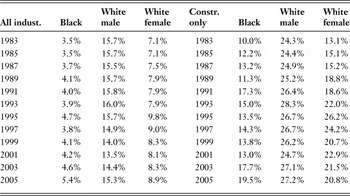
Seeking to measure objectively the impacts of preferential programs, Aaron Chatterji and colleagues (Reference Chatterji, Clay and Fairlie2014) examined Current Population Survey (CPS) data from 1979–1989 to determine whether preferential procurement program initiation caused concurrent increases in Black self-employment rates. Comparing cities starting programs to cities lacking such programs in twenty-five metropolitan areas, they found that the gap in Black/White self-employment rates narrowed by three percentage points in the first five years following new program initiation. Gains in self employment were concentrated in the industries most heavily involved in government contracting. Actual self-employment rates nationwide among Blacks overall rose from 3.5% in 1983 to 4.0% by 1991; among Blacks self employed in construction, in contrast, corresponding rates rose from 10.0% in 1983 to 17.3% in 1991 (Table 1), a pattern consistent with Chatterji and colleagues’ (Reference Chatterji, Clay and Fairlie2014) findings of positive impacts. Gains in self employment in the 1980s were very small (but positive) among the least educated Black males under age thirty and very large among those thirty and over with stronger educational credentials. Preferential procurement program initiation in the central cities, furthermore, was associated with increased self employment among Black male residents of both the city and the suburban periphery. In metro areas lacking programs, no corresponding gains were found. In the areas where programs were implemented, there was no evidence of post-program gains in self employment in industries not impacted by preferential procurement nor was there evidence that pre-program trends in Black self employment were responsible for the observed post-program increases. The coincidental timing of preferential program initiation and subsequent increases in Black self- employment rates were due to causal effects of the procurement programs (Chatterji et al., Reference Chatterji, Clay and Fairlie2014).
Nationwide White and Black Self-Employment Rates, 1983 to 2005

Source: Basic monthly files of the Current Population Survey (CPS), reported in Blanchflower (Reference Blanchflower2008). Total self employment is reported, defined as the sum of incorporated and unincorporated self employed, and self-employment rates are defined with reference to workers—one if self employed, zero for an employee. Corresponding self-employment rates for all Hispanic workers were 7.1% in 1983, 7.0% in 1993, 6.5% in 2003 and 7.2% in 2005. Self-employment rates for Hispanics working in construction were 11.1% in 1983, 15.6% in 1993, 11.7% in 2003, and 13.0% in 2005. Blanchflower used these CPS data to estimate the probability of an individual working in construction being self employed, while controlling statistically for education, age, race, ethnicity, gender, and state of residence, and concluded the gap in construction self-employment rates between White males and Blacks “has narrowed markedly over time” while the corresponding gap between White males and Hispanics “has changed little over time” (2008, p. 16).
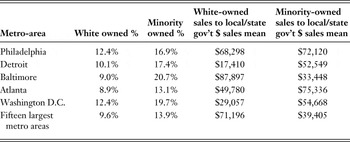
Statistics describing small-firm participation in public sector procurement in metropolitan areas indicate that MBEs doing business in these regions were more likely than those in small-town and rural America to sell to government, while the opposite pattern typified White firms. Further disagregation clarified that MBE involvement was most pronounced in areas where the central city mayor was African American. Table 2 describes percentages of MBEs and White-owned firms serving local and state government clients in 1987 in fifteen large metro areas, including selected cities with Black mayors (Bates Reference Bates1997). Not only were MBEs in cities with Black mayors particularly likely to sell their products to government; but MBE vendors in these areas reported greater average sales, with Atlanta standing out as the region where sales were highest.
Percentage of Small Firms Selling to State and Local Government Clients in 1987 in Large Metro Areas Only

Source: U.S. Bureau of the Census Characteristics of Business Owners database; reported in Bates (Reference Bates1997).
By the 1980s, it was apparent that the nation’s innovative programs operated in cities where Black mayors presided. The discretion granted to mayors over procurement contracting gave them opportunities to reward MBEs owned by constituents. Political power generated economic benefits: the actions of Black mayors produced substantive business development impacts. Using census data, Timothy Bates and Darrell Williams (Reference Bates and Williams1993) demonstrated statistically that among MBEs in industries where government contracting was common, firms in cities with Black mayors had both higher average sales revenues and lower failure rates than otherwise identical firms in cities governed by White mayors. The obvious question was how do they do it?
A mayor’s tenure in office impacts his/her ability to promote effective preferential procurement policies. Procurement decisions are often decentralized, with special districts controlling spending. Placing proponents of preferential procurement into positions of authority takes time. Between 1973 and 1980, “the Black share of administrators rose from 14 to 35% in Atlanta and from 12 to 41% in Detroit” (Eisinger Reference Eisinger, Hahn and Levine1984, p. 252). Procurement opportunities resulting from these realignments changed the landscape for MBEs serving government clients. Preferential procurement packaged with complementary assistance was the strategy for aiding MBE vendors. Common types of assistance were: (1) Procurement was handled by a staff specifically responsible for assisting MBEs; (2) Working-capital assistance—including quick payment of invoices—was provided to MBE contract recipients; (3) On small contracts requiring vendor bonding, these requirements were waived or reduced for MBEs; (4) Large contracts were unbundled and down-sized to increase their accessibility to MBEs; (5) MBEs seeking to sell their products to government clients were subjected to rigorous certification processes to weed out fronts; (6) MBEs caught circumventing procurement regulations through such actions as fronting for White-owned firms had significant penalties imposed upon them; and (7) Procurement departments were not permitted to meet their set-aside goals by purchasing goods from MBE brokers that carried no inventory and did not service their products.
To explore whether the nature of preferential procurement programs determined if MBEs benefitted from their involvement in this marketplace, the Joint Center for Political and Economic Studies in 1992 collected detailed profiles of active programs in twenty-eight large cities. These were combined with 1987 census data describing 1085 MBEs in these metro areas that actually sold products to state or local government clients, and these vendor firms were tracked through 1991 to differentiate surviving firms from closures. Controlling statistically for firm and owner traits, regression analysis indicated that: (1) waiver of bonding requirements, (2) provision of working-capital assistance, and (3) rigorous certification were strongly associated with enhanced MBE vendor survival (Bates and Williams, Reference Bates and Williams1995). Among these twenty-eight cities, only 30% actually provided bonding waivers to MBEs, 63% provided working-capital assistance, and 67% rigorously certified MBE vendors. Impacts of contract unbundling also benefitted MBEs. Cities with Black mayors typically provided more and better assistance to MBE vendors than others. The above types of assistance were effective because they addressed specific barriers limiting the ability of MBEs to win and successfully fulfill their contracts. MBEs, on balance, were younger, smaller, more credit-constrained firms than established vendors serving government clients. Overly large contracts and slow payment of invoices by government were among the more common problems MBE vendors struggled to cope with successfully (Bates and Williams, Reference Bates and Williams1995; Joint Center for Political and Economic Studies 1994; Long Bow Econometrics 1993).
MBEs were occasionally pushed into front-company roles because of structural deficiencies built into poorly designed procurement programs. Absent well-designed programs to alleviate barriers, MBEs sometimes lacked the capacity to handle large contracts. When small firms with contracts in hand purchased materials and hired workers to fulfill contract requirements, they could be destroyed by their inability to pay suppliers and employees if they were not paid on a timely basis by their government clients. In these circumstances, allowing another business (or their prime contractor) to take de facto control of their firm might generate a profit for the MBE, while producing to complete the contract risked insolvency, credit-rating destruction, and perhaps bankruptcy. Such circumstances could make the front company option an intelligent choice. Public sector entities that did not carefully certify MBEs, paid their bills slowly, and awarded large contracts to MBEs lacking the capacity to handle the work were inviting fraudulent practices (Bates and Williams, Reference Bates and Williams1995).
MBEs Selling to Private Businesses
Efforts of corporate America since the late 1970s to cultivate MBE suppliers have been coordinated through the activities of the National Minority Supplier Development Council (NMSDC). Corporate members seeking MBE vendors have replaced a tradition of minority exclusion by creating a supportive environment for minority-owned firms. By 1997, the NMSDC, through its affiliated regional councils, had 3500 corporate members and over 15,000 MBE members. Large corporations seeking to expand their network of MBE suppliers did so by using NMSDC as the vehicle for announcing their intentions to buy specific products. MBE members, in turn, used NMSDC information to seek out corporations having specific product demands overlapping with the products they were selling. As newcomers, large-scale MBEs aggressively used the entry point provided by NMSDC to penetrate corporate supply chains.
How big was this corporate marketplace? In 1996, Ford purchased about $2 billion in goods and services from minority suppliers (Jensen Reference Jensen1997). Corporate claims of many billions of dollars in purchases from minority suppliers were impressive but undocumented. An alternative involved asking MBE owners to indicate whether they actually sold products to corporate clients. We have no perfect measure of such sales, but a solid proxy is provided by the Census Bureau CBO data. Among MBEs nationwide, 28.9% reported in 1987 that they sold products to business clients (Bates Reference Bates2001). Some of these sales undoubtedly were made not to corporate clients but to other small businesses. Sales to business clients nonetheless have traditionally been rare among MBEs and the 28.9% figure suggests large increases in accessing the corporate marketplace. Importantly, the MBEs serving business clients were, on average, nearly three times larger than those not selling to businesses, and they were concentrated in different industries, particularly manufacturing and wholesale (Bates Reference Bates2001). By 1992, the proportion of MBEs selling goods and services to business clients had risen, relative to 1987, although the measure of the incidence of such sales is imprecise.Footnote 2
POST-CROSON PROCUREMENT POLICY SETBACKS AND INNOVATIONS
Judicial Constraints
Preferential procurement programs were sufficiently threatening to spur entrenched construction firms to attack MBE preferences in government procurement by filing lawsuits charging local and state governments with practicing reverse discrimination. Richmond, Virginia operated a preferential procurement program requiring contract recipients to award at least 30% of contracts to MBE subcontractors. This was challenged, culminating, in 1989, in the U.S. Supreme Court ruling (City of Richmond v. Croson) that Richmond’s program violated the equal protection clause of the U.S. Constitution. According to the majority opinion, detailed statistical proof in conjunction with other evidence of discriminatory processes—strict scrutiny—was needed before a government entity could craft remedies for alleviating discriminatory barriers harming MBEs, and Richmond’s factual predicate did not measure up to these standards. Many cities and states abolished preferential procurement programs in the wake of the Croson decision. “This case has been viewed by some as the deathblow to governmental affirmative action programs designed to enhance minority economic well-being” (Myers and Chan, Reference Myers and Chan1996, p. 205). Yet for many, the Croson ruling provided a convenient justification to abolish ineffective programs. For others, discontinued programs were reconfigured and reimplemented. There were, however, some real losses—after Chicago’s Water Department dropped preferences, contract awards to MBEs fell by nearly 70% (Blanchflower and Wainwright, Reference Blanchflower and Wainwright2005).
The case of Atlanta demonstrates that the strict scrutiny judicial doctrine did not necessarily handicap preferential procurement programs. In Associated General Contractors of America vs. City of Atlanta, the Georgia Supreme Court, in October 1984, struck down Atlanta’s program, which the city reinstated in December 1984 after altering certain language offensive to the State judiciary. Atlanta’s preferential procurement program, after the 1989 Croson ruling, was struck down multiple times, and every time it was reinstated with alterations. Atlanta continued to steer contracts to minority vendors despite hostile court decisions because substantive minority involvement was a top priority of city government.
Examination of the impacts of eliminating MBE preferences by the State of New Jersey reveals why program elimination often had no apparent impacts on MBE vendors. Although New Jersey in 1985 established a preferential program targeting 7% of procurement spending to MBEs, the minority share remained low in 1986 because rules for implementing the program were not in place and a system for tracking MBE involvement was not operational (Long Bow Econometrics 1993). The process of certifying MBEs as bona fide vendors was so prolonged that procurement officials often designated vendors as “minority” based solely on the owner’s word. Aggregating procurement information across state agencies was imprecise because some recorded contract awards, others tracked actual dollars paid out, and still others collected no data whatsoever on MBE involvement. According to an authoritative report, it was impossible before 1991 to determine with any accuracy the share of New Jersey procurement dollars received by MBEs (State of New Jersey Governor’s Study Commission on Discrimination in Public Works and Construction Contracts 1993). A sophisticated tracking system came on line in 1991, one year after the state had abolished its MBE program. New Jersey’s procurement program produced mixed impacts: award dollars to firms listed as minority vendors did increase somewhat but the ratio of bids submitted to contracts awarded actually rose among White firms and declined among MBEs. Among Black-owned firms, suspension of New Jersey’s program in 1990 had no impact on the probability their bids for State contracts would be approved. A comparison of their success in winning contracts during and after program operation revealed the ratio of bids submitted to contracts won was stable (Myers and Chan, Reference Myers and Chan1996). Program abolition minimally impacted MBEs because New Jersey’s program had really never been implemented.
MBE Expansion Continued in the Early 1990s, Judicial Constraints Notwithstanding
Did post-Croson judicial constraints halt the expansion of Black-owned businesses? Were MBEs losing ground in government procurement in the years following the Supreme Court’s January 1989 ruling applying strict scrutiny to state and local government procurement programs? To explore this issue systematically, we first examine Black-owned businesses certified as approved vendors by Atlanta to clarify the nature of the firms serving government clients. Although average sales revenues among all Black-owned firms in the Atlanta region were $44,668 in 1992, corresponding sales for certified Black vendor firms were $606,203. The average vendor had 9.5 employees, and 62.3% of these firms were run by college-graduate owners, while most of the Black firms active in the Atlanta region had no paid employees and their owners had weaker educational credentials (Boston Reference Boston1999). While personal service and retail firms were most numerous in the region, firms in construction and business services accounted for most of the certified vendors. Regarding legal form of organization, 42% of the vendors were Subchapter C corporations (C-corps) and 16% were Subchapter S corporations (S-corps), while most Black-owned firms in the Atlanta region were sole proprietorships. This profile—larger firms, employers, corporate form of ownership, college-graduate owners, industries in non-traditional fields—typified Black-owned ventures and MBEs serving government clients in Atlanta and nationwide.
Was Black-business growth halted by post-Croson judicial constraints? Given the paucity of accurate and comprehensive data measuring minority business participation in government (or corporate) procurement, this question is probed broadly. Census Bureau Survey of Minority-Owned Business Enterprise (SMOBE) data indicate Black-owned firms nationwide in 1987 employed 220,500 paid workers. Presumably, negative impacts of the Croson ruling unfolded over the next several years, yet in 1992, Black firms nationwide employed 345,200 workers, a 56.6% increase since 1987 (U.S. Bureau of the Census 1996). Small firms owned by Whites, meanwhile, had increased their employee numbers by 25.5% by 1992. Black firms serving government were concentrated at the top of the small-business size distribution, and a comparison focusing solely on the largest firms tracked by SMOBE indicated that employee numbers rose from 78,900 in 1987 to 178,100 in 1992, a 125.7% increase.Footnote 3 Although this pattern of growth in employee numbers implies that Black-owned firms were continuing to expand nationwide, the possibility of contraction in government procurement opportunities is not ruled out. The largest firms were also the ones most likely to sell their products to other businesses; perhaps the growing presence of Black firms in this market segment was offsetting declining sales to public sector clients.
Restrictive judicial rulings in the wake of the Croson decision focused on one industry—construction—but self-employment rates among Black adults nationwide in construction rose from 13.2% in 1987 to 15.8% in 1992 (Table 1). Black-owned vendor firms in Atlanta and most other large cities were heavily concentrated in construction, as were Latino-owned firms. Similar tests of time trends in industry composition and the relative frequency of large-scale Black-owned firms nationwide from 1987 through 1992 indicate growing numbers of firms with annual sales exceeding $500,000 and operating in nontraditional industries, including construction. In fact, census data yield no concrete evidence that judicial constraints had negative impacts upon the growth trajectory of either Black-owned firms or minority-owned business overall either in the aggregate or in government or business procurement markets (Bates Reference Bates2001).
Making headway in these mainstream procurement markets was nonetheless challenging. Expanding MBE presence often generated resistance as procurement gatekeepers questioned whether minority vendors matched the competence of existing supplier firms. Entrenched suppliers facing unwanted competition attributed expanding minority presence to reverse discrimination. Describing the plight of White-owned construction firms bidding for contracts amidst MBE subcontracting requirements, John Sroka, director of the occupational division of the Associated General Contractors of America, complained, “their bids, although the lowest, are being rejected in favor of higher bids… they are being foreclosed from competing in their market” (Sroka Reference Sroka1985, p. 181). MBEs were often stereotyped as tokens rather than serious suppliers. “They view me as a minority first and a contractor second,” observed Glenn Walsh, a Black contractor with annual sales of $4 million. “I go to major corporations and am immediately directed to the minority department” (quoted in Grossman Reference Grossman1992, R5).
To understand the controversy over expanding MBE presence in mainstream markets, consider two explanations. First, declining barriers, including the entrenched networks weakened by corporate America’s NMSDC program and government preferential procurement programs, encouraged highly educated and skilled minorities to create and expand firms in industries where minority presence had historically been minimal. Second, the competing explanation was that MBEs enjoyed unfair advantages—quotas, sheltered markets, and bid preferences—which discriminated against White-owned firms. Significantly, these competing explanations are not mutually exclusive.
Commenting on the methodological approach, disparity studies, most often used as the factual predicate justifying public sector affirmative-action procurement policies, George La Noue (Reference La Noue1994) observed that most minority-owned firms had zero employees; was it realistic to assume these firms had the capacity to compete for major procurement contracts? In fact, he concluded, they lacked the necessary capacity and relied instead on illegal preferences. There was an obvious circularity to Dr. La Noue’s logic: if discriminatory barriers indeed reduced MBE capacity and that lack of capacity, in turn, was grounds for declaring preferential procurement programs unconstitutional, then aid to MBEs was unconstitutional because they had suffered from discrimination (and therefore lacked capacity). Although La Noue’s critique simply denied the premise that discriminatory barriers were relevant to the issue of racial preference legality, his reasoning was often accepted by courts rejecting the disparity studies’ rationale that justify minority preferences (Ayres and Vars, Reference Ayres and Vars1998; Rice Reference Rice1991).
In the corporate and government procurement marketplace, did MBEs have less capacity than competing firms? Assuming that discrimination hurts, they logically would be laggards. Capacity in this context refers to the ability of businesses to produce the products government and corporate clients seek to purchase. Barbershops, by assumption, lack the capacity to produce engineering services. Beyond industry, small firms often lack the capacity to fulfill large contracts and firms with substantial experience in particular product niches often have more capacity to produce those products than those lacking experience. La Noue’s claim is a hypothesis, and testing this hypothesis entails delineating small firms selling to particular client types from others, while controlling statistically for capacity measures—firm size, age, and industry—and owner demographic traits. Results of this exercise, because they identify how capacity constraints operate in context, are actually quite interesting.
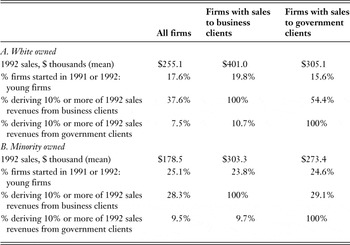
Table 3 divides small firms operating nationwide in 1992 into: (1) all firms, (2) those deriving 10% or more of their sales from business clients, and (3) firms deriving 10% or more of their sales from government. The 10% sales threshhold was applied by the Census Bureau to screen out firms selling relatively little to business/public sector clients; those meeting the threshhold thus received a “significant” share of their sales (10%+) from these clients. The noteworthy finding is that 9.5% of MBEs (and 7.5% of White firms) in 1992 derived significant sales from government, while 37.6% of White-owned small businesses (and 28.3% of MBEs) reported significant sales to other businesses (Table 3). The hypothesis that MBE capacity was lessened by their smaller relative size and high frequency of young firms is supported by Table 3’s statistics. MBEs overall, and those serving government and business clients, were smaller (and younger) on average than White-owned firms. Measuring how these capacity constraints restricted MBE presence in these procurement markets and the degree to which MBE presence was impacted is the task of regression analysis.
Small Businesses, by Clientele Served: Sales to Government and Business Clients in 1992 (Nationwide Data)

Source: U.S. Bureau of the Census Characteristics of Business Owners database. Statistics were compiled by the author.
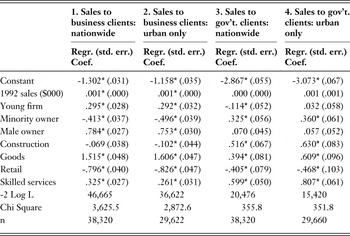
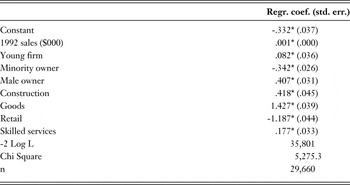
Table 4's regression analysis uses capacity measures—firm size, industry of operation, and relative youth—to delineate businesses deriving at least 10% of their 1992 revenues from sales to government clients and other firms.Footnote 4 This analysis is conducted two ways: (1) small firms nationwide are examined to determine how firm capacity differences shape access to procurement markets, and (2) only those firms located in metro areas are examined using the same capacity measures as explanatory variables. Stated in common-sense terms, the question of interest is: Among firms of the same size, age, and industry, does the minority trait alone increase or decrease the likelihood of selling to business or government clients?
Delineating Firms Selling to Business/Government from Firms that Did Not: Logistic Regression

Source: U.S. Bureau of the Census Characteristics of Business Owners database; regression findings were generated by the author. Findings reported in columns two and four are reported in Bates (Reference Bates2001). Goods industries refer to wholesale and manufacturing; skilled-services industries include business services, professional services; and finance, insurance, and real estate.
* Statistically significant at the .05 level.
Regression findings indicate that MBEs, after controlling for capacity, had: (1) less access to business, and (2) more access to government clients than otherwise identical White-owned firms. In important ways, MBE capacity limitations did reduce their access to mainstream procurement markets, and these limitations were operative both nationwide and in metropolitan America. MBE overrepresentation in retailing and underrepresentation in goods industries (manufacture and wholesale) reduced their access to business and government clients. In business procurement, the smaller size of MBEs was a hindrance but their relative youth was not. Although regression coefficients attached to sales are small (Table 4), they suggest that multi-million dollar supplier firms were far more likely to sell to business clients than firms with low revenues. Young MBEs nationwide, finally, were less likely than older firms to derive significant sales revenues from government clients, but this capacity limitation was not operative in urban areas.
This test measuring the ability of firms of differing capacity and racial ownership to penetrate procurement markets clarifies that capacity constraints operated differently in the business and government procurement markets. MBEs, controlling for capacity, were less likely than White firms to serve businesses and more likely to sell to government. This is interesting because it suggests that affirmative action in government procurement was achieving what it was designed to achieve: policies were compensating at least partially for effects of past and present discrimination thwarting the size and scope of minority businesses. Preferential procurement, according to Ian Ayres and Frederick Vars (Reference Ayres and Vars1998), ideally seeks to achieve the level of market access MBEs would experience absent discrimination—a level playing field—which is why preferential MBE public sector access is desirable. One method used to achieve this goal is to view public sector preferential procurement as a tool for offsetting MBE disadvantage in private markets. A level playing field objective, viewed thusly, entails undertaking government procurement policies sufficiently affirmative to counterbalance limited MBE access to business markets (Table 4). A test for the presence of such a level playing field in the aggregate involves pooling the two markets, business and government, to determine whether MBEs experience less access to this marketplace than White-owned firms of similar size, age, and industry of operation (Table 5).
Delineating Urban Firms that Sell to Either Business or Government Clients (or both) from Firms Selling to Neither Business or Government Clients: Logistic Regression

Source: U.S. Bureau of the Census Characteristics of Business Owners database; regression findings were generated by the author.
* Statistically significant at the .05 level.
The regression analysis in Table 5 tests whether equal access for small firms owned by Whites and minorities prevailed in the combined government and business marketplace. The dependent variable identifies firms deriving 10% or more of their annual sales from either business or government, and controls measuring firm capacity are those used in the regression exercise in Table 4. Findings indicate that MBEs, controlling for capacity, had significantly less access to this pooled marketplace than Whites (Table 5). This econometric test for the presence of a level playing field indicates it is not level; MBE advantage in the government sector is overwhelmed by White advantage in business procurement. A major objective of government affirmative-action procurement policy is to achieve fundamental fairness, to create a “level playing field” in which all potential vendors, minority and nonminority alike, are equally able to compete for contracts. Yet, no commonly accepted definition of the level-playing-field concept exists and the “level playing field” objective, in practice, usually functions as an empty slogan (Bates Reference Bates2009). The empirical test described in Table 5 is one of several possible tests for the presence (absence) of the environment MBEs would be operating in if U.S. society were free of racial discrimination’s impacts. It has the advantage of being backed by evidence regarding restricted MBE access to markets (Bates Reference Bates2001), and it generates a straightforward empirical test of equal access to mainstream procurement markets. To the extent that preferential access did prevail, this analysis indicates that firms owned by Whites, on balance, were the ones with preferential access. While government was on balance acting affirmatively (Table 4), these actions were not sufficiently affirmative to level the procurement playing field.
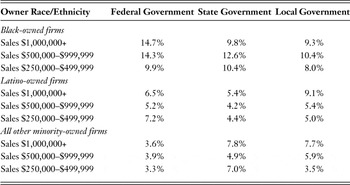
MBE overrepresentation in government contracting and underrepresentation in business procurement (Tables 3 and 4) applies broadly to MBE subgroups generally, and to Black firms specifically. Black-owned firms in 1992 were actually relatively more numerous in government procurement than other minority subgroups, and their relative dominance prevailed in all subsectors—federal as well as state and local. An essential point to understand is that the likelihood individual firms would sell their products to mainstream customers rose substantially along with firm size. Thus, among Black firms with 1992 sales in the $25,000–$50,000 range, 4.7% derived 10% or more of their sales revenues from the federal government; among those with sales of $1,000,000+, in contrast, 14.7% did so (U.S. Bureau of the Census 1997). Similarly, among small firms with gross 1992 sales of $1,000,000 or more, 9.8% of the Black-owned firms derived 10%+ of their sales from state government clients, versus 3.8% among firms owned by White males, 5.4% among Latinos, and 7.8% among all other minority-owned businesses (Table 6). Recent evidence, although scanty, suggests this pattern of the Black vendor firm’s relative dominance continues to characterize government procurement in the twenty-first century. Among the small businesses registered with the Federal Government’s Central Contractor Register in 2008, for example, MBE overrepresentation was pronounced: 59.3% of these firms were White owned—significantly less than their relative share of all small businesses nationwide—and Black-owned firms were far more numerous than either Hispanic- or Asian-owned firms (Gazelle Index 2012).Footnote 5
Percent of Firms Deriving 10% or More of Their 1992 Sales Revenues from Specific Public-Sector Customers

Source: U.S. Bureau of the Census (1997). 1992 Economic Census: Characteristics of Business Owners, table 31b. These statistics are drawn from overly inclusive data that include as “firms” operations where supposed owners worked, on average, zero hours per week and instances where “owners” viewed themselves as independent contractors rather than small-business owners, etc. (Bates Reference Bates1997). They thus understate the degree of small-firm involvement in government procurement.
As in government contracting, the firms most actively engaged in selling to other businesses are large firms. Black-owned firms grossing $1,000,000+ were relatively least numerous among racially-defined subgroups in this market segment—41.0% of them had significant sales to other businesses, as opposed to 56.5% of White-male firms in this size category, along with 48.8% of Latinos and 49.7% among all other MBEs (U.S. Bureau of the Census 1997). Note, finally, that selling to business and government clients is not an either/or proposition: Black-owned firms with sales to government clients were much more likely to sell to other businesses as well, in comparison to those not selling to government (Bates Reference Bates1997).
Thomas Boston’s analysis of certified minority businesses on Atlanta’s list of approved vendors, discussed above, indicated that mean 1992 sales among Black-vendor firms were $606,203 (Boston Reference Boston1999), well above the $273,400 average sales figure describing all MBEs reporting significant sales to government (see Table 3). This differential suggests the typical Black-owned firm in Atlanta was larger than the average MBE serving government clients nationwide, but this conclusion is invalid. The important point here is that the Census Bureau’s CBO database is fundamentally flawed in the sense that it ignores hundreds of thousands of larger-scale small businesses actively involved in government and corporate procurement. Census Bureau databases (CBO and SMOBE) providing extensive coverage of MBEs are based on income tax returns and, between 1977 and 1997, they ignored firms organized as C-corps (Bates and Tuck, Reference Bates and Tuck2014). In the case of Atlanta, Boston’s (Reference Boston1999) research documented that 42% of the Black-vendor firms were, in fact, C-corps. Because this bias applies equally to minority- and White-owned firms, the comparative analyses based upon census small business data presented throughout this study (Tables 3, 4, 5, and elsewhere) are valid, but these data provide flawed time-series measures of minority business growth since the proportion of MBEs organized as C-corps has soared since the 1970s.Footnote 6 The multiple gross deficiencies of these MBE-oriented databases have been dealt with in this study by downplaying nationwide census data and emphasizing, instead, preferential procurement program impacts in select major metropolitan areas.
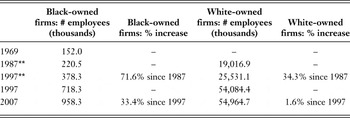
The inconsistent and incomplete census data on small businesses active in government and corporate procurement markets complicate the task of tracking any sort of long-term growth trajectory. Data on self-employment rates, employee numbers, and the incidence of large-scale ventures that are available, however, paint a consistent picture of progress among the types of firms most active in these sectors. Numbers of paid workers employed by Black-owned businesses, for example, seemingly reveal an uneven pattern of growth in employee numbers—from 152,000 to 958,300 nationwide—over the 1969 through 2007 period (Table 7). More insight can be gained by comparing growth in employee numbers among Black employer firms at the low end (one-to-four workers) of the size spectrum over this thirty-eight-year period with the high-end employers (twenty+ employees). Back in 1969, all Black firms in the one-to-four worker category had 55,119 employees, over 36% of all 152,000 employees attached to Black employer firms in that year. In 2007, in contrast, these small employers (one-to-four workers) had 116,523 employees, an increase of over 111% since 1969. Among Black employers with twenty or more workers, employee numbers had risen from 40,480 in 1969 to 596,000 in 2007, an increase of roughly 1,400%. Back in 1969, these large employers (more than twenty workers) accounted for 26.6% of all workers employed by Black-owned firms nationwide, while in 2007, their share of aggregate employees was 62.2%. Growth in worker numbers has been concentrated at the high end, particularly among Black firms with more than twenty paid employees and $1,000,000+ in annual sales.
Employment Statistics by Race: Firms Owned by Blacks and Whites* (total number of paid employees nationwide)

* Excludes foreign-owned firms, publicly-held corporations, and non-profit firms. Note that the time trends in paid employee numbers among Black and White firms reported in this table are meaningful because these employment statistics were generated by applying identical methodological approaches to both groups of employer firms. No one familiar with the underlying methodologies employed by the Census Bureau would deny that reasonable statistics calculated using different methodologies might generate results differing somewhat from above. The 2007 employment figures reported above are from SBO PUMS files and, in fact, they differ slightly from corresponding figures reported in other 2007 SBO sources: the primary difference concerns employee numbers among White-owned firms—52,518,200 according to tabulations not based on PUMS versus 54,964,700 based on PUMS. Thus, relative 1997–2007 employee growth figures (above) for Black- and White-owned firms would place Black-firm performance in a more favorable light if I had relied upon non-PUMS tabulations. There are no available alternative data sources useful for generating comparisons of employee numbers for Black- and White-owned firms in these time periods. These employment statistics are the only game in town. Before 1997, no basis for comparing paid employee numbers for Black- versus White-owned small businesses existed in any Census Bureau database.
** Excludes Subchapter-C corporations.
Sources: U.S. Bureau of the Census Survey of Minority-Owned Business Enterprises, 1969 (1972); U.S. Bureau of the Census Survey of Minority-Owned Business Enterprises, 1987 (1991); U.S. Bureau of the Census Survey of Minority-Owned Business Enterprises, 1997 (2001); and U.S. Bureau of the Census 2007 Survey of Business Owners (SBO) Public Use Microdata Sample (PUMS) Data Users Guide: Technical Documentation (2012).
Table 7 data on employee numbers suggest little growth in the ranks of paid workers in Black employer firms from 1969 to 1987, but this comparison is marred by the Census Bureau’s inclusion of C-corps in 1969 and their exclusion in 1987. Thus, census data provide no clear picture of actual growth trends. The reintroduction of C-corps in the 1997 census data tell us two things: absent C-corps, aggregate employee numbers were 378,300 among Black-owned firms, and growth in worker numbers was relatively rapid since 1987 in comparison to White employer firms. Adding C-corps raised those aggregate employee numbers to 718,300, documenting that C-corp exclusion had produced enormously biased estimates of worker numbers up to 1997. Finally, the broader coverage of employers since 1997 clarifies that Black employer firms over the next decade created new jobs at a faster rate than White employer firms (Table 7). These census data on aggregate employee numbers suggest relatively rapid rates of long-term job creation by Black-owned businesses overall, but particularly among the larger ventures most active in government and business procurement. However aggregated or sorted, evidence drawn from government small-business data suggests the long-term growth trajectory of Black-owned business was not harmed by judicial constraints limiting preferential procurement. Although imperfect, the evidence in fact points toward accelerating growth among the types of firms most active in the procurement programs ostensibly restricted by the U.S. Supreme Court’s 1989 Croson decision.
PREFERENTIAL PROCUREMENT IN THE TWENTY-FIRST CENTURY
Discriminatory practices thwarting minority entrepreneurship continue in the twenty-first century to prevail widely (Bates Reference Bates2011) and, as passive participants, government entities often employ internal operating procedures that inadvertently perpetuate this discrimination, thus limiting MBE participation in procurement opportunities. Paradoxically, these public entities encourage and undermine MBE access to procurement contracting simultaneously. Research conducted by the Metropolitan Pier and Exposition Authority (MPEA)—a Chicago-area agency operating major public amenities—illuminates how these effects thwart MBE development. MPEA’s procurement policies seek to achieve a level playing field on which vendors, minority and nonminority alike, are equally able to compete for contracts. To operationalize this objective, the MPEA has actually quantified key barriers small-business vendors face when they seek government contracts.
The MPEA—like most public sector entities—often awards large contracts that most small firms lack the capacity to handle. The MPEA in 2005 conducted a survey asking its vendors to identify explicit barriers restricting their ability to sell products to the MPEA. Additionally, vendors working as subcontractors were asked to describe their working relationships with prime contractors. Respondents, by a wide margin, most often identified unbundling and down-sizing large contracts as the policy change that would allow them to participate more actively in procurement opportunities. Policy changes enhancing procurement accessibility (and percentages of vendors responding “yes”) were: (1) Unbundling of large contracts, 68.9%; (2) Prompt payment of invoices, 44.7%; (3) Longer bid lead times, 38.1%; (4) Waiver or a lowering of bonding requirements, 35.1%; and (5) Waiver of insurance requirements, 24.7% (Bates and Blanchflower, Reference Bates and Blanchflower2007). The barriers of large, bundled contracts, short bid lead times, slow payment, bonding and insurance requirements harmed small firms generally. Identifying these barriers allowed the MPEA to craft procedural reforms; each barrier indicated an area that needed work so as not to hold down vendor participation. Contract unbundling, for example, increases the ability of small firms to bid for work; large, bundled contracts have the opposite effect. Prompt payment disproportionately assists undercapitalized vendors; slow payment discourages their participation (Bates and Blanchflower, Reference Bates and Blanchflower2007).
Minority vendors active in government procurement are an elite subset of Chicago-area businesses. Among those selling products to the MPEA, nearly 70% reported gross sales revenues in 2005 exceeding $1,000,000 (Bates Reference Bates2009). Relative to vendor firms owned by Whites, nonetheless, they displayed traditional disadvantages: they were smaller, younger, and more credit-constrained businesses facing entrenched insider networks. These higher barriers are the crux of why a “level playing field” is needed in public procurement. A concrete measure of a level playing field is whether MBEs and White-owned firms face equal barriers—if MBEs report higher barriers, then procurement contracts are more accessible to White vendors than to minorities. Regarding changes in procedures that “would help you get additional work” from the MPEA, these percentages of vendors responded affirmatively.

For these barriers, MBEs were more often adversely impacted than White-owned firms. Regarding large, bundled contracts, minority/White differentials were not significantly different. The other differentials were all statistically significant (Bates Reference Bates2009).
Among MPEA vendor firms, 47.5% of the MBEs (and 39.4% of Whites) worked as subcontractors. Because prime contractors are required to utilize MBE subcontractors, relations are apt to be more contested between primes and minority subs, relative to White firms, the presumed insiders. Since these insiders often thwart MBE access to procurement, mandatory subcontracting requirements are imposed. Among the surveyed minority subcontractors, 32.2% described their working relationships with prime contractors as contested; among White subs, in contrast, the contested percentage was 12.0% (Bates and Blanchflower, Reference Bates and Blanchflower2007). The fact that 67.8% of the MBEs reported harmonious relations with their prime contractors, however, reflects progress, relative to past decades when preferential procurement opportunities were unavailable.
The level playing field concept is, in the twenty-first century, a standard widely used in public sector procurement to judge whether MBEs are experiencing equal access to procurement opportunities. In practice, government entities define “playing fields” within wide parameters. Achieving fundamental fairness—a level playing field—entails alleviating the barriers disproportionately retarding MBE involvement in procurement. Explicit barriers limiting small-business involvement in procurement contracting, when quantified, provide concrete measures of the degree to which the playing field is or is not level. This barrier-alleviation strategy is simply an application of the appproach widely used in cities headed by Black mayors back in the 1970s and 1980s to incorporate MBE vendors into the procurement marketplace.
CONCLUDING OBSERVATIONS
This is a study about barriers and opportunities. H. J. Russell Co. of Atlanta was, in the early 1970s, a small Black-owned construction firm focusing on home renovation. Its big break came in 1974 when the company, because of Mayor Jackson’s affirmative action procurement policies, won a construction subcontract working on Atlanta’s Hartsfield International Airport. By 1996, H. J. Russell Co. employed 1400 workers, grossed $163 million in annual revenues, and worked in real estate development, property management, airport concessions, and general construction contracting. Black political power created the initial opportunities Mr. Russell parlayed into one of the nation’s largest Black-owned businesses (Boston Reference Boston1999). Preferential procurement programs initiated in the 1970s and 1980s provided Black-owned small businesses with new opportunities to sell their products to government clients, thus opening up a major market traditionally closed to them. The ensuing growth dynamic fed upon itself as the impacted firms gained expertise and built capacity, expanding their business operations in scale, thereby allowing them to compete for still larger contracts in public sector and business procurement markets.
Historically, the small-business growth process worked in the opposite direction: restricted Black-business access to mainstream markets interacting with limited access to capital held down firm size and scope, often resulting in firms lacking the capacity to compete for the large contracts typifying government and corporate procurement. These barriers, in turn, encouraged highly educated Blacks—potential entrepreneurs—to avoid business ownership. Reversing this dynamic entailed reducing the traditional barriers thwarting minority entrepreneurship. Lessening market-access barriers, importantly, encouraged highly educated and skilled Blacks to pursue business ownership in growing numbers, thus providing the human-capital base and access to resources needed to build large firms in industries where minority presence has been low historically.
Moving toward a level playing field where Black-owned businesses—indeed all MBEs—could compete effectively for mainstream clients required affirmative efforts to reduce barriers and alter incentives. Successful preferential procurement programs not only encouraged MBE participation by introducing mandatory subcontracting requirements and the like; they downsized and unbundled contracts, paid MBE invoices promptly, screened out front firms, and selectively eased bonding and insurance requirements. These programs succeeded because they lowered traditional barriers limiting the size and scope of the minority business community. They succeeded because they created the less discriminatory environment that allowed talented entrepreneurs to create large firms capable of handling major procurement opportunities effectively. Rulings of the judiciary and case law provided few specifics on how government might reduce barriers while staying within the limits imposed by strict scrutiny (Martin et al., Reference Martin, Berner and Bluestein2007), yet the evidence, however imperfect, consistently indicates this legal environment has not hampered the development of large-scale MBEs serving public sector and business clients. On balance, the record of preferential procurement programs in the United States is one of success.
Attracting a younger generation of highly educated and skilled Blacks into business ownership was essential to constructing large-scale, industrially diverse firms competing for mainstream procurement business in the twenty-first century. Firm capacity built initially by serving government clients helped many to expand their penetration of private markets, and MBE sales to other businesses have accounted, since the 1990s, for greater aggregate revenues nationwide than sales to government. Success in preferential procurement is a reflection of declining barriers unleashing the creativity of new generations of Black entrepreneurs.