

INTRODUCTION
Vocal fish, like other vertebrates, use acoustic signals during social behaviour to communicate. Sound characteristics depend largely on the mechanism of sound production. Fish evolved the largest diversity of sonic organs among vertebrates. Well-known and common mechanisms of sound generation used by fish are the vibration of the swimbladder via the contraction of specialized rapid intrinsic or extrinsic sonic muscles and stridulation that results from rubbing bony elements against each other (Ladich & Fine, Reference Ladich, Fine, Ladich, Collin, Moller and Kapoor2006). Other mechanisms include plucking enhanced tendons of pectoral fins and vibration of pectoral girdles (Ladich & Fine, Reference Ladich, Fine, Ladich, Collin, Moller and Kapoor2006). While stridulatory mechanisms generate broad-band pulsed sounds with frequencies up to a few kHz, the vibration of the swimbladder results in the emission of low-frequency (<1 kHz) sounds made up of pulses that can be repeated at different rates, depending on the sonic muscles' contraction rate (Ladich, Reference Ladich, Van der Emde, Mogdans and Kapoor2004; Ladich & Fine, Reference Ladich, Fine, Ladich, Collin, Moller and Kapoor2006).
Despite the diversity of sound-producing mechanisms, fish acoustic signals present a much lower variability than found in the sounds of other taxa and the acoustic repertoire of a fish species is typically restricted to one or two different types (Amorim, Reference Amorim, Ladich, Collin, Moller and Kapoor2006). One exception is the mormyrid fish Pollimyrus adspersus (Günther, 1866) that is known to produce five different sounds (Crawford, Reference Crawford1997). Fish can communicate by either producing different sound types or changing the characteristics of one sound type according to context (Amorim, Reference Amorim, Ladich, Collin, Moller and Kapoor2006). Behavioural studies have demonstrated that temporal features within a sound, including pulse rate and number, can be important to its communicative value (Ladich, Reference Ladich, Van der Emde, Mogdans and Kapoor2004). For example, differences in the number and repetition rate of pulses can potentially encode species (Myrberg et al., Reference Myrberg, Spanier, Ha, Reese and Lighter1978; Amorim et al., in press) or individual (Thorson & Fine, Reference Thorson and Fine2002; Amorim & Vasconcelos, Reference Amorim and Vasconcelos2006) identity, and the motivational state of the sound-emitter (e.g. Mann & Lobel, Reference Mann and Lobel1998).
Although fish probably represent the largest group of sound-producing vertebrates, with several thousands of vocal species (Ladich, Reference Ladich, Van der Emde, Mogdans and Kapoor2004), the knowledge of their vocal ability to communicate (e.g. extent of the vocal repertoire; the role of different sound types) remains largely unexplored in comparison with amphibians, birds and mammals (Ladich, Reference Ladich, Van der Emde, Mogdans and Kapoor2004). This study aimed at describing the acoustic repertoire of the Lusitanian toadfish Halobatrachus didactylus (Bloch & Schneider) (Batrachoididae). This species is known to have an unusual large acoustic repertoire for fish composed of five different sound categories (four different sound types and a mixed call) that are produced by the contractions of paired intrinsic sonic muscles attached to the swimbladder wall (dos Santos et al., Reference dos Santos, Modesto, Matos, Grober, Oliveira and Canário2000; also see Amorim et al., Reference Amorim, Vasconcelos, Marques and Almada2006). In this study, new sound types, several mixed (blends) of sound types, and the incidence of various sound types are described demonstrating that this species has the widest acoustic repertoire known in fish.
MATERIALS AND METHODS
Study species
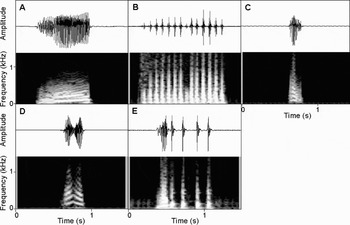
Lusitanian toadfish males defend nests in estuarine shallow waters during the breeding season (May to July). Females are attracted to the nests by the males' conspicuous advertisement calls, the boatwhistles, and leave their fertilized eggs attached to the nest's ceiling after spawning. After mating with several females, males continue to defend the nest alone until the young are free-swimming (dos Santos et al., Reference dos Santos, Modesto, Matos, Grober, Oliveira and Canário2000; personal observation). Besides the boatwhistle, four other sound categories were recognized in the Lusitanian toadfish: grunt trains, croaks, double croaks and a mixed grunt–croak call (for sound descriptions see dos Santos et al., Reference dos Santos, Modesto, Matos, Grober, Oliveira and Canário2000; Amorim & Vasconcelos, Reference Amorim and Vasconcelos2006; Amorim et al., Reference Amorim, Vasconcelos, Marques and Almada2006; Figure 1).
Oscillograms (top) and sonograms (bottom) of boatwhistles (A), grunt trains (B), croaks (C), double croaks (D), and a mixed grunt–croak call made up of croak element followed by four grunts (E). The sonograms used a 30 Hz filter bandwidth in all sound types.

Sound recording and data analysis
Twenty artificial concrete nests 50 cm long, 30 cm wide and 20 cm high (internal dimensions) with a hemicylinder shape and closed at one end were placed 1.5 m apart in an intertidal area of the Tagus estuary (Portugal, Montijo, Air-Force Base 6; 38°42′N, 8°58′W). These nests were only exposed to air during spring tides (at very low tides), which only happened twice during the study period. During the course of this study water level in the nest area varied between 0 m and 2.8 m. Two groups of eight males (total length (TL)—mean (range): 41.6 cm (35.3–47.7 cm); eviscerated weight (We): 1195 g (857–1612 g)), that spontaneously occupied these artificial concrete nests, were recorded over a period of eight days in June/July 2006, during the peak of the reproductive season. Each male was recorded for an average of 36 hours (11 hours–56 hours). Mean water temperature was 23.5°C (21°–28°C). All recorded fish experienced similar water temperature ranges and variability during recordings of the various sound types. Nests' entrances were closed with a plastic net to prevent males from escaping and to ensure male identity throughout the study. Plastic nets did not affect acoustic signals and allowed possible visual interactions. All unoccupied nests were also wrapped in plastic nets to prevent further occupations during the study. Simultaneous multi-channel recordings were made to a laptop connected to USB audio capture devices (Edirol UA25, Roland; 16 bit 6 kHz acquisition rate per channel) controlled by Adobe Audition 2.0 (Adobe Systems Inc., 2005). One hydrophone (High Tech 94 SSQ hydrophone, sensitivity −165 dB re 1 V/μPa, frequency response within±1 dB from 30 Hz to 6 KHz) was placed at about 10 cm from the entrance of each occupied nest. Sounds could be attributed to particular males because of the high attenuation of the sounds produced by the males restrained in nearby nests (>~27 dB), observed in the simultaneous multi-channel recordings of the different males.
Sound analysis was carried out with Adobe Audition 2.0, and Raven 1.2.1 for Windows (Bioacoustics Research Program, Cornell Laboratory of Ornithology, Ithaca, NY, USA). The occurrences of each sound type emitted by each male were counted. The proportion (%) of each sound type on total sound production was calculated based on male calling rate, i.e. number of sounds produced per hour.
During sound analysis new undescribed sound types were recognized. From these only long grunt trains (LGT) were characterized and analysed in detail because of their common occurrence. Long grunt trains were analysed for the number of grunts per train, call duration (from the start of the first grunt to the end of the last grunt, s), grunt duration (measured in three grunts randomly chosen, ms), average grunt period (measured for all the grunts in a train, ms), number of pulses per grunt (measured in three grunts chosen at random), and dominant frequency (measured from the average power spectrum of at least three consecutive grunts). When LGT occurred combined with other sounds only the longer LGT present in the sequence was analysed. A total of 78 LGT were analysed from 12 males. Grunt trains (GT) were also measured for the same parameters. Comparisons between these two sound types were carried out with Mann–Whitney non-parametric tests, using mean values for each male. A total of 36 GT were analysed from 7 males. To compare the amplitude of LGT and GT, the relative peak amplitude of 25 calls of each type (from 10 males) was measured from power spectra. Average power spectra were computed with a 2048 points FFT conditioned by a Hamming window, with a time overlap of 50.0% and a 10 Hz filter bandwidth. Amplitude measurements were only taken when LGT and GT were produced within 60 seconds. In such cases it was assumed that the recording conditions and the distance from the male to the hydrophone were similar during the production of both sounds. Amplitude differences were tested with Wilcoxon non-parametric tests. The potential relation between LGT production rate and GT and total sound production rate, and male total length (TL, cm) and condition factor [CF, (We/TL3) × 1000] was explored with Spearman rank-correlation tests.
RESULTS
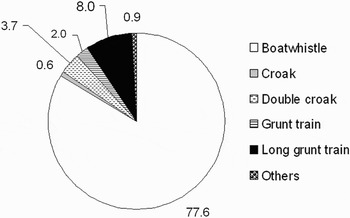
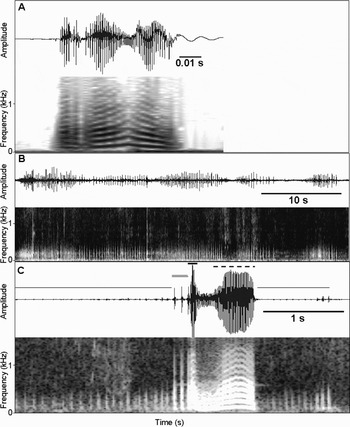
All males in the nests emitted sounds. On average, 345 sounds (mean±SD (range) = 344.5±689.7 (7–2296)) were registered per male. As expected boatwhistles were the most frequent sounds (Figure 2), composing 78% (±22.7 (28.6–100.0) %) of the total sound production activity observed per hour. Interestingly, the second most frequent sound type were long grunt trains (8.0±9.5 (0.0–33.3) %), a new sound type for the Lusitanian toadfish. Less frequent sounds (Figure 2) were double croaks (3.7±5.7 (0.0–21.4) %), followed by grunt trains (2.0±4.3 (0.0–14.3) %) and croaks (0.6±0.8 (0.0–2.3) %). Approximately 1% of the registered sounds (0.9±1.7 (0.0–5.6) %) did not fit in either of the previous categories. These were composed mostly by grunt–croak calls but also by other mixed calls and triple croaks, a sound type also described for the first time (Figure 3A). Triple croaks resemble double croaks with a further frequency modulated element. It is likely that males produced this variety of sounds influenced by the vocal activity of neighbours.
Mean percentage of the different sound types emitted per hour by 16 nesting males during one week in the peak of the breeding season.

During the present study, nesting Lusitanian toadfish males emitted sounds that have not previously been described such as triple croaks (A), long grunt trains (B) and combinations of long grunt trains with other sound types (C). In (C) a long grunt train (thin line) combines with a grunt train (double line) that ends in a croak (thick line), which blends into a boatwhistle (dashed line), which is then followed by another long grunt train (thin line). Note that in (C), the LGT is hardly visible in the oscillogram due its much lower amplitude than the other sounds. Sonograms used a 30 Hz filter bandwidth.

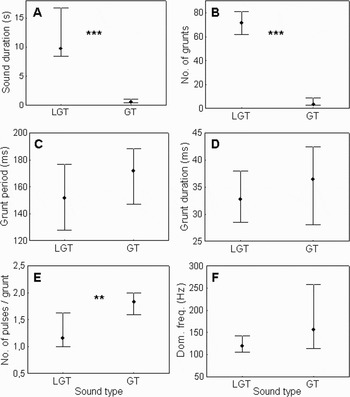
Long grunt trains sounded to the human ear like a running engine (Figure 3B) and were made up of a long sequence of grunts (70.7±47.3 (14–302) grunts, N = 78), lasting on average 10.3 seconds (±6.7 (1.2–39.4) seconds). 74% of registered LGT were combined either with other single sound type or with combinations of joined sounds such as boatwhistles, croaks and double croaks (see example in Figure 3C). LGT differed from the typical GT because of their lower amplitude (peak amplitude difference: 24.6±5.2 (16.4–36.1) dB, N = 25; Wilcoxon test: T = 0.00, P < 0.001)), an increased number of grunts per call (Mann–Whitney test: Z = 3.55, P < 0.001), and a longer duration (Mann–Whitney test: Z = 3.55, P < 0.001) (Figure 4). Grunt period did not differ between sound types (Mann–Whitney test: Z =−0.76, P > 0.05). The grunts in a LGT were also made up of fewer pulses than in GT calls (Mann–Whitney test: Z =−2.79, P < 0.01) but had similar durations and dominant frequencies (Mann–Whitney test: Z = −1.52–−0.33, P > 0.05) (Figure 4). LGT production rate was neither correlated with sound production rate (GT or total sound production) (Spearman rank-correlation: N = 16, R = 0.18–0.34, P > 0.05) nor with the male's physical features (TL and CF) (Spearman rank-correlation: N = 16, R = −0.10–0.03, P > 0.05).
Long grunt trains (LGT) were significantly longer (A), were made up of more grunts (B), but had similar grunt periods (C) than grunt trains (GT). Grunts in LGT had similar duration (D) and dominant frequency (F), but had a higher number of pulses (E) than grunts in GT. Medians and quartiles are depicted. Mann–Whitney tests, ***, P < 0.001; **, P < 0.01.

DISCUSSION
Toadfish and midshipmen (Batrachoididae) have long been known for their conspicuous ability to produce sounds and a great deal of what is known in terms of acoustic communication and its underlying neurophysiological mechanisms in fish has been based on studies focusing on batrachoidids (Bass & McKibben, Reference Bass and McKibben2003). The Lusitanian toadfish is however the species with the most extensive acoustic repertoire, contrasting with Opsanus spp. and Porichthys notatus Girard, 1854 that produce mating tonal sounds (boatwhistles or hums) and agonistic grunts and growls (Bass & McKibben, Reference Bass and McKibben2003).
The present study has shown that during the breeding season the Lusitanian toadfish commonly produces a new undescribed sound type (long grunt trains, LGT) besides the five known sound categories described by dos Santos et al. (Reference dos Santos, Modesto, Matos, Grober, Oliveira and Canário2000). LGT differed from GT calls by their significantly lower amplitude, higher number of grunts per call and longer durations. Perhaps the only other fish species that is comparable in terms of acoustic signal diversity is the weakly electric fish Pollimyrus adspersus (Mormyridae). Crawford (Reference Crawford1997) has named this species as the strongly acoustic fish because of its wide acoustic repertoire and the conspicuousness of its calls. Pollimyrus adspersus produces hoots and pops during agonistic interactions and long conspicuous acoustic courtship displays that can last for tens of seconds and consist of long sequences of grunts and moans followed by growls (Crawford, Reference Crawford1997).
The long grunt trains produced by nesting toadfish males were low amplitude long sound sequences that commonly preceded or followed other sound types. The production of LGT was not correlated with either the male's calling rate (GT and total sound) or its physical features (TL and CF). However, this ‘rumbling’ activity suggests a general physiological ‘excitement’ from the nesting males, that may perhaps be associated with the production of more intense sounds, such as the boatwhistles, that are used to attract females from long distances. LGT have probably not been detected before because previous studies on this species were based on recordings where the hydrophones were placed at unknown distance from the calling males (dos Santos et al., Reference dos Santos, Modesto, Matos, Grober, Oliveira and Canário2000; Amorim & Vasconcelos, Reference Amorim and Vasconcelos2006; Amorim et al., Reference Amorim, Vasconcelos, Marques and Almada2006). In the present study, hydrophones were positioned 10 cm from the males (just in front of the nests) so even low amplitude sound emissions could be detected and attributed undoubtedly to a particular male.
The present study also demonstrated the ability of this species to mix and blend different sound types, or modify existing sound types (e.g. triple croaks). Other species are known to exhibit a continuous variation in their vocalizations. For example, the courting male haddock Melanogrammus aeglefinus (Linnaeus, 1758) (Gadidae) produces a graded series of repeated ‘knocks’ that become longer and faster as the male's level of arousal increases (Hawkins & Amorim, Reference Hawkins and Amorim2000). The wealth in acoustic signals and in signalling plasticity show that the Lusitanian toadfish has a richer ability to communicate acoustically than previously thought that seems exceptional among fish. Future studies will focus on testing the function of the different sound types.
ACKNOWLEDGEMENTS
The authors would like to thank the Air Force Base No. 6 of Montijo (Portugal) for allowing this study in their military establishment. This study was supported by the project PDCT/MAR/58071/2004 and by a grant POSI SFRH/BPD/14570/2003 (MCPA) from FCT, Portugal.