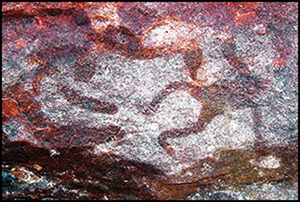

Introduction
Australia has one of the most diverse stencilled rock art assemblages found anywhere in the world. In their simplest form, stencils, or negative silhouettes/impressions, are motifs created by spraying paint (a pigment mixed with a liquid such as water) around an object held against a rock surface. Among the many categories of recorded stencilled motifs are human bodies, body parts (e.g. hands, feet), zoomorphs (e.g. fish, birds, snakes, macropod legs, tails and paws, and emu feet), wooden and fibre objects (e.g. boomerangs, hafted axes, spear-throwers and bags), plant matter (e.g. leaves and twigs), and contact-themed motifs, such as horseshoes, tobacco tins, metal knives and metal axes (McDonald Reference McDonald1992; May et al. Reference May, Taçon, Wesley and Travers2010; Morwood Reference Morwood2010; Taçon et al. Reference Taçon, Langley, May, Lamilami, Brennan and Guse2010; Hayward et al. Reference Hayward, Johnston, May and Taçon2018). An extensive ethnographic record provides valuable insights into the diverse meanings associated with these stencilled motifs, including their significance as identity markers, narratives of events involving people and/or Ancestral Beings, markers of land ownership and ceremony, and memorials to the role of objects in people's lives (Moore Reference Moore and Ucko1977; Layton Reference Layton1992; Taçon et al. Reference Taçon, Langley, May, Lamilami, Brennan and Guse2010; Hayward et al. Reference Hayward, Johnston, May and Taçon2018). In addition, unique stencilling techniques in the Australian rock art record highlight the diverse and culturally complex nature of stencilled motifs. These include ‘composite stencilling’, when an object is stencilled multiple times in different directions to create a motif, and ‘hand masks’, where hands and fingers are positioned to create a shape for stencilling (Walsh Reference Walsh1983; Gunn et al. Reference Gunn, Douglas and Whear2012).
To date, stencils in Australian rock art have received much attention in terms of the full and life-sized material used to create the stencil templates, and their associated social and cultural dimensions. Yet little has been recorded or known about stencilled motifs that do not conform to full- and life-sized dimensions. In 2017, as part of an ongoing rock art recording project in northern Australia's south-west Gulf of Carpentaria, a unique and distinctive assemblage of miniature and small-scale stencilled motifs consisting of anthropomorphs, boomerangs, macropod tracks, and geometric and linear designs was recorded from the Yilbilinji rockshelter, traditionally owned by the Marra Aboriginal people, in Limmen National Park (Figure 1). Miniature and small-scale stencils (identified by the authors as being less than 0.12m in length) are extremely rare both in Australia and the global rock art record generally. As such, the Yilbilinji assemblage offers an unprecedented opportunity to develop new insights into this rare yet distinctive form of rock art. In this article, we present the results of experimental archaeology and the use of ethnographic data to consider the material(s) employed in the creation of the stencil templates, and discuss the significance of these materials and motifs in terms of their meanings for Aboriginal people and understanding of the broader rock art record.
The south-western Gulf of Carpentaria region in northern Australia (Limmen National Park shaded) (map by L.M. Brady).

Characterising miniature rock art motifs
‘Miniatures’, or small-scale models of objects, people and animals, are commonly found in the archaeological and ethnographic record, in a range of contexts (e.g. ritual, magic, reproduction of ceremonial objects, children's playthings, funerary items and gifts). They are made using a variety of raw materials, including clay, stone and animal bone. While these portable, miniature figurines have attracted scholarly attention from researchers for decades (e.g. Bailey Reference Bailey2005; Foxhall Reference Foxhall2015; Langley & Litster Reference Langley and Litster2018), miniature rock art motifs are comparatively less well known. Although the specific size dimensions used to classify a motif as ‘miniature’ vary, and in some cases are unspecified, miniature rock art motifs are widespread, and previous studies of them address questions of regional rock art chronologies, social interaction, cultural change and motivation for their production. The Austronesian Painting Tradition in Island Southeast Asia, for example, is characterised by small (approximately 0.10–0.15m in height) painted-red, ‘active’ anthropomorphs in frontal or profile poses, and depicted with weapons or other objects, and wearing headdresses. Together with their placement in the landscape, they may have acted as shared symbolic markers of social interaction, used by Austronesian-speaking peoples as they spread throughout Island Southeast Asia after 4000 cal BP (e.g. Ballard Reference Ballard, McDonald and Haskovec1992; O'Connor et al. Reference O'Connor, Mahirta, Tanudirjo, Ririmasse, Husni, Kealy, Hawkins and Alifah2018).
In the Sahara region of North Africa, the ‘miniature style’ is a recognised rock art form dated to before 4400 BC. It features anthropomorphs, both individual and ‘family’ scenes, with adults measuring 80–150mm (in height) and children 20–30mm (in height), while miniature zoomorphs (e.g. giraffes) are depicted as part of hunting scenes (Rhotert Reference Rhotert1952; Le Quellec Reference Le Quellec2009). In the Lower Pecos Canyonlands of south-west Texas, USA, and Coahuila, Mexico, the Red Linear Style is one of five categories identified for the region's rock paintings. This style is characterised by “hundreds of Red Linear pictographs portraying humans engaged in group activities […and…] frequently portrayed with gender markers and typically stand less than 10cm in height”, and were probably produced around 1300 years ago (Boyd et al. Reference Boyd, Castañeda and Koenig2013: 459; Turpin Reference Turpin1984).
Paintings and, to a lesser degree, engravings are easier to create at small or miniature scales, due to the artist's ability to control the size and shape(s) more easily (cf. Turpin Reference Turpin2005: 318). Stencil templates, however, are predominantly fixed in size and shape (i.e. full- or life-sized body parts, objects and animals), and reflect the exact dimensions of the object being stencilled (Morwood Reference Morwood2010: 165). Published examples of smaller than life-sized stencilled motifs, such as miniature humans and animals, are extremely rare globally. In a rockshelter at Nielson's Creek in New South Wales, Moore (Reference Moore and Ucko1977: 319) recorded a “stencilled human figure only 12cm high, surrounded by hand stencils”. The anthropomorph features a rounded head, short legs and downward-curved arms. He suggests that the motif “could only have been stencilled by using a small doll or a flat cut-out” (Moore Reference Moore and Ucko1977: 319), although he provides no details about what material(s) could have been used for this purpose. Similarly, at the Jawalang painted art complex on Kisar Island in eastern Indonesia, O'Connor et al. (Reference O'Connor, Mahirta, Tanudirjo, Ririmasse, Husni, Kealy, Hawkins and Alifah2018: 228–29) recorded a small anthropomorph stencil motif (approximately 0.20m in height), whose upper half is depicted in a frontal pose and lower half in profile. The motif has a triangular head, a slightly curving torso and bent and rounded knees. In describing the motif, the authors note that the anthropomorph “has no correlates in the Timor-Leste art repertoire [and] appears to have been produced by using a stencil to create an outlined shape of a human figure” (O'Connor et al. Reference O'Connor, Mahirta, Tanudirjo, Ririmasse, Husni, Kealy, Hawkins and Alifah2018: 228–29). Little information is available concerning the potential meanings and symbolism associated with these two motifs. O'Connor et al. (Reference O'Connor, Mahirta, Tanudirjo, Ririmasse, Husni, Kealy, Hawkins and Alifah2018) refrain from offering any such suggestions about the Kisar example. Moore (Reference Moore and Ucko1977: 319) uses an interpretation provided by an Aboriginal ‘medicine man’ of a similar rock art panel some 25km from Nielson's Creek to suggest that the motif represents an “example of hostile magic” or “a record of an event”.
Beyond these anthropomorph/doll-like stencils, we are unaware of any other published references to miniature or small-scale stencilled rock art. Hence, the recent discovery of the miniature and small-scale stencil assemblage from Yilbilinji offers an opportunity to explore this rare and poorly understood category of rock art in more detail.
Yilbilinji 1
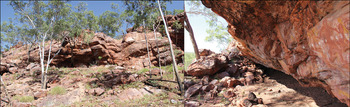
The Yilbilinji 1 rockshelter is located approximately 1km north from the Nathan River Ranger Station in Limmen National Park (Figure 2). The site was first documented in 1974 by geologist Dehne McLaughlin, and again in 2015 by a cultural heritage survey team (Cooke Reference Cooke2016). The inward-sloping shelter is associated with Karrimala, the Taipan Ancestral Being who travelled through the area during the Ancestral Past, creating the rockshelter and placing himself on the rock wall in the form of a snake painting. An extensive material culture assemblage on the site's surface was recorded during our visit and includes stone artefacts, glass flakes, a stone-circle fireplace, grinding stones and rocks with grinding hollows. The full rock art assemblage (Table 1) comprises 355 determinate motifs, where an image could be classified according to its formal attributes. Spread across the roof and rear walls of the shelter, the motifs are monochrome or bichrome using four different coloured pigments: red, black, yellow and white. Thirty-four instances of superimposed imagery, with a maximum of seven layers, were recorded. The overall motif assemblage includes anthropomorphs, marine and terrestrial zoomorphs, material culture objects, dot clusters, ‘track’ motifs (bird, macropod, and hands), geometric and linear non-figurative designs, and one European-style smoking pipe.
The Yilbilinji rock art site in Limmen National Park (photograph by L.M. Brady).

Rock art production techniques documented by the research team at Yilbilinji.

Stencil assemblage
The Yilbilinji 1 stencil assemblage is relatively small, accounting for only 16 per cent (n = 59) of the site's rock art. The stencilled subject matter is dominated by hand and hand combination (i.e. hand and wrist; hand, wrist and forearm) motifs (n = 38, 64 per cent). A second dominant pattern is the colour of the spray used to produce the stencil, with white spray being most common (n = 52, 88 per cent), followed by yellow (n = 6, 10 per cent), and red (n = 1, 2 per cent).
Of the 59 stencils recorded, 17 are classified as miniature or small-scale (Table 2). This classification is based on two, non-mutually exclusive criteria:
1) The identification of figurative and track-based stencilled subject matter that is considerably smaller than life size or whose proportions are unrealistic when compared to full- or life-sized examples (‘miniature’); that is, depictions of bodies, body parts, objects and animals.
2) Drawing on the literature review presented above concerning miniature and small-scale categories and dimensions, the arbitrary designation of a 0.12m width or height for a non-figurative motif (‘small-scale’).
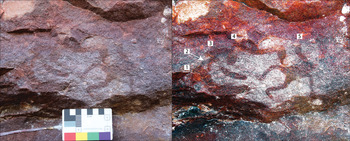
Using these criteria, 13 miniature and four small-scale motifs were identified in the Yilbilinji 1 assemblage. All were created using a white spray, and are located in the centre and right side of the shelter. The quantity of miniature stencil motifs documented here is, as far as we are aware, the largest published such assemblage in the rock art record anywhere in the world. Five motifs (1–5) form part of a panel composition (Figure 3). Four curved 7-shaped boomerangs (motifs 1–4) are positioned on the left-side of the panel. An anthropomorph (5) holding a boomerang is situated on the right-side of the panel. The figure has a tiny head, outstretched arms and curved and splayed bent knees.
Main panel motifs: 1–4) boomerangs; 5) anthropomorph holding a boomerang (left: original photograph, right: digital enhancement using Adobe Photoshop) (photographs and enhancement by L.M. Brady).

Hierarchical motif classification of miniature and small-scale stencil assemblage.

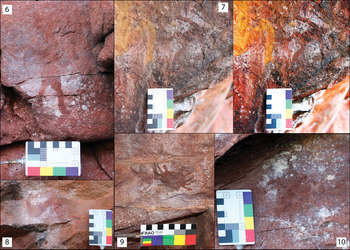
Motif 6 is an anthropomorph depicted vertically, holding a V-shaped boomerang in its left hand, and possibly wearing a headdress (Figure 4). Motif 7 is an anthropomorph depicted in a similar style to 5, with outstretched arms pointed slightly downwards, curved and bent knees, and on a near-horizontal angle. This figure also has a shield in one hand, and its right foot underlying a yellow infilled anthropomorph (Figure 4). This panel represents the only instance of superimposition involving the miniature and small-scale stencil assemblage at the site. A single, curving ‘7’-shaped boomerang (8) is situated near a cluster of hand stencils on the far left side of the panel (Figure 4).
Figurative motifs: 6) anthropomorph holding a boomerang; 7) anthropomorph holding a shield (left: original photograph, right: digital enhancement using Adobe Photoshop); 8) boomerang; 9) crab; 10) long-neck turtle (photographs and enhancement using Adobe Photoshop by L.M. Brady).

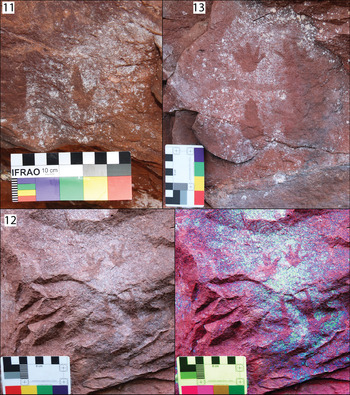
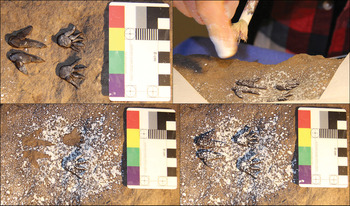
Two zoomorphs—crab (9) and long-neck turtle (10)—occur individually in the middle of the shelter (Figure 4). A single macropod track (11) is located under a small, shallow overhang near the northern end of the site (Figure 5). One set of macropod tracks and paws (12) is stencilled with the two paws, with four ‘fingers’ each, side by side, and the two tracks directly beneath the paws and also side by side (Figure 5). The second set of macropod tracks (13) is similar, with the paws (left paw with five ‘fingers’, the right with four) positioned above the tracks; a horizontal line divides the paws from the tracks (Figure 5). In both instances (12 and 13), the macropod tracks are smaller than typical for adults, juveniles and joeys.
Macropod track motifs: 11) single track; 12) tracks and paws (left: original photograph, right: digital enhancement using Adobe Photoshop); 13) tracks and paws; (photographs and enhancement using Adobe Photoshop by L.M. Brady).

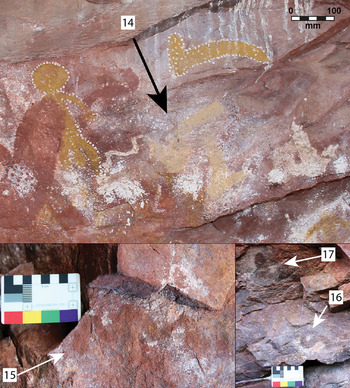
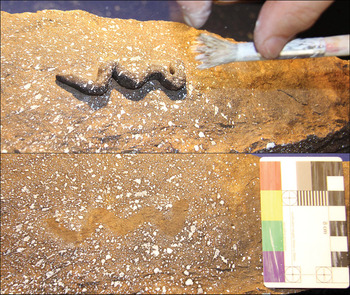
The non-figurative imagery (Figure 6) is spread across the site and consists of three wavy lines (14–16), and a small oval-shape with three small lines projecting from its base (17). As none of the non-figurative motifs appear to be stencilled ‘models’ of anything figurative or track-based, they are classed here as ‘small-scale’ because they fit the less than 0.12m height criteria. No attempts were made to date the white pigment, and no information about the potential meaning or significance of the imagery was obtained from our Marra collaborators.
Non-figurative motifs: 14–16) wavy line; 17) oval-shape (photographs by L.M. Brady).

Identifying raw materials
The second part of our research concerns the identification of the material(s) used to make the stencil templates for these miniature and small-scale motifs. As far as we are aware, no attempts to replicate the miniature and small-scale stencil motifs found in the literature have been undertaken; the Yilbilinji assemblage therefore offered an opportunity to explore the production process in detail. We approach this process in relation to three factors: malleability and motif shape; comparison with ethnographic collections; and ethnographic data concerning the use of beeswax and other adhesive resins from the region.
Malleability and motif shape
Morphologically, most of the assemblage comprises motifs with well-rounded or curved edges. These attributes suggest that a malleable substance, such as wax, resin or clay, was used to sculpt the templates, and also to allow the creation of curved but also sharper edges and points, where required. Other raw materials such as bark, wood and stiff skin would involve carving, a time-consuming process, although this technique typically produces sharper edges due to splintering and fracturing in the carving process. Additionally, with a malleable raw material, a shaped object can be placed flush against an uneven rock wall surface, resulting in a more complete reproduction through stencilling. In addition, an adhesive, malleable material would not require support to hold it against the rock wall.
Comparison with ethnographic collections
Across Australia, small portable objects in the shape of ‘dolls’ (i.e. miniature humans), animals and objects (e.g. boomerangs) were frequently collected by ethnographers, beginning in the late 1800s. Cox's (Reference Cox1888) description of two small ‘wax figures’ (each approximately 0.18m high by 0.19m wide, with tapering bodies) collected from central Queensland in 1864, for example, were “modelled from dark soiled native bees’-wax” (Cox Reference Cox1888: 1223); the beeswax was mixed with iron oxide to provide decorative colouring (Cox Reference Cox1888: 1224). In Arnhem Land, Thomson (Reference Thomson1954: 118) recorded Aboriginal people using mud to create ‘dolls’ belonging to children. He describes how beeswax was hand-worked into a soft and malleable material that could be used to sculpt the small “heads, hands and feet of animals and supernatural beings” (Thomson Reference Thomson1954: 118). Also in Arnhem Land, Berndt and Berndt (Reference Berndt and Berndt1999) identified several small sculpted beeswax models, including “miniature copies of sacred objects”, human figures and animals used as “love magic” objects, an “effigy” or doll-like figure used for sorcery, and models of animals, such as “echidna, dugong, mice, fish, tortoises and so on, as well as a penis” (Berndt & Berndt Reference Berndt and Berndt1999: 280, 436, 315, 323). Other animal beeswax models from Arnhem Land include a kangaroo, emu, goanna, bandicoot, dugong, turtles and queen fish (McCarthy Reference McCarthy1948: 51; Mountford Reference Mountford1956: 445), while in the east Kimberley region, Adam (Reference Adam1954: 163) describes clay figures of introduced animals, such as a horse and a rider on horseback.
Ethnographic data on the use of beeswax and other adhesive resins
Bradley's ethnographic research (1980–present) in the study region provides insight into the Aboriginal use of beeswax in the region (e.g. Bradley Reference Bradley1991, Reference Bradley, Peterson and Rigsby1998, Reference Bradley, David and Thomas2008; Bradley with Yanyuwa Families Reference Bradley2010). Up until the late 1980s in Borroloola, for example, most senior men had access to beeswax, and carried beeswax balls with them on a regular basis. During his early fieldwork, Bradley recalls seeing people carry beeswax balls as large as 50–100mm in diameter, although people most often carried a 30–50mm-diameter ball-sized piece of the important adhesive. Beeswax was often included in an assemblage of items carried by men in small string bags that contained essential items, such as needle and thread, and string for harpoon repair. The most prized wax was usually collected by women from the hives of native bees (Austroplebeia and Tetragonula). After chewing and swallowing the wild honey, or ‘sugarbag’, the women distributed the remaining wax to the men. Although used predominantly as an adhesive for personal ornaments and a sealant over hafting on pronged spears and harpoons, beeswax had a wide range of other uses. From the late 1980s, however, beeswax was slowly replaced by synthetic adhesives, such as epoxy resins. During the 1980s, Bradley often camped with families at rural ‘bush camps’ across the region. Here, he observed children playing with the small balls of beeswax obtained from their parents, sculpting objects and animals such as cattle, horses and cowboys. Although none of these modelled objects were observed being used as stencilling templates for creating rock art, we combine all of these various factors and observations to suggest that beeswax, as a portable, malleable and adhesive material, was the most likely source material used to sculpt the stencil templates at Yilbilinji 1.
Replicating miniature and small-scale stencils
To identify the source material most likely used for the stencil templates, or models, we undertook a replication experiment. We used several lumps of beeswax collected by Bradley during his ethnographic research to sculpt stencil templates that matched the motifs seen at Yilbilinji (Figure 7).
Left and centre) Trigona sp. beeswax collected from the study region; right) shaping beeswax into a miniature boomerang (photographs by L.M. Brady).

A large sandstone slab obtained from northern Victoria was used as a rock surface (similar to that at Yilbilinji) on which to apply the stencil templates, and Australian white kaolin clay, similar to the natural kaolin clay outcrops in the study region, was used around the templates. The methodology for this experiment is outlined below.
Sculpting the templates
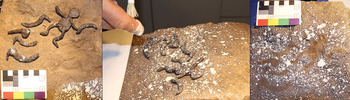
Our collected beeswax was lightly heated over a gas flame for approximately one minute to soften it and facilitate the shaping process. This follows Bradley's observations of Yanyuwa men, women and children heating their beeswax over hot coals to make it malleable. The beeswax was kept warm in the hand, allowing it to be easily moulded and shaped in curved and tapering styles. The models were shaped by hand so that the entire model could be adhered to the rock surface, each model taking approximately two mintues to create. Once formed, the model was placed on the rock slab surface, and lightly pressed to test for adherence. The stencils remained in place while the white kaolin clay, mixed with water to create a paint-like consistency, was applied to a paintbrush and ‘flicked’ over and around the model. All 17 motifs were replicated in this way (Figures 8–10).
Replicating the anthropomorph and boomerang motif panel (photographs by L.M. Brady).

Replicating the macropod tracks and paws motif (photographs by L.M. Brady).

Replicating a wavy line motif (photograph by L.M. Brady).

Observations
In each case, the sculpted beeswax templates allowed for a direct or close replication of the original motifs. Both the sharply defined edges and the curving and angular shapes were easily reproduced in our experiment. The heating and shaping of the beeswax required minimal time or effort, and was an effective and expedient way to create a miniature or small-scale stencil motif on a sandstone rock surface. In addition, the variable rock surface, both smooth and rough, played no role in the model's ability to adhere, suggesting that this technique would be suitable in a variety of different contexts.
Other considerations
We did not undertake a residue analysis of the stencils while in the field due to a lack of equipment, although we hope to undertake such work in the future. Nonetheless, our on-site visual inspection of the stencils, along with analysis of our high-definition photographs, has not produced any evidence for traces of beeswax or other related materials. A second consideration is whether the beeswax motif was left on the rock face in a figurative or non-figurative form, and subsequently stencilled and removed. We have recently identified two of these traditional beeswax rock art motifs in Limmen National Park, which confirm that beeswax was indeed used for rock art production in the region (Brady et al. Reference Brady, Bradley and Wesley2019). A further consideration is whether the Yilbilinji miniature and small-scale motifs were made over white splatterwork backgrounds (a decorative effect made by dipping a brush into paint and flicking the wet bristles onto an object). If so, this would add another dimension to their production process. Close in situ inspection and analysis of photographs, however, show the underlying rock surface to be natural.
Motivation and meaning of Yilbilinji's miniature and small-scale stencilled motifs
The discovery of Yilbilinji's miniature and small-scale assemblage, along with our proposal that beeswax was probably used to create the motifs, raises two questions: first, what is the potential motivation, meaning and significance behind the motifs and the material used to produce them? And second, what are the implications for characterising stencilled motifs in the rock art record?
The attention to the specific structural details of the objects depicted, along with the repetitive nature of the subject matter, indicate familiarity with the subject matter and the production technique. A potential association with sorcery can also be identified. When Bradley began his ethnographic research in the region, senior Yanyuwa men spoke of the power of drawing and painting. In describing this power, the men were referencing narnu-bulabula (also known as wirlkin)—a powerful and highly feared form of site-specific sorcery that involves the production of rock art (paintings, stencils, prints and beeswax in its traditional form—affixed to, and left on, a rock surface) at Kurrmurnnyini (Gudanji Country) and Nangkuya (Marra Country) (see Brady & Bradley Reference Brady and Bradley2016). Men with the correct kin-based relationships to these sites were able to create motifs to attack the life force of a selected victim. The singing of potent sorcery songs over these motifs would empower the motifs to ensorcel and kill people.
Yilbilinji, as far as can be remembered by senior Marra men, was not associated with this kind of sorcery. This fear of the power of rock art was recently articulated to us by two senior Marra men when asked about one of the newly discovered beeswax-based rock art motifs at Limmen National Park. The men approached the motif warily and spoke quietly of it being ‘something else’—a creole term used to reference a hesitation to speak about something, given its esoteric and sometimes feared nature (see Povinelli Reference Povinelli1993). The relationship between the men and the motif was clearly one of hesitation; as senior men who, until the late 1970s, lived in constant fear of narnu-bulabula being practised, their reaction was likely rooted in their understanding of, and experiences with, this practice.
While beeswax has multiple meanings and significance among Aboriginal people in the Gulf Country (e.g. as an Ancestral Being, kin or a food source), it can also be associated with sorcery and Aboriginal Law. Among the Yanyuwa in the neighbouring south-west Gulf of Carpentaria, for example, there are strict rules surrounding the heating of beeswax, which could only happen at night, while on the islands. Also, in Marra Country, there is a Native Honey (sugarbag) Ancestral Being that is associated with powerful sorcery practices. We therefore suggest that the complex relational nexus linking beeswax, beeswax-based rock art and sorcery offers a useful approach to accessing the significance of the miniature stencil assemblage.
Recent research into miniatures in the archaeological record offers other ways of conceptualising the Yilbilinji assemblage. Back Danielsson's (Reference Back Danielsson, Gheorgiou and Cyphers2010, Reference Back Danielsson, Alberti, Jones and Pollard2013) approach to exploring miniature gold foil figures from the late Scandinavian Iron Age—as more than just symbols or representations—is particularly useful in elucidating how miniature objects, and in our case motifs, are made meaningful in terms of entanglement(s) and relational networks involving people and things (see also Alberti Reference Alberti, Back Danielsson, Fahlander and Sjostrand2012). Her analysis of the miniature gold foil figures focuses on aspects of process, transformation and performance on the part of the creator/artist, and highlights how the objects were constantly in motion, being transformed and made distinctive. Similarly, the Yilbilinji miniature and small-scale motif assemblage should not be viewed as static, end-product representations, but rather as embedded in a complex relational network involving performative events that reference themes of gender, exchange, agency and social interaction. In our case study, the finding and collecting of beeswax in the south-west Gulf of Carpentaria is (still) a women's activity. Once obtained, the women give it to the men, who may distribute it to others, including children. Based on our interpretation, the holders of the beeswax then choose to shape a ‘thing’ (e.g. zoomorphs, anthropomorphs, geometric shape), affix it to the rock wall and then spray pigment around it to create the image. Thus, multiple strands of performance are undertaken to produce the motifs, and when the ontological dimensions of beeswax are incorporated into considerations of the material being used, a more complex view of the relational network within which the images are embedded further emerges.
Another approach draws on Langley and Litster's (Reference Langley and Litster2018) suggestion for archaeologists to consider in more detail the role of children in the archaeological record. While children in the rock art record—their input into the creation of specific motifs, or the identification of children depicted in rock art—are difficult to identify beyond the presence of child-sized hand stencils and prints, Langley and Litster use ethnographic data concerning hunter-gatherer children to suggest that ‘figurines/dolls’ and ‘miniature weapons’ (e.g. boomerangs) made from a variety of materials (e.g. antler, clay, wood, mud, shell and wax) are two categories of children's artefacts that could potentially be recovered. These, and other miniatures or models (e.g. string bags), were suggested to “give children the opportunity to mimic and practice adult social roles and physical tasks in the context of their peer groups” (Langley & Litster Reference Langley and Litster2018: 619) (cf. Haagen Reference Haagen1994; Foxhall Reference Foxhall2015). While Langley and Litster (Reference Langley and Litster2018) mention nothing about children's agency in producing motifs, or motifs depicting children, their identification of portable miniature objects and children's putative playthings in the archaeological record has some correlates with the Yilbilinji assemblage: namely the appearance of miniature boomerangs and small-scale anthropomorphs. This observation raises the possibility that some aspects of the Yilbilinji assemblage could potentially be related to children. Bradley's observation of children shaping beeswax into objects and animals suggests that they could have been involved in producing the templates for stencilling, or perhaps been involved in the stencilling process.
Other possible markers of the involvement of children, such as the height at which motifs appear, cannot be substianted at Yilbilinji, as all motifs are at adult eye-level (approximately 1.75m) or higher. While there is no definitive way for us to determine that the stencil assemblage at Yilbilinji was produced by children, the implication of children being related to the production of these motifs raises questions of both the possible didactic nature of the assemblage (such as the possibility of children creating models of weapons), and the practice of inscribing landscapes more generally.
Finally, while rock art research in Marra Country is still in its infancy, the unique nature and quantity of the miniature and small-scale stencil assemblage at Yilbilinji clearly adds another dimension to both the Australian and the global rock art record. While stencils are one of the most commonly encountered rock art production techniques, the identification of subject matter has focused predominantly on full-sized templates. The Yilbilinji miniature stencil assemblage, argued here to have been created using malleable and adhesive beeswax, suggests the need for archaeologists to reconsider their approach to interpreting stencilled subject matter, especially in cases where the motifs depicted are extremely small, difficult to identify or do not conform to commonly accepted objects or body parts. Identifying stencilled imagery is not always a straightforward task, and consideration of alternative, widely available malleable substances—often imbued with complex symbolic qualities—that can be used to create stencil templates adds another element to the complex graphic systems found in the archaeological record.
Acknowledgements
Special thanks to the Marra and Yanyuwa communities for sharing their knowledge about beeswax and rock art. Thanks also to Kim Akerman, Robert Bednarik, Noelene Cole, Bruno David, R.G. Gunn, Sally May, Ian McNiven and Claire Smith for assisting with queries about beeswax rock art. Fieldwork was supported by the Marra Rangers, and Parks and Wildlife Commission of the Northern Territory (PWCNT), in particular Glenn Durie and the PWCNT Rangers. This research is funded by the Australian Research Council (DP170101083, DE170101447, FT180100038).