Introduction
Chemoreception plays an important role in the process of insect survival and reproduction, such as foraging, mating and ovipositing (Hildebrand, Reference Hildebrand1995; Birkett et al., Reference Birkett, Agelopoulos, Jensen, Jespersen, Pickett, Prijs, Thomas, Trapman, Wadhams and Woodcock2004; Richard and Hunt, Reference Richard and Hunt2013). Insects can perceive odour molecular information in the external environment and respond accordingly. Insect antennae are the principal chemosensory organs and have various sensilla on the flagellum. Olfactory genes located on the sensilla are used to sense various odourants (Hildebrand and Shepherd, Reference Hildebrand and Shepherd1997; Hallem et al., Reference Hallem, Dahanukar and Carlson2006).
The recognition of odourants by insects is a very complex chain reaction. The lipophilic odourant molecule requires water-soluble carriers to be transported to receptive membranes. Binding proteins such as odourant-binding proteins (OBPs) and chemosensory proteins (CSPs) are responsible for the binding and transport of water-insoluble compounds through the sensillar lymph (Leal, Reference Leal2013; Pelosi et al., Reference Pelosi, Iovinella, Felicioli and Dani2014). OBPs and CSPs are small, water-soluble proteins and characterised by the specific six and four α-helices domains, respectively. An inner hydrophobic pocket used for lipophilic ligand binding is established by the interconnection of disulphide bridges.
These proteins are secreted in large quantities by the supportive cells that surround the receptor neurons at the base of chemosensillar (Pelosi and Maida, Reference Pelosi and Maida1995). The odourant receptor (OR), which is embedded in the dendrites of olfactory receptor neurons (ORNs), is associated with chemosensory signal transduction processes (Clyne et al., Reference Clyne, Warr, Freeman, Lessing, Kim and Carlson1999; Robertson et al., Reference Robertson, Gadau and Wanner2010). A specific OR and an olfactory receptor coreceptor (Orco) are required to selectively bind stimulus chemicals and generate a series of action potentials. The function of specific ORs is responsible for various volatiles, for instance, the plant volatiles or insect pheromones. Orco, which is widely expressed in the majority of ORNs and highly conserved across insect orders, plays a role in ion channels. Ionotropic receptors (IRs), which were initially identified in Drosophila melanogaster, are a type of ligand-gated ion channels and characterised by three transmembrane domains (TMDs), though functional studies of IRs are limited (Benton et al., Reference Benton, Vannice, Gomez-Diaz and Vosshall2009; Bengtsson et al., Reference Bengtsson, Trona, Montagné, Anfora, Ignell, Witzgall and Jacquin-Joly2012; Li et al., Reference Li, Zhu, Wang, Wang, He, Chen, Sun, Deng and Zhang2015). Insect IRs can be divided into conserved ‘antennal IRs’, which have a function of odourant sensation, and ‘divergent IRs’, which may function in the process of taste (Croset et al., Reference Croset, Rytz, Cummins, Budd, Brawand, Kaessmann, Gibson and Benton2010). Sensory neuron membrane proteins (SNMPs), the homologous genes of the CD36 family, are of importance in odour detection (Rogers et al., Reference Rogers, Krieger and Vogt2001). This membrane protein is characterised by two-TMD and located on dendrite cilia (Benton et al., Reference Benton, Vannice and Vosshall2007; Hu et al., Reference Hu, Wang, Cui, Tao and Luo2016). SNMPs can be divided into SNMP1 and SNMP2 subfamilies. The SNMP1 subfamily, which specifically expresses pheromone-specific olfactory sensory neurons in the insect antennae are mainly involved in pheromone sensing (Vogt et al., Reference Vogt, Miller, Litvack, Fandino, Sparks, Staples, Friedman and Dickens2009). The SNMP2 was expressed in the supporting cells with corresponding pheromone binding protein genes (Forstner et al., Reference Forstner, Gohl, Gondesen, Raming, Breer and Krieger2008), while their function is still poorly understood.
Crematogaster rogenhoferi (Hymenoptera: Formicidae), an omnivorous ant, is widely distributed in South China. C. rogenhoferi has strong predation ability and plays a role in controlling pests, such as Dendrolimus punctatus Walker, Xylotrechus quadripes Chevrolat, Anoplophora glabripennis and Zeuzera coffeae Nietner (Huang et al., Reference Huang, Wei, Xi and Liu1984; Wei and Yu, Reference Wei and Yu1998). C. rogenhoferi has also been identified as predatory natural enemy of Parasaissetia nigra Nietner (Homoptera: Coccidae), a major soft scale pest of rubber trees that has severely threatened the rubber industry in Hainan, China (Wang and Reference ZhouZhou, Reference Wang and Zhou2012; Chen et al., Reference Chen2014). In addition, C. rogenhoferi effectively reduces the population of symbiotic species of P. nigra, which slows the spread of P. nigra and reduces damage (Zhang et al., Reference Zhang, Du, Qiu and Wang2017). The use of C. rogenhoferi is an effective way to biologically control pests.
Olfaction plays an important role in the process of predation, though the mechanism of chemical sensing and the genes involved in this process are still unclear. In this study, we obtained comprehensive information on the antennal transcriptome of C. rogenhoferi based on the Illumina Hiseq™ X Ten platform. In total, 49 genes related to chemoreception were identified, including four OBPs, three CSPs, 37 ORs, two IRs and three SNMPs. Our results are expected to expand our knowledge of the chemosensory genetic information of C. rogenhoferi.
Materials and methods
Insect samples and RNA extraction
C. rogenhoferi individuals were collected from rubber forests on the Danzhou campus of the Hainan University in Hainan Province. The collected worker ants were reared in a plastic box under conditions of 25 ± 1°C, 14:10 L:D cycle, and 65 ± 5% relative humidity. To prevent the escape, a layer of Vaseline was smeared around the edges of the container, and the container was placed in a shallow sink. Antennae were excised from about 150 worker ants using fine tweezer and immediately frozen in liquid nitrogen, and stored at −80°C until RNA isolation. The antennal sample was crushed in the hand mortar. Then total RNA was extracted using TRIzol reagent (Invitrogen, USA) according to the manufacturer's instructions. RNA degradation and purity were examined on 1% agarose gels, and RNA concentration and integrity were assessed using an RNA Nano 6000 Assay Kit for the Bioanalyzer 2100 system (Agilent Technologies, USA).
cDNA library construction and transcriptome sequencing
Sequencing libraries were constructed using NEBNext® Ultra™ RNA Library Prep Kit for Illumina (NEB, USA) following manufacturer's recommendations. Poly-T oligo-attached magnetic beads were utilised to isolate mRNA from the total RNA samples. The mRNA was fragmented randomly into short fragments using divalent cations under elevated temperature in NEBNext First Strand Synthesis Reaction Buffer (5×). The first-strand cDNA was synthesised by using the random hexamer primers, and the second-strand cDNA was synthesised by using buffers, RNaseH, dNTPs and DNA polymerase I. Then, the cDNA was purified using AMPure XP beads (Beckman Coulter, USA) and repaired at the ends. The polymerase chain reaction (PCR) was performed with Phusion High-Fidelity DNA polymerase (Thermo, USA), Universal PCR primers and Index (X) Primer. At last, the cDNA concentration was measured using a Qubit® RNA Assay Kit (Invitrogen, USA). An Agilent Bioanalyzer 2100 was used to assess the library quality. After the library was qualified, high-throughput sequencing using HiSeq x-ten, construction of the cDNA library and Illumina sequencing of the samples were performed at the Biomarker Technologies Company (Beijing, China).
Assembly and functional annotation
Clean reads were obtained by removing low-quality reads and reads containing adapter and ploy-N. Firstly, clean reads were assembled into contigs. Then the contigs were clustered and further assembled into transcripts based on the paired-end information and sequence similarity. Finally, TGI Clustering Tool was used to obtain unigenes from the potential transcript sequences (Pertea et al., Reference Pertea, Huang, Liang, Antonescu, Sultana, Karamycheva, Lee, White, Cheung and Parvizi2003). All unigenes were compared to the National Centre for Biotechnology Information (NCBI) non-redundant protein (NR), EuKaryotic Orthologous Groups of proteins (KOG) and Swiss-Prot databases by BLAST alignment with E-value less than 1.0 × 10⁻⁵ (Altschul et al., Reference Altschul, Madden, Schäffer, Zhang, Zhang, Miller and Lipman1997; Koonin et al., Reference Koonin, Fedorova, Jackson, Jacobs, Krylov, Makarova, Mazumder, Mekhedov, Nikolskaya and Rao2004; Deng et al., Reference Deng, Li, Wu, Zhu, Chen and He2006). Amino acid sequences prediction was performed by HMMER software in the Pfam database (Eddy, Reference Zhou1998; Finn et al., Reference Finn, Bateman, Clements, Coggill, Eberhardt, Eddy, Heger, Hetherington, Holm, Mistry, Sonnhammer, Tate and Punta2014). Gene ontology (GO) annotation was annotated by Blast2GO and GO functional classification of all unigenes was performed with WEGO software (Ashburner et al., Reference Ashburner, Ball, Blake, Botstein, Butler, Cherry, Davis, Dolinski, Dwight, Eppig, Harris, Hill, Issel-Tarver, Kasarskis, Lewis, Matese, Richardson, Ringwald, Rubin and Sherlock2000). The involved pathways were identified according to the Kyoto Encyclopedia of Genes and Genome (KEGG) orthology terms, which is based on the annotation of sequences conducted on KEGG Automatic Annotation Server (Kanehisa et al., Reference Kanehisa, Araki, Goto, Hattori, Hirakawa, Itoh, Katayama, Kawashima, Okuda, Tokimatsu and Yamanishi2007).
Olfactory gene identification
The NCBI-Blast network server (http://blast.ncbi.nlm.nih.gov) was used to calculate the similarity score. The putative signal peptides of CrogOBPs and CrogCSPs were predicted by SignalP 4.1 (http://www.cbs.dtu.dk/services/SignalP/). The TMDs of both CrogORs and CrogIRs were predicted with TMHMM Server Version 2.0 (http://www.cbs.dtu.dk/services/TMHMM). DNAMAN 6.0 software was employed for sequence comparison. A phylogenetic tree was constructed with MEGA5.2 software using the neighbour-joining method with 1000 bootstrap replications (Tamura et al., Reference Tamura, Peterson, Peterson, Stecher, Nei and Kumar2011).
Results
Transcriptome sequencing
The eligible antennal RNA sample extracted from C. rogenhoferi was used to construct the sequencing library (Supplement material. fig. S1). Then the transcriptome sequencing was performed with HiSeq X-ten, and a total of 8.57 GB of transcriptome data was obtained. After data filtering, we acquired 28,755,562 clean reads. The Q30 percentages were calculated at 93.59%, and the GC content is ~41.74%. These data indicate that the sequencing was accurate and highly credible. The quality control assessment was performed to confirm that this library construction was qualified (Supplement material. fig. S2). The reads were assembled into 163,283 transcripts, with an average length of 2897 bp and an N50 length of 5046 bp using Trinity software. The transcripts were clustered and assembled into 53,892 unigenes, with a mean length of 904 bp and an N50 of 2145 bp.
Functional annotation and classification
All unigenes were aligned using the NR, Swiss-Prot, KEGG, KOG, GO and Pfam databases, with 16,185 unigenes annotated (table 1). A total of 16,074 (99.31%) of the unigenes had significant matches in the NR database: 6670 (41.21%) and 5967 (36.87%) were annotated in Swiss-Prot and KEGG, respectively. There were no significant matches in any of the databases for 37,707 unigenes.
Summary of annotations of the assembled Crematogaster rogenhoferi unigenes.

NR database queries revealed that a high percentage of C. rogenhoferi sequences closely matched Vollenhovia emeryi (3214, 20.00%), Wasmannia auropunctata (1526, 9.49%), and Solenopsis invicta (1412, 8.78%) sequences (fig. 1A). Based on identity distribution, 34.73% of the unigenes had percentages ranging from 90 to 100% (fig. 1B). The E-value distribution of the top hits in the NR database showed that 35.84% of the mapped sequences were strongly homologous (lower than 1 × 10−50), and 39.97% of the homologous sequences ranged between 1.0 × 10⁻¹⁰ and 1.0 × 10−50 (fig. 1C). KOG cluster analysis was used to predict and classify possible functions of the unigenes, and 7365 were categorised into 26 KOG categories (fig. 2). The clusteFr for ‘General function prediction only’ was the largest group (383, 13.85%), followed by ‘Translation, ribosomal structure and biogenesis’ (325, 11.75%).
Characteristics of a homology search against the NR database. (A) Species distribution of BLASTX results. (B) Identity distribution of the best BLAST hits for each unigene. (C) E-value distribution of the best BLAST hits for each unigenes.

KOG functional classification of Crematogaster rogenhoferi transcriptome.

Using Blast2GO and WEGO software, 7420 unigenes were categorised into 45 subcategories under three main GO categories: ‘biological process’, ‘cellular component’ and ‘molecular function’ (fig. 3). The ‘cellular process’ (3455, 46.56%) and ‘metabolic process’ (3422, 46.12%) terms were the most abundant in the ‘biological process’ category. A total of 904 unigenes are associated with ‘response to stimulus’, including ‘response to chemical’ (191, 2.57%) and ‘chemosensory behaviour’ (4, 0.05%), and 3928 are mainly related to ‘binding’, 114 (1.54%) of which are associated with ‘odourant binding’.
Gene ontology (GO) classification of unigenes.

Pathway enrichment analysis was conducted by mapping all the unigenes to reference canonical pathways, and we mapped 5967 unigenes to 166 KEGG pathways. The pathway with the most gene enrichment was purine metabolism (117 1.96%), followed by endocytosis (110, 1.84%), ubiquitin-mediated proteolysis (108, 1.80%) and RNA transport (107, 1.79%).
Identification of OBPs and CSPs
Based on Nr and Pfam annotation, four OBP genes and three CSP genes, named CrogOBPs and CrogCSPs, were identified in C. rogenhoferi. All four CrogOBPs are full-length genes encoding complete open reading frames (ORFs) that encode proteins ranging in size from 133 to 146 amino acids. CrogOBPs were classified into the classic group with a typical six-cysteine signature: C1-X15–39-C2-X3-C3-X21–44-C4-X7–12-C5-X8-C6. All CrogOBPs exhibit higher amino acid sequence identities with reported OBPs from other Myrmicinae species (table 2). CrogOBP1 shares the highest identity of 95.68% with GOBP from Pogonomyrmex barbatus, whereas CrogOBP3 shares the lowest identity of 61.81% with GOBP from V. emeryi. A phylogenetic tree based on the neighbour-joining method was constructed. The phylogenetic relationships indicated that these CrogOBPs are distributed in four subfamilies together with the OBPs of other Hymenoptera species (fig. 4). CrogOBP1 clustered into the OBP69 group and CrogOBP2 into the OBP56 group. CrogOBP3 clustered together with other OBP72, and CrogOBP4 sequences mostly clustered with OBP19a.
Sequence information of OBP, CSP and SNMP genes in C. rogenhoferi.

Phylogenetic relationships of candidate OBPs. Atta cephalotes (Acep), A. colombica (Acol), Acromyrmex echinatior (Aech), Bombyx mori (Bmor), Pogonomyrmex barbatus (Pbar), Solenopsis invicta (Sinv), Temnothorax curvispinosus (Tcur), Monomorium pharaonic (Mpha), Drosophila virilis (Dvir), Drosophila mojavensi (Dmoj). The tree was constructed in MEGA5.2 using the neighbour-joining method.

We also identified three unigenes with the potential to encode CSPs in the antennal transcriptome by annotation. All of them consisted intact ORFs and signal peptides. Alignment of the amino acid sequences of CrogCSPs revealed four conserved cysteine residues, which agrees with the strict structural characteristic model of C1-X6-C2-X18-C3-X2-C4 of the CSP family. The phylogenetic relationships indicated that CrogCSP1, CrogCSP2 and CrogCSP3 all cluster with CjCSP6 and CjCSP7 from Camponotus japonicus (fig. 5).
Phylogenetic relationships of candidate CSPs. Meteorus_pulchricornis (Mpul), Camponotus_japonicus (Cjap), Apis_cerana_cerana (Acer), Apis_mellifera (Amel), Linepithema_humile (Lhum), Microplitis_mediator (Mmed), S._invicta (Sinv), Vespa_velutina (Vvel). The tree was constructed in MEGA5.2 using the neighbour-joining method.

Identification of candidate SNMPs
Three SNMPs were identified in the antennal transcriptome of C. rogenhoferi. CrogSNMP1 and CrogSNMP3 are predicted to have a partial-length ORF. CrogSNMP2 is a full-length gene encoding 520 amino acids. The identity values of these CrogSNMPs with SNMPs from other insects are higher than 83.00%. CrogSNMP1 shows similarity with SNMP of Temnothorax curvispinosus. CrogSNMP2 and CrogSNMP3 are similar to the SNMPs from Acromyrmex echinatior (table 2). The phylogenetic analysis revealed that three CrogSNMPs cluster with their SNMP orthologues into separate subclades (fig. 6).
Phylogenetic relationships of candidate SNMPs. A._echinatior (Aech), S. invicta (Sinv), P. barbatus (Pbar), A. cephalotes (Acep), L. humile (Lhum), Monomorium pharaonis (Mpha), A. colombica (Acol), Trachymyrmex_septentrionalis (Tsep), Camponotus floridanus (Cflo), Formica exsecta (Fexs). The tree was constructed in MEGA5.2 using the neighbour-joining method.

Identification of candidate ORs and IRs
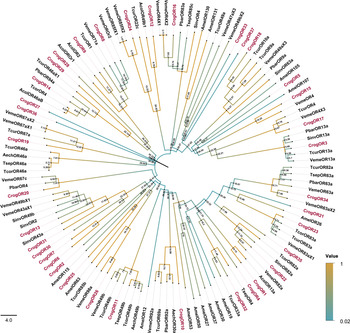
A total of 37 CrogORs were identified in the antennal transcriptome, 22 of which are full-length genes encoding 218–481 amino acids, with various numbers of TMDs ranging from three to eight. The identity values of these CrogORs with ORs from other Formicidae insects are higher than 72.00%. CrogOR27 is hypothesised to function as a coreceptor and shares the highest identity of 97.00% with the conserved odourant receptor coreceptor (ORco) from P. barbatus (table 3). In addition, CrogOR10, CrogOR20, CrogOR23 and CrogOR24 had the best blast matches with the OR of V. emeryi, with identity values higher than 90.00%. Phylogenetic analysis revealed high divergence of OR genes, and all CrogORs were distributed in different branches of the phylogenetic tree (fig. 7).
Sequence information of ORs and IRs genes in C. rogenhoferi.

Phylogenetic relationships of candidate ORs. A. colombica (Acol), A. echinatior (Aech), A. mellifera (Amel), P. barbatus (Pbar), S. invicta (Sinv), Trachymyrmex cornetzi (Tcor), T. septentrionalis (Tsep), Vollenhovia emeryi (Veme). The tree was constructed in MEGA5.2 using the neighbour-joining method.

We also identified two unigenes encoding full-length IRs. The ORF lengths of CrogIR1 and CrogIR2 are 2694 bp and 2808 bp, respectively. The identity values of CrogIRs are higher than 90.00%, and both CrogIR1 and CrogIR2 exhibit high similarities with the IRs from T. curvispinosus (table 3). In the phylogenetic tree, CrogIR1 is closely related to TcurlR25a, and CrogIR2 is closely related to TcurlR25aX1 (fig. 8).
Phylogenetic relationships of candidate IRs. T. curvispinosus (Tcur), M. pharaonis (Mpha), T. septentrionalis (Tsep), Nasonia vitripennis (Nvit), A. colombica (Acol), T. cornetzi (Tcor), Trachymyrmex zeteki (Tzet), Cyphomyrmex costatus (Ccos), S. invicta (Sinv), P. barbatus (Pbar), Nylanderia fulva (Nful), Camponotus_floridanus (Cflo), Pseudomyrmex gracilis(Pgra). The tree was constructed in MEGA5.2 using the neighbour-joining method.

Discussion
Chemosensory systems play a central role in chemical communication, which is essential for ants to perceive their surroundings and critical to finding mates, food and oviposition sites. Insect antennae are the principal chemosensory organs and have various chemosensillae. Different olfactory protein families participate in different steps of peripheral olfactory signal transduction events, such as OBPs, CSPs, ORs, IRs and SNMPs. In this study, the antennal transcriptomic data sets of C. rogenhoferi were explored. We obtained more than 8.57 GB of clean reads, which were assembled into 53,892 unigenes. We identified four OBPs, three CSPs, 37 ORs, two IRs and three SNMPs, and the chemosensory genes in C. rogenhoferi were investigated first time. Our findings provide a basis for elucidating the molecular mechanisms of olfactory-related behaviours in ants.
Insects use both OBPs and CSPs to facilitate the transport of odourant molecules through the sensillar lymph and serve as the liaison between the external environment and ORs (Calvello et al., Reference Calvello, Brandazza, Navarrini, Dani, Turillazzi, Felicioli and Pelosi2005; Gong et al., Reference Gong, Zhang, Zhao, Xia and Xiang2009; Gu et al., Reference Gu, Wang, Zhang, Wu, Guo, Zhou and Zhang2011). These two protein families are thought to be the first interactants with odourant semiochemicals and pose an important discriminatory filter during the perception of chemosensory stimuli (Pelosi et al., Reference Pelosi, Iovinella, Felicioli and Dani2014). Some studies have revealed that most insect genomes contain 40–55 OBPs and 4–8 CSPs. The first ant OBP, gp-9/SinvObp3, was identified in the fire ant S. Invicta (Krieger and Ross, Reference Krieger and Ross2002). Then, a single antenna-specific CSP was identified in the Argentine ant Linepithema humile (Ishida et al., Reference Ishida, Chiang and Leal2002). The number of OBP and CSP genes identified in this study was lower than the number found in other ants, such as S. invicta (17 OBPs, 21 CSPs), Camponotus floridanus (13 OBPs, 13 CSPs) and P. barbatus (16 OBPs, 11 CSPs) (McKenzie et al., Reference McKenzie, Oxley and Kronauer2014). The differences in the number of OBP and CSP genes may be due to the tissue used for sequencing. Some OBPs or CSPs can be expressed in other non-chemosensory tissues, such as the thorax, legs and wing, as well as in the antenna. In addition, the sequencing depth of different sequencing platforms influences the number of OBP genes identified (Gu et al., Reference Gu, Zhou, Gao, Wang, Li, Guo and Zhang2015). The feature of conserved cysteines (Cys) is regarded as a signature for insect OBPs (Pelosi et al., Reference Pelosi, Zhou, Ban and Calvello2006). Based on the number of cysteines (Cys), all four CrogOBPs are classic OBPs with six Cys residues, consistent with the C1-X15–39-C2-X3-C3-X21–44-C4-X7–12-C5-X8-C6 structural mode, which is considered to form interlocked disulfide bonds that stabilise the three-dimensional structure of the OBP (Zhou 2010; Vieira and Rozas Reference Vieira and Rozas2011; Sun et al., Reference Sun, Song, Du, Wang and Cheng2016). CSPs are more highly conserved than OBPs and are characterised by four cysteines that form two disulfide bridges (Pelosi et al., Reference Pelosi, Zhou, Ban and Calvello2006). Sequence analysis revealed that CrogCSPs have four conserved cysteine residues, in agreement with the strict structural characteristic model of C1-X6-C2-X18-C3-X2-C4 of the CSP family. OBPs and CSPs evolved dynamically between insect orders, while they appear to be more conserved at lower taxonomic levels, such as in the wasp infraorder Aculeata, which contains ants (McKenzie et al., Reference McKenzie, Oxley and Kronauer2014). Some studies have speculated that CSPs have replaced OBPs in ant olfaction, and recent studies have indicated that OBPs and CSPs primarily fulfil important conserved roles in ant olfaction rather than dynamically evolving to recognise species-specific odourants (McKenzie et al., Reference McKenzie, Oxley and Kronauer2014). More experiments are required to explore their functions in this process.
Insect SNMPs, a type of membrane proteins, are homologous genes to human CD36 receptors (Rogers et al., Reference Rogers, Krieger and Vogt2001). This olfactory-specific membrane proteins are expressed at different sites in insect antennal sensilla (Rogers et al., Reference Rogers, Sun, Lerner and Vogt1997, Reference Rogers, Krieger and Vogt2001; Forstner et al., Reference Forstner, Gohl, Gondesen, Raming, Breer and Krieger2008; Zhang et al., Reference Zhang, Liu, Walker, Dong and Wang2015). SNMP1 is usually expressed in neuron cells that respond to pheromones, whereas SNMP2 is usually expressed in supporting cells (Forstner et al., Reference Forstner, Gohl, Gondesen, Raming, Breer and Krieger2008). CrogSNMP1, CrogSNMP2, and CrogSNMP3 identified in this study clearly belong to different phylogenetic groups, which shows that the function of CrogSNMP1 is similar to that of S. invicta and P. barbatus. CrogSNMP2 and CrogSNMP3 have similar functions to proteins in C. pipiens and Drosophila.
ORs are crucial for insects to detect general odours and sex pheromones (Leal, Reference Leal2013). A large number of ORs have been reported in other ants based on genome studies, such as the red imported fire ant S. invicta (259 ORs), Florida carpenter ant C. floridanus (352 ORs), red harvester ant P. barbatus (344 ORs) and Argentine ant L. humile (337 ORs). The abundance of ORs may play a key role in olfactory codes to allow ants to detect and discriminate complex combinatorial odourant stimuli (Engsontia et al., Reference Engsontia, Sangket, Robertson and Satasook2015). In our study, a total of 37 ORs were identified based on the transcriptome of C. rogenhoferi, which was much less than that of other ants. ORs expressed in other tissues or at low expression levels might be difficult to identify (Poivet et al., Reference Poivet, Gallot, Montagné, Glaser, Legeai and Jacquinjoly2013). CrogOR27 is hypothesised to function as a coreceptor, and homology analysis showed that CrogOR27 is highly conserved with Orcos of other ant species. They may form functional heteromeric complexes with other ORs, such as ORco in OR/ORco complexes (Abuin et al., Reference Abuin, Bargeton, Ulbrich, Isacoff, Kellenberger and Benton2011). In addition, we obtained 2 CrogIRs from the transcriptome data. Usually, IRs are expressed in sensory neurons in a combinatorial fashion that responds to many distinct odours (Benton et al., Reference Benton, Vannice, Gomez-Diaz and Vosshall2009). Homology analysis revealed that CrogIR1 and CrogIR2 cluster with IRs from Myrmicinae into a subfamily, indicating that these two genes are probably involved in the chemical sensing system of C. rogenhoferi.
In summary, we obtained comprehensive information on the C. rogenhoferi transcriptome by using RNA-seq analysis. Major genes related to chemoreception were identified, including four OBPs, three CSPs, 37 ORs, two IRs and three SNMPs. The findings provide a basis for elucidating the molecular mechanisms of the olfactory-related behaviours of C. rogenhoferi, which would facilitate a better application of C. rogenhoferi as a biological control agent.
Supplementary material
The supplementary material for this article can be found at https://doi.org/10.1017/S0007485321000134.
Acknowledgements
This work was supported by grants from the Natural Science Foundation of Hainan Province of China (2019RC136), the Startup Funding of Hainan University (No. KYQD (ZR)1879) and the Hainan Major Research Project of Science and Technology (ZDKJ201817).
Conflict of interest
The authors have no conflicts of interest to declare.