The influence of the mass media on public opinion is widely documented in political communication research. Apart from learning and information acquisition, important and well-researched media effects include agenda setting, priming and framing – whereby news coverage influences cognitive and attitudinal aspects of public opinion (McCombs, Reference McCombs2004; Schaffner and Sellers, Reference Schaffner and Sellers2009; Shah et al., Reference Shah, McLeod, Gotleib and Lee2009). While documenting and analysing instances of significant media impact on public opinion is important for theory building and validation, close examination of deviant cases that run counter to what is predicted by media effect theories can be equally important for understanding public opinion formation. The present study of priming effects during the financial crisis focuses on such a puzzle: despite a dramatic increase in negative media coverage of economic issues, followed by growing public concern, priming of economic considerations did not occur. Stated differently, several of the most important ingredients that create information environments conducive to substantial priming effects were present during the financial crisis – providing a most-likely case for strong media effects on public opinion (Noelle-Neumann and Mathes, Reference Noelle-Neumann and Mathes1987; Peter, Reference Peter2004; George and Bennett, Reference George and Bennett2005). Still, priming did not take place. This study documents these trends and seeks to explain the absence of priming based on the social psychological distinction between accessibility and applicability effects.
In essence, research on media priming has shown that the news media can influence the standards people use when evaluating political actors (Iyengar and Kinder, Reference Iyengar and Kinder1987; Scheufele and Tewksbury, Reference Scheufele and Tewksbury2007). With respect to the financial crisis, the basic priming hypothesis suggests that sociotropic economic considerations should become more important evaluation criteria for government approval assessments as the economic crisis unfolds and dominates the media agenda (Mutz, Reference Mutz1992; Sheafer, Reference Sheafer2007). In this study we show, using longitudinal survey data collected in Sweden between 2007 and 2010, employing a variety of economic assessment indicators, that such priming did not occur. In a second analysis based on panel data gathered during the ‘second phase’ of the economic crisis in May 2010, our results suggest that priming of economic considerations depends on whether citizens see national economic trends as caused by international factors beyond government control, or whether responsibility is actually attributed to government actors. We conclude that these findings support the notion of priming as a two-step process, whereby heavy news coverage of the financial crisis increases the accessibility of economic considerations among the audience, but whether these considerations are used in government approval assessments depends on their perceived applicability as well (Althaus and Kim, Reference Althaus and Kim2006; Roskos-Ewoldsen and Roskos-Ewoldsen, Reference Roskos-Ewoldsen and Roskos-Ewoldsen2009). Accordingly, the absence of priming effects during the initial phase of the economic crisis, we argue, reflects the fact that news coverage was characterized by a combined focus on the international origins of the economic crisis and negative assessments of its impact on economic growth and unemployment domestically.
The article is organized as follows. The first section discusses priming effects, with a specific focus on the distinction between accessibility and applicability as two mechanisms behind priming. Based on research on economic voting we discuss attributions of responsibility as a potential individual-level applicability variable moderating priming (Rudolph and Grant, Reference Rudolph and Grant2002; Lewis-Beck and Stegmaier, Reference Lewis-Beck and Stegmaier2007). The second section briefly presents Sweden as the case, provides an empirical background on Swedish media coverage of the financial crisis, and presents the hypotheses tested in the study. After discussing methodology and data sources in the third section, the results are presented in the fourth section. In the conclusion, we discuss the broader and theoretical implications of our findings.
Media priming
Research on media priming has shifted from documenting the existence of priming effects on the audience (Iyengar and Kinder, Reference Iyengar and Kinder1987; Iyengar and Simon, Reference Iyengar and Simon1993; Mendelsohn, Reference Mendelsohn1996; Domke et al., Reference Domke, Shah and Wackman1998; Holbrook and Hill, Reference Holbrook and Hill2005) to studying how priming actually works, including the processes that drive priming (Scheufele, Reference Scheufele2000; Althaus and Kim, Reference Althaus and Kim2006; Scheufele and Tewksbury, Reference Scheufele and Tewksbury2007; Sheafer, Reference Sheafer2007). As defined in the political communication literature, priming refers to the effects of media content on people’s later evaluation of political actors. The classic definition focuses on how the amount of news coverage affects the assessment criteria used by members of the public: ‘by calling attention to some matters while ignoring others, television news influences the standards by which governments, presidents, policies and candidates for public office are judged’ (Iyengar and Kinder, Reference Iyengar and Kinder1987). Twenty-five years of priming research has demonstrated that news coverage can influence what attitudes and considerations people use to make political judgements (Iyengar and Kinder, Reference Iyengar and Kinder1987; Krosnick and Kinder, Reference Krosnick and Kinder1990; Krosnick and Brannon, Reference Krosnick and Brannon1993; Miller and Krosnick, Reference Miller and Krosnick2000). More recently, however, empirical research has focused on the mechanisms producing priming effects, suggesting that such effects are not a function of the salience of different topics in the news media alone, but of the applicability – or perceived relevance – of various considerations among the audience as well. There is thus still no consensus on the role of different individual-level mechanisms in the priming process. In other words, researchers disagree on whether priming effects are explained exclusively by salience and accessibility, that is, whether people think about something, or by applicability, that is, how they think about something, as well.
Priming as an accessibility effect
Many scholars consider priming an accessibility effect, arguing that priming is a function of the salience of certain issues in the news media, and that increased coverage influences the criteria people use to evaluate the performance of political actors (Price and Tewksbury, Reference Price and Tewksbury1997; Scheufele, Reference Scheufele2000; Scheufele and Tewksbury, Reference Scheufele and Tewksbury2007). From this perspective, priming is seen as an extension of agenda setting whereby issue salience in the media is transferred to the public, making these considerations more accessible for retrieval in subsequent judgemental tasks. As argued by Scheufele and Tewksbury, ‘[p]riming and agenda setting […] are accessibility effects; that is, they are based on memory-based models of information processing. The temporal sequence of agenda setting and priming assumes that media can make certain issues or aspects of issues more accessible (i.e. easily recalled) for people and thereby influence the standards they use when forming attitudes about candidates and political issues’ (2007: 15). Thus, the focus is not on how people think about certain issues, but rather on what information they use as criteria when forming judgements about political actors (Iyengar and Kinder, Reference Iyengar and Kinder1987; Ansolabehere et al., Reference Ansolabehere, Behr and Iyengar1993). The information provided by the news media is processed and stored in memory, and salient issues become more accessible and easily retrieved when forming global assessments, evaluations and opinions (Iyengar and Kinder, Reference Iyengar and Kinder1987; Zaller, Reference Zaller1992; Higgins, Reference Higgins1996; Price and Tewksbury, Reference Price and Tewksbury1997; Scheufele, Reference Scheufele2000; Scheufele and Tewksbury, Reference Scheufele and Tewksbury2007). Accordingly, heightened accessibility due to issue salience in the news media is the core explanation and the primary mechanism behind the priming effect.
According to this logic, one should expect priming of economic considerations during the financial crisis to occur as a function of increases in media coverage and growing public concern about the state of the national economy. As economic issues come to dominate the media agenda following the eruption of the financial crisis in 2008, citizens will become increasingly concerned about the economy (Sheafer, Reference Sheafer2007; Boomgaarden et al., Reference Boomgaarden, van Spanje, Vliegenthart and de Vreese2011), thereby affecting the weight attached to these issues in government approval evaluations (Hetherington, Reference Hetherington1996).
Priming as an applicability effect
Drawing on social psychological literature, however, other researchers argue that priming effects are, in fact, not only a function of accessibility, but of applicability mechanisms as well (Higgins, Reference Higgins1996; Althaus and Kim, Reference Althaus and Kim2006). This accentuates the question of whether accessibility alone drives priming effects. According to Althaus and Kim (Reference Althaus and Kim2006), the focus on accessibility in many priming studies is a notable theoretical and empirical limitation. They argue that it is insufficient to analyse priming effects as a result exclusively of increased accessibility, since salience in itself does not ensure that specific information is used as criteria for evaluating political actors. Applicability, as it is used here, refers to the extent to which a certain knowledge construct or consideration is considered relevant – or applicable – to a given judgemental task (Price and Tewksbury, Reference Price and Tewksbury1997; Scheufele and Tewksbury, Reference Scheufele and Tewksbury2007). Althaus and Kim describe priming as a two-step process whereby ‘accessibility is one of two primary factors moderating the activation of stored knowledge: the other is the degree to which a stimulus and a stored knowledge construct are perceived as applicable to one another’ (2006: 962; see also Higgins and Brendl, Reference Higgins and Brendl1995; Carpentier et al., Reference Carpentier, Roskos-Ewoldsen and Roskos-Ewoldsen2008). Similarly, Roskos-Ewoldsen and Roskos-Ewoldsen (Reference Roskos-Ewoldsen and Roskos-Ewoldsen2009) refer to applicability as ‘deliberate judgements of the relevance of information to the current situation’ (p. 184). Therefore, whether economic considerations – as in the case of the financial crisis – are not only activated by increased media coverage, but also increasingly used as evaluation criteria by citizens, depends on the perceived relevance of these considerations for government approval assessments. Describing priming as a two-step process expresses the notion that priming effects are moderated by applicability as well as accessibility mechanisms (Althaus and Kim, Reference Althaus and Kim2006).
With respect to public opinion during the financial crisis, the applicability argument suggests that increased salience of economic issues in the media and growing public concern are not sufficient conditions for generating priming effects. In addition, citizens need to consider these economic considerations as relevant for their government approval evaluations. Inspired by research on economic voting (Anderson, Reference Anderson2000; Lewis-Beck and Stegmaier, Reference Lewis-Beck and Stegmaier2000; Hellwig, Reference Hellwig2007; Sheafer, Reference Sheafer2008), we consider attribution of responsibility for economic developments as a key applicability mechanism behind priming of economic issues. As several of these studies have noted, the reward–punishment hypothesis that underlies economic voting depends on the clarity of political responsibility (Hellwig, Reference Hellwig2007; Sheafer, Reference Sheafer2008) – a finding that seems highly relevant for priming effects during the financial crisis. As argued by Lewis-Beck and Stegmaier (Reference Lewis-Beck and Stegmaier2007): ‘[b]ecause of globalization, that is, international economic integration, governments are less able to manage their national economies. Therefore, as electorates perceive this, we should expect less economic voting’ (p. 529). In one of the most extensive studies on the relationship between perceptions of responsibility for current economic trends and economic voting, Rudolph and Grant (Reference Rudolph and Grant2002) found that ‘attributions of responsibility moderate the effects of national economic perceptions on actual voting decisions’ (p. 819; see also Rudolph, Reference Rudolph2003; Rudolph, Reference Rudolph2006). Given the global scope of the financial crisis, it is far from obvious that growing public concern over the national economic situation translates into priming effects. According to an applicability argument, priming of economic perceptions should depend on whether citizens see national economic trends as caused by international factors beyond government control, or whether responsibility is actually attributed to government actors.
Case selection, empirical background and hypotheses
The present study of priming effects during the financial crisis focuses on opinion dynamics in Sweden – a small country strongly dependent on international trade and global economic activities. From a media system perspective, Sweden is typically considered a democratic corporatist country with strong journalistic professionalism, high levels of newspaper circulation and strong public service broadcasting institutions that attract large audiences from broad segments of the population (Hallin and Mancini, Reference Hallin and Mancini2004; Aalberg and Curran, Reference Aalberg and Curran2011; Shehata and Strömbäck, Reference Shehata and Strömbäck2011).
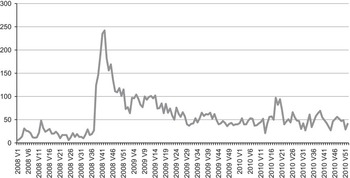
The Swedish economy was heavily affected by the financial crisis that erupted in September 2008, as well as the subsequent global economic recession (Lybeck, Reference Lybeck2009). The macroeconomic downturn that followed was clearly reflected in all major Swedish news media, as shown by two previous studies analysing media coverage of the financial crisis (Asp, Reference Asp2011; Färm et al., Reference Färm, Jendel and Nord2012). In addition, these studies suggest that the Swedish experience of the global economic crisis could be divided into two phases – as illustrated by Figure 1, which displays the amount of news coverage of the economic crisis in four leading Swedish dailies from January 2008 to December 2010 (Färm et al., Reference Färm, Jendel and Nord2012). The fall of Lehman Brothers in September 2008 marks a starting point of the initial phase of the economic crisis, with a substantial increase in attention devoted to economic issues in the Swedish media. From the graph it is obvious that news coverage was most extensive in the second half of 2008 and the first 6 months of 2009, but the economy remained a key issue on the media agenda throughout the entire period. News coverage during the initial phase in 2008 was characterized both by a strong focus on developments abroad and very negative assessments of the impact on economic growth and unemployment domestically (Färm et al., Reference Färm, Jendel and Nord2012). According to the extensive content analysis by Asp (Reference Asp2011), media coverage of the state of the economy and unemployment was extremely negative in the fall of 2008 but gradually improved during 2009. Negative media coverage of the Swedish economy dominated until late spring 2010, however, at which point the total amount of positive stories of economic development and unemployment rates outnumbered the negative – a tipping point that coincided with increasingly negative coverage of the economic situation in the euro zone (Asp, Reference Asp2011: 112). This tipping point in April–May 2010 marks what we consider the ‘second phase’ of the economic crisis, illustrated in Figure 1 by a second wave of economic news coverage focusing on worrying economic developments in the euro zone in general, and in the Greek economy in particular. At the same time, however, media framing of the Swedish economy and unemployment trends became increasingly positive in the following months (Asp, Reference Asp2011).
The number of articles about the economic crisis published in Aftonbladet, Expressen, Dagens Nyheter and Svenska Dagbladet between 2008 and 2010.
Note: N=8904 (number of articles).
Source: Färm et al., Reference Färm, Jendel and Nord2012.

The extensive news coverage devoted to the economy by the Swedish media following the eruption of the financial crisis in 2008 provides an excellent opportunity to study priming effects on government approval. Building upon research on opinion formation and economic voting, we focus on how citizens’ sociotropic economic assessments – that is, perceptions of the national rather than personal economic situation – influence government approval (Mutz, Reference Mutz1992; Lewis-Beck and Stegmaier, Reference Lewis-Beck and Stegmaier2007; Boomgarden et al., Reference Boomgaarden, van Spanje, Vliegenthart and de Vreese2011). In terms of priming, we contrast two partly competing explanations as to how and why priming effects occur. Following the original priming hypothesis based on an accessibility mechanism, we should expect the substantial increase in negative media coverage of the economy to increase public concern over economic issues which, in turn, influences the weight attached to these considerations in government approval evaluations. According to the applicability argument outlined previously, on the other hand, we expect priming of economic considerations to depend not only on the accessibility (or salience) of economic considerations, but also on how citizens attribute responsibility to current economic trends during the financial crisis. More formally, we formulate and test the following three hypotheses:
Hypothesis 1: Increased negative news coverage of the economy, following the eruption of the financial crisis in 2008, leads to growing public concern about the state of the national economy (salience effect).
Hypothesis 2: Growing public concern about the national economy leads citizens to attach greater weight to economic considerations when evaluating government performance (accessibility mechanism).
Hypothesis 3: Priming effects during the financial crisis depend both on issue salience and attributions of responsibility for current economic trends (applicability mechanism).
Methodology and data
This study of priming effects during the financial crisis is based on two public opinion data sources. First, economic perceptions and government approval in the period 2007–2010 are analysed using an annual representative survey, which has been administered by the Swedish Society, Opinion, Media (SOM) institute at the University of Gothenburg since 1986. These cross-sectional surveys are conducted each fall during a fieldwork period of ∼3 months, and provide one of the most extensive longitudinal representative databases on public opinion and behaviour available in Sweden. The SOM surveys utilized here were conducted between September and December in the years 2007–2010, thereby covering public opinion dynamics before (2007), during (2008) and in the aftermath (2009 and 2010) of the financial crisis. As data for the 2008 survey were gathered immediately after the fall of Lehman Brothers on 15 September, we will further track public opinion dynamics week-by-week following the eruption of the initial phase of the crisis. Second, to investigate the role of attributions of responsibility in the priming process a separate four-wave panel study was conducted during the 2010 Swedish election campaign, with the first wave in field at the start of the ‘second phase’ of the financial crisis in May 2010, when the economic problems in Greece and the euro zone quickly became the dominant issue. While the panel survey does not allow for an analysis of public opinion at the outbreak of the financial crisis in 2008, it provides an opportunity to study the role of responsibility attributions at a time when the global economic crisis entered a new phase, and media coverage as well as public perceptions of the current Swedish economic situation shifted.
The annual SOM survey
The cross-sectional SOM surveys are distributed by mail annually to a national probability sample of the Swedish population. While the overall research design and sampling procedure have remained the same since the surveys were launched in 1986, some minor amendments have been made. In 2007 and 2008 the sample included citizens aged 15–85, while the 2009 and 2010 surveys covered an age span of 16–85 years. The fieldwork starts at the end of September and continues over the following months. The majority of the questionnaires are returned before the end of October. The final response rates for the surveys used here range from 58 (2008) to 63% (2010).
The four-wave panel study
The panel study was conducted in four waves during the 2010 Swedish election campaign. The study was conducted by the Centre for Political Communication Research at Mid Sweden University in cooperation with the polling institute Synovate in Sweden. The sample was drawn using stratified probability sampling from a database of ∼28,000 citizens from Synovate’s pool of Web survey participants. The participants included were recruited continuously using both random digit dialling and mail surveys based on random probability samples. Approximately 5% of those who are initially contacted and invited agreed to be part of this pool of respondents. As the invitations were not carried out for this specific study, but rather for the purpose of doing market research, the common bias towards politically interested citizens is avoided.
The survey is based on a sample of 4010 respondents aged 18–74 from this pool, stratified by gender, age, county size, political interest and Internet use, in order to be as representative of the Swedish population aged 18–74 as possible. Respondents were asked to complete a Web survey four times during a period of ∼5 months leading up to the election. Wave 1 of the panel took place in May (3–20 May); Wave 2 in mid-June (14–23 June); Wave 3 in mid-August (16–23 August) and Wave 4 immediately after Election Day (20–27 September). In order to utilize the strength of the panel data, most analyses will be based on respondents who completed all four questionnaires, resulting in a cooperation rate of 35% (COOP2, AAPOR).
Measures
All the main variables used in our study of priming effects were measured either identically or similarly in the SOM and panel surveys.
Government approval
The dependent variable is based on the following two survey items posed in the SOM survey: (1) ‘To what extent do you approve of the way the government is doing its job?’ (2) ‘To what extent do you trust how the following institutions or groups [the government] are doing their job?’. These two five-point scales were added (Pearson’s r=0.76) to form a government approval index ranging from 0 (Not at all) to 8 (Strongly approve). From the panel survey, the following item was used to tap government approval: ‘Overall, how do you think the government has handled its job in the past four years?’, ranging from 1 (Very bad) to 7 (Very good).
Sociotropic economic perceptions
Following research on economic voting, we are primarily interested in the priming of sociotropic economic perceptions. These were measured identically in both the SOM and the panel surveys, using the following item: ‘How has, according to you, the following economic situation [the Swedish economy] changed during the past 12 months?’, ranging between 0 (Improved), 1 (Remained the same) and 2 (Gotten worse). While this retrospective item is the main priming variable used in the analysis, we will validate some findings using alternative measures of sociotropic perceptions. First, a measure of prospective economic perceptions is based on the following item: ‘How do you believe the [Swedish] economy will change in the coming 12 months?’, ranging between 0 (Improve), 1 (Remain the same) and 2 (Get worse). Furthermore, the SOM survey includes the following question on the problems citizens are worried about: ‘If you consider the situation today, what do you consider most worrying for the future?’, with two items focusing on a future (1) economic crisis and future (2) widespread unemployment. Response categories range from 1 (Not worried at all) to 4 (Very worried). Finally, a classic open-ended agenda-setting item was included in the SOM survey: ‘What issues or problems do you consider most important for Sweden today?’. Respondents who named either the financial crisis, the Swedish economy, the economic recession or unemployment were combined.
Attributions of responsibility
To address the distinction between accessibility and applicability effects, the panel study included an item to capture the extent to which citizens perceive the current economic situation as a result of the international economic downturn on the one hand, or as a result of government policy on the other. The item was worded in the following way: ‘In public discourse some argue that the financial crisis is the main cause of economic developments in Sweden in the last couple of years. Others argue that government policy is the main cause of these economic developments. What do you consider to be the main cause?’, with responses ranging from 1 (The financial crisis is the main cause of the economic development) to 7 (Government policy is the main cause of the economic development).
Salience of economic issues
To fully test the applicability argument – that economic considerations should be both accessible and applicable to influence government approval assessments – the panel study also included a measure of the salience of the national economy as a political issue. Following previous agenda-setting research, salience was measured by asking respondents to rate how important they considered a number of political issues to be, using a scale from 1 (Not important at all) to 7 (Very important). A relative economic issues salience index was computed by dividing the importance attached to ‘economic growth’ by the importance attached to nine other political issues. By focusing on the relative salience of economic issues, our measure better reflects the perceived importance of, or concern for, economic issues compared with the salience of other issues. Finally, this index was recoded to range between 1 (low relative salience) and 7 (high relative salience).
Control variables
In addition to the main variables described above, our analysis of priming effects includes a number of key political and socio-demographic background characteristics. As both government approval and sociotropic economic perceptions are heavily influenced by partisan preferences, respondents’ left–right ideological predispositions are included as a control variable measured on a five-point scale in the SOM survey, and on an 11-point scale in the panel survey. Other control variables are personal economic situation, political interest, education, age and gender. Changes in respondents’ personal economic situation (egocentric perceptions) is included as a control variable in order to distinguish the influence of sociotropic perceptions of the economy from personal experiences of the financial crisis on public opinion.
Results
The analysis of priming effects during the financial crisis will be presented in two steps. In the first section we document, using a variety of indicators, that priming did not occur despite a substantial increase in media coverage and growing public concern about the economy in the fall of 2008 – results that run counter to the basic priming hypothesis. Second, we focus on the distinction between accessibility and applicability mechanisms as one potential explanation for this outcome. In particular, the analysis addresses the role of individual-level attributions of responsibility as a moderator of priming effects.
Increases in media coverage and public concern
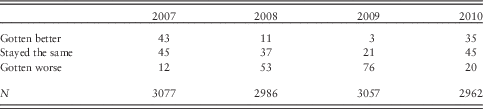
Given the substantial increase in negative media coverage documented by Asp (Reference Asp2011) as well as Färm et al. (Reference Färm, Jendel and Nord2012), it is no surprise that public concern about the economy followed a predicted pattern. Table 1 displays the development of retrospective economic perceptions about the Swedish economy (sociotropic) between 2007 and 2010, thereby covering public opinion before (2007), during (2008) and in the aftermath of the initial financial crisis (2009 and 2010). As expected, economic perceptions became more negative following the financial crisis. In autumn 2007, 43% believed the Swedish economy had improved in the past 12 months. One year later – in the midst of the financial crisis – this number was down to 11%. Two years later it was down even more, when only 3% believed the Swedish economy had improved. The percentage having negative sociotropic perceptions of the economy followed an opposite trend, from 12% to 76% between 2007 and 2009. In 2010, however, economic perceptions had improved, following trends of more optimistic media accounts of economic developments in Sweden.
Retrospective economic perceptions during the financial crisis (%)

SOM=Society, Opinion, Media.
Note: Estimates based on the survey question: How has, in your opinion, the following (the Swedish economy) economic situation developed during the past 12 months?
Source: SOM 2007–2010.
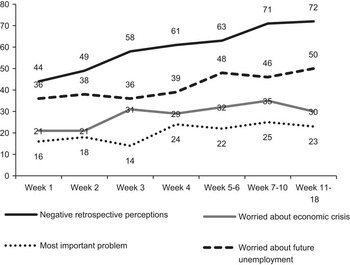
Figure 2 provides another way of looking at public economic perceptions in response to the financial crisis by zooming in on opinion dynamics in the fall of 2008, immediately following the intense surge in media reporting after the breakdown of Lehman Brothers. The numbers are broken down based on the time at which completed questionnaires were received from the respondents. The first questionnaires were returned on 25 September – 10 days after the fall of Lehman Brothers – with a majority (62%) received within the first 2 weeks. Due to the skewness of this distribution, and in order to secure fairly reliable estimates, we constructed a time variable so as to avoid categories with fewer than 200 observations. Despite these data limitations, Figure 2 reveals opinion trends that are expected, given the dramatic surge in negative media coverage of the economy. From week 1 to weeks 11–18, the share of citizens with negative retrospective perceptions of the Swedish economy increases from 44% to 72%; the percentage naming the economy, the financial crisis, the recession or unemployment as the most important problem increases from 16% to 23%; and the share saying they are either rather or very worried about a future economic crisis or future widespread unemployment grows from 21 to 30 and from 36% to 50%, respectively. Thus, irrespective of what indicators are used, there is a clear growth in public concern over economic issues in autumn 2008, lending strong support for hypothesis 1. A stronger test of the trends in Figure 2 was conducted by regressing each indicator on the time variable, controlling for individual-level differences in education, political interest, partisan predispositions, age and gender (regressions not displayed). We also controlled for changes in the personal economic situation to account for the possibility that respondents’ own economic experiences coloured their sociotropic economy assessments. In all cases, however, the time factor had a statistically significant effect beyond the variance accounted for by the other variables.
Sociotropic economic perceptions during autumn 2008 (%).

In sum, the heightened media attention and growing economic concern among the public that followed the eruption of the economic crisis in 2008 should provide fertile ground for priming effects to occur. As the economic crisis came to dominate the political and media agenda for several years, the basic priming hypothesis suggests that economic considerations should become more important when citizens evaluate the performance of political actors. More precisely, we expect government approval to depend more on economic perceptions as the financial crisis unfolds and pervades the political, media and public agenda.
Priming effects during the financial crisis
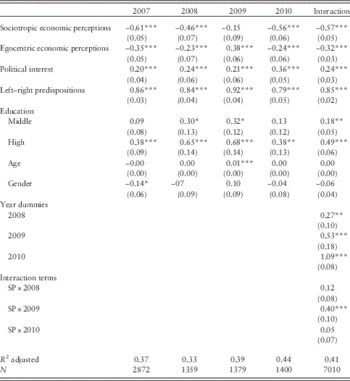
Our first tests of the priming hypothesis are presented in Table 2, where government approval is regressed on retrospective economic perceptions before (2007), during (2008) and in the aftermath (2009 and 2010) of the financial crisis, controlling for several background variables – including changes in personal economic situation, education, political interest, ideological predispositions, age and gender. Egocentric economic perceptions refer to development of the personal economic situation, a variable constructed identically to sociotropic perceptions. As documented extensively by previous studies, the results show that negative sociotropic economic perceptions are consistently related to lower government approval – and the effect of sociotropic economy perceptions is substantially stronger than personal economic developments. More importantly, however, no evidence of a priming effect is found as we compare the coefficient for sociotropic economic perceptions over time. On the contrary, sociotropic economic perceptions exert the strongest impact on government approval prior to the financial crisis (b=−0.61), and lose weight as a predictor in the following 2 years. In 2010, 2 years after the eruption of the financial crisis and in a situation of growing optimism over the Swedish economy, order seems to have been restored. The last column provides a more robust statistical test of the priming hypothesis by including interaction terms between year dummies and sociotropic economic perceptions. This model confirms the pattern found in the separate year-by-year models, showing one statistically significant deviation from the 2007 effect of economic perceptions on government approval: in 2009 the impact of economic considerations weigh significantly less (b=0.40) than in 2007.
The effect of retrospective economic perceptions on government approval, 2007–2010 (ols)

SP=sociotropic economic perceptions; SOM=Society, Opinion, Media.
Note: Estimates are unstandardized OLS coefficients with standard errors in parentheses.
*P<0.05, **P<0.01, ***P<0.001.
Source: SOM 2007–2010.
To further validate the findings in Table 2, each model was estimated using three alternative indicators of economic perceptions: prospective economic evaluations, worries about a future economic crisis and worries about widespread unemployment. None of these tests produced a significant priming effect over time, which substantially strengthens the findings in Table 2.
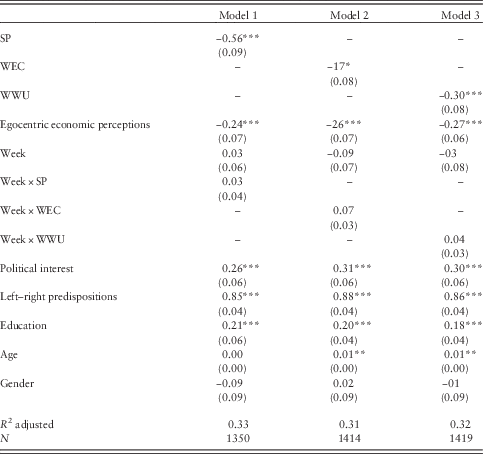
As a final test of the basic priming hypothesis, we again zoom in on opinion dynamics during autumn 2008. Figure 2 clearly illustrated how public concern over economic issues and unemployment rapidly grew in the weeks following the eruption of the financial crisis. Table 3 presents results from three regression models testing whether there is a corresponding increase in the weight given to economic considerations as the financial crisis unfolds in the weeks following the fall of Lehman Brothers. The stand-alone coefficients for retrospective perceptions (model 1), worries about a future economic crisis (model 2) and worries about widespread unemployment (model 3) each represent the effect of these perceptions on government approval at the outset of the financial crisis, that is, in the period 25 September–1 October. The corresponding interaction terms between sociotropic perceptions and time captures changes in the weight given to these economic considerations over time. Again, none of these interaction terms are significant, suggesting that, despite growing public concern, sociotropic economic perceptions do not weigh heavier for government approval assessments.
The effect of sociotropic economic perceptions on government approval, 2008 (ols)

SP=sociotropic economic perceptions; WEC=worried about economic crisis; WWU=worried about widespread unemployment; SOM=Society, Opinion, Media.
Note: Estimates are unstandardized OLS coefficients with standard errors in parentheses.
*P<0.05, **P<0.01, ***P<0.001.
Source: SOM 2007–2010.
In sum, then, contrary to the basic priming hypothesis, there is no evidence that dramatically increasing media coverage and growing public concern about the economy results in a corresponding increase in the weight given to these issues for government approval assessments – lending no support to hypothesis 2. How can we understand these opinion dynamics in light of priming theory? In the next section, we address this question by incorporating ideas from research on economic voting.
Attributions of responsibility as a moderator of priming effects
Our basic idea – borrowed from the literature on economic voting – holds that the influence of economic considerations on government approval is dependent on attributions of responsibility (Rudolph and Grant, Reference Rudolph and Grant2002; Rudolph, Reference Rudolph2006; Lewis-Beck and Stegmaier, Reference Lewis-Beck and Stegmaier2007). A potential reason for the absence of priming effects documented above is the global character of the financial crisis and how the crisis was framed by the Swedish media. To the extent that citizens perceive the economic downturn primarily as a result of international forces, they are less likely to either reward or punish the domestic government – despite growing public concern over the economy. Compared with most economic voting studies, however, we treat attributions of responsibility as a factor partly shaped by the communication environment in general, and frames used by political actors and the media to make sense of ongoing current events and developments. To test these ideas we turn to opinion dynamics during the second phase of the financial crisis. Starting in spring 2010, this is a time characterized by growing concerns over several economies in the euro zone, and Greece in particular, while media framing of the Swedish economy became increasingly positive (Asp, Reference Asp2011).
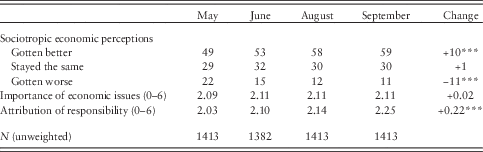
These trends are clearly evident in our four-wave panel study, which covers opinion dynamics between May and September 2010. As can be seen from Table 4, perceptions of the development of the Swedish economy improve significantly in the 5-month period. The percentage seeing retrospective improvements grows from 49% to 59%, while the number of citizens perceiving economic deterioration goes down from 22% to 11%. As noted in the final column, these changes are statistically significant. Additional analysis (not displayed) reveals that these changes occur independently of partisan preferences. While perceptions of the economic situation are substantially more optimistic among rightwing citizens, the overall changes uncovered in Table 4 occur among leftwing voters as well. Table 4 also reveals parallel trends in two other critical public opinion indicators. First, despite growing economic optimism, there is no change in the relative importance of economic issues in the eyes of Swedish citizens. In terms of perceived importance as a political issue, then, the Swedish economy remains as salient among the electorate in May as in September.
Sociotropic economic perceptions, attributions of responsibility and government approval during the election campaign (% and mean values)

Note: Tests of significance were conducted using a pooled dataset containing data from each panel wave. Regression models including three wave-specific dummy variables and robust standard errors were estimated in order test the significance of time trends in each of the variables. Stars in the last column denote significant changes between May and September.
More important given our main hypothesis, however, is the change in attributions of responsibility for the current economic situation in Sweden that occur during the same period of time. Table 4 displays these changes as mean values on the seven-point (0–6) attribution of responsibility scale, indicating the extent to which the financial crisis (low values) or domestic government policy (high values) is considered the main cause of the current economic situation in Sweden. Overall there is a clear – and statistically significant – trend of growing government responsibility for economic developments according to Swedish citizens. While the financial crisis becomes a weaker explanation for the current economic situation, the actions taken by the Swedish government are gradually seen as more important. Although these are general trends, additional analysis (not displayed) also shows that there is substantial variation between leftwing and rightwing citizens in this regard. In fact, the general trend is driven primarily by changes among centrist and, in particular, rightwing citizens, who strongly attribute signs of economic improvement domestically to the government – while leftwing citizens move in the opposite direction by increasingly pointing to the financial crisis as the main source behind current economic developments.
Thus, as perceptions of the current economic situation in Sweden improve among the public, the Swedish government is increasingly seen as responsible for these developments among all but leftwing citizens. Furthermore, if attribution of responsibility is a key mechanism behind priming, two observable implications should follow from these trends. First, the impact of economic considerations on government approval should increase over time following aggregate changes in responsibility attributions. Second, attribution of responsibility should moderate the impact of economic considerations on government approval on the individual level. Both these implications are tested in a series of regression models presented in Table 5.
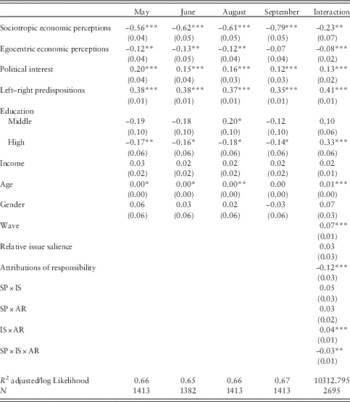
The effect of retrospective economic perceptions on government approval, May–September (ols)

SP=sociotropic economic perceptions; IS=issue salience; AR=attributions of responsibility.
Note: Estimates are unstandardized OLS coefficients with standard errors in parentheses. Models 1–4 are identical when it comes to model specification. Government approval, sociotropic economic perceptions, egocentric economic perceptions, political interest and relative issue salience were measured in each specific wave, while the other background variables were considered time-invariant and measured in the first wave only. The final interaction model is a hierarchical linear model estimated using a pooled data set containing data from all four waves. Information from all level-2 units (individuals) was used in estimating this model.
*P<0.05, **P<0.01, ***P<0.001.
Before turning to a more robust test of these ideas, it is worth noting that comparisons of the bivariate effect of economic considerations on government approval across panel waves lend initial support to the general argument. The unstandardized bivariate regression coefficient capturing the effect of sociotropic economic perceptions on government approval increases from b=−1.26 in May, to b=−1.38 in June, to b=−1.41 in August and finally to b=−1.60 in September – which is a statistically significant change.Footnote 1
The four-wave-specific models in Table 5 replicate these bivariate analyses in a much stronger test including several control variables. Each of the focal variables was measured in each of the four panel waves.Footnote 2 Again, these models focus on the change in the weight given to economic considerations over time, following the changes in responsibility attributions documented above. As the public increasingly perceives the Swedish government as responsible for the current economic situation, we expect the impact of sociotropic perceptions to gain importance as a predictor of government approval. This is exactly what happens. In May the effect of sociotropic perceptions is −0.56, controlling for a host of socioeconomic and political background variables. In September this effect has grown to −0.79, using the same control variables, which reveals the heavier weight given to sociotropic economic perceptions by the end of the campaign. Again, a separate significance test of differences between slopes revealed that the increase in the effect of economic considerations from May to September is statistically significant.
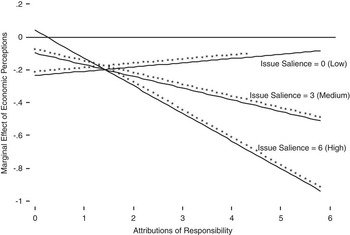
The final column of Table 5 tests the second implication of the applicability argument. On the individual level, we expect the inclination to punish or reward the government for current economic trends to be stronger among citizens who see the government – rather than the financial crisis – as responsible for these trends. Furthermore, the argument that priming of economic considerations depends on construct accessibility as well as applicability suggests a three-way interaction effect. Not only should citizens who increasingly see government as responsible for economic developments be more inclined to let their sociotropic perceptions influence assessments of government approval (applicability), but this pattern should be particularly pronounced among citizens who also are concerned about economic issues (accessibility). Stated differently, both attribution of responsibility and issue salience should jointly moderate the impact of economic considerations on government approval. We tested this idea using a hierarchical linear model on a pooled dataset including all four panel waves, with observations from each wave nested within individuals (Hox, Reference Hox2002). The three-way interaction between sociotropic perceptions, attributions of responsibility and issue salience is displayed graphically in Figure 3 in order to facilitate interpretation of the main finding. Following suggestions by Brambor et al. (Reference Brambor, Clark and Golder2006), the graph displays how the marginal effect of sociotropic perceptions depends on attributions of responsibility and issue salience. More specifically, the lines illustrate how the negative effect of sociotropic perceptions on government approval (y-axis) changes along the attribution of responsibility scale (x-axis) for different values of issue salience (represented by three separate lines). The stars mark regions of statistical significance of the marginal effect of sociotropic perceptions on government approval.
The marginal effect of economic perceptions on government approval.

Overall, the pattern revealed in Figure 3 lends additional support for the critical role of responsibility attributions in the priming process. The effect of sociotropic economic perceptions on government approval is weakest when issue salience is low. With growing salience of the economy, however, attributions of responsibility become more important as a moderator of economic perceptions. For medium levels of issue salience (=3 on the 0–6 salience scale) the negative impact of economic perceptions is substantially weaker among citizens who see the current economic situation mainly as a result of the financial crisis – corresponding to low values on the attributions of responsibility scale – than those who perceive government policy as the primary cause. This pattern is even more pronounced among citizens who are very concerned about the economy (issue salience=6). When issue salience is at its highest value, the effect of economic considerations on government approval is close to zero and non-significant among citizens who primarily see current macroeconomic trends as caused by the financial crisis – but this effect increases rather dramatically as we move along the attributions of responsibility scale. In sum, the impact of sociotropic perceptions on government approval is by far strongest when issue salience is high and responsibility for economic trends is attributed to the government.
Conclusion and discussion
The global financial crisis erupted in September 2008 and rapidly came to dominate the political and media agenda across the world. Its immediate consequences included the fall of major banks, growing financial uncertainty and a major economic recession with a profound impact on trade and unemployment in western democracies – sometimes described as the worst economic crisis since the Great Depression. The present study utilized the dramatic increase in media coverage devoted to economic issues to study public opinion formation in general, and to analyse the mechanisms behind priming effects in particular, focusing on the Swedish case. The information environment following the financial crisis contained several of the ingredients that are usually considered conducive for strong media effects, including a rapid growth of intense, consonant and negative news coverage of a single issue that came to dominate the media agenda for several years (Noelle-Neumann and Mathes, Reference Noelle-Neumann and Mathes1987; Zaller, Reference Zaller1992; Peter, Reference Peter2004; Sheafer, Reference Sheafer2007; Boomgarden et al., Reference Boomgaarden, van Spanje, Vliegenthart and de Vreese2011) – thereby resembling a most-likely case for many media effect theories (George and Bennett, Reference George and Bennett2005).
Despite these favourable conditions, however, this study showed, using a variety of economic assessment indicators, that priming did not occur – at least not in its most basic form. While public opinion dynamics followed the expected agenda-setting pattern, in the sense that the intense surge of negative economic news led to growing public concern over economic issues, citizens did not attach greater weight to economic considerations in their government approval assessments following the outbreak of the economic crisis. In a second analysis focusing on the ‘second phase’ of the financial crisis, we found that the extent to which respondents attached weight to economic considerations in their assessment of government approval depended heavily on their attribution of responsibility for current economic developments in the country. Citizens who were concerned about the economy but primarily considered the ups and downs of the Swedish economy as a result of the financial crisis were substantially less inclined to let their economic perceptions influence government approval than those who viewed economic developments as caused by government action. Importantly, these findings reflect broader patterns of Swedish media coverage of the economy during the financial crisis. In the initial phase – when public concern over economic issues grew substantially – news coverage was characterized by extremely negative assessments of economic trends as well as a heavy focus on events and developments abroad, hence contributing to the international character of the crisis. During the second phase, however, media coverage provided a contrasting frame of positive developments in the Swedish economy and heightened concern about the economic situation in the euro zone and Greece.
These results are important as they shine light on the mechanisms and contingencies behind priming effects. In particular, the analyses strongly indicate that priming is not a function of heightened salience and accessibility alone (Iyengar and Kinder, Reference Iyengar and Kinder1987; Scheufele, Reference Scheufele2000; Scheufele and Tewksbury, Reference Scheufele and Tewksbury2007). Substantial increases in negative media coverage and growing public concern were not enough to generate priming effects. Rather, the findings support the notion of priming as a two-step process, whereby heavy news coverage of the financial crisis increases the accessibility of economic considerations among the audience, but whether these considerations are used in government approval assessments also depends on their perceived applicability or perceived relevance (Althaus and Kim, Reference Althaus and Kim2006; Roskos-Ewoldsen and Roskos-Ewoldsen, Reference Roskos-Ewoldsen and Roskos-Ewoldsen2009). It is noteworthy that what changed in public opinion during the second phase of the crisis was not issue salience or perceived importance of economic issues, which remained remarkably stable during these months, but perceptions of responsibility for current national economic trends. With high issue salience and changing responsibility perceptions, economic considerations came to weigh more heavily in government approval assessments – offering support for the two-step process of priming. Compared with the Althaus and Kim study, which contained ‘no direct means of measuring construct applicability’ (2006: 974), the present study aimed at measuring and modelling applicability more explicitly by using individual variations in attributions of responsibility for economic trends as a modifying variable in the priming process.
Furthermore, the results of the present study indicate that priming may be a more active process than is commonly suggested by a pure accessibility account of media effects. Not only was attribution of responsibility a critical applicability mechanism, but we also found that shifts in responsibility attributions – following the dominant media frame during the second phase of the financial crisis – were strongly influenced by ideological predispositions. The interplay between personal political motivations and applicability seems to be critical here, as implied by research on priming (Kim, Reference Kim2005) and motivated reasoning (Druckman, Reference Druckman2012). As Kim (Reference Kim2005) argues, ‘[i]ndividuals must feel the inappropriateness or appropriateness of the primed concept and select a concept, either consciously or unconsciously, that is relevant to their judgments. This might be the place where individuals’ motivations can play a role in priming effects’ (p. 752). We consider these issues to be important to future research on priming.
Thus, the findings of this study contribute with empirical evidence to the discussion about mechanisms behind the priming process and highlight the importance of incorporating individual-level factors in priming research. It is nevertheless important to highlight some limitations of this study. One relevant objection relates to the lack of direct measures of media exposure in the study. To be sure, news exposure could be considered a necessary condition for priming. However, measures of news exposure are not without problems in situations of extensive and consonant media coverage, or information saturation, such as during the financial crisis. We know from previous studies that news coverage of the financial crisis was not only extensive – the economy dominated the media agenda – but also that this coverage was consonant across different news outlets (Asp, Reference Asp2011; Färm et al., Reference Färm, Jendel and Nord2012; Falasca, Reference Falasca2013). As noted by Druckman (Reference Druckman2005), focusing on widely available information such as major national or international events makes it very hard to detect media effects from exposure to individual outlets, since such mediated information can reach citizens in multiple ways. Attempts to separate the influence of a specific news media are, therefore, plagued by methodological problems in situations of major events such as the financial crisis.
The extent to which these results are valid for other issues and in other countries is of course an open question that needs to be addressed by further research. We believe that the findings in this paper hold promise for future research on the mechanisms behind priming effects and that further work in different contexts and cases as well as multi-case studies can clarify the role of individual perceptions for priming effects.