INTRODUCTION
Patients with cancer enrolled in a phase I trial have no remaining standard treatment options, but they are still in good enough clinical condition to receive experimental treatments. Along with a limited chance of benefit, experimental treatment may lead to significant side effects and more visits to the hospital (Catt et al., Reference Catt, Langridge and Fallowfield2011). This may burden a patient during the vulnerable end-of-life phase (Cox, Reference Cox2000). Critics have stated their concerns about patients' voluntariness, considering the risk/benefit ratio and the informed consent procedure for phase I oncological trials. The decision to participate will most often be a consequence of a misconception, coercion, or blurred judgment caused by the urgency of the patient's condition (Agrawal & Emanuel, Reference Agrawal and Emanuel2003). On the other hand, the well-informed patient is aware of the alternatives to enrollment, does not suffer from coercion, and is determined to fight their cancer no matter what the cost (Agrawal et al., Reference Agrawal, Grady and Fairclough2006). Regarding studies performed related to the ethical basis of experimental treatment, most take the point of view of the care professional or patient (Agrawal & Emanuel, Reference Agrawal and Emanuel2003; Joffe et al., Reference Joffe, Cook and Cleary2001). Since the partner may suffer due to the patient's burden during and following participation, the partner's point of view is at least as important, but usually not actively sought. There is increasing awareness that care for a patient with cancer has a significant impact on the partner's life (Kim et al., Reference Kim, Kashy and Spillers2010; Kim & Carver, Reference Kim and Carver2012). They are not prepared and educated to provide specialized care for a patient with cancer during the often dynamic and protracted illness trajectory (Williams & McCorkle, Reference Williams and McCorkle2011; Given et al., Reference Given, Given and Sherwood2012), and they have to integrate their role as caregiver into their own personal life, including their employment, household, and social life (van Ryn et al., Reference van Ryn, Sanders and Kahn2011; Kim et al., Reference Kim, Kashy and Spillers2010). They can experience unmet needs while providing care, which bring on negative consequences for their general health (Kim et al., Reference Kim, Kashy and Spillers2010; Williams & McCorkle, Reference Williams and McCorkle2011). As we noted that partners face special difficulties assisting the patient during experimental treatment, we retrospectively (1) explored the partner's point of view on patient participation in a phase I study and (2) determined their well-being after the patient's death, assessing depression, psychological distress, complicated grief, and health-related quality of life.
Our results could ultimately lead to improved support for partners during the phase of experimental therapy and after the death of patients. To our knowledge, this is the first study on the experience of partners of patients participating in phase I oncology trials.
PATIENTS AND METHODS
Sample and Procedures
This study was conducted between January of 2009 and July of 2010 and consisted of completion of validated questionnaires. Partners of deceased patients who participated in phase I studies at the Radboud University Medical Center between 2007 and 2009 were recruited. Some 74 partners were deemed eligible and were approached between six months and two years after a patient's death.
Although this study did not fall under the Medical Research Involving Human Subjects Act, the advice of the local medical ethical committee was requested, since the partners were regarded as a vulnerable group. Permission to conduct the study was obtained. For recruitment, a research nurse (MEWJP) contacted partners by telephone. Information was provided within a structured format in order to transmit the needed information most completely. Partners were asked to consider participation and were offered additional written information and time for consideration. Some gave oral informed consent instantly and agreed to receive the questionnaires, which were sent by mail, together with an enclosed return envelope. Some requested additional written information and needed further time to consider. After one to two weeks they were again contacted. If they decided to participate and gave oral informed consent, they received the questionnaires immediately. Completing the paper-and-pencil questionnaires took between 45 and 60 minutes.
Measurements
A general questionnaire was designed by us to obtain demographic characteristics and more specific details on a partner's experience during the patient's participation in a phase I study. A partner's experience was investigated using seven main questions (listed in Table 2). Answers to these questions were categorized in a multiple-choice format, using a 3-to-5-point Likert-type scale. Our questionnaire also assessed changes in the partner's personal situation due to patient illness and treatment, including financial problems, employment, relationship with the patient, and general health. We also evaluated the partner's experience regarding the patient's terminal phase and death, the personal situation after the death, including having received professional grief counseling, current marital status, housing, employment, and whether other important life events took place during the previous year.
For determination of partners' well-being during bereavement we used four validated questionnaires.
The Beck Depression Inventory for Primary Care (BDI–PC) is a 7-item screening instrument for depression. The questions are extracted from the Beck Depression Inventory–II, which reflects DSM–IV criteria for major depressive disorders. Each item has a 4-point scaling system, ranging from 0 to 3, and is scored by summing all scores for the 7 items. Higher scores indicate symptoms of depression. This instrument has a high internal consistency (Cronbach's α = 0.85–0.88). For determination of caseness, we used a cutoff score of 4 (Beck et al., Reference Beck, Guth and Steer1997; Steer et al., Reference Steer, Cavalieri and Leonard1999).
The Hospital Anxiety and Depression Scale (HADS) is a 14-item self-assessment questionnaire measuring psychological distress, with two 7-item subscales measuring anxiety and depression. Based on the current discussion, and considering the reliability of the use of the HADS subscales, only the total score was employed to measure psychological distress (Norton et al., Reference Norton, Cosco and Doyle2013). Total score ranges from 0 to 42. Each item is rated on a scale from 0 (not at all) to 3 (very much), with higher scores indicating higher levels of distress. This scale has been translated and validated for different age groups within the general Dutch population (α = 0.84–0.90). When the total score on the questionnaire is 12 or higher, manifest distress is likely (Spinhoven et al., Reference Spinhoven, Ormel and Sloekers1997).
The Inventory of Traumatic Grief (ITG) (Dutch version) is a validated (α = 0.94) 29-item self-report questionnaire that measures maladaptive symptoms of grief. It is scored on a 5-point scale, ranging from 0 (never) to 4 (always). Summation of individual item scores yields an indication of the severity of maladaptive grief symptoms. A cutoff score of 39 or higher indicates complicated grief (Boelen et al., Reference Boelen, van den Bout and de Keijser2003).
The RAND-36 Health Survey (RAND-36) is a validated 36-item questionnaire that assesses general health, well-being, and functional status on nine subscales: physical functioning, role physical, role emotional, mental functioning, social functioning, pain, vitality, health, and health changes. Subscale scores are transformed to a range from 0 to 100, with higher scores representing higher levels of functioning and health. The questionnaire is validated against a healthy random sample in the Netherlands and has been shown to be sufficient in terms of internal consistency (α = 0.71–0.92). Scores for healthy normative comparators are documented in the Dutch version of the RAND manual (VanderZee et al., Reference VanderZee, Sanderman and Heyink1996).
Statistical Analyses
Statistical analysis was conducted using IBM SPSS statistics software (v. 20). Descriptive statistics with frequencies were employed to summarize the data obtained from the general questionnaire. To compare subgroups, a chi-squared test was utilized for categorical variables, and an independent sample t test was used for continuous variables. A one-sample t test was employed to compare mean scores for the sample on the RAND-36 with normative comparators. The significance level was set at p < 0.05.
RESULTS
Participants
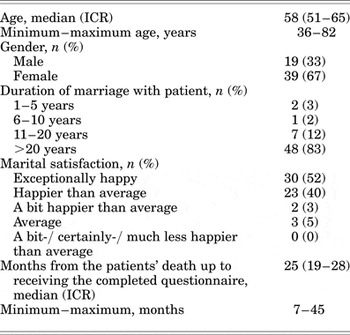
Of the 89 deceased patients who received experimental treatment between 2007 and 2009 in the Radboud University Medical Center, 12 lacked a partner and 3 partners were untraceable. Of the 74 deceased patients with a partner, 4 refused to participate in the study, 1 was not able to participate due to health problems, and 6 others refused without citing a clear reason. Finally, 63 partners (85%) were included, of whom 60 (81%) returned the questionnaires. Two partners returned the questionnaire without filling it out due to emotional difficulties brought on by the assessment process. Data from 58 (78%) partners were thus available for analysis. The characteristics of participating partners are given in Table 1.
Partners' characteristics (n = 58)

Partner's Experiences During Patient's Treatment
Participation in a Phase I Study
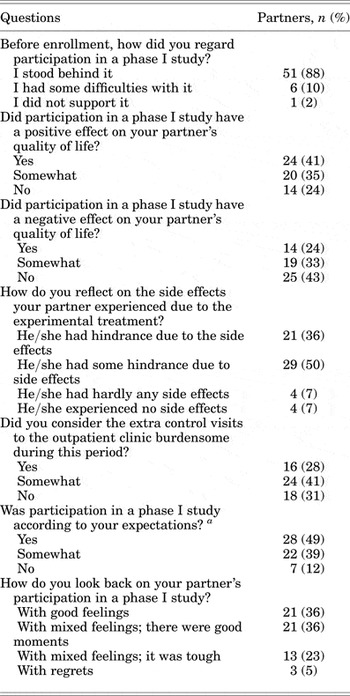
The specifics of partners' experiences during patient participation in a phase I study are shown in Table 2. Some 33% of partners reported “somewhat negative effects” and 24% “negative effects” on patients' quality of life due to phase I study participation. “Some hindrance” or “hindrance” to the patient due to side effects were reported by 50 and 36% of partners, respectively. Outpatient control visits were reported “somewhat burdensome” and “burdensome” in 41 and 28% of partners, respectively. In contrast, 88% of partners supported patient participation and 41% reported positive effects on patient quality of life. Though a substantial number of partners regarded patient participation with mixed feelings (59%), only 5% deemed such participation regrettable.
Experiences of patients' participation in a phase I study from the partner's point of view

a 1 missing value.
Patients' Terminal Phase
During the terminal phase (i.e., during the last weeks of life), 64% of patients were free from hospital admissions, whereas 26% of patients were admitted once and 10% more than once. Some 83% of patients died at home, 12% in the hospital, and 5% in a hospice. Satisfaction with the final farewell was reported by 76% of partners, while 17% regarded the farewell unsatisfactorily, and 7% were still not able to think about it.
Changes of Partners' Personal Situation
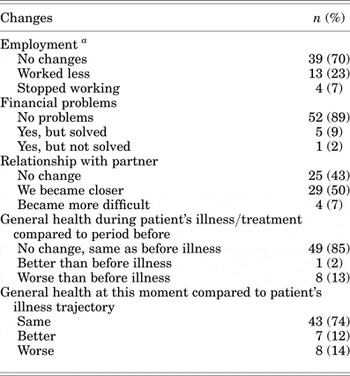
Table 3 shows the changes in partners' personal situations due to patient illness and treatment. Of the 58 participating partners, an important number reported no changes in their employment (70%), no financial problems (89%), and no changes in their general health (85% reported the same general health compared to before the patient's illness; 74% experienced no health changes during bereavement compared to the period of patient illness).
Changes in personal situation of the partner due to patient illness

a Two missing values.
Well-Being After Patient Death
Depression, Distress, and Complicated Grief
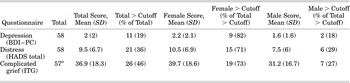
The scores for depression, distress, and complicated grief are presented in Table 4. The mean scores for the total sample on the questionnaires showed no abnormalities compared to cutoff points. On an individual level, 19% of partners scored for depression, 36% for psychological distress, and 46% for complicated grief. No significant differences for gender were found. The concomitant prevalence of complicated grief and depression was 29%.
Descriptors of validated questionnaires: Mean scores and caseness on depression (BDI–PC), distress (HADS), and complicated grief (ITG)

a One missing value (female partner).
Health-Related Quality of Life
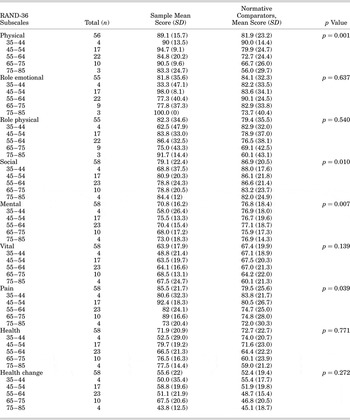
The data for health-related quality of life are given in Table 5. Three outcomes are outlined herein. The mean scores of partners in the age group 35–44 years were lower than their normative comparators on all RAND-36 subscales, except for “physical functioning.” The mean scores for the total sample showed that partners scored significantly higher on subscales “physical functioning” (p = 0.001) and “pain” (p = 0.039) compared to normative comparators. Partners scored significantly lower on subscales “social functioning” (p = 0.010) and “mental functioning” (p = 0.007). No significant differences for gender were found.
Mean scores for age groups and differences in sample mean scores compared to normative comparators

Personal Situation and Care After Patients' Death
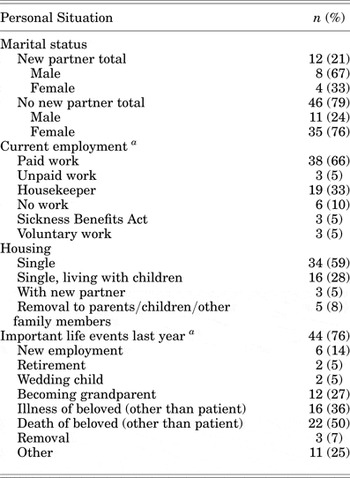
Professional help for grief was received by 31% of partners, of whom 50% scored for complicated grief. A general practitioner was most often consulted (56%), followed by a psychologist (22%), a vicar (22%), a welfare worker (17%) and/or specialized bereavement support (17%). Satisfaction with grief-related care was reported by 44% of partners, 44% was neutral, and 11% were not satisfied.
Table 6 presents partners' personal situation after a patient's death. Of the bereaved partners, 21% had a new relationship (men significantly more often than women; p < 0.01).
Partner's personal situation after patient's death

a More than one answer per partner possible.
DISCUSSION
To the best of our knowledge, this is the first study to report on partners' experiences of patients' participation in a phase I study. A substantial number of partners reported that participation went according to their expectations, and they did not regret the patient's participation, though they reported hindersome side effects, burdensome augmentation of visits to the outpatient clinic, and negative effects on patient quality of life. These findings may expand on the criticism of phase I study participation at the end of life in the literature (Agrawal & Emanuel, Reference Agrawal and Emanuel2003), and may also contribute to our ability to provide partners more information on what a patient's participation might imply for that partner, since experimental treatment has consequences for partners as well.
Depression, psychological distress, and complicated grief are frequently noted during bereavement (Stroebe et al., Reference Stroebe, Schut and Stroebe2007). Their prevalence in this sample was 19, 36, and 46%, respectively. The incidence of complicated grief reported in other studies in general populations is 2.4% in Japan, 3.7% in Germany, and 4.8% in the Netherlands, with a mean duration of bereavement of 13.3 years, 10 years, and 6.7 months, respectively (Fujisawa et al., Reference Fujisawa, Miyashita and Nakajima2010; Kersting et al., Reference Kersting, Brahler and Glaesmer2011; Newson et al., Reference Newson, Boelen and Hek2011). For the significant others of deceased patients who suffered from cancer, the prevalence of complicated grief ranges between 18 and 40% (Guldin et al., Reference Guldin, Vedsted and Zachariae2012; Allen et al., Reference Allen, Haley and Small2013; Chiu et al., Reference Chiu, Huang and Yin2010). In addition, the prevalence of complicated grief in bereaved individuals diminished over time in one study, with a decline from 40% at 6 months to 27% at 18 months (Guldin et al., Reference Guldin, Vedsted and Zachariae2012). A possible explanation for the relatively high incidence of complicated grief in our sample might be found in the combination of (1) the spousal relationship, (2) caring for the patient at the end of life (since most patients in this sample died at home), and (3) loss of another person in their inner circle, which was the case for 50% of our partners. These three factors have been identified as risk factors for complicated grief (Thomas et al., Reference Thomas, Hudson and Trauer2013; Chiu et al., Reference Chiu, Huang and Yin2010; Simon, Reference Simon2013). It can also be considered whether the reported high marital satisfaction contributed to more problems during bereavement.
Symptoms of complicated grief are closely related to symptoms of depression and psychological distress (Simon, Reference Simon2013). Their coincidence is frequently found, as is worsening of depressive symptoms due to complicated grief (Stroebe et al., Reference Stroebe, Schut and Stroebe2007; Simon, Reference Simon2013). In our sample, the prevalence of depression was 19% about 2 years after the patient's death, which is high comparable to another study with 11% moderate to severe depression within bereaved family cancer caregivers at 18 months following loss (Guldin et al., Reference Guldin, Vedsted and Zachariae2012). Though the compared studies for depression and complicated grief employed different measurement tools at different timepoints with different sample characteristics, our findings emphasize that the psychological problems of caregivers during a patient's treatment and during bereavement merit more attention. Moreover, according to the definition of the World Health Organization (WHO, 2010), palliative care includes support for family members and bereavement care. However, no consensus has been reached on the amount of support for the wide range of difficulties in a patient's terminal phase and during bereavement (Guldin et al., Reference Guldin, Vedsted and Zachariae2012). With regard to the number of partners with complicated grief receiving professional help after a patient's death, this was only 50% in our sample, and the help they received was scattered.
Our study can promote the consideration of depression, psychological distress, and complicated grief as three important aspects that need to be assessed in the partners of cancer patients with respect to participation in experimental treatment trials. Further research should focus on the extent to which experimental treatment can contribute to the severity of depression, psychological distress, and complicated grief experienced by partners.
On our questionnaire, a substantial number of partners reported stable general health during the patient's treatment and following their death. This was supported by a general health-related quality-of-life assessment. The mean scores for the total sample were significantly higher on physical functioning and pain when compared to normative comparators. This might be explained by having to confront the patient's physical limitations due to their illness and treatment. As a consequence they might value their physical functioning differently. Another explanation could be that partners of patients who participated in a phase I study were themselves in relatively good physical condition. One could expect that if a partner suffered from significant health problems, participation in a phase I study would not even be considered. It would be of added value to know if the partners suffered from comorbidities, something that was not assessed in our study. In contrast to the significantly higher scores for physical functioning, the significantly lower scores for social and mental functioning compared to normative comparators were remarkable. An association of these findings with the prevalence of depression and complicated grief in our sample could be an explanation, since these are associated with problems in social and mental functioning (Simon, Reference Simon2013; Stroebe et al., Reference Stroebe, Schut and Stroebe2007). Whether problems related to social functioning could be a trigger for development of complicated grief and/or depression or the other way around remains unclear as a consequence of our study design.
Also with regard to our study design, it is important to consider that there is a possibility for recall bias, which can be related to the theory of cognitive dissonance. When confronted with incongruent or contradictory ideas or actions, which result in extreme mental stress, people try to reduce these conflicts with their beliefs (Festinger, Reference Festinger1957). Patients had made a decision to participate in a phase I trial, and partners most often supported them. After the patient's death, in order to reduce this dissonance, partners perhaps answer according to their beliefs: so the patient made the right decision to participate.
Considering the amount of depression, psychological distress, and complicated grief among the partners in our sample, the 78% response rate is remarkable. It emphasizes partners’ willingness to help improve partner-related care during the patient’s experimental treatment. The restrictions on performing studies of this kind, where delicate topics are investigated in vulnerable individuals, is common, but not always necessary, as discussed in other work (Gysels et al., Reference Gysels, Evans and Higginson2012) and supported by our study regarding response rate.
In conclusion, most partners of patients who participated in a phase I study supported their participation and did not regret it, though a significant number reported negative consequences for the patient's quality of life at the end of life. It is unknown whether our findings regarding the high incidence of depression, psychological distress, and complicated grief about two years after the patient's death are related to the experimental treatment. This will require further study and may perhaps ultimately lead to the required guidance for partners of patients participating in phase I oncological trials.
ACKNOWLEDGMENTS
The authors would like to extend their sincere gratitude to the partners who participated in this study. The research was funded by the Radboud Institute for Oncology, and by the departments of Medical Oncology and Medical Psychology at the Radboud University Medical Center. The data were presented as a poster session at the European Cancer Congress 2013 on September 30, 2013, in Amsterdam. The abstracts were published in a supplement: European Journal of Cancer, 49(Suppl. 2), September 2013.
CONFLICT OF INTEREST
The authors state that they have no conflicts of interest to declare.