On 21 March 2012, in a context of general confusion, the International Monetary Fund (IMF) expert team on a mission to Mali were caught by soldiers at the hotel l'Amitié, located in downtown Bamako, in what turned out to be a military coup that toppled President Amadou Toumani Touré (hereafter ATT).Footnote 1 In the confusion of an overall improvised coup, the soldiers led by Captain Sanogo thought that these IMF staffers were North American spies and held them hostage for several hours until staff at the IMF headquarters in Washington, DC successfully convinced putschists to relieve their colleagues during a phone conversation. This anecdote dramatically illustrates the close articulation between aid and Malian politics, especially since the IMF was blamed by Malian finance experts to be increasingly ‘permissive’ regarding the government's budget arrears during the ATT era.Footnote 2
This article offers a political economy perspective on the Malian crisis with a focus on aid and donor practices, an aspect that has not been prominent in the current academic debate. It argues that donor resources and recommendations were an important factor responsible for the country's context of fragility. Given its long-standing aid dependence, Mali's crisis was also a crisis of extraverted development and of ‘donor-driven ownership’, i.e. the efforts made by aid agencies to build a State according to their conceptions of poverty reduction and efficient management (Bergamaschi Reference Bergamaschi and Whitfield2008).
The argument is two-fold. On the one hand, aid consolidated a regime that grew increasingly unpopular and discredited, so that aid and donors – voluntarily or otherwise – contributed to widening the gap between Mali's good international image and domestic grievances. On the other hand, this structural gap has created a state of affairs that provided some impulse, momentum and legitimacy to the two groups contesting the State's authority and constitutional order during the crisis, i.e. putschists and insurgent groups.
The article traces the direct and indirect processes through which aid became enmeshed with, and in turn influenced, Malian politics in the pre-crisis scenario. It explores four channels through which this happened in practice. External funders and aid agencies have sponsored what was perceived as ATT's ‘mismanagement’ of the situation in the north as well as the degradation of governance at the national level. These trends were later identified by the majority of citizens as key causes of the 2012 multi-dimensional crisis. In addition, donors exerted weak control over the national strategy that they were funding and ignored signals of growing dissatisfaction with ATT, partly because they treated Mali as a donor darling. Finally, when they tried to put pressure on successive governments, donors chose highly controversial issues and have enacted unpopular conditionalities, which have had destabilising effects.
The article draws on a doctoral thesis and extensive empirical material collected during six months of fieldwork (over 100 interviews with State, donor and civil society representatives), field and participant observations as an intern at the Poverty Reduction Strategy paper (PRSP) technical Unit in Bamako in 2007–2008. About forty semi-structured interviews were conducted after the March 2012 coup with Malian civil servants, United Nations (UN) staff, former development project managers in northern Mali, technical assistants and donor representatives. The interviews were carried out by phone, over Skype or in person in Paris, and during two two-week fieldwork trips to Bamako in June and September 2013.
The article is organised in five sections. The first section presents the article's contribution to the existing literature and to the ongoing debate about the Malian crisis. The second section explains how donors supported ATT's flawed strategy in the north. The third section argues that aid, especially in a context of shifting modalities, contributed to the degradation of governance countrywide. The fourth section shows how aid and donors perpetuated Mali's status as a democratic model and ‘donor darling’. The fifth section elaborates on three conditionalities promoted by donors which have worsened the regime's unpopularity.
A NEW LENS FOR ANALYSING THE MALIAN CRISIS: ASSESSING THE ROLE OF AID AND DONOR PRACTICES
The recent academic debate about Mali, summed up below, has identified several long-standing and structural causes accounting for Tuareg uprisings since Mali's independence in 1960 as well as the conjunctural factors that led to the crisis in 2012.
Tuareg irredentism finds its roots in the colonial policy of separating populations and that policy's legacy, grievances related to access to land and resources in an environmentally challenging area, feelings of marginalisation and exclusion, and fierce competition over trafficking and smuggling (cigarettes and, more recently, migrants and cocaine) between northern leaders and ‘Big Men’ (Muna Reference Muna2009; Marchal Reference Marchal2012; Bøås Reference Bøås and Utas2012; Grémont Reference Grémont, McDougall and Scheele2012; Olivier de Sardan Reference Olivier de Sardan2013). Roy (Reference Roy2013), an expert in political Islam, further described the recent process of Islamisation of the ancient Tuareg regionalist project, which led the Mouvement de Libération Nationale de l'Azawad (MNLA) to build alliances with Ansar-Dine, elements of Al-Qaeda in the Islamic Maghreb and the Movement for Oneness and Jihad in West Africa (MUJAO in French). Lacher (Reference Lacher2011, Reference Lacher2012) investigated the links between organised crime, conflict and terrorism in the Sahel.
Scholars have also highlighted that the crisis was spurred by unexpected and contingent circumstances, as many different crises converged in the spring of 2012. First, the fall of Colonel Gaddafi in Libya played a catalysing role. It accelerated the return to Mali of well-equipped and well-trained mercenaries (Marchal Reference Marchal2012; Larémont Reference Larémont2013) who joined smuggling activities and insurgent groups. This caused an escalation of the fighting, leading up to the army's defeat in several northern cities by late 2011. Second, if the March 2012 coup was directly linked to military demands concerning the army's difficult situation in the north, it was mostly unprepared and its plotters improvised considerably. These aspects, as well as the divisions in the national army, were described in great detail in the ‘live’ online contributions of Mann and Whitehouse.Footnote 3 Later, Gavelle et al. (Reference Gavelle, Siméant and Traoré2013) reported on the ‘short-term legitimacies’ and rumours that shaped the crisis's volatile dynamics and the popular support enjoyed by its main protagonists in Bamako at different points in time; and Whitehouse (Reference Whitehouse2012a) explained how Captain Sanogo legitimised the coup and became a ‘mythic hero’ for many Malians.
How the pre-coup political economy helped to create the ‘recent mess’ in Mali has largely been ignored by existing works. Soares (Reference Soares2012) noted the rise in cronyism, corruption and citizen discontent over the years of ATT's rule. However, the role of aid and ‘aid dependence’ (Lancaster & Wangwe Reference Lancaster and Wangwe2001) has not been explored sufficiently so far. Mali has been actively engaged in the implementation of the post-Washington consensus – the renovated version of structural adjustment promoted by International Financial Institutions (IFIs) since the end of the 1990s – and has been taking part in the Highly Indebted Poor Country (HIPC) initiative. External funds represented three-quarters of the State's special investment budget and 27·6% of its general budget between 1996 and 2005. Prior to the crisis, donors would take part in most formal decision-making processes in the country, to the point that a representative of the French Development agency interviewed in Bamako in 2008 said that donors and the government ‘chewed and digested’ every public policy together.
This blind spot in the literature is undeniably the result of the crisis's mainly domestic roots (Wing Reference Wing2013), but is also the result of the structure of the academic sub-field of Malian studies, which has traditionally been dominated by historians, anthropologists and ethnologists. With notable exceptions (Schulz Reference Schulz2001, Reference Schulz2012; Magassa Reference Magassa, Gohy and Sané2002, Reference Magassa2010; Diakon Reference Diakon2006; Rodet Reference Rodet2009; Rillon Reference Rillon2010; Whitehouse Reference Whitehouse2012b), most research has primarily dealt with social hierarchies, identities, cultural and religious actors and practices (Bouhlel-Hardy Reference Bouhlel-Hardy2013; Leininger Reference Leininger and Leininger2013), often with a focus on Tuareg populations and/or Mali's northern regions (Olivier de Sardan Reference Olivier de Sardan1984, Reference Olivier de Sardan2013; Boilley Reference Boilley1999; Doquet Reference Doquet1999, Reference Doquet2002; Touré Reference Touré and Pordié2005; Amselle Reference Amselle, Fay, Koné and Quiminal2006; Hamès Reference Hamès2007; Colleyn Reference Colleyn2009, Reference Colleyn2010; Holder Reference Holder and Holder2009; Lecocq Reference Lecocq2010; Hall Reference Hall2011; Klute Reference Klute and Casajus2011; Pelckmans Reference Pelckmans2011; Grémont Reference Grémont, McDougall and Scheele2012). Mande studies have a special interest in the country's various Mande or Mande-speaking peoples, their culture and music, while the Dogon people has long been exoticised (Soares Reference Soares2012).
Economists (Guillaumont et al. 2000; Dante et al. Reference Dante, Gautier, Marouani, Raffinot, Cling, Razafrindakoto and Roubaud2002; Pesche & Nubukpo Reference Pesche and Nubukpo2004; Nubukpo Reference Nubukpo2006; Nubukpo & Keïta Reference Nubukpo and Keïta2006; Raffinot Reference Raffinot2010) and policy analysts have also looked into the country's development strategies and their multiple failures (Diarrah Reference Diarrah1990; Couloubaly Reference Couloubaly2004). Only activists (Traoré Reference Traoré1999) have pointed to the responsibility of international creditors. Serra (Reference Serra2012) has touched upon the issue in a comparative study that looks primarily at domestic actors and dynamics of West African cotton sectors. Sociologists and political scientists have focused, on the one hand, on Mali's institutions, political elite, Parliament (Van Vliet Reference Van Vliet2014), constitutional courts (Heyl & Stroh Reference Heyl and Stroh2013) and decentralisation process in the democratisation era (Berrubé Reference Berrubé1995; Seely Reference Seely2001; Thiriot Reference Thiriot, Thiriot, Marty and Nadal2005, Reference Thiriot2008; Baudais & Chauzal Reference Baudais and Chauzal2006; Wing Reference Wing2010; Bleck & van de Walle Reference Bleck and van de Walle2011; Diawara Reference Diawara2012). On the other hand, a body of literature has looked into Mali's civil society, such as religious actors and leaders, urban and alter-globalist social movements or the promotion of causes related to health and gender (Broqua Reference Broqua2007, Reference Broqua2009, Reference Broqua2010; Roy 2010a, b; Castro Reference Castro, Fassin and Eideliman2012, Reference Castro, Broqua, Deschamps and Krausforthcoming; Villalón Reference Villalón, Lust and Ndegwa2012; Touré Reference Touré2013).Footnote 4 Recent works have also investigated Malian migrants (Rodet Reference Rodet2009), diasporas and their contributions to development (through remittances) and democracy (Daum Reference Daum1998; Gubert et al. Reference Gubert, Lassourd and Mesplé-Somps2010; Pelckmans Reference Pelckmans2013; Chauzet & Mercier Reference Chauzet and Mercier2014).
For a long time, Mali has not been a country of interest for the field of International Relations. Only recently has the securitisation of the Sahel and Mali drawn attention, primarily through the lens of the foreign policies of the European Union or the USA (see, for example, Lecocq & Schrijver Reference Lecocq and Schrijver2007 or, more recently, Begusch Reference Begusch2013). Other research has underlined the contribution of regional actors in mediation and peace negotiations; the regional consequences of the Malian crisis (Gazibo Reference Gazibo2013; Joffe Reference Joffe2013; Maoundonodji Reference Maoundonodji2013; Marchal Reference Marchal2013; Porter Reference Porter2013; Scheele Reference Scheele2013; de Wall Reference de Wall2013; Zekeria Ould Reference Zekeria Ould2013); or the possible implications of the labels (‘ungoverned spaces’, ‘war on terror’) applied by external actors to the management of the Malian crisis after the coup (Abrahamsen Reference Abrahamsen2013; Ammour Reference Ammour2013; Chasdi Reference Chasdi2013; Dowd & Raleigh Reference Dowd and Raleigh2013; Guichaoua Reference Guichaoua2013a, Reference Guichaouab).
As a consequence, most scholarly insights appear to work under the assumption that non-domestic factors have impacted Mali only by means of illegal activities in the Sahel or through the expansion of the Libyan conflict. Also, one is left with the impression that international intervention in Mali started with France's Opération Serval, launched in early January 2013. From that perspective, international intervention is defined as necessarily violent or military, and posterior to the failure of the State and the national pact. This article looks at non-military international action – specifically, aid and donor practices prior to 2012 – and their specific contribution to the context of fragility.
The qualitative and monographic study of the inner workings of aid presented in this article indicates that aid and donor practices were one of the factors accounting for the context in which the crisis started and flourished. It links up the politics and effects of aid with the structural and immediate causes of the crisis, as identified in the literature mentioned above; and it seeks to contribute to the ‘multi-vocal analysis’ needed to understand Mali's complex crisis (Lecocq et al. Reference Lecocq, Mann, Whitehouse, Badi, Pelckmans, Belalimat, Hall and Lacher2013: 2). The analysis is contextual, which means that establishing a general theory about aid and political (in)stability applicable to all sub-Saharan African countries where levels of aid dependence are comparable to Mali's is beyond the scope of this paper.
The article's analytical framework is inspired by previous attempts to investigate how aid's globalised and ‘depoliticised mode of technocratic governance’ re-moulds ‘the way politics is played out’ in developing countries (Gould & Ojanan Reference Gould and Ojanan2003: 7; Gould Reference Gould2005). It also draws on invitations to consider aid partners as fully ‘part of a political process in which the issues of development and politics are closely interwoven’ (Hyden Reference Hyden2008: 267–8) and as part of African states themselves (Bergamaschi Reference Bergamaschi2011a).Footnote 5
Academic works dealing with the political impacts of aid have focused on the relationship between aid and regime change (or the lack thereof). Some authors have analysed how international resources and recommendations are adapted or instrumentalised by authoritarian regimes so as to consolidate, reproduce and diffuse their power. For instance, Vallée (Reference Vallée2010) has shown how Cameroon's President Paul Biya has used the international anti-corruption agenda as a political tool to silence opposition. In a similar vein, Hibou (Reference Hibou2005, Reference Hibou2006), Allal (Reference Allal2007) and Elbaz (Reference Elbaz2009) have analysed economic tools and policies as instruments of control and repression serving the survival and extension of President Ben Ali's regime in Tunisia, and have shown how his regime was able to domesticate aid recommendations and resources for its own purposes.
Another strand of the academic debate scrutinises the relationships between aid and democratic transition on the continent. Rita Abrahamsen argues that the good governance agenda promoted by donors since the 1990s has failed to produce or sustain stable multi-party democracies in Africa. The liberal project of democracy is intimately linked to the promotion of neoliberal policies and the retreat of the State. It focuses on political rights more than on socio-economic ones, and on the demands of external donors and creditors rather than on the aspirations of the majority of poor citizens. As such, democracy has been limited to formal, electoral aspects and has become ‘exclusionary’ (Abrahamsen Reference Abrahamsen2000).
Resnick and van de Walle tackle similar issues in a comparative book dealing with aid and democratisation in Africa. In the chapter on Mali, van de Walle concludes that ‘the large volume of aid to the country did not alleviate key problems that undermined Malian democracy … It did not prevent and in some cases actually exacerbated the failure of democratic consolidation, which contributed to the current debacle’ (van de Walle Reference van de Walle, Resnick and van de Walle2013: 90, 96, 98).
This article's objective and approach differ from that author's in several ways. The book focuses primarily on the impact of ‘democracy assistance’, i.e. explicit donor efforts to support democratic activities and institutions. In contrast, the research presented here analyses the totality of development assistance and assesses its ambiguous effects on politics and the reproduction of power without any reference to a pre-defined political state or regime (democratic or otherwise). However, this article's conclusions are not incompatible with those of Resnick & van de Walle's book, especially insofar as they underline that aid may be better at fostering and accompanying democratic transition than at sustaining its consolidation (Dietrich and Wright in Resnich & van de Walle Reference D. and van de Walle2013: 17). This article, then, describes the weaknesses of Mali's democratic consolidation in a context of extraversion (Bayart Reference Bayart1999) and intense partnership with, and close supervision by, foreign donors.
HOW DONORS HAVE SUPPORTED ATT'S FLAWED STRATEGY IN THE NORTH: AID AND ‘BIG MEN’
Donors have – voluntarily or not – sponsored ATT's conflict management strategy, which mixed imperfect decentralisation, laissez-faire, co-optation and, significantly after 2010, militarisation.
To the credit of donors, aid has sustained the decentralisation policy that the government was reluctant to finance. This had the potential to make a useful contribution to peace since greater autonomy has been part of the demands of northern leaders for decades and was seen by the central government as a tool to ‘co-opt the Tuareg threat’ after a new rebellion in 1991 (Seely Reference Seely2001). But the massive involvement of donors in the sector meant that local administrations and projects often had to align with those of donors – especially the European Commission – in terms of their priorities, conceptions of decentralisation and procedures. Launched with considerable endogenous political momentum in the early 1990s, decentralisation progressively became a donor-driven, technocratic issue. Procedural constraints prevented the timely and actual disbursement of aid funds.Footnote 6
Measuring the amount of aid directed to the north since the democratic transition is not easy (Possémé-Rageau Reference Possémé-Rageau2014: 32). The IMF, the World Bank and the European Union asked that certain budget lines and expenses be specifically targeted towards the north, but stopped doing so in 1997. Some national poverty surveys and analyses by donors furthermore showed that northern populations had higher incomes than in the cotton-producing areas of Sikasso (Raffinot Reference Raffinot2014: 34). According to government data, more than three hundred development programmes were implemented and about € 1 billion was spent in the north in the past twenty years. However, their outcomes were hampered by insecurity, mismanagement, the insufficient presence of the State and the lack of a coherent development vision and planning. It is believed that the regions of Timbuctu, Kidal and Mopti received most of the financial envelopes provided by the national agency for the investment in local governments (ANICT), but the local governments did not have the capacity to absorb and disburse all the funds or supervise projects (Possémé-Rageau Reference Possémé-Rageau2014: 32–3).
In the 2000s, traditional aid donors have been less active and present in the northern area. Due to increasing tensions between the government and Tuareg armed groups, narco-trafficking and the kidnapping of Westerners, aid agencies evacuated their staff, suspended many of their projects or supervised them from Bamako. For reasons of security, cost-effectivenessFootnote 7 or ‘institutional cowardice’ (the European Commission), new roads could not be built or restored, although they would have been instrumental in better connecting the north to the rest of the country.Footnote 8 NGOs, churches, associations or decentralised cooperation between regions or cities run several projects in northern Mali, often with limited means and little planning.Footnote 9
People who worked in development cooperation in northern Mali for years disagree that money was lacking in that region. Instead they counter that it has been poorly used and instrumentalised in local and national politics.Footnote 10 Since the Sahelian drought in the early 1970s, the central government systematically filtered and limited the allocation of aid to the north. More recently, ATT had established networks of influence and clientelism with certain local leaders. In the local communes, the selection of projects, partners or executing agencies was subject to fraudulent arrangements between public entities and private firms at the expense of recipient populations. Women, young activists or social groups less skilled in development discourse and in the art of political connections were not able to obtain funding for their projects.Footnote 11
As donors left the north, the filtering and selection of aid exercised by the capital became easier. The Agence de Développement du Nord-Mali, a parastatal created in Bamako in 2005, did nothing more than serve the central government's ‘clientelist co-optation of segments of northern elites’ (Management Systems International 2009, also quoted in van de Walle Reference van de Walle, Resnick and van de Walle2013). Likewise, the president's Programme special pour la paix, la sécurité et le développement dans le Nord-Mali fed into these networks. It was backed by donors, mainly the European Union as part of its ‘strategy for the Sahel’ which combined development and security objectives. By the end of ATT's rule, the construction of schools and community health centres was systematically associated with increased policy and military presence. This trend fomented feelings of militarisation and securitisation of the area amongst northern populations at the expense of development and social services and eventually nurtured tensions with and grievances against the State.Footnote 12
Aid has fed into the mafia-like governance of the north, which has rested on ‘loose networks of patronage and personal alliances’ (International Crisis Group 2012). Malians and Niger's authorities accused ATT of letting armed leaders prosper and govern in the country's Sahelian regions. They also blamed him for having ‘a deal with AQIM’ to facilitate the liberation of foreign hostages (donor countries, especially France and Spain, would pay a ransom) and ultimately for not negotiating previous disarmament and/or political agreements with soldiers returning from Libya.Footnote 13
Finally, the Malian crisis followed ten years of US counterterrorism programmes, on account of which Mali has received millions of dollars, military training and equipment (Pincus Reference Pincus2013). The inability of the Malian army to resist insurgent attacks between 2011 and 2013 has shed some doubt about the programme's efficiency. So has the fact that Captain Sanogo had participated in US-provided military training. And the corruption of high-ranking generals was a central grievance of putschists and their supporters in low or intermediary military ranks.
ATT's strategy failed at buying social peace. Instead, it has caused frustration among the population and tensions with the central government, and aggravated rivalries between northern ‘Big Men’ (Bøås Reference Bøås and Utas2012). In retrospect, the march of mothers and wives of soldiers who walked to the presidential palace to demand additional support for the troops on 2 February 2012 appeared as the culmination of this flawed strategy and an early forewarning of the coup.
HOW BUDGET SUPPORT HAS FED INTO CONSENSUS AND DEGRADING GOVERNANCE COUNTRYWIDE
Aid delivered through new modalities, especially budget support, also served to consolidate the politics of consensus and degrading governance that characterised ATT's regime, and it fed into popular discontent with the ‘system’ and the political class as a whole.
According to the typology drawn by Thomson (Reference Thomson2004: 134), the 2012 coup was a ‘guardian coup’ aimed at rescuing the State from civilian mismanagement. Captain Sanogo claimed that the military took action in order to ‘save what was left of the Republic’. Although unprepared, the coup reflected deep and widespread non-conformity with ATT's regime.
Democratisation has undeniably generated an improvement of socio-economic conditions. Thanks to both governmental and aid programmes, the rate of absolute poverty decreased from 72·8% in 1989 to 64·4% in 2006 countrywide, even if progress was uneven: rates decreased spectacularly to reach 31·8% in urban areas, but remained high and stable (from 80·6 to 79·05%) in rural areas over the period.Footnote 14
Citizen disappointment was caused by the way the State and public affairs were handled. Democratisation is perceived to have gone hand in hand with what Bayart, Hibou and Ellis (1999) called the criminalisation of the State. Under Alpha Oumar Konaré, the country was shaken by social movements, economic difficulties, political instability, rumours of electoral fraud, an election boycott and corruption amongst the ruling party ADEMA (Alliance pour la Démocratie au Mali) (Diarrah Reference Diarrah1990; Berrubé Reference Berrubé1995; Couloubaly Reference Couloubaly2004; Doumbi-Fakoly 2004). Later, with ATT in power, governments were accused of distributing huge parcels of fertile land near the Office du Niger (an irrigated agricultural area near Ségou in south-central Mali) to international firms. Corruption scandals came to light about the Global Fund to Fight AIDS, Tuberculosis and Malaria. After a Boeing 727 carrying six tons of cocaine coming from Latin America landed near Gao in November 2009, the president and his ‘clan’ were suspected by US authorities and the national press of having connections with and protecting drug traffickers (Semega Reference Semega2009).
ATT's politics of ‘consensus’, an apolitical coalition of all political parties and some civil society representatives, is partly responsible for those scandals. Created by ATT in 2002, it stemmed both from a political strategy and particular circumstances.Footnote 15 In 2001, ADEMA was divided and could not find a candidate. General ATT had played a key role in the fall of military dictator Moussa Traoré in 1991. He then retreated from the political game and gave power back to civilians. A few years later, he left the army and ran as an independent, non-party candidate. He was elected president in 2002, in the midst of accusations of electoral fraud and opaque political deals. Deprived of a majority in Parliament, he set up a coalition of all parties and civil society representatives that was accepted by political parties because it met their needs: for small parties, it helped them avoid being excluded from policy-making and, in the case of ADEMA, it gave it some time to prepare for the next presidential election (Baudais & Chauzal Reference Baudais and Chauzal2006).
The resulting consensual political system was weakly structured from an ideological point of view. It was not based on a common vision or project but on a fragile compromise between contradictory political forces whose only common goal was to share power (Diawara Reference Diawara2012). A few years down the line, it became apparent that the political consensus had hindered efficient decision-making and annihilated the political opposition. Most candidates running for president in the elections that were scheduled for April 2012 had worked in ATT's governments, thus offering little chance for real turnover.
Retrospectively, consensus is widely suspected to have fostered corruption because it required constant redistribution (of positions and resources) amongst members of a fragile coalition. In 2011, Mali's Vérificateur général found that CFA francs 10 billion were not reported in public accounting systems or were simply ‘missing’. Popular satisfaction with the way democracy works in Mali has decreased since 2001 (Afrobarometer 2013). Since the coup, critical accounts of consensus have grown in the Malian press and everyday conversations; and political parties are deemed opportunistic and deeply discredited by their constituency.
Aid has fuelled consensual politics, especially when it was delivered through budget support, i.e. directly through the National Budget. It provided the financial resources that made consensus and its unstable alliances sustainable, in a context ‘where political parties treated ministries as their properties’ (Magassa & Meyer Reference Magassa and Meyer2008: 15). Evidence from the field shows that despite their sophisticated monitoring systems, donors had little control over the uses of budget support. Furthermore, anti-corruption measures have not sufficed to guarantee transparency and efficiency in public spending.
In the past decade, budget support was promoted internationally to limit the number of projects, enhance government ‘ownership’ of the national poverty reduction strategy and align donor interventions on recipient policies and procedures. In Mali, this aid modality rose from 12 to 42% of total aid between 1999 and 2009, hence accounting for almost one-quarter of Mali's public expenses (ECO Consult, AGEG, APRI, Euronet, IRAM & NCG 2011).
Because they go into the national budget and are fungible by definition, ‘it is not easy to relate budget support funds with concrete public expenses, actions or outcomes’, said an agent of the Malian Treasury in an interview in 2007. For Elisabeth Paul, former technical assistant at the Ministry of Health in Mali and expert in budget support, ‘it is very difficult to figure out how the money is used in practice’ because the documents listing public expenses produced by the Malian State (the Finance Law, the government's financial operations table) are either too detailed or too vague.Footnote 16
In the context of budget support provision, donors and the government elaborated a matrix for joint assessment in 2007, which has been updated many times since. The matrix is a list of indicators aimed at monitoring the implementation of the Poverty Reduction Strategy Papers.Footnote 17 But the matrix has faced many obstacles.
First, since the PRSP has not carried over into the State's annual budget, it does not really guide or direct public expenses and actions (République du Mali/Cellule Technique CSLP 2007), which has made discussions about its implementation largely irrelevant and meaningless. Second, the matrix has been described as ‘an unlikely patchwork of stupid indicators … of exogenous, fake and heterogeneous things’,Footnote 18 ‘a bureaucratic invention … a heavy system established on a bad and weak basis: Mali's statistics’,Footnote 19 which are ‘not always coherent and harmonised’ (République du Mali/Cellule Technique CSLP 2007: 3). According to sectoral experts, the indicators included in the matrix are ‘false, stupid, or both’, ‘hastily-done’Footnote 20 or ‘Kafkaesque’, and some targets are ‘impossible to meet’ (Lohle-Tart Reference Lohle-Tart2005: 21–4). Third, according to Boris Samuel and the representative of a bilateral cooperation agency, donors have never had a common interpretation of the matrix but rather continued to apply the specific criterion selected by their headquarters to make decisions regarding the disbursement of funds.Footnote 21 Finally, donor representatives have not always had the time, experience and necessary technical skills to monitor budget support.Footnote 22 Malian civil servants and technicians were ‘always better prepared and better armed’ in the discussions and evaluations, to such an extent that the technicians of ‘the Budget [Malian Ministry of Economy and Finance] keep control and donors floundered’.Footnote 23 As a result, the matrix has never permitted an accurate assessment of PRSP implementation; and donor reactions in cases of non-compliance have been fragmented, thus reducing their power of sanction. Budget support monitoring by donors grew increasingly lax and lenient (Raffinot Reference Raffinot2014: 34).
On the other hand, donors such as the Netherlands, the European Union or Canada have tried to improve the efficiency and transparency of public spending in order to mitigate the financial risks related to budget support. The most significant and visible anti-corruption measure consisted of the creation of the Vérificateur général (known as the ‘Végal’ in Mali) in 2003. The story goes that ATT himself made this decision after a visit to Canada and despite the fact that the French model of Cour des Comptes prevails in all ex-French colonies in West Africa. This was interpreted by donors as a strong indication of Malian authorities' ‘political will’.Footnote 24
The Végal's missions include the revision of finance, performance and adequacy of public spending. The structure enjoys some ‘functional autonomy’.Footnote 25 It is not attached to a ministry or to any other institution and has leverage in the choice and definition of its objects of enquiry. The Végal is appointed for seven years and cannot be removed. His budget is guaranteed by the Malian State (90–95% of funds) and continued Canadian support. The office's capacities have increased with time, and many vérificateurs are well-qualified economists, finance experts and lawyers. Their salaries are higher than in the normal administration and they follow strict ethical rules so as to ensure their independence and integrity.Footnote 26
The Végal produced several detailed reports published on the internet, in the Journal Officiel, sent to the National Assembly and translated into Malian languages. They have been widely disseminated in the national press and among the population. Several directors of Financial Affairs (Directeur des Affaires financières, or DAF) in Ministries have been accused of bribery, arrested and tried. For instance, the Ministry of Health was sacked after he was convicted of fund embezzlement in 2010. The fact that the Minister of Transport and Equipments, Ahmed Diane Sémega, was reported to have spent CFA francs 10 million in one day for ‘the purchase of tea bags’ deeply shocked public opinion.
However, the Végal's office has faced two challenges. While in Canada the Parliament questions the government about the Végal's conclusions, in Mali the Végal is directly accountable to the President, with whom he meets personally before publishing his report. This is due to the National Assembly's perceived weaknesses (many members of Parliament cannot read or write and are unable to engage in discussions about law projects or the national Budget)Footnote 27 and the influence of the executive throughout the different branches of power. This institutional adaptation has limited the Végal's real independence and room for manoeuvre as the President ‘keeps him under control’.Footnote 28
The other important challenge involved tying the Végal's conclusions to the justice system, i.e. systematically taking cases to court. The government was perceived as ‘dragging its feet’,Footnote 29 and the fight against corruption remained ‘the line of State reform that had advanced the least in practice’.Footnote 30 In 2009, the representative of a bilateral donor agency reported in an interview that some aid workers had tried to deter the Végal staff from publishing in their final report all the data and cases they had found.Footnote 31 This was because it would draw criticisms about the use of aid funds, create turmoil domestically and make it more difficult for agencies at the country level to justify further disbursements and obtain future credits during discussions and negotiations with their headquarters.
The Végal's role has been largely publicised in the media.Footnote 32 By making empirical data available about corrupt practices, it has increased citizen awareness and generated public debate. But in the absence of sufficient and timely sanctions for misdeeds, perceptions that impunity was rife have risen. Misunderstanding and frustration reached a climax in 2010 when the President declared, in reference to cases of allegedly corrupt ministers, that ‘one should not humiliate good fathers [‘les bons pères de famille’] and accuse them without proof’.
HOW DONORS HAVE PERPETUATED A FICTION DISCONNECTED FROM POPULAR GRIEVANCES: THE DONOR DARLING
To understand why donors did not react earlier in the face of degrading governance, it is important to remember that, until Sanogo's coup, Mali was long considered a model of democracy and treated as a donor darling by the international community. It follows that donors have perpetrated a myth and fiction that contradicted popular feelings about ATT's regime.
Mali's special status can be traced to several factors. After 2002, the international community praised and cherished Mali's ‘remarkable political mutation’ (UNDP 2003) and its president ATT, known as the ‘soldier of democracy’. Amongst foreign politicians, aid workers and diplomats, consensual politics was also valued as a peaceful mode of political regulation and a prerequisite for government ownership and leadership in carrying out reforms. At that time, the Malian government was eligible to get access to debt relief operations (the Highly Indebted Poor Countries initiative) despite the fact that it was satisfactorily reimbursing all its debt (Raffinot Reference Raffinot2014: 34). The social ‘culture of consensus’ and joking relationships, e.g. a set of institutionalised jokes and obligations between particular groups common in West Africa (Canut & Smith Reference Canut and Smith2006) was believed to guarantee peace between Mali's different communities. Despite its persistently low levels of electoral participation (from 23% to 43% between 1992 and 2007), Mali provided stability in an otherwise chaotic or politically gridlocked region (civil war in Côte d'Ivoire, failed democratic transition in Togo, authoritarian rule in Burkina Faso, repeated coups in Guinea and Mauritania).
The country remained amongst the world's poorest countries but had stable – although degrading – governance features. According to the World Bank Country Policy and Institutional Assessment, Mali ranked number 10 out of 38 sub-Saharan countries in 2011. The Bank's ‘doing business’ indicator outlined that it was overall relevant for firms to invest and work in Mali, although less so in the later years (Raffinot Reference Raffinot2014: 34). According to Transparency International's corruption index, Mali's ranking under ATT dropped from 102 to 118 out of 174 countries.
Geopolitical factors have also played an important role since ATT became an important partner for US authorities in the midst of their ‘war on terror’ in the Sahel. In addition, Mali was an active participant and a test case for the implementation of the Paris agenda for aid efficiency launched by the Organisation for Economic Co-operation and Development.Footnote 33 For all these reasons, donors have marketed Mali as a ‘good pupil’ (Quaregna Reference Quaregna2006). From 2006 to 2012, the country benefited from a US$ 460 million compact investment as part of the Millenium Challenge Account, a political initiative launched by US authorities whose beneficiaries are subjected to a competitive selection based on indicators of policy performance.Footnote 34
Mali was greatly admired in donors' informal rankings of recipient countries. Its civil servants were deemed more honest, open to dialogue and committed to poverty reduction than in Cameroon, Senegal or Tunisia, for example.Footnote 35 For expatriates, it was easy to settle and pleasant to live in Mali. Tourism in the Dogon country was experienced as authentically African (Johanna Siméant in Bourmeau Reference Bourmeau2013). Malians in general have a tradition of welcoming foreigners as kindly as they would like to be received abroad, and are good at allowing strangers into their social circles.
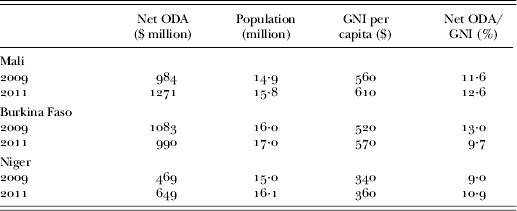
Mali's special status has been reflected in the fact that aid has represented a larger share of the Gross National Income (GNI) than its poorer neighbours Niger and Burkina Faso between 2009 and 2011 (see Table I).
A comparative analysis of aid volumes in Mali, Burkina Faso and Niger (2009–2011)

Source: OECD-DAC, World Bank: www.oecd.org/dac/stats.
Over decades of aid dependence, Malian authorities have developed agency in their relations with donors and succeeded in managing and benefiting from their international image.Footnote 36 They have developed an appealing aid negotiation style, consisting of sending donors appropriate signals of adhesion and commitment while avoiding direct conflict or explicit disagreement. Leeway and leverage were achieved not during initial negotiations but during the implementation phase (Bergamaschi Reference Bergamaschi2011a: 350–1). Representatives of an embassy interviewed in Bamako in 2007 and staff of a development bank interviewed in 2009 said that ‘Malians are the champions of saying yes and then doing nothing’. In 2008, a French technical assistant compared Mali to a duvet, stating that ‘when donors hit them, they change form and adapt’. This strategy stands in sharp contrast with Rwanda's under President Kagame, which consists of developing a truly owned government development plan and of compelling donors to align their interventions and projects to it. Rwanda's posture was described as ‘assertive’ in a comparative study of African strategies to ‘deal with donors’ in the 2000s (Whitfield 2008) whereas Mali's was deemed ‘compliant’ with donors and weak in aid negotiations (Bergamaschi Reference Bergamaschi and Whitfield2008). Malian authorities did not reject the Post-Washington consensus, but they did not adhere to it fully either.
A process of fusion and co-production of public policies was established through daily meetings and exchanges, or through the presence of foreign technical assistants in strategic ministries (Bergamaschi Reference Bergamaschi2011a). When they tried to engage with non-government actors, funders chose to support primarily an urban, donor-oriented, professional civil society not that different from the government (Cissoko & Touré Reference Cissoko and Touré2005). Because of their proximity and entanglement with the State, Bamako-based agencies lost sight of the country's grassroots realities and regional dynamics, and they failed or refused to decode the warning signs of the regime's collapse.
Mali's successive governments have obtained multiple arrangements when aid objectives were not met. Progress – or lack thereof – was often interpreted quite flexibly. For instance, in 2007, the European delegation changed their indicator of progress in the decentralisation sector in order to reach the original target, thus allowing them to disburse additional aid funds. This led one NGO representative to state that ‘donors and the Malian government all make the most of this system of indicators’.Footnote 37 In theory, aid funds are cut when targets are not met or when conditionalities are not respected. In practice, sanctions were exceptional and the disbursement of aid funds practically automatic.Footnote 38
In other cases, donors are suspected to have been involved in explicit cases of corruption. Danièle Rousselier, writer and cultural attaché at the French embassy in Mali between 2007 and 2009, recently wrote in a newspaper article that the French embassy's cultural services granted the mayor of a northern city an envelope containing € 30,000 for the renovation of a mosque despite obvious risks of corruption (Rousselier Reference Rousselier2013). In the same vein, the Millennium Challenge Account was supervised by members of the Mouvement Citoyen, a coalition favourable and close to President ATT, and has faced issues of implementation and fund mismanagement, especially concerning the renovation of Bamako's airport. The coup in March 2012 – and the democratic breakdown it represented – is believed to have provided a timely and convenient opportunity for the US authorities to stop the programme without doing the due final audit of its achievements. Why were donors ready to conceal such failings in aid money spending or programme implementation?
Answering this question requires understanding foreigners' perceptions about Malian politics and the impact of aid and the incentives at play in donor agencies. Dominant donor perceptions and incentives can be roughly classified in five categories. In the case reported by Rousselier, her superiors considered that ‘this is how things work in Mali’, thus displaying a rather blasé and culturalist vision of national politics. Other aid workers opt for a pragmatic posture aimed, according to them, at serving a superior goal. While reflecting upon the recent turn of events in Mali, one staff member of an embassy of a European country interviewed in 2013 considered that Mali's national systems and procedures were by no means perfect, but that the duty of aid and donors was precisely to reinforce them. Such reinforcement implies bringing continued support for the existing structures of public administration and building coalitions with like-minded, professional, honest and committed civil servants in ministries. In other cases, past aid dependence is seen as justifying continued aid disbursements. A representative of the IMF interviewed in Bamako in 2007 explained that the IMF was well aware about the State's financial and budgetary problems but considered that ‘if we stopped helping Mali for a while, the cost for the international community will be higher in the middle-term, because we will have to start again in a couple of years, and start from zero’. An agent of a bilateral development agency interviewed in June 2013 exemplified yet another position, which builds on a trust in aid's monitoring systems and tends to brush politics aside: ‘we knew that ATT's political system was based on co-optation. But Mali's socio-economic indicators were not bad and even improving’. Finally, the pressure exerted from headquarters to disburse aid funds and show success was also a powerful disincentive against criticism or sanctions against the recipient government (Bergamaschi Reference Bergamaschi2010). In 2007–2008, one member of the European Commission's delegation declared in an interview that they were ‘flexible with indicators because disbursing is so important’. The interviewee was concerned about the way European budget support was delivered, used and monitored, but did not voice her concern within the institution because this was not what higher-rank officials expected.
The permanent arrangements established by donors to protect their ‘partnership’ with governments and administrations grew increasingly out of touch with popular perceptions about ATT's regime. While donors hoped that political consensus would facilitate economic reforms, Malian citizens doubted the President's commitment to solving their problems, especially during his second term (2007–2012). His ‘weakness’ was frequently highlighted in the press and everyday discussions. For example, in his speech at the International Women's Day in 2007, he said: Bè bi ba bolo. This is a Bambara expression which means that a child's destiny depends on his or her mother's moral uprightness. This offended the women at the ceremony by implying that individuals should take responsibility for their own lives without relying on the State's help.Footnote 39 Bloggers (Les Échos 2008) criticised the President's record and indifference (Bergamaschi Reference Bergamaschi2011b).
These feelings rose to such an extent that in March 2012, when a modest number of disaffected soldiers marched from their barracks in Kati into the highest seats of State power on Koulouba hill in Bamako, political power appeared ‘naked’ (Gavelle et al. Reference Gavelle, Siméant and Traoré2013: 24). Nobody was willing to ‘either negotiate or fight’ for an increasingly ‘isolated and ill-advised’ President.Footnote 40
Despite signals of degrading governance and growing dissatisfaction with the regime, donors lacked the interest, evaluation tools or institutional incentives to challenge Mali's status as a democratic model and as aid's good pupil. Control over the overall national poverty reduction strategy was loose and interpretation of its progress flexible. Nevertheless, when it came to certain topics that they deemed essential, donors pressured the government to encourage policy reform, and they adopted a much more rigid approach, including the implementation of conditionalities which have had some destabilising effects.
THE DESTABILISING EFFECTS OF AID
The three strongest conditionalities donors have attached to their aid in the past decade have focused on Mali's most ‘contentious issues’, i.e. topics that are meaningful to the population but overlooked or left unaddressed by the political parties, both those in power and in the opposition (Bleck & van de Walle Reference Bleck and van de Walle2011).
First, after 2000, the World Bank pressured the government to privatise the Compagnie Malienne de Développement des Textiles (CMDT), the parastatal responsible for supervising cotton production since independence. The integrated production chain (filière intégrée) inherited from the colonial system and adapted by the Malian State after independence became in the following decades a ‘success story’ of economic competitiveness in West Africa (Nubukpo Reference Nubukpo2006). Malians commonly refer to cotton as ‘white gold’. It is estimated to provide direct or indirect income for one-quarter of Mali's population, especially in the southern areas of the Office du Niger and Sikasso. The CMDT used to provide public services (literacy courses and training, road maintenance, etc.) in rural areas; and belonging to the ‘cotton club’ was a way for peasants to get access to credit for the production of cereals consumed locally.Footnote 41 Cotton is also a major source of foreign currency and financing for the Malian State.Footnote 42
However, because of the evolution in the supply and demand in international markets, variations in the value of the euro and the dollar (Nubukpo Reference Nubukpo2006), and the subsidies provided by the US government to their producers (Oxfam 2002), Malian cotton entered a structural crisis in the 1990s.
The World Bank asked for an adjustment of the filière and the privatisation of the CMDT. In the new scheme, private stakeholders would manage different production zones and abandon the provision of public services. Purchasing prices would not be guaranteed by the State but determined by international prices. Producers would receive higher pay after the liberalisation of input provision and they would become organised and ‘empowered’ in cooperatives (Babin Reference Babin2009: 84–5).
The World Bank made the privatisation of the CMDT ‘the main topic of its policy dialogue with the Malian government’Footnote 43 and exerted strong financial pressure by cutting, suspending or postponing aid disbursements in 1998, 2001 and 2004 (Oxfam 2006: 20). But the privatisation never occurred. The government was reluctant to destabilise a highly strategic economic sector. While finding a credible, trustworthy private firm to take over the CMDT was objectively difficult, Malian civil servants also used various techniques to delay implementation (Bergamaschi Reference Bergamaschi2011a: 217).Footnote 44
Successive reforms have interrupted the normal production chain. Producers lost income (Nubukpo & Keïta Reference Nubukpo and Keïta2006), predictability and trust in their unions and their rulers alike. While the CMDT personnel organised regular strikes and marches against the social plan contemplated by privatisation, in 2000–2001 producers launched the largest boycott of cotton production in Malian history after their representatives (the Syndicat des producteurs de Coton et de Vivriers, or SYCOC) unilaterally accepted a decrease in the purchasing price (Roy Reference Roy2010b). Peasants considered that SYCOV leaders had been co-opted by the government and created a new trade union, thus fragmenting the peasant movement (Roy Reference Roy2010b). Only the minority, leftist and alter-globalist Parti pour la Solidarité Africaine, la Démocratie et l'Indépendance (SADI) overtly opposed the project (Keïta Reference Keïta2011) as part of its broader agenda against neoliberal policies and for autochthonous, country-led development.Footnote 45
Decisive steps toward privatisation had been taken before the coup: four production zones (North-east, South, Centre and West) were designed, four public limited companies were put for sale to private shareholders, and a first call for tenders was launched in March 2010. The process was interrupted by the crisis. In 2012, the interim government subsidised the purchase of inputs – in an attempt to ensure social peace in southern MaliFootnote 46 – and the volume of cotton production hit a record high in 2012 despite political instability. However, the cotton-producing zone is in a deep, structural crisis.
Second, as of 2009, Nordic donors, the European Union (EU) and Canadian diplomats have insisted on modernising Mali's Family Code to improve gender relations and women's rights and supported, amongst others, the Malian NGO umbrella Coordination des Associations et ONG Féminines (Soares Reference Soares2009: 415). Soares (Reference Soares2009: 410) recalls that ‘many Malians, and not only women's rights activists, had advocated law reform’ since the early 1990s, and especially of the 1962 Code's article 38, which forbids a woman from engaging in commercial activities without her husband's consent. The issue had already created a major clash between the government and its constituency under Alpha Oumar Konaré in the early 1990s (Schulz Reference Schulz2003: 133).Footnote 47
In another attempt to promote more equality between men and women regarding marriages and inheritance, the National Assembly voted on a new Family Code on 3 July 2009. Amongst other things, a minimum age for female marriage (18 years) was introduced, children conceived outside of marriage were given a status and rights, and limits were placed on the possibility for men to marry several wives without the consent of their first spouse.
The new Code's adoption generated assertive sermons in mosques, which not only gathered ‘Islamists’ but also reflected the ‘widespread and popular opposition of ordinary Malian Muslims’ (Soares Reference Soares2009: 419). Popular reformist wahhabist Imam Dicko, head of the Haut Conseil Islamique since 2007, organised a meeting on 8–9 July 2009 at the Stadium Modibo Keïta in Bamako. It gathered 50,000 people and turned out to be the largest public protest in Mali since the fall of military leader Moussa Traoré in 1991. The president – and donors – had to pull back and the text was amended in August.
Donor attempts were revealed to be counter-productive. Against their will, their involvement allowed public critics of the family law reform to argue that ‘the government's proposed changes were merely a continuation of its pursuit of western-inspired social agendas that were not compatible with Islam or most Malians' Muslim identity’ (Soares Reference Soares2009: 421). Fragments of the Malian population were under the impression that donors had coalesced with their rulers, who formally take the French secular system of laïcité as a model, and took the reform project as ‘yet another sign of the government's enslavement to international aid money and the Women's liberation movement’ alike (Schulz Reference Schulz2003, in reference to reform attempts launched in the 1990s). Because the donor approach was rigid and normative,Footnote 48 too, and because it followed an international campaign against another widespread social practice – i.e. female excision – it was mostly perceived as an attack on Malian ‘traditions’, religion and way of life.Footnote 49 In the broader context of the ‘re-Islamisation’ of society (Holder Reference Holder2012), imams have consolidated their power as spokespersons of average citizens and accumulated political capital. Debates over the legitimate practice of Islam in Mali were central during the crisis with the occupation of the north by Tuareg and Islamist groups; and Dicko unsuccessfully engaged in mediation and dialogue with the leaders of Ansar-Dine and the MUJAO in the autumn of 2012.
Third, the French president's sensitive request that ATT sign agreements of ‘joint management’ of migration flux with France was equally problematic. He repeatedly asked authorities to facilitate the identification and deportation of Malian illegal migrants in France: 120,000 Malians live in France, and an estimated 45,000 are undocumented (Jeune Afrique, 2010). Between 2008 and 2012, despite at least six high-level meetings, ATT constantly refused to sign and endorse the agreement for political reasons: in the south-western region of Kayes, whole villages survive thanks to remittances sent by their family members working abroad, and migrating – mostly to France – is conceived as an essential step in the ‘transition to manhood’ (Jónsson Reference Jónsson2008: 9–10). Whereas Nicolas Sarkozy advocated their return to their home country, the ‘sans papiers’ (undocumented people) based in France pushed for their régularisation, i.e. to be granted legal residence documents. The Bamako-based Association Malienne des Expulsés raised awareness about human rights violations generated by the EU's migration policy in member-countries or third countries (especially Tunisia and Libya). Consensus was never reached and the migration topic has poisoned Franco–Malian relations since 2008.Footnote 50
Concluding remarks on aid and international intervention in Mali
This article highlights the role of aid and donor practices in the collapse of ATT's regime and the subsequent crisis in Mali. We agree with Resnick & van de Walle (Reference D. and van de Walle2013: 17) that aid has done little in favour of democratic consolidation or enhanced horizontal accountability, i.e. the establishment and strengthening of checks and balances able to control the executive branch of power. Budget support in particular acted as a ‘strategic rent’ for the incumbent regime, which in Mali in the 2000s was increasingly discredited domestically. By marketing Mali as a good pupil and treating it as a donor darling, aid agencies have contributed to widen the breach between the government and the population, a breach that was key in triggering the 2012 crisis.
This article ends with the proposal that a critical assessment of aid in Mali is needed. If Mali's ruling elite and donors do not significantly change the terms of their partnership, the same perverse political process could develop again – with international support (on this, see Bergamaschi Reference Bergamaschi2013). Some donor representatives interviewed in Bamako in June 2013 acknowledged that the crisis had taken them by surprise and served as a powerful ‘wake-up call’ and an incentive for them to stop doing ‘business as usual’. The coup resulted in the total suspension of budget support and partial suspension of other aid funds.Footnote 51 During the donor retreat of 31 October 2012, some donors and diplomats blamed themselves for having been ‘compliant’ and bearing responsibility for the turn of events.Footnote 52 They debated and partly adjusted their priorities and modalities of intervention, their ways of working with the Malian state (budget support's relevance and risks were specifically examined), the sequencing of emergency relief (humanitarian aid) and development assistance and, finally, the geographical focus of their aid (north-south).
But on the donor side, the window of opportunity for such a critical assessment may already be closed. Following the Brussels conference held in May and the presidential elections held in July–August 2013, aid has started to flow into the country again. Political pressure from capitals to disburse aid funds and show results quickly remains as strong as institutional constraints and routines.
The initiative, then, could well – and probably should – come from Mali's new authorities. The French military operation was apparently very popular and relatively consensual, and as of June 2013, the return of aid was welcomed in Bamako by public servants, taxi-drivers, Tuareg house-owners and Lebanese shop-tenders alike. However, claims of sovereignty have punctuated the crisis and could well re-emerge soon under the influence of pro-coup and opposition groups and personalities. The establishment of the United Nations Multidimensional Integrated Stabilisation Mission in Mali in July has already triggered more concerns regarding the perils of international domination than the Opération Serval that preceded it, although the mission was still at about 50% strength (counting 6,000 blue helmets instead of the announced 12,000) in April 2014. Ibrahim Boubakar Keïta, the president elected by over 70% of voters in July 2013, will certainly take these elements into account as he takes his first steps as president.
Finally, this critical assessment is crucial insofar as the management of Mali's crisis has been highly internationalised since March 2012 through the mediation of ECOWAS, a French military intervention, emergency relief and, most recently, the arrival of the UN civilian staff and blue helmets. The research presented in this article suggests that these apparently new patterns of international intervention in Mali should be analysed in terms of their continuity with previous frameworks rather than as pure novelties creating a breakthrough in the domestic order, and that international intervention should be seen as part of the problems facing Mali rather than their solution.