1. Introduction
Capacity is a concept from potential theory that is useful in studying the long-range hitting probability of a set. Consider a finite set
 $A\subset\mathbb Z^d$
, for each
 $0\lt \beta\lt d$
, the (discrete) Newtonian capacity with parameter
 $\beta$
is
 \begin{equation}\mathtt{Cap}_\beta (A)\,{:\!=}\,\bigg({\inf_{\mu}\sum_{x,y\in A}\mu(x)\mu(y)(|x-y|\vee 1)^{-\beta}}^{-1}\bigg),\end{equation}
where the infimum is taken over all probability measures
 $\mu$
on A, and
 $|x-y|$
means Euclidean distance. Let
 $(S_n)$
be a simple random walk in
 $\mathbb Z^d (d\ge 3)$
started from the origin, it is well known that (see Lawler and Limic [Reference Lawler and Limic9, proposition 6.5.1]) if
 $0\in A$
and
 $|x|\ge2\mathrm{diam}(A)$
,
 \begin{equation}\mathbb P_0((S_n)\text{ hits }(x+A))\asymp |x|^{2-d}\mathtt{Cap}_{d-2}(A),\end{equation}
where
 $\mathrm{diam}(A)$
is the diameter of A, and the notation
 $f\asymp g$
means
 $C_1 g\le f\le C_2 g$
for some
 $C_1,C_2\gt0$
only depending on the dimension d.
Recently, it is shown in Asselah, Okada, Schapira and Sousi [Reference Asselah, Okada, Schapira and Sousi1, Theorem 1·6] that hitting probability estimates for Minkowski sum of simple random walks can be given in a similar pattern: Let
 $d\gt2k$
, let
 $\mathcal R_1,\ldots,\mathcal R_k$
be the ranges of independent simple random walks, i.e.
 \begin{equation*}\mathcal R_i=\left\{S^{(i)}_0,S^{(i)}_1,\ldots\right\},\end{equation*}
where for each
 $i=1,2,\ldots,k$
,
 $(S^{(i)}_n)$
is a simple random walk started from
 $0\in\mathbb Z^d$
, independent of each other. For every finite set
 $A\subset\mathbb Z^d$
containing the origin, when
 $|x|\ge 2\mathrm{diam}(A)$
,
 \begin{equation*}\mathbb P({(\mathcal R_1+\cdots+\mathcal R_k)\cap(x+A)\ne\emptyset})\asymp |x|^{2k-d}\mathtt{Cap}_{d-2k}(A),\end{equation*}
where Minkowski sum is defined by
 \begin{equation*}A+B\,{:\!=}\,\lbrace{a+b}\,:\,{a\in A,b\in B}\rbrace.\end{equation*}
In this paper, we prove this phenomenon for any random set with property similar to (1·2).
Theorem 1·1. Let
 $d,k\ge 1$
, let
 $\alpha_1,\beta_1,\ldots,\alpha_k,\beta_k\in(0,d)$
such that
 \begin{equation*}\alpha_1+\cdots+\alpha_k\gt(k-1)d,\end{equation*}
 \begin{equation*}\beta_1+\cdots+\beta_k\gt(k-1)d.\end{equation*}
If
 $\mathcal R_1,\ldots,\mathcal R_k$
are independent random sets in
 $\mathbb Z^d$
with the following property: for every finite set
 $A\subset\mathbb Z^d$
containing the origin and every
 $|x|\ge 2\mathrm{diam}(A)$
, we have
 \begin{equation*}{\mathbb P(\mathcal R_i\cap (x+A)\ne\emptyset)}\asymp|x|^{-\beta_i}\mathtt{Cap}_{\alpha_i}(A),\quad i=1,\ldots,k.\end{equation*}
Then for every
 $|x|$
sufficiently large,
 \begin{equation*}{\mathbb P((\mathcal R_1+\cdots+\mathcal R_k)\cap (x+A)\ne\emptyset)}\asymp|x|^{(k-1)d-\beta_1-\cdots-\beta_k}\mathtt{Cap}_{\alpha_1+\cdots+\alpha_k-(k-1)d}(A).\end{equation*}
Here
 $\asymp$
may depend on
 $d,k,(\alpha_{i}),(\beta_{i})$
.
Remark 1·2. By taking
 $\alpha_i=\beta_i=d-2$
, and
 $(\mathcal R_i)$
to be ranges of independent simple random walks, we deduce [Reference Asselah, Okada, Schapira and Sousi1, Theorem 1·6] for large enough
 $|x|$
.
Take
 $\alpha_i=d-4,\beta_i=d-2$
, by Bai, Delmas and Hu [Reference Bai, Delmas and Hu2, Theorem 1·1], we can also apply the theorem to ranges of independent critical branching random walks
 $(\mathcal R_i)$
.
Remark 1·3. To be more precise, we need
 $|x|$
large enough so that
 \begin{equation*}|x|\ge 2\mathrm{diam}(A)+\max_{1\le i\le k}\unicode{x1D7D9}_{\alpha_i\le\beta_i}\mathrm{diam}(A)^{\frac {d-\alpha_i}{d-\beta_i}}\log^{\frac{1}{d-\beta_i}}(\mathrm{diam}(A)+1),\end{equation*}
see Section 3.3. In particular, if
 $\alpha_i\gt\beta_i$
, it is enough to have
 $|x|\ge 2\mathrm{diam}(A)$
. When the sets
 $(\mathcal R_i)$
are ranges of Markov processes (e.g. stable random walks), one may directly adapt the method of Section 2.3 to remove this restriction on
 $|x|$
.
The main tool we use is fractal percolation, or Mandelbrot percolation:
Definition 1·4. Let
 $d\ge 1$
,
 $p\in[0,1]$
. Consider the natural tiling of
 $[-\tfrac 1 2,\tfrac 1 2)^d$
by
 $2^d$
cubes congruent to
 $[0,\tfrac 1 2)^d$
. For each of these cubes, we keep it with probability p (and discard it with probability
 $1-p$
), independent of other cubes. Let
 $Z_1$
be the collection of remaining cubes. Then we iterate the process, divide each cube in
 $Z_k$
into
 $2^d$
smaller ones congruent to
 $[0,2^{-k-1})^d$
, and keep each of them with probability p independently to obtain
 $Z_{k+1}$
. Finally, we call
 \begin{equation*}Q_d(\;p;k)\,{:\!=}\,\left({\bigcup_{Q\in Z_k}2^{k}Q}\right)\cap\mathbb Z^d\end{equation*}
the discrete fractal percolation, and
 \begin{equation*}Q_d(\;p)\,{:\!=}\,{\bigcap_{n\ge 1}\bigcup_{Q\in Z_n}\overline Q}\end{equation*}
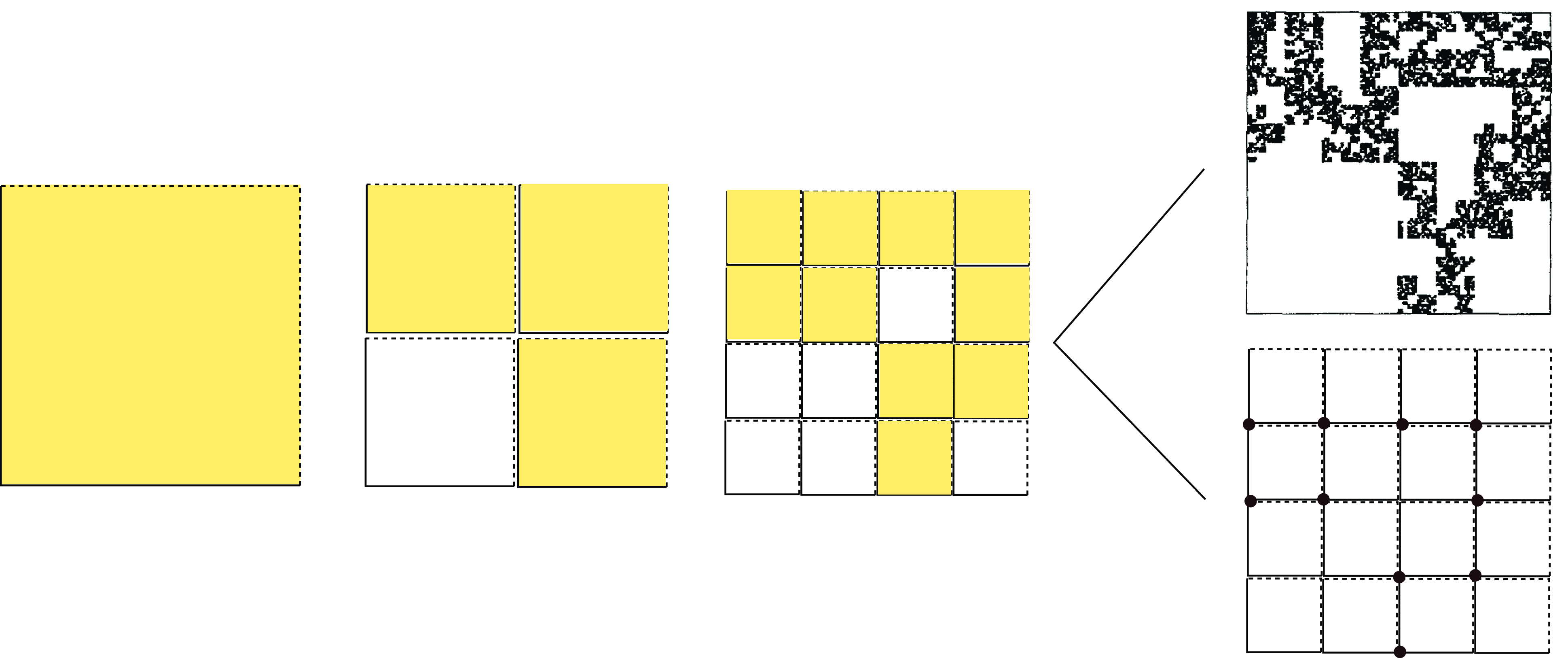
the (continuous) fractal percolation. See Figure 1 for illustration.
Demonstration for construction of fractal percolation. The continuous version is limit of (union of closure of)
 $Z_k$
, and the discrete version is collection of lattice points in the rescaled
 $2^kZ_k$
.

In particular, by Peres [Reference Peres13, Corollary 4·3], long-range hitting probabilities of fractal percolation are characterised by capacity in a similar way as (1·2): Let
 $d\ge 1$
,
 $\beta\gt0$
, then for every
 $k\ge 1$
and
 $A\subset[-2^{k-1},2^{k-1})^d\cap\mathbb Z^d$
,
 \begin{equation}{\mathbb P(Q_d(2^{-\beta};k)\cap A\ne\emptyset)}\asymp 2^{-\beta k}\mathtt{Cap}_\beta(A),\end{equation}
where
 $\asymp$
only depends on
 $d,\beta$
(independent of k, A).
Our key result is the following estimate for sum of fractal percolations:
Theorem 1·5. Let
 $d\ge 1$
. Let
 $p,q\in(0,1)$
such that
 \begin{align}\beta\,{:\!=}\,-\log_2(2^dpq)\gt0,\quad p,q\gt2^{-d},\end{align}
let
 $Q_d,\widehat Q_d$
be two independent fractal percolations, then for every
 $1\le m\le n$
and every nonempty set
 $A\subset[-2^{n-1},2^{n-1})^d\cap\mathbb Z^d$
,
 \begin{equation*}(2^{d}p)^m\lesssim\frac{\mathbb P((Q_d(\;p;m)+\widehat Q_d(q;n))\cap A\ne\emptyset)}{q^n\mathtt{Cap}_\beta(A)}\lesssim (2^dp)^{m\vee\log_2\mathrm{diam}(A)}.\end{equation*}
Here
 $\lesssim$
only depends on d,p,q (independent of m,n,A).
Remark 1·6. As has been observed in [Reference Peres13], the number of cubes in
 $(Q_d(\;p;k))_{k\ge 1}$
forms a branching process, whose offspring distribution is binomial with average offspring number
 $2^dp$
. When
 $2^dp\le 1$
, the branching process is subcritical or critical, so
 \begin{align*}&\lim_{k\rightarrow\infty}\mathbb P(Q_d(\;p;k)=\emptyset)\\ &\quad{}=\mathbb P(\text{a branching process with binomial offspring}\\&\qquad\qquad{} \text{distribution of average $2^dp$ extincts})\\&\quad{}=1.\end{align*}
This implies that as
 $m\rightarrow\infty$
, with probability
 $1-o(1)$
, the sum
 $Q_d(\;p;m)+\widehat Q_d(q;n)=\emptyset+\widehat Q_d(q;n)$
is degenerate. Therefore we restrict to
 $p,q\gt2^{-d}$
in (1·4). See also Section 3.4 for a brief discussion on the condition
 $\beta\gt0$
.
Theorem 1·5 has many interesting consequences. Firstly, we may take
 $m=n$
, and consider the continuous limit when
 $m,n\rightarrow\infty$
. Here we abuse the notation
 $\mathtt{Cap}_\beta(\cdot)$
for Newtonian capacity of a compact set
 $\Lambda\subset\mathbb R^d$
,
 \begin{equation*}\mathtt{Cap}_\beta (\Lambda)\,{:\!=}\,\bigg({\inf_{\mu}\int_{x,y\in \Lambda}|x-y|^{-\beta}\mu(\mathrm{d} x)\mu(\mathrm{d} y)}\bigg)^{-1}.\end{equation*}
Corollary 1·7. Let
 $d\ge 1$
, let
 $p,q\in(0,1)$
satisfy (1·4). For every
 $n\ge 1$
and every
 $A\subset[-2^{n-1},2^{n-1})^d\cap\mathbb Z^d$
,
 \begin{equation}{\mathbb P((Q_d(\;p;n)+\widehat Q_d(q;n))\cap A\ne\emptyset)}\asymp{\mathbb P(Q_d(2^dpq;n)\cap A\ne\emptyset)}.\end{equation}
Moreover, for every closed set
 $\Lambda\subset\big[-\frac12,\frac12\big]^d$
,
 \begin{align}{\mathbb P((Q_d(\;p)+\widehat Q_d(q))\cap\Lambda\ne\emptyset)}\asymp\mathtt{Cap}_\beta(\Lambda)\asymp{\mathbb P(Q_d(2^dpq)\cap\Lambda\ne\emptyset)}.\end{align}
Here
 $\asymp$
only depends on d,p,q (independent of
 $\Lambda$
).
Corollary 1.7 means the random set
 $Q_d(\;p)+\widehat Q_d(q)$
is comparable to
 $Q_d(2^dpq)$
, and a phase transition takes place when
 $2^dpq=1$
. This phenomenon has been noticed since Larsson [Reference Larsson7], and has been studied in terms of fractal geometry when
 $d=1$
in Dekking and Simon [Reference Dekking and Simon4].
Secondly, we may fix m and let
 $n\rightarrow\infty$
in Theorem 1·5 to obtain a comparison between two capacities,
Corollary 1·8. Let
 $0\lt a\lt b\lt d$
. For every nonempty finite set
 $A\subset\mathbb Z^d$
and every
 $m\ge 1$
,
 \begin{align*}2^{(a-b)(m\vee\log_2\mathrm{diam}(A))}\lesssim\frac{\mathtt{Cap}_{a}(A)}{\mathbb E[\mathtt{Cap}_b(A+Q_d(2^{b-a-d};m))]}\lesssim 2^{(a-b)m}.\end{align*}
For every nonempty closed set
 $\Lambda\subset[0,1]^d$
,
 \begin{align*}\frac{\mathtt{Cap}_{a}(\Lambda)}{\mathbb E[\mathtt{Cap}_b(\Lambda+Q_d(2^{b-a-d}))]}\asymp 1.\end{align*}
Here
 $\lesssim$
and
 $\asymp$
may depend on d,a,b.
Studies of fractal percolation date back to Mandelbrot [Reference Mandelbrot11]. In particular, its relation to capacity in terms of hitting probability was discovered in [Reference Peres13]. Minkowski sum of sets is equivalent to algebraic difference,
 \begin{equation*}A-B\,{:\!=}\,\{a-b,a\in A,b\in B\},\end{equation*}
and this structure for Cantor sets was first introduced in Palis [Reference Palis12], and adapted to random cases in [Reference Larsson7]. The sum of fractal percolations in dimension
 $d=1$
(Mandelbrot cascades) was considered in [Reference Dekking and Simon4]. More recently, sum of simple random walks was studied in [Reference Asselah, Okada, Schapira and Sousi1]. Notably, fractal percolation methods can also be used to give intersection probability estimates for random walks (Lawler [Reference Lawler8]), branching random walks (Baran [Reference Baran3]), as well as in continuous regime for Brownian motions and Brownian sheets (Khoshnevisan and Shi [Reference Khoshnevisan and Shi6]).
The paper is outlined as follows. In Section 2 we prove Theorem 1·5 in a few steps:
-
(1) we first introduce in Section 2·1 that, fractal percolation is equivalent to percolation on a tree;
-
(2) then we show in Section 2·2 that lower bound of Theorem 1·5 follows by a standard second moment method;
-
(3) in Section 2·3, we observe that sum of fractal percolation can be described using product of two Markov chains, and one can apply a method first introduced in Fitzsimmons and Salisbury [Reference Fitzsimmons and Salisbury5] and Salisbury [Reference Salisbury14], later simplified in Lyons, Peres and Schramm [Reference Lyons, Peres and Schramm10] to study product of Markov chains;
-
(4) finally we prove the upper bound of Theorem 1·5 in Section 2·4.
In Sections 3·1–3·3, we prove Corollary 1·7, Corollary 1·8 and Theorem 1·1 respectively, and we end the paper in Section 3·4 by a brief discussion on sum of fractal percolations with parameters not covered by (1·4).
2. Proof of Theorem 1·5
For each
 $k\ge 1$
, we abbreviate the centered discrete cube with side length
 $2^k$
by
 \begin{equation*}\Delta_k\,{:\!=}\,[-2^{k-1},2^{k-1})^d\cap\mathbb Z^d.\end{equation*}
2·1. Percolation on tree
Our first observation is that (discrete) fractal percolation
 $Q_d(\;p;k)$
on
 $\Delta_k$
can be described by the Bernoulli bond percolation on a (finite)
 $2^d$
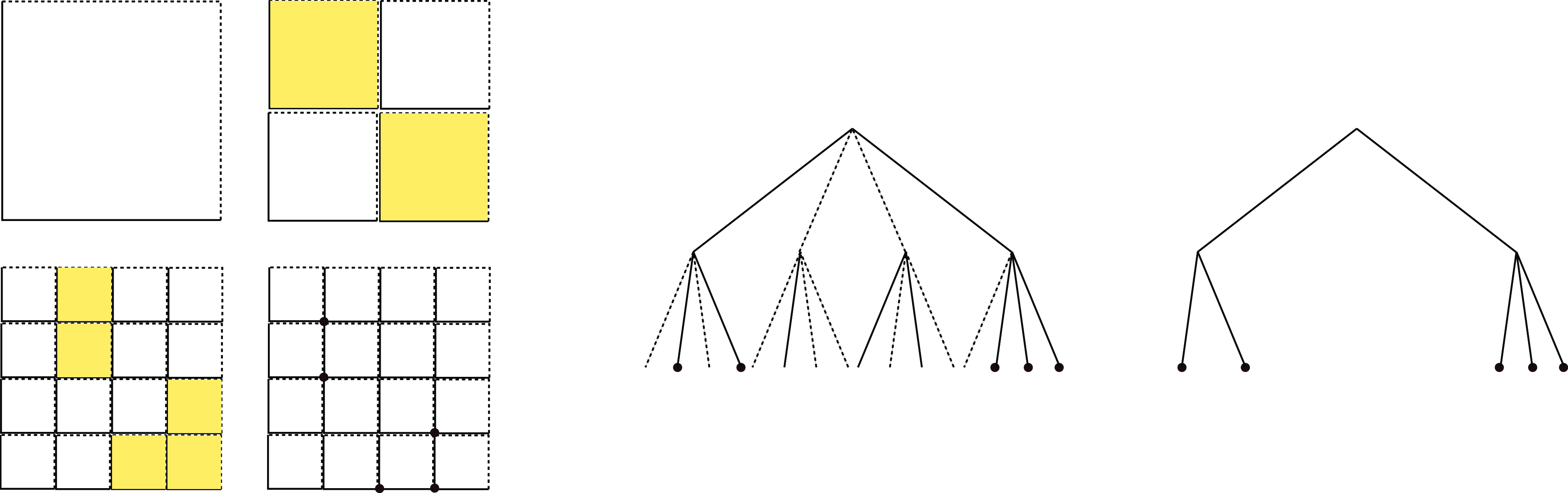
-ary tree defined as follows, see Figure 2 for demonstration.
An illustration of
 $Q_k(\;p)$
and its corresponding percolation on
 $\Gamma^{(k)}$
.

Definition 2·1. Let
 $\Xi=\{0,1\}^d$
be our alphabet (heuristically, we use
 $\Xi$
to represent the
 $2^d$
small cubes when cutting one cube into half size). For
 $j\ge 1$
, let
 $\Xi^j$
denote the set of words
 $(\theta_1,\ldots,\theta_j)$
with
 $\theta_1,\ldots,\theta_j\in\Xi$
. By convention, let
 $\Xi^0\,{:\!=}\,\{\emptyset\}$
, let
 \begin{equation*}\mathbf 0_d=(0,\ldots,0), \mathbf 1_d=(1,\ldots,1)\in\Xi.\end{equation*}
Denote by
 $\Gamma^{(k)}$
a
 $2^d$
-ary tree of height k with vertices labelled by
 $\Xi^0\cup\cdots\cup \Xi^k$
: the tree is rooted at
 $\emptyset\in \Xi^0$
, and for each
 $j=1,2,\ldots,k$
, generation j of the tree is given by
 $\Xi^j$
, with an edge connecting
 $(\theta_1,\ldots,\theta_j)\in\Xi^j$
to its parent
 $(\theta_1,\ldots,\theta_{j-1})$
.
For each particle
 $(\theta_1,\ldots,\theta_j)\in\Xi^j$
, let
 \begin{equation*}\mathscr R_k(\theta_1,\ldots,\theta_j)\,{:\!=}\,\sum_{i=1}^j 2^{k-i}\bigg({\theta_i-\frac 1 2\mathbf 1_d}\bigg)+\Delta_{k-j}\subset\mathbb Z^d.\end{equation*}
This gives a bijection between
 $\Xi^j$
and the natural tiling of
 $\Delta_k$
by blocks of size
 $\Delta_{k-j}$
. For instance, when
 $j=1$
,
 \begin{equation*}\mathscr R_k(\mathbf 0_d)=-2^{k-2}\mathbf 1_d+\Delta_{k-1},\quad\mathscr R_k(\mathbf 1_d)=2^{k-2}\mathbf 1_d+\Delta_{k-1},\end{equation*}
and when
 $\theta_1\in\Xi^1$
runs from
 $\mathbf 0_d$
to
 $\mathbf 1_d$
, the cubes
 $(\mathscr R_k(\theta_1))$
form a tiling of
 $\Delta_k$
. When
 $j=2$
,
 \begin{equation*}\mathscr R_k((\mathbf 0_d,\mathbf 0_d))=-(2^{k-2}+2^{k-3})\mathbf 1_d+\Delta_{k-2}\end{equation*}
is the “bottom left” block in the tiling of
 $\Delta_k$
by
 $\Delta_{k-2}$
, and when
 $(\theta_1,\theta_2)$
run from
 $(\mathbf 0_d,\mathbf 0_d)$
to
 $(\mathbf 1_d,\mathbf 1_d)$
, the cubes
 $(\mathscr R_k((\theta_1,\theta_2)))$
form a tilling of
 $\Delta_k$
.
On
 $\Gamma^{(k)}$
, we perform Bernoulli bond percolation with parameter p, that is, we independently keep each edge open with probability p, closed with probability
 $1-p$
, and let
 \begin{equation*}O_j\,{:\!=}\,\lbrace{\theta=(\theta_1,\dots,\theta_j)}\,:\,{\text{there is an open path between }\emptyset \text{ and }\theta}\rbrace.\end{equation*}
Under a suitable coupling probability measure,
 $\mathscr R_k$
gives a bijection between
 $O_j$
and
 $2^kZ_j$
, where we recall
 $Z_j$
from Definition 1·4.
In other words, we may take a coupling probability measure
 $\mathbb P$
under which
 \begin{equation*}O_j=\mathscr R_k^{-1}(2^kZ_j),\,\;j=1,2,\ldots,k.\end{equation*}
In particular, when
 $j=k$
,
 \begin{align}\text{there is an open path between $\emptyset$ and $(\theta_1,\ldots,\theta_k)$}\iff\mathscr R_k((\theta_1,\ldots,\theta_k))\in Q_d(\;p;k).\end{align}
As a direct application, we have the following estimates for fractal percolation:
Lemma 2·2. For any
 $x,y\in\Delta_k$
,
 \begin{equation*}\mathbb P(x\in Q_d(\;p;k))=p^{k},\end{equation*}
 \begin{equation*}\mathbb P(x,y\in Q_d(\;p;k))\le p^{k+\log_2|x-y|-\frac 1 2\log_2 d}.\end{equation*}
Proof. The first equation is clear, because
 $x\in Q_d(\;p;k)$
means all the k edges on the path from
 $\emptyset$
to
 $\mathscr R_k^{-1}(x)$
are open, which happens with probability
 $p^k$
.
For the second, denote by
 $\theta$
the common ancestor of
 $\mathscr R_k^{-1}(x)$
and
 $\mathscr R_k^{-1}(y)$
, and by h the length from
 $\theta$
to
 $\mathscr R_k^{-1}(x)$
, then it is immediate that
 \begin{equation*}\mathbb P(x,y\in Q_d(\;p;k))=p^{k+h}.\end{equation*}
Moreover,
 $\mathscr R_k(\theta)$
is congruent to
 $\Delta_h$
, so the distance between
 $x,y\in \mathscr R_k(\theta)$
is bounded by
 \begin{align}|x-y|\le \sqrt d 2^h,\end{align}
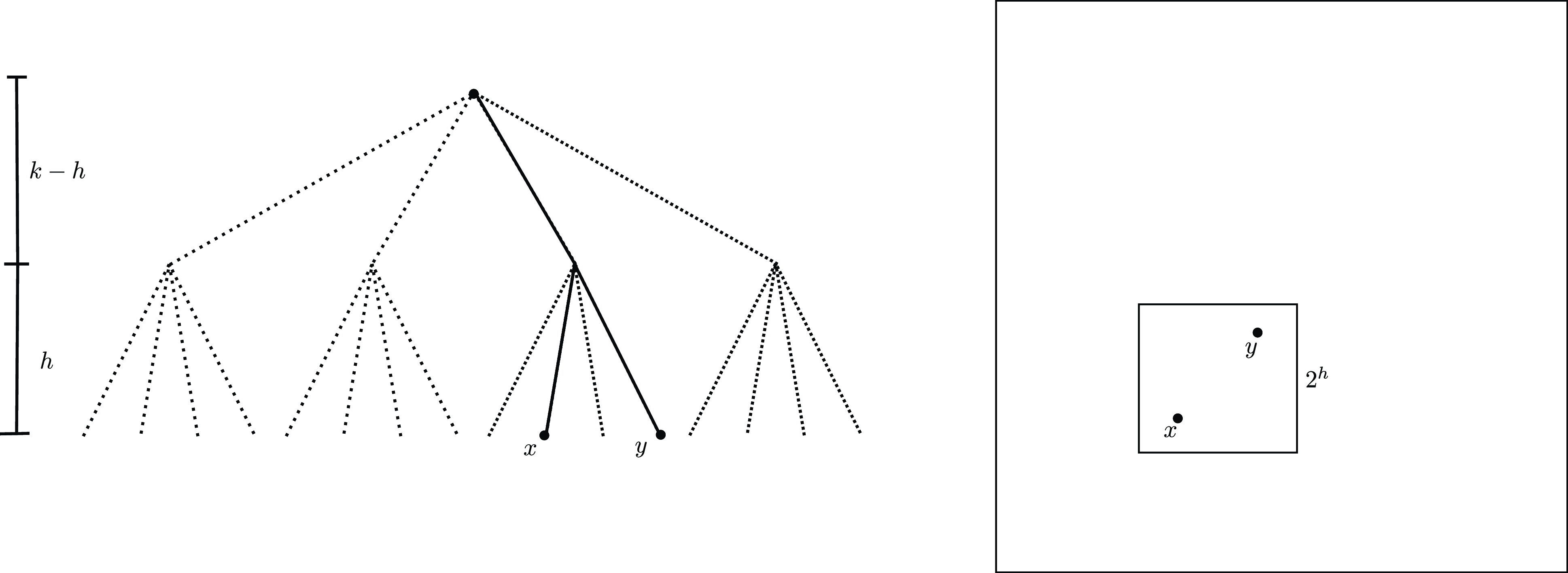
as shown in Figure 3.
Illustration for Lemma 2·2. On the tree
 $\Gamma^{(k)}$
, two points corresponding to x,y has common ancestor of height h. In
 $\mathbb Z^d$
, x,y fall into a cube congruent to
 $\Delta_h$
.

2.2 Lower bound of Theorem 1·5
We are now ready to give the lower bound of Theorem 1·5 by a standard second moment method. For later usage, we slightly extend the domain where the target set stays.
Lemma 2·3 Let
 $d\ge 1$
,
 $\lambda\in[0,1)$
. Let
 $p,q\in(0,1)$
with property (1·4). For every
 $1\le m\le n$
and every finite set
 $A\subset[-2^{n-1}-\lambda2^{m-1},2^{n-1}+\lambda2^{m-1})^d\cap\mathbb Z^d$
,
 \begin{equation*}\mathbb P((Q_d(\;p;m)+\widehat Q_d(q;n))\cap A\ne\emptyset)\gtrsim (2^{d}p)^mq^n\mathtt{Cap}_\beta(A).\end{equation*}
Here
 $\gtrsim$
depends on
 $d,\lambda,p,q$
.
Proof. By definition of
 $\mathtt{Cap}_\beta$
in (1·1), it suffices to show that for any probability measure
 $\mu$
supported on A,
 \begin{align}\mathbb P((Q_d(\;p;m)+\widehat Q_d(q;n))\cap A\ne\emptyset)\gtrsim (2^{d}p)^mq^n\bigg({\sum_{a,b\in A}\mu(a)\mu(b)(|a-b|\vee 1)^{-\beta}}\bigg)^{-1}.\end{align}
Arbitrarily fix
 $\mu$
, let
 \begin{equation*}L_\mu\,{:\!=}\,\sum_{a\in A}\mu(a)\sum_{x\in\mathbb Z^d}\unicode{x1D7D9}_{x\in Q_d(\;p;m),a-x\in \widehat Q_d(q;n)}.\end{equation*}
By the Paley–Zygmund inequality,
 \begin{equation}\mathbb P((Q_d(\;p;m)+\widehat Q_d(q;n))\cap A\ne\emptyset)\ge\mathbb P(L_\mu\gt0)\ge\frac{(\mathbb E[L_\mu])^2}{\mathbb E[L_\mu^2]}.\end{equation}
Observe that uniformly in
 $a\in A$
, (here
 $\asymp$
depends on
 $\lambda$
, in particular it requires the condition
 $\lambda\lt 1$
)
 \begin{equation}\#\lbrace{x\in\Delta_m,a-x\in\Delta_n}\asymp 2^{dm}.\end{equation}
Therefore by Lemma 2·2,
 \begin{align}\mathbb E[L_\mu]=\sum_{a\in A}\mu(a)\sum_{x\in\Delta_m}\mathbb P(x\in Q_d(\;p;m))\mathbb P(a-x\in\widehat Q_d(q;n))\gtrsim 2^{dm}p^{m}q^n.\end{align}
Moreover, apply Lemma 2·2 again, we have
 \begin{align*}\mathbb E[L_\mu^2]&=\sum_{a,b\in A}\mu(a)\mu(b)\sum_{x,y\in\mathbb Z^d}\mathbb P(x,y\in Q_d(\;p;m))\mathbb P(a-x,b-y\in \widehat Q_d(q;n))\\&\lesssim\sum_{a,b\in A}\mu(a)\mu(b)\sum_{x,y\in\mathbb Z^d}p^{m+\log_2(|x-y|\vee 1)}q^{n+\log_2(|a-x+y-b|\vee 1)}\unicode{x1D7D9}_{x,y\in\Delta_m}\unicode{x1D7D9}_{a-x,b-y\in\Delta_n}\\&\lesssim2^{dm}p^mq^n\sum_{a,b\in A}\mu(a)\mu(b)\sum_{z\in\Delta_{m+1}}p^{\log_2(|z|\vee 1)}q^{\log_2(|a-b-z|\vee 1)},\end{align*}
where in the last step we change variable
 $z=x-y\in\Delta_{m+1}$
.
By (1·4), we can expand the sum on z and continue the calculation above,
 \begin{align}\mathbb E[L_\mu^2]&\lesssim2^{dm}p^mq^n\sum_{a,b\in A}\mu(a)\mu(b)\sum_{z\in\Delta_{m+1}}p^{\log_2(|z|\vee 1)}q^{\log_2(|a-b-z|\vee 1)}\nonumber\\&\lesssim2^{dm}p^mq^n\sum_{a,b\in A}\mu(a)\mu(b)(2^dp)^{(m\wedge\log_2(|a-b|\vee 1))}q^{\log_2(|a-b|\vee 1)}\unicode{x1D7D9}_{a\ne b}\nonumber\\&\lesssim2^{dm}p^mq^n\sum_{a,b\in A}\mu(a)\mu(b)(|a-b|\vee 1)^{-\beta}\unicode{x1D7D9}_{a\ne b}.\end{align}
Combine (2·4), (2·6) and (2·7), and the conclusion follows.
2·3. Relation with Markov chain
The percolation on
 $\Gamma^{(k)}$
in Section 2·1 can be identified by the following sequence
 $(Y_i^{(k)})_{i=1,2,\ldots,2^{dk}}$
.
Definition 2·4. Fix a percolation on
 $\Gamma^{(k)}$
. We list all the
 $2^{dk}$
elements of
 $\Xi^k\subset\Gamma^{(k)}$
of the tree in lexicographical order,
 \begin{align}u_1=(\mathbf 0_d,\ldots,\mathbf 0_d),u_2,\ldots,u_{2^{dk}}=(\mathbf 1_d,\ldots,\mathbf 1_d)\in\Xi^k.\end{align}
For each
 $1\le i\le 2^{dk}$
, the path from
 $\emptyset$
to
 $u_i$
on the tree has length k, and we define
 $Y^{(k)}_i=(y_{i1},\ldots,y_{ik})\in\{0,1\}^k$
, where
 \begin{equation*}y_{ij}\,{:\!=}\,\unicode{x1D7D9}_{\lbrace{\text{The}\ \textit{j}\text{th step in the path from $\emptyset$ to $u_i$ is open}}\rbrace}.\end{equation*}
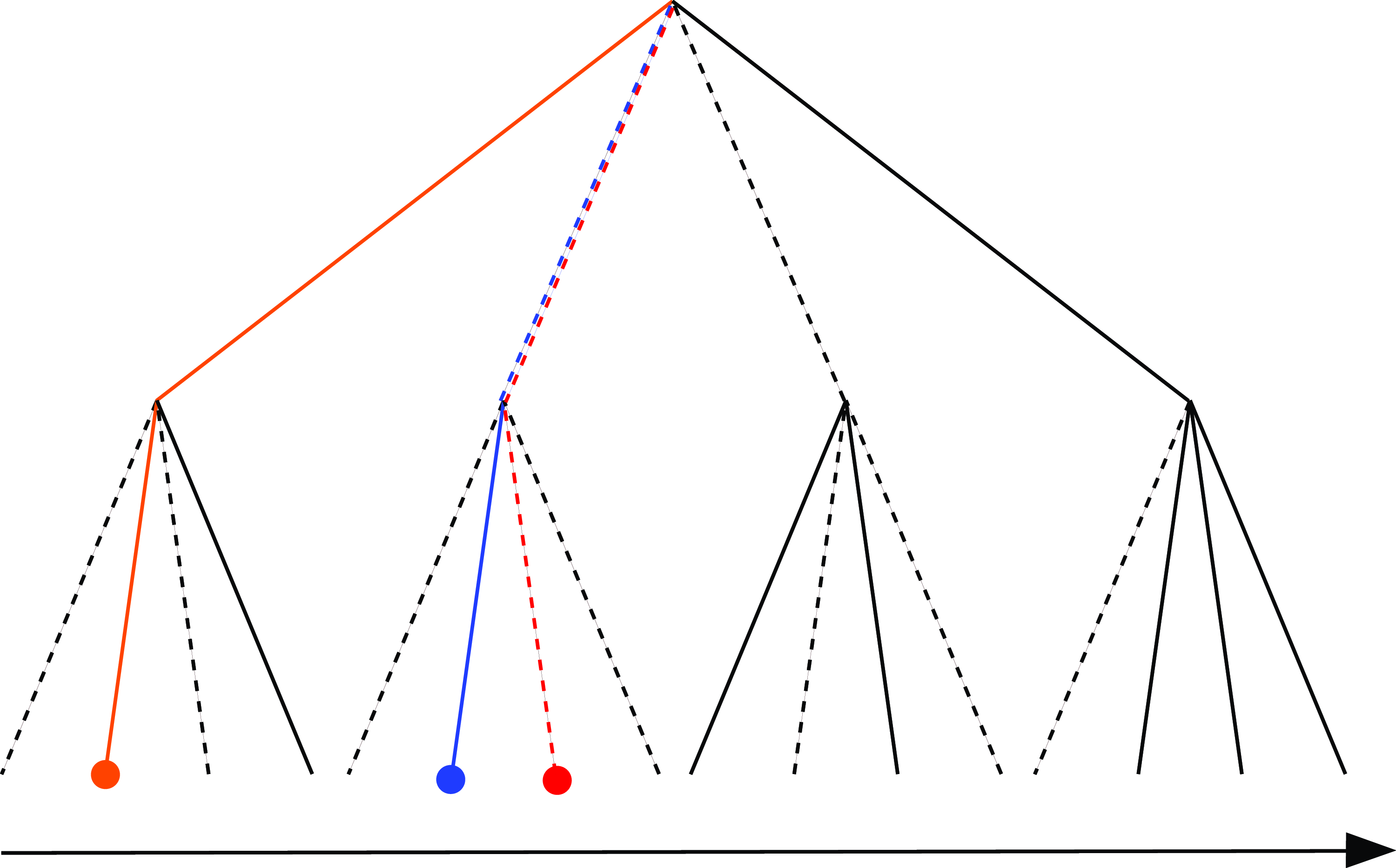
In particular, as is illustrated in Figure 4,
 \begin{align}Y^{(k)}_i=(1,1,\ldots,1) \iff\text{There is an open path between $\emptyset$ and $u_i$}.\end{align}
In this picture we list
 $(u_i)$
for
 $\Gamma^{(2)}$
from left to right. Here the paths from the root to the labelled points correspond to
 $Y^{(2)}_2=(1,1), Y^{(2)}_6=(0,1), Y^{(2)}_{7}=(0,0)$
.

By construction, it is immediate that:
Lemma 2·5. Let
 $\mathbb P$
be the law under which we have Bernoulli bound percolation on
 $\Gamma^{(k)}$
with parameter p. Under
 $\mathbb P$
,
 $(Y_i^{(k)})_i$
is a Markov chain.
Finally, we cite the following theorem on general Markov chains from [Reference Lyons, Peres and Schramm10], which is a simplified version of the method first introduced in [Reference Fitzsimmons and Salisbury5], see also [Reference Salisbury14, Theorem 2], and shall provide an important bound on hitting probability estimates of fractal percolation.
Theorem 2·6. Let
 $(X_n)_{n\in\mathbb N}$
,
 $(Y_n)_{n\in\mathbb N}$
be two independent Markov chains with the same state space
 $\mathcal S$
. For any set
 \begin{equation*}K\subset \lbrace{(i,\;j;\,x,y)}\,{:}\,{i,\;j\in\mathbb N,x,y\in\mathcal S}\rbrace,\end{equation*}
if
 \begin{equation*}\mathbb P\lbrace{\exists i,\;j}\,{:}\,{(i,\;j;\,X_i,Y_j)\in K}\rbrace\gt 0,\end{equation*}
then there are explicit nonnegative coefficients
 $(a_{ijxy})$
not identically zero on K, such that
 \begin{equation*}\frac{\mathbb E[S_K]^2}{\mathbb E[S_K^2]}\le\mathbb P\lbrace{\exists i,\;j}\,{:}\,{(i,\;j;\,X_i,Y_j)\in K}\rbrace\le 64\frac{\mathbb E[S_K]^2}{\mathbb E[S_K^2]},\end{equation*}
where
 \begin{equation*}S_K\,{:\!=}\,\sum_{(i,\;j;\,x,y)\in K}a_{ijxy}\unicode{x1D7D9}_{X_i=x,Y_j=y},\end{equation*}
Proof. The theorem is [Reference Lyons, Peres and Schramm10, Theorem 3·1], and the explicit construction for
 $S_K$
is given in [Reference Lyons, Peres and Schramm10, Page 7] by
 \begin{equation*}a_{ijxy}=\mathbb P({\tau=i,\lambda=j}\big|{X_i=x,Y_j=y}),\end{equation*}
where
 \begin{equation*}\tau\,{:\!=}\,\min\lbrace{i}\,{:}\,{\exists j,(i,\;j;\,X_i,Y_j)\in K}\rbrace,\end{equation*}
 \begin{equation*}\lambda\,{:\!=}\,\min\lbrace{\;j}\,{:}\,{(\tau,\;j;\,X_\tau,Y_j)\in K}\rbrace.\end{equation*}
In particular,
 \begin{equation*}\sum_{(i,\;j;\,x,\;y)\in K}a_{ijxy}\mathbb P(X_i=x,Y_j=y)=\mathbb P(\tau,\lambda\lt \infty)=\mathbb P\lbrace{\exists i,\;j}\,{:}\,{(i,\;j;\,X_i,Y_j)\in K}\rbrace\gt0,\end{equation*}
so
 $(a_{ijxy})$
cannot be identically zero on K.
2·4. Upper bound of Theorem 1·5
For simplicity, we shall denote
 \begin{equation*}i\oplus j\,{:\!=}\,\mathscr R_m(u_i)+\mathscr R_n(\widehat u_j)\in\mathbb Z^d\end{equation*}
for every
 $1\le i\le 2^{dm}, 1\le j\le 2^{dn}$
, where
 $(u_i)$
and
 $(\widehat u_j)$
enumerate the elements in the last generation of
 $\Gamma^{(m)}$
and
 $\Gamma^{(n)}$
, as in Definition 2·4. We also denote by
 $h^m_{ii'}$
(similarly for
 $h^n_{jj'}$
) the graph distance from
 $u_i$
to the most recent common ancestor of
 $u_i$
and
 $u_{i'}$
in
 $\Gamma^{(m)}$
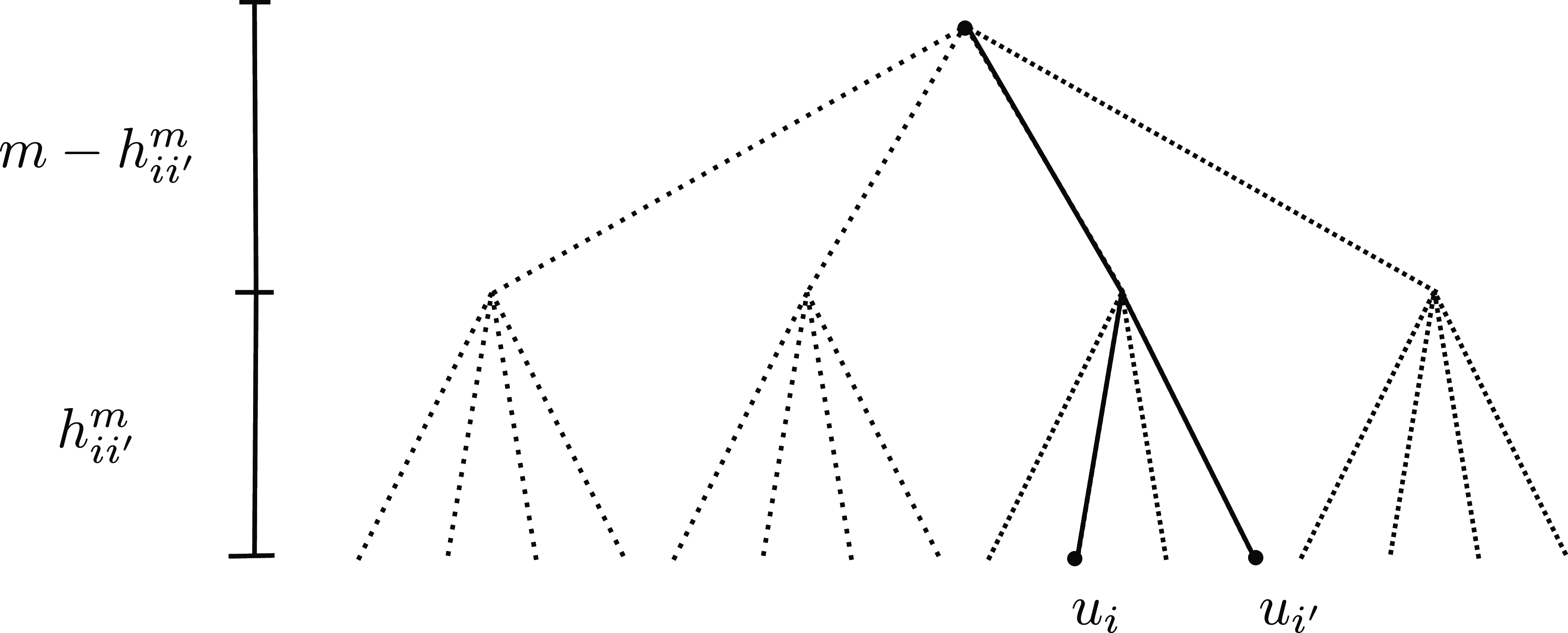
, as shown in Figure 5.
Illustration for
 $h^m_{ii'}$
,
 $u_i$
, and
 $u_{i'}$
.

Lemma 2·7. Let
 $d\ge 1$
, let
 $p,q\in(0,1)$
with property (1·4). For every
 $1\le m\le n$
and every finite set
 $A\subset[-2^{n-1}-2^{m-1},2^{n-1}+2^{m-1})^d\cap\mathbb Z^d$
, there is a family of nonnegative coefficients
 $(a_{ij})_{1\le i\le 2^{dm},1\le j\le 2^{dn}}$
such that
 \begin{align}a_{ij}=0\text{ when }i\oplus j\not\in A,\quad\sum_{i,\;j}a_{ij}=1,\end{align}
and
 \begin{equation*}{\mathbb P({(Q_d(\;p;m)+\widehat Q_d(q;n))\cap A\ne\emptyset})}\le64p^mq^n\left({\sum_{i,i',\;j,\;j'}a_{ij}a_{i'j'}p^{h^m_{ii'}}q^{h^n_{jj'}}}\right)^{-1}.\end{equation*}
Proof. Let Y and
 $\widehat Y$
be the Markov chains of Lemma 2·5 associated with
 $Q_d(\;p;m)$
and
 $\widehat Q_d(q;n)$
. Abbreviate
 $\mathbf 1_k\,{:\!=}\,(1,1,\ldots,1)$
for k consecutive 1s.
We apply Theorem 2·6 to them together with the set
 \begin{equation*}K\,{:\!=}\,\lbrace{(i,\;j;\,\mathbf 1_m,\mathbf 1_n)}\,{:}\,{i\oplus j\in A}\rbrace,\end{equation*}
to get that there exist nonnegative coefficients
 $(a_{ij})$
such that
 \begin{equation*}\mathbb P\big({\exists i,\;j,Y_i=\mathbf 1_m,\widehat Y_j=\mathbf 1_n,i\oplus j\in A}\big)\le64\frac{\mathbb E[S_A]^2}{\mathbb E[S_A^2]},\end{equation*}
where
 \begin{equation*}S_A=\sum_{i,\;j}a_{ij}\unicode{x1D7D9}_{Y_i=\mathbf 1_m,\widehat Y_j=\mathbf 1_n}\unicode{x1D7D9}_{i\oplus j\in A}.\end{equation*}
By (2·1) and (2·9),
 \begin{equation*}Y_i=\mathbf 1_m,\widehat Y_j=\mathbf 1_n\iff\mathscr R_m(u_i)\in Q_d(\;p;m),\mathscr R_n(\widehat u_j)\in \widehat Q_d(q;n),\end{equation*}
so we obtain
 \begin{align}\mathbb P\big({(Q_d(\;p;m)+\widehat Q_d(q;n))\cap A\ne\emptyset}\big)\le64\frac{\mathbb E[S_A]^2}{\mathbb E[S_A^2]}.\end{align}
Note that
 $\frac{\mathbb E[S_A]^2}{\mathbb E[S_A^2]}$
does not change if we replace
 $(a_{ij})$
by its multiple
 $(ca_{ij})$
, and does not change if we change
 $a_{ij}$
for some index
 $i\oplus j\not\in A$
. Also, Theorem 2·6 guarantees that the coefficients
 $(a_{ij})$
are not identically zero on A, so we can modify them to fit (2·10).
Finally, we expand
 \begin{equation*}\mathbb E[S_A]=\sum_{i,\;j}a_{ij}\mathbb P(Y_i=\mathbf 1_m,\widehat Y_j=\mathbf 1_n)=p^{m}q^n,\end{equation*}
and
 \begin{align*}\mathbb E[S_A^2]&=\sum_{i,i',\;j,\;j'}a_{ij}a_{i'j'}\mathbb P(Y_i=Y_{i'}=\mathbf 1_m)\mathbb P(\widehat Y_j=\widehat Y_{j'}=\mathbf 1_n)\\&=\sum_{i,i',\;j,\;j'}a_{ij}a_{i'j'}p^{m+h^m_{ii'}}q^{n+h^n_{jj'}}.\end{align*}
The conclusion follows by putting these equations into (2·11).
Lemma 2·8. Let
 $d\ge 1$
, let
 $p,q\in(0,1)$
with property (1·4). Let
 $1\le m\le n$
and
 $A\subset[-2^{n-1}-2^{m-1},2^{n-1}+2^{m-1})^d\cap\mathbb Z^d$
. Let
 $(a_{ij})$
be any collection of nonnegative coefficients satisfying (2·10), then
 \begin{equation*}(2^dp)^{\log_2\mathrm{diam}(A)\vee m}\sum_{i,i',\;j,\;j'}a_{ij}a_{i'j'}p^{h^m_{ii'}}q^{h^n_{jj'}}\gtrsim p^{m}\sum_{i,i',\;j,\;j'}a_{ij}a_{i'j'}(|i\oplus j-i'\oplus j'|\vee 1)^{-\beta}.\end{equation*}
Here
 $\gtrsim$
only depend on d,p,q (independent of m,n,A).
Proof. We claim that:
-
(i)
(2·12) \begin{align}&2^{dm}\sum_{i,i',\;j,\;j'}a_{ij}a_{i'j'}p^{h^m_{ii'}}q^{h^n_{jj'}}\nonumber\\&\quad{}\gtrsim \sum_{i,i',\;j,\;j':|\mathscr{R}_n(\widehat u_j)-\mathscr{R}_n(\hat{u}_{j'})|\le 2\sqrt d 2^m}a_{ij}a_{i'j'}(|i\oplus j-i'\oplus j'|\vee 1)^{-\beta};\end{align}
-
(ii) if
$m\lt \log_2\mathrm{diam}(A)$
, then(2·13)
\begin{align}&(2^dp)^{\log_2\mathrm{diam}(A)}\sum_{i,i',\;j,\;j'}a_{ij}a_{i'j'}p^{h^m_{ii'}}q^{h^n_{jj'}}\nonumber\\&\quad{}\gtrsim p^m\sum_{i,i',\;j,\;j':|\mathscr R_n(\hat{u}_j)-\mathscr R_n(\widehat u_{j'})|\ge 2\sqrt d 2^m}a_{ij}a_{i'j'}(|i\oplus j-i'\oplus j'|\vee 1)^{-\beta}.\end{align}


Let us first demonstrate that these claims are sufficient to give Lemma 2·8. In fact, if
 $m\ge\log_2\mathrm{diam}(A)$
, then the condition
 $|\mathscr R_n(\widehat u_j)-\mathscr R_n(\widehat u_{j'})|\le 2\sqrt d2^m$
trivially includes every choice of
 $(\widehat u_j,\widehat u_{j'})$
such that
 $i\oplus j,i'\oplus j'\in A$
, because
 \begin{align*}|\mathscr R_n(\widehat u_j)-\mathscr R_n(\widehat u_{j'})|&\le |i\oplus j-i'\oplus j'|+|\mathscr R_m(u_i)-\mathscr R_m(u_i')|\\&\le \mathrm{diam}(A)+\sqrt d2^m\le 2\sqrt d2^m.\end{align*}
Therefore, (2·12) is already our desired result. If
 $m\lt \log_2\mathrm{diam}(A)$
, then
 $(2^dp)^m\lt (2^dp)^{\log_2\mathrm{diam}(A)}$
(recall by (1·4) that
 $2^dp\gt1$
), and the conclusion follows by adding (2·12) and (2·13).
Let us begin by proving (2·13), given that
 $m\lt \log_2\mathrm{diam}(A)$
. By the trivial bound
 $p^{h^m_{ii'}}\ge p^m$
, it suffices to show that
 \begin{align}&(2^{d}p)^{\log_2\mathrm{diam}(A)}\sum_{i,i',\;j,\;j'}a_{ij}a_{i'j'}q^{h^n_{jj'}}\nonumber\\&\quad{}\gtrsim\sum_{i,i',\;j,\;j':|\mathscr R_n(\widehat u_j)-\mathscr R_n(\widehat u_{j'})|\ge 2\sqrt d 2^m}a_{ij}a_{i'j'}(|i\oplus j-i'\oplus j'|\vee 1)^{-\beta},\end{align}
where we recall that
 $\beta=-\log_2(2^dpq)\gt0$
. Since
 $(a_{ij})$
is supported on those (i,j) with
 $i\oplus j\in A$
, and
 $2^dp\gt1$
, we can simplify the right-hand side by
 \begin{align*}&\text{RHS}_{(2{\cdot}14)}\\ &\quad{}=\sum_{i,i',\;j,\;j':|\mathscr R_n(\widehat u_j)-\mathscr R_n(\widehat u_{j'})|\ge 2\sqrt d 2^m}a_{ij}a_{i'j'}(2^dpq)^{\log_2(|i\oplus j-i'\oplus j'|\vee 1)}\\ &\quad{}\le (2^dp)^{\log_2\mathrm{diam}(A)}\sum_{i,i',\;j,\;j':|\mathscr R_n(\widehat u_j)-\mathscr R_n(\widehat u_{j'})|\ge 2\sqrt d 2^m}a_{ij}a_{i'j'}q^{\log_2(|i\oplus j-i'\oplus j'|\vee 1)}.\end{align*}
Note that for each i,i’,
 $|\mathscr R_m(u_i)-\mathscr R_m(u_{i'})|\le\sqrt d 2^m$
because they live in
 $\Delta_m$
. Therefore,
 $|\mathscr R_n(\widehat u_j)-\mathscr R_n(\widehat u_{j'})|\ge 2\sqrt d 2^m$
implies
 \begin{equation*}|i\oplus j-i'\oplus j'|\ge \frac 12|\mathscr R_n(\widehat u_j)-\mathscr R_n(\widehat u_{j'})|,\end{equation*}
so we further simplify
 \begin{align*}&\text{RHS}_{(2{\cdot}14)}\\&\quad{}\lesssim (2^dp)^{\log_2\mathrm{diam}(A)}\sum_{i,i',\;j,\;j':|\mathscr R_n(\widehat u_j)-\mathscr R_n(\widehat u_{j'})|\ge 2\sqrt d 2^m}a_{ij}a_{i'j'}q^{\log_2(|\mathscr R_n(\widehat u_j)-\mathscr R_n(\widehat u_{j'})|\vee 1)}\\ &\quad{}\le (2^dp)^{\log_2\mathrm{diam}(A)}\sum_{i,i',\;j,\;j'}a_{ij}a_{i'j'}{(|\mathscr R_n(\widehat u_j)-\mathscr R_n(\widehat u_{j'})|\vee 1)}^{\log_2 q}.\end{align*}
Put this into (2·14), it now suffices to show
 \begin{align*}\sum_{i,i',\;j,\;j'}a_{ij}a_{i'j'}q^{h^n_{jj'}}\gtrsim \sum_{i,i',\;j,\;j'}a_{ij}a_{i'j'}{(|\mathscr R_n(\widehat u_j)-\mathscr R_n(\widehat u_{j'})|\vee 1)}^{\log_2 q},\end{align*}
and this is known by [Reference Peres13, Theorem 4·2]. Hence we have proved (2·13).
It remains to prove (2·12). Denote by
 $|v|$
the generation (distance to the root) of a vertex v in a tree, denote
 $i\succeq v$
for the event that
 $u_i$
is an offspring of v, and denote
 \begin{equation*}a_{[v][\;\widehat{v}\;]}=\sum_{i\succeq v,\;j\succeq \widehat{v}}a_{ij},\end{equation*}
then we can bound the sum in left-hand side of (2·12) by
 \begin{align}2^{-dm}\text{LHS}_{(2{\cdot}15)}&=\sum_{i,i',\;j,\;j'}a_{ij}a_{i'j'}p^{h^m_{ii'}}q^{h^n_{jj'}}\nonumber\\&\gtrsim\sum_{v\in\Gamma^{(m)},\widehat{v}\in\Gamma^{(n)}}p^{m-|v|}q^{n-|\;\widehat{v}\;|}\sum_{i,i'\succeq v,\;j,\;j'\succeq \widehat{v}}a_{ij}a_{i'j'}\nonumber\\&\gtrsim\sum_{h=0}^m\sum_{|v|=m-h,|\;\widehat{v}\;|=n-h}p^{h}q^{h}\sum_{i,i'\succeq v,\;j,\;j'\succeq \widehat{v}}a_{ij}a_{i'j'}\nonumber\\&=\sum_{h=0}^m\sum_{|v|=m-h,|\;\widehat{v}\;|=n-h}p^{h}q^{h}a_{[v][\;\widehat{v}\;]}^2,\end{align}
where in the second line we are summing over each vertex v (and
 $\widehat{v}\;$
) on the path from root to common ancestor of
 $u_i,u_{i'}$
(and
 $\widehat u_j,\widehat u_{j'}$
).
For each
 $h=0,1,\ldots,m$
, we say four vertices (x,y,z,w) are h-regular, if x,y are in the
 $(m-h)$
-th generation of
 $\Gamma^{(m)}$
, z,w are in the
 $(n-h)$
-th generation of
 $\Gamma^{(n)}$
, and there exists a quadruple (i,i’,j,j’) such that (x,y,z,w) are ancestors of
 $(u_i,u_{i'},u_j,u_{j'})$
respectively (denoted by
 $(x,y,z,w)\preceq(i,i',\;j,\;j')$
), and
 \begin{align}|i\oplus j-i'\oplus j'|\le 3{\sqrt d}2^{h}.\end{align}
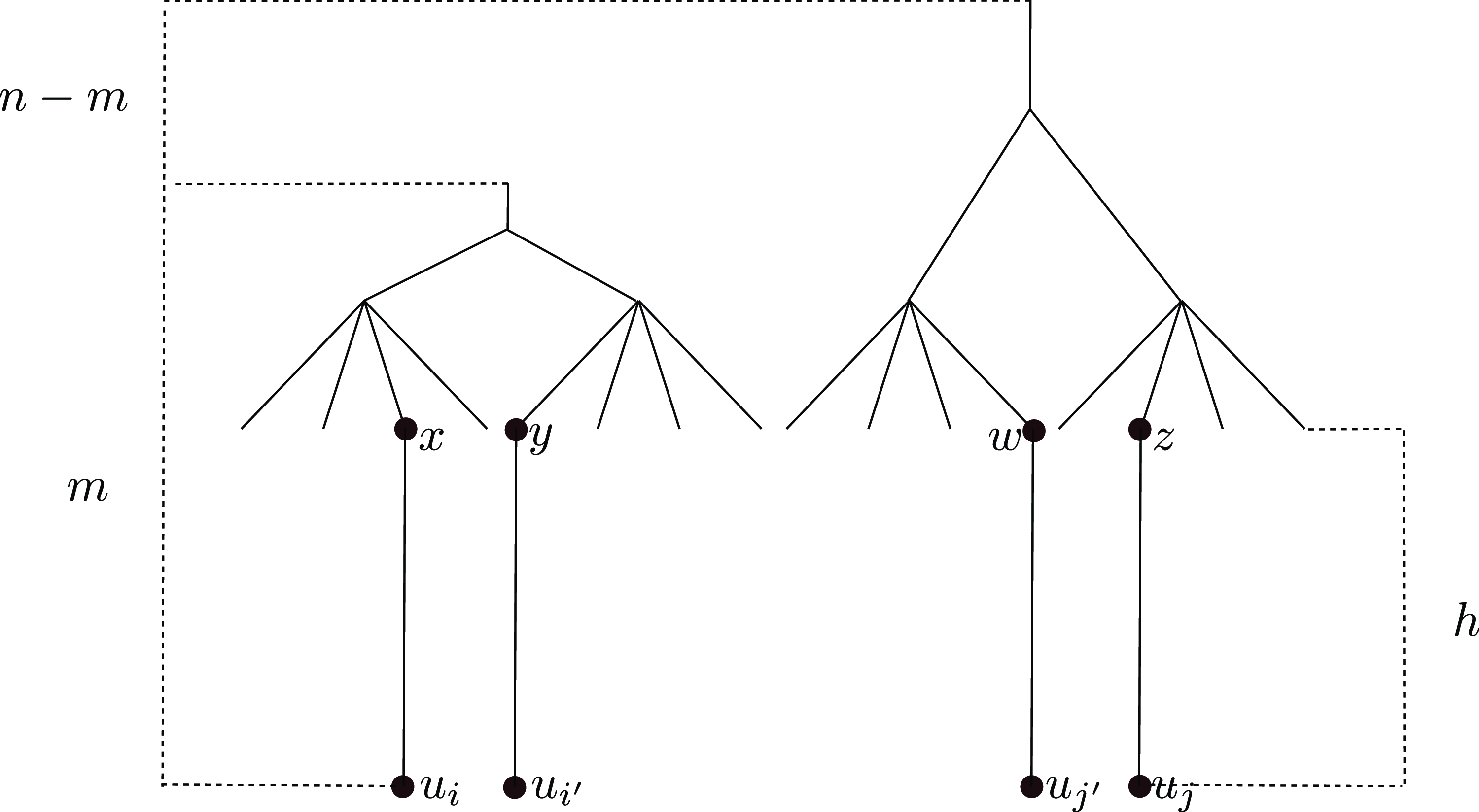
Denote by
 $\Theta_h$
the collection of all h-regular quadruples, as illustrated in Figure 6.
Illustration of
 $(x,y,z,w)\in\Theta_h$
.

We observe from the definition of
 $\Theta_h$
that,
 \begin{align}&\sum_{h=0}^m\sum_{(x,y,z,w)\in\Theta_h}\sum_{(i,i',\;j,\;j')\succeq(x,y,z,w)}2^{-\beta h}a_{ij}a_{i'j'}\nonumber\\ &\quad{}\ge\sum_{h=0}^m\sum_{(x,y,z,w)\in\Theta_h}\sum_{(i,i',\;j,\;j')\succeq(x,y,z,w)}2^{-\beta h}a_{ij}a_{i'j'}\unicode{x1D7D9}_{\lbrace{|i\oplus j-i'\oplus j'|\le 3{\sqrt d}2^{h}}\rbrace}\nonumber\\ &\quad{}=\sum_{i,i',\;j,\;j'}a_{ij}a_{i'j'}\sum_{h=0}^m 2^{-\beta h}\unicode{x1D7D9}_{\lbrace{|i\oplus j-i'\oplus j'|\le 3{\sqrt d}2^{h}}\rbrace}\nonumber\\ &\quad{}\gtrsim \sum_{i,i',\;j,\;j':|i\oplus j-i'\oplus j'|\le 3\sqrt d 2^m}a_{ij}a_{i'j'}\cdot ({|i\oplus j-i'\oplus j'|\vee 1}^{-\beta}\gtrsim \text{RHS}_{(2{\cdot}15)}.\end{align}
Moreover,
 \begin{align}&\sum_{h=0}^m\sum_{(x,y,z,w)\in\Theta_h}\sum_{(i,i',\;j,\;j')\succeq(x,y,z,w)}2^{-\beta h}a_{ij}a_{i'j'}\nonumber\\&\quad{}=\sum_{h=0}^m\sum_{(x,y,z,w)\in\Theta_h}2^{-\beta h}a_{[x][z]}a_{[y][w]}\nonumber\\&\quad{}\le\sum_{h=0}^m2^{-\beta h}\sum_{(x,y,z,w)\in\Theta_h}\frac 1 2(a^2_{[x][z]}+a^2_{[y][w]})\nonumber\\&\quad{}=\sum_{h=0}^m2^{-\beta h}\sum_{x,z}a^2_{[x][z]}\#\lbrace{(y,w)}\,{:}\,{(x,y,z,w)\in\Theta_h}\rbrace,\end{align}
where in the last line we use that (x,z) and (y,w) are symmetric.
For each
 $x\in\Gamma^{(k)}$
, denote by
 $\mathscr R_k^*(x)$
the center of the cube
 $\mathscr R_k(x)$
. When x is ancestor of
 $u_i$
in generation h, we have
 \begin{equation*}|\mathscr R^*_k(x)-\mathscr R^*_k(u_i)|\le \sqrt d 2^{h}.\end{equation*}
So for every
 $(x,y,z,w)\in\Theta_h$
,
 \begin{align*}|\mathscr R^*_k(x)-\mathscr R^*_k(y)+\mathscr R^*_k(z)-\mathscr R^*_k(w)|\le 7\sqrt d 2^{h}.\end{align*}
In particular, for each triple (x,y,z), if we want to choose w so that
 $(x,y,z,w)\in\Theta_h$
, then
 $\mathscr R^*_k(w)$
lives in a ball of radius
 $7\sqrt d 2^{h}$
. For different choices of w,
 $(\mathscr R_k(w))_w$
are disjoint cubes of side length
 $2^{h}$
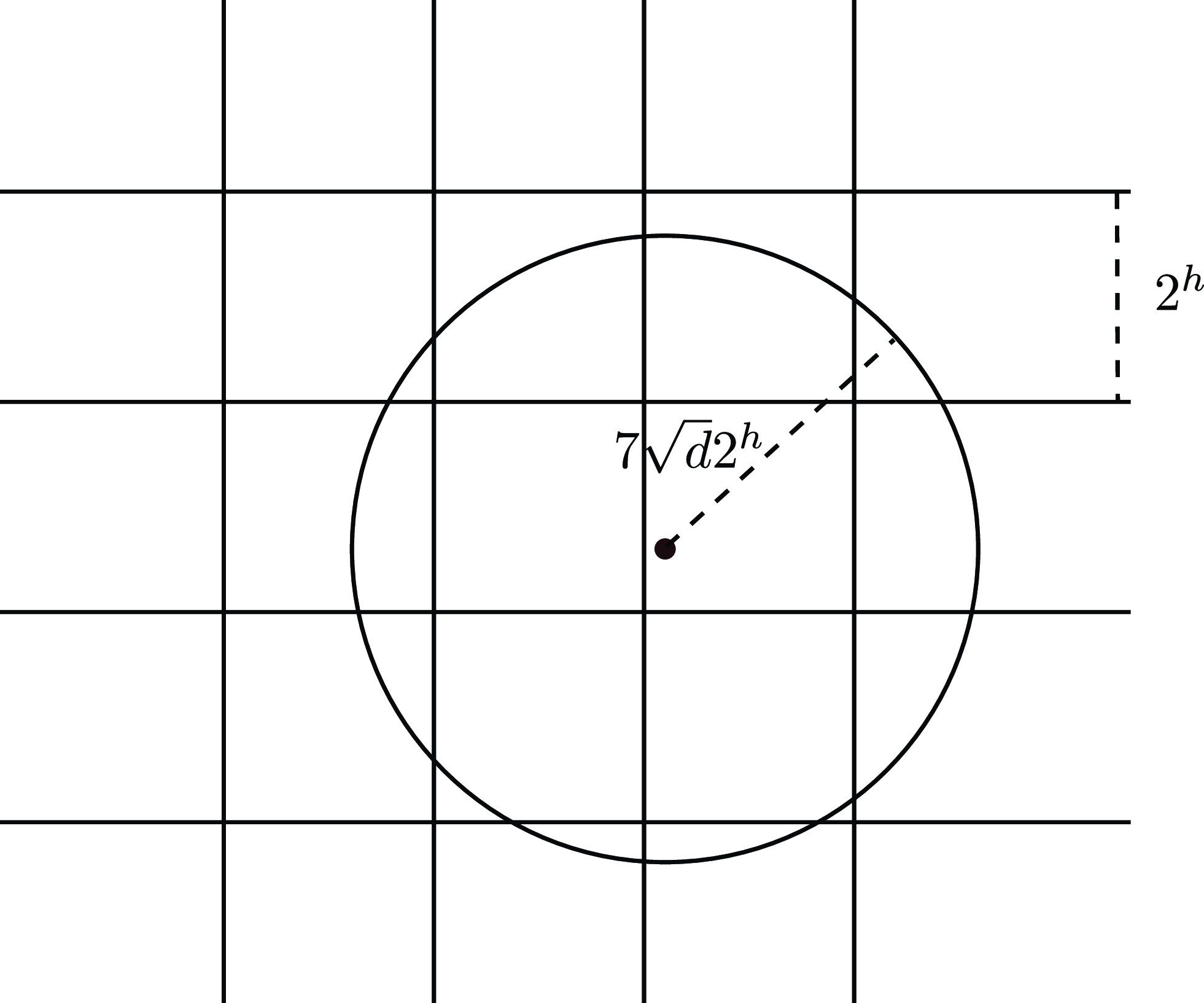
, so we have at most a constant number (
 $(2+7\sqrt d)^d$
) of choices for it, as illustrated in Figure 7. Therefore, for each (x,z), by choosing y arbitrarily and then using the observation above, we obtain
 \begin{align}\#\lbrace{(y,w)}\,{:}\,{(x,y,z,w)\in\Theta_h}\rbrace\lesssim 2^{d(m-h)}.\end{align}
The ball with radius
 $7\sqrt d 2^{h}$
intersects at most
 $(2+7\sqrt d)^d$
tiles of size
 $2^{h}$
.

Put this into (2·18), note that
 $2^{-\beta h}=2^{h\log_2(2^dpq)}=(2^dpq)^h$
, we have
 \begin{align}&\sum_{h=0}^m\sum_{(x,y,z,w)\in\Theta_h}\sum_{i,i',\;j,\;j'}2^{-\beta h}a_{ij}a_{i'j'}\unicode{x1D7D9}_{(i,i',\;j,\;j')\succeq(x,y,z,w)}\nonumber\\&\quad{}\lesssim\sum_{h=0}^m2^{-\beta h+d(m-h)}\sum_{|x|=m-h,|z|=n-h}a^2_{[x][z]}=2^{dm}\sum_{h=0}^m(\;pq)^{h}\sum_{|x|=m-h,|z|=n-h}a^2_{[x][z]}.\end{align}
Finally, (2·12) follows by combining (2·15), (2·17) and (2·20).
Now we are ready to give upper bound in Theorem 1·5. For later usage, we extend the domain where the target set stays from
 $[-2^{n-1},2^{n-1})^d\cap\mathbb Z^d$
to
 $[-2^{n-1}-2^{m-1},2^{n-1}+2^{m-1})^d\cap\mathbb Z^d$
.
Lemma 2·9. Let
 $d\ge 1$
, let
 $p,q\in(0,1)$
with property (1·4). For every
 $1\le m\le n$
and every finite set
 $A\subset[-2^{n-1}-2^{m-1},2^{n-1}+2^{m-1})^d\cap\mathbb Z^d$
,
 \begin{equation*}\mathbb P((Q_d(\;p;m)+\widehat Q_d(q;n))\cap A\ne\emptyset)\lesssim (2^dp)^{m\vee\log_2\mathrm{diam}(A)}q^n\mathtt{Cap}_\beta(A).\end{equation*}
Here
 $\lesssim$
only depends on d,p,q (independent of m,n,A).
Proof. By Lemma 2·7 and Lemma 2·8,
 \begin{align*}&{\mathbb P({Q_d(\;p;m)+\widehat Q_d(q;n)\cap A\ne\emptyset})}\\ &\quad{}\lesssim(2^dp)^{m\vee\log_2\mathrm{diam}(A)}q^n\Bigg({\sum_{i,i',\;j,\;j'}a_{ij}a_{i'j'}(|i\oplus j-i'\oplus j'|\vee 1)^{-\beta}}\Bigg)^{-1}.\end{align*}
Let
 \begin{equation*}\mu(x)=\sum_{i,\;j}a_{ij}\unicode{x1D7D9}_{\mathscr R_m(i)+\mathscr R_n(\;j)=x},\end{equation*}
then
 $\mu$
is a probability measure supported on A, and the equation above implies
 \begin{align*}&\mathbb P((Q_d(\;p;m)+\widehat Q_d(q;n))\cap A\ne\emptyset)\\&\quad{}\lesssim(2^dp)^{m\vee\log_2\mathrm{diam}(A)}q^n\bigg({\sum_{x,y\in A}\mu(x)\mu(y)(|x-y|\vee 1)^{-\beta}}\bigg)^{-1}\\ &\quad{}\le(2^dp)^{m\vee\log_2\mathrm{diam}(A)}q^n\mathtt{Cap}_\beta(A).\end{align*}
Proof of Theorem 1·5. It is now immediate by Lemma 2·3 and Lemma 2·9.
3. Applications
3·1. Continuous case, proof of Corollary 1·7
Proof of Corollary 1·7. The first conclusion (1·5) follows immediately from (1·3) and Theorem 1·5 by taking
 $m=n$
.
Below we consider the continuous case. For any closed set
 $\Lambda\subset[-1/2,1/2]^d$
, denote
 \begin{equation*}T_k(\Lambda)\,{:\!=}\,\bigcup_{\lbrace{x}\,{:}\,{2^kx\in \mathbb Z^d,(x+[-2^{1-k},2^{1-k}]^d)\cap\Lambda\ne\emptyset}\rbrace}(x+[-2^{1-k},2^{1-k}]^d)\end{equation*}
then
 $T_k(\Lambda)\subset[-1/2-2^{1-k},1/2+2^{1-k}]^d$
, and it is not hard to check that
 $(T_k(\Lambda))_k$
is a decreasing sequence of sets with
 \begin{equation*}\bigcap_{k\ge 0}T_k(\Lambda)=\Lambda.\end{equation*}
We claim that
 \begin{equation*}(Q_d(\;p)+\widehat Q_d(q))\cap \Lambda\ne\emptyset\iff\forall k,(Q_d(\;p;k)+\widehat Q_d(q;k))\cap 2^kT_k(\Lambda)\ne\emptyset.\end{equation*}
On one hand, if
 $(Q_d(\;p)+\widehat Q_d(q))\cap \Lambda\ne\emptyset$
, we take
 $a\in Q_d(\;p),b\in \widehat Q_d(q)$
with
 $a+b\in\Lambda$
. Then by Definition 1·4, for each k there is
 $a_k\in Q_d(\;p;k),b_k\in\widehat Q_d(q;k)$
such that
 \begin{equation*}2^ka\in a_k+[-1,1]^d,\;2^kb\in b_k+[-1,1]^d.\end{equation*}
This implies
 \begin{equation*}2^k(a+b)\in (a_k+b_k)+[-2,2]^d,\end{equation*}
so
 $2^{-k}(a_k+b_k)\in T_k(\Lambda)$
.
On the other hand, if we have
 $a_k\in Q_d(\;p;k)$
,
 $b_k\in \widehat Q_d(q;k)$
with
 $a_k+b_k\in2^k T_k(\Lambda)$
for every k, by looking for a subsequence we can assume
 $2^{-k}a_k\rightarrow a$
,
 $2^{-k}b_k\rightarrow b$
. Notice that
 $(2^{-k}\overline {Q_d(\;p;k)})$
is a decreasing sequence of closed set. For each fixed k,
 $2^{-k}\overline {Q_d(\;p;k)}$
contains
 $a_k,a_{k+1},\ldots$
, therefore also contains their limit point a. Hence
 $Q_d(\;p)$
contains a. Similarly we have
 $b\in \widehat Q_d(q)$
and
 $a+b\in \Lambda$
.
This allows us to conclude that
 \begin{align*}\mathbb P\big({(Q_d(\;p)+\widehat Q_d(q))\cap \Lambda\ne\emptyset}\big)=\lim_{k\rightarrow\infty}\mathbb P\big({(Q_d(\;p;k)+\widehat Q_d(q;k))\cap 2^kT_k(\Lambda)\ne\emptyset}\big).\end{align*}
Then we can apply Theorem 1·5 to
 $m=n=k$
,
 $A=2^kT_k(\Lambda)$
(use Lemma 2·3 and Lemma 2·9 directly if
 $2^{-k}A\not\subset[-1/2,1/2]^d$
slightly exceeds the boundary) and obtain
 \begin{align*}\mathbb P\big({(Q_d(\;p)+\widehat Q_d(q))\cap \Lambda\ne\emptyset}\big)&\asymp\lim_{k\rightarrow\infty}2^{-\beta k}\mathtt{Cap}_\beta(2^kT_k(\Lambda))\\&=\lim_{k\rightarrow\infty}\mathtt{Cap}_\beta(T_k(\Lambda))=\mathtt{Cap}_\beta(\Lambda),\end{align*}
where
 $\asymp$
is independent of k. This proves the first part of (1·6). The second part of (1·6) is immediate by [Reference Peres13, Corollary 4·3].
3·2. Changing parameter in capacity, proof of Corollary 1·8
Proof of Corollary 1·8. By (1·3) (and symmetry in Q and
 $-Q$
),
 \begin{align*}&\mathbb P((Q_d(\;p;m)+\widehat Q_d(q;n))\cap A\ne\emptyset)\\&\quad{}=\mathbb P(\widehat Q_d(q;n)\cap (A+Q_d(\;p;m))\ne\emptyset)\\&\quad{}\asymp q^n\mathbb E[\mathtt{Cap}_{-\log_2 q}(A+Q_d(\;p;m))],\end{align*}
as long as n is large enough such that
 $A+Q_d(\;p;m)\subset[-2^{n-1},2^{n-1})^d$
.
Combining this with Theorem 1·5, we have
 \begin{equation*}(2^{d}p)^m\lesssim\frac{\mathbb E[\mathtt{Cap}_{-\log_2 q}(A+Q_d(\;p;m))]}{\mathtt{Cap}_\beta(A)}\lesssim (2^dp)^{m\vee\log_2\mathrm{diam}(A)}.\end{equation*}
The first conclusion follows by taking
 $p=2^{b-a-d},q=2^{-b}$
.
The continuous version follows from a similar argument as proof of Corollary 1·7 with
 $A=2^mT_m(\Lambda)$
.
3·3. Consequences for sum of general random sets, proof of Theorem 1·1
Lemma 3·1. Let
 $k\ge 1$
,
 $\beta\gt0$
, let
 $A=A_1\cup\cdots\cup A_k$
. Then
 \begin{align*}\mathtt{Cap}_\beta(A)\asymp\mathtt{Cap}_\beta(A_1)+\cdots+\mathtt{Cap}_\beta(A_k)\asymp\max\lbrace{\mathtt{Cap}_\beta(A_1),\ldots,\mathtt{Cap}_\beta(A_k)},\end{align*}
where the constant in
 $\asymp$
only depends on k (independent of
 $\beta,A,A_1,\ldots,A_k$
).
Proof. Capacity is clearly monotone, so
 $\mathtt{Cap}_\beta(A)\ge\max\lbrace{\mathtt{Cap}_\beta(A_1),\ldots,\mathtt{Cap}_\beta(A_k)}$
. Capacity is also subadditive (see for instance [Reference Lawler and Limic9, proposition 6.5.3]), so
 \begin{equation*}\mathtt{Cap}_\beta(A)\le\mathtt{Cap}_\beta(A_1)+\cdots+\mathtt{Cap}_\beta(A_k)\le k\max\lbrace{\mathtt{Cap}_\beta(A_1),\ldots,\mathtt{Cap}_\beta(A_k)}.\end{equation*}
Now we are ready to Theorem 1·1, in fact we will prove a slightly stronger version as stated below.
Theorem 3·2. Let
 $d,k\ge 1$
, let
 $0\lt \alpha_i,\beta_i\lt d$
,
 $i=1,2,\ldots,k$
such that
 \begin{align}\gamma\,{:\!=}\,\alpha_1+\cdots+\alpha_k-(k-1)d\gt0,\end{align}
 \begin{equation*}\beta_1+\cdots+\beta_k-(k-1)d\gt0.\end{equation*}
Let
 $\mathcal R_1,\ldots,\mathcal R_k$
be independent random sets in
 $\mathbb Z^d$
with the following property: for every finite set
 $B\subset\mathbb Z^d$
containing the origin and every
 $|x|\ge 2\mathrm{diam}(B)$
, we have
 \begin{equation}{\mathbb P(\mathcal R_i\cap (x+B)\ne\emptyset)}\asymp|x|^{-\beta_i}\mathtt{Cap}_{\alpha_i}(B),\quad i=1,2,\ldots,k.\end{equation}
Let
 $A\subset\mathbb Z^d$
be any finite set containing the origin. When
 \begin{align}|x|\ge 2\mathrm{diam}(A)+\max_{1\le i\le k} \mathrm{diam}(A)^{\frac {d-\alpha_i}{d-\beta_i}}\log^{\frac{1}{d-\beta_i}}(\mathrm{diam}(A)+1),\end{align}
then
 \begin{align*}\mathbb P((\mathcal R_1+\cdots+\mathcal R_k)\cap (x+A)\ne\emptyset)\asymp|x|^{(k-1)d-\beta_1-\cdots-\beta_k}\mathtt{Cap}_{\gamma}(A),\end{align*}
where the constant in
 $\asymp$
only depends on d,k and
 $(\alpha_i),(\beta_i)$
(independent of A,x).
Proof. For each n, abbreviate
 \begin{equation*}\Psi_n=[-2^{n-1},2^{n-1}]^d\setminus [-2^{n-2},2^{n-2}]^d,\end{equation*}
and we assume all different instances of fractal percolations appearing in this proof to be independent.
Take
 $n=\lceil\log_2 |x|\rceil$
. By (3·3), we know that
 $x+A\subset\Psi_{n+1}\cup\Psi_n\cup\Psi_{n-1}$
. By Lemma 3·1, it suffices to assume
 $x+A\subset\Psi_n$
(otherwise cut the set into pieces in
 $\Psi_{n+1},\Psi_n,\Psi_{n-1}$
, and apply the argument for
 $n+1,n,n-1$
), and it remains to show that
 \begin{align*}\mathbb P((\mathcal R_1+\cdots+\mathcal R_k)\cap (x+A)\ne\emptyset)\asymp2^{((k-1)d-\beta_1-\cdots-\beta_k)n}\mathtt{Cap}_{\gamma}(A).\end{align*}
Moreover, by (3·2) and Lemma 3·1, it is not hard to observe that for every
 $B\subset\Psi_n$
,
 \begin{align}\mathbb P(\mathcal R_i\cap B\ne\emptyset)\asymp 2^{-n\beta_i}\mathtt{Cap}_{\alpha_i}(B).\end{align}
We first prove the lower bound. Let
 \begin{equation*}M\oplus N\,{:\!=}\,(M+N)\cap\Psi_n,\end{equation*}
then
 \begin{align*}\mathbb P((\mathcal R_1+\cdots+\mathcal R_k)\cap (x+A)\ne\emptyset)&\ge\mathbb P((\mathcal R_1\oplus\cdots\oplus\mathcal R_k)\cap (x+A)\ne\emptyset)\\&=\mathbb P(\mathcal R_1\cap(-\mathcal R_2\oplus\cdots\oplus-\mathcal R_k\oplus (x+A))\ne\emptyset).\end{align*}
Notice that
 \begin{equation*}-\mathcal R_2\oplus\cdots\oplus-\mathcal R_k\oplus (x+A)\subset\Psi_n,\end{equation*}
by (3·4) and (1·3),
 \begin{equation}\begin{split}&\mathbb P(\mathcal R_1\cap(-\mathcal R_2\oplus\cdots\oplus-\mathcal R_k\oplus (x+A))\ne\emptyset)\\&\quad{}\asymp 2^{-\beta_1 n}\mathbb E[{\mathtt{Cap}_{\alpha_1}(-\mathcal R_2\oplus\cdots\oplus-\mathcal R_k\oplus (x+A))}\\&\quad{}\asymp 2^{(\alpha_1-\beta_1) n}\mathbb P(Q_d(2^{-\alpha_1};n)\cap (-\mathcal R_2\oplus\cdots\oplus-\mathcal R_k\oplus (x+A))\ne\emptyset)\\ &\quad{}= 2^{(\alpha_1-\beta_1) n}\mathbb P((Q_d(2^{-\alpha_1};n)\oplus\mathcal R_2\oplus\cdots\oplus\mathcal R_k)\cap (x+A))\ne\emptyset).\end{split}\end{equation}
Iterate the same procedure (3·5) for
 $\mathcal R_2,\ldots\mathcal R_k$
, we have
 \begin{align*}&\mathbb P((\mathcal R_1\oplus\cdots\oplus\mathcal R_k)\cap (x+A)\ne\emptyset)\gtrsim2^{n\sum_{i=1}^k(\alpha_i-\beta_i)}\mathbb P((Q_1\oplus\cdots\oplus Q_k)\cap (x+A)\ne\emptyset),\end{align*}
where we denote
 $Q_i=Q_d(2^{-\alpha_i};n)$
for simplicity.
Notice that for a set
 $B\subset[-2^{n-1},2^{n-1}]^d$
,
 \begin{equation*}\mathbb P((Q_1\oplus Q_2)\cap B\ne\emptyset)=\mathbb P((Q_1+ Q_2)\cap B\ne\emptyset),\end{equation*}
by Corollary 1·7 (the condition
 $\alpha_i\in(0,d)$
and (3·1) guarantees that
 $2^{d-\alpha_1-\alpha_2}\lt 1$
), we have
 \begin{equation}\begin{split}&\mathbb P((Q_1\oplus\cdots \oplus Q_k)\cap (x+A)\ne\emptyset)\\&\quad{}=\mathbb P((Q_1\oplus Q_2)\cap ((x+A)\oplus Q_3\oplus\cdots\oplus Q_k)\ne\emptyset)\\&\quad{}=\mathbb P((Q_1+ Q_2)\cap ((x+A)\oplus Q_3\oplus\cdots\oplus Q_k)\ne\emptyset)\\&\quad{}\asymp\mathbb P((Q_d(2^{d-\alpha_1-\alpha_2};n))\cap ((x+A)\oplus Q_3\oplus\cdots\oplus Q_k)\ne\emptyset)\\&\quad{}=\mathbb P((Q_d(2^{d-\alpha_1-\alpha_2};n)\oplus Q_3\oplus\cdots\oplus Q_k)\cap (x+A)\ne\emptyset).\end{split}\end{equation}
This reduces the number of fractal percolations from k to
 $k-1$
. The lower bound of Theorem 1·1 now follows by iteration of (3·6) and the fact
 $\mathtt{Cap}(A)=\mathtt{Cap}(x+A)$
.
For the upper bound, by union bounds,
 \begin{equation}\begin{split}&\mathbb P((\mathcal R_1+\cdots+\mathcal R_k)\cap (x+A)\ne\emptyset)\\&\quad{}=\mathbb P(\mathcal R_1\cap(-\mathcal R_2+\cdots+-\mathcal R_k+ (x+A))\ne\emptyset)\\&\quad{}\le\sum_{j}\mathbb P(\Psi_j\cap\mathcal R_1\cap(-\mathcal R_2+\cdots+-\mathcal R_k + (x+A))\ne\emptyset).\end{split}\end{equation}
We need this step because even though
 $x+A\subset\Psi_n$
,
 $-\mathcal R_2+\cdots+-\mathcal R_k + (x+A)$
can be unbounded. By (3·4),
 \begin{align*}&\mathbb P(\Psi_j\cap\mathcal R_1\cap(-\mathcal R_2+\cdots+-\mathcal R_k + (x+A))\ne\emptyset)\\&\quad{}\asymp2^{-\beta_1 j}\mathtt{Cap}_{\alpha_1}((-\mathcal R_2+\cdots+-\mathcal R_k + (x+A))\cap\Psi_j).\end{align*}
By (1·3), we conclude that
 \begin{align*}&\mathbb P((\mathcal R_1+\cdots+\mathcal R_k)\cap (x+A)\ne\emptyset)\\&\quad{}\lesssim\sum_j 2^{-\beta_1 j}\mathbb E[{\mathtt{Cap}_{\alpha_1}((-\mathcal R_2+\cdots+-\mathcal R_k + (x+A))\cap\Psi_j)}\\&\quad{}\lesssim\sum_j 2^{(\alpha_1-\beta_1)j}\mathbb P({Q_d(2^{-\alpha_1};\;j)\cap(-\mathcal R_2+\cdots+-\mathcal R_k + (x+A))\ne\emptyset}\\&\quad{}=\sum_j 2^{(\alpha_1-\beta_1)j}\mathbb P({(Q_d(2^{-\alpha_1};\;j)+\mathcal R_2+\cdots+\mathcal R_k)\cap(x+ A)\ne\emptyset}.\end{align*}
Iterating for each
 $\mathcal R_i$
, we get
 \begin{equation}\begin{split}&\mathbb P((\mathcal R_1+\cdots+\mathcal R_k)\cap A\ne\emptyset)\\&\quad{}\lesssim\sum_{j_1,\ldots,\;j_k}2^{\sum_i(\alpha_i-\beta_i)j_i}\mathbb P({(Q_d(2^{-\alpha_1};\;j_1)+\cdots+Q_d(2^{-\alpha_k};\;j_k))\cap(x+A)\ne\emptyset}.\end{split}\end{equation}
Since
 $\mathcal R_1,\ldots,\mathcal R_k$
are exchangeable, it suffices to study the case
 $j_1\ge\cdots\ge j_k$
, i.e.
 \begin{equation*}\sum_{j_1,\ldots,\;j_k}\unicode{x1D7D9}_{j_1\ge\cdots\ge j_k}2^{\sum_i(\alpha_i-\beta_i)j_i}\mathbb P({(Q_d(2^{-\alpha_1};\;j_1)+\cdots+Q_d(2^{-\alpha_k};\;j_k))\cap(x+A)\ne\emptyset}.\end{equation*}
Note that in order for the intersection to happen, sum of the blocks
 $[-2^{j_i-1},2^{j_i-1}]^d$
must reach
 $x+A\subset\Psi_n$
, hence
 \begin{align}k2^{j_1}\ge 2^{j_1}+\cdots+2^{j_k}\ge 2^{n-2}.\end{align}
By (1·3) (and the fact that capacity is translational invariant),
 \begin{equation*}\begin{aligned}&\mathbb P({(Q_d(2^{-\alpha_1};\;j_1)+\cdots+Q_d(2^{-\alpha_k};\;j_k))\cap(x+A)\ne\emptyset}\\&\quad{}\lesssim2^{-\alpha_1 j_1}\mathbb E[{\mathtt{Cap}_{\alpha_1}(Q_d(2^{-\alpha_2};\;j_2)+\cdots+Q_d(2^{-\alpha_k};\;j_k)+A)}].\end{aligned}\end{equation*}
Now
 $j_2$
becomes the largest among the remaining indices, and we can use Corollary 1·8 and (3·4) to obtain
 \begin{equation*}\begin{aligned}&\mathbb E[{\mathtt{Cap}_{\alpha_1}(Q_d(2^{-\alpha_2};\;j_2)+\cdots+Q_d(2^{-\alpha_k};\;j_k)+A)}\\&\quad{}\lesssim2^{(d-\alpha_2)(\;j_2\vee\log_2\mathrm{diam}(A))}\mathbb E[{\mathtt{Cap}_{\alpha_1+\alpha_2-d}(Q_d(2^{-\alpha_3};\;j_3)+\cdots+Q_d(2^{-\alpha_k};\;j_k)+A)}.\end{aligned}\end{equation*}
Given that
 $j_1\ge j_2\ge\cdots\ge j_k$
, we can iterate this argument for
 $j_3,\ldots,\;j_k$
and obtain (recall
 $\gamma=\alpha_1+\cdots+\alpha_k-(k-1)d\gt0$
)
 \begin{equation}\begin{split}&\mathbb P({(Q_d(2^{-\alpha_1};\;j_1)+\cdots+Q_d(2^{-\alpha_k};\;j_k))A\ne\emptyset}\\&\quad{}\lesssim2^{-\alpha_1j_1}2^{\sum_{i\ge 2}(d-\alpha_i)(\;j_i\vee\log_2\mathrm{diam}(A))}\mathtt{Cap}_{\gamma}(A).\end{split}\end{equation}
Therefore,
 \begin{align*}&\sum_{j_1,\ldots,\;j_k}\unicode{x1D7D9}_{j_1\ge\cdots\ge j_k}2^{\sum_i(\alpha_i-\beta_i)j_i}2^{-\alpha_1j_1}2^{\sum_i(d-\alpha_i)(\;j_i\vee\log_2\mathrm{diam}(A))}\mathtt{Cap}_{\gamma}(A)\\[-3pt]&\quad{}\le\sum_{j_1\ge n-2-\log_2k} 2^{-\beta_1j_1}\mathtt{Cap}_\gamma(A)\cdot\prod_{i=2}^k\bigg({\sum_{j\le j_1}2^{(\alpha_i-\beta_i)j+(d-\alpha_i)(\;j\vee\log_2\mathrm{diam}(A))}}\bigg)\\[-3pt]&\quad{}\lesssim \sum_{j_1\ge n-2-\log_2k} 2^{-\beta_1j_1}\mathtt{Cap}_\gamma(A)\cdot\prod_{i=2}^k\big({2^{(d-\beta_i)j_1}+\log_2\mathrm{diam}(A)2^{(d-\alpha_i)\log_2\mathrm{diam}(A)}\unicode{x1D7D9}_{\alpha_i\le \beta_i}}\big).\end{align*}
By (3·3) and (3·9), the term on
 $\mathrm{diam}(A)$
is negligible, hence
 \begin{align*}&\sum_{j_1,\ldots,\;j_k}\unicode{x1D7D9}_{j_1\ge\cdots\ge j_k}2^{\sum_{i=1}^k(\alpha_i-\beta_i)j_i}2^{-\alpha_1j_1}2^{\sum_{i=2}^k(d-\alpha_i)(\;j_i\vee\log_2\mathrm{diam}(A))}\mathtt{Cap}_{\gamma}(A)\\[-3pt]&\quad{}\lesssim \sum_{j_1\ge n-2-\log_2k} 2^{-\beta_1j_1}\mathtt{Cap}_\gamma(A)\cdot{2^{\sum_{i=2}^k(d-\beta_i)j_1}}\asymp 2^{n((k-1)d-\beta_1-\cdots-\beta_k)}\mathtt{Cap}_\gamma(A).\end{align*}
The conclusion follows by combining this with (3·8) and (3·10).
Remark 3·3. The restriction (3·3) is technical, but the current proof requires at least
 $|x|\gg\text{diam}(A)$
. In fact, this proof relies on the fact that all the hitting events are dominated by that of one typical scale
 $\Psi_j$
. More specifically, on the right-hand side of (3·7), we showed (by (3·9)) that the term
 $j=j_1$
dominates all the others terms, and conclude by estimating this single term.
However, when
 $\mathrm{diam}(A)\gtrsim|x|$
, this intuition may fail. Take for instance A to be a ball of radius
 $c|x|$
, and take
 $(\mathcal R_i)$
as ranges of simple random walks, then each
 $\mathcal R_i$
hits A with positive probability, so each term on the right hand side of (3·7) is of constant order, and we can no longer expect one single term to dominate the others.
3·4. Remark on the case
$\beta\le 0$
in (1·4)

If
 $2^dpq\ge1$
, by (2·7) we have
 \begin{equation*}{\mathbb P((Q_d(\;p;m)+\widehat Q_d(q;n))\cap A\ne\emptyset)}\gtrsim\begin{cases}q^{n-m},\,2^dpq\gt1,\\m^{-1} q^{n-m},\,2^dpq=1,\end{cases}\end{equation*}
as long as A is nonempty. Moreover,
 \begin{align*}{\mathbb P((Q_d(\;p;m)+\widehat Q_d(q;n))\cap A\ne\emptyset)}&=\mathbb P({\widehat Q_d(q;n)\cap (A+Q_d(\;p;m))\ne\emptyset)}\\&\lesssim q^{-n}\mathtt{Cap}_{\log_2 q}(Q_d(\;p;m)-A)\\&\lesssim q^{-n}(2^m+\mathrm{diam}(A))^{\log_2 q}\\&\lesssim q^{n-(m\vee \log_2\mathrm{diam}(A))}.\end{align*}
When
 $m\gtrsim \log_2\mathrm{diam}(A)$
and
 $2^dpq\gt1$
, we obtain
 \begin{align*}\mathbb P((Q_d(\;p;m)+\widehat Q_d(q;n))\cap A\ne\emptyset)\asymp q^{n-m}.\end{align*}
When
 $m\ll\log_2\mathrm{diam}(A)$
or
 $m\gtrsim \log_2\mathrm{diam}(A)$
and
 $2^dpq=1$
, the upper and lower bounds do not meet, yet in fact they are both optimal (by taking
 $A=\{0\},\{0,2^m\},$
or
 $[-2^m,2^m)^d\cap\mathbb Z^d$
), which indicates that only knowing information on diameter of A is insufficient for a sharp estimate. In particular, we conjecture that the case
 $2^dpq=1$
can be related to log-capacity of the target set A.
Acknowledgements
We would like to thank the anonymous referee for useful suggestions.