

INTRODUCTION
Seahorses (genus Hippocampus) and other species related to the family Syngnathydae (pipefish, pipehorses and seadragons) are usually captured either for human consumption or for their trade as aquarium fish and curiosities (Lourie et al., Reference Lourie, Vincent and Hall1999). Also, some aspects of their living habits and behaviour as well as some peculiarities of their natural history make these species highly sensitive to overexploitation (Vincent, Reference Vincent1994, Reference Vincent1995). As a result, the International Union for the Conservation of Nature (IUCN) considers most seahorse species as endangered, vulnerable or poorly studied (Baillie et al., Reference Baillie, Hilton-Taylor and Stuart2004). Also, under similar criteria, the entire genus Hippocampus has been added to Appendix II of the Convention on International Trade in Endangered Species of Wild Flora and Fauna (CITES). In view of this, those people involved in the exploitation of seahorses, as well as those interested in the conservation of wild stocks are currently investigating the potential of culturing seahorses, as a means of supplying a demand and helping to reduce the fishing pressure on wild stocks (Woods, Reference Woods2000). In this respect, studies on feeding habits of seahorses are of crucial importance. Most of the investigations on diet of seahorses have been conducted with animals in captivity (Woods & Valentino, Reference Woods and Valentino2003; Woods, Reference Woods2005; Martinez-Cárdenas & Purser, Reference Martinez-Cárdenas and Purser2007; Lin et al., Reference Lin, Gao, Sheng, Chen, Zhang and Lu2007) whereas research on the feeding in nature includes only a few studies. Several authors (Herald & Rakowicz, Reference Herald and Rakowicz1951; Schmidt, Reference Schmidt1995; Vincent, Reference Vincent1995; Wilson & Vincent, Reference Wilson and Vincent1999; Woods, Reference Woods2002; Storero, Reference Storero2004) mentioned that crustacean species, namely copepods, amphipods, decapods and mysid shrimp are the main dietary items of seahorses.
Seahorses are ambush predators which rely on stealth and camouflage to approach prey (Woods, Reference Woods2002; Foster & Vincent, Reference Foster and Vincent2004). Woods (Reference Woods2002) mentions that there is a prevalence of particular species among the dominant dietary items of H. abdominalis and that the importance of specific crustacean species in the diet varies not only with the species of seahorse but also with the availability and abundance of prey in the ecosystem.
This study aims at analysing the dietary composition and diversity of the Patagonian seahorse, Hippocampus patagonicus, and compares the feeding habits with the available preys in their natural environment.
MATERIALS AND METHODS
Study site
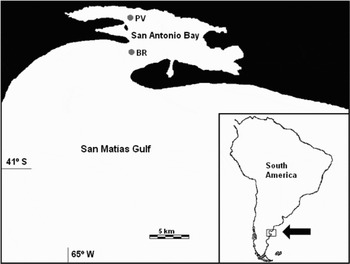
San Antonio Bay (40°42′S–40°50′S/64°43′W–65°07′W) is located in the north-western sector of San Matías Gulf, Argentina (Figure 1). It is an estuarine system with semidiurnal tides (tidal amplitude ranges between 6 and 9 m) and a system of channels exposed to strong tidal currents (Schnack et al., Reference Schnack, Aliotta, Isla and Lizasoain1996). A previous study on density of seahorses in the bay (González, unpublished data) showed that the highest number of fish is found in the subtidal environment, mainly in the beds of tidal channels. Seahorse samples were obtained from: (a) Banco Reparo (40°47′S/64°54′W), located in the north-western area of the main channel entering the bay; and (b) Punta Verde (40°43′S/64°57′W), a tidal pond located in the inner area of the bay. Currents of variable intensity of the order of 0.10 to 2.0 m/s are daily registered in both sampling sites (Schnack et al., Reference Schnack, Aliotta, Isla and Lizasoain1996).
Location of the study area and sampling sites (PV, Punta Verde; BR, Banco Reparo).

Fish sampling
San Antonio Bay is a coastal marine environment characterized by a high species richness and biological diversity. This ecosystem works as a refuge for fish, invertebrates, and migratory birds undergoing critical stages of their living cycle. San Antonio Bay was declared a Marine Protected Area in 1993. So, taking into account the protected area and the genus Hippoccampus conservation status, official permission was requested from the Consejo de Ecología y Medio Ambiente (CODEMA) before conducting this study.
Samplings were collected monthly (October 2001–February 2004) by SCUBA divers, either during low tide or the first hours of high tide. Transects (3 replicates), 1 m wide and 50–70 m long, were performed. All seahorses in the transect area were captured, individually stored in plastic bags and frozen at −18°C. Individuals were sacrificed and processed in the laboratory following a standard sampling routine. Total weight (g) and body dimensions (height in mm) were recorded following the method of Kuiter (Reference Kuiter2001). Each fish was dissected and the digestive tract was preserved in 70% alcohol.
For the dietary composition analysis, both stomach and gut contents were examined in glass capsules under stereoscopic microscope (10×–50×). All the species were identified or the taxonomic identity was determined as thoroughly as possible. Whenever possible, the number of prey corresponding to each group in each sample was recorded.
The dietary composition and relative importance of preys were evaluated by the following indices: (a) frequency of occurrence (%FO): percentage of guts containing a certain prey, with respect to the total number of stomach contents analysed; and (b) number of prey (%N): percentage of the total number of individuals of a certain prey, with respect of the total number of prey items.
Seahorses were classified in ranges (small: 0–5 g, medium: 5.1–10 g, large: >10 g) and the total number of prey found in guts was compared with ANOVA (Sokal & Rohlf, Reference Sokal and Rohlf1979), in order to identify differences between sex and size of seahorses. Both sites (Banco Reparo and Punta Verde) were analysed in the same way.
Prey sampling
Samples of the microfauna present in both sampling sites were collected during the whole study period. From each site, 3–5 replicates of the microhabitat close to the bottom, including the upper layer of sediment (2 cm) were randomly collected. Samples were obtained with a 20 cm-long corer, 4 inches in diameter, and preserved in plastic bags. In the laboratory, organisms smaller than 10 mm were removed and conserved in 70% alcohol for their later analysis. The same procedure used for dietary composition was followed for identification of the microfauna.
Free swimming preys were not taken into account because of the difficulties of sampling (time and logistics). Also, authors (James & Heck, Reference James and Heck1994; Woods, Reference Woods2002; Foster & Vincent, Reference Foster and Vincent2004) mentioned that other seahorse species were observed hunting among algal blades and the surrounding substratum and only occasionally actively swimming near macroalgae. So, free swimming preys were considered as if they were not very vulnerable to seahorses.
RESULTS
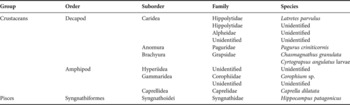
The stomach and gut content of 97 individuals (52 ♀, 45 ♂; 21–162 mm height) were analysed. Thirty-three per cent of these individuals (23 from Banco Reparo and 9 from Punta Verde) revealed identifiable content in the digestive tract and 21 had the stomach empty. Species and taxonomic groups found in the guts are shown in Table 1. The dietary composition of the Patagonian seahorse consisted mainly of juvenile decapods and amphipods and, to a lesser extent, juvenile seahorses. Sand particles with variable granulometry and macroalgal fragments (Polysiphonia abscissa, Gymnogongrus sp., Enteromorpha sp. and Dictyota dicotoma) were observed with relative abundance.
Species and groups identified in the digestive tracts of seahorses from the two sampling sites in San Antonio Bay.

The mean size of the carapace width for crabs found in gut contents was 1.57±0.32 mm. Amphipods and other preys could not be measured because they were usually broken; crabs' carapaces instead remained intact.
There were four specimens with juvenile seahorses in their stomach contents. The proximate height of juveniles was 7 mm. Even more, one individual was observed with three juvenile not fully developed (larvae) in its gut content.
No significant differences in the number of preys ingested were observed between sexes and sizes, in neither of the two sites analysed (ANOVA, P > 0.05). As a result, %FO and %N were calculated together for sexes and sizes. There were differences in the dietary composition between sites. The %FO indicated that gammarids predominate in both sampling sites. At Banco Reparo the two crustacean decapods also showed a high rate of occurrence whereas in Punta Verde this item was not detected in the digestive tracts analysed (Table 2).
Frequency of occurrence (%FO) and number of prey (%N), of the main species and groups identified in the digestive tracts of Hippocampus patagonicus from both sampling sites.

The %N for Banco Reparo showed that crustacean decapods predominate (in number) over amphipods (Table 2). On the other hand, although gammarids and caprellids evidenced the same %FO for Punta Verde, caprellids revealed a higher abundance. The average and standard deviation of each prey item found in the digestive tracts analysed indicates that the highest number of preys per stomach correspond to C. angulatus for Banco Reparo and caprellids for Punta Verde (Table 3).
Mean number and standard deviation (SD) of preys found in the digestive tracts of seahorses from the two study sites. N, number of digestive tracts containing the prey item.

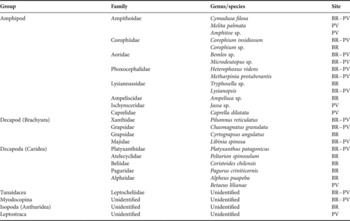
The microhabitat samplings allowed the identification of an important number of organisms of the microfauna that seem to constitute potential preys to seahorses. The genus and species identified for the sites analysed are shown in Table 4. The latter not only includes microcrustaceans but also larger species whose larval or juvenile stages constitute potential preys to seahorses.
Potential prey of the Patagonian seahorse in San Antonio Bay. BR, Banco Reparo; PV, Punta Verde.

DISCUSSION
The present study reports the first evidence on the diet composition in nature of the southernmost seahorse. Even though a low number of the samples analysed showed identifiable stomach or gut content, data collected in this study allowed us not only to characterize the dietary composition of H. patagonicus in two different sites but also to identify differences between them. In San Antonio Bay, the main dietary items of the Patagonian seahorse are crustaceans, particularly, amphipods (Gammaridae and Caprellidae and to a lesser extent, Hyperiidae) and decapods (particularly, Brachyura and Caridea).
Woods (Reference Woods2002), analysing the natural diet of H. abdominalis, claimed that the type of crustaceans ingested is indicative of both the predation method and habitat of the prey. The amphipods and decapods registered in H. patagonicus are generally found in temperate waters from the intertidal zone and are commonly associated with green, red and brown algae (Alonso de Pina, Reference Alonso de Pina1997). Life habits of these organisms make them vulnerable to seahorses, which are most of the time grasped by the tail to algae or other objects, capturing the preys accessible to them (González, personal observation).
Our data reveal that microcrustaceans (amphipods and crabs) predominate over other preys in the diet of H. patagonicus. These observations agree with those reported by Tipton & Bell (Reference Tipton and Bell1988), Teixeira & Musick (Reference Teixeira and Musick2001) and Woods (Reference Woods2002), regarding H. zoosterae, H. erectus and H. abdominalis, respectively. Besides, there were differences between %FO and %N indices obtained for the two sites evaluated. These differences may be due to the relative abundance and availability of prey in each habitat.
The mean size of crabs found in the gut contents showed that some microcrustacea (mainly amphipods and decapods) in San Antonio Bay, have (when juvenile or adult) sizes lower than the mouth gape of seahorses, which is between 2.2 and 3.3 mm (González, unpublished data). So, they constitute potential prey for seahorses.
A predator is said to exhibit preference for a prey item when it consumes that prey more often than it would normally encounter it in the environment (Begon et al., Reference Begon, Harper and Townsend1995). Therefore, in order to trace preferences in the feeding habits of a particular species it is necessary both to analyse the diet of the fish and the availability of different prey in the environment. With regard to this, results from our study confirm among the dietary items, the presence of at least 7 of the species or groups of species reported in the microhabitats of H. patagonicus in San Antonio Bay. The majority of such items, such as C. granulata, C. angulatus and some species of gammarid and caprellid amphipods, are frequent prey as it can be inferred from %FO and %N. These indices and the mean number of prey found in the digestive tracts indicate that gammarid amphipods and decapods (C. angulatus and C. granulata) are very abundant prey in the environments analysed.
It can be concluded that in San Antonio Bay, seahorses feed on a wide spectrum of preys. The absence of representation of some species or taxa in the diet shown in Table 4 could be due either to seasonal variations in their abundance and availability or to spatial segregation of the early ontogenic stages (e.g. crabs). Other studies (Bres, Reference Bres1986; Xie et al., Reference Xie, Cui, Zhang and Li2000) have also pointed out that changes in the feeding habits of fish may result from seasonal changes in the abundance of prey.
In some stomachs of H. patagonicus analysed, the presence of sand particles was observed, although the quantification of such particles is beyond the scope of the present study. Woods (Reference Woods2002) mentions that the presence of sand in stomach contents, may be indicative of individuals unusually found in open areas with a bottom surface having no algae. As a result, an accidental ingestion of inorganic particles during the suction of organisms on sandy bottom surfaces may occur. The capture of preys of either benthic or infaunal habits may also lead to accidental ingestion of sand grains. The presence of Corophium sp. in the diet of H. patagonicus could be indicative of this.
Cannibalism on juveniles appears to be a common phenomenon in the genus Hippocampus. Scarratt (Reference Scarratt1996) mentions that during the growing of H. erectus in captivity the newly-born seahorses had to be separated to avoid predation from the parents. In the case of H. patagonicus, 4 samples with juveniles in their stomachs (one of which had 3 individuals) were found. Pregnant male seahorses demonstrate parental care, however recently hatched fish become totally independent after birth (Wilson & Vincent, Reference Wilson and Vincent1999). Newly-born seahorses have similar sizes to adult prey (approximately 7 mm); consequently, and taking into account the broad dietary spectrum of this fish, juveniles may constitute a potential prey for adults. There is little literature concerning cannibalism in seahorses. Rosa et al. (Reference Rosa, Alves, Bonifácio, Mourão, Osório, Oliveira and Nottingham M.2005) evaluating the fishers' knowledge on Hippocampus reidi in the wild, registered two fishers who said that young seahorses may be eaten by the adults. Some researchers (University of Georgia, 2000) also documented filial cannibalism in seahorses and tested the idea that these parents might be actually eating only the young of other parents; however genetic data confirmed that filial cannibalism does indeed occur. Kitsos et al. (Reference Kitsos, Tzomos, Anagnostopoulou and Koukouras2008) analysed the diet composition of Hippocampus guttulatus and Hippocampus hippocampus and found Hippocampus spp. ova (with embryos) in the gut of both species, but they do not discuss the occurrence further. In males of paternal mouthbrooding fish, studies have indicated that filial cannibalism is affected by male status, such as age, somatic condition and mate availability (Okuda, Reference Okuda1999; Takeyama et al., Reference Takeyama, Okuda and Yanagisawa2007). Perhaps the sedentary strategy and the limited alternative food are the factors influencing cannibalism in seahorses.
As shown in other seahorses (D'Entremont, Reference D'Entremont, Foster and Vincent2002; Foster & Vincent, Reference Foster and Vincent2004), and even though its quantification was not carried out in the present study, the involuntary consumption of algae in order to obtain animals adhered to them is a common phenomenon in the Patagonian seahorse.
Studies on the feeding habits of fish reveal differences in the diet of males and females (Molinero & Flos, Reference Molinero and Flos1991; Castillo-Rivera et al., Reference Castillo-Rivera, Kobelkowsky and Chavez2000). These differences which are attributed to the behaviour of fish as well as other factors inherent to each sex, were not observed in the present study. D'Entremont (Reference D'Entremont, Foster and Vincent2002) and Woods (Reference Woods2002) found no differences in the dominant prey-types among gravid males, non-gravid and females of H. guttulatus and H. abdominalis, repectively.
In some syngnathids, diet variations have been observed throughout ontogenic development (Tipton & Bell, Reference Tipton and Bell1988; Teixeira & Musick, Reference Teixeira and Musick2001; Woods, Reference Woods2002). Our results indicate that, within the range of sizes analysed (21–162 mm height), there are no differences in the diet composition. This could be indicative of a certain degree of intra-specific competence because of the food available.
Our results show that H. patagonicus is a versatile predator, with the ability to incorporate a wide range of preys. Also, and due to the morphological characteristics of seahorses (such as limited flexibility, slow swimming and static position most of the time) as well as the limiting environmental factors (strong currents, variations in availability and abundance of preys), the Patagonian seahorse does not seem to have a selective trophic behaviour. Then, this species may take advantage of those organisms which are not only the most abundant but also the most vulnerable in nature, thus evidencing the behaviour of an opportunistic predator.
The theory of optimal foraging states that relatively sedentary predators, which wait to capture their preys, as it is the case of H. patagonicus, evidence a higher average rate of energy gain when preys are scarce (Caraco & Gillespie, Reference Caraco and Gillespie1986). In disagreement with this, our observations indicate that the microcrustacean fauna in San Antonio Bay is sufficiently abundant to satisfy the feeding requirements of seahorses. Finally, our results may contribute to hypothesize that the opportunistic strategy used by the Patagonian seahorse seems to be related to the physical restrictions of the environment.
ACKNOWLEDGEMENTS
The authors are grateful to Sandro Acosta, Néstor Dieu and Tony Brochado for their technical assistance in the diving surveys. Thanks are also due to Dr Gloria Alonso and Dr Daniel Roccatagliata for their assistance in the identification of microcrustaceans.