Introduction
The risk of radiation emergencies is always present for various reasons, and all countries must be ready to respond to them.Reference Veenema, Lavin and Bender1 After the Fukushima accident, it became clear that special preparations should be made for such incidents.Reference Marui, Sawano and Yamamoto2
Given Iran’s developing nuclear infrastructure and the presence of multiple nuclear facilities across the country, the risk of radiation accidents—whether from power plants, medical applications, or the transportation of radioactive materials—poses a tangible threat to public health. These incidents may include nuclear power plant accidents, radiological dispersal devices (dirty bombs), medical or industrial radiation leaks, or transportation-related events involving radioactive materials. In addition to risks associated with nuclear facilities, the widespread use of radiation in medical and industrial applications may increase population exposure. Furthermore, the transport of radioactive materials across extensive networks increases the potential for accidental releases and related incidents.Reference Noel, Stricklin, Pandya, Hatch, Hicks, Ryan and Swienton3
Different groups are involved in responding to nuclear disasters. The largest and most significant role in helping the injured belongs to the health system, particularly hospitals, which serve as the primary medical service providers. To meet these obstacles, the health system must have a unique plan in place for anticipating and handling such incidents. Increasing hospital preparedness for nuclear and radiological accidents depends on raising the personnel’s risk perception, having a suitable physical space, and having sufficient equipment.Reference Schneider4 Hospitals prepare to deal with disasters using the all-hazard approach, but the preparation for radiation accidents may differ from the all-hazard approach.Reference Diamond5
Risk perception among senior managers and hospital personnel is one of the most critical issues in preparing for nuclear accidents.Reference Xu, Xie and Li6 To assess the risk perception of hospital staff and managers, their knowledge about nuclear accidents and the stages of personnel change to prepare for nuclear accidents should be investigated.Reference Farhat, Alinier and Helou7
Based on the stages of the change model, hospital personnel may be in passive stages of change, including pre-contemplation, contemplation, and preparation, or they may be in active stages of action and maintenance. This model states that people may be promoted or downgraded during the cycle of stages of change by using other constructs such as decisional balance, self-efficacy, and cognitive and behavioral processes of change.Reference Moslehi, Tavan and Narimani8
Increasing awareness and creating a risk perception and stage of change promotion among hospital personnel are the most critical aspects of preparing medical centers to manage nuclear accidents. To plan to increase the risk perception of hospital personnel and managers, their stages of change should be determined first. Then, the predictors of improving the stages of change should be examined. Cognitive and behavioral processes of change, self-efficacy, and decisional balance affect the stages of change in nuclear radiation risk perception and, ultimately, the hospital’s preparedness to deal with these disasters.Reference Nishikawa, Yamaguchi and Yamada9
Various studies have concluded that personnel education and training play a significant role in increasing personnel risk perception; however, the critical issue is whether all personnel are at the same stage and whether the predictors of improving awareness and preparedness of all staff are the same.Reference Li and Li10-Reference Narimani, Mozaffari and Soola12 Using the model of stages of change can be helpful in the proper management of this challenge.
Despite the growing application of the stages of change model in health behavior research, few studies have applied this model to radiation preparedness, particularly in low-resource hospital settings. The unique challenges of low- and middle-income countries, including resource limitations and infrastructure gaps, necessitate context-specific investigations that go beyond the findings of high-income countries.
Therefore, in this study, we are looking for the following three particular goals:
-
1. Determining the hospital’s level of readiness to deal with nuclear radiation;
-
2. Determining the knowledge and risk perception of nursing personnel about nuclear radiation;
-
3. Determining the stages of change in nursing personnel and the components of improving the stages of change among hospital personnel.
Methods
An analytical cross-sectional study was conducted using four questionnaires to measure the level of preparedness of teaching hospitals for nuclear disasters and to understand the risk perception of emergency department nurses regarding nuclear radiation. Additionally, the stages of change model questionnaire was used to determine the stages of change for nurses in managing nuclear accidents, aiming to identify the predictive components that could enhance these stages.
After obtaining the ethics code from the ethics committee of Kerman University of Medical Sciences (IR.KMU.REC.1400.208) and receiving the necessary permits, the researcher visited the university’s affiliated hospitals. To assess hospital preparedness, a three-pronged approach was employed: (1) document review of hospital disaster plans, crisis committee records, and training logs; (2) direct observation of designated decontamination areas, personal protective equipment storage, and radiation detection devices; and (3) structured interviews with hospital managers, the quality improvement officer, and the hospital crisis committee secretary. Each item on the preparedness checklist was verified through at least two sources of evidence before being scored as present.
After obtaining signed consent, nurses received risk perception and stage of change questionnaires. The census approach was used for sampling. The 3 selected hospitals are teaching hospitals affiliated with Kerman University of Medical Sciences, representing the primary tertiary care centers in southeastern Iran. These hospitals serve as referral centers for a wide geographic area and are expected to function as frontline responders in regional disasters, including potential radiation incidents. Ninety-five percent of eligible nurses completed the questionnaires and were enrolled in the study.
Instruments
The questionnaires used in this study were as follows: The demographic information questionnaire of nurses, which includes age, sex, marital status, educational qualification, work experience, workplace hospital, and number of children.
To determine the level of preparedness of hospitals against radiation accidents, the tool “Measuring the level of preparedness of hospitals against radiation and nuclear accidents” was used, designed, and analyzed by Jahangiri et al. in 2015.Reference Jahangiri, Sohrabizadeh, Sadighi, Tavousi and Rostami13 This questionnaire has 56 questions and 5 fields. The fields of this questionnaire include the preparation of the physical space of the hospital, the preparation of the hospital equipment, the preparation and training of the hospital’s human resources, the coordination within the hospital, and the coordination of the hospital with other supporting organizations. The answers to each of the questions in this questionnaire, which indicate the presence or absence of the desired standard, were “yes” and “no,” and the total score was calculated based on the number of yes answers. In addition, the hospital’s score in each of the 5 areas was also measured. The researcher carefully graded based on the existing standards and documents, and it was reviewed by 2 other colleagues.
The content analysis index (CVI) for all questions and dimensions of the questionnaire was reported to be higher than 0.8, and Cronbach’s alpha coefficient for each dimension of the questionnaire was higher than 0.7. Moreover, it was estimated at 0.79 for the whole instrument. In the present study, we further confirmed its face validity through review by three hospital disaster management experts.
To determine the risk perception of nuclear radiation risk among hospital nurses, the instrument prepared by Hosseini et al.Reference Hosseini, Bahadori and Raadabadi14 was used. This tool, with 16 multiple-choice questions, measures nurses’ awareness level in facing radiation accidents. Answers to questions 1, 2, 3, 5, 7, 9, 10, 14, and 16 on the Likert scale (not at all, minimal, appropriate extent, and thoroughly familiar) and answers to questions 4, 6, 8, 12, 13, and 15 are correct options. The validity of the tool was confirmed in the university expert panel. Test-retest reliability was conducted with a 2-week interval on a pilot sample of 20 nurses, yielding an intraclass correlation coefficient (ICC) of 0.91 (95% CI: 0.85-0.95), indicating excellent stability.
Four sub-constructs were made up of the stage of change questionnaire in the current study: (1) stage of change, (2) processes of change, (3) self-efficacy, and (4) decisional balance.Reference Moslehi, Tavan and Narimani8 The readiness and progress of nurses in gaining the skills needed to handle nuclear emergencies were evaluated using five questions that measured the stages of change (pre-contemplation, contemplation, preparation, action, and maintenance). Thirty questions with 5-point Likert ratings, ranging from “never” (score of 1) to “always” (score of 5), were used to evaluate the processes of change. These questions assessed an individual’s ability to manage nuclear incidents based on their thoughts and behavior about past experiences from the preceding month. Additionally, we assessed self-efficacy using thirty questions that measured an individual’s capacity to surmount possible setbacks, withstand the need to forego providing nursing care, and stop unethical behavior in radiological events. The evaluation was performed using a 5-point Likert scale, ranging from “1” (very low) to “5” (very high). Ten questions that probed a person’s decision-making process about accepting nursing care in nuclear events were used to assess the decisional balance. The decisional balance consists of 2 substructures, assessed using 5 questions: the advantages (Pros) and disadvantages (Cons). A 5-point Likert scale was used to grade the responses, with one representing “not very important” and five representing “very important.”
The CVI scores for the stages of change, process of change, self-efficacy, and decisional balance were 89%, 95%, 90%, and 88%, respectively. For these parameters, the CVR ratings were 90%, 89%, 84%, and 76%. Furthermore, the internal consistency of the decisional balance, process of change, and self-efficacy subscales was verified using Cronbach’s alpha coefficient, yielding values of 0.90, 0.75, and 0.72. Confirmatory factor analysis (CFA) was performed to verify the construct validity of the processes of change, self-efficacy, and decisional balance subscales, with all factor loadings exceeding 0.40 and model fit indices (CFI > 0.90, RMSEA < 0.08) indicating acceptable fit.
Data Analysis
The data was analyzed using SPSS v26. The stage of change model’s components and the demographic traits and scores obtained from the risk perception tool were examined using descriptive statistics, such as mean and standard deviation tests. An analysis of variance test was performed to determine the link between the model variables and demographic parameters. Using self-efficacy, behavioral and experiential processes of change, and decisional balance (pros and cons) as independent variables, we employed linear regression to identify predictors of the stage of change as a dependent variable.
Model assumptions were evaluated prior to interpretation. Linearity between the dependent and independent variables was visually checked using scatter plots. Normality and homoscedasticity of residuals were examined by inspecting residual plots. Independence of errors was confirmed by Durbin–Watson’s statistic (DW = 1.921), indicating no relevant autocorrelation.
To assess multicollinearity, we inspected tolerance and variance inflation factors (VIFs) for all predictors; all VIF values ranged from 1.12 to 1.85, and tolerance values ranged from 0.54 to 0.89, indicating no serious multicollinearity. Overall model fit was evaluated using the coefficient of determination (R2) and the F-statistic from the regression ANOVA table.
Result
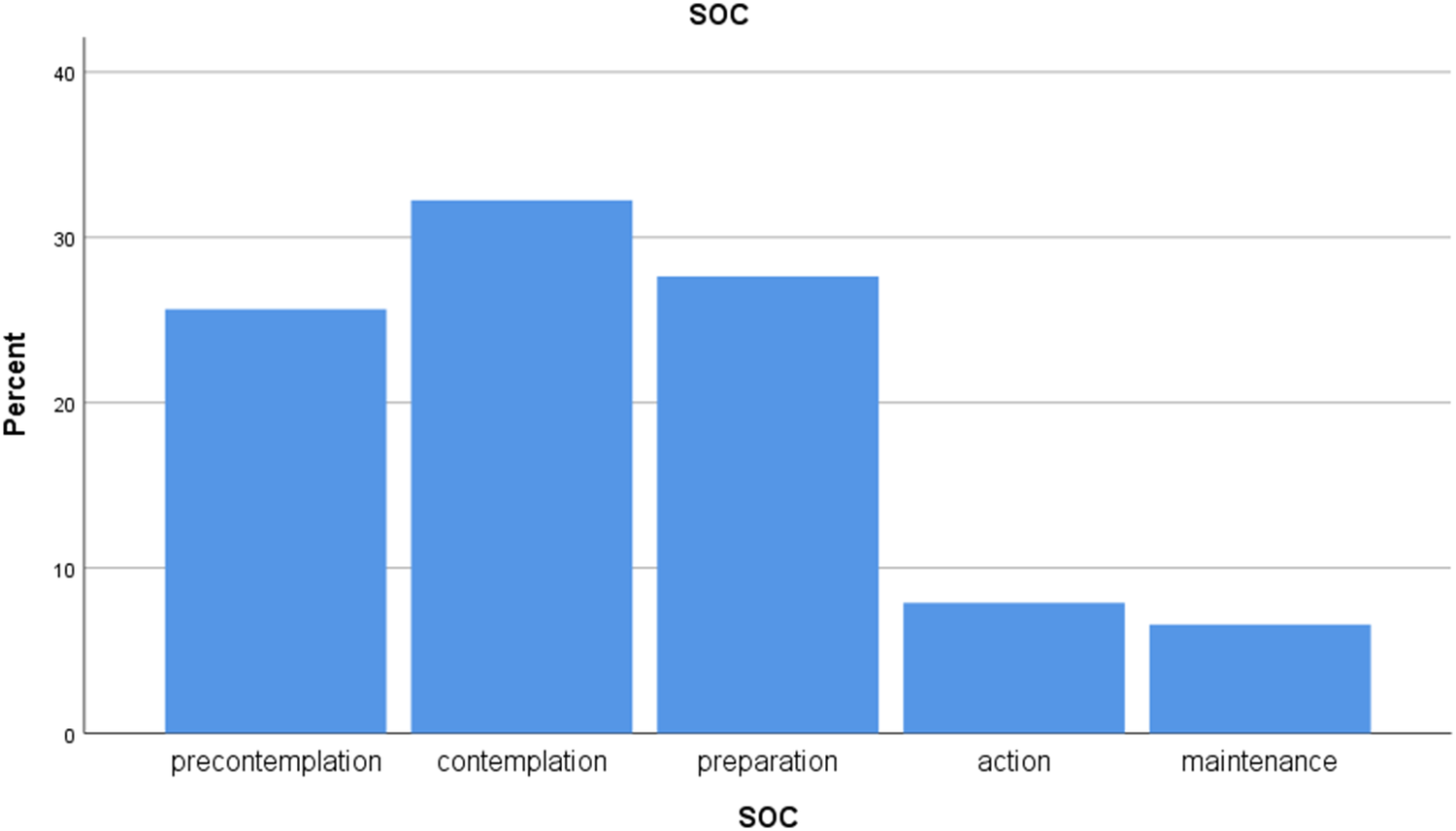
A total of 152 out of 160 nurses employed in the emergency departments of 3 teaching hospitals affiliated with Kerman University of Medical Sciences participated in the study by completing the questionnaires. All questionnaires were completed and included in the analysis. Seventy-five percent of the participants were women, and most were aged 25 to 35 years. The majority (85.5%) were in the passive stages of change (pre-contemplation, contemplation, and preparation). Furthermore, participants demonstrated a need for increased awareness of nuclear incidents and greater engagement in processes such as dramatic relief to reduce apprehension (Figure 1).
Stage of change of nursing in nuclear incidents.

Three educational hospitals were assessed using the hospital preparation for radiological incidents tool. Based on this, the overall average score of preparedness of the examined hospitals is reported as intermediate to good (see Table 1).
Hospital preparedness for nuclear accidents

Table 1. Long description
The table consists of seven rows representing preparedness categories: Physical space, Equipment, Education, Internal coordination, External coordination, Total, and Hospital accreditation. Each row contains values for Shafa, Bahonar, and Afzalipour hospitals, followed by minimum, maximum, mean, and standard deviation columns. For Physical space, Shafa scored 4, Bahonar 3, Afzalipour 6, with a minimum of 3.00, maximum of 6.00, mean of 4.3333, and standard deviation of 1.52753. Equipment scores are 19 for Shafa, 21 for Bahonar, 15 for Afzalipour, minimum 15.00, maximum 21.00, mean 18.3333, standard deviation 3.05505. Education scores are 4, 3, and 0, minimum .00, maximum 4.00, mean 2.3333, standard deviation 2.08167. Internal coordination scores are 9, 8, and 3, minimum 3.00, maximum 9.00, mean 6.6667, standard deviation 3.21455. External coordination scores are 5, 6, and 4, minimum 4.00, maximum 6.00, mean 5.0000, standard deviation 1.00000. Total scores are 41 for Shafa, 41 for Bahonar, 28 for Afzalipour, minimum 28.00, maximum 41.00, mean 36.6667, standard deviation 7.50555. Hospital accreditation is listed as Good for Shafa and Bahonar, Intermediate for Afzalipour, with no descriptive statistics provided for this row.
The nursing staff’s awareness and attitude toward radiation accidents were assessed. The findings suggest that improving nurses’ knowledge and strengthening their behavior are necessary to enhance risk perception among frontline hospital staff (see Table 2).
Emergency nurses’ risk perception of radiological incidents

Table 2. Long description
The table has four columns: Risk perception items, Min, Max, and Mean. The first row lists ‘The level of awareness and attitude toward radiation accidents’ with Min 7, Max 28, Mean 14.5. The second row is ‘Awareness of the required equipment’ with Min 3, Max 12, Mean 5.1. The third row is ‘Awareness level of decontamination and attitude toward it’ with Min 2, Max 8, Mean 3.9. The fourth row is ‘Level of awareness and attitude toward treatment protocols’ with Min 1, Max 4, Mean 2.6. The fifth row is ‘Level of awareness and attitude toward side effects’ with Min 1, Max 4, Mean 2.4.
Linear regression showed that the cognitive and behavioral processes of change constructs have a strong influence on improving the nursing personnel stages transition into the action and maintenance stages (see Table 3).
Predictors of nurses’ stages transition in nuclear incidents based on the stages of change model

Table 3. Long description
The table lists predictors for nurses’ stage transition in nuclear incidents, with the dependent variable as S O C. Columns are: Stage of change constructs and independent variables, unstandardized coefficients (B, standard error), standardized coefficient (Beta), t value, and significance (Sig.). First row: Self-efficacy, B 0.003, standard error 0.003, Beta 0.054, t 0.768, Sig. 0.444. Decision balance is split into Pros (B 0.107, standard error 0.016, Beta 0.690, t 6.770, Sig. 0.001) and Cons (B minus 0.016, standard error 0.017, Beta minus 0.073, t minus 0.901, Sig. 0.369). Process of change is split into Cognition (B 0.067, standard error 0.015, Beta 0.937, t 4.576, Sig. 0.001) and Behavioral (B 0.057, standard error 0.014, Beta 0.763, t 0.384, Sig. 0.001). Summary statistics: R squared 0.146, adjusted R squared 0.140, F 23.75 with degrees of freedom 4 and 556.
Dependent variable: SOC
Summary statistics: RReference Marui, Sawano and Yamamoto2 = 0.146, Adjusted RReference Marui, Sawano and Yamamoto2 = 0.140, F = 23.75 (4, 556)
The overall regression model was statistically significant and showed an acceptable fit to the data (RReference Marui, Sawano and Yamamoto2 = 0.146, Adjusted RReference Marui, Sawano and Yamamoto2 = 0.140, F(4, 556) = 23.75, P < 0.001). Among the predictors, cognitive (experiential) processes of change were identified as the strongest predictors of stage advancement, as they exhibited the largest beta value (B = 0.937, P < 0.001). Behavioral processes of change (B = 0.763, P < 0.001) also emerged as significant predictors. In contrast, self-efficacy (B = 0.054, P = 0.444) did not show statistically significant associations with stage of change after adjusting for the other variables (P > 0.05).
Examination of the residual plots confirmed that the assumptions of linearity, normality, and homoscedasticity were reasonably met. The Durbin-Watson statistic (DW = 1.921) indicated no relevant autocorrelation in the residuals, and all variance inflation factors (VIF) were below 10, suggesting no serious multicollinearity.
A one-way ANOVA revealed that the most important factors in facilitating the nursing stages transition to manage radiological accidents are stimulus control and self-liberation, which are substructures of the cognitive and behavioral processes of change (see Table 4).
Evaluating the nursing stage transition in radiological incidents based on processes of change

Table 4. Long description
The table contains 12 rows for processes of change and six columns: Pre-contemplation, Contemplation, Preparation, Action, Maintenance, and P-value. For Cognitive, means and standard deviations are 36.5 plus or minus 14.83, 36.3 plus or minus 12.52, 55.8 plus or minus 13.97, 53.9 plus or minus 13.8, and 55.2 plus or minus 12.6, with P-value 0.001. For Behavioral: 35.9 plus or minus 14.5, 55.3 plus or minus 11.5, 57 plus or minus 12.9, 51.3 plus or minus 12.7, 58.3 plus or minus 10.5, P-value 0.001. For Consciousness-raising: 7 plus or minus 2.8, 10.83 plus or minus 3, 11.21 plus or minus 2.57, 10.3 plus or minus 2.4, 10.4 plus or minus 3.2, P-value 0.001. For Dramatic relief: 6.9 plus or minus 3.3, 11.6 plus or minus 3, 10.3 plus or minus 3.25, 10.4 plus or minus 2.7, 10.6 plus or minus 3.17, P-value 0.001. For Environmental reevaluation: 7.8 plus or minus 2.9, 11.6 plus or minus 2.7, 11.2 plus or minus 3, 11.1 plus or minus 2.6, 10.5 plus or minus 2.6, P-value 0.001. For Self-reevaluation: 6.8 plus or minus 3.58, 11.5 plus or minus 2.8, 11.8 plus or minus 2.8, 10.75 plus or minus 3, 12.1 plus or minus 2.84, P-value 0.001. For Social liberation: 7.94 plus or minus 3.72, 10.75 plus or minus 2.5, 11.23 plus or minus 3.3, 11.1 plus or minus 3.5, 11.3 plus or minus 3.2, P-value 0.001. For Self-liberation: 7.2 plus or minus 3.6, 10.9 plus or minus 2.93, 11.6 plus or minus 2.95, 10 plus or minus 2.9, 12.6 plus or minus 2.6, P-value 0.001. For Counterconditioning: 7.5 plus or minus 2.87, 11.42 plus or minus 2.57, 11.5 plus or minus 2.38, 10.4 plus or minus 2.7, 11.1 plus or minus 2.9, P-value 0.001. For Helping relationship: 7.1 plus or minus 2.8, 9.5 plus or minus 2.21, 11.1 plus or minus 3, 8.5 plus or minus 2.64, 10.4 plus or minus 3.2, P-value 0.001. For Reinforcement management: 6.9 plus or minus 3.15, 11.7 plus or minus 2.81, 11.3 plus or minus 2.42, 11.6 plus or minus 2.7, 11.6 plus or minus 2.45, P-value 0.001. For Stimulus control: 7.15 plus or minus 3.2, 11.8 plus or minus 3.42, 11.45 plus or minus 3.47, 10.6 plus or minus 3.28, 12.6 plus or minus 2.22, P-value 0.001. All processes show statistically significant differences across stages.
Discussion
Hospital facilities and frontline nursing staff require a high level of physical and psychological preparedness for radioactive and nuclear incidents.Reference Narimani, Seyedin and Moslehi15 Education and training alone may not be sufficient to empower nurses in radiological crises; instead, nurses’ mental, psychological, social, spiritual, and financial requirements must be considered during the preparedness phase, as these factors significantly influence their ability to respond effectively to such emergencies.Reference Seyedin, Moslehi and Narimani16 On the other hand, the second arm focuses on the appropriate response to radiological incidents concerning hospital resources and preparedness. Furthermore, all personnel from the frontline forces to the management should have a strong awareness of the risk of radiological incidents.Reference Narimani, Seyedin and Moslehi15, Reference Seyedin, Moslehi and Narimani16
Unlike many natural disasters such as earthquakes, radiation incidents are often invisible, poorly understood, and associated with long-term health consequences such as cancer.Reference Narimani, Seyedin and Moslehi15, Reference Burtt, Akiba and Bazyka17 This uncertainty increases fear, stigma, and avoidance behaviors among health care workers.Reference Narimani, Seyedin and Moslehi15 Therefore, psychological preparedness plays a more central role in radiation emergencies compared to disasters with immediate and visible impacts.
The first of the three specific objectives we sought to address in our study was hospital readiness for radiological incidents. The finding that equipment scored highest while education scored lowest in hospital preparedness reveals a critical imbalance: physical resources are available, but human resources remain underprepared. This pattern suggests that Iranian hospitals may be prioritizing tangible assets over the less visible but equally essential component of workforce training, a trend that mirrors findings from other low-resource settings.Reference Olyaeemanesh, Habibi and Mobinizadeh18, Reference Najar, Zarqi and Hooshmand19
The overall accreditation scores ranged from moderate to good, which is consistent with findings from Diamond et al.Reference Diamond5 To prevent the loss of previously acquired knowledge under the stress of real incident conditions, education and training for radiological incidents should be conducted through simulation.Reference Popov, Iatsyshyn and Iatsyshyn20-Reference Lavin, Mangano and Goodwin22 While Diamond et al.Reference Diamond5 reported higher levels of hospital preparedness in New York City hospitals, the discrepancy with our findings may be attributed to differences in resource availability, regulatory requirements, and prior exposure to radiation threats. Unlike U.S. hospitals that have received substantial federal funding for bioterrorism and radiation preparedness since 9/11, Iranian hospitals operate under resource constraints that limit sustained investment in specialized radiation training and equipment.
The study’s second specific objective was to ascertain the risk perception of nurses based on their awareness of and attitudes about radiological occurrences. The nurses’ ratings on all questions fell within the average range. Our study’s results are consistent with those of Xu et al.Reference Xu, Xie and Li6 While Xu et al.Reference Xu, Xie and Li6 reported similar levels of awareness among Chinese health care workers, the persistently moderate levels across different settings suggest that conventional training approaches may be insufficient. The lower intermediate level of awareness is particularly problematic during radiological occurrences, as it can exacerbate fear and panic, thereby worsening the stages of change in nursing behavior.Reference Diamond5, Reference Dağ, Çalışkan and Koçak23 It is recommended that frontline nursing personnel be exposed to scientific materials at various intervals, in conjunction with dramatic relief and accident scene simulation, to mitigate the fear and panic accompanying radiological accidents. Finally, the individual will achieve increased confidence in working in radiological events through stimulus control. In addition to the stimulus control construct, reinforcement management is effective in increasing risk perception among frontline nurses responding to radiological incidents in hospital emergency departments, as it provides positive feedback and rewards for recognizing and addressing potential hazards in these high-stress situations.
The third objective of the current study was to identify the nursing stages of behavior modification and the factors that predict stage transition in radiological accidents. The majority of nurses (85.5) were in the passive stages of change (pre-contemplation, contemplation, preparation), so talking about radiological incidents caused them fear. The Transtheoretical Model indicates that individuals in the pre-contemplation and contemplation stages typically lack awareness of risks or feel overwhelmed by negative emotions. Radiation accidents, often perceived as catastrophic and uncontrollable, may particularly amplify this emotional barrier. This calls for interventions that address not only knowledge deficits but also emotional responses through dramatic relief and consciousness-raising techniques. These findings are consistent with prior applications of the Transtheoretical Model in health behavior.Reference Moslehi, Tavan and Narimani8
After conducting a more thorough examination of the subconstructs of processes of change, it was discovered that the subconstructs of dramatic relief and awareness-raising are crucial in helping nurses transition from the pre-contemplation stage to the preparation stage. Considering that awareness-raising and attitude can decrease over time before it is implemented to understand the risk, action should be taken to stabilize and strengthen the information and prevent the reduction of the stages of change and relegation to the elementary stages. In the current study, the sub-construct of reinforcement management from the constructs of behavioral processes stabilized the stage of change in the preparation stage and promoted the change stages. Our study’s results are consistent with those of Moslehi et al.Reference Xu, Xie and Li6, Reference Moslehi, Tavan and Narimani8, Reference Shubayr24
To be more prepared and perform appropriate operations in radiological incidents, nurses should enter the active stages of behavior change, i.e., action and maintenance. The present study showed that self-liberation is the central infrastructure promoting the stage of change at this moment. Stimulus control is the main substructure for improvement during all stages, and in this stage (i.e., passing from preparation to action), it helps self-liberation as an auxiliary structure so that nurses are stabilized in the action stage. As well as two substructures of helping relationships and counter-conditioning prevent the reduction of the change stage to inactive stages. Our study’s results are consistent with those of Moslehi et al.Reference Moslehi, Tavan and Narimani8, Reference Ohba, Tanigawa and Liutsko25
Finally, for frontline nurses to reach the maintenance stage in radiological preparedness, constructs such as self-reevaluation, social liberation, and self-liberation play a vital role. When these are supported by reinforcement management and stimulus control, nurses are more likely to remain in the maintenance stage and avoid relapse to earlier stages. This process can help transform nurses’ awareness and attitudes into an appropriate perception of risk and more effective responses to radiological incidents. Our findings are consistent with those reported by Matsuo et al.Reference Matsuo and Hirano26
In contrast to radiation incidents, disasters such as earthquakes—common in Iran—are more familiar to health care workers and involve visible injuries and well-established response protocols.Reference Bidaki27 While psychological stress is also present in such events, it is typically related to workload and trauma exposure rather than fear of invisible hazards. This difference may explain why behavioral and emotional barriers are more pronounced in radiation preparedness.
Overall, our findings align with existing literature suggesting that behavioral and cognitive processes play a central role in disaster preparedness. Similar patterns have been reported in studies of health care workers’ preparedness for infectious disease outbreaks, where psychological factors—such as fear, uncertainty, and perceived risk—have been shown to significantly influence willingness to respond, particularly during the COVID-19 pandemic.Reference Murray, Mason and Sparke28, Reference Sirois and Owens29
Limitations
This study has several limitations. First, it was conducted exclusively in three teaching hospitals in Kerman city, which limits the generalizability of findings to other regions of Iran with different resource levels, infrastructure, or exposure to nuclear risks. Second, the cross-sectional design captures only a single point in time and cannot assess changes in preparedness or risk perception over time. Third, the findings must be interpreted within the context of Iran’s health care system, which faces unique challenges, including economic sanctions that restrict access to advanced radiation detection and decontamination equipment, as well as limited opportunities for international collaboration in disaster training. These contextual factors may exacerbate the gap between knowledge and preparedness observed in this study. Future multicenter and longitudinal studies are recommended to enhance external validity and examine causal relationships.
Although the study was limited to three teaching hospitals in one region, these hospitals function as referral and tertiary care centers, which share structural and operational similarities with other teaching hospitals in Iran and comparable low- and middle-income countries. Therefore, some of the observed patterns—particularly the gap between infrastructure and behavioral readiness—may be transferable to similar health care settings.
Implications for Other Settings
The applicability of these findings to other health care systems should be interpreted with caution. However, the identified role of behavioral processes of change is likely relevant across different contexts, as similar behavioral barriers have been reported in disaster preparedness literature globally. In high-resource settings, these findings may inform the refinement of training programs, while in low-resource settings, they highlight the value of low-cost, behaviorally targeted interventions.
Conclusion
Training must consider psychosocial factors in improving nurses’ skills to deal with radiological accidents. Although awareness raising is the basis of all training, increasing awareness without considering the practical components in improving the stages of change and stabilizing behavior may be insufficient. To prepare for radiological incidents, the frontline forces’ mental, emotional, and psychological aspects should be considered in planning because if nursing personnel are not mentally and psychologically prepared, the structure of self-liberation and self-reevaluation will not be activated.
Based on these findings, we recommend that hospital disaster planners and policymakers:
(a) conduct annual assessments of nursing staff’s stages of change to tailor interventions appropriately; (b) integrate cognitive processes (consciousness-raising, dramatic relief) for staff in pre-action stages, while emphasizing behavioral processes (stimulus control, reinforcement management, self-liberation) for those in preparation and action stages; (c) establish peer support networks that leverage helping relationships to prevent relapse to earlier stages; and (d) implement regular risk communication strategies that move beyond basic awareness to foster sustained behavioral change.
While context-specific factors should be considered, the emphasis on stage-matched, behaviorally informed interventions may have relevance across diverse health care systems, particularly in settings where gaps between knowledge and practice persist. This supports the potential external validity of the findings beyond the study context.
For other low-resource settings, our findings highlight the importance of leveraging low-cost, high-impact strategies such as scenario-based simulations and peer-led training programs that specifically target behavioral processes of change. These approaches may be particularly applicable to teaching hospitals and tertiary care centers with similar structural and resource constraints.
Improving hospital preparedness in such contexts may therefore require not only strengthening workforce capacity and ensuring access to appropriate equipment, but also integrating psychosocial and behaviorally oriented interventions into existing training programs.
Data availability statement
Data will be made available on request.
Acknowledgments
We would like to extend our gratitude to the Kerman University of Medical Sciences, Iran, for their invaluable support in this project.
Author contribution
Nadia Sedri and Neda Nayebi are responsible for the study design and data gathering. Sajjad Narimani and Asghar Tavan did the analyses and were responsible for data interpretation. Sajjad Narimani and Hojjat Farahmandnia conducted the drafting of the manuscript. Sajjad Narimani, Hojjat Farahmandnia, and Asghar Tavan revised the draft of the manuscript. All authors have read and approved the final manuscript.
Funding statement
This work was supported by the Kerman University of Medical Science.
Competing interests
None.
Ethical guidelines
Not applicable.
Ethics approval and consent to participate
After securing the ethics code from the ethics committee of Kerman University of Medical Sciences (IR.KMU.REC.1400.208) and obtaining the required permits, the researcher visited the hospitals affiliated with the university.
Consent for publication
Not applicable.