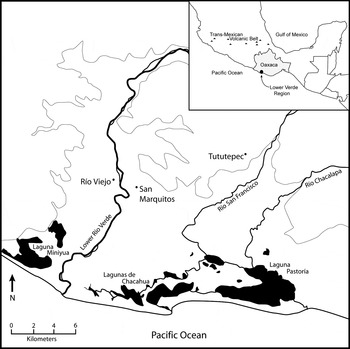
Although quite common today, obsidian provenance studies in Mesoamerica came of age only recently, in the early 1970s, following the successful application of new analytical techniques (Clark Reference Clark and Hirth2003:32). Methods such as instrumental neutron activation analysis (INAA) and x-ray fluorescence (XRF) have enabled researchers to identify with great accuracy the origin of obsidian specimens from a wide variety of sources. Armed with these new tools, archaeologists have gone about the “normal science” (Kuhn Reference Kuhn1996:5) of collecting obsidian source data. Nonetheless, our understanding of obsidian exchange networks for many time periods in ancient Mesoamerica remains woefully incomplete. Of particular importance here, our knowledge of Postclassic obsidian exchange in Oaxaca remains fairly rudimentary (e.g., Parry Reference Parry and de Arechavaleta1990; Spores Reference Spores, Spores and García2006; Winter Reference Winter, Gaxiola and Clark1989). The present study reports the results of obsidian sourcing studies from excavated Early and Late Postclassic period household contexts in the lower Río Verde region of Oaxaca, Mexico (Figure 1). We attempt to explain shifting patterns of obsidian procurement in the lower Verde region by placing these within the broader context of sociopolitical and economic changes at the local, regional and macroregional levels. This study represents the most detailed examination of Postclassic obsidian exchange yet reported from Oaxaca.
Map of lower Río Verde Region, Oaxaca, Mexico.

BACKGROUND, METHODOLOGY, AND SAMPLING
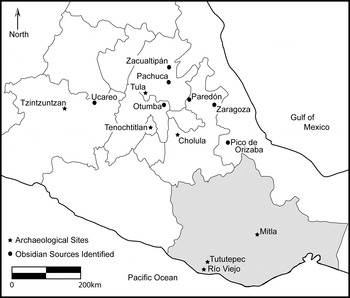
The lower Río Verde region is located on the Pacific coast of Oaxaca, hundreds of kilometers south of the nearest available obsidian sources in highland Mexico (Figure 1). The area includes the floodplain and surrounding environs of the lower Río Verde, which drains most of the western highlands of Oaxaca. The last two decades have witnessed a flurry of archaeological research in the lower Verde region, including survey and excavation projects focusing on the Formative, Classic, and Postclassic periods (Barber Reference Barber2005; Barber and Joyce Reference Barber, Joyce, Wells and Davis-Salazar2007; Joyce Reference Joyce1991a, Reference Joyce1991b, Reference Joyce1999, Reference Joyce2005, Reference Joyce2010; Joyce et al. Reference Joyce, Bustamante and Levine2001, Reference Joyce, Winter and Mueller1998; King Reference King2003; Levine Reference Levine2007, Reference Levine2011; Urcid and Joyce Reference Urcid and Joyce2001; Workinger Reference Workinger2002). The present study expands on earlier instrumental obsidian sourcing studies carried out by Joyce and colleagues (Reference Joyce, Elam, Glascock, Neff and Winter1995), and Workinger (Reference Workinger2002). To date, obsidian from eight different sources have been identified in the lower Río Verde region through INAA and XRF analyses. All of the known sources are located along the Trans-Mexican Volcanic Belt, in central and west Mexico (Figure 2).
Postclassic period obsidian sources identified at lower Río Verde Region sites (after Smith et al. Reference Smith, Burke, Hare and Glascock2007:Figure 1).

In spite of the great distance between the lower Verde region and available obsidian resources, imports from central and west Mexico appear in significant numbers by the Early Formative period (ca. 1600–850 b.c.) (Hepp Reference Hepp2011). By the Late Formative and continuing through the remainder of the pre-Hispanic sequence, obsidian comprised over 80% of the chipped stone recorded in lower Verde domestic contexts (Joyce Reference Joyce1991a; Joyce et al. Reference Joyce, Elam, Glascock, Neff and Winter1995; King Reference King2003:233–239; Levine et al. Reference Levine, Joyce and Glascock2007). This attests to the long tradition and durability of highland-lowland obsidian exchange, although the variety and frequency of obsidian imports changed significantly through time (Joyce et al. Reference Joyce, Elam, Glascock, Neff and Winter1995; Levine et al. Reference Levine, Joyce and Glascock2007).
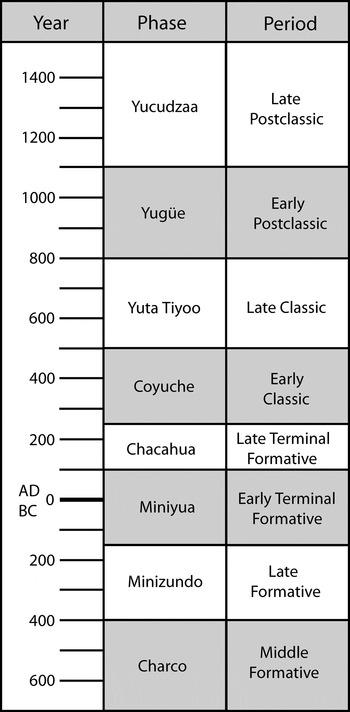
The current study traces patterns of obsidian exchange in the lower Verde region during the Early Postclassic Yugüe phase (a.d. 800–1100) and the Late Postclassic Yucudzaa phase (a.d. 1100–1522) (Figure 3). A total of 153 obsidian samples were selected from three well-dated excavated contexts associated with residences in the lower Verde region. All of the obsidian samples were subjected to XRF analysis at the University of Missouri Research Reactor (Glascock Reference Glascock2006). Although an analysis of obsidian samples from a larger number of households would have been ideal, this study still provides an important first glimpse of Postclassic obsidian exchange patterns from the lower Verde region.
Lower Río Verde Region ceramic chronology (dates based on uncalibrated radiocarbon dates).

The earliest obsidian sample (n = 54) was drawn from a Yugüe phase commoner household context at Río Viejo (RV0A), one of two demographic centers in the lower Verde region during the Early Postclassic period (Joyce et al. Reference Joyce, Bustamante and Levine2001). The Yugüe phase sample included all obsidian artifacts recovered from two midden contexts associated with the RV0A residence (Table 1). The architectural features and material patterns associated with RV0A are consistent with other excavated Postclassic households at Río Viejo, suggesting that it is a relatively typical commoner residence (Joyce and King Reference Joyce and King2001). The RV0A obsidian was dated to the Early Postclassic based on its direct association with Yugüe phase pottery and charcoal (AA37669) yielding a radiocarbon date of cal a.d. 968–1161 (Table 2). The RV0A obsidian samples were examined through XRF analysis only, although the later Yucudzaa phase specimens were also subjected to visual analysis, as we discuss below.
Formal attributes of obsidian artifacts subjected to XRF analysis.

Radiocarbon dates and calibration.

Note: Calibration based on Stuiver and Reimer (Reference Stuiver and Reimer2006).
The second obsidian sample was selected from excavated contexts at a commoner household (Residence A) at the Late Postclassic capital of Tututepec. Residence A was located 1.25 km northwest of the civic-ceremonial core of the site. During the Yucudzaa phase (a.d. 1100–1522), Tututepec was the capital of a Mixtec polity that dominated much of coastal Oaxaca (Joyce et al. Reference Joyce, Workinger, Hamann, Kroefges, Oland and King2004; O'Mack Reference O'Mack1990; Smith Reference Smith1973; Spores Reference Spores1993). A total of 69 obsidian artifacts from Tututepec Residence A were subjected to XRF analysis. The first 50 samples were selected randomly from excavated contexts, whereas an additional 19 obsidian samples were selected from the same contexts on the basis of their distinctive visual characteristics. The non-random component of the sampling strategy sought to capture the full range of variability present in the assemblage. Radiocarbon dates (AA69823 and AA69824) from the upper and lower levels of the largest midden excavated at Residence A, where the majority of the obsidian samples were drawn, returned dates falling almost entirely within the fourteenth century (Table 2). Thus, the obsidian sample from Residence A dates to the 1300s, a conclusion supported by the exclusive presence of Yucudzaa phase pottery in all household contexts and stratigraphic evidence indicating a relatively brief occupation (Levine Reference Levine2007:206). A comparative study of architecture and artifact patterns from three neighboring Late Postclassic households at Tututepec suggests that Residence A was home to commoners that were somewhat wealthier than their peers, although a larger sample of households is needed to verify this assessment (Levine Reference Levine2011).
The third obsidian sample was drawn from a second commoner household at Tututepec, designated Residence B, and was located only a few hundred meters south of Residence A. Using the same sampling methodology utilized at Residence A, a total of 30 obsidian fragments from Residence B was selected by both random (n = 16) and non-random (n = 14) means to undergo XRF analysis. A calibrated radiocarbon date (AA69825) from the shallow Residence B midden, from which most of the obsidian samples were drawn, returned a date spanning the fifteenth century (Table 2). Additional chronological indicators provide support for the radiocarbon date. Virtually all of the ceramic material associated with Residence B dated to the Yucudzaa phase and the stratigraphic analysis demonstrated that the household occupation spanned only a few generations (Levine Reference Levine2007:244). The comparative analysis of Tututepec households, cited above, indicates that Residence B was a commoner household of average wealth (Levine Reference Levine2011).
Prior to the XRF analysis, all of the obsidian from Tututepec Residences A (n = 838) and B (n = 281) were subjected to visual analysis. The analysis began with an evaluation of the obsidian in terms of reflected color, refracted color, opacity-translucence, and the presence and nature of inclusions (see Braswell et al. Reference Braswell, Clark, Aoyama, McKillop and Glascock2000:270–271). After a complete evaluation of the attribute patterns present in the obsidian assemblage, the artifacts were coded according to their suite of visual characteristics. It was soon clear that more than 95% of the assemblage was either green (with slight variations in hue and inclusions) or a translucent gray with darker wisp-like inclusions. The XRF analysis later confirmed that the aforementioned green and gray obsidian artifacts were from the Pachuca and Pico de Orizaba sources, respectively, and could be visually identified as such (see also Joyce et al. Reference Joyce, Elam, Glascock, Neff and Winter1995; Workinger Reference Workinger2002:339). All but fourFootnote 1 of the obsidian artifacts whose visual characteristics diverged from the Pachuca or Orizaba groups were later sent for XRF analysis.
Following the visual analysis, XRF analysis of the obsidian samples confirmed a near 100% accuracyFootnote 2 in the visual identification of Orizaba and Pachuca sources. Importantly, the XRF analysis also revealed that the visually based portion of the study failed to effectively and consistently discriminate the sources of obsidian from Otumba, Paredon, Ucareo, and Zaragoza (also see Moholy-Nagy Reference Moholy-Nagy2003). These types of obsidian were conflated because of their somewhat overlapping visual characteristics. By combining visual and XRF analyses, we sourced more than 99% of the obsidian recovered during the Tututepec Residence A and B excavations. In the following sections, we present the results of the obsidian sourcing analysis and provide interpretations of exchange patterns at the local, regional, and macroregional scales.
RESULTS
Obsidian Procurement at Río Viejo in the Yugüe Phase
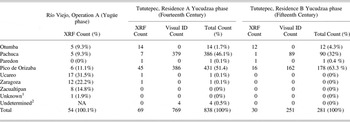
XRF analysis of the Early Postclassic Yugüe phase sample from RV0A (n = 54) identified obsidian from Ucareo (31.5%), Zaragoza (22.2%), Zacualtipan (14.8%), Otumba (9.3%), Pachuca (9.3%), and Pico de Orizaba (11.1%) (Table 3). We first consider these obsidian import patterns within the context of a changing sociopolitical and economic climate in the lower Verde region following the collapse of Late Classic Río Viejo (Joyce et al. Reference Joyce, Bustamante and Levine2001). In the following Yugüe phase, Río Viejo remained a demographic center, but declined in size from approximately 250 ha in the Late Classic to 140 ha in the Early Postclassic. In addition, Río Viejo was no longer the singular regional power during the Yugüe phase, when a second and slightly larger population center emerged at San Marquitos (191 ha).
Results of XRF and visual analysis of obsidian from Yugüe phase and Yucudzaa phase households.

1The “unknown” category includes obsidian analyzed by XRF that was not matched to any known sources.
2The “undetermined” category consists of obsidian samples that could not be securely identified through visual analysis and were not submitted for XRF analysis.
A comparison of obsidian procurement at well-dated Early Postclassic period sites in other areas of Mesoamerica indicates a general similarity with patterns at Yugüe phase Río Viejo. The relatively high proportion of Ucareo obsidian identified at Río Viejo is also reported from Xochicalco, as well as from Terminal Corral (a.d. 800–900) and Early Tollan (a.d. 950–1000) phase deposits at Tula (Braswell Reference Braswell, Smith and Berdan2003:Table 20.1; Healan Reference Healan1993:454; Ringle et al. Reference Ringle, Negrón and Bey1998:222). In addition, Zaragoza obsidian, comprising nearly a quarter of the Yugüe phase sample, also appears in significant proportions from similarly dated contexts at Cantona, Cholula, and El Tajin (Braswell Reference Braswell, Smith and Berdan2003:Table 20.1). Otumba, Pachuca, and Pico de Orizaba obsidian were also widely distributed at Early Postclassic sites. In contrast, the proportion of Zacualtipan obsidian from Yugüe phase Río Viejo is unusually high, among the highest reported from Early Postclassic contexts in Mesoamerica (see Braswell Reference Braswell, Smith and Berdan2003:Table 20.1).
In general, the Yugüe phase Río Viejo obsidian assemblage reflects broad procurement and exchange regimes across Early Postclassic period Mesoamerica. The presence of at least six different obsidian sources could be a result of the general political decentralization of Mesoamerica at this time. There were, however, several regional capitals, including Tula in central Mexico, that were probably involved in but did not dominate obsidian procurement and/or trade in the Early Postclassic (Braswell Reference Braswell, Smith and Berdan2003:145). The broad variety of obsidian at Río Viejo demonstrates the prevalence of procurement activities at a multiplicity of obsidian sources throughout the Mexican highlands, suggesting that several factions may have been mining obsidian with limited political oversight.
Given that the lower Verde region is located far from all known obsidian mines, how did it secure such a large and steady quantity of obsidian imports? Part of the answer lies in the variety of animal and plant-based products from the lower Verde region that were available for exchange. Although many of the likely coastal exports preserve poorly in the archaeological record (e.g., feathers, cacao, and salt), cotton thread production was clearly an important household activity during the Yugüe phase at Río Viejo (Joyce et al. Reference Joyce, Bustamante and Levine2001; King Reference King2003). Hundreds of ceramic spindle whorls used for spinning cotton thread have been recovered in residential excavations at Río Viejo and during archaeological survey of the lower Verde region (Joyce Reference Joyce1999). Additional evidence for textile production at RV0A included fine bone needles and awls (Joyce et al. Reference Joyce, Bustamante and Levine2001:360). The evidence suggests that Early Postclassic Río Viejo produced cotton exports for large populations in highland areas, where cotton plants did not fare well. Cotton cloth was more valuable than textiles woven from fibers of the agave plant, which flourish at high elevations (see Haines et al. Reference Haines, Feinman and Nicholas2004).
Obsidian traders from west Mexico, central Mexico, and the Gulf Coast were attracted to the lower Verde because of its bevy of material resources, but they would have also been interested in exchanging valuable cultural and religious knowledge. Having access to new and exotic ritual practices, iconography, art styles—even deities—provided elites with a means of demonstrating their special access and mastery of the supernatural realm. During the Yugüe phase, many areas of Mesoamerica were politically decentralized and competition among polities may have encouraged acquisitive strategies of adopting foreign cultural elements to bolster legitimacy or status at home. For example, the Aztecs adopted the Xipe Totec cult, probably from the people of Oaxaca, and used it to augment and extend their power (Boone Reference Boone, Smith and Berdan2003:213).
The diversity of Yugüe phase obsidian imports implies that lower Verde people maintained economic and social relationships with several highland groups. A broad reliance on multiple sources may have been a strategy to insure the steady flow of obsidian to the lower Verde region or provide leverage in negotiating the terms of trade. Alternatively, the diversity of obsidian at Río Viejo may have arrived with merchants from throughout the highlands who were attracted to coastal markets that offered cotton, salt, animal hides, feathers, dried fish, and other goods.
Obsidian Procurement at Tututepec in the Fourteenth Century
The analysis of obsidian from Tututepec Residence A (n = 838) revealed a radical shift in procurement patterns during the fourteenth century (Table 3). In contrast to the earlier Yugüe phase, over 97% of the obsidian from Residence A came from either Pico de Orizaba (51.4%) or Pachuca (46.1%), with the remaining 3% imported from Otumba, Paredon, Ucareo, or Zaragoza. The realignment of obsidian import patterns could signal the establishment of more highly orchestrated modes of extraction at Pachuca and Pico de Orizaba and/or a regularization of trade networks linking these sources with Tututepec. But the shift in exchange was also associated with profound sociopolitical changes occurring in the lower Verde region during the Yugüe to Yucudzaa phase transition.
At the close of the Yugüe phase, the ruling establishments at Río Viejo and San Marquitos fell out of favor and both sites were virtually abandoned. A new capital was founded at Tututepec around a.d. 1100 in the piedmont overlooking the lower Verde valley (Joyce et al. Reference Joyce, Workinger, Hamann, Kroefges, Oland and King2004). Tututepec became the region's singular capital and home to approximately 90% of the lower Verde population (Joyce et al. Reference Joyce, Workinger, Hamann, Kroefges, Oland and King2004:287). Archaeological, linguistic, and ethnohistoric evidence indicate that a group of people from the Mixteca Alta migrated to the Oaxaca coast during the Postclassic period (Josserand et al. Reference Josserand, Jansen, Romero, Josserand, Winter and Hopkins1984; Joyce et al. Reference Joyce, Bustamante and Levine2001; Joyce et al. Reference Joyce, Workinger, Hamann, Kroefges, Oland and King2004). The arrival of the highland Mixtecs appears to coincide with the establishment of Tututepec, which is recorded in the Mixtec codices as having taken place in a.d. 1083 (Joyce et al. Reference Joyce, Workinger, Hamann, Kroefges, Oland and King2004). Three of the Mixtec codices (Nuttall, Colombino-Becker and Bodley) depict the founding of Tututepec by Lord 8 Deer “Jaguar Claw,” who then proceeds to conquer approximately 100 communities and establishes a tributary empire (Smith Reference Smith1973). By the time of the Spanish Entrada, Tututepec was a regional power that controlled an estimated 25,000 km2 of coastal Oaxaca (Spores Reference Spores1993).
The sharp increase in the frequency of Orizaba and Pachuca obsidian at Tututepec in the fourteenth century likely resulted from a combination of changes at the local, regional and macroregional levels. Although obsidian source data from contemporaneous contexts is lacking from most areas of Oaxaca, the available information suggests that Tututepec's obsidian assemblage reflected broader patterns of exchange throughout the region. For instance, in the Tamazulapan Valley of northwest Oaxaca, Byland (Reference Byland1980:164) reported an obsidian blade-production locale at the site of Yucuchicano dating to the Late Natividad phase and prior to the Aztec conquest of the area. Approximately one-third of the chipped stone debris was green obsidian, similar to the proportion identified at Tututepec Residence A (see also Winter Reference Winter, Gaxiola and Clark1989:358). From the Isthmus of Tehuantepec, Zeitlin (Reference Zeitlin1982) reports a Late Postclassic assemblage including Pachuca (45%), Pico de Orizaba (45%), and Otumba (10%) obsidian, similar to the proportions found at Tututepec Residence A.
From the perspective of cost minimization, one might argue that Orizaba was the most frequently imported obsidian because it was the closest (325 km)Footnote 3 to Tututepec. But Orizaba was not the most frequently imported obsidian in the lower Verde region during all periods, so proximity does not provide an adequate explanation (Joyce et al. Reference Joyce, Elam, Glascock, Neff and Winter1995). Further, an economizing strategy of lithic procurement fails to explain why imported obsidian was preferred over more locally available chert from the coastal region and adjacent Oaxacan highlands.Footnote 4 Chert comprised less than 3% of the chipped stone tool assemblage at Tututepec Residence A (Levine Reference Levine2007:Table 6.07). This contrasts with roughly contemporaneous households in the Mixteca Alta that relied heavily on chert, even though they were considerably closer to highland obsidian sources (e.g., Pérez Rodríguez Reference Pérez Rodríguez2003:Table 4.6).
Refocusing attention to the local scale, the burgeoning population of Tututepec would have stimulated greater demand for obsidian and thus affected the flow of imports. Appadurai (Reference Appadurai and Appadurai1986:31) suggests that demand is determined by social and economic forces, but at the same time can affect these forces. Settlement pattern data from the lower Verde region demonstrate that the total area occupied grew from 452 ha in the Yugüe phase to 2,315 ha in the Yucudzaa phase, suggesting a virtual population boom during the Late Postclassic period (Joyce et al. Reference Joyce, Workinger, Hamann, Kroefges, Oland and King2004:280). Lowland demand for highland products, including obsidian, would have soared. Importantly, the rise in population at the beginning of the Yucudzaa phase was due, in part, to the influx of highland Mixtec people whose movement corresponded with Lord 8 Deer's migration to the lower Verde region. After groups of highland Mixtecs moved to the coast, there would have been durable ethnic, linguistic, and genealogical ties facilitating highland-lowland trade.
The creation of a highland-lowland Mixtec trade corridor would have benefited both partners and, indeed, may have been a motivating factor for the Mixtec migration to the coast in the first place (Joyce et al. Reference Joyce, Workinger, Hamann, Kroefges, Oland and King2004). Ethnohistoric and codical records demonstrate that the Tututepec elite maintained close connections with their highland kinsmen through trade and intermarriage (Joyce et al. Reference Joyce, Workinger, Hamann, Kroefges, Oland and King2004; Pohl Reference Pohl, Johnson and Sharon1994, Reference Pohl, Smith and Berdan2003a; Spores Reference Spores1974). Highland-lowland links are reflected by the formal and decorative similarity of Mixteca-Puebla style polychrome pottery made locally in Tututepec and analogous types from the Mixteca Alta (Forde Reference Forde2006; Levine Reference Levine2006a). During the Yucudzaa phase, the people of the lower Verde region appear to have drawn closer to their counterparts in the Mixteca Alta, but also forged relationships with Zapotec polities, the regional center of Cholula, and other Eastern Nahua city-states (Pohl Reference Pohl, Smith and Berdan2003b).
The shift from a broad reliance on six types of obsidian in the Yugüe phase to a pattern dominated by Pachuca and Orizaba in the Yucudzaa phase may be explained in part by the characteristics of these two latter types and their associations with prestigious centers. Ancient Mesoamericans undoubtedly appreciated Pachuca obsidian for both its high quality and translucent, dazzling green color (Spence Reference Spence1996). Green stones of all varieties were relatively rare in Mesoamerica and thus highly esteemed and traded widely (Grove and Gillespie Reference Grove, Gillespie, Demarest and Conrad1991:30; see also Lange Reference Lange1993). Apart from its excellent flaking characteristics (Ponomarenko Reference Ponomarenko2004), Pachuca obsidian may have been preferred because it served as an important medium for interaction with powerful central Mexican polities. Apart from obsidian imports, ceramic and iconographic data also point to long standing exchange networks linking the lower Verde region to highland Mexico (Joyce Reference Joyce1991b; Reference Joyce1993; Joyce et al. Reference Joyce, Bustamante and Levine2001:354; King Reference King and Blomster2008; Levine Reference Levine2007). Lower Verde people's role as longtime trade partners with distant highland capitals may have helped to define their social identity, one that distinguished them from their less “well-connected” neighbors.
In a similar manner, the preference for Orizaba obsidian may lie in its high quality and possible association with Cholula—one of Mesoamerica's primary centers at this time (Durán Reference Durán1971). Drawing on ethnohistoric and codical sources, Jansen and Pérez Jiménez (Reference Jansen and Jiménez2007:213–216) argue that following his reign at Tula, Topiltzin Quetzalcoatl (Lord 4 Jaguar) became the founder of the religious-mercantile center of Cholula. Religious pilgrims from throughout Mesoamerica came to Cholula to pay their respects to Quetzalcoatl and peddle their crafts in its vast marketplace. In tracing Lord 8 Deer's biography, Jansen and Pérez Jiménez (Reference Jansen and Jiménez2007) cite multiple points of convergence between the Tututepec founder and both “Lord 4 Jaguar,” and the regional capital of Cholula. That Cholula was a commercial center and located relatively close to Pico de Orizaba raises the possibility that it was a convenient distribution point for Orizaba obsidian—though this point remains highly speculative in the absence of more direct archaeological evidence. Braswell (Reference Braswell, Smith and Berdan2003:146) also suggests a close connection between Cholula and Orizaba obsidian, citing the presence of Cholula-style polychrome pottery in the Orizaba region (see also Daneels Reference Daneels, Stark and Arnold1997:245). The distinctive gray obsidian from Orizaba may have conjured associations with the powerful and prestigious center of Cholula.
Obsidian Procurement at Tututepec in the Fifteenth Century
The analysis of obsidian from Tututepec Residence B (n = 281) demonstrates general continuity from the fourteenth to fifteenth centuries, with Pachuca and Pico de Orizaba continuing to comprise the bulk of the assemblage (Table 3). There was, however, a modest drop in Pachuca imports (46.1 to 32.4%) and a corresponding increase in obsidian from Pico de Orizaba (51.4% to 63.3%) through time.
Comparative analyses of artifact patterns from Tututepec Residences A (fourteenth century) and B (fifteenth century) provide clues as to why obsidian imports from Orizaba may have increased and those from Pachuca decreased through time. A comparison of the number of obsidian artifacts per 1,000 potsherds recovered from Residence A (13.8) versus Residence B (16.4) suggests a slight increase in obsidian consumption through time (Levine Reference Levine2011:Table 3). This mirrors the general trend of increasing obsidian consumption during the Postclassic period in Oaxaca and throughout Mesoamerica (Braswell Reference Braswell, Smith and Berdan2003:153–154; Winter Reference Winter, Gaxiola and Clark1989:360). In addition, evidence for the intensification and expansion of obsidian mining activities at Pachuca (Pastrana Reference Pastrana, Hirth and Andrews2002:25–26) and Pico de Orizaba (Cobean Reference Cobean2002:139–161) attests to the increasing demand for obsidian during the Late Postclassic.
During the final century of the Late Postclassic period, the expansion of the Aztec Empire and steady population growth throughout the Basin of Mexico (Parsons et al. Reference Parsons, Brumfiel, Parsons and Wilson1982:267) may have fueled greater demand for Pachuca obsidian and outpaced the available supply. Archaeological data from the Aztec heartland and outlying provinces indicate that people living under Aztec hegemony relied primarily on Pachuca obsidian (Braswell Reference Braswell, Smith and Berdan2003:153). As the Aztec Empire expanded and populations grew steadily, a smaller quantity of Pachuca would have been available for export to distant areas such as Oaxaca. Thus, sites like Tututepec may have had to turn to other sources of obsidian, such as Pico de Orizaba, to meet their needs.
The establishment of the Aztec Triple Alliance (ca. a.d. 1428) may have also precipitated important changes in the nature of interregional obsidian trade. The Aztecs, most notably the long-distance pochteca merchants, were deeply involved in the trade of Pachuca obsidian. Pachuca was the most heavily utilized obsidian at the Aztec capital of Tenochtitlan, arriving through both tribute and commercial activity (Braswell Reference Braswell, Smith and Berdan2003:157; Cobean Reference Cobean2002:41). Although some argue that the Aztecs controlled the extraction and trade of Pachuca obsidian (Pastrana Reference Pastrana1998:179; Zeitlin Reference Zeitlin1982:270), others question the Aztecs' direct involvement (Clark Reference Clark, Gaxiola and Clark1989:303–304; Smith and Berdan Reference Smith and Berdan1992:358). Braswell (Reference Braswell, Smith and Berdan2003:157) reasons that the local Pachuca polity maintained direct control over obsidian extraction, but was itself a subject of the Acolhua state. As Texcoco, a founding member of the Triple Alliance, was the capital of the Acolhua polity, the Aztecs would have at least retained some indirect control over the Pachuca mines. Based on ethnohistoric data and extensive archaeological research at the source—Sierra de las Navajas—Pastrana (Reference Pastrana1998, Reference Pastrana, Hirth and Andrews2002, Reference Pastrana2007) compellingly argues that the Triple Alliance controlled the Pachuca mines.
Although the Aztecs conquered parts of Oaxaca and appear to have been encroaching on the coastal Mixtec's territory, it did not prevent Tututepec from importing a significant quantity of Pachuca obsidian throughout the fifteenth century. Notably, the Tarascans and Tlaxcalans also imported Pachuca amidst hostilities with the Aztecs, albeit in apparently lower proportions (Pollard and Smith Reference Pollard, Smith, Smith and Berdan2003). Nonetheless, political friction between the Mixtecs and Aztecs provides a plausible explanation for the diminution of Pachuca imports to Tututepec at this time. Whereas more direct forms of trade may have been possible prior to the establishment of the Triple Alliance, by the mid-fifteenth century the Aztec pochteca would have had to trade green obsidian to Tututepec via intermediaries or perhaps through politically “neutral” highland markets (see Pohl et al. Reference Pohl, Monaghan, Stiver, Smithers, Sosa and Baracs1997). It is doubtful that Tututepec's leaders would have permitted the pochteca, trained warriors and spies who facilitated Aztec expansion, to enter their community (Hassig Reference Hassig1985; Zeitlin Reference Zeitlin2005:80). When the supply of Pachuca imports slowed, Tututepec may have made up the difference by soliciting more obsidian from Orizaba. In addition, this shift may represent Tututepec's cultivation of closer ties with the greater Gulf Coast area and the neighboring center of Cholula, located in the present-day state of Puebla. Cholula was a religious mecca and mercantile center whose leaders also resisted Aztec hegemony (McCafferty Reference McCafferty1996). The codices indicate that the royal dynasties of Tututepec, polities of highland Oaxaca (e.g., Tilantongo), and Cholula were closely related through elite intermarriage (Johnson Reference Johnson, Smithers and Sosa1997; Pohl Reference Pohl, Smith and Berdan2003b). Political pressure from Aztec incursions into Oaxaca may have encouraged an even closer relationship between the polities of greater Oaxaca and Puebla (see Pohl Reference Pohl, Smith and Berdan2003a:65).
The surge in Orizaba imports to Tututepec can alternatively be attributed to the Aztec conquest of the greater Orizaba area in the fifteenth century. Cobean (Reference Cobean2002:161) argues that the Aztecs seized control of the Orizaba mines during the reign of Axayacatl, ca. a.d. 1469–1481, when they established a garrison near Coscomatepec, only 20 km from the obsidian mines. The Aztecs may have conquered Orizaba to secure access to this important resource, as demand for obsidian within the empire increased. The rise in Orizaba imports to Tututepec may have been facilitated by Aztec management of the mines and further development of extraction activities. This possible scenario, however, is difficult to evaluate without greater chronological precision in dating the obsidian samples from Tututepec.
Although seemingly at odds, the preceding explanations for shifting patterns of obsidian procurement are more or less compatible. During the fourteenth to fifteenth century, population growth and a corresponding increase in demand for obsidian was present at Tututepec and throughout Mesoamerica. Similarly, the increasing demand for cotton thread and cloth, especially in highland areas, stimulated an intensification of textile production at Tututepec households (Heijting Reference Heijting2006; Levine Reference Levine2006b). Highland obsidian merchants would have flocked to cotton-producing areas such as Tututepec to acquire raw materials or finished textiles. In response to the imperial ambitions of the Aztecs, Tututepec may have banished pochteca merchants from the capital and dealt with them through intermediaries. Furthermore, Tututepec may have sought to strengthen ties with allies in highland Oaxaca and Puebla, which may have resulted in a greater flow of Orizaba obsidian to Tututepec in the fifteenth century.
CONCLUSIONS
This study traces patterns of obsidian exchange through the Early and Late Postclassic period from the vantage point of the lower Río Verde region of Oaxaca. During the Yugüe phase, people provisioned their households with at least six different sources of obsidian, more than half (53.7%) from Ucareo and Zaragoza combined. The strong presence of obsidian from Ucareo and Zaragoza is not surprising as both were distributed widely in Mesoamerica at this time (Braswell Reference Braswell, Smith and Berdan2003:Table 20.1; Healan Reference Healan and Darras1998:102). Otumba, Pachuca, Paredon, and Pico de Orizaba each made up roughly 10% of the Yugüe phase assemblage, while almost 15% was from Zacualtipan. We argue that the variety of imported obsidian sources reflected the relatively decentralized political makeup of highland Mexico and the absence of a singular polity dominating procurement and/or trade. The variety of obsidian types also suggests that the lower Verde region remained an important broker of lowland products, maintaining exchange relations with contingents from multiple highland polities involved in the obsidian trade.
During the fourteenth century there was a radical shift in obsidian exchange in the lower Verde region, with over 97% imported from Pico de Orizaba and Pachuca combined. We argue that the significant increase in Pachuca imports to the lower Verde region during the fourteenth century was part of a broader trend of increasing commercial activity and cultural exchange between central Mexico and Oaxaca. We also suggest that people of the lower Verde may have actively sought green obsidian because of its high quality and to link themselves with prestigious centers who dealt in this distinctive green commodity.
Even more important than the Pachuca source, Orizaba obsidian comprised the largest proportion of the lower Verde's lithic assemblage in the fourteenth century. We argue that the heavy reliance on Orizaba obsidian at this time was probably associated with changes that came about following the establishment of the Mixtec capital of Tututepec ca. A.D. 1100. The founding of Tututepec created a Mixtec highland-lowland exchange corridor that extended to Cholula and its important market, possibly a distribution point for Orizaba obsidian.
In the fifteenth century, there was a slight drop in Pachuca imports to the lower Verde, which we attribute to a combination of factors associated with the establishment and expansion of the Aztec Empire. Tututepec may have received less Pachuca obsidian because of its adversarial relationship with the Aztecs, who conquered large areas of Oaxaca and were encroaching on the coastal Mixtec territory. Additionally, people living in Aztec controlled areas relied primarily on Pachuca obsidian and as the empire expanded, there may have been less material available for export to distant regions such as Oaxaca. While Pachuca imports to Tututepec fell in the fifteenth century, Orizaba obsidian was on the rise. We suggest that the threat of Aztec conquest may have drawn Tututepec closer to neighboring highland Mixtec, Zapotec, and Eastern Nahua polities (e.g., Cholula) who also opposed the Aztecs. Distribution patterns of Orizaba obsidian in the Late Postclassic seem to support the presence of a cleavage—however short lived—in political and economic ties between the central Mexican Aztec area and eastern and southern portions of Mexico (see also McCafferty Reference McCafferty, Kowalski and Kristan-Graham2007:467). During the Late Postclassic period, Orizaba obsidian was exported throughout the Gulf Coast, as well as regions of Oaxaca and Chiapas (Braswell Reference Braswell, Smith and Berdan2003:Table 20.3), but very little has been reported from the Aztec-controlled areas of central Mexico, such as the Yautepec region of Morelos (Smith et al. Reference Smith, Burke, Hare and Glascock2007:439).
This study demonstrates that there were significant shifts in obsidian exchange patterns during the Postclassic period and that these patterns appear to have been associated, in part, with the changing political climate of this era. Although the analysis results should be considered preliminary because of the limited sample size, the study greatly clarifies our understanding of the lower Verde region's participation in exchange, and sheds light on broader patterns of exchange in Oaxaca and greater Mesoamerica. In addition, the conservative integration of instrumental and visual analyses demonstrates how these methods can be utilized in concert to analyze larger samples reliably and at lower cost. Finally, the study reaffirms the importance of highland-lowland exchange to the Mesoamerican economy during the Postclassic period, with obsidian exchange networks shifting to accommodate changing political fortunes in both the lower Río Verde region and beyond.
RESUMEN
Este artículo presenta un análisis diacrónico de los cambios en los patrones de obtención de obsidiana durante el periodo posclásico en el área inferior del río Verde de Oaxaca. El estudio se basa en el análisis de artefactos de obsidiana hechos por inspección visual y del proceso de florescencia de rayos-x (XRF). Dichos artefactos fueron analizados y elegidos de los contextos arqueológicos de las excavaciones pertenecientes a los conjuntos habitacionales de Río Viejo, del posclásico temprano (800–1100 d.C.) y de Tututepec, en el posclásico tardío (1100–1522 d.C.). Reportamos la presencia de obsidiana importada por lo menos de seis fuentes del área inferior del río Verde durante el posclásico temprano, mientras que durante los siglos catorce y quince del posclásico tardío, la obsidiana predominante proviene del Pico de Orizaba y de Pachuca. Se interpreta que los cambios en los patrones de obtención de obsidiana en la parte inferior del río Verde a través del tiempo fueron influenciados por cambios sociopolíticos a nivel local, regional y macroregional. Este estudio representa el análisis más detallado, del intercambio de obsidiana, durante el periodo posclásico, que se ha reportado acerca del área de Oaxaca.
ACKNOWLEDGMENTS
We thank the Consejo de Arqueología of the Instituto Nacional de Antropología e Historia, Mexico, who permitted our fieldwork in the lower Verde region and allowed for the transport of archaeological materials to the United States for analyses. We also wish to thank the staff of the Centro INAH Oaxaca for their support and assistance, especially the directors: Eduardo López Calzada and Enrique Fernández Dávila. Levine's research at Tututepec (Yucu Dzaa) was supported by a Fulbright-García Robles Scholarship, a grant from the Foundation for the Advancement of Mesoamerican Studies (#05031), an NSF Dissertation Improvement Grant (#0508078), and support from the University of Colorado Graduate School and Department of Anthropology. This article was written while Levine was a postdoctoral fellow at the Denver Museum of Nature & Science and he wishes to acknowledge the support of colleagues Stephen Nash, Steven Holen, and Chip Colwell-Chanthaphonh. Joyce's field research in the lower Verde was supported by grants from the following organizations: National Science Foundation (grants SBR-9729763 and BNS-8716332), Foundation for the Advancement of Mesoamerican Studies (#99012), and the University of Colorado. The obsidian analysis was also supported by a reduced-rate grant from MURR. Several anonymous reviewers, David Carballo, Chip Colwell-Chanthaphonh, Jamie Forde, Craig Lee, Maxine McBrinn, Mark Mitchell, Alejandro Pastrana, and Robert Zeitlin provided comments on earlier drafts of this paper—but we take full responsibility for any oversights or errors in judgment. Thanks to Abe Grinberg and Lucha Luna for editing the Spanish summary. Finally, we wish to extend a heartfelt thanks to the local workers and graduate students who participated in the fieldwork at Tututepec and Río Viejo.