INTRODUCTION
Burrow construction is a common behaviour in many animal species, including invertebrates (Matsumasa et al., Reference Matsumasa, Takeda, Poovachiranon and Murai1992; Lomovasky et al., Reference Lomovasky, Casariego, Brey and Iribarne2006) and vertebrates (Moulton et al., Reference Moulton, Brady and Belthoff2006; Schwaibold & Pillay, Reference Schwaibold and Pillay2006). Several crustaceans construct burrows in the sediment to protect against predators and to avoid adverse environmental conditions (Kinoshita, Reference Kinoshita2002; Thongtham & Kristensen, Reference Thongtham and Kristensen2003). Inside the burrows, parameters such as humidity and temperature are maintained at more suitable levels (Atkinson & Taylor, Reference Atkinson and Taylor1988). In some ocypodoids, morphology of the burrow construction may also provide indications of the hierarchical territoriality (Christy, Reference Christy1982), or the reproductive state of a particular species (Yamaguchi, Reference Yamaguchi1998). Other ocypodoid crabs construct elevated sediment structures that are associated with their burrow opening and are utilized by males to attract their partners for copulation. Such constructions may be in the configuration of pyramids like in Ocypode ceratophthalmus Pallas (Jones, Reference Jones1972), or shelters (e.g. in Uca pugilator Bosc according to Christy, Reference Christy1982). Moreover, the digging habit of these crustaceans promotes important bioturbation processes in the sediment, enhancing the oxygenation and facilitating the incorporation of nitrogen in mangrove areas (Wolfrath, Reference Wolfrath1992; Nordhaus et al., Reference Nordhaus, Wolff and Diele2006).
In general, brachyuran burrows present single openings and ducts. These may interconnect to produce multiple openings, which maximize foraging and refuge areas (Morrisey et al., Reference Morrisey, DeWitt, Roper and Williamson1999). External morphology of the burrows may vary with the drainage, sediment consolidation and granulometry of the sediments (Matsumasa et al., Reference Matsumasa, Takeda, Poovachiranon and Murai1992) that in turn will reflect in the depth and complexity of the structures. As a result, burrows constructed in sandy sediments typically present single ducts, whilst multiple ducts and chambers occur in muddy sediments (Morrisey et al., Reference Morrisey, DeWitt, Roper and Williamson1999).
The crab Ucides cordatus (Linnaeus, 1763) is a member of the family Ucididae (Števčić, Reference Števčić2005; Ng et al., Reference Ng, Guinot and Davie2008), and has an omnivorous feeding habit (Christofoletti, Reference Christofoletti2005). It is an iconic species in this environment and occupies a distinguished position due to its commercial importance (Glaser & Diele, Reference Glaser and Diele2004). These crabs are distributed along the Brazilian coastline, where they are found associated with mangrove forests from Amapá to Santa Catarina State (Melo, Reference Melo1996). In addition, they have seasonal reproduction, exhibiting a breeding migration known locally as andada, a period when they abandon their burrows and walk on the sediment for mating (Costa, Reference Costa1972; Alcântara-Filho, Reference Alcântara-Filho1978; Fiscarelli & Pinheiro, Reference Fiscarelli and Pinheiro2002).
The mating occurs in the burrow opening (Góes et al., Reference Góes, Sampaio, Carmo, Toso and Leal2000) and spawning takes place approximately two months later (Pinheiro & Fiscarelli, Reference Pinheiro and Fiscarelli2001). Females usually walk to the river margin to spawn, or they wait until the high tide to release the larvae in the burrow entrance (Góes et al., Reference Góes, Sampaio, Carmo, Toso and Leal2000).
Despite the great economic importance for the native population (Nordi, Reference Nordi1994; Blandtt & Glaser, Reference Blandtt and Glaser2000; Fiscarelli & Pinheiro, Reference Fiscarelli and Pinheiro2002), there is still scarcity of biological–ecological information about Ucides cordatus, such as the excavatory and burrow construction behaviour. According to Costa (Reference Costa1972), burrows from adult U. cordatus display inclined aperture in relation to the sediment surface (45°), deepening abruptly towards the water level. In juveniles, the burrows have a larger variety of forms and a higher number of openings. In addition, burrows from U. cordatus are generally excavated near the vegetation, following patterns seen in other crabs, as these structures provide a more stable construction (Oliveira, Reference Oliveira2005). The crabs usually move and change their burrows, and it appears that local competition is one reason for this behaviour (Piou et al., Reference Piou, Berger, Hildebrandt, Grimm, Diele and D'Lima2007).
Due to this limited scientific knowledge on the external characteristics of the burrows of U. cordatus, as well as the declivity of the ducts and orientation of their aperture, the present study aims to narrow this gap in the literature. The analyses of these parameters aimed to characterize the excavatory pattern shown by the different morphotypes of the species, and to evaluate variations due to flooding levels in the mangrove forests studied.
MATERIALS AND METHODS
The present study was carried out at the Environmental Protection Area of Cananéia, Iguape and Peruíbe (APA/CIP), in the south of São Paulo State (24°50′36″S–47°59′53′W), on an estuarine isle close to Barra de Icapara, Iguape City, Brazil. In that area, the mangrove forest consisted of the species Laguncularia racemosa C.F. Gaertn, Avicennia schaueriana Stapf & Leechman and Rhizophora mangle Linnaeus, with the species predominance varying by location. This allowed the delimitation of two areas with the same arboreal species (Laguncularia racemosa) with distinct tidal heights: Site A (high mangrove, lower flooding height) and Site B (low mangrove, higher flooding height).
Protocols for collection and analysis of data
Collection of data occurred from 14 to 16 August 2005 in the two mangrove forests. Quantification of flooding height in the mangrove was established from the maximum heights of the vertical distribution of the alga Bostrychia sp., which was recorded from the base of 10 trees. Site A presented 100% of L. racemosa with mean algal height of 9.8±2.8 cm, whilst in the Site B these values were 93.3% and 23.2±2.7 cm, respectively.
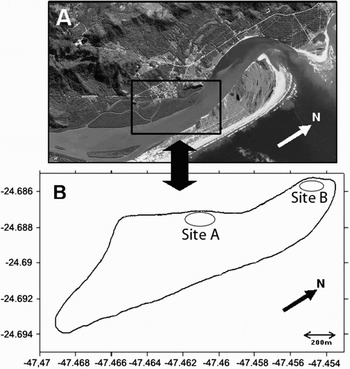
For each study site, 150 burrows with evident opening and presence of biogenic activity (e.g. tracks, faeces or pellets) were selected. Concomitantly, orientation points were positioned in relation to the margin of the river. At Site A (Figure 1), there was only a single orientation point, as the margin profile was parallel to the estuary. In contrast, on Site B, the margin profile was curved and required some orientation points; hence, the mean was used in the statistical analyses.
Estuarine isle where the study was performed at Iguape Region, Brazil (A), and delimitation of Sites A and B in this isle (B).

The external morphology of the selected burrows was described based on the following characteristics: (1) biogenic, with mud deposition near the opening, which enabled the occurrence of structural organization (e.g. tower, mounds, or hoods, and presence of tracks on the sediment); (2) biometric, the diameter of the burrow aperture (BD), using a Vernier calliper (0.05 mm precision); and (3) physical, the measurement of the duct declivity from the burrow using a clinometer and the orientation of the burrow opening in relation to the magnetic north using a universal geological compass.
Each burrow was photographed and the occupying specimen was captured by hand or using a trap (a small dipping net). Subsequently, the size was measured with a Vernier calliper (CW, carapace width) and the specimen morphotype (male or female) was recorded. Two classes of burrow diameter (BD) were considered and used to classify the specimens in juveniles (BD < 45 mm) and adults (BD ≥ 45 mm). These classes corresponded to animals with size (CW) smaller or larger than 60 mm, respectively, according to Pinheiro & Hattori (Reference Pinheiro and Hattori2006).
Orientation data of the burrow openings were analysed using the Rayleigh test for circular distribution (Batschelet, Reference Batschelet1981; Zar, Reference Zar1999) and represented in circular graphs produced using the program Stereonett®, with each sex being delimited in each angular band. The G-test was used to compare the proportion of burrows constructed landward and toward the margin. Declivity data of the ducts were examined using an ANOVA to compare areas of study, sex and size of individuals.
Burrow characters were examined for relationships with size at maturity and sex of the specimens. These features were obtained from field notes or photographs and from the perception of the crab catcher on the burrows, and this information was used in the description of each structural type.
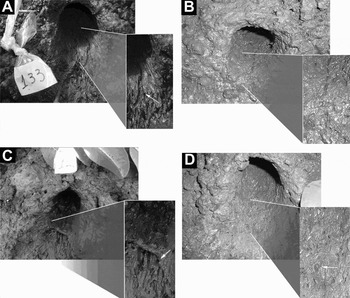
Digital photographs were treated in image software, and only the red channel of the photographs (Color Mode RGB 8 bit) was used to facilitate the visualization of the nuances of the sediment. Particular attention was taken on the analysis of the track morphology and certain areas of the images were zoomed around 4 times to stress features that were more evident. These are indicated with an arrow in Figure 3.
RESULTS
Data from 120 burrows were collected on Site A (24 females and 96 males; 92 juveniles and 28 adults) and from 101 burrows on Site B (23 females and 78 males; 42 juveniles and 59 adults). As the efficiency of the capture of the specimens by the collectors and the traps was not 100%, only data from burrows that had the occupant's sex confirmed were used. Ovigerous females were not recorded during the study period.
Orientation in relation to magnetic north
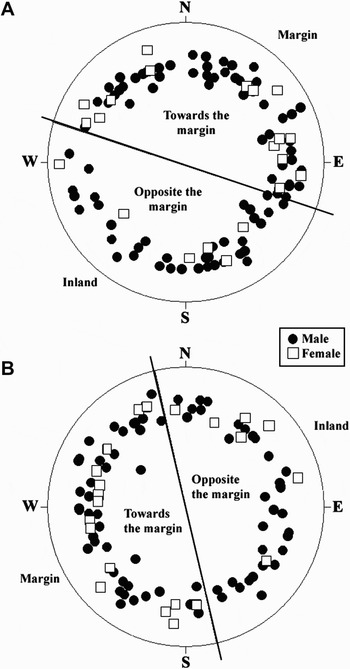
At Site A, the margin of the river was located at 19° of the magnetic north. The data were divided by sectors and the Rayleigh test applied (Zar, Reference Zar1999), which indicated the non-uniform distribution in the 0 to 360° interval (Z = 6.97; P < 0.05). No preferential direction was detected for males using the G-test (55.2% towards the river margin; G = 0.76; P > 0.05), whilst 70.8% of females constructed burrows with aperture facing the margin (G = 15.51; P < 0.001; Figure 2 A). On Site B, sectorization and the Rayleigh test indicated a uniform distribution of the orientation in the interval 0° to 360° (Z = 1.37; P > 0.05). On this site, the margin profile was curvilinear and it was necessary to calculate the mean angle in relation to the magnetic north (77°). As verified for Site A, no directional preference was detected in the burrow aperture of males on Site B using the G-test (53.8% toward the margin; G = 1.49; P > 0.05), whilst females continued to show a significant percentage of open burrows (69.4%) towards the margin (G = 13.79; P < 0.001; Figure 2 B).
Distribution orientation of burrows of Ucides cordatus from Site A (high mangrove) and Site B (low mangrove); Site A (high mangrove) with 55.2% of male's burrows (P > 0.05) and 70.8% of female's burrows (P < 0.001) towards the margin; Site B (low mangrove) with 53.8% of male's burrows (P > 0.05) and 69.4% of female's burrows (P < 0.001) towards the margin.

Declivity
No difference was found between the burrow declivity from the two mangrove sites studied (F = 2.29, P > 0.05), and a similar pattern was found when the burrow inclination was compared between males and females (F = 1.23, P > 0.05). The analysis between juveniles (CW < 60 mm) and adults (CW ≥ 60 mm) found that the inclination of the burrows in juveniles (5 to 40°; 17.9±0.7°) was lower than in adults (10 to 30°, 20.3±1.1°) (F = 13.31, P < 0.001).
External morphology
In most of the burrows of U. cordatus, the opening was ellipsoid or circular, and only a few of them were associated with mud deposits, which were 2 to 4 cm in height. Mud deposition on the burrow aperture was not related to sex, mangrove area or specimen size. No observation of any sedimentary structure (e.g. tower, mound and hood), or use of mud balls or trenches in association with the burrows were recorded. Nevertheless, it was possible to characterize the morphotype of the species from the tracks left on the sediment, and these were identified as: (1) adult females, producing tracks that were fine, delicate, superficial and larger than those from males (Figure 3 A); (2) juvenile females, making tracks that consisted of grooves of reduced size, but difficult to distinguish (Figure 3 B), from unoccupied galleries; (3) adult males, with punctuated and deep tracks on a lightly brushed sediment (Figure 3 C); and (4) juvenile males, with tracks similar to those from females, but more superficial (Figure 3 D).
Photographs of the external morphology of burrows of Ucides cordatus. (A) Burrow of an adult female, arrow indicating tracks larger, delicate and superficial, without deeper points; (B) burrow of a juvenile female, without evident tracks; (C) burrow of an adult male, arrow indicating shorter tracks, punctuated over a brushed surface; (D) burrow of a juvenile male, arrow indicating more superficial tracks.

DISCUSSION
Female preference constructing the burrow openings facing the margin has possibly a reproductive implication. This construction would optimize their water access during the larval release and would favour the larval dispersal due to the tidal action (Freire, Reference Freire1998; Goés et al., 2000). Thus, the river would function as a reflector of natural light and a visual cue for ovigorous females migrating to the water line for larval release. This behaviour has been previously described for other semi-terrestrial brachyurans (Bliss et al., Reference Bliss, van Montfrans, van Montfrans and Boyer1978). However, other orientation mechanisms may also be used by the females. Luschi et al. (Reference Luschi, Del Seppia and Crosio1997) verified the influence of polarized light in the orientation of Dotilla wichmanni Man, but this might not be used by all brachyuran species, since Daumer et al. (Reference Daumer, Jander and Waterman1963) have not observed the same for crabs of the genus Ocypode. Furthermore, there have been suggestions that orientation in many crustaceans occurs by detection of the geomagnetic field (Lohmann et al., Reference Lohmann, Pentcheff, Newitt, Stetten, Zimmer-Faust, Jarrard and Boles1995), visual stimuli (Zeil, Reference Zeil1998), or even by anemotaxis (Vannini & Chelazzi, Reference Vannini and Chelazi1981). The mechanism involved in the orientation may change ontogenetically according to the crab necessities and/or environmental conditions. Winn & Olla (Reference Winn and Olla1972) and Herrnkind (Reference Herrnkind, Vernberg and Vernberg1983) reported that during the early stages, crustaceans show a tendency to orientate by chemical cues, whilst in adults visual cues are more decisive, particularly in relation to polarized light and sun position. Hence, larval dispersal in the burrow entrance during high tide (Goés et al., 2000) may be driven by chemical cues to direct them toward the river, while the females use the river as a visual cue.
Reports on the orientation in Brachyura are rare in the crustacean literature. Amongst these reports, the migration of the red crab (Gecarcinus lateralis Freminville) is particularly remarkable (Bliss et al., Reference Bliss, van Montfrans, van Montfrans and Boyer1978). Adults travel several kilometres from the forests to the beach to spawn, whilst their juveniles make their way back closing the life cycle (Bliss et al., Reference Bliss, van Montfrans, van Montfrans and Boyer1978). Nevertheless, this topic requires more studies on the existence or absence of an orientation pattern during migration, or in the case of U. cordatus, during the burrow construction.
The direction of the burrow openings showed a non-uniform distribution on Site A and this may be explained by the female tendency for constructing the burrows facing the river margin, which presented a straight profile. Nonetheless, we verified an uniform distribution pattern at Site B that is certainly a result of the curvilinear profile of the margins in this area. The orientation points available to the females probably have produced the spurious uniformity observed.
Morphological characteristics such as the duct declivity are of extreme relevance in agonistic displays or territory defence behaviours (Christy, Reference Christy1982), but descriptions are very limited in the literature. For ocypodoids, this subject has been investigated previously only for species of the genus Uca (Genoni, Reference Genoni1991; Wolfrath, Reference Wolfrath1992; Lim & Diong, Reference Lim and Diong2003) and only Lim & Diong (Reference Lim and Diong2003) have carried out precise measurements of the declivity of the burrows and comparison between sexes. For the crab U. cordatus, such information is still rare. According to Costa (Reference Costa1972), juvenile and adult burrows present similar slope (45°) and are constructed with the pereopods. This is in contrast with the results of the present study, which demonstrates that the declivity of the ducts is different between juveniles and adults. Such discrepancy may be due to the absence of a systematic collection of data by Costa (Reference Costa1972), who made only a visual description of the differences.
The heterochely appears to influence the declivity of the duct (Clayton, Reference Clayton1988) and the direction of the burrow opening (Vaninni, 1980). Lim & Diong (Reference Lim and Diong2003) verified significant differences in the burrow declivity between sexes in Uca annulipes, and the authors suggested heterochely (males) and homochely (females) as the causes for the observed pattern. Conversely, this could explain the patterns observed in Ucides cordatus because heterochely is found in both males and females (Alcântara-Filho, Reference Alcântara-Filho1982; Melo, Reference Melo1996), but occurring with an increase in the growth rate of the claws in relation to the cephalothorax at the onset of sexual maturity (Pinheiro & Hattori, Reference Pinheiro and Hattori2006). Consequently, it is expected that such morphological alterations affect the excavatory behaviour of the crabs. This is evidenced in the distinct patterns between juveniles and adults expressed by the differences in burrow declivity.
Power (Reference Power1975) noted that granulometric differences may cause alterations in the burrow declivity in some species of the genus Uca. This is evident in mangrove areas where granulometry may vary significantly as a function of the flooding level, with sandier sediments in less flooded areas (Site A) and muddier in the more frequently flooded areas (Site B) (Hogarth, Reference Hogarth1999; Little, Reference Little2000). Nevertheless, the present study has not evidenced correlation between burrow declivity and flooding height, which suggests that granulometry does not influence the duct inclination of burrows in Ucides cordatus.
Burrow morphology in mangrove crabs may vary according to depth (Takeda & Kunihara, Reference Takeda and Kunihara1987), drainage, and sediment composition and consolidation (Rossi & Chapman, Reference Rossi and Chapman2003; Ribeiro et al., Reference Ribeiro, Iribarne and Daleo2005) of the site. Although the subject has been studied in a few brachyurans (Power, Reference Power1975; Vannini, Reference Vannini1980; Christy, Reference Christy1982; Thongtham & Kristensen, Reference Thongtham and Kristensen2003), a detailed analysis has not been carried out in U. cordatus. The only description for this species refers to the circular/ellipsoid format of the openings (Oliveira, Reference Oliveira1946; Costa, Reference Costa1972; Alcântara-Filho, Reference Alcântara-Filho1978), and particularly the information on the tracks of this species continues to be empirical rather than scientific (Fiscarelli & Pinheiro, Reference Fiscarelli and Pinheiro2002).
Territorial behaviour at the burrows has been reported for males of many ocypodoid species, with the construction of specific structures (Christy, Reference Christy1982; Oliveira et al., Reference Oliveira, McGregor, Burford, Custodio and Latruffe1998; Wada et al., Reference Wada, Kosuge and Trong1998; Yamaguchi, Reference Yamaguchi1998; Burford et al., Reference Burford, McGregor and Oliveira2001). In U. cordatus, no construction associated with the burrow was recorded in the study period, only a small elevation of the opening in relation to the sediment. This feature characterizes excavatory and cleaning activities from the burrows, which is common amongst these animals (Costa, Reference Costa1972; Fiscarelli & Pinheiro, Reference Fiscarelli and Pinheiro2002). Therefore, it is presumable that U. cordatus does not utilize mud constructions as a demonstration of territorialism such as in other smaller sympatric crab species.
According to Góes et al. (Reference Góes, Sampaio, Carmo, Toso and Leal2000), Ucides cordatus copulates at the burrow opening during the andada (the reproductive migration), when males produce large quantities of foam around their bodies. These authors suggested the presence of pheromones in the foam composition, which could enhance the chemical attraction of the females. Moreover, the foam volume also maximizes the size of the males on the sediment, making the crabs more visible to their partners and enhancing sexual recognition and formation of pairs. This would explain the absence of sedimentary structures near the burrow openings in this species (e.g. hood, mound, pyramid, etc.), a common character in other ocypodoids (Jones, Reference Jones1972; Christy, Reference Christy1982).
Burrows of juvenile U. cordatus may have more than one opening (Costa, Reference Costa1972; Alcântara-Filho, Reference Alcântara-Filho1978). In the majority of brachyurans, burrows have a single opening and duct, but some of these burrows are interconnected forming multiple openings that maximize a safe foraging area and serve as a communal refuge against predation (Morrisey et al., Reference Morrisey, DeWitt, Roper and Williamson1999). In the present study, only burrows with a single opening were observed, despite the fact that juvenile burrows with multiple openings were previously recorded on the same estuarine isle (Hattori, Reference Hattori2006).
Differences observed in the tracks of this species are related to the different morphological characteristics between the morphotypes. Males show numerous developed setae covering the entire ventral area, from the 2nd to the 4th pairs of pereopods, which produce brushed tracks. In females, setae are not well developed, but abundant on the locomotor appendages (Pinheiro & Fiscarelli, Reference Pinheiro and Fiscarelli2001). The finest grooves on the female tracks are attributed to the more styliform dactyls of their pereopods (Fiscarelli & Pinheiro, Reference Fiscarelli and Pinheiro2002), with the depth of the tracks depending on the weight of the specimen. Males have larger size and weight than females (Alcântara-Filho, Reference Alcântara-Filho1982; Alves & Nishida, Reference Alves and Nishida2004; Pinheiro et al., Reference Pinheiro, Fiscarelli and Hattori2005), particularly after puberty moult (CW >60 mm) (Pinheiro & Hattori, Reference Pinheiro and Hattori2006) when males leave deeper, punctural tracks, whilst females leave shallow, but widespread grooves. Similarly, juvenile tracks are more superficial and difficult to distinguish, and are easily confused with adult female tracks by the crab collectors.
The information obtained demonstrates the adaptations of the crab to the mangrove environment, which is expressed as behavioural and morphological adjustments. The present study is important for the management optimization of this fishery resource in Brazil, as the external morphology of the burrows allows the estimation of density and population structure by a non-invasive technique. The use of a non-invasive method has proven to be useful to estimate the size of specimens in burrows (Hattori, Reference Hattori2006). This technique may be helpful, particularly, considering the reduction of the population stocks in many regions (Gondim & Araújo, Reference Gondim and Araujo1996; Machado & Gondim, Reference Machado and Gondim2000).
Additional information on the orientation of the female burrows and testing the efficiency of the pattern proposed by this study of external morphology of the burrows could lead to future studies.
ACKNOWLEDGEMENTS
We acknowledge the financial support by FAPESP (Projeto Uçá II, Proc. # 02/05614-2 to M.A.A.P.; and Scientific Initiation Scholarship to C.M.H.S., Proc. # 05/00269-3). We also thank MSc Bruno S. Sant'anna, Daiane F. Oliveira and Bruno Sayão for their assistance in fieldwork and Dr Ronaldo A. Christofolleti for help with statistical analysis.