Introduction
Room-temperature ionic liquids (RTILs), molten salts at room temperature, are a very interesting new class of neoteric fluids because of their advantages with respect to organic solvents such as non-flammability, undetectable vapor pressure, wide chemical, electrochemical, and thermal stability, and high ionic conductivity. Therefore, RTILs have attracted attention for use as “green” solvents for chemical reactions, biphasic catalysis, and separationsReference Wasserscheid and Keim1–Reference Dupont, de Souza and Suarez5 (see the Introductory article in this issue). Also, RTILs have been extensively investigated for applications such as advanced high-temperature lubricants,Reference Jin, Ye, Phillips, Zabinski, Liu, Liu and Shreeve6 and heat exchanger,Reference Van Valkenburg, Vaughn, Williams and Wilkes7 and transfer fluids in solar thermal energy systems.Reference Wu, Reddy and Rogers8 More recently, they have been investigated as electrolytes (or electrolyte components) for the replacement of flammable and volatile organic compounds aiming to realize high safety, electrochemical devices,Reference Bhatt, May, Volkovich, Hetherington, Lewin, Thied and Ertok9–Reference Appetecchi, Kim, Montanino, Alessandrini and Passerini28 including rechargeable lithium batteries, fuel cells, double-layer capacitors, hybrid super-capacitors, and photoelectrochemical cells.
However, ILs with the purity levels required for electrochemical applications are not widely available commercially. Therefore, the electrochemistry community has been devoting much effort into obtaining highly pure IL materials. One of the most stringent, if not the most stringent, requirement in designing the synthesis process of ILs is the solvent restriction (e.g., toxicity, volatility, flammability, cost), which has pushed several researchers toward more environmentally friendly process solvents. Finally, in view of near-future large-scale industrial production, the development of suitable procedures, which allow for the full recycling of the starting chemicals, the solvents, and the purifying materials adopted for the synthesis of ILs is mandatory. In this article, we review the route improvements for synthesizing high purity level ILs in terms of solvent environmental impact, chemical recycling, and cost and process yield.
Synthesis processes of ionic liquids
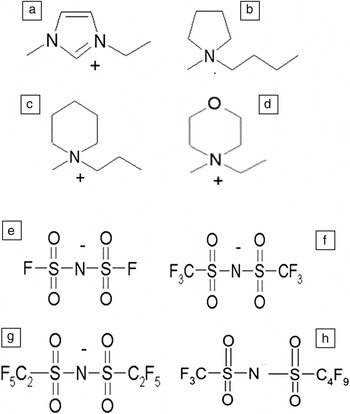
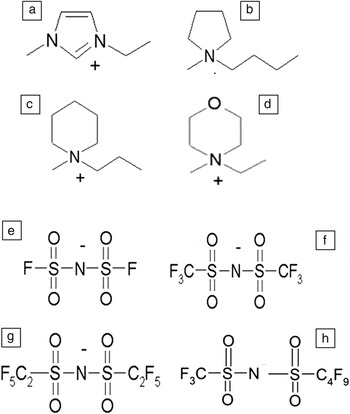
RTILs are constituted of organic (generally asymmetric) tetraalkylammonium (e.g., cyclic (pyrrolidinium, piperidinium)), phosphonium, or heteroaromatic (imidazolium, pyridinium) cations associated with organic/inorganic (symmetric/asymmetric) anions (such as PF6, BF4, per(fluoroalkylsulfonyl)imide).Reference Wasserscheid and Keim1–Reference Dupont, de Souza and Suarez5,Reference Wasserscheid and Welton29,Reference Welton30 The chemical structures of a few of the most common IL cations and anions are depicted in Scheme 1.
Chemical structures of the ionic liquid cations and anions most commonly employed in electrochemical energy devices. (a) N-ethyl-N-methylimidazolium, EMI+; (b) N-butyl-N-methylpyrrolidinium, PYR14+ (the subscript indicates the number of carbon atoms of the alkyl side chains bounded to the nitrogen atoms); (c) N-methyl-N-propylpiperidinium, PIP13+; (d) N-ethyl-N-methylmorpholinium, MOR12+; (e) bis(fluorosulfonyl)imide, FSI–; (f) bis(trifluoromethanesulfonyl)imide, TFSI–; (g) bis(pentafluoroethanesulfonyl)imide, BETI–; and (h) (nonafluorobutanesulfonyl)(trifluoromethanesulfonyl)imide, IM14–.
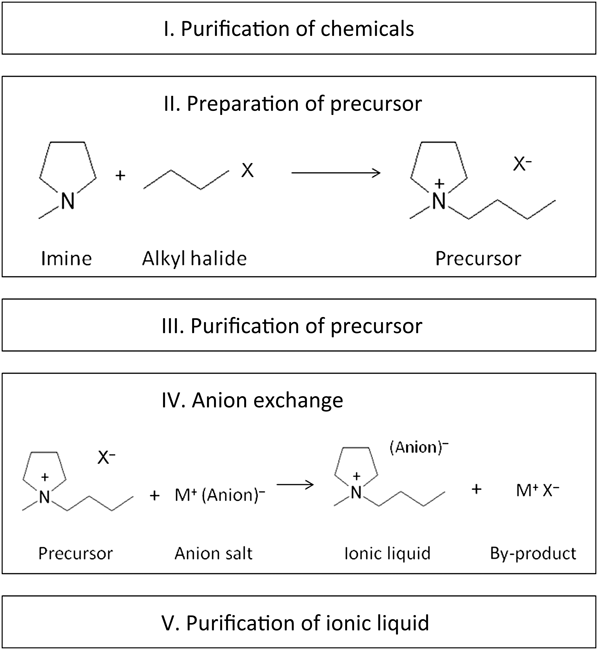
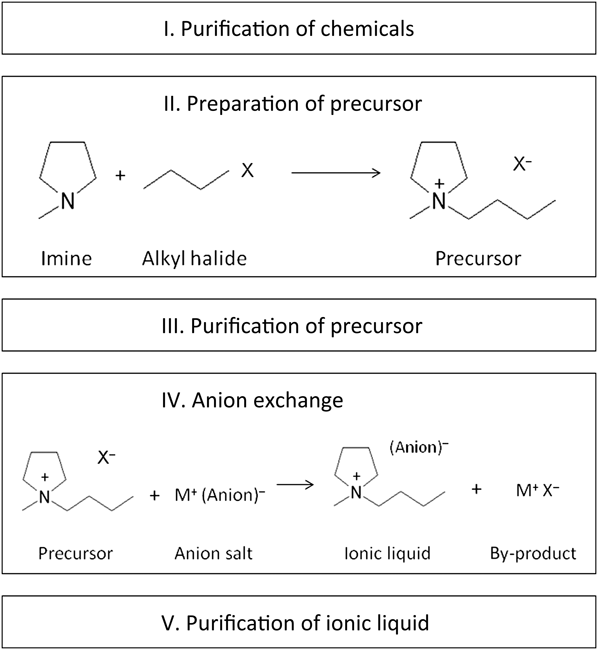
The great majority of ILs is usually synthesized through a two-stage process: (1) preparation of the precursor salt obtained by N-alkylation of amines using alkyl halides as alkylation agents, and (2) exchange reaction of the precursor halide (halide metathesis) with a suitable anion. However, halide-free synthesis routes, mostly two-step processes, for a wide variety of IL materials are also proposed (see later in the text). Finally, the overall RTIL synthesis processes also include other side steps aimed at enhancing the material purity, including a low water content. Scheme 2 outlines the synthesis steps of a procedure route starting from alkyl halides.
Outlines of the overall procedure route commonly followed for the synthesis of ionic liquids. M+: alkaline metal; X–: halide.
Synthesis routes from alkyl halides
Preparation of the precursor
A suitable and rather simple way to prepare the precursor is the N-alkylation of amines (i.e., saturated cyclic [pyrrolidine, piperidine] or linear [NR3] or heteroaromatic [imidazole, pyridine]), with alkyl halide, according to the reaction (II) reported in Scheme 2, to obtain a quaternary ammonium halide salt. Most researchers progressively replaced the alkyl iodide compounds, previously used as alkylation agents,Reference MacFarlane, Meakin, Sun, Amini and Forsyth31–Reference Fernicola, Croce, Scrosati, Watanabe and Ohno34 with the cheaper, more chemically stable (less oxygen- and light-sensitive) and less toxic alkyl bromideReference Sakaebe and Matsumoto14,Reference Arco, Laxamana, Giron and Obliosca35–Reference Montanino, Alessandrini, Passerini and Appetecchi37 and alkyl chlorideReference Appetecchi, Montanino, Carewska, Moreno, Alessandrini and Passerini36,Reference Moreno, Montanino, Carewska, Appetecchi, Jeremias and Passerini38 reagents. The latter, however, show very slow reaction kinetics toward aminesReference Appetecchi, Montanino, Carewska, Moreno, Alessandrini and Passerini36,Reference Moreno, Montanino, Carewska, Appetecchi, Jeremias and Passerini38 since chloride is much more difficult to be released by the alkyl group than bromide and, especially, iodide.Reference Morrison and Boyd39,Reference Allinger, Cava, De Jongh, Johnson, Lebel and Stevens40
Although Arco et al.Reference Arco, Laxamana, Giron and Obliosca35 have carried out the preparation of the precursor by directly mixing amine with alkyl halide, a solvent is generally preferred in order to (1) drive the alkylation reaction (panel I of Scheme 2) up to a 100% yield (e.g., choosing suitable medium to dissolve the reagents but not the precursor, which can be easily removed by filtration), and to (2) dilute the heat delivered during the reaction. This precautionReference Henderson and Passerini32,Reference Appetecchi, Montanino, Carewska, Moreno, Alessandrini and Passerini36,Reference Appetecchi, Montanino, Zane, Carewska, Alessandrini and Passerini41,Reference Montanino, Carewska, Alessandrini, Passerini and Appetecchi42 may be important, especially when using aliphatic iodide compounds with long (iodopentane and longer) or short (iodomethane or iodoethane) alkyl chains, because the reaction with amine is exothermic due to a large energy release (long chains) or very fast kinetics (short chains). MacFarlane et al.Reference MacFarlane, Meakin, Sun, Amini and Forsyth31,Reference MacFarlane, Huang and Forsyth43 have used acetonitrile as the solvent for reacting N-methylpyrrolidine with alkyl iodine compounds, whereas Tommasi et al.Reference Tommasi and Sorrentino44 have prepared a 1,3-dialkylimidazolium salt precursor in an acetone medium. Although acetonitrile and acetone have been among the most common, if not the most common, solvents initially employed for the preparation of the precursor,Reference Wasserscheid and Keim1–Reference Dupont, de Souza and Suarez5,Reference Wasserscheid and Welton29,Reference Welton30 none of these compounds are welcome in the chemical industry because of their volatility (acetone), safety, and environmental issues (acetonitrile). In addition, Appetecchi et al.Reference Appetecchi, Scaccia, Tizzani, Alessandrini and Passerini33 have reported that the presence of acetone traces might occasionally result in the formation of unwelcome yellowish compounds even at moderate temperatures (50°C).
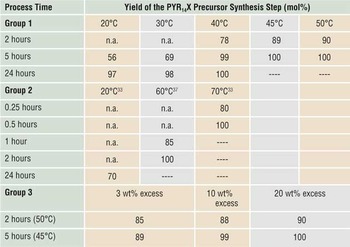
Henderson et al.,Reference Henderson and Passerini32 Appetecchi et al.,Reference Appetecchi, Scaccia, Tizzani, Alessandrini and Passerini33,Reference Montanino, Carewska, Alessandrini, Passerini and Appetecchi42 Fernicola et al.,Reference Fernicola, Croce, Scrosati, Watanabe and Ohno34 and Arco et al.Reference Arco, Laxamana, Giron and Obliosca35 have successfully prepared several kinds of pyrrolidinium (or piperidinium or imidazolium or tetraalkylammonium) halide precursors using ethyl acetate as the solvent medium. This organic compound, actually the most widely adopted for the synthesis route of IL precursors,Reference Clare, Sirwardana and MacFarlane45 shows rather lower environmental impact and safety issues with respect to the previously mentioned solvents. Henderson et al.Reference Henderson and Passerini32 and, particularly, Appetecchi et al.Reference Appetecchi, Scaccia, Tizzani, Alessandrini and Passerini33 have investigated in detail (Table I) the effect of the process operating conditions (temperature and time) and of the chemical amounts on the synthesis step yield of the pyrrolidinium iodide (PYR14I) precursor obtained from the reaction of N-methylpyrrolidine with 1-iodobutane. These procedure routes have been successfully used for the synthesis of several other kinds of precursor (e.g., pyrrolidinium, piperidinium, tetraalkylammonium, or imidazolium), with alkyl side chains containing from 1 to 10 carbon atoms.Reference Henderson and Passerini32,Reference Appetecchi, Montanino, Carewska, Moreno, Alessandrini and Passerini36,Reference Montanino, Alessandrini, Passerini and Appetecchi37,Reference Appetecchi, Montanino, Zane, Carewska, Alessandrini and Passerini41,Reference Montanino, Carewska, Alessandrini, Passerini and Appetecchi42 The results, compared in Table I, clearly show that temperature largely affects the kinetics of the precursor synthesis. The yield of PYR14I approaches 100 mol% after five hours of reaction at 45°C, whereas at 30°C, a 24-hour process time is required for achieving a yield equal to 98 mol% (Table I, Group 1). A moderate enhancement in yield was also observed up to a 10 wt% N-methylpyrrolidine excess (Table I, Group 3), which, however, can be easily recycled by distillation of the ethyl acetate because it is highly soluble in this solvent.Reference Appetecchi, Scaccia, Tizzani, Alessandrini and Passerini33
Summary of the synthesis step yield dependence of PYR14I and PYR14Br precursors.
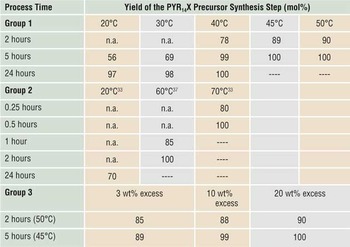
Summary of the synthesis step yield (reported as mol%) dependence of the PYR14I (Group 1 data taken from Reference 33) and PYR14Br (Group 2 data taken from Reference 37) precursors, obtained from the reaction of N-methylpyrrolidine with 1-iodobutane (Group 1) and 1-bromobutane (Group 2), respectively, as a function of the temperature and process time. The N-methylpyrrolidine excess (for the data reported in Groups 1 and 2), with respect to the stoichiometric amount of 1-iodobutane or 1-bromobutane, is fixed at 10 wt%,Reference Appetecchi, Scaccia, Tizzani, Alessandrini and Passerini33 5 wt%,Reference Montanino, Alessandrini, Passerini and Appetecchi37 and 0.5 wt%,Reference Appetecchi, Scaccia, Tizzani, Alessandrini and Passerini33 respectively. Group 3 reports the PYR14I yield (mol%) versus N-methylpyrrolidine excess (wt%) dependence (data taken from Reference 33) at different temperatures and process times.
A relevant improvement in terms of reaction time, optimization of chemical amount, and, especially, environmental impact was recently reported. Appetecchi et al.Reference Montanino, Alessandrini, Passerini and Appetecchi37 first demonstrated that the synthesis process of the precursor, as well as the metathesis process, can be driven in water, achieving a 100 mol% yield after a reaction time of only 30 minutes at 70°C and with a N-methylpyrrolidine excess not exceeding 0.5 wt% (Table I, Group 3). The disappearance of the alkyl iodide (insoluble in water) from the aqueous solution drove the synthesis process to completion. It is worth noting that this represents a very appealing result, highlighting how water can be used as the only solvent medium for the overall synthesis process of ILs.
Metathesis reaction
The tetraalkylammonium halide precursor, as obtained from the alkylation process, is reacted through a halogen metathesis (or anion exchange) reaction, with a suitable alkaline metal (mostly lithium) salt (according to the reaction (IV) reported in Scheme 2) to produce the IL and alkaline metal halide salt as the by-product. For the preparation of the precursor, previous procedures reported in literatureReference Sakaebe and Matsumoto14,Reference Noda, Susan, Kudo, Mitsushima, Hayamizu and Watanabe15,Reference MacFarlane, Meakin, Sun, Amini and Forsyth31,Reference Monteiro, Seferin, Dupont and de Souza46,Reference Boesmann, Van Hal and Wasserscheid47 made use of hazardous, unsafe, high environmental impact, and relatively expensive organic solvents such as acetone, acetonitrile, and, especially, dichloromethane. In addition, these compounds (generally not preferred in the chemical industry) need to be fully recycled to avoid their emission into the environment.
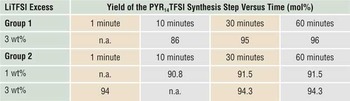
A considerable breakthrough is represented by the use of water as the solvent medium for the metathesis reaction, thus allowing for a wide variety of RTIL materials to be obtained.Reference Henderson and Passerini32–Reference Fernicola, Croce, Scrosati, Watanabe and Ohno34,Reference Appetecchi, Montanino, Carewska, Moreno, Alessandrini and Passerini36,Reference Montanino, Alessandrini, Passerini and Appetecchi37,Reference Appetecchi, Montanino, Zane, Carewska, Alessandrini and Passerini41,Reference Montanino, Carewska, Alessandrini, Passerini and Appetecchi42,Reference Clare, Sirwardana and MacFarlane45 As highlighted by Henderson et al.,Reference Henderson and Passerini32 Passerini et al.,Reference Appetecchi, Montanino, Zane, Carewska, Alessandrini and Passerini41 and Appetecchi et al.,Reference Montanino, Carewska, Alessandrini, Passerini and Appetecchi42 particular care has to be devoted for iodide-based precursors, which require nitrogen bubbling to remove oxygen from the aqueous solution, minimizing the oxidation of I– to I2. The formation of two separate liquid phases (e.g., hydrophobic RTIL and an aqueous solution containing the hydrophilic, alkaline metal halide salt) clearly indicates that the reaction, driven by the intrinsic hydrophobicity of the IL (e.g., some ILs do not easily form hydrogen bonds with water molecules and tend to separate from the aqueous phase) continues. The results reported by Henderson et al.Reference Henderson and Passerini32 and Appetecchi et al.,Reference Appetecchi, Scaccia, Tizzani, Alessandrini and Passerini33 summarized in Table II, confirm that the metathesis reaction takes place in very short times with yield leveling up to 95–96 mol% after 30 minutes. Even if the IL is insoluble in water (especially at low temperatures), its anion is strongly bound to the alkaline metal cations, as previously demonstrated by Castriota et al.Reference Castriota, Caruso, Agostino, Cazzanelli, Henderson and Passerini48 and Nicotera et al.Reference Nicotera, Oliviero, Henderson, Appetecchi and Passerini49 The strong coordination of alkaline metal cations by water molecules and anions is the driving force that causes the partial dissolution of the IL in the aqueous phase, leading to yields lower than 100%.
Summary of the synthesis step yield dependence of N-butyl-N-methylpyrrolidinium bis(trifluoromethanesulfonyl)imide PYR14TFSI ionic liquid.
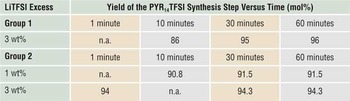
Summary of the synthesis step yield (reported as mol%) dependence of the N-butyl-N-methylpyrrolidinium bis(trifluoromethanesulfonyl)imide PYR14TFSI ionic liquid, obtained from the metathesis reaction of the pyrrolidinium iodide (PYR14I) (Group 1, data taken from Reference 33) and PYR14Br (Group 2, data taken from Reference 37) precursors with the LiTFSI salt, as a function of the process time and LiTFSI excess with respect to the stoichiometric amount of precursor. Note: TFSI, bis(trifluoromethanesulfonyl)imide; n.a., not available.
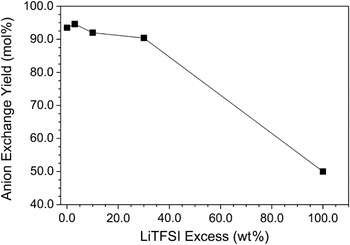
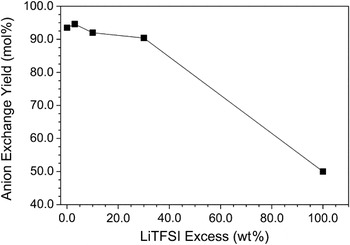
Appetecchi et al.Reference Appetecchi, Scaccia, Tizzani, Alessandrini and Passerini33 also investigated the effect of the alkaline metal salt reagent excess on the yield of the metathesis process driven in water, detecting a slight increase (from 93.5 mol% to 94.6 mol%) in passing from 0 wt% to 3 wt% excess. Further increases in salt excess lead to a decrease of the process yield. These results, plotted in Figure 1, suggest the use of limited excess of alkaline metal reagent salts which, in addition, are rather expensive (especially perfluoroalkylsulfonyl imide-based salts).
Synthesis process yield (reported as mol%) of N-butyl-N-methylpyrrolidinium bis(trifluoromethanesulfonyl)imide (PYR14TFSI), obtained from the metathesis reaction of PYR14I with LiTFSI as a function of the LiTFSI excess with respect to the stoichiometric amount of precursor. Data taken from Reference 33.
The aqueous route was followed to also successfully synthesize water soluble ILs. Wilkes et al.Reference Wilkes and Zaworotko50 and Moreno et al.Reference Moreno, Montanino, Carewska, Appetecchi, Jeremias and Passerini38 have prepared 1,3-dialkylimidazolium- and pyrrolidinium-based RTILs with various anions such as BF4, CH3COO, and CF3OSO2 by reacting imidazolium or pyrrolidinium chlorides (precursors) with a silver salt containing the desirable anion. These metathesis reactions are driven by the very poor water solubility of the by-product AgCl, which can be separated by the aqueous IL (water soluble) solution through filtration, even if silver halides may form submicron particles that are difficult to remove.Reference Clare, Sirwardana and MacFarlane45 A distillation step allows the removal of water from the RTIL. However, this route, even if representing an important task, is rather expensive and requires more careful purification from halides.Reference Moreno, Montanino, Carewska, Appetecchi, Jeremias and Passerini38
Synthesis routes from halide-free reagents
The presence of alkyl halogen and/or halide impurities represents one of the most undesirable contaminations for ILs, especially if they are used for electrochemical applications (halides can reduce to halogens, thus narrowing the electrochemical stability window of the ILs), leading to the development of synthesis routes from halide-free compounds.Reference Clare, Sirwardana and MacFarlane45
Seddon et al.Reference Pitner, Seddon, Stack, Curzons and Freer51 have reacted (through alkylation) 1-alkylimidazolium with trifluoroethyl acetate or butyl methanesulfonate (to obtain 1,3-dialkylimidazolium salts), followed by metathesis reaction with acids (HBF4, HPF6). Cassol et al.Reference Cassol, Costa Ferrera, Ebeling and Dupont52 followed a similar method by proposing alkylation of 1-alkylimidazoliums with alkyl alkane sulfonates or alkyl trifluoromethanesulfonate, followed by metathesis in water solution with alkaline metal salts containing suitable anions (PF6, BF4, CF3OSO2, N(CF3SO2)2, (CF3CF2)3PF3).
Holbrey et al.Reference Holbrey, Reichert, Swatloski, Broker, Pitner, Seddon and Rogers53 have used dimethyl sulfate (or diethyl sulfate) for the alkylation of 1-alkylimidazolium. Successively, the CH3OSO2 (or CH3CH2OSO2) anion was exchanged for BF4 or PF6 or CF3OSO2. Mikami et al.Reference Jodry and Mikami54 have used the triflic ester derived from (S)-ethyllactate for the alkylation of 1-methylimidazolium, followed by metathesis with PF6-based salt to prepare 1,3-dialkylimidazolium PF6 IL. Dupont et al.Reference Silveira, Lando, Dupont and Monteiro55 proposed a reaction where five components, namely glyoxal, formaldehyde, two different amines, and an acid, are condensed to 1,3-dialkylimidazolium salts.
Table III summarizes the chemicals and reagents used for the above-mentioned halide-free synthesis routes. The absence of residual halide contaminants may be undoubtedly an appealing issue for ILs. However, halide-free synthesis procedures generally make use of hazardous, toxic, and volatile organic solvents, which are unwelcome in industrial applications. In addition, it is to be noted that the alkyl halogen-based routes easily allow for the selection of aliphatic substituents, thus allowing for the possibility to finely tune the cation structure and, therefore, the physicochemical properties of the RTILs.
Summary of chemicals and reagents used in a few of the most common halide-free routes for the synthesis of ionic liquids.

Note:
M+ = alkaline metal.
Purification of ionic liquids
The purity level of RTILs is essential in many applications because the nature and amount of contaminants may significantly affect the physicochemical properties of the RTILs.Reference Earle and Seddon3 Therefore, the IL community has been devoting large efforts to obtain ILs with high purity levels, while at the same time taking care not to deplete the overall synthesis process yield and not to significantly increase the cost of the final product. It is to be noted how most of the overall process time and energy cost are devoted for the purification steps (e.g., less than two hours are required for running both the preparation of the precursor [70°C] and the metathesis reaction [room temperature], whereas the purification steps need much longer process times, vacuum stages, and, sometimes, higher temperatures [drying step]). Various purification procedures were designed and developed, which differ depending on the method for purifying RTILs and the stage of the overall synthesis process at which the purification is carried out.
Purification methods
The most frequently encountered RTIL contaminantsReference Clare, Sirwardana and MacFarlane45 are water (from the metathesis reaction), unreacted organic reagents (from precursor synthesis), residual organic solvents (from overall synthesis process), halide salts (from overall synthesis process), and suspended solid particles (from sorbents, chemical drying agents, metathesis by-products as silver halides).
The most common method for purifying ILs consists of the use of a sorbent material, such as activated carbon, alumina, or silica, which can be employed following different procedures. Passerini et al.Reference Appetecchi, Scaccia, Tizzani, Alessandrini and Passerini33,Reference Montanino, Alessandrini, Passerini and Appetecchi37 have used stirring the IL (or the reagent chemicals or the precursor) over carbon and alumina. Seddon et al.Reference Rogers and Seddon2 flowed the RTIL through a column loaded with carbon and silica, whereas Davis et al.Reference Davis, Gordon, Hilgers, Wasserscheid, Wasserscheid and Welton56 proposed stirring over carbon and then passing the RTIL through an alumina column. Scammells et al.Reference Scammells, Scott and Singer57 passed RTILs over silica to reduce the contamination from alkali metal halide salts. Solvents are generally added to reduce the viscosity of the resulting slurry.Reference Appetecchi, Scaccia, Tizzani, Alessandrini and Passerini33,Reference Montanino, Alessandrini, Passerini and Appetecchi37,Reference Davis, Gordon, Hilgers, Wasserscheid, Wasserscheid and Welton56,Reference Clare, Bayley, Best, Forsyth and MacFarlane58–Reference Nockemann, Binnemans and Driesen60 Even if sorbents can be rather easily removed (by filtration), a few researchersReference Clare, Bayley, Best, Forsyth and MacFarlane58–Reference Nockemann, Binnemans and Driesen60 have detected the presence of nanoparticles of these materials (behaving as overlooked impurities) in the purified ILs. Microfiltration (<0.2 µm)Reference Appetecchi, Scaccia, Tizzani, Alessandrini and Passerini33,Reference Montanino, Alessandrini, Passerini and Appetecchi37 was found to reduce the sorbent contamination below 10 ppm,Reference Clare, Bayley, Best, Forsyth and MacFarlane58 although even this very low contamination level was seen to have non-negligible effects toward some of the physicochemical properties of ILs.Reference Clare, Bayley, Best, Forsyth and MacFarlane58,Reference Nockemann, Binnemans and Driesen60
Rinsing with an appropriate fluid is a simple and efficient way to purify ILs. The main contamination for RTILs is represented by metal alkaline cations and halide anions derived from the metathesis reaction. Hydrophobic ILs can be properly rinsed through water,Reference Wasserscheid and Keim1–Reference Dupont, de Souza and Suarez5,Reference Wasserscheid and Welton29,Reference Welton30,Reference Henderson and Passerini32–Reference Moreno, Montanino, Carewska, Appetecchi, Jeremias and Passerini38,Reference Appetecchi, Montanino, Zane, Carewska, Alessandrini and Passerini41–Reference MacFarlane, Huang and Forsyth43,Reference Clare, Sirwardana and MacFarlane45,Reference Wilkes and Zaworotko50 thus efficiently removing the (highly water soluble) alkali metal halides. In order to limit the loss of IL (whose solubility in water increases with temperature), the rinsing steps are performed in cold water. Conversely, water-miscible (hydrophilic) RTILs have to be previously dissolved in organic solvents (usually CH2Cl2) and then rinsed with very cold water in order to extract contaminants but minimize the IL loss.Reference Clare, Sirwardana and MacFarlane45
Purification stages
The purification route can be performed at three different stages of the overall synthesis process (Scheme 2): chemicals, precursor, and IL. The chemicals are generally used as received. Recently, Passerini et al.Reference Appetecchi, Montanino, Carewska, Moreno, Alessandrini and Passerini36–Reference Moreno, Montanino, Carewska, Appetecchi, Jeremias and Passerini38 have proposed a purification step also for the precursor reagents (amines and alkyl halide) through sorbent materials (e.g., activated carbon and alumina), which are stirred together with the chemicals and then separated from the liquid fraction by filtration. It is worth noting that high purity chemicals allow for a considerable reduction in the contamination level in RTILs and to run softer and cheaper purification routes on the precursor and IL, which are generally much more difficult to be purified (especially the IL).
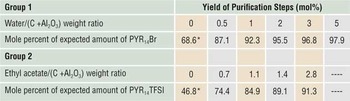
Concerning the precursor, different approaches were followed. It is to be noted that a careful purification of the precursor rather than the IL (harder to be purified) also allows for limiting the loss of the generally expensive metal alkaline salt used for the metathesis reaction. Henderson et al.Reference Henderson and Passerini32 have proposed a purification procedure for tetraalkylammonium halides carried out through recrystallization. For instance, the precursor is dissolved in acetone at 80–100°C and then slowly recrystallized (formation of a fine, white solid precipitate) at ambient (or sub-ambient) temperature (precursor is insoluble in acetone at room temperature). Successively, the impurities and excess reagents (soluble in acetone) are removed by filtration. However, acetone can produce undesirable compounds (even if in small amounts) if the temperature rises above 50°C.Reference Appetecchi, Scaccia, Tizzani, Alessandrini and Passerini33 Passerini et al.Reference Appetecchi, Scaccia, Tizzani, Alessandrini and Passerini33 have suggested an acetone-free purification route by repeatedly rinsing the solid precursor with ethyl acetate until the liquid phase is clear and colorless (the precursor, insoluble in ethyl acetate, is separated by the liquid phase, containing soluble impurities, by filtration). Appetecchi et al. Reference Montanino, Alessandrini, Passerini and Appetecchi37 have reported in detail a purification route, to be simply performed in water as the medium, through sorbents (activated carbon and alumina), which, after filtering from the liquid fraction, are rinsed with water to recover the precursor trapped through the sorbents. The results, summarized in Table IV, Group 1, show evidence that the rinsing of the purifying materials allowed for enhancement of the yield of the purification step up to about 97 mol% for a water/(carbon + alumina) weight ratio equal to 3. No relevant amount of precursor was recovered for further water addition, whereas more extensive rinsing led to a slightly yellowish coloration of the liquid fraction, indicating the partial release of impurities from sorbents.
Yield of the purification step of the PYR14Br precursor and the N-butyl-N-methylpyrrolidinium bis(trifluoromethanesulfonyl)imide (PYR14TFSI) ionic liquid.
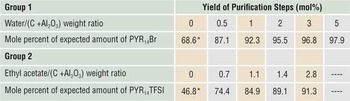
Yield of the purification step of the PYR14Br precursor (Group 1, data taken from Reference 37) and the N-butyl-N-methylpyrrolidinium bis(trifluoromethanesulfonyl)imide (PYR14TFSI) ionic liquid (Group 2, data taken from Reference 33) as a function of the solvent/(C + Al2O3) weight ratio used for the rinsing of the purifying materials. Group 1: C/Al2O3 weight ratio = 0.67; (C + Al2O3)/PYR14Br weight ratio = 1.5. Group 2: C/Al2O3 weight ratio = 0.4; (C + Al2O3)/PYR14TFSI weight ratio = 0.7. * = percent amount directly obtained from vacuum filtration before the rinsing steps.
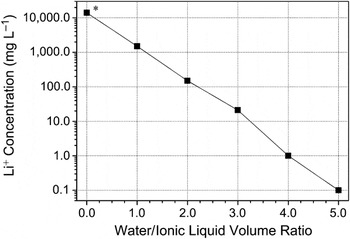
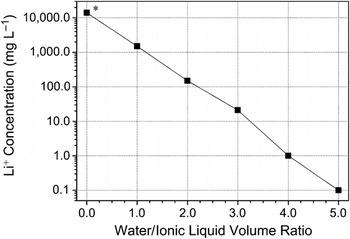
The purification of the IL obtained from the metathesis reaction is mainly performed through three different methods: rinsing with fluids (to remove alkali metal halides), passing through (or over) sorbent materials (colored impurities), and vacuum drying (water traces). Appetecchi et al.Reference Appetecchi, Scaccia, Tizzani, Alessandrini and Passerini33,Reference Montanino, Alessandrini, Passerini and Appetecchi37 have reported a detailed investigation, summarized in Figure 2, on the residual Li+ cation concentration in the aqueous phase collected after the rinsing steps carried out with water on hydrophobic RTILs. A lithium concentration of 14,000 mg L−1 was detected in the aqueous phase immediately after the metathesis reaction (e.g., 89.3 wt% of overall lithium is extracted). A fast decay in Li+ concentration was progressively observed in the aqueous phase after consecutive rinsing steps, leveling down to 0.1 mg L−1 (70 ppb) for a water/RTIL volume ratio equal to 5.
Lithium concentration in the aqueous phases collected immediately after the metathesis process (marked with an asterisk) and the rinsing steps as a function of the water/ionic liquid volume ratio (fixed at 1:1 in each rinsing step). Data taken from Reference 33.
Several authorsReference Wasserscheid and Keim1–Reference Dupont, de Souza and Suarez5,Reference Wasserscheid and Welton29,Reference Welton30,Reference Henderson and Passerini32–Reference Moreno, Montanino, Carewska, Appetecchi, Jeremias and Passerini38,Reference Appetecchi, Montanino, Zane, Carewska, Alessandrini and Passerini41–Reference MacFarlane, Huang and Forsyth43,Reference Clare, Sirwardana and MacFarlane45,Reference Wilkes and Zaworotko50 have reported purification routes over sorbent materials. A detailed and optimized procedure for purifying RTILs was developed by Appetecchi et al.,Reference Appetecchi, Scaccia, Tizzani, Alessandrini and Passerini33,Reference Moreno, Montanino, Carewska, Appetecchi, Jeremias and Passerini38 who have been intimately mixing the IL with activated carbon (10 hours at 70–75°C until discoloration of the RTILs promoted by temperature) and, upon removal of carbon, with alumina (five hours at room temperature). The sorbent materials, separated by filtration, were rinsed with ethyl acetate to recover the IL trapped in the solid phases. The results, illustrated in Table IV, Group 2, show that about 47 wt% of the expected (stoichiometric) IL amount is obtained directly by the filtration of the sorbent materials. The rinsing of carbon and alumina allowed for the increase in the yield of the purification process up to about 90 wt%.
Despite the fact that several applications are not affected by the presence of water,Reference Clare, Sirwardana and MacFarlane45 its presence as a contaminant is generally unwelcome. Water traces can be fully eliminated by vacuum distillation followed by high vacuum drying at 100–120°C.Reference Henderson and Passerini32,Reference Appetecchi, Scaccia, Tizzani, Alessandrini and Passerini33,Reference Montanino, Alessandrini, Passerini and Appetecchi37 However, vacuum steps are not appropriate for many protic RTILs since the conjugated acid and base species may be volatile.Reference Clare, Sirwardana and MacFarlane45
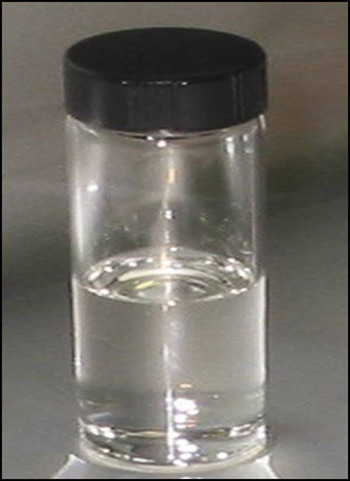
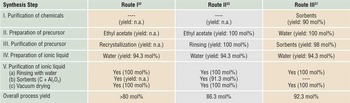
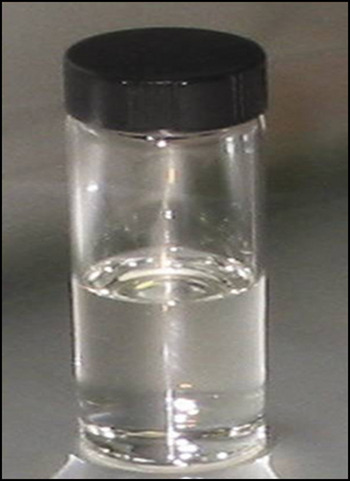
The impurity level in RTILs may be detected through different techniques (e.g., ionic chromatography, cyclic voltammetry, x-ray fluorescence, atomic absorption, AgNO3 titration, Karl-Fischer titration). Appetecchi et al.Reference Appetecchi, Scaccia, Tizzani, Alessandrini and Passerini33,Reference Montanino, Alessandrini, Passerini and Appetecchi37,Reference Moreno, Montanino, Carewska, Appetecchi, Jeremias and Passerini38 have demonstrated the feasibility of preparing transparent, colorless, and odorless ILs (Figure 3) with extremely low Li+ (2 ppb), Ag+ (25 ppb), Cl– (400 ppb), and humidity (<1 ppm) content. Other impurities such as Si, Mo, Al, and Na were found to be well below 100 ppm. The high purity level of the IL materials was also confirmed by sweep voltammetry.Reference Appetecchi, Scaccia, Tizzani, Alessandrini and Passerini33,Reference Montanino, Alessandrini, Passerini and Appetecchi37 Table V summarizes the progressive improvements carried out on the basis of the results reported by Henderson et al.,Reference Henderson and Passerini32 Passerini et al.,Reference Appetecchi, Scaccia, Tizzani, Alessandrini and Passerini33 and Appetecchi et al.Reference Montanino, Alessandrini, Passerini and Appetecchi37 on the synthesis procedure for hydrophobic tetraalkylammonium per(fluoroalkylsulfonyl)imide RTILs. Upon moving from route I to route III, a progressive improvement in the overall process yield is combined with a lower environmental impact of the used chemicals.
Picture of a N-butyl-N-methylpyrrolidinium bis(trifluoromethanesulfonyl)imide (PYR14TFSI) ionic liquid sample.
Progressive improvements of the synthesis process of hydrophobic ionic liquids. The yield values (indicated in mol%), referring to each synthesis step as well as the overall process, are also reported.
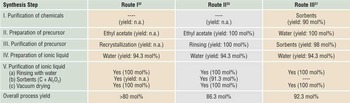
Note:
n.a., not available.
Recycling of chemicals
In view of the anticipated near-future large industrial production of ILs, the need for recycling the chemicals used in the synthesis route and recovering the IL fractions lost through the overall process becomes a necessity. In particular, if sorbents are employed in the purification step, a large amount of waste would be produced. However, detailed routes concerning recycling procedures of RTIL production waste are still not widely available in the literature.
Appetecchi et al.Reference Montanino, Alessandrini, Passerini and Appetecchi37 have observed that the main IL losses for the aqueous synthesis are localized in the precursor purification and the metathesis reaction stages. They have developed suitable routes to fully recover these RTIL fractions. Reference Montanino, Alessandrini, Passerini and Appetecchi37 The waste sorbent materials are recycled by extensive rinsing with water until no halide traces are detected and then vacuum annealed at 200°C,Reference Montanino, Alessandrini, Passerini and Appetecchi37 whereas the aqueous precursor solution derived from rinsing is vacuum distillated to remove water. The aqueous phase waste coming from metathesis is vacuum distillated to obtain a slurry, mainly composed of IL and metal alkali halide salt, which is vacuum filtered to separate the RTIL. The latter is rinsed with cold water until full removal of halide is achieved.
Summary
A review of the synthesis routes of ionic liquids (ILs) is reported. Large efforts have been devoted to improving the environmental impact of solvents, chemical recycling and cost, and the overall process yield for obtaining high purity level ILs. The results demonstrate the feasibility of using water as the only solvent for the synthesis process to obtain RTILs with impurity content well below 100 ppm, moisture content below 1 ppm, and yields above 92 mol%. In addition, the feasibility of recycling the chemicals used in the synthesis route and of recovering the IL fractions lost through the overall process was demonstrated. This issue, in combination with the use of very low environmental impact solvents such as water, is of particular interest in view of future (if not near-future) large-scale industrial production of ILs.