




No CrossRef data available.
An Anonymous Sermon against the Hagarenes, the Bogomils, and the Jews
Published online by Cambridge University Press: 01 July 2004
Extract
Three years ago, Patrick Andrist published a study listing an impressive register of manuscripts containing Christian literature against the Jews. One item in particular caught my eye, because it targets a wider range of opponents: it is an anonymous sermon against the Hagarenes, the Bogomils, and the Jews, and, more specifically, their hatred of the cross. This work, meant to be read on the third Sunday of Lent, has been preserved in one manuscript only: Athos,  388 (16th c.; 8°; 994 folios), a voluminous paper codex with various contents. The text, which runs from fol. 426r (431r), line 19, to 427v (432v), line 40, was written by a quick but rather inaccurate hand, as is shown by the numerous abbreviations, the presence of two lacunae, and the lack of quite a few initial capitals, which should have been added by the rubricator. The sermon is of unknown date, but the In exaltationem uenerandae crucis et contra Bogomilos of Germanos II, patriarch of Constantinople-Nicaea from 1223–1240, gives us a clue, as a major portion of lines 9–83 of our sermon can be found in this work (PG 140.621–44). In this article I present the editio princeps of the Greek text, accompanied by both an apparatus fontium and an apparatus criticus.
Information
- Type
- ARTICLES
- Information
- Copyright
- © 2004 Cambridge University Press
Three years ago, Patrick Andrist published a study listing an impressive register of manuscripts containing Christian literature against the Jews.
1Patrick Andrist, “Pour un répertoire des manuscrits de polémique antijudaque,” Byzantion 70 (2000) 270–306, at 293.

388 (16th c.; 8°; 994 folios), a voluminous paper codex with various contents.
2As I did not have the opportunity to examine the manuscript myself—I have relied on photographs of the relevant folios—I have taken these data from Spyridon P. Lambros, Catalogue of the Greek Manuscripts on Mount Athos (2 vols.; Cambridge: Cambridge University Press, 1900) 2:122–38. Lambros gives a detailed survey of the contents of the codex.
See Hans-Georg Beck, Kirche und theologische Literatur im byzantinischen Reich (2d ed.; München: Beck, 1977) 667–68; Jean-Marie Mayeur et al., eds., Histoire du christianisme des origines à nos jours (14 vols.; Paris: Desclée, 1990–2000) 5:670, 673–74; Franz Tinnefeld, “Germanos II,” in LTK3 4:532.
The first and by far shortest part of the sermon (lines 2–5) is directed against the so-called Hagarenes, a term that originally denoted the offspring of Abraham's slave Hagar (

; see Gen 16; 21:8–21; 1 Chr 5:19; Ps 82:7). Very soon, however, even before the rise of Islam, the term came into use to designate the Arabs and Saracens, the supposed descendants of Hagar's son Ishmael (Epiphanius, Pan. 4.1.7 [CPG 3745] and John of Damascus, De haer. 100 [CPG 8044]).
4
The word also occurs in the ancient Bulgarian translation (first half of the 14th c.) of the


, written by Konstantinos Manasses during the reign of Manuel I Komnenos (1143–1180), while until the nineteenth century, agarjanin (

) figured in languages across the Balkan as a synonym for “heathen,” and more particularly “Muslim.” In the sermon, the Hagarenes accuse the Christians of worshipping mere wood, a criticism undoubtedly derived from Qurānic verses such as 5:92 and 6:74.
5Qurān 5:92: “O ye who believe, verily, wine and gambling and statues and divining arrows are only an abomination of Satan's work; avoid them then, that haply ye may prosper”; 6:74: “Lo! Ibrahim said to his father Azar: Takest thou idols for gods? Verily, I see thee and thy people in obvious error.”
The second part (lines 6–131) targets the sectarian movement of the (Macedonian?) priest Bogomil and his followers,6


Hans-Dieter Döpmann, “Bogomilen,” in LTK3 2:548–49.
See the account by Kozma in the edition by Popruzhenko (n. 7, above), 26.
Euthymios Zigabenos, Panoplia dogmatica 27.14–15 (PG 130. 1309–12); according to Kozma, the heretics are worse than demons: demons are afraid of the cross, while the heretics cut down the crosses and make their tools out of them (ed. Popruzhenko [n. 7, above], 5).
Mayeur et al., eds., Histoire du christianisme, 4:330.
In the third part of the sermon—the second half of the text (lines 132–272)—the author finds himself on familiar ground, for anti-Judaic sentiments are practically as old as Christianity itself. Slander and defamation of the Jews are already found in the Gospel of John (especially 8:44) and the Letter to the Galatians.12
See John G. Gager, The Origins of Anti-Semitism: Attitudes Toward Judaism in Pagan and Christian Antiquity (New York: Oxford University Press, 1985) 151–53, 230–43.
Luke Timothy Johnson, “The New Testament's Anti-Jewish Slander and the Conventions of Ancient Polemic,” JBL 108 (1989) 419–41; and Guy G. Stroumsa, “From Anti-Judaism to Antisemitism in Early Christianity,” in Contra Iudaeos. Ancient and Medieval Polemics between Christians and Jews (ed. O. Limor and G. G. Stroumsa; TSMJ 10; Tübingen: J. C. B. Mohr [Paul Siebeck] 1996) 7.
Averil Cameron, “Byzantines and Jews: some recent work on early Byzantium,” BMGS 20 (1996) 249–74, at 258.
Ch. Munier, “Jews and Christians,” in EECh 1:436a-b.
So David M. Olster, Roman Defeat, Christian Response, and the Literary Construction of the Jew (Philadelphia: University of Pennsylvania Press, 1994) 182. According to Stroumsa (“From Anti-Judaism,” 16–17), this can be explained by the changed self-perception of Christians, who, after the Byzantine Empire had become Christian, no longer perceived themselves primarily in relationship to uetus Israel.
In the centuries that followed, Jews also became the victims of imperial legislation and church councils that aimed to isolate them and deprive them of any opportunity to exercise, collectively or individually, any power or influence over Christians.17
N. R. M. de Lange, “Jews and Christians in the Byzantine Empire: Problems and Prospects,” in Christianity and Judaism (ed. Diana Wood; SCH 29; Cambridge, Mass.: Ecclesiastical History Society, 1992) 15–32, at 22.
Andreas Külzer, Disputationes graecae contra Iudaeos. Untersuchungen zur byzantinischen antijüdischen Dialogliteratur und ihrem Judenbild (Byzantinisches Archiv 18; Stuttgart: B. G. Teubner, 1999) 238. See also Alfredo Mordechai Rabello, Giustiniano, Ebrei e Samaritani, alla luce delle fonti storico-letterarie, ecclesiastiche e giuridiche (Milan: Giuffrè, 1987).
Andrew Sharf, Jews and other Minorities in Byzantium (Jerusalem: Bar-Ilan University Press, 1995) 57.
See Cameron, “Byzantines and Jews,” 253–54; and Külzer, Disputationes graecae contra Iudaeos, 239.
De Lange (“Jews and Christians in the Byzantine Empire,” 23) calls the seventh century “the darkest age of Byzantine Jewry.”
See A. Frolow, La relique de la Vraie Croix. Recherches sur le développement d'un culte (Paris: Institut français d'études byzantines, 1961); Hans Georg Thümmel, Die Frühgeschichte der ostkirchlichen Bilderlehre. Texte und Untersuchungen zur Zeit von dem Bilderstreit (TU 139; Berlin: Akademie Verlag, 1992); Bernard Flusin, Saint Anastase le Perse et l'histoire de la Palestine au début du VIIe siècle (2 vols.; Paris: Éditions du C.N.R.S., 1992) 2:293–319, esp. 317; and Cameron, “Byzantines and Jews,” 267.
As Heinz Schreckenberg has convincingly shown, the anti-Judaic arguments that Christians thought they had found in the Hebrew Bible became traditional elements in the literature against the Jews, and our sermon, dealing with the worship of the cross, is no exception to this development.23
Heinz Schreckenberg, Die christlichen Adversus-Judaeos-Texte und ihr literarisches und historisches Umfeld (1.–11. Jh.) (3d ed.; EHS.T 172; Frankfurt am Main: P. Lang, 1997) 62–72. This circumstance elicited a sarcastic remark from Nietzsche: “Wie sehr auch die jüdischen Gelehrten protestirten, überall sollte im alten Testament von Christus und nur von Christus die Rede sein, überall namentlich von seinem Kreuze, und wo nur ein Holz, eine Ruthe, eine Leiter, ein Zweig, ein Baum, eine Weide, ein Stab genannt wird, da bedeute dies eine Prophezeiung auf das Kreuzesholz; selbst die Aufrichtung … der ehernen Schlange” (Morgenröte, Aphorismus 84).
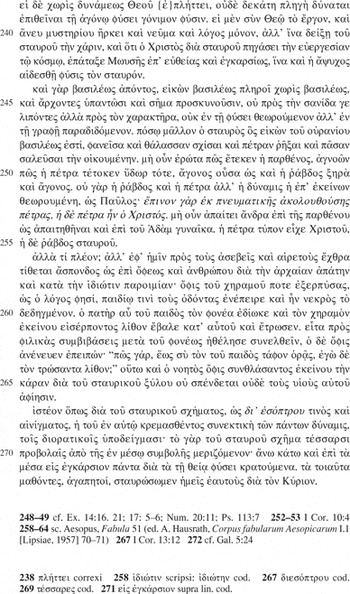
Three kinds of people hate the cross: Hagarenes, Bogomils, and Jews.
1. The Hagarenes allege that you worship mere wood. You will certainly silence them at once by saying, “I worship the image of the cross, not wood. Indeed, suppose I take apart the image of the cross: then I think of the two remaining parts as nothing more than scrap wood and throw them into the fire, if I see fit.”
2. The battle against the diabolical Bogomils, however, has turned out to be a fierce one. So, let us make ourselves ready first against them, and afterwards against the Jews. Along with many other great heretical statements, they deny the cross, stating: “One must neither worship nor embrace it; on the contrary, it is necessary to hold it in dishonor and to turn away from it because it destroyed Christ and put him to death.” In fact, they put us on the spot by saying: “If someone hung your father on a piece of wood and murdered him, would you then revere that wood and worship it, or would you instead turn away from it, hating it as an enemy, because it killed your beloved father?”
Human beings have a law, established by nature, that one must feel kindly disposed towards benefactors and express one's gratitude in return; not only must one honor and give the proper respect to them, but one must also bless the very things that mediate toward the fulfillment of the benefaction and are designated as instruments of salvation and freedom for those in peril. Let Solomon persuade you, who says: For blessed is the wood through which salvation comes about. Some people have honored a king's sword that killed a murderous tyrant and gave freedom to the citizens who were suffering under his oppression; others revered a multitude of places where they shared in prosperity or succour. We have also heard how numerous kings and army commanders honored the place where they became the victors over their enemies, and how they erected a trophy there in remembrance; they celebrated the moment of their birth or the day on which they mounted the throne, calling the day on which they were proclaimed king their birthday, as indeed Herod did when he murdered the great forerunner.
In brief, one must praise and love everything that is in any way useful to people and procures benefaction and joy, according to the measure in which it is helpful. Likewise, we hate that which has caused spiritual damage and turn away from it, whether it be an instrument, a time, or a place.

That is why someone buries the sword that slew his brother and shatters the stick that killed his child. David cursed the mountains of Gilboa because his friend had met his end there; and Job cursed the day on which he was born, the misfortunes that followed, and the waves of temptation.
Let us at any rate consider those for whom the cross has been a help and those for whom it was harmful. The one who got help must also pay tribute, depending on the help received, but the one for whom it was a source of harm must turn himself away from it, loathing it rightly. Such a one should accordingly read what the Savior says in the Gospel according to John: Now is the time of judgment on this world; now the ruler of this world will be driven out. And when I am lifted up, I will draw everyone to myself. Now, in just these few words, there is something to be learned both by the one who is helped by the cross and by the one who awaits destruction. Christ says these words about his own crucifixion: the evangelist himself is our trustworthy witness, for he remarks, He said this indicating the kind of death he would die. Read it again: Now is the time of judgment on this world. Christ, judging as a king on a royal throne—the cross—decides that the ruler of the world should be thrown out of his own realm; that his tyranny over men and his long-standing oppression should cease; and that the despot should be placed under the feet of the oppressed (because of the unjust death on the cross and the shameful shamelessness of the all-destructive one), and that he shall no longer be called ruler of the world. The devil will in fact be thrown out when Christ is crucified and redeems the world with his own blood. To his friends who have received the good news, he says: All power in heaven and on earth was given to me; from now on, the dead—those who yesterday or the day before were taken from the earth and brought to the nether world—are admitted to heaven. For he declared: When I am lifted up, I will draw everyone to myself, so that where I am, they too may be with me.
Who, then, is obliged to love the cross? Those who are liberated from the devil's tyranny through the cross, who are rising up from the nether world to heaven, and who are being deemed worthy of the same glory that angels have. And who is obliged to hate the cross? The devil, who, falling from his former station by the cross, lies pitiably exposed to the mockery of human beings. In truth, those who through the cross have been deemed worthy of numerous blessings, must love the cross and worship it.

Well then, if everyone must consider the friends of their friends as friends, and, likewise, the enemies of their enemies as enemies, so must the Bogomils, who are friends of the devil. They declare, in fact, that he is the creator of all that is visible, and naturally hate the cross and turn away from it. Displaying manifest goodwill towards him and calling themselves his faithful followers, they regard his enemy as their own, just as they love his friends. In conformity with their disposition towards the devil, the Bogomils assert that the wood on which somebody's father or friend was killed is unjust. In fact, the devil, their father and friend, did suffer countless terrors due to the cross, as we have shown; hence, they hate the cross as the destroyer of their father, for the cross is a hateful pursuer of demons. By habit most people often turn away from the many big ordeals they meet and the terrifying dangers they run into; they avoid the road that leads there, averting and closing their eyes. The message of the cross is really foolishness to those who are perishing, but to us who are being saved it is the power of God.
“But you worship that with which Christ was tortured,” the Bogomil says. Foolish, blind man! The cross once was, I admit, an instrument used as a curse, and a place of suffering that everyone understandably avoided; it caused death and destruction to those who were liable, and those who were crucified submitted deservedly to their punishment, paying the penalty for their crimes. But since the King of glory without sin became man for mankind and voluntarily accepted death by crucifixion, since he effected salvation in the center of the world and, observing that we were tortured, set us free, we who were saved through the cross acknowledge our gratitude, and we worship both our Savior and that through which we have been saved: seeing Christ in arms, we revere him, the destroyer of death.
Also take note of the example that I bring forward now, for it is appropriate to my argument. David, son of Jesse, struck down the notorious Goliath—a giant, who was exceedingly big, and of no little arrogance—and killed him. Just as that noble bird which people name after “stone” [i.e., petra]—for that's how the stone-throwing slinger was armed—pulls down, say, a long fishing-rod raised aloft, so did the little fellow drag the giant down to earth and snatch away his shining sword, which now lay idle beside him.

With this he killed his wretched opponent, and that same weapon became salvific instead of lethal, helpful instead of harmful; it was brought into the holy tabernacle and dedicated to God, for whom he slew the one who had insulted God's battleline. Well, if they honored so much the weapon by which they were liberated from the arrogance of the boaster, why then should we not honor the weapon of Christ, the cross through which we were freed from the devil's deceit and power? While [David] overcame one who, though excessively arrogant, was nevertheless a man, the cross defeated him who boasted that he would devastate both earth and sea. It wiped out the one who said that he would wipe out the whole world like a nest of young birds (indeed, instead of being lethal as before, the cross became salvific to us, helpful instead of harmful), the one who carried his rebellion against the Almighty in heaven all the way down to the pit of the underworld, the one who for his own benefit even drew us into revolt against God through disobedience, which truly is the universal evil.
Say then, friends of the devil, is the honorable cross rightly worshipped by us? When a king has murdered a tyrant, restored freedom to his subjects and has returned with the sword that killed the despot, who upon meeting him would say, “I will not revere you, my liberator, if you do not throw away that sword”? Will he not embrace along with [his liberator] the instrument of his salvation?
Now, we do not worship the crosses of the condemned. That is why it was ordained that an inscription should be written on Christ's cross, so that it would be worshipped when it was found and identified. The crosses of the others, on the contrary, were regarded as scrap wood and not revered, while that of Christ was held in honor as his glory; [the identification] was also confirmed by that incredible wonder, the resurrection of the dead man. That is the cross we do indeed worship, no other, and consequently also its image, from whatever material it is made. The great Lord sees in heaven a single image of the cross composed of stars, with letters on it that are also made out of stars, spelling out: “Vanquish, Lord!” He made this instrument his own and conquered, and I was the first to worship it.
3. Next the Jews. They say: “It is written in the Law: cursed be everyone who hangs on a tree. Well, if he is cursed, how will you get a blessing from a cursed man? How can you expect life from one who succumbed to death? What is shown here is cursed, as even your teacher and apostle Paul himself agrees: It is written, he says, cursed be everyone who hangs. How can cross-worshippers obtain a blessing?”

How indeed! When the serpents in the desert were biting your ancestors, Moses made a bronze image of a serpent and affixed it to a cross, saying, “Let everyone who is bitten by a serpent look at this one, and he will be saved.” How far is this relevant? Completely relevant! God said to the serpent, You are cursed above every animal on the earth. How then did the image of the cursed animal give life to your ancestors when they found themselves in distress? Would it not have been more reasonable to say, “If anyone among you is bitten, let him look at the lampstand, the table, the altar, the veil, the ark or the image of the cherubim”? None of these, however, was mentioned by the lawgiver: ignoring them all, he set up nothing other than the image of the cross, in the figure of the bronze serpent. Why then does he who says in the Law, “You shall not make a carved idol nor a molten image; a serpent melts the mind and carves it,” do exactly what he himself forbids? But in that case, he gave a command in order to condemn the materials used for impiety as well as the idols; now, [speaking of the serpent,] he gives a command in order to prefigure the image of the cross.
This explanation is not strained, for hear the Lord confirming this image. Speaking with a certain Nicodemus, a ruler of the Jews, as a teacher of his people and one able to understand the contemplation of the divine order, he says, And just as Moses lifted up the serpent in the desert, so must the Son of Man be lifted up, so that everyone who believes in him may not perish but have eternal life. Say then, was the serpent not a bronze one? Dead matter had the power to overcome death because it had the image of the cross, yet the cross's truth itself is not believed, and this is the case in spite of the knowledge of truth shining in the whole world, the redemption of the nations, and the erection of the churches. So far for the Jews.
Let us, the faithful, examine and investigate by ourselves the exactness of the words, and why the Lord ordained as a sign of that dispensation nothing other than a serpent. It is, after all, imperative to persuade the unbelievers how the figure of the cursed serpent contains the image of Christ whom we worship. That figure had the image and the appearance of a serpent, but not its poison and wickedness; likewise, the Savior appeared in the likeness of the flesh, but was truly outside of all sin, just as Isaiah says in accordance with the blessed Paul, who moreover saw a second image of sin. Serpents were biting the children of Israel, and when his people were perishing, Moses implored God to give a remedy which could save them. God said: “Make a bronze serpent and fix it in front of the tent of meeting.”

What does this sign mean? The biting serpents are one thing, while the one crucified in place of them is another. What does the obscure mystery mean? While some serpents are biting there, the one that is not is nailed to the wood. The same applies to sinners. The sinless Jesus is going to suffer on account of them. A blameless serpent is crucified on behalf of those who bite; the one who is not subject to sin dies for us who are subject, as Isaiah says: He went into death for the sins of his people and the Lord laid upon him on account of our sins.
It is necessary to repeat the significance of the mystery. There, those that bit were one thing, the one that was hanged, another; likewise, we found two sides here: all sinners versus one who was crucified for them. Examine the image according to the testimony of two or three witnesses. Why is the bronze serpent crucified? To make the bites of the serpents ineffective. Thus, the crucified serpent is one thing; what is made ineffective is something else. Do you not see the power of the divine order hidden as it were in the text? The serpent, he says, was crucified to make the bites of the snakes ineffective; Christ was crucified in order to counter the ruses of the demons. And just as the image of the serpent was then, so [is Christ] the death of death and the overthrow of the demons. Hence, the Savior naturally said: And just as Moses lifted up the serpent in the desert, so must the Son of Man be lifted up, so that everyone who believes in him may not perish but have eternal life.
Listen also to some foreshadowings and types that reveal in the clearest way the truth of the cross. Nature from the very beginning knew in advance the fear-inspiring mystery that the cross would bring about at the appointed time, and it foretold in many and various ways its power to those who in whatever way could be led to the spiritual through the visible. I disregard how God put the tree of life in the middle of Paradise, just as the life-bringing cross would be planted in the center of the world, the bringer of life hanging in its middle; also, why Moses chose to call it “wood” (this term is normally used after it has been chopped up), in all ways foretelling the future.

I also pass over Noah's ark, by which a remnant of the human race was saved; the water is a representation of the baptism that washes away sin, while the wood—the dove with the olive branch—shows the mercy of the Holy Spirit.
I skip over too how the offering of the patriarch Abraham served as an image of the cross. For the Lord's flesh—like an unblemished lamb [going] to the slaughter, bearing upon its shoulders the cross, while the Godhead was untouched by suffering—was like Isaac; and on the third day he arose and appeared to his mother. I omit Jacob who, on his way to Haran, laid down his head on a stone after sunset and fell asleep, as well as the ladder which appeared to him. Here, “sleeping” stands for getting outside of the perceptible, bodily perceptions having ceased. And “resting against the stone” refers to the authoritative element, which is symbolized by the head. And you know that “the stone that the builders rejected” refers to the Law, [striving] for harmony between the two peoples. The ladder is in fact the cross by which we on earth were dragged up, for it was necessary that the Sun of justice bring us firmness and power by dying on the cross.
I move on to Moses. He split the sea, saved his people and drowned Pharaoh by striking twice with his rod. David too says: Why was it, sea, that you fled, and you, Jordan, that you turned yourself away from the Lord's face? What face? The face of the rod, which symbolizes the cross, as David says: The Lord will send you the rod of sovereignty, clearly a powerful kingdom. Why powerful? Because he sets right the opposite using the opposite: by suffering he liberates us from distress, by dying he gives us immortality; through his crucifixion he crucifies the demons, with the rod of revelation he triumphed over the demons' ranks. The rod of sovereignty, which overcame the enemy, not using what agreed but what opposed, trembled at the presence of the Lord. O, the arrogance of the unbelievers! The rock, seeing the rod as an image of the cross, was full of awe, but when the chosen people saw him who was hung up in front of their eyes, they did not blush. The rock, seeing the cross's image, gave even what it did not have, but heretics saw the Savior and denied what they received. He offers what he did not have, while they deny what they received: they got faith and denied it, they got illumination and denied its power. Moses struck the rock with his rod once and twice, and water ran out of it. If, in fact, the rock obeyed God's power, why then was a second stroke needed?

If Moses strikes without God's power, not even a tenth stroke can bestow fertility on what is by nature sterile. If it was done with God's help, a nod, a command sufficed, mystery not being needed; but in order to show the grace of the cross, and that Christ through his cross would pour kindness over the world, Moses struck both straight and across, so that inanimate nature would also feel awe for the cross.
In fact, when a king is away, his picture suffices in his absence; the leaders meet and revere a symbol, not paying attention to the wood but to what is depicted upon it; not paying attention to the board as a physical thing, but rather to what is communicated by the drawing. How much more does this apply to the cross, which is an image of the heavenly king, appearing to split the sea, shatter the rock, and make the whole world tremble! So do not ask me how the Virgin gave birth, if you don't know how the rock produced water, although it was barren and, like the rod, dry and sterile. In fact, neither the rod nor the rock did this, but the power that is to be perceived in them, as Paul says: For they drank from a spiritual rock that followed them, and the rock was the Christ. Consequently, don't demand a mortal husband for the Virgin as if this were the same as demanding a wife for Adam. The rock was a figure of Christ, the rod that of the cross.
And further? An implacable enmity towards the impious and the chosen is placed upon us, like the one that exists between serpents and human beings because of the ancient deceit, and according to the familiar tale: Once upon a time a serpent crept out of his hole, so the story goes, and bit a child; once bitten, the boy died. His father in turn pursued the slayer, and when the serpent crept into his hollow, he threw a stone and wounded it. Afterwards he wanted to be reconciled with the slayer, but it refused, saying: “How is this possible, as long as you can see the grave of your child, and I the stone that injured me?” Likewise, the spiritual serpent does not make peace with the one who crushed his head by virtue of the cruciform wood, nor does he leave his sons alone.
One must know how the all-embracing power of him who hung on the cross is shown by the cruciform shape, as in a mirror or a riddle, by means of clear indications. For the form of the cross consists of four projections, joined in the middle; up, down, and from the middle out crossways, all things are held fast by the divine nature. Having learned this, beloved ones, let us crucify ourselves because of the Lord.
Footnotes
I wish to express my sincere gratitude towards my esteemed colleague, Dr. J. L. North (University of Hull, U.K.), for checking the English translation of the Greek text. Biblical citations refer to LXX.
 You have
Access
- 1
- Cited by