Introduction
The genus Drombus Jordan & Seale 1905 is one of the most diverse groups of benthic fishes of the estuarine environment. There is a total of 14 valid species reported worldwide to date (Fricke et al., Reference Fricke, Eschmeyer and Fong2025). Of these, nine species have been reported from the Indian Ocean (Fricke et al., Reference Fricke, Eschmeyer and Fong2025). Species reported across the eastern Indian Ocean include D. triangularis (Weber, 1909), D. oligactis (Bleeker, 1875), D. lepidothorax (Whitley Reference Whitley1945), D. halei (Whitley, 1935), D. dentifer (Hora, 1923), and D. bontii (Bleeker, 1849). Species reported from the Western Indian Ocean are D. simulus (Smith, 1960) and D. key (Smith Reference Smith1947). Drombus globiceps (Hora 1923) was reported from both the eastern Indian Ocean and the western Indian Ocean (Fricke et al., Reference Fricke, Eschmeyer and Fong2025). The majority of these gobies can be found in tropical and subtropical coastal regions, including mudflats, mangroves, and other coastal and estuarine habitats. As micro-predators, they are crucial to estuarine food webs (Tan and Jaafar, Reference Tan and Jaafar2017). Only three species, viz., D. globiceps, D. dentifer, and D. triangularis, have been identified from India (Koumans, Reference Koumans1941; Fricke et al., Reference Fricke, Eschmeyer and Fong2025). The Bahuda Estuary’s varied ecology makes it a possible home for teleosts like Gobiidae, which can be found in a wide variety of water types, including brackish, fresh, and marine.
Materials and methods
The specimens were collected along with other estuarine goby fishes during different local surveys during pre-monsoon, monsoon and post-monsoon periods in the Bahuda estuary (19°07′08.7″N 84°47′25.4″E), Odisha, India (Figure 1a,b). Local fishermen caught these nine specimens using a dragnet at a depth of approximately one metre. From the nine individuals, four specimens were subjected to molecular analysis. After collection, those four specimens were stored at −20°C for molecular analysis. All other specimens were preserved in 10% formalin and taken to the laboratory for taxonomic identification. Morphological characteristics such as scale and fin ray counts, tooth type, papilla pattern, and cephalic pore counts were observed using a Leica S9i stereomicroscope. Millimetre units were used for all morphometric measurements. This identification process was based on authoritative sources, specifically Larson (Reference Larson, Heemstra, Heemstra, Bogorodsky, Randall, Golani and Carpenter2022) and Chen and Li (Reference Chen and Li2024). The identified samples were deposited and registered in the National Repository at the Estuarine Biology Regional Centre, Zoological Survey of India, Gopalpur-on-Sea.
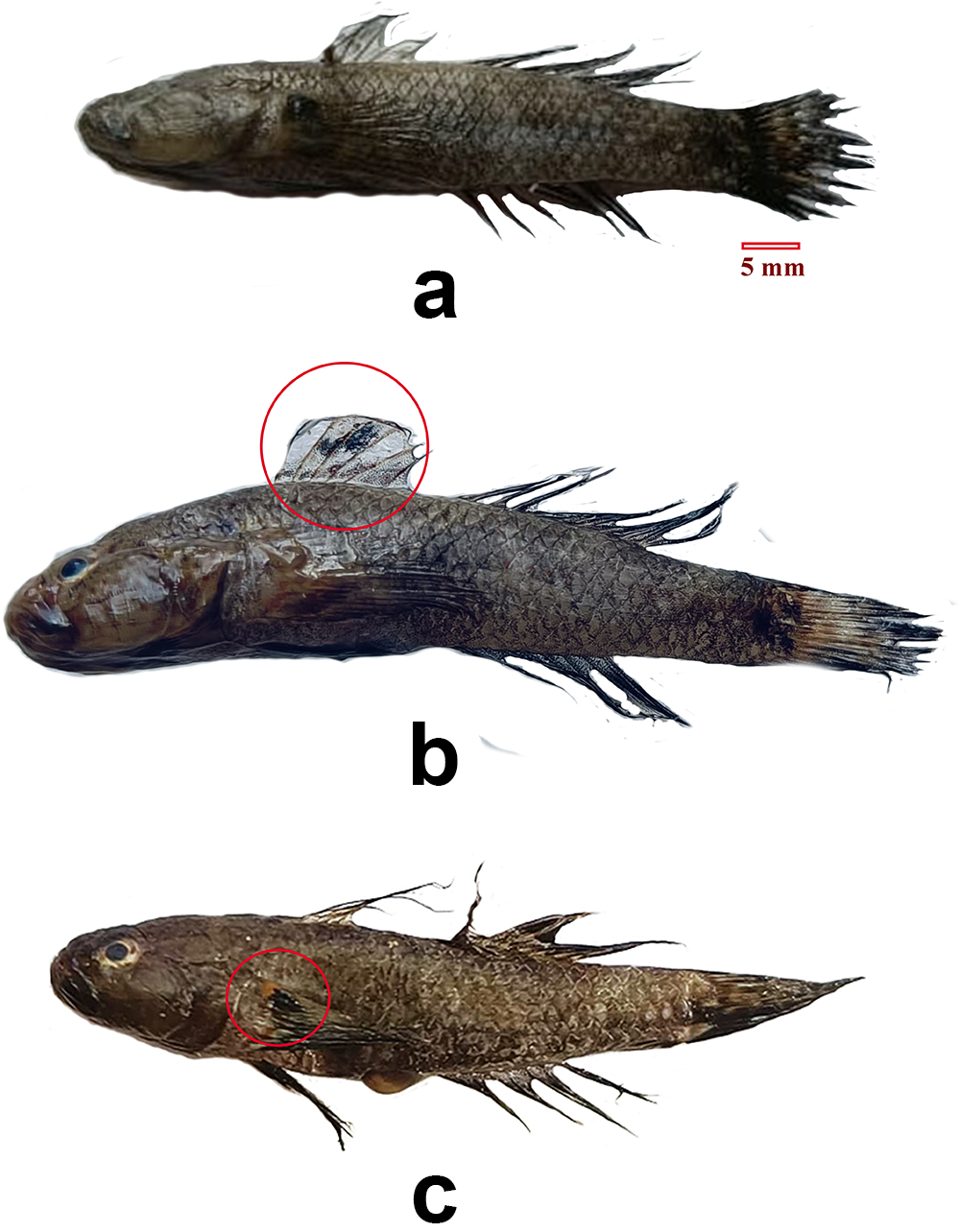
Lateral profile of D. key collected from Bahuda estuary (a); dorsal fin black blotch colouration of the D. key (b); and yellow triangular mark anterior to a black Bloch on pectoral fin base (c).

The genomic DNA was extracted using the HiPurA® Insect DNA Purification Kit, following the manufacturer’s protocol. The obtained DNA concentrations of each were measured with a Qubit-4-fluorometer, which is approximately 34–126 ng/μL. After isolation, the DNA sample was stored at −20°C for future use. The COI gene amplification was performed using the iGene Labserve PCR machine, with a final volume of 25 μL containing 9 μL nuclease-free water, 12.5 μL 2× Hi G9 Taq PCR Master Mix, 0.5 μL forward primer Fish F1 (5′-TCAACCAACCACAAAGACATTGGCAC-3′), 0.5 μL of reverse primer Fish R1 (5′-TAGACTTCTGGGTGGCCAAAGAATCA-3′) (Ward et al., Reference Ward, Zemlak, Innes, Last and Hebert2005), and 2.5 μL extracted DNA template. The conditions for PCR included initial denaturation at 94°C for 3 min, 35 cycles at 94°C for 30 s, annealing at 54°C for 30 s, and extension at 72°C for 1 min with a final extension at 72°C for 10 min followed by an indefinite hold at 4°C (Mohapatra et al., Reference Mohapatra, Ho, Acharya, Ray and Mishra2022). The resulting PCR product was sequenced using the Sanger sequencing method (HKP Scientific). Sequence assembly was carried out using BioEdit version 7.2 (Hall, Reference Hall1999). A total of four sequences (PV460202, PV459966, PV459949, and PV453564) generated in the current study and an additional related sequence were taken from NCBI and BOLD for comparative analysis, including three outgroups in the Bayesian inference (BI) tree. The multiple alignment of the sequence was done using MAFFT version 7 (Katoh et al., Reference Katoh, Rozewicki and Yamada2019). The best fit was determined using MrModeltest2-v.2.4 (Nylander, Reference Nylander2004) and the construction of the best-fit GTR + I + G model BI was done using MrBayes-3.2.7 (Ronquist et al., Reference Ronquist, Teslenko, Van Der Mark, Ayres, Darling, Höhna, Larget, Liu, Suchard and Huelsenbeck2012) up to 1.5 million generations and trees were sampled every 1000 generations. However, 25% of the sampled trees was discarded as burn-in. The final tree with a standard deviation of split frequencies of 0.0016 was visualized in FigTree (Rambaut, Reference Rambaut2012).
Abbreviations: D1: first dorsal fin elements; D2: second dorsal fin elements; A: anal fin elements; P: pectoral fin elements; LSS: lateral scale series; TR: transverse scale rows; D–P: scale rows between D1 origin and upper P base; SL: standard length; TL: total length; HL: head length (Chen and Li, Reference Chen and Li2024).
Results
Drombus key (Smith 1947)
Materials examined. ZSI/EBRC/ F17884 ex. 01, 40.9 mm, Bahuda estuary, Odisha, India, 30 Aug 2023; ZSI/EBRC/ F17885 ex. 01, 44.6 mm, Bahuda estuary, Odisha, India, 02 Oct 2023; ZSI/EBRC/ F17886 ex. 01, 47.6 mm, Bahuda estuary, Odisha, India, 16 Feb 2024; ZSI/EBRC/ F17887 ex. 01, 48.8 mm, Bahuda estuary, Odisha, India, 24 Apr 2024; and ZSI/EBRC/ F17888 ex. 05, 37.6–47.3 mm, Bahuda estuary, Odisha, India, 24 Apr 2024.
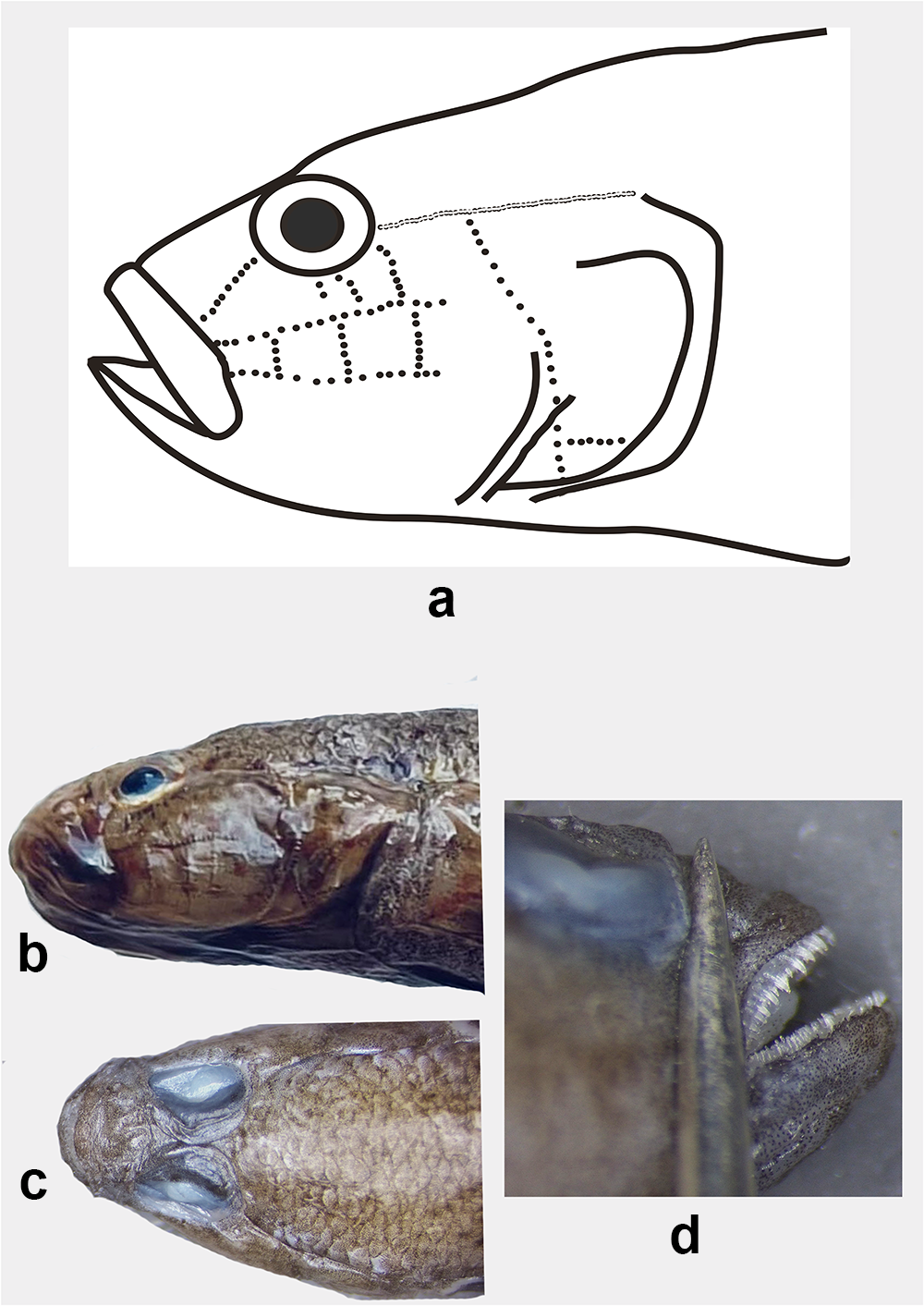
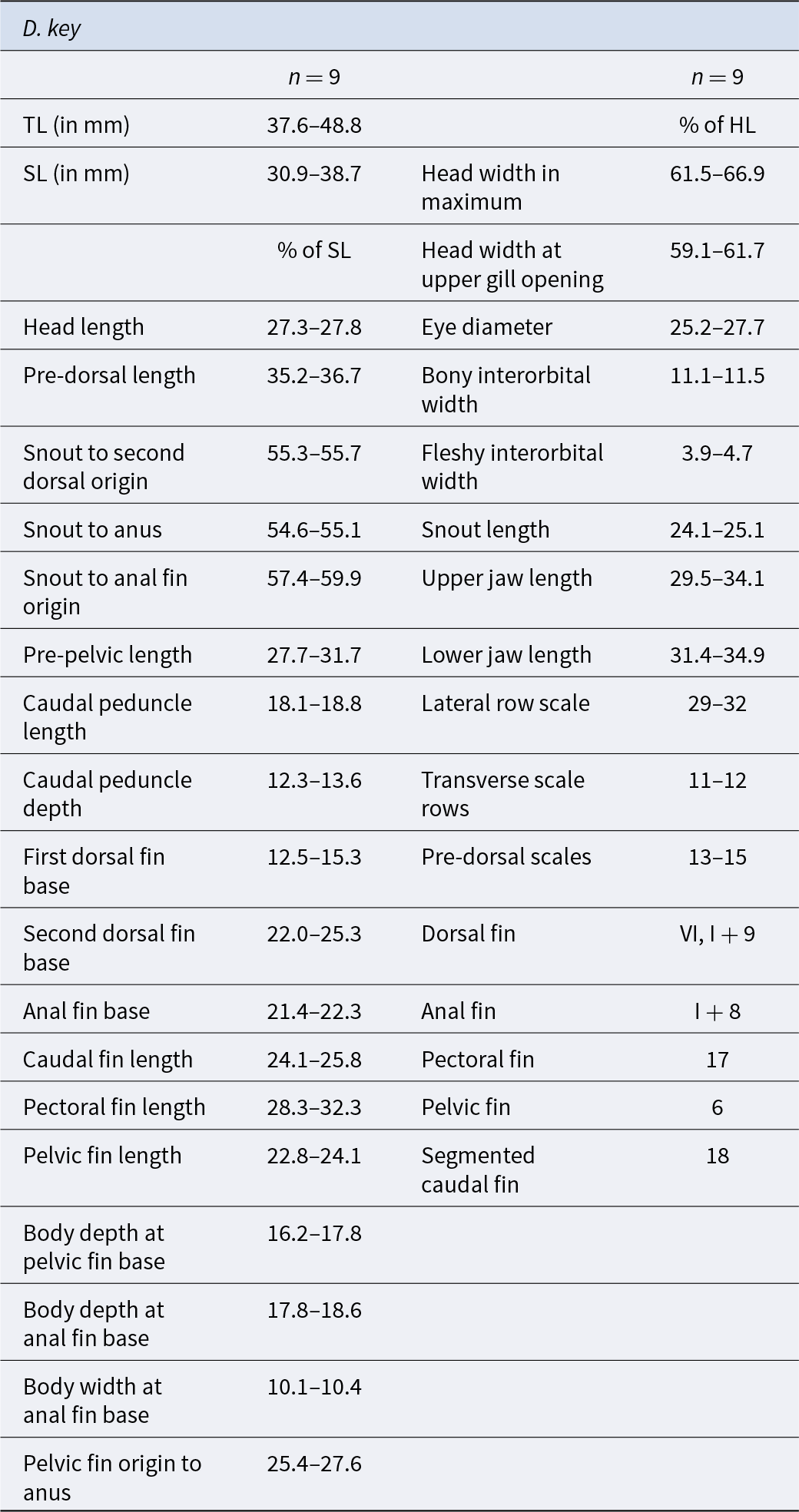
Descriptive characters. D1: VI; D2: I, 9; A: I, 8; P: 17; LSS: 29–32; TR:11–12; D–P: 4–5; small, cycloid predorsal scales 13–15 reaching up to eyes; predorsal scales small and cycloid; chin smooth and without mental frenum; gill opening reaching below opercle; absence of large canine tooth on lower jaw; cheek and preopercle naked; cheek with transverse rows of sensory papillae under eye; oculoscapular canal present (Figure 2a,b), extending from rear margin of eye to opercle; head pores present; nape scaly (Figure 2c); pelvic fins connected by membrane; fifth ray of pelvic fins longer than fourth; mouth small; absent of teeth on vomer; both jaws with multiple rows of teeth (Figure 2d); large eye 25.2–27.7% HL; and rounded snout, 24.1–25.1% HL. Pelvic frenum complete; and length of pelvic fin 22.8–24.1% SL. Two separated dorsal fins. First dorsal fin base 12.5–15.3% SL and second dorsal fin base 22.0–25.3% SL. Head width 1.6–1.9 in HL. Head height 1.5–1.6 in HL. Caudal fin length 1.0–1.1 in HL. Bony interorbital width 11.1–11.5% HL (Table 1).
Papillae pattern in line diagram (a); papillae pattern in fresh specimen of D. key (b); dorsal head profile of D. key (c); and teeth type in D. key (d).

Morphometric details of D. key collected from Bahuda estuary, Odisha

Colouration. The fresh specimen is dark brown in colour with small melanophores, white spots, and dark blotches, which offer the camouflage against the substrate like sands and rocks (Figure 1a). Dorsal fins translucent membrane with dark rays and a black blotch on the middle of first dorsal fin (Figure 1b). Numerous black blotches on the upper pectoral-fin base. A white to yellow triangular or tear-drop shaped mark to the upper anterior pectoral fin base is present, which is clearly visible to the naked eye (Figure 1c). The caudal fin is with a light brown base with dark margins and small dark bars at the middle of the fin.
Distribution. The species was originally described from Inhaca Island, Delagoa Bay, Mozambique. Presently, the species is known from East Africa to Seychelles and Madagascar (Fricke et al., Reference Fricke, Eschmeyer and Fong2025; Smith, Reference Smith1947). The present study from India (Bahuda estuary) extends the distributional range of D. key more than 2000 Nautical miles northeast from the Western Indian Ocean to the Bay of Bengal (Northern Indian Ocean).
Habitat. The species particularly found from muddy and sandy bottoms of the Bahuda estuary.
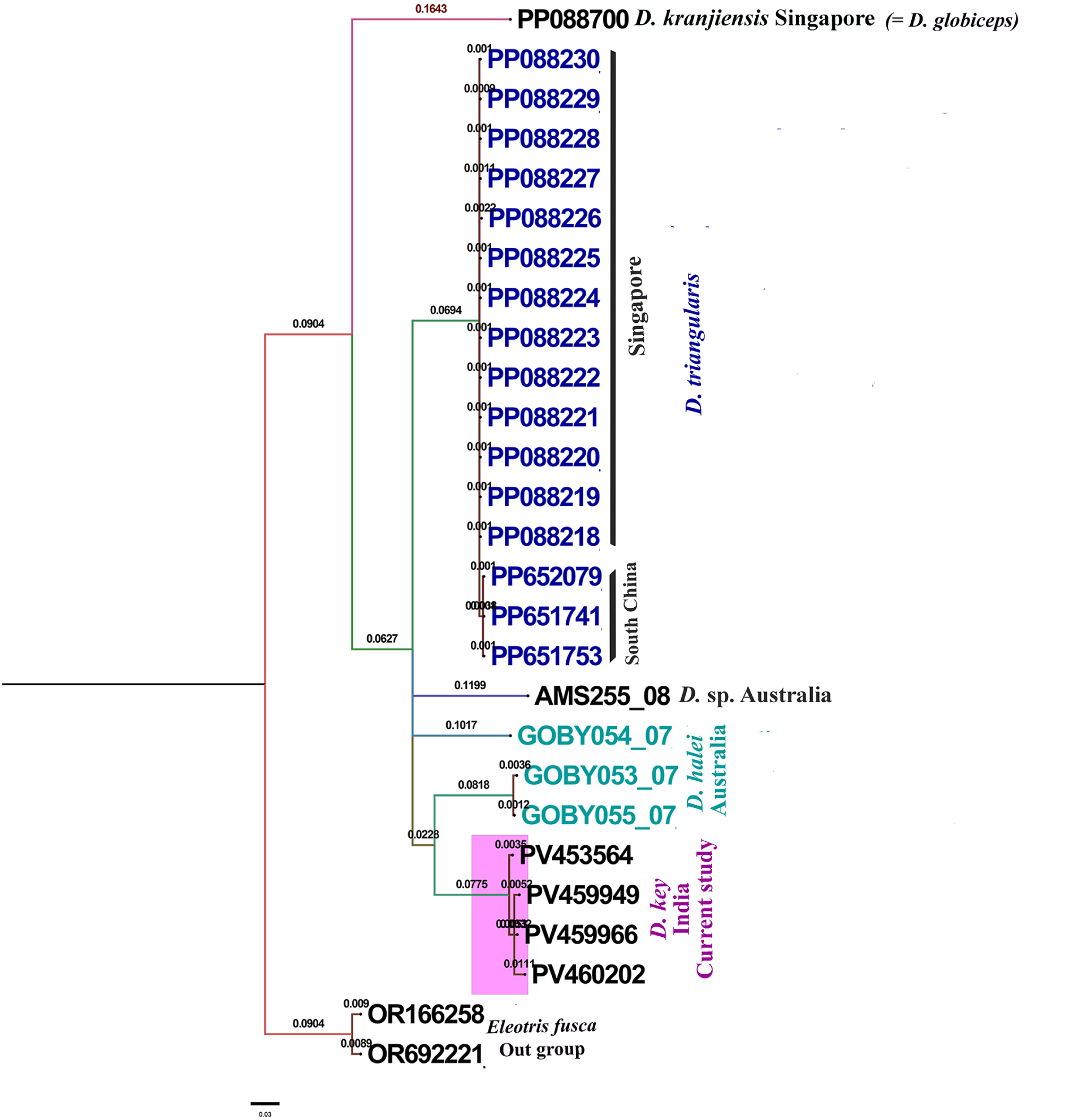
Molecular analysis. There is no genetic evidence of D. key available. Thus, four COI gene sequences were obtained to infer the evolutionary relationships among all the available sequences of Drombus. Only three species, D. kranjiensis, D. triangularis, and D. halei have COI gene data, which were included in the phylogenetic analysis with an out-group Eleotris fusca (Forster 1801). The sequences of D. key form a unique clade in the BI phylogenetic study (Figure 3). The phylogenetic analysis shows the immediate ancestral clade of D. key with three sequences of D. halei generated from Australia. The sequences of D. key show nucleotide distances of 13.2% and 21.4% with other available genetic sequences of Drombus.
BI tree of D. key with all the available COI gene sequence of Drombus.

Discussion
The genus Drombus is mostly distributed in marine and brackish water of the Indian and western Pacific (Fricke et al., Reference Fricke, Eschmeyer and Fong2025). The individuals of the genus Drombus are very small in size (Chen and Li, Reference Chen and Li2024). Drombus key differs by having the second dorsal fin usually with 1 spine and 9 rays vs. 1 spine and 10 rays in D. dentifer, D. globiceps (also predorsal scales 13–15 vs. 7–8), D. halei, D. palackyi (A 8 vs. 9), D. rubropunctatus (also A 8 vs. 9), D. triangularis (also LSS 29–32 vs. 35–38), D. vexillifer, and D. ocyurus (Jordan and Seale, Reference Jordan and Seale1907; Koumans, Reference Koumans1941; Chen and Li, Reference Chen and Li2024). Additionally, D. key differs from D. dentifer, D. globiceps (also predorsal scales 13–15 vs. 7–8), D. halei, D. palackyi (A 8 vs. 9), D. rubropunctatus (A 8 vs. 9), D. triangularis (LSS 29–32 vs. 35–38), D. vexillifer, and D. ocyurus (Jordan and Seale, Reference Jordan and Seale1907; Koumans, Reference Koumans1941; Chen and Li, Reference Chen and Li2024). Further, D. key differs from D. oligactis by having 11–12 transverse rows of scales vs. 8–9 transverse rows in D. oligactis (Chen and Li, Reference Chen and Li2024). Drombus key has fewer numbers of lateral series scales (29–32 vs. 36 in D. bontii). Additionally, D. key is dark brown in colour, whereas D. bontii is reddish green in colour (Koumans, Reference Koumans1941). Drombus key differs from D. lepidothorax by lacking prominent white spots on the head (Whitley, Reference Whitley1945). Drombus simulus is rather a slender species (body depth 6.5–7.5 vs. 5.5–6.5 in total length in D. key) (Hoese, Reference Hoese, Smith and Heemstra1986) and has fewer predorsal scales (11 or 12 vs. 13 to 15 in D. key) (Larson, Reference Larson, Heemstra, Heemstra, Bogorodsky, Randall, Golani and Carpenter2022).
The phylogenetic analysis forms different monophyletic clades for different species, like D. triangularis, D. halei, D. kranjiensis, and D. key. The accession numbers in NCBI (PP652079, PP651741, and PP651753) named Drombus sp. from the South China Sea, forming the monophyletic clade with D. triangularis. Thus, these sequences may belong to D. triangularis. This study adds a significant biogeographic extension of the gobiid species. Drombus key in Indian waters from the western Indian Ocean to the Bay of Bengal in the northern Indian Ocean and provides the first genetic evidence of D. key. This current record adds the fourth member of Drombus in Indian waters.
Acknowledgements
We extend our gratitude to Dr Dhriti Banerjee, Director of the Zoological Survey of India, for providing the necessary facilities and granting permission for our research. We also appreciate the invaluable efforts of the fishermen nearby Sunapur.
Author contributions
S.A.: Collection, identification, molecular analysis, manuscript preparation. R.K.B.: Collection and photography. S.P., S.S.M., A.M.: Identification, critical analysis and thorough review of the manuscript.
Funding
The first author sincerely acknowledges the financial assistance received from the CSIR SRF-Direct fellowship (Unique ID No. 35111080; File No. 09/1432(19149)/2024-EMR-I).
Competing interests
The authors declare that they have no competing interest and the specimens used in the study do not fall under any protection category of the wildlife act.
Data availability
All data generated or analysed during this study are included in this article.
Ethical standards
The specimens do not fall under any protected category and were obtained in dead condition from local fish landing centres; therefore, no specific ethical approval was required.