Introduction
Chronic rhinosinusitis is a common disease, characterised by inflammation of the nasal cavity and paranasal sinuses, with or without nasal polyps.Reference Fokkens, Lund, Mullol, Bachert, Alobid and Baroody1 It is a heterogeneous, often refractory disease, with variable responses to medical therapies. It causes significant morbidity and negatively impacts on quality of life.Reference Snidvongs and Thanaviratananich2 Functional endoscopic sinus surgery (FESS) is indicated for the treatment of chronic rhinosinusitis that is refractory to medical treatment.Reference Fokkens, Lund, Mullol, Bachert, Alobid and Baroody1, Reference Patel, Thamboo, Rudmik, Nayak, Smith and Hwang3, Reference Lund, Holmstrom and Scadding4 As inflammatory processes continue to play a significant role in chronic rhinosinusitis patients after FESS, the continued use of medical therapy, especially topical treatment, is indispensable.Reference Subramanian, Schechtman and Hamilos5 Nasal irrigation is a classic and powerful adjunctive method for the management of chronic rhinosinusitis after FESS.Reference Achilles and Mosges6
The mechanism of nasal irrigation remains unclear. Saline nasal irrigation may improve nasal mucosa function through several physiological effects, including: direct cleaning of mucus (mucus is a potential condition for bacteria to multiply; saline dilutes mucus and helps to clear it out); removal of antigens, bacterial biofilm or inflammatory mediators (thereby alleviating the inflammation); and improving mucociliary function.Reference Principi and Esposito7 A Cochrane review (2007) of nasal saline irrigations for chronic rhinosinusitis concluded that nasal saline irrigation was better than no irrigation for improving symptoms and quality of life.Reference Harvey, Hannan, Badia and Scadding8, Reference Brown and Graham9 Recent studies have shown that nasal irrigation with various topical medications can provide a high concentration of the drug and achieve better outcomes.Reference Pham, Sykes and Wei10, Reference Ezzat, Fawaz, Rabie, Hamdy and Shokry11
Saline nasal irrigation in chronic rhinosinusitis after FESS has been proved to clean the nasal cavity and promote the restoration of mucosal function, and is widely used.Reference Patel, Thamboo, Rudmik, Nayak, Smith and Hwang3, Reference Sanan, Rabinowitz, Rosen and Nyquist12 A number of studies have verified the efficacy of nasal irrigation with various solutions.Reference Farag, Deal, McKinney, Thorp, Senior and Ebert13–Reference Li and Peters16 However, the value of various solutions in nasal irrigation remains controversial.Reference Adappa, Wei and Palmer17 This study aimed to evaluate the efficacy of nasal irrigation with various solutions in order to treat chronic rhinosinusitis patients after FESS, and compare this with normal saline alone, in a systematic review and meta-analysis.
Materials and methods
Search methods
We searched the PubMed, Embase and Cochrane Central Register of Controlled Trials databases for original articles published in English from October 1971 to March 2017. The search strategies used the following main keywords: nasal irrigations, saline irrigation, sinus irrigation, nasal rinsing, saline nasal washes, irrigations and chronic rhinosinusitis post endoscopic sinus surgery. Similar search words were used in each database.
Criteria for included studies
Types of participants
The study included research on adult patients with a clinical diagnosis of chronic rhinosinusitis, according to the European Position Paper on Rhinosinusitis and Nasal Polyps 2012 (‘EPOS2012’) guidelines,Reference Fokkens, Lund, Mullol, Bachert, Alobid and Baroody1 who had recently undergone FESS.
Types of interventions
Those articles that compared various solutions plus normal saline with normal saline alone for nasal irrigations were included.
Types of outcome measures
These included: findings of biopsies (of the anterior ethmoid sinus) conducted to assess eosinophil counts; paranasal sinus computed tomography (CT) scores; 20- or 22-item Sino-Nasal Outcome Test (SNOT-20 or SNOT-22) scores; visual analogue scale (VAS) scores; mucociliary clearance assessment; endoscopic scores; and adverse events.
Study selection, data extraction and quality assessment
Studies were identified with the search strategy by two independent reviewers. Where there was uncertainty regarding eligibility, any difficulties were resolved by discussion and consensus. The Cochrane Risk of Bias Tool was used to assess the included studies.Reference Higgins and Green18 The quality assessment was performed by the independent reviewers, and a third reviewer was consulted for any uncertainties. Analytical data missing from the primary reports were requested from the relevant authors.
Statistical analysis
Data suitable for meta-analysis were entered into the software package Review Manager (RevMan), version 5.3.19 Differences were expressed as weighted mean difference with 95 per cent confidence intervals (CIs) for change from baseline symptom scores. Statistical heterogeneity across trials was assessed with the chi-square statistic (p < 0.1) and the I 2 statistic. As a guide, I 2 values of 25, 50 and 75 per cent correspond to low, medium and high levels of heterogeneity, respectively.Reference Higgins and Thompson20, Reference Higgins, Thompson, Deeks and Altman21 When a significant heterogeneity was found, a random-effects model was used to examine the pooled results and 95 per cent CI. Otherwise, a fixed-effects model was applied. Publication bias was assessed by visually inspecting funnel plots.Reference Langhorne22 A p value of less than 0.05 was considered statistically significant. We intended to carry out sensitivity analyses to assess the robustness of the conclusions, if sufficient studies were available.
Results
Results of search
A total of 824 studies were identified; 741 of these were removed after screening the title and abstract, and 43 articles were removed after full text assessment. Five studies were included for systematic review. A flowchart of study search and selection is shown in Figure 1.
Flowchart of study search and selection. CRS = chronic rhinosinusitis; FESS = functional endoscopic sinus surgery; RCT = randomised controlled trial

Characteristics of included studies
The 5 included studies, published between 2008 and 2015, comprised 331 patients aged 18–73 years.Reference Jiang, Hsu and Liang23–Reference Staffieri, Marino, Staffieri, Giacomelli, D'Alessandro and Maria27 The five trials investigated nasal irrigation using various solutions, such as sulphurous-arsenical-ferruginous thermal water, Ringer's lactate solution, electrolysed acid water, amphotericin B saline, and hyaluronan plus saline. The characteristics of the included studies are showed in Table 1.
Characteristics of included studies

VAS = visual analogue scale; SNOT-20/22 = 20/22-item Sino-Nasal Outcome Test; CT = computed tomography
The duration of treatment time ranged from six weeks to six months. Several outcome measures were used, including paranasal sinus CT scores, SNOT-20 or SNOT-22 scores, VAS scores, mucociliary clearance assessment, and endoscopic scores (Lund–Kennedy scores). The primary outcome measure was symptom scores (SNOT-20 or SNOT-22, and VAS scores). The secondary outcome measure was nasal endoscopic scores. The outcomes assessed in the study by Staffieri et al. were based on findings of biopsies (of the anterior ethmoid sinus), which included eosinophil counts, and there were no other outcome measures.Reference Staffieri, Marino, Staffieri, Giacomelli, D'Alessandro and Maria27 The study by Macchi et al. lacked sufficient data for analysis.Reference Macchi, Terranova, Digilio and Castelnuovo25 Finally, three studies had sufficient discrete data for inclusion in a formal meta-analysis.Reference Jiang, Hsu and Liang23, Reference Jiang, Liang, Wu, Su, Chen and Lu24, Reference Low, Woods, Ullah and Carney26
Risk of bias assessment
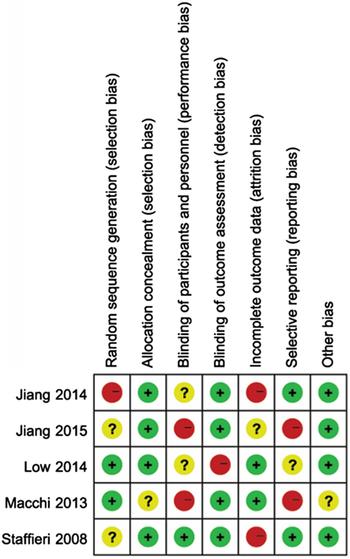
Risk of bias in the included studies was assessed using the Cochrane Collaboration Tool for Assessing Risk of Bias. Figure 2 provides the methodological details for each trial. The included studies were randomised trials, but only one trial was a randomised controlled trial with an adequate description of intervention methods.Reference Low, Woods, Ullah and Carney26
Risk of bias summary: review authors’ judgements about each risk of bias item for each included study.

Eosinophil counts
Nasal irrigation with thermal water solution locally reduces the eosinophil count. This may limit the eosinophil-mediated production of cytokines and inflammatory molecules, which damage nasal mucosa and lead to oedema and sinonasal inflammation.Reference Staffieri, Marino, Staffieri, Giacomelli, D'Alessandro and Maria27 Staffieri et al. showed that eosinophil counts were significantly decreased after thermal water solution irrigation (p = 0.04).Reference Staffieri, Marino, Staffieri, Giacomelli, D'Alessandro and Maria27 On the contrary, Macchi et al. found that the eosinophil counts were not significantly different after hyaluronan plus saline solution irrigation when compared with normal saline (p = 0.249).Reference Macchi, Terranova, Digilio and Castelnuovo25 Neither of these studies could provide sufficient data for inclusion in a meta-analysis.
Nasal symptoms scores
Data on total and individual nasal symptom scores were available for meta-analysis in three trials.Reference Jiang, Hsu and Liang23, Reference Jiang, Liang, Wu, Su, Chen and Lu24, Reference Low, Woods, Ullah and Carney26 Low et al. compared Ringer's lactate solution with normal saline, and found that Ringer's lactate solution could dramatically improve nasal symptoms, such as nasal blockage, nasal congestion, headache, facial pain and nasal discharge.Reference Low, Woods, Ullah and Carney26 In chronic rhinosinusitis patients who received nasal irrigation with electrolysed acid water or amphotericin B saline after FESS,Reference Jiang, Hsu and Liang23, Reference Jiang, Liang, Wu, Su, Chen and Lu24 the SNOT-20 or SNOT-22 scores were significantly lower than the scores before FESS. However, there were no significant differences among the electrolysed acid water and amphotericin B saline groups compared with the normal saline irrigation (control) group.Reference Jiang, Hsu and Liang23, Reference Jiang, Liang, Wu, Su, Chen and Lu24 Pooled results failed to show a significant difference in nasal symptoms when various solutions were compared with normal saline alone (weighted mean difference = 2.84, 95 per cent CI −1.87 to 7.54, p = 0.24; p for heterogeneity = 0.25, I 2 = 28 per cent; Figure 3). Sensitivity analysis could not be carried out because of the small number of included studies.
Forest plot showing meta-analysis of the trials comparing symptom scores for various solutions versus normal saline. Risk of bias key: A = random sequence generation (selection bias); B = allocation concealment (selection bias); C = blinding of participants and personnel (performance bias); D = blinding of outcome assessment (detection bias); E = incomplete outcome data (attrition bias); F = selective reporting (reporting bias); and G = other bias. SD = standard deviation; IV = inverse variance; CI = confidence interval

Endoscopic scores
Data on endoscopic scores were available for meta-analysis in two trials.Reference Jiang, Hsu and Liang23, Reference Jiang, Liang, Wu, Su, Chen and Lu24 In chronic rhinosinusitis patients who received nasal irrigation with electrolysed acid water or amphotericin B saline, the endoscopic scores dramatically decreased after FESS. However, when electrolysed acid water or amphotericin B saline were compared with normal saline alone, there were no significant differences in endoscopic scores for chronic rhinosinusitis patients after FESS (weighted mean difference = −0.20, 95 per cent CI −0.71 to 0.31, p = 0.45; p for heterogeneity = 0.09, I 2 = 65 per cent; Figure 4).Reference Jiang, Liang, Wu, Su, Chen and Lu24, Reference Liang, Su, Shiao, Tseng, Hsin and Lin28 There was a medium degree of heterogeneity between the studies when combined in the meta-analysis (p = 0.45, I 2 = 65 per cent), which was associated with a non-significant trend in favour of the various solutions groups. It suggested that the various solutions were no more effective than nasal irrigation with normal saline alone. Sensitivity analysis could not be carried out because of the small number of included studies.
Forest plot showing meta-analysis of the trials comparing endoscopic scores for various solutions versus normal saline. Risk of bias key: A = random sequence generation (selection bias); B = allocation concealment (selection bias); C = blinding of participants and personnel (performance bias); D = blinding of outcome assessment (detection bias); E = incomplete outcome data (attrition bias); F = selective reporting (reporting bias); and G = other bias. SD = standard deviation; IV = inverse variance; CI = confidence interval

Publication bias
A funnel plot of Ringer's lactate solution, electrolysed acid water and amphotericin B saline irrigations showed that the included studiesReference Jiang, Hsu and Liang23, Reference Jiang, Liang, Wu, Su, Chen and Lu24, Reference Low, Woods, Ullah and Carney26 were distributed near the centre of the plot, suggesting minimal publication bias (Figure 5).
Funnel plot for publication bias, which shows that the three studies (circles) are spread around the midline of the pyramid. SE = standard error; MD = mean difference

Safety
Five trials reported some adverse events.Reference Jiang, Hsu and Liang23–Reference Staffieri, Marino, Staffieri, Giacomelli, D'Alessandro and Maria27 The adverse events mainly included hyposmia, headache, nasal discharge, rhinorrhagia and so on.Reference Liu, Chan, Hecht, Storm and Davis29 The occurrence of adverse events in those who underwent nasal irrigation using various solutions was not significantly different compared with the normal saline irrigation group.Reference Lee and Dominguez30 There were no occurrences of a therapy-related serious systemic reaction that required treatment in the hospital.
Discussion
Nasal saline irrigation is a common adjuvant therapy for chronic rhinosinusitis patients.Reference Sanan, Rabinowitz, Rosen and Nyquist12 Clinical studies and meta-analysis have shown nasal irrigation to be an effective therapy for decreasing chronic rhinosinusitis symptoms and nasal endoscopic scores, both pre- and post-operatively. It is safe, with no systemic pharmaceutical absorption risks.Reference Khianey and Oppenheimer31 Patients’ acceptance means it is suitable for long-term topical therapy management.Reference Soudry, Wang, Vaezeafshar, Katznelson and Hwang32 Furthermore, nasal irrigation is an inexpensive treatment that can be used alone or in conjunction with other interventions for chronic rhinosinusitis patients pre- or post-operation.Reference Adappa, Wei and Palmer17 Topical nasal irrigation is an effective treatment because a high concentration of the drug can be applied locally, with minimal systemic side effects.Reference van den Berg, de Nier, Kaper, Schilder, Venekamp and Grolman33 Side effects of saline irrigation might include local irritation, ear pain, nose bleeds, headache, nasal burning, nasal drainage, bottle contamination and hyposmia.Reference Liu, Chan, Hecht, Storm and Davis29, Reference Hardy, Stringer, O'Callaghan, Arana, Bierdeman and May34 However, these effects are rare and not severe, and patients can decide to stop nasal irrigation treatment at any time.Reference Soudry, Wang, Vaezeafshar, Katznelson and Hwang32
For some patients with recalcitrant chronic rhinosinusitis, increasing saline irrigation along with the use of a topical substance have been recommended.Reference Adappa, Wei and Palmer17 Solutions that can be used for nasal irrigation are: normal or hypertonic saline, with the addition of an antibiotic, corticosteroid, antifungal or surfactant.Reference Adappa, Wei and Palmer17 In addition, the volume (low or high), pressure (passive or active), frequency and duration of nasal irrigations are variable.Reference Principi and Esposito7 Their volume ranges from around 30 to 500 ml, and is considered appropriate by adult patients.Reference Pynnonen, Mukerji, Kim, Adams and Terrell35
Some studies have verified the efficacy of nasal irrigation with various solutions. Farag et al. found no significant differences in chronic rhinosinusitis symptoms post-FESS between surfactant and hypertonic saline irrigation.Reference Farag, Deal, McKinney, Thorp, Senior and Ebert13 Chiu et al. concluded that baby shampoo nasal irrigation was an inexpensive, tolerable adjuvant to conventional medical therapies for symptomatic patients after FESS.Reference Chiu, Palmer, Woodworth, Doghramji, Cohen and Prince14 Its greatest benefit may be in improving symptoms of thickened nasal discharge and post-nasal drainage. Kim et al. found that maxillary sinus saline irrigation may be effective in the prevention of poor prognostic factors, such as persistent purulent discharge, at the early stages after FESS.Reference Kim, Sung, Jung, Paik, Woo and Cha15 A number of authority system reviews have already been published.Reference Li and Peters16
However, there are limited data on nasal irrigation using various solutions for chronic rhinosinusitis patients post-FESS. In this study, we attempted to identify all of the reviews on chronic rhinosinusitis patients who underwent nasal irrigation as adjuvant therapy after FESS.Reference Harvey, Hannan, Badia and Scadding8 We subsequently selected five trials for a systematic review.Reference Jiang, Hsu and Liang23–Reference Staffieri, Marino, Staffieri, Giacomelli, D'Alessandro and Maria27
This systematic review evaluated and compared the outcomes of 5 studies involving 331 chronic rhinosinusitis patients post-FESS, who received nasal irrigation with various solutions or normal saline alone. The solutions used may be a useful adjuvant treatment following FESS for chronic rhinosinusitis, but are not significantly different compared with normal saline irrigation.
The various solutions for nasal irrigation all have their own characteristics. Ringer's lactate solution resulted in improved nasal symptoms such as nasal blockage or congestion, headache, facial pain, and nasal discharge.Reference Low, Woods, Ullah and Carney26 Nasal irrigation with electrolysed acid waterReference Jiang, Liang, Wu, Su, Chen and Lu24 and hyaluronan plus salineReference Macchi, Terranova, Digilio and Castelnuovo25 can improve symptom scores and endoscopic scores, but are not significantly different to normal saline irrigation. Nasal irrigation with electrolysed acid water can make chronic rhinosinusitis patients feel more uncomfortable than irrigation with normal saline. Nasal irrigation with amphotericin B saline can decrease chronic rhinosinusitis recurrence.Reference Jiang, Hsu and Liang23, Reference Jiang, Liang, Wu, Su, Chen and Lu24 Nasal irrigation with thermal water can decrease eosinophil counts and thus relieve nasal inflammation and oedema.Reference Staffieri, Marino, Staffieri, Giacomelli, D'Alessandro and Maria27 Overall, these various solutions can be effective for chronic rhinosinusitis patients after FESS. Solutions such as thermal water, Ringer's lactate solution, electrolysed acid water, amphotericin B saline, and hyaluronan plus saline may be a useful adjunct to nasal irrigation following FESS for chronic rhinosinusitis patients, based on decreased endoscopic scores and symptom scores.Reference Jiang, Hsu and Liang23–Reference Staffieri, Marino, Staffieri, Giacomelli, D'Alessandro and Maria27
Because of differences in outcome measures and insufficient data, only three studies could be included in a meta-analysis. Regarding the two studies that were not included, the investigation by Staffieri et al.Reference Staffieri, Marino, Staffieri, Giacomelli, D'Alessandro and Maria27 lacked outcome measures other than biopsy findings, and the study by Macchi et al.Reference Macchi, Terranova, Digilio and Castelnuovo25 had insufficient data.
The remaining three studies included in the meta-analysisReference Jiang, Hsu and Liang23, Reference Jiang, Liang, Wu, Su, Chen and Lu24, Reference Low, Woods, Ullah and Carney26 used the same symptom and endoscopic scoring systems, and calculated the change from baseline to the endpoint. Therefore, we combined the mean differences weighted on the precision of estimates (weighted mean difference), rather than using a standardised mean difference, which is typically used to evaluate outcomes.
Comparison of Ringer's lactate solution, electrolysed acid water and amphotericin B saline with normal saline irrigation revealed a weighted mean difference of 2.84 (95 per cent CI −1.87 to 7.54, p = 0.24), with low heterogeneity (p = 0.25, I 2 = 28 per cent). Comparison of electrolysed acid water and amphotericin B saline with normal saline irrigation revealed a weighted mean difference of −0.20 (95 per cent CI −0.71 to 0.31, p = 0.45), with medium heterogeneity (p = 0.09, I 2 = 65 per cent). However, sensitivity analysis could not be carried out because of the small number of included studies. Furthermore, a funnel plot of Ringer's lactate solution, electrolysed acid water and amphotericin B saline irrigations, indicated that the studies were distributed near the centre of the plot, suggesting minimal publication bias.
• This study systematically assessed the clinical efficacy of nasal irrigation from the medical literature
• Nasal irrigation with saline and various solutions reduced symptom and endoscopic scores in chronic rhinosinusitis patients after functional endoscopic sinus surgery
• Irrigation using various solutions was more effective in reducing the eosinophil count than normal saline
• However, there was no statistically significant reduction in symptom or endoscopic scores between various solutions and normal saline
The present study findings indicate that nasal irrigation with various solutions is more effective than normal saline alone for chronic rhinosinusitis patients after FESS, although the differences were not significant. The various solutions and doses of nasal irrigation, the diverse scoring systems, and the different treatment durations may potentially affect our results. Moreover, the small sizes of the studies and the lack of clinical randomised controlled trials made our analysis unsatisfactory. More clinical trials are needed to compare the effectiveness of nasal irrigation with various solutions for chronic rhinosinusitis post-FESS and help guide clinical practice.
Conclusion
To our knowledge, this is the first meta-analysis to assess the effects of nasal irrigation with various solutions and compare these with normal saline alone for chronic rhinosinusitis post-FESS. Nasal irrigation was an effective therapy for chronic rhinosinusitis patients after FESS. However, when comparing various solutions with normal saline, no significant differences were found in terms of symptom scores and endoscopic scores. Future studies addressing the long-term effects and moderator variables of various solutions will overcome the present limitations, and contribute additional clinical information.
Acknowledgements
This study was supported by grants from the Natural Science Foundation of China (number: 81371073) and the Natural Science Foundation of Guangdong Province (number: 2013B021800081).
Competing interests
None declared