


Introduction
Schizophrenia is characterized by devitalization and degeneration in various areas of the unique mental functioning of humans. Psychotic symptoms are difficult to control or eliminate completely, tend to be chronic, and can result in multiple dysfunctions that affect quality of life. Because of the psychopathological nature of schizophrenia, a variety of interventional strategies have been employed to relieve clinical symptoms and dysfunction. Although psychopharmacology has had a dramatic effect on psychotic symptoms, the lack of response to drugs, residual symptoms, and long-term dysfunction remain challenges for mental health professionals.
Understanding and treating the psychotic symptoms and dysfunctions of schizophrenia are challenging in metacognition (Moritz et al., Reference Moritz, Andreou, Schneider, Wittekind, Menon and Balzan2014). Metacognition generally refers to ‘cognition about cognition’. Metacognitive capacity is the ability to think about one’s own and others’ thinking, that is, mental activities such as thought, feeling and intention (Lysaker et al., Reference Lysaker, Vohs, Ballard, Fogley, Salvatore, Popolo and Dimaggio2013). Inquiries on metacognitive capacity have suggested new insights into the understanding of an awareness of illness, clinical symptoms, and social functioning in schizophrenia, with potentially important implications for their cognitive remediation (Brüne et al., Reference Brüne, Dimaggio and Lysaker2011). Multiple studies have indicated that many patients with schizophrenia experience a broad range of metacognitive deficits, which have links to symptoms and dysfunction (Koren et al., Reference Koren, Seidman, Goldsmith and Harvey2006; Lysaker et al., Reference Lysaker, Dimaggio, Carcione, Procacci, Buck, Davis and Nicolò2010; Lysaker et al., Reference Lysaker, Vohs, Ballard, Fogley, Salvatore, Popolo and Dimaggio2013). Metacognitive deficits have also been identified as a significant barrier to recovery from schizophrenia (Buck and Lysaker, Reference Buck and Lysaker2009). Addressing and enhancing metacognitive capacity in psychotherapy for schizophrenia may play a key role in the contemporary treatment of schizophrenia (Lysaker et al., Reference Lysaker, Buck, Carcione, Procacci, Salvatore, Nicolò and Dimaggio2011).
There have been several metacognitive interventions for subjects with psychological deficits: metacognitive therapy (MT) by Wells (Reference Wells, Herbert and Forman2011), metacognitive reflection and insight therapy (MERIT) by Lysaker et al. (Reference Lysaker, Hamm, Hasson-Ohayon, Pattison and Leonhardt2018b), and metacognitive training (MCT) by Moritz and Woodward (Reference Moritz and Woodward2007). MT focuses on metacognitive knowledge about cognition in general. MERIT focuses on metacognitive knowledge about oneself and others as beings with unique histories and wishes. MCT focuses on awareness of mental processes and metacognitive experience (Moritz and Lysaker, Reference Moritz and Lysaker2018). MCT is a hybrid of psychoeducation, cognitive remediation, and cognitive behavioral therapy (Moritz et al., Reference Moritz, Vitzthum, Randjbar, Veckenstedt and Woodward2010; Moritz et al., Reference Moritz, Kerstan, Veckenstedt, Randjbar, Vitzthum and Schmidt2011).
MCT is mainly operated with a group format and is manualized to target cognitive biases that are thought to be involved in the pathogenesis of schizophrenia. The primary thinking errors targeted include attributional biases, jumping to conclusions, change in beliefs, problems taking the perspectives of others (Moritz et al., Reference Moritz, Vitzthum, Randjbar, Veckenstedt and Woodward2010; Moritz et al., Reference Moritz, Andreou, Schneider, Wittekind, Menon and Balzan2014), and deficits in social cognition (Savla et al., Reference Savla, Vella, Armstrong, Penn and Twamley2013). In addition, cognitive biases are normalized with the hope of reducing stigma and encouraging self-efficacy through the MCT (Lysaker, Reference Lysaker, Gagen, Moritz and Schweitzer2018a). In a recent meta-analysis of the interventional effects of MCT for patients with schizophrenia, MCT had a moderate immediate effect and was beneficial in modifying cognition errors of patients (Liu et al., Reference Liu, Tang, Hung, Tsai and Lin2018).
As a result of this cognitive remediation, MCT appears to improve cognitive performance primarily, psychotic symptoms and social functioning secondarily, and related evidence has accumulated. In particular, MCT for schizophrenia has been confirmed to have an effect on positive symptoms, such as delusions related to a tendency to jump to conclusions (Aghotor et al., Reference Aghotor, Pfueller, Moritz, Weisbrod and Roesch-Ely2010). Eichner and Berna (Reference Eichner and Berna2016) reported that MCT has small to moderate effect sizes on delusions and positive symptoms, and has large effect sizes on subjective acceptance. MCT also has an effect on improving social cognition and social functioning (Rocha and Queirós, Reference Rocha and Queirós2013). In this study, we determined whether an MCT program has an impact on the primary and secondary targets in patients with schizophrenia.
The acceptability of this treatment for schizophrenia and its positive outcomes have been reported (Lysaker et al., Reference Lysaker, Vohs, Ballard, Fogley, Salvatore, Popolo and Dimaggio2013; Moritz and Woodward, Reference Moritz and Woodward2007). Although MCT has been applied in various countries and languages, its effectiveness has not been verified in the Korean context. Therefore, this study was conducted to develop a Korean version of the MCT program and to evaluate its therapeutic effects. The research hypotheses were that theory of mind (ToM), positive and negative symptoms, and interpersonal relationships of the experimental subjects who underwent the MCT program will show greater improvement compared with the control group.
Method
Study design
This experimental study was conducted using a pre-test–post-test design with a control group.
Participants and sampling
The participants of this study were outpatients with schizophrenia registered at five mental health facilities in a city in South Korea. The participants were recruited after we explained the purpose and method of this study to each director, and received permission to collect the data. To prevent the proliferation and contamination of treatment effects, the experimental and control groups were sampled randomly from mental health facilities located in different districts. The criteria for participant selection were a diagnosis of schizophrenia from a psychiatrist and a stable level of symptoms during outpatient treatment, so that patients could participate in the study treatment program. Patients were also required to have no difficulty with reading or speaking Korean, understanding the purpose and method of the study, and had agreed to participate in the study. The criterion for drop-out was an absence at four or more of 18 total program sessions during the study period. Participants were randomly allocated to the experimental and control groups, respectively.
We used the G*Power 3.1.9.2 software to determine the proper sample size (Faul et al., Reference Faul, Erdfelder, Lang and Buchner2007). The total number of samples required for the independent t-test was calculated to be 26 per group for a one-tailed test when a medium effect size of d = 0.70, significance level of α = 0.05, and power of 1−β = 0.80 were set. In this study, 36 participants in each group were recruited, taking into consideration the possibility of elimination. Of these, six (16.7%) in the experimental group (three were absent from sessions 7, 11 and 16; one was irregularly absent; and two dropped out during the post-test) and seven (19.4%) in the control group were lost due to hospitalization, employment, or a refusal to participate in the study. Finally, 30 participants in the experimental group and 29 in the control group were enrolled.
Data collection and procedure
Data collection was conducted from October 2015 to August 2016 using structured questionnaires, after approval by the Institutional Review Board. The participants were informed of the purpose and methods of the study, the potential side-effects and risks of study participation, confidentiality, and the option to withdraw from participation without penalty at any time during the study. We received written consent from outpatients and their caregivers for voluntary participation. Both the experimental and control groups were provided certain household goods and snacks during the pre-test and post-test periods. After the program was completed, we provided educational material on social skills to the control group, in accordance with ethics.
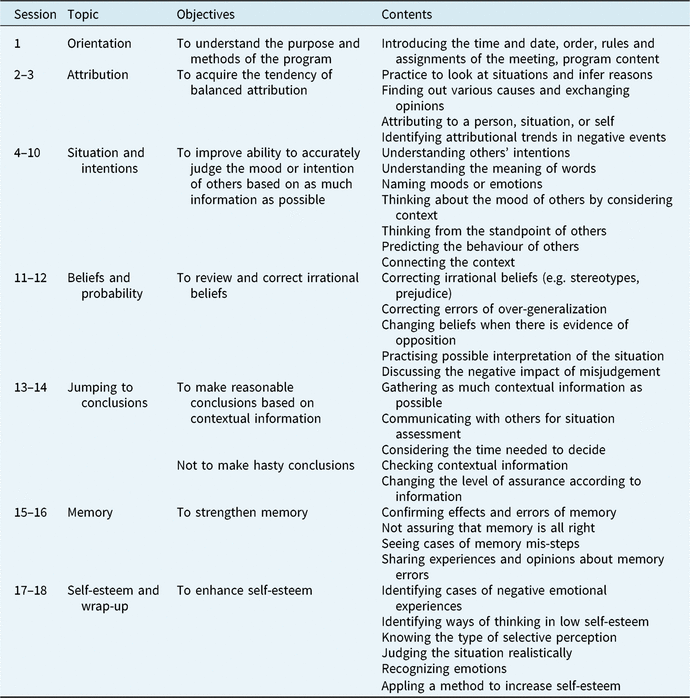
The pre-test was performed in the experimental and control groups just prior to the start of the MCT program. The MCT program was applied for a total of 18 sessions (60 minutes per session) over 14 weeks (1–2 sessions per week). The program was conducted in the education room of the facility where the participant was registered. Each session usually involved warm-up, teaching (lecturing), discussing and sharing ideas, identifying tasks, and practising. The post-test in the experimental and control groups was conducted in the same manner as the pre-test, after completion of the experimental group’s program.
Development of a Korean version of the MCT program
First, we decided on the direction and initial composition of the cognitive training program, based on the evidence regarding the cognitive deficits and improvement strategies of the patients with schizophrenia. As a result of an additional literature review and expert consultation, it was decided to develop the MCT program to suit the Korean culture, particularly to enhance metacognitive capacity. Specific program content and manuals were based on the MCT program devised by Moritz et al. (Reference Moritz, Kerstan, Veckenstedt, Randjbar, Vitzthum and Schmidt2011). We received permission from the copyright owner for use of this program and were provided with the manual and related material by the developer. The English manual was translated into Korean and approved by a language expert fluent in both English and Korean to ensure the validity of the content. Some of the pictures and content were revised in consideration of Korean culture. In addition, scenarios, cartoons and drawings depicting the social interpersonal situation in Korea were created for MCT. The final program content is shown in Table 1.
Metacognitive training program
Measurements
The measurement tools used were structured questionnaires and purchased inspection tools to measure the demographic and disease-related characteristics, intelligence, ToM, positive and negative symptoms, and interpersonal relationships. Intelligence was included to confirm and control in advance, because intelligence is a variable that can influence the effects of cognitive training. The intelligence test and ToM task were conducted by trained psychology major evaluators. They were blinded by the irrelevance of the research process, including program administration and assignment of the experimental and control groups.
Intelligence
The short form (WARD 7) of the Korean Wechsler Additional Intelligence Scale (K-WAIS) (Yum et al., Reference Yum, Park, Oh, Kim and Lee1992) was used to evaluate the intelligence of the participants. WARD 7, the seven subtests of the WAIS proposed by Ward (Reference Ward1990), is useful for people with mental illness who find it difficult to focus and get motivated. The reliability and validity of this tool have been confirmed in studies of psychiatric patients including schizophrenia (Bulzacka et al., Reference Bulzacka, Meyers, Boyer, Le Gloahec, Fond and Szöke2016; Kim et al., Reference Kim, Kim and Oh2005). The Cronbach’s alpha value of this instrument was 0.87.
Theory of mind
The hinting task and false belief task were adopted to measure ToM in terms of social cognition. These tools were translated into Korean and back-translated into English. We then modified them to fit Korean culture by testing the Korean versions among 130 college students without mental problems. For example, a few words with cultural differences in meaning were revised (e.g. an unfamiliar brand name of a specific item). The adapted content was validated by five experts (nurses and professors) using a 5-point scale. The content validity index was 0.76 for the hinting task and 0.72 for the false belief task.
The hinting task (Corcoran et al., Reference Corcoran, Mercer and Frith1995) is a tool used to assess the ability to infer metaphor and real intentions behind indirect speech. This instrument consists of conversations between two characters and includes a total of 10 scenarios. The original tool uses a format in which the experimenter shows the conversation contents to the participants and reads the text directly, or lets the participants read it instead. However, we presented the dialogue scenario to the participants via a cartoon, instead of using text. This was because the linguistic inference method of reading the conversation and answering questions when conducting the ToM task has a greater associated burden in terms of cognitive effort by the subject compared with information provided via a visual comic (Brüne, Reference Brüne2005). At the end of each conversation, a question about the state of mind of the characters was asked, and the participants’ responses were evaluated by a blinded rater using the following scale: 2 points, correct answer; 1 point, correct answer after additional information was given; 0 points, wrong response even after additional information was given).
The false belief task developed by Frith and Corcoran (Reference Frith and Corcoran1996) consists of 12 different stories, each concerning two or three characters. This tool is used to evaluate whether participants properly understand the false beliefs of the characters. For example, when a character named A exits the room leaving a cigarette packet in his desk, a character named B comes in and takes a cigarette. A then comes back into the room to retrieve the packet of cigarettes. The experimenter asks the subject, ‘Does A believe that there will be a cigarette in his or her desk?’. At the end of each story, the participant was asked to describe the state of mind of the characters, and their response was evaluated by a blinded rater, as appropriate (0: incorrect response, 1: correct response).
Positive and negative symptoms
To measure the positive and negative symptoms of patients with schizophrenia, we used the measurement tools developed by Andreasen (Andreasen, Reference Andreasen1984a; Andreasen, Reference Andreasen1984b), which were adapted as the Korean version and validated by Yi et al. (Reference Yi, Ahn, Shin, An, Joo and Kim2001). The Scale for the Assessment of Positive Symptoms (SAPS) includes items assessing 32 positive symptoms, including four general symptoms. The Scale for the Assessment of Negative Symptoms (SANS) assesses 25 negative symptoms, including five general symptoms. Symptoms on each scale are rated from 0 to 5, and the higher the score, the more severe the symptoms. The Cronbach’s alpha values of this instrument were 0.77 for the SAPS and 0.86 for the SANS.
Interpersonal relationships
To measure interpersonal relationships, the Relationship Change Scale developed by Schlein and Guerney (Reference Schlein and Guerney1971), translated by Moon and Lee (Reference Moon and Lee1980), and modified by Chun (Reference Chun1995) was used. It is a self-reported questionnaire with a 5-point Likert scale (1–5) for all 25 questions. The higher the combined score on this scale, the better the interpersonal relationship. The Cronbach’s alpha of this instrument was 0.88 in Chun’s study (Reference Chun1995) and 0.91 in this study.
Data analysis
The collected data were analysed using the SPSS/PASW 22.0 program. The distributions of the continuous variables were verified as normal in advance using the Shapiro–Wilk test. Non-parametric tests were used for variables without a confirmed normal distribution. The chi-square test, t-test and Mann–Whitney U-test were performed to confirm pre-homogeneity between the two groups in terms of the general characteristics and major variables of the participants. To verify the effects of the provided program, we compared differences in measurement variables between the groups using the Mann–Whitney U-test.
Results
General characteristics
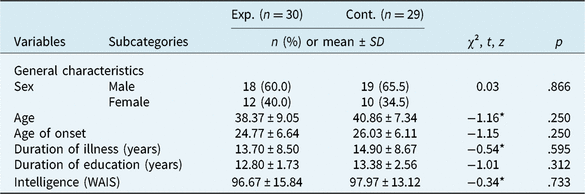
The general characteristics of the study participants, including demographic and disease-related characteristics and intelligence, are given in Table 2.
Homogeneity for general characteristics between the two groups (N = 59)

* Parametric test (t-test). Exp., experimental group; Cont., control group; WAIS, Wechsler Adult Intelligence Scale.
Participant homogeneity
There were no significant differences between the experimental and control groups in terms of general characteristics (p = 0.250–0.866) and dependent variables (p = 0.066–0.453) in the pre-MCT program, indicating that the two groups were homogenous (Table 2).
Effects of the MCT program
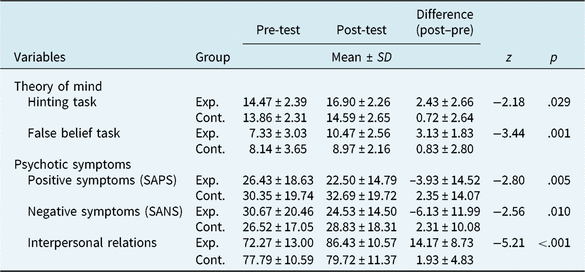
On completion of the MCT program, ToM, positive and negative symptoms, and interpersonal relationships were significantly improved (Table 3). In the ToM task, the experimental group showed a significant improvement compared with the control group (hinting task: z = −2.18; p = 0.029; false belief task: z = −3.44; p = 0.001). On the psychotic symptoms scale, positive symptoms (z = −2.80; p = 0.005) and negative symptoms (z = −2.56; p = 0.010) were significantly improved in the experimental group. The mean difference in interpersonal relationships was 14.17 (SD 8.73) in the experimental group and 1.93 (SD 4.83) in the control group, and a significant improvement (z = −5.21; p < 0.001) after the intervention was found.
Comparison of dependent variables between two groups after treatment (N = 59)

Exp., experimental group; Cont., control group; SAPS, Scale for the Assessment of Positive Symptoms; SANS, Scale for the Assessment of Negative Symptoms.
Discussion
Although there is growing evidence concerning cognitive deficits that trigger or maintain symptoms and dysfunction in patients with schizophrenia, cognitive therapy for such deficits has been considered harmful or inefficient by many clinicians (Moritz et al., Reference Moritz, Vitzthum, Randjbar, Veckenstedt and Woodward2010). However, cognitive models in schizophrenia are effective for understanding their symptoms, and cognitive remediation for them has produced improvements in cognitive performance and improved functional outcomes when combined with psychiatric rehabilitation (McGurk et al., Reference McGurk, Twamley, Sitzer, McHugo and Mueser2007; Sarin and Wallin, Reference Sarin and Wallin2014; Wykes et al., Reference Wykes, Huddy, Cellard, McGurk and Czobor2011). When considering the high rates of relapse and non-compliance and the possibility of fatal side-effects under anti-psychotic therapy, cognitive training can be an effective and safe alternative treatment (Moritz et al., Reference Moritz, Andreou, Schneider, Wittekind, Menon and Balzan2014). In this study, we developed a Korean version of MCT and offered it to outpatients with schizophrenia in the community.
The hypothesis pertaining to the effect of the MCT program on ToM was supported. The experimental group who underwent the MCT program showed a significant improvement in the performance of the hinting task (z = −2.18; p = 0.029) and false belief task (z = −3.44; p = 0.001) compared with the control group. The ToM refers to the cognitive capacity to represent one’s own and others’ mental states (e.g. thinking, believing or pretending) (Brüne, Reference Brüne2005). Impaired ToM and the role of clinical symptomatology in schizophrenia have been reported in previous studies (Abdel-Hamid et al., Reference Abdel-Hamid, Lehmkämper, Sonntag, Juckel, Daum and Brüne2009; Bora et al., Reference Bora, Yucel and Pantelis2009; Sprong et al., Reference Sprong, Schothorst, Vos, Hox and Van Engeland2007). An improvement in ToM after MCT was also found in other studies (Rocha and Queirós, Reference Rocha and Queirós2013). Therefore, these results show that the MCT program has an impact on social cognitive ability.
The hypothesis regarding the effect of the MCT program on psychotic symptoms was also supported. Metacognitive enhancement had effects on both positive and negative symptoms in this study. The positive symptoms (z = −2.80; p = 0.005) and negative symptoms (z = −2.56; p = 0.010) of the experimental group were significantly improved compared with the control group. The anti-psychotic effect of MCT has been confirmed in previous studies (Aghotor et al., Reference Aghotor, Pfueller, Moritz, Weisbrod and Roesch-Ely2010; Favrod et al., Reference Favrod, Rexhaj, Bardy, Ferrari, Hayoz and Moritz2014; Vitzthum et al., Reference Vitzthum, Veckenstedt and Moritz2014). In particular, positive symptoms have been considered a main target of MCT. Delusional patients have reasoning bias, such as jumping to conclusions, and those with hallucinations have impaired self-monitoring, and experience their own thoughts as voices (Sarin and Wallin, Reference Sarin and Wallin2014). The main mechanism by which MCT improves positive symptoms is to reduce the distortion of reality by improving metacognitive ability. In addition, metacognitive deficits are likely to be associated with negative symptoms (Hamm et al., Reference Hamm, Renard, Fogley, Leonhardt, Dimaggio and Buck2012). Patients with negative symptoms have negative beliefs, such as low expectations regarding pleasure and success, and low self-esteem is common in them (Sarin and Wallin, Reference Sarin and Wallin2014). The mechanism by which MCT is effective in improving negative symptoms is not clear, but stimulation of cognitive activities, regular interpersonal contacts and social learning, and enhanced self-esteem, which were gained through participating in the MCT program in this study, are thought to contribute to the therapeutic change. Significant improvements in clinical symptoms through the use of less invasive cognitive training techniques are encouraging for mental health professionals, because the main reason for the dependence of patients with schizophrenia on long-term anti-psychotic medications is to control clinical symptoms. Favrod et al. (Reference Favrod, Rexhaj, Bardy, Ferrari, Hayoz and Moritz2014) demonstrated the sustained anti-psychotic effect of MCT in psychosis in a randomized controlled study. Clarification of the mechanism of symptom improvement induced by improved metacognition, as well as verifying the sustained effects and identifying strategies to maintain sustainability should be explored in a future study.
As the psychotic effects of the MCT program have been confirmed in various cultures, a novel approach to refine and expand existing MCT programs needs to be introduced. While recent studies on individualized MCT programs have been published, Vitzthum et al. (Reference Vitzthum, Veckenstedt and Moritz2014) reported a substantial reduction in the symptoms of a patient with psychosis after a 4-week MCT program using a combined group- and individual-session approach. This suggests that multiple forms of intervention can produce time-effective outcomes in individuals, compared with the group only format. Therefore, these various approaches should continue to be investigated and their clinical usefulness should be confirmed in future studies.
Finally, the hypothesis regarding the effects of the MCT program on interpersonal relationships was supported. The experimental group receiving the MCT program showed a significant improvement (z = −5.21; p < 0.001) in interpersonal relationships, compared with the control group. In the program of this study, it was shown that training in social situation information, improvement of social cognitive factors, and strengthening of self-esteem had an effect on social competence in terms of correctly understanding and communicating other people’s mind or social situation appropriately. The above-mentioned improvement of ToM after the MCT program positively influenced interpersonal functioning. ToM has been identified as a mediator between neurocognition and social competence (Couture et al., Reference Couture, Granholm and Fish2011). This is in line with previous studies that showed improved ToM, social perception, emotion recognition, and social functioning after MCT (Moritz et al., Reference Moritz, Kerstan, Veckenstedt, Randjbar, Vitzthum and Schmidt2011; Rocha and Queirós, Reference Rocha and Queirós2013). As a secondary target of MCT, interpersonal improvement is a meaningful result, as it contributes to the restoration of functions that lead to improved quality of life in patients with schizophrenia.
The limitations of this study were that the long-term effect of the intervention was not confirmed, and self-reported questionnaires were used to measure interpersonal relationships. In future research, we suggest an advanced study incorporating objective measurements of actual interpersonal relationships, an exploratory study on metacognitive capacity according to various clinical conditions, and an interventional study on the MCT approach in a clinical setting. Moreover, if the results of the intervention in terms of improving metacognition are collated, a systematic review and meta-analysis study will be needed to integrate the results and confirm the effectiveness of the MCT program.
Conclusion
The Korean version of the MCT program was developed in this study and its effect on ToM, symptoms, and social functioning was verified after adjusting for intelligence. The findings suggest that this MCT program is a safe and complementary treatment in the field of psychiatric care, and that it is useful in the Korean cultural context, beyond the Western context. More specific interventional strategies to strengthen metacognitive capacity in various backgrounds should be developed in future studies.
Acknowledgements
None.
Conflicts of interest
The authors have no conflicts of interest with respect to this publication.
Financial support
This work was supported by a grant in 2019 from Hannam University in South Korea.
Ethical statements
This study was conducted in accordance with the Ethical Principles of Psychologists and Code of Conduct as set out by the APA. The study was approved by the Institutional Review Board of Hannam University (IRB no. 16-01-03-0412).



Comments
No Comments have been published for this article.