Background
Non-alcoholic fatty liver disease (NAFLD) encompasses a spectrum of liver disease ranging from simple steatosis (NAFLD) to non-alcoholic steatohepatitis (NASH) and cirrhosis, occurring in the absence of excessive alcohol intake.Reference Brown and Kleiner 1 NAFLD is considered to be the hepatic manifestation of the metabolic syndrome and as such its worldwide prevalence is increasing alongside the increasing prevalence of obesity. The National Health and Nutrition Examination Survey found the prevalence of simple steatosis in the U.S. adult population to be around 20–30%, rising to ~69% in obese subjects or those with type 2 diabetes.Reference Leite, Salles, Araujo, Villela-Nogueira and Cardoso 2 Despite previously being considered almost entirely a disease of adults, NAFLD now has an estimated 9.6% incidence in children.Reference Molleston, Schwimmer and Yates 3 , Reference AlKhater 4 Whilst the majority of patients with NAFLD have simple steatosis, around 10–30% of cases progress to NASH, which is characterized by inflammation and hepatocellular injuryReference Dyson, Anstee and McPherson 5 and confers an increased risk of hepatocellular carcinoma and cirrhosis, potentially resulting in end-stage liver failure necessitating liver transplantation.Reference Zezos and Renner 6 Indeed, NASH is currently the third most common indication for liver transplantation in the United States, and could soon become the most common.Reference Charlton, Burns and Pedersen 7 NAFLD also confers increased cardiometabolic risk, so that cardiovascular disease is a major cause of mortality in affected individuals.Reference Bhatia, Curzen and Byrne 8
Although the pathophysiology of NAFLD is not completely understood,Reference Noureddin, Mato and Lu 9 insulin resistance (IR), which is strongly associated with obesity, is thought to be of particular importance.Reference Oliveira, de Lima Sanches, de Abreu-Silva and Marcadenti 10 The hepatic accumulation of triglycerides results from an imbalance in lipid uptake, metabolism and release by the liver. In the context of obesity and IR, peripheral lipolysis and de novo lipogenesis is increased, resulting in additional free fatty acid (FFA) influx to the liver.Reference Oliveira, de Lima Sanches, de Abreu-Silva and Marcadenti 10 , Reference Gaggini, Morelli and Buzzigoli 11 After reaching the liver, lipids undergo either β-oxidation in mitochondria or esterification with glycerol to form triglycerides. The increase in FFAs can overwhelm the β-oxidation process resulting in mitochondrial dysfunction, oxidative stress and overproduction of reactive oxygen species.Reference Oliveira, de Lima Sanches, de Abreu-Silva and Marcadenti 10 These factors, together with decreased hepatic very low-density lipoprotein secretion contribute to the hepatic accumulation of triglycerides in the context of obesity and overnutrition. The risk factors determining the risk of progression to NASH are also unclear.Reference Brown and Kleiner 1 The ‘multiple parallel hits’ model proposes that multiple insults drive the progression of NAFLD to NASH;Reference Molleston, Schwimmer and Yates 3 , Reference Dowman, Tomlinson and Newsome 12 steatosis is often regarded as the first ‘hit’, inducing increased susceptibility to injury from further insults such as mitochondrial dysfunction, oxidative stress and IR.Reference Dowman, Tomlinson and Newsome 12 These additional ‘hits’ result in apoptosis, inflammation and fibrosis and progression to NASH.Reference Molleston, Schwimmer and Yates 3 In addition, ethnic differences in susceptibility to NAFLD suggest genetic predisposition may be importantReference Guerrero, Vega, Grundy and Browning 13 , Reference Weston, Leyden and Murphy 14 and single nucleotide polymorphisms have been identified in association with increased NAFLD risk.Reference Romeo, Kozlitina and Xing 15
It is now recognized that the environment experienced in early life can have a profound influence on health. Many studies have now shown that exposure to adverse conditions during periods of developmental plasticity in early life alters tissue development, organogenesis and metabolism; resulting in the ‘programming’ of an increased risk of cardiovascular disease, obesity and the metabolic syndrome.Reference Roseboom, van der Meulen and Osmond 16 – Reference Wang, Wang, Kong, Zhang and Zeng 18 Given the association of NAFLD with obesity and the metabolic syndrome, it is not surprising that a number of reports in both humans and in animal models suggest that adverse early life conditions can also lead to an increased risk of NAFLD. Here we review the evidence demonstrating a link between early life factors and the risk of NAFLD.
Early life growth restriction and the programming of NAFLD
Many of the early studies in the Developmental Origins of Health and Disease (DOHaD) field described the association between intrauterine growth restriction (IUGR, defined as low fetal weight for gestational age) and a higher risk of developing metabolic and cardiovascular disease.Reference Barker, Osmond, Golding, Kuh and Wadsworth 19 Growth restriction can occur as a consequence of maternal undernutrition and/or placental dysfunction including pre-eclampsia, in which there is disruption of the normal transplacental nutrient supply and/or fetal hypoxia. In humans, being born IUGR is associated with an increased risk of abnormal liver function tests and of developing NAFLD in adulthood,Reference Fraser, Ebrahim, Davey Smith and Lawlor 20 and this is also seen in childhood, with children born small for gestational age having an increased risk of developing NASH.Reference Nobili, Marcellini and Marchesini 21 In addition, postnatal growth patterns may be important in determining disease risk, so that individuals showing rapid catch-up growth in the first 3 months of life have a higher risk of developing NAFLD compared with those with slower early postnatal growth.Reference Breij, Kerkhof and Hokken-Koelega 22 The DOHaD concept also includes events occurring in infancy and childhood that also influence later disease risk and this includes the risk of NAFLD. For example, exposure to the Great Chinese Famine in early life was shown to have sex-specific association with moderate–severe NAFLDReference Wang, Chen and Ning 23 and amongst individuals in the Helsinki birth cohort study, individuals who were small during early childhood and obese as adults were at the highest risk of developing NAFLD.Reference Sandboge, Perala and Salonen 24
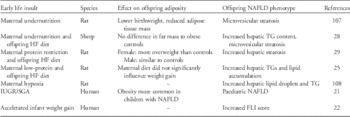
Animal models have been developed in order to understand potential mechanisms linking IUGR with later disease risk, and these mainly involve global maternal calorie restriction or specific macronutrient restriction, usually a low-protein diet. In rodents, maternal 50% calorie restriction or protein restriction results in offspring developing microvesicular steatosis accompanied by upregulation of the master transcription factors sterol regulatory element binding protein (SREBP-1c), carbohydrate-responsive element-binding protein and peroxisome proliferator-activated receptor-γ (PPAR-γ), together with effects on downstream target genes important in lipid metabolism including fatty acid synthase (FAS), acetyl-CoA carboxylase and steroyl-CoA desaturase.Reference Erhuma, Salter, Sculley, Langley-Evans and Bennett 25 , Reference Carr, Chen and Cooper 26 In some of these studies, hepatic steatosis and changes in hepatic gene expression occurred in the absence of obesity in the offspring, suggesting obesity-independent mechanisms.Reference Erhuma, Salter, Sculley, Langley-Evans and Bennett 25 Effects on SREBP-1c may be mediated through changes in nicotinamide adenine dinucleotide+-dependent histone deacetylase (SIRT1) and AMP-activated protein kinase (AMPK) which are involved in the deacetylation and phosphorylation of SREBP-1c: 50% food restriction in pregnant rats resulted in increased hepatic SIRT1 activity in offspring fetal liver, but decreased hepatic SIRT1 and AMPK activity postnatally, in association with increased lipogenesis, decreased lipolysis and increased fat stores.Reference Wolfe, Gong and Han 27 Thus, changes in hepatic gene expression in the offspring of females subjected to calorie or protein restriction predict increased lipid turnover, with an increased propensity for lipogenesis as well as lipid storage. These studies are not limited to rodents; in sheep, maternal dietary restriction promotes the accumulation of lipid in offspring liver.Reference Hyatt, Gardner and Sebert 28 Further, in some studies, the severity of hepatic steatosis is worsened when the offspring are also exposed to a high-fat diet.Reference Souza-Mello, Mandarim-de-Lacerda and Aguila 29 Finally, although most studies have used models of maternal calorie or protein restriction, maternal vitamin D deficiency leads to increased body mass, diffuse hepatic steatosis and increased hepatic expression of FAS.Reference Nascimento, Ceciliano, Aguila and Mandarim-de-Lacerda 30 Details of some of the animal and human studies are summarized in Table 1.
Overview of intrauterine growth restriction (IUGR) and undernutrition literature

NAFLD, non-alcoholic fatty liver disease; HF, high fat; TG, triglyceride; SGA, small for gestational age; FLI, fatty liver index.
Maternal overnutrition and the programming of NAFLD
In humans, exposure to maternal obesity is associated with increased risk of premature mortality from cardiovascular diseaseReference Reynolds, Allan and Raja 31 and maternal obesity has also been linked to increased hepatic steatosis and adiposity in offspring. Recent studies using magnetic resonance imaging in the neonatal period show a direct correlation between maternal body mass index and adipose tissue and intrahepatocellular lipid levels.Reference Modi, Murgasova and Ruager-Martin 32 , Reference Brumbaugh, Tearse and Cree-Green 33
Experimental evidence from animal models has linked exposure to maternal overnutrition during gestation and/or lactation to the development of NAFLD. Some experimental studies in animals, including rodents and non-human primatesReference Bayol, Simbi, Fowkes and Stickland 34 – Reference Drake and Reynolds 37 have confirmed that the offspring of high-fat fed dams have increased body mass and adiposity. In a number of these studies, offspring exposed to maternal overnutrition have increased hepatic triglyceride accumulation and liver lipid droplets, indicative of hepatic steatosis,Reference Oben, Mouralidarane and Samuelsson 35 , Reference Bringhenti, Ornellas, Martins, Mandarim-de-Lacerda and Aguila 36 although the increase in hepatic lipid levels does not always persist into adulthood.Reference Hellgren, Jensen, Waterstradt, Quistorff and Lauritzen 38 However, a number of other studies have found no effects of maternal overnutrition on the offspring phenotype.Reference King, Dakin and Liu 39 , Reference King, Norman, Seckl and Drake 40
Some of the discrepancies between studies may be explained by the different diets used in these studies which have included high-fat, high sugar, a combination of both (a ‘Western-style’ or ‘cafeteria’ diet) or supplementation with additional chocolate, sucrose and/or fructose. The offspring of dams fed on these supplemented diets display an increased percentage body fat.Reference Kjaergaard, Nilsson, Rosendal, Nielsen and Raun 41 , Reference Zhang, Dai, Wang and Wang 42 The source of fat in the diet may be important to the programming of NAFLD, as demonstrated by a study in which the offspring of dams fed diets supplemented with different sources of fat had differential susceptibility to NAFLD.Reference Llopis, Sanchez, Priego, Palou and Pico 43 In addition, the timing of intervention in the dams may be important, with some studies starting dietary interventions pre-conception, leading to maternal obesity, whereas others commence the diets only during pregnancy. Furthermore, the maternal phenotype may be crucial; in rats, offspring exposed to maternal diabetes had vacuolar and ballooning degeneration in the liver, with a hepatitis-like phenotype.Reference El-Sayyad, Al-Haggar, El-Ghawet and Bakr 44 Another rat model demonstrated that exposure to maternal hyperglycaemia exacerbated the effects of a postnatal high-fat diet, with offspring displaying more severe hepatic steatosis.Reference Song, Li and Zhao 45
In terms of mechanisms, altered expression of genes important in the PPAR signalling, gluconeogenesis and lipid metabolism pathways have been observed in mice born to high-fat fed dams.Reference Kjaergaard, Nilsson, Rosendal, Nielsen and Raun 41 , Reference Alfaradhi, Fernandez-Twinn and Martin-Gronert 46 – Reference Zhou, Wang, Cui, Chen and Pan 48 A role for disrupted mitochondrial function in NAFLD pathogenesis has been implicated in some models,Reference Alfaradhi, Fernandez-Twinn and Martin-Gronert 46 , Reference Bruce, Cagampang and Argenton 49 and a number of studies have implicated increased oxidative stress, with increased markers of oxidative damage and alterations in the levels of key anti-oxidant enzymes glutathione peroxidase-1,Reference Bringhenti, Ornellas, Martins, Mandarim-de-Lacerda and Aguila 36 , Reference Alfaradhi, Fernandez-Twinn and Martin-Gronert 46 which can precede the development of IR.Reference Matsuzawa-Nagata, Takamura and Ando 50 Such mechanisms have also been implicated in non-human primate studies, with elevated levels of markers of oxidative stress observed in the fetal livers of Macaques born to high-fat diet fed mothers.Reference McCurdy, Bishop and Williams 51 A number of studies show alterations in key mediators of inflammation in offspring of overnourished mothers, including increased circulating concentrations of the adipokine leptin, which may have a proinflammatory role in liver and play a role in the progression of fibrosis in NASH;Reference Bouanane, Merzouk and Benkalfat 47 , Reference Reitman 52 altered expression of toll-like receptor 4 which is important in the activation of Kuppfer cells, the resident liver macrophages;Reference Thorn, Baquero and Newsom 53 and increased expression of tumour necrosis factor alpha (TNFα).Reference Pruis, Lendvai and Bloks 54
Alterations in DNA methylation and histone modifications have also been proposed to be important in the programming of NAFLD. In Macaques, Aagaard-Tillery et al. Reference Aagaard-Tillery, Grove and Bishop 55 reported decreased expression of the histone deacetylase HDAC1 in offspring exposed to maternal high-fat diet and histone hyperacetylation at H3K14 in association with increased expression of retinal dehydrogenase 12 (Rdh12), a gene essential to the circadian rhythm controlled feeding pattern in hepatic tissueReference Aagaard-Tillery, Grove and Bishop 55 which could lead to abnormal feeding behaviour.Reference Xue, Shen, Corbo and Kefalov 56 Changes in DNA methylation patterns were also identified, with altered hepatic expression of the DNA methyltransferase Dnmt1,Reference Aagaard-Tillery, Grove and Bishop 55 suggesting that exposure to gestational insults may cause alterations in the DNA methylation machinery in offspring. However, whether these changes are causative or simply a consequence of the induced disease state remains to be determined.
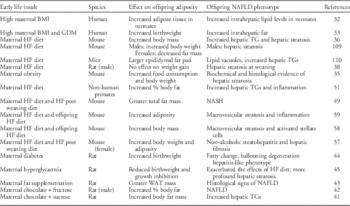
Finally, as with models of maternal undernutrition, exposure to a high-fat diet postnatally can exacerbate the effects of exposure to maternal overnutrition. Mice born to females maintained on a high-fat diet during gestation, which were then exposed to a high-fat diet after weaning developed more severe hepatic steatosis and characteristics of NASH, including fibrosis.Reference Bruce, Cagampang and Argenton 49 , Reference Mouralidarane, Soeda and Visconti-Pugmire 57 Other studies have demonstrated comparable findings, with the offspring of high-fat fed dams showing microvesicular steatosis, progressing to macrovesicular steatosis if animals were also fed a high-fat diet postnatally.Reference Gregorio, Souza-Mello, Carvalho, Mandarim-de-Lacerda and Aguila 58 , Reference Kruse, Seki and Vuguin 59 Studies showing an association of maternal undernutrition with offspring NAFLD are summarized in Table 2.
Overview of maternal obesity and high-fat (HF) diet literature

NAFLD, non-alcoholic fatty liver disease; BMI, body mass index; GDM, gestational diabetes mellitus; TG, triglyceride; NASH, non-alcoholic steatohepatitis; WAT, white adipose tissue.
Glucocorticoids and the programming of NAFLD
Prenatal glucocorticoid overexposure has also been implicated in the programming of cardiometabolic disease. In humans, such exposure may occur as a consequence of maternal stress, resulting in increased fetal exposure to maternal glucocorticoids, or exposure to exogenous glucocorticoids. Maternal stress during pregnancy, for example as a consequence of bereavement, has been associated with an increased risk of offspring metabolic dysfunction including overweight.Reference Li, Olsen and Vestergaard 60 – Reference Wang, Anderson and Dalton Iii 62 Synthetic glucocorticoids are administered to women with threatened preterm labour, and while this undoubtedly accelerates fetal lung development and increases survival, excess synthetic glucocorticoid exposure can reduce birthweight and increase the risk of later IR.Reference Dalziel, Walker and Parag 63 , Reference Khulan and Drake 64 Although glucocorticoid overexposure therefore appears to increase the risk of cardiometabolic disease, there are no studies reporting any effects on the risk of NAFLD in the offspring.
In animal models, prenatal glucocorticoid overexposure as a consequence of maternal stress or synthetic glucocorticoid exposure reduces birthweight and has been linked to the programming of cardiovascular disease, hypertension, glucose intolerance and the disruption of the hypothalamic–pituitary–adrenal axis.Reference Khulan and Drake 64 In rats, administration of the synthetic glucocorticoid dexamethasone to pregnant females reduces birthweight and leads to IR in adipose and hepatic tissue.Reference Cleasby, Kelly, Walker and Seckl 65 In rats, maternal dexamethasone exposure in late gestation increased liver triglycerides in their male offspring, particularly when offspring were maintained on a high-fat diet,Reference Drake, Raubenheimer and Kerrigan 66 and induced hepatocellular apoptosis,Reference Huang, Chen and Tang 67 a feature linked with the progression and initiation of NAFLD.Reference Alkhouri, Carter-Kent and Feldstein 68 In contrast, another study in Sprague Dawley rats found that prenatal exposure to high dose dexamethasone had no significant effect on triglyceride accumulation in male offspring, however there were differences in females, with increased numbers of steatotic cells.Reference Carbone, Zuloaga and Hiroi 69 Perhaps surprisingly, the prenatal glucocorticoid exposure-induced increase in hepatic steatosis was not paralleled by an increase in obesity, despite the offspring having low birthweight.Reference Drake, Raubenheimer and Kerrigan 66 , Reference Carbone, Zuloaga and Hiroi 69
The mechanisms involved in the programming of NAFLD in glucocorticoid programming may differ from those observed as a consequence of maternal overnutrition. Prenatal exposure to dexamethasone resulted in decreased hepatic PPAR-γ and AMPK2 mRNA expression, in contrast to the upregulation observed in offspring exposed to maternal high-fat diets.Reference Drake, Raubenheimer and Kerrigan 66 There were depot-specific alterations in gene expression in adipose tissue, with upregulation of SREBP-1c in subcutaneous but not omental fat in dexamethasone-exposed animals.Reference Drake, Raubenheimer and Kerrigan 66 Rats born to dams exposed to restraint stress had higher liver lipid levels compared with controls, with increased expression of hepatic 11-beta hydroxysteroid dehydrogenase type 1 (11β-HSD1), which reactivates inactive glucocorticoids, increasing local tissue glucocorticoid concentrations,Reference Maeyama, Hirasawa and Tahara 70 predicted to increase local IR. Thus, prenatal overexposure to glucocorticoids has programming effects on lipid metabolism, inducing an increased susceptibility to hepatic steatosis. However, the differences between studies, notably in differential effects on males and females which may stem from the use of different animal strains and differences in experimental protocols merit further investigation.
Environmental pollutants and the programming of NAFLD
Bisphenol A
There is much interest in the potential role of environmental pollutants in programming adverse effects on metabolism in offspring. Bisphenol A (BPA) is a chemical widely used in the production of plastics and epoxy resins and exposure is widespread in humans, with detectable levels in the urine of ~95% of a sample population.Reference Calafat, Kuklenyik and Reidy 71 Evidence from animal studies suggests that gestational exposure to BPA can program an increased risk of developing the metabolic syndrome.Reference Somm, Schwitzgebel and Toulotte 72 – Reference Wei, Sun and Chen 74 Dietary BPA exposure during gestation and lactation results in adverse effects in the offspring including increases in body weight, hepatic triglycerides, microvesicular steatosis, altered expression of triglyceride synthesis and β-oxidation-related genes and a liver histology resembling mild NAFLD.Reference Jiang, Xia and Zhu 75 , Reference Strakovsky, Wang and Engeseth 76 Again, postnatal exposure to a high-fat diet exacerbates the effects of prenatal BPA exposure, with increases in the concentrations of the liver enzymes aspartate aminotransferase, alanine aminotransferase and alkaline phosphate (ALP), suggestive of liver injury, and liver histology showing diffuse lipid droplets, balloon degeneration and signs of inflammation.Reference Wei, Sun and Chen 74 However, the applicability of this study to human populations is unclear, as the 100 μg/kg/day dose used is far higher than the estimated human typical daily exposure (0.5–4.8 μg/kg/day).
Mitochondrial dysfunction and increased oxidative stress have again been implicated as important drivers of NAFLD development in these models. Prenatal BPA exposure leads to an early decrease in hepatocyte mitochondrial respiratory complex activity, increased production of reactive oxygen species and reduced mitochondrial ATP production indicative of impaired hepatic mitochondrial function and increased oxidative stress.Reference Jiang, Xia and Zhu 75 A decrease in the expression of the key β-oxidation enzyme carnitine palmitoyltransferase (Cpt1a) following prenatal BPA exposure supports the argument that dysfunctional β-oxidation is a ‘hit’ involved in NAFLD pathogenesis.Reference Strakovsky, Wang and Engeseth 76 Prenatal BPA exposure coupled with a high-fat diet postnatally predisposes offspring to increased oxidative stress, with decreased levels of antioxidants and an increased level of the lipid peroxidation product malondialdehyde, a biomarker of oxidative stress.Reference Wei, Sun and Chen 74
Overall, the evidence suggests that in rodent models, prenatal BPA exposure combined with postnatal obesity results in an increases predisposition to hepatic steatosis, with mitochondrial dysfunction and oxidative stress acting as a ‘hit’, leading to a more severe NAFLD phenotype. However, there are issues with the extrapolation of these animal studies to humans due to differences in BPA metabolism. Rats have an increased ability to glucuronidate BPA, meaning humans may be exposed to a higher oestrogenic burden at the same dose.Reference Elsby, Maggs, Ashby and Park 77 Studies in non-human primates and longitudinal epidemiological studies linking BPA detection in the mothers’ urine with offspring’s future health may prove useful. The recent lowering of the tolerable daily intake (TDI) to 4 μg/kg/day from 50 μg/kg/day means that some studies have used inappropriately high doses and future studies should use lower doses to better reflect both the TDI and estimated daily intake in order to be relevant to human populations.
Phthalates
Phthalates are ubiquitous environmental pollutants used as plasticizers in a range of consumer products with widespread human exposure demonstrated by studies showing that metabolites were detectable in urine in over 75% of a U.S. study population.Reference Silva, Barr and Reidy 78 Phthalates are thought to impede the function of nuclear receptors involved in lipid and glycogen metabolism, such as PPARs.Reference Peraza, Burdick, Marin, Gonzalez and Peters 79 Studies showing reduced liver ALP levels suggestive of hepatocellular membrane damage and increased hepatic acid phosphatase levels indicative of liver injury in the offspring of male and female Wistar rats exposed to polychlorinated biphenyl (PCB, a xenoestrogen) and diethylphthalate (DEP) suggest these chemicals may have a synergistic interactive toxic effect.Reference Pereira and Rao 80 Histologically, livers from offspring exposed to DEP showed mild vacuolation, with pups exposed to both PCB and DEP having more severe vacuolation and hepatic steatosis. Again, studies have used doses that may be much higher than those to which humans are exposed. Prenatal di-(2-ehtylhexyl)phthalate exposure at a dose of 100 mg/kg (a much higher dose than the estimated median human daily exposure of 1.32 μg/kg/dayReference Marsee, Woodruff, Axelrad, Calafat and Swan 81 ) resulted in reduced glycogen storage and hepatic steatosis at weaning, which seemed to improve with age.Reference Maranghi, Lorenzetti and Tassinari 82 Thus, although there is some evidence to suggest that prenatal phthalate exposure could affect hepatic development and metabolism, there is limited literature to support the persistence of these effects into adulthood and further studies using phthalates at doses relevant to human exposure are needed.
Maternal smoking and alcohol intake and the programming of NAFLD
Smoking during pregnancy has long been known to have a deleterious effect on offspring development, particularly lung function.Reference Gilliland, Berhane and McConnell 83 Human epidemiological studies suggest that maternal tobacco use during pregnancy increases a child’s risk of obesity.Reference Huang, Burke and Newnham 84 Maternal smoking during pregnancy has been associated with increased circulating triglycerides and lower high-density lipoprotein cholesterol in femalesReference Cupul-Uicab, Skjaerven and Haug 85 and the adult offspring of mothers that smoked during pregnancy had higher body mass index and circulating triglycerides when compared with non-smokers.Reference Power, Atherton and Thomas 86
Benzo[a]pyrene (BaP) is a carcinogenic polycyclic aromatic hydrocarbon to which humans are typically exposed through tobacco, in addition to air pollution and grilled foods.Reference Ortiz, Nakamura, Li, Blumberg and Luderer 87 In the model organism Xenopus tropicalis, BaP exposure disrupted hepatic cholesterol and lipid metabolism.Reference Regnault, Worms and Oger-Desfeux 88 In female mice, in utero exposure to BaP led to increased visceral adipose depot, increased body weight and increased hepatic lipid content.Reference Ortiz, Nakamura, Li, Blumberg and Luderer 87 Histologically, these mice displayed features of NAFLD, such as mild inflammatory infiltrates and steatosis despite being fed a low-fat diet. This hepatic steatosis was accompanied by an increased in expression of PPAR-γ and UCP2.
Despite previously being believed to cause less harm, there is growing evidence that gestational exposure to nicotine, the major psychoactive chemical in tobacco, may also have harmful effects.Reference Wickstrom 89 Exposure to nicotine during gestation has been shown to affect the metabolic processes of multiple generations in rats, with the second (F2) generation offspring of rats exposed to nicotine in utero displaying increased IR compared with controls.Reference Holloway, Cuu, Morrison, Gerstein and Tarnopolsky 90 In a study by Ma et al., male and female offspring of female rats treated with daily nicotine injections preconceptually and through to weaning, had increased levels of hepatic triglycerides at postnatal day 180 with males also having increased circulating triglycerides. This was associated with an increase in hepatic expression of FAS and its regulator LXRα, suggestive of increased de novo triglyceride synthesis,Reference Ma, Nicholson, Wong, Holloway and Hardy 91 an established mechanism in NAFLD pathogenesis.
Moderate to heavy ethanol consumption during pregnancy can have teratogenic effects in humans, with severity varying from a slight reduction in cognitive abilities and low birthweight to fetal alcohol syndrome, characterized by facial abnormalities, pre/postnatal growth retardation and neurocognitive deficits.Reference Ornoy and Ergaz 92 In rats, prenatal ethanol exposure (PEE) increases the risk of developing the metabolic syndrome in association with hypothalamic–pituitary–adrenal axis-associated neuroendocrine programming.Reference Xia, Shen and Kou 93 Offspring had increased IR, hyperglycaemia and total cholesterol, with lipid accumulation present in the liver. PEE induces increased susceptibility to high-fat diet-induced NAFLD with macrovesicular steatosis and increased insulin like growth factor 1 (IGF-1), glucose and triglyceride levels in female Wistar rats.Reference Shen, Liu and Gong 94 Proposed mechanisms for this include the dysregulation of hepatic glucose and lipid metabolism and the influence of changing glucocorticoid concentrations, in response to ethanol-induced IUGR, on IGF-1 concentrations during catch-up growth.
Potential interventions
Interventions for chronic diseases such as NAFLD are generally initiated in later life when response to treatments may be suboptimal. The fetal and early life period is a time of developmental plasticity, when small changes can have a large impact on future disease risk, highlighting this period as a critical window for interventions.Reference Godfrey, Gluckman and Hanson 95 In the case of maternal high-fat diet induced NAFLD, dietary interventions and nutrient supplements in mothers and offspring have had varying levels of success in reducing the risk of NAFLD development. For example, in non-human primates chronically fed a high-fat diet, switching the mothers onto a low-fat diet during pregnancy helped to partially normalize their offspring’s hepatic triglyceride levels, reducing but not eliminating the offspring’s risk.Reference McCurdy, Bishop and Williams 51 However, achieving compliance with long-term lifestyle modifications such as improving diet has proved difficult in human studies, meaning dietary supplementation may prove to be easier to implement.
In rats, taurine (an amino sulphonic acid) supplementation has been shown to alleviate high-fat diet induced liver lipid accumulationReference Gentile, Nivala and Gonzales 96 and supplementation during pregnancy was demonstrated to ameliorate maternal hepatic steatosis and IR.Reference Li, Reynolds, Sloboda, Gray and Vickers 97 However, there was increased neonatal mortality in this study, and previous work by the same group demonstrated that maternal taurine supplementation in addition to a high-fat diet aggravated hepatic steatosis in some offspring.Reference Li 98 Fish oil contains anti-inflammatory n-3 polyunsaturated fatty acids (PUFAs) and supplementation helps prevent hepatic steatosis in obese animal models.Reference Alwayn, Gura and Nose 99 Fish oil administration after weaning reversed some of the adverse programming caused by a maternal low-protein diet, reducing serum triglyceride levels, hepatic SREBP-1C expression and hepatic steatosis in offspring.Reference Bringhenti, Schultz and Rachid 100 These beneficial effects seem to occur through suppression of hepatic lipogenesis and upregulation of β-oxidation. Omega-9 supplementation also has a protective effect against the developmental programming of NAFLD, with the offspring of high-fat dams which were fed an omega-9 supplemented diet after weaning having reduced serum and hepatic triglycerides and reduced steatosis compared with controls.Reference Torres Dde, Dos Santos and Silva 101
Drug treatments targeting the PPAR transcription factors have been explored. Bezafibrate is a pan-PPAR activator that is used clinically to improve glycaemic control in diabetic patients.Reference Teramoto, Shirai, Daida and Yamada 102 In mice exposed to an obesogenic maternal diet, bezafibrate treatment resulted in lowered hepatic triglycerides, an increased PPAR-α/SREBP-1c ratio and reduced hepatic steatosis compared with non-treated mice.Reference Magliano, Bargut and de Carvalho 103 The proposed mechanism behind this is the reduction of the proinflammatory adipokine profile in WAT and increased β-oxidation in response to the upregulation of PPAR-α. Therefore, pharmaceutical interventions targeting the PPAR transcription factors may prove useful in reversing developmental programming of increased NAFLD risk.
Finally, breastfeeding may also be protective against the developmental programming of NAFLD in humans. Breastfeeding may reduce a child’s risk of becoming overweightReference Grube, von der Lippe, Schlaud and Brettschneider 104 and may help prevent NAFLD progression; a study of 191 children demonstrated that breastfeeding was protective against NASH and liver fibrosis, with a longer duration of breastfeeding conferring an increased benefit.Reference Nobili, Bedogni and Alisi 105 Potential mechanisms include the effect of long chain-PUFAs present in breast milk that can affect gene expression of enzymes (e.g. FAS), leading to the inhibition of hepatic glycolysis and de novo lipogenesis.Reference Dentin, Benhamed and Pegorier 106
Conclusions
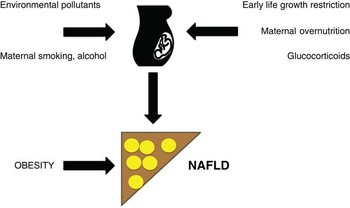
There is compelling evidence from epidemiological clinical studies and experimental research to suggest that an adverse fetal and early life environment can programme increased susceptibly to NAFLD development and progression. Some of the factors which may increase the risk of NALFD are summarized in Fig. 1. Evidence from human and animal studies demonstrate that maternal over- and undernutrition during pregnancy confers increased susceptibly to NAFLD development, as well as exacerbating the effects of a postnatal obesogenic diet and increasing the offspring’s risk of a more severe phenotype such as NASH. In animal models, gestational overexposure to glucocorticoids leads to an increased risk of NAFLD in offspring without an associated increased susceptibly to obesity. Finally, experimental evidence from animal models suggests that environmental pollutants have developmental toxicity, however, the use of inappropriate treatment doses make it difficult to assess whether they have a large impact at typical human exposure concentrations. Finally, studies suggest that interventions in early life can at least partially reverse the adverse developmental programming leading to NAFLD development and progression. However, further controlled clinical trials in humans are necessary to establish treatment doses and the safety profiles of these interventions before they can be implemented.
The environment in early life influences the risk of non-alcoholic fatty liver disease (NAFLD). Environmental factors which may mediate this include early growth restriction, maternal nutrition, glucocorticoid exposure, environmental pollutants and maternal smoking and/or alcohol use. The effect of early life exposure to an adverse environment may be amplified by the development of obesity.

Acknowledgements
Work in AJDs lab is supported by the Medical Research Council, the British Heart Foundation, Theirworld and the Wellcome Trust.
Financial Support
This piece of work received no specific grant from any funding agency, commercial or not-for-profit sectors.
Conflicts of Interest
None.