

1. INTRODUCTION
East European peasants at the end of the middle ages have frequently been portrayed as serfs who were an indispensable element in but victims of the backward socio-economic system in this part of the continent. Poland has often been cited as a classic example in support of the so-called ‘export hypothesis’ of European economic development, according to which demand for Polish grain in the west of Europe helped the country to enter the international economy, but on the other hand, strengthened the feudal system and the position of the gentry, which resulted in the development of demesne lordship, the second serfdom, corvée labour and movement restrictions.Footnote 1 It has been claimed that it was impossible in such a system to develop strong peasant communities and peasant property rights, or to incite peasants to engage in production for the market.Footnote 2 Although sometimes there have been no good grounds to maintain such a portrait of East European peasants, this view has held appeal because it allows for a clear-cut distinction between capitalist societies and economies in the north and the west of the continent and more backward regions in the east.Footnote 3
In contrast to this stereotypical view, it can be shown that in the late middle ages the first contracting institutions appeared in Poland, which were similar in character to their west European counterparts, and written contracts quickly became the basis of economic interactions among the representatives of the largest social group: the peasants. As in other countries of feudal Europe, Poland was characterised by overlapping jurisdictions, as a result of which historians find peasants as parties in many different types of courts.Footnote 4 For the peasants, the most important of these were the special village courts, as their records document many aspects of peasants' activity. These records are the most important source for the study of Polish peasants at the end of the middle ages, as they provide abundant information about the social and economic life of rural communities and about peasants' relations with their feudal lords. The aim of this article is to show that in late medieval Poland there existed a well-established system for registering peasant transactions and that this played an important role in the development of credit and land markets in the period studied.
2. VILLAGE COURT RECORDS
Village court records are the accounts of the proceedings of legal institutions under peasant self-government that developed in Poland, as well as in Lusatia, Bohemia and Silesia,Footnote 5 as a result of the introduction of the written German law.Footnote 6 Prior to this, Polish peasants followed Polish customary law, and in eastern regions Ruthenian peasants followed the Ruthenian law, which both stated that peasants' feudal dues were to be paid in kind or in labour. During the thirteenth and fourteenth centuries, German colonisers settling in Polish lands and in Ruthenian lands belonging to the Kingdom of Poland (Red Ruthenia) brought various forms of written German law that became widespread across the country in the early modern period. The new law introduced important changes in peasant–landlord relations and in the organisation of villages. First, while it retained at a minimal level (pro honores) the amount of dues peasants could pay in kind, it also introduced the payment of money rents as the basic duty of Polish peasants to their feudal lords. Second, all villages were to have their self-governing bodies. The headman (bailiff) of the village (Latin: scultetus; Polish: sołtys; German: Schultze) was an intermediary between the peasants and the landowner. The sołtys' considerable standing in the village was further improved by his strong economic position. However, from the fifteenth century onwards, the hereditary office and property of the sołtys were often purchased by village owners, who appointed their own administrators, the so-called wójt (Latin: advocatus; Polish: wójt; German: foyt). Like the sołtys, a wójt exercised his power helped by a council consisting of seven local peasants over the age of maturity who were held in respect and had good economic standing. Headed by the sołtys or the wójt, the seven peasants, as jurymen, formed a village court.Footnote 7
Decisions made by village courts were first recorded at the beginning of the fifteenth century. Their juridical books were modelled on the recordings of urban courts and courts of the gentry dating back to the previous century. The earliest juridical books in the Polish lands emerged in towns. The oldest, from Cracow, dates to 1300.Footnote 8 At the end of the fourteenth century the first juridical books were produced by the courts of the gentry.Footnote 9 Both urban and gentry courts were the equivalent of notarial offices, so their books contained the records of various transactions. Since each social estate had its own courts, urban court records contained cases chiefly concerning townspeople, whereas gentry court records concerned principally the gentry; it should be noted that, at the end of the middle ages, the Polish gentry were exceptionally numerous, comprising between 6 and 8 per cent of the Polish population.Footnote 10 If a townsman or a gentleman carried out a transaction with a peasant, the peasant's name was also recorded in the urban or gentry court records. It is assumed in the historiography that the initiative for recording the proceedings of village courts was taken by landlords. To keep the books, the sołtys, wójt or peasant communities hired notaries, clergymen or students attending Cracow Academy.Footnote 11 Before the mid-sixteenth century the books were written in Latin, while in areas more densely populated by west European settlers they were sometimes written in German. During the early modern period, Polish became the language of the juridical books. By the end of the eighteenth century, village court records had become common and were used in all regions of Poland. Unfortunately, only about 200 books of court records have survived until today and most of them are from the regions of Little Poland and Red Ruthenia.Footnote 12 The vast majority are documents created in the early modern period; very few date from the beginning of the fifteenth century.Footnote 13
Village courts performed the functions of notarial offices and their books contain simple accounts of newly performed land transactions, rents, wills, inventories, entries concerning inheritance procedures, loans and deposits. It is estimated that as many as 70 per cent of all entries concerned various property transactions such as purchases, sales, exchanges, mortgages and inheritances.Footnote 14 Credit contracts for the purchase of land form a considerable share of all entries. Much less frequent, especially in the fifteenth and sixteenth centuries, are accounts of court sessions dealing with minor criminal offences, such as theft, and civil offences, such as alleged cases of witchcraft, various controversies between neighbours and between peasants and landlords, or broken contracts which were the subject of litigation. Occasionally, village court records also contained confirmation of the property rights of peasants.Footnote 15
The records contain information about all categories of villagers, from farm owners to cottagers, rural craftsmen, millers and innkeepers. The most important and the most numerous section of the peasantry in late medieval and early modern Poland was the kmiecie (Latin: cmethones), full peasant holders of hereditary farms with an average size in the region under study of half a mansus, which was equivalent to eight hectares. Farms belonging to kmiecie were largely self-sufficient, although some of them were, to varying extents, engaged in production for the market. Other, less numerous, sections of the peasantry were the zagrodnicy (Latin: ortulani), or smallholders, and the ogrodnicy, or cottagers, who farmed small plots of land. These two categories of peasants were not able to support themselves and their families from their land, so they earned extra money as hired labourers on their landlords' land, or that of the kmiecie. Apart from the holders of large or small farms, Polish villages were also inhabited by so-called komornicy, landless lodgers who earned wages locally.Footnote 16 This group included village craftsmen, while the wealthiest kmiecie included millers and innkeepers.
The fact that some groups, such as wealthy peasants, seem over-represented in court records may result from their greater economic and social activity. The most frequent mentions in the juridical books relate to the sołtys, wójt, jurymen and farm owners, in other words, the village elite. These individuals could appear in court several times, sometimes more than 10 times in their lifetimes, which makes it possible to study their life cycles. Other types of villager were mentioned only occasionally. Women appeared in the records much less frequently than men, comprising only 20 per cent of all those whose names were registered, and, even then, they were usually mentioned next to their male guardians, i.e. their husbands, fathers or brothers assisting them in court.Footnote 17
The jurisdiction of a village court was limited to the village where it was located and almost all transactions recorded in juridical books were made between local villagers. Sometimes the records mention people coming from a nearby town or a neighbouring village. In the majority of such cases, outsiders appear as parties in conflicts or transactions involving a local villager or villagers. In several cases, outsiders came to court because their own villages were too small to have their own institution of this kind. It is clear that most entries concerned people who came from a relatively small area around the village, and they rarely came from territories outside the parish or from lands belonging to a different lord. One exception was a group of entries documenting inheritance cases where people claiming their inheritance often came from far more distant places. This is particularly typical of cases involving daughters of peasants who moved out in search of employment and settled in towns up to 80 kilometres away from their home villages.Footnote 18 From the beginning of the sixteenth century, court sessions were often attended by the representatives of the landowner or the lord himself, which offered him an opportunity to control social and economic relations within rural communities.Footnote 19
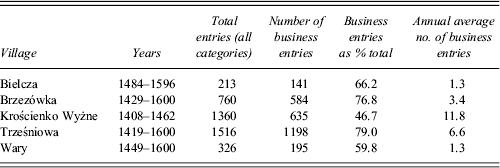
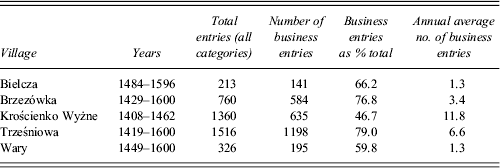
Village courts were not permanent institutions, but were summoned by the sołtys or wójt should the need arise. In an emergency, peasants could register their transactions in sąd grodzki, i.e. courts for the gentry, which existed in the towns since the second half of the fifteenth century, and whose books contained cases involving representatives of the peasantry throughout the whole early modern period.Footnote 20 The records of town courts, which were permanent institutions, likewise contained traces of peasants' transactions, usually involving peasants from suburban villages. As a result, in practice, village courts did not deal with all cases involving peasants. Moreover, scribes were not always present during village court sessions, so sometimes the court's decisions or transactions were officially recorded afterwards, on the basis of notes and rough drafts. It is not possible to determine whether all drafts were subsequently copied into the juridical books. The frequency with which the courts met depended on the intensity of economic activity among the local peasants and on the size of the village. Normally, scribes recorded between several to several dozen cases a year. The vast majority of cases were business transactions, involving some money transfers (Table 1).
Number of all entries and business entries in the oldest village juridical books used in this study, 1408–1600
Sources: Księga sądowa wsi Bielcza, Biblioteka Instytutu Historii Polskiej Akademii Nauk w Warszawie, manuscript 47; Księga sądowa wsi Brzezówka, Biblioteka Katedry Prawa Polskiego Uniwersytetu Jagiellońskiego; B. Ulanowski ed., Księgi sądowe wiejskie (2 vols., Starodawnego Prawa Polskiego Pomniki vols. XI–XII, Cracow, 1920–1921), i, 145–273; H. Polaczkówna ed., Najstarsza księga sądowa wsi Trześniowej 1419–1609 (Lwów [Lviv], 1923); L. Łysiak ed., Księga sądowa wsi Wary 1449–1623 (Wrocław, 1971).
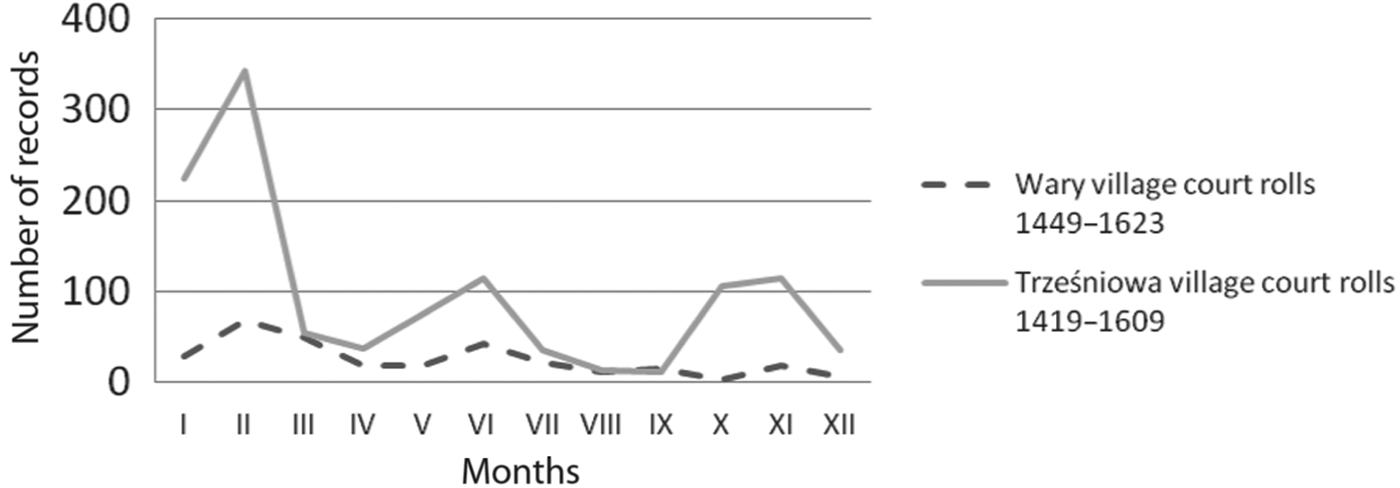
In the winter months, the court met regularly. It was the time of the year when peasants were most likely to make some crucial decisions concerning their property, and the whole rural community, much less preoccupied with field work, had more time to socialise. The court records from the village of Trześniowa, one of the richest sources of this type, show that almost a half (48.7 per cent) of all transactions were made in the first two months of a calendar year.Footnote 21 In other months, the level of the court's activity declined visibly, although there were some minor increases in June, October and November (Figure 1).
Number of entries made in particular months in the court books of Wary, 1449–1623, and Trześniowa, 1419–1609. Months run from January (I) to December (XII).

A similar frequency of court sessions throughout the year is also visible in villages smaller than Trześniowa, where the pace of economic and social life must have been slower, which may be illustrated by data from the records from Wary (Figure 1).Footnote 22 Almost one-third of all entries were made in January and February; nearly half, 48 per cent, were made in the first quarter of the year. As in Trześniowa, the court again met more frequently in June. It is worth adding that the seasonal fluctuation of court sessions in the countryside did not differ much from the rhythm of court activity in towns.Footnote 23
Village court books do not contain the record of all cases examined by the courts, but only of those in which parties paid a special charge. Thus, accounts of cases of particular significance, such as land transactions, were written in the juridical books, but matters of lesser importance, such as minor transactions or litigations, did not find their way into the court records. The charge collected by a scribe was not fixed, and sometimes it was not even paid in cash; it could be paid in honey, for example. At the end of the middle ages, the exact amount of money paid as a charge for registering the transaction was hardly ever noted. The only known case is the payment of 1 grosh, which was 2 per cent of the value of the registered contract and equivalent to the daily wage of an unskilled worker.Footnote 24 It may have been too much for a peasant of modest means to pay for inscribing a minor matter in the juridical book, but it was certainly not a sum that would deter a peasant from registering any bigger land or credit transaction.
3. CREDIT IN VILLAGE COURT RECORDS
Credit in medieval and early modern Poland has for a long time been a focus of interest among legal historians. They have identified different types of credit and examined the theory and practice of the Polish credit market. Their research, however, has had a tendency to focus on the elite, the gentry in particular, and peasants have been almost completely excluded from their studies.Footnote 25
Polish legal historians identify four types of late medieval credit arranged outside financial institutions such as banks: ‘1) a loan inter Christianos, very often made on security […], 2) a usura Judeorum, i.e. a loan given to a Christian by a Jew, which was in many respects different from the previous category,Footnote 26 3) the purchase of the right to collect rents, and 4) the selling of real property with the right to repurchase’.Footnote 27
Research on credit in Poland has thus far been based on the analysis of the records generated by town courts and the courts of the gentry, which also registered credit transactions made by peasants if the other party to it was a gentleman or an inhabitant of a town.Footnote 28 In comparison with townspeople or gentlemen, the role of peasants in the credit market was not regarded as particularly important. This view has been supported by many historians, especially during the communist period, who saw the peasantry as the collective victim of landlords and the emerging system of second serfdom. Polish historians emphasised the dominance of manorial farms in the production of grain for sale, the abandoning of money rents in favour of corvée, and the peasants' alleged lack of interest in rising above subsistence level, seeing them all as major limitations on peasants' engagement in the market.Footnote 29 On the other hand, some historians would occasionally hint that the great demand for Polish grain in Western Europe and the fact that Poland participated in international trade was likely to improve the economic situation not only of Poland's gentry, but also of its peasantry.Footnote 30 The study of the credit market and of the level of financial obligations to the state, the Church, and feudal lords, makes it possible to determine Polish peasants' financial potential and also, indirectly, to assess the level of commercialisation of the peasant economy and their engagement in market production. The analysis of village court records gives a new perspective not only on the peasant credit market, but also on the overall peasant economy. This article relies entirely on this kind of source.
For the purposes of this study, 12 court books have been selected according to their ability to provide a long-term perspective, that is, over a period of at least 40 years, through entries made on a continuous basis throughout the fifteenth and sixteenth centuries. Seven of the records used in this article, those from Lubatówa, Nowa Wieś Łobzowska, Rajbrot, Bielcza, Brzezówka, Trześniowa and Wary,Footnote 31 are either complete manuscripts or complete modern editions. The records from Krościenko Wyżne, Maszkienice, Wola Komborska, Jadowniki and Lubcza are only available in the form of incomplete printed copies.Footnote 32
The records differ in the periods that they cover, and in the number and the quality of the entries they contain. The records from Trześniowa, which contain 1,542 entries from the years between 1419 and 1609, provide the largest quantity of evidence, while the records from Jadowniki are the least informative.Footnote 33
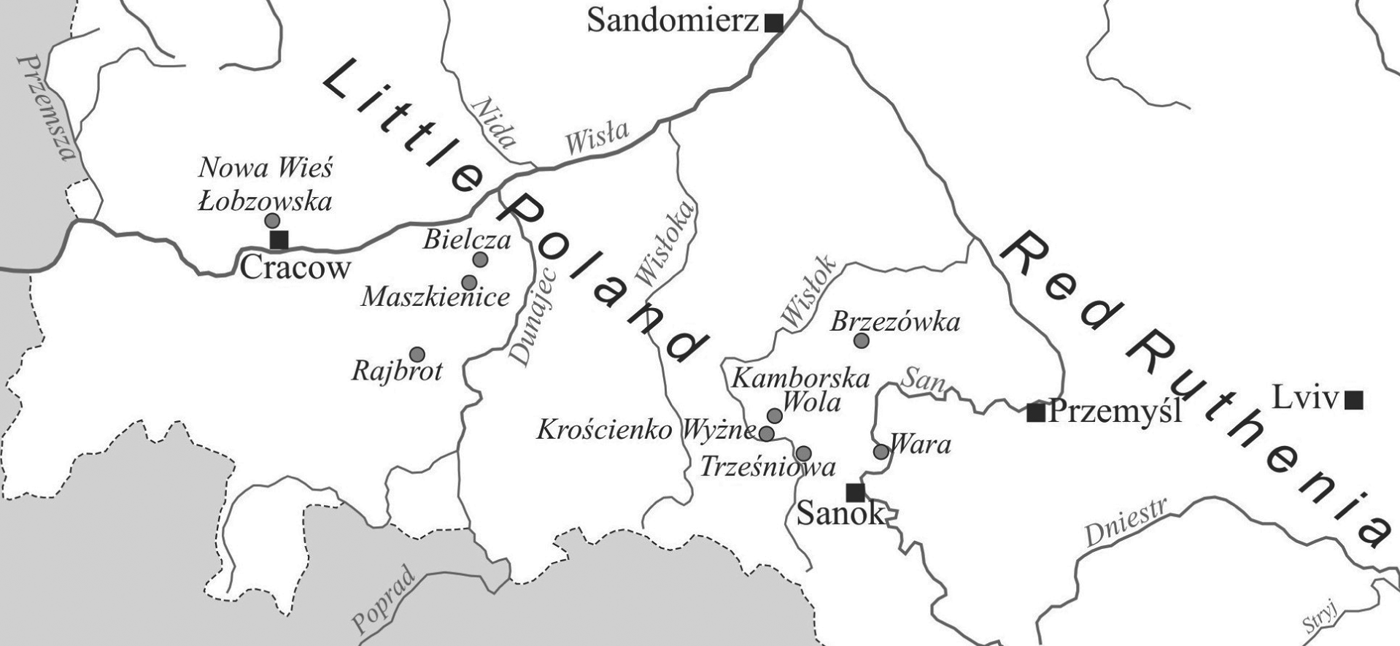
There were substantial differences not only in the quality of the sources, but also between the villages from which the sources came. The villages were scattered across three micro-regions with different levels of economic development. Jadowniki, Lubcza, Maszkienice, Nowa Wieś Łobzowska and Rajbrot were located in the vicinity of Cracow, the largest commercial centre in southern Poland. Brzezówka, Komborska Wola, Krościenko, Lubatówa, Trześniowa and Wary lay close to the town of Sanok, in the foothills of the Carpathians (Figure 2). Finally, Bielcza was in the relatively poor Sandomierskie voivodship (a voivodship was the highest tier of local administration). The villages also differed in size. Sixteenth-century fiscal sources provide information on how much arable land was held by peasants in particular villages. The largest settlement was Nowa Wieś Łobzowska, where peasants held as many as 60 mansi of land.Footnote 34 Krościenko was half that size, containing almost 60 peasant households who held about 30 mansi of arable land between them.Footnote 35 Somewhat smaller was Rajbrot, with 20 mansi.Footnote 36 Trześniowa was a medium-sized village, with about 10 mansi of arable land. All the other villages were smaller. Between them the peasants in Bielcza worked six mansi,Footnote 37 in Brzezówka four and a half mansi,Footnote 38 in Wary about five mansi.Footnote 39 The smallest were Maszkienice where the peasants held just three mansi in 1581Footnote 40 and Komborska Wola where they held just one and a quarter mansi in 1589.Footnote 41
Villages in the vicinity of Cracow and Sanok
The status of the villages under study also varied according to their ownership. Jadowniki, Krościenko and Nowa Wieś Łobzowska belonged to the king;Footnote 42 Brzezówka, Komborska Wola, Rajbrot, Trześniowa and Wary were in the hands of gentlemen;Footnote 43 while Bielcza and Lubatówa were ecclesiastical villages belonging to bishops.Footnote 44
In spite of a considerable diversity in the quality of sources and in the characteristics of individual villages, the analysis of the oldest surviving village court records makes it possible to study changes over time and regional diversification in the economic life of Polish peasants seen from the perspective of their engagement in the credit market.
Almost all types of credit identified by legal historians studying urban and gentry court records also appear in the village court records. There were loans of money on security: in the village of Krościenko money was lent by Jewish bankers, and in almost all the villages there were sales of real estate with the right to repurchase. The most common form of credit, however, was that used for the purchase of land (though transactions of lesser value were not recorded).Footnote 45 This was the least complicated form of debt arrangement because it did not involve middlemen, interest was not charged (at least not officially), and neither party to the transaction had to have ready cash at his disposal.Footnote 46 For all these reasons, purchase on credit played a particularly important role in the peasant economy.
Information about purchases on credit may be obtained from two types of entries in the village court records. The first is a small group of entries documenting the whole transaction with the exact sum of money involved being recorded along with the information about the amount paid in cash and about the amount to be paid in installments. The other is a group of records documenting only the fact of an installment or installments being paid in settlement of a debt.
Historians studying village court records are often confronted with problems arising from the way entries in the records were made. Commonly encountered are items in which the fact of transferring money from one person to another was recorded, but neither the amount nor the object of transaction was indicated. Some entries note the exact amount of money paid by one peasant to another, but it is not made clear whether these were full payments or installments. Moreover, phrases such as totale solucio (‘full payment’), finale solucio (‘last payment’) or annualis solucio (‘annual payment’) were used interchangeably, which is the reason why data obtained from statistical analysis of the records allow only rough approximations of the actual situation to be made.
4. RECORDS OF COMPLETE TRANSACTIONS
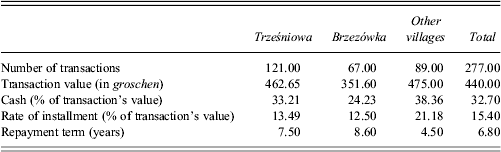
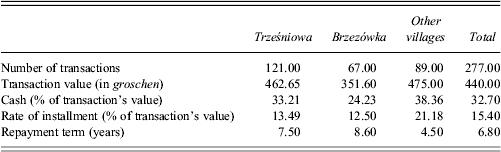
In the village court records under study there are 277 complete entries providing detailed information about credit transactions, but most of them come from just two villages: Trześniowa (121 entries) and Brzezówka (67 entries). In other villages, the number of documented credit actions is considerably smaller and ranges from 1 in Lubcza village to 26 in Lubatówa. The average value of the recorded credit arrangements was 440 groschen, or a little more than 9 marcs.Footnote 47 This sum is surprisingly high, much higher than the average value of all recorded transactions, i.e. not just those involving credit, which was 246.5 groschen. A typical rate of feudal rent paid by peasants in the fifteenth and sixteenth centuries was between 24 and 48 groschen, and the rate of land tax was 24 groschen annually. Therefore, reservations have to be expressed here concerning the extent to which the results of our analysis realistically reflect the situation in the peasant credit market more generally.
When goods were purchased on credit, from 2 to 70 per cent of their value was paid in cash and the average rate of cash payment was 32.7 per cent of the goods' value. The remaining sum was repayable by installment. Installment rates ranged from 3 to 50 per cent of the goods' value, 15.4 per cent on average. The repayments were spread over a period ranging from 1 to 24 years, but the average repayment term was 6.8 years, a period perhaps equivalent to between one-third to one-half of an average peasant household's lifespan (18–25 years according to demographers) (Table 2).Footnote 48 It is possible that transactions with a longer repayment time were made between elderly peasants and their future carers and the installments served the purpose of a retirement pension.Footnote 49
Average value of transactions, installment rates and repayment term in the villages under study
Sources: Księgi wiejskie lubatowskie, Archiwum Główne Akt Dawnych, Księgi Wiejskie; Księga sądowa Nowej Wsi Łobzowskiej, Archiwum Główne Akt Dawnych, Zbiór Branickich z Suchej, Depozyt z Wohynia, sygn. tymczasowa 62; Księga sądowa wsi Rajbrot, Archiwum Państwowe na Krakowie; Księga sądowa wsi Bielcza, Biblioteka Instytutu Historii Polskiej Akademii Nauk w Warszawie, manuscript 47; Księga sądowa wsi Brzezówka, Biblioteka Katedry Prawa Polskiego Uniwersytetu Jagiellońskiego; H. Polaczkówna ed., Najstarsza księga sądowa wsi Trześniowej 1419–1609 (Lwów, 1923); L. Łysiak ed., Księga sądowa wsi Wary 1449–1623 (Wrocław, 1971); B. Ulanowski ed., Księgi Sądowe wiejskie (2 vols., Starodawnego Prawa Polskiego Pomniki vols. XI–XII, Cracow, 1920–1921), i, 3–55, 67–273; ii, 77–103, 203–20.
In almost 80 per cent of the records of complete transactions, the repayment term did not exceed 10 years, and it was very rarely longer than 15 years. In about 50 per cent of all these hire purchase arrangements, involving repayment by installment, creditors automatically assumed that the repayment term would not be shorter than five years.Footnote 50
The average value of credit transactions, installment rates and repayment term varied from village to village (Table 2). In Brzezówka, unlike in other villages, peasants' credit transactions were made on a smaller scale; the value of transactions was lower by an average of two marcs. At the same time, installment rates were lower in Brzezówka than in other villages and repayment term was the longest at 8.6 years, on average.
5. ANNUAL PAYMENTS
A large number of entries in village court records document only the fact of successive repayments of a debt. Some entries refer to transactions concerning mills and inns made usually by village headmen, gentlemen or citizens. These have been excluded from our analysis. The remaining 1,156 entries that have been analysed are unevenly spread among particular court records. In Bielcza, Jadowniki, Lubcza, Nowa Wieś Łobzowska and Rajbrot only a small number (6–11) of cases of repayment were documented. A few more entries of this type may be found in the records from Wola Komborska, Maszkienice and Wary (28–33), whereas in Brzezówka, Krościenko, Lubatówa and Trześniowa, entries like this occur in the hundreds (116–446). The following analysis of annual installments focuses on their rate and its fluctuation over time.
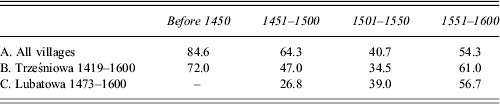
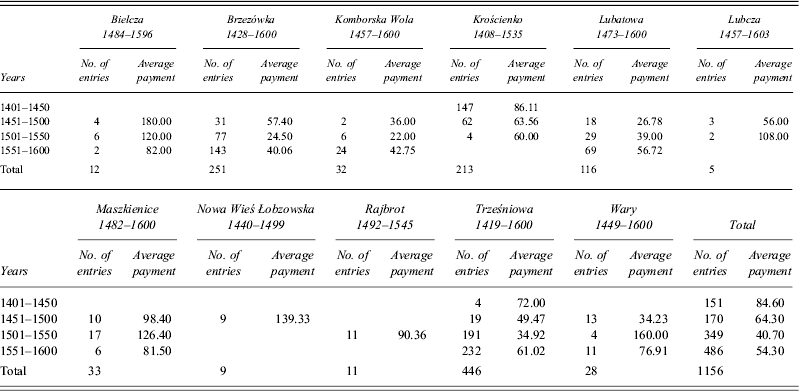
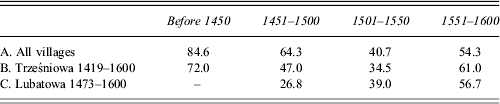
The average rate of annual installments fluctuated considerably over successive 50-year time periods (Table 3 part A). The value of the average installment was the highest in the first half of the fifteenth century, when it reached 84 groschen, but during the following 100 years it fell by a half so that in the 50 years between 1501 and 1550 it lay at 40.7 groschen, before rising slightly again in the second half of the sixteenth century. It needs to be remembered, though, that the number of recorded transactions of annual repayment was smallest in the first half of the fifteenth century and that they are available for only two villages: Krościenko Wyżne which had only 147 entries, and Trześniowa with just 4 entries. For each successive 50-year period more evidence becomes available, drawn from an increasing number of villages. In the second half of the sixteenth century, a total of 486 entries were found, drawn from the records of seven courts (see Appendix 1).
Average value of annual repayment installments in village court records (in groschen)
Sources: Księgi wiejskie lubatowskie, Archiwum Główne Akt Dawnych, Księgi Wiejskie; Księga sądowa Nowej Wsi Łobzowskiej, Archiwum Główne Akt Dawnych, Zbiór Branickich z Suchej, Depozyt z Wohynia, sygn. tymczasowa 62; Księga sądowa wsi Rajbrot, Archiwum Państwowe na Krakowie; Księga sądowa wsi Bielcza, Biblioteka Instytutu Historii Polskiej Akademii Nauk w Warszawie, manuscript 47; Księga sądowa wsi Brzezówka, Biblioteka Katedry Prawa Polskiego Uniwersytetu Jagiellońskiego; H. Polaczkówna ed., Najstarsza księga sądowa wsi Trześniowej 1419–1609 (Lwów, 1923); L. Łysiak ed., Księga sądowa wsi Wary 1449–1623 (Wrocław, 1971); B. Ulanowski ed., Księgi Sądowe wiejskie (2 vols., Starodawnego Prawa Polskiego Pomniki vols. XI–XII, Cracow, 1920–1921), i, 3–55, 67–273; ii, 77–103, 203–20.
For the above-mentioned reasons, the data presented in Table 3 part A may be slightly distorted, in addition to which they fail to show the full complexity of the situation in particular villages. The general tendencies presented in Table 3 part A correspond closely with tendencies that may be observed in villages whose court records contain a large number of repayment entries. For example, in Trześniowa, average rates of annual installments were the highest in the first half of the fifteenth century, then they fell and then rose slightly again after 100 years (Table 3 part B). A similar situation was evident in Brzezówka and Krościenko Wyżne (Appendix 1) where a relatively large number of documented repayments were also made during the two centuries under consideration here.
However, the general downward tendency in the changes in installment rates is not visible in villages other than the three mentioned above. For example, in Lubatówa, where the court records contain 116 documented annual repayments, the average rate of repayment in successive 50-year periods tended to increase (Table 3 part C). Over 127 years between 1473 and 1600 the rate rose by 100 per cent.
Data gathered from the village court records reveal one more characteristic tendency of some of the villages under study. In Brzezówka, Komborska Wola, Lubatówa and Trześniowa, the average rate of annual installments increased significantly in the second half of the sixteenth century in comparison with the preceding 50-year period. In Maszkienice and Wary, the situation was exactly the opposite, but for these villages the quantity of relevant entries was smaller.
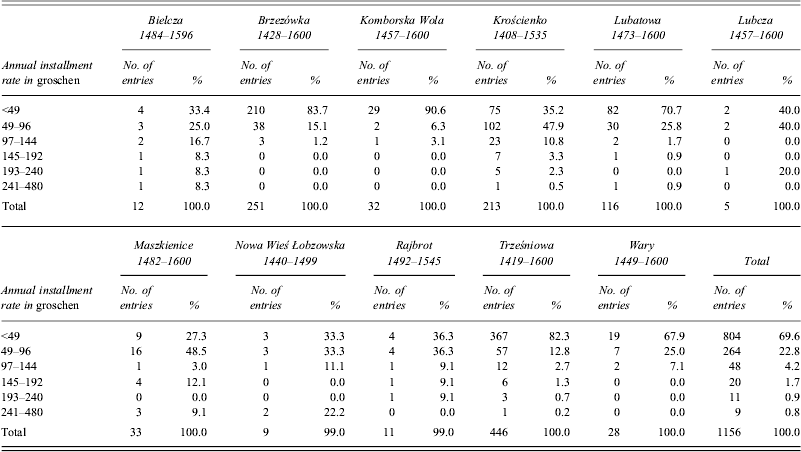
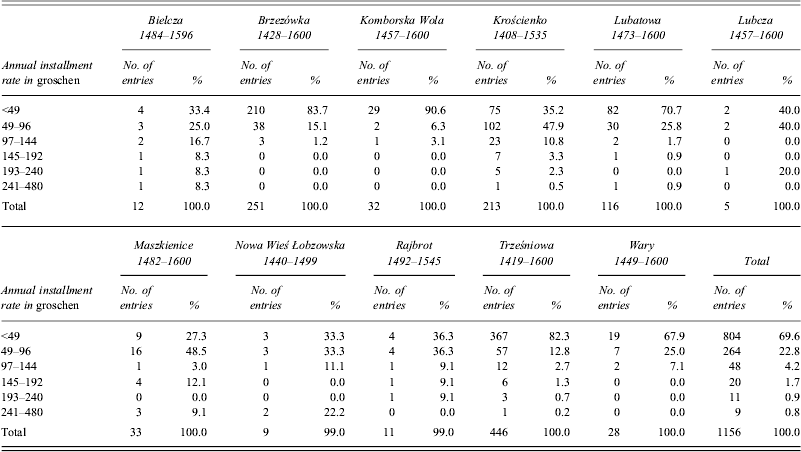
Annual installments may be put into categories according to their rate of repayment (Table 4). Among the 1,156 documented repayments analysed in this study, more than 69 per cent were repayments of very small sums of money, usually less than 1 marc, or 48 groschen. In almost a quarter of cases, the sum in question ranged from 48 to 96 groschen, or 1 to 2 marcs. Only about 5 per cent of all entries mentioned installments ranging from 2 to 3 marcs or 97–144 groschen. Annual installments of higher amounts appear only very rarely in the records.
Distribution of annual repayment installments by value (all villages)

Sources: Księgi wiejskie lubatowskie, Archiwum Główne Akt Dawnych, Księgi Wiejskie; Księga sądowa Nowej Wsi Łobzowskiej, Archiwum Główne Akt Dawnych, Zbiór Branickich z Suchej, Depozyt z Wohynia, sygn. tymczasowa 62; Księga sądowa wsi Rajbrot, Archiwum Państwowe na Krakowie; Księga sądowa wsi Bielcza, Biblioteka Instytutu Historii Polskiej Akademii Nauk w Warszawie, manuscript 47; Księga sądowa wsi Brzezówka, Biblioteka Katedry Prawa Polskiego Uniwersytetu Jagiellońskiego; H. Polaczkówna ed., Najstarsza księga sądowa wsi Trześniowej 1419–1609 (Lwów, 1923); L. Łysiak ed., Księga sądowa wsi Wary 1449–1623 (Wrocław, 1971); B. Ulanowski ed., Księgi Sądowe wiejskie (2 vols., Starodawnego Prawa Polskiego Pomniki vols. XI–XII, Cracow, 1920–1921), i, 3–55, 67–273; ii, 77–103, 203–20.
Small rates of repayment characterised 7 villages whose court records contain more than 20 repayment entries (see Appendix 2). In Brzezówka, Komborska Wola, Lubatówa, Trześniowa and Wary, installments of less than 1 marc appeared in the majority of entries, forming 67.9 per cent of entries in Wary to 90.6 per cent of those in Komborska Wola. In Krościenko Wyżne and Maszkienice almost half of all entries, 47.9 per cent and 48.5 per cent, respectively, mentioned repayments of sums between 1 and 2 marcs or 48–96 groschen.
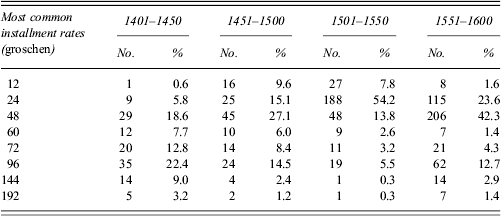
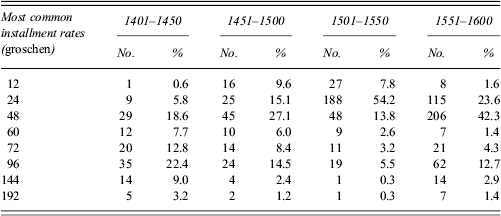
The most common sums of money being paid annually in settlement of a debt were 24 groschen, which was the case in 29.1 per cent of all entries, and 48 groschen in 28.5 per cent of cases. In 10.4 per cent of cases 96 groschen was paid and in 5.7 per cent of cases, 72 groschen.
With the exception of the first half of the fifteenth century, for which data are available from only one village (Krościenko Wyżne), installments at the rate of either 24 or 48 groschen prevailed in each successive 50-year period. It is also worth noticing that in the first half of the sixteenth century, in the vast majority of entries, the sum of 24 groschen was mentioned, whereas in the second half of that century, it was the sum of 48 groschen that tended to appear more often (Table 5).
Most common repayment installment rates recorded in the court records of the villages studied, by 50-year periods, 1401–1600
Sources: Księgi wiejskie lubatowskie, Archiwum Główne Akt Dawnych, Księgi Wiejskie; Księga sądowa Nowej Wsi Łobzowskiej, Archiwum Główne Akt Dawnych, Zbiór Branickich z Suchej, Depozyt z Wohynia, sygn. tymczasowa 62; Księga sądowa wsi Rajbrot, Archiwum Państwowe na Krakowie; Księga sądowa wsi Bielcza, Biblioteka Instytutu Historii Polskiej Akademii Nauk w Warszawie, manuscript 47; Księga sądowa wsi Brzezówka, Biblioteka Katedry Prawa Polskiego Uniwersytetu Jagiellońskiego; H. Polaczkówna ed., Najstarsza księga sądowa wsi Trześniowej 1419–1609 (Lwów, 1923); L. Łysiak ed., Księga sądowa wsi Wary 1449–1623 (Wrocław, 1971); B. Ulanowski ed., Księgi Sądowe wiejskie (2 vols., Starodawnego Prawa Polskiego Pomniki vols. XI–XII, Cracow, 1920–1921), i, 3–55, 67–273; ii, 77–103, 203–20.
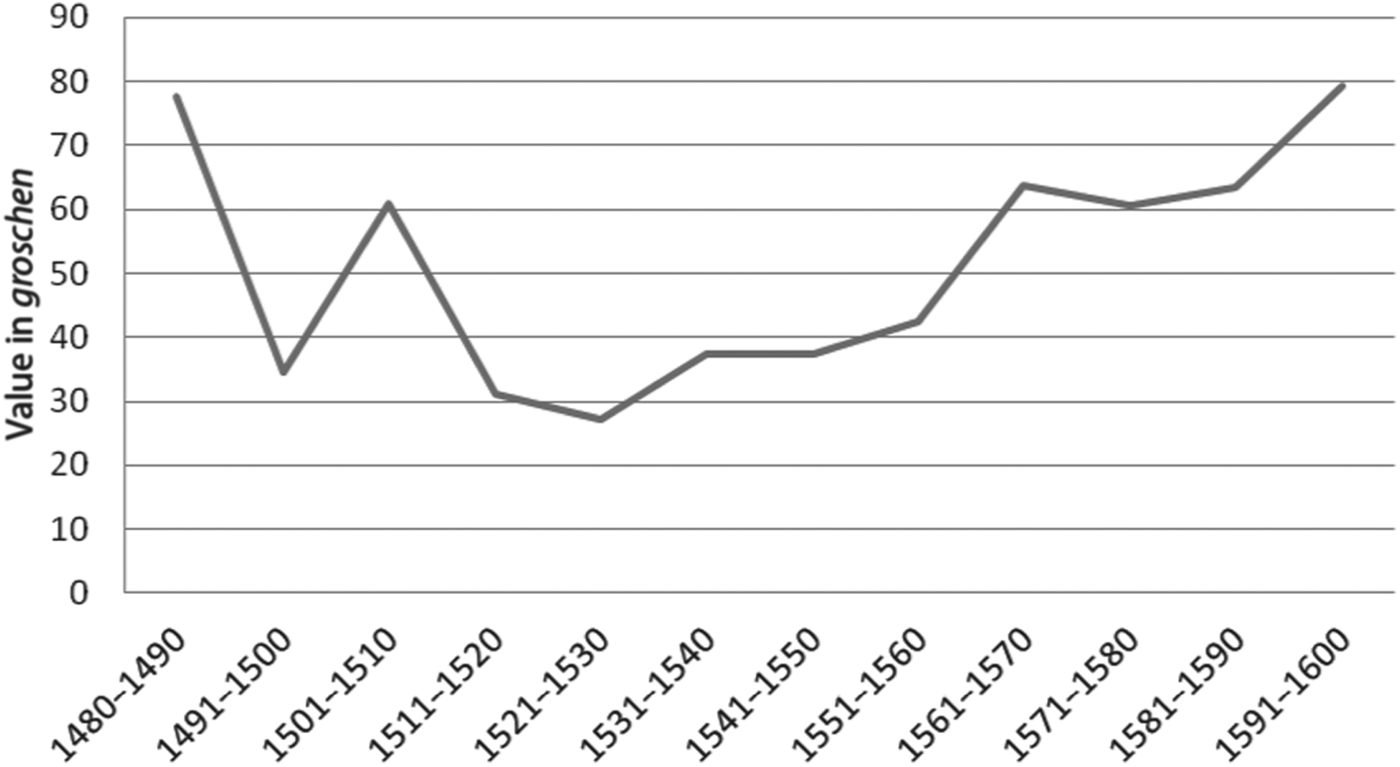
For most villages it is not possible to carry out even a brief statistical analysis for periods shorter than 50 years because of the lack of court records. One notable exception is the village of Trześniowa where the large number of court records allows changes taking place over decades to be observed (Figure 3). Between 6 and 55 repayments are documented in Trześniowa for each decade. In the sixteenth century, there were more than 10 entries in each decade, with at least 27 for each decade after 1511. The average rate of annual installments in successive decades of the sixteenth century tended to grow. In the last decade of the sixteenth century, a peasant in Trześniowa was paying an installment which was one and a half times greater than his forefathers would have paid 80 years earlier.
Average value of annual repayment installments recorded in the Trześniowa village court records, by decade.
Small rates of installment payments were thus the most common, but there were also cases when the sums were relatively high, such as in the purchase of mills. In the sources analysed in this study, there are 42 entries concerning the purchase of a mill. An average installment rate in such cases was almost 120 groschen, which is much more than in the other sorts of credit arrangements discussed above. What is more, unlike other transactions, for which particular repayment rates tended to dominate, repayment installments paid when a mill had been purchased were characterised by a much greater diversity. With regards to deferred payments for the purchases of inns, an average annual installment was 92 groschen, but it needs to be noted that it was calculated according to data from only nine available records.
6. THE VALUE OF CREDIT TRANSACTIONS
The analysis of village court records allows us to answer the question of how much money Polish peasants were able to invest in land, ortulanum and farm animals by considering the rate of annual installments which, it can be argued, reflect the peasants' financial capability. As the sources show, in almost 70 per cent of cases, peasants were not able to pay installments higher than 48 groschen a year; payments of 48 groschen were much less common, and higher rates of payment were rare exceptions, suggesting that their finances were very limited. The payment amounts were similar to the average rate of rents paid by peasants who tilled half-mansus and one-mansus farms in the fifteenth and sixteenth centuries.
Average annual installment rates in the transactions documented in village court records fluctuated over the two centuries under consideration here. These changes closely follow those in the average value of credit transactions, which are shown in Table 6.
Average value of all transactions, by 50-year periods, 1401–1600a

a Based on a total of 2,736 transactions from all village court records. Records of annual repayments of debts and transactions concerning sołectwo (land belonging to the sołtys, or bailiff), mills and inns are excluded.
Sources: Księgi wiejskie lubatowskie, Archiwum Główne Akt Dawnych, Księgi Wiejskie; Księga sądowa Nowej Wsi Łobzowskiej, Archiwum Główne Akt Dawnych, Zbiór Branickich z Suchej, Depozyt z Wohynia, sygn. tymczasowa 62; Księga sądowa wsi Rajbrot, Archiwum Państwowe na Krakowie; Księga sądowa wsi Bielcza, Biblioteka Instytutu Historii Polskiej Akademii Nauk w Warszawie, manuscript 47; Księga sądowa wsi Brzezówka, Biblioteka Katedry Prawa Polskiego Uniwersytetu Jagiellońskiego; H. Polaczkówna ed., Najstarsza księga sądowa wsi Trześniowej 1419–1609 (Lwów, 1923); L. Łysiak ed., Księga sądowa wsi Wary 1449–1623 (Wrocław, 1971); B. Ulanowski ed., Księgi Sądowe wiejskie (2 vols., Starodawnego Prawa Polskiego Pomniki vols. XI–XII, Cracow, 1920–1921), i, 3–55, 67–273; ii, 77–103, 203–20.
It is difficult to say whether the decrease in average installment rates and in the value of credit transactions in the sixteenth century in comparison with those of the previous 100 years reflected the changing economic situation of Polish peasants. The trend may be indicative of greater financial capability of late medieval peasants in comparison with their early modern counterparts, but it may also be a mere distortion of the overall picture caused by a smaller sample size.
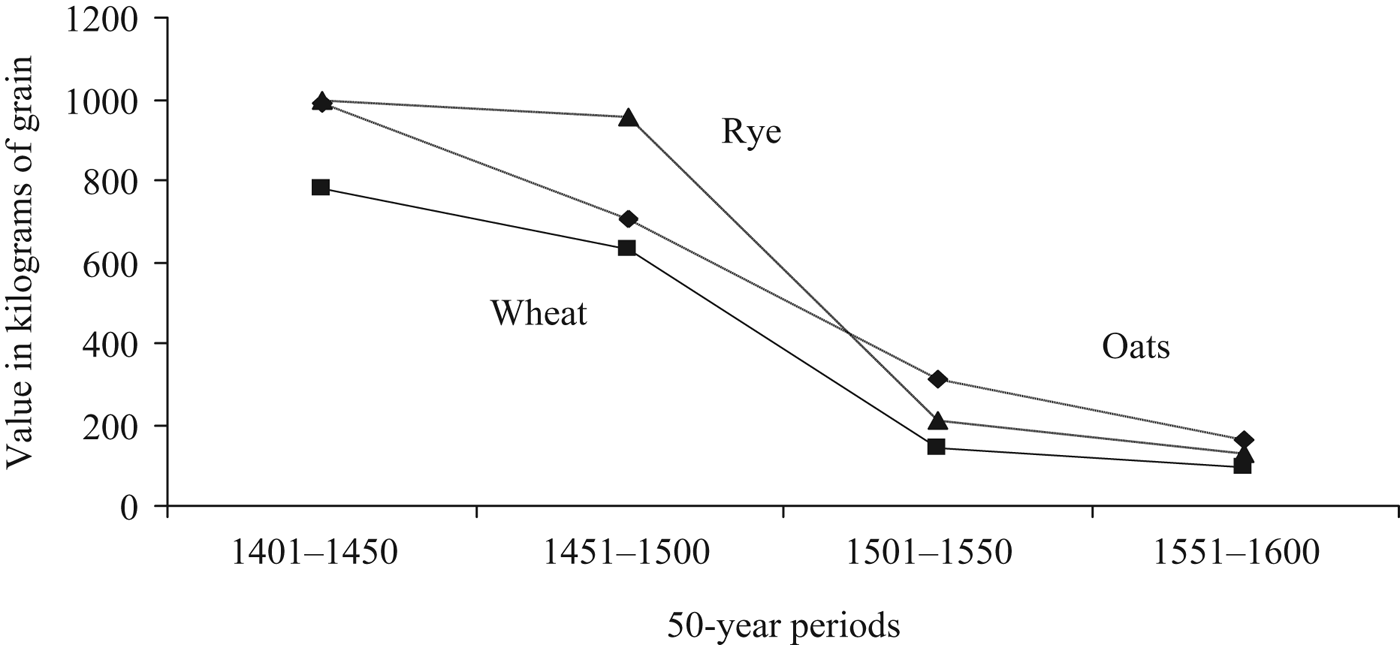
A downward trend in both the value of transactions and the installment rates was reversed in the second half of the sixteenth century. This phenomenon may be associated with a sudden increase in grain prices, which began in the second decade of the sixteenth century, after more than 100 years of relative stagnation. Nevertheless, the growth in the price of grain was greater than the growth in the value of village credit arrangements.Footnote 51 The average rate of an annual installment can be expressed as the number of kilograms of grain that a peasant had to sell in order to settle his annual debt (Figure 4). It is discernible that the amounts of grain that a peasant had to sell gradually decreased over time. Throughout the fifteenth century the rate of annual installments expressed in kilograms of oats, wheat or rye diminished together with their nominal monetary value. In the sixteenth century, a considerable rise in grain prices was the reason why, despite the growth in the nominal value of annual installments in the second half of the century, they appeared to become cheaper when expressed in grain. In the first half of the fifteenth century the grain equivalent of the most typical rate of annual repayment, 48 groschen, was more than 440 kilograms of wheat or 560 kilograms of oats, but by the second half of the sixteenth century it had fallen to only 82 kilograms of wheat or 146 kilograms of oats.
Equivalent value in kilograms of grain of 48 groschen, by 50-year period, in the Polish villages studied.
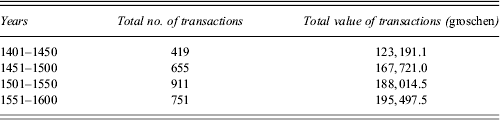
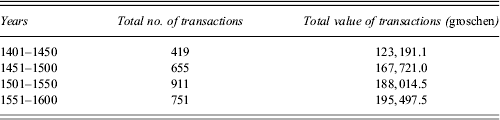
Another issue that is worth addressing here is the changing number of entries in the court records and the changing value of the business transactions that they documented in the four successive 50-year periods (Table 7). During the first 150 years, the number of transactions rose, as did their value. In the first half of the sixteenth century, the number of documented transactions doubled but their value did not increase at the same rate, suggesting that in this period peasants were more often involved in business transactions than they had been previously, but that the value of the transactions they engaged in was lower. Between 1551 and 1600 the total value of business arrangements increased in comparison with the previous half century, but they were smaller in number. It may be concluded, then, that by the fifth decade of the sixteenth century more and more Polish peasants were becoming active participants in the market economy, but the level of their individual engagement was gradually diminishing. Neither the growth prior to 1551 nor the fall after this year in the number of transactions seemed to have been connected with changes in village population which in the villages under study was, at least in the sixteenth century, relatively stable.
Total number and value of business transactions in court records in successive 50-year periods, 1401–1600
Sources: Księgi wiejskie lubatowskie, Archiwum Główne Akt Dawnych, Księgi Wiejskie; Księga sądowa Nowej Wsi Łobzowskiej, Archiwum Główne Akt Dawnych, Zbiór Branickich z Suchej, Depozyt z Wohynia, sygn. tymczasowa 62; Księga sądowa wsi Rajbrot, Archiwum Państwowe na Krakowie; Księga sądowa wsi Bielcza, Biblioteka Instytutu Historii Polskiej Akademii Nauk w Warszawie, manuscript 47; Księga sądowa wsi Brzezówka, Biblioteka Katedry Prawa Polskiego Uniwersytetu Jagiellońskiego; H. Polaczkówna ed., Najstarsza księga sądowa wsi Trześniowej 1419–1609 (Lwów, 1923); L. Łysiak ed., Księga sądowa wsi Wary 1449–1623 (Wrocław, 1971); B. Ulanowski ed., Księgi Sądowe wiejskie (2 vols., Starodawnego Prawa Polskiego Pomniki vols. XI–XII, Cracow, 1920–1921), i, 3–55, 67–273; ii, 77–103, 203–20.
There were also notable differences between individual villages. Peasants participating in credit transactions in the village of Trześniowa, where the court records had yielded the largest number of relevant entries, made deals that were substantially smaller than the transactions made by peasants from neighbouring Krościenko. Generally, peasants from Sanocki region tended to engage in credit transactions of smaller value than those transacted by the inhabitants of Krakowski region.
The vicinity of a village to the big urban markets in Krosno, Sanok or Cracow undoubtedly played an important role in the development of its peasant economy. Entries in the Nowa Wieś Łobzowska village court records provide excellent examples of the influence that Cracow had on the rural economy. This is visible in the value of the documented transactions, and also in the methods of payment used. Some records contain information showing that payments were made in gold coins, which may be explained by the fact that, as Nowa Wieś Łobzowska lay so close to the city, it was a convenient place for Cracow citizens to invest their money. In other court records under study here, almost all transactions were carried out in the so-called ‘common’ currency, silver coins made in the Polish royal mints. However, entries that indicate the exact type of currency in which payments were to be made, such as ‘Prague groschen’, are very rare. Interestingly, all entries where the currency of payment was stated concerned transactions in which a mill was purchased and in which one of the parties involved was an inhabitant of a town.
Another important point is that Polish peasants tended to use the least complicated type of credit – hire purchase, with payment in installments – and that this is also, to some extent, indicative of their financial situation. With the exception of Krościenko Wyżne, where Jewish bankers appear sporadically in the village court records, all credit transactions were performed without middlemen, interest was not charged, and neither party was obliged to possess the whole sum in ready cash. Consequently, Polish peasants, who did not have much money, could function effectively in the late medieval or early modern economy. To pay their feudal rent, peasants holding half-mansus and one-mansus farms needed 24 to 48 groschen a year. In addition they needed a maximum of 24 groschen to cover their obligations to the state and the Church. What peasants produced for the market was enough not only to pay all these dues, but also to accumulate some capital that could be invested in land. The analysis of the village court records shows clearly that a credit market existed in Poland even during the period of the second serfdom and, apart from the compulsory amounts, Polish peasants had at least 24 to 48 groschen at their disposal to repay any credit they obtained to finance their investments. Data derived from court records support an earlier estimation of the productivity of peasant farms. These calculations suggested that in the second half of the sixteenth century, by selling their grain surplus alone, half-mansus and one-mansus farms were capable of earning 300 groschen and 1300 groschen, respectively.Footnote 52 The situation of peasants in the fifteenth century was more difficult and only the holders of one-mansus farms, with an income of about 150 groschen coming from the sale of their grain, could afford to participate in credit or land markets.Footnote 53 Even after including other sources of peasant income, such as husbandry and transport (which are more difficult to study), it is clear that it was not until the sixteenth century that the holders of half-mansus farms had much greater opportunities to participate in the credit and land markets.
7. CONCLUSION: PEASANT CONTRACTS IN PERSPECTIVE
It might be suspected that the comparison of Polish peasants with other social groups in terms of their financial capability would reveal substantial differences, with peasants being the most disadvantaged. However, data from the gentry-, clergy- and citizen-dominated credit market in Łęczyca at the beginning of the fifteenth century show that of all credit transactions carried out by these groups, most involved small amounts of money of no more than 240 groschen.Footnote 54 The situation was very similar in the Sanocki region where one-third of credit market participants, usually gentlemen, whose transactions were documented in fifteenth-century gentry and town court records, were involved in credit arrangements that did not exceed 480 groschen.Footnote 55 It may be concluded that a financial gap between peasants and other social groups did exist, but it was not as wide as may have appeared at first sight. Zbigniew Morawski put forward an even more optimistic view when, on the basis of several peasant credit transactions recorded in the Łęczycki region gentry court records, he concluded that ‘…192–240 groschen was a typical sum of money that an average Polish peasant or a village entrepreneur such as a miller could have at his disposal’.Footnote 56 I would argue, however, that Morawski's comments may only be true of millers. With regard to ‘average Polish peasants’, village court records show that it is very unlikely that they had as much ready cash at their disposal as Morawski suggests. Furthermore, peasants appearing in gentry and town court records as parties to transactions were exceptions rather than the norm, and their transactions too were, in all respects, exceptional rather than typical. It should be admitted, however, that although Polish peasants did not have a great deal of money, they still had only a little less than representatives of other social groups, and that the financial gap between wealthy peasants and poorer members of the gentry was smaller than between some members of the most privileged groups.Footnote 57
The total value of peasant credit activity documented in the village court records during the two centuries under consideration here was about 14,050 marcs, which is not much when compared with 296,409.7 marcs, which was the total value of the credit market in the Sanocki region in the years 1423–1506. Moreover, considering the fact that an average peasant rarely had more than 96 groschen in surplus money,Footnote 58 the picture of peasant economic activity is far from optimistic. Nevertheless, the significance of peasants’ involvement in the market economy in Poland in the fifteenth and sixteenth centuries should not be ignored. The population of peasants in Poland at the end of the sixteenth century was about two million.Footnote 59 This number divided by six gives an approximate number of peasant households. Assuming that an average peasant family was able to invest between 48 and 96 groschen a year, together all the peasants in the country were potentially able to invest from 388,000 to 776,000 marcs a year. In comparison, the total value of goods exported from Gdansk via Sund to Western Europe between the 1560s and the 1580s was about 767,815 marcs annually.Footnote 60 From a macroeconomic perspective, although the role of peasants in the Polish economy was disproportionately low relative to their number, it was still substantial.
There appears to be a need, therefore, to revise some of the long-established opinions concerning the minimal degree of participation of east-European peasants in agricultural production for the market and their lack of interest in rising above a subsistence level existence during the period of the second serfdom (fifteenth–nineteenth centuries), or at least during the fifteenth and the sixteenth centuries. Although at the end of the middle ages Polish peasants faced such adverse phenomena as the development of corvée labour, growing restrictions on leaving their village, and increasing subjugation, they still had considerable opportunities to capitalise on the large demand for Polish grain, the advantages of a free grain market, and the revolution in prices, as well as the emergence of institutions enabling the development of peasant credit and peasant land markets. The most important of these institutions were the village courts that enabled peasants to enter into transactions virtually without leaving their villages and at minimal cost. Village court records provide evidence not only of the development of economic relations in rural areas, but also of some degree of legal culture and literacy among the inhabitants. Although there were similarities between Polish and west-European village courts, it must be emphasised that in Poland they functioned in a context of economic backwardness. In comparison with the most developed west- and north-European economies, the Polish credit market, as seen from the perspective of village court records, was very primitive and it was, like the peasant land market, based on two simple rules: no middlemen, and no interest rates on loans. Both of those features are indicative of the rather limited levels of monetisation and commercialisation within the peasant economy, though these gradually increased, particularly during the sixteenth century.
APPENDICES
Number of entries concerning credit repayments and the average amount (in groschen) repaid annually in the villages studied in successive 50-year periods, 1401–1600
Number and percentage of annual repayment installments, by amount repaid, for all villages studied, fifteenth and sixteenth centuries