INTRODUCTION
In the past 30 years, the landscape of church-state relations has undergone a consequential jurisprudential shift away from the strict separation of church and state and toward the government accommodation of religion. In 1991, legal scholar Ira Lupu declared that “the constitutional era where separation is the dominant theme appears to be over” (Lupu Reference Lupu1991, 557). Evidence of this shift can be seen in Supreme Court's decisions favoring religious organizations on “equal access,” free speech, and free exercise grounds in the face of no-establishment challenges.Footnote 1 Evangelical Protestants have played an important role in this shift, as they have been some of the strongest supporters for the public accommodation of religion (see e.g., Brown Reference Brown2002; Jelen and Wilcox Reference Jelen and Wilcox1995). Arguably, no evangelical group better exemplifies this change in church-state relations than the Southern Baptist Convention (SBC), the largest Protestant denomination in America, which, despite its historic ties to the separation of church and state, officially began lobbying for accommodation in 1991.
While this shift away from the separation of church and state is evident in the literature, little attention has been given to its causes. Many scholars have debated the historical merits of both the separation and accommodation positions (see Drakeman Reference Drakeman2010 for a review), whereas others have analyzed public opinion on church-state matters (Jelen Reference Jelen2000; Jelen and Wilcox Reference Jelen and Wilcox1995) and the activity of religious groups involved in church-state litigation (Hacker Reference Hacker2005). Those focusing on Southern Baptists have given some attention to their declining support for church-state separation, within a broader discussion of the SBC's recent denominational divide (Farnsley Reference Farnsley1994; Hankins Reference Hankins2002; Lewis Reference Lewis2011; McDaniel Reference McDaniel2008). In doing so, these scholars identified the rise of conservative evangelicalism as promoting the theological, political, demographic, and organizational factors that contributed to the Southern Baptist shift in church-state politics. Yet, what is missing is a thorough analysis of how the central issue of conservative evangelical politics — abortion — affected church-state advocacy change. Doing so provides greater insight into the political and religious divisions that have shaped Christian Right politics. It also illuminates the Christian Right's increased emphasis on rights-based political arguments.
THEORETICAL FRAMEWORK
I propose that abortion politics provides the framework for evangelical legal engagement, via two mechanisms — representation and rights. First, connecting legal advocacy to the pro-life cause legitimizes broader advocacy efforts and appropriate tactics. Linking advocacy strategy to abortion thus promotes effective political representation. The centrality of the abortion framework may be particularly true for evangelical advocacy groups, which have been shown to value close connections between leaders and members (Skocpol Reference Skocpol2003). This, combined with evangelicals’ absolutist abortion views (Hoffman and Johnson Reference Hoffman and Johnson2005), may stimulate a strong relationship between abortion and legal advocacy decisions. As such, I suggest that what connects abortion politics to legal advocacy is its salience to the rank-and-file supporters of elite evangelical organizations, drawing upon principal-agent understanding of interest group politics and representation (see e.g., Moe Reference Moe1980). For example, as one scholar suggests, individuals are in need of salient issue frames that “define what the problem is and how to think about it” (Kinder Reference Kinder1998, 170). The politics of abortion serves this role in legal advocacy.
Second, the abortion issue structures evangelicals’ understanding of rights and can motivate broader pursuits of rights-oriented legal advocacy. The framework of evangelical abortion politics has shifted from anti-abortion to the right to life, providing a potent rights-based claim in public discourse (see Jelen Reference Jelen2005; and Djupe et al. Reference Djupe, Lewis, Jelen and Dahan2014). This emphasis on rights-based argumentation bodes well for expanded legal advocacy, as evidenced by evangelical successes in the free speech and free exercise realm (Brown Reference Brown2002).
Abortion's role in shaping legal advocacy may be especially true in the crafting the prudential relationship between church and state, as the need for abortion advocacy demands an open public square for religious viewpoints. These issues are two of the central issues of the cultural divide in American politics (Hunter Reference Hunter1991; Layman Reference Layman2001), so one would expect a connection. Yet, while abortion has been shown to influence voting behavior, political activity, and even partisanship (see Jelen and Wilcox Reference Jelen and Wilcox2003), there is little analysis of how it might have shaped church-state politics. Legal scholar Thomas Berg references abortion's role in contemporary church-state politics when discussing the decline of anti-Catholic separationism among evangelicals (Berg Reference Berg2001), and historian Barry Hankins suggests that abortion may be the “most important factor” in the SBC's move toward accommodation (Hankins Reference Hankins2002, 189). Yet, neither work engages in a full treatment of how abortion altered church-state relations. Here, I analyze the relationship between abortion politics and church-state advocacy by examining SBC.
DATA AND METHODOLOGY
To analyze the relationship between abortion politics and church-state politics within the SBC, I use a variety of data sources. The bulk of the research in this article comes from historical and qualitative analysis. I obtained amicus curiae briefs filed in abortion and church-state cases from Westlaw Campus and Lexis-Nexis Academic and evaluated the arguments being made by Baptist organizations and other religious groups. I completed six semi-structured interviews with leaders of both moderate and conservative factions within the SBC, along with leaders of Baptist advocacy organizations — the Baptist Joint Committee on Public Affairs (BJC)Footnote 2 and the Christian Life Commission (CLC), now called the Ethics and Religious Liberty Commission (ERLC). Additionally, I performed a thorough analysis of Baptist news outlets, including Baptist Press and SBC Today, the BJC's Report from the Capitol, and the Christian Life Commission's Light and Salt. Finally, I examined SBC resolutions from the denomination's annual convention.
I support these historical and qualitative data with quantitative analyses of responses from national, random-sample surveys of Southern Baptist clergy, collected every presidential election year from 1980 to 2008.Footnote 3 These surveys include a variety of church-state, political, theological, and demographic questions. I focus on three policy questions that were asked in most of these surveys, as well as two questions regarding approval of Baptist advocacy organizations, the BJC and the CLC, that were asked until 1996. The policy questions are: (1) do you favor a school prayer amendment; (2) do you favor tuition assistance for Christian schools; and (3) do you favor an amendment outlawing abortion. Responses were coded from strongly disagree to strongly agree (0–4). The approval questions asked how well the BJC and CLC were performing their duties, with responses coded from poor to excellent (0–3). From these data, I present both summary statistics and predicted probability results from ordered logistic regression models that control for political, religious, and personal factors, employ robust standard errors, and utilize fixed effects for survey year differences (see online Appendix for variables and coding).
SOUTHERN BAPTISTS AND CHURCH-STATE RELATIONS
As a religious group, Baptists have a heritage of dissenting from the religious establishment favored by the government and supporting the separation of church and state. The Baptists, while not solely responsible, made an important contribution to securing religious liberty, the institutional separation of church and state, and religious equality in America (McLoughlin Reference McLoughlin1971; Reference McLoughlin1991). The dominant Baptist position on the separation of church and state is that separation is vital to protecting the church from the state. For most of the 20th century, the SBC was a leading proponent of church-state separation and religious liberty. Its Washington, DC-based advocacy organization, the BJC, was active in promoting these issues before the Supreme Court and in other political arenas. The BJC is an umbrella group of several Baptist denominations in America of which the SBC was the largest and most important until its split with the BJC in 1991.
The BJC was an active proponent of the Court's Establishment Clause jurisprudence, beginning in Everson v. Board of Education (1947) and McCollum v. Board of Education (1948), which has often been characterized as promoting the strict separation between church and state. Southern Baptists also helped found Protestants and Other Americans United for the Separation of Church and State, currently called Americans United for Separation of Church and State, to express a broader Protestant voice on church and state issues and to promote church-state separation.Footnote 4 In the early days, both the BJC and Americans United opposed public funding for religious schools and hospitals, religious practices in public schools, and diplomatic relations with the Vatican, while promoting religious liberty domestically and internationally (Hastey Reference Hastey1985; Perry Reference Perry1996). Both also had an anti-Catholic animus (Hamburger Reference Hamburger2002).
Despite some criticism, from the 1940s to the 1970s the denomination approved of the BJC and Supreme Court's separationist positions. In 10 of the 25 annual conventions from 1947–1972, Southern Baptists passed resolutions opposing the use of public funds to support religious schools, hospitals, and other institutions. On three occasions, the SBC passed resolutions opposing diplomatic relations with the Vatican. The SBC also officially affirmed the McCollum decision and the Court's Establishment Clause doctrine in resolutions at the annual conventions in 1949 and 1952.
Regarding prayer in schools, neither the SBC nor the BJC was directly involved in the Supreme Court's controversial 1962 and 1963 rulings, but the BJC was active in defending the Court's decisions. It opposed congressional attempts to override the school prayer decisions, and it was able to persuade the SBC to pass a resolution opposing such amendments in 1964 (Hastey Reference Hastey1985; Perry Reference Perry1996). The SBC also implied its support for the school prayer decisions in a 1971 resolution, which explained that it only supported truly voluntary prayer, not prayer coerced by government involvement (Resolution on Voluntary Prayer 1971).
In the late 1970s, the SBC began to change. In a well-documented denominational battle over theology, politics, and control that spanned from the late 1970s to the early 1990s, Southern Baptist “conservatives” gained control of denominational leadership positions from the “moderates,” who had long controlled the Convention (see Ammerman Reference Ammerman1995; Hankins Reference Hankins2002; Smith Reference Smith1997).Footnote 5 At the end of this struggle, the SBC defunded the BJC and authorized a conservative-led, SBC-only group, the Christian Life Commission, to serve as its advocacy arm regarding church-state and other moral and political issues. In 1988, active SBC conservative Richard Land was selected to head the CLC. Two years later, Land secured a Washington office for his organization and gained the authority to lobby on church-state issues. Land continued to lead what is now called ERLC until 2013 when Russell Moore succeeded him. During his tenure, Land paved the way for the SBC to officially alter its approach to the First Amendment. He was an influential entrepreneur in the SBC and the broader Christian Right.
In the area of church-state relations, Land rejected the BJC's type of church-state separation. Instead, he championed a position he called the “accommodation” of religion, which “seeks government ‘accommodation’ of individuals’ rights to express religious beliefs in government locales” (Land 1997). This is generally similar to the position of legal scholar Michael McConnell, among others (McConnell Reference McConnell1992). To Land, Southern Baptists never agreed with the type of separation of church and state that the BJC promoted. In fact, he argued that some Southern Baptists’ preferences might even lean toward the unconstitutional establishment of religion. In an interview with the author, Land said, “The majority of Southern Baptists, you give them a choice between the Joint Committee's separation and establishment, and they're going to choose establishment” (Land Reference Land2010). To him, accommodation protects against the negative implications of both establishment and separation (Land 1997; Reference Land2010). Land described his perspective, saying, “What I want to do is restore maximum accommodation. Government maximally accommodates your right and my right to speak our religious beliefs to others in the public square and in the classroom when appropriate. But the majority doesn't silence the minority; the minority doesn't silence the majority” (Land Reference Land2010).
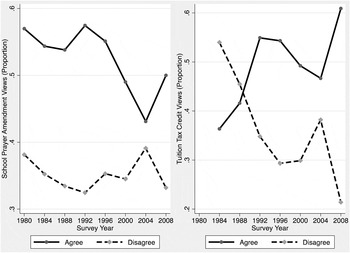
Under Land, the ERLC accepted non-preferential aid to religious organizations on the basis of equality, allowed the government to recognize America's Christian heritage, and rejected the idea that the government “entanglement” of religion violates the Establishment Clause. Land's emphasis on accommodation and rejection of much of the Court's prior separationist doctrine was matched by the Southern Baptist membership. For example, Figure 1 shows that the majority of SBC pastors approved of a school prayer amendment, especially from 1980–1996, when a voluntary prayer amendment was on the political agenda. The BJC consistently opposed such an amendment, but in the mid-1990s Land supported a narrowly tailored one that protected voluntary prayer.Footnote 6
Southern Baptist clergy's views on the school prayer amendment and tuition tax credits, 1980–2008.

The same is true with tuition tax credits, which the BJC also has consistently opposed as being a violation of the Establishment Clause. Land personally supported vouchers and other types of indirect funding to religious and non-religious groups and individuals. He helped move the SBC in this direction, though he admitted that the SBC lacks consensus on the issue. As Figure 1 shows, SBC clergy have increasingly been inclined to accept tuition tax credits and other voucher programs as being a favorable policy.
ABORTION AND CHURCH-STATE POLITICS IN THE SBC
During the process of the SBC's transition from moderate leadership to conservative leadership and from support for separation to support for accommodation, the denomination also experienced an important shift in its position on abortion. While the SBC was promoting church-state separation, it maintained a qualified defense of pro-choice abortion rights. From 1971–1979, the Convention passed six resolutions supporting, at least somewhat, pro-choice rights for American women. A 1971 resolution called for “Southern Baptists to work for legislation that will allow the possibility of abortion under such conditions as rape, incest, clear evidence of severe fetal deformity, and carefully ascertained evidence of the likelihood of damage to the emotional, mental, and physical health of the mother” (Resolution on Abortion 1971). This was the strongest pro-choice resolution the convention ever passed. Its succeeding resolutions endorsed a culture of protecting life, encouraged efforts to reduce abortion, and opposed the wanton use of abortion, while still allowing for some abortions. In the 1970s, Southern Baptists lacked consensus on abortion, but they were becoming more pro-life. Still, a large percentage assumed that the effort to outlaw abortion was particularly a Catholic issue (Hankins Reference Hankins2002).
In 1980, though, there was a decisive shift in the SBC's position on abortion. The 1980 resolution unequivocally declared the SBC's opposition to “abortion on demand” and “the use of tax money or public, tax-supported medical facilities for selfish, non-therapeutic abortion.” It closed with a clear statement of the Convention's wishes, stating, “We favor appropriate legislation and/or a constitutional amendment prohibiting abortion except to save the life of the mother” (Resolution on Abortion 1980). In every resolution on abortion since 1980, the SBC has taken a firm pro-life stance. Survey data show that, at least since 1980, the overwhelming majority of SBC pastors were pro-life supporters, with 60–80 percent favoring an anti-abortion constitutional amendment between 1980–1996. Similarly, General Social Survey data from the period show that Southern Baptists were more pro-life, by a statistically significant margin, than the general population. In 1988 when Richard Land was selected to head the Christian Life Commission, he moved the denomination's abortion advocacy unambiguously in the pro-life camp and positioned it as one of the religious leaders of the pro-life movement.
During this change in the SBC, its positions on abortion and church-state relations shifted in important ways. My argument is that the concurrence of these shifts is not coincidental. The relationship between these two issues is also more explicit than a broad culture war battle occurring within American society and the denomination (Hankins Reference Hankins2002; Hunter Reference Hunter1991). In the SBC, abortion politics played an important role in promoting its shift away from the separation of church and state. The BJC's version of the separation of church and state did not commingle well with pro-life advocacy and the political and theological conservatism of Southern Baptists.
PRO-LIFE POLICIES AND THE ESTABLISHMENT CLAUSE
Pro-life Southern Baptists’ frustration with the denomination's Establishment Clause interpretation stemmed from events beginning in the era of Roe v. Wade (1973), though not necessarily with the case itself. Rather, the problem was that the strict separationists, including the BJC, often supported abortion rights through First Amendment arguments. Pro-life Southern Baptists also became frustrated with the BJC as an organization, because it was viewed as being pro-choice and liberal.
Much of pro-life Southern Baptists’ disdain for the BJC begins with James E. Wood, Jr., the executive director of the BJC from 1972–1980. Early in his tenure, Wood supported abortion rights. In order to avoid a territorial conflict with the CLC, which was charged with advocating on social issues, he couched pro-choice advocacy in terms of promoting religious liberty for those who favored abortion and the promotion of the separation of church and state in the face of the potential establishment of religious beliefs (Perry Reference Perry1996).
Utilizing Free Exercise and Establishment Clause arguments to oppose pro-life policies was not unique to Wood and the BJC of the 1970s. These arguments were frequent among strict separationist lobbies and Mainline Protestant groups. Before the Supreme Court, evidence of this first appears in an amicus curiae brief submitted by the American Ethical Union, American Jewish Congress, Episcopal Diocese of New York, United Methodist Church, and others in Roe v. Wade and Doe v. Bolton (1973). At the end of the brief, the groups pithily argue that religious beliefs underlie the moral concern for the fetus. As such, “The police power cannot be employed in the service of sectarian moral views without violating the Establishment Clause of the First Amendment” (American Ethical Union 1971, 18). The BJC did not participate in Roe or Bolton, but these filers were its allies. In addition, the year of the Roe decision, Wood first went on record supporting abortion rights at the Joint Committee's board meetings (Perry Reference Perry1996).
Separationist groups and defenders of abortion rights continued to proffer First Amendment arguments against pro-life policies that were challenged at the Supreme Court in the 1970s and 1980s. In 1976, the American Jewish Congress, the United Methodist Church, and others filed an amicus brief in Poelker v. Doe (1977), a case concerning the city of St. Louis’ policy of not allowing therapeutic abortions in its state-run hospitals. In the brief, these religious groups placed even more emphasis on the religious nature of pro-life policies, believing this should engender the policies to run afoul of the Establishment Clause. They declared, “The mayor's action violates the First Amendment's dual guaranty of church-state separation and the free exercise of religion by imposing upon the entire community the religious doctrine of those to whom abortions are sinful” (American Jewish Congress 1976, 4).
While neither the BJC nor the moderate Southern Baptist leadership joined the early briefs supporting abortion rights, evidence suggests that their sentiments were in favor of defending abortion on First Amendment grounds. The religious strict separationist groups and Mainline Protestant groups were frequent allies of the BJC. In addition, in the late 1970s, the BJC opposed a constitutional amendment to ban abortion except to protect the life of the mother, arguing that the pro-choice position was a matter of religious liberty. In October 1979, Wood endorsed a pro-choice statement released by the Religious Coalition for Abortion Rights that also expressed this position. The statement declared:
The position that a fetus is a human being with full human rights from the moment of conception is a particular theological position. Other theologies take other positions. If, therefore, those opposing abortion are successful in incorporating their particular religious doctrine into the supreme law of the land, our religious liberties will have been seriously eroded (Baptists Among Signers of Abortion Rights Statement 1979).
This strain of legal argument reached its apex with the federal courts following the 1976 passage of the Hyde Amendment, which prohibited federal funds from being used to supply abortions. Wood testified before a US District Court that the Hyde Amendment was a violation of the First Amendment. He stated that “while the Hyde Amendment is manifestly discriminatory in public policy against the poor, even more alarming is that one's free exercise of conscience and religion in this matter is abrogated.” During his testimony, Wood also declared that the Hyde Amendment violated the Establishment Clause by being a “gross entanglement of institutional Government into the moral and religious values of the people of this Country” (McRae v. Califano 1980). He linked the policy to aid to parochial schools and seemed to be implying that, in agreement with some other religious groups involved in advocacy against the Hyde Amendment, the end result is the establishment of the Catholic religion in America.
When the District Court invalidated the legislation, Wood called the decision “supportive of the guarantees of the First Amendment for all citizens and for the inviolability of one's individual conscience in facing what is intrinsically a complex moral issue” and “a profoundly significant one for maintaining the integrity of the First Amendment” (Hastey Reference Hastey1980, 3). When the Supreme Court agreed to hear the challenge to the Hyde Amendment in Harris v. McRae (1980), the BJC chose not to join an amicus brief. Yet, several other like-minded religious groups did file. The brief of the American Ethical Union, United Methodist Church, and others opposed the Hyde Amendment, focusing entirely on First Amendment considerations. In fact, Foy Valentine, the director of the SBC's Christian Life Commission, and four Southern Baptist seminary professors signed on to the brief. The amici deemed the anti-abortion statutes “religious rather than secular” and a violation of both the Free Exercise and Establishment Clauses. The brief argued that the Hyde Amendment “constitutes a law which prefers those religions that forbid abortion over those which do not and injures women who do not profess a religious belief forbidding abortion by withholding from them a government benefit available to others” (American Ethical Union 1979, 3). Using the standards culled from the Court's previous Establishment Clause decisions, in particular the three-part “Lemon Test” from Lemon v. Kurtzman (1971), the brief argued that the Hyde Amendment lacked a secular purpose, had a primary effect of advancing religion, and entangled the government with religion.
Two other Mainline Protestant groups, the National Council of Churches and the Presbyterian Church in the U.S.A., also filed briefs opposing the Hyde Amendment, but they grounded their objections in the Free Exercise Clause, arguing that the amendment violated the liberty of conscience of women (National Council of Churches of Christ in the U.S.A. 1980; United Presbyterian Church in the U.S.A. 1980). Only the United States Catholic Conference filed a brief objecting to these First Amendment claims against the Hyde Amendment, outlining that it is acceptable and even normal for laws to articulate public morality (United States Catholic Conference 1980).
In its 5-4 decision allowing the Hyde Amendment to stand, the Court rejected the Establishment Clause argument. The majority opinion stated, “We are convinced that the fact that the funding restrictions in the Hyde Amendment may coincide with the religious tenets of the Roman Catholic Church does not, without more, contravene the Establishment Clause” (Harris, Secretary of Health and Human Services v. McRae et al. 1980, 21). The majority avoided the Free Exercise issue, though, declaring that the appellees lacked standing.
While the decision in Harris v. McRae directly rejected church-state arguments for invalidating pro-life policies, separationists and abortion rights groups continued to utilize them. For example, in two abortion-related cases in the 1980s, Bowen v. Kendrick (1988) and Webster v. Reproductive Health Services (1989), groups filed amicus briefs objecting to pro-life policies because they violated the separation of church and state. Pro-life, Southern Baptist conservatives rejected this brand of separationist jurisprudence, moving them away from supporting church-state separation and toward supporting the government accommodation of religion.
Of particular concern to Southern Baptists was the Joint Committee — both its brand of church-state separation and its tacit defense of abortion rights. The BJC's pro-choice advocacy during this period remains one of its most controversial positions, and it played a significant role in the growing division between the BJC and Southern Baptists. When James Dunn was appointed the leader of the BJC in 1980, he vowed to avoid the abortion issue, in large part because Southern Baptist conservatives were upset with Wood and the BJC's involvement with the issue. Yet for SBC conservatives, this was not enough. The inaction on abortion troubled them, causing many to suspect Dunn and the BJC were pro-choice. For example, conservative leader Paige Patterson said that Dunn's lack of a clear stance on abortion was “probably the signal” that he did not agree with them more broadly (Patterson Reference Patterson2010).
While the BJC did not take any public positions on abortion under Dunn, there were a few incidents, beyond the organization's inaction, which troubled pro-life conservatives. First, in a 1983 criticism of Reagan, Dunn made a statement that alluded to his probable pro-choice views. He declared, “The complex issue of abortion is reduced to the simple cry of ‘infanticide’ by Mr. Reagan, who would redress ‘a great national wrong’ in the name of civil religion, making it virtually impossible for mothers to make their own decision in this very private, very religious matter” (Majority Report of SBC Executive Committee on Baptist Joint Committee 1990, emphasis in original). To many, this statement was similar to the arguments made by Dunn's BJC predecessor.
Conservatives were also disgruntled about the BJC inviting Sarah Weddington, the lawyer who argued the pro-choice position in Roe, to speak at its religious liberty conference in 1981. Weddington spoke against Senator Jesse Helms's proposal to strip the federal courts of the jurisdiction to hear school prayer cases. Though in its press release, the BJC did not mention her ties to Roe (Baptists Will Examine Evangelism, Freedom 1981), her appearance troubled pro-life Southern Baptists who were aware of it (see e.g., Workman Reference Workman1986).
The Joint Committee additionally filed a brief with the American Jewish Committee and Americans United in Bowen v. Kendrick (1988), regarding the constitutionality of the Adolescent Family Life Act, which provided federal funding for a partnership of religious and government agencies to provide counseling to teenagers on issues of sexual activity. The BJC argued that this act violated the Establishment Clause by advancing religious views and entangling government and religion. Part of its argument directly addressed abortion on church-state grounds, declaring that religious organizations are promoting religion when they counsel teens on sexual morality, as it is “fundamentally a religious doctrine.” The brief follows with a statement that discouraging abortion is fundamentally a religious component of sexual morality (Baptist Joint Committee on Public Affairs 1988, 6).
The abortion issue continued to hamper the BJC's relationship with the SBC until the very end. When Richard Land was appointed the new director of the CLC, putting it firmly in control of the SBC conservatives and pro-lifers, he sought to counteract Baptist arguments that abortion rights should be defended on First Amendment grounds. In Webster v. Reproductive Health Services (1989), the CLC filed its first-ever amicus brief (Moore Reference Moore1989). Filing with the Lutheran Church Missouri-Synod and the National Association of Evangelicals, it argued that while being pro-life is a religious belief, it is also a belief of fundamental morality. The brief proclaimed, “We do not advocate the imposition of our religious views by law in order to impose upon others our religious beliefs. Rather, those religious beliefs are also deeply seated in the moral and ethical system that forms that basis of much of the civil and criminal law of this nation and therefore, if the state legislatures so decide may coincidentally be expressed in legislation” (Lutheran Church-Missouri Synod 1989, 11–12). As such, they clearly argued that “state laws prohibiting abortions are not unconstitutional establishments of religion” (Lutheran Church-Missouri Synod 1989, 11). In this brief, Land, the CLC, and the new conservative SBC leadership were clearly opposing the past positions of the BJC and developing a view of the relationship between church and state that would be friendly to pro-life policies and advocacy.
The division between these two Southern Baptist lobbies over abortion is evident in a conflict between the BJC and the CLC in the waning days of the BJC's partnership with the Convention. In 1991, the BJC was a leading proponent of the Religious Freedom Restoration Act (RFRA) that combated the Court's ruling in Employment Division v. Smith (1990), which had limited the scope of free exercise of religion claims. RFRA was a legislative remedy to restore free exercise rights to the standard used before the Smith decision. The CLC, under Land's leadership, also opposed Smith, but they were hesitant to support RFRA, because they were concerned it might be used to advance pro-choice positions in the name of religious freedom. Dunn was somewhat critical of the CLC's slow response, and Land used this opportunity to attack Dunn on the pro-life issue. He wrote a pointed letter asking Dunn to “state for the record whether abortion is a practice which should prevail as a free exercise of religion claim.” Land also wanted Dunn to commit to Southern Baptists that the BJC “will never advocate, especially in the courts or in Congress, the view that abortion claims would prevail as religious liberty claims” (Religious Liberty Bill before Congress Highlights Difference among Baptists 1991, 1). Dunn responded, “As everyone knows, or should know quite well, the BJCPA since I have been here has never addressed abortion as a free exercise right, nor have we addressed the issue of abortion in any fashion” (Religious Liberty Bill before Congress Highlights Difference among Baptists 1991, 1). Dunn further declared, “Our position on the free exercise/abortion issue is clear: We oppose any effort to amend the Religious Freedom Restoration Act that would keep any free exercise claim from being made; we take no position, however, on whether such claims should be successful.” Land and the new, pro-life CLC were not satisfied with Dunn's response (Strode Reference Strode1991b, 15).
Eventually, Land and the CLC agreed to support RFRA, as their abortion concerns were satisfied. At its 1991 annual convention, the SBC passed a resolution supporting a legislative remedy to Smith. In that same convention, however, the SBC would also vote to end its financial ties with the BJC.
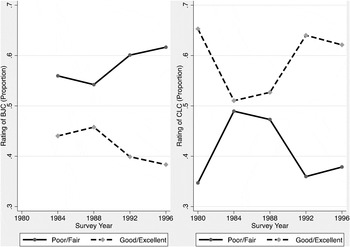
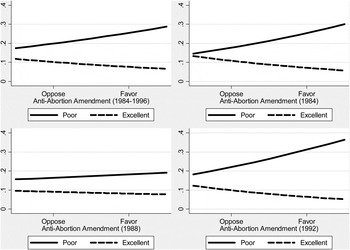
The SBC's split with the BJC is the event that allowed Southern Baptists to officially embrace accommodationism. It gave Land the ability to craft the denomination's new approach to church-state issues, and it gave SBC conservatives almost complete control over the decision-making. Yet, it should be noted that it was not a small band of conservative SBC elites that had a disregard for the BJC. Southern Baptist clergy also disapproved of the BJC. Figure 2 shows that from 1984–1996 more SBC pastors thought the BJC was doing a poor or fair job than those who thought it was doing an excellent or good job. There is also a statistically significant correlation between pastors rating the BJC negatively and being pro-life.Footnote 7 Similarly, the ordered logistic regression models (for the full estimates, see Table A1 in the online Appendix) show that abortion attitudes were a strong, constant predictor of one's view toward the BJC, even when controlling for political and religious views. The graphs in Figure 3 show the predicted probabilities for pro-life clergy, who were more likely to disapprove of the BJC from 1984–1996.
Clergy's views of the performance of the Baptist Joint Committee (BJC) and Christian Life Commission (CLC), 1980–1996.

Predicted probabilities of effect of abortion views on supporting BJC, 1984–1996.

Considering the foregoing evidence, abortion appears to have affected the SBC's church-state positions and views in large part because those promoting the separation of church and state attacked pro-life policies, and defended pro-choice decisions, on First Amendment grounds. The SBC's relationship with the BJC was a casualty of this strategy by the separationists. In an interview, Dunn, former BJC head, recognized this, calling it an “excuse” used to attack him and the BJC (Dunn Reference Dunn2010). Land, in describing the view of conservative elites, recognized that abortion was one of several factors that led to the defunding of the BJC and the changes in the CLC.
It was a significant factor, but it wasn't the only factor. Almost all the moderates were pro-choice, the theological moderates. They have never understood, they still don't understand, and I suspect they never will understand the depth of the outrage that pro-life Southern Baptists felt that Southern Baptists were being portrayed in Washington as pro-choice, when they were so strongly and convictionly pro-life. I think that's why this agency [the Christian Life Commission] changed first, because it was the point agency on the life issue. I've talked to a lot of pro-choice people, and they just don't get it. They just don't get how huge this was, and how angry and upset Southern Baptists were over having themselves be described as a pro-choice denomination when they weren't (Land Reference Land2010).
To Land and most of the SBC conservatives, abortion was a legitimate concern with both the BJC and its strict separationist fellow-travelers, not merely an excuse. The usage of the separation of church and state as a reason to reject pro-life policies tainted separationism for Southern Baptist conservatives and helped the denomination embrace accommodation.
CATHOLICISM AND CHURCH-STATE SEPARATION
Intertwined with the linkage between abortion and church-state politics is Baptists’ evolving relationship with Catholics. For much of the 20th century, Baptists battled Catholics, especially in the church-state arena. Baptists opposed an ambassador to the Vatican, championed a legal battle against transportation reimbursements to parochial schools in Everson, passed numerous resolutions opposing funding for church schools (e.g., Catholic schools) at the annual convention, and helped start Protestants and Other Americans United for the Separation of Church and State, as a direct counter to the Catholic Church. Legal historian Philip Hamburger argues that Southern Baptists saw church-state separation as “attractively antihierarchical,” being congruent with their opposition to Catholicism (Hamburger Reference Hamburger2002, 376). This is evident in Southern Baptist pastor George W. Truett's famous 1920 sermon on the steps of the United States Capitol, where he developed a lengthy contrast between the Baptist and Catholic views of church-state relations and church polity, calling the two religious messages “the very antipodes of each other” (Truett Reference Truett2011 [1920]).
Following Roe, Catholics were the primary religious group opposing abortion rights. As such, separationists were able to paint pro-life policies as establishing a particular religion — Catholicism — in amicus briefs, hearings, and public statements. For example, the amicus brief of the American Jewish Congress, United Methodist Church, and others in Poelker v. Doe (1977) identifies the Catholic theology that a soul is given at conception as being the driving force behind anti-abortion laws (American Jewish Congress 1976, 8). This view had also taken hold among some of the Southern Baptist leadership (see e.g., Simmons Reference Simmons1990). A 1981 pamphlet on abortion by Christian Life Commission even stated, “Christians may properly work to change [using abortion for birth control] without moving to the other extreme and insisting that the whole nation be required to accept the Roman Catholic dogma related to abortion as the law of the land” (Hankins Reference Hankins2002, 171).
For much of the 1970s, Baptists, the BJC, and Americans United took the position that they had taken before on parochial school issues, opposing the Catholic Church on separation of church and state grounds. But, by the late 1970s and early 1980s, pro-life issues became one of the two central issues for Southern Baptist conservatives. In the process, Southern Baptists and Catholics became comrades in the battle against abortion. In Bowen v. Kendrick, Concerned Women for America, ally to Southern Baptist conservatives and founded by Beverly LaHaye, the wife of Southern Baptist pastor Tim LaHaye, partnered with the Catholic League for Religious and Civil Rights supporting the Adolescent Family Life Act against its Establishment Clause challenge. The newly conservative-controlled CLC filed a brief alongside, though not in partnership with, the United States Catholic Conference in Webster v. Reproductive Health Services (1989), supporting the pro-life position. In Planned Parenthood v. Casey (1992), the CLC partnered with the United States Catholic Conference and the National Association of Evangelicals arguing that Roe should be “reconsidered and . . . abandoned” (United States Catholic Conference 1992, 6). Catholics and Baptists were now allies.
Land also originally signed the joint declaration “Evangelicals & Catholics Together” in 1994, recognizing both the religious and moral common ground between evangelicalism and Catholicism. Abortion played a prominent role in this statement. In fact, the statement recognized that the cooperation between these two groups was in large part due to their agreement on abortion. “The pattern of convergence and cooperation between Evangelicals and Catholics is, in large part, a result of a common effort to protect human life, especially the lives of the most vulnerable among us.” “Abortion on demand . . . must be recognized as a massive attack on the dignity, rights, and needs of women” (Various 1994). In April 1995, however, Land and another prominent Southern Baptist signer removed their names from the document after a year of criticism. Their disassociation with the document was for theological and missiological reasons. Land affirmed “efforts which consolidate the influence of evangelicals and Catholics in addressing moral issues,” abortion being prominent (King Reference King1995, 1).
One of the areas that display how Southern Baptists’ church-state views have been altered by the improvement in their relations with Catholics is government funding for private schools. From the founding of the BJC in the 1940s, the SBC frequently went on record opposing government aid to religious schools and institutions. Throughout the 1960s and 1970s, the SBC explicitly and consistently opposed even indirect government aid to religious institutions, with the SBC declaring its opposition in 1966, 1967, 1968, 1971, and 1972. In 1972, the SBC extensively opposed vouchers and proposals from the Nixon Administration to provide public support for parochial schools, while at the same time affirming the Court's separation doctrine (Resolution on Religious Liberty and No Establishment of Religion 1972).
During the 1980s, and continuing to the present, the BJC opposed direct and indirect aid to religious schools. Southern Baptist conservative elites, however, were increasingly becoming more favorable to neutral, indirect funding to religious schools.
For many SBC moderate elites, any type of funding for religious schools was unconstitutional. For example, Dunn criticized tuition tax credits for being unconstitutional, as well as “regressive,” “expensive,” “inflationary,” “unfair,” “divisive,” “destructive,” “undemocratic,” “dishonest,” and “intrusive” (Dunn Reference Dunn1981). In staking their opposition to tuition tax credits for religious schools, moderates frequently cited the SBC's commitment to the separation of church and state through numerous resolutions and official positions at least dating back to the 1940s (Dunn Reference Dunn2010).
Conservatives countered the moderate perspective, arguing that vouchers for students to attend religious schools are not direct funding for religious institutions and they promote neutrality. Land, for example, stated that the government does not have to provide vouchers to religious schools, but, if it wants to provide tax money to support private schools, it must, as a matter of neutrality, allow that money to go to religious schools (Land Reference Land2010).
The conservative elites’ positions on tuition tax credits also began to be reflected in the opinion of the Southern Baptist clergy. According to Figure 1, in 1984 only 36 percent of pastors agreed or strongly agreed with the policy of tuition tax credits, while 54 percent disagreed or strongly disagreed with the policy. Support for tuition tax credits increased, reaching 54 percent in 1992 and 61 percent in 2008. SBC pastors’ support for tuition tax credits effectively switched from 1984–1992 in favor of the accommodationist view, and in 2008 the approval gap widened.
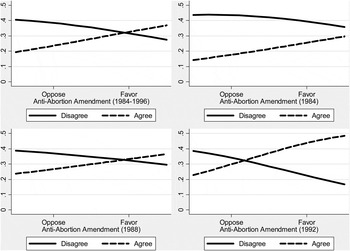
The survey data also suggest that there is a strong relationship between abortion and views on tuition assistance to religious schools. The correlation between abortion and tax credits is statistically significant from 1984–1996, and the correlation increases as the pastors change their views.Footnote 8 In ordered logistic regression models, even with the inclusion of extensive controls, views on abortion remain statistically important (for the full estimates, please see Table A2 in the online Appendix). Figure 4 shows that pastors who were in favor of an anti-abortion amendment to the Constitution were more likely to be supportive of tuition tax credits from 1984–1996. The relationship between abortion attitudes even holds in 1984 while the majority of SBC pastors disagreed with tuition tax credits.
Predicted probabilities of supporting tuition tax credits, 1984–1996.
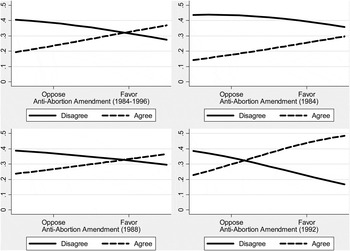
As the conservatives gained more control of the SBC, its official positions on the issue began to change. They were surely bolstered, in part, by the change in opinion of the denomination's clergy. In 1991, the year that the SBC voted to defund the BJC, the annual convention passed a resolution supporting tax credits and voucher-type programs for religious education, breaking from a long-standing position that the SBC and BJC had taken. The resolution “encourag[ed] choice in education initiatives which include proper tax incentives for families.” It clarified that as long as the educational choice proposals did not “constitute direct aid to churches” the SBC would view them as “keeping with the First Amendment protections” (Resolution on Parental Choice in Education 1991). In 1996, the Convention expressed a similar sentiment in a resolution, though its language was not nearly as qualified as it was in 1991.
The CLC followed the positions in the 1991 and 1996 resolutions by filing amicus briefs supporting a school choice program in Wisconsin in 1995 and 1997 (Warner Jackson v. John T. Benson) and programs in Cleveland, Ohio (Zelman v. Simmons-Harris) and Arizona (Arizona Christian School Tuition Organization v. Winn) in 2002 and 2010. Though Land said that he “probably wouldn't file” in vouchers cases because the SBC lacks consensus on the issue (Land Reference Land2010), the ERLC has filed briefs supporting these tuition assistance programs on the basis of religious freedom. In the Arizona case, the brief the ERLC joined argued that by striking down this law the lower court “chills private religious conduct and expression” (Ethics and Religious Liberty Commission of the Southern Baptist Convention et al. 2010).
While the SBC is not an ecumenical denomination, its partnership with the Catholic Church to combat abortion and other social issues has improved its regard for the Catholic Church. In the process, Southern Baptists have become friends with their former foe in the church-state arena. No longer do they view religious schools with contempt. Instead, Baptists and Catholics are fighting the same culture war for the role of faith in politics and social issues such as abortion. The SBC's improving relationship with Catholics is partly responsible for its shift away from church-state separation. Of all the issues, opposition to abortion has played the most important role in fostering this relationship.
EMPHASIS ON FREE EXERCISE
Another impetus in the SBC's shift away from the separation of church and state was its evaluation that the separationist Establishment Clause doctrine limited the ability of religious individuals to live their faith in public. Land described the differences between the conservative ERLC and the BJC, saying:
There is a genuine philosophical difference between the Joint Committee and us [the ERLC] over where the threat is. They [the BJC] remain convinced that there is a threat to the Establishment Clause, which I think is loony. I think that there would have to be a spiritual revival of incredible proportions in the United States before there would be any possibility for there to be any significant violations of the Establishment Clause. But I think there is diminution of the free exercise clause every day (Land Reference Land2010).
Much of this belief regarding the “diminution” of the Free Exercise Clause has ties to abortion. Two factors contributed to the connection between anti-abortion advocacy and anti-church-state separation advocacy, and both of these shifted Southern Baptists’ focus to the Free Exercise Clause. First, the critics of pro-life evangelicals frequently attacked their political involvement by declaring that church and state should be separate. Because their pro-life attitudes were religiously informed, they did not belong within the public arena. Second, and related, pro-life advocates saw a decline of religious values within American culture, which they viewed as one of the primary reasons why abortion had come to be legal and accepted. Because of these influences, pro-life Americans were more likely to take positions protecting their ability to express their religious views within political conversations and promoting America's religious heritage. Both positions contributed to them opposing the strict separation of church and state.
Historian Barry Hankins credits two evangelical intellectuals, Carl F. H. Henry and Francis Schaeffer, for being especially important in activating SBC conservative elites against abortion and the separation of church and state (Hankins Reference Hankins2002). Their leadership on cultural issues had an important connection to the way conservative evangelicals came to understand the culture wars and the relationship between church and state. Underlying the scholarship and apologetics of both was resistance to a view of American church-state politics which would require American Christians to separate their faith from politics and allow America's religious heritage to be expunged by secular humanists. Land credited Schaeffer for convincing him that there was “a real attempt to suppress the religious free speech and the religious free exercise rights of the people in the public square in general and in public schools in particular” (Land quoted in Hankins Reference Hankins2002, 23). To Land and other conservatives, pro-life and pro-democracy advocacy should not be inhibited by the strict church-state separation which had the effect (either direct or indirect) of inhibiting the exercise of religious faith in politics.
To guard against strict Establishment Clause jurisprudence restricting religious advocacy, particularly on abortion issues, Land and other evangelicals argued that the Court should move away from the Lemon Test — the three part test used by the Court in Lemon v. Kurtzman to determine if a policy amounted to an unconstitutional establishment of religion. To Land, the Lemon Test is “broodingly hostile to religion” and it violates the Supreme Court's purpose in striking down government sponsored prayer in the 1962 and 1963 cases (Land Reference Land2010).
The SBC's distaste for the Lemon Test was not merely about church-state separation. The SBC's displeasure for it was also precipitated by the strategy employed by Mainline Protestant groups, Americans United, and even the BJC to rebut pro-life policies and programs with the Establishment Clause. In the briefs filed by religious groups and separationist groups in abortion cases, they analyzed pro-life policies through the lens of Lemon, determining if the policy had a secular legislative purpose, advanced religion, or resulted in an excessive government entanglement with religion. The following three cases serve as examples. First, in Harris v. McRae, the amicus brief joined by organizations including the United Methodist Church, the Unitarian Universalists, a division of the Disciples of Christ, and signed by moderate SBC leader Foy Valentine among others, argued that the Hyde Amendment should be struck down because it violated the “Purpose-Effect-Entanglement Test,” what is now typically called the Lemon Test (American Ethical Union 1979, 7–10). Second, in Bowen v. Kendrick, the BJC and Americans United argued that the Adolescent Family Life Act violated the second prong of the Lemon Test because the program which, encouraged religious institutions to provide services regarding teenage sexuality, had the primary effect of advancing religion (Baptist Joint Committee on Public Affairs 1988). Finally, in Webster, Americans United argued that the state of Missouri violated the second prong of the Lemon Test, because by the preamble declaring that life begins at conception, the legislation improperly advanced a religious belief (Americans United for the Separation of Church and State 1989).
When Land took over the CLC, he guided it in filing a brief in Lee v. Weisman (1992), a public school graduation prayer case, arguing that the Court should reject Lemon. Aided by constitutional law scholar, Michael McConnell, the CLC argued that a no-coercion test would be more prudent than the Lemon Test. In the same case, the BJC argued that the Court continue to use the Lemon Test. Directly attacking the CLC's position, the BJC's brief declared that those who seek to change the test require “the court to abandon the fundamental requirement that government be neutral toward religion, and substitute instead that requirement that government refrain from ‘coercion’” (Strode Reference Strode1991a, 5). In Lee v. Weisman, the Court did not strike down the Lemon Test, but the CLC continued to express this opinion before the Court, making a similar argument in Kiryas Joel School District v. Grumet (1994) (Whitehead 1994).
Land grounded his agency's shift away from focusing on the Establishment Clause in the desires of Southern Baptist congregants (Land Reference Land2010). According to the survey data from pastors on their church-state views and their disapproval of the BJC, Land's perspective is accurate, as the clergy's positions are far from the BJC's model of separation. Land viewed his accommodation approach as a middle way that adhered both to Baptist tradition and the denomination's preferences. In fact, the ERLC's shift away from focusing on the separation of church and state to promoting the government accommodation of religion appears to have been positively received. Figure 2 shows that after Land was appointed to lead the SBC's religious liberty and moral agency (the Christian Life Commission) in 1988, Southern Baptist pastors increasingly gave the agency positive ratings.
In church-state relations, Southern Baptists have shifted most of their concern from the Establishment Clause to the Free Exercise Clause, matching the emphasis of most evangelical activists (see Brown Reference Brown2002) and growing the discourse of rights politics. Yet, heretofore scholars have largely overlooked abortion's important role. To the Southern Baptist leadership, the high wall of separation that characterized the Court's church-state jurisprudence from the 1940s to the 1980s and still infects the advocacy of many separationists groups has served to hamper political advocacy against abortion. For them, this has caused free exercise to be a greater concern. If religious groups are able to actively participate in public life and religious institutions are able to receive the same benefits as secular groups, then America's culture war, of which abortion is a central battle, has a better chance of being won by the traditionalists.
CONCLUSION
The connection between abortion politics and church-state politics has been under-analyzed by previous scholars. This case study shows that abortion, while surely not the sole cause, played an important role in the Southern Baptist shift away from the separation of church and state in the past 30 years. Abortion politics was central to the SBC's separation from the BJC, the separationist stalwart, because the BJC had been tainted for its usage of the religion clauses to support pro-choice advocacy and for refusing to take a pro-life position. The SBC's commitment to pro-life advocacy has also established an advocacy partnership with the Catholic Church, its former enemy in church-state relations. As such, Southern Baptists are less cautious of indirect government support for religious schools and institutions. This alliance is further support for James Davison Hunter's premise that the new cultural landscape pits the orthodox, like Southern Baptists and Catholics, against progressives and seculars (Hunter Reference Hunter1991). Finally, Southern Baptist engagement in abortion politics seems to have motivated a greater emphasis on the free exercise of religion, while eschewing Establishment Clause retorts. This attention to pro-life politics and emphasis on free exercise characterizes much contemporary Christian Right legal advocacy, as seen in opposition to the 2010 Patient Protection and Affordable Care Act and its contraceptive mandate.
Though this is a single case study of the SBC, abortion's role in church-state politics has some important implications for a broader understanding of law and politics. While abortion has been credited for mobilizing evangelicals and affecting political behavior, its impact on other legal issues has been underappreciated. Abortion is the touchstone for evangelical engagement in both politics and law. As an issue, it is highly salient for evangelicals. They understand abortion frames and respond to them. As such, evangelical advocacy leaders seeking to engage the Supreme Court on other issues have incentives to connect their efforts to abortion politics. When abortion is the vehicle for advocacy, leaders maintain credibility from their membership and develop an issue niche. This promotes enhanced political representation, and, at least for Southern Baptists and church-state politics, this seems to be the case.
Abortion politics is also important for its role in connecting evangelicals to rights-based legal and political advocacy. The right to life movement has a broader rights orientation for evangelicals, helping them craft liberty arguments, which have proven successful before the Supreme Court and in the court of public opinion. The Southern Baptist case presented here provides evidence of the connection between pro-life politics and free exercise politics. From their experience being involved in abortion politics, evangelicals have developed a strategy of emphasizing rights claims and downplaying the common morality of church-state separation.
Finally, if abortion politics are driving evangelical legal engagement in areas such as church-state relations, there are implications for the politics of culture wars. Salient cultural issues may be able to legitimate expanded advocacy, providing unrealized opportunities for culture warriors. While many have been skeptical of the culture wars thesis, these battles may not be ending but merely evolving in the most conspicuous of places — American courts. Moreover, evangelicals’ foray into rights-based advocacy signals a broader shift in the cultural landscape. No longer are evangelicals the silent majority or the active cultural force. Many see themselves as the persecuted minority, being trampled by the secular left. Minority groups are often the most protective of their political rights, because the majority threatens them. In taking an active role in rights advocacy, evangelical elites are signaling a shift from Christian America to post-Christian America, where the right to expression must be protected.
Supplementary materials and methods
To view supplementary material for this article, please visit http://dx.doi.org/10.1017/S1755048314000492.