The United Kingdom's (UK) decision to leave the European Union (EU) has pushed to the fore public and academic interest in scepticism towards European integration (Hobolt Reference Hobolt2016; De Vries Reference De Vries2018). In the first few decades of its existence, the process of European integration was enabled by a permissive consensus whereby domestic elites assumed they had the support of their diverse publics when acting at the European level (Lindberg and Scheingold Reference Lindberg and Scheingold1970). The permissive consensus allowed domestic elites to advance European integration by manoeuvring relatively freely, secluded from the opinions of their respective constituencies. This permissive consensus gradually became a constraining dissensus following the Maastricht Treaty in 1992 as the European integration process shifted from a mainly economic community to a political union (Hooghe and Marks Reference Hooghe and Marks2009). Since then, national elites have been forced to consider the views of their diverse publics in European-level negotiations.
The significance of public opinions towards European integration can be observed in many different ways (Anderson Reference Anderson1998; Hobolt and De Vries Reference Hobolt and De Vries2016; Hooghe and Marks Reference Hooghe and Marks2005). First, citizens have been able to express their preferences on EU-related questions in referendums in Denmark, France, Sweden, the Netherlands, Ireland, Greece and the UK as well as in direct elections to the European Parliament every five years. Second, ‘Eurosceptic’ parties have been on the rise in many national elections and are increasingly shaping government policies (Taggart Reference Taggart1998; Taggart and Szczerbiak Reference Taggart and Szczerbiak2013). Third, EU issues are playing an increasingly important role in domestic debates, which has become particularly apparent regarding the economic and migration crises. According to Liesbet Hooghe and Gary Marks (Reference Hooghe and Marks2018), these two crises and the intense political reactions they spurred have given rise to a transnational cleavage in Europe.
In conjunction with the fading permissive consensus and the growing constraining dissensus, a burgeoning number of studies are theorizing and testing diverse explanations for the level of support for European integration (Hobolt and De Vries Reference Hobolt2016; Hooghe and Marks Reference Hooghe and Marks2005). From this literature, three main clusters of driving factors have been distilled, including economic utility (Anderson and Reichert Reference Anderson and Reichert1995; Garry and Tilley Reference Garry and Tilley2009; Hooghe and Marks Reference Hooghe and Marks2005), national identity (Carey Reference Carey2002; Hooghe and Marks Reference Hooghe and Marks2005; McLaren Reference McLaren2007) and attitudes towards the national political establishment (Hobolt Reference Hobolt2016; De Vries Reference De Vries2018). These factors reflect the micro-foundations of political conflicts over denationalization concerning economic competition, cultural diversity and political integration associated with an emerging transnational cleavage (Grande and Kriesi Reference Grande, Kriesi and Kreisi2012; Hooghe and Marks Reference Hooghe and Marks2018). The literature has highlighted how some of these factors complement rather than compete with each other (Garry and Tilley Reference Garry and Tilley2009; Hobolt and De Vries Reference Hobolt and De Vries2016; Hooghe et al. Reference Hooghe, Huo and Marks2007; Kuhn et al. Reference Kuhn2016; McLaren Reference McLaren2007). It has also pointed to the importance of considering their nested nature; that is, how individual-level factors interact with regional- and national-level factors (Armingeon and Ceka Reference Armingeon and Ceka2014).
The significance of these explanatory factors has been tested in the context of the UK's departure from the EU – Brexit – which can be considered a case of ‘hard Euroscepticism’ or what Catherine De Vries (Reference De Vries2018) classifies as ‘exit scepticism’. Here, people are not only questioning individual policies or the institutions of the EU but the idea of membership per se. Studies of Brexit have suggested that Leave voters were motivated by anti-globalization, anti-multicultural and anti-elitist attitudes (Hobolt Reference Hobolt2016; De Vries Reference De Vries2018). Yet there is limited knowledge about how these factors are related and the configurations of pathways in Europe for wanting to exit the EU. This article adds to the existing literature on Brexit and public support for European integration by answering the research question: What are the pathway(s) for people in different member states wanting to leave the EU? We find that there is no single route but several pathways to exit and that they vary between countries.Footnote 1
The research question is addressed over six sections. This introduction has established the topic and relevance of the article. The theory section discusses prominent explanations of public support for European integration. The methods, operationalization and data section explains the mechanics of path models as well as cluster analysis, how the theories are operationalized and the data used in the article. The analysis section presents the results, which illuminate a diverse set of routes to exiting the EU. The concluding section recaps the findings and discusses the overall pattern.
Theory
The shift from permissive consensus to constraining dissensus has spurred numerous theories of support for European integration. Some theories concentrate on parties (Taggart Reference Taggart1998), while others focus on public support (Leconte Reference Leconte2015; Vasilopoulou Reference Vasilopoulou, Leruth, Startin and Usherwood2017), including the utilitarian, identity, reference, cue-taking, signalling and anti-elite models (Hobolt and De Vries Reference Hobolt and De Vries2016; Hooghe and Marks Reference Hooghe and Marks2005; De Vries Reference De Vries2018). The models of public support for European integration differ in terms of the theories from which they are derived, the assumed causal mechanisms at work, and whether they operate at the micro- and/or macro-levels. The article focuses on three of these models: the utilitarian, identity and anti-elite models, as they all operate at the micro-level with regard to both the dependent and independent variable. Moreover, the models are directly related to the three suggested drivers of Brexit: anti-globalization, anti-multiculturalism and anti-elite sentiments, respectively (Hobolt Reference Hobolt2016; De Vries Reference De Vries2018). In that way, we focus on the micro-foundations of exit scepticism, though macro-level factors such as cue-taking from political elites have been highlighted as important in explaining the outcome of the Brexit referendum (Clarke et al. Reference Clarke, Goodwin and Whiteley2017). We also leave out more proximate factors such as ideology in order to focus on the distal micro-level drivers of Brexit (Leruth et al. Reference Leruth, Usherwood, Startin, Leruth, Startin and Usherwood2018).
The utilitarian model is a classic explanation in the study of support for European integration (Anderson and Reichert Reference Anderson and Reichert1995; Gabel Reference Gabel1998; Hooghe and Marks Reference Hooghe and Marks2005). The model comes from economic theory and builds on the causal mechanism of utility maximization. It predicts that the more utility an individual gets from the EU, the more they will be in favour of it. Hence, those who receive fewer economic benefits from European integration will be less supportive (Ejrnæs and Jensen Reference Ejrnæs and Jensen2019; Gabel Reference Gabel1998). The literature suggests that older, less educated, poorer and unemployed people will experience firms relocating to less costly locations or possibly lose their jobs to immigrants due to free movement of workers (Ejrnæs and Jensen Reference Ejrnæs and Jensen2019; Gabel Reference Gabel1998; Hooghe and Marks Reference Hooghe and Marks2005). One would therefore expect that the lower a person's income and education, the less supportive they will be of European integration. This model relates directly to the anti-globalization proposition, as European integration similar to globalization fosters the breakdown of barriers to trade and increases competition – with distributive consequences. This supposedly privileges the wealthy and better educated, who are able to take advantage of the opportunities of European integration while further disadvantaging the already underprivileged, who are not equipped to reap the benefits.
The identity model is another classic theory in the study of public opinion formation towards the European integration process. The model is developed on the basis of social theory and social psychology, where it proposes that people evaluate their environment according to their norms and values (Carey Reference Carey2002; Ejrnæs and Jensen Reference Ejrnæs and Jensen2019; Hooghe and Marks Reference Hooghe and Marks2005; McLaren Reference McLaren2007). The causal mechanism of the theory is simple: the more something in our environment is consistent with our norms and values, the more we will be sympathetic towards it, and vice versa. Scepticism is driven by the perception that an in-group's national identity is threatened by an out-group's identity, as in the case of immigration (Boomgaarden and Freire Reference Boomgaarden and Freire2009; McLaren Reference McLaren2002, Reference McLaren2007; Tajfel Reference Tajfel1974; de Vreese and Boomgaarden Reference de Vreese and Boomgaarden2005). Applied to the context of European integration, it has been suggested that individuals who are suspicious of out-groups (in terms of migrants) are more likely to be less in favour of European integration, which promotes the dissolution of borders and the free movement of people (de Vreese and Boomgaarden Reference de Vreese and Boomgaarden2005). As with the utilitarian model, the identity model fits well with one of the purported drivers of Brexit: anti-multicultural sentiments. Another branch of the identity model focuses on individuals’ attachment to their nations, as it has been suggested that the stronger the feeling of national belonging, the more likely it is that one will be sceptical about European integration (Boomgaarden et al. Reference Boomgaarden2011; Hooghe and Marks Reference Hooghe and Marks2005). In this article we focus on the identity model that is linked to attitudes in favour of or opposed to multiculturalism.
The anti-elite model is a more recent theory in the context of public opinion formation regarding European integration but with a lengthy history in political theory (Hobolt Reference Hobolt2016; Hobolt and de Vries Reference Hobolt and De Vries2016). It has been proposed that those who feel disenfranchised from the political system will have little trust in the elites and blame them for their own marginalization (Inglehart and Norris Reference Inglehart and Norris2016). But who are the people blaming the elites? Edgar Grande and Hanspeter Kriesi (Reference Grande, Kriesi and Kreisi2012) suggest that they are the ‘losers’ of the globalization and European integration processes in material and/or cultural terms, which relates to the two previous models. Similarly, Christophe Guilluy (Reference Guilluy2019) argues that segments from low-income groups have turned against the political establishment, by whom they do not feel represented because the elites have promoted policies which enhance inequality and/or challenge the homogeneous national culture. When it comes to Euroscepticism, it has been proposed that low trust in the national political establishment will translate into low trust in European integration and a desire to leave the EU (Hobolt Reference Hobolt2016; Hobolt and de Vries Reference Hobolt and De Vries2016). This has given rise to the anti-elite model, where Euroscepticism is part of opposing the national establishment. However, it is important to emphasize that the anti-elite model cannot be reduced to the socioeconomic dimension such as income and education but also includes dimensions pertaining to geography and culture (Guilluy Reference Guilluy2019) which are beyond the scope of this article.
Methods, operationalization and data
This section first describes path analysis and cluster analysis, which are the main methods used in the article. It then discusses issues related to how to measure the dependent variable in terms of hard/exit scepticism as well as the independent variables based on data from the European Social Survey Round 8 (ESS Round 8 Data 2016).
Path analysis
Path analysis is an extension of a multivariate regression and is useful for studying the direct and indirect effects of the independent and mediating variables (Alwin and Hauser Reference Alwin and Hauser1975; Land Reference Land1969). Unlike an OLS regression, which assumes that all explanatory variables have a direct influence on the dependent variable, path models allow for multiple pathways operating through intervening variables (Garson Reference Garson and Garson2013; Land Reference Land1969). Through the path model we can separate the effect of both exogenous (income and education) and endogenous variables (multiculturalism and trust in the political establishment). The path analytical framework has two purposes: first to test the theoretical models and to examine the link between the utility, identity and anti-elite models in explaining hard Euroscepticism; second, to illustrate and map the heterogeneity between the European member states. We apply a path model to capture a comprehensive theoretical perspective of the different variables influencing hard Euroscepticism and the direct and indirect influences of these variables as hypothesized in the Euroscepticism literature.
The path model applied in this article comprises five different variables. First, two exogenous independent variables representing the utilitarian model are included: income and education. The literature also suggests that older and unemployed people will be more Eurosceptic than younger generations and people in stable employment (Gabel Reference Gabel1998; Hooghe and Marks Reference Hooghe and Marks2005). However, an additional multilevel logistic regression analysis shows that age has a limited effect and employed individuals are more in favour of leaving the EU while higher education and higher income levels clearly reduce the probability of being in favour of leaving the EU (see Online Appendix 1). Therefore employment status and age are not included in the path analysis. Several studies have shown that the effect of age is complex because of difficulties in separating it from the cohort effect (Down and Wilson Reference Down and Wilson2013, Reference Down and Wilson2017). Because the cohort effect within age could be correlated with education we have included age in the path analysis (see Online Appendix 3 and 4). Including age does not change the effect of either the exogenous variable (education and income) or the endogenous variable (trust in political establishment and support for multiculturalism). In the UK path analysis age seems to have a positive effect on voting Leave. This means that younger people are less in favour of voting Leave, which is in line with the findings of Stuart Fox and Sioned Pearce (Reference Fox and Pearce2018). We cannot determine, however, whether this age effect is a cohort effect where younger birth cohorts are more in favour of the EU or if it is a life cycle effect where people in the earlier stage of life are more in favour of the EU. However, including age does not substantially change the effect of the other variables that are included in the path model.
Second, two intermediary attitudinal variables in terms of trust in the political establishment and support for multiculturalism, representing the anti-elite and identity models, respectively, are included in the model. In some studies attachment to country is also used as an indicator of national identity. In an additional multilevel logistic regression analysis we tested whether people who are emotionally attached to their country are more likely to be in favour of leaving the EU (see Online Appendix 1). The analysis shows a reverse association, which means that people who are attached to their country are less likely to be in favour of leaving. However, the size of the effect is relatively modest. Thus, the driver of hard Euroscepticism is not linked to the feeling of emotional attachment to the country as one of the arguments of the identity model suggests but primarily hostility towards a multicultural society. Based on the regression analysis we only include support for multiculturalism because this variable indicates an inclusive or exclusive identity. Third, one dichotomous dependent variable is used in the model to capture whether an individual is in favour of leaving the EU. This variable measures the respondent’s intended behaviour.
We ran a multilevel logistic path model by adding a between-country variance component to each of the dependent variables in order to test the overall pathway of leaving the EU. Then we conducted several path analyses for each European country to explore the variation between pathways for leaving among the European states. As this study is concerned with both practical and statistical significance we report the marginal effects of the results (Williams Reference Williams2012). The marginal effects make it easier to interpret the results and provide more substantive information about the size of the effects and practical relevance in explaining hard Euroscepticism. We report the average marginal (partial) effect, meaning that the effect of a variable is calculated for each observation in the data and then averaged. The marginal effect can be interpreted as the average change in probability when the predictor or independent variable changes by one unit. In order to compare the effects of the different factors, we z-standardized the independent variables and mediation variables. To decompose the effects we used the KHB method, which allowed us to divide the total effects into indirect and direct effects when the response variable was binary. The classical methods for decomposing total effects in a linear model do not apply to logit and probit models, because the error variance may differ across models (Breen et al. Reference Breen, Karlson and Holm2013; Fienberg Reference Fienberg1979). However, by using the KHB method, developed by Richard Breen, Kristian Karlson and Anders Holm (Reference Breen, Karlson and Holm2013), it is possible to decompose the total effects into direct and indirect effects given the nature of the variables (Karlson et al. Reference Karlson, Holm and Breen2012; Kohler et al. Reference Kohler, Karlson and Holm2011). We used the decomposed effects as input for a K-mean cluster analysis to divide the countries into different groups with regard to the pathways for exiting the EU (Rodriguez et al. Reference Rodriguez2019).
Operationalizing the models
This article operationalizes the theoretical models for wanting to leave the EU by using path diagrams that enable us to gauge and visualize the relationships between the variables.
Utilitarian model/anti-globalization
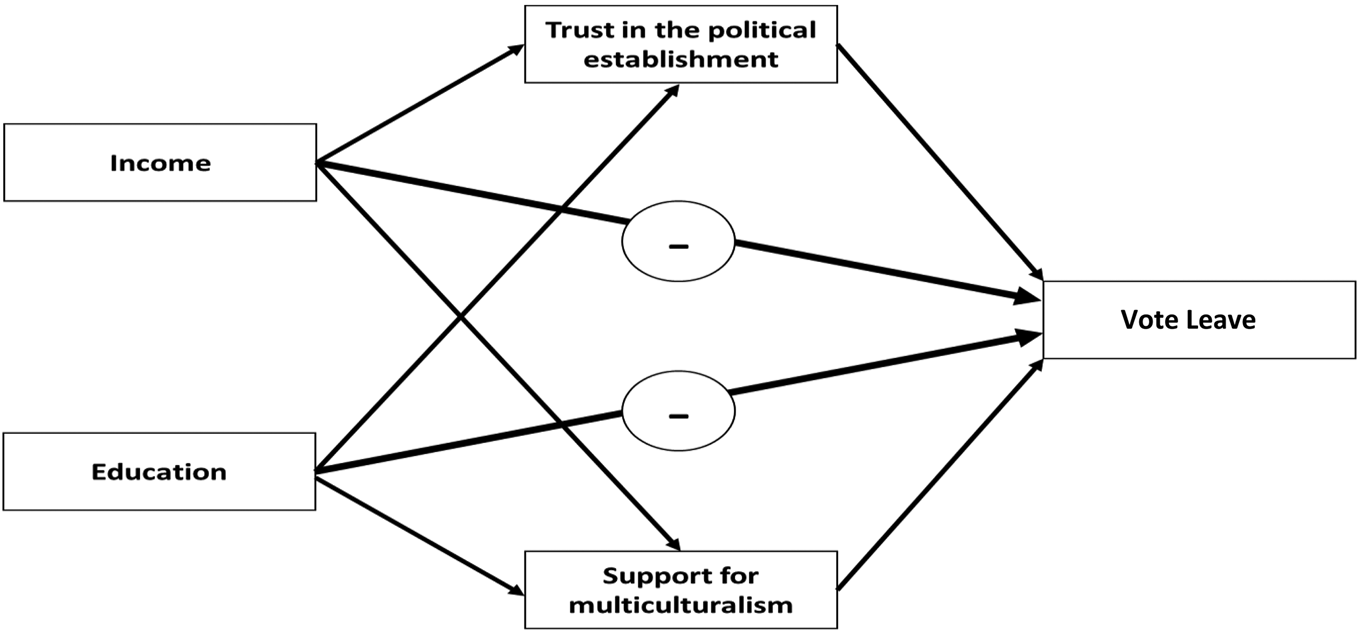
According to the utilitarian model outlined in the theoretical framework, people with higher income and education can be expected to benefit more from European integration and to be less likely to want to leave the EU. Education and income will therefore have a direct effect on the likelihood of voting Leave, independent of attitudes towards multiculturalism and of trust in the national political establishment (see Figure 1).
Utilitarian Model/Anti-Globalization

Identity model/anti-multiculturalism
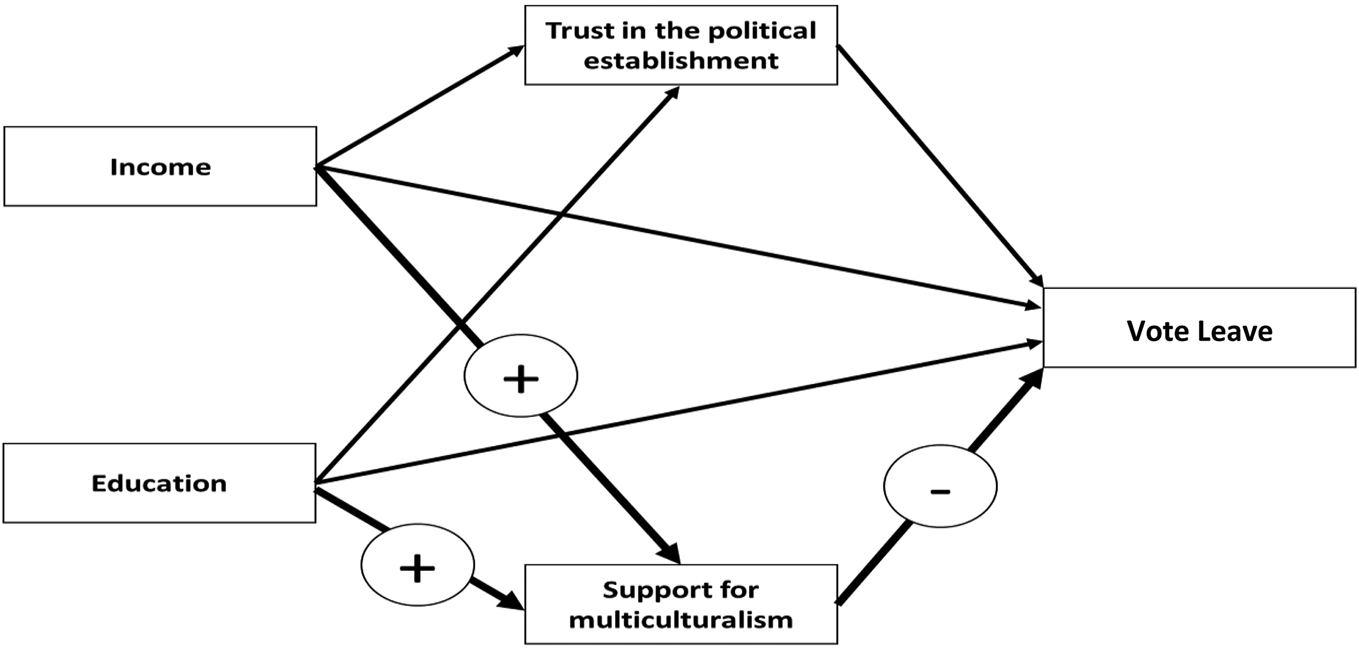
According to the identity model, those with a higher education and higher income will be more positive towards a multicultural society, which will be reflected in a lower likelihood of voting Leave (see Figure 2). Conversely, people with a lower income and little or no education will be more opposed to a diverse society, and this fear will be reflected in a higher probability of voting Leave.
Identity Model/Anti-Multiculturalism

Anti-elite model/anti-establishment
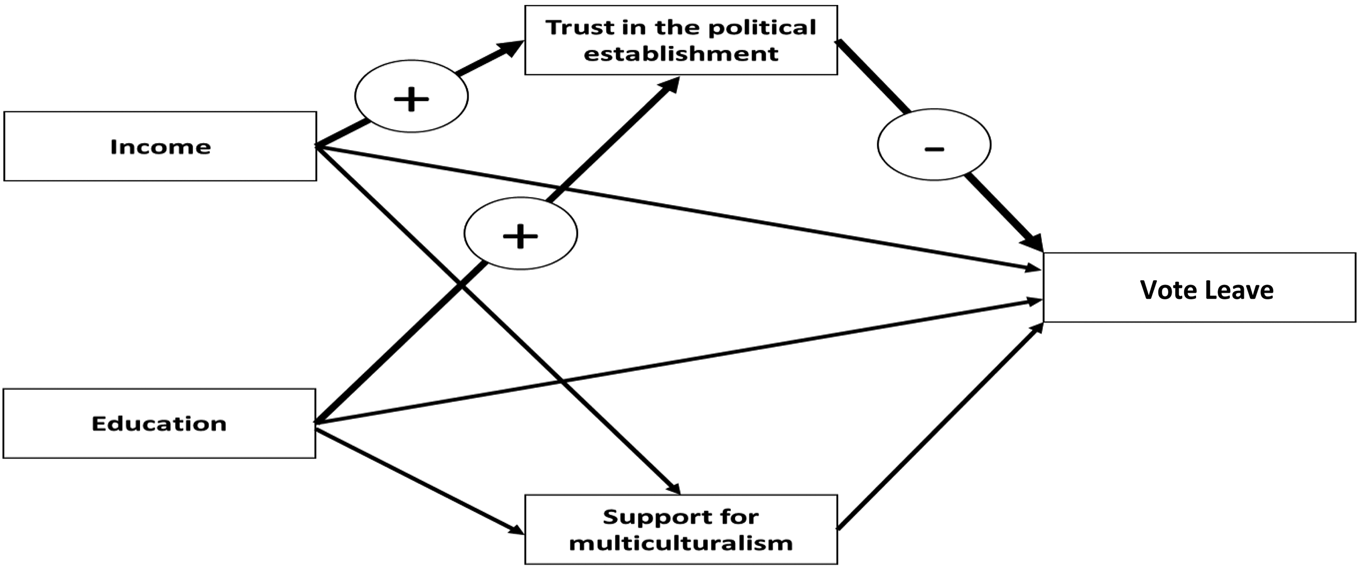
According to the anti-elite model, we expected that those with a higher income and education would have greater trust in the national political establishment. This trust in the national political establishment will reduce the likelihood of voting Leave (see Figure 3). On the other hand, those with low income and little or no education will trust the national political establishment less and therefore be more likely to vote Leave. Income and education will then have an indirect effect on voting Leave through trust in the establishment.
Anti-Elite/Anti-Establishment

European Social Survey
Measuring whether people wanted to terminate their member state's EU membership used to be challenging due to the lack of readily available data. First, most EU-related questions in different cross-national surveys (e.g. Eurobarometer and the European Quality of Life Survey) are formulated as scales, where the respondents are asked to judge an issue using an ordinal Likert scale. One problem with using ordinal scales is that there is no exact cut-off point for where opposition to European integration becomes so strong that the respondent wants to terminate EU membership. Moreover, this cut-off point varies across countries, as we show in the next section. Second, even when using EU-related questions such as the Eurobarometer question, ‘Generally speaking, do you think that [our country's] membership of the European Union is a good thing, a bad thing, or neither bad nor good?’, it does not mention leaving the EU. Thus, using it as an indicator for hard Euroscepticism would challenge measurement validity, as the indicator does not reflect the components of the systematized concept (Adcock and Collier Reference Adcock and Collier2001). Third, although strong alternatives such as eupinions have emerged in recent years, they are not yet readily available for large international across-country studies.
This study relies on the European Social Survey (ESS), which provides large samples with a minimum of 1,200 respondents per country and a low unit nonresponse bias compared with other cross-country surveys (Kohler Reference Kohler2007). The ESS is one of the most reliable comparative surveys administrated by academics, where rigorous methods are applied to measure the attitudes, beliefs and behaviours of European citizens. Questions are tested in various ways before being deployed to secure comparable understandings of meaning across countries. This article utilizes the 2016 round of ESS with 32,693 respondents, as it included for the first time the question about whether people wanted to leave the EU.
For the dependent variable concerning whether an individual wanted to leave the EU, we use the answer to the question ‘Imagine there were a referendum in [country] tomorrow about membership of the European Union. Would you vote for [country] to remain a member of the European Union or to leave the European Union?’ The variable was recoded into a dichotomous variable with people wanting to leave and the residual. In order to separate hard Euroscepticism from the rest of the population, we have included ‘don't know’ in the residual. However, we have run an additional path analysis where we have removed the ‘don't know’. The results are very similar. The effect size increases by approximately one percentage point.
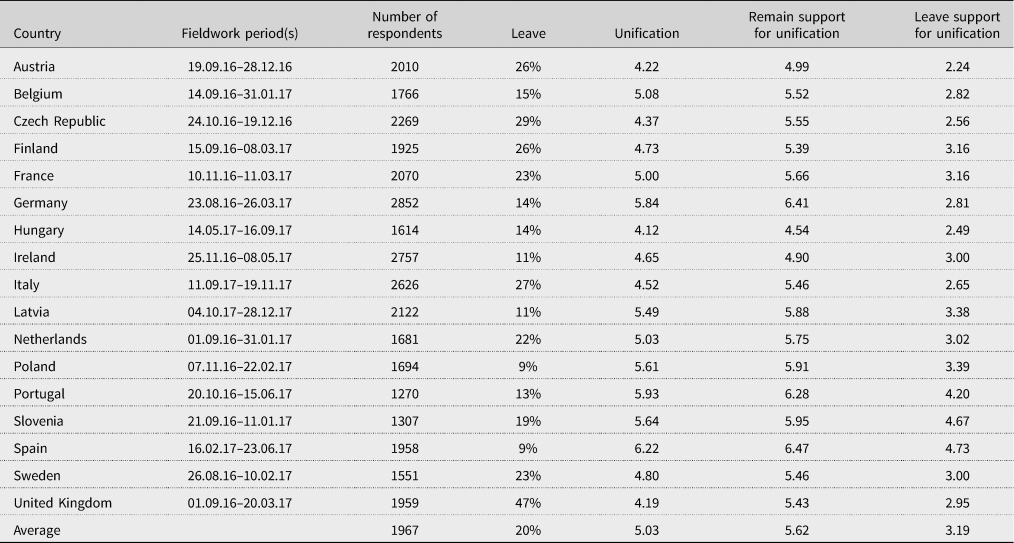
Table 1 outlines the countries included, when the data were collected, the number of respondents per country, the percentages of respondents who indicated that they wanted to leave, the average country score for support for European unification, the average score for those stating that they wanted to remain and for those stating that they wanted to leave. Unsurprisingly, the UK is at the top, with 47%, whereas Spain is at the bottom with only 9%. There seems to be no clear geographic clustering of countries. This also underscores the point about the problem of using an ordinal scale measure of hard Euroscepticism, as the average support for European unification differs greatly between countries and even more so when considering the average of those respondents who stated that they would vote Remain or Leave, respectively.
Descriptive Statistics

The utility model is operationalized using two variables. The first is the level of education measured by the following question: ‘About how many years of education have you completed, whether full-time or part-time? Please report these in full-time equivalents and include compulsory years of schooling.’ The second variable is household income, measured using the following question: ‘Please tell me which letter describes your household's total income, after taxes and compulsory deductions, from all sources?’
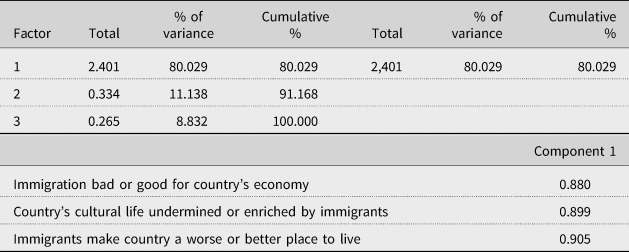
For the identity model, an index is used to measure multicultural attitudes by first conducting a principal component analysis for the following items in the ESS:
1. Would you say it is generally bad or good for [country]'s economy that people come to live here from other countries? Please use this card. Measured on a scale from 0 (bad for the economy) to 10 (good for the economy).
2. And, using this card, would you say that [country]'s cultural life is generally undermined or enriched by people coming to live here from other countries? Measured on a scale from 0 (cultural life undermined) to 10 (cultural life enriched).
3. Is [country] made a worse or better place to live by people coming to live here from other countries? Please use this card. Measured on a scale from 0 (worse place to live) to 10 (better place to live).
The principal component analysis shows that the items loaded strongly on one latent structure, explaining 80% of the variance. To test the internal reliability of the scale, we used Cronbach's alpha, which showed a value of 0.87, demonstrating a highly satisfactory connection between the items. This suggests that the index we constructed obtained a high degree of internal reliability. The scale ranged from 0 to 30, 30 indicating an extremely positive attitude towards immigrants, 0 indicating an extremely negative attitude towards immigrants. The index was intended to capture attitudes towards multiculturalism. In order to compare the strength of the coefficient we standardized all the independent variables (Table 2).
Factor Loadings for Multiculturalism

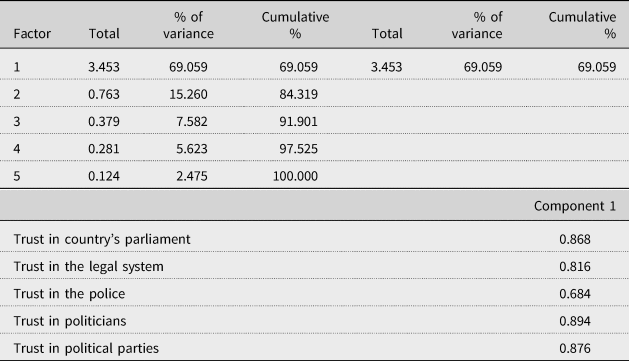
For the anti-elite model, we examined whether the following items in the ESS were connected by a latent structure via a principal component analysis: ‘Please tell me on a scale from 0 to 10 how much you personally trust each of the institutions. 0 means you do not trust an institution at all, and 10 means you have complete trust. The institutions are: (1) national parliament, (2) politicians, (3) political parties, (4) the legal system, and (5) the police.’
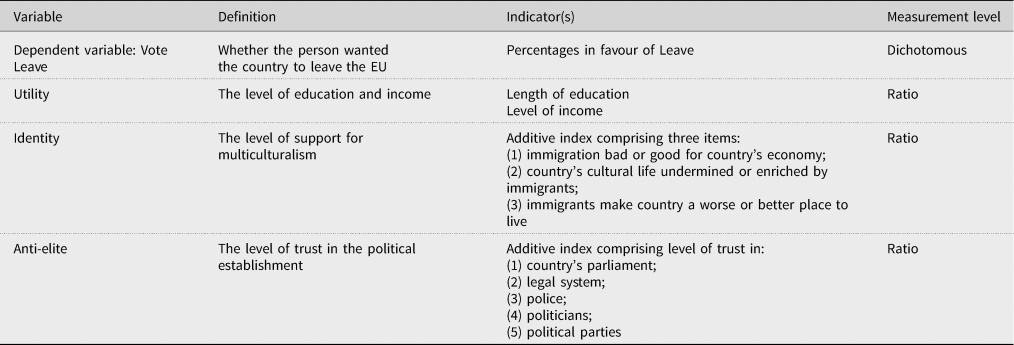
The results in Table 3 show that the five items loaded strongly on one factor, explaining 69% of the variance. The Cronbach's alpha was 0.88, which is indicative of a high level of internal reliability as the five items are strongly connected. The scale ranged from 0 (minimum trust) to 50 (maximum trust), and the intention was to capture the general trust in the political system. Table 4 provides an overview of the variables used in the study in terms of definition, indicator(s), measurement level and source.
Factor Loadings for Anti-Establishment

Variables Used in the Study

Note: All data come from the European Social Survey.
Analysis
In this section, we first test the aggregate theoretical model using a multilevel path model of all countries except for the UK due to its decision to leave the EU. Second, we compare this multilevel path model with a model of the UK based on data after the referendum. Third, we test the theoretical model on each country to map the variation in ‘hard Euroscepticism’/‘exit scepticism’. Finally, we discuss four illustrative countries which represent different paths to exiting the EU.
Overview of the results
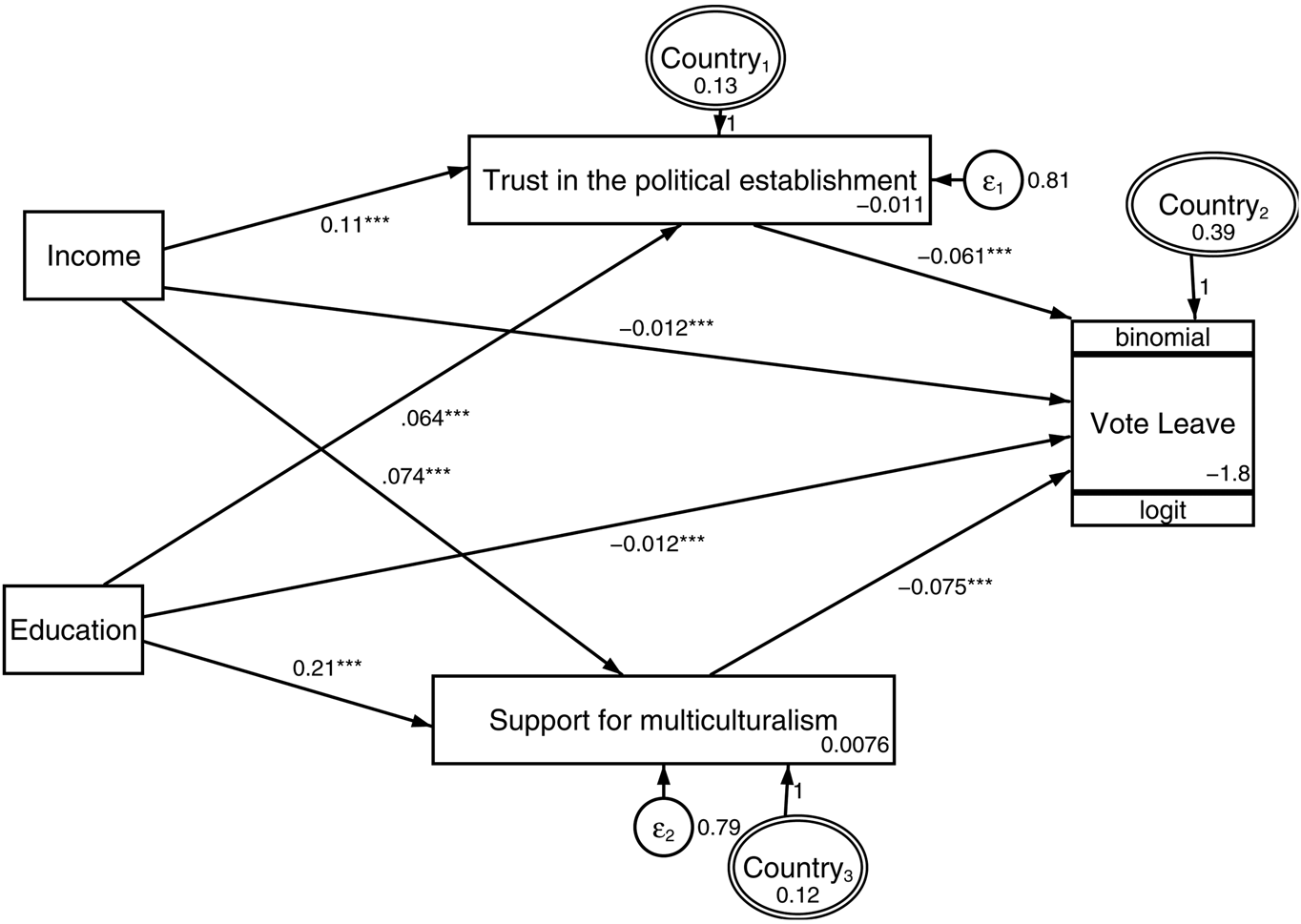
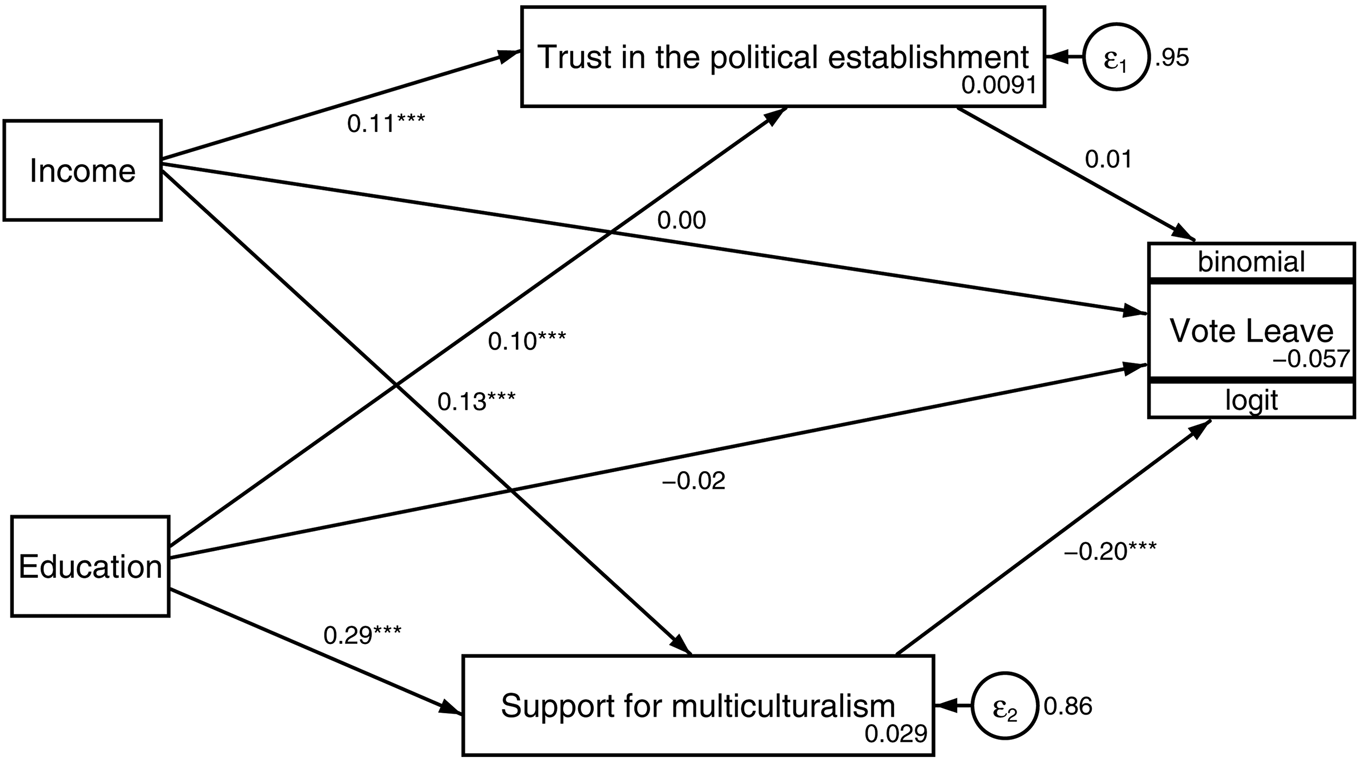
Figure 4 represents the multilevel logistic path model with coefficients. The diagram shows that high levels of income, education, trust in the political establishment and support for a multicultural society all had a direct, negative impact on the probability of supporting Leave. However, the strength of the association differed considerably between the variables. Income and education had only a weak direct negative relationship with wanting to leave the EU, while being in favour of multiculturalism and having trust in the political establishment were strongly negatively related to being in favour of leaving. If the level of support for multiculturalism and trust in the political establishment rose with one standard deviation, support for leaving the EU then declined by 7.5 and 6.1 percentage points, respectively. Yet both income and education had an indirect effect on wanting to vote Leave. The model shows two main paths to exiting the EU. On the one hand, education was mediated through support for multicultural societies. Higher education fostered more positive attitudes towards a multicultural society, which reduced the probability of voting Leave. On the other hand, the effect of income seemed to be mediated through trust in the political establishment. Higher income increased the level of trust in the political establishment, which again reduced the probability of voting Leave.
Multilevel Path Model with Coefficients (all countries except the UK)
Note: *p < 0.05; **p < 0.01; ***p < 0.001.

We ran a multilevel logistic regression with more control variables to check the robustness of the result (see Online Appendix 1). The regression analysis also showed a strong direct effect of support for multiculturalism and trust in the establishment. The analysis indicated that the effect of both education and income on being in favour of leaving EU was reduced after inclusion of the variable indicating trust in the establishment and support of multiculturalism. This indicates that the effect of education and income is mediated by support of multiculturalism and trust in the establishment.
These results call for a reconsideration of the existing models of opinion formation regarding European integration when applied in the context of ‘hard Euroscepticism’. This can be achieved by incorporating insights from cleavage theory, which was originally developed by Seymour Martin Lipset and Stein Rokkan (Reference Lipset and Rokkan1967), who saw cleavages as a function of political conflict related to structural changes in society, such as the Industrial Revolutions. To avoid ‘concept stretching’, Stefano Bartolini and Peter Mair (Reference Bartolini and Mair1990) narrowed down the concept of a cleavage by arguing that three elements must be present: (1) an empirical element that can be defined in socioeconomic terms; (2) a normative element, which can be defined in attitudinal terms with regard to specific values and beliefs; and (3) a behavioural element, which is the specific actions associated with the cleavage. If present, these will, together, constitute a cleavage.
The different factors in the path diagram can be grouped according to these elements. First, income and education are empirical or socioeconomic elements. Economic conflicts over resources are being transformed by globalization and European integration (Grande and Kriesi Reference Grande, Kriesi and Kreisi2012: 12). People in sectors vulnerable to international competition and with low-level skills are at a higher risk of being the losers in economic terms of these transnational processes (Grande and Kriesi Reference Grande, Kriesi and Kreisi2012: 12). While the economic consequences of industrialization are a traditional cause of material conflict, the rise of the post-industrial society has rendered education an important predictor of social conflict (Bovens and Wille Reference Bovens, Wille, Bovens and Wille2017). Second, the normative or attitudinal elements in the path diagram are constituted by opinions towards multiculturalism and trust in political establishment. Third, the behavioural element in the diagram is whether the individual wanted to leave the EU.
By relating these three elements, the diagram suggests two separate mechanisms behind wanting to leave the EU. The empirical or socioeconomic elements in terms of education and income are distinctly stratifying engines which create two different normative/attitudinal responses. When it comes to income, several authors have argued that income has a significant impact on trust in the political establishment (Castells Reference Castells2019; Guilluy Reference Guilluy2019). After decades of rising economic and social insecurity, the trust among lower-income groups in the political establishment in terms of politicians and political institutions has diminished (Guilluy Reference Guilluy2019). According to Manuel Castells (Reference Castells2019), the economic crisis which began in 2008 and the ways national governments addressed it was one of the key factors contributing to the crisis of political legitimacy. This legitimacy crisis is especially strong for low-income groups, who are turning against the political establishment and the EU. Thus, being a member of a low-income group with limited trust in the political establishment increases the probability of voting Leave.
In contrast, differences in attitude towards a multicultural society are primarily based on education. According to Anchrit Bovens and Mark Wille (Reference Bovens, Wille, Bovens and Wille2017), the division between cosmopolitan and nationalist attitudes is linked to different levels of education. Highly educated individuals tend to be more in favour of multiculturalism and cultural heterogeneity, whereas less educated people are against, as they prefer a homogeneous national culture. This translates into an interest in leaving the EU, which can also be seen as a threat to national identity and sovereignty. This finding is in line with previous studies which suggest that opposition towards a multicultural society goes beyond material concerns about competition from migrants or costs related to social transfers (Grande and Kriesi Reference Grande, Kriesi and Kreisi2012). Here, education is a key factor contributing to whether people have a cosmopolitan or local outlook on the world, which extends to the EU.
In theoretical terms, this implies that the utility model can be subsumed by the two other models, where income influences trust in the political establishment, which again impacts the enthusiasm for leaving the EU, and education has an impact on support for a multicultural society, which again relates to whether the respondent wanted to exit the EU. Having examined all countries except for the UK, the next section examines the latter.
The UK
The UK has historically been an ‘awkward partner’ of the EU, with a significant degree of Euroscepticism to be found in both the public and the political establishment. During its accession to the European Community, the merits of community membership were debated intensely, not least because the UK did not shape the EU's original architecture and entered at a time when the economic benefits of membership had diminished (Usherwood and Startin Reference Usherwood and Startin2013). This debate over membership has continued over the years and culminated in the 2016 Brexit referendum.
The high level of exit Euroscepticism is also reflected in the data, where the UK was (by far) the country with the most respondents expressing interest in leaving the EU (with 47%). The UK also scored comparatively low regarding support for further European integration (with a score of 4.19), with only Hungary scoring lower. The UK path model (Figure 5) shows that highly educated people were more supportive of a multicultural society. We also found that those who supported a multicultural society were significantly less likely to vote Leave. The coefficient indicates that a one-standard-deviation increase in support of a multicultural society reduced the likelihood of being in favour of leaving the EU by 20 percentage points. The educational effect of voting Leave was mediated by support for a multicultural society. The total effect of education was −0.08, which means that for a one-standard-deviation increase in the educational level the probability of voting Leave decreased by eight percentage points on average. However, approximately 70% of the total effect was mediated by support for multiculturalism. The only direct effect on voting Leave was the support for a multicultural society. Compared with the aggregate path model, the UK model shows that trust in the political establishment had no significant impact on the likelihood of voting Leave. This might be because Euroscepticism is internalized within the main governing parties in the UK due to the British party system, where the main parties have Eurosceptic factions which in the case of the Conservatives now dominate the party line. By contrast, hard or exit Euroscepticism is isolated at the fringes of the party system in many other European countries.
The UK Path Model
Note: *p < 0.05; **p < 0.01; ***p < 0.001.

Mapping the pathways to an exit
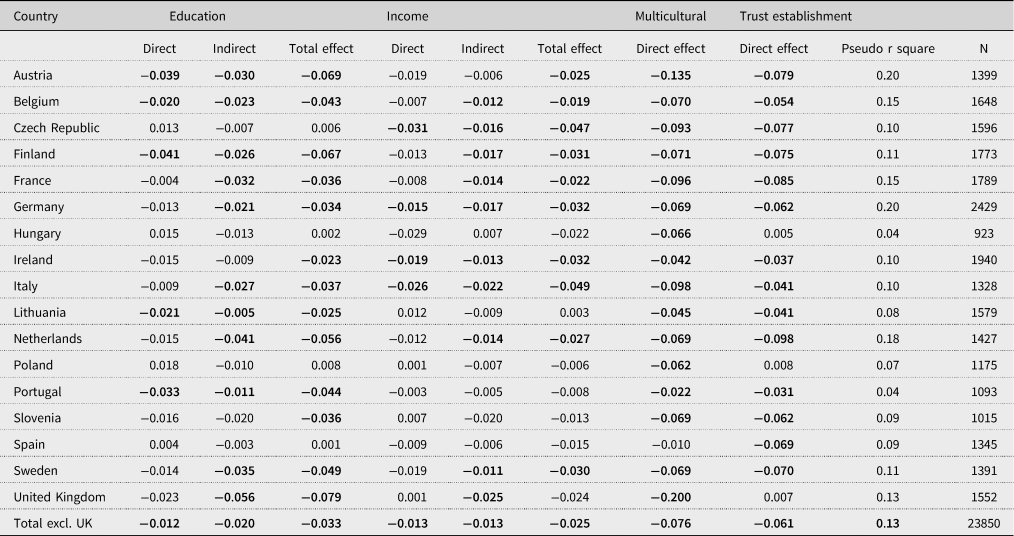
Table 5 shows the decomposed direct and indirect effects. It indicates that the total effect of both education and income varied regarding the likelihood of intending to vote Leave. The total effect of education was highest in the UK, Austria and Finland, where the probability of voting Leave decreased by approximately six to eight percentage points for a standard deviation increase in the length of completed education. In all countries except Poland, Hungary, Spain and the Czech Republic, there was a significant negative total effect of education on being in favour of voting Leave. When it comes to income, the total effect also varied considerably. Income had a significant total effect on being in favour of leaving the EU in Italy, Belgium, the Czech Republic, Sweden, Germany, Finland, the Netherlands and France. By contrast, income and education had almost no impact on hard Euroscepticism in most of the Southern and Eastern European member states. The ‘left-behind’ thesis that predicts that unskilled and economically deprived citizens would be in favour of leaving the EU was not confirmed for member states such as Hungary, Poland and Spain.
Decomposing Direct and Indirect Effects (KHB methods)

Note: Bold indicates significant relationship at the 0.05 level.
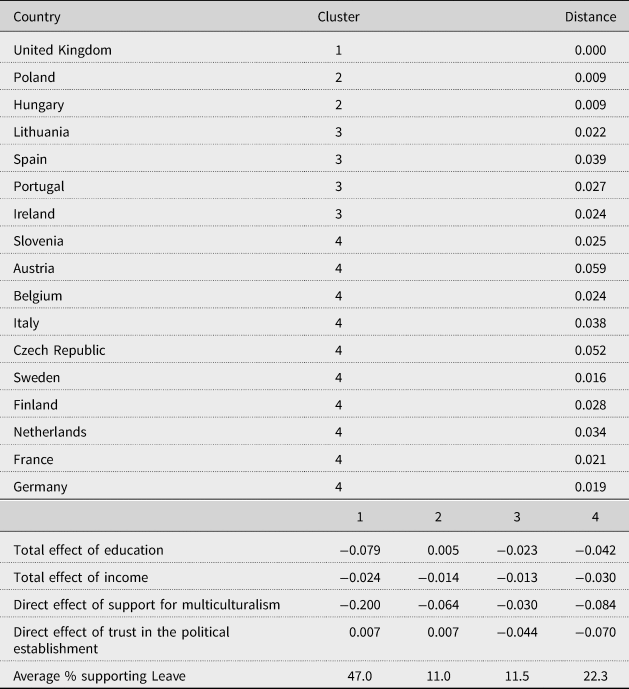
By running a K-mean cluster analysis using the total effect of income and education and the direct effect of multiculturalism and trust in the political establishment, the countries were divided into four groups. The number of clusters for the K-mean analysis was determined by running a hierarchical cluster model and inspecting drops in the coefficients of the agglomeration schedule (see Online Appendix 2). The hierarchical cluster model was also used as a source of validation as the dendrogram allocated the countries to the same clusters as the K-mean model (see Online Appendix 2) (Rodriguez et al. Reference Rodriguez2019). Table 6 shows the four groups and their final cluster centres.
The Different Mechanisms Behind Hard or Exit Euroscepticism for the Entire Sample

The first cluster comprises only the UK, for which the explanatory power of identity/anti-multiculturalism is very strong and where education also plays a limited role in wanting to leave the EU. The second cluster comprises Hungary and Poland, which are similar to the UK as they are countries where the identity/anti-multiculturalism model explains support for wanting to leave the EU. However, compared with the first cluster the effect is moderate. The only direct effect on supporting Leave is the variable indicating the degree of support for a multicultural society. By contrast, the level of trust in the political establishment has a very limited impact on the probability of supporting leaving the EU in these countries.
There are considerable variations between the countries in the two clusters. In Hungary (14%) and Poland (9%), the number of exit sceptics is low compared with the UK (47%). Hungary is an illustrative case as Euroscepticism is not ‘hard’ or ‘exit’-oriented, which is likely to be attributed to the economic benefits that the country enjoys from the EU's budget, the free movement that allows Hungarians to seek employment in other EU countries, the painstaking process of becoming a member of the EU and, last but not least, the idea of reforming the EU from within, as proposed by Viktor Orbán and the Hungarian Civic Alliance (Fidesz) (Duff Reference Duff2013).
Portugal, Lithuania, Spain and Ireland are located in the third cluster. The effect of multiculturalism/identity is smaller than in the other clusters while the effect of trust in the political establishment on exit Euroscepticism is medium. Thus, all variables are weakly or moderately related to supporting Leave. Moreover, the heterogeneity in this group is small as the share of exit Eurosceptics is low. Spain is an instructive case in point, as historically the country is known for its strong, cross-partisan and public support for European integration (Jiménez and de Haro Reference Jiménez and de Haro2011). This is also the case in descriptive terms, where Spain is the country with the fewest respondents who wanted to leave the EU. Only 9% of the respondents were exit sceptics and on the ordinal scale (6.22) Spain is the country with the strongest support for further European integration. Spain exemplifies countries where the desire to leave the EU is related to anti-establishment sentiments. Income has an indirect effect, as it increases trust in the national establishment, which again decreases the likelihood of voting Leave. Spain is one of the few countries where support for a multicultural society had no effect on voting Leave.
The fourth cluster is composed of Belgium, the Czech Republic, Germany, Austria, Sweden, Finland, France, Italy, Slovenia and the Netherlands, which represent a combined anti-multicultural and anti-elite attitude. Both the attitude towards multiculturalism and the degree of trust in the political establishment had a direct impact on hard Euroscepticism. The effect of the multiculturalism/identity model is, on average, higher than in clusters two and three. Except for Germany, this cluster was characterized by a high level of exit Euroscepticism. Germany is known for its positive attitude towards European integration (Baluch Reference Baluch, Leruth, Startin and Usherwood2017; Lees Reference Lees2002), as is mirrored in descriptive data, where a mere 14% of the respondents could be classified as ‘hard’ or ‘exit’ Eurosceptics. On the ordinal scale of whether European integration should go further, Germany also scored highly (5.84), which places it in the top three. By contrast, Austria, which shares many similarities with Germany, had a much more ambivalent relationship with the EU. This can be seen in the descriptive data, where 26% of the respondents indicated that they wanted to leave the EU and on the ordinal scale concerning European unification Austria was placed among the lowest (4.22). Eurosceptic sentiments are not least driven by the Freedom Party of Austria, which during the access referendum in 1994 advocated against membership and since then has been actively campaigning against the EU (Taggart and Szczerbiak Reference Taggart and Szczerbiak2013).
While the low number of observations (n = 17) makes it difficult to disentangle statistically the drivers at play in the four clusters, some cautious observations can be made. What is characteristic of both clusters one and two is that the political elites of the countries express Eurosceptical sentiments, which is likely to diminish the importance of the anti-elite model (Startin Reference Startin2015). By contrast, the group of countries in cluster three is characterized by broad cross-partisan support for the EU and a low degree of politicization of the European integration process. Finally, cluster four contains countries in which the EU is politicized and where the models perform strongly. These countries are characterized by having extremist parties that are expressing Euroscepticism sentiments but not among the mainstream parties.
Conclusion
Support for European integration has changed from a permissive consensus to a constraining dissensus (Hooghe and Marks Reference Hooghe and Marks2009). While this constraining dissensus assumes many forms, it has possibly been expressed most strongly in the unprecedented decision of the UK to leave the EU, also known as Brexit. In the wake of Brexit, identifying the probable causes behind dissatisfaction with European integration has become of utmost importance (Hobolt Reference Hobolt2016; De Vries Reference De Vries2018). Whereas most existing studies focus on explaining the general support (or lack thereof) for European integration, this study has zoomed in on mapping and explaining ‘hard’ or ‘exit’ Euroscepticism, where people wish to terminate their country's EU membership (De Vries Reference De Vries2018). In short, the article has addressed the simple but underexplored research question of why people in different member states want to leave the EU. The research question has been answered by examining three prominent theoretical models: the anti-globalization/utility, anti-multiculturalism/identity and anti-elite/anti-establishment models. The explanations were examined on the basis of path models using 2016 data from ESS with a total of 32,693 respondents.
The aggregate path model of all countries in the survey except the UK demonstrated that while all three models have merits in terms of explaining ‘hard’ or ‘exit’ Euroscepticism, the indicators of anti-globalization/utility worked strongest indirectly, expressing two main routes to the exit. First, the higher an individual's income, the more trust they had in the political establishment and the lower the probability of them voting Leave. Second, the higher an individual's education, the more support they had for a multicultural society, making a vote for Leave less likely. Thus, income is linked to trust in the political establishment, whereas education is linked to support for multiculturalism. The two routes can be seen as distinct exit mechanisms. As for the UK, the path model demonstrates that the only direct connection to voting Leave is the anti-multiculturalism/identity model. Indirectly, the anti-globalization/utility model operationalized in terms of higher income and education increases support for multiculturalism, which again reduces the likelihood of voting Leave.
Moving beyond the aggregate and UK path models, the analysis highlighted four clusters of countries in terms of the mechanisms contributing to exit Euroscepticism. The first cluster is only composed of the UK, where the anti-multiculturalism/identity model performs very strongly. The second group is composed of countries where the anti-multiculturalism/identity model performs best in explaining the desire to leave the EU. This group consists of Hungary and Poland. The third group consists of Portugal, Lithuania, Spain and Ireland, where the anti-multiculturalism/identity and anti-elite/anti-establishment models are also at play but perform insignificantly when compared with the fourth cluster. The fourth cluster contains countries in which both the anti-multiculturalism/identity and anti-elite/anti-establishment models are at play and have relatively strong explanatory power. This group comprises Belgium, the Czech Republic, Germany, Austria, Sweden, Finland, France, Italy and the Netherlands and represents the main road to Euroscepticism. In sum, the four clusters illustrate how there are different paths to the exit and that they vary considerably in terms of strength. This implies that assumptions about ‘hard’ or ‘exit’ Euroscepticism must be sensitive to heterogeneity instead of assuming that the same set of distal causes influences all member states equally.
While the UK is clearly an outlier when it comes to wanting to exit the EU (Hobolt Reference Hobolt2016), examining the drivers in other member states has revealed variation of ‘hard’ Euroscepticism in these states. To delve deeper into the nature of this, we have three recommendations for future research. Empirically, one could disentangle the drivers at play in the four groups to answer questions such as why anti-multicultural feelings are a strong driver in some countries, whereas in other countries it is anti-elite feelings or different combinations of the two that are strong drivers. Here we expect that variation in the public debate regarding European integration will play an important role. Theoretically, the mechanisms linking income with anti-elite feelings and education with anti-multicultural feelings and ‘hard’ Euroscepticism could be developed further. Methodologically, gathering data over time (preferably from the same cohort) would allow for the implementation of econometric models for panel data, which would enhance the potential for causal inferences about the factors creating ‘hard’ Euroscepticism.
Supplementary material
To view the supplementary material for this article, please go to: https://doi.org/10.1017/gov.2020.37.
Acknowledgements
This article has been presented on a number of occasions in 2019 including the Inequality Platform at Copenhagen Business School, the Quantitative Network at the Roskilde University, the Midwest Political Science Association conference in Chicago and the European Studies Association conference in Denver. The authors would like to thank the participants for valuable feedback. A special thank you goes to Tomasz Drabowicz, Marcus Jachtenfuchs and Christel Koop for providing detailed feedback. We are also very grateful for the reviewers' helpful comments that have improved this article.