Introduction
Human infection with the ascarid nematode Toxocara is among the most common zoonotic infections worldwide (Rubinsky-Elefant et al., Reference Rubinsky-Elefant, Hirata, Yamamoto and Ferreira2010). An understanding of the global impact and cost of human toxocariasis is lacking (Smith et al., Reference Smith, Holland, Taylor, Magnaval, Schantz and Maizels2009). Knowledge about the epidemiology of toxocariasis in Mexico is poor. Exploring Mexican populations living in extremely poor hygienic–sanitary conditions that may favour dissemination of infections may be a good strategy to find Toxocara exposure. Therefore, Tepehuanos (an indigenous ethnic group in north-western Mexico) who live in such disadvantaged conditions were selected for exploring Toxocara exposure. Most Tepehuanos live in remote mountains in rural regions in the state of Durango, Mexico. The majority of Tepehuanos live in the municipalities of Mezquital (23°28′N, 104°24′W) and Pueblo Nuevo (23°47′N, 105°22′W). Tepehuanos live in poverty and have poor education and housing. Rural communities in Durango also have poor health-care coverage for the diagnosis, treatment and prevention of infectious diseases. The aim of the present study was to determine the seroprevalence of Toxocara exposure in rural Tepehuanos in Durango State, Mexico and to identify their characteristics associated with Toxocara seropositivity.
Materials and methods
Ethical clearance
Through a retrospective study using serum samples from a recent Toxoplasma gondii serosurvey (Alvarado-Esquivel et al., Reference Alvarado-Esquivel, Estrada-Martínez, García-López, Rojas-Rivera, Sifuentes-Álvarez and Liesenfeld2012), 126 rural Tepehuanos of Durango, Mexico were studied. Inclusion criteria for the study subjects were Tepehuano ethnicity (those who speak the Tepehuano language and identify themselves as Tepehuanos), rural residence, either sex, 15 years and older, any occupation, any socio-economic level and who agreed to participate.
This study was approved by the Ethical Committee of the Instituto de Seguridad y Servicios Sociales de los Trabajadores del Estado in Durango City. Written informed consent was obtained from all participants.
Socio-demographic, clinical and behavioural aspects of Tepehuanos
Characteristics of participants were obtained by using a standardized questionnaire. Socio-demographic data including age, sex, birth place, residence, educational level, occupation and socio-economic level were obtained from all participants. The clinical data assessed included the presence of underlying diseases, presence or history of lymphadenopathy, frequent presence of headache, memory, reflex, hearing and visual impairments, and history of surgery, blood transfusions or transplants. In women, obstetric history was also documented. Behavioural data obtained from all participants included animal contact, foreign travel, frequency of eating out of home (in restaurants or fast food outlets), contact with soil (gardening or agriculture), types of flooring at home, consumption of unwashed raw vegetables and fruits, unpasteurized milk or untreated water, meat consumption (pork, beef, goat, lamb, boar, chicken, turkey, pigeon, duck, rabbit, venison, squirrel, horse or opossum), frequency of meat consumption, consumption of raw or undercooked meat, and dried or cured meat (ham, sausages, salami or chorizo). Chorizo consumed in Durango Mexico is a red fresh sausage made mostly of raw pork tissues mixed with raw chili pepper.
Serological procedures
Serum samples were obtained from all participants and kept frozen at − 20°C until analysed. Serum samples were analysed for anti-Toxocara immunoglobulin (Ig) G antibodies with a commercially available enzyme immunoassay Toxocara kit (Diagnostic Automation, Inc., Calabasas, California, USA). This test has a sensitivity of 93% and a specificity of 88%. Absorbance readings equal to or greater than 0.3 optical density units were considered positive. All tests were performed following the manufacturer's instructions.
Data analysis
Statistical analysis was performed with the aid of Epi Info version 3.5.3 (Centers for Disease Control and Prevention, Atlanta, Georgia, USA) and SPSS version 15.0 (SPSS Inc., Chicago, Illinois, USA). For calculation of the sample size, a reference seroprevalence of 13.9% (Won et al., Reference Won, Kruszon-Moran, Schantz and Jones2008) as the expected frequency of the factor under study, 26,453 as the size of the population from which the sample was selected, a least acceptable result of 20.0% and a confidence level of 95% were used. The result of the calculation was 123 subjects. Pearson's χ2 test and the Fisher exact test (when values were less than 5) were used for comparison of the frequencies among groups. For comparison of age among seropositive and seronegative subjects the Mann–Whitney U test was used. Bivariate and multivariate analyses were used to assess the association between the characteristics of the subjects and Toxocara seropositivity. Variables were included in the multivariate analysis if they had a P value equal to or less than 0.20 in the bivariate analysis. Odd ratios (ORs) and 95% confidence intervals (CIs) were calculated by multivariate analysis using a backward stepwise logistic regression analysis. A P value less than 0.05 was considered statistically significant.
Results and discussion
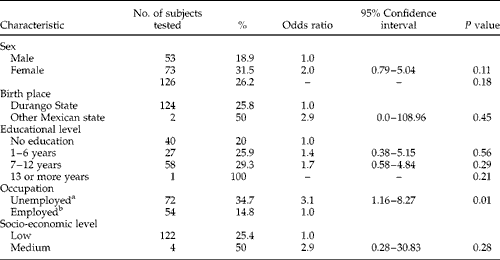
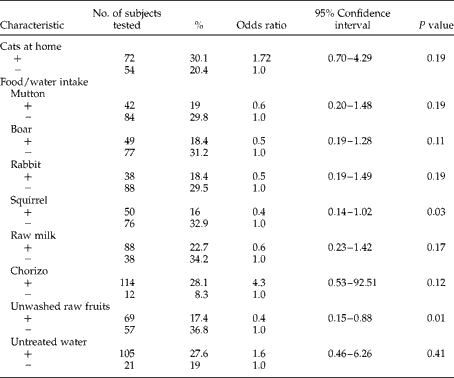
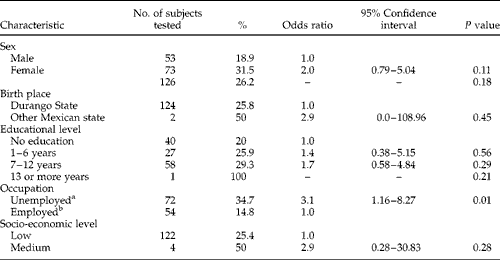
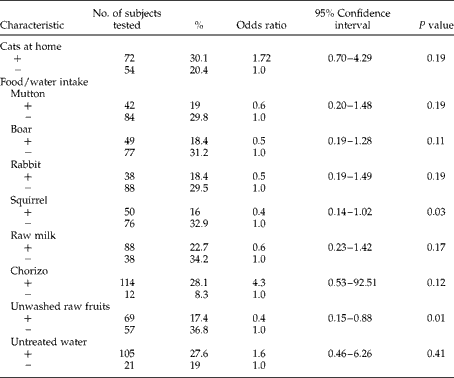
Socio-demographic and behavioural characteristics of the 126 rural Tepehuanos studied are shown in tables 1 and 2, respectively. Most participants were born in Durango, and their mean age was 32.46 ± 17.36 years (range 15–89 years). Of the 126 Tepehuanos, 33 (26.2%) had anti-Toxocara IgG antibodies and such a value, apart from confirming that Toxocara exposure is common, is the first documentation of Toxocara prevalence in Tepehuanos in Mexico. In an international context a 26.2% seroprevalence is comparable with other studies undertaken in South America, where values of 20.5–39% have been reported in rural and urban populations in Bolivia (Cancrini et al., Reference Cancrini, Bartoloni, Zaffaroni, Guglielmetti, Gamboa, Nicoletti and Genchi1998), Brazil (Rubinsky-Elefant et al., Reference Rubinsky-Elefant, da Silva-Nunes, Malafronte, Muniz and Ferreira2008), Argentina (Radman et al., Reference Radman, Archelli, Fonrouge, del V Guardis and Linzitto2000; Chiodo et al., Reference Chiodo, Basualdo, Ciarmela, Pezzani, Apezteguía and Minvielle2006; Fillaux et al., Reference Fillaux, Santillan, Magnaval, Jensen, Larrieu and Sobrino-Becaria2007) and Peru (Espinoza et al., Reference Espinoza, Huapaya, Roldán, Jiménez, Abanto, Rojas, Cavero and Gutiérrez2010; Roldán et al., Reference Roldán, Cavero, Espinoza, Jiménez and Gutiérrez2010). In contrast, the Toxocara seroprevalence in Tepehuanos is higher than those reported in other North American countries. Seroprevalences less than 5% have been reported in Canada (Messier et al., Reference Messier, Lévesque, Proulx, Rochette, Serhir, Couillard, Ward, Libman, Dewailly and Déry2012; Sampasa-Kanyinga et al., Reference Sampasa-Kanyinga, Lévesque, Anassour-Laouan-Sidi, Côté, Serhir, Ward, Libman, Drebot, Ndao and Dewailly2012) and a 13.9% seroprevalence was reported in the USA (Won et al., Reference Won, Kruszon-Moran, Schantz and Jones2008). In an indigenous ethnic context, Toxocara seroprevalence in Tepehuanos is comparable with the 31% seroprevalence reported in Yakima Indians in the USA (Stürchler et al., Reference Stürchler, DiGiacomo and Rausch1987).
Seroprevalence (%) of toxocaral infection in the rural Tepehuanos population, relative to bivariate analysis of sex and socio-economic variables.
a Unemployed = student or housewife.
b Employed = employee, business, agriculture, factory worker, cattle raising, construction worker or other.
Seroprevalence (%) of toxocaral infection in the rural Tepehuanos population, relative to cat contact, food consumption and feeding habits.
+, Positive; − , negative.
Multivariate analysis of socio-demographic and behavioural characteristics of Tepehuanos showed that Toxocara seropositivity was associated with unemployment (students and housewives) (OR = 3.1, 95% CI 1.25–7.47; P= 0.01). Other socio-demographic or behavioural characteristics including age, sex, educational level, socio-economic status, raising animals, soil contact and consumption of meat, unwashed raw fruits and vegetables or untreated water were not associated with Toxocara seropositivity. The association of Toxocara seropositivity with unemployment in Tepehuanos conflicts with that reported in a study of mountain aboriginal adults in Taiwan, where researchers found that labourers had a higher risk for infection with T. canis than persons who were unemployed (Fan et al., Reference Fan, Lan, Hung, Chung, Liao, Du and Su2004). There are no previous reports of an association of toxocaral infection and unemployment. It is not clear why unemployed (students and housewives) Tepehuanos had an increased Toxocara seroprevalence. It is likely that unemployed Tepehuanos are in closer contact with the Toxocara source of infection than Tepehuanos in work. Low education levels have been associated with toxocariasis (Prestes-Carneiro et al., Reference Prestes-Carneiro, Souza, Moreno, Troiani, Santarém, Zago, Miguel, Freitas, Faria, Martini, Rubinsky-Elefant, Iha and Vaz2009). However, in the present study, Toxocara seroprevalence was not associated with this socio-demographic characteristic. Toxocara seropositivity has been associated with dog ownership (Won et al., Reference Won, Kruszon-Moran, Schantz and Jones2008; Prestes-Carneiro et al., Reference Prestes-Carneiro, Souza, Moreno, Troiani, Santarém, Zago, Miguel, Freitas, Faria, Martini, Rubinsky-Elefant, Iha and Vaz2009). Some Tepehuanos have dogs at home but they do not use them for hunting. In the present study, there was no association between Toxocara seropositivity and dog or cat ownership. This finding agrees with the results of other studies (Ajayi et al., Reference Ajayi, Duhlinska, Agwale and Njoku2000; Demirci et al., Reference Demirci, Kaya, Cetin, Arıdoğan, Onal and Korkmaz2010). Contact with soil has also been associated with toxocariasis (El-Shazly et al., Reference El-Shazly, Abdel Baset, Kamal, Mohammed, Sakrs and Hammad2009). Tepehuanos with soil contact had a higher seroprevalence of toxocaral infection than those without soil contact (27 versus 18.2%, respectively). However, the difference in the seroprevalence rates was not statistically significant (P= 0.41). It is possible that the small sample size might have been a factor in the failure to reach statistical significance. Similarly, living in a house with soil floors was not associated with toxocaral seropositivity.
None of the clinical characteristics assessed, including underlying diseases, frequent headaches, presence or history of lymphadenopathy, memory, reflex, visual and hearing impairments, surgery history, blood transfusion and transplant history, were associated with toxocariasis.
The conclusions of the present study are: Toxocara exposure is common among Tepehuanos. However, Toxocara exposure does not seem to be making an impact on the health of Tepehuanos. This is the first report of toxocaral infection in Tepehuanos and of an association of toxocariasis in adults with unemployment. Further research is needed to understand the routes of transmission of Toxocara in Tepehuanos, including the role of hygiene practices, canine and feline contact, paratenic hosts and soil contamination with infective Toxocara eggs.