Sepsis represents a major international health challenge with high mortality.Reference Cohen, Vincent and Adhikari 1 , Reference Vincent, Marshall and Silvio 2 Although early antibiotic therapy is likely to reduce mortality in severe sepsis,Reference Kumar, Roberts and Wood 3 recent debate has focused on the importance of antibiotic appropriateness in addition to timing.Reference Cohen, Vincent and Adhikari 1 , Reference Sterling, Miller and Pryor 4 , Reference Ryoo, Kim and Sohn 5 The international ‘surviving sepsis’ campaign focused on improving outcomes in sepsis.Reference Dellinger, Levy and Rhodes 6 In New South Wales, Australia, the Clinical Excellence Commission (CEC) introduced statewide clinical sepsis pathways for emergency departments and subsequently for non–intensive care unit (non-ICU) inpatient wards in 2014, as part of a quality improvement program. 7 The CEC sepsis pathways promote performing blood cultures, measuring serum lactate levels, conducting intravenous fluid resuscitation, and administering antibiotics within 60 minutes of sepsis recognition. 7 The CEC pathways are based on the Sepsis-2 definitions of sepsis as infection with 2 or more systemic inflammatory response syndrome (SIRS) criteria and of severe sepsis as sepsis causing organ dysfunction.Reference Dellinger, Levy and Rhodes 6 The CEC inpatient sepsis pathway was implemented in this hospital in October 2014 (referred to hereafter as ‘the sepsis pathway’) following an intensive preimplementation phase of junior medical officer and nurse education, resource development within the rapid response program, and provision of ward ‘sepsis kits’ containing otherwise restricted antibiotics.
Preliminary evaluation of our hospital sepsis pathway implementation revealed that half of the patients who triggered the pathway did not have sepsis and were frequently prescribed prolonged broad-spectrum antibiotic courses requiring infectious disease (ID) antimicrobial stewardship (AMS) intervention. Overprescription of broad-spectrum antibiotics was identified as a potential risk to patient safety and a target for intervention.Reference Davey, Brown and Charani 8 The aim of this study was to improve antibiotic management for inpatients triggering the sepsis pathway by early ID case review.
METHODS
Study Design, Setting and Population
This investigation was an interventional, nonrandomized, controlled study of adult non-ICU inpatients conducted in a 660-bed tertiary-care referral hospital in Sydney, Australia. Consecutive patients who triggered the sepsis pathway between May and August 2015 were enrolled. The intervention was case review within 24 hours of the sepsis pathway trigger, by an infectious diseases advanced trainee (IDAT), an ID fellow equivalent trained in sepsis and AMS management and clinical practice improvement (CPI) methodology. Application of the plan-do-study-act (PDSA) cycle methodology identified IDAT intervention as the most likely to be effective.Reference Taylor, McNicholas and Nicolay 9 Hospitalwide clinical staff education was undertaken prior to implementation, including training videos, intranet resources, and empiric sepsis antibiotic prescribing guide.
The sepsis pathway was triggered when deterioration in a patient’s vital signs was suspected to be due to sepsis by either the treating team or by the rapid response medical team. 7 Specifically, 2 or more of the following vital signs in the context of infection would prompt sepsis pathway trigger: respiratory rate ≤10 or ≥25 respirations per minute, SpO2 <95%, systolic blood pressure <100 mmHg, heart rate ≤50 or ≥120 beats per minute, altered consciousness or new onset of confusion, temperature <35.5°C or >38.5°C. 7 The trigger time was recorded as the time of the rapid response call or, if no rapid response was instituted, the time when abnormal vital signs consistent with sepsis were recognized. The treating team generated an electronic alert to notify the IDAT of a sepsis pathway case.
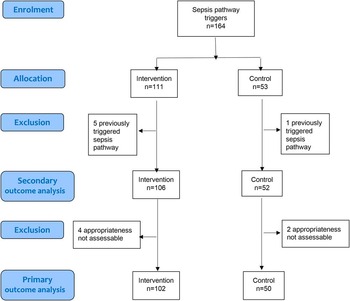
The intervention group received an IDAT review within 24 hours either during that working day or the next day so that timely recommendations for antibiotic management and investigations could be documented as a handwritten entry in the patient file. Written acknowledgement of IDAT review by the treating team was confirmed. A formal ID consulting process involving a senior ID physician was not undertaken unless the treating team requested it. No patients had received ID review prior to enrollment. The control group comprised those patients who triggered the sepsis pathway (ie, generating an electronic alert) but did not receive IDAT intervention due to lack of availability (eg, Saturday trigger or competing clinical priorities) and received standard care from their treating team. The electronic alert contained patient identifying information, sepsis trigger time, ward location and department without clinical case details; these alerts were reviewed consecutively by the IDAT as work schedule permitted. There was no prescreening and, thus, no prioritizing of alerts. Patients were excluded from the study if they had previously triggered the sepsis pathway (Figure 1).
Schematic flow diagram of inpatient sepsis pathway study enrollment and analysis.

The following data were collected retrospectively from the patient’s electronic medical record and paper files following discharge or death: baseline demographics at the time of sepsis trigger, likely source of sepsis, whether blood cultures and serum lactate were obtained, vital signs and laboratory data to determine whether SIRS criteria for sepsis were met and to calculate the APACHE II score for sepsis severity, and microbiology data at both time points. The antibiotics prescribed, dose and time of administration, were recorded for the period immediately prior to, immediately after the alert, and at 48 hours after the pathway trigger.
Antibiotic appropriateness was categorized as ‘appropriate,’ ‘inappropriate’ or ‘not assessable’ according to National Antimicrobial Prescribing Survey (NAPS) criteria. 10 These standardized criteria are used nationally in periodic point-prevalence surveys. They classify prescriptions as ‘appropriate’ if consistent with local or national therapeutic guidelines 11 or directed by microbiological results, with subcategories of ‘optimal’ and ‘adequate.’ The ‘inappropriate’ classification refers to antibiotic prescribing where ‘appropriate’ criteria are not met, with subcategories of ‘suboptimal’ and ‘inadequate.’ Antibiotic appropriateness, was assessed immediately after the sepsis pathway trigger and at 48 hours after the trigger (a recommended pathway review time point). 7 ‘Inappropriate’ initial antibiotic therapy may be exemplified by an empiric prescription of cefazolin for presumptive line-related sepsis when a patient is colonized with MRSA. ‘Appropriate’ initial antibiotic therapy of pipericillin/tazobactam plus gentamicin for presumptive severe nosocomial urosepsis would be classified at 48 hours as ‘inappropriate’ if it was not de-escalated when ampicillin-susceptible Escherichia coli was isolated from the urine and bloodstream. The primary outcome was defined as antibiotic appropriateness at 48 hours post sepsis pathway trigger. Patients classified as unassessable due to missing clinical data at the time of IDAT review were excluded from the appropriateness analysis (Figure 1). Total length of antibiotic therapy was calculated by combining days of parenteral, oral, and discharge prescriptions. Secondary outcomes analyzed were length of therapy, admission to the ICU, formal ID consultations, length of stay (LOS), and in-hospital mortality.
Interventions recommended by the IDAT and the compliance of the treating team were recorded. Compliance was defined as ‘followed’ if all recommendations were implemented within 48 hours, ‘partially followed’ if at least 1 but not all recommendations were implemented within 48 hours, or ‘not followed.’
The first author was responsible for conducting the IDAT intervention. Data retrieved from patient electronic records and paper-based files by a blinded author were assessed separately by 2 blinded senior ID physician coauthors to establish the inter-rater reliability for antibiotic appropriateness, and the diagnoses of sepsis and severe sepsis. The outcome of any disagreement between assessors was determined by a consensus decision between the 2 ID physicians.
Data Analysis
Dichotomous baseline and outcome measurements between groups was compared using a χ2 or Fisher exact test, as appropriate. For continuous variables, a t test or a Mann-Whitney test was used as appropriate. For imbalance in baseline characteristics between the 2 groups, a log-binomial regression model was fitted adjusting for the variables for which there were important baseline differences. The primary outcome was compared in all patients who triggered the sepsis pathway and in the subgroup identified as having sepsis. To detect a difference in antibiotic appropriateness at 48 hours between 50% in the control group and 80% in the intervention group with an α of 0.05 and 80% power, 45 patients were required in each arm of the study. Due to limited data from the literature and our small pilot study to guide sample size calculations, 8 further controls were enrolled. Data were analyzed using Stata version 14.0 software (StataCorp, College Station, TX).
Ethics
The study was approved by the South Eastern Local Health District’s Human Research Ethics Committee (HREC 15/039).
RESULTS
Participants and Baseline Characteristics
During the 15-week study period, there were 164 referrals for inpatients who triggered the sepsis pathway. Of these, 111 were captured by the IDAT intervention and 53 patients were included as controls (Figure 1). Overall, 5 patients were excluded in the intervention arm and 1 patient was excluded in the control arm because they had previously triggered the sepsis pathway, leaving 106 patients in the intervention arm and 52 patients in the control group for analysis. Among them, 6 patients were excluded from appropriateness analysis due to unassessable baseline appropriateness (Figure 1).
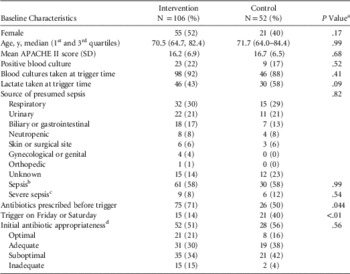
Notable baseline differences between the intervention and control group were prior antibiotic and day of the week trigger (ie, Friday or Saturday) (Table 1). No advanced-care directives were in place that limited antibiotic management.
Baseline Characteristics of Patients Triggering the Sepsis Pathway

NOTE. APACHE II, Acute Physiology and Chronic Health Evaluation II; SD, standard deviation.
a P value from test for difference between intervention and control baseline characteristics.
b Defined as infection with 2 or more systemic inflammatory response syndrome (SIRS) criteriaReference Dellinger, Levy and Rhodes 6 and is inclusive of severe sepsis
c Defined as sepsis with organ dysfunctionReference Dellinger, Levy and Rhodes 6
d Immediate postsepsis trigger appropriateness (adequate+optimal) according to NAPS criteria, 10 determined in those assessable for appropriateness (intervention n=102; controls n=50).
Antibiotic Appropriateness
Antibiotic appropriateness at the time of the sepsis pathway trigger was assessable in 152 of 158 patients and was found to be appropriate in 80 of 152 (53%) and inappropriate for 72 of 152 (47%). There was no difference in overall initial antibiotic appropriateness between the intervention and the control group (Table 1). At 48 hours after sepsis pathway trigger, antibiotic management was appropriate in 97 of 102 (95%) intervention patients compared to 38 of 50 (76%) controls (relative risk [RR], 1.25; 95% confidence interval [CI], 1.06–1.47; P<.01). The difference remained after adjusting for baseline differences in the day of the week of the trigger (ie, Friday or Saturday versus another day of the week) and pretrigger antibiotics (adjusted RR, 1.24; 95% CI, 1.04–1.47; P=.035). There was no difference in 48-hour appropriateness when analysis was restricted to those with a diagnosis of sepsis. In this subanalysis, 60 of 61 (98%) and 27 of 30 (90%) received appropriate antibiotics at 48 hours in the intervention and control groups, respectively (P=.09). The interrater agreement between 3 ID authors for assessment of appropriateness was 95%.
Sepsis Diagnosis
Overall, 61 of 106 patients in the intervention group (58%) and 30 of 52 controls (58%) had a diagnosis of sepsis. Severe sepsis was present in 8% of intervention patients compared to 12% of controls (P=.54). Diagnostic test sampling did not differ markedly; blood cultures were collected in 90% and serum lactate in 48% of patients (Table 1).
Intervention Recommendations and Concordance
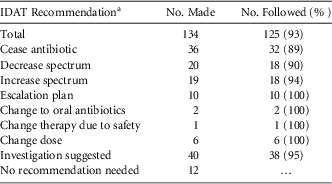
In the intervention group, 134 IDAT recommendations were made for 94 patients, among whom 125 (93%) were followed or partially followed (Table 2). IDAT recommendations included cessation or de-escalation of antibiotics in 56 of 106 patients (53%) and increasing antibiotic spectrum in 19 of 106 patients (18%). Diagnostic investigations were recommended in 40 of 106 patients (38%). Patients without sepsis were more likely to receive a recommendation to cease an antibiotic (29 vs 7; P<.01) and to have further investigation (14 vs 20; P<.05) and were less likely to receive the recommendation ‘increase spectrum’ (1 vs 19; P<.01). Prescriptions for ceftriaxone and pipericillin-tazobactam, the most frequently prescribed antibiotics, were reduced in the intervention group from 34% (46 of 137) to 27% (25 of 94) and were increased in the control patients from 25% (13 of 52) to 44% (28 of 64) at 48 hours.
Compliance with Infectious Diseases Advanced Trainee (IDAT) Recommendations in the Intervention Group

a >1 intervention possible per patient.
Clinical Outcomes
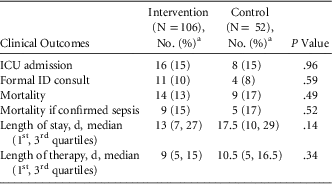
Clinical outcomes were similar in the intervention and control groups (Table 3). Overall, 24 patients (15%) were admitted to the ICU and 15 patients (9%) received a formal ID consult. The difference in mortality between the intervention (14 of 106; 13%) and control group (9 of 52; 17%) was not statistically significant (P=.49). The median LOS was 18 days in the control group and 13 days in the intervention group (P=.14). Overall median duration of antibiotic therapy was 9 days for the intervention patients compared to 10.5 days for controls (P=.34).
Clinical Outcomes of Patients Who Triggered the Sepsis Pathway

NOTE. ICU, intensive care unit; ID infectious diseases.
a Unless otherwise specified.
DISCUSSION
This study demonstrates that appropriateness of antibiotic prescribing at 48 hours for non-ICU inpatients triggering the sepsis pathway was significantly improved by early IDAT review. This finding is consistent with other findings that ID intervention improves appropriate antibiotic prescribing in acute care.Reference Pulcini, Botelho-Nevers, Dyar and Harbarth 12 – Reference Fariñas, Saravia and Calvo-Montes 14 In the patient subgroup with confirmed sepsis, the rate of appropriate antibiotic therapy in patients at 48 hours were comparable, suggesting that the greatest impact from IDAT intervention was on antibiotic management of those patients triggering the pathway who did not have sepsis. This highlights the importance of monitoring quality sepsis interventions for unintended consequences and a role for AMS.
Initial antibiotic management was inappropriate in almost half of the study population. Optimization was predominantly achieved through de-escalation; an increase in spectrum was the next most frequent recommendation. Suboptimal initial antibiotic prescribing may be due to a combination of poor pathway specificity, overattribution of the diagnosis of sepsis in deteriorating patients, and protocol-driven time pressure to administer antibiotics within 60 minutes for suspected sepsis. Similar rates of hospital inpatient infection misdiagnosis were found to be strongly associated with inappropriate antibiotic use.Reference Filice, Drekonja, Thurn, Hamann, Masoud and Johnson 15
The relatively high rate of blood culture sampling suggests effective junior doctor sepsis pathway process training. However, protocolizing inpatient sepsis antibiotic management is difficult given that many patients may already be receiving therapy. Junior doctors (ie, with the least experience) are typically required to make acute inpatient assessments and management decisions, often with less on-site senior medical support compared with emergency departments and ICUs. The imperative for early antibiotic initiation in sepsis management pathways exacerbates this scenario. While appropriate antibiotic therapy should be commenced as early as possible and within 60 minutes for severe sepsis and septic shock,Reference Kumar, Roberts and Wood 3 there is little evidence demonstrating the benefit of early antibiotic administration in uncomplicated sepsis.Reference Sterling, Miller and Pryor 4 , Reference Ryoo, Kim and Sohn 5 , Reference Wisom, Eaton and Gordon 17 Thus, it may be more judicious for sepsis pathways to focus on early antibiotic delivery (<60 minutes) for cases suspected of severe sepsis and septic shock, while further timely investigation should be undertaken for cases suspected of uncomplicated sepsis.
Antibiotic review and rationalization post sepsis trigger is recommended in sepsis pathways, 7 but in clinical practice, these may not be prioritized. Despite a comprehensive hospitalwide AMS programReference Bond, Chubaty and Adhikari 16 and intensive sepsis pathway preimplementation preparation, IDAT intervention facilitated a further significant sizeable improvement in antibiotic prescribing over standard inpatient care beyond the sepsis trigger. Inadequate de-escalation and overprescription of broad-spectrum antibiotics may represent avoidable harm and is important to monitor antibiotic administration in sepsis interventions. AMS efforts could be integrated with sepsis pathway protocols to optimize appropriate initial and ongoing antibiotic therapies. Appropriate, guideline-adherent empirical antibiotic management has been shown to be associated with a relative risk reduction for mortality of 35% (relative risk, 0.65; 95% CI, 0.54–0.80; P<.0001).Reference Schuts, Hulscher and Mouton 18
Secondary outcomes including length of therapy, LOS, ICU admission, formal ID consultation, and mortality were not significantly different between the intervention and control groups. However, this study was not powered to detect a statistically significant difference in clinical outcomes. These clinical outcomes were used to detect potential harms arising from the intervention. Overall mortality of 15% is consistent with other reported inpatient sepsis mortality (15%–35%)Reference Burrell, McLaws and Fullick 19 , Reference Kaukonen, Bailey and Suzuki 20 and was not different among patients diagnosed with sepsis. Although there was no difference in LOS, emerging evidence suggests that improving antibiotic appropriatenessReference Davey, Brown and Charani 8 , Reference Yokota, Alexandre and Marines 21 and ID specialist reviewReference Butt, Al Kaabi and Saifuddin 13 , Reference Fariñas, Saravia and Calvo-Montes 14 may impact this outcome in a larger study.
This study had several limitations including study size, duration, generalizability, and selection bias. Although the study population was small, it was adequately powered to detect the primary outcome of a significant difference in antibiotic appropriateness in patients 48 hours after triggering the sepsis pathway. Standardized national criteria for antibiotic appropriateness 10 were utilized in this study; however, observer bias was a potential risk. This was addressed by using additional blinded assessments by 2 senior ID coauthors, which demonstrated high interrater agreement.
The study intervention was a brief case review by 1 IDAT in a single institution. Therefore, benefits may be operator dependent and are not necessarily generalizable. PDSA cycles may generate different interventions in other settings. Additionally, the capacity of both AMS and quality programs depend on the institution’s resources. To remain cost neutral, additional time required for the IDAT intervention during this study was taken from routine AMS responsibilities. Inclusion of early IDAT sepsis review within AMS programs may prove to be an efficient use of AMS resources, particularly if it is prioritized for higher-acuity patients.
This study was not randomized; therefore, selection bias is a limitation. The small sample size restricts the number of potential baseline differences that can be adjusted for. Nevertheless, those differences considered most likely to influence group allocation and appropriateness, prior antibiotics and triggering the pathway on a Friday or Saturday, were also statistically significant. After adjusting for these, the significance of the impact of IDAT intervention on antibiotic appropriateness remained. Nevertheless, the need to ensure ongoing optimal antibiotic management ‘after hours’ is highlighted by this study and other research demonstrating an association between weekend day admissions and adverse clinical outcomes.Reference Fremantle, Ray and McNulty 22 Other baseline differences were unlikely to be clinically significant for the primary study end point, antibiotic appropriateness.
The difficulty with achieving diagnostic specificity in sepsis is acknowledged in the recent change in the International Consensus Definitions for Sepsis and Septic Shock (SEPSIS-3).Reference Singer, Deutschman and Warren Seymour 23 New sepsis definitions published after the completion of this study hone the criteria for sepsis toward organ dysfunction as a manifestation of an injurious host response to infection rather than focusing on systemic inflammation. Application of SEPSIS-3 criteria in this study would have improved specificity and therefore may have reduced unnecessary exposure to broad-spectrum antibiotics.
In Australia, improvement in emergency department sepsis recognition and care followed implementation of the CEC emergency department sepsis pathway in 2011.Reference Burrell, McLaws and Fullick 19 However, a significant rise in non-ICU inpatient sepsis mortality was also observed, the cause of which was unclear.Reference Burrell, McLaws and Fullick 19 Benefits of adult inpatient sepsis pathways have yet to be established. Further CEC inpatient sepsis pathway revision has occurred since this study was conducted. 24 An evaluation of the impact of these pathways on much needed improvement in inpatient sepsis recognition and management is highly anticipated.
In conclusion, hospital inpatient sepsis remains a clinical challenge. Lack of sepsis diagnostic specificity hinders clinical sepsis pathway implementation and may drive inappropriate antibiotic use. Infectious disease AMS significantly improved antibiotic appropriateness for non-ICU inpatients with suspected sepsis, with the greatest impact on those patients who were misdiagnosed. Hospitals implementing sepsis pathways should evaluate their diagnostic specificity and patients’ antibiotic exposure and consider how AMS may optimize these. Larger prospective studies are needed to validate these findings and evaluate clinical outcomes.
ACKNOWLEDGMENTS
Financial support: No financial support was provided relevant to this article.
Potential conflicts of interest: All authors report no conflicts of interest relevant to this article.