During the post-world war era, international organizations (IOs) have been delegated increasing authority in an ever-wider range of areas. This shift of political power to the global level has been accompanied by growing interest in IOs and their policies from non-governmental organizations (NGOs), which devote extensive energy and resources to the task of influencing global policy making. Nowadays, there is a broad consensus in the existing literature that NGOs sometimes succeed in their efforts to shape IO policies in areas such as human rights, environmental protection, conflict resolution, international trade and humanitarian aid.Footnote 1 This NGO influence is consequential, since IOs in turn are known to affect state behavior in world politics through economic coercion, social shaming, information provision and norm socialization. As Lisa Martin and Beth Simmons conclude in a recent overview, ‘[T]he influences of IOs […] are much more wide-ranging than might have been supposed only a decade or two ago’.Footnote 2
This article focuses on the determinants of NGO influence in IO policy making. Why are NGOs sometimes successful in influencing political decisions in global governance and sometimes not? Not only has this question received considerably less attention than NGOs’ effects on state policies and global norms, by now the object of an extensive literature.Footnote 3 In addition, existing research on this topic offers anything but a conclusive answer. The list of potentially important explanatory factors for NGOs’ influence on IO policy making is long and variegated. It usually includes NGOs’ transnational networks, material resources, level of professionalization, access to decision makers, capacity to mobilize public opinion, moral authority, ideational resources and information provision.Footnote 4 An important reason for the lack of consensus on the determinants of NGO influence is the methodological limitations of existing research. The literature is rich in hypothesis-generating case studies of individual advocacy campaigns, NGOs and IOs, but poor in comparative assessments of influence across different types of NGOs, IOs and issue areas.Footnote 5
Accordingly, this article makes two central contributions. First, we examine the determinants of NGO influence in global governance among NGOs active in different IOs, issue areas and policy phases. The analysis builds on original survey data from more than 400 NGOs involved in five different IOs, complemented by elite interviews with IO and state officials. The dataset enables a comparative, large-n analysis of NGO influence, but also offers a unique resource for future research on NGOs. In a first step, we examine the sources of NGO influence in the central bodies of the United Nations (UN). As an organizational hub in global governance with activities in multiple issue areas and a long history of interaction with NGOs, the UN is particularly relevant for any inquiry of NGO influence in global governance. In a second step, we explore whether our results are specific to the UN or are applicable to other IOs. For this purpose, we extend the analysis to NGOs involved in a specialized UN agency with a programmatic orientation, the United Nations Environmental Programme (UNEP), and in three multi-issue regional organizations, the African Union (AU), the Council of Europe (CoE) and the Organization of American States (OAS).
Secondly, we advance a specific argument about the determinants of NGO influence in IOs. Drawing on theories of lobbying in American and European politics, we conceptualize the relationship between NGOs and IOs as an exchange of information and access. While policy makers in IOs demand multiple forms of information that cannot be sufficiently and efficiently generated within, NGOs typically specialize in collecting and providing information that is relevant to their cause. At the same time, NGOs covet what IOs control – access to the policy process. Engaging in mutually beneficial exchange, decision makers grant NGOs access, while NGOs in return provide information useful to decision makers. Yet since NGOs have strategic incentives to contribute information favoring their interests, and IOs have imperfect means of screening NGOs, the result of the exchange will be policy decisions that reflect some degree of NGO influence. Our argument ties in with a growing literature that emphasizes the many similarities between NGOs and interest groups in how they operate in world politics, and is corroborated by the evidence from the UN and the UNEP, and partially the regional IOs.Footnote 6 We contrast this argument with three alternative explanations of NGO influence – privileging material resources, transnational networks and public opinion mobilization – for which we find no or mixed empirical support.
The article is structured in four sections. First, we outline our argument about information-access exchange and three alternative explanations. Secondly, we describe the survey design and the operationalization of the theoretical concepts through survey questions. Thirdly, we present the results of the quantitative analysis, which we underpin by using the qualitative interview data. We conclude the article by discussing the findings and their implications for the study of NGO influence in world politics.
Explaining NGO Influence in INTERNATIONAL ORGANIZATIONS
What explains NGOs’ relative influence over IO policy outcomes? We first introduce our privileged explanation and then outline three theoretical alternatives.
The Argument: Information, Access and Exchange
We advance the argument that NGOs’ impact in IO policy making is driven by an information-access exchange logic that has proven central to the influence of interest groups in domestic politics.Footnote 7 In its generic, domestic politics version, this theory starts with the assumption that policy makers are uncertain of the implications of potential decisions, and therefore demand information about the likely effects of alternative proposals and the likely reactions from constituency interests. Interest groups are attractive to decision makers because they often possess this kind of information. They tend to be experts on the policy issues that most affect their interests, and frequently collect politically salient information on the views of constituencies. Yet what interest groups lack and desire is access to decision makers – a prerequisite for influencing policy.Footnote 8
Engaging in mutually beneficial exchange, decision makers grant interest groups access to the policy process, while interest groups in return provide information that is useful to decision makers. While co-operative rather than antagonistic, this relationship is not innocent. Both parties recognize that interest groups have a strategic incentive to present specialized information in such a way that it benefits their cause. Decision makers will therefore try to establish mechanisms they can use to evaluate the reliability of interest groups and their information. Yet such screening mechanisms may be imperfect, because of the costs of establishing full control. At the end of the day, decision makers are likely to accept the remaining risk of bias, given the benefits of outsourcing information collection to interest groups. The result will be policy decisions that are different than if interest groups had not been involved.
The logic of this argument is inspired by rationalist resource-exchange theory, as developed in the sociological study of inter-organizational relations.Footnote 9 In this tradition, the interaction of public and private organizations is conceptualized as a series of inter-organizational exchanges. The rationale of the exchange is an absence of organizational self-sufficiency, which pushes the organizations to interact with those actors who control the resources they demand. Consequently, ‘[t]he exchange relation is only likely to be durable when the exchange is reciprocal and both sides receive benefits from the interaction’.Footnote 10
Building on this generic logic, students of interest groups have significantly advanced our understanding of lobbying in American and European politics.Footnote 11 We argue that the logic of information-access exchange can effectively capture the dynamics of NGO influence as well. In our view, there is little reason to assume a priori that the logic of influence is different in global governance than in American or European politics.
First, NGOs are also instrumental actors that seek to deploy the means at their disposal in order to influence decision makers. While there has been a tendency in the literature to view NGOs as constitutively different from domestic interest groups, by emphasizing their value-based orientation, we join recent contributions that question this assumption. Sell and Prakash, for instance, challenge the distinction between instrumental and normative orientations, and show that NGOs were just as instrumental as business actors in their attempts to shape the international intellectual property rights regime.Footnote 12 Mitchell and Schmitz suggest that NGOs instrumentally pursue their principled objectives within the constraints and opportunities imposed by the external environment, and demonstrate empirically how this ‘principled instrumentalism’ is reflected in the perspectives of NGO leaders.Footnote 13 Bloodgood shows that there is extensive empirical overlap between advocacy NGOs and interest groups, suggesting that interest group theories in American politics can be usefully applied to international NGOs.Footnote 14
Secondly, IOs are dependent on multiple forms of information that often cannot be sufficiently or efficiently generated within. To begin with, many problems in global governance are characterized by significant uncertainty, regarding both the available policy options and the effects of alternative choices. The issues commonly dealt with by IOs are not necessarily less complex and information demanding than those in domestic politics. If anything, IOs should be more dependent on external information provision than domestic governments, since they can rarely muster the bureaucratic capacity and expertise of national administrations, even when highly specialized.Footnote 15 Furthermore, information on the views of societal stakeholders is often not directly and naturally forthcoming in IOs. Unless IOs offer access to NGOs, their only channel for information on constituency interests is indirect, through member governments. Finally, IOs are dependent on knowing whether state and societal actors comply with regime rules, but rarely have an independent capacity to generate this information at reasonable cost. IO monitoring of compliance from above is typically both resource demanding and inefficient in detecting violations on the ground.Footnote 16
Thirdly, NGOs usually specialize in collecting information relevant to their cause that is of great potential value to IOs.Footnote 17 For instance, environmental NGOs offer scientific information on policy options for handling ecological problems,Footnote 18 human rights NGOs collect information on violations of such rights worldwide,Footnote 19 and development NGOs provide data on poverty and malnutrition in crisis-struck areas.Footnote 20 NGOs typically provide this policy information for free, allowing IOs to shift research costs off budget. In addition, NGOs contribute information on the views of stakeholders, partly by expressing their own positions and partly by functioning as conduits for civil society. In the latter case, NGOs can be seen as a ‘transmission belt’ between the global citizenry and IOs.Footnote 21 Finally, NGOs have a comparative advantage in detecting non-compliance where information on violations is diffused.Footnote 22 Compared to IOs, NGOs usually operate closer to local populations, enabling them to discover information on non-compliance, either because they experience the violation of their own rights or because they specialize in collecting on-the-ground information of rule violations.
Fourthly, there is evidence that IOs seek to structure institutional access so as to obtain the information that NGOs offer. A recent study demonstrates that NGO access to IOs has increased significantly over the past sixty years, but continues to vary both within and across IOs.Footnote 23 Part of the explanation for the patterns in NGO access is varying demand from IOs for policy expertise, local knowledge and compliance information. This study shows that IOs frequently use accreditation procedures to screen NGOs, and that expertise in the specific issue area is an often-used criterion. Examining a century of delegation to private actors in international environmental treaties, another contribution concludes that NGOs are most often enlisted as ‘helpers’, assisting in the implementation of treaties through their expertise.Footnote 24 Others establish similar patterns based on case studies of international environmental institutions,Footnote 25 the Organization for Security and Co-operation in Europe,Footnote 26 and the Food and Agriculture Organization.Footnote 27
We are not the first to theorize that information affects the level of NGO influence. The literature on transnational advocacy networks conventionally argues that ideational resources and the framing of information are central to the impact of NGOs.Footnote 28 Likewise, the literature on epistemic communities privileges authoritative knowledge as the central source of influence for scientific networks.Footnote 29 Our argument differs from these earlier strands of research by starting from an alternative theoretical position (rationalism rather than constructivism), by conceptualizing NGOs differently (instrumental rather than principled actors) and by specifying a novel mechanism of influence (information-access exchange rather than knowledge construction). These differences have important implications. Where earlier accounts underline that NGOs will quickly lose influence if they are perceived as partial or manipulative,Footnote 30 we expect NGOs to act (and be recognized as) biased interest groups. Where earlier accounts are agnostic about the institutional context of information politics,Footnote 31 we expect information to be particularly influential in conjunction with access to decision makers.
The logic of information-access exchange translates into three hypotheses. The first two predict the direct effects of information provision and access on influence, and the third captures the two-step causal pathway from information to access to influence:
Hypothesis 1: The more NGOs engage in information provision, the more likely they are to influence policy making in IOs.
Hypothesis 2: The greater the access of NGOs to IO bodies, the more likely they are to influence policy making in IOs.
Hypothesis 3: The more NGOs engage in information provision, the greater their access to IO bodies, increasing the likelihood of NGO influence on policy making in IOs.
Alternative Explanations
The logic of information-access exchange is distinct from three commonly proposed alternative explanations of NGO influence: material resources, transnational networks and public opinion mobilization.Footnote 32
First, it is frequently argued that organizations that are well endowed in terms of finances and manpower should be able to devote more resources to advocacy, engage in a broader set of tactics and be present in more arenas.Footnote 33 While it is often assumed in the study of domestic interest groups that financial resources matter by enabling lobbyists to buy influence through campaign contributions,Footnote 34 the logic of the argument is different in the international setting, where the electoral dynamic is weaker or non-existent. In global governance, advocacy strategies consist of either inside or outside lobbying, where the first refers to direct interaction with decision makers and the second to mobilization of public opinion.Footnote 35 Both strategies require extensive resources. Existing research demonstrates that relatively more well-endowed organizations are more likely to engage in lobbying and to afford combining inside and outside lobbying.Footnote 36
Furthermore, well-endowed NGOs should be more able to establish and maintain a long-term presence in IOs, and therefore be better positioned to influence political outcomes. This expectation is borne out in recent work on the communities of NGOs present at the World Trade Organization, the UN climate change negotiations and the UN biodiversity negotiations.Footnote 37 In all cases, more resourceful groups are over-represented among the NGOs that attend ministerial meetings and negotiation sessions. Likewise, research on the EU finds a positive relationship between groups’ resource endowment and influence in EU policy making.Footnote 38
These findings support a traditional concern in interest group studies that actors with greater resources have advantages in policy making. Schattschneider famously referred to the ‘upper-class accent’ of organized interests in the pluralist heaven, and subsequent research on domestic interest group populations has confirmed this bias.Footnote 39 Furthermore, this argument ties in with a broader literature emphasizing that NGOs compete for funding from states, IOs, philanthropic foundations and private citizens.Footnote 40 Taken together, this literature yields the hypothesis that:
Hypothesis 4: The greater the material resources of NGOs, the more likely they are to influence policy making in IOs.
Secondly, one very influential strand of research emphasizes the building of transnational networks as a determinant of successful NGO advocacy.Footnote 41 While this concept is sometimes used to refer to networks involving state and IO officials in addition to NGOs, we exclusively use it to refer to coalitions among NGOs. Networks or coalitions permit NGOs to join forces with likeminded groups, build collective strength and wield more power together than any single actor could have done on its own. As Keck and Sikkink succinctly put it: ‘Success in influencing policy depends on the strength and density of the network, and its ability to achieve leverage’.Footnote 42 Others emphasize how networks serve as mobilizing structures that bring ideas, expertise and energy to facilitate influence in IOs.Footnote 43 The notion that coalitions of likeminded groups can achieve greater influence together than a single group on its own is also firmly anchored in research on domestic interest groups.Footnote 44
Many of the most frequently invoked examples of NGO influence in world politics are advocacy campaigns pursued by transnational networks. Central contributions highlight the success of transnational coalitions against the World Bank,Footnote 45 for human rights,Footnote 46 against landmines,Footnote 47 for the establishment of the International Criminal CourtFootnote 48 and against the building of dams.Footnote 49 Building on social movement theory, a specific literature has emerged over the past decade that focuses on the growth of transnational activism and protest, and on the conditions for successful collective action mobilization.Footnote 50
Exploring the nature of transnational coalitions, Khagram, Riker and Sikkink, for instance, differentiate between transnational advocacy networks, bound together by shared values, dense exchanges of information and common discourses; transnational campaigns, or the strategies that coalitions employ publicly to achieve change; and transnational social movements, which have the capacity to generate co-ordinated and sustained mobilization.Footnote 51 Recent research expands on this inventory by showing how digital media has changed the mode of transnational coalition formation,Footnote 52 and by mapping coalition patterns among international NGOs across issue areas.Footnote 53 In all, this literature generates the expectation that:
Hypothesis 5: The more NGOs join forces in transnational networks, the more likely they are to influence policy making in IOs.
Thirdly, existing research suggests that NGOs are more likely to succeed in their advocacy efforts if they mobilize public opinion for the cause they promote. By raising the public’s awareness of an issue, communicating normative frames of right and wrong and garnering popular support for their cause, NGOs can build political leverage in a way that makes it increasingly difficult for IO decision makers to resist policy change.Footnote 54 In addition, public mobilization serves the purpose of recruiting activists, attracting contributions and strengthening transnational coalitions. Central elements of this strategy are attempts to affect public opinion through news media, social media and campaigns.
In this vein, Gulbrandsen and Andresen highlight the importance of public opinion mobilization in global environmental politics, where NGOs are ‘putting pressure on negotiators, governments, and target groups through campaigning, letters of protest, rallying, direct actions, boycotts, and even civil disobedience’, with the aim to ‘influence public opinion in order to induce states to be more flexible in international negotiations, to push governments to comply with international commitments, and to give polluters and environmentally harmful corporations negative public exposure’.Footnote 55 Recent work extends this logic to a broad set of issues in world politics, emphasizing the ways in which advocacy campaigns use rhetoric to tap into the main cultural currents in the countries where they operate.Footnote 56
As noted earlier, the approach of seeking influence by mobilizing or changing public opinion is often described as an outside strategy, to be distinguished from an inside strategy of direct consultation with decision makers.Footnote 57 Importantly, the outside strategy should not be misunderstood as an outsider strategy, reserved for peripheral and disadvantaged NGOs. Previous research on lobbying strategies suggests that most NGOs use both approaches. Groups with direct access seldom rely exclusively on this strategy, since public support through outside strategies further strengthens their leverage with decision makers, and has the attendant advantage of demonstrating publicly that a group is actively working for a cause, making it easier to secure the support of the membership base and bolstering its long-term potential for influence.Footnote 58 In sum, this literature yields the expectation that:
Hypothesis 6: The more NGOs rely on public opinion mobilization, the more likely they are to influence policy making in IOs.
Research Design
To examine the sources of NGO influence in IOs, we surveyed a random sample of 900 NGOs active in five IOs between December 2011 and July 2012 (see Table 1). The survey approach allows us to collect data on the characteristics of NGOs, such as resource endowment and influence strategies, and to examine the influence of a broad set of NGOs active in different issue areas and policy phases in a range of different IOs, which case-study and preference-attainment methods would not have permitted.Footnote 59
Survey Details

Survey Design
We conducted two surveys. The first focused on NGOs involved in the central bodies of the UN. These are the General Assembly, the Security Council, the Economic and Social Committee (ECOSOC), the International Court of Justice, the Secretariat and all their subsidiary bodies. The choice of the UN was informed by several considerations. First, the UN is a multi-issue IO, active at all stages of the policy process, which permits us to examine NGO influence across issue areas and policy phases within the same organizational context. Secondly, the choice of the UN reduces the risk of a bias for or against inside or outside strategies, since it has a long history of interactions with NGOs, but is also very visible and often the target of public campaigns.Footnote 60 Thirdly, the UN is of particular relevance as perhaps the foremost organizational hub in global governance. The UN survey was conducted through telephone interviews with NGOs. A total of 303 NGOs were asked to participate, and we arrived at 223 completed questionnaires, which amounts to a completion rate of 74 per cent (see Table 1).Footnote 61
In addition, we conducted a second survey among NGOs involved in the central bodies of four other IOs: the AU, CoE, OAS and UNEP. These IOs were selected according to two logics. First, the inclusion of the UNEP allows us to assess whether the determinants of NGO influence are different for UN agencies or programs engaged in specialized policy development and implementation in domains known for their extensive NGO presence. Secondly, we selected the AU, CoE and OAS because they share the UN’s multi-issue orientation, but are organized at the regional level and have different memberships. The survey of NGOs involved in these four IOs was identical to that of the UN, but conducted as a web survey. In total, we invited 597 NGOs to participate, and received 200 completed questionnaires, corresponding to a completion rate of 34 per cent (see Table 1).
We asked questions about NGOs’ characteristics, opportunities for involvement in IO bodies, influence strategies and perceived influence, among others. These questions had to be answered with a view to the body in which NGOs are most involved, assuming that respondents know most about that body and will therefore give more valid answers (for a list of these bodies, see Appendix A). As a first step, we contacted the liaison officer or head of the NGO, describing our project and asking them to help us identify the person in the organization with the most extensive knowledge about involvement in IOs. We then asked that person to complete our questionnaire via phone or email. About half of the respondents had worked in their organization for more than ten years, increasing our confidence in the validity of the data.
We used the same sampling method for both surveys with the aim of establishing random samples of NGOs involved in the respective IOs. We work with a broad definition of NGOs as private non- or for-profit organizations, including civil society organizations, philanthropic foundations, business associations, trade unions and research institutes.Footnote 62 This broad conceptualization is also consistent with how the term NGOs is used in the UN. We conceive of involvement as any form of interaction between an NGO and an IO, irrespective of whether the NGO is formally accredited to an IO or not. The list of NGOs involved in the different IOs was obtained for 2011 by creating two sampling frames: (1) lists of accredited NGOsFootnote 63 and (2) lists of NGOs that are not accredited, but indicate an interest in an IO in the Yearbook of International Organizations Online.Footnote 64 Since the bar for NGOs to get accreditation to the UN is quite low, the population included in the first sampling frame includes a diverse set of organizations that varies in terms of type, geographical origin and resource endowment.Footnote 65 By also including NGOs that are not accredited, we capture those actors that have chosen or been forced to adopt an approach of informal engagement, thus making it possible to arrive at a final sample that includes the full variety of NGOs involved in a particular IO.Footnote 66 Accredited NGOs may be better positioned to answer questions about their activities and perceived influence in an IO, since they may interact more frequently with the IO. We therefore include more accredited NGOs than non-accredited NGOs in the final sample (see Table 1).Footnote 67
In the absence of a 100 per cent response rate, it is important to examine the possibility of non-response error, which arises when non-respondents systematically differ from respondents with regard to characteristics that are relevant to the object of inquiry. Ideally, we would want to compare the characteristics of survey respondents with those of respondents in the total surveyed population.Footnote 68 However, as we lack full information about the total NGO population in world politics, we instead inquired for the reason of non-response when conducting the telephone survey. About half of the organizations that did not respond to the telephone survey indicated a lack of resources as a reason for not participating, which leads us to raise the cautionary note that relatively resource-poor NGOs could be under-represented. Yet the dataset involves NGOs of all sizes, with a relatively similar distribution across all IOs that is skewed toward smaller NGOs (see Appendix Table B1). In addition, the dataset is fairly evenly balanced in terms of NGOs from the global North (60 per cent) and the global South (40 per cent), and there is substantial variation in country origin in each category (see Appendix Table B2).Footnote 69
Given that NGOs’ material resource endowment and their ability to trade politically relevant resources for access may be systematically related,Footnote 70 we investigated the relationship between resource endowment and accreditation status. If relatively poor NGOs are less likely to become accredited, then our sample may be biased toward richer organizations, given that it includes more accredited than non-accredited NGOs. To examine this, we use the number of permanent staff members as an indicator of an NGO’s resource endowment,Footnote 71 coded 0 if NGOs have no or up to ten staff members, indicating relatively resource-poor organizations, and 1 if they have eleven or more, indicating relatively resource-rich organizations.Footnote 72 A t-test shows that the average non-accredited NGO in the sample is not poorer than the average accredited NGO in the sample (p=0.455; N=285). These analyses do not allow us to draw conclusions about NGOs that are not included in our sample, but they indicate that there is no systematic bias in favor of resource-rich NGOs among accredited organizations.
Measurement
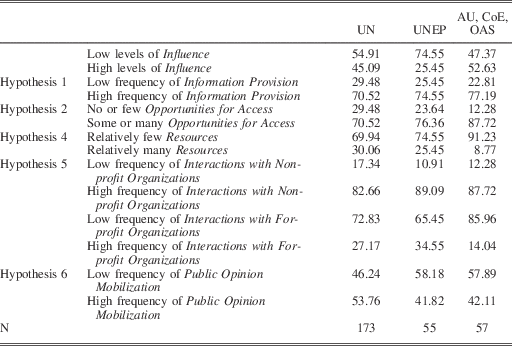
We conceptualize the dependent variable influence as control over political outcomes, understood as the extent to which an actor causes outcomes that would not have come about in its absence.Footnote 73 NGO influence in IOs cannot be measured directly, as influence refers to a process involving several causal relationships.Footnote 74 We seek to tap information about policy processes and outcomes held by those political actors seeking to exert influence. Specifically, we measure influence by using the responses to a question about how NGOs rate their overall impact on policy making in the IO body they are most involved in on a scale from 1 (no impact at all) to 10 (extremely high impact). The variable influence is normally distributed across NGOs in all IOs. The proportion of NGOs experiencing low levels of influence in the UN is about 55 per cent, in the UNEP about 75 per cent and in the three regional IOs about 47 per cent (see Table 2).
Descriptive Statistics

Note: numbers in table are percentages. Coding of categories: low levels of influence (code 1–5), high levels of influence (code 6–10), low frequency of information provision (code 0–3); high frequency of information provision (code 4–6), no or few opportunities for access (code 0–1), some or many opportunities for access (code 2–3); relatively few resources (0–30 permanent staff members); relatively many resources (more than 30 permanent staff members); low frequency of interactions with non-profit organizations (code 0–1); high frequency interactions with non-profit organizations (code 2–3); low frequency of interactions with profit organizations (code 0–1); high frequency interactions with profit organizations (code 2–3); low frequency of public opinion mobilization (code 0–4); high frequency of public opinion mobilization (code 5–9).
As NGOs may have strategic incentives to over- or underestimate their influence in IOs, we assess how (and to what extent) this may affect the validity of our influence measure.Footnote 75 First, respondents that work for NGOs that rely on membership contributions may have incentives to exaggerate the impact of their organization’s work. If this were true, we would expect to find systematically higher evaluations of influence among NGOs receiving membership fees than among those whose budget relies on other revenues. However, a t-test shows that the mean perceived influence of NGOs receiving membership fees is not significantly different from the mean perceived influence of those that do not receive any membership fees (p=0.288, N=230).
Secondly, NGO influence may be downplayed where actors do not wish to appear influential, for instance in order to avoid provoking political counter-mobilization. Notably, for-profit NGOs, which enjoy superior resources and structural power, may have a tendency to downplay their influence.Footnote 76 If this were correct, then we would expect to observe systematically lower levels of influence among for-profit NGOs (for example, business associations) than among non-profit NGOs (for example, philanthropic foundations). Again, a t-test reveals that the mean perceived influence among for-profit NGOs does not differ significantly from that among non-profit NGOs (p=0.986, N=278).
Thirdly, we assess whether other participants in IO policy making – member state representatives and IO staff – see systematic differences in NGO influence between for-profit and non-profit actors as well as between membership organizations and non-membership organizations. For this purpose, we supplemented the survey-based self-assessments of NGO influence with other assessments through nineteen interviews with member state and secretariat officials in the UN. These officials were asked a similar question about their evaluation of NGO impact in the UN body they are most involved in, and given the opportunity to elaborate on their response. The interviews do not yield evidence that the officials assess influence as greater for one or the other category of NGOs.
Fourthly, we consult the results of research specifically aimed at assessing the level of agreement between different measures of interest group influence. In a unique recent study, Helene Helboe Pedersen systematically compares assessments of interest group influence in the Danish Parliament generated through survey data and documentary data. She concludes that ‘different measures of influence are strongly and significantly correlated’ and that there are ‘no clear indications of some group types being less “honest” in their responses’.Footnote 77 Similar findings are reported in another recent study of interest group influence in the US Congress, where it is established that measures of preference attainment and self-assessments of influence are highly correlated.Footnote 78
In all, the results of the t-tests, the corroboration in interview evidence and the findings on measurement agreement in diverse political settings give us reason to assume that our influence measure is not biased due to strategic considerations of specific NGO types.
Next, we discuss the operationalization of the independent variables. We operationalize Hypothesis 1 by using responses to a question about how commonly NGOs provide (a) policy expertise and (b) information on the views and needs of stakeholders when seeking to influence the policy making of an IO body. Both items tap potentially overlapping types of information and are coded from 0 (not at all common), 1 (not too common), 2 (common), to 3 (very common). Adding these variables creates an index of Information Provision ranging from 0 to 6.Footnote 79 Table 2 shows that between 70 and 77 per cent of the NGOs frequently engage in information provision.
Hypothesis 2 is operationalized through responses to a question about NGOs’ opportunities for involvement in IO bodies. The variable Access is coded from 0 (no opportunities), 1 (few opportunities), 2 (some opportunities), to 3 (many opportunities), and captures both formal and informal forms of NGO access to policy making. Table 2 reveals that about 70 per cent of the NGOs involved in the UN or the UNEP experience some or many opportunities for access, compared to about 88 per cent in the three regional IOs.
Hypothesis 3 builds on the operationalizations of information provision and access in Hypotheses 1 and 2.
With regard to the alternative explanations, the variable Resources measures the number of permanent full-time staff members (Hypothesis 4). This is a categorical variable ranging from 1 (zero to two staff members) to 7 (over 201 staff members). Table 2 shows that the greater part of the NGO population has relatively few resources. About 70 per cent of the NGOs involved in the UN and the UNEP have between zero and thirty staff members, whereas about 91 per cent of the NGOs involved in the regional IOs have less than thirty staff members.
We operationalize Hypothesis 5 by using two measures that capture how commonly NGOs interact with other NGOs to increase their influence: Interactions with Non-profit Organizations and Interactions with For-profit Organizations. Both items are coded from 0 (not at all common) to 3 (very common). The percentage of NGOs that interact relatively frequently with non-profit organizations is highest in the UNEP and the regional IOs (almost 90 per cent) and lowest in the UN (about 83 per cent). The share of NGOs with relatively frequent interactions with for-profit organizations is highest in the UNEP (almost 35 per cent) and lowest in the three regional organizations (about 14 per cent).
To operationalize Hypothesis 6, we use responses to a question about how common it is that an NGO attempts to mobilize public opinion through (a) the news media, (b) social media or (c) campaigns, protests and events when seeking to influence the policy making of an IO. Responses are coded from 0 (not at all common) to 3 (very common), yielding an additive index Public Opinion Mobilization ranging from 0 to 9. This index is normally distributed in all IOs.Footnote 80 Public opinion mobilization is common or very common for about half of the NGOs.
Finally, we control for a range of contextual factors, since previous research on NGOs and interest groups suggests that successful advocacy and lobbying may be contingent on the policy-making context. To begin with, we control for policy phase, as some studies indicate that NGO influence should be greatest at the early stages of the policy-making process, particularly in agenda setting.Footnote 81 For this purpose, we measure whether an NGO is active in policy formulation, decision making, implementation, or monitoring or enforcement by means of dummy variables coded 1 if an NGO indicated in the survey that it is active in a policy phase, and 0 otherwise. Furthermore, previous studies suggest that an issue’s degree of complexity may affect the demand for NGO input and, consequently, groups’ capacity to have influence.Footnote 82 We therefore include a series of dichotomous measures indicating whether NGOs are active within a given issue area. These measures are coded using the responses to survey questions about NGO activity in a given policy area.Footnote 83
Sources of NGO Influence
We begin by analyzing the sources of NGO influence in the UN before we assess the generalizability of these findings to the UNEP and the three regional IOs. We test the direct effects predicted in Hypotheses 1–2 and 4–6 using a series of ordinary least square (OLS) regression models, and the mediating effect of access predicted in Hypothesis 3 through structural equation modeling.
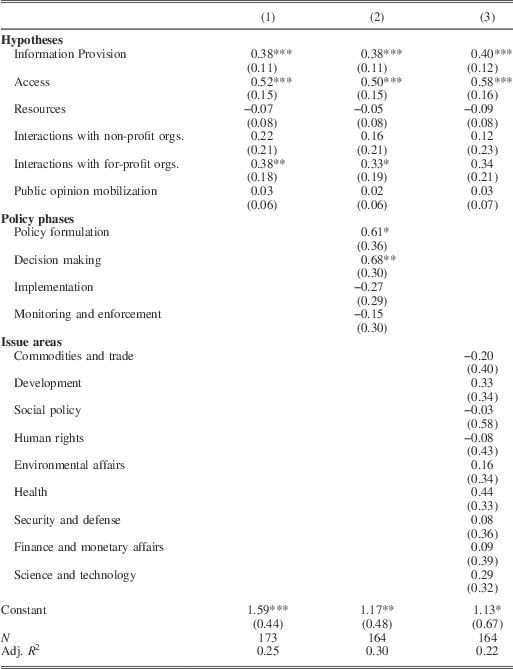
Table 3 presents the results from the OLS regression analyses. The first model includes only theoretically relevant variables, the second model controls for NGO activity in different policy phases and the third model controls for NGO activity in different issue areas.Footnote 84 In all three models, Information Provision and Access are positively related to Influence. This suggests that the more an NGO in the UN relies on a strategy of information provision, the more influential it is in UN policy making (Hypothesis 1). Furthermore, the greater an NGO’s access to UN policy makers, the greater its influence seems to be (Hypothesis 2).Footnote 85
Regression Analysis of NGO Influence in the UN

Notes: unstandardized regression coefficients, with robust standard errors in parentheses. *p<0.10, **p<0.05, ***p<0.01
Turning to the alternative explanations, only Hypothesis 5 receives some support. There is a positive and significant effect of NGOs’ Interactions with For-profit Organizations on influence in the UN. This indicates that coalitions between non-profit and for-profit organizations are conducive to influence in the UN, but not interactions with non-profit organizations, which is in line with findings on the EU.Footnote 86 By contrast, neither an NGO’s resource endowment (Hypothesis 4) nor its reliance on public opinion mobilization (Hypothesis 6) seems to affect its influence in the UN. Last, NGOs that are active in the early stages of the policy-making process – policy formulation and decision making – appear to have more influence, confirming expectations in existing literature.Footnote 87 However, the issue area in which NGOs are involved does not appear to matter for their influence.
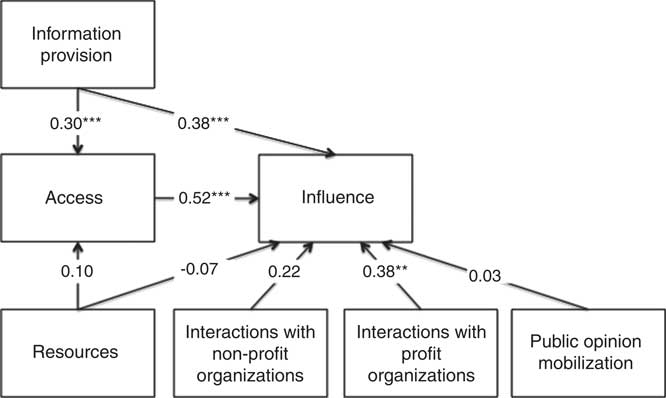
To examine whether the effect of Information Provision on Influence is mediated by the degree of Access enjoyed by NGOs, as predicted in Hypothesis 3, we assess the two-step causal path from information to access to influence using a structural equation model (see Figure 1). We find that the path coefficients for the links between Information Provision and Access, and between Access and Influence, are positive and statistically significant. This suggests that Information Provision affects Influence indirectly through its direct effect on Access. The structural equation analysis also confirms that Information Provision, Access, and Interactions with For-profit Organizations have direct and positive effects on Influence, supporting Hypotheses 1, 2 and 5.Footnote 88 Taken together, these results from the UN endorse our argument that NGO influence is a function of information-access exchange.
Information-access exchange logic in the UN Note: unstandardized coefficients from linear regressions of influence and ordered logistic regressions of access. N=173, df=13, AIC=1,158, BIC=1,199. **p<0.05, ***p<0.01

Anecdotal evidence from the qualitative interviews we conducted with state and IO representatives in the UN lend additional support to these findings. When asked what factors increase NGOs’ impact on policy making, respondents overwhelmingly emphasized the provision of policy expertise and information on stakeholder views, as well as informal contacts with state and UN officials (87 per cent). The interviews also give valuable insights into the exchange dynamic from the perspective of the IO. As one official explains: ‘For the UN, it is not a question of whether to cooperate with NGOs or not. The issue is how to cooperate. – We need to have a mechanism that allows us to get feed-back. – Without a mechanism for consulting, NGOs become useless.’Footnote 89 In testimonies, officials commonly emphasize the value of the expertise that NGOs can offer, the need for the UN to devise ways of acquiring that information and the benefits to an NGO of having recognized knowledge in a particular area. In this vein, three typical UN officials emphasize ‘credible and accurate information’, ‘the quality of their work’ and ‘knowledge from the ground up’ as essential to NGO success.Footnote 90 Likewise, officials highlight the importance of access for NGOs with information if they are to influence policy making. A Swiss representative underlines as most essential ‘the access to as many discussions and exchanges among states as possible’, while one UN official stresses that ‘presence where decisions are being made is extremely important’ and another concludes that ‘those who work alone or without knowing very well the UN mechanisms [for consultation] cannot pretend to have important impact’.Footnote 91
By contrast, the interviews offer less support for the alternative explanations. Public opinion mobilization is identified as a common, but ineffective, strategy. As a French representative puts it, ‘Your message has to be calibrated so that it can fit into the diplomatic process. If you are loud and your message […] does not bring anything or cannot be introduced into some kind of work, it is useless’.Footnote 92 Resources and co-operation with other NGOs do not hurt, according to the interviewees, but neither are they decisive. One UN official with extensive insight into NGO co-operation flatly declared: ‘It is not a question of staff resources or financial resources’.Footnote 93
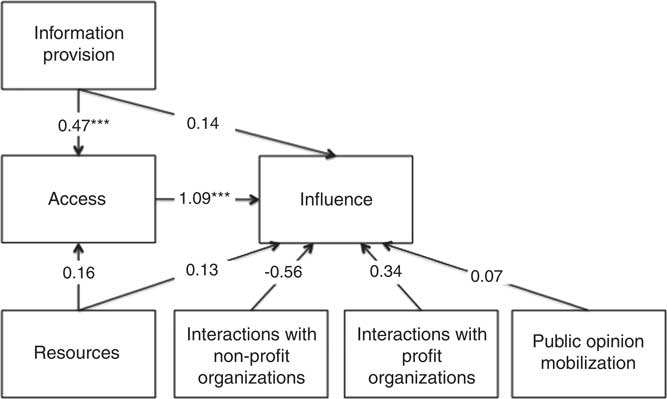
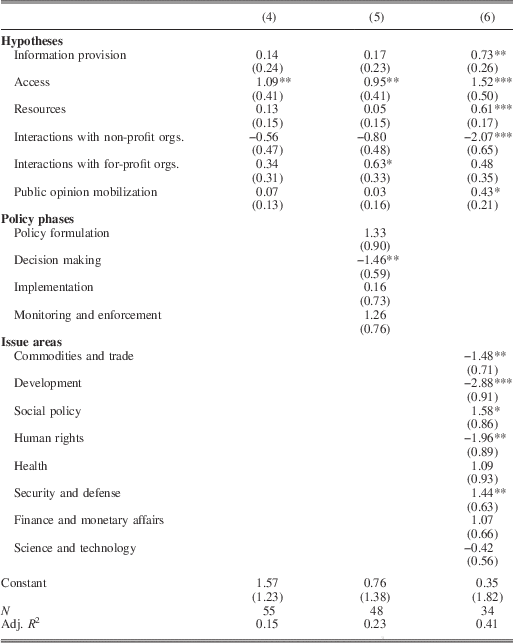
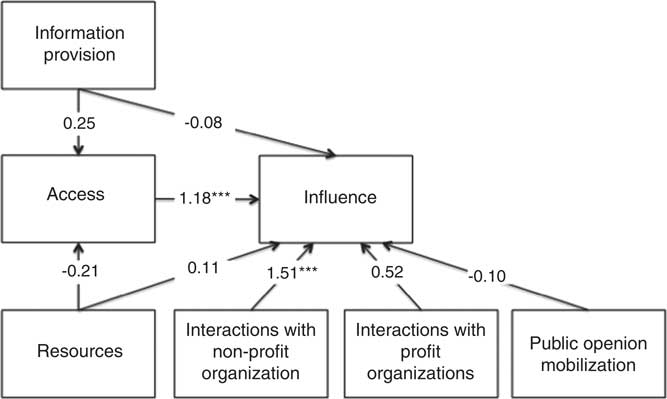
Next, we turn to the question of whether these results from the UN extend to other IOs. Although we cannot directly compare the results from models based on different samples of NGOs, comparing the findings gives us some indication of whether the logic of resource-access exchange is at play in other IOs as well. Beginning with the UNEP, the results from the OLS regression analyses (see Table 4) support the expectation that access helps NGOs lobby this IO effectively (Hypothesis 2). Yet they do not yield robust support for an effect of Information Provision (Hypothesis 1) or any of the alternative explanations. Furthermore, unlike in the UN, the results show that NGOs involved in decision making are less influential, as are NGOs specializing in development, trade and human rights issues, while NGOs active in the area of security and defense report more influence.Footnote 94 The results from the structural equation model (see Figure 2) corroborate the information-access exchange logic predicted in Hypothesis 3, and lend additional support to Hypothesis 2 about a direct effect of Access. However, the results do not lend support for a direct effect of Information Provision (Hypothesis 1).
Information-access exchange logic in the UNEP Note: figures show unstandardized coefficients from linear regressions of influence and ordered logistic regressions of access. N=55, df=12, AIC=352, BIC=376. ***p<0.01

Regression Analysis of NGO Influence in the UNEP
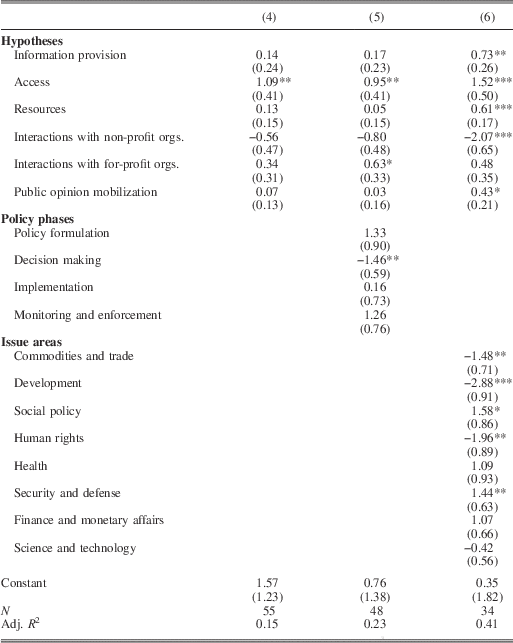
Notes: unstandardized regression coefficients, with robust standard errors in parentheses. The dummy indicating activeness in environmental affairs was dropped from Model 6 since all NGOs involved in the UNEP are active in environmental affairs. *p<0.10, **p<0.05, ***p<0.01
Last, we examine whether the results also apply to the AU, CoE and OAS (see Table 5).Footnote 95 The evidence again corroborates the expectation that access leads to influence (Hypothesis 2), but does not grant support to Hypothesis 1 about information provision. With regard to the alternative explanations, we observe a pattern similar to that in the UN. However, with respect to Hypothesis 5, contrary to the results from the UN, Interactions with Non-profit Organizations has a positively significant effect, while there is no effect from Interactions with For-profit Organizations. Moreover, there is no support for NGO resources and public opinion mobilization as positive sources of NGO influence. The coefficient of Public Opinion Mobilization is even negatively significant, which indicates that this outside strategy functions as a second-best option for NGOs that cannot make their voices heard through inside channels. Finally, NGOs involved in later stages of the policy cycle seem to have less influence. Our structural equation analysis (see Figure 3) corroborates these results but does not yield evidence of an indirect effect of Information Provision on Influence via Access as predicted in Hypothesis 3.
Information-access exchange logic in the AU, CoE and OAS Note: figures show unstandardized coefficients from linear regressions of influence and ordered logistic regressions of access. N=57, df=13, AIC=384, BIC=410. ***p<0.01

Regression Analysis of NGO Influence in the AU, CoE and OAS

Notes: unstandardized regression coefficients, with robust standard errors in parentheses. *p<0.10, **p<0.05, ***p<0.01
In sum, the findings indicate that information-access exchange is an important source of NGO influence in the UN. The more expertise and information NGOs contribute, the more likely they are to enjoy access to policy makers, and, in turn, to influence political outcomes. Interestingly, information provision also promotes NGOs’ influence once NGOs enjoy access. In the UNEP, too, the results yield evidence of information-access exchange. In line with this logic, information provision affects influence through access, while there is no direct effect on influence. By contrast, we do not find evidence of an indirect or direct effect of information in the three regional IOs. Instead, access to decision makers appears to matter greatly for NGO influence in the AU, CoE and OAS. These are substantially important findings. To illustrate the magnitude of the effects, if an average NGO in the UN very commonly provided policy expertise or information on stakeholder views, it would score about 2.3 points higher on the ten-point influence scale than NGOs that provided no such information.Footnote 96 Similarly, moving from no to many opportunities for access would increase the expected value of Influence by about 1.6 in the UN, 3.3 in the UNEP and 3.6 in the regional IOs.
What can potentially explain why the information-access exchange logic receives more support in the UN and the UNEP, compared to the three regional IOs? When comparing NGOs involved in the three sets of IOs in terms of policy phase involvement, policy area focus, resources and profit orientation, three patterns stand out that may help explain why information provision is a less important determinant of influence in the AU, CoE and OAS (see Appendix Table C4). First, NGOs in the UNEP are considerably more active in the areas of environment and natural resources (100 per cent) and science and technology (61 per cent) compared to NGOs in the three regional IOs (57 and 36 per cent, respectively). Both are areas where policy expertise from NGOs is highly valued by IOs and frequently identified as a source of NGO influence in case studies.Footnote 97 Secondly, NGOs in the AU, CoE and OAS stand out in terms of their relatively higher activity in the areas of human rights (93 per cent) and security (36 per cent) compared to NGOs in both the UNEP (67 and 25 per cent, respectively) and the UN (79 and 29 per cent, respectively). Yet these are both policy areas associated with Westphalian sovereignty, where states are known to be very anxious about their control, which may leave fewer opportunities for NGOs to contribute information that shapes political outcomes. Thirdly, NGOs in the three regional IOs more seldom have a profit orientation (4 per cent) compared to NGOs in the UNEP (11 per cent) and the UN (16 per cent). If profit-oriented NGOs are more able to exert influence based on information provision, which has been found in the EU context, this could help account for the explanatory pattern we have observed.Footnote 98 We discuss these findings against the backdrop of previous research in the concluding section.
Conclusion
As IOs have been delegated growing political authority, NGOs have directed increasing effort at influencing global policy making. This article has offered a large-n empirical assessment of the sources of perceived influence among NGOs active in multiple IOs, issue areas and policy phases of global governance. Our argument can be summarized in four main conclusions.
First, while NGOs engage in multiple strategies aimed at influencing IO policy making, they are most likely to succeed when exchanging information for access. The evidence in favor of this logic is strong in the UN and the UNEP, but weaker in the three regional IOs. The greater explanatory power of the information-access exchange logic in the former IOs may be a result of NGOs’ greater involvement in relatively information-dependent issue areas and lesser involvement in sovereignty-sensitive issue areas, as well as NGOs in these IOs more often being for-profit organizations. The consistently most important determinant of NGO influence across all five IOs is access to policy making. This finding challenges claims that access only aims to silence opposition,Footnote 99 mainly constitutes a window dressing strategyFootnote 100 or has few consequences for NGO influence.Footnote 101 It also suggests that recent reforms in IOs toward greater NGO access have been, and are likely to remain, consequential for global policy making.Footnote 102
Secondly, there is some evidence that involvement in transnational networks among non-profit organizations favors NGO impact in the three regional organizations. Networks and coalitions may enable NGOs to join forces and exert greater influence together than on their own. This result confirms expectations in the existing literature on NGO advocacy and interest groups.Footnote 103
Thirdly, contrary to the experience in domestic politics, material resources and public opinion mobilization do not appear to matter systematically for NGO influence in global governance. The absence of an effect of resources may be due to a potentially more homogeneous population of NGOs internationally, given the costs of going global and the irrelevance of campaign contributions as a means of influence in the international setting.Footnote 104 In the case of public opinion mobilization, potential explanations include the lower political salience of international issues compared to domestic concerns and the fact that many IO policy makers do not need to face electorates – two conditions that reduce the pressure from public opinion on IO policy making.
Fourthly, NGO influence is partly shaped by contextual conditions, especially the policy stage at which NGOs are active. Results from the UN confirm that NGOs tend to have the most influence at the early stages of the policy process.Footnote 105 Conversely, NGOs that primarily are involved at the stage of implementation experience less influence over outcomes in the three regional IOs. These findings underline the importance of studying NGO influence under varying conditions.
Our results suggest three broader implications for the study of NGOs in global governance. First, the logic of information-access exchange offers a useful theoretical frame for analyzing non-state influence, not only in American and European politics, but also in global governance. Much like national interest groups, NGOs trade in information, making themselves useful to IOs in ways that enable influence over policy making. IOs are not intrinsically less information-demanding organizations than national administrations, nor are NGOs less information-rich than domestic interest groups. This ties in well with recent literature that challenges the widespread image of NGOs as constitutively different from interest groups. While many NGOs may be guided by principled aims, they tend to act strategically in pursuit of these objectives, rely on information provision as an influence strategy and are most successful when engaging in mutually beneficial exchange with IOs.Footnote 106 Two natural next steps for future research are to assess this logic based on measures of objective (rather than perceived) influence and in the context of IOs with different decision-making procedures and policy orientations than those explored here.
Secondly, this article demonstrates the benefits of seeking closer integration between the literature on NGOs in international relations (IR) and research on interest groups in comparative politics. For too long, the study of NGOs in global governance has been divorced from the study of interest groups in American and European politics, given the conceptual and empirical parallels.Footnote 107 For IR scholars, existing research on interest groups in the domestic setting offers a rich potential source of theoretical and methodological inspiration. Areas where the existing literature on interest groups has reached some maturity and can contribute to the development of IR research include the mobilization, population dynamics, internal organization, strategies and influence of interest groups.Footnote 108
Thirdly, this article joins other recent contributions in showing the promise of quantitative methods as a complement to case studies in research on NGOs in global governance.Footnote 109 While the rich set of existing case studies of individual IOs, NGOs and advocacy campaigns has offered unique insights into the nature of transnational activism, the advantages of comprehensive data collection and comparative statistical analysis will become increasingly relevant as this research program engages more in systematic hypothesis testing.
Supplementary Material
To view supplementary material for this article, please visit http://dx.doi.org/10.1017/S000712341500037X