BACKGROUND
Increasing life expectancy along with a higher incidence of chronic disease in Indigenous peoples has led to a growing need for end-of-life/palliative care (McGrath, Reference McGrath2000; Kitzes & Domer, Reference Kitzes and Domer2004; Assembly of First Nations, 2005; Kelley, Reference Kelley2010). “Indigenous” is a word that is used internationally to mean native to an area (National Aboriginal Health Organization, 2012). Research studies have made an important contribution to understanding end-of-life experiences for Indigenous peoples with chronic diseases or terminal illness (Barkwell, Reference Barkwell2005; Castleden et al., Reference Castleden, Crooks and Hanlon2010; Clark & Phillips, Reference Clark and Phillips2010; Kelley, Reference Kelley2010; Bellamy & Gott, Reference Bellamy and Gott2013). These experiences are a reflection of unique heritages, languages, cultural practices, and spiritual beliefs (Kelly & Minty, Reference Kelly and Minty2007; McGrath & Phillips, Reference McGrath and Phillips2008). However, a literature review of quantitative and qualitative studies of Indigenous people regarding end-of-life issues (Kelly & Minty, Reference Kelly and Minty2007) concluded that the existing literature is scant and provides an incomplete picture of the issues. Given the complexity of the concept of end of life and the importance of understanding Indigenous people's experiences at the end of life, the development of knowledge in this area is critical.
Metasynthesis is a method of synthesizing qualitative research findings to enhance their contribution to the development of more formalized knowledge (Zimmer, Reference Zimmer2006). This method seeks diversity in studies to explore how disparate findings are conceptually related to each other and to clarify the defining and overlapping attributes (Sandelowski & Barroso, Reference Sandelowski and Barroso2007). This approach is particularly useful for exploring the diverse experiences of Indigenous peoples. For example, when using a metasynthesis approach, studies from different cultures and contexts are not assumed to be the same; rather, the findings highlight differences as well as similarities. The resultant findings from a metasynthesis thus provide a potentially more in-depth understanding of Indigenous people's experiences at the end of life. Our intent was not to speak on behalf of Indigenous peoples, but to address a significant gap in the literature. The primary purpose of this metasynthesis study was to explore the end-of-life experiences of Indigenous peoples. The secondary purpose was to inform others of the extent of work in this area worldwide. Further understanding of the end-of-life experiences of Indigenous peoples is of value with respect to enhancing care provider knowledge and positively impacting the care received at the end of life.
METHOD
The procedures for conducting a metasynthesis of qualitative research studies outlined by Sandelowski and Barroso (Reference Sandelowski and Barroso2007) were employed to complete: (a) a comprehensive search, (b) an appraisal of reports of qualitative studies, (c) classification of studies, and (d) synthesis of the findings. Research team members guided this process. This team was multidisciplinary and included Indigenous and non-Indigenous researchers from Canada, Australia, New Zealand, and the United States.
Search Method
The team members met with an experienced librarian and determined the search terms. The librarian then searched MEDLINE, Embase, PsycINFO, CINAHL, Web of Science, and ProQuest Dissertations & Theses Full Text using key search terms and subject headings for Indigenous people, terminal illness, palliative, and end of life. A qualitative and mixed-methods study filter was also utilized. Depending upon the database and controlled vocabularies available, each search was modified using a combination of subject headings/keywords in the title as search strategies.
Two research assistants reviewed the titles and abstracts of all of the studies found through the search and identified those that were appropriate based on five inclusion criteria: (a) studies on the experiences of Indigenous populations (all genders, 18 + years of age) at the end of life; (b) studies published in English in any country; (c) studies using qualitative and mixed-methods designs; and (d) studies published between 1993 and 2013. Studies meeting the inclusion criteria were retrieved and the references within reviewed for inclusion criteria. The relevant researchers/authors were also contacted and asked if they had additional articles accepted for publication that they would be willing to share.
Search Outcome
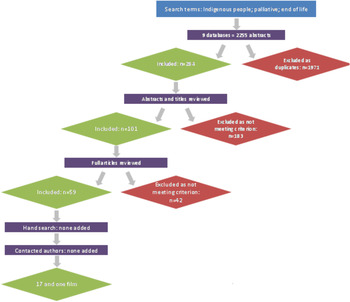
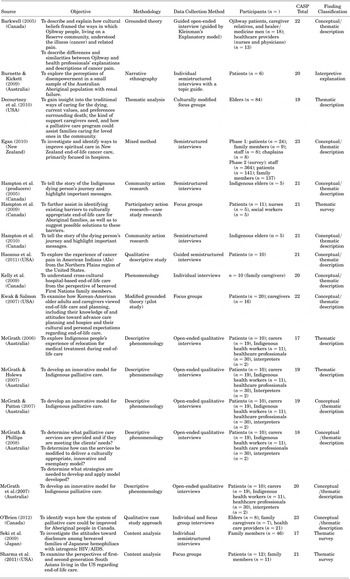
A flow diagram detailing the search is presented in Figure 1. Overall, a total of 2255 articles were obtained with a final selection of 17 articles and 1 film, which reported the findings of a research study, meeting the inclusion criteria. The authors of the selected 18 studies were contacted and asked if they knew of any articles not captured in our search. Seven responded, but no additional articles were found. The 18 studies included in the metasynthesis represented diverse topic areas in palliative/end-of-life care, such as pain control, communication, and spirituality. Demographic information about the study participants (e.g., sample age, disease/illness, gender) was entered into SPSS 20 for descriptive analysis. Table 1 lists the included studies, their purpose, their method, and quality appraisals.
Flow diagram of search.

Study characteristics

The studies were conducted mainly in Canada (n = 6), Australia (n = 6), and the United States (n = 4), and included one from New Zealand and one from Japan. No studies from Europe, Africa, or South America were found. In total, the perspectives of 447 Indigenous persons with terminal illness, family members, and elders were involved in these studies. All data on healthcare providers' perspectives were excluded to maintain the focus on Indigenous peoples.
Appraising Reports of Qualitative Studies
The purpose of the appraisal was to become familiar with the reports and to evaluate them. All of the selected studies were appraised using Sandelowski and Barroso's (Reference Sandelowski and Barroso2007) reading guide. The selected studies were also evaluated utilizing the Critical Appraisal Skills Program (CASP) (available at: http://phru.nhs.uk/casp/qualitat.htm), which provides a standardized mechanism for appraising qualitative studies (Britten et al., Reference Britten, Campbell and Pope2002; Feder et al., Reference Feder, Hutson and Ramsay2006). It consists of 10 questions covering the credibility and relevance of studies to a metasynthesis question. The maximum score, indicating highest study quality, is 24. The range of CASP scores for the 18 studies included in the metasynthesis was 17 to 23, with a mean of 20.2 (SD = 2). No studies were excluded because of CASP score. However, the CASP was employed to provide a description of the methodological quality of the studies included in the metasynthesis.
Classifying the Findings
Sandelowski and Barroso's (Reference Sandelowski and Barroso2007) classification system was used to identify the actual analytic work performed (vs. what was stated). They suggest that topical survey studies be excluded from a metasynthesis, but this did not apply to any of the studies under consideration. The 18 studies reviewed included 11 conceptual/thematic descriptions, three thematic descriptions, one interpretive explanation, and three thematic surveys. Sandelowski and Barroso (Reference Sandelowski and Barroso2007) suggest that interpretive qualitative studies provide a rich in-depth understanding of a phenomenon, and only 1 of 18 was classified in this category.
The reported methodologies represented a wide range: six phenomenologies, four descriptive/content/thematic analyses, three participatory/community action research studies, two grounded-theory studies, one case study, one mixed-methods study, and one ethnography. Classifications are reported in Table 1 along with a description of the studies.
Synthesis of Findings
Taxonomic analysis (Sandelowski & Barroso, Reference Sandelowski and Barroso2007) was conducted to identify significant underlying concepts and conceptual relationships to explore the end-of-life experiences of Indigenous people. Using constant target comparison (Sandelowski & Barroso, Reference Sandelowski and Barroso2007), the study findings were then evaluated for similarities and differences to clarify defining and overlapping attributes of end-of-life experiences along with interactions with the healthcare system. This resulted in discerning the relationships among the interpreted concepts. Reciprocal translation (Sandelowski & Barroso, Reference Sandelowski and Barroso2007) was then used to integrate the metasynthesis findings using concepts in the broader literature outside of the 18 included studies.
Validity
The descriptive validity for this metasynthesis as suggested by Sandelowski and Barroso (Reference Sandelowski and Barroso2007) was maintained by: (a) full team discussion and decision on search terms and inclusion criteria; (b) a comprehensive search for literature; (c) appraisals by two members of the team; (d) contacting authors for additional information; and (e) keeping an audit trail of search results and decisions. We also utilized a reflective process to ensure that the findings were interpreted in a meaningful and useful way and were reflective of the Indigenous voices as reported in the original studies. Team members reviewed the findings individually and then met as a team to discuss the emerging findings. The findings were also discussed with individual Indigenous persons outside the team. Aided by this additional grounding in Indigenous perspectives, the team discussed the findings of the studies and themes until agreement was reached through consensus.
FINDINGS
Although the studies included in the metasynthesis reflected the perspectives of diverse populations of Indigenous peoples, common themes emerged. The overarching theme of the findings was “preparing the spirit.” This theme has the following subthemes: “where we come from,” “protecting,” “healing,” “connecting,” and “what I want at the end of life.” Each of these themes is explained in detail below.
Preparing the Spirit
Because death was seen as a time of transition, “preparing the spirit” became the central focus of the end-of-life experiences. As noted in Hampton et al. (Reference Hampton, Baydala and Bourassa2005), “If a spirit is not at peace, due to lack of emotional or mental wellness, then it will be blocked from a successful transition.” The notion of a journey was also expressed by Decourtney et al. (Reference Decourtney, Branch and Morgan2010): “You prepare yourself for the road you will take when you go, because you don't have anything left in this world.” Preparing the spirit occurred within the context of “where we come from.”
“Where We Come from”
Participants described “where we come from” as inherently important to their experiences (McGrath & Patton, Reference McGrath and Patton2007; McGrath & Phillips, Reference McGrath and Phillips2008; Burnette & Kickett, Reference Burnette and Kickett2009; Hampton et al., Reference Hampton, Baydala and Drost2009). For example, Burnette and Kickett (Reference Burnette and Kickett2009) reported a participant saying, “I just think some of the staff in hospital don't understand where we come from.” The concept of “where I come from” included beliefs and values as Indigenous peoples and their perspectives about ”the heart and spirit,” transitions, and the concept that “sickness is inseparable from the pain of life.”
The “heart and spirit” were the most important focus for participants at the end of life: “care and comfort for the heart and spirit took precedence at the end of life” (Hampton et al., Reference Hampton, Baydala and Bourassa2010). The spirit was described as being connected to the world through the heart: “Help us and listen to us as the First Nations people; we talk from our heart rather than from our minds” (Hampton et al., Reference Hampton, Baydala and Bourassa2010). The spirit embodied the essence of life for participants and was described using the terms “spirit” (McGrath & Phillips, Reference McGrath and Phillips2008; Egan, Reference Egan2010; Hampton et al., Reference Hampton, Baydala and Bourassa2010), “energy,” or “life force” (Hampton et al., Reference Hampton, Baydala and Bourassa2010).
Common among all studies in the metasynthesis was the concept of death not being the end of life (McGrath et al., Reference McGrath, Holewa and Ogilvie2006; Egan, Reference Egan2010; Hampton et al., Reference Hampton, Baydala and Bourassa2010; Sharma et al., Reference Sharma, Khosla and Tulsky2012). The Indigenous persons in the studies believed that the spirit does not die, but lives on or transitions. However, there were different perspectives on what happens to the spirit at the time of this transition. For example, one participant noted that “Death is not welcomed by any means, but accepted as a normal and inevitable process. Death is not the end of anything; it is just a transition” (Hampton et al., Reference Hampton, Baydala and Bourassa2005). Another Indigenous person said that “death is (…) merely the completion of the circle of life on this side of the curtain” (Hampton et al., Reference Hampton, Baydala and Bourassa2010). The transition was also described as a time when an individual went to an afterlife with deceased family members (Egan, Reference Egan2010), or that the life force returned to “their country or some say to heaven, or a bit goes to country and heaven” (McGrath & Phillips, Reference McGrath and Phillips2008). Despite these diverse perspectives regarding where the spirit transitions to, there was consensus that death was not considered the end of life.
With respect to the underlying causes of death, “Sickness [was seen as] inseparable from the pain of life” (Barkwell, Reference Barkwell2005). Pain was often described as being both collective and individual (McGrath & Phillips, Reference McGrath and Phillips2008; Hampton et al., Reference Hampton, Baydala and Drost2009). For example, collective pain experienced by Indigenous populations was the result of historical racism and oppression and a “lack of awareness of the impact and extent of historical racism and oppression, and multiple traumas that is experienced by Indigenous people” (Hampton et al., Reference Hampton, Baydala and Drost2009). The pain of life was also experienced by the individual, and each would seek treatment based on “how they believe the problem/illness originated” (McGrath & Phillips, Reference McGrath and Phillips2008). For some, pain became part of their life experience, for example, “because pain of cancer exceeded the physical boundaries, and it extended to disrupt physical, psychological, social, and spiritual integrity” (Barkwell, Reference Barkwell2005). Overall, sickness was viewed as more than a disease; it reflected, represented, and was constituted by historical and present pain, both of which harmed the spirit.
Protecting
The process of protecting involved guarding the spirit from any subsequent harm or pains that could cause disruption, fracturing, or imbalance (Barkwell, Reference Barkwell2005; Kwak & Salmon, Reference Kwak and Salmon2007; Kelly et al., Reference Kelly, Linkewich and Cromarty2009; Hampton et al., Reference Hampton, Baydala and Drost2009; Reference Hampton, Baydala and Bourassa2010; Haozous et al., Reference Haozous, Knobf and Brant2011). The majority of protecting activities described by participants involved guarding from negative thoughts. Many participants took the view that negative thoughts harm the spirit and at times may result in death. For some, not speaking of illnesses was a tradition: “People think that the more they talk about it, it will come” (Kelly et al., Reference Kelly, Linkewich and Cromarty2009). One participant indicated that they felt pressured by healthcare providers to engage in conversations about advanced directives with their families, as this was counter to how this topic was dealt with culturally: “People know through noon-chi [emotional intelligence in Korean culture]. My children already know what I want, so why talk about it and cause [emotional] troubles?” (Kwak & Salmon, Reference Kwak and Salmon2007).
In addition, naming the illness could also draw too much attention to the negative energy and cause it to spread, and, specifically, “Naming the condition, especially in the case of cancer, has the potential to influence the mind to anticipate negative outcomes. Negative thoughts create negative realities. Blocking, not speaking about the illness, is a means of avoiding that” (Barkwell, Reference Barkwell2005). This was very prominently described in the experiences of cancer. For the kin, it was critical to not “catch” these negative thoughts, or the spirit of the dying person would be further fractured and trapped in this life. This is clearly illustrated in the words of a dying individual speaking to his niece who was crying at his bedside: “If you cry, you're going to hold me back. You're going to hold me back when I'm going” (Hampton et al., Reference Hampton, Baydala and Bourassa2010). Overall, the process of protecting involved the safeguarding of the spirit from further harm that could occur through pain and isolation.
Healing
Healing was described as the mending of the spirit from the ongoing pains of life (Barkwell, Reference Barkwell2005; Hampton, Reference Hampton2005; Haozous et al., Reference Haozous, Knobf and Brant2011). Recognizing the contributing causes of the pain was important to making the spirit whole again. For example, to assist in this healing process it was important for kin and other care providers to “visualize the pain that [others were] going through in order for us to feel it. (…) true and genuine support for the patient and a sense of hope was possible after making this connection with the ‘other's pain'” (Barkwell, Reference Barkwell2005). It was through this healing process that individuals were able to “cope with the suffering in their experience” (Haozous et al., Reference Haozous, Knobf and Brant2011).
Some studies described that, through spiritual healing, participants were able to come to a sense of peace: “[spiritual connection] offers you the ability to be at peace with what the Creator has given you or as close as possible” (Hampton et al., Reference Hampton, Baydala and Bourassa2005). Healing also helped with connecting to a higher power; indeed, “Healing offers pure straight communication with the Creator” (Hampton et al., Reference Hampton, Baydala and Bourassa2005). Overall, the process of healing increased feelings of peace and facilitated connecting with others.
Connecting
The process of connecting was described as the actions undertaken for the purpose of building the strength of the spirit to enable its journey onward. This process involved gaining energy through connections with greater beings, kin, previously deceased family members, and the homeland.
Connecting with a “Greater Being” resulted in feelings of comfort and peace (Barkwell, Reference Barkwell2005; Hampton, Reference Hampton2005; Hampton et al., Reference Hampton, Baydala and Bourassa2010; Haozous et al., Reference Haozous, Knobf and Brant2011). For example, one participant said, “When the pains, if I said my prayers. (…) My prayers were stronger than the pain, so I knew He would be there beside me and He would help” (Barkwell, Reference Barkwell2005).
Connecting with kin was deemed to be especially important for Indigenous persons (Barkwell, Reference Barkwell2005; Hampton, Reference Hampton2005; Seki et al., Reference Seki, Yamazaki and Mizota2009; O'Brien, Reference O'Brien2012). In the film “Completing the Circle,” one family member said, “As a family, it is very important to help prepare for death in your family by offering your support through prayer. Prayer can be shown in various ways—song, food, traditional practices like smudging. These are all ways that we give our energy to our loved one” (Hampton et al., Reference Hampton, Baydala and Bourassa2005). It was very important to the family to be able to provide this energy to their family member to help make the transition onward. As expressed by one participant, “you know, because it's important that everybody gives their energy at that time to that person” (Hampton et al., Reference Hampton, Baydala and Bourassa2010).
Connecting with kin also produced feelings of comfort in very challenging circumstances. As noted by Haozous et al. (Reference Haozous, Knobf and Brant2011), “Making connections with community and family provided important coping for a population that is economically, socially, and physically isolated.” Connecting with kin was viewed as very important to the spirit of the dying person as they prepared for the journey. In fact, many participants indicated that this was one of the most important parts of their preparation: “That's what preparing for death is—stick together as a family” (Hampton et al., Reference Hampton, Baydala and Bourassa2010).
Another important connection was with deceased family members who, for some Indigenous persons, provided a direct connection to the other side of death (McGrath & Phillips, Reference McGrath and Phillips2008; Decourtney et al., Reference Decourtney, Branch and Morgan2010; Egan, Reference Egan2010; Hampton et al., Reference Hampton, Baydala and Bourassa2010). For example, this connection with deceased family was described as “literally seeing her dead ‘nanny’ who ‘had made a place for me’” and “my tipuna [ancestors]—yeah” (Egan, Reference Egan2010). This connection sometimes occurred through a special sign, which could be “anything (…) a bird, star, a voice, a noise in your dreams, or somebody touches you” (McGrath & Phillips, Reference McGrath and Phillips2008). Such encounters usually occurred when the dying individual was being called to the other side by deceased family members. Overall, these connections enhanced feelings of peace and comfort for the dying person, as these encounters were described as “friendly spirits” that “help me” and “guide me” (Egan, Reference Egan2010).
Connection with the land was also important to provide comfort for participants (McGrath, Reference McGrath2006; Kwak & Salmon, Reference Kwak and Salmon2007; McGrath & Holewa, Reference McGrath and Holewa2007; Decourtney et al., Reference Decourtney, Branch and Morgan2010; O'Brien, Reference O'Brien2012). However, land or homeland had different meanings. To some, homeland was the physical place to which they were strongly connected: “Indigenous peoples (…) have a strong tie with their land and a desire to die in their homeland” (McGrath, Reference McGrath2006). For others, it was the place where they were with their own people: “Because we do have a lot of Natives that are off the reserve, and we just want to come home, and if we know that our time is near, I don't know, it's like, I just want to go home to die. Or some of our people went out and never married or had children, but they would like to be surrounded by Natives again” (O'Brien, Reference O'Brien2012). Thus, connection with kin could create a homeland even when the physical place was not that home. Regardless of how homeland was described, participants indicated that feeling connected to their home was important: “They want to be home. If you ask them, they'd rather be home” (Decourtney et al., Reference Decourtney, Branch and Morgan2010). Through the process of connecting with greater beings, kin, previously deceased family members, and their homeland, Indigenous peoples were able to prepare the spirit for the journey ahead.
“What I Want at the End of Life”
Preparing for transition of the spirit through the processes of protecting, healing, and connecting was seen to as way to achieve “what I want at the end of life.” This subtheme included the following: the spirit being at peace, to feel comforted and safe, and to be strong for the journey ahead. When the spirit was at peace, the spirit had become whole once again (healed) and the individual could be at rest. Participants described how the spirit “should be able to make the transition with dignity and a feeling of mental and emotional wellness, and if something is blocking that, then you aren't going with ease” (Hampton et al., Reference Hampton, Baydala and Bourassa2005).
Feeling comforted and safe was most commonly described when the individuals were surrounded by other Indigenous persons: “To me, that's home, when you're surrounded by your own kind of people. And you feel more comfortable that way, that you're with your people” (O'Brien, Reference O'Brien2012). Feelings of comfort were also described after they “had positive experiences with healthcare providers who were seen as being considerate and compassionate” (Hampton et al., Reference Hampton, Baydala and Drost2009), and were able to meet on common ground when “[the healthcare providers] heard [they] were talking from [their] hearts” (Hampton et al., Reference Hampton, Baydala and Bourassa2010).
The feeling of comfort and safety was also experienced when appropriate information was provided to facilitate end-of-life decisions by the dying individual and their family (McGrath et al., Reference McGrath, Patton and Ogilvie2007; Burnette & Kickett, Reference Burnette and Kickett2009; Seki et al., Reference Seki, Yamazaki and Mizota2009). At times, participants found themselves pleading with healthcare providers to tell them about their conditions: “My son would plead with the doctor, saying, ‘I'm ready for whatever you say, so please tell me what's going on,’ but that day would go by with nothing said” (Seki et al., Reference Seki, Yamazaki and Mizota2009).
Comfort was also experienced when appropriate physical care allowed individuals to prepare the spirit with fewer physical limitations (McGrath & Phillips, Reference McGrath and Phillips2008; Burnette & Kickett, Reference Burnette and Kickett2009). For example, one study participant noted, “When I first started on dialysis, after the first couple of weeks, I noticed the difference: a new person, breathe better, walk better, eat like a new person” (Burnette & Kickett, Reference Burnette and Kickett2009). Comfort was achieved when there was a combination of “balanda or Western medicine plus cultural medicine, plus fellowship, church or spirit—you know, other way of things, so the whole three we work in together in that way“(McGrath & Phillips, Reference McGrath and Phillips2008).”
Having strength or energy was described as a necessary component for the spirit to transition effectively to the next stage (McGrath & Phillips, Reference McGrath and Phillips2008; Hampton et al., Reference Hampton, Baydala and Bourassa2010; O'Brien, Reference O'Brien2012). The comfort provided by the family and community was very important to have energy; indeed, the “elders explained that in their traditional worldview, many people come to be with a dying person to give energy to the person and to the grieving loved ones” (Hampton et al., Reference Hampton, Baydala and Bourassa2010).
The studies reviewed also contained descriptions of barriers to gaining strength and energy from kin as a result of healthcare system policies. For example, one elder noted, “One of the things [he didn't] understand is this five-minute rule with the person that is dying. It's to let—everyone should let—extended family as well—and they'll say just family, and there are, like 30 people out there who want to be in the room. You know, because it's important that everybody gives their energy at that time to that person. It's not that they're taking [energy] (…) I don't understand the whole concept of keeping it down to a few people and not allowing the things to happen that would happen if they were at home” (Hampton et al., Reference Hampton, Baydala and Bourassa2010).
The availability of physical space was often described by participants as a great challenge, especially when it was inadequate to complete necessary preparatory activities. The lack of space for family members in “some care environments such as the ICU—or visiting rooms—challenged the ability to be surrounded with needed support for the end of life” (Hampton et al., Reference Hampton, Baydala and Drost2009). Participants indicated that “For appropriate care to be provided [it was] suggested that it be culturally appropriate: allowing big family gatherings, ‘smoking out,’ grieve traditionally [crying and wailing]” (McGrath & Patton, Reference McGrath and Patton2007). Overall, care environments that did not facilitate connecting with family or spiritual rituals were perceived as a barrier to achieving peace, comfort, safety, and strength at the end of life.
Model of Preparing the Spirit
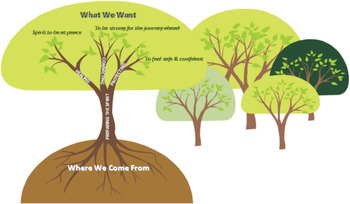
Figure 2 uses a schematic diagram of a tree to illustrate the findings of the metasynthesis. “Where we come from” are the roots under the surface that stabilize the tree. The trunk supporting the branches is “preparing the spirit”; the branches are healing, connecting, and protecting; and the leaves of the tree are “what we want at the end of life.” Other trees in the figure reflect the collective nature of these experiences. Trees have been used as a symbol by many Indigenous peoples and have many different meanings. However, the use of the tree here to illustrate the model of “preparing the spirit” is to show the connection to the land and nature as well as how all of the noted concepts are important interconnected parts of end-of-life experiences. For example, connecting resulted in healing and enhanced the energy of the spirit. There was a need to balance levels of connectedness, to build strength for the spirit with levels of protection, and to conserve the energy and health of the spirit. However, all of the processes are considered an important part of achieving what participants' indicated was “what [they] want at the end of life.”
Preparing the spirit.

DISCUSSION
Limitations
Only 18 studies met the criteria for inclusion in this synthesis, underscoring the need for more research in this area. The included studies were from various contexts and cultures, and, consequently, nuances between the contexts may have been overlooked. However, what emerged is the cross-contextual, crosscultural nature of the understanding of Indigenous people's experiences at the end of life. The studies also used a variety of methodologies, and only one was considered to be interpretive in nature. Future research should include more interpretive types of qualitative studies to provide a more in-depth understanding of the end-of-life experiences of Indigenous peoples.
Using a metasynthesis approach, the findings of the studies and not the actual data were synthesized, and we relied on the data selected by the individual researchers to illustrate the findings they reported. This means that any assumptions about Indigenous people's experiences at the end of life made by the researchers of the studies and any methodological or analytical shortcomings are replicated in the synthesis of the findings. Nevertheless, we have sought to find themes that cross the studies, and were careful not to include study findings derived from the perspectives of non-Indigenous healthcare providers.
Preparing the Spirit
The concept of “preparing the spirit” at the end of life is congruent with the literature on the importance of the spirit for Indigenous peoples. The importance of the spirit is found in other literature on Indigenous people's beliefs not related to the end-of-life experience. Despite many cultural differences between Indigenous groups, one important similarity of the worldview is that the spirit is primary, essential, and fundamental to life (Poroch et al., Reference Poroch, Arabena and Tongs2009; Egan, Reference Egan2010; Mark & Lyons, Reference Mark and Lyons2010; Shi & Zhang, Reference Shi and Zhang2012; Nakao & Ohara, Reference Nakao and Ohara2014). “Preparing the spirit” is one of the most important aspects of the end-of-life experience for Indigenous peoples. Specifically, it is important that the spirit be at peace and be strong to transition to the next life. The concept of the spirit transitioning at the end of life is also found in Western worldviews (Edwards et al., Reference Edwards, Pang and Shiu2010), but it is the significance and importance of this to Indigenous peoples that make their end-of-life experiences and focus unique.
The worldview of connectedness with the land is also evident in the findings. For Indigenous peoples, the land is a sacred entity and a fundamental part of existence (Mark & Lyons, Reference Mark and Lyons2010). Their identity is linked by a sense of belonging to and bonding with the land (Durie, Reference Durie2001). Many believe in the consubstantiality, or “sharing of physical substance, of people with the places in which they are conceived, born, and live and die” (Willis, Reference Willis1999; Cowan, Reference Cowan2007). The importance of returning to the “homeland” described in the findings of the metasynthesis is reflective of this worldview.
When a person could not return to their physical home, their homeland was a place with their kin. This underscores the importance of kin and community to Indigenous peoples. Not only did their kin constitute their homeland; they also were a source of energy to help them with their journey. Kin also included deceased ancestors who reached out to the dying person near the end of corporal life. The importance of kin (or family) for Indigenous peoples is consistent with other research findings not focusing on end-of-life experiences (Blackhall et al., Reference Blackhall, Murphy and Frank1995; Bowman & Singer, Reference Bowman and Singer2001; Matsumura et al., Reference Matsumura, Bito and Lui2002). Based on an understanding of Indigenous cultural knowledge and traditions, it follows that Indigenous people recognize their kin as central to their experience at the end of corporeal life. Moreover, our research suggests that the connection with kin at the end of life is important for providing strength and energy for the spirit to transition or journey to the next life. Current healthcare system policies and practices that limit the number of family members being present when a person is dying and rituals connecting the dying person with those who are already deceased create barriers to preparing the spirit.
Indigenous people described what they “want at the end of life” is for their spirit to be at peace, to have comfort and safety, and to have energy for the journey ahead. Death is a journey or a transition, and protecting, healing, and connecting are central to this process. This experience is fundamentally different than the biomedical constructs of death in which death is the enemy; such an approach is at odds with Indigenous people's experiences at the end of life (Halfe, Reference Halfe1989; Holmes & Holmes, Reference Holmes and Holmes1995; Turner-Weeden, Reference Turner-Weeden1995; Baydala et al., Reference Baydala, Placsko and Hampton2006). Although not the topic of this metasynthesis, the experiences of Indigenous people at the end of life featured numerous descriptions of their treatment when receiving palliative care. Policy and physical environments, as well as communication with healthcare providers, were often barriers to preparing the spirit. This underscores the need for future research focusing on how to improve the provision of palliative care services for Indigenous people at the end of life.
CONCLUSION
The findings of this metasynthesis provide a better understanding of shared themes regarding end-of-life experiences for a variety of Indigenous peoples. Indigenous peoples focus on preparing their spirit through processes of protecting, healing, and connecting, so that they are able to achieve peace, comfort and safety, and strength for the journey. How this is achieved varies in different cultures, communities, and among individuals. The findings provide a glimpse of why current palliative care services and healthcare provider practices often create barriers to these processes. They also underscore the critical need to conduct future research focusing on the end-of-life experiences of Indigenous peoples.
ACKNOWLEDGMENTS
We thank Salima Meherali, who worked as a research assistant on this study. We also thank the following organizations for funding: the Technology Evaluation in the Elderly Networks of Centers of Excellence (TVN–NCE), the University of Alberta Faculty of Nursing for summer studentship funding, and the University of Alberta Faculty of Nursing Innovations in Seniors Care Research Unit.