Introduction
Parkinson disease (PD) is one of the most common neurodegenerative disorders of late life. While tremor, muscular rigidity, postural instability, and bradykinesia (i.e., slowness of movement) are the hallmark motor features of the disorder, neuropsychiatric symptoms are highly prevalent, and can be among the most disturbing, disabling, and complex aspects of PD. One such neuropsychiatric symptom is apathy. Apathy refers to negative/deficit symptoms such as blunted emotions, loss of interest, and lack of productivity. Two decades ago, researchers hypothesized that apathy could be present in neurological disorders as either a single symptom or as a full psychiatric syndrome. A key study in the early 1990s proposed diagnostic criteria for a syndrome of apathy (Marin, Reference Marin1991). It was emphasized that lack of motivation in a syndrome of apathy is primary, and not secondary to intellectual impairment, emotional distress (e.g., depression), or impaired consciousness (e.g., delirium). Criteria includes behavioral symptoms, such as lack of productivity; cognitive symptoms, such as lack of interest in learning new things; and emotional symptoms, such as blunted affect and lack of responsivity to positive or negative events (Marin, Reference Marin1991).
Studies specifically investigating apathy in PD have blossomed over the last decade. Yet, there are still many aspects of apathy that remain unknown. For example, it is unknown whether apathy is a unique syndrome or a subcomponent of depression in PD. This has important implications both for understanding the neural substrates of mood disorders and for differential diagnosis and treatment of apathy in PD. Studies to date have suggested that depression and apathy are separable (Isella et al., Reference Isella, Melzi, Grimaldi, Iurlaro, Piolti, Ferrarese and Appollonio2002; Kirsch-Darrow, Fernandez, Marsiske, Okun, & Bowers, Reference Kirsch-Darrow, Fernandez, Marsiske, Okun and Bowers2006; Pluck & Brown, Reference Pluck and Brown2002). However, these studies are limited methodologically by the use of total scores on clinical inventories that are used to assess their presence and severity. This is problematic because apathy and depression scales overlap in content. Thus, a particular symptom endorsement on the Beck Depression Inventory might better represent apathy and thus be counted toward depression and vice versa. The primary aim of the present study was to address whether apathy and depression are separable in a way that disentangles the total score confound on two commonly used clinical scales, the Beck Depression Inventory-II (BDI-II, Beck, Steer, & Brown, Reference Beck, Steer and Brown1996) and the Apathy Scale (AS, Starkstein et al., Reference Starkstein, Mayberg, Preziosi, Andrezejewski, Leiguarda and Robinson1992). To do so, confirmatory factory analysis was used to examine individual items of the two scales.
Based on prior literature and before conducting any analyses, we proposed four discrete factors: (1) an apathy factor representing loss of motivation, (2) a dysphoric mood factor representing sad mood/negativity, (3) a loss of interest and pleasure factor representing the overlap between apathy and depression, and (4) a somatic factor representing bodily complaints. The rationale for these factors is based on several ideas about how apathy and depression can be distinguished. Studies on the phenomenology of apathy describe it as a primary lack of motivation that is not attributable to emotional distress (Marin, Reference Marin1990, Reference Marin1991). Depressive disorders often involve emotional distress and sad mood/dysphoria. Symptoms of worthlessness, failure, disappointment, and guilt are found in depression. Apathy, however, does not involve sad mood, but instead has “blunted” or “no” mood. Apathy does not involve negative appraisal of the self, world, or future (Brown & Pluck, Reference Brown and Pluck2000). A NINDS workgroup on depression in PD proposed loss of interest and anhedonia as common to both depression and apathy in PD (Marsh, McDonald, Cummings, & Ravina, Reference Marsh, McDonald, Cummings and Ravina2006). Physical symptoms such as fatigue, changes in appetite/sleep patterns, and loss of libido are hypothesized to load on their own separate factor because physical symptoms are common in PD even in the absence of mood disorder.
Methods
Participants
Participants included 161 non-demented patients with idiopathic PD who underwent clinical neuropsychological evaluation between 2004 and 2009 at the University of Florida's Psychology Clinic. All PD patients had been referred by the UF Movement Disorders Center. Informed consent was obtained according to university and federal guidelines. To be included, PD patients had to be between 40 and 90 years of age and meet UK Brain Bank diagnostic criteria (Hughes, Ben-Shlomo, Daniel, & Lees, Reference Hughes, Ben-Shlomo, Daniel and Lees1992; Hughes, Daniel, Kilford, & Lees, Reference Hughes, Daniel, Kilford and Lees1992). These criteria are based on the presence of bradykinesia plus at least one other cardinal motor symptom: muscular rigidity, resting tremor, or postural instability. Patients must demonstrate marked improvement in response to dopaminergic therapy to differentiate idiopathic PD from Parkinson's plus syndromes. Exclusion criteria were co-morbid neurological illnesses, previous neurosurgical treatments (i.e., deep brain stimulation or pallidotomy), or evidence of dementia based on scores less than 130 on the Dementia Rating Scale II (DRS-II; Jurica, Leitten & Mattis, Reference Jurica, Leitten and Mattis2001). Dementia was excluded because the intent was to capture primary apathy. Including demented patients creates a confound that apathy may be secondary to cognitive impairment (Marin, Reference Marin1991).
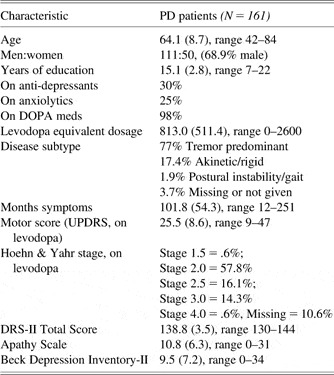
Participant information and disease characteristics are shown in Table 1. As a group, the PD patients were well educated, predominantly men (68.9%), Caucasian (95%), and ranged in age from 42 to 84 years. On average, they had been experiencing parkinsonian symptoms for 8.5 years and were in the mid-stages of their disease (i.e., Unified Parkinson's Disease Rating Scale (UPDRS) motor score = 25.5, SD = 8.6). Approximately one third of the patients were pre-surgical candidates for Deep Brain Stimulation (DBS). The majority of patients were tremor-predominant subtype (77%) or akinetic–rigid subtype (17.4%). Between 25 and 30% of the PD participants were taking antidepressants and/or anxiolytic medications. Importantly, rates of apathy were not significantly different between individuals who were taking antidepressants or anxiolytics and those who were not taking them (p = .098 for antidepressants and p = .17, for anxiolytics). There were no significant differences in apathy (p = .69) or depression (p = .76) between patients with tremor predominant versus akinetic rigid subtypes of PD. Additional information is shown in Table 1.
Patient characteristics

Note. N = 161. However, 4 patients were missing UPDRS on scores (n = 157), 17 were missing Hoehn & Yahr staging (n = 144), and 6 patients did not have a subtype diagnosis (n = 155). Three patients (1.9%) were not taking dopaminergic medications because they were in the early stages of disease. Levodopa equivalent dosages were calculated by converting dopamine agonists into equivalent amounts of levodopa and then adding them to each patient's regular levodopa dose (i.e., Sinemet) using the formula described by Hobson and colleagues (Hobson et al., Reference Hobson, Lang, Martin, Razmy, Rivest and Fleming2002).
Procedure
Measures
Mood measures were the Beck Depression Inventory-II (BDI-II) and the Apathy Scale (AS). The BDI-II is a 21-item, 0–3 Likert scale that assesses symptoms of depression experienced over the last 2 weeks (Beck et al., Reference Beck, Steer and Brown1996). Reliability studies of the BDI-II in PD patients have not been published yet; however, we found excellent internal consistency reliability of .89. Past literature has shown that the BDI-I has excellent reliability and validity in PD patients and a Movement Disorder Society task force recommended the BDI for assessing depression in PD (Levin, Llabre, & Weiner, Reference Levin, Llabre and Weiner1988; Schrag et al., Reference Schrag, Barone, Brown, Leentjens, McDonald, Starkstein and Goetz2007; Visser, Leentjens, Marinus, Stiggelbout, & van Hilten, Reference Visser, Leentjens, Marinus, Stiggelbout and van Hilten2006).
The Apathy Scale (AS) is a 14-item scale measuring cognitive, emotional, and behavioral symptoms of apathy (Starkstein et al., Reference Starkstein, Mayberg, Preziosi, Andrezejewski, Leiguarda and Robinson1992). Items are rated on a 0 to 3 Likert scale. The scale is abridged from the original 18-item version developed by Marin (Marin, Biedrzycki, & Firinciogullari, Reference Marin, Biedrzycki and Firinciogullari1991). The original scale was shortened by 4 items, and wording was simplified by Starkstein et al. in Reference Starkstein, Mayberg, Preziosi, Andrezejewski, Leiguarda and Robinson1992. Although other scales can be used to assess apathy, some have questionable sensitivity/specificity (i.e., single item from the Unified Parkinson Disease Rating Scale [Kirsch-Darrow et al., Reference Kirsch-Darrow, Zahodne, Has, Mikos, Okun, Fernandez and Bowers2009]), while others such as the Lille Apathy Rating Scale are too lengthy for routine screening in a typical clinical setting (Sockeel et al., Reference Sockeel, Dujardin, Devos, Deneve, Deste and Defebvre2006; Zahodne et al., Reference Zahodne, Young, Kirsch-Darrow, Nisenzon, Fernandez, Okun and Bowers2009). The AS is routinely used in studies comparing apathy and depression and has good psychometric properties in PD (internal consistency reliability = .76, test–retest 1 week r = .90, Starkstein et al., Reference Starkstein, Mayberg, Preziosi, Andrezejewski, Leiguarda and Robinson1992). The Movement Disorder Society task force assessed apathy and anhedonia scales and classified the AS as “recommended for use” in PD (Leentjens et al., Reference Leentjens, Dujardin, Marsh, Martinez-Martin, Richard, Starkstein and Goetz2008). Recently, construct validity has been established for the AS in a small sample of 28 nondemented PD patients and 19 age-matched controls who were videotaped while sitting alone with six novel toys/gadgets on a table in front of them. The apathetic PD group spent significantly less time interacting with the gadgets than the nonapathetic group. Depression, motor severity, and levodopa equivalent dosage were unrelated to time spent interacting (Ferencz et al., Reference Ferencz, Kirsch-Darrow, Bogordskaya, Okun and Bowers2010). These findings of a relationship between apathy and behavioral initiation correspond to those reported by Marin and colleagues for the original Apathy Evaluation Scale (Marin et al., Reference Marin, Biedrzycki and Firinciogullari1991).
Statistical Analysis
First, the prevalence of apathy and depression was examined in this cohort of 161 PD participants using the traditionally defined criteria. Apathy was defined using the recommended cutpoint of ≥14 (Starkstein et al., Reference Starkstein, Mayberg, Preziosi, Andrezejewski, Leiguarda and Robinson1992). Depression was defined using the recommended cutpoint from the BDI-II manual of ≥14 (i.e., minimal depression ≤13, mild = 14–19, moderate = 20–28, severe ≥29). Leentjens and colleagues recommend using 14 as a cutpoint for the original BDI-I in PD patients (Leentjens, Verhey, Luijckx, & Troost, Reference Leentjens, Verhey, Luijckx and Troost2000). We also examined the frequency of pure apathy (≥14 AS without ≥14 BDI-II), pure depression (≥14 BDI-II without ≥14 AS), and mixed apathy and depression symptoms (≥14 on AES and BDI-II).
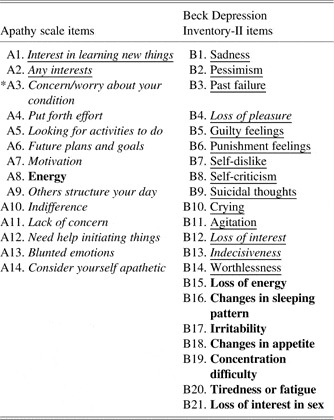
Next, the reliability of each item from the AS and BDI-II was examined using item-total scale correlations and Cronbach's alpha. One item was excluded due to unreliability (AS item 3). Remaining items were analyzed using confirmatory factor analysis (CFA). Table 2 shows the hypothesized loadings of each item onto the factors.
Proposed factor loadings of each item
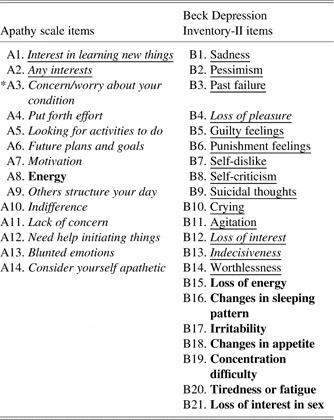
Note. * = unreliable item, was excluded from the CFA; italic = apathy factor, underlined = dysphoric mood factor, italic & Underlined = overlap factor of loss of interest/pleasure, bold = somatic factor.
Confirmatory factor analysis was conducted with statistical software AMOS 17.0, using maximum likelihood estimation. Before factoring, items were examined for univariate normality (e.g., skewness and kurtosis). Since most items were non-normally distributed, item parcels were created instead of factoring raw items. The rationale is that CFA has an assumption of multivariate normality. Items on psychopathology scales were skewed toward the lack of psychopathology (e.g., 0 or 1) and thus present a non-normal, positively skewed, and kurtotic distribution. Parceling helps correct for this. Furthermore, parceling creates fewer indicators, requires fewer parameters of estimation, and thus improves fit (Little, Cunningham, Shahar, & Widaman, Reference Little, Cunningham, Shahar and Widaman2002). Models were examined for fit based on the following goodness of fit criteria: minimum fit function χ2, root mean square error of approximation (RMSEA), root mean square residual (RMR), normed fit index (NFI), comparative fit index (CFI), incremental fit index (IFI), relative fit index (RFI), and the Tucker-Lewis Index (TLI). Conventional standards were used to determine goodness of fit (e.g., ratio of χ2 to degrees of freedom 2:1 or less, RMSEA below .05 and nonsignificant, RMR below .05, and NFI, CFI, IFI, RFI, TLI above .9. As is conventional, no single fit index is the primary indicator, but the preponderance of evidence must be in support of the fit of the model (Marcoulides & Hershberger, Reference Marcoulides and Hershberger1997, Chap. 8).
A nested model approach was used to test alternatives to the full four-factor model. These included a single factor model of “depression” that subsumed all items from both scales. A two-factor model was tested that included “apathy” and “depression” factors based on each scale's content. Two alternative three-factor models (one without loss of interest/pleasure and one without somatic complaints) were tested. The resulting χ2 statistics were tested against the hypothesized four-factor model to examine for changes in fit.
Results
Frequency of Apathy and Depression Symptoms
Approximately one third of the PD sample (i.e., 54 of 161; 33.5%) had clinically significant levels of apathy (defined by ≥14 on the Apathy Scale). Approximately one fourth of the sample (i.e., 41 of the 161; 25.3%) had clinically significant depressive symptoms (defined by ≥14 BDI-II score). To examine the relationship between apathy and depression, we calculated the number of individuals who exhibited traditionally defined “pure” apathy, “pure” depression, and “mixed” apathy and depression, and neither apathy nor depression again using the clinical cutoffs for the BDI-II (i.e., ≥14 for depression) and Apathy Scale (≥14 AS). Results indicated that 17.4% (28/161 patients) had pure apathy, 9.3% (15/161 patients) had pure depression, 16% (26/161) had mixed apathy and depression, and 57.3% (92/161) had neither apathy nor depression.
Factor Structure of Apathy and Depression in PD
A primary aim of this study was to use confirmatory factor analysis (CFA) to test the hypothesis that items from the Apathy Scale (AS) and the BDI-II loaded on four different factors: (1) an apathy factor, (2) a dysphoric mood factor, (3) a loss of interest/loss of pleasure factor representing the overlapping features of apathy and depression, and (4) a somatic factor representing bodily complaints (e.g., sleep, appetite, fatigue). Before the CFA, the items from the AS and BDI-II were screened for internal consistency reliability. This was done by examining the means, standard deviations, and item-total correlations. As is conventional for reliability analysis, negatively worded items were reverse scored. Cronbach's alpha was examined for each of the total scales, and whether deleting items improved overall alpha. For the AS, all items positively correlated with the total apathy score between .4 and .7, except for item 3. This item was reverse scored such that higher scores equaled more apathy. However, it had a negative correlation with the total score (r = −.14). This item states: “Are you concerned about your condition?” Negative correlation with the total apathy score indicates that as patients endorse higher apathy on this item they score lower in overall total apathy. This indicates that it is an unreliable item. Furthermore, internal consistency reliability item-total statistics indicated that deleting this item improved internal consistency reliability (i.e., Cronbach's alpha) from .831 to .855. Thus, this is a psychometrically poor item and was excluded from the CFA. In contrast, the BDI-II did not have any psychometrically poor items. All items positively correlated with the total depression score (between .36 and .68), Cronbach's alpha was .89, and alpha was not improved by deleting any items.
Next, items were checked for normality. Items on both scales tended to be skewed toward the lack of psychopathology (positively skewed and positively kurtotic). Item parcels were created by summing items into pairs. This is done pseudorandomly by combining items randomly within hypothesized factors. Item parcels improve normality, an assumption for CFA. Because some item parcels were still non-normal, the data were transformed by taking the square root (√(x + 1)) of each item parcel to further reduce the positively skew.
Confirmatory Factor Analysis Results
One hundred forty-six participants had complete item data for both the AS and BDI-II. Fourteen patients had skipped at least one item on either scale, so their item data was incomplete and was not analyzed.Footnote 1 The remaining 146 participants’ item parcels were constrained to the hypothesized four-factor solution. These factors and indicators were as follows: (1) “Apathy/Loss of Motivation” (five item parcel indicators, A7_A10, A9_A4, A5_A14, A11_A6, A12_A13), (2)“Dysphoric mood” (six item parcel indicators, B6_B8, B3_B17, B9_B2, B1_14, B5_10, B7_11), (3) “Loss of Interest and Pleasure” (three item parcel indicators, B4_B12, A1_A2, B13), and (4) “Somatic Complaints” (four item parcel indicators, B16_B18, B21_A8, B15_B20, B19).
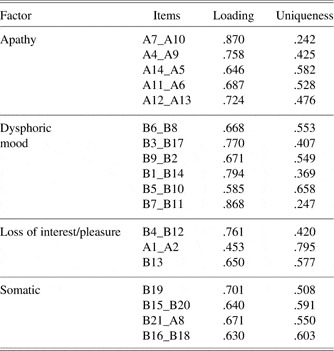
The overall fit of the model to the data was: χ2 (129, N = 146) = 213.3, p < .01 (NFI = .844, CFI = .931, IFI = .932, RFI = .815, TLI = .918). The RMSEA was .067 (p = .04), and the RMR was .011. The overall fit was good in terms of the ratio of χ2 to degrees of freedom ratio being less than a ratio of 2:1, fit indices close to 1, and RMR less than .05. However, the RMSEA was significant and greater than .05. Modification indices were examined to see if there was a single parameter that would greatly improve the fit of the model. Of interest, it was a correlated uniqueness (i.e., unexplained variance) among two “Dysphoric Mood” indicators (B6_B8 and B7_B11) that the modification indices provided as improving fit the most. These items have to do with feelings of punishment, self-criticalness, and crying and guilt. This means that there is unexplained variance in these parcels that “clusters together.” Allowing the unexplained variance of these indicators to correlate improved the model by 17.05 χ2 points. This improved the fit to: χ2 (128, N = 146) = 194.9, p < .01 (NFI = .858, CFI = .945, IFI = .946, RFI = .830, TLI = .934). The RMSEA was .060 (p = .16) and the RMR was .011. The χ2 to degrees of freedom ratio is slightly lower (1.5:1 vs. 1.65:1 before) and fit indices are closer to 1; additionally RMSEA is nonsignificant, indicating a better fit. Table 3 shows these four factors, items, standardized loadings and uniquenesses.
Confirmatory factor analysis loadings and uniquenesses

All the loadings were high, ranging from .59 to .87. For the Apathy/Loss of Motivation factor, the loadings ranged from .65 to .87. The highest loadings were for items A7_A10, “Do you have motivation?,” “Are you indifferent to things?,” (.87) and items A4_A9, “Do you put much effort into things?,” “Does someone have to tell you what to do each day?” (.76). For the Dysphoric Mood factor, loadings ranged from .59 to .87. The highest loadings were items B7_B11, “Self-dislike,” “Agitation/Restlessness” (.87) and items B1_B14, “Sadness,” “Worthlessness.” The Loss of Interest and Pleasure factor ranged from .65 to .72, with the highest loading for items A12_A13, “Do you need a push to get started on things?,” “Are you neither happy nor sad, just in between?” Finally, the Somatic factor ranged from .63 to .70, with the highest loading B19, “Concentration difficulty” and B21_A8 “Loss of interest in sex,” “Do you have the energy for daily activities?”
In terms of inter-factor correlations, they ranged from medium to high. The lowest correlation was between Apathy and Dysphoric Mood (r = .526) and the highest correlation was between Dysphoric Mood and Loss of Interest and Pleasure (r = .895). See Table 4 for inter-factor correlations. Additionally, to determine the overall correlation between apathy and depression scores, total scores were correlated between the AS and BDI-2. The correlation was in the medium range (r = .61; p < .001).
Factor correlations

Alternative Nested Models
A nested model approach was used to test alternatives to the four-factor model. This was performed to determine if the four-factor model has a significantly lower χ2 (indicating a better fit) than other alternative models. The nested models were identical in structure to the original model except for the number of factors (i.e., they included the correlated uniqueness). Results are summarized in Table 5. A one-factor model, subsuming dysphoric mood, apathy, loss of interest/pleasure, and somatic into one overarching “Depression” factor was tested. This model was significantly worse than the four-factor model (one factor χ2 = 433.3, vs. four factor χ2 = 194.9; p < .01). We also tested two factors (“Apathy” and “Depression”), a three-factor solution without the Somatic factor, and a three-factor solution without the Loss of interest/pleasure factors. All of these models were significantly worse than the four-factor model (p < .01). Worse (higher) χ2 indicates a greater discrepancy between the original and reproduced correlation matrix, and hence a worse fit to the data.
Goodness-of-fit statistics for confirmatory factor analysis of full four factor model and alternative nested models

Note. p values indicate the χ2 difference between the alternative models and the four-factor model, indicating significantly worse fit for all alternative models.
Thus, the four-factor model separating the constructs of apathy, depression, loss of interest/anhedonia, and somatic complaints was supported.
Discussion
The present study investigated the hypothesis that apathy and depression are dissociable in PD. First, we examined the prevalence of apathy and depression in our sample. Then, we proposed discrete apathy and depression factors and conducted confirmatory factor analysis (CFA) of individual items from the Beck Depression Inventory-II and the Apathy Scale. Apathy (i.e., ≥14 on the AS) was present in one third of our sample (33.5%). This prevalence falls into the reported range of 23–44% in nondemented PD samples (Czernecki et al., Reference Czernecki, Pillon, Houeto, Pochon, Levy and Dubois2002; Dujardin et al., Reference Dujardin, Sockeel, Devos, Delliaux, Krystkowiak, Deste and Defebvre2007; Pedersen et al., Reference Pedersen, Alves, Bronnick, Aarsland, Tysnes and Larsen2009; Pluck & Brown, Reference Pluck and Brown2002; Zgaljardic et al., Reference Zgaljardic, Borod, Foldi, Rocco, Mattis, Gordon and Eidelberg2007). Furthermore, our results indicated 17% of patients had apathy in the absence of depression (i.e., 16% had both apathy and depression and 9% had depression without apathy). Several previous studies have also found apathy in the absence of depression in PD (Isella et al., Reference Isella, Melzi, Grimaldi, Iurlaro, Piolti, Ferrarese and Appollonio2002; Kirsch-Darrow et al., Reference Kirsch-Darrow, Fernandez, Marsiske, Okun and Bowers2006; Oguru, Tachibana, Toda, Okuda, & Oka, Reference Oguru, Tachibana, Toda, Okuda and Oka2010; Starkstein et al., Reference Starkstein, Mayberg, Preziosi, Andrezejewski, Leiguarda and Robinson1992; Zgaljardic et al., Reference Zgaljardic, Borod, Foldi, Rocco, Mattis, Gordon and Eidelberg2007).
Next, we used CFA to test the hypothesis that items from the BDI-II and AS would fall into four factors: (1) an apathy factor representing “loss of motivation,” (2) a dysphoric mood factor representing “sadness and negativity,” (3) a loss of interest and anhedonia factor representing the overlapping features between apathy and depression, and (4) a somatic factor representing “bodily complaints.” Results indicated the four-factor model fit the data well. It fit significantly better than a single ‘general depression’ factor including all apathy and depression items. It fit better than a two-factor model with all Apathy Scale items loading onto an “apathy” factor and all Beck Depression Inventory-II items loading onto a “depression” factor. Finally, it fit better than alternative three-factor models without either the: a) loss of interest/pleasure factor or b) somatic factor.
Taken together, these findings contribute to the growing body of literature suggesting a separation of these two mood states in PD (Dujardin et al., Reference Dujardin, Sockeel, Devos, Delliaux, Krystkowiak, Deste and Defebvre2007; Isella et al., Reference Isella, Melzi, Grimaldi, Iurlaro, Piolti, Ferrarese and Appollonio2002; Kirsch-Darrow et al., Reference Kirsch-Darrow, Fernandez, Marsiske, Okun and Bowers2006; Levy et al., Reference Levy, Cummings, Fairbanks, Masterman, Miller and Craig1998; Oguru et al., Reference Oguru, Tachibana, Toda, Okuda and Oka2010; Pedersen et al., Reference Pedersen, Alves, Bronnick, Aarsland, Tysnes and Larsen2009; Santangelo et al., Reference Santangelo, Vitale, Trojano, Longo, Cozzolino, Grossi and Barone2009; Starkstein et al., Reference Starkstein, Mayberg, Preziosi, Andrezejewski, Leiguarda and Robinson1992 Zgaljardic et al., Reference Zgaljardic, Borod, Foldi, Rocco, Mattis, Gordon and Eidelberg2007). The findings argue against the idea that apathy is more accurately classified as a subcomponent of depression. Moreover, results support several concepts about the different characteristics of apathy and depression in PD. Depression includes sadness and negative thoughts about the self. One of the item clusters that loaded most highly on the dysphoric mood factor was: “Sadness,” and “Worthlessness.” Another that loaded highly was: “Past failure perception,” and “Irritability.” Additionally, symptoms of guilt and self-dislike loaded highly on the dysphoric mood factor. In contrast, apathy is free from affective evaluation and does not involve negative self or event appraisal. Apathetic individuals lack responsiveness to both negative and positive events (Brown & Pluck, Reference Brown and Pluck2000). Results lend support for the idea that apathy involves behavioral lack of initiation, and lack of effort. The strongest loading item parcel on the apathy factor was “Do you put much effort into things?” and “Does someone have to tell you what to do each day?”
In addition to apathy and depression factors, a somatic factor and an “overlapping symptom” factor of loss of interest and anhedonia were hypothesized. The somatic factor included physical complaints such as changes in appetite, sleep, energy, fatigue, and loss of libido. Our results supported somatic symptoms loading onto their own factor. This is logical, given that physical symptoms can occur as part of PD itself and independent of mood symptoms. The final factor, loss of interest and anhedonia, was highlighted by a National Institute of Neurological Disorders and Stroke (NINDS) PD depression workgroup as two symptoms that overlap between depression and apathy (Marsh et al., Reference Marsh, McDonald, Cummings and Ravina2006). To our knowledge, this is the first study to empirically test this concept. Indeed, it was supported by our four-factor model. The workgroup cautioned that using loss of interest as one of the two core symptoms of a Major Depressive Disorder (MDD) diagnosis in PD (i.e., Criteria A1 of sad mood or Criteria A2 of markedly diminished interest or pleasure) could lead to false positive diagnosis of MDD because loss of interest might be better accounted for by a syndrome of apathy. They noted similar concerns regarding anhedonia (Marsh et al., Reference Marsh, McDonald, Cummings and Ravina2006).
Using the overlapping symptoms could lead to false positive diagnosis of major or minor depressive disorder. Minor depression requires only two symptoms. One of these must be a core depression symptom and the other can be any of the MDD symptoms (DSM-IV-TR, 2000). Minor depression can easily be misdiagnosed because a patient may have loss of interest or anhedonia plus another symptom associated with PD itself (e.g., psychomotor slowing, insomnia, concentration problems). Major depressive disorder can also be misdiagnosed in the apathetic patient because appetite, sleep, psychomotor changes, concentration, and fatigue are five symptoms in common with MDD and PD.
Factor Based Scoring for BDI-II and AS
To help disentangle the assessment of apathy and depression symptoms, we propose a modified scoring of the BDI-II and AS. In addition to summing the items to derive total scores, a complementary method would combine items across scales to create subscale scores that map onto the four factors found in this study. This will provide four separate indices: “pure” apathy, “pure” depression, overlapping symptoms of loss of interest and pleasure, and somatic symptoms. Based on this study, the apathy/loss of motivation subscale contains 10 items (maximum 30 points), depression/dysphoric mood subscale contains 11 items (maximum 33 points), loss of interest and pleasure subscale contains 5 items (maximum 15 points), and the somatic subscale contains 7 items (maximum 21 points). We briefly examined descriptive statistics in our sample [Apathy subscale (M = 8.0; SD = 5.4; range, 0–24); Depression subscale (M = 3.1; SD = 3.9; range, 0–17); Overlapping subscale (M = 2.6; SD = 2.4; range, 0–13), Somatic subscale (M = 6.0; SD = 3.4; range, 0–19)].
Limitations
The current study has several limitations. This study did not use psychiatric interviews and DSM-IV diagnoses. This would have allowed for apathy prevalence to be assessed within the context of Dysthymia or Major Depressive Disorder (MDD). However, research has shown that patients with significant depression symptoms not meeting full criteria for MDD still experience significant disability from their mood symptoms and benefit from treatment (Judd, Paulus, Wells & Rapaport, Reference Judd, Paulus, Wells and Rapaport1996; Lyness et al., Reference Lyness, Bruce, Koenig, Parmelee, Schulz and Lawton1996). Another weakness of the present study is the lack of a large enough sample to cross-validate. Ideally, the sample can be divided in half and exploratory factor analysis can be performed first. Then, the results can be tested on the second half as a confirmatory factor analysis. Furthermore, combining the items into item pairs (e.g., parcels) is a weakness of the study. Parceling does not allow each item to independently load on factors. A stronger item could influence a weaker item in terms of loadings. Parceling was necessary in the present study because of severe non-normality of the data. For future studies, a sample with a more normal distribution of apathy scores could be created by only including patients that have apathy and depression above a certain threshold of symptoms (i.e., ≥14). This may be less representative of the general PD patient population, but would improve the normality of responses and avoid the need to parcel.
Conclusions and Directions for Future Research
Apathy appears to have a prominent place in the neuropsychiatric profile of nondemented Parkinson patients. Support was found for important discriminating characteristics of apathy and depression. An additional factor based scoring of the Apathy Scale and Beck Depression Inventory-II may help disentangle symptoms related to apathy, depression, overlapping symptoms, and somatic symptoms.
Support for the dissociability of apathy and depression in Parkinson disease has broad implications, both theoretically and clinically, for the field of movement disorders. It suggests different neural mechanisms may underlie apathy and depression. Orbito-frontal-subcortical connections may underlie depression whereas mesial frontal/anterior cingulate cortex-ventral tegmental connections may underlie apathy in PD. Mayberg and colleagues found depressed PD patients had hypometabolism in the orbital-inferior frontal lobe and the caudate compared to non-depressed PD patients (Mayberg, Reference Mayberg1994; Mayberg et al., Reference Mayberg, Starkstein, Sadzot, Preziosi, Andrezejewski, Dannals and Robinson1990). The neurobiological substrates of apathy are unknown, but are hypothesized to involve the ACC circuit (Brown & Pluck, Reference Brown and Pluck2000; Isella et al., Reference Isella, Melzi, Grimaldi, Iurlaro, Piolti, Ferrarese and Appollonio2002). Specifically, the striato-thalamo-cortical circuit originating in the ventral tegmental area (VTA) and ending in the ACC (VTA→ventral striatum→ventral pallidum→medialdorsal thalamus→ACC). These limbic structures are involved in motivation and drive, and are important in translating motivation into action (Davidson & Irwin, Reference Davidson and Irwin1999; Groenewegen, Wright, & Beijer, Reference Groenewegen, Wright and Beijer1996; Mogenson, Jones, & Yim, Reference Mogenson, Jones and Yim1980). Lesions in the region of the ACC and supplemental motor area produce a syndrome of extremely severe apathy called akinetic mutism. Patients make no effort to communicate or initiate activities and lie silent and motionless (Damasio & Van Hoesen, Reference Damasio and Van Hoesen1983). To our knowledge, one study has examined PD apathy with functional imaging. Remy and colleagues used Positron Emission Tomography (PET) and found apathy was inversely correlated with dopamine and norepinephrine binding in the ventral striatum (Remy, Doder, Lees, Turjanski, & Brooks, Reference Remy, Doder, Lees, Turjanski and Brooks2005). The ventral striatum is a key structure in the circuit described earlier. Dysfunction of the ACC circuit, perhaps neurochemically through loss of dopamine and neuropathologically through Lewy bodies, may underlie apathy in PD. Future studies are needed to elucidate differences in neural substrates between apathy and depression in PD.
Future studies are also needed to examine the relationship between apathy and cognition. Several studies have found apathy is associated with impaired executive functioning (Butterfield, Cimino, Oelke, Hauser, & Sanchez-Ramos, Reference Butterfield, Cimino, Oelke, Hauser and Sanchez-Ramos2010; Isella et al., Reference Isella, Melzi, Grimaldi, Iurlaro, Piolti, Ferrarese and Appollonio2002; Pedersen et al., Reference Pedersen, Alves, Bronnick, Aarsland, Tysnes and Larsen2009; Pluck & Brown, Reference Pluck and Brown2002; Santangelo et al., Reference Santangelo, Vitale, Trojano, Longo, Cozzolino, Grossi and Barone2009; Starkstein et al., Reference Starkstein, Mayberg, Preziosi, Andrezejewski, Leiguarda and Robinson1992; Zgaljardic et al., Reference Zgaljardic, Borod, Foldi, Rocco, Mattis, Gordon and Eidelberg2007). A recent study assessed patients at baseline and after an average of a 1.5 years and found that apathetic versus non-apathetic PD patients declined faster on the Dementia Rating Scale-2 (DRS-2), free recall, attention, cognitive inhibition, and fluency. However, the apathetic group was lower on the DRS-2 at baseline, making it difficult to attribute the change solely to apathy (Dujardin, Sockeel, Delliaux, Destee, & Defebvre, Reference Dujardin, Sockeel, Delliaux, Deste and Defebvre2009).
In terms of clinical implications from the present study, our results suggest that clinicians should screen for both apathy and depression to appropriately triage and treat patients. In other neurological disorders, treatments for apathy are being examined in pharmacological areas such as amphetamines (e.g., methylphenidate), atypical antipsychotics, dopaminergic agonists, and acetylcholinesterase inhibitors (van Reekum, Stuss, & Ostrander, Reference van Reekum, Stus and Ostrander2005). Some of these may hold promise for the treatment of apathy in PD. In PD patients that have undergone deep brain stimulation surgery, studies have shown that apathy can be successfully treated by reintroducing dopaminergic agonists (Thobois et al., Reference Thobois, Ardouin, Lhomme, Klinger, Lagrange, Xie and Krack2010). While pharmacological research is being explored, non-pharmacological interventions such as cognitive-behavioral psychotherapy focusing on behavioral activation that re-engages the patient slowly back into activities and interests could be investigated. CBT approaches have shown promise in the treatment of PD depression (Dobkin, Allen, & Menza, Reference Dobkin, Allen and Menza2007; Dobkin, Menza, & Bienfait, Reference Dobkin, Menza and Bienfait2008), and may also prove beneficial for treatment of apathy.
Acknowledgments
This project was completed as part of a doctoral dissertation (L.K.D.) at the University of Florida. Support was provided by NINDS (predoctoral NRSA F31-NS059142 to LKD, RO1-NS05063 to DB, and K23-NS044997 to MSO) the Michael J. Fox Foundation, and the UF National Parkinson Foundation Center of Excellence. There are no financial or other conflicts of interest regarding authors for this study.