Introduction
Frail older adults often present with functional decline and multiple comorbidities (Fried et al., Reference Fried2001), which lead to increased home care needs and hospitalization (Fried and Watson, Reference Fried, Watson, Hazzard, Blass, Ettinger, Halter and Ouslander1998). As a consequence, frail elderly adults now represent a large proportion of patients seen in healthcare settings, such as geriatric rehabilitation and assessment units (Wells et al., Reference Wells, Seabrook, Stolee, Borrie and Knoefel2003). Prior to discharge, these patients are usually assessed for their ability to perform some activities of daily living (ADLs) such as preparing a light meal safely, independently, and effectively. This performance-based assessment, usually done in the clinical setting, is intended to determine home care requirements and the need for relocation into residential care (Mountain and Pighills, Reference Mountain and Pighills2002).
Health professionals may, however, question the extent to which frail older adults’ performance observed in clinical settings is truly representative of their performance in a more familiar environment, such as at home. Given the current dearth of healthcare resources (Aiken et al., Reference Aiken, Clarke and Sloane2002) and the growing needs of an expanding frail population often at risk of falls and malnutrition (Fried and Watson, Reference Fried, Watson, Hazzard, Blass, Ettinger, Halter and Ouslander1998), it is important to allocate services efficiently so that the assistance recommended upon discharge from healthcare settings meets the needs of frail patients.
To our knowledge, only a few studies (Nygård et al., Reference Nygård, Bernspang, Fisher and Winblad1994; Park et al., Reference Park, Fisher and Velozo1994; West et al., Reference West, Rubin, Munoz, Abraham and Fried1997; Hoppes et al., Reference Hoppes, Davis and Thompson2003; Rogers et al., Reference Rogers2003; Raina et al., Reference Raina, Rogers and Holm2007) have compared older adults’ performance in ADL tasks between familiar and unfamiliar settings using observation-based assessments. Nygård et al. (Reference Nygård, Bernspang, Fisher and Winblad1994) and Hoppes et al. (Reference Hoppes, Davis and Thompson2003) did not find any significant differences between the assessment settings in the performance of complex tasks (such as meal preparation) in populations with dementia. However, a different conclusion may be drawn from studies conducted with older adults presenting with orthopedic, cardiovascular, and visual problems (Park et al., Reference Park, Fisher and Velozo1994; West et al., Reference West, Rubin, Munoz, Abraham and Fried1997; Rogers et al., Reference Rogers2003; Raina et al., Reference Raina, Rogers and Holm2007). These studies tended to report a better performance in home assessment settings for most participants. Even if some older adults demonstrated the same ability between settings, the authors concluded that familiar settings may generally provide a more accurate assessment of actual performance in this population.
But why would familiarity with settings improve the performance of some but not all older participants without severe cognitive impairments? Some authors (Lundberg and Hakamies-Blomqvist, Reference Lundberg and Hakamies-Blomqvist2003) have suggested that decreased abilities in some older adults to adapt to unfamiliar environments might be related to a decline in specific cognitive abilities, such as executive functions (EF). EF can be particularly important in enabling the individual to interact with the environment, especially in new circumstances and for complex activities (Van der Linden et al., Reference Van der Linden, Meulemans, Seron, Coyette, Andrès, Prairial, Seron and Van der Linden2000). Complex activities such as cooking tasks are thus expected to require considerable executive resources in unfamiliar settings. Since a selective decline in EF has been reported in normal aging (Isingrini, Reference Isingrini, Meulemans, Collette and Van der Linden2004) and especially in frail populations (Patrick et al., Reference Patrick, Gaskovski and Rexroth2002), it is anticipated that frail older adults may experience even greater difficulties in performing complex tasks such as cooking in an unfamiliar environment.
However, it is still unclear how assessment settings influence performance on meal preparation tasks in frail older adults as none of the studies reviewed were specifically conducted with this population. Moreover, despite the expected role of EF in explaining differences found between assessment settings, their specific contribution has barely been explored since most studies did not try to specifically measure or analyze those cognitive functions. This study thus aimed to (1) compare cooking task performance in familiar and unfamiliar assessment settings in a population of frail older adults; and (2) assess how a decline in EF may account for the difference in task performance, if any, between assessment settings.
Methods
Participants
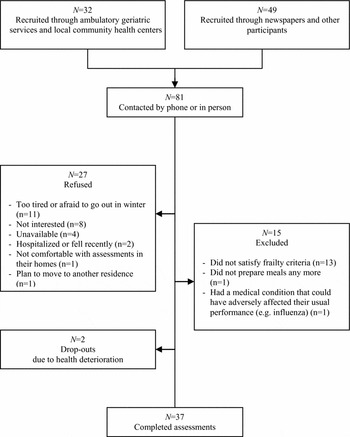
Thirty-seven frail adults aged 65 years or older and showing no severe cognitive impairments were selected for this study. Participants were recruited from ambulatory geriatric services and local community health centers in the urban area of Montreal, Canada. The sample also included older volunteers who learned about the study through newspapers or were referred by other participants (see Figure 1). To be eligible for the study, participants had to meet three or more of the five frailty criteria used in the Cardiovascular Health Study (Fried et al., Reference Fried2001): (1) unintentional weight loss of 10 lbs (4.5 kg) or 5% of body weight in the prior year, based on participant's report; (2) grip strength in the lowest 20%, adjusted for gender and body mass index; (3) poor endurance and energy as indicated by self-report of exhaustion identified by two questions from the Center for Epidemiological Studies Depression (CES–D) scale; (4) slowness, as defined in our study as time to walk 10 feet (3 m), in the lower 20%, adjusted for gender and standing height; (5) low physical activity, as defined as weighted score of kilocalories expended per week in the lowest quintile, adjusted for gender and based on participant's report.
Participants' enrolment.

All participants lived in the community. Participants recruited from inpatient services had been discharged for at least three months, which suggests a stable medical condition. Participants had to have lived in their own home (house or apartment) and used the main appliance (stove, toaster, kettle) for at least two months to ensure familiarity with their kitchen environment. Individuals showing severe physical, sensory, or language deficits due to a neurologic disease or cognitive impairments that may suggest the presence of dementia were excluded from the study. All participants provided written informed consent prior to beginning the study. This research was approved by the institutions’ ethics committees.
Measures
Demographic and clinical variables
Demographic and clinical data used to describe the sample were age, gender, education, number of frailty characteristics, as well as familiarity with the home setting, defined as the number of years spent in their current home environment. Episodic memory was also measured using the Free and Cue Selective Reminding Test-16 items (Grober and Buschke, 1987, adapted by Van der Linden, Reference Van der Linden and Van der Linden2004), a test known to be sensitive to cognitive decline in aging (Van der Linden, Reference Van der Linden and Van der Linden2004).
Executive functions
EF were measured with three neuropsychological tests.
The Trail-Making Test (TMT) is a paper-and-pencil task requiring participants to circle (1) numbers in consecutive order (TMT A), and (2) numbers and letters in alternating order (TMT B) (Strauss and Spreen, Reference Strauss and Spreen2006). The latter assesses cognitive flexibility and divided attention (Lezak et al., Reference Lezak, Howieson, Loring, Hannay and Fisher2004). The score is the time to complete the Trail B. A faster time indicates better performance.
The Victoria version of the Stroop test requires participants to read aloud as quickly as possible the color of 24 dots (part D), common words (part W) and then name the color of the ink for printed words (e.g. name the color of the ink “green” of the printed word “blue”; part C) (Strauss and Spreen, Reference Strauss and Spreen2006). The latter measures inhibition and selective attention (Lezak et al., Reference Lezak, Howieson, Loring, Hannay and Fisher2004). The scores are the time to complete part C and the number of errors (not self-corrected). Faster times and low error rate indicate better performance.
The Tower of London test requires participants to move colored balls one at a time from an initial state to match a set of goal positions (Coyette and Van der Linden, Reference Coyette and Van der Linden1993). This test is used as a measure of planning ability. Scores are calculated by adding planning time to execution time for each trial. A faster time indicates a better performance.
Based on previous studies (Binetti et al., Reference Binetti, Magni, Padovani, Cappa, Bianchetti and Trabucchi1996; Di Fabio et al., Reference Di Fabio, Zampieri, Henke, Olson, Rickheim and Russell2005; Johnson et al., Reference Johnson, Lui and Yaffe2007), the following cut-offs were used to define a decline in EF: performance <1 standard deviation or <30th percentile compared to normative data based on age and/or education (Coyette and Van der Linden, Reference Coyette and Van der Linden1993; Strauss and Spreen, Reference Strauss and Spreen2006) on at least two of the three measures of EF.
Cooking task performance
Performance in cooking tasks was evaluated with the Assessment of Motor and Process Skills (AMPS) (Fisher, Reference Fisher2003). The AMPS is an observational assessment simultaneously evaluating effort, efficiency, safety, and independence of 16 motor and 20 process skills as a person performs standardized tasks related to ADLs (e.g. cooking). Motor skills refer to the abilities to move oneself or the task objects. Process skills are related to the abilities to (1) select, interact with, and use tools and materials, (2) carry out individual actions and steps, and (3) modify performance when problems are encountered. Each skill is rated on a 4-point scale, from deficit (1) to competent (4). A computer program converts ordinal data into equal-interval ability measures, expressed as logits. Tasks chosen must be appropriate to challenge the participants’ motor and process skills and be perceived as familiar and life-relevant by the person. The AMPS was selected because it demonstrates high test-retest, intra-rater, and inter-rater reliability. It is also widely used with older adults and culturally relevant for different parts of the world.
Procedure
Assessments were generally conducted in three 90-minute sessions by a trained occupational therapist. In the first session, demographic and clinical data were collected. Individuals meeting the study criteria were then invited to perform the EF tests. In the second and third sessions, the AMPS was administered. All participants performed two tasks twice: once in their home and once in the unfamiliar setting. Two life-relevant tasks (e.g. preparing eggs, toast, and coffee) were chosen from about 20 standardized cooking tasks that involve the use of an electrical appliance. The unfamiliar setting was a kitchen that the participant had never seen prior to this study. Before performing the tasks in the unfamiliar setting, each participant was shown the location and use of the tools they would need.
Two groups were created: the “preserved EF group” that included those persons who do not show a decline in EF; and the “poor EF group” that included those persons who show a decline in EF. To minimize order effect, a counterbalanced design was used: within each group (poor EF and preserved EF), one half of the participants first performed the tasks in their homes while the other half first performed the tasks in the unfamiliar setting. Assessments in the two environments for each individual were administered at least one week apart and were completed about the same time of day. The aim was to limit participants’ recall of the test and to control for frail older adults’ fluctuating fatigue during the day. Time between measures did not exceed three weeks to reduce the possibility that their condition may have changed between assessments. Participants were videotaped during their performance for later scoring by another trained occupational therapist. This independent rater was blind to the order of settings, group assignment, and study hypothesis. For each participant, assessments in the two environments were scored at least two weeks apart to limit the rater's recall of their previous performance. The number of participants scored first in familiar and unfamiliar settings was also counterbalanced.
Data analysis
Descriptive statistics were calculated for the main characteristics of the participants. Independent t-test Mann-Whitney U or Fisher's exact test were used to compare the groups (poor EF and preserved EF) on these characteristics.
Descriptive statistics were also generated to determine if mean scores on the AMPS were below expected cut-offs (2.0 logits on motor ability measures and 1.0 logits on process ability measures), indicative of a person who may need assistance in the community (process scores being a better predictor than motor scores) (Fisher, Reference Fisher2003). Differences between mean ability measures in familiar and unfamiliar settings were also calculated (by subtracting the lowest score to the highest score). A value of at least 0.30 between measures may be considered as clinically significant (Fisher, Reference Fisher2003).
Two two-way repeated measures analyses of variance (ANOVA) were conducted to examine if there was a significant difference (p < 0.05) between familiar and unfamiliar AMPS motor and process ability measures in our sample. ANOVA simple effects analyses were used to look at the impact of assessment settings on each group (preserved EF and poor EF).
Two two-way repeated measures ANOVAs and two paired t-tests were performed to detect any order or learning effects for motor and process skills. Further analyses (Rasch measurement statistics) were also conducted by the AMPS Project International (2011) to ensure rater reliability and the validity of the measures obtained (whether the ability measures were as expected, based on the demographic information provided). All statistical analyses were performed using SPSS for Windows Version 17.0.
Results
Results from the Rasch measurement statistics indicated good rater reliability and confirmed the validity of the measures obtained, except for four participants. Thirty-three participants were thus retained for analysis.
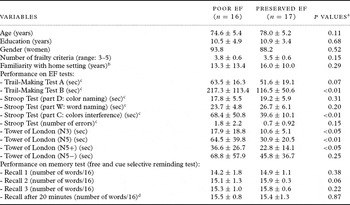
Results showed that the two groups (preserved EF and poor EF) were comparable on age, education, gender, number of frailty criteria, familiarity with home setting and memory tests (see Table 1). As expected, the two groups differed on EF tests (TMT B, Stroop C [time], three of the four Tower of London subtests), but not on the parts known to measure speed performance (TMT A, Stroops D and W) (see Table 1).
Characteristics of participants with poor and preserved executive functions (EF)

Note: Data expressed as mean ± SD or %; ap-values from independent t-test, Mann-Whitney U or Fisher's exact test; bpoor EF (n = 13); preserved EF (n = 15); cpoor EF (n = 15); preserved EF (n = 17), as one participant completed only one of the three tests. This participant was assigned to the poor EF group, based on similar results obtained by participants in that group on the Tower of London and the therapist's clinical judgment. dPoor EF (n = 14); preserved EF (n = 14).
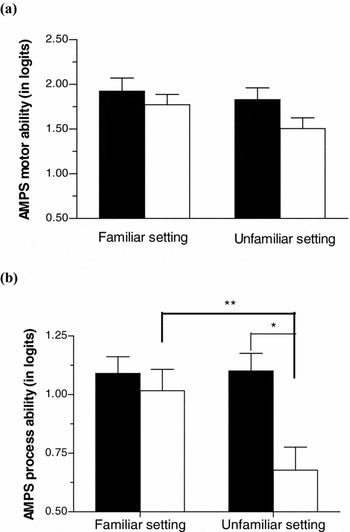
Descriptive analyses revealed that mean scores for motor ability measures were below the cut-off score of 2.0 logits for both groups (Figure 2). However, the only mean score below the cut-off of 1.0 logits on the process scale was obtained by the group with poor EF in unfamiliar settings (mean process score: 0.68 ± 0.39). Moreover, the difference between process mean ability measures in familiar and unfamiliar settings was clinically significant for that group (.34 logits).
Impact of settings (familiar vs. unfamiliar) on assessment of (a) motor and (b) process ability in frail older adults with preserved executive functions (EF) ■ (n = 17) and poor EF □ (n = 16). *p < 0.01 (difference between frail participants with poor EF and preserved EF in the unfamiliar setting); **p < 0.001 (difference between familiar and unfamiliar settings in frail participants with poor EF).

The ANOVAs revealed a significant difference in motor (F = 5.536; p = 0.025) and process (F = 8.149; p = 0.008) skills performance between familiar and unfamiliar settings. Results of the interaction indicated that poorer EF had no effect on motor skills (F = 1.258; p = 0.271) as both groups performed worse in the unfamiliar setting (see Figure 2a). However, a decline in EF did have an effect on process skills (F = 9.299; p = 0.005) (see Figure 2b). More specifically, the “poor EF” group performed worse in the unfamiliar setting than the familiar setting (F = 16.920; p < 0.001) while no such difference was found between settings for the “preserved EF” group (F = 0.200; p = 0.890). Results of the interaction also revealed that both groups showed similar process ability measures in the familiar setting (F = 0.400; p = 0.530) but that the “poor EF” group performed worse in the unfamiliar setting than the “preserved EF” group (F = 11.950; p = 0.002).
The ANOVAs revealed no effect of setting order for both motor (F = 2.645; p = 0.114) and process skills (F = 0.114; p = 0.737). In other words, there was no significant difference in the ability measures for either motor or process skills between the subgroup of participants who performed first in the home (n = 16) and the subgroup who performed first in the unfamiliar setting (n = 17). Moreover, no learning effect was detected for process and motor skills by the paired t-tests (motor: t = −0.488; p = 0.629; process: t = −1.104; p = 0.278), indicating that ability measures taken the first time did not differ significantly from those taken the second time, not accounting for the assessment settings.
Discussion
This study examined the effect of assessment settings on cooking task performance in a population of frail older adults with preserved and poor EF. The results revealed that frail older adults performed better overall in familiar settings than unfamiliar settings on process and motor skills. However, further analysis indicated that only participants with poor EF were more likely to show poorer process skills in unfamiliar settings. Thus, the results of this study support the hypothesis that familiarity with the environment improves performance in frail older adults and that EF might account for some of the difference between settings.
Our results for motor skills suggest that some frail older adults may benefit significantly from the familiarity of home when assessing performance on a cooking task. These results are not consistent with previous studies examining the effect of the environment on AMPS motor ability measures in older adults. Neither Park et al. (Reference Park, Fisher and Velozo1994) nor Nygård et al. (Reference Nygård, Bernspang, Fisher and Winblad1994) reported significant poorer motor scores in the unfamiliar environment. Since motor skills are observable actions that are related to the abilities to move oneself or task objects, the different trend that emerged from our study may be attributable to a more pronounced decline in some physical abilities, as suggested by poorer mean motor ability measures (<2.0 logits) in our frail population. More precisely, frail older adults often demonstrate decreased balance and strength (Fried and Watson, Reference Fried, Watson, Hazzard, Blass, Ettinger, Halter and Ouslander1998), which may reduce their stability and standing tolerance in unfamiliar environments where distance between facilities is generally increased (Hagedorn, Reference Hagedorn and Law1995). These conclusions are in agreement with observations by Park et al., which suggest that a greater propensity to use supports to move around may explain the poorer performance of some participants in unfamiliar settings. Thus, our results for motor skills suggest that frail older adults may benefit from the familiarity of home when assessed for their ability to perform cooking tasks.
Our results for process skills suggest that some frail older adults may benefit significantly from the familiarity of an assessment at home. These results concur with previous studies (Park et al., Reference Park, Fisher and Velozo1994; Darragh et al., Reference Darragh, Sample and Fisher1998) that reported a significant difference between settings for process skills. In our study, a larger difference between settings was observed in participants with poor EF since this group scored low on the process scale (below the 1.0 cut-off) in unfamiliar settings. Similar findings emerged from the study by Darragh et al. (Reference Darragh, Sample and Fisher1998), where participants showing poorer process skills in an unfamiliar environment tended to benefit from familiarity of settings. Since process skills are related to the individual's ability to modify performance when problems are encountered, these results suggest that differences between settings may be related to more difficulties in compensating for limitations in unfamiliar settings. This hypothesis is also supported by our results obtained with frail participants showing preserved EF, who demonstrated similar performance between familiar and unfamiliar settings. Taken together, our results are consistent with the view that a decline in EF tends to expose the individual to greater difficulties when performing complex tasks (such as cooking) in an unfamiliar setting, which may explain the difference between settings.
Even if there is no exact relationship between process skills and cognitive abilities (Fisher, Reference Fisher2003), the results may be interpreted in light of the decreased cognitive resources with aging. As process skills refer to the abilities to interact with tools and materials as well as carry out individual actions and steps, the difference between settings shown by older adults with poor EF may be related to decreased ability to recruit enough cognitive resources when preparing a meal in a challenging environment (Craik and Bialystok, Reference Craik and Bialystok2006). This may be expressed by difficulty overcoming automatisms, such as looking for objects where they are at home or switching between different cooking tasks performed simultaneously, while discovering how to adjust the cooking level of a new appliance to avoid burning food. They could however mobilize the cognitive resources needed to perform the tasks in a familiar environment (Kliegel et al., Reference Kliegel, Martin, McDaniel and Phillips2007). This hypothesis is supported by our results, which indicate that frail older adults with poor EF showed about the same level of process skills at home as those with preserved EF. This suggests that home assessment settings, by providing the opportunity to use familiar objects and perform the activity in the usual environmental layout, may support the use of known strategies that help to reduce the demand on some cognitive components, such as EF (Lundberg and Hakamies-Blomqvist, Reference Lundberg and Hakamies-Blomqvist2003; Kliegel et al., Reference Kliegel, Martin, McDaniel and Phillips2007).
Overall, the significant and clinical difference found between settings in frail older adults with poor EF on process skills raise concerns about the risks of underestimating their abilities when assessed in an unfamiliar setting, which could lead to unnecessary services and higher costs. Given that most people presenting poor process ability measures (<1.0 logits) require assistance to live in the community (Fisher, Reference Fisher2003), our findings mean that frail older adults with decreased EF may be offered more services than needed upon discharge from hospital, based on assessments performed in clinical settings. Such a higher perceived need for assistance may even lead health professionals to recommend that some of those frail patients be moved to residential care when it is not fully appropriate. However, these conclusions should not obscure the fact that an assessment in a clinical setting can be a good predictor of how frail older adults with preserved EF will perform on process skills at home.
A limitation of this study is that the high rate of refusal among eligible frail participants may have compromised the generalizability of our results. As underscored by Ferrucci et al. (Reference Ferrucci, Guralnik, Studenski, Fried, Cutler and Walston2004), frail older adults are not an easy population to get involved in a research project. Because of their limited energy and restricted mobility, it is a challenge to convince them to come to the clinical setting for a cooking activity. However, many strategies were used to facilitate their participation in our study: sessions were planned so that they could get some rest when needed, taxi transportation was offered, and assistance was provided to help them get in and out of the car.
This study suggests that a familiar setting may be advocated for a more accurate assessment of cooking task performance in frail older adults, especially those showing fewer coping skills. Since a large proportion of older adults are discharged home after hospitalization (Lim et al., Reference Lim, Hoffmann and Brasel2007), our results support the relevance of assessing frail clients for their ability to cope in their likely living environment. This conclusion is in agreement with previous studies (Nygård et al., Reference Nygård, Bernspang, Fisher and Winblad1994; Park et al., Reference Park, Fisher and Velozo1994; Rogers et al., Reference Rogers2003; Raina et al., Reference Raina, Rogers and Holm2007), which emphasized the importance of evaluating clients in a familiar setting if the purpose of the assessment is to predict the ability to function at home (Park et al., Reference Park, Fisher and Velozo1994) or to obtain the best estimate of a client's potential (Nygård et al., Reference Nygård, Bernspang, Fisher and Winblad1994). However, assessment in unfamiliar settings may still be relevant if the purpose of the evaluation is to screen for a possible decline in EF, which could be suggested by some difficulties when performing an activity of daily living in a new context.
To our knowledge, this is the first study to demonstrate the effect of assessment settings on task performance in a frail population and how a decline in EF may explain the difference between settings. Our findings may help to distinguish frail clients likely to present different abilities in familiar and unfamiliar settings from those showing comparable abilities in both settings when performing a meal preparation task. Since geriatric rehabilitation now takes place either in institutional or home settings, our results may also assist in the selection of frail older people more likely to receive the greatest benefit from interventions conducted in real-life settings. Further studies should verify if similar results are obtained with other ADLs and using different assessment tools and if other factors might explain the difference between settings. Taking into consideration the increasing cost of community services for aging populations around the world, further research that may help to direct the allocation of financial resources more appropriately are also needed. Greater knowledge could ultimately mean that frail clients are provided with services adapted to their needs, fostering their ability to live independently at home while minimizing the cost of delivering inappropriate services.
Conflict of interest
None.
Description of authors' roles
V. Provencher designed the study, collected the data, and carried out the statistical analyses. L. Demers, I. Gélinas, and L. Gagnon supervised the data collection and assisted with design of the study and statistical analyses. V. Provencher wrote the first draft of the paper and all the authors commented critically and contributed with important intellectual content to the writing of the paper.
Acknowledgments
This work was supported by the Canadian Institutes of Health Research - Institute of Aging (#90205), the Canadian Occupational Therapy Foundation, and the Fonds de recherche en santé du Québec. The authors thank D. McCabe, Y. Bergeron, and M. Plante for their valuable assistance in the completion of this study and F. Giroux for statistical advice. Special thanks are extended to our collaborators from IUGM and CSSS Bordeaux-Cartierville & St-Laurent as well as to the study participants.