1. Introduction
Three major diversification pulses are recognized in the so-called Great Ordovician Biodiversification Event (Webby, Reference Webby, Webby, Paris, Droser and Percival2004). The highest diversity peak, with c. 1800 marine genera, was reached during Katian time (formerly late Caradoc to mid Ashgill; 456–446 Ma). Analysis focused on brachiopods also documents a succession of stepwise radiations across most of their major orders, reaching another peak during Katian times (Harper et al. Reference Harper, Cocks, Popov, Sheehan, Bassett, Copper, Holmer, Jin, Rong, Webby, Paris, Droser and Percival2004). Palaeoclimatic control on Ordovician biodiversification fluctuations is related to both plausible poleward deflection of subtropical oceanic currents in Gondwana (Villas et al. Reference Villas, Vennin, Álvaro, Hamman, Herrera and Piovano2002) and global climatic warming (the Boda Event; Fortey & Cocks, Reference Fortey and Cocks2005): the significance of the polarward deflected subtropical oceanic currents was more evident during Early to Mid Ordovician times, when Baltica and Avalonia were located in temperate latitudes, but reduced by the Katian Age, when both Baltica and Avalonia moved to the tropics likely leading to alternation of warming and cooling events rather than a continuous warming episode (Page et al. Reference Page, Zalasiewicz, Williams, Popov, Williams, Haywood, Gregory and Schmidt2007; Keller & Lehnert, Reference Keller and Lehnert2010; Loi et al. Reference Loi, Ghienne, Dabard, Paris, Botquelen, Christ, Elaouad-Debbaj, Gorini, Vidal, Videt and Destombes2010; Finnegan et al. Reference Finnegan, Bergmann, Eiler, Jones, Fike, Eisenman, Hughes, Tripati and Fischer2011; Cherns et al. Reference Cherns, Wheeley, Popov, Ghobadi Pour, Owens and Hemsley2013).
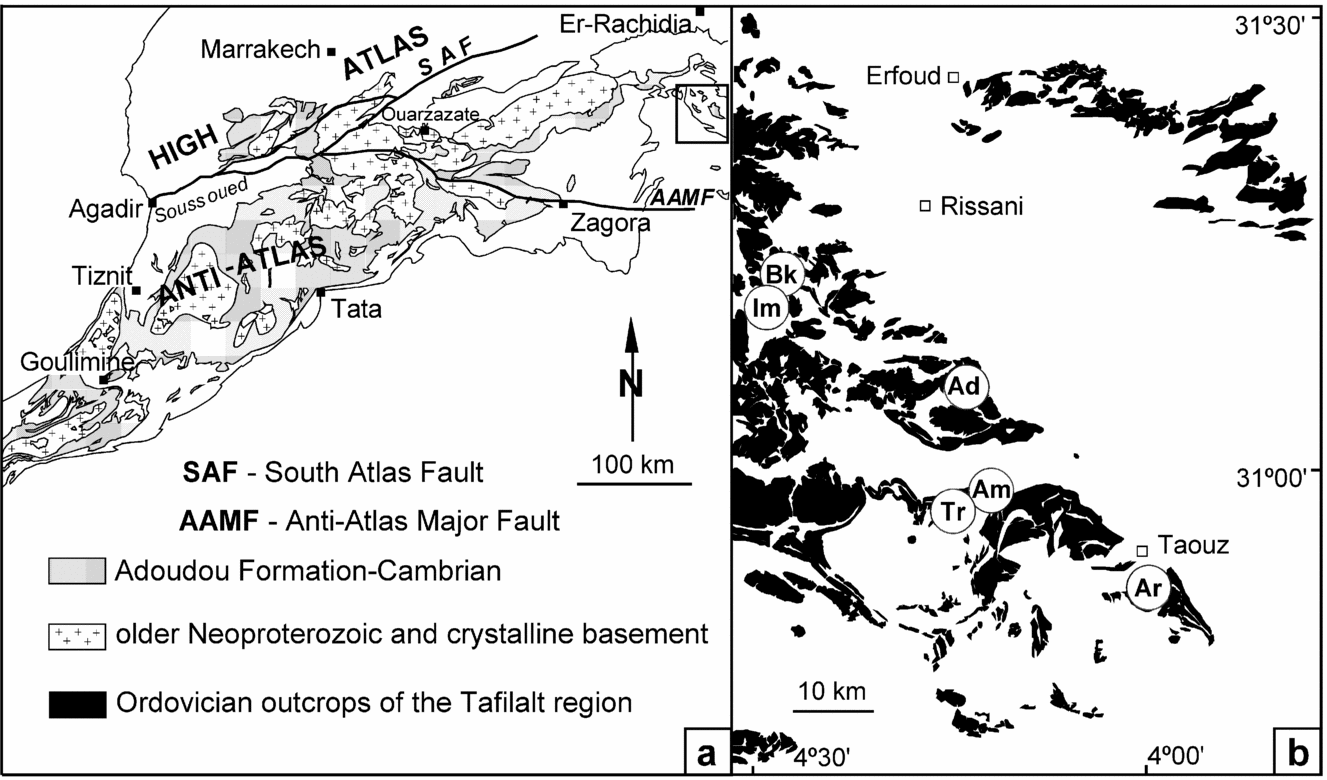
Katian biodiversity peaks were not only reached in subtropical carbonate-dominated platforms, but also in temperate-water shelf deposits. In the latter, brachiopods, molluscs, bryozoans and echinoderms were the most abundant contributors to the carbonate fraction. The relative abundance of these taxa allows identification of the bryomol and bryonoderm fossil assemblages, characteristic of temperate- and cool-waters (Webby, Reference Webby, Kiessling, Flügel and Golonka2002). In the Anti-Atlas of Morocco (Fig. 1), the Upper Ordovician consists of mixed carbonate-siliciclastic strata that contain skeletons characteristic of the bryonoderm association: they are dominated by bryozoans, brachiopods and echinoderms, with variable amounts of molluscs and trilobites (Destombes, Hollard & Willefert, Reference Destombes, Hollard, Willefert and Holland1985; Álvaro et al. Reference Álvaro, Vennin, Villas, Destombes and Vizcaïno2007; Loi et al. Reference Loi, Ghienne, Dabard, Paris, Botquelen, Christ, Elaouad-Debbaj, Gorini, Vidal, Videt and Destombes2010). Carbonate mud is generally rare, ranging between 0 and 20 % in volume, and laterally correlatable impure limestones are rich in silty and sandy debris. Upper Ordovician brachiopods of the eastern Anti-Atlas are locally abundant, diverse and well preserved, providing a nearly continuous record of faunal change (Havlíček, Reference Havlíček1971; Villas et al. Reference Villas, Vizcaïno, Álvaro, Destombes and Vennin2006).
Geological sketch of the southern High Atlas and Anti-Atlas, Morocco. (a) Precambrian and Cambrian outcrops. (b) Ordovician outcrops in Tafilalt, eastern Anti-Atlas (boxed area in (a)). Ad – Adrar Jbel; Am – Amessoui Jbel; Ar – Aroudane Jbel; Bk – Bou-Khoualb Jbel; Im – Imzizwi Jbel; Tr – Tizi-n’Rsoa Jbel.

This paper presents a study of brachiopod faunal dynamics related to the facies mosaic and platform evolution of a Late Ordovician (Katian–Hirnantian) mixed platform in the eastern Anti-Atlas. This has been done by establishing the precise stratigraphic ranges of calcitic brachiopods by reference to lithostratigraphic and sequence-stratigraphic schemes.
2. Geological setting and stratigraphy
In the Anti-Atlas Mountains, the Upper Ordovician stratigraphic framework consists, from bottom to top, of the First Bani, Ktaoua and Second Bani groups (Destombes, Reference Destombes1985a ,Reference Destombes b ,Reference Destombes c , Reference Destombes2006; Destombes, Hollard & Willefert, Reference Destombes, Hollard, Willefert and Holland1985). These units, erected in the central Anti-Atlas, primarily consist of sandstones, quartzites and cemented rocks resistant to weathering (both Bani groups), cropping out as the top of jbels and plateaux, separated by a shaly dominated unit (the Ktaoua Group) that forms relatively flat valleys and jbel flanks. The groups change lithologically in the eastern Anti-Atlas: both Bani groups grade laterally into alternating sandstones and shales, whereas the Ktaoua Group increases its sandstone content (Destombes, Reference Destombes1987, Reference Destombes2006; Álvaro et al. Reference Álvaro, Vennin, Villas, Destombes and Vizcaïno2007). Dating and correlation of the Upper Ordovician deposits in the eastern Anti-Atlas are based on brachiopods and trilobites (Destombes, Reference Destombes1985a , Reference Destombes1987, Reference Destombes2006; Villas et al. Reference Villas, Vizcaïno, Álvaro, Destombes and Vennin2006), whereas in the central Anti-Atlas a detailed chronostratigraphic sketch has been completed based on acritarchs and chitinozoans (Elaouad-Debbaj, Reference Elaouad-Debbaj1984, Reference Elaouad-Debbaj1986, Reference Elaouad-Debbaj1988; Paris, Reference Paris1990, Reference Paris1999; Paris et al. Reference Paris, Elaouad-Debbaj, Jaglin, Massa, Oulebsir, Cooper, Droser and Finney1995, Reference Paris, Verniers, Achab, Albani, Ancilletta, Asselin, Chen, Fatka, Grahn, Molyneux, Nolvak, Samuelsson, Sennikov, Soufiane, Wang and Winchester-Seeto1999; Bourahrouh, Paris & Elaouad-Debbaj, Reference Bourahrouh, Paris and Elaouad-Debbaj2004).
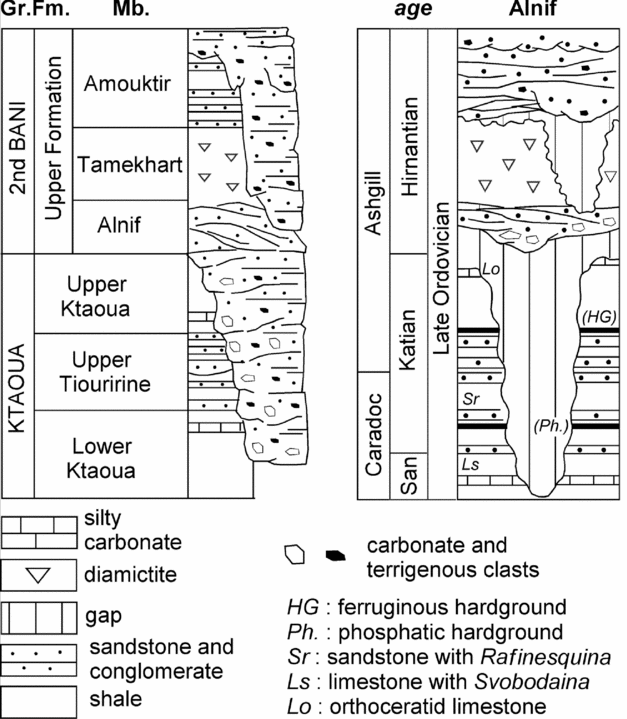
Previous reconnaissance geological mapping covering the eastern Anti-Atlas was performed at the 1:200 000 scale and edited in the middle 1980s (Destombes, Reference Destombes1985a ,Reference Destombes b ,Reference Destombes c , Reference Destombes1987; the latter revised in Reference Destombes2006). Information reported below is derived from new geological mapping at the 1:50 000 scale made from 2009 to 2011 (Benharref et al. in press). Apart from surveys tied to specific map sheets, there has been an involvement in ongoing multidisciplinary regional studies on palaeontology and stratigraphy. These studies were focused in particular on dating and correlating recently identified multiple glaciogenic horizons and their use as reliable time-stratigraphic markers to constrain the history and geometry of basin development during the Hirnantian glaciation (Fig. 2).
Stratigraphic chart of the Upper Ordovician in the Alnif and Tafilalt areas.

In the Tafilalt region, the Katian Ktaoua Group, subdivided into the Lower Ktaoua, Upper Tiouririne and Upper Ktaoua formations, may reach a thickness of 500–800 m. Their lithostratigraphic contacts have been arbitrarily selected at distinct amalgamated sandstone/shale contacts close to orange-stained limestone marker beds. Four measured logs and fossiliferous exposures were selected owing to their completeness and fossil wealth: Aroudane Jbel from the Taouz sheet (GPS coordinates: 30º 53.349′ N 03º 57.950′ W), Adrar Jbel from the Merzouga sheet (31º 04.896′ N 04º 13.943′ W), Tizi-n’Rsoa Jbel from the El Atrous sheet (30º 58.343′ N 04º 11.250′ W) and Bou-Khoualb Jbel from the Irara sheet (31º 12.244′ N 04º 29.369′ W), which are easily correlatable with the Alnif log of the Todhra Ma’der region (Destombes, Reference Destombes1985a ; Álvaro et al. Reference Álvaro, Vennin, Villas, Destombes and Vizcaïno2004, Reference Álvaro, Vennin, Villas, Destombes and Vizcaïno2007; Villas et al. Reference Villas, Vizcaïno, Álvaro, Destombes and Vennin2006; Clerc et al. Reference Clerc, Boucristiani, Guiraud, Vennin, Desaubliaux and Portier2013).
Several apparently diachronous unconformities have been classically recognized at the top of some exposures of the Ktaoua Group. These are capped by similar facies associations, although they have received different lithostratigraphic names according to their scouring position: e.g. ‘Conglomérat d’Alnif’ or ‘Conglomérat d’Amessoui’ (incising the Lower Ktaoua Formation in the vicinity of the eponymous village and jbel, respectively; Destombes, Reference Destombes1985a , Reference Destombes2006; Hamoumi, Reference Hamoumi1999; Choukri, Hamoumi & Attou, Reference Choukri, Hamoumi and Attou2004), ‘Conglomérat d’Imzizoui’ (incising the Upper Tiouririne Formation; Destombes, Reference Destombes2006; El Maazouz & Hamoumi, Reference El Maazouz and Hamoumi2007), some conglomeratic beds of the Jbel Tafersikt Member (Lower Ktaoua Formation; Destombes, Reference Destombes2006) and the ‘Argiles microconglomératiques’ (Destombes, Hollard & Willefert, Reference Destombes, Hollard, Willefert and Holland1985) or ‘glaciomarine diamictites’ (Villas et al. Reference Villas, Vizcaïno, Álvaro, Destombes and Vennin2006). All of these apparently diachronous unconformities represent indeed one single, laterally correlatable glaciogenic erosive unconformity. After mapping in detail this unconformity and its stratigraphic contacts, the overlying Upper Second Bani Formation is clearly recognizable, on the basis of its deeply erosive lower boundary and the distinct glaciogenic features of its lower part (Benharref et al. in press).
In the eastern Anti-Atlas, the Hirnantian Upper Formation of the Second Bani Group is made up of three members, characterized by significant lateral variations in thickness and facies (Villas et al. Reference Villas, Vizcaïno, Álvaro, Destombes and Vennin2006; Álvaro et al. Reference Álvaro, Vennin, Villas, Destombes and Vizcaïno2007). A basal and discontinuous unit, the Alnif Member, consists of the Alnif Conglomerate (sensu Destombes, Reference Destombes1985c ), up to 80 m thick, conformably overlain by upper lenticular sandstones, up to 10 m thick. The Alnif Member is overlain by a claystone-dominated diamictite, named ‘argiles microconglomératiques’ by Destombes, Hollard & Willefert, (Reference Destombes, Hollard, Willefert and Holland1985) owing to the presence of abundant but scattered quartz granules and pebbles ‘floating’ in a clayey matrix, and Tamekhtart Member by Villas et al. (Reference Villas, Vizcaïno, Álvaro, Destombes and Vennin2006); its thickness is highly variable (up to 100 m) and influenced by the bedrock palaeorelief inherited from the aforementioned erosive unconformity. Finally, the uppermost Amouktir Member, 30–60 m thick, is a stratigraphic unit resistant to weathering, composed of sandstone/shale alternations that pass upwards into conglomerates, that ends at the occurrence of Silurian graptolite-bearing black shales.
3. Facies associations and sequence framework
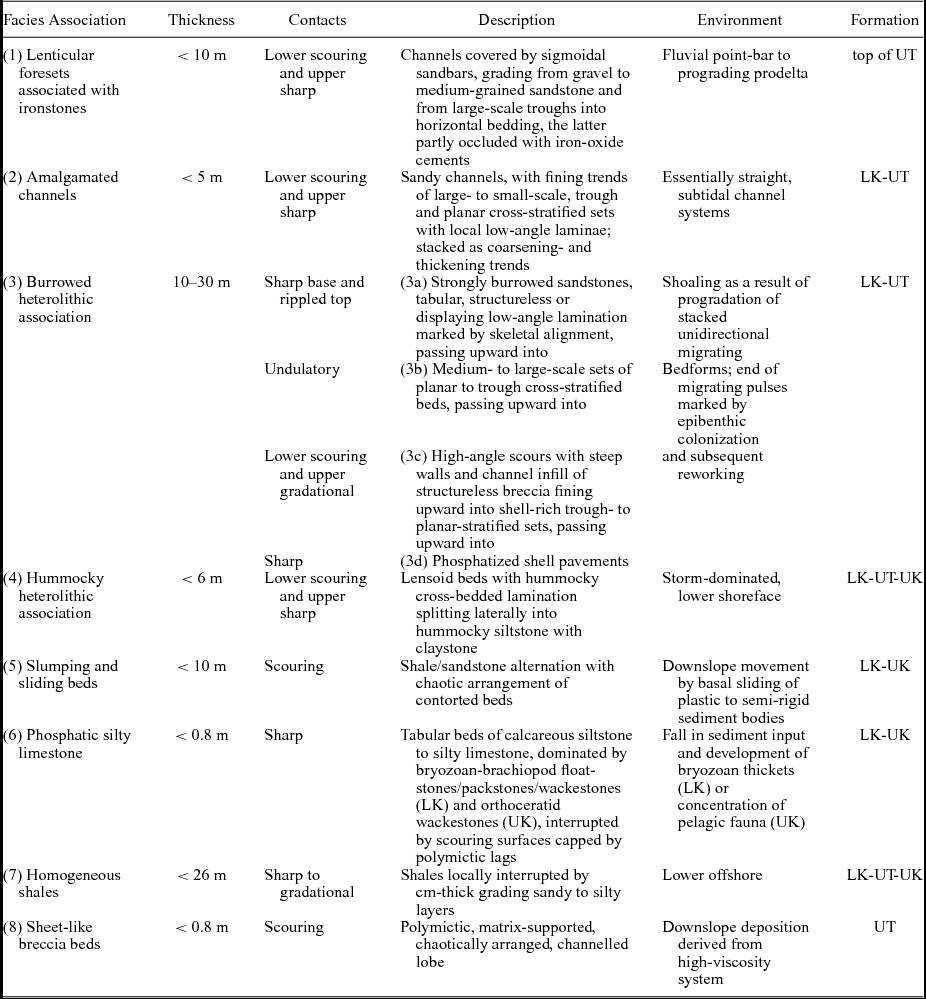
In the eastern Anti-Atlas, sedimentary structures and fossil preservation in the Ktaoua Group are interpreted to represent an open-marine, wave- and storm-agitated shallow-water platform, with little evidence for tidal currents and a pattern of high carbonate production in a reduced area of the eastern Anti-Atlas, in the vicinity of Erfoud (Destombes, Hollard & Willefert, Reference Destombes, Hollard, Willefert and Holland1985; Destombes, Reference Destombes2006). Facies associations in the Alnif area were described and interpreted by Álvaro et al. (Reference Álvaro, Vennin, Villas, Destombes and Vizcaïno2007), which are completed with those of Tafilalt in Table 1.
Summarized facies associations of the Lower Ktaoua (LK), Upper Tiouririne (UT) and Upper Ktaoua (UK) formations in the Tafilalt and Todhra Ma’der areas (modified from Álvaro et al. Reference Álvaro, Vennin, Villas, Destombes and Vizcaïno2007)

3.a. Sequence arrangement
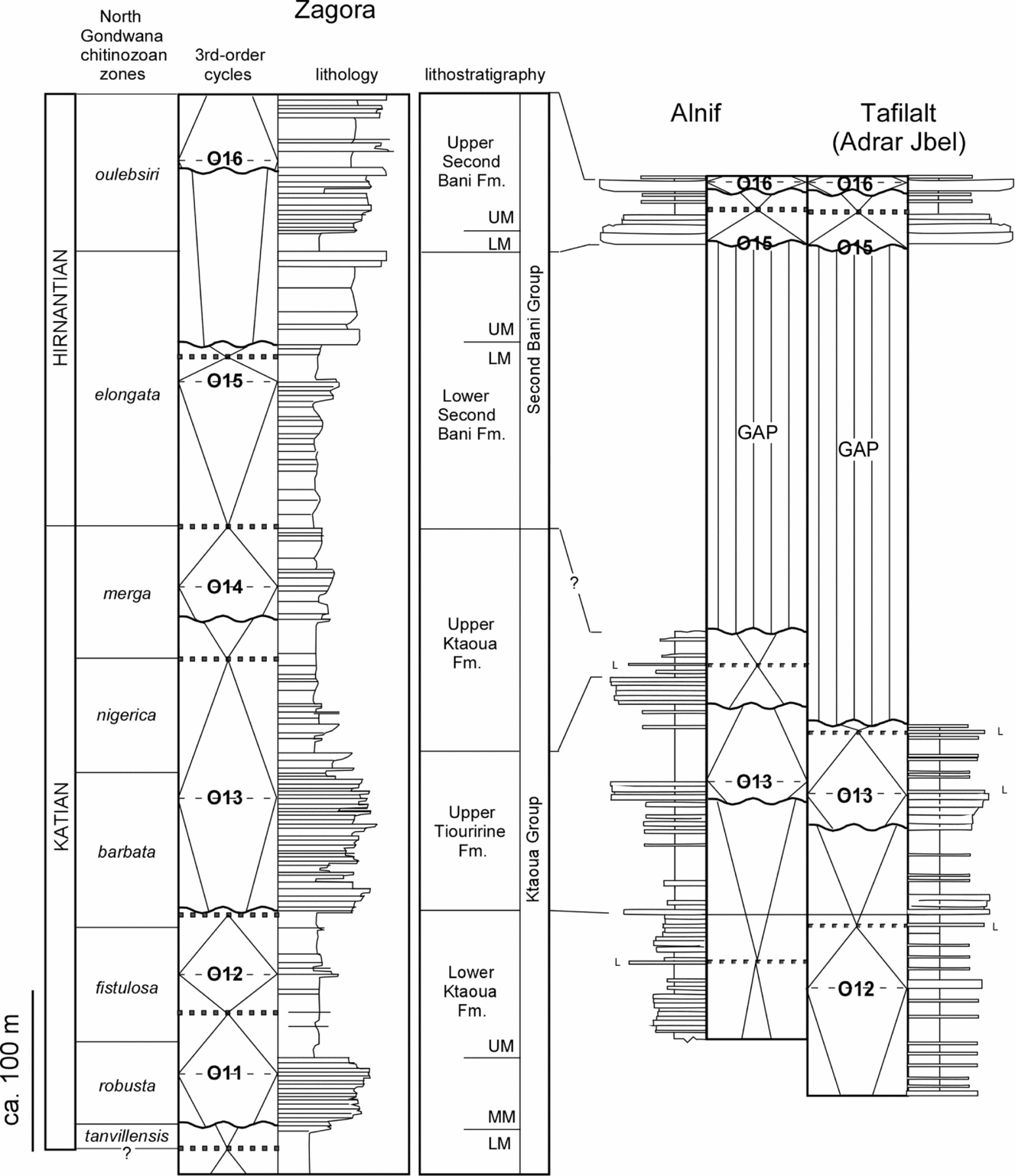
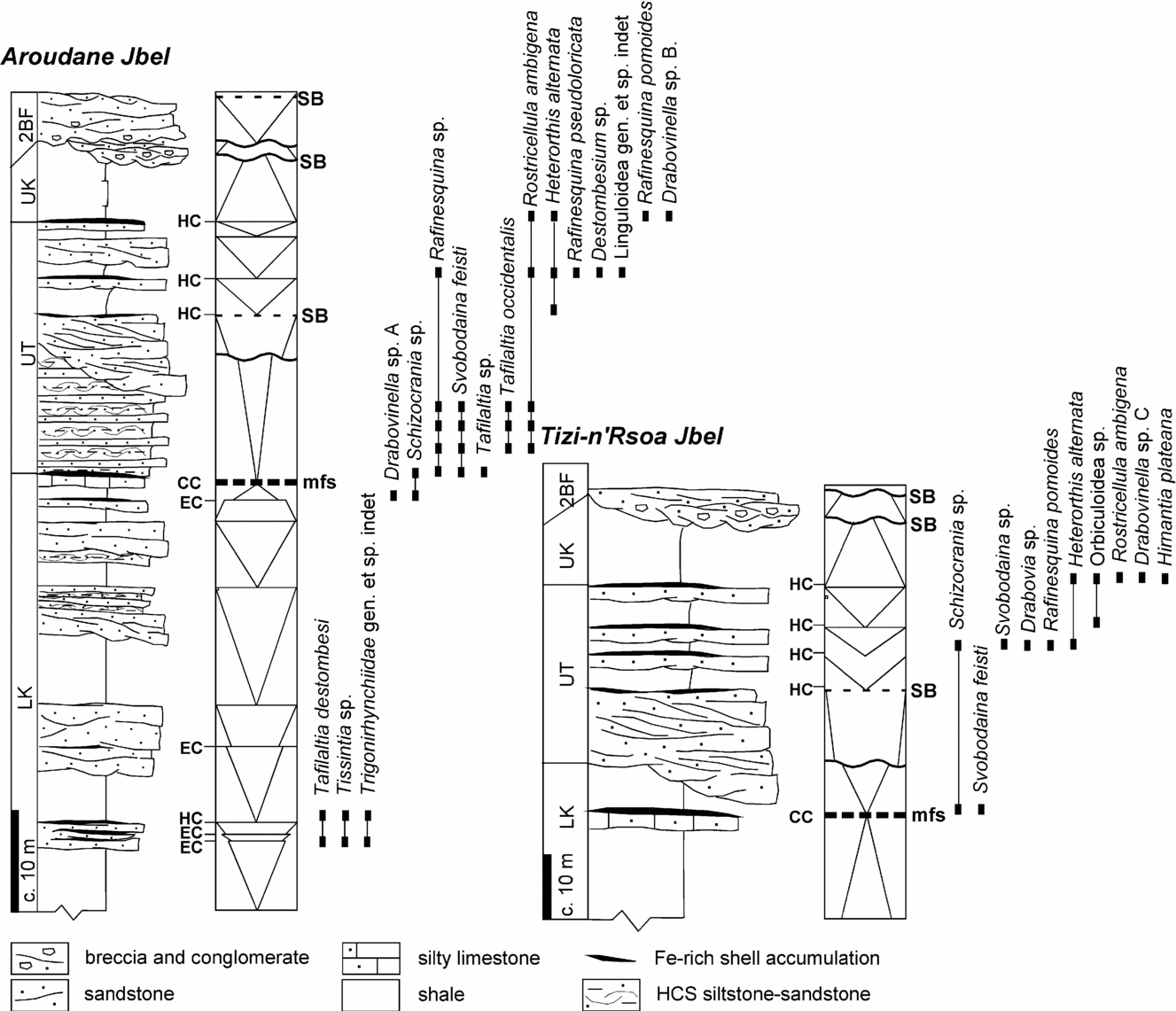
The Katian sequence arrangement of Tafilalt, unaffected by the Hirnantian glaciogenic erosion, comprises two composite (third-order) depositional sequences, composed of a lower transgressive systems tract (TST) and an upper highstand systems tract (HST) (for a nomenclatural comparison with the sequence framework of the central Anti-Atlas, see Loi et al. Reference Loi, Ghienne, Dabard, Paris, Botquelen, Christ, Elaouad-Debbaj, Gorini, Vidal, Videt and Destombes2010; Videt et al. Reference Videt, Paris, Rubino, Boumendjel, Dabard, Loi, Ghienne, Marante and Gorino2010; Fig. 3) that were deposited on a low-angle, high-energy platform. Lowstand systems tracts (LST) are absent in this epeiric platform. The upper part of the Upper Ktaoua Formation is stratigraphically incomplete owing to glaciogenic erosion.
Stratigraphic and sequence framework of the Upper Ordovician in the central (Zagora; Loi et al. Reference Loi, Ghienne, Dabard, Paris, Botquelen, Christ, Elaouad-Debbaj, Gorini, Vidal, Videt and Destombes2010; Videt et al. Reference Videt, Paris, Rubino, Boumendjel, Dabard, Loi, Ghienne, Marante and Gorino2010) and eastern (Adrar Jbel in Tafilalt) Anti-Atlas.

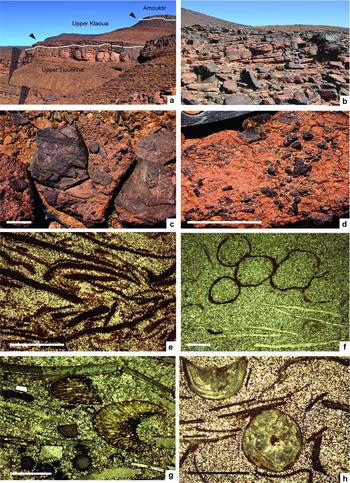
Two sequence boundaries (O12–O13; terms after Loi et al. Reference Loi, Ghienne, Dabard, Paris, Botquelen, Christ, Elaouad-Debbaj, Gorini, Vidal, Videt and Destombes2010) are recognized in Tafilalt. Their recognition is based on features of bedding geometry, erosion and facies-tract offset, and reflect the presence of sediment gaps subsequently onlapped by overlying sediments. O12 and O13 cover amalgamated coarsening sets of cross-laminated sandstones locally punctuated by interbeds of shell concentrations. Their base is marked by channelled erosive surfaces that truncate up to 4 m, and represent prograding shoal complexes suggesting shoaling and/or upwards increase in energy levels. In the Adrar Jbel, O13 is marked by fluvial point bars encrusted with iron oxides, up to 1.8 m thick (Figs 4, 5a, b). The maximum flooding surfaces (MFS) were placed below facies interpreted to record the deepest-water facies associations, capping transgressive, retrogradational parasequence sets. MFS at the top of the TST are abrupt shifts to condensed calcareous and phosphatized levels. Nearly all the silty and skeletal limestones that mark the uppermost Lower Ktaoua and lowermost Upper Ktaoua formations are inferred to represent stacking of mineralized hardgrounds and increased content of reworked phosphate nodules and crusts, indicating increased sediment starvation.
Stratigraphic ranges of brachiopod species in the Aroudane and Tizi-n’Rsoa jbels with sequence framework and surfaces. LK – Lower Ktaoua Formation; UT – Upper Tiouririne Formation; UK – Upper Ktaoua Formation; SB – sequence boundary; mfs – maximum flooding surface, EC – event concentration; HC – hydraulic concentration; CC – hiatal condensed concentration; 2BF – Lower Second Bani Formation.

Field aspect and photomicrographs of the brachiopod-significant levels reported in the text: (a) summit of Adrar Jbel showing the contacts of the Lower Ktaoua, Upper Tiouririne and Upper Ktaoua formations, with setting of two shoaling-upwards sequences (triangles) and erosive contacts (white lines); (b) detail of (a) exhibiting (fluvial?) prograding shoals capped by iron-oxide hardgrounds that mark the top of the Upper Tiouririne Formation. Hammer for scale is 28 cm long; (c, d) quartzitic boulders and gravels mixed with disarticulated skeletons as channel lags intersecting the shoal sandstones of the Upper Tiouririne Formation at Jbel Tizi-n’Rsoa; scale bars = 10 cm (e) brachiopod-rich (wholly ferruginized) siltite cemented with calcite of the Upper Tiouririne Formation at Jbel Tizi-n’Rsoa; scale bar = 5 mm; (f) siltstone cemented with calcite rich in fragmented bryozoans and disarticulated brachiopod valves from the Upper Tiouririne Formation at Jbel Aroudane; scale bar = 3 mm; (g) phosphatic siltstone rich in bryozoans, brachiopod shells and echinoderm ossicles of the Lower Ktaoua Formation at Jbel Aroudane; scale bar = 3 mm; (h) orthoceratid–brachiopod siltstone cemented with calcite of the Upper Ktaoua Formation at Jbel Adrar; scale bar = 5 mm.

Both the TST and HST are composed of regionally correlatable parasequences, up to 24 m thick, likely reflecting high-frequency changes in relative sea level (Fig. 5a). Most of the sandstone/shale alternations and sandstone packages reported in the Ktaoua Group form coarsening-upwards parasequences indicative of shoaling and/or upwards increase in energy level. Individual parasequences tend to be asymmetrical, with a thick regressive interval associated with forestepping cycles and thin transgressive intervals composed of backstepping cycles. The group reflects the interplay and feedback between (i) changes in third-order accommodation potential, (ii) episodic progradation of terrigenous wedges, and (iii) distal production of a temperate-water (bryonoderm) carbonate shelly factory rich in trepostomate and fenestrate bryozoans. The carbonate production during the HST was less resilient to terrigenous poisoning and was susceptible to localized nucleation of bryozoan–pelmatozoan meadows and thickets, whose relief above the surrounding substrate was low.
3.b. Shell accumulations marking event surfaces
Detailed sampling of brachiopods in the Katian third-order TST–HST sequences reveals a recurrent link between shell beds and parasequence-related surfaces. Brachiopod-rich accumulations occur in different positions relative to flooding, transgressive and erosive surfaces. They display a distinct bioclastic fabric and origin, and may be interpreted in a sequence-stratigraphic context. Brachiopod-based marker-beds conform to the definition of both acme zones and ecostratigraphic biotic event horizons.
3.b.1. Lag concentrations
These are the most easily recognizable indicators of erosion surfaces (Fig. 5c, d). Moderately cutting (erosion exceeding 50 cm deep) erosive surfaces can be traced out to distances of ~ 10 km. Concentrations display randomly oriented skeletons with a mixed preservation state. The shells are densely packed and rest on sharp erosive surfaces. High disarticulation, fragmentation and abrasion on both valves are common, in some cases hampering taxonomic determination of the brachiopods and suggesting high-energy substrates. The random arrangement of these centimetre-scale shelly accumulations and mixing of taphonomic grades suggest reworking and episodic accumulation.
3.b.2. Event concentrations (EC in Fig. 4)
Shelly accumulations are loosely to densely packed in sandy bars that exhibit both hummocky and trough cross-stratification sets and are concentrated along bedding and foreset planes. The latter, up to 10 cm thick, are generally structureless, but may display horizontal or low-scale imbrication and grading. The faunal diversity is low (even monospecific) and dominated by loosely to densely packed, disarticulated and fragmented brachiopod valves currently found convex-up, suggesting amalgamation by multiple reworking pulses.
3.b.3. Hydraulic simple and composite concentrations (HC in Fig. 4)
These mark the top of shoal complexes. Their lower contact is erosive and their upper one gradational. Shelly fragmentation and disarticulation are high, fabric is generally skeleton-supported, and brachiopod valves show considerable abrasion and sorting of size and shape (Fig. 5e). Local haematite and apatite crusts are present. The diversity is moderate and dominated by bryozoans, echinoderms and brachiopods. They represent transgressive surfaces marking the lowermost part of the TST, and developed in response to winnowing and relative enrichment of robust biogenic hardparts.
3.b.4. Hiatal or condensed concentrations (CC in Fig. 4)
These are represented by the above-reported silty limestones that mark the MFS. They are up to 1 m thick, laterally persistent and used as marker beds for correlation. They display a matrix-supported fabric and randomly oriented shells, with low to moderate fragmentation (Fig. 5f, g). Skeletal remains generally show no preferential orientation along the bedding planes as burrowing became an important factor for the reorientation of shells. Encrustation (by phosphate crusts and bryozoan encrustation) is moderate to high, in some cases, obliterating original microstratigraphic details. The faunal diversity is high, mixing benthic (brachiopods, bivalves, trilobites, echinoderms, ostracodes and conulariids) and pelagic (orthoconic nautiloids) organisms, the former dominating in volume in the Lower Ktaoua and the latter in the Upper Ktaoua formations. A special kind of condensation is recognized in the Hirnantian Alnif conglomerate, which will be detailed in Section 3.c.
3.c. Taphonomic condensation: a new look at an old biostratigraphic problem
Preservation of gravel-to-boulder conglomerates (the Alnif Conglomerate) is common in the scours of the Hirnantian glaciogenic unconformity. Reworked fossiliferous granules and boulders and isolated skeletons (mainly brachiopods, bryozoans and trilobites) are conspicuous. Although they have been sampled in the same lithostratigraphic unit, the fossils belong to different chronostratigraphic units, grading from ‘Caradoc’ to ‘early Ashgill’ (Destombes, Reference Destombes1985a , Reference Destombes2006; Destombes, Hollard & Willefert, Reference Destombes, Hollard, Willefert and Holland1985). However, the sampled skeletons are exotic to the accumulation site and underwent multiple episodes of burial, exhumation, reworking and resedimentation. Fossil allochthony occurred as a result of reworking (after initial burial) and resedimentation (before definitive burial) altering palaeoenvironmental, palaeoecological and biostratigraphic information provided by the fossils. Original fossil sites were exposed by glaciogenic erosion, fed from southern sources, and shell accumulations occupy ‘lag positions’ of tunnel valley infills. As a result, the deeper the glaciogenic erosion the greater the condensation exhibited by the Alnif conglomerate.
Mixed fossils from different ages fit the concepts of ‘taphonomic condensation’ (Gómez & Fernández-López, Reference Gómez and Fernández-López1994) and ‘downslope fossil contamination’ (Wood, Kraus & Gingerich, Reference Wood, Kraus and Gingerich2008). This produces time-averaged and potentially anomalous faunal records. As stated by NACSN (1983) and Whittaker et al. (Reference Whittaker, Cope, Cowie, Gibbons, Haikwood, House, Jenkins, Rawson, Rushton, Smith, Thomas and Wimbledon1991), among others, ‘if fossils were reworked or displaced by natural agents from their place of origin and incorporated in recognizable forms in a younger formation, they cannot be used for dating and, consequently, for estimating of the sedimentation or accumulation rates’. By contrast, they are useful for estimates of sedimentary record incompleteness.
3.d. Comparison with neighbouring areas
During Katian times, the Erfoud area (North of Tafilalt) recorded a carbonate-dominated platform system, separated from the terrigenous influx that characterizes the southern clastic shelf of Tafilalt. The Katian sequence-stratigraphic framework of Tafilalt and its brachiopod-based biostratigraphic control is comparable with that of Zagora (Loi et al. Reference Loi, Ghienne, Dabard, Paris, Botquelen, Christ, Elaouad-Debbaj, Gorini, Vidal, Videt and Destombes2010) and its chitinozoan-based biostratigraphic sketch (Fig. 3). The sequence boundaries in Tafilalt have been assigned approximate ages on the basis of tentative calibration and the simplifying assumption of constant rates of sediment accumulation between tie points. As a result, the sequence framework reveals similar patterns in facies development, sequence boundaries, sequence-stratigraphic architecture and timing of basin subsidence. Depositional sequences and smaller-scale cycles are also widely correlatable, suggesting that eustasy (and not synsedimentary tectonics) played a major role in the development of depositional patterns during this time. Time-equivalent systems tracts and parasequences show similar (broadly isochronous) bathymetric evolution. In contrast, the key dissimilarity between both transects is the Hirnantian record. The Hirnantian Lower Second Bani Formation, currently mapped in the central Anti-Atlas, is absent in the Todrha Ma’der and Tafilalt areas owing to the onset of a glaciogenic unconformity that marks the onset of successive Hirnantian tunnel valley infill by the Upper Second Bani Formation (Álvaro et al. Reference Álvaro, Vennin, Villas, Destombes and Vizcaïno2004; Clerc et al. Reference Clerc, Boucristiani, Guiraud, Vennin, Desaubliaux and Portier2013). Either the Lower Second Bani Formation (present in the depocentre of the basin) was not deposited in the proximal eastern Anti-Atlas or it was completely eroded as a result of the Hirnantian glaciation. In any case, this formation is absent on the shoulders of the tunnel channels that incised, in the eastern Anti-Atlas, into the Ktaoua Group at different depths (Álvaro et al. Reference Álvaro, Vennin, Villas, Destombes and Vizcaïno2004, Reference Álvaro, Vennin, Villas, Destombes and Vizcaïno2007; Clerc et al. Reference Clerc, Boucristiani, Guiraud, Vennin, Desaubliaux and Portier2013; Benharref et al. in press).
These results, although preliminary, indicate that depositional sequences can be correlated over c. 150 km and are approximately coeval. Decametre-scale parasequences appear to be laterally persistent, although variable in thickness across the platform owing to differences in accumulation rate in the depocentre (Zagora) and glaciogenic erosion marking the base of the Hirnantian. As a result, the Katian depositional sequences were markedly influenced by allocyclic and probably eustatic fluctuations.
4. Katian–Hirnantian brachiopod assemblages
In the Anti-Atlas, unlike in most parts of the Mediterranean Province, optimal conditions for the development of carbonate platforms were not achieved during late Katian times, owing to its location in high latitudes very close to the Antarctic Polar Circle (Harper et al. Reference Harper, Rasmussen, Liljeroth, Blodgett, Candela, Jin, Percival, Rong, Villas, Zhan, Harper and Servais2013). As a result, siliciclastic input continued to be dominant in the region during Late Ordovician time, except in some patchy areas of the eastern Anti-Atlas, such as the Erfoud area (bryozoan- and echinoderm-dominated limestones of the Khabt-El-Hajar Formation; Destombes, Reference Destombes1985a ).
Some of the brachiopods reported below can be assigned to some of the spatially repeated and temporally recurring groups of taxa usually related to specific environmental parameters (Pickerill & Brenchley, Reference Pickerill and Brenchley1979), the so-called communities, already described in both Avalonia and in the Mediterranean region. These are characteristic of one of Boucot's (Reference Boucot1975) Benthic Assemblages (BA), numbered from 1 to 6 according to the environmental parameters where they thrived, such as depth, distality to the shore, energy of bottom water currents, turbulence, sedimentation rate and substrate type. As it has not been possible to check the temporal recurrence and the spatial repetition in other regions of the studied assemblages, they have been considered here as associations instead of communities.
Complete and fragmented brachiopod valves comprise up to 50 % in volume of the skeletal coarse fraction from the sandy shoal complexes of the Lower Ktaoua and Upper Tiouririne formations. High-density brachiopod banks formed in sandy shorelines and shoreface complexes, where about 20 taxa have been recorded. Most of the shell accumulations are composed of parautochthonous taxa, so none of them experienced high transport rates from their living substrate (there are a few less-abundant allochthonous taxa in some of the assemblages discussed in the following sections). Taking into account the nature of the biofacies, in terms of skeletal constituents and relative abundance, and the stratigraphic arrangement of the studied logs, six brachiopod associations can be distinguished. The abundance of each brachiopod taxon in each association has been calculated by considering the most abundant type of valve plus the number of shells with conjoined valves.
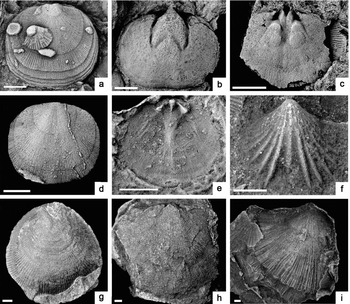
4.a. Tafilaltia destombesi association (Fig. 6)
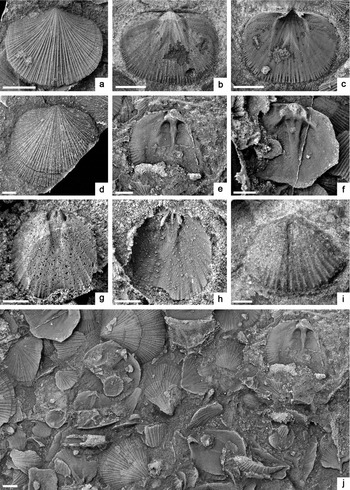
Tafilaltia destombesi association from the lower and middle parts of the Lower Ktaoua Formation: (a–f) Tafilaltia destombesi Havlíček, Reference Havlíček1971: (a) latex cast of exterior of a ventral valve (ARD-10.7); (b, c) internal mould (b) and latex cast of interior (c) of ventral valve (ARD-10.11); (d) latex cast of exterior of dorsal valve (ARD-10.25); (e) latex cast of interior of dorsal valve (ARD-10.21); (f) latex cast of interior of dorsal valve (ARD-10.18); (g, h) Tissintia sp. internal mould (g) and latex cast of interior (h) of dorsal valve (ARD-10.4); (i) Orthide gen. et sp. indet., internal mould of dorsal valve (ARD-10.29); (j) latex cast of top of a bed surface showing the general aspect of the accumulation and the high degree of fragmentation of the shells. Scale bars = 2 mm.

This association occurs in sandstones bearing hummocky and trough cross-stratification sets of the lower and middle part of the Lower Ktaoua Formation. These sandstones have been interpreted as shoreface sandy bars and offshore tempestites. The degree of fragmentation in the shells is high, which are composed almost completely of Tafilaltia destombesi Havlíček, Reference Havlíček1971 (91 % in abundance) and subsidiary valves of Tissintia sp. (6 %) and Orthide gen. et sp. indet (3 %). Owing to the structure of the assemblage, with its low diversity pattern but high abundance of the homonymous taxon, the assemblage seems to fit perfectly with the single-taxon communities described by Boucot (Reference Boucot1975), normally characteristic of rough-water environments in BA–3 and to a lesser extent in BA–2 or 4. According to sedimentological and taphonomic data, we suggest its assignation to BA–3.
4.b. Drabovinella sp. A association (Fig. 7)
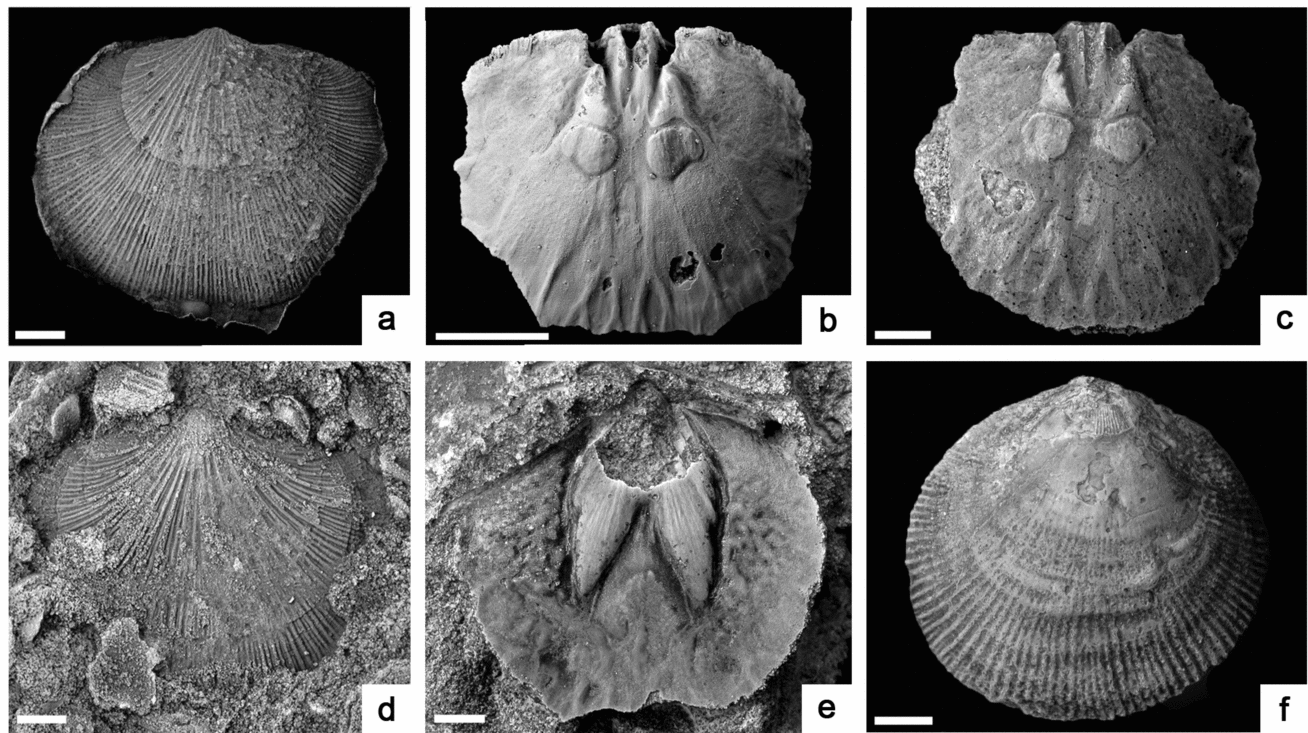
Drabovinella sp. A association from the upper part of the Lower Ktaoua Formation: (a–e) Drabovinella sp. A: (a) latex cast of exterior of dorsal valve (ARD-0.17); (b) internal mould of a specimen with conjoined valves in dorsal view (ARD-0.18); (c) internal mould of a specimen with conjoined valves in dorsal view (ARD-0.11); (d) latex cast of exterior of ventral valve (ARD-0.1); (e) internal mould of ventral valve (ARD-0.13); (f) Schizocrania sp., internal mould of dorsal valve (ARD-0.3). Scale bars = 2 mm.

This association is very similar to the above-reported Tafilaltia destombesi association. Its diversity is very low and dominated by Drabovinella sp. A (64 %) and Schizocrania sp. (36 %). It occurs in the upper part of the Lower Ktaoua Formation, also shoreface sandstones (sandy bars in origin). Draboviids, among which Drabovinella is included (dominant in our association), are very common in the Late Ordovician benthic communities of Bohemia, where they are commonly assigned to BA–3 (Havlíček, Reference Havlíček1982). The other genus of the association, Schizocrania, was able to attach by cementation with its flat pedicle valve to both hard substrates (Hall & Whitfield, Reference Hall and Whitfield1875; Rowell, Reference Rowell and Moore1965, p. H283) and shelled living/dead organisms, such as orthocone nautiloids (Lockley & Antia, Reference Lockley and Antia1980), conulariids (Harland & Pickerill, Reference Harland and Pickerill1987) and brachiopods. This is why only dorsal valves of this genus have been collected. Owing to its adaptive properties, it is difficult to determine the allochthonous or autochthonous character of Schizocrania valves, a taxon inadequate for palaeoenvironmental inferences.
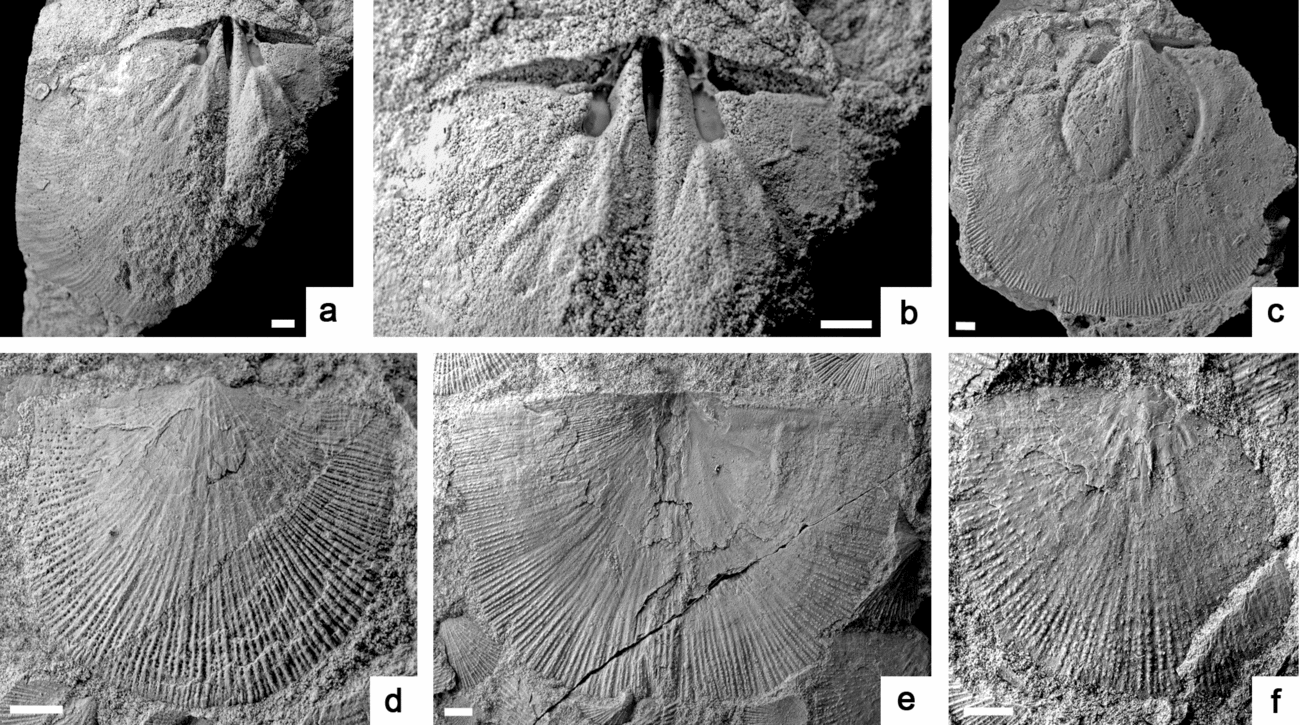
4.c. Svobodaina feisti association (Fig. 8)
Svobodaina feisti association from the uppermost Lower Ktaoua and lower part of Upper Tiouririne formations: (a, b, d, e) Svobodaina feisti Havlíček, Reference Havlíček1981: (a) latex cast of exterior of ventral valve (ARD-1.2); (b) internal mould of ventral valve (ARD-2.11); (d) latex cast of exterior of dorsal valve (ARD-2.14); (e) latex cast of interior of dorsal valve (ARD-2.5); (c) Tafilaltia occidentalis Havlíček, Reference Havlíček1971, internal mould of dorsal valve (ARD-2); (f) Rostricellula ambigena (Barrande, Reference Barrande1847), latex cast of exterior of ventral valve (ARD-2.29); (g) Schizocrania sp., internal mould of dorsal valve (ARD-1.17); (h, i) Rafinesquina sp.: (h) internal mould of ventral valve (ARD-2.13); (i) latex cast of exterior of ventral valve (ARD-1.1). Scale bars = 2 mm.

This association displays greater diversity patterns than the preceding ones, counting up to four brachiopod taxa associated with other benthic and pelagic groups, such as bivalves, trilobites, echinoderms, ostracodes, conulariids and orthoconic nautiloids. This association occurs in silty limestones of the uppermost Lower Ktaoua Formation and marks a MFS. The most common taxon is Svobodaina feisti Havlíček, Reference Havlíček1981 (65 %), followed in lesser abundance by Schizocrania sp. (26 %), Tafilaltia sp. (5 %) and Rafinesquina sp. (3 %). A very similar association, but replacing one of those taxa with another, occurs in hummocky cross-stratificated (HCS), silty tempestites of the lower part of the Upper Tiouririne Formation. In the latter case, the most common taxon is also Svobodaina feisti (82 %), followed by Rostricellula ambigena (Barrande, Reference Barrande1847) (6 %), Tafilaltia occidentalis Havlíček, Reference Havlíček1971 (6 %) and Rafinesquina sp. (6 %).
S. feisti is a very recurrent taxon from the Late Ordovician fossil assemblages of the Mediterranean Province. It is abundant in calcareous lithofacies deposited in the upper offshore, just below the fair weather wave base (FWWB), although sometimes it appears in storm-induced accumulations associated with brachiopods derived from shallower substrates (Colmenar, Harper & Villas, Reference Colmenar, Harper and Villas2014).
In the reported silty limestones, the great abundance of S. feisti (75 %) and its ventral/dorsal valve (vv/dv) ratio of close to 1 (0.78) are indicative of low transport rates (for a methodological discussion, see Hallman, Jonathan & Flessa, Reference Hallman, Jonathan and Flessa1996; Simões & Kowalewski, Reference Simões and Kowalewski2003; Simões et al. Reference Simões, Rodrigues, Leme, Bissaro and Junior2005; Colmenar, Villas & Vizcaïno, Reference Colmenar, Villas and Vizcaïno2013; Colmenar, Sá & Vaz, Reference Colmenar, Sá and Vaz2014). In the HCS-rich strata, S. feisti displays low vv/dv (0.48) ratios, indicating a higher transport rate than those of the silty limestones. Regardless, the low to moderate fragmentation rates of the shells and their random orientation suggest that both associations probably sedimented below the FWWB and above the storm wave base (SWB). The Svobodaina feisti association is the deepest of all those described in this section, probably representative of upper offshore environments, corresponding to the lowermost BA–3.
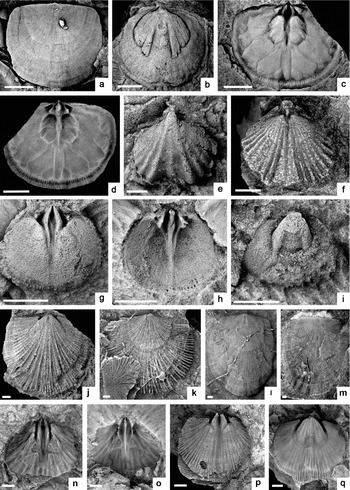
4.d. Heterorthis alternata association (Fig. 9)
Heterorthis alternata association from the upper part of the Upper Tiouririne Formation: (a–d) Heterorthis alternata (Sowerby, Reference Sowerby and Murchinson1839): (a) latex cast of exterior of dorsal valve (ARD-4.4); (b) internal mould of ventral valve (ARD-4.20); (c, d) internal mould (c) and latex cast of interior (d) of dorsal valve (TNR-2.1); (e) Rostricellula ambigena (Barrande, Reference Barrande1847), internal mould of ventral valve (ARD-4.21); (f) internal mould of dorsal valve (TNR-4.11); (g–i) Destombesium sp.: (g, h) internal mould and latex cast of interior of dorsal valve (ARD-4.22); (i) internal mould of ventral valve (ARD-4.32); (j, k) Rafinesquina pseudoloricata (Barrande, Reference Barrande1848): (j) internal mould of ventral valve (ARD-4.23); (i) latex cast of exterior of ventral valve (ARD-4.19); (l, m) Rafinesquina pomoides Havlíček, Reference Havlíček1971: (l) latex cast of exterior of ventral valve (ARD-5.2); (m) latex cast of exterior of dorsal valve (ARD-5.3); (n, o) Drabovinella sp. B, internal mould (n) and latex cast of interior (o) of dorsal valve (TNR-4.1); (p, q) Hirnantia plateana Havlíček, Reference Havlíček1977, (p) internal mould of dorsal valve (TNR-4.8); (q) internal mould of ventral valve (TNR-4.2). Scale bars = 2 mm.

This assemblage is characterized by moderate diversity patterns, dominated by bryozoans, echinoderms and brachiopods. The shells are highly abraded, fragmented and show important size sorting. The most abundant taxon is Heterorthis alternata (Sowerby, Reference Sowerby and Murchinson1839), with a maximum abundance of 45 %. The association also includes, in order of abundance, Rostricellula ambigena, Destombesium sp. and Rafinesquina pseudo-loricata Barrande, Reference Barrande1848, and subsidiary Rafinesquina pomoides Havlíček, Reference Havlíček1971, Drabovinella sp. B, Hirnantia plateana Havlíček, Reference Havlíček1977 and Linguloidea gen. et sp. indet.
Heterorthis alternata displays the largest ventral muscle scars within its genus. In a study of some species belonging to the heterorthid Svobodaina Havlíček, Reference Havlíček1951, Colmenar, Harper & Villas (Reference Colmenar, Harper and Villas2014) observed that the development of larger ventral muscles points to higher energetic conditions. This relationship may be applied to Heterorthis, inferring its adaptation to high-energy substrates, under the continuous influence of fair weather waves. This is supported by Pickerill & Brenchley (Reference Pickerill and Brenchley1979), who described the so-called Dinorthis sub-community, in which they included Heterorthis, as ‘developed on shifting, coarse sand substrates in high-energy, non-turbid, well oxygenated environments of water depths of less than approximately 10 m’.
Subsidiary taxa of this association, such as H. plateana, are typical of a community characteristic of the Upper Ordovician Bohdalec Formation from Bohemia, assigned by Havlíček (Reference Havlíček1982) to BA–3. Other minority taxa of the Heterorthis alternata association can locally increase in abundance: this is the case of R. pomoides, more typical from slightly deeper environments (lower BA–3) and the lingulids (Linguloidea gen. et sp.) currently assigned to shallower environments than those expected for BA–1 (Boucot, Reference Boucot1975). In summary, based on the reported sedimentological, taphonomic and morphofunctional data, the association may be representative of an upper BA–3.
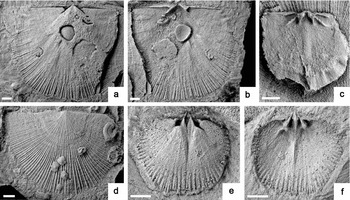
4.e. Destombesium akkaensis association (Fig. 10)
Destombesium akkaensis association from the Alnif Member of the Upper Formation of the Second Bani Group: (a–c) Destombesium akkaensis Havlíček, Reference Havlíček1971: (a, b) internal mould (a) and detail of cardinalia (b) of dorsal valve (CoA.1); (c) internal mould of ventral valve (CoA.2); (d–f) Eostropheodonta? tafilaltensis Havlíček, Reference Havlíček1971: (d) internal mould of ventral valve with the shell partially preserved (CoA.3); (e) internal view of ventral valve (CoA.4); (f) internal view of dorsal valve (CoA.5). Scale bars = 2 mm.

This association was sampled in the lower member of the Hirnantian Upper Formation of the Second Bani Group, the Alnif Member. The brachiopods occur in boulders included within the conglomerate that characterizes the member, so they are allochthonous fossils. The association is composed of Destombesium akkaensis Havlíček, Reference Havlíček1971 and Eostropheodonta? tafilaltensis Havlíček, Reference Havlíček1971 as well as bivalves, gastropods, echinoderms, cornulitids and orthoconic nautiloids. Both brachiopod species are characteristic of the Upper Tiouririne Formation (Havlíček, Reference Havlíček1971).
4.f. Eostropheodonta jebiletensis association (Fig. 11)
Eostropheodonta jebiletensis association from the Amouktir Member of the Upper Formation of the Second Bani Group: (a–d) Eostropheodonta jebiletensis Havlíček, Reference Havlíček1971: (a, b) internal mould (a) and latex cast of interior (b) of ventral valve (71.1); (c) latex cast of interior of a dorsal valve (71.3); (d) latex cast of exterior of a ventral valve (71.4) (e, f) Kinnella kielanae (Temple, Reference Temple1965): internal mould (e) and latex cast of interior (f) of dorsal valve (71.5). Scale bars = 2 mm.

This association is characteristic of sandstone interbeds from the Hirnantian Amouktir Member (Upper Formation of the Second Bani Group). It is dominated by Eostropheodonta jebiletensis Havlíček, Reference Havlíček1971 and Kinnella kielanae (Temple, Reference Temple1965). The latter is typical of the Aphanomena (= Eostropheodonta)–Hirnantia Community (Rong, Reference Rong1986; Wang et al. Reference Wang, Boucot, Rong and Yang1987), which was included within the shoreface-dominated, upper BA–3 by Rong (Reference Rong and Bruton1984). Eostropheodonta jebiletensis had not yet been included in any community, but its morphological similarity with Eostropheodonta hirnantiensis (McCoy, Reference McCoy1851), also typical of the upper BA–3 community, may point to environmental preferences similar to that of E. jebiletensis.
5. Diachronous distribution and stratigraphic resolution of brachiopod assemblages
The variation in taxonomic composition throughout the above-reported brachiopod assemblages was mostly environmentally controlled, because their close correspondence with bio- and lithofacies changes suggests they did not display time-recurrent patterns. The traditional brachiopod-based biostratigraphy, although well established and easy to use, does not have the appropriate temporal resolution to evaluate some sequence-stratigraphic correlations. Therefore, their utilisation for interbasinal correlation requires calibration with other stratigraphic subdivisions.
However, some specific brachiopods are characteristic of some Katian slices and useful for chronostratigraphic correlation. The presence of Tafilaltia destombesi in the lowermost stratigraphic levels of the Lower Ktaoua Formation indicates a probable early Katian age (Ka1 stage slice) for these levels. The presence of Svobodaina feisti, although displaying a wide stratigraphic range (Ka2–4 for Colmenar, Harper & Villas, Reference Colmenar, Harper and Villas2014), allows the assignation of a mid Katian (Ka2) minimum age to the uppermost part of the Lower Ktaoua Formation and to the lower part of the Upper Tiouririne Formation. In the same way, the occurrence in the lower part of the Upper Tiouririne Formation of Tafilaltia occidentalis, only cited until now from the Pusgillian of Morocco, warrants the attribution of a mid Katian age (Ka2) to the lower part of this formation. Rafinesquina pomoides, sampled in the middle and upper parts of the Upper Tiouririne Formation, also confirms a mid Katian age (Ka2) (Villas et al. Reference Villas, Vizcaïno, Álvaro, Destombes and Vennin2006). All these data are consistent with those based on chitinozoans and acritarchs (Elaouad-Debbaj, Reference Elaouad-Debbaj1986; Paris, Reference Paris1990). The stratigraphic ranges of the remaining species sampled in the Upper Tiouririne Formation, such as Rostricellula ambigena (Sa2–Ka2) and Hirnantia plateana (Ka1–2), are consistent with the estimated age of the formation.
Another interesting case is offered by Heterorthis alternata, which proliferated in the late Sandbian – early Katian siliciclastic platforms of Avalonia. Havlíček (Reference Havlíček1970) reported this taxon in Morocco, representing its first occurrence outside Avalonia. Villas et al. (Reference Villas, Vizcaïno, Álvaro, Destombes and Vennin2006) stated that its presence in the Upper Tiouririne Formation probably constitutes the youngest known occurrence of the taxon, extending its stratigraphic range into the mid Katian (Ka2). The siliciclastic-dominated platform of the eastern Anti-Atlas probably represents a last refuge for the survival of this species facing the changing climatic and environmental conditions recorded in the Mediterranean Province during Mid to Late Ordovician times.
6. Conclusions
The main characteristic of the Katian succession in the eastern Anti-Atlas is the dominance of brachiopod assemblages that reached their peak in the Lower Ktaoua and Upper Tiouririne formations, occurring in all shallow-water environments. The skeletal composition suggests a temperate-water bryonoderm association different from the subsequent Hirnantia cool-water fauna.
Two Katian (transgressive–regressive) composite depositional sequences, c. 60 and 170 m thick and related to third-order fluctuations in sea level, were unaffected by Hirnantian glaciogenic erosion. They were deposited on a mixed platform with a bryonoderm association dominated by brachiopods, bryozoans and echinoderms. Brachiopods developed in high-energy inner shelf areas, whereas bryozoans (mainly trepostomates and fenestrates) and pelmatozoans (cystoids and crinoids) dominated in low-energy outer shelf areas. The brachiopods mark distinct event surfaces, such as lag and event concentrations, hydraulic simple and composite concentrations related to transgressive surfaces, and hiatal condensed concentrations marking MFS. The taphonomic condensation displayed by the Hirnantian Alnif Member, which onlaps the erosive base of glaciogenic tunnel channels, is explained as reworking and resedimentation of allochthonous, robust, biogenic hard parts sourced from the underlying (Katian) Ktaoua Group.
Six brachiopod assemblages are recognized, the so-named Tafilaltia destombesi, Drabovinella sp. A, Svobodaina feisti, Heterorthis alternata, Destombesium akkaensis and Eostropheodonta jebiletensis associations. Because the composition and preservation potential of brachiopod communities is controlled by environmental factors, which are predominantly depth- and substrate-related, a strong correlation exists between brachiopod appearances and disappearances and the onset of sequence-stratigraphic cycles. Most of the brachiopod taxa occurring in the studied logs have a wide stratigraphic range or belong to specific biofacies and are thus of little use for correlative purpose. Although a brachiopod-based biostratigraphic resolution at species level zonation is not as precise as that attainable by using chitinozoans, the potential exists for significant bioevent horizons characterized by brachiopod accumulations with sequence-stratigraphic significance.
Acknowledgements
The ideas expressed in this paper benefited from fruitful discussions during geological mapping with Lahssen Baidder, Mohammed Benharref and Abdelilah Fekkak. Financial support and field logistics in Tafilalt were provided by CAP-Ressources (Casablanca). The authors thank the Ministère de l’Energie, des Mines, de l’Eau et de l’Environnement of Morocco for permission to publish these results. The authors also want to acknowledge the comments of the two anonymous referees that improved considerably the quality of this paper. The brachiopods described and illustrated in this paper are housed in the Musée de l’Institut Scientifique de Rabat (collection Tafilalt/CAP-Ressources). This paper is a contribution to the Spanish Ministry of Economy and Competitiveness projects CGL2012–39471 and CGL2013–48877, and to the Department of Science, Technology and University of the Aragón Government Project E–17 ‘Patrimonio y Museo Paleontológico’, with the participation of the European Social Fund.