What I attempted to do in my administration was to transcend
race and look at what was in the best interest of the whole
city. I talk about one Memphis, not a separated Memphis…. Yes,
this is the time; we could enjoy the leadership of an African
American mayor, but I have to be successful to receive support
from the business community and White citizens, I need
everybody.
—Dr. W. W. Herenton, personal interview, July 17, 2003
Morris Washer, a White 78-year-old Midtowner, also considered
race to be a nonfactor [in the 2003 Memphis mayoral election].
Regardless of a candidate's race, Washer said, “I want to have
the best person in there.”
—Chattanooga Times, October 10, 2003
In 2005, Hurricane Katrina flooded more than 80% of the city of New Orleans.
As the stories of hurricane victims, mostly African Americans, dominated the
national news coverage, New Orleans' racial politics in particular, and the
racial divisions in general, once again invited public debate. Why did a
city that had been firmly controlled by African-American politicians from
the mayor's office to the city council exhibit such a clear racial image?
What role did Whites play in the city's political establishment?
Though the increases in minority populations across the country, especially
in urban areas, have drawn considerable attention from the media and
politicians, there has been a lack of academic effort to study how Whites
have reacted to their minority status in American cities. New Orleans, a
White-minority city, has elected four African-American mayors since 1977.
The rise of Black political power has contributed to and benefited from a
“White flight” in New Orleans. However, the Whites who chose to stay
represent more than 30% of the registered voters in the city's most recent
elections. How did they respond to the increasing Black political voice in
mayoral elections?
Memphis, another Southern White-minority city, did not elect a Black mayor
until 1991. After many years of racially polarized elections, Whites in
Memphis started to vote for the moderate Black candidate and defeat those
Black opponents who were most popular in the Black community. As in New
Orleans, the White minority would not have played any major role in mayoral
elections if they had continued to vote along racial lines. Scholarly
scrutiny must move beyond just explaining how Whites became “willing” to
support Black candidates in these two Southern cities, and on to Whites'
increasingly pivotal role in the cities' elections.
Current Theories of White Voting Behavior
Studying Whites as a minority certainly can give scholars an important
perspective. More than 50 years ago, V. O. Key (1949) convincingly explained why the White minority in the
Black belt was the key to understanding Southern politics. Key's Black
threat hypothesis, perhaps one of the longest-lived hypotheses in
American political science, has profoundly influenced the study of
racial politics in America (Taylor 1998; Glaser 1994; Giles and Hertz
1994; Giles and Buckner 1993). Key
hypothesized that an increase in Black presence in a community leads to
a higher level of Black threat perceived by the community's Whites.
Applying this hypothesis to White voting behavior in New Orleans and
Memphis, the Black threat thesis predicts that an increase in Black
density, measured by the proportion of Black registered voters in an
electoral unit, leads to a decrease in White support for Black
candidates (Hypothesis 1 in this research).
Key's original theory (1949) was about the
“maintenance of White supremacy” in the South, where Black
disfranchisement was fairly common (5). The old context in which Key
constructed his theory clearly was different from the post-Voting Rights
Act era (Lublin 1997, 89). Indeed, Black
politicians elected to powerful positions may no longer be just a
“threat”; it has become a “reality” in many areas, especially at the
local level (Liu 2003). One more issue in the
empirical testing of the Black threat hypothesis concerns the proper
geographic units that the Black threat theory should be based upon
(Liu 2001b; Oliver and
Wong 2003). While scholars of Black threat have found support
for this hypothesis when Black density is measured at the county or
other relatively large election unit level (e.g., Tolbert and Hero 2001), precinct-level or neighborhood
analyses tend to provide counter-evidence (e.g., Welch, Sigelman, Bledsoe, and Combs 2001; Carsey 1995). Moreover, some studies have also discovered
that the relationship between Black density and White backlash may not
be simply linear. It is possible that White backlash against Black
interests is the strongest when Black density reaches a critical level
of around 20–30%, and Whites may become less discriminatory once they
are in the minority (Keech 1968; Liu 2003).
More recently, scholars of racial interaction have provided a competing
theory (Welch, Sigelman, Bledsoe, and Combs
2001; Huckfeldt and Sprague 1995;
Huckfeldt 1986; Carsey
1995; Oliver and Wong 2003). Here
the focus shifts to the positive social consequences of racial
interactions. According to this theory, the more White voters
communicate or encounter with Blacks, especially at the neighborhood
level, the higher the possibility that these Whites will make friends
with Blacks or become racially tolerant. With respect to White voting
behavior, an increase in Black density (also measured by the proportion
of Black voter registration in a voting precinct) may lead to a greater
opportunity for racial interaction and, therefore, a higher level of
White support for Black candidates (Hypothesis 2).
Critiques of the racial interaction hypothesis point to the possibility
of a “self-selection” process that takes place when voters choose to
live in a certain neighborhood (e.g., a racially mixed one) because they
have already had a certain racial attitude to out-groups (e.g., racial
tolerance) before they moved into that neighborhood (Pettigrew 1998; Powers and Ellison
1995; Oliver and Wong 2003).
Furthermore, according to a recent study (Liu
2001a), the positive effect of racial contact on White racial
tolerance may indeed exist, but this effect can be conditional on other
factors, such as the overall group status and political power of Whites
in a certain area.
Other than Black density, ideology has also been suggested as a
determinant of White voting behavior (Browning,
Marshall, and Tabb 2003; Sonenshein
1993). In this vein, the political incorporation theory
emphasizes the coalition between White liberals and minorities to defeat
White conservatism in urban America. Browning, Marshall, and Tabb (1984) argue that Black political control is
vital to Black interests, and the biracial coalition between Blacks and
liberal Whites is a key to the success of Black empowerment. More
importantly, this coalition must be the “dominant coalition” to protect
Black interests (also see Sonenshein and Pinkus
2005 for a case study of the racial coalition between Latinos
and White liberals in Los Angeles). Based on this proposition, one may
simply hypothesize that White liberals are more likely to support Black
candidates in a biracial election than are non-liberal Whites
(Hypothesis 3).
Though ideology has been a focus of many electoral studies, there is no
consensus on the effect of a White belief system. Other scholars used
the concept of symbolic racism, a much more pessimistic view
than that offered in the political incorporation theory, to describe and
explain the modern White moralistic and abstract resentments toward
Blacks as a group. The subtle sentiments of symbolic racism are
suggested as a reflection of the belief that “Blacks violate such
traditional American values as individualism and self-reliance, the work
ethic, obedience, and discipline” (Kinder and Sears
1981, 416; Kinder and Sanders
1996). Another limitation on the existing theories of White
ideology is the difficulty in using them to trace the dynamic impact of
racial transition on White political behavior. Arguably, when Whites
become a minority in cities such as New Orleans and Memphis, their
political power status is structurally changed. As a result, Whites may
develop a new approach to Black political power to maximize their own
political power, though their ideology may or may not remain the same
(for an early theoretical treatment of White reaction to contextual
changes, see Eisinger 1974 about White
“pragmatic coalition”). Furthermore, a scholar who uses the conceptual
framework of White ideology may find it very difficult to distinguish
whether Whites' racial hostility is based on real-world concerns or on
racial stereotypes (Bobo 1983).
White Voting Patterns in New Orleans and Memphis' Mayoral
Elections
This paper focuses on New Orleans and Memphis, two major Southern cities
that Key (1949) argued are the key to
understanding the racial politics of Louisiana and Tennessee. Indeed,
given the racial tensions that have existed historically in these two
cities (e.g., see Hirsch 1997; Pohlmann and Kirby 1996), it is reasonable to
assume that if a successful biracial coalition can be formed in these
two cities, then a same or similar coalition can be formed in other
cities where racial tension has not been as high. Both New Orleans and
Memphis use a mayor-council form of government and a nonpartisan
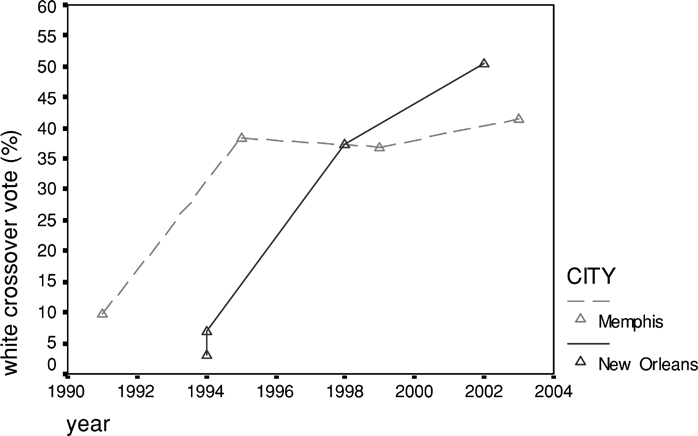
election system. Figure 1 provides the changes
in White support for the leading Black mayoral candidates who won the
respective elections in Memphis and New Orleans since 1991. These
city-wide estimates were based on the Ecological Inferences (EI) basic
model developed by Gary King.1
Many scholars have indicated that King's
Ecological Inference (EI) method is especially valuable and
reliable for estimating racial voting behavior in some Southern
states, especially for Louisiana (see, for example, Liu 2001a; 2001b;
Palmquist 1999; Voss and Lublin 2001). Southern states such as
Louisiana and Florida collect voter registration data by race
and by precinct. In these states, racial voting patterns can be
estimated with impressive accuracy also because there are a
number of precincts that are predominantly White or Black, which
is always good news for any statistical procedures that infer
individual-level behavior from aggregate-level data. Louisiana
also has a unique advantage: since the late 1980s, the
government has also provided precinct-level racial data for
voters who cast their votes (i.e., the sign-in or post-election
data). This enhances the ability of the EI method to accurately
estimate racial voting.
White Crossover Voting in New Orleans and Memphis, 1991–2003
Clearly, both cities exhibited the same pattern: White support for Black
candidates started at a very low level before increasing substantially
to more than 40% in the next 15 years. One may speculate that Whites
became more liberal over time in their racial attitude to Black
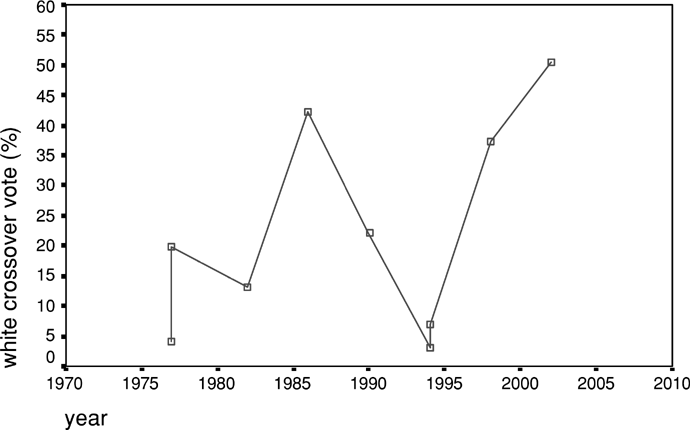
electoral challenges in the two cities. Yet, a closer look at New
Orleans' longitudinal White voting data from 1977 to 2002 indicates that
1994 marked a significant drop in White support for Black candidates
(see Figure 2). In other words, there has been
no consistent growth in White support for Black candidates over time.
Therefore, to understand the surges and declines of White support for
Black candidates, one has to pay attention to the contexts in which the
elections took place.
White Crossover Voting in New Orleans' Mayoral Elections,
1977–2002
Mayoral Elections in Memphis
All of the mayoral elections presented in Figures 1 and 2 were biracial elections
involving both Black and White candidates. Thus, there was a chance for
the White voters to support White candidates in these elections. Indeed,
in both cities Whites provided a very low level of support for Black
candidates in the early 1990s. In Memphis, the White support for Dr.
Willie W. Herenton, the leading Black candidate and former school board
superintendent of Memphis, was less than 10%. However, Herenton carried
more than 95% of the African-American vote and benefited from a court
decision that stopped the use of mayoral runoff election in Memphis to
defeat the White incumbent, Dick Hackett, by only 142 votes in the
primary, becoming the first elected Black mayor in Memphis history
(Pohlmann and Kirby 1996).
Herenton easily won reelection in Memphis with his share of the White
vote increasing to more than 30% in 1995. One may quickly attribute this
success to the incumbency advantage. Indeed, in 1995 Herenton had no
opposition from any Black candidate, and none of Herenton's three White
challengers could muster a serious threat to his reelection. The only
White candidate with some name recognition was John Baker, who had
unsuccessfully run for the U.S. Senate.
In the following 1999 mayoral election, as many as 15 candidates joined
the race—a sign that Herenton's incumbent advantage was challenged. The
major White candidate was Pete Sisson, a county commissioner. Herenton
managed to maintain his White crossover vote at the 37% level, about the
same as his White crossover level in the 1995 race. White support for
Herenton in this election, however, was crucial to his reelection
because his Black support dropped more than 45%. The division in the
Black community was largely due to a strong challenge from City Council
Chairman Joe Ford, a Black candidate and former Congressman Harold
Ford's brother, who accused Herenton of selling out Black interests to
White downtown development projects (Wright
2000). Ford was defeated in the election, but almost half of
the Black electorate voted for him.
By 2003, Herenton, now a three-term incumbent, had become increasingly
popular in the White community. Herenton received 68% of the votes cast
in the 2003 mayoral election to defeat seven other candidates, including
John Willingham, a White candidate and a Shelby County commissioner.
Herenton's White crossover increased to about 42%. Herenton is currently
in his fourth term, longer service than any previous mayor.
Mayoral Elections in New Orleans
In New Orleans, the 1994 mayoral contest was mainly between Donald Mintz
and Marc Morial. Mintz was the major White candidate who had entered
into a runoff with the Black incumbent mayor, Sidney Barthelemy, in the
1990 race. Marc Morial, the major Black candidate, is a son of Ernest
“Dutch” Morial, the first Black mayor in New Orleans. With the local
White media alerting the White community that the election might be “the
last chance to elect a White mayor” (Engstrom and
Kirkland 1995, 8), Morial openly suggested that only his
election would stop the White challenge to the 16-year Black control of
city hall. He urged the Black community to unite behind him to defeat
Mintz. The outcome of the 1994 mayoral race was the most racially
divided election in New Orleans' history (Engstrom
and Kirkland 1995, 6). Morial won the election, but he
received only 3% of the White vote in the primary and 7% in the
runoff.
In 1998, Morial successfully won reelection. His two White challengers,
lawyer Kathleen Cresson and arts store manager Paul Borrello, were
newcomers to New Orleans' local politics and were not a real threat to
Morial's reelection (Perry 2003). Despite the
weak competition from these White candidates Morial still failed to
gather a majority from White voters—his White crossover was only about
38% in 1998. After the election, Morial attempted, but failed, to
persuade the city's voters to eliminate or modify the term limit law.
Not able to run for a third term, he retired after eight years as
mayor.
The 2002 mayoral election quickly attracted 15 candidates including a
famous White professor and constitutional scholar from Tulane
University. Two Black candidates made it to a runoff. As a surprise to
many, C. Ray Nagin, the general manager/vice president of Cox
Communications and co-owner of the Brass hockey team, defeated Richard
J. Pennington, the popular police superintendent widely regarded as a
surrogate candidate for the Morial administration (Perry 2003).2
Pennington's
biggest asset was name recognition. Prior to the 2002 election,
his job approval rating was even higher than that of Mayor Marc
Morial (DuBos 2001). His campaign
focused on fighting crime and improving job opportunities and
education, a message designed to consolidate his support among
African Americans. However, Pennington was criticized by some
Black leaders based on a 2001 FBI report showing New Orleans
once again leading the nation in murders, despite its lower
crime rates. Jim Singleton, a popular Black city councilman and
a candidate for the mayoral election, openly attacked
Pennington. Singleton remarked, “with recent reports that New
Orleans is once again the ‘murder capital of America,’ we have
to stop harping on the progress we have made and begin to put
together the mechanics for a sustained and consistent strategy
against crime” (DuBos 2001,
15).
Nagin's success, based on a deracialized campaign
strategy, was largely due to White support. He received 50% of the White
vote in the primary and 86% in the runoff. Both were record-breaking
White support for a Black candidate in New Orleans history, but his
Black support was as low as 12% in the primary and only 39% in the
runoff.
To summarize, when White voters rallied behind the major White
candidates in the 1991 Memphis mayoral election and the 1994 New Orleans
mayoral race, the White candidates were defeated. These defeats seemed
to persuade many White voters that continuing to vote for White
candidates would further limit their own electoral power. To see the
strategic adjustment of White voters in subsequent mayoral elections, it
is important to focus on the 1999 Memphis election and 2002 New Orleans
race where White voters played an instrumental role in electing Herenton
and Nagin and defeating Joe Ford and Richard Pennington, their major
Black opponents who were popular in the Black communities.
The pivotal role of the White minority in electing their favorable Black
candidates in the two cities' subsequent mayoral elections was
intrinsically linked to the racial contexts which structured the overall
political power of White voters. In Memphis, based on the voter
registration data, the electorate changed from 48% Black at the time of
the 1991 mayoral contest to 51% Black in 1995. By 2000, the city's
population was 61% Black and 34% White.
In New Orleans, the electorate was 54% Black in 1990 and 63% Black in
1998. By 2000, the city's population was 67% Black and 27% White.3
It should be noted that the population
sizes of other minorities (e.g., Latinos and Asians) have also
grown in the two cities. But these other minority groups have
not grown to the extent that they can significantly affect
mayoral election results. In New Orleans, as late as 2002 the
White and Black racial groups combined were still about 95% of
the total registered voters. In 1990, White and Black voters
were 99% of the electorate. Prior to 1990, there were almost no
reliable data on the racial registration for the non-Black
minorities due to their small sizes. In Memphis, non-Black
minorities have grown more rapidly than in New Orleans. In 1995,
Latinos, Asians, and other minorities collectively were about 8%
of the registered voters prior to the Memphis mayoral election.
This figure was increased to 14% prior to the 2003 Memphis
mayoral election.
Clearly, the racial transition has
provided a better chance for Black candidates to win in both cities,
while White candidates faced increasing difficulty to win as a minority
in the cities' elections. Thus, continuing to vote for a White candidate
was likely to produce White defeats. It became rational for White voters
to strategically vote for a “friendly” Black candidate to at least help
defeat “threatening” Black candidates. The following sections use both
aggregate and individual-level data to test the three hypotheses (the
Black threat (H1), racial interaction (H2), and political incorporation
(H3) hypotheses) based on the existing theories of White voting
behavior.
Methods and Data
As stated above, the “increasing power” of White voters was evident in
the 1999 Memphis and 2002 New Orleans mayoral elections where Whites
were a pivotal force electing Herenton and Nagin, the favorable Black
candidates, and defeating other “threatening” Black candidates (i.e.,
Pennington and Ford). The precinct-level racial registration data are
available for both cities with respect to these two elections. To find
which White voters supported Herenton and Nagin, I matched these
registration data with the precinct-level election return figures to
form the first dataset.
To explain individual-level White voting behavior using aggregate-level
data, I employed King's EI procedure to produce estimates of White-voter
support for the Black candidates at the precinct level. I used the EI
approach because the traditional ecologic regression methods (Goodman
Regression, Homogeneous-Precinct analysis, and Double Regression
procedures) do not offer precinct-level estimates. To test H1 and H2
(i.e., the two competing hypotheses that expect a positive or a negative
relationship between the level of White support for Black candidates and
Black density), the independent variable is measured by the Black
proportion of registered voters. H3 states that liberal White voters are
more likely to support Black candidates than are conservative White
voters. Thus a measure of White voters' ideologies is necessary.
Unfortunately no registration data are available to measure voters'
ideologies. In New Orleans, however, there are official data showing
precinct-level White Republican voters who voted in the 2002 mayoral
runoff. This variable is used as an indirect measure of ideology. It is
reasonable to assume that White Republicans are more likely to have a
conservative ideology than are White non-Republicans.
Very few previous studies used both aggregate and individual-level data.
This is because such data are normally not available to scholars. One
advantage of this study is that it tests hypotheses by using
aggregate-level data as well as individual-level analysis. The
individual-level data came from a citywide survey conducted in New
Orleans by the Survey Research Center of the University of New Orleans
between February 14th and 19th of 2002. The survey
used a random digit dialing procedure with a screen for registered
voters, and was based on telephone interviews of a random sample of 472
registered voters. The racial distribution of the survey respondents—31%
White and 63% Black—closely reflects the city's registration
characteristics at the time of the 2002 mayoral primary.
The respondents were asked how they would vote in the upcoming mayoral
runoff election. This question is used to measure the dependent variable
for Hypothesis 3. Because it is a dichotomous variable, the logistical
regression models are employed to examine the voting decision of White
and Black voters. Furthermore, borrowing from the findings of previous
studies of racial politics, some control variables are also included in
the models. These include the measures of social economic status of
voters (Brewer and Stonecash 2001), voters'
evaluations of current local government (Howell and
Marshall 1998), and effect of news media (Liu 2003; Reeves 1997).
Findings
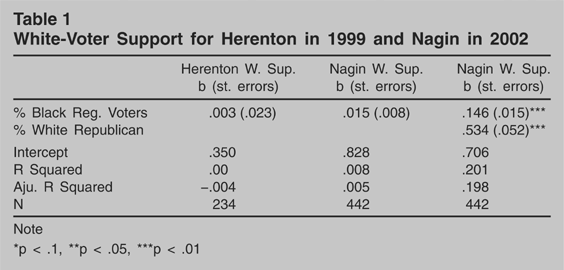
Table 1 reports three equations that use
precinct-level estimates of White crossover voting for Herenton in the
1999 election and Nagin in the 2002 runoff as the dependent variables.
Equations 1 and 2 are simple bivariate regressions with precinct-level
Black density as the independent variable. The regression coefficients
are not statistically significant, which suggests that, unlike what the
Black threat and racial interaction hypotheses proposed, there is no
relationship between Black density and White crossover voting at the
precinct level. Thus, there is no empirical support for Hypotheses 1 and
2 based on the aggregate-level data in New Orleans and Memphis.
White-Voter Support for Herenton in 1999 and Nagin in 2002
According to the political incorporation theory (H3), there should be a
higher level of support for the Black candidate of the biracial
coalition from White liberal Democrats than from White Republicans.
Equation 3 therefore adds one more independent variable, the percentage
of registered voters who are White Republicans, into the New Orleans
model. The R-squared increased from .008 to .201, indicating that the
new model explains about 20% more variation in the dependent variable.
Thus, Nagin's White support was from White Republicans, certainly not
from White liberals.4
White Democrats as a
measure of White ideology did not reveal a statistically
significant finding. This is shown in the following regression
result:
Moreover, the Black
density variable also becomes statistically significant, which shows
that with the level of White Republican voters held constant, White
support for Nagin increases as Black density increases.
To further test if Black density and party identification are
statistically significant once other factors are controlled, we turn to
our logistical regression models based on the individual-level survey
data collected by the University of New Orleans Survey Research Center.
The dichotomous dependent variable is based on the question, “[a]s
things stand today, who are you most likely to vote for in the election
for Mayor of New Orleans, Ray Nagin or Richard Pennington?” (Recoded as
“1” if the answer is Nagin, “0” if the answer is Pennington.) The
logistic regression models are employed to examine the voting decision
of White and Black voters.
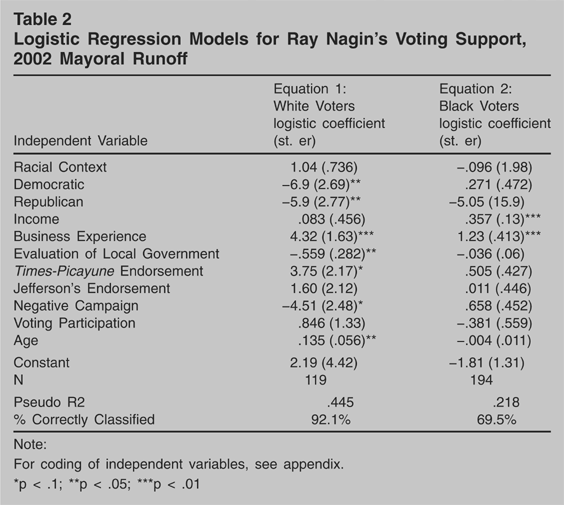
The racial context variable is used to test H1 and H2, which suggest that
the Black density of a neighborhood may affect the probability of Whites
voting for Nagin. However, according to Equation 1 of Table 2, racial context, or Black density at the
neighborhood level, did not affect White voters' decision to vote for
Nagin. Thus, survey data do not provide empirical support for H1 and H2
(see Appendix for survey question wording and coding).
Logistic Regression Models for Ray Nagin's Voting Support, 2002
Mayoral Runoff
Party affiliation, on the other hand, is a predictor of Whites' choices.
Democrats, contrary to political incorporation theory (H3), were less
likely to vote for Nagin. This seems to support an earlier observation
reported in Equation 3 of Table 1. It is also
in line with Perry's (2003) argument that
Nagin led a conservative coalition in the 2002 mayoral election.
However, based on the logistic regression model in Equation 1, which
includes two dummy variables to measure party affiliations, Nagin's
White support was actually neither from Democrats nor from Republicans.
In fact, those Whites who identified themselves as “independent” were
most likely to support Nagin.
Other control variables also reveal very important findings: Nagin's
White supporters were those who emphasized the importance of his
previous business experience; gave negative evaluations of the Morial
administration; and knew that the major White-controlled local
newspaper, the Times-Picayune, had endorsed Nagin. Moreover,
these White voters were, comparatively speaking, older, and were not
affected by the negative TV commercials attacking candidates.
For Black respondents, Equation 2 shows that only two independent
variables are statistically significant. Similar to White voters, Black
respondents also indicated that Nagin's previous business experience
positively influenced their support for him in the mayor election. This
finding suggests that both White and Black groups stress the importance
of their city's future economic success as the reason to support Nagin.
The main difference between Black and White voters regarding their
support for Nagin is that only Black voters who had high levels of
family income were likely to support Nagin in the runoff. In other
words, social class was an indictor of Nagin's coalition membership only
for Black voters. For White voters, family wealth was not a factor.5
Since the dependent variable of Table 2 is a dichotomous variable, i.e.,
a vote for either Nagin or his opponent, Pennington, in the
runoff, the findings reported in Table
2 can also be used to reveal the characteristics of
those White voters who supported Pennington, the more
“threatening” Black candidate who received about 15% of the
White vote (Perry 2003). For example,
according to Table 2, Pennington's
White supporters, comparatively speaking, were more likely to be
influenced by the negative campaigns of Pennington against
Nagin, were younger, and were more partisan (Democratic as well
as Republican).
Discussions
The empirical findings presented above did not substantiate the three
hypotheses derived from the literature of White political behavior. With
respect to the first hypothesis, as noted above, V. O. Key's famous
Black threat thesis was originally constructed in the context of the old
South where White political domination was the core of racial politics.
This political domination no longer exists in New Orleans and Memphis.
One may argue that Black threat in a mayoral contest is at the city
level, rather than at the precinct or neighborhood level, the geographic
unit used in this study to test the Black threat hypothesis. Certainly,
further research is needed to measure Black density at multiple levels
(see Liu 2001b). However, the fact that the
Black density in both cities has increased over time, and yet there has
been no consistent growth in White support for the leading Black
candidate (see Figure 2 about White voting
behavior over time in New Orleans) suggests that even when measured at
the city level, Black threat theory seems to have limited explanatory
power.
The social interaction hypothesis, which presented an overall optimistic
view of racial politics and received support from the empirical studies
of the Northeast and Midwest (e.g., see Welch,
Sigelman, Bledsoe, and Combs 2001; Carsey
1995), should also be examined with caution in the context of
New Orleans and Memphis' White minorities. The multiple regression model
based on the aggregate data (Equation 3 of Table
1) suggests that Black density was positively related to
White support for Nagin. However, our individual-level analysis did not
confirm this finding. Arguably, it does take time for racial
interactions to produce a positive effect on White voting for Black
candidates in the South, and the interacting in New Orleans and Memphis
may still have occurred too early to show that positive effect (for a
discussion of the slow effect of racial interaction on White political
opinions, see Kinder and Mendelberg 1995).
As for the third hypothesis, as stated, at the core of the liberal
coalition explained in the political incorporation theory is the
dominant Black (or minority) leadership with significant
liberal Whites' electoral support. In Berkeley and other
northern California cities as well as Los Angeles, for example, this
racial coalition was in fact put into power, and the minority interests
were greatly enhanced, if not fully protected (Browning, Marshall, and Tabb 2003). Our statistical analysis
shows, however, that the new biracial coalitions led by Black
politicians—Ray Nagin in New Orleans and Willie Herenton in Memphis—were
clearly different from those found in California.
Overall, the logistic models indicate that White and Black voters
supported Nagin for different reasons. They didn't support him because
they shared the same liberal belief system or party identification. To
understand this new coalition, one needs to pay attention to the context
of the local election. Different than Black politics at the national
level, which shows more unity than division (Tate
1994), Black internal division may be much deeper at the
local level. Very often this internal division is due to disagreements
among Black leaders on policy priorities and “the optimum strategy for
liberation” (Hill 1994, 15; for the politics
of racial reflexivity, see Pohlmann and Kirby
1996). In New Orleans, a major Black division was clear as
early as in the 1986 mayoral election in which Sidney Barthelemy, a
Black candidate using a deracialization campaign, received 42% of the
White vote and defeated the other “racially confrontational” Black
candidate, William Jefferson (Perry 2003). In
Memphis, the internal struggle has always involved Congressman Harold
Ford. Acknowledging his conflict with Ford, Herenton explained:
I knew that we couldn't peacefully coexist because of his [i.e.,
Harold Ford] needs for power…. I kept trying to tell people what
the Ford family had done. He had misled you. Yes, Ford built up
his enormous reputation by getting utilities on and food stamps.
But in terms of moving the city forward economically, expanding
tax base, and creating more opportunities and bringing a
polarized community together, he never did that because his
politics involved dividing people, because he benefited from
division. He played that very well (Personal interview, July 17,
2003).
The direct consequence of Black internal conflicts is that Whites become
a very important political source of votes in competitive elections.
White support serves as a pivotal force for the racially “friendly”
Black candidates to win elections. Indeed, relying on pivotal White
support to defeat their Black opponents and win election, Herenton and
Nagin openly emphasized the value of racial conciliation over
polarization. One consequence of their campaign strategies, however, was
that both Herenton and Nagin were questioned and attacked by some Black
leaders because of their “pro-business” and “pro-White” positions. In
the 1999 Memphis mayoral campaigns, for example, Herenton was criticized
by Joe Ford and Shep Wilbun, two of Memphis' influential Black leaders,
as a Black mayor who showed no differences from previous “White mayors”
(Wright 2000). In the 2002 New Orleans
mayoral election, the negative campaigning and advertising went to the
extent that voters received telephone messages portraying Nagin as a
tool of the White business community (Firestone
2002, A-13). Even Nagin's Democratic Party affiliation was
challenged by some Black politicians who called him “Ray Reagan” (Russell, Donze, and Grace 2002, B-01).
The White-minority status and the ongoing Black divisions likely have two
political implications for the White community. First, continuing to
vote for White candidates in biracial elections is the same as wasting
votes. Second, finding a Black candidate who will cooperate with White
interests and who has the ability to develop the local economy is not
only pragmatic, but also necessary, because otherwise a Black candidate
who is much more “confrontational” racially may win election. Making
strategic decisions may demand a high-level of reasoning and information
gathering on the part of White voters.6
The new White politics in New Orleans and Memphis, to be
sure, is much more pragmatic than the extant theories would
expect. The strategic thinking process of Whites to build a new
biracial coalition in New Orleans can be shown by a report from
the White-controlled newspaper (Times-Picayune), which
described Vernon Palmer, a major White candidate in the 2002
mayoral election, in this way: “Palmer has diplomas from some of
the world's finest universities, and his avocations have
included drafting constitutions for Madagascar and Lesotho … but
he is White. A mayor of New Orleans is, in more ways than one, a
horse of a different color” (Gill
2002, B-07). This example shows why a strategic voting
model may explain the White-minority politics in New Orleans and
Memphis.
Our logistic model even shows an “age effect”
on Nagin's White support: older White voters, who arguably have more
political experiences than do younger voters, were more likely to
support Nagin. Our empirical analysis suggests that liberal ideology is
not the key to understanding the new White politics. Contrary to
previous findings (
Perry 2003;
Brewer and Stonecash 2001), Nagin's White
support was not from conservatives or liberals. Moreover, social class
(family income) did not affect White voters' decision, though it did
influence how Black voters voted. Nagin's support came from White
independents, from those White voters who knew the White-controlled
newspaper endorsement, and from those who emphasized the value of his
previous business experience.
Conclusions
This study examines how Whites have reacted to their minority status in
urban areas. A common White response to Black political power has
“politically connected” Memphis and New Orleans. The experiences of
White voters in these two cities may cast a sharp light on each other.
The extremely low level of support from White voters for the leading
Black candidates in these two cities in the early 1990s seems to be
consistent with the previous findings that racial prejudice is still
high in the South (Brewer and Stonecash 2001).
But the surge of White support for Black candidates around the turn of
this new century certainly requires further investigation. The change in
White voting behavior is not a result of liberal ideology or of
increasing racial interactions. A better explanation can be found when
the political power status of Whites is directly linked to the racial
makeup of the city (Eisinger 1974; Liu 2001b). To be more specific, this strategic
voting model works best when Whites have become a minority. The racial
transition from a White majority to a White minority likely fostered a
White behavioral change, reflected by the increase in White-voter
support for their favorable Black candidates.
Certainly, the White-minority success in electing their favorable Black
candidates and defeating the Black candidates who had substantial
support in the Black community is not unconditional. It depends on how
Blacks, as the majority of the city, exercise the leadership role in
elections. A unified Black electorate further weakens Whites' political
power. However, a divided leadership among Black politicians, as we have
seen in New Orleans and Memphis, gives rise to White political
power.
Biography
Baodong Liu is associate professor of political science at the University
of Wisconsin, Oshkosh. His main research interests include racial
politics, urban public policy, and the electoral system. He has
published research articles in such professional journals as Social
Science Quarterly, American Political Research, Urban Affairs
Review, Political Behavior, and Journal of Urban
Affairs, among others.