Browsing through interwar editions of Industrial Welfare,Footnote 1 a journal that represented the interests of industrial welfare supervisors, one might easily in a moment of lapsed concentration imagine that it was a home and garden journal. Interspersed with articles on sports and timekeeping are numerous pieces extolling the virtues of model companies, illustrated with photographs of factory kitchens, gardens, dining rooms, restrooms, and bathrooms. These images of upholstered chairs, artwork, flowers, tablecloths, beds, and curtains represent the factory environment not as a site of industrial production but as an idealized middle-class home.
In Britain, this vision of the “homely” factory—a term deployed to connote a sense of coziness and to evoke the atmosphere of the domestic home—was promoted by women factory inspectors, industrial welfare supervisors, companies, and advertisers seeking to reconcile modernity with tradition, to imbue mass-produced goods with an individualized handcrafted aura, and to resolve industrial labor problems. Its origins can be traced back to the nineteenth century, when reformers from a range of social and political persuasions protested that workers had become alienated by the scale of industrial production and the subdivision of the labor process and were manifesting their discontent in disorderly conduct, apathy, and industrial “warfare.” Among these critics of the factory system of production were John Ruskin and William Morris, pioneers of the Arts and Crafts movement, which repudiated the mass-production aesthetic and sought to imbue both labor and its end products with creativity. In his 1853 essay “The Nature of the Gothic,” published in The Stones of Venice, John Ruskin railed against the “degradation of the operative into a machine,” whose “fingers measure degrees like cog-wheels.” To avoid social upheaval, Ruskin demanded an end to the mass-production of fripperies, advocating the production and consumption of handcrafted goods, which would constitute a “healthy and ennobling labour” by providing workers with a creative outlet.Footnote 2 In the late Victorian era, as Amy Woodson-Boulton has demonstrated, Ruskin’s critique proved instrumental in the establishment of museums and art galleries. Art reformers believed that art could communicate beauty and morality through the representation of nature and viewed galleries as a rational form of recreation which could tame emotion and calm industrial discontent.Footnote 3
While Ruskin believed the industrial system of production to be beyond redemption, William Morris outlined his utopian vision of a socialist factory of the future, “a true palace of industry,” which would reincorporate beauty and creativity within industrial production, as he wrote in 1884. Morris’s idealized factory would combine industrial work space with other facilities and social spaces: a dining hall, a library, a school, and “the highest and most intellectual art, pictures, sculpture” and “gardens as beautiful … as those of Alcinous.”Footnote 4 In practice, Morris found it difficult to reconcile his ideals with business imperatives, operating a division of labor in which most of his workers had no opportunity to exercise their creativity.Footnote 5 In the interwar years, however, as the subdivision of labor processes increased, opportunities to exercise skill and creativity within industrial work diminished and industrial unrest intensified, Morris’s proposed compromise solution to the plight of an alienated workforce was revived by a relatively new professional group: industrial welfare supervisors.
The roots of this profession stretch back to the nineteenth century, when a handful of companies inaugurated welfare facilities for their employees. The Boots Pure Drug Company, for example, organized works outings from 1888 and employed its first welfare supervisor in 1893.Footnote 6 By the 1910s, lady factory inspectors were praising welfare supervisors, hired to oversee bathroom and messroom arrangements and safeguard the welfare of female employees, for improving the cleanliness, discipline, and moral tone of the workplace.Footnote 7 Attempting to reconfigure the factory environment into a domestic space, welfare supervisors in the early twentieth century drew upon new psychological understandings of individual behavior and motivation: they implemented the guise of domesticity to facilitate management rather than to offer workers any of the physical or emotional privacy typically associated with the concept of the domestic interior.Footnote 8 While welfare supervisors discussed the need to rescue the individual worker who had become lost within the vast, dehumanizing industrial system, in practice they hoped to stem the rising tide of “industrial warfare” that characterized the 1910s in particular.Footnote 9 Similar objectives underpinned the expansion of welfare capitalism in America; companies sought to curb industrial hostilities and augment worker loyalty by providing recreational facilities that were built and furnished to represent elite building types.Footnote 10 If the work itself could not be humanized as Ruskin had urged, then the working environment would have to be modified to combat the soul-destroying effects of monotonous, repetitive labor, as William Morris had suggested. Modern industry, claimed the Journal of Industrial Welfare in 1921, “has given rise to much human misery and has defaced the beauty of the earth, but we are now finding that none of these things need be. It is possible to give happiness to workers in their toil, and to surround our factories with natural loveliness. It is possible to harmonise work with leisure, and the perfection of machines with the natural impulses and energies of the men and women who attend them.”Footnote 11
The government vigorously promoted the project to domesticate the factory during the First World War, when the need for women’s industrial work ran in tension with the desire to protect the health of the race.Footnote 12 By 1915, the emphasis on separate spheres that had characterized the first year of the war, prizing motherhood and home craft for women, had been displaced as attacks on the civilian population and women’s entry into munition factories blurred the boundaries between the home and the front.Footnote 13 While women’s suffrage organizations demanded that women be allowed to serve the country, others expressed anxiety that war work defeminized women, circulating stories concerning the extravagant spending and immoral behavior of women war workers.Footnote 14 By July 1918, the number of women employed in industry had risen to 2,970,600, an increase of almost 800,000 from the figures of July 1914.Footnote 15 In response, the Home Office and the Board of Trade instituted the Women’s Employment Committee to consider issues arising out of the mass substitution of women for men, such as housing, transit, canteens, and recreation.
In 1915 the Ministry of Munitions appointed the Health of Munition Workers Committee, instructing it “to consider and advise on questions of industrial fatigue, hours of labour, and other matters affecting the personal health and physical efficiency of workers in munitions factories and workshops.”Footnote 16 It was necessary, the committee contended, to study the individual as a member of the community and examine “his home as well as his workplace.”Footnote 17 The Ministry of Munitions established a welfare section under Seebohm Rowntree to undertake the executive work arising from the committee’s recommendations. It sought to secure improved conditions of health and welfare within government-controlled factories by encouraging the appointment of welfare supervisors. In response, the government issued welfare orders mandating the appointment of a welfare supervisor in many factories and established intensive courses to train women to fill these vacancies.Footnote 18 During the course of the war, companies appointed approximately 1,000 industrial welfare supervisors to oversee women’s working conditions and a further 400 to supervise boy workers.Footnote 19 Some of the women who entered the field of welfare supervision had been employed in social work or health care; others had undertaken academic study or were promoted from the factory floor.Footnote 20 Like the lady factory inspectors, whose suggestions for improvements they implemented, most women welfare supervisors were middle class and sought to exercise control over the working-class women they supervised.Footnote 21 Querying the extent to which participation in war work transformed women’s social roles, Deborah Thom concludes that “the factory did not detach women from domesticity: it helped to reproduce a domestic ideology and extend it to the state.”Footnote 22
Thom suggests that efforts to domesticate the factory were discarded after the war. Her findings coincide with a body of historiography that points to the value placed upon private, domestic home life in this era and emphasizes the resurgence of conservative values in the interwar years and the diminution of women’s opportunities.Footnote 23 By illustrating how the model of the homely factory persisted into the interwar years, facilitating women’s entry into industrial work and blurring the boundaries between private and public life, this article contributes toward recent literature that seeks to refine this interpretation. Outlining the expansion of women’s social, recreational, economic, and political opportunities, Adrian Bingham has argued that the interwar years saw the articulation of a new modern femininity.Footnote 24 Selina Todd’s research demonstrates how paid employment helped define the identity of young women in the interwar period, when labor force participation rates among women between ages fifteen and twenty-four rose from 63 percent to 69 percent between 1921 and 1931.Footnote 25 In 1938, just over 55 percent of the female labor force was employed in manufacturing, many in the new consumer goods industries.Footnote 26 Health advice directed toward these young working women urged a holistic approach to health, advocating exercise, recreation, healthy eating, and sensible dress.Footnote 27 In keeping with these trends, attention shifted from the dangers industrial work posed to women’s reproductive health to how the working environment could be manipulated to improve well-being and discipline.Footnote 28 As state interest in industrial productivity diminished following the cessation of hostilities, a number of companies adopted the model of the homely factory to facilitate the management of their workforce and to advertise their products.
The domestication of the factory represents, however, only one-half of the story; over the course of the 1920s and 1930s, a symbiotic relationship developed between domestic and industrial space, dissolving the ideology of separate spheres and the corresponding boundaries between home and work. Within factories, the guise of domesticity simultaneously facilitated the expansion of women’s employment within industrial sectors while perpetuating gendered notions of suitable work. Conversely, architects and women’s groups, inspired by scientific management and modern production methods sought to rationalize housework, elevate the status of the housewife, and enhance the functionality of the home.Footnote 29 The growth of home economics and domestic science helped disseminate a scientific approach to cookery and other household tasks, while medical and scientific advice literature urged mothers to raise their children by standardized schedules.Footnote 30 Architects began to draw on the mass-production aesthetic to outline modernist visions of streamlined, standardized housing, ideas that influenced government committees which advocated a more functional work space within homes and investigated whether new industrial materials and production processes could transform house building. As housewives began to consume goods that they had formerly produced themselves within the home,Footnote 31 the image of the homely factory helped advertise natural, traditional, “home-made” products.
The representation of the homely factory and industrial home indicates how a conservative modernity and a modernist aesthetic drew together domestic and industrial design in the interwar years. Through an exploration of this convergence, this article traces how the domestic, private virtues stressed at the end of the First World War came into conflict with, and ultimately lost ground to, modernist values. By the 1930s, the domestic Victorian bourgeois interior that had represented the ideal for factories in the early twentieth century was increasingly displaced by a new modernist aesthetic that had taken hold in both home and factory, pointing to an erosion of the boundaries between public and private space.
Domesticating the Factory
Historians analyzing the domestication of institutional environments have explored how architecture and decor have been deployed to embody and shape values and practices. Marta Gutman, for example, has studied how members of the Oakland New Century Club sought to instill gender-specific behavior within working-class men and women by recreating aspects of the middle-class domestic environment within social institutions.Footnote 32 Pointing to the difficulties of maintaining distinctions between public and private space, Abigail Van Slyck suggests that ladies’ reading rooms offered a domestic, feminine refuge within the public space of late nineteenth-century libraries.Footnote 33 In her study of early twentieth-century nurses’ residences, Annmarie Adams reflects on the shortcomings of isolated typographical analyses, arguing that the “dynamic interplay” between the design of the hospital and nurses’ residences pointed to a lack of distinction between institutional and domestic architecture. Spaces designed for women, she argued, tended to embody “a carefully negotiated compromise of private and public space.”Footnote 34
Similar rationales may offer an insight into the replication of homely qualities within factories, a seemingly incongruous phenomenon that challenged the demarcation of domestic, private, familial, feminine space and economic, public, male space that had been established over the course of the nineteenth century. Indeed, Antoine Prost has asserted that for the working classes, boundaries between public and private life were formalized over the course of the twentieth century, evidenced in the differentiation of work space. Production, Prost argues, moved “from the private sphere into the public … workplace ceased to coincide with living space.”Footnote 35 The home was eulogized as a private space, materializing social, moral, and intellectual values, from which paid employment had been banished.Footnote 36 Interior decor literature of the 1870s and 1880s, influenced by liberal beliefs in self-expression within the private sphere, urged home owners to create an individualized, artistic interior that reflected their soul and could aid self-realization. Yet the mass-production of home furnishings undermined calls to reject earlier standardized schemes of home decor.Footnote 37
Attempts to domesticate the factory reflected the difficulty of implementing the separate spheres ideology and illustrate how compromises were introduced to reconcile ideology and practice, finding expression in architecture, decor, and rhetoric.Footnote 38 Even in the nineteenth century, the boundaries between public and private life, home space and work space, were fluid.Footnote 39 Annmarie Adams has illustrated that, far from serving as a private refuge from urban turmoil, the Victorian home was experienced as a porous space in which public and private matters connected,Footnote 40 while Moira Donald has observed that “at the very point in history when ‘work’ began to be defined as something done outside the home, the number of people employed within the home expanded to new heights.”Footnote 41 The ideological distinctions made between the private sphere of the home and the public sphere of paid work was impracticable for most working-class women, who needed to combine domestic duties with paid labor.Footnote 42 Moreover, a number of families continued to produce goods within their own homes, combining home space and factory space. In 1924 the Trades Union Congress (TUC), concerned with the unsanitary condition of such work spaces, proposed an amendment to bring these “domestic factories” under the remit of the 1901 Factory and Workshop Act.Footnote 43
Employers introduced aspects of domesticity into their factories in part as a response to the growing number of women employed within industry. In the interwar years, heavy industries such as steel, iron, and shipbuilding, largely based in the north of the country, went into decline.Footnote 44 Women came to assume a more visible role within the industrial workforce with the ascendency of light manufacturing industries, reliant upon mechanization and mass-production methods.Footnote 45 Believing that women constituted a cheaper, more malleable workforce to undertake these semiskilled industrial processes, companies sought to designate such tasks as women’s work, reconfiguring these new manufacturing plants, in the words of Carol Walkowitz, in accordance with a “working-class female habitus,” defined as clean rather than dirty, light as opposed to heavy, and spatially constricted, rather than mobile.Footnote 46 One way to interpret the feminization of industrial workplaces and the designation of particular forms of industrial employment as women’s work would be to view these developments as evidence of the tenacity of the separate spheres ideology.Footnote 47 However, employers, motivated by the attractions of a cheaper workforce, invoked the guise of domesticity to bring women from the domestic sphere into the factory, ultimately undermining the notion of separate spheres. Firms may well have hoped to entice and retain employees by providing modern amenities. In 1929, the Chief Inspector of Factories noted that “welfare arrangements are becoming increasingly necessary if the services of the best type of worker are to be obtained.”Footnote 48 Four years later, one factory inspector reported that welfare facilities, especially mess rooms, had become so widespread throughout industry that complaints were often received regarding their absence in industries where they were not legally required.Footnote 49
The inception and demise of the homely factory can also be plotted within the history of factory architecture, revealing how the development of new construction materials and the ascription of new functions to the factory combined to reshape factory space. The layout of textile mills in the eighteenth and nineteenth centuries was primarily determined by practical considerations; reliance upon natural lighting, for example, restricted the width of mills. By the early twentieth century, industrial engineers sought to enhance the efficiency of industrial production by experimenting with methods for handling materials and directing work flows through the factory. Increasingly, as engineers’ attention turned to how space could be used to manage the human element within the system of production, they advocated open-plan designs that facilitated surveillance and minimized unnecessary worker movement.Footnote 50 With the shift from water to steam power, manufacturers were able to use heavier machinery, thus necessitating larger buildings.Footnote 51 The introduction of steel and concrete provided greater strength to buildings, allowing larger windows to be installed and reducing the number of columns necessary for support.Footnote 52 These developments enabled architects to design showpiece model factories as the balance between practical and aesthetic considerations shifted in the interwar years.Footnote 53 Joan Skinner suggests that the new breed of industrial “crystal palaces,” characterized by large windows and exterior art deco styling, served as both sites of production and “commanding advertisements in a competitive world.”Footnote 54
The lady factory inspectors, first appointed in 1893, promoted the ideal of the homely factory, describing isolated initiatives to improve health and welfare through workplace provisions prior to the outbreak of the First World War.Footnote 55 This reflected the gendered division of labor within the inspectorate; female inspectors examined welfare and workplace hygiene, while the male inspectors focused on technical questions such as the fencing of machinery. In 1912, for example, Miss Escreet described how “at two mills recently I found charming dining-rooms. The furniture of one included books, basket chairs, a piano, and a sewing machine; the other was gaily decorated with paper flowers.”Footnote 56 Efforts to improve factory conditions were, however, hampered by the 1901 Factory and Workshop Act that left legal standards open to interpretation: ventilation and sanitary accommodation were required to be “sufficient,” and factories were required to be kept in a “cleanly” state. As former inspector Rose Squire reminisced in her memoir: “it has often been found difficult to convince a bench of justices of the peace that in prosecuting an obdurate employer one was not merely ‘fussy’ or thirsting for an orgy of spring cleaning at his expense.”Footnote 57 Squire’s recollection conveys how the lady factory inspectors sought to forge a role for themselves by extending into the public sphere of the factory the notion of housework, equating the factory to the home, while indicating the resistance they encountered when attempting to reform existing practices. In an era when middle-class women advised working women about cleanliness within their homes, the lady factory inspectors sought to apply the same ideas to the factory.Footnote 58
The emerging profession of industrial welfare supervisors subsequently popularized the model of the domestic factory, using Industrial Welfare as a platform to disseminate good practice. Supervisors insisted that “a workshop no less than a home requires to be kept clean and sweet if it is to fulfil its functions adequately.”Footnote 59 These concerns mirrored contemporary anxieties regarding cleanliness in the home; housewives were urged to keep homes free of germs by utilizing new technological appliances and choosing easy-to-clean surfaces.Footnote 60
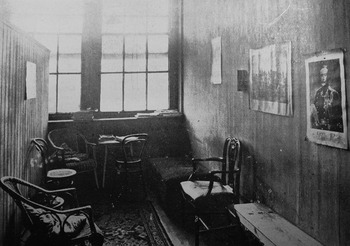
During the First World War and in the early 1920s, attempts to adapt the factory environment were often undertaken in a rather ad hoc way. Welfare supervisors carved out small enclaves of domesticity from existing factory space, using pictures, flowers, and soft furnishings as shorthand signifiers for domestic space. A feature from 1920 in the Journal of Industrial Welfare on the welfare provisions established by Dr Jaeger’s Woollen Company illustrates these trends. The company established a makeshift canteen in a corridor that linked one department of the works to another, and portioned off a restroom from the welfare supervisor’s office, which was “painted with a pretty cream distemper.” The windows were “hung in the same dainty style as in the canteen. Deep wicker chairs invite the worker to rest for this half hour, and on the tables are magazines, books and games” (see fig. 1).Footnote 61 Similarly, photographs of ambulance rooms and restrooms in the early 1920s suggest that they were simply curtained off from production space; the caption to the photograph of the ambulance room at the engineering firm Mather & Platt featured in Industrial Welfare in 1924 noted that “the large workshop can be seen through the window.”Footnote 62
Welfare supervisors and their employers sought to domesticate factory space by incorporating spaces whose functions were more typically associated with the upper- and middle-class Victorian home, an architectural model that inscribed the ideology of separate spheres and class distinctions through the provision of separate spaces for men, women, and servants.Footnote 63 A key example was the spread of factory canteens, which duplicated the functions of the domestic kitchen and dining room.
Photograph of restroom, Dr Jaeger’s Woollen Company. “Welfare in a Congested Area,” Journal of Industrial Welfare 2 (July 1920): 227.

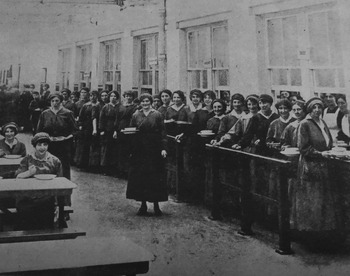
There were around 100 factory canteens prior to the outbreak of the First World War and approximately 1,000 by the end of the war.Footnote 64 The Health of Munition Workers Committee viewed canteens as a valuable mechanism through which to ensure the productivity of workers, and wartime factory canteens appear to have been designed with utilitarian considerations in mind, rapidly to serve nutritious food to large numbers of workers. The committee provided template plans for canteens catering for 400 diners and 280 diners in 1916, allowing eight to ten square feet per diner.Footnote 65 In these plans, a kitchen, containing a scullery area, was flanked by dining rooms for male and female employees. The kitchen adjoined the dining rooms by means of hatches, through which kitchen personnel served hot food and workers returned their dirty crockery directly to the sinks. The committee advocated temporary buildings as an expedient wartime measure and recommended durable concrete floors. It also took other practicalities into consideration, suggesting that the serving counter should be situated so as to enable workers to access food without crossing the hall, and placing barriers in front of the counter to prevent congestion and gangways between seating to enable workers to take and leave their seats. The committee did make some aesthetic concessions, suggesting a “pleasant, open outlook and southern aspect” and recommending a
“Counter Service.” Ministry of Munitions, Health of Munition Workers Committee Final Report, Cd. 9065 (1918), 96.

distemper of primrose, duck’s-egg green or French gray to give the interior a “clean and cheerful” appearance.Footnote 66 A photograph of a canteen from the committee’s report suggests that practical considerations predominated, depicting a room devoid of decor aside from a coat of light paintwork covering the upper half of the walls. The concrete floor, identical trestle tables and benches, and uniformed workers, queuing behind barriers for counters labeled “soup” and “meat,” conjure an atmosphere redolent of institutional conformity rather than cozy domesticity (see fig. 2).
As James Vernon has outlined, factory canteens were intended to discipline workers as well as to meet their nutritional requirements. The factory canteen, explained Edgar Collis and Major Greenwood, functioned as a social institution, in which “workers meet, make friends, and learn to be part of, and take part in, the life of what should be a valuable humanising influence—–their industrial home.”Footnote 67 The austere wartime canteens may not have evoked a homelike atmosphere, but the function and design of factory canteens altered once responsibility shifted from the government to individual companies. Although no interwar figures are available, virtually every annual report issued by the factory inspectorate commented on the increasing number of factory canteens, and in 1934 the inspectorate reported that in some areas “workers are so used to finding such provision that they think the absence of it is necessarily illegal.”Footnote 68 In the 1920s, Industrial Welfare urged employers to build canteens that resembled a domestic dining room, publishing photographs of new canteens in which attempts had been made to shape behavior and create suitably gendered dining spaces. Within upper- and middle-class domestic architecture, the formal dining room was largely a product of the Victorian era. Typically furnished in dark mahogany and decorated with plants and animals, the dining room was gendered as a masculine space.Footnote 69 These aesthetic characteristics are evident in the design of the men’s dining hall at Dalmarnock Electricity Power Station, which Industrial Welfare described as conjuring “an atmosphere savouring of home and individual life.”Footnote 70 Here, an earlier concrete floor had been replaced with linoleum and the walls were decorated with etchings, wood strapping, and a dado painted mahogany color. Some companies established clubhouses or club rooms to provide recreational spaces for male and female employees. Those provided for male workers tended to draw upon the decorative schemes typical of gentlemen’s clubs and the smoking and billiard rooms of upper-class housing.Footnote 71 The hallway of the clubhouse provided by the Automatic Telephone Manufacturing Co. Ltd. for its workers was adorned with antlers and featured dark wood carved door frames, panels, and an imposing carved-wood staircase.Footnote 72
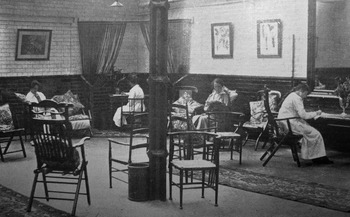
Women’s club rooms were more evocative of the ladies’ boudoir and morning and drawing rooms, often furnished in lighter tones and incorporating chintz, flowers, cushions, and mirrors.Footnote 73 A photograph of the girls’ club room provided by the Watford Manufacturing Company, for example, suggests a compromise between domestic and industrial space; no windows are evident, the concrete floor, brickwork walls, and pipes are exposed, and a support pillar is in the center of the frame. Attempts have been made to camouflage these features characteristic of the industrial workplace by draping a curtain over a windowless corner and furnishing the room with assorted wooden chairs, cushions, floral rugs, writing desks, pot plants, pictures, and a mirror (see fig. 3). Similarly, welfare supervisors sought to fashion a feminine space in girls’ dining rooms through the use of tablecloths and flowers. Dorothea Proud,Footnote 74 author of a prominent work promoting industrial welfare, argued that the environment shaped behavior and could encourage factory girls to behave with decorum. She described “attractive” canteens with comfortable
Photograph of girls’ club room. “The Employer’s Motive: What a Visit to Delectaland Revealed,” Journal of Industrial Welfare 2 (February 1920): 40.

individual seats and small “homelike” tables, furnished with red and green tablecloths, vases of flowers, books, and pictures, creating an atmosphere “quite free from the suggestions of places of toil.”Footnote 75
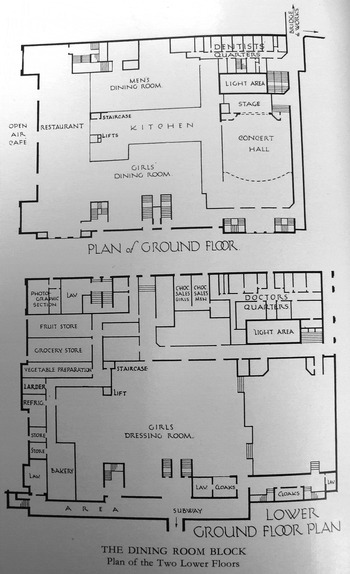
As new factories were constructed in the 1920s, the practice of establishing canteens and other welfare provisions in underutilized spaces within the factory gave way to the creation of purpose-built spaces or entire blocks, adjacent to the production spaces of the factory, which incorporated a range of welfare facilities. In 1926, for example, Industrial Welfare profiled the new club building constructed by the carpet manufacturer James Templeton & Co, which contained a recreation hall, a kitchen, and an adjoining dining room for women and girls. Such purpose-built provisions were most commonly found among firms with a large female workforce: two-thirds of the 3,000 workers employed by Templeton & Co were women.Footnote 76 The new dining block contracted by the confectioner Cadbury in 1920 and completed in 1927 was designed to provide dining accommodation for 4,225 girls and 2,082 men. Positioned between the girls’ recreation ground, the men’s recreation ground, and the works buildings, this four-floored building was designed to rationalize the flow of employees between work space and lunch hour. It centralized catering facilities for the firm’s employees while simultaneously separating out employees by gender and rank.Footnote 77 These spatial distinctions began even before workers set foot inside the buildings and indicate how the movement of female employees was more restricted than that of their male counterparts. Women entered the canteen block at basement level, where the girls’ dressing room was located, via a fifteen-foot-wide corridor that linked up to the girls’ departments in the works buildings; men made their way to the block at ground level. After changing, women could make their way upstairs directly into the girls’ dining room. This was supplied by a centrally placed kitchen with serving hatches that also opened into the terrace restaurant and men’s dining room. Further dining rooms were provided for female employees on the first and second floors, while directors and senior staff were provided with dining rooms on the second floor. Within each dining room, separate queues for hot, cold, and prepaid meals facilitated rapid service. The block also contained a library, a reading room, a lecture room, a concert hall, and lounges, while the dining halls accommodated meetings, classes, dances, and rehearsals out of work hours. The medical and dental departments were situated on the lower and ground floors, respectively (see fig. 4).
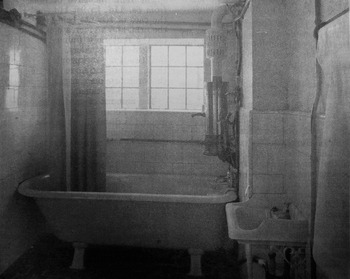
Industrial Welfare suggested that factories establish restrooms for their female employees. Typically furnished with beds or chaise lounges, curtains, and carpets, such rooms recalled the domestic bedroom. Where work was hot or heavy, factory inspectors and welfare supervisors encouraged factories to provide bathrooms to enable their employees to wash before returning home. In 1923, Industrial Welfare featured a photograph of a bathroom at the Letchworth factory of the Spirella Company, which manufactured corsets. The photograph depicted a room with gleaming white-tiled walls, a tile floor, and a white bath and sink with a porcelain finish, at once hygienic and private (see fig. 5).Footnote 78 These provisions would have compared favorably to the facilities available within many workers’ homes; a 1918 government report chaired by Sir John Tudor Walters on the construction of working-class housing acknowledged that it would not be feasible in all instances to provide separate bathrooms in new homes. Instead, the report suggested that a bath could be sited in the scullery alongside the copper, ideally portioned off by walls to offer privacy, thus creating a dual purpose bathroom and washhouse.Footnote 79
Parallels can be drawn between the provision of resting spaces for women manufacturing consumer goods and the proliferation of facilities established to meet the needs of the consumers of such goods: bourgeois women on shopping excursions.Footnote 80 If the model of the homely factory sought to re-create aspects of the domestic private sphere in the space of production, the proliferation of tea shops, restaurants, ladies’ lavatories, department stores, and women’s clubs similarly re-created a domestic retreat within the sphere of consumption. Department stores of the late nineteenth and early twentieth centuries were designed and richly furnished to evoke the atmosphere of a grand house, replete with carpeting, draperies,
Plan of lower and ground floor of Cadburys’ canteen block. An Industrial Canteen: Catering Arrangements at Bournville (Bournville, 1930), Library and Information Service, Cadbury Ltd., Bournville, Cadbury Archives, 334/002123, p. 14. Image reproduced courtesy of Cadbury Archives.

Photograph captioned “a bathroom at the Letchworth factory of the Spirella Company (of Great Britain) United, where the employees work under ideal conditions.” Industrial Welfare 5 (June 1923): 159.

and grand staircases.Footnote 81 Women’s clubs, which provided dining rooms, bedrooms, concert halls, and lounging rooms, offered fatigued shoppers a cozy, feminine, and luxurious retreat or “temporary home”;Footnote 82 their existence demonstrates the merging of public and private space within the city, while their demise in the 1930s points to the waning of the separate spheres ideology.
Writers described how decor throughout the factory could influence the morale and behavior of workers, suggesting cheerful paint schemes to alleviate monotonous work or the oppressive feeling of heavy machinery,Footnote 83 advocating mirrors and flowers and advising that machinery be arranged “with thought to its appearance.”Footnote 84 “Some people may question whether it is wise to accustom workers to beauty,” wrote Dorothea Proud, “but it will scarcely be denied that beauty will, if permitted, affect their senses.”Footnote 85 Evoking Victorian beliefs in the transformative power of art, the Journal of Industrial Welfare described the aesthetic appearance of factories and artwork displayed within. In 1921, for example, it praised the addition of paintings to the reeling room at the Belgrave Mills in Oldham for increasing worker efficiency, although the overall impression gleaned from the accompanying photograph is one of incongruity; the two large prints appear markedly out of place on the haphazardly whitewashed walls of an otherwise lackluster workroom. They appear to offer no distraction to the two workers featured in the photograph who seem engrossed in tending their machines.Footnote 86 These innovations point to a belief that the factory environment could be transformed to shape workers’ emotional responses. Welfare supervisors sought to invert the idea that the interior of a dwelling projected “its inhabitants’ interiority”;Footnote 87 they aimed to manipulate the factory interior to mold the interiority of its inhabitants. Concerns that workers had become alienated cogs in the machine could now—in theory—be redressed through artwork, decor, and the inauguration of spaces that facilitated social interaction.
Within the homely factory, industrial welfare supervisors sought to “maternalise” the workplace, acting as a “big sister” toward their “girls.”Footnote 88 The factory “family” functioned as a disciplinary construct to mold behavior, maintaining hierarchical relations by ascribing parental roles to managers and supervisors. Such an approach dated back to the paternalistic firms that had been the innovators of industrial welfare in the nineteenth century.Footnote 89 An article published in the May 1926 edition of Industrial Welfare on the Shredded Wheat factory at Welwyn Garden City referred to the “community spirit” and “Shredded Wheat family.”Footnote 90
The proposed domestication of the factory extended beyond interior transformation; the ideal model “homely” factory would be complemented by its own garden. David Nye has described how the modern American factory was an emblem of technological progress, revered as a sublime industrial object.Footnote 91 In Britain, technological awe went hand in hand with arcadian pastoralism; as Raymond Williams noted, while the Industrial Revolution transformed the city and the country, “English attitudes to the country, and to ideas of rural life, persisted with extraordinary power.”Footnote 92 The British firm Cadbury consciously represented its model factory at Bournville as a reinvention of the pastoral idyll, persistently using the image of the “factory in a garden” in advertising throughout the late nineteenth and early twentieth centuries.Footnote 93 From 1910 onward, Cadburys issued visitors with a pamphlet, “Bournville: The Factory in a Garden,” which advertised the factory in a garden and life in the Bournville factory village. “Situated in one of the healthiest and prettiest parts of Worcestershire,” an early edition explained, “everything has been done to beautify the factory and its surroundings.”Footnote 94 Cadburys was careful to maintain its pastoral image as it expanded production facilities, describing in a lecture how “creepers are at once trained up the newly-erected walls, and quickly cover them, giving a homely beauty.”Footnote 95
This paradoxical combination of the industrial and the pastoral found expression in the garden city movement, which sought to ease overcrowded living conditions in industrial areas by creating new satellite towns. Garden cities were designed with public services, shopping amenities, housing, and places of employment, enabling people to work and live within easy reach of the countryside. Developed and popularized by Ebenezer Howard in his 1898 work To-morrow: A Peaceful Path to Real Reform, the garden city ideal underpinned the founding of Welwyn Garden City in 1919.Footnote 96 In an article written to promote the new Shredded Wheat factory at Welwyn, Constance Kerr, organizer of the Women’s Department of the Industrial Welfare Society, discussed the tendency for companies to discard premises in urban areas. The article referred to “the factory in a garden,” describing the flower beds and lawns surrounding the premises. Designed to introduce a maximum amount of light, Kerr described the factory as “a beautiful structure, looking in the distance as if it had been carved out of white ivory, and with innumerable windows sparkling like diamonds in the sunshine.”Footnote 97
It is difficult to ascertain the prevalence of homely factories as Industrial Welfare never enumerated the model workplaces described within its pages and the overstretched factory inspectorate, which struggled to enforce legal requirements in the interwar years, was in no position to monitor the growth of voluntary welfare provisions. Given the virtual absence of interwar data, we can use figures collected by the factory inspectorate in response to wartime pressures and new legal requirements to trace the expansion of welfare facilities between the two world wars, while acknowledging that this information camouflages regional variation and fluctuations over the course of the interwar years. This allows us to gauge the prevalence of three features found within the sort of comprehensive industrial welfare publicized in Industrial Welfare: canteens, welfare supervisors, and ambulance rooms. Factory canteens increased from 1,000 in 1918 to 5,695 at the end of 1941, a figure that includes a number built after the outbreak of war in 1939.Footnote 98 The number of welfare supervisors employed within industry increased marginally from 1,400 during the First World War to 1,500 at the outbreak of the Second World War.Footnote 99 Over the same time period, the number of factories operating in Britain decreased from 281,191 in 1919 to 238,170 in 1939, reflecting a shift toward larger companies and larger workplaces.Footnote 100 Thus, around 2 percent of the factories operating in Britain in 1939 featured a canteen, while 0.6 percent employed a welfare supervisor. These numbers correspond closely to the figure given in 1924 by one manager of the number of British firms operating a system of industrial welfare: 1,300.Footnote 101 According to statistics collated at the cessation of the First World War and data gathered while implementing the first aid requirements of the 1924 Workmen’s Compensation Act, the number of factory ambulance rooms increased from 290 in 1919 to 450 in 1925, with a corresponding rise in nursing staff from 85 to 109.Footnote 102 Given the preponderance of small factories—as late as 1948, 195,000 of the 230,000 factories within Britain employed twenty-five people or less—a higher proportion of industrial workers would have been employed in workplaces featuring these facilities than these figures might suggest, especially in regions where light manufacturing flourished.Footnote 103 Other factory owners may well have dabbled with welfarist ideas and sought to add a homely touch to their workplaces by experimenting with color schemes or artwork. Nevertheless, these figures indicate that the image of the model factory came to assume a disproportionate prominence.
At the Factory Gate: Boundaries between Home and Work
The industrial welfare movement believed that happier, healthier workers would be more efficient. While measures implemented within the workplace could go some way toward enhancing the “human factor” in industrial production, many welfare supervisors argued that their good work was undermined by workers’ poor living conditions. How could employees perform their work well, they asked, if their home environment was not conducive to health? In the 1920s, a number of companies inaugurated welfare provisions in response to these concerns which traversed the boundaries between the factory and the home: these included facilities offered within the workplace out of work hours such as evening classes, recreational clubs, and baths and those that linked the workplace to the home, such as transport, visits to the sick and to the homes of young workers, company housing, holidays, and convalescent homes. A spate of workmen’s compensation cases brought to the courts in the 1920s concerning accidents occurring to people travelling to work on company transport, through work premises, and in breaks in the working day demonstrate that the question as to when and where work began and ended had became decidedly fuzzy.Footnote 104
Some welfare supervisors argued that homely factories could serve as a template to educate factory girls about housekeeping standards. One Lancashire food firm established a class in cookery that was taught in a kitchen at the caretaker’s home.Footnote 105 Another factory built a cottage that it hoped “may have an educational influence on the girls’ tastes and ideas of what a better-class workman’s home can be made … the furniture, while not being beyond the reach of a working-man’s purse, is of a much superior style and design to that generally found in working-class homes.”Footnote 106 Company housing schemes emerged against a backdrop of labor unrest and became a site in which the expertise of social reformers, welfare supervisors, and architects came into conflict.Footnote 107 At Penistone, the company village of steel firm Cammell Laird & Co, housing design followed a contradictory aesthetic of individualized mass production: Industrial Welfare described attempts to vary the texture and color of the concrete blocks used to construct the housing. By contributing bricks and slates for the chimneys, porches, and roofs, the firm expressed the hope that monotony would be avoided.Footnote 108 The engineering firm Vickers, mingling homes for working-class and middle-class families in its model village, suggested that this would motivate the working man to ensure that his home and garden did not “disgrace” his surroundings, and that his children “are not to be singled out by dirty faces and untidy clothes from the children of his neighbours.”Footnote 109
Through company housing and home visits, welfare supervisors sought to extend the discipline of the factory into workers’ homes. A series of articles published in Industrial Welfare between 1922 and 1923 claimed that the intervention of welfare supervisors in the home lives of their workers was both effective and legitimate, recalling nineteenth-century philanthropic visitations to working-class homes undertaken by middle-class women, in which inequality had structured the relationship between visitors and visited.Footnote 110 “An inefficient worker is an extravagance that no employer can afford,” argued one supervisor, explaining how “the home-visitor who expects to find the most ordinary elements of common sense in the homes of workers will, in many instances, be disillusioned.” This unsatisfactory state of affairs was best remedied by providing young factory girls with classes in homemaking skills after factory hours to ensure that “the good training and wholesome influence that have been perhaps so sadly lacking in her own home may come into her life at the factory.”Footnote 111 Another supervisor believed that the “tactful and winsome” visiting welfare supervisor could invoke “a latent self-respect in even the most untidy of women, except where every shred of self-respect has been killed by drink and vice.”Footnote 112 Citing examples of drunken fathers who had “retired” on the wages of their wives, and wage-earning daughters who had been overburdened with excessive household chores, one supervisor expressed the view that girls should be persuaded to leave when home conditions left much to be desired.Footnote 113 Some welfare supervisors did question the fairness of critiquing the housekeeping standards of working-class women who were obliged to undertake paid labor and domestic chores: one argued that “with a hot bath, a larder, a larger kitchen, and more bedrooms, mothers would have a better chance of obtaining a reward for the character and self-denial that they are now showing in battling with this ‘home and factory’ problem.”Footnote 114
One way the overstretched housewife could ease her burden of household labor was to purchase domestic appliances and pre-prepared food items. In the interwar years, the formal economy and the domestic economy began to dovetail as the household became an important site of consumption.Footnote 115 These trends are illustrated within interwar advertisement targeted at the household consumer that featured the image of the homely factory to convey the homemade, healthy character of products, blurring distinctions between home and factory. Long-established garden factories such as the Cadbury factory in Bournville had pioneered advertising in this genre, emphasizing the bucolic charms of their products. An advertisement for Crosse & Blackwell in 1914 illustrates this trend, describing the “romantic settings” of the firm’s factories and detailing welfare initiatives at the factories, including the girls’ dining club, swimming club, and orchestra. The company justified these facilities partly on the grounds of efficiency, which would become the predominating objective underpinning welfare schemes in the twentieth century, but also on paternalistic grounds, which characterized nineteenth-century welfare initiatives. The article focused on the welfare of female employees, with one director remarking, “men are better able to look after themselves, but girls seem to have such a hard time that it is a pleasure for us to do anything that will brighten things up for them.”Footnote 116
The advertisement counterposed the image of “a small army of white-coated young women” described as making preserves in an “old-fashioned homemade way” in a room that “may well be taken as a model for the average kitchen”Footnote 117 The factory was represented as at once domesticated and paternalistic yet also modern and scientific, mirroring developments in 1920s hospital architecture in which historical styles created a conservative exterior while interior design revealed a “technological fetishism.”Footnote 118 This mixture of the familial, domestic, modern factory environment continued to find expression in the 1920s. Advertisements for Ovaltine, Chivers’ Jams, and Lyons all promoted the image of idyllic rural factories, well-cared for workers, and homemade products.Footnote 119 One typical Ovaltine advertisement from 1926 was headed by an illustration of the new factory the company had commenced building in 1924. Depicted against a backdrop of rolling hills and sited within formal gardens, the large windows and art deco façade of the factory appear unabashedly modern and somewhat at odds with its bucolic surroundings and the horse and cart portrayed in the foreground. Captioned “The Home of Good Health,” the advertisement described the beautiful healthy surrounding countryside before focusing on the factory: “the factory itself is the ideal of what a factory should be. Spotlessly clean, full of sunshine and sweet country air, and surrounded by gardens to make a happy and health staff—such is the home of ‘Ovaltine.’”Footnote 120
As these examples demonstrate, many companies sought to embellish their factories for promotional purposes. Musing on this issue, Dorothea Proud criticized the “straining after splendour” evident in the design of new factories, contrasting “entrance halls which suggest amusement or luxury” with poor working conditions and underground workrooms. “Some factory gardens,” she argued, “certainly have an obtrusiveness which suggests that they concern the public more nearly than the employees.”Footnote 121 These developments in factory architecture bring to mind the architecture of public asylums in the nineteenth and early twentieth centuries, which combined the palatial exterior and gardens of a public house with an interior fitting to a poor law institution.Footnote 122 The contradiction between the interior and exterior of many factories could be explained by a similar duality of purpose: an exterior designed to promote the status of the firm and an interior fitting to industrial toil. Pointing to the emergence of visitor observation galleries in factories, Dorothea Proud argued that the practice of using the process of manufacture for advertisement had shaped the internal architectural structure of workrooms. The aesthetic design of the Shredded Wheat factory in Welwyn Garden City undoubtedly reflected company strategy. In 1907, 100,000 tourists were given tours of the American Shredded Wheat factory.Footnote 123 Similarly, the design of the new factory at Beeston constructed for the pharmaceutical firm Boots in 1933 integrated visitor-friendly features, creating public pathways through production spaces. A handbook for guides described a route for visits through the factory over gangways, bridges, and balconies that enabled visitors to watch various production processes.Footnote 124
While advertisements for food items focused on the domesticated, rural factory, and homemade products, advertisements for electricity, gas, and domestic appliances tended to emphasize the benefits that could be reaped from adopting the modern technologies employed in factories within the home. The British Commercial Gas Association enticed domestic customers by detailing how a factory was able to turn out 90,000 biscuits per hour in a gas oven. “In the home as in the factory, solid fuel is out of the question where fine variations of heat are required. The home cook needs just those delicate gradations demanded by the large-scale confectioner.”Footnote 125 Similarly, an advertisement placed by the British Electrical Development Association stressed the benefits of electric light bulbs. “Factory workers’ eyes are looked after by law,” it explained. “Wouldn’t it be wise to make good lighting a law in your own home?”Footnote 126 An advertisement placed by the Gas Light and Coke Company advised consumers to model their marital relationships within the domestic sphere on modern workplace relationships, informing readers that “in modern life the business man and his wife should be working together as partners in the business of living … your home must be as modern as your office, shop or factory.”Footnote 127
Models of the pastoral homely factory thus competed in interwar advertising with images of new modernist factories; the modern housewife, advertisements suggested, would naturally want the same standard of fittings and appliances in her home as was available in modern factories. Modernist factories drew on new architectural styles and building materials to reject the bourgeois domestic aesthetic.Footnote 128 Boots, which had a long pedigree of paternalist welfare work, provides an interesting example of this transition. Its Beeston factory, opened in 1933, was described in press reports as an “industrial crystal palace” and “factory of utopia.”Footnote 129 Constructed using concrete, the factory provided its workers with ample sources of daylight through large windows. Based around large, open spaces, it followed modernist precepts by challenging distinctions between interior and exterior, public and private space.Footnote 130 The modernist factory, like the homely factory, was presented as a means to stem worker unrest. Influenced by the ideals of scientific management, modernist architects believed that rationalizing space within factories could enhance efficiency by shaping social life and individual behavior within the premises, alleviating monotony and facilitating surveillance.Footnote 131 The emergence of scientific management and the clinical modernist factory reflected a broader trend toward rationalization across medical and industrial practice, utilizing mass production to deliver standardized goods and services.Footnote 132 While this efficiency-driven approach appealed more to managers preoccupied by profits than the holistic vision of domesticated factories promoted by welfare supervisors, many viewed the standardization inherent in scientific management as dehumanizing. In Charlie Chaplin’s 1936 film Modern Times, these sentiments were quite literally embodied as Chaplin’s character, unable to maintain the pace of the production line, was pulled into the very cogs of the machine.
Industrializing the Home
The interest displayed by welfare supervisors in the home lives of their employees illustrates how the question of working-class housing linked to concerns with industrial productivity, anxieties regarding social unrest, and the need for a healthy and efficient workforce. Although city boundaries had expanded in the two decades leading up to the First World War, the cost of transport compelled most industrial workers to rent accommodation close to work in crowded inner-city dwellings. Families living in tenements, back-to-back housing, and multiple-occupancy houses often had only one or two rooms in which to cook, eat, sleep, and wash, and usually shared communal toilets and water supplies with other residents. In the two decades prior to the outbreak of the First World War, rental values escalated due to the rising demand for centrally located accommodation, prompting rent strikes in England and Scotland.Footnote 133 By 1918, the prewar shortfall of 120,000 homes had leapt to 600,000, prompting the government to pass the 1919 Housing Act, which compelled local authorities to provide housing.Footnote 134 Although 4 million new homes were built in Britain between 1919 and 1939,Footnote 135 postwar building schemes were stemmed by adverse economic circumstances, forcing many working-class families to live in slum housing.Footnote 136 As late as 1928, the Special Committee of the National Housing and Town Planning Council found that the state of slum housing had not improved since 1918, estimating that there were at least 1 million unfit and 2 million overcrowded houses.Footnote 137
One solution to this problem, closely aligned to the ethos of the homely factory, was the creation of garden cities. Another approach adopted by local authorities was the model of the cottage estate, advocated in the 1918 Tudor Walters Report.Footnote 138 Designed as quasi-rural estates with ample green space and low-density housing, the estates embodied the belief that space could be used to shape social behavior, promoting healthy living and calming discontent. The New Estates Community Committee, established in 1929, strove to promote “constructive leisure” on the new cottage estates, advocating educative entertainment and physical recreation to counteract “‘machine-made and spoon-fed entertainments.’”Footnote 139
Yet not all housing developments sought to recapture the rural idyll; in the interwar years, the government began to explore whether industrialization could help resolve the very housing crisis it had precipitated. The impetus in part came from experiments undertaken by industrial firms. In 1920, for example, Cadburys published an account of five experimental houses designed for workmen, expressing the hope that these experiments could assist the national housing problem. The designs included houses constructed from concrete blocks, bungalows fashioned from rammed earth, and a wooden bungalow, built in sections within the works and bolted together on site. Unwilling to jettison its garden factory image, the firm planted creepers and rambling roses against the walls of its experimental houses in Bournville Village just as it had done when it expanded its production facilities.Footnote 140 Modernist architect Le Corbusier expressed a more radical assault on the traditional concept of the home, enthusiastically embracing the functionalist industrial aesthetic as a template for house design. A home, he argued, should be a receptacle for light and sun, containing “cells appropriated to cooking, work, and personal life.”Footnote 141 What purpose, he asked, did the elaborate furnishings and decor, so beloved of the nineteenth-century bourgeois domestic interior, serve? “If we eliminate from our hearts and minds all dead concepts in regard to the house and look at the question from a critical and objective point of view, we shall arrive at the ‘House-Machine,’ the mass-production house, healthy (and morally so, too) and beautiful in the same way that the working tools and instruments that accompany our existence are beautiful.”Footnote 142
Given the financial constraints of the interwar years, models of house construction and design that drew upon industrial materials and mass-production methods proved appealing to government authorities. The 1924 Housing Act reduced the subsidy provided to local authorities for house construction if they rejected new building methods and materials. When the Conservatives were reelected in late 1924, the new Minister of Health, Neville Chamberlain, vigorously promoted research into innovative building methods. Chamberlain believed that a program of social reform was essential if social unrest was to be curbed and hoped to circumvent the demands of unionized building trades through recourse to prefabricated housing.Footnote 143 Between 1924 and 1925, a committee appointed by the Ministry of Health explored the possibility of using new materials in housing construction to save on time, money, and skilled labor through mass-production methods. The committee considered the feasibility of timber-framed houses faced externally with steel sheeting, steel frameworks, and houses constructed in situ by pouring concrete between wooden or steel shutters.Footnote 144 The committee also expressed an interest in the “factory production of houses,” through which materials could be pressed into moulds to form sections that could then be bolted together.Footnote 145
No more than 3,000 houses were constructed using these methods in the interwar years, but prefabricated methods featured prominently in plans for postwar reconstruction.Footnote 146 The Ministry of Health’s 1944 report, Design of Dwellings, advocated a new standard of housing in terms of space, ventilation, noise, light, functionality, and privacy. It recommended a standardization of fittings and equipment to facilitate mass production, bringing down costs and aiding replacement of parts. The report also claimed that modern factories had transformed women’s expectations and had become templates for housing standards. While the First World War accelerated the domestication of the factory, the Second World War promoted the standardization of the home. “War-time factories and hostels often provide high standards of services and equipment, which will make such women intolerant of inferior conditions in their own homes,” explained the report. “Both men and women have become conscious during the war of the potentialities of modern scientific developments and will expect to enjoy the benefit of these discoveries at home.”Footnote 147 The report noted that the process of house construction was moving toward “a greater pre-assembly of parts of the house in the factory” and suggested that entire houses might yet be built in this way.Footnote 148
Mass production was not the only idea to cross over from the factory to the home. Architects and women’s groups were inspired by scientific management practices that, in the words of one contributor to Charles Myer’s Industrial Psychology, promised to “eliminate the wastes of energy due to the persistence of inefficient traditional methods of performing household tasks and to faulty planning and design of the home.”Footnote 149 These trends originated in America with the publication of Christine Frederick’s 1915 volume, Household Engineering and Scientific Management in the Home. Frederick heard about scientific management from her husband and subsequently visited factories to see how the system was implemented.Footnote 150 Such ideas rapidly took hold in Britain; a diagram published in the Daily Mail illustrated how a well-planned kitchen could enable afternoon tea to be made in fifty steps as opposed to 350.Footnote 151 Clear parallels can be drawn between these developments and the preoccupations of the Industrial Fatigue Research Board, a joint venture between the Medical Research Committee and the Department of Scientific and Industrial Research, whose reports explored how fatigue could be reduced and efficiency enhanced by standardizing workers’ motions to exclude unnecessary action.Footnote 152 One such report considered the fifty factors that must be known to calculate the efficiency of a bobbin winder, of which the average time required to have tea and the number of times tea was taken constituted factors forty-four and forty-five, respectively.Footnote 153
The application of scientific management ideals to the performance of household tasks can be seen to exemplify the emergence of a conservative modernity in the interwar years.Footnote 154 The home became “the woman’s workshop,”Footnote 155 and the working-class housewife could be conceived of as a “quasi-professional worker,”Footnote 156 drawing status and satisfaction from her mastery of domestic science and electrical appliances and from her role as home manager.Footnote 157 The Ideal Home Exhibition helped popularize household technologies, arranging a competition in 1920 for the ideal labor-saving home; the winning design had easy-to-clean surfaces, grouped kitchen appliances together to minimize work, and arranged the heights of the kitchen work tops to meet the requirements of a woman of average height.Footnote 158 It subsequently became common practice to justify the arrangement of rooms in reference to circulation routes round the house.Footnote 159
Indeed, while factory canteens had been one of the earliest features of the domestic factory, factory design appears in turn to have shaped the design of the domestic kitchen, fuelling a desire for rooms devoted to specific functions. Reading the 1918 Tudor Walters Report, which attempted to prescribe suitable models for new working-class housing, it becomes apparent that the notion of the kitchen was in flux. The report commented on the desire for a living space separated from dirty work and the preparation of meals. It suggested that the tradition of a combined back kitchen and living room, which incorporated the cooking range, sink, and frequently the copper bath, was now outmoded.Footnote 160 Ellen Lupton and J. Abbott Miller summarized these developments in their comparison of factories and continuous kitchens in the 1930s, which enabled a series of chores to be undertaken seamlessly through “specialized work stations”; the only difference was that the labor expended led to the consumption rather than the production of goods.Footnote 161 Throughout the 1930s, model kitchens were exhibited by women’s organizations to demonstrate the benefits of a well-designed kitchen space with fitted cupboards and work tops.Footnote 162 A brief examination of the career trajectory of Dame Caroline Haslett, the chairman of one of these organizations—the Council of Scientific Management in the Home—illustrates how industrial technologies and practices filtered into the domestic sphere over the course of the interwar years. Haslett’s career commenced in the industrial sphere: in 1919, she was appointed as Secretary to the Women’s Engineering Society. Haslett served as editor for the society’s journal, Woman Engineer, until 1932 and was a member of the Industrial Welfare Society between 1923 and 1955. She began to apply industrial principles to household affairs in 1924, founding the Electrical Association for Women through which she advocated the use of electricity within the home. In 1927, Haslett invited Christine Frederick, the American pioneer of scientific management in the home, to give a series of lectures to the Electrical Association.Footnote 163
Conclusion
An exploration of the increasingly symbiotic relationship between factory and housing space offers a window into the social upheavals of interwar Britain. In 1918, when the fledging Boys’ Welfare Journal sought to convince employers that the establishment of welfare facilities was both an economic and humanitarian imperative, the specter of industrial and social unrest haunted the government, middle-class reformers, and industrialists. Trade union membership, which had stood at 2.5 million in 1910, spiraled to 6.5 million in 1918, and had reached 8.5 million by 1920. The government sought to dampen industrial unrest in 1915 by introducing compulsory arbitration. However, as revolution broke out in Russia in 1917, a series of strikes orchestrated by shop stewards working independently of the unions fuelled concerns that British factories would form the battleground for bitter industrial disputes and class conflict.Footnote 164 On the home front of this prospective industrial war, the government was faced with another potentially explosive situation as the housing shortage prompted overcrowding, soaring rents, and slum living conditions. Against this backdrop, the welfare measures introduced by the government during the war to support industrial production and placate disgruntled workers proved attractive to employers. Practitioners of the nascent profession of welfare supervision, appointed by anxious industrialists, attempted to reconcile the nineteenth-century arts and crafts ideals with a new era of mass production by replicating aspects of the middle-class home within the factory. Mechanization was a necessary evil that needed to be counterbalanced if man was not to become a mere cog in the machine.
The dialectical impulses of modernity and arcadianism, combined with anxieties about unruly and inefficient workers, led to a convergence of domestic and industrial space in the 1920s that brought into question the boundaries of public and private space. Advertisements straddled these antithetical images, enticing the domestic consumer with alternate images of “homely” factory produce and industrial technologies fit for the modern housewife. By the 1930s sleek modernist factories eclipsed Arcadian visions of the homely garden factory and the appeal of industrial welfare lost ground to the practices of scientific management and industrial psychology. The threat of industrial strife receded in the wake of the 1926 General Strike as the TUC pursued a policy of modernization, seeking to effect political change through dialogue rather than confrontation.Footnote 165 Women’s social and economic opportunities expanded; policy makers, architects, advertisers, and women’s groups embraced mechanization, mass-production methods, and scientific management practices as liberating forces that could resolve housing problems and ease the burden of domestic labor within the home. In so doing, they reconfigured home space and workplace as mutually reinforcing rather than oppositional, blurring boundaries between public and private space.
With the passing of the 1937 Factory Act, provisions such as drinking water and washing facilities that had previously come under the ambit of voluntary welfare were now required in all factories. Maximum working hours were lowered and the Home Office was empowered to order medical supervision where it believed that working practices could damage health. It would be misleading, however, to assume that the model factories of the interwar years had paved the way for these reforms. Images of model factories proved a potent tool for advertisers but helped disguise disparities in working conditions in an era when aspirations for social reconstruction ran in tension with economic constraints. By suggesting that the well-being of industrial workers was primarily dependent upon healthy recreation, a homelike environment, and nutritious food, the rhetoric of industrial welfare and the model homely factory offered employers a discourse through which to proclaim their interest in workers’ health while downplaying the risks posed by industrial disease and accidents, suggesting that responsibility for ill health lay with the workers themselves.Footnote 166 It cannot be a coincidence that in 1928, as asbestosis began to attract attention in the medical press a year after the term was coined to describe the disease that killed an employee of Turner Brothers Asbestos Company, and the government commissioned a study of workers’ health in the asbestos textile industry, Industrial Welfare chose to lavishly showcase the firm’s model canteens, cloakrooms, and sporting provisions, portraying Turner Brothers as a model employer.Footnote 167 Moreover, many British companies publicized the model working conditions enjoyed by their British employees while quietly exploiting their overseas labor force.Footnote 168 Employer organizations sought to keep health and welfare matters within the domain of industrial relations, advocating voluntarism as a strategy through which to evade government imposition of national standards via legislation or welfare regulations. In 1930, for example, the inspectorate noted that the draft Safety in Factories Order remained in abeyance following assurances from employers’ associations that they would take up the matter of safety organization with their members.Footnote 169 Indeed, the opposition and intransigence of employer bodies successfully delayed the passing of the 1923 Factory Bill for fourteen years. “In view of the repeated attempts that have been and are being made by employers’ associations and similar bodies to secure the dropping, postponement, or toning down of the Factory Bill,” a 1927 TUC memorandum noted, “we think it necessary to restate with emphasis the reasons why it should be proceeded with immediately, and in a much stronger form.”Footnote 170 The high profile of model factories in the interwar years thus helped perpetuate poor working conditions. They created the illusion that voluntary provisions could remove industrial health risks without the need for legislative intervention, diverted attention from the poor conditions pertaining in many factories, and disguised the persistence of small factories, frequently more evocative of homely slums than modernist production sites.