INTRODUCTION
Early in the seventh century bce, Parian colonists established the polis of Thasos. The city quickly grew to become a metropolis, founding several colonies on the Thracian coast opposite.Footnote 1 Thasos rapidly extended its influence further into Thrace by exploiting natural waterways (the Strymon, Nestos and Evros rivers) and founding emporia in the hinterland, such as Verge (Bonias Reference Bonias2000; Koukouli-Chrysanthaki Reference Koukouli-Chrysanthaki and Adam-Veleni2000) and Pistiros (Domaradzka Reference Domaradzka, Bouzek, Domaradzka and Archibald1996; Reference Domaradzka, Bouzek, Domaradzka and Archibald2002; Chankowski and Domaradzka Reference Chankowski and Domaradzka1999; Dimitriou Reference Dimitriou2010; Chankowski and Chankowski Reference Chankowski and Chankowski2012). One of the most important Thasian colonies was Oisyme, located at the western end of the Gulf of Kavala and the southern end of the Gulf of Eleutherae, nearly 2 km south of modern Nea Peramos (Fig. 1).
Map of Macedonia and eastern Thrace: ⊙ sanctuary of Oisyme; □ sites where Argive-type shields have been discovered in a settlement or burial context; △ other significant sites mentioned in the text (map based on ASTER digital elevation model; ASTER is a product of METIS and NASA; https://asterweb.jpl.nasa.gov/gdem.asp).

Léon Heuzey originally identified a strong coastal fortification near Nea Peramos as the Byzantine site of Anaktoroupolis. Drawing upon a commentary on Claudius Ptolemy by a Byzantine scholiast, in which Anaktoroupolis is equated with Oisyme,Footnote 2 Heuzey proposed that the ancient polis of Oisyme occupied the same hill as the Byzantine castle (Heuzey and Daumet Reference Heuzey and Daumet1876, 32). In 1935, however, Paul Collart discovered the remains of an earlier fortified settlement on a neighbouring coastal hill, and (drawing on the same commentary) identified that site as the acropolis of ancient Oisyme (Collart Reference Collart1937, 86, n. 1). This hill still preserves a considerable part of the ancient fortification circuit near its peak. The first excavation in the vicinity of this fortification took place in 1938 under the direction of Georgios Bakalakis (Reference Bakalakis1938, 98–102), and was followed in 1964 and 1968 by extensive excavations in the coastal area south of the hill, which revealed an ancient cemetery (Leventopoulou-Giouri Reference Leventopoulou-Giouri1965; Giouri and Koukouli Reference Giouri and Koukouli1969). The discovery of amphora handles stamped ΟΙΣΥΜΑΙΩΝ (Bakalakis Reference Bakalakis1938, 100–2, fig. 3; Giouri and Koukouli Reference Giouri and Koukouli1969, 349) further reinforced the identification of the site, despite the lack of epigraphical evidence to confirm it beyond doubt.Footnote 3
Finally, in 1987, the Kavala Ephorate of Prehistoric and Classical Antiquities (now the Ephorate of Antiquities of Kavala and Thasos) embarked on a three-year programme of systematic excavation on the acropolis of ancient Oisyme, under the direction of Eugenia Giouri and Chaido Koukouli. This programme was the first to reveal and explore in detail stratified contexts corresponding to the earliest phases of occupation. It has demonstrated conclusively that an Early Iron Age settlement on the hill predated the foundation of the Thasian colony in the late seventh century bce (Giouri and Koukouli Reference Giouri and Koukouli1987; Koukouli-Chrysanthaki and Papanikolaou Reference Koukouli-Chrysanthaki and Papanikolaou1990; Koukouli-Chrysanthaki Reference Koukouli-Chrysanthaki, Guimier-Sorbets, Chatzopoulos and Morizot2006). Thereafter, the site was continuously occupied until the foundation of nearby Anaktoroupolis during the Byzantine period (Kakouris Reference Kakouris1980; Zikos Reference Zikos and Roudometoff2007; Dadaki Reference Dadaki, Mentizis and Apostolaki2017).
Preparation for the publication of the 1987–90 excavations is ongoing, under the overall direction of Chaido Koukouli-Chrysanthaki. The shield presented in this article is only part of a larger collection of weapons from the site. It is, however, one of the most important Archaic finds from the Oisyme acropolis.
THE ARCHAIC SANCTUARY
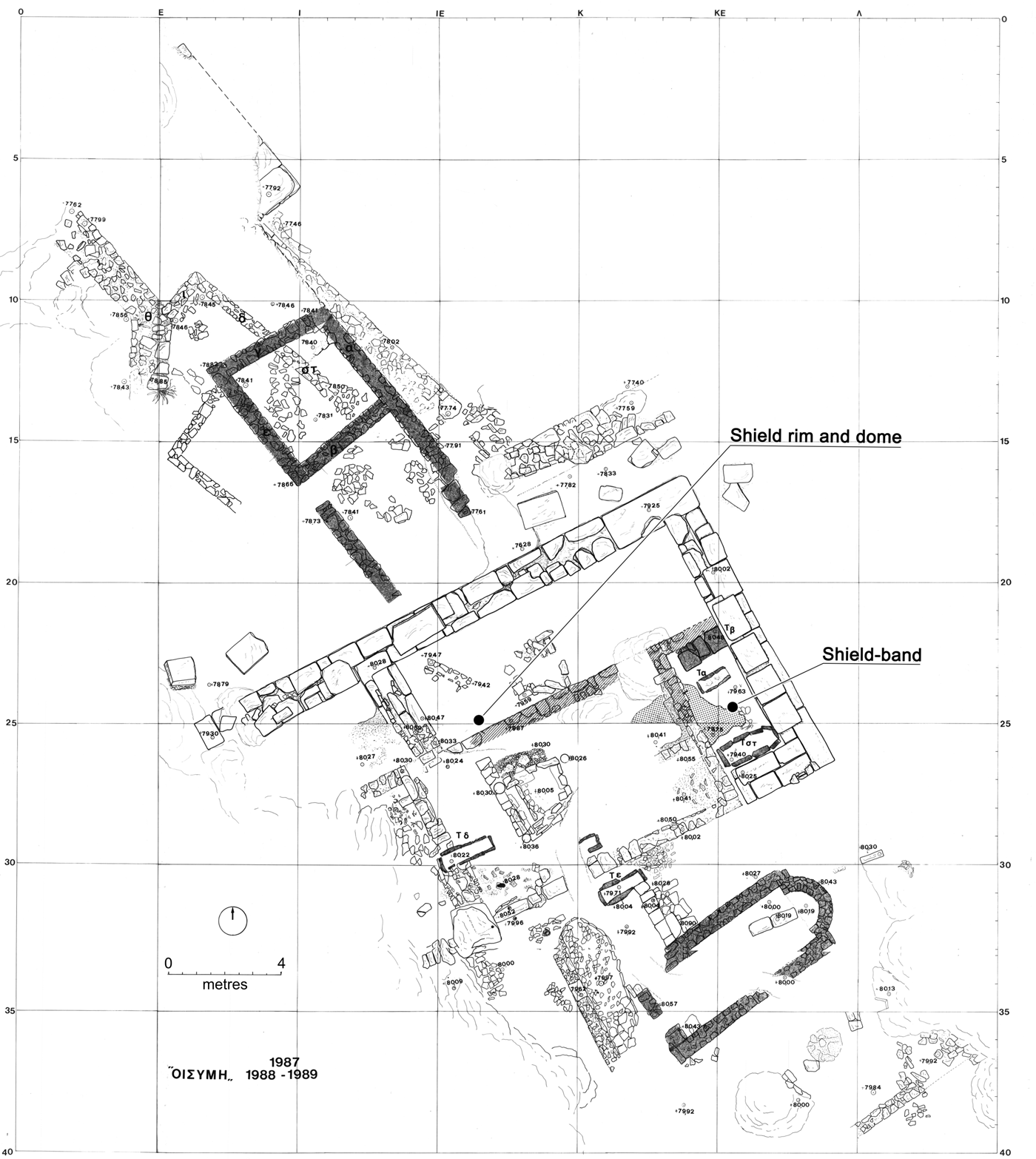
Cult activity at the sanctuary on the acropolis (Fig. 2) appears to have begun at least as early as the late seventh century bce and to have continued up to the second century bce, if not later. Two distinct phases of activity have been identified. The earlier, Archaic, phase is defined by a substantial destruction layer containing architectural spolia from an early cult building, now lost (see below). Later, a Classical temple (oriented south-west to north-east, apparently with an entrance located at the west due to space constraints) was founded directly on this destruction layer and remained in use (repaired as necessary) well into the Hellenistic period (Giouri and Koukouli Reference Giouri and Koukouli1987, 368–9; Koukouli-Chrysanthaki and Papanikolaou Reference Koukouli-Chrysanthaki and Papanikolaou1990, 487–90; Koukouli-Chrysanthaki Reference Koukouli-Chrysanthaki, Mentizis and Apostolaki2017, 261).
Plan of the sanctuary of Oisyme.

The Archaic destruction layer yielded a large quantity of pottery, both locally produced and imported. Its date is thus secure. The earliest datable sherds belong to late seventh-century Cycladic and East Greek vessels, including Chian amphorae and Wild Goat Style plates. These are accompanied by early sixth-century local (or Thasian) ‘pseudo-Chian’ imitations and followed by a considerably larger number of mid- and late sixth-century imported Attic and Corinthian drinking vessels. The most recent material recovered from the destruction layer consists of Thasian pottery of the turn of the sixth century, such as Phari-style kylikes and skyphoi (Giouri and Koukouli Reference Giouri and Koukouli1987, 371–2; Koukouli-Chrysanthaki and Papanikolaou Reference Koukouli-Chrysanthaki and Papanikolaou1990, 492; Koukouli-Chrysanthaki and Marangou Reference Koukouli-Chrysanthaki, Marangou, Tiverios, Misailidou-Despotidou, Manakidou and Arvanitaki2012, 323–35; Koukouli-Chrysanthaki Reference Koukouli-Chrysanthaki, Mentizis and Apostolaki2017, 261).
Finds from the destruction layer also attest to an early phase of cult activity. Several Archaic architectural terracottas, including roof tiles and antefixes with relief and painted decoration, find parallels at the Archaic Sanctuary of Heracles in Thasos (Launey Reference Launey1944, pls 7–10). Many small terracotta female figurines of various types were found,Footnote 4 as well as loomweights, large fragments of a near life-size terracotta female statue, several smaller fragments of sculptures in Thasian marble and many metal finds including weapons and jewellery (Giouri and Koukouli Reference Giouri and Koukouli1987, 369–70; Koukouli-Chrysanthaki and Papanikolaou Reference Koukouli-Chrysanthaki and Papanikolaou1990, 492). The excavators interpret these finds – especially the figurines and the statues – as clear indications for the sanctuary being dedicated to a female deity possibly akin to Athena Polias (Giouri and Koukouli Reference Giouri and Koukouli1987, 372). A close link to the Artemis cult of Thasos and the similar ‘Parthenos’ cult of nearby Neapolis has also been suggested by previous scholars (Huysecom-Haxhi Reference Huysecom-Haxhi2009, 599–604; Maffre and Tichit Reference Maffre and Tichit2014, 159–62; Prokova Reference Prokova2014, 115). Such a link is highly likely, given the foundation dates of the three sanctuaries (c.675–650 bce), the striking similarities in the types of votive offering (especially the terracotta figurines), the identifiable attributes and purview of Thasian Artemis and the ‘Parthenos’ in comparison to the deity worshipped at Oisyme and the extensive political and cultural influence exerted by Thasos over her apoikiae during the Archaic period (Huysecom-Haxhi Reference Huysecom-Haxhi2009, 599–604; Maffre and Tichit Reference Maffre and Tichit2014, 159–62; Prokova Reference Prokova2014, 87–115; Chalazonitis Reference Chalazonitis, Lemos and Tsingaridaforthcoming).
THE SHIELD: DISCOVERY AND STATE OF PRESERVATION
Discovery
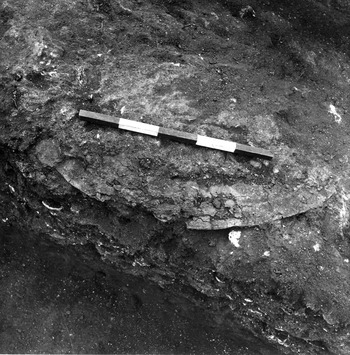
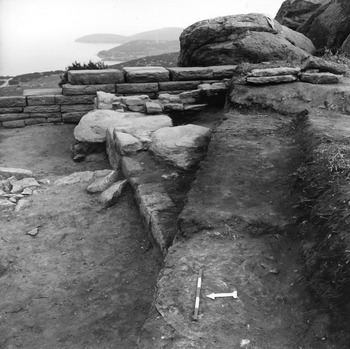
Part of a shield-band (porpax or ochanon) with relief decoration (Oisyme excavation inventory Δ180, 2/11/1987; Kavala Museum M3090) was the first shield fragment discovered in the destruction layer near the eastern foundation of the Classical temple, at an elevation of 79.82 mamsl (Fig. 2).Footnote 5 Soon afterwards, parts of a shield dome and rim (Oisyme excavation inventory Δ281 and Δ284, 16/11/1987; Kavala Museum M3278) were found almost 8 m away, immediately north of the northern wall of the temple, at an elevation of 80.01 mamsl (Fig. 2). These pieces lay at the level of the Classical temple foundation, almost touching the putative line of the wall (Figs 3, 4). Most of the shield would have lain along the course of the wall, and is thus lost. The shield must have been deposited during the Archaic phase of the sanctuary because it was found within the destruction layer and because the Classical wall essentially cut through and destroyed its dome.
The shield dome, as discovered.

The shield dome, as discovered in relation to the wall of the Classical cult building.

Given the distance between the two finds, a case might be made for two partially preserved shields. Yet the nature of the destruction layer and the levelling of the sanctuary terrace before the erection of the Classical building could easily explain the dispersal of parts of a single shield over a wider area.
State of preservation
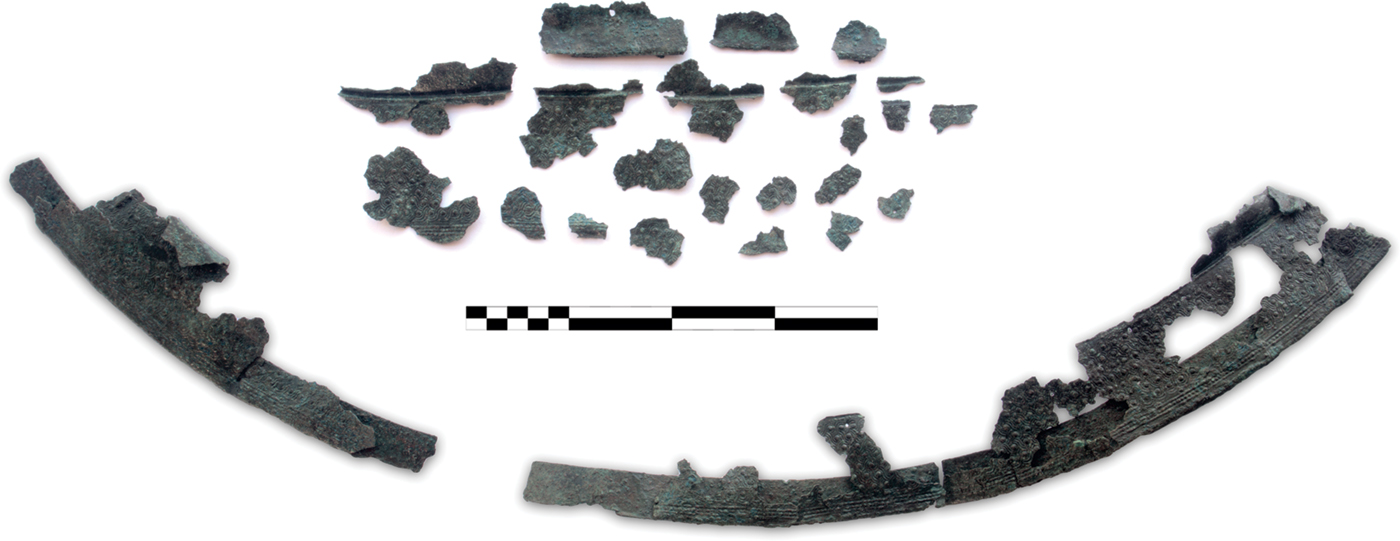
Both the shield and the band are only partially preserved.Footnote 6 Most of the former was lost either in the destruction of the Archaic cult building or during the subsequent levelling of the area for the erection of its Classical successor. Only about a third of the rim has been found (Figs 3, 5), with the corresponding part of its bronze dome. The rim fragments are generally well preserved, but several dome fragments appear to have been struck or bent out of shape: in at least two cases, fragments are folded back onto themselves (Fig. 5, far left and far right). The junction between the dome and the relatively flat rim-band also bears signs of considerable stress, with several instances of fracture or of the dome bending against the line of the junction. The deformation suggests that at some point in the destruction of the Archaic building or the erection of the Classical temple, the wooden backing of the bronze sheet was destroyed or splintered to the extent that it no longer provided the support necessary to maintain the shape of the bronze facing.
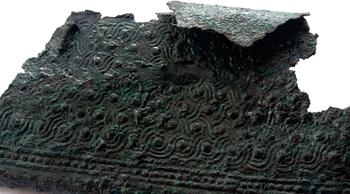
The rim of the shield, with its decorative guilloche band.

The shield-band, pieced together from over a dozen small fragments, preserves rectangular, metope-like frames (two mostly complete and a third in fragmentary condition) bearing decoration typical of Argive/Corinthian examples (Kunze Reference Kunze1950, primarily 1–44; Bol Reference Bol1989, 36–101). The band also shows signs of considerable stress. It has been bent sharply along the decorative frame separating the two better-preserved metopes. No part of the bracing porpax or the ends of the band are preserved (the latter are usually decorated with palmettes: see Kunze Reference Kunze1950, 201–11; Bol Reference Bol1989, 85–8).
THE RIM AND DOME
The identifiable parts of the shield include a section of its relief-decorated rim and part of the central dome. Extensive corrosion, fragmentation and deformation of the bronze, and its ensuing fragility, make it difficult to reassemble a continuous section. Nevertheless, part of the rim has been restored to its full width, and we can therefore identify the shape and dimensions of the shield.
The shield was a typical Argive round aspis, with a flat rim and a domed centre. Its metal facing consisted of a single hammered bronze sheet. Near the outer edge, the thickness of the sheet ranges between 1.5 and 1 mm; it becomes progressively thinner towards the centre of the dome. Just past the junction of the rim and dome, the sheet is only 0.8 mm thick; the fragment that may have belonged to a central device (see below) barely reaches 0.5 mm in thickness. The tapering of the bronze sheet matches that observed in other Archaic shields (Kunze and Seiterle Reference Kunze, Seiterle and Berger1982, 258).
The curvature of the rim indicates that the overall diameter of the shield was around 0.8–0.85 m, with a diameter of around 0.75 m for the central dome. This falls well within the range of other known Archaic parallels (Kunze and Seiterle Reference Kunze, Seiterle and Berger1982, 255–9; Stamatopoulou Reference Stamatopoulou2004, 295–473).
The rim-band
The rim was folded back around the edge of the shield to secure it to its wooden backing and ensure its better rigidity (Fig. 5). The fold is quite thin and follows a sharp angle, with very little space available for a wooden core between the metal sheets; this was probably caused by the deformation of the metal during the destruction of the sanctuary. Pressure along this fold has created a notable weak spot; the metal sheet has suffered significant stress, and before reconstruction it was broken along almost the entire length of the crease.
The exterior band-like zone of the rim is almost 55 mm wide and the internal folded part 12–15 mm. The internal band is plain, with no markings whatsoever, unlike some Peloponnesian examples (Bol Reference Bol1989, 16–17). The external rim-band is adorned with decorative motifs executed in repoussé. From the outer edge inwards, the decoration is as follows.
1. A reserved/undecorated band, 5–6 mm wide, near the rim crease.
2. Two very thin relief bands framing a row of repoussé dots for a total width of 45 mm.
3. The main decorative zone, 41–42 mm wide, with a complex guilloche motif.
4. A recessed groove, no more than 3 mm wide and deep, bordered by the junction between the flat rim and the central, undecorated dome of the shield.
The main guilloche consists of seven rows of large repoussé dots (or ‘eyes’) linked by interwoven triple relief bands (Fig. 6). This is one of the most complex but also most commonly encountered patterns on Archaic Argive shields. Similar motifs are known from Olympia and Sindos (Bol Reference Bol1989, 6–15; Despoini Reference Despoini2016, 316–53).
Close-up of a rim section. Note the bent nail, used to affix the bronze shield facing to its wooden core.

Several bronze nails and nail holes are preserved along the guilloche band near the junction crease. These thin nails would have fixed the bronze shield facing onto its wooden core. One has been pushed out and bent sharply on the exterior, possibly during or after the destruction event when the shield was damaged (Fig. 6). The Oisyme aspis provides us with a welcome new instance of such nails, as few ancient Greek shields preserve them in good condition (Kunze and Seiterle Reference Kunze, Seiterle and Berger1982, 261).
The dome
The dome of the shield has suffered considerably, as noted above. This damage, together with the breakage and deformation around the junction with the rim, makes it difficult to determine the angle between dome and rim, and thus the exact profile of the shield.
Three bronze fragments discovered underneath the dome may have belonged to a central device or blazon. They form a small circular boss, around 40 mm in diameter, framed by a succession of dotted lines in concentric circles. At least two ‘thin’ and two ‘wide’ circles can be identified (Fig. 7). If they were originally part of a central device, it is impossible to reconstruct it with any certainty. The corpus of Argive shields from Olympia does not provide exact parallels (Philipp Reference Philipp2004).
Shield fragments(?) with concentric circle/dotted line decoration.

A tentative parallel may be drawn with the concentric circle motifs found on early metal weapons and armour from the central Balkans (Baitinger Reference Baitinger2011, fig. 56). Similarities can also be identified between the boss or device of the Oisyme shield and the decoration of early Italian Iron Age shields (Geiger Reference Geiger1994, particularly pls 1–7). Fragments of several such shields have been recovered from Greek sanctuaries, Olympia included (see Geiger Reference Geiger1994; also Baitinger Reference Baitinger2011, fig. 53), and they would therefore have been familiar to Greek artisans. However, the shape of these buckler-like shields, with their almost conical dome and single, centrally placed grip, differs sharply from the later Argive-type examples.
Alternatively, we should perhaps dissociate this ‘omphalos’ from the shield altogether, and suggest a different interpretation. Similar patterns decorate Archaic bronze phialae from sites in the northern Aegean. Such a vessel could easily have found its way to the Thasian peraea or have been produced there, and might have been dedicated on its own or alongside the bronze shield as part of a larger set (see, e.g., Chrysostomou and Chrysostomou Reference Chrysostomou and Chrysostomou2004, 563, fig. 5 for such a phiale from a sixth-century bce ‘warrior’ grave at Archontiko near Pella).
THE SHIELD-BAND
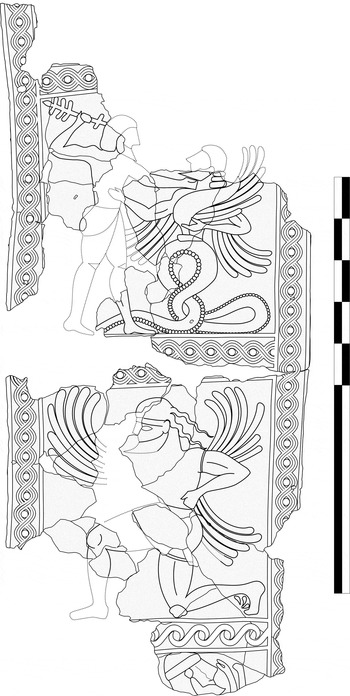
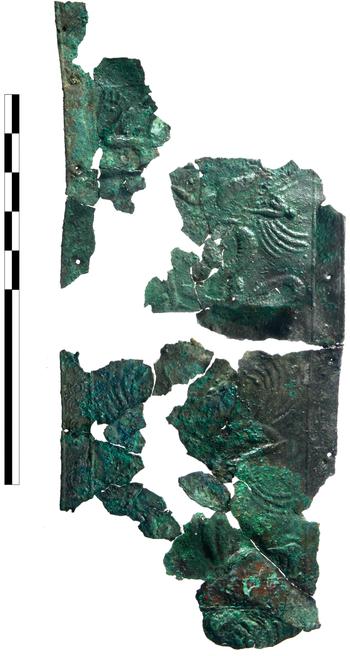
The decoration of the shield-band follows the metopal scheme common on other Argive-type shields of the period (Stamatopoulou Reference Stamatopoulou2004, 415, Fig. 359). It consists of consecutive rectangular fields with pictorial scenes, interspersed by, and framed with, bands of geometric motifs. The Oisyme shield-band preserves large parts of two metopes and a small part of a third (Figs 8, 9).
The shield-band (drawing).

The shield-band (photograph).

The piece is framed by two lateral bands running down its entire length and by transverse bands between the metopes. The lateral bands are decorated with the regular point-and-triple-braid guilloche which is by far the most common motif on shield-bands of the period (Kunze Reference Kunze1950, 45–8; Bol Reference Bol1989, 37–9). In this case, the relief appears to be relatively shallow, especially when compared to the guilloche on the rim. The same is true of the transverse bands, which are variously decorated with guilloche or wave patterns.
Three separate metopes can be identified. In contrast to the framing bands, they are decorated in relatively high relief. Very little fine detail is preserved, primarily because of surface corrosion and the deformation of the metal, but the subjects depicted in at least two of the three metopes can safely be identified.
At the top of the band, metope A depicts the clash between Zeus (to the left) and Typhon (to the right). The central part is lost, but the scene can be reconstructed from the two preserved fragmentary groups. The smaller group corresponds to the upper-left corner of the metope. Zeus holds a thunderbolt and prepares to strike, his arm raised in an overarm throwing or thrusting pose. The second group corresponds to the right half of the metope, missing the upper-right corner. Zeus’ foot, at the bottom left, is shown stepping forward to the right, towards Typhon. The rest of Zeus’ body is lost, but we can safely reconstruct a stance depicted in other examples of the period: striding towards the defeated Typhon, left hand extended to grasp him by the throat or head and the right raising the thunderbolt that will smite him (Kunze Reference Kunze1950, 82–8; Bol Reference Bol1989, 50–1).
Crouched at the right edge of the metope, Typhon is immediately recognisable. His lower body is formed of two long snake tails wound together into a figure of eight, their ends curling against the frame of the metope. He wears a thick belt around his waist; immediately above it, a large crescent wing covers the front of his torso and extends towards his back, to the right frame of the metope. A pair of secondary, crescent-shaped wings extend down from his lower back. Typhon's left arm is drawn back, his elbow sharply angled and his hand raised to chest height. His right hand is extended towards Zeus in supplication or defence. Unfortunately, most of his head is lost.
Below metope A, metope B depicts a figure in Knielauf towards the left. A pair of large, crescent-shaped wings curve towards the upper corners of the metope, while a second pair of smaller crescent wings extend down from the figure's lower back. There is a striking similarity with the manner in which Typhon's wings are depicted, with multiple individual curving pinion feathers. It seems almost certain that the dies used for the repoussé decoration of metopes A and B were products of the same workshop and, in all likelihood, the same artist.
The right arm of the figure is not preserved, but the left is bent close to the body. The kneeling (left) leg is very well defined, with pronounced musculature at least to the mid-thigh; the figure's chiton must have been quite short. A small wing can be discerned over the figure's left instep.Footnote 7 Unfortunately, the right leg (that moving forwards) is lost and metal corrosion has severely damaged the central part of the torso and head. Most of the face is also destroyed.
At first glance, it is tempting to interpret the metope as a depiction of Medusa, a common motif in Peloponnesian metalworking of the Archaic period. However, upon closer examination, this interpretation is unconvincing. As a rule, when Medusa is in the Knielauf pose her face is depicted en face, as a gorgoneion (Kunze Reference Kunze1950, 65–71; Bol Reference Bol1989, 45–6), but on the Oisyme shield-band, two long tresses of hair are blown towards the right in the breeze created by the figure's passing; beneath them is the right edge of a nape and head, rendered in profile, towards the left. This allows us to identify the figure as one of the winged deities named ‘Boreades’ by Emil Kunze. Originally, only one such metope was known in the Olympia corpus (Kunze Reference Kunze1950, 72), but Peter Bol has tentatively identified several more parallels (Bol Reference Bol1989, 47–8).
At the bottom of the band, metope C preserves only the upper-right corner of the pictorial field. At the edge, a crescent-like line curves towards the top left. To the left of this is a man's head, facing right. The curved line recalls the curve of the pinion feathers on the other metopes. However, a mouth-like incision at its end, if an original part of the relief and not a subsequent deformation, might suggest the tail of a beast or the head of a snake. The poor preservation of the metope makes it particularly difficult to identify the scene depicted, and there are no published parallels from central Greece.
MANUFACTURE AND DATE
The Late Archaic destruction layer in which the shield fragments were found provides a terminus ante quem of c.500 bce. The shield certainly belongs to the Archaic phase of the Oisyme sanctuary, but only a stylistic analysis of the find might suggest a more precise date and a centre of manufacture.
Dies and stylistic analysis
The shield-band offers the best starting point for discussion of both iconography and style. Two of the three metopes depict scenes well known from the Olympia corpus, although their order has no direct parallel among the shield-band ‘Forms’ from Olympia (Kunze Reference Kunze1950, 7–44). In terms of iconography, the Oisyme band may be a product of a Peloponnesian workshop subsequently brought to the Thasian peraea, in which case it establishes a new Form sequence among other Peloponnesian parallels. Alternatively, it may have been produced in the region of Thasos by metalworkers familiar with, and able to imitate, central and southern Aegean products.Footnote 8 For instance, the cemetery at Sindos has yielded shield-bands evidently produced using copies of Corinthian-made dies. The scenario originally proposed by Kunze, and subsequently taken up by Aikaterini Despoini in the Sindos publication, dismisses the export of finished shields because of the weight, production and transport costs of the final product. Instead, dies for decorative elements might have been procured (purchased or copied) by workshops far from the well-known Peloponnesian production centres or carried by itinerant artists. Bespoke shields would then have been produced on-site to suit the tastes of their purchasers (Kunze Reference Kunze1950, 216; Despoini Reference Despoini2016, 349–53).Footnote 9
The dies used for the metopes on the Oisyme shield were not direct copies of any known Peloponnesian example. The Boreas metope is clearly different from its contemporaries, and unique in the orientation of the figure. In all known instances of winged deities in Knielauf from Olympia, Boreades move to the right (Kunze Reference Kunze1950, 72; Bol Reference Bol1989, 47–8) (Fig. 10a), and the same is overwhelmingly true of the similarly depicted flying Medusas (Kunze Reference Kunze1950, 65–71; Bol Reference Bol1989, 45–6).Footnote 10 However, the Oisyme Boreas is shown flying to the left.
Metopes from Olympia depicting (a) a ‘Boreas’ winged figure, (b) and (c) the Zeus-Typhon battle and (d) the battle between Heracles and a river god (after Kunze Reference Kunze1950, pls 6, 30, 54, 61; reproduced with the kind permission of the German Archaeological Institute at Athens).

The battle between Zeus and Typhon is one of the most popular motifs in the Olympia corpus. Kunze lists it as the second-most-common mythological scene, after the slaying of the Nemean Lion by Heracles. More than ten different dies with renditions of the scene have been identified (Kunze Reference Kunze1950, 82; Bol Reference Bol1989, 50); the most significant differences between them lie in the depiction of the snake-like body of Typhon and the shape of his wings.
The closest parallel from Olympia for the depiction of Typhon on the Oisyme shield-band is Form Id. The symmetrical, figure-of-eight rendition of the demon's snake tails, the large wing extending from his chest towards the top right and the smaller pair of wings extending down from his waist are all characteristic of this type (Kunze Reference Kunze1950, pls 6–7) (Fig. 10b). Yet there are also significant differences. The lower wings of the Oisyme Typhon are not the stylised, straight, almost vertical wings so common in the Olympia corpus, but are curved and crescent-like, as those of the Boreas in metope B. This is a relatively rare stylistic feature at Olympia. One might compare the wings of Medusa in Form IIb and VIIe metopes (Kunze Reference Kunze1950, pls 10, 23), but the closest parallel is undoubtedly the singular Form Xb (Kunze Reference Kunze1950, pl. 30) (Fig. 10c). There, the pinion feathers are also separate, long and curved, as on the Oisyme band, and their number per wing is the same (seven for a primary and five for a secondary wing). Form Xb also depicts Zeus’ lightning in a similar fashion, as a spear with a series of crossbars or ‘branches’, rather than the more common flaming bolt. Nonetheless, there are also differences between Form Xb and the Oisyme shield. In the Olympia metope, Typhon possesses two primary wings and one secondary wing, and his snake-legs are rendered in two loose, completely asymmetric coils instead of the more conservative figure-of-eight arrangement.
Only a very small part of the pictorial field of metope C is preserved. As a result, the subject cannot be identified with certainty. Difficulty in determining whether the curved line(s) at the top-right corner are part of a wing, a tail, a snake or something completely different adds a further complication. If this is a snake, a tentative parallel might be sought in the Olympia Form XXXδ metope, which depicts Heracles fighting a river god (Kunze Reference Kunze1950, pl. 54) (Fig. 10d). If it is a tail, another possibility might be a variant on the well-known fight between Heracles and the Nemean Lion (Kunze Reference Kunze1950, 95–102; Bol Reference Bol1989, 54–6). Whatever the case, the die used is not part of any known corpus.
In short, all three of the Oisyme metopes appear to be unique. Stylistic similarities between them clearly show that their dies were produced by the same workshop and perhaps the same artist. The crescent-shaped wings of the demonic figures (with the multiple curved pinions and no stylised upper-wing coverts) are an obvious common feature, and there are also similarities in the rendition of the left arm and elbow of Typhon and of the Boreas on metopes A and B (these are held rigid, close to the body, unlike the Typhons on Forms I, VII and X or the Form XXXIX Boreas from Olympia). Furthermore, the sequence of the metopes is unparalleled in the Olympia corpus.Footnote 11 If metope C depicts Heracles’ battle with the Nemean Lion (which is by no means certain), the only known parallel would be a shield-band from the Sanctuary of Persephone and Hades in ancient Hipponion/Vibo Valentia (Baitinger Reference Baitinger2011, 119, fig. 80).
The shield rim, with its complex guilloche, offers a secondary point of stylistic analysis. Here, the Oisyme shield is in line with Peloponnesian production. The eight- or seven-row triple guilloche with a dotted repoussé line at its outer edge is the most common rim decoration in the Olympia corpus. It appears on more than two-thirds of the Olympia shields until the mid-fifth century (Bol Reference Bol1989, 7). Other rims bear narrower (six- or five-row) guilloche patterns, sometimes with a simpler, double weave; in some cases, the main guilloche is divided into multiple, parallel decorative bands. A small number of late shields also feature palmette bands and in some cases even pictorial zones (Bol Reference Bol1989, pls 15–17).
On some shields from Olympia it is possible to identify the dimensions of the die used by identifying repeating elements and flaws in the pattern (Kunze and Seiterle Reference Kunze, Seiterle and Berger1982, 256–9; Bol Reference Bol1989, 7–8). Unfortunately, this is not possible at Oisyme due to metal corrosion and the fragmentary nature of the shield. For the same reasons it is also impossible to determine whether the die utilised for the guilloche has a direct parallel at Olympia or if, like the metope dies, it is unique.
Date
The artist who produced the Oisyme shield-band was clearly familiar with the products of contemporary Peloponnesian workshops.Footnote 12 On stylistic grounds, there is a possible link with the workshop that produced the Olympia Form X shield-band – a workshop placed by Kunze in the mid-sixth century (Kunze Reference Kunze1950, 234–5, 243). However, the Oisyme artist was more conservative than his counterpart at Olympia. For instance, the figure-of-eight arrangement of Typhon's coils recalls similar renditions of the demon in Form I metopes from Olympia; this type dates as far back as the first quarter of the sixth century, although it survives in later phases too (Kunze Reference Kunze1950, 233–5, 242).
Furthermore, if we compare metope B to the well-preserved Form XXXIX (the closest thematic parallel in the Olympia corpus, dating to the third quarter of the sixth century), the Oisyme metope appears to be rendered in a significantly more conservative style. The deep, kneeling pose of the Oisyme Boreas is much more stylised and rigid than that of the Olympia winged demon. On metope B, the figure's left knee and foot both touch the bottom of the frame and the left ankle is bent at an almost vertical angle. By contrast, on the Form XXXIX metope, the right knee of the figure is raised high off the frame with the right ankle bent sharply forwards. Furthermore, the right hand of the Olympia demon hangs loose, away from his body, while the Oisyme Boreas holds his trailing hand rigidly close, in a stance that harks back to early (575–550 bce) depictions of Gorgons (Kunze Reference Kunze1950, 65–71, pl. 23). Therefore, stylistic criteria suggest that the Oisyme shield-band dates to the second quarter of the sixth century (or to the mid-sixth century at the latest).
The main body of the shield is considerably harder to date. There is very little stylistic variation between the ‘standard’ eight- and seven-row guilloches of the Peloponnesian workshops. Bol argues that ‘we should not expect to identify significant differentiation or draw particularly precise information from the decoration of shield rim-bands’ (Reference Bol1989, 9). What little variation exists lies primarily in the thickness of the weave strands and the height of the relief; this can range from a repoussé pattern of even height to very pronounced ‘eyes’ in a disproportionally flat weave. The Oisyme rim-band belongs to the former category. Its clear pattern of uniform height closely resembles that found on Bol's A90 and A119 shields (Bol Reference Bol1989, pls 6–7).
The flatter patterns with very pronounced ‘eyes’, such as those on Bol's A59, A149 and A150 shields (Bol Reference Bol1989, pls 7–8), make their appearance from the mid-sixth century onwards, while relief bands of uniform height are characteristic of earlier periods (dating as far back as the late seventh and early sixth centuries). These early types survive even after the middle of the century; at least one example occurs on a late sixth-century shield (Bol Reference Bol1989, 9). Nevertheless, while it is impossible to discount a later date, it remains most likely that the Oisyme shield was forged before or around the middle of the sixth century.
In short, we may place the manufacture of both the body of the shield and the band in the second quarter of the sixth century (c.550 bce at the latest). This alone is not proof that they were part of the same weapon, especially given the distance between their find-spots. However, based on the partly deformed condition of the shield parts and their discovery in a destruction layer later levelled into a terrace fill in antiquity, and given that their proposed dates of manufacture match, a case can be made for a single shield, broken into many parts during the destruction of the Archaic cult building.Footnote 13
The proposed date of the shield's manufacture is most unlikely to correspond with that of the shield's dedication at Oisyme, since it may have remained in use for many years. As noted above, however, the context and condition of the find and, perhaps more significantly, the apparent destruction of part of the dome during the construction of the Classical temple provide a clear terminus ante quem for its dedication.
THE SHIELD AS A VOTIVE OFFERING: THE CULT AND THE COMMUNITY
The geographical, historical and cultic contexts of the Oisyme shield make it a particularly interesting discovery. No other Archaic shields have been discovered on Thasos or in its peraea. In the northern Aegean, large bronze shields are found only beyond the Gulf of Kavala and the Thasian sphere of influence, at sites such as Archontiko (Pella), Sindos and Trebenishte, where they appear in funerary contexts (Fig. 1).Footnote 14 Another Archaic shield-band, probably of the late sixth century, is an isolated find from the northern enclosure of ancient Abdera (Koukouli-Chrysanthaki Reference Koukouli-Chrysanthaki, Moustaka, Skarlatidou, Tzannes and Ersoy2004, 241–2, fig. 20). Michalis Tiverios reports a bronze shield-band covered in silver leaf from the Karabournaki settlement (Reference Tiverios2009, 394, fig. 14).
This distribution is not particularly surprising because only a few Archaic sanctuaries have been identified and excavated in northern Greece, while funerary contexts have received significantly greater attention. Nonetheless, many Thasian sanctuaries have been thoroughly excavated (including the sanctuaries of Athena and Apollo on the city's acropolis), and none has yielded a comparable find. The only weapons recovered are the spearheads and arrowheads unearthed in limited numbers in the sanctuaries of Artemis and Athena (Daux Reference Daux1960, 864; Prêtre Reference Prêtre2016, 103–4).
It is primarily to the sanctuaries of central and southern Greece that one must look for comparanda (Fig. 11). Olympia has the most extensive published corpus of Argive-type shields in the Peloponnese, although some (still unpublished) examples have been discovered at Isthmia.Footnote 15 At Kalapodi, Rainer Felsch has identified at least 35 shields of Argive type, although he reports that they ‘add nothing to established typologies, but rather confirm the conclusions advanced by Emil Kunze, Gerard Seiterle and Peter Bol’ primarily based on the Olympia finds (Felsch Reference Felsch and Felsch2007, 226–30). Holger Baitinger has compiled a comprehensive catalogue of the fragments of Argive-type shields found at Archaic sanctuaries both in Aegean Greece and the western colonies (Reference Baitinger2011). A limited number of Archaic relief-decorated shields discovered at Delphi and on Crete, at sites such as the Idaean Cave, are stylistically distinct from Peloponnesian products and belong primarily to the Idalion/Herzsprung and Lion-protome types.Footnote 16 However, they are comparable with their counterparts at Olympia in terms of size, material value and investment in production, and they may also have been functionally similar since they were large enough to have served as real weapons before their dedication.
Archaic/Early Classical sanctuary sites of mainland Greece and the Aegean Sea that have yielded non-miniature bronze shields (map based on ASTER digital elevation model; ASTER is a product of METIS and NASA; https://asterweb.jpl.nasa.gov/gdem.asp). (1) Aigina, Sanctuary of Aphaia, (2) Aphyssos (Lakonia), Sanctuary of Zeus Messapeus, (3) Athens, Acropolis (and Agora), (4) Bassae, Sanctuary of Apollo, (5) Delphi, Sanctuary of Apollo, (6) Didyma, Sanctuary of Apollo, (7) Dodona, Sanctuary of Zeus, (8) Epidaurus, Sanctuary of Apollo Maleatas, (9) Ialysos, Sanctuary of Athena, (10) Idean Cave, Sanctuary of Zeus, (11) Isthmia, Sanctuary of Poseidon, (12) Kalapodi, Sanctuary of Apollo and Artemis, (13) Lindos, Sanctuary of Athena, (14) Lousoi, Sanctuary of Artemis Hemera, (15) Miletus, Sanctuary of Athena and Sanctuary of Aphrodite, (16) Oisyme, acropolis sanctuary, (17) Olympia, Sanctuary of Zeus, (18) Orchomenos, Sanctuary of Heracles, (19) Palaikastron, Sanctuary of Zeus, (20) Pallantion, acropolis sanctuary, (21) Mount Parnes, Sanctuary of Zeus, (22) Perachora, Sanctuary of Hera, (23) Pherae, Sanctuary of Artemis Enodia, (24) Philia, Sanctuary of Artemis Itonia, (25) Ptoion, Sanctuary of Apollo, (26) Samos, Sanctuary of Hera, (27) Sparta, Sanctuary of Athena Chalkioikos, (28) Therapne, Menelaion.

The principal deities worshipped at all these sanctuaries were male (Zeus, Poseidon, Apollo); furthermore, by the sixth century, sanctuaries such as Olympia, Delphi, Isthmia and Kalapodi enjoyed wider regional and even Panhellenic fame. At first glance, the Oisyme shield stands out as a dedication to a female deity at an acropolis sanctuary. This raises questions about the identity and purview of the goddess worshipped at Oisyme, and about the regional importance of the city and its sanctuary.
Weapons are not unknown as offerings in sanctuaries of female deities. According to a database of nearly 150 sanctuaries and the votive weapons found at them, compiled by Stephanie Larson, miniature votive armour and shields (in metal or terracotta), as well as functional, full-sized offensive arms (spears, swords etc.), were equally common offerings in sanctuaries of male and female deities (Larson Reference Larson and Prêtre2009, 127–8). However, Larson draws attention to the dichotomy between potentially functional, full-scale armament and miniature variants. She concludes that from the eighth to the fifth century bce, ‘male deities have significantly more sites with full-size defensive arms and with pieces that make up a full or partial hoplite panoply’ (Larson Reference Larson and Prêtre2009, 128).
This does indeed mark the Oisyme shield as an outlier of sorts. The sanctuary has produced no miniature weapons whatsoever. The substantial sets of miniature shields, helmets, spears and swords encountered in Archaic sanctuaries of other goddesses (e.g. Athena and Hera) in the central and southern Aegean are completely absent (Warin Reference Warin, Egg, Naso and Rollinger2016, 93–5). Furthermore, the Archaic layers have yielded only a small corpus of functional, full-size offensive weapons: a single iron spearhead, a small number of fragmentary iron knife-blades, part of an iron sword and three arrowheads (one bronze, two iron). Although varied in type, these finds are limited in number and by no means exceptional. The available evidence therefore suggests that the dedication of weapons was not an integral part of ritual activity in the sanctuary.
Previous scholarship has established a close link between the cults of the unnamed goddess of Oisyme, the ‘Parthenos’ at nearby Neapolis and Artemis and Athena in Thasos (Giouri and Koukouli Reference Giouri and Koukouli1969, 372–3; Prokova Reference Prokova2014, 107, 127; also Chalazonitis Reference Chalazonitis, Lemos and Tsingaridaforthcoming). These sanctuaries have produced similar repertoires of finds from the time of their foundation in the seventh century bce, including terracotta female statues and figurines of the same standing and seated types, loomweights, jewellery and imported and locally produced kylikes. There are strong indications that the goddesses were worshipped as ergane deities, i.e. as protectors of women and of the household (Bakalakis Reference Bakalakis1936, 36; Giouri and Koukouli Reference Giouri and Koukouli1987, 372–3). They may also have been worshipped as kourotrophoi, or protectors of childbirth, of the youth of the community and of the passage from childhood to adulthood (Maffre and Tichit Reference Maffre and Tichit2014, 159–62; Prokova Reference Prokova2014, 105–9; Chalazonitis Reference Chalazonitis, Lemos and Tsingaridaforthcoming). Whatever the case, the evolution of the ‘Parthenos’ into the patron deity of Neapolis and the probably similar role of the Oisyme goddess (given the location of her sanctuary on the acropolis) demonstrate that the goddesses of the Thasian peraea played an important role in ensuring social cohesion within their poleis.
Weaponry (and in the social context of an Archaic Greek polis, the hoplite panoply in particular) may have served as a mark of adulthood and been dedicated within a rite of passage (Brize Reference Brize1989–90, 325–6; Baumbach Reference Baumbach2004, 166; Warin Reference Warin, Egg, Naso and Rollinger2016, 93). It is not, therefore, surprising to find that arms were offered at sanctuaries of kourotrophoi and poliad deities. Yet the corpus of weapons dedicated at Oisyme is much too small to be connected with a regular rite of passage. Instead, the shield may have been a war prize or trophy (Baitinger Reference Baitinger1999, 125–39; Reference Baitinger2011, 144–50; Reference Baitinger, Egg, Naso and Rollinger2016, 67–8; Larson Reference Larson and Prêtre2009, 127). Unfortunately, there is no inscription to confirm this interpretation, and little or no historical information exists to link the dedication of the shield to a specific conflict in the region.Footnote 17 A simpler (and perhaps more likely) interpretation is that the shield was dedicated by a private individual to the patron deity of Oisyme, to honour the goddess and/or give thanks for her protection. This fits the pattern of smaller corpora of weapons, consisting largely of personal dedications, which Holger Baitinger has characterised as typical of local polis sanctuaries (Baitinger Reference Baitinger2011, 146, 154–5).
Finally, we note the importance of the votive as perceived by the dedicator and the local community. The dedicator was evidently a person of substantial means, as it would have been expensive to commission such a weapon. Although Baitinger is right to describe the notion of the poor hoplite as a contradiction in terms during the Archaic period (Reference Baitinger2011, 160), this does not mean that any hoplite could have offered this dedication. A shield was a substantial, long-term investment that could be inherited within the family.Footnote 18 We must therefore differentiate between the ability of a hoplite to afford a shield for his own use and that of his descendants and his capacity to dedicate the same shield at a sanctuary.Footnote 19
There are, nonetheless, known cases of hoplites offering their panoply to the gods in their old age.Footnote 20 Such dedications were probably not surprising or unexpected at the sanctuary of the poliad deity. To a visitor, the Oisyme shield would have been one of the most impressive offerings on the acropolis (if not the most impressive), but it would hardly connote an ‘elite’ dedicator.
CONCLUSIONS
The Oisyme shield offers new insight into early metalworking practices in Thasos and its peraea. The artist who made the shield was clearly familiar with the work of his contemporaries in the Peloponnese (possibly through the Corinthian trade network) and sought to imitate the standard of the Argive-type shield. It is unclear whether he created his own dies, imported them or travelled with them. The unique rendition of known themes and scenes might argue for the first, but we have no accompanying evidence to suggest the development of a local Archaic tradition in shield manufacture and decoration. The style of his work indicates a particularly close connection between the Oisyme weaponsmith and one specific Peloponnesian artist now represented by a single mid-sixth-century shield-band (Form X in Olympia). The Oisyme shield-band is stylistically more conservative than the Olympia piece and its probable date of manufacture, c.575–550 bce, falls early in the life of the Peloponnesian workshop.
The Oisyme shield provides further evidence of continuing contact between the Thasian region and the central Aegean. It shows that metalworkers in the region were as open to southern influences as were contemporary potters. The shield also complements earlier literary evidence about military technology and confirms that the essential element of the hoplite panoply – the Argive-type shield – was known and almost certainly produced in the Thasian region during the sixth century bce.
The votive assemblage from the Oisyme acropolis indicates the worship of a female poliad deity who likely served as ergane and kourotrophos: a protectress of the household, of the youths of the polis and of the transition to adulthood. Dedications of weapons should be interpreted as offerings from private citizens to the tutelary goddess and not as evidence of her martial character. It is tempting to connect the dedication of the shield and perhaps the destruction of the Archaic cult building with what little we know of martial clashes in the region, such as the collaboration between Parian settlers and certain Thracian groups in the defence of nearby Eion, or the first Persian campaigns beyond the Hellespont. However, there is no secure evidence that supports this.
Finally, it must be noted that only a small part of the Oisyme acropolis (the sanctuary area and a fraction of the wall circuit) has been excavated to date. The remainder, including much of the area within the fortification, remains to be explored. There is much to learn about the early sanctuary, its spatial context and its importance to the early polis. Further excavation is also required to shed light on the exact circumstances of the collapse of the early temple and the formation and extent of the Archaic destruction layer.
ACKNOWLEDGEMENTS
This article forms part of an ongoing project, titled ‘Warriors on the periphery: early arms and armour in eastern Macedonia’, directed by Ioannis Chalazonitis and hosted by the Centre de Recherches en Archéologie et Patrimoine of the Université Libre de Bruxelles. It also forms part of the ongoing publication of material from Oisyme, directed by Chaido Koukouli-Chrysanthaki. Our sincere thanks go to the staff of the Ephorate of Antiquities of Kavala and Thasos (and especially Stauroula Dadaki and Pinelopi Malama) for permission to publish this find and for their hospitality. We gratefully acknowledge the very important contribution of Evangelia Gountakou, who undertook the Herculean task of conserving the shield. Among the Brussels academic community, we thank Athena Tsingarida for promoting the project and for her constant, untiring support and Vicky Vlachou, Vivi Saripanidi, Marie de Wit and Delphine Tonglet, as well as Antoine Attout, for their perceptive feedback. In addition, we offer many thanks to Alastar Jackson for the information he kindly provided on the Isthmia shield-band corpus. For their invaluable assistance in editing the article, we are most grateful to Catherine Morgan and Sofia Fileri. Last, but certainly not least, we express our gratitude to the Philippe Wiener – Maurice Anspach Foundation for its crucial support.