I. Introduction
Peppered throughout the Troodos mountain range in Cyprus are dozens of churches that contain within them some of the finest examples of Byzantine iconographic painting, and fortunately, several are designated and protected as UNESCO World Heritage sites.Footnote 1 Most of them are quite modest in size and scale, and many were connected to a local monastic community at one point, while others apparently fulfilled a more private function. Anyone who tries to visit these churches is due for some degree of adventure and detective work, as most are locked and the key usually held by a designated caretaker living nearby. But those with the tenacity to track down and somehow persuade the key master to travel the distance to the church and unlock the door are rewarded with the brilliant colors and rich symbolism of Cypriot icon painting. To visit one of these churches is to travel back in time, amid the iconographic cloud of witnesses that were so important to Byzantine Christianity.
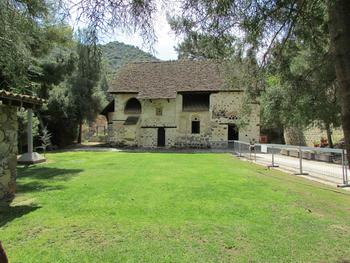
One of the most famous and well preserved of these churches is that of St. Nicholas of the Roof (Εκκλησία Αγίου Νικολάου της Στέγης), situated only a couple miles southwest of the charming village of Kakopetria, which lies just off the main road that ascends the mountain range (figure 1).Footnote 3 Fortunately, this particular church has regular open hours and is managed by a gracious custodian, Spiroula Chrysi. The early eleventh-century church was once part of a monastery and in its original construction a cross-in-square design with a dome over the center, and a narthex added in the early twelfth century.Footnote 4 In addition, at some point in its early life, a sloped roof was attached to the building to protect it from rain and snow, hence its unique name. In the interior, the church is covered with paintings that range in date from its original construction through the fifteenth century, and the thematic content includes biblical scenes, panels depicting the lives of Jesus and Mary, the images of manifold apostles, saints, martyrs, and clerics, and the Last Judgment, with each series reflecting trends characteristic of the century in which it was painted.Footnote 5
(Photo by Y. R. Kim)Footnote 2

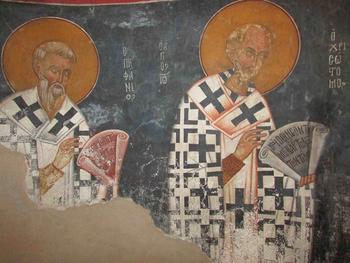
The particular image that is the inspiration for this paper is found in the apse, where one can find an array of eight prelates painted in medallions (Spyridon, Heraklidios, Lazaros, Auxibios, Hypatios, Tychon, Zenon, and Nikolaos) and below them another eight figures, depicted in two groups of four, facing the center of the apse. All of these images date to the middle of the fourteenth century. In the first group of four, we find together the saints Triphyllios, Gregory (the Theologian), Epiphanius, and John Chrysostom, and in the latter Sylvester, Basil, John the Almsgiver, and James, the brother of Jesus.Footnote 6 In the first tetrad the depiction of Epiphanius and Chrysostom together (figure 2), at least from a modern Orthodox point of view, offers little of note, since both men (but especially the latter) are revered as preeminent saints and fathers of the church.Footnote 7 However, the history between the two men is a complicated one, the climax of which apparently resulted in each bishop wishing the other a rather uncharitable end. And so, to reach a point in which both could stand together, a long process of hagiographic rehabilitation and selective forgetfulness unfolded after the deaths of both holy men.
(Photo by Y. R. Kim)

II. The Origenist Drama
Act 1: Palestine
Our story begins with Epiphanius, an outsider who became lead bishop of Cyprus in 367 and served in this capacity for about thirty-six years until his death at sea in 403.Footnote 8 Originally from a small village in Palestine, Epiphanius spent some of his youth training in the ascetic life in Egypt, and afterward he returned to his homeland and established a monastery over which he served as abbot for an extended time.Footnote 9 Even in these early years, he forged a reputation as a monastic exemplar and a defender of orthodoxy, but he became even more famous as a bishop and after composing the Ancoratus and the Panarion. Christians in other communities sought his expertise on matters of orthodoxy, as both of these and his later works were written in response to requests from outside Cyprus.
Toward the end of his life, beginning in the 390s, Epiphanius involved himself, indeed one might say meddled, in ecclesiastical affairs well beyond his island jurisdiction. His “international” activity brought him into close contact and partnership with the likes of Jerome and Theophilus of Alexandria during the so-called Origenist Controversy, a drama that developed in two distinct but connected phases.Footnote 10 The first act took place primarily in the environs of Palestine, where Epiphanius clashed with bishop John of Jerusalem.Footnote 11 Jerome was heavily involved, siding with Epiphanius, shunning his own previous engagement (and admiration) of Origen, and repudiating his friendship with Rufinus.Footnote 12 In particular, through Epiphanius's deliberate and improper ordination of Jerome's brother, Paulinian, Jerome and his monastic community came into open conflict with John, who ultimately excommunicated Jerome and his fellow monks and even secured imperial sanction against them.Footnote 13 In 396, John asked Theophilus to mediate, and the patriarch of Alexandria assigned his agent, Isidore, the task of brokering a reconciliation, which was unsuccessful.Footnote 14 Theophilus then intervened directly, personally wrote to Jerome, and was able to negotiate a truce between the warring factions; Jerome also made (temporary) peace with Rufinus.Footnote 15 Thus ended “Act 1” of the Origenist Controversy.
Act 2: Trouble in Egypt
“Act 2” saw the stakes increase as the drama eventually shifted to the imperial capital, and Epiphanius would reprise his role as provocateur but this time against another John, he of the “golden mouth.” As is well known, John Chrysostom's tenure as bishop of Constantinople was anything but smooth sailing, as he clashed at one time or another with several constituencies in the city, including those in the ecclesiastical hierarchy and various local monastic communities, wealthy urban elites, and members of the royal court.Footnote 16 But as many enemies as John had within the imperial capital, perhaps no one was more keen to facilitate his downfall than one on the outside, Theophilus of Alexandria.Footnote 17 Their enmity was born when Theophilus had tried unsuccessfully to influence the ecclesiastical succession at Constantinople by offering his own man Isidore for the post, but the Alexandrian was eventually compelled to endorse John.Footnote 18 However, any tensions that resulted from Theophilus's failed bid at bishop-making were nothing compared to the all-out war that would ensue in the next phase of the controversy.
The story takes us first to Egypt.Footnote 19 In his festal letter for 399, Theophilus harshly criticized the views of the so-called Anthropomorphites, ascetics who allegedly maintained a belief that God exists in corporeal form.Footnote 20 When a gang of these monks protested in Alexandria, the patriarch, in what seemed to be a dubious reversal of theological conviction, proclaimed to them, “Thus when I saw you, it was as though the face of God.”Footnote 21 Around the same time, Theophilus had a falling out with Isidore, with the former accusing the latter of sodomy, and the latter indicting the former of financial impropriety.Footnote 22 However, Theophilus characterized this dispute as a theological matter, charging Isidore with being an Origenist heretic.Footnote 23 Theophilus excommunicated Isidore, who sought refuge in the desert of Nitria with a different monastic community, led by the famous “Tall Brothers,” and the patriarch responded in kind by sending letters to various Egyptian bishops and monks, ordering them to expel these “Origenist” monks.Footnote 24 Some of them protested their treatment before the patriarch, who apparently responded by assaulting one of their leaders, Ammonius, and demanding that he anathematize Origen.Footnote 25 Theophilus followed up by convening a synod at Nitria in late 399 or early 400 to condemn the writings of Origen and banish the Tall Brothers and their brethren.Footnote 26 One of the victims of the synodal action made his way to Bethlehem where he found refuge with Jerome.Footnote 27 Theophilus wrote a letter reprimanding Jerome for receiving this fugitive, and Jerome replied, voicing the frustration that many had felt at Theophilus's slowness to move against the Origenist heretics.Footnote 28 But in the spring of 400, with imperial permission and troops in tow, Theophilus began a violent purge of the allegedly Origenist monks, who eventually fled to Palestine.Footnote 29 He circulated a letter to the bishops there, justifying his actions as a move against Origenist heresy.Footnote 30 Theophilus also sought to placate Jerome, who replied with enthusiasm for being “summoned to my accustomed duty,” regretting his earlier criticism of Theophilus’s reluctance to take action.Footnote 31
Act 3: Escalation
In the late fall of 401, the Tall Brothers, along with many of their refugee monastic brethren, came to Constantinople with the hope of pleading their case before John.Footnote 32 Some of Theophilus's clerics, who were already in the capital to secure favors from imperial officials on behalf of their bishop, were summoned for questioning. They conceded that the refugees were maltreated and encouraged John not to receive them into communion but still to treat them kindly.Footnote 33 John wrote to Theophilus in an attempt to broker a reconciliation, but the Alexandrian was in no mood for peace and sent other agents to denounce the “heretic” monks.Footnote 34 Theophilus also wrote to Epiphanius, a man whom he earlier had derided during the first act of the Origenist Controversy:Footnote 35
The Lord, who said to his prophet: “Behold, today I have set you over the nations and kingdoms to root out and to sap and to destroy and build up again and to plant” [Jeremiah 1:10], bestows the same grace in every age upon his church, in order that through forbearance his body [cf. Ephesians 1:23] might be kept unharmed and that in no way at all might the poisons of the doctrines of heretics prevail. Because indeed now we see it has been fulfilled. For the church of Christ, which has “no spot or wrinkle or anything of this sort” [Ephesians 5:27], with the Gospel sword has cut down the serpents of Origen emerging from their caves and has freed the holy flock of the monks of Nitria from the pestilent contagion.
(2) Thus I have recounted a few of the things that have been accomplished in a general letter, which I laid out for all in common, accordingly as was allowed by the constraint of time. It is of a worthy thing for you, as one who often has contended before us in struggles of this sort, both to encourage those put in the fray and to gather the bishops of the entire island, and to send letters both to us and to the holy bishop of the city of Constantinople, if also to any others you will have considered, in order that with the consent of all, both Origen himself and his nefarious heresy might be condemned.
(3) In fact I have learned that the calumniators of the true faith, Ammonius, Eusebius, and Euthymius, reveling with newfound passion for their heresy, have set sail for Constantinople, in order that they may ensnare new men, those whom they will have been able to overcome, and that they may be joined with the old allies of their impiety. Therefore let it be of your concern, that you relate the course of things to all of the bishops throughout Isauria and Pamphylia and of other provinces that are in the vicinity, and if you consider it worthy, to append our letter, in order that all gathered in spirit with the virtue of our Lord Jesus Christ might deliver those men into the destruction of the impiety of Satan, who is master over them.
(4) And in order that our writings may arrive more swiftly to Constantinople, send an industrious man and someone from among the clergy, just as we have sent fathers of the monks from the very monasteries of Nitria with other holy and most continent men, who might be able to teach everything at hand that has been done. (5) And above all we ask, that you utter devoted prayers to our Lord, by which we might be able then to pursue victory in this battle. In fact no small joy both in Alexandria and throughout Egypt has spread through the hearts of the people, where a few men have been ejected, in order that the pure body of the church might remain. Greet the brothers who are with you. The people who are with us greet you in the Lord.Footnote 36
Epiphanius responded (presumably with great enthusiasm) by convening a synod that condemned Origen and prohibited the reading of his writings. He sent letters to other bishops, including John Chrysostom, asking them to do the same. Meanwhile, Theophilus organized a council of his own in Egypt to explicitly condemn the writings of Origen, thus setting the stage for an all-out, entirely manufactured conflict over the theology of Origen.Footnote 37
Rumor reached Alexandria that John had received the Egyptian monks into full communion, an act that would have been an affront to Theophilus's authority. The refugees presented a formal petition to John, lodging their complaints against Theophilus and his atrocious behavior.Footnote 38 John wrote again to Theophilus and informed him of the monks’ appeal. According to Palladius, Theophilus predictably responded in anger: “Utterly inflamed by these things, Theophilus barred the brother of the monks, Dioscorus the bishop, from his own church, a man who had grown old in the church. To bishop John he wrote, ‘I know that you are not unaware of the ordinances of the canons of Nicaea that declare a bishop should not adjudicate beyond his boundaries. But if you are unaware, having learned them, leave the petitions to me. For if even there should be a need for me to be judged, it should be by the Egyptians, and not by you, away by a seventy-five days’ journey.’”Footnote 39 Palladius reports that John tried but failed again to mediate between the exiled monks and Theophilus's representatives, so he gave up on the matter. As a result, the refugee monks turned to the imperial court and composed a lengthy petition outlining their grievances against Theophilus's men and against the bishop himself, and they presented it on the feast of John the Baptist, June 24, 402.Footnote 40 Sozomen's account (writing circa 445) stresses the importance of the intervention of the empress Eudoxia: “After much time passed, those with Ammonius approached the wife of the emperor when she was out in public, complaining about all the machinations of Theophilus against them. She was aware of the designs against them and honoring them, she stood up. And bending forward from her royal carriage, she nodded her head and, ‘Bless,’ she said, ‘and pray for the emperor and me and our children and our rule. I have set my thoughts on a synod and on the arrival of Theophilus [to it].’”Footnote 41 An imperial order demanded that Theophilus come to Constantinople for a tribunal to be overseen by John and that his agents in the city substantiate the charges made against the refugee monks.Footnote 42 Elaphios, a former princeps agentum in rebus, traveled to Egypt to summon Theophilus, while officials in Constantinople investigated Theophilus's men, some of whom fled, while others were jailed.Footnote 43
And so finding himself in a rather precarious situation, Theophilus was compelled to travel to the capital. But as he undertook the journey, he delayed his arrival by taking a slower land route.Footnote 44 He also set into motion a plan to deploy Epiphanius on an anti-Origenist mission to Constantinople in order to discredit John, his would-be judge.Footnote 45 As we can see above, in his earlier letter Theophilus made it clear to Epiphanius that the threat of Origenist heresy was of the gravest concern but did not name any names. But given Epiphanius's subsequent behavior in the capital, Theophilus must have implicated John Chrysostom among the Origenists in another letter.Footnote 46 Sometime in the spring of 403, Epiphanius set sail for Constantinople.
Act 4: Confrontation in Constantinople
This was no friendly mission or courtesy visit. Instead of coming to the city center, Epiphanius landed some seven miles away in the suburb of Hebdomon where the martyrium of Saint John was located, and there he “celebrated a service and ordained a deacon” before finally entering the city.Footnote 47 As he had done in his conflict with John of Jerusalem, Epiphanius acted provocatively by ordaining a cleric outside of his jurisdiction. Chrysostom, for his part, had invited the infamous heresiologist to stay in the episcopal residence, but following the instructions of Theophilus, Epiphanius declined.Footnote 48 He then convened a gathering of bishops in the city and presented to them his copy of the synodal decree condemning the writings of Origen, which some of those present subscribed out of respect for the bishop, but others refused.Footnote 49
According to Socrates (writing circa 439-440), John took the high road. Again he invited Epiphanius to stay at the episcopal residence, to which Epiphanius replied that he would only do so if John expelled Dioscorus and his brethren from the city and subscribed to the condemnation of Origen's writings. John then decided to wait for a proper investigation before acting, but his adversaries persuaded Epiphanius to act provocatively yet again. Their plan was that at a gathering at the Church of the Holy Apostles, “Epiphanius come forward and in the presence of all the people reject the books of Origen, excommunicate those with Dioscorus, and disparage John as one who even accounted himself for those men.”Footnote 50 The plot was reported to John, who sent a message through his deacon Serapion: “You do many things contrary to the canons, O Epiphanius. First, you made an ordination in the churches that are under me, then seeing that you were not appointed by me still held services in them, using your own authority. Just now you were urged to come but refused, and now again you leave it to yourself to do so. So beware, lest with a tumult happening among the people, you yourself also suffer danger from it.”Footnote 51 In Socrates's version of the events, this warning was enough for Epiphanius to cease and desist, and he left for Cyprus. The last words exchanged by the two men has Epiphanius saying to John, “I hope that you do not die a bishop,” while John replied, “I hope that you do not set foot in your country.”Footnote 52
Sozomen included two additional anecdotes that further complicate the narrative of the conflict between the two bishops:
In the meantime, it happened that the son of the emperor was ill. Being fearful lest he suffer death, the mother, having sent for Epiphanius, was begging him to pray for the boy. He promised that the ailing child would live, if she would turn away from those heretics around Disocorus. (2) The empress said, “My son, if at least it seems good for God to take him, let this be done. For the Lord who gave him, may take him back. If indeed you are such a one to raise the dead, your archdeacon would not have died.” For it happened that not long before, Chrispion, who was brother of Fuscon and Salamanos (monks discussed [in my work] during the reign of Valens), died. He [Epiphanius], having him as a cohabitant, ordained him as his archdeacon.
(3) Those with Ammonius, for this seemed good to the empress herself, came to Epiphanius. When he inquired who they were, Ammonius replied and said, “We are the Tall Brothers, O Father. But if ever you have met with our disciples or our books, we gladly would like to know.” When he [Epiphanius] said no, again he [Ammonius] asked, “So how is it that you have considered us to be heretics, having no proof of our thought?” (4) When Epiphanius said by what he had heard, he [Ammonius] said, “But we have come to a mind in quite the opposite way. For we often have met with your disciples and your writings, of which one has the title Ancoratus. When many people wish to revile you and to calumniate you as a heretic, we fought for and defended you as a father. Therefore was it necessary to pass judgment from hearsay on an undefended action, of whom you, not trusting, condemned, or to give back such recompense to those who speak well of you?”
(5) Epiphanius then, convinced in a more measured way, dismissed the men. Not long later, he sailed off to Cyprus, either because he condemned his arrival to Constantinople, or because God proclaimed and, as is likely, foretold his death to him. For when he was at sea, before arriving in Cyprus, he died. (6) It is said at any rate that to those who came with him to the marina he said, as he was about to embark on the ship, “I leave to you the city and the palaces and the stage, and I am departing. For I make haste, indeed I make haste.” (7) And yet now from many people I heard that report, that John foretold to Epiphanius his death on the sea, and the latter to the former the deposition from his episcopacy. For when they were quarrelling, he [Epiphanius] declared to John: “I hope that you will not die a bishop.” And John declared in response: “And I that you will not set foot in your city.”Footnote 53
The saintly shine of Epiphanius diminishes quite a bit in these conversations with Eudoxia and Ammonius (if indeed, they happened at all).Footnote 54 In the former, Epiphanius seems to offer his prayers for the ailing prince on the condition that Eudoxia repudiate the Tall Brothers, while in the latter, his blind zeal is almost embarrassing compared to the grace extended by Ammonius.
By all accounts, Epiphanius comes off as less than charitable and perhaps more than gullible, a foolish victim of, or maybe a willing accomplice in, Theophilus's machinations. Yet he acted without a doubt as a provocateur and aggressor in Constantinople. Certainly, we can see in Epiphanius a fanaticism for what he believed to be orthodoxy, and that he operated according to his convictions, but still he clashed with John, who would become one of the most revered and beloved church fathers, a “Doctor of the Church.” Michael Gaddis, in his study of late antique Christian violence, astutely observes that because both men were future saints, their prophetic words somehow had to come true.Footnote 55 Epiphanius died at sea on his return journey from Constantinople and exited the late antique theatrical stage for good. John was, of course, deposed and exiled after the Synod of the Oak.Footnote 56 He would die a few years later (September 14, 407), during a second exile under condemnation as a heretic.Footnote 57 The pronouncements of both holy men were thus fulfilled. This, however, created a hagiographic conundrum, since neither bishop was a heretic but each wished ill on the other, and so in both the immediate aftermath and in the ensuing decades, a rehabilitation process took place.
III. “Hagiographic” Rehabilitation
Epiphanius
The restoration of Epiphanius's reputation was initiated in the Vita Epiphanii, a composite work composed and compiled sometime in the fifth or sixth century and attributed to John and Polybios, two of Epiphanius's disciples.Footnote 58 The text is perhaps most famous for ascribing Jewish origins to Epiphanius, but it is also full of the usual hagiographic tropes, presenting its subject as a morally impeccable monastic exemplar and miracle worker. Very different from the account given by Jerome, the Vita depicts Epiphanius's clash with John of Jerusalem not as an issue of theology but over the latter's avarice, for which he ultimately repents.Footnote 59 But of even greater interest is how the Vita reconfigures the story of Epiphanius and John Chrysostom by portraying Theophilus as the undeniable antagonist in the drama. The story begins in Egypt with three monk brothers who were forcibly ordained by Theophilus. After serving for three years, two of them sought permission from the patriarch to return to their monastic life, but having been denied, they fled to the desert. Theophilus then excommunicated them, so the two brothers fled to Constantinople, where they sought the aid of John Chrysostom, who wrote twice to Theophilus on their behalf and restored them to communion.Footnote 60
The Vita then turns to a controversial episode in John's life, when he allegedly rebuked the empress Eudoxia for confiscating a vineyard belonging to a recently widowed noblewoman, an act which earned him the bitter ire of the empress: “Thus from this point, the empress was stirred against him, to banish him.”Footnote 61 Theophilus received word of Eudoxia's desires and so wrote letters to Epiphanius denouncing John for holding Origenist doctrines. Epiphanius, already preparing to go to the capital for other business, hurried to make his way there, but as the Vita clearly says, “not to do ill against John, but in order to help him.”Footnote 62
Still, not all was well between the two bishops, and the Vita preserves traces of the earlier accounts of what transpired once Epiphanius arrived in the capital. For example, Epiphanius performed an illegal ordination in a monastery, which spurred John to write a letter of reproach.Footnote 63 Eudoxia, hearing of the tension between the two bishops, then summoned Epiphanius to the palace, and she complained of John's insolence and rumored adherence to “some heresy.”Footnote 64 She expressed her desire to exile John via a synod to which Epiphanius replied: “If on the one hand, for this heresy about which you speak, John is condemned and convicted and does not confess that he errs, then he is unworthy of his sacred office. And if your Authority bid something, your servant ought to do it. But if on account of your pride you seek to expel John from the church, then your Epiphanius will not acquiesce to this.” Predictably, Eudoxia was furious that someone would question her motives, and so she threatened to open pagan temples for worship if Epiphanius would not agree to her plan, to which Epiphanius replied, “Child, I wash my hands of this judgment.”Footnote 65 This episode offers a significant twist from the story told by Sozomen about Eudoxia and Epiphanius. Whereas in the ecclesiastical historian's version, Epiphanius appeared to offer prayers for the empress's son on the condition that she expel the Origenist monks from the city, thus appearing to be the uncharitable one, in the Vita, Eudoxia assumes this role and softens the rather mean-spirited Epiphanius of Sozomen's account.Footnote 66
The hagiography continues with a story about one of Epiphanius's traveling companions and disciples, Isaac, who because of illness was not able attend the audience with the empress. However, upon hearing the rumor that Epiphanius had indeed condemned John, a despondent Isaac hid himself away in a monastery, and only after three days was Epiphanius able to convince his disciple that the story was unfounded. John himself, the Vita tells us, also believed that Epiphanius had sanctioned his exile and wrote to him, saying, “Wise Epiphanius, since you acquiesced to my exile, may you no longer sit upon your episcopal throne.” Epiphanius responded in kind, “Champion of Christ, be beaten and conquered; and because you believed that I acquiesced to your exile, may you not reach the place to which you are exiled.” At this point in the narrative, the author of the hagiography intervenes with a very important qualification and rhetorical question: “I wrote these things, brothers, lest someone cast blame upon Epiphanius. For can one who has done such good descend to such a depth of evil?”Footnote 67
The remainder of the Vita explores the circumstances leading to Epiphanius final, fateful voyage home, but we can see clearly enough the hagiographical rehabilitation of Epiphanius and his relationship with John Chrysostom. While the narrative preserves elements of their confrontation as told by earlier writers, the author has shifted the blame to Theophilus and Eudoxia. Epiphanius, still maintaining his role as arbiter of orthodoxy, is exonerated in this retelling of the story. The afterlife of the afterlife for Epiphanius was a bit more complicated, but there is no doubt that he has been received as Saint Epiphanius, celebrated on May 2 by Orthodox and Roman Catholic Christians.Footnote 68
John Chrysostom
In the case of John Chrysostom, the rehabilitation was of a different sort, due in no small part to the immediate efforts in Constantinople of both his supporters and his enemies to control the narrative of his personal character and behavior.Footnote 69 The defenders of John strived to present him as a virtuous victim of savage political machinations and to recover and restore his reputation as an orthodox Christian. One effort was initiated by Palladius (circa 363/4–after 420), a devout monk and onetime bishop of Helenopolis (and later Aspuna), who was also an unabashed admirer of Origen—mediated through Evagrius—and of John Chrysostom.Footnote 70 Soon after the latter's death, Palladius composed an apology (and not a hagiography, strictly speaking), the Dialogue on the Life of John Chrysostom (written circa 408/9).Footnote 71 As Demetrios Katos demonstrates, Palladius, drawing on principles of judicial rhetoric, portrayed John ultimately as the target of unmerited hatred and envy, especially that of Theophilus.Footnote 72 For example, Palladius summarized the contents from a letter John wrote to Innocent, the bishop of Rome, concerning the lead up to the Synod of the Oak, and he described Theophilus's motivations and behavior in the following way:
Having spent three weeks [at Constantinople], neither did he meet with bishop John according to the custom of bishops, nor did he approach at all the church. But he tarried, striving day and night, having joined new hatred to old, so as to force bishop John not only out of the church, but even from his very life. On the one hand, he was buying off superstitious people with an extravagant amount of money to prevail against the truth, and on the other hand he was enslaving the gluttonous with his rich table. With flattery and promise of greater standing, he was inducing fellow imposters among the clergy. Having bound all these not with rope but with pleasures, as if a people-deceiving demon he bewitched the reasoning of their souls. He was seeking a demonic actor for service in this drama, whom he indeed even chanced upon.Footnote 73
Throughout the Dialogue, Palladius worked through each charge leveled against John relating to his personal character, lifestyle choices, administrative decisions, and ecclesiastical reforms, all of which were misunderstood and mischaracterized by his enemies as excessive and tyrannical. It is also worth noting that Palladius made two references to Epiphanius, neither of which had anything to do with the Cypriot bishop's visit to Constantinople or clash with John Chrysostom. Rather, in the first comment, Palladius emphasized how Theophilus had once derided Epiphanius as a heretic (during the first act of the Origenist Controversy) then later praised him as a saint, thus further diminishing the hypocritical character of the Alexandrian.Footnote 74 Theophilus, the opportunist, was through and through the antagonist.Footnote 75 In Palladius's account, the conflict between Epiphanius and John Chrysostom was conveniently forgotten.
In fact, the earliest source that defends John Chrysostom is the funeral oration (circa late 407) attributed to Pseudo-Martyrius.Footnote 76 The John presented therein is described by the recent translators of this text into English, “as a modern Job who consistently turned the other cheek and refused to resist the exercise of imperial power even when he considered it unjust.”Footnote 77 In this account (again, not a hagiography per se), composed very soon after John's death, both Eudoxia and Theophilus are the instigators of his demise.Footnote 78 In the oration, Pseudo-Martyrius narrates an inner conversation of the Devil himself:
I already have among the presbyters instruments practised in the arts of slander, and I have a woman of that sort, whom I have taken prisoner through her insatiable avarice, and who is invested with both power and wickedness, great wickedness. <John> is very troublesome to this woman, who views him with suspicion. Theophilus the Egyptian will collaborate with me in this business; for I watched him with pleasure when he opposed <John> at the start and stirred up countless plots to prevent him becoming bishop. What he watched with displeasure as it happened then, he will surely be willing to undo with pleasure, now that he has gained in strength.Footnote 79
In this dramatic rendering, chronologically most proximate to the death of John, the Devil is the theatrical director and the star villains were Eudoxia and Theophilus, but again any hint at all of Epiphanius is simply nowhere to be found.Footnote 80
The fault lines, however, of the fractured relationship between Epiphanius and John are clearly visible in the accounts of the fifth-century ecclesiastical historians Socrates and Sozomen.Footnote 81 Indeed, without their accounts we would have very little knowledge at all about their interactions in Constantinople. While Epiphanius was already deceased by the time proceedings against John saw him deposed twice, he certainly played a role in the buildup to the downfall of John. Yet Pseudo-Martyrius and Palladius, clearly apologists for John, omitted any details related to their falling out, and the question remains, why the selective forgetting? Wendy Mayer has argued persuasively that after John's death, there emerged competing narratives of his life promulgated by his supporters and his detractors, which resulted at the same time in the misappropriations and manipulation of his writings and the false attribution of documents in his name.Footnote 82 Clearly, there were other stories circulating in the imperial capital that portrayed John in a negative light, and so both Pseudo-Martyrius and Palladius proceeded directly into the mode of media spin.Footnote 83 Thus I would suggest that because the affairs with Epiphanius threatened even the slightest hint of doubts about John's orthodoxy, it was better not to mention them at all, and a very public clash with a revered church father had the potential to raise further doubts about his character.
In reality, one could argue that the depositions of John had less to do with theology and more with ecclesiastical politics and the personal enmity that Eudoxia and Theophilus felt toward him.Footnote 84 The former's recruitment and deployment of Epiphanius was an attempt to malign John's orthodoxy, but the strategy was ultimately unsuccessful. But, as we have seen, the narrative of the Epiphanius affair, perhaps preserved in sources hostile to John, had to be dealt with by the author(s) of the Vita Epiphanii, who had at least the history of Socrates, hence the careful reframing we discussed above. The authors of the earliest defenses of John, however, strategically omitted it, and these versions were winning the public relations battle by the end of the fifth century. About nine years after John's death, his name was restored to the diptychs of the high church in Antioch, and sometime thereafter, Atticus, the bishop of Constantinople, added John's name to the list of bishops of the city prayed for by the church. He also persuaded Cyril of Alexandria to honor John.Footnote 85 On January 27, 438, John's remains returned from exile and were placed under the altar of the Church of the Apostles.Footnote 86 In the ensuing years, John's status as an orthodox doctor of the church was fully realized, and from there, the trajectory for John was only upward.Footnote 87
The later hagiographers, George of Alexandria (early seventh) and Theodore of Trimithous (later seventh), had access to the various narratives of John's life, including the account of Socrates, and so we can see in them a reemergence of elements of the conflict with Epiphanius.Footnote 88 Still, George identified Epiphanius as “the most blessed bishop of Constantia of the island of Cyprus,” and he also made it clear that Theophilus orchestrated the anti-Origenist agenda as a pretext to attack John.Footnote 89 His narrative retraced Epiphanius's actions in Constantinople, up to an almost verbatim repetition of John's last words of warning to Epiphanius in Socrates's account.Footnote 90 George also integrated into his account the role of Eudoxia in the downfall of John, but most importantly he included the final verbal exchange (again, virtually word-for-word) we found in the Vita Epiphanii between Epiphanius and John.Footnote 91 Like Epiphanius's hagiographer, George inoculated the potentially ugly conflict between the two saints: “Thus let no one ascribe this blame upon Epiphanius: for the one who has accomplished such good things was not able to descend into so deep a pit of wickedness and as such a source of light to cleanse the world without fault. Nevertheless both men had this end: for Epiphanius did not set foot on Cyprus while alive in his present life, for he died far away in his ship. And John, a little later, was pulled down from his episcopal seat, not having reached the locale of his second exile, as the following account will demonstrate.”Footnote 92 The prophetic words of both holy men had to come true (and they did), but the blame was shifted elsewhere, namely on Theophilus and Eudoxia.
Although there is some debate about whether the hagiography of John written by Theodore of Trimithous (a city in Cyprus) precedes that of George, the approach to the dilemma of the conflict between Epiphanius and John is quite clear.Footnote 93 Theodore based his narrative on that of Palladius, so Theophilus and Eudoxia were the villains.Footnote 94 Absent is any recollection of the conflict between Epiphanius and John. Rather, taken from the Vita Epiphanii, Epiphanius's sole appearance was in a conversation with Eudoxia, who accused John of being a heretic and asked Epiphanius to endorse John's banishment as others had done: “If you do not listen and sign thus as the rest, I will close the churches and open the temples, so that all may worship there.”Footnote 95 Epiphanius responded coolly, “If you know what is good for your soul, you will thus do. For even if all have signed, Epiphanius will not sign.” However, Theodore then immediately added, “And she announced to John that even Epiphanius signed,” and again we see a near verbatim restatement of the final exchange between the two from the Vita Epiphanii. Their “prophecies” had to be fulfilled, and so Theodore concluded, “Just as was spoken by both, thus it also happened,” but the potential embarrassment of two saints wishing ill on one another was neutralized by ascribing blame Eudoxia.Footnote 96
IV. Conclusion: Back to the Image
If Pseudo-Martyrius and Palladius had had their way, the conflict between John and Epiphanius would have remained selectively forgotten, but the account of Socrates (and to a lesser degree, Sozomen) necessitated a subtler hagiographical rehabilitation in the traditions of both saints, as we see in the Vita Epiphanii and the versions of George and Theodore. And so we return once more to the iconic depiction of Epiphanius and Chrysostom, side-by-side, at a small church in the mountains of Cyprus. The two saints minister together, participating in the divine liturgy with their holy colleagues, as if nothing had happened between them during their earthly sojourns.Footnote 97 We ought not forget, however, that they took part in a rather nasty affair, ultimately wishing each other an uncharitable end. Of course, the shadow of Theophilus in all accounts looms large; and because of the monstrous enormity of his presence, perhaps it was much easier simply to omit Epiphanius in the earliest attempts at the restoration of John Chrysostom's reputation.Footnote 98 This was a selective forgetfulness that belies the reality, that real-life church was and is a messy affair. Still, hagiography and hagiographic writings can create the pleasant fiction that all is well among the saints, as we see here with this iconic odd couple.