Introduction
Broccoli, Brassica oleracea L. ssp. capitata (L.) DC. convar. botrytis (L.) Alef. var. italica Plenck (Hammer et al., Reference Hammer, Gladis, Laghetti and Pignone2013), is an important crop. The commercial production (with other Brassica vegetables) is about 89 million tons worldwide (FAOSTAT, 2011) and 426,000 tons (ISTAT, 2011) in Italy, where part of the production comes from landraces (LRs) (Ciancaleoni et al., Reference Ciancaleoni, Chiarenza, Raggi, Branca and Negri2013; Negri et al., Reference Negri, Pacicco, Bodesmo and Torricelli2013) and is obtained from organic agriculture (OA). All the developed broccoli varieties are essentially F1 hybrids. To develop synthetic varieties (Syn) of broccoli for OA, we initiated a farmer-assisted breeding programme from a LR. LRs could be the best material for this purpose (Hammer and Gladis, Reference Hammer and Gladis2001; Falcinelli and Torricelli, Reference Falcinelli and Torricelli2004; Lammerts van Bueren et al., Reference Lammerts van Bueren, Jones, Tamm, Murphy, Myers, Leifert and Messmer2011; Koutis et al., Reference Koutis, Mavromatis, Baxevanos and Kuotsika-Sotiriou2012) because they are characterised by (1) adaptation to the proposed environment, since they have developed over time through evolutionary processes including both environmental and farmer selection (Negri et al., Reference Negri, Maxted, Veteläinen, Vetelainen, Negri and Maxted2009; Polegri and Negri Reference Polegri and Negri2010), and (2) stability (S. Ciancaleoni, personal communication), since their genetic diversity provides a buffer against environmental fluctuations due to biotic and abiotic stresses. To the best of our knowledge, none has bred broccoli specifically for OA yet.
The aim of this paper was to establish a clear genetic characterisation of the initial material (Syn0) from which the Syn was developed.
Experimental
The LR under study has been cultivated by the ‘Vento’ family in our region since generations. After the family abandoned the land 9 years ago, the Department continued its cultivation by annual reproduction of the seed and applying the mother plant (MP) selection procedures suggested by the farmer: the most vigorous two or three MPs among the 25 usually grown are chosen and intercrossed, while the field is cleared from other B. oleracea plants. In addition, the Department assured spatial isolation from nearby cultivated fields.
While starting the breeding programme, we asked the farmer to choose 17 MP among the 25 grown instead of the usual numbers (we were worried about restricting the genetic base too much). The following year, ten plants for each of the 17 MP half-sib progenies (MPHS) were grown in a trial (five plants for each MPHS in each of two replicates, for a total of 170 plants). Among them, the farmer was asked to select, according to his personal opinion, the best eight MPHS and then, within each of them, the best five plants. Accordingly, a Syn0 made of 40 plants by eight MPHS (8C, i.e. eight components), which mirrors the original LR, was obtained (hereafter Syn0_8C).
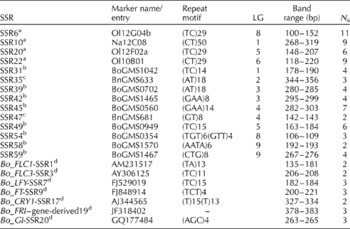
The genetic diversity of the 40 plants was assessed using 14 putatively neutral simple sequence repeats (SSR) (Love et al., Reference Love, Batley, Lim, Robinson, Savage, Singh, Spangenberg and Edwards2004; Cheng et al., Reference Cheng, Xu, Xia, Gu, Yang, Fu, Qian, Zhang, Wu and Liu2009; Li et al., Reference Li, Chen, Yang, Xu, Gu, Fu, Qian, Zhang, Wu and Liu2011) and seven SSR related to genes involved in flowering control [expressed sequence tag (EST)-SSR and the Bo_FRI–gene-derived SSR] (Aksoy et al., Reference Aksoy, Almeida-Val, Azevedo, Baucom, Bazaga, Beheregaray, Bennetzen, Brassaloti, Burgess, Caccone, Chang, Ciampi, Ciancaleoni, Climaco, Clouet, Coimbra, Coutinho, Dantas, De Vega, Echodu, Enyaru, Figueira, Filho, Foltz, Fressigne, Gadomski, Gauthier, Herrera, Hyseni, Jorge, Zkaczmarczyk, Knott, Kuester, Lima, Lima, Lima, Longo, Lor, Maggioni, Marques, Martins, Matoso, Medrano, Mendonca, Mettler, Nascimento, Negri, Oliveira, Oliveira, Ovcarenko, Paula-Silva, Raggi, Sandoval-Castillo, Anjos Santos, Martinschaefer, Segelbacher, Seino, Sistrom, Taole, Teske, Tsagkarakou, Verdade, Villela, Vinson, Wingfield and Wingfield2013) (Table 1). The genetic diversity of 32 plants, eight for each of four commercial F1 hybrids (Ironman, Marathon, Packman and Santee) used as controls, was also assessed. It should be noted that the variation in the F1 hybrids is generally very low and, consequently, eight individuals are sufficient to test the heterozygosity.
Simple sequence repeat (SSR) marker codes, marker name/genebank entry, repeated motif, linkage group (LG), band range (in base pairs (bp)) and number of observed alleles (N a), relative to the 21 microsatellites used

c Cheng et al. (Reference Cheng, Xu, Xia, Gu, Yang, Fu, Qian, Zhang, Wu and Liu2009).
DNA extraction and marker amplification was carried out as reported in Ciancaleoni et al. (Reference Ciancaleoni, Chiarenza, Raggi, Branca and Negri2013). The number of alleles and band range were recorded for each marker used. The number of successfully analysed genotypes (N), observed (N a) and effective (N e) alleles, observed (H o) and expected (H e) heterozygosity and fixation index (F) were also calculated for each accession and each marker using the GENALEX software (Peakall and Smouse Reference Peakall and Smouse2006). The same software was used to estimate a genetic distance (GD) matrix between individuals following Nei (Reference Nei1978). A GD-based neighbour joining (NJ) tree was drawn using the MEGA5 software (Tamura et al., Reference Tamura, Peterson, Peterson, Stecher, Nei and Kumar2011).
Results
The number of alleles per locus ranged from 2 to 11; the total number of alleles were 96 (Table 1), of which over one-fourth (26) were found in the Syn0_8C only. In the Syn0_8C, N a ranged from 1 to 6 and from 2 to 3 for SSR and EST-SSR/gene-derived SSR, respectively (Table S1, available online). The average N a, N e, H o and H e values of the Syn0_8C (Table S1, available online) were similar to those of LRs and synthetics that had not undergone the same selection procedure (Ciancaleoni et al., Reference Ciancaleoni, Chiarenza, Raggi, Branca and Negri2013), while the H e values were lower than the H o values for the hybrids (Table S1, available online). The F value was generally low and close to 0 for the Syn0_8C (e.g. in a random mating situation), which was unexpected when considering the selection applied. All the hybrids showed an excess of heterozygosity, as it is expected for varieties developed for this purpose (Table S1, available online).
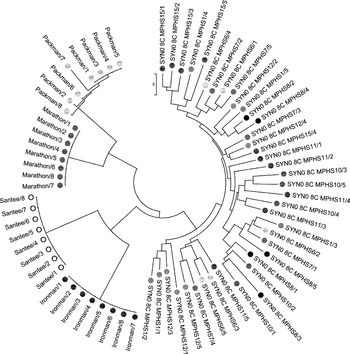
The high diversity of the Syn0_8C and the uniformity of the hybrids are well depicted in the NJ tree (Fig. 1). All of the plants of the Syn0_8C, even those belonging to the same MPHS, are different from each other; in addition, plants belonging to the same MPHS are not clearly grouped in the NJ tree.
Neighbour-joining tree of genetic distances. In the tree, genotypes belonging to the same hybrid/family are identified with the same black and white pattern.

Discussion
The diversity of the Syn0_8C seems to be large enough to guarantee that the derived Syn will also have a diversity level that might be sufficient to buffer environmental fluctuations due to biotic and abiotic stresses that occur under OA. LR selection carried out over generations by the farmer has maintained a substantial diversity both in putatively neutral and EST-SSR/gene-derived SSR.
There are at least two hypotheses that can justify these findings. We might have chosen markers that did not probe parts of the genome where significant uniformity was obtained by selection. It can also be supposed that, by choosing the most vigorous plant per generation, the farmer unconsciously selects those plants that have the highest heterozygosity, and different alleles are consequently maintained across generations. This has already been suggested as a possible mechanism for maintaining diversity in a celery LR (Torricelli et al., Reference Torricelli, Tiranti, Spataro, Castellini, Albertini, Falcinelli and Negri2013).
To our knowledge, very few data are available for LRs that could explain their diversity. The long term effects of on-farm conservation strategy on LRs diversity deserve to be better investigated.
Supplementary material
To view supplementary material for this article, please visit http://dx.doi.org/10.1017/S1479262113000592
Acknowledgements
This research was partially funded by the European Community's Seventh Framework Programme (FP7/2007-2013) under grant no. 245058 SOLIBAM.