Policy uncertaintyFootnote 1 is a major constraint on economic development. In theoretical terms, political economists stress the role of policy-related risk and uncertainty in determining the investment decisions of enterprises and individuals (Pindyck Reference Pindyck1991; Dixit and Pindyck Reference Dixit and Pindyck1994; Brunetti et al. Reference Brunetti, Kisunko and Weder1998). A key argument is that, since most investments are irreversible, expected gains must be always discounted by the value of waiting for more information about the future, with the latter increasing when policy environments are perceived to be volatile. Empirical research confirms that economies lose from higher uncertainty regarding future policies. Many studies find a strong negative relationship between uncertainty and economic growth, direct foreign investment and public sector productivity (Brunetti et al. Reference Brunetti, Kisunko and Weder1998; Manning et al. Reference Manning, Ranjana and Gokcekus2000). A recent report by the World Bank shows that lowering the uncertainty of regulatory policies significantly increases the probability of new investments (World Bank 2004).
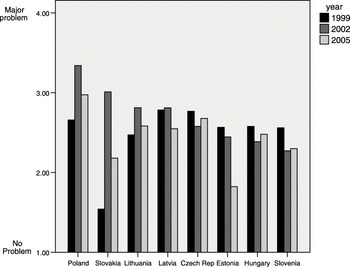
The level of uncertainty regarding future policies tends to vary across and within political systems. Given the exigencies of democratization, Europeanization and market reforms, the post-communist states of East Central Europe (ECE) could be expected to be particularly prone to high levels of policy uncertainty. Yet, as the data from recent firm-level surveys show, the ECE are not a homogenous group (BEEPS 1999, 2002, 2004, 2005). Measured on a four-point scale in 1999, 2002 and 2005, policy uncertainty was consistently high in Poland with average scores ranging between 2.6 and 3.3 (Figure 1). In other countries, notably Slovenia and Hungary, the perception of policy uncertainty tended to be significantly lower with average scores of less than 2.5. In some countries such as Slovakia, average assessments changed radically from low to high during the observed period.
Business Perceptions of Policy Uncertainty

Why is perceived policy uncertainty high in some states and low in others? While the importance of uncertainty is hardly disputed, there have been very few studies into its underlying causes. A notable exception is a recent study by Kenyon and Naoi (Reference Kenyon and Naoi2010) who find that firms in hybrid regimes show more concern over policy uncertainty than those in authoritarian regimes or liberal established democracies. They explain this effect by demonstrating that the perceived predictability of public policies is lower in polities with polarized political competition and limited access to credible information about future policies. Some further insights are also offered by research on government reliability (Blondel and Manning Reference Blondel and Manning2002; Evans and Manning Reference Evans and Manning2003). These studies link varying levels of policy uncertainty with the ability of governments to keep policy promises: uncertainty is high if cabinets and ministers notoriously break electoral pledges and contravene pre-agreed policy contracts.
This article contributes to this literature by examining the impact of a frequently omitted factor: the characteristics of the national legislature. There are at least two major reasons for why parliaments may have an impact on the perceived policy uncertainty. First, in democratic states, the adoption of important policies, including business legislation, requires the approval of the legislature. This is particularly the case in polities where – like in most democracies in East Central Europe – the ability of the executive to govern with secondary law is constrained by the constitutional principle of parliamentary delegation of legislative powers. The second reason for why parliaments are important is that, as will be argued, legislative assemblies are inherently prone to producing unpredictable outcomes. This means that, unless some form of institutional stabilizers are present, parliamentary decision-making may, in itself, be a major source of uncertainty.
The rest of the article proceeds as follows. The next section explains how majoritarian decisions may be chaotic and shows how parties and legislative institutions can alleviate this condition. It hypothesizes that uncertainty regarding future policies is likely to be influenced by an interaction of party institutionalization and legislative organization. Section 3 presents data on policy uncertainty, party institutionalization and legislative rules in eight ECE countries – the Czech Republic, Estonia, Hungary, Latvia, Lithuania, Poland, Slovakia and Slovenia – for the period between 1997 and 2005. Section 4 tests the theoretical expectations regarding the interactive impact of parties and rules on policy uncertainty. The final part assesses the relevance of the results for understanding institutional performance in East Central Europe and beyond.
Parliaments, Majority Rule and Policy Uncertainty
Majority Rule and Social Choice Literature
In passing legislation, all parliaments apply some form of the majoritarian principle. Majority rule not only offers an efficient method to reach a common decision, but also produces outcomes that are considered legitimate. In fact, for some democratic theorists, majority rule is inextricably linked to the very idea of democracy (Christiano Reference Christiano1996). But although relatively efficient and legitimate majority decision-making faces a central problem: in its pure form, it may not always produce a stable outcome. The likelihood of majority-rule instability grows as the number of voters and the number of policy alternatives increases. If there are many decision-makers and numerous possible solutions, majority rule alone cannot return a stable collective choice – for any decision there is at least one other that can be offered for a vote and that can defeat the previous decision. In brief, there can be decisional chaos. These insights follow from research by social choice theorists (McKelvey Reference McKelvey1976; Arrow Reference Arrow1951; May Reference May1952).
Majority rule can produce stable outcomes only under restrictive assumptions about the structure of individual preferences and the complexity of the issue space. If individuals are assumed to have single-peaked preferences and decision-making occurs in a uni-dimensional policy space, the median voter's preferred option provides the equilibrium (Black Reference Black1985). In multidimensional spaces, the conditions under which a stable outcome exists are more difficult to achieve. Majority decision-making produces a stable choice only if preferences are distributed in a radially symmetric fashion (Plott Reference Plott1967). More recently, some theorists have argued that although a stable majority equilibrium may not exist in multidimensional spaces, the scope for majority-rule instability is more limited than envisaged in the original models (McKelvey Reference McKelvey1976; McGann Reference McGann2006). Rather than entirely unstable, majoritarian choices are shown to be confined to a smaller, centrally-located ‘uncovered’ set of optionsFootnote 2.
These findings are poor news for legislatures. Majority rule provides the cornerstone of parliamentary decision-making. Legislative assemblies consist of many members representing different political views, interests and regions. Each of them typically has the power to propose bills and amendments to bills (Mattson Reference Mattson and Döring1995). Such decisions are normally taken in more than one dimension, not least because many bills cover multiple policy issues or are of distributive nature. In brief, if preference-induced policy stability is hard to achieve, parliaments provide an ideal arena for unpredictable decision-making which can contribute to high levels of policy uncertainty. Indeed, theorists have argued that, unless constraints exist, chaos is a permanent companion of democratic assemblies (Riker Reference Riker1980; Riker Reference Riker1982). As William Riker (Reference Riker1980: 443) explained,
We cannot know much about the future at all, whether it is likely to be palatable or unpalatable, and in that sense our future is subject to the tricks and accidents of the way in which questions are posed and alternatives are offered and eliminated.
Parties and Rules
The new institutionalist literature, in particular its rational choice variant, has stressed the role of political parties in stabilizing majoritarian decision-making (Aldrich Reference Aldrich, Fiorina and Rohde1989). The key argument is that a stable majority outcome exists in multi-dimensional spaces if parliamentary parties show a minimum of ideological cohesion and if party members agree not to vote against the majority of their own party (Aldrich Reference Aldrich1994; Aldrich Reference Aldrich1995). Programmatic cohesion implies that parties aggregate the preferences of individual members into common positions on most, if not all, policy issues. In two-party systems, comprehensive electoral manifestos function as a key reference point for a party's legislative actions in parliament. In multi-party environments, a similar role is fulfilled by coalition contracts (Strøm et al. Reference Strøm, Wolfgang and Bergman2008) or government-opposition agreements for minority governments (Bale and Bergman Reference Bale and Bergman2006). But having a detailed program is not enough. Parties must implement and defend their policy positions in a united way. The more frequently party members or coalition partners deviate from the agreed line, the less reliable is the program in reducing policy uncertainty. In single-party governments, unity tends to follow from a shared electoral fate of party members. In coalition cabinets the electoral ties are less likely to bind and so discipline depends on enforcement and monitoring mechanisms that leaders can use to achieve unity.
Research has also demonstrated that in legislatures where party cohesion and discipline are weak (as is the case in the US Congress) majority-rule instability can be alleviated by rules that govern parliamentary decision-making. In a seminal article, Shepsle (Reference Shepsle1979) shows how a combination of single-jurisdiction committees with gate-keeping powers and closed or germaneness rules governing floor amendments enables legislatures to avoid the problem of chaotic decision-making. Cox and McCubbins (Reference Cox and McCubbins1993; Reference Cox and McCubbins2005) argue that a similar function may be fulfilled by the delegation of agenda-setting powers to special offices (such as the speaker) that are typically occupied by majority party leaders (see also Huber Reference Huber1996). It is expected that party leaders use their agenda control powers to block bills that may split the majority party thereby reducing the uncertainty regarding policy outcomes. Döring (Reference Döring and Döring1995; Reference Döring2001; Reference Döring2003) finds that a variety of institutional devices privileging the government can substitute for party cohesion and discipline. In sum, the existing theories predict that, under conditions of low party cohesion and weak discipline, instability of majoritarian decision-making can be reduced if legislative rules delegate control over the floor agenda to the government, committees or majority party leaders and if some form of germaneness or closed rule applies on the floor.
Impact on Policy Uncertainty
Building on the above insights from social choice literature, it can be hypothesized that the level of policy uncertainty is likely to be shaped by the cohesion and discipline of parliamentary parties and the extent to which legislative agenda control is restrictive. If the legislature is populated by parties and coalitions that rarely enter into detailed policy contracts and do not maintain unity, social and economic actors are likely to face high uncertainty regarding future policies. Policy uncertainty should be lower if legislative rules provide for numerous agenda-setting constraints on the floor. The effect of parties and rules is likely to be interactive rather than additive. Rules determine the institutional setting within which parties operate and, hence, one can expect that the effect of parties on perceived policy uncertainty will vary depending on the configuration of legislative proceduresFootnote 3. The level of party cohesion and discipline should have strongest effects if rules provide for a liberal agenda-setting process. Under such conditions increases in party institutionalization will lead to major reductions in policy uncertainty. The scope for party effects is, however, likely to diminish as rules become more restrictive. It is thus possible to formulate the following hypotheses regarding the impact of parties and rules on policy uncertainty:
H1: Higher party institutionalization should reduce policy uncertainty.
H2: Policy uncertainty should be lower if legislatures operate restrictive agenda-setting rules.
H3: Higher party institutionalization should have a stronger reductive effect on policy uncertainty if legislatures operate liberal agenda-setting rules.
Data and Operationalization
Policy Uncertainty
In measuring the degree of policy uncertainty, this article relies on perceptions of actors that are directly affected by this condition: firms and enterprises. The information is derived from World Bank-EBRD Business Environment and Enterprise Performance Surveys conducted in East Central Europe in 1999, 2002 and 2005 (BEEPS 1999, 2002, 2005). As part of the survey, managers were asked to evaluate the business environment in their country and the implications for their firms. Most importantly for present purposes, they were asked if they considered policy uncertainty a problem for the operation and growth of their business. The answers were provided on a four-point scale ranging from 1 (no obstacle) to 4 (major obstacle). The same question was asked in all of the three surveys which makes it possible to trace variation in policy uncertainty over timeFootnote 4. Using perception data is not without its problems, not least because the meaning of high/low uncertainty may vary across national settings. But few good alternative measures exist. For example, attempts to gather data on individual law changes quickly run into similar problems of validity and comparability (Trantas Reference Trantas and Döring1995).
Party Characteristics
Parties are expected to reduce uncertainty if they are cohesive and disciplined. As Hazan (Reference Hazan2006) shows, party cohesion and discipline are analytically distinct, but difficult to disentangle empirically. Whereas the former captures the similarity of preferences, the latter refers to a variety of disciplining mechanisms employed by party leaders. There are few established proxies for cohesion. Kitschelt and Smyth (Reference Kitschelt and Smyth2002) use the standard deviation of expert evaluations of policy positions to capture the ideological cohesion of parties. Most research relies on the observation of the voting unity of party groups which may result from a combination of cohesion and discipline (Carey Reference Carey2007; Sieberer Reference Sieberer2006; Linek and Rakusanová Reference Linek and Rakusanová2005).
Without questioning the usefulness of such measures, this article relies on an arguably more fundamental proxy for capturing the party characteristics that facilitate policy predictability. Following Lewis (Reference Lewis2006), it calculates an index of party institutionalization (IPS) by measuring the percentage of the vote taken by parties that have been represented in parliament on more than one occasion. The IPS index stresses the notion that, to function as agents of collective representation, parties must exhibit organizational stability. Political systems in which parties split or dissolve frequently are likely to be prone to higher uncertainty.
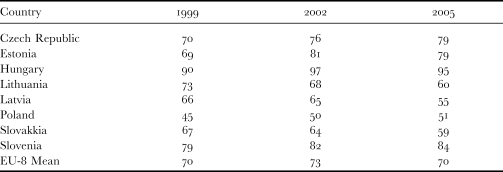
In its original formulation, the IPS index – which ranges from 0 to 100 – has been calculated to summarize a period of four consecutive elections (Lewis Reference Lewis2006: 575). This article disaggregates it into separate scores for each election since 1989. Accordingly, it calculates the total sum of enhanced representations for each election (for example, the total for the third election is the sum of scores for the first, second and third elections), divides the resulting total for each election by 220 in the second, 360 in the third and 520 for the fourth election and then multiplies it by 100. The values of the IPS index are allocated to BEEP scores as follows. For each year of the BEEPS survey the analysis allocates the value of the IPS index for the last election, if it occurred three or more years before that year, or the weighted average of IPS scores for the last two elections, if the last election occurred less than three years before the year of the BEEPS survey. The data on cabinets and parties are derived from (Döring and Manow Reference Döring and Manow2008). Table 1 shows that parliamentary parties in Latvia, Lithuania, Poland and Slovakia were the least stable among the EU8, while those in Estonia, Hungary, Slovenia and the Czech Republic demonstrated much higher degree of stabilityFootnote 5.
The Lewis Index of Party Institutionalization
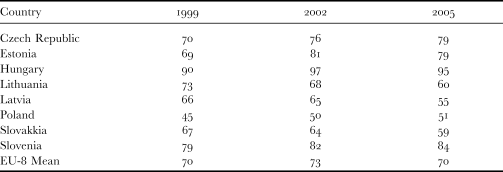
Source: own calculations based on formula and data from Lewis (Reference Lewis2006: 575).
Agenda Rules
In capturing the characteristics of legislative organization, this article examines the rules that govern the process of setting the plenary agenda. The data come from an original review of legislative rules and practices (Stecker Reference Stecker2008; Zubek Reference Zubek2008a, Reference Zubek2010). Three types of rules are taken into consideration. The first type determines who sets the floor agenda. The institutional rules can provide for centralized agenda-setting (by majority party leaders, majority-nominated speaker or committees) or decentralized agenda-setting (through consensus of all parties or by the floor). Under the former rules, only a selection of bills have a chance to be debated and voted on the floor; under the latter rules, all bills are likely to be scheduled for floor deliberations. The second type of rule is whether items can be added to the agenda on the floor. If members of parliaments are free to propose motions for the extension of the agenda, then the final control over the agenda passes to the floor. The third issue is whether non-germane changes can be made to bills on the floor. The institutional solutions can vary from closed or germaneness rules to limited or no constraints on floor amendments. If no restrictions are present, members of parliament can circumvent agenda-setting constraints by proposing bills to the floor in the form of amendments.
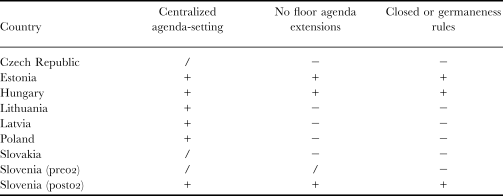
The plenary agenda rules are scored as follows. A score of 1 is given if rules provide for all of the three features: centralized agenda-setting, constraints on agenda extensions and closed or germaneness rules; a score of 0 is given for all other rule configurations. The analysis of the EU-8 states reveals that only parliaments in Estonia, Hungary and Slovenia after 2002 receive a score of 1. See Table 2. In Estonia, the floor agenda is determined based on proposals from committees. In Hungary, the control of the floor agenda is shared between the speaker, house committee and sectoral committees. What is important for present purposes is that committees decide whether bills proposed by members of parliament should be placed on the order book. Agenda extension is not allowed in Estonia and is permitted only in exceptional circumstances in Slovenia after 2002. In Hungary, proposals for agenda extension can be made by the government or 15 MPs in Hungary, but it must be remembered that, in the case of private member bills, only bills from the committee-controlled order book can be put on the agenda. In all of three legislatures, rules provide for substantive constraints on floor amendments to bills. Legislatures in the Czech Republic, Lithuania, Latvia, Poland, Slovakia and Slovenia before 2002 receive a score of 0. In all of the cases, at least two of the three necessary institutional features are missing: motions for agenda extensions can be made and non-germane amendments are allowed on the floor.
Agenda Control in EU-8 Parliaments
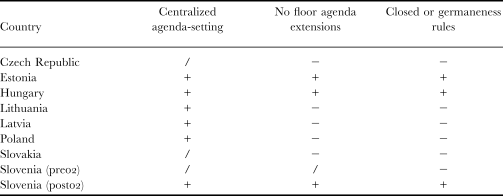
Source: own compilation;
+Institutional features present. – Features not present. / Institutional features partially present.
Other Factors
Besides party characteristics and legislative rules, there are, of course, other factors that are likely to shape the perception of policy uncertainty. Four national-level controls are introduced into the analysis. The first is cabinet volatility. It is likely that firms report lower uncertainty if cabinets operate for long periods and higher uncertainty when cabinet turnover is considerable. The article measures cabinet stability as the number of times a government changed in the three years before the date of the BEEPS survey. For example, the volatility score for 1999 captures the number of government changes in 1997, 1998 and 1999. A change of government is defined here as a change in both party composition and the position of prime minister. The second control factor is the impact of the EU accession talks. While EU membership is generally considered as a stabilizing force, the accession process is likely to have produced at least a brief ‘valley of transition’ (in particular between 1999 and 2002) during which firms were more likely to have shown concern for policy uncertainty (Przeworski Reference Przeworski1991; see also Zubek Reference Zubek2008b; Kenyon and Naoi Reference Kenyon and Naoi2010). The analysis controls for this effect through a dummy variable which takes the value of 1 in 2002, and 0 for the other two years.
Thirdly, the degree of ideological consensus inside national parliaments is controlled for. This is to account for the fact that the smaller the policy distances between the key parliamentary actors, the less incentive for future policy change. This control factor is captured by calculating policy distances between the most extreme leftwing and rightwing parties using party positioning scores derived from Laver and Benoit (Reference Laver and Benoit2006). The allocation of these scores to BEEPS scores followed the same procedure as with the IPS scores. Finally, it is sensible to expect that country size should influence the extent to which firms perceive policy changes as unpredictable. Businesses operating in small countries should be at a distinct advantage in this respect because of more tightly-knit social networks. We control for this condition by including a country's GDP (PPS corrected) into the analysis.
Finally, some firm-level variables are entered into the analysis. First, one expects bigger firms to have greater capabilities to adapt to unexpected rule changes and, hence, to report lower concern over policy uncertainty. This expectation is controlled for using the size of a firm's sales in the year of the survey measured on an 11 point scale ranging from 250 000 to 50 million dollars. Second, the perceived level of uncertainty is likely to be related to how well informed respondent managers are. Fortunately, all three BEEPS surveys included a question on access to informationFootnote 6. Firm respondents have been asked to assess the extent to which information on laws and regulations affecting their firm was easy to obtain. Thirdly, firm-level anchoring variables have been used. This is necessary because the question about policy uncertainty was part of a larger battery of questions regarding different obstacles to doing business. Three factors that are most likely to affect perceptions of policy uncertainty are selected as anchoring controls: macroeconomic instability (inflation and exchange rates), corruption and functioning of the judiciary.
Analysis and Findings
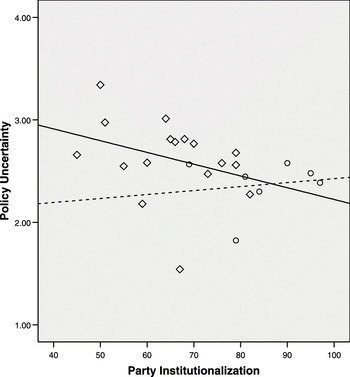
This section checks whether – as is expected – party institutionalization and legislative organization affect the degree of policy uncertainty. It is illustrative to look, first, at some bivariate statistics. Figure 2 plots mean policy uncertainty against party scores for each of the 24 country observations. These data allow for a first visual test of the theoretical propositions. Is high party institutionalization associated with low policy uncertainty? Is the effect of parties more or less pronounced depending on the type of the agenda-setting rules? The data in Figure 2 offer some initial confirmation of these expectations. Firms in countries with more stable parliamentary parties tend to report on average lower concern over policy uncertainty. The effect of parties is stronger under liberal agenda-setting rules (rules = 0), but is reversed under restrictive rules (rules =1). This effect tends to hold even if one removes the two outliers with very low mean values of policy uncertainty – Slovakia in 1999 (mean=1.54) and Estonia in 2005 (mean=1.82).
Party Institutionalization, Legislative Rules and Policy Uncertainty
Note: dotted line=least squares line of best fit for country-year observations with restrictive agenda-setting rules (◇); straight line=least squares line of best fit for country-year observations with liberal agenda-setting rules (○)

What happens if one controls for the effect of other variables? To check this, we analyse the data using ordinal logistic regression method. This technique is particularly suitable for analyzing survey responses measured on an ordinal scale. In such cases simple OLS regression produces biased coefficients as the distance between the categories cannot be meaningfully interpreted. One immediate difficulty for using regression analysis is that, although there are 5999 survey responses that evaluate policy uncertainty, the test examines only 24 country observations (eight countries at three points in time). This condition violates the assumption of independent observations as respondents from the same country are likely to share some similarities. Therefore, the analysis clusters error terms by country (Long and Freese Reference Long and Freese2006). This procedure accounts for the fact that observations are only independent across but not within clusters.
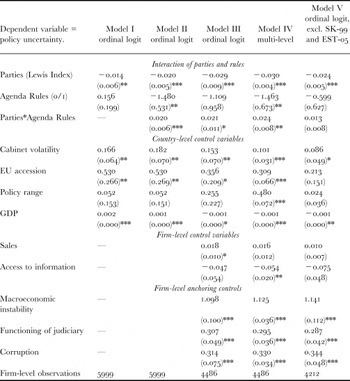
Table 3 presents the regression results. In the first two models we introduce the main explanatory variables and country-level controls. Model I analyzes the effect of parties and rules without the interaction effect. It shows that higher party institutionalization translates into lower perceptions of policy uncertainty. Contrary to expectations, more restrictive rules increase policy uncertainty, but this effect lacks statistical significance. The coefficients for cabinet volatility, EU accession, GDP and the degree of political consensus have the expected sign, though the latter fails to reach common levels of statistical significance. Model II estimates the conditional effects of parties and rules by including the interaction term (party scores multiplied by rules scores). As expected, restrictive agenda rules depress the effect of party institutionalization. The coefficient for the interaction term is positive and significant at 0.05 level. The results further show that higher party institutionalization reduces perceived policy uncertainty if legislative rules impose limited agenda-setting constraints. Restrictive agenda-setting rules reduce policy uncertainty if party institutionalization is lowFootnote 7. The results for control variables are in line with expectations.
Ordinal Logit Results

* significant at 10%;
** significant at 5%;
*** significant at 1%. Robust z statistics in parentheses. Standard errors adjusted by country in all models.
In a second step, we introduce firm-level controlsFootnote 8. Models III and IV report the results of standard and multi-level ordinal logistic regressions respectively (Rabe-Hesketh and Skrondal Reference Rabe-Hesketh and Skrondal2008). Again, the analysis clusters error terms by country. In both models the interactive effect of parties and rules essentially remains unchanged relative to Models I and II. Regarding country-level controls, the coefficients for cabinet volatility, EU accession and political consensus continue to have the correct signs and generally attain statistical significance. The effect of country size measured by GDP is now reversed: businesses in larger countries tend to report lower policy uncertainty, but the size of this effect is very small. The firm size seems to matter for perceptions of policy uncertainty, but the effect is small and lacks statistical significance in one of the models. The access to information has a predicted (negative) impact on the perception of predictability: the easier the access to information, the lower the perceived uncertainty. All the anchoring controls have the predicted sign. Macroeconomic instability, a malfunctioning judiciary and high corruption increase the perceived level of policy uncertainty.
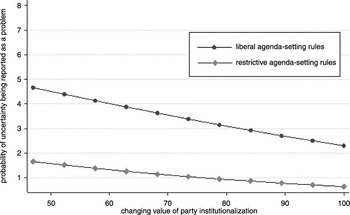
The effect of parties and rules on perceived policy uncertainty is presented in Figure 3. The predicted probability of firms selecting a score of 4 (highest uncertainty) is plotted against observed values of party institutionalization. This probability falls with higher values of parties and the decline is more rapid under liberal agenda-setting rules (upper line) than restrictive rules (lower line). The plot also shows that the probability of firms considering policy uncertainty as a major problem is generally much lower if the national legislature operates restrictive agenda-setting rules.
Relation of Party Institutionalization and Policy Uncertainty

It must be noted that both the marginal and mediating effect of parties loses some of its robustness if the analysis is run without the two outlying observations: Slovakia in 1999 and Estonia in 2005 (see Model V). The results reveal that, while the direction of the effects continues to hold, the coefficients do not attain conventional levels of statistical significanceFootnote 9. The p value for the interaction effect (at 0.110) narrowly misses the 0.1 level.
Conclusion
This article has shown that the characteristics of parliamentary parties affect the level of perceived policy uncertainty in eight new EU member states in East Central Europe. Firms tend to report lower concern over uncertainty regarding future policies in systems with higher party institutionalization. This result holds if one controls for the effect of other national and firm-level factors. It is also present in all of the model specifications and does not change if one removes outlying observations. These findings confirm the expectations of theories developed in the existing literature on Western Europe and the United States. Programmatic and disciplined parliamentary parties stabilize legislative decision-making and ensure the predictability of policy outcomes. These conditions, in turn, translate into low perceptions of policy uncertainty among firms and businesses. Our study thus confirms the fruitfulness of employing existing theories of legislative decision-making in the study of East Central European states. In future research the combined analysis of West and East Central European parliaments would be desirable. Such analyses would offer further insights into the question of whether the effects of legislative institutions are distinct in East Central European parliaments.
The analysis also finds some, although less robust, evidence for the impact of legislative rules. Firms report less concern over policy uncertainty if national legislatures operate centralized agenda-setting, impose constraints on agenda extensions and require closed or germaneness rules for floor amendments. The effect of rules also appears to mediate the impact of parties: party institutionalization has a smaller effect on policy uncertainty if national legislatures operate restrictive agenda-setting rules. The effect of rules is not, however, as robust as that of the parties. Its strength and statistical significance depends on the model specification and inclusion of outlying observations. How can this weak robustness be explained? On the one hand, our data has limitations, not least because of the limited variation in rules over time and the small number of countries studied. On the other hand, our results – although inconclusive – are hardly atypical given the ongoing debate in the existing literature about whether legislative procedures may be expected to have independent effects (Cox Reference Cox2000; McGann Reference McGann2006; Taylor Reference Taylor2006).