Aggressive peer interaction is thought to play an important role in the development of stable patterns of childhood disruptive behavior (Haselager, Cillessen, Van Lieshout, Riksen-Walraven, & Hartup, Reference Haselager, Cillessen, Van Lieshout, Riksen-Walraven and Hartup2002; Laird, Jordan, Dodge, Pettit, & Bates, Reference Laird, Jordan, Dodge, Pettit and Bates2001). Although most studies have focused on school-age or adolescent populations, there is evidence that disruptive preschool-age children experience conflicted and coercive relationships with peers (Hughes, White, Sharpen, & Dunn, Reference Hughes, White, Sharpen and Dunn2000; Keown & Woodward, Reference Keown and Woodward2006; Miller & Olson, Reference Miller and Olson2000; Olson, Reference Olson1992). Thus, early peer aggression may represent an important and understudied pathway to the pervasive patterns of social maladjustment that characterize aggressive/disruptive school-age children (Melnick & Hinshaw, Reference Melnick and Hinshaw2000).
The consequences of early peer aggression must be understood in the context of rapid developmental changes that unfold across the preschool period. Learning to regulate affective and behavioral impulses is a core adaptive “task” in early childhood (Bradley, Reference Bradley2000; Shonkoff & Phillips, Reference Shonkoff and Phillips2000). Thus, it is common for young children to struggle with control of aggressive impulses (Tremblay, Reference Tremblay2000), and these difficulties tend to resolve over time as children develop more advanced self-regulation. For example, most children show acts of aggression by the second year of life, which peak in the third year; by the time children enter kindergarten, aggressive behaviors are largely inhibited (Hay, Payne, & Chadwick, Reference Hay, Payne and Chadwick2004). However, a sizable subgroup of children will continue to show problem behavior across the transition from preschool to school (NICHD Early Child Care Research Network, 2004; Shaw, Gilliom, Ingoldsby, & Nagin, Reference Shaw, Gilliom, Ingoldsby and Nagin2003). It is important that high levels of disruptive/aggressive behavior in kindergarten are warning signs of later more serious problems (Broidy et al., Reference Broidy, Nagin, Tremblay, Bates, Brame and Dodge2003; Tremblay, Pihl, Vitaro, & Dobkin, Reference Tremblay, Pihl, Vitaro and Dobkin1994). To understand the origins of chronic aggression, we must identify developmental factors and mechanisms in early childhood that are associated with persistent versus self-limiting patterns of problem behavior.
What characteristics place young children at elevated risk for aggressive/disruptive peer relationships in the school-age years? In largely separate literatures, three broad categories of risk factors have been linked to high levels of early peer aggression: disturbances in children's self- regulation, delays in children's social cognitive understanding, and exposure to adverse parenting. Our major research objective was to examine the conjoint influences of these factors to illuminate mechanisms underlying the development of peer aggression across the preschool to school transition. We now briefly review prior work relating these individual risk domains to the development of peer aggression.
Disturbances in Self-Regulation
Early-onset externalizing problems reflect deficits in multiple emotion systems, particularly underregulation of negative emotions (e.g., Calkins & Fox, Reference Calkins and Fox2002; Keenan, Reference Keenan2000). For example, young children who show angry responses to frustration also manifest higher levels of aggressive/disruptive peer interactions (Hughes, Cutting, & Dunn, Reference Hughes, Cutting and Dunn2001) as well as generalized externalizing problems (Calkins & Dedmon, Reference Calkins and Dedmon2000; Cole, Zahn-Waxler, Fox, Usher, & Welsh, Reference Cole, Zahn-Waxler, Fox, Usher and Welsh1996). These findings suggest that children's ability to modulate negative emotional responses to frustrating situations may play a critical role in early peer aggression.
Another key issue concerns the role of executive processes in early peer aggression. A growing body of research indicates that childhood externalizing problems may reflect inadequate regulation of attention and impulses (e.g., Barkley, Reference Barkley1997; Moffitt, Reference Moffitt, Lahey, Moffitt and Caspi2003). The construct of effortful control is thought to be central here (effortful control; Rothbart, Reference Rothbart, Kohnstamm, Bates and Rothbart1989; Rothbart & Bates, Reference Rothbart, Bates, Damon and Eisenberg2006). According to Rothbart, effortful control is a temperament trait that emerges during the latter half of the first year of life, in concert with maturation of the anterior attention network, and functions to regulate more “reactive” aspects of temperament such as fear and anger (Rothbart, Derryberry, & Posner, Reference Rothbart, Derryberry, Posner, Bates and Wachs1994). Externalizing problems in the toddler and preschool years have been associated with low effortful control (Murray & Kochanska, Reference Murray and Kochanska2002; Olson, Sameroff, Kerr, Lopez, & Wellman, Reference Olson, Sameroff, Kerr, Lopez and Wellman2005) and with related constructs such as impulsivity (Calkins & Dedmon, Reference Calkins and Dedmon2000; Hughes, Dunn, & White, Reference Hughes, Dunn and White1998) and attentional disorganization (Olson, Bates, Sandy, & Schilling, Reference Olson, Bates, Sandy and Schilling2002). Moreover, children's effortful control skills have been found to interact with negative emotion (anger) to predict externalizing psychopathology in school-age children, in that children with the highest levels of anger and lowest levels of regulation manifested more serious problem behavior than others (Eisenberg et al., Reference Eisenberg, Cumberland, Spinrad, Fabes, Shepard and Reiser2001). However, in prior research with young preschool-age children, we found that effortful control and negative emotion made additive, not interactive, contributions to parent's and teacher's ratings of children's externalizing behavior (Olson et al., Reference Olson, Sameroff, Kerr, Lopez and Wellman2005). Thus, in the case of early-onset aggressive behavior, the specific nature of linkages between children's effortful regulation skills and negative emotionality is unclear.
Delayed Social Cognitive Understanding
Delays in social understanding also have been posited to play a major role in the development of early onset and later childhood aggression (Lemerise & Arsenio, Reference Lemerise and Arsenio2000). As with the development of self-regulation, children's understanding of themselves and others changes rapidly across early childhood and individual differences become quite salient (Dunn, Brown, & Maguire, Reference Dunn, Brown and Maguire1995; Wellman, Cross & Watson, Reference Wellman, Cross and Watson2001). In the current study, we highlighted individual differences in children's emerging theory of mind understanding as potential contributors to behavioral interactions with peers. During the preschool period, children develop an increased awareness that mental states are internal, subjective experiences distinct from behaviors and contexts associated with them (Wellman et al., Reference Wellman, Cross and Watson2001). Moreover, individual differences can be reliably measured as early as 3 years of age (e.g., Wellman, Harris, Banerjee, & Sinclair, Reference Wellman, Harris, Banerjee and Sinclair1995). High levels of social understanding have been associated with positive peer interaction in young children (Watson, Nixon, Wilson, & Capage, Reference Watson, Nixon, Wilson and Capage1999). Conversely, even with verbal IQ controlled, aggressive, disruptive toddlers and preschoolers have been found to show delays in theory of mind (Hughes et al., Reference Hughes, Dunn and White1998; Hughes & Ensor, Reference Hughes and Ensor2006).
Adverse Parenting Behaviors
A growing literature has revealed links between parenting behavior and social information processing and aggression in school-age children (Criss, Shaw, & Ingoldsby, Reference Criss, Shaw and Ingoldsby2003; Heidgerken, Hughes, Cavell, & Wilson, Reference Heidgerken, Hughes, Cavell and Wilson2004; Scarmella & Leve, Reference Scaramella and Leve2004). Two categories of parenting risk have been related to early externalizing problems: frequent and harsh parental discipline, of which corporal punishment is one important component, and low levels of emotional support.
Corporal punishment
Although associations between harsh parental discipline and child problem behavior may be negligible or weak in cultural groups where physical punishment is widely considered a typical child rearing practice (Deater-Deckard & Dodge, Reference Deater-Deckard and Dodge1997; Lansford et al., Reference Lansford, Chang, Dodge, Malone, Oburu and Palmerus2005), parents' frequent use of corporal punishment has been related to impaired child self-regulation and high levels of aggression (e.g., see meta-analysis by Gershoff, Reference Gershoff2002).
Low warmth
In other reports, children who manifest high levels of early disruptive behavior have been found to experience lower levels of warm, responsive parenting (Gardner, Reference Gardner1994; Olson, Bates, Sandy, & Lanthier, Reference Olson, Bates, Sandy and Lanthier2000; Pettit, Bates, & Dodge, Reference Pettit, Bates and Dodge1997; Shaw et al., Reference Shaw, Winslow, Owens, Vondra, Cohn and Bell1998). Even though they have been found to be negatively correlated (Olson et al., Reference Olson, Sameroff, Kerr, Lopez and Wellman2005), corporal punishment and warmth typically have not been analyzed simultaneously. Thus, it is plausible that they also may contribute interactively to peer aggression, that is, children who experience both low parental warmth and frequent corporal punishment may be at heightened risk.
Goals of the Current Study
In summary, deficits in children's self-regulation, social cognition, and parenting experiences have been implicated as key risk factors in the development of early peer aggression. Typically, these factors have been related to child aggression in separate studies. Thus, there are major gaps in our understanding of how these risk factors work together in the genesis and development of early peer aggression. Current conceptualizations underscore the need for simultaneous assessments of these factors, so that the nature of their combined contributions to children's aggressive behavior can be better understood (Arsenio & Lemerise, Reference Arsenio and Lemerise2004; Crick & Dodge, Reference Crick and Dodge1994; Izard, Fine, Mostow, Trentacosta, & Campbell, Reference Izard, Fine, Mostow, Trentacosta and Campbell2002). For example, deficits in regulation and social cognition could make independent (additive), interactive, or hierarchical contributions to children's early peer aggression. Supporting a case for hierarchical influences, Hughes et al. (Reference Hughes, White, Sharpen and Dunn2000) found that difficulties in inhibitory control and attentional regulation explained substantial variance in high levels of peer aggression among disruptive preschoolers, whereas measures of affective perspective taking and theory of mind did not. Especially in young children, it is plausible that adequate levels of social understanding could be overridden by poor regulation of affect and impulses. Similarly, there are important questions concerning how children's early self-regulative and social–cognitive vulnerabilities combine with adverse caregiving experiences to accelerate risk for persistent peer aggression. Developmental pathways to children's behavior problem outcomes are widely believed to be multifactorial, reflecting processes of continuous dynamic interplay between qualities children bring to their social interactions and characteristics of the immediate caregiving environment and its social–ecological context (Sameroff, Reference Sameroff, Olson and Sameroff2009). For example, harsh parenting has been found to moderate relations between temperament vulnerabilities and externalizing behavior in young children (e.g., Bates, Pettit, Dodge, & Ridge, Reference Bates, Pettit, Dodge and Ridge1998; Bates, Goodnight, Fite, & Staples, Reference Bates, Goodnight, Fite, Staples, Olson and Sameroff2009). Likewise, Hughes & Ensor (Reference Hughes and Ensor2006) found that associations between harsh parenting and externalizing problems were strongest in toddlers with poor theory of mind skills.
In the current prospective longitudinal study, individual differences in peer aggression were assessed during the early preschool period, and reassessed following children's transition to kindergarten. From many perspectives, this was an opportune time to examine children's emerging levels of peer adjustment. The vast majority of prior studies have focused on the school-age period, when children's difficulties with peers are already present. Adjustment to the preschool setting, often the first social context outside the home, represents a significant challenge for young children who must learn to adapt to new routines, share attention and resources with peers, and modulate emotional and behavioral responses in ways that permit harmonious social exchanges. By examining children who were just beginning to meet these challenges, our central aim was to identify risk markers and processes that antecede heightened peer aggression at early school age. Specific aims were as follows:
1. Our initial goal was to test individual, within-domain models featuring children's self-regulation, theory of mind understanding, and parenting experiences as predictors of children's concurrent and school-age levels of peer aggression. We expected that all three models would make significant contributions to our understanding of early peer aggression. We also examined two subhypotheses concerning associations between specific risk factors within each domain of influence:
a. Do individual differences in children's effortful control and proneness to negative emotional reactivity combine additively or interactively in the prediction of peer aggression?
b. Do the parenting behavior factors corporal punishment and warm responsiveness combine additively or interactively in the prediction of peer aggression?
2. Our primary aim was to identify preschool-age predictors of children's peer aggression following the transition to school. We hypothesized that measures of early child self-regulation, theory of mind understanding, and adverse parenting behaviors would predict individual differences in peer aggression following the transition to school, either alone or in combination with one another. Given the expected continuity in children's peer aggression across the preschool period, we also questioned whether preschool-age risk factors would predict changes in peer aggression across this important transition period, after controlling for initial levels of peer aggression.
3. Our final aim was to examine potential sex differences in early peer aggression and patterns of associated risk factors. Limited attention has been given to examining early antecedents of aggressive, disruptive behavior in girls compared with boys. Most available data on girls has been drawn from later childhood or early adolescence, when they already manifest problem behavior (Cote, Zoccolillo, Tremblay, Nagan, & Vitaro, Reference Cote, Zoccolillo, Tremblay, Nagin and Vitaro2001). However, child sex has been shown to be a powerful moderator of the development of externalizing problem behavior in young children (Keenan & Shaw, Reference Keenan and Shaw1997; Moffitt, Caspi, Rutter, & Silva, Reference Moffitt, Caspi, Rutter and Silva2001). Moreover, preschool-age girls tend to show more mature self-regulatory and social–cognitive skills than boys (e.g., Hay et al., Reference Hay, Payne and Chadwick2004). In a previous report on the same sample, preschool-age girls were found to have more advanced effortful control skills than boys (Olson et al., Reference Olson, Sameroff, Kerr, Lopez and Wellman2005). In the current study, we expected that preschool-age girls also would show more advanced levels of social cognitive maturity than boys. Especially in light of these important, early appearing sex differences, we questioned whether associations between developmental and social predictors of children's peer aggression would be moderated by child sex.
Method
Participants
Participants (N = 199) were drawn from a sample of 240 3-year-old children (118 girls; age range = 32–45 months, M = 41.40 months, SD = 2.09 months) who were enrolled in an ongoing longitudinal study of young children at risk for school-age conduct problems (Olson et al., Reference Olson, Sameroff, Kerr, Lopez and Wellman2005). Children represented the full range of externalizing symptom severity on the Child Behavior Checklist/2–3 (Achenbach, Reference Achenbach1992), with an oversampling of toddlers in the medium high to high range of the Externalizing Problems Scale (T > 60; 44%). The remaining sample was split relatively evenly between children whose externalizing problems T scores exceeded 50 but were below 60, and those whose T scores were below 50. Most families (95%) were recruited from newspaper announcements and fliers sent to day care centers and preschools; others were referred by preschool teachers and pediatricians. In order to recruit children with a range of behavioral adjustment levels, two different ads were periodically placed in local and regional newspapers and child care centers, one focusing on hard to manage toddlers, and the other on normally developing toddlers. The child's attendance in a formal preschool program was not an absolute requirement for family enrollment. Once a parent indicated interest, a screening questionnaire and brief follow-up telephone interview were used to determine the family's appropriateness for participation and willingness to engage in a longitudinal study. Children with serious chronic health problems, mental retardation, and/or pervasive developmental disorders were not included the current study. Families were paid for their participation.
Most children (91%) were of European American heritage. Others were of African American (5.5%), Hispanic American (2.5%), and Asian American (1%) racial or ethnic backgrounds. The majority (87.9 %) resided in two-parent families; of the remaining households, 5.3% of parents identified themselves as single (never married), and 6.8% as divorced. Fifty-five percent of mothers worked outside the home on a full-time basis. Nineteen percent of mothers and 24% of fathers had achieved high school educations, 46% of mothers and 34% of fathers had completed 4 years of college, and 35% of mothers and 42% of fathers had completed additional graduate or professional training. The median annual family income was $52,000 (range = $20,000 to >$100,000).
Of the 240 families assessed initially, we have retained 210 (88%) who participated in all aspects of data collection and 96% who have provided partial data. Twenty families moved out of state but continue to provide questionnaire data. Of the 10 families no longer in the study only 2 have refused participation (too busy). The other 8 withdrew because of family or child illness. Attrition was not selective based on our comparisons of major sociodemographic or study characteristics.
Overview of procedures
Age 3
Children participated in a Saturday morning laboratory session scheduled at a local preschool. Following 20–30 min of rapport building, measures of effortful control, social–cognitive maturity, and cognitive competence were individually administered. Children received small gifts for their participation.
Mothers were interviewed in their homes by a female social worker. Family demographic information was obtained; in addition, mothers responded to questions concerning their child's behavioral adjustment. Subsequent to the home visit, mothers completed questionnaires concerning the child's behavioral adjustment and temperament.
The majority of the children in our study (86%) were enrolled in preschool or daycare programs outside the home. Preschool teachers were asked to contribute ratings of children's behavioral adjustment, and 95% agreed and were given gift certificates for their participation. As described below, children's peer interactions were videotaped in preschool settings.
Age 6
Kindergarten teachers were asked to provide follow-up measures of child adjustment, and were given gift certificates for their participation. At follow-up, approximately 9% (20) of the children exceeded clinical cutoffs on the Externalizing Problems Scale of the Teachers Report Form (Achenbach & Rescorla, Reference Achenbach and Rescorla2001). Observations of peer aggression were carried out in classroom and playground settings using hand-held computers.
Assessment of effortful control
Individual differences in effortful control were assessed using behavioral tasks and maternal ratings.
Behavioral battery
During a laboratory visit children were administered six tasks from Kochanska, Murray, Jacques, Koenig, and Vandegeest's (Reference Kochanska, Murray, Jacques, Koenig and Vandegeest1996) toddler-age behavioral battery: turtle and rabbit, tower task, snack delay, whisper task, tongue task, and lab gift, which were administered in that order. Each behavioral task was designed to tap Rothbart's (Reference Rothbart, Kohnstamm, Bates and Rothbart1989) general construct of effortful control (suppressing a dominant response and initiating a subdominant response according to varying task demands). All tasks were introduced as “games,” and children were reminded of the rules midway through each task. In order to provide a check on accuracy of recording, 15 test administrations were videotaped and independently scored. Reliability was excellent (κ = 0.95). Individual tasks have been described in detail elsewhere (Kochanska et al., Reference Kochanska, Murray, Jacques, Koenig and Vandegeest1996; Olson et al., Reference Olson, Sameroff, Kerr, Lopez and Wellman2005). As recommended by Kochanska et al. (Reference Kochanska, Murray, Jacques, Koenig and Vandegeest1996), a total behavioral score was computed by summing individual subtest scores (standardized α = 0.70).
Maternal rating
An abbreviated version of Rothbart's Child Behavior Questionnaire (CBQ; Ahadi, Rothbart, & Ye, Reference Ahadi, Rothbart and Ye1993) was used to assess individual differences in maternal perceptions of child temperament. An effortful control index was created by summing children's scores on inhibitory control (α = 0.77) and attentional focusing (α = 0.85), the two most theoretically and empirically salient components of the construct (e.g., Posner & Rothbart, Reference Posner and Rothbart2000).
Total effortful control score
Previously we reported that the maternal rating index and laboratory behavioral composite index of effortful control were significantly intercorrelated. Thus, a summary index was created by aggregating children's standardized scores on these measures (Olson et al., Reference Olson, Sameroff, Kerr, Lopez and Wellman2005).
Assessment of negative emotional reactivity
Individual differences in children's proneness to negative emotional reactivity were assessed using behavioral tasks and maternal ratings.
Disappointment task
Individual differences in children's negative emotional reactivity were assessed using an adapted version of the disappointment paradigm developed by Cole, Zahn-Waxler, and Smith (Reference Cole, Zahn-Waxler and Smith1994). Children were seated at a small table and shown an array of four small objects, some desirable (small toys or stickers) and some undesirable (broken pencils or bottle caps). The child was asked to rank order his/her most versus least preferred toys, and was told that another person would bring his/her most highly desired choice. A second assistant entered the room, presented the child's least desired choice, and sat at the table completing paperwork for 60 s. The assistant left the child alone for 60 s. Finally, the first assistant reentered and interviewed the child to determine self-reported emotional responses to disappointment. Next, the examiner told the child that there was a mistake and gave the child his/her first choice. The second assistant returned briefly and apologized for the mistake. The task was videotaped.
The presence of three affective states (happiness, sadness, anger) was coded every 10 s. Reliability was based on 30 paired observations independently analyzed by two coders (κ = 0.83, range = 0.71–0.94). The indexes of reactive anger and sadness were extracted for use in the current study and aggregated into a composite index, negative emotion. The internal consistency of this composite was good (α = 0.80). These measures were created by subtracting expressed negative affect in response to receiving a disappointing toy from basal levels of negative affect (assessed before the toy was presented). Voice and facial cues for anger/hostility included harsh insistent tone, increase in pitch and volume, tightened or narrowed eyelids, tightened or pressed lips, clenched teeth, and mouth or jaw set. Voice and facial cues for sadness included soft voice tone decreases in volume and/or drops off, lip corners turned down, depressed lower lip, eyelids drooped, and tearfulness (Cole et al., Reference Cole, Zahn-Waxler and Smith1994).
Maternal report scales
The child's dispositional proneness to anger also was assessed using maternal reports on the Anger/Frustration Scale of the CBQ (our α = 0.77).
Data reduction
Attempts to combine behavioral and rating measures of child negative emotion were unsuccessful, given that these two variables were uncorrelated. Therefore, negative emotion and anger/frustration were retained as separate variables.
Assessment of theory of mind understanding
Children's theory of mind abilities were assessed using the False Belief Prediction and Explanation Tasks—Revised (Bartsch & Wellman, Reference Bartsch and Wellman1989). These tasks index the child's ability to predict and explain action choices of hypothetical children who have erroneous information about the location of everyday stimulus objects. Children were given a total of four different prediction and explanation tasks presented in an alternating order/fashion. In the prediction tasks, the child must predict where a doll character will look for a desired object based on what that character believes about that object's location. For example, in one false belief prediction task, the experimenter shows the child a crayon box and a plain box. The experimenter then suggests that they play a “trick” on the story character and then proceeds to take the crayons out of the crayon box and put them in the plain box, emphasizing to the child that the story character cannot see them play this trick. The child is then asked to predict where the story character will look for the crayons. The explanation tasks follow the same format where the desired objects are moved in order to “trick” the story character. For example, raisins are moved from a raisin box to a plain box. The explanation tasks differ in that the experimenter then proceeds to have the story character look for the desired object in the original location (raisin box). The child is then asked to explain why the story character looked for the raisins in that location. In order to respond correctly, the subject's answer must refer to the story character's mental state, such as “he thinks the raisins are in the raisin box.” If the child does not spontaneously provide this sort of explanation, he/she is explicitly asked, “What does (the character) think?”
Children received a score of 2 if they correctly answered the control question (i.e., “where are the crayons really?”) and spontaneously provided a mental state explanation (false-belief or ignorance explanation) for the story characters' search behavior (e.g., “because he thinks there are crayons in there”). They received a score of 1 for any false-belief explanation item if they correctly answered the control question and only provided a mental state explanation for the story characters' behavior in response to the explicit prompt, “what does he/she think?” Children received a score of 2 on any false belief prediction item if they correctly answered the control question and correctly predicted where the story character would search for the item (based on that character's false belief). All other responses for the false-belief prediction items received a score of 0. The reliability of scoring (based on random sample of 15 subjects) was 97%. Disagreements were settled through consultation with the team leader, an expert in the assessment of early theory of mind.
A total score was calculated by summing each child's total score on the theory of mind tasks (correct responses to the prediction and explanatory belief-desire tasks) divided by 16 (the total possible correct score). Total scores on each task were summed across trials and composited into one index (higher scores indicated more advanced perspective-taking skills), which was the theory of mind (α = 0.71).
Assessment of peer aggression
Preschool observations
Target children were videotaped during free play activities in their preschool classrooms. There were two 30-min observation sessions scheduled 2–3 weeks apart. The observer was unknown to the target child and was introduced as “a visitor to our classroom who's taking pictures of our preschool.” A 10- to 15-min warm-up period occurred during which the observer videotaped multiple targets in the classroom so that children could adapt to the observer's presence. Following the warm-up, the observer videotaped the target child for 30 min continuously, moving the camera away only when the child looked directly at it. Subsequently, videotapes were written to CD. Aggressive interactions between the target and his/her peers were coded sequentially, with the presence or absence of the following behaviors recorded at 15-s intervals (adapted from Olson, Reference Olson1992): verbal aggression (taunts, threatens physical harm, insults), object aggression (smashes or bangs peer's toys or possessions), and physical aggression (hits, kicks, bites, scratches, pinches, spits on, and/or pulls hair of peer). Reliability was established based on 40 paired observations independently analyzed (κ = 0.89, range = 0.79–0.97). For the purposes of the present study, a total peer-directed aggression score was derived, based on a composite of verbal aggression, physical aggression, and object aggression directed toward peers. Because different observations varied slightly in length, proportional scores were used.
Kindergarten observations
There were two 1-hr visits to the child's kindergarten classroom and playground settings. Visits were scheduled 1–2 weeks apart. Observers used hand-held computers (Noldus Observer) to record aggressive interactions between study children and their peers. The presence of child Verbal Aggression and Physical Aggression directed to peers was entered every 15 s (same criterion behaviors as above). Two independent coders achieved good reliability (20% of the observations; mean κ = 0.84). The final composite scores represented the proportion of times each child showed aggressive behavior toward peers (sum of verbal and physical aggression/number of minutes observed).
Teacher ratings
At age 3 years, preschool teachers completed the Caregiver/Teacher Report Form, Ages 2–5 (Achenbach, Reference Achenbach1997). The aggressive behavior subscale, a measure of aggressive, destructive behavior in preschool settings, was extracted for use in the current study. At age 6 years, kindergarten teachers completed the Inventory of Peer Relations (Dodge & Coie, Reference Dodge and Coie1987). This 20-item scale provides measures of reactive (“when teased, strikes back”) and proactive (“bullies others”) peer aggression. The scale has high internal consistency and moderate construct validity (Dodge & Coie, Reference Dodge and Coie1987).
Composite measures of peer aggression
Observational and teacher rating measures of children's peer aggression were significantly intercorrelated (rs = .29 and .30, ps < .01, at ages 3 and 6 years, respectively). Composite variables integrating the teacher report and observational measures of child aggression were created. Both teachers' ratings and the observational indexes of child aggression were found to be highly skewed; in addition, the observational indexes contained many cases with scores of zero. The following steps were taken to derive statistically sound weighted composite measures of child aggression at each age point. Given that teachers' ratings of children's aggression can be considered more reliable than discrete observations over a limited time period, the observation scores were treated as upward adjustments to the teacher rating scales. The observation scores were weighted 0.5 in relation to the “1” values assigned the teacher scores. Next, the resulting Z-score composite was corrected for skewness using procedures described in Afifi, Kotlerman, Ettner, and Cowan, (Reference Affifi, Kotlerman, Ettner and Cowan2007): a constant was added, and a logarithmic transformation of the new variable was created. These procedures yielded robust, normally distributed measures of peer aggression at ages 3 (skewness = 0.12, SE = 0.17) and 6 (skewness = −0.62, SE = 0.17) years.
Measures of parental warm responsiveness and harsh discipline
Mothers completed the Parenting Dimensions Inventory (Power, Reference Power1993). The nurturance and responsiveness subscales, which are theoretically related as dimensions of parental warmth, were averaged to form a total score, warm responsiveness (α = 0.73). During the home interview, mothers reported how frequently they and their husbands had physically disciplined their child (e.g. spank, grab, shake) during the last 3 months (Dodge, Pettit, & Bates, Reference Dodge, Pettit and Bates1994). Possible answers included never (0), once/month (1), once/week (2), daily (3), and several times daily (4). We adapted this measure by creating a summary scale based on the frequency with which the mother reported that her child received physical punishment from either parent (Kerr, Lopez, Olson & Sameroff, Reference Kerr, Lopez, Olson and Sameroff2004). The lowest score was assigned to children who received no physical punishment from either their mother or father. Children assigned the next lowest score received no physical punishment from one parent, but were physically punished once per month by the other parent, and so on. Children who experienced physical punishment several times daily from both parents received the highest score. These procedures yielded a total score, corporal punishment. Approximately 73% of parents endorsed occasional use of physical punishment, 39% stated that they used corporal punishment at least once per month, and at the mot extreme end of the continuum, 8% physically punished their child one or more times each day.
Results
Overview
In preliminary analyses, we examined descriptive properties of measures, mean-level sex differences, bivariate associations between study variables and multivariate associations spotlighting concurrent predictors of peer aggression. In subsequent analyses, we evaluated single- and cross-domain models of preschool-age precursors of children's peer aggression at early school age, and whether child gender moderated the nature of these associations. Analyses were conducted using a sample consisting of children who had observational and teacher rating data on peer aggression behaviors at both time periods (n = 199). Pairwise deletion of missing data was used in all analyses. The total numbers fluctuated somewhat across specific analyses, as shown in the tables.
Preliminary analyses
Descriptive statistics and sex differences
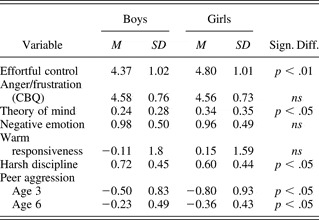
Means, standard deviations, and mean-level sex differences for all study variables are shown in Table 1. Normality was assessed comparing the skewness statistic with zero using the Z distribution. The behavioral indexes of children's negative emotion and theory of mind understanding and parents' reports of corporal punishment were found to be skewed. As with the peer aggression measures, these variables were corrected using a logarithmic transformation: theory of mind, skewness = 0.59 (SE = 0.16); negative emotionality, skewness = 0.35 (SE = 0.17); and corporal punishment, skewness = 0.19 (SE = 0.15). The transformed variables met the normality assumption and were used in all further analyses.
Means, standard deviations, and sex differences

Note: CBQ, Child Behavior Questionnaire.
At ages 3 and 6 years, boys displayed significantly higher levels of peer aggression than girls. Previously we reported that boys achieved lower scores on behavioral and maternal rating measures of effortful control, whereas boys and girls did not differ significantly on maternal ratings of anger/frustration (Olson et al., Reference Olson, Sameroff, Kerr, Lopez and Wellman2005). As shown in Table 1, current analyses revealed that preschool-age boys also received higher levels of parental corporal punishment and achieved lower levels of theory of mind understanding than girls. Mean scores on children's negative emotional reactivity to disappointment and experience of maternal warm responsiveness did not differ significantly between boys and girls.
Bivariate correlations between study variables
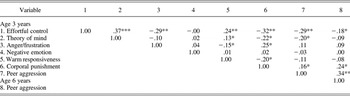
Bivariate correlations between all study variables are shown in Table 2. As expected, individual differences in children's peer aggression were moderately stable between ages 3 and 6 years. On the whole, measures of child self-regulation, child theory of mind understanding, child aggression and parenting behavior tended to be significantly intercorrelated, supporting the need for complex multivariate analyses across different risk domains. However, the laboratory index child negative emotion did not correlate with other measures of child self-regulation, or with measures of parenting and child aggression.
Bivariate correlations between study variables

*p < .05. **p < .01.
Concurrent predictors of preschool-age peer aggression
Contributions of child self-regulation
Contributions of children's early self-regulatory functioning to preschool peer aggression were examined using multiple linear regression. Preschool measures of child negative emotion (negative emotion; anger/frustration) and effortful control were entered simultaneously as predictors of preschool-age peer aggression. The overall model was significant, R 2 = .09, F (3, 158) = 4.92, p < .01. However, only effortful control made a significant individual contribution (β = −0.28, p < .001).
To test the subhypothesis that interactions between negative emotional reactivity and effortful control predict children's peer aggression, the following two-way interaction terms were created: Effortful Control × Negative Emotion and Effortful Control × CBQ Anger/Frustration. Following recommendations of Aiken and West (Reference Aiken and West1991), all variables were centered before entry into regression analyses. The interaction between effortful control and negative emotion was entered in Steps 2 and 3 of the equations described above, after controlling for main effects. These interaction terms did not make a significant contribution to children's peer aggression. However, the interaction between effortful control and anger/frustration made a significant contribution to preschool-age peer aggression, R 2 = .03, F (3, 167) = 7.67, p < .01.
The nature of the interaction between child effortful control and anger/frustration was examined. The significance of the simple slopes was tested by creating new control variables for each level of the moderating variable (mean, 1 SD below the mean, and 1 SD above the mean; Aiken & West, Reference Aiken and West1991). Results indicated that effortful control predicted concurrent levels of peer aggression in children who manifested medium and high levels of anger (βs = −0.29 and −0.28, ps < .01), but not in children who manifested low levels (β = 0.11, ns).
Contributions of child theory of mind
Contributions of early theory of mind understanding to children's preschool peer aggression were examined using multiple linear regression analyses. The theory of mind understanding made a significant contribution to the concurrent measure of peer aggression, R 2 = .04, F (1, 187) = 7.69, p <. 01. Results were in the predicted direction: children with relatively poor theory of mind understanding tended to manifest higher levels of peer aggression than others.
Contributions of parenting behavior
Contributions of early parenting behavior to children's preschool-age peer aggression were examined using multiple linear regression analyses. Preschool-age measures of maternal warm responsiveness and parental corporal punishment, entered simultaneously, made a significant contribution to concurrent levels of peer aggression, R 2 = .03, F (2, 194) = 3.29, p < .05. However, only corporal punishment made a significant individual contribution to children's peer aggression (β = 0.15, p < .05).
Potential interactive contributions of warm responsiveness and corporal punishment to the explanation of children's peer aggression were examined. Their two-way interaction term, entered on the second step of the equation described above, did not make a significant incremental contribution to children's peer aggression.
Combined contributions of effortful control and theory of mind
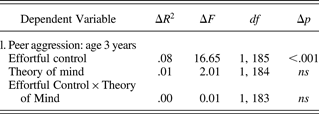
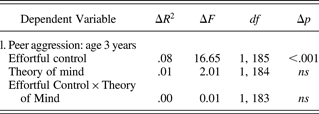
Having shown that effortful control and theory of mind made significant individual contributions to children's peer aggression, we evaluated the nature of their combined contributions using hierarchical multiple regression analyses. The dependent variable was the preschool-age measure of children's peer aggression. Effortful control was entered on the first step of the equation, theory of mind understanding on the second step, and their two-way interaction term on the third. As shown in Table 3, effortful control made a highly significant contribution to the variance in preschool-age peer aggression. However, controlling for the effects of effortful control, theory of mind no longer made a significant contribution to preschool peer aggression. The interaction between effortful control and theory of mind did not contribute significantly to the explanation of children's concurrent peer aggression.
Hierarchical multiple regression analyses: Effortful control and theory of mind predicting children's peer aggression
Although measures of children's proneness to negative emotionality did not make significant individual contributions to peer aggression, we questioned whether negative emotionality might interact with theory of mind in the prediction of peer aggression. Terms expressing the two-way interactions between child negative emotionality and theory of mind understanding (Negative Emotion × Theory of Mind; CBQ Anger/Frustration × Theory of Mind) were created using methods described above. These terms were added on the third step of each equation, after controlling for individual contributions of each predictor variable. However, interactions between children's theory of mind and negative emotionality did not contribute significantly to individual differences in peer aggression.
Combined contributions of intrachild and parenting risk
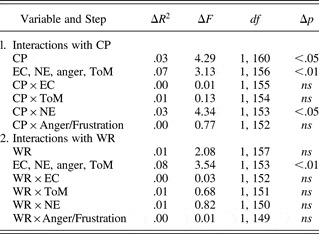
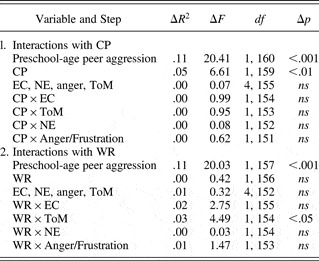
Finally, we tested models focused on interactive contributions of parenting and intrachild risk factors to children's peer aggression. In the first block of equations, we evaluated interactive contributions of preschool intrachild risk factors with parental corporal punishment to children's peer aggression at age 3. Corporal punishment was entered on Step 1 of the equation, measures of child self-regulation and theory of mind were entered on Step 2, and the following two-way interaction terms were entered on Steps 3–6: Effortful Control × Corporal Punishment, Theory of Mind × Corporal Punishment, Negative Emotion × Corporal Punishment and Anger/Frustration × Corporal Punishment. As shown in Table 4, after controlling for the significant individual contributions of corporal punishment and intrachild risk factors, only the interaction between corporal punishment and child negative emotion made a significant incremental contribution to children's preschool peer aggression.
Hierarchical multiple regression analyses: Interactions between parenting and developmental risk factors as predictors of children's concurrent peer aggression

Note: CP, corporal punishment; EC, effortful control; NE, negative emotion; WR, warm responsiveness; ToM, theory of mind.
These steps were repeated using warm responsiveness as the focal parenting behavior variable. As shown in Table 4, none of the interactions between warm responsiveness and developmental risk factors contributed significantly to the concurrent index of children's peer aggression.
The nature of the interaction between corporal punishment and child negative emotion was examined. The significance of the simple slopes was tested by creating new control variables for each level of the moderating variable (mean, 1 SD below the mean, and 1 SD above the mean; Aiken & West, Reference Aiken and West1991). However, none of these interaction terms reached significance.
Interactive contributions of child gender
Does child gender moderate associations between early risk variables and children's concurrent and later peer aggression? Two-way interactions between child gender and each risk variable were constructed using methods described above. Six equations were analyzed; each individual risk variable was entered on the first step, followed by its two-way interaction with gender. However, none of the models reached significance, demonstrating that child gender did not interact with preschool risk factors to predict concurrent or later levels of peer aggression.
Preschool predictors of peer aggression at early school age
Our primary research objective was to identify preschool-age predictors of children's peer aggression following the transition to school. In what follows, we examine predictive associations between preschool measures of self-regulation, theory of mind understanding, and adverse parenting behavior and individual differences in children's peer aggression at early school age. Finally, we examine the nature of combined contributions of early intrachild and parenting risk factors to later peer aggression, controlling for initial levels of peer aggression.
Contributions of early child self-regulation
In the first block of equations, kindergarten-age peer aggression was the dependent variable and measures of preschool-age child self-regulation were simultaneously entered as predictors. The model was marginally significant, R 2 = .03, F (3,191) = 1.94, p = .12. Only effortful control made a significant individual contribution to the variance in children's later peer aggression (β = −0.21, p < .05). Next, the autoregressive association between early and later aggressive behavior was accounted for by entering preschool-age peer aggression on the first step of the equation. After controlling for continuity in children's peer aggression, early effortful control no longer predicted school-age peer aggression (β = −0.07, ns).
We also explored the possibility that measures of effortful control and child negative emotion may combine interactively to predict heightened peer aggression. However, interactions between measures of child effortful control and negative emotion did not predict children's peer aggression at early school age.
Contributions of early child theory of mind
In the second block of analyses, school-age peer aggression was the dependent variable and children's preschool-age theory of mind understanding was the predictor variable. The model failed to reach significance.
Contributions of early parenting
In the third block of analyses, measures of preschool-age parenting behavior were entered as predictors of children's peer aggression at early school age. Preschool-age measures of parenting were significant predictors of children's school-age peer aggression (R 2 = .06, F = 6.13, p < .01). Corporal punishment was the only significant individual predictor (β = 0.23, p < .01). When the autoregressive association between children's early and later aggressive behavior was controlled by entering preschool-age peer aggression on the first step, the association between corporal punishment and later peer aggression remained significant (β = 0.19, p < .05). Interactions between corporal punishment and warm responsiveness did not make a significant incremental contribution.
Combined contributions of intrachild and parenting to later peer aggression
Hierarchical multiple regression analyses were used to examine how early child and parenting factors combined to predict school-age peer aggression, controlling for preschool levels of peer aggression. Preschool-age peer aggression was entered on the first step of the equation, followed by corporal punishment on the second step, preschool measures of child self-regulation and theory of mind on the third step, and the four two-way interaction terms (Corporal Punishment × Each Intrachild Factor) on Steps 4–6. As shown in Table 5, even after controlling for the robust contribution of preschool levels of peer aggression, corporal punishment made a significant incremental contribution to the variance in peer aggression at school entry. However, none of the interaction terms contributed significantly to the explanation of changes in children's peer aggression across the transition to school.
Hierarchical multiple regression analyses: Interactions between parenting and developmental risk factors as predictors of children's peer aggression at early school age, controlling for preschool aggression

Note: CP, corporal punishment; EC, effortful control; NE, negative emotion; ToM, theory of mind; WR, warm responsiveness.
These steps were repeated using maternal warm responsiveness as the focal parent behavior variable. As shown in Table 5, controlling for levels of preschool peer aggression, only the interaction between theory of mind and maternal warm responsiveness made a significant contribution to children's school-age peer aggression.
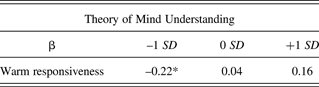
The nature of the interaction between maternal warm responsiveness and child theory of mind understanding was examined. The significance of the simple slopes was tested by creating new control variables for each level of the moderating variable (mean, 1 SD below the mean, and 1 SD above the mean; Aiken & West, Reference Aiken and West1991). As shown in Table 6, low warm responsiveness was the best predictor of later peer aggression in children who also manifested low levels of theory of mind understanding.
Standardized regression coefficients: Preschool maternal warm responsiveness predicting school-age peer aggression, estimated at high, medium, and low levels of child theory of mind understanding
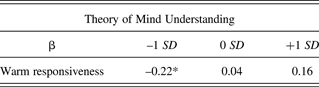
*p < .05.
Discussion
In this prospective longitudinal study, individual differences in peer aggression were assessed during the early preschool period, and reassessed following children's transition to kindergarten. Most prior studies of children's peer aggression have focused on the school age period, when difficulties with peers are already present. However, adjustment to the preschool setting represents a significant challenge for young children who must learn to adapt to new routines, share attention and resources with peers, and modulate emotional and behavioral responses in ways that permit harmonious social exchanges. By examining children who were just beginning to meet these challenges, our central aim was to identify risk markers and processes that antecede adjustment to another major developmental transition, school entry. Adjustment to kindergarten is an important turning point in children's development, requiring accelerated social and self-regulatory skills. Children who show elevated rates of peer aggression in kindergarten are at risk for cascading social and academic problems across the school-age years (e.g., Dodge et al., Reference Dodge, Greenberg and Malone2008).
Individual differences in children's peer aggression at 3 years, which were assessed using teacher reports and behavioral observations, were good predictors of heightened peer aggression following the transition to school. The moderate level of association is consistent with other research (e.g., Campbell, Shaw, & Gilliom, Reference Campbell, Shaw and Gilliom2000) and is impressive given that children were assessed in the beginning of the preschool period, a time of rapid developmental change, and were evaluated nearly 3 years later by different teacher and observers. We now discuss concurrent risk factors associated with children's early peer aggression and then move to our main research question: which patterns of early developmental and parenting risk best predict children's peer aggression following the transition to kindergarten?
Concurrent correlates of children's peer aggression at age 3 years
Preliminary findings provided further support for the salience of self-regulation deficits as contributors to early aggression, and helped clarify our understanding of how different types of regulatory difficulties work together in young children who experience frequent aggressive interactions with peers. Controlling for shared variance between different measures of regulation, only effortful control made a significant individual contribution to children's peer aggression. Previously we reported that deficits in effortful control were robust predictors of parents' and teachers' ratings of child externalizing problems at age 3 years (Olson et al., Reference Olson, Sameroff, Kerr, Lopez and Wellman2005). The current findings show that associations between poor effortful control and child problem behavior generalized to the domain of early peer aggression.
Our findings also provided insight into how different types of self-regulation deficits combined in children with high levels of peer aggression (e.g., Olson, Sameroff, Lunkenheimer, & Kerr, Reference Olson, Sameroff, Lunkenheimer, Kerr, Olson and Sameroff2009). Children's proneness to negative emotionality, assessed using responses to a laboratory “challenge” task and maternal ratings, did not make an individual contribution to the explanation of peer aggression once levels of effortful control were controlled. However, supporting an interactive model of risk (Eisenberg et al., Reference Eisenberg, Cumberland, Spinrad, Fabes, Shepard and Reiser2001), effortful control was the strongest predictor of peer aggression in children who manifested medium to high levels of anger in the home setting. These early patterns of aggressive behavior may be precursors of the reactive form of peer aggression that has been well documented in school-age children (e.g., Dodge, Reference Dodge, Lahey, Moffitt and Caspi2003).
To a modest degree, our findings also supported the hypothesis that delays in children's emerging understanding of others' mental states contribute to early aggressive peer interactions. Consistent with some recent findings (e.g., Hughes & Ensor, Reference Hughes and Ensor2006), preschool-age children with relatively poor theory of mind understanding were at elevated risk for aggressive interactions with their preschool peers. Because measures of effortful control and theory of mind were positively intercorrelated (see also Carlson & Moses, Reference Carlson and Moses2001), integrative models were needed to clarify how these vulnerabilities worked in concert to elevate children's risk status. Controlling for the effects of effortful control, the predictive association between theory of mind and peer aggression became negligible. Thus, these data affirmed an hierarchical model wherein children's poor effortful control skills were primary contributors to early problem behavior (Hughes et al., Reference Hughes, White, Sharpen and Dunn2000).
Finally, young children who experienced high levels of corporal punishment tended to manifest frequent aggressive peer interactions in preschool. These findings affirmed a large body of prior work showing that corporal punishment is robustly associated with children's aggressive behavior during the school-age years (e.g., Gershoff, Reference Gershoff2002). Contrary to expectation, low levels of maternal warmth and responsiveness were not associated with children's peer aggression, nor did they interact with harsh discipline to place children at heightened risk.
As expected, deficits in children's self-regulation and social cognition also were significantly associated with heightened levels of corporal punishment and low levels of warm responsiveness. Integrative analyses showed that frequent corporal punishment made an incremental contribution to the explanation of early peer aggression. Thus, both intrachild regulatory deficits and adverse parenting should be considered fundamental components of heightened peer aggression in preschool-age children. Given that children's regulatory problems often elicit harsh parental control, the nature of these associations is thought to be highly reciprocal (Olson & Lunkenheimer, Reference Olson, Lunkenheimer and Sameroff2009).
Preschool-age predictors of children's peer aggression at early school age
Our primary research goal was to identify early preschool predictors of children's peer aggression at early school age, particularly preschool precursors of changes in peer aggression across this important transition period. As a whole, intrachild deficits in self-regulation and theory of mind understanding made few direct contributions to children's later peer aggression. A notable exception was the significant association between children's early effortful control skills and later peer aggression, extending prior concurrent associations to a longitudinal time frame (Olson et al., Reference Olson, Sameroff, Kerr, Lopez and Wellman2005). However, when children's preschool levels of peer aggression were controlled, associations between early effortful control and later peer aggression became negligible. We conclude that young children with poor effortful control skills are at elevated risk for aggressive interactions with peers, and that this key developmental vulnerability was linked with later peer aggression through individual continuity in aggressive behavior.
In contrast to the weak pattern of associations between early measures of self-regulation and theory of mind and children's later peer aggression, measures of early parenting risk were significant predictors of children's peer aggression following the transition to school. Given the substantial continuity in peer aggression across early childhood, by controlling for preschool levels of peer aggression we were able to predict change in peer aggression across this important transition period. A single domain of risk appeared to be most critical in understanding why children's peer aggression may accelerate across the transition to school: parental corporal punishment contributed significantly and uniquely to the explanation of changes in peer aggression across the transition to school. These data strongly affirmed a large body of research linking corporal punishment to increased aggressive responding in children (e.g., Berlin et al., Reference Berlin, Ispa, Fine, Malone, Brooks-Gunn and Brady-Smith2009; Gershoff, Reference Gershoff2002; Snyder, Cramer, Afrank, & Patterson, Reference Snyder, Cramer, Afrank and Patterson2005). Our findings extended prior research by showing that corporal punishment in the early preschool period predicted changes in children's peer aggression across a significant developmental transition.
Other categories of early risk operated differently in the prediction of changes in peer aggression. Neither low levels of maternal warmth nor delays in children's theory of mind understanding made significant individual contributions to children's later peer aggression. However, low levels of warm responsiveness predicted increased peer aggression in children who also had low levels of theory of mind understanding. Thus, the interactive contribution of maternal warmth and children's theory of mind deficits was important to our understanding of early risk for peer aggression following the transition to school.
In sum, it was fascinating that different patterns of risk factors were associated with individual differences in children's concurrent versus later peer aggression. During the early preschool period, deficits in children's self-regulatory and social cognitive skills were salient contributors to high levels of peer aggression, as was frequent corporal punishment. Generally, however, deficits in children's early developmental skills did not predict changes in peer aggression across the transition to school, whereas frequent corporal punishment predicted heightened aggressive responding. This was not surprising given that children's self-regulatory and social cognitive skills undergo rapid developmental changes across the preschool period (Olson et al., Reference Olson, Sameroff, Lunkenheimer, Kerr, Olson and Sameroff2009). We speculate that these early skills deficits play a key role in the origins of children's aggressive responding. Once aggressive behaviors begin to stabilize, however, environmental risk factors become the primary predictors of children's later risk status, most likely reflecting complex child–environment transformational processes (e.g., Sameroff, Reference Sameroff, Olson and Sameroff2009).
The role of child gender
Finally, our findings highlighted the salience of sex differences in the development of peer aggression. Boys showed higher levels of peer aggression than girls at both ages. Moreover, preschool boys had significantly lower levels of effortful control, mental state (theory of mind) understanding, and control of angry reactivity than girls. These findings converge with those of other studies showing that boys are at elevated risk for preschool onset aggression, and that multiple developmental vulnerabilities contribute to boys' risk status (Keenan & Shaw, Reference Keenan, Shaw, Lahey, Moffitt and Caspi2003; Moffitt et al., Reference Moffitt, Caspi, Rutter and Silva2001). However, gender did not moderate associations between preschool risk variables and peer aggression. Thus, our findings support Moffitt's (Reference Moffitt, Lahey, Moffitt and Caspi2003) argument that boys are at elevated risk for early aggression because they experience higher levels of developmental and social risk.
Strengths and Limitations
The noteworthy strengths of our study included prospective longitudinal assessments of children's peer aggression across an important developmental transition; assessments of early developmental risk that spanned multiple constructs, three different settings, and multiple informants; use of both observational and rating measures of children's peer aggression; the participation of relatively equal numbers of boys and girls; and consideration of interrelations between intrachild and parenting risk factors.
We also highlight features of this study that may limit the generalizability of our findings. First, most children in the study were from intact, two-parent middle-class families. Therefore, our findings may not generalize to children growing up in other family constellations, or to those whose families experience severe economic hardship. Similarly, reflecting the local population, children and parents in our study primarily were from European American backgrounds. Thus, our findings may have limited generalizability to racially and ethnically diverse groups of young children.
Another potential limitation concerned our measurement of a key parenting construct, corporal punishment. Our interview based assessment focused on the frequency of parents' use of physical punishment. We did not directly address the broader construct of punitive discipline that also includes harsh emotional behaviors such as screaming, yelling, and/or derogating the child. Given the importance of frequent corporal punishment as a correlate of child aggression, in future studies it would be worthwhile to include broader constructs of punitive discipline that encompass a full range of harsh practices.
Finally, children in our constrained community sample represented the full range of the externalizing problems spectrum with a disproportionate number in the medium–high to high range. However, relatively few had externalizing scores in the extreme range, limiting generalizability to clinically referred populations of young children.
Conclusion
Difficulties in children's early self-regulation, theory of mind understanding and parenting experiences have been related to children's early aggressive behavior in previous reports (e.g., Gilliom, Shaw, Beck, Schonberg, & Lukon, Reference Gilliom, Shaw, Beck, Schonberg and Lukon2002; Hughes & Ensor, Reference Hughes and Ensor2006; Olson et al., Reference Olson, Sameroff, Kerr, Lopez and Wellman2005; Snyder, Prichard, Schrepferman, Patrick, & Stoolmiller, Reference Snyder, Prichard, Schrepferman, Patrick and Stoolmiller2004). In the current study, measures in each risk domain were associated with concurrent measures of early peer aggression, and any of these associations could have been the foundation for a concise “story.” However, most of these risk factors were intercorrelated, obscuring unique contributions and complex transactions between child and environment that underlie the acceleration of children's early risk potential (Sameroff, Reference Sameroff, Olson and Sameroff2009). Our main finding was that preschool-age measures of adverse parenting predicted children's peer aggression at early school age, even after initial levels of aggression were controlled. These data clearly show that adverse parenting behaviors, particularly frequent corporal punishment, are important contributors to the growth of peer aggression in young children. High levels of aggressive behavior in kindergarten have been linked with chronic, cascading social and academic difficulties that include peer victimization (e.g., Morrow, Hubbard, McAuliffe, Rubin, & Dearing, Reference Morrow, Hubbard, McAuliffe, Rubin and Dearing2006), use of illicit substances (Dodge et al., Reference Dodge, Malone, Lansford, Miller, Pettit and Bates2009), and poor educational attainment in early adulthood (Vitaro, Brendgen, Larose, & Tremblay, Reference Vitaro, Brendgen, Larose and Tremblay2005). Thus, our data highlight the need for family intervention during the early preschool years.