Attachment theory (Bowlby, Reference Bowlby1982) was initially formulated to describe and explain the bonds that children establish with their caregivers early in life. Subsequently, however, it was expanded to the realm of personal relationships in adulthood, where it has become in one of the dominant research paradigms (Mikulincer & Shaver, Reference Mikulincer and Shaver2007). More recently there have been preliminary efforts to apply attachment theory to explain the bonds between individuals and their organizations and leaders (e.g., Davidovitz, Mikulincer, Shaver, Ijzak, & Popper, Reference Davidovitz, Mikulincer, Shaver, Izsak and Popper2007).
According to attachment theory, the initial emotional bonds of children with their caregivers are the bases of internal working models of self and others that exert a strong influence on later adolescent and adult psychological and social life. Attachment theory was first empirically tested by Ainsworth, Blehar, Waters, and Wall (Reference Ainsworth, Blehar, Waters and Wall1978), who identified three major patterns of infant attachment: secure, anxious (or ambivalent), and avoidant. In adulthood, similar attachment patterns can be characterized in terms of two continuous dimensions: attachment anxiety and avoidance (Brennan, Clark, & Shaver, Reference Brennan, Clark, Shaver, Simpson and Rholes1998; Mikulincer & Shaver, Reference Mikulincer and Shaver2007). Secure people find it easy to get close to others and do not worry about being abandoned or about someone getting too close to them. Anxious people feel that others are reluctant to get as close as they would like and cannot be counted on to be available when needed. Avoidant people feel uncomfortable being close to others and find it difficult to be intimate with and dependent on them.
Hazan and Shaver (Reference Hazan and Shaver1987) extended Bowlby’s (Reference Bowlby1982) theory and Ainsworth et al.’s (Reference Ainsworth, Blehar, Waters and Wall1978) research into the realm of adult romantic relationships. And Bartholomew and Horowitz (Reference Bartholomew and Horowitz1991) showed how the main attachment patterns could be understood in terms of two conceptually independent dimensions—Model of Self and Model of Others—which together defined four attachment styles rather than three: secure, preoccupied, fearful, and dismissing. More recent studies (reviewed by Mikulincer & Shaver, Reference Mikulincer and Shaver2007) have tended to include measures of the two underlying dimensions conceptualized as anxious attachment (fear of rejection or abandonment) and avoidant attachment (discomfort with closeness and interdependence combined with a preference for self-reliance). A large research literature (reviewed by Mikulincer & Shaver, Reference Mikulincer and Shaver2007) documents negative associations between attachment insecurities and several variables related to couple functioning and adjustment (e.g., communication, intimacy, relationship satisfaction, and commitment).
As research on adult attachment patterns has expanded, it has become clear that the patterns extend to other kinds of relationships in which attachment processes are involved, such as those that occur in groups or institutions and in leader-follower relationships (Davidovitz et al., Reference Davidovitz, Mikulincer, Shaver, Izsak and Popper2007; Smith, Murphy, & Coats, Reference Smith, Murphy and Coats1999). As Mayseless and Popper (Reference Mayseless and Popper2007) point out, political leaders may be seen, mainly in times of crisis, as attachment figures because followers seek security, protection, and reassurance. However, there is little empirical research, other than journalistic and historical analyses, addressing this issue. In the same vein, Bresnahan and Mitroff (2007) have suggested that inclusion of attachment theory in the study of leadership could strengthen leadership research and theory as a whole because leadership often involves creating good relationships with followers, who generally wish to be able to rely for their success and well-being on their leader’s guidance and support. Thus far, however, although there has been some research analyzing the influence of a leader’s attachment orientation (secure, anxious, or avoidant) on his or her leadership performance (Davidovitz et al., Reference Davidovitz, Mikulincer, Shaver, Izsak and Popper2007), there has not been research on the nature of subordinates’ attachment to their leaders, even though this may be an important issue affecting employees’ job performance and satisfaction. For example, perceiving one’s leader as absent or unresponsive may produce an avoidant bond between a subordinate and the leader which may in turn reduce the subordinate’s identification with and commitment to the organization. If so, this may erode the subordinate’s effort and damage the organization’s success. Moreover, perceiving one’s leader as unpredictable or unfair may produce an anxious bond between a subordinate and the leader which creates stress and dissatisfaction, also lowering effort, success, and satisfaction. The aim of the present study is to explore the extent to which employees establish attachment bonds with their leaders and the effects that these bonds have on organizational and leadership outcomes such as employee’s extra effort and satisfaction.
Attachment and Leadership
The idea that follower-leader relationships are similar in many respects to the attachment relationships between children and parents was first discussed by Freud (Reference Freud1939). Both the role of leader and the role of parent involve protecting and taking care of others who are less powerful (children or followers, respectively) and whose fate depends to a certain extent on them (Mayseless & Popper, Reference Mayseless and Popper2007). As Bowlby (Reference Bowlby1988) pointed out, the tendency to establish specials bonds with certain figures (through the operations of what he called the attachment behavioral system) is due to a motivational system that, although most evident and important early in life, continues to be active over the entire lifespan and is manifested in thoughts and behaviors related to seeking proximity to and support from attachment figures. Consequently, it is reasonable to assume that under certain circumstances, leaders may become attachment figures (Mayseless, Reference Mayseless2010; Mayseless & Popper, Reference Mayseless and Popper2007; Popper & Mayseless, Reference Popper and Mayseless2003).
Only a few studies have analyzed leadership from an attachment perspective (for reviews, see Mayseless, Reference Mayseless2010; Mikulincer & Shaver, Reference Mikulincer and Shaver2007). Some of them have explored whether one attachment style is more suitable for a leader, as judged by the influence of the leader’s attachment style on his or her subordinates’ performance and satisfaction.
For example, Mikulincer and Florian (Reference Mikulincer and Florian1995) found, in military settings that anxious recruits, as compared with secure or avoidant ones, received fewer peer nominations for leadership positions after four months of training. Popper and Amit (Reference Popper and Amit2009) found, among 403 soldiers in the Israel Defence Forces, that a secure attachment style formed in early childhood influences a person’s potential to lead, and that this potential is related to leadership ability as evaluated by peers and commanders. In the same vein, we can expect, regarding other organizational settings that secure people will reach managerial positions more readily than insecure ones, and that secure leaders will perform better than insecure ones.
Davidovitz et al. (Reference Davidovitz, Mikulincer, Shaver, Izsak and Popper2007) examined, also in military settings, the contributions of a leader’s attachment style to leadership motives and beliefs and to followers’ outcomes. In a series of three studies, they found that leaders who scored relatively high on anxious attachment were preoccupied with their own need for approval and lacked confidence in their leadership abilities. Avoidant leaders, in contrast, tended to ignore the sociemotional aspects of leadership and were viewed by followers as emotionally unavailable and disapproving. These authors also found that a leader’s avoidance was negatively related to followers’ group cohesion and personal mental health, particularly among insecurely attached followers engaged in combat training. According to Davidovitz et al. (Reference Davidovitz, Mikulincer, Shaver, Izsak and Popper2007), the results parallel those found in many previous studies of parent-child relationships showing that caregivers’ attachment insecurities have detrimental effects on children’s felt security and mental health.
In addition, Keller (Reference Keller2003), working from an implicit leadership perspective, suggested that the most positive relationships between leaders and followers occur when the two have the same style of attachment – that is, when both leader and subordinate are secure or anxious or avoidant. When the patterns match, leader and subordinate have consistent implicit theories of leadership, which facilitates their social interactions. Manning (Reference Manning2003) underlined the importance of taking into account the attachment style of the leader and recommended selecting managers with a secure attachment style for diverse or cross-cultural assignments, on the assumption that secure leaders are more flexible and adaptive to new situations.
Although research on attachment and leadership is based on the idea that a leader may be viewed as an attachment figure, none of the aforementioned studies have tested that important assumption empirically. And the kind or the quality of the bond between subordinate and leader and subordinate may be important for subordinates’ performance and satisfaction. These are the issues we wished to investigate.
Attachment and Transformational/Transactional Leadership
The concept of transformational-transactional leadership has inspired one of the most influential recent lines of research in the field of leadership. According to Bass (Reference Bass1985) there are three types of leadership: transformational, transactional and passive–avoidant. Transformational leaders, through their charisma and inspiration, achieve important changes in followers’ attitudes, beliefs, and behaviors, causing their followers to accomplish more than they expected. Transactional leaders, by rewarding followers’ positive behaviors and punishing negative behaviors, may also have a positive effect on followers’ performance. Finally passive-avoidant leadership characterizes certain leaders who do not actually lead and are perceived as absent by their employees.
The majority of the research on transformational leadership has been conducted in organizational settings, and the terms leader, manager, or supervisor are used interchangeably. The person who has the role of responsibility in a work team is called the leader, manager, or supervisor, and the people under his/her supervision are called followers, subordinates, or employees. This practice will be followed in the present investigation as well.
Many studies worldwide (e.g., Avolio & Bass, Reference Avolio and Bass2004; Dumdum, Lowe, & Avolio, Reference Dumdum, Lowe, Avolio, Avolio and Yammarino2002; Lowe, Kroeck, & Sivasubramaniam, Reference Lowe, Kroeck and Sivasubramaniam1996) have shown that transformational leadership is positively correlated with subjective (i.e., employee’s perceptions) and objective (i.e., corporate profits) criteria for organizational effectiveness and with employees’ satisfaction with the leader and with their own work. The association of these variables with the transactional leadership factor of contingent reward is also positive but lower. In contrast, the association of effectiveness and satisfaction with the passive–avoidant leadership style is strongly negative.
Regarding the relation between transformational leadership and attachment style, there has been little research. Popper, Mayseless, and Castelnovo (Reference Popper, Mayseless and Castelnovo2000) considered transformational leadership to be a product of a secure attachment style. In a series of three studies they found a significant positive correlation between cadets’ secure attachment style and transformational leadership evaluated by their officers (Studies 1 and 2). They also found (Study 3) positive relations between soldiers’ evaluations of their commanders on dimensions of transformational leadership and the commanders’ secure attachment style. In a theoretical paper, Popper and Mayseless (Reference Popper and Mayseless2003) established parallels between transformational leadership and good parenting, concluding that transformational leaders promote subordinates’ secure attachment to them.
The Present Research
The first objective of this research is to explore whether a specific style of leadership – transformational, transactional, or passive/avoidant – generates a certain style of attachment to the leader (anxious or avoidant). Additionally, we wished to explore the extent to which employees’ attachment to their leader is associated with important organizational outcome variables such as employees’ satisfaction, perceived leader effectiveness, exerting extra work effort, and identification with the organization.
Based on the previous literature we expected that leaders who take care of and support their employees (transformational leaders) would increase the likelihood of employees’ secure attachment bonds with these leaders (Popper & Mayseless, Reference Popper and Mayseless2003; Popper et al., Reference Popper, Mayseless and Castelnovo2000). Although there are very few studies of passive-avoidant leaders, we expected that such leaders would be perceived somewhat like absent parents by their employees, which would foster insecure attachment to these leaders. In particular, we formulated the following hypotheses:
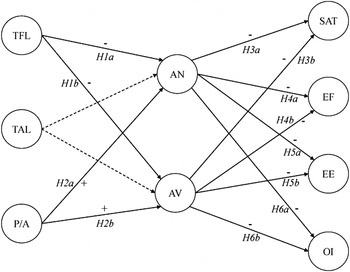
Hypothesis 1: Perceived transformational leadership will be negatively related to anxious attachment (H1a) and avoidant attachment (H1b) to the leader.
Hypothesis 2: Perceived passive-avoidant leadership will be positively related to anxious (H2a) and avoidant (H2b) attachment to the leader.
As far as we know, there is no research exploring the relation between transactional leadership and followers’ attachment styles. Transactional leaders are characterized as paying attention to their subordinates in order to reward or punish behaviors relevant to the achievement of organizational objectives. There is not a clear a priori prediction about the relation between transactional leadership and subordinates’ attachment patterns. On the one hand, we might expect that a leader who pays attention to subordinates’ activities will encourage secure attachment bonds. On the other hand, if the leader focuses only on mistakes or is perceived as assigning rewards unfairly, insecure attachment bonds may be formed on the part of employees. Because of our uncertainty about these details, we did not formulate an a priori hypothesis about the relation between transactional leadership and employee attachment.
There is also no previous research exploring the effects of attachment to a leader on organizational outcomes. However, in the same way that insecure attachment in close relationships produces marital dysfunction, we expected that insecure attachment to a leader would be associated negatively with several desirable outcome variables such as employee’s job satisfaction, perceived leader effectiveness, and employees making an extra effort.
Hypothesis 3: Job satisfaction will be negatively related to anxious (H3a) and avoidant (H3b) attachment to the leader.
Hypothesis 4: Perceived leader effectiveness will relate negatively to anxious (H4a) and avoidant (H4b) attachment to the leader.
Hypothesis 5: Employees’ extra effort will be related negatively to anxious (H5a) and avoidant (H5b) attachment to the leader.
Although there is some research showing that transformational leadership is related to organizational identification (Epitropaki & Martin, Reference Epitropaki and Martin2005), there is no research exploring the association between attachment to the leader and organizational identification. However, we expect that, given that the leader is responsible for transmitting the values and aims of the organization, a good relationship with the leader, as characterized by secure attachment, should increase subordinate’s organizational identification.
Hypothesis 6: Organizational identification will be negatively related to anxious (H6a) and avoidant (H6b) attachment to the leader.
The hypotheses are summarized diagrammatically in Figure 1. In addition, demographic variables such as gender, age, job tenure (seniority), educational level, and sector (public vs. private) may influence outcome variables and may need to be controlled for.
Theoretical model: TFL = Transformational leadership, TAL = Transactional leadership, PAL = Passive-avoidant leadership, AN = Anxious attachment, AV = Avoidant attachment, SA = subordinates’ satisfaction, EF = Perceived leader efficacy, EE = subordinates’ extra-effort, OI = Organizational identification.

Method
Participants and Procedure
The participants were recruited and interviewed by undergraduate psychology students at a Spanish University; the students received practicum credits for their work. Participants, from all over Spain, were asked to evaluate their immediate leaders and several aspects of their organizational life. Of these participants, 59% worked in private companies and 39.6% worked in public companies, the rest, 1.4%, don’t answer to this question. Participants (N = 225, 43.6% males and 56.4% females) were included only if they had been working with their leader for at least for one year (M = 4.38 years, SD = 4.17). Participants’ ages ranged from 18 to 65 years (M = 37.38, SD = 10.19); the 46.7% of the participants had a university degree and about 25% had finished high school; of the rest, 15% had received professional training and 14% had finished the compulsory secondary education. None of these sociodemographic variables were significantly related to the other variables in this study.
Measures
Leadership styles
Leadership was assessed with a Spanish version (Molero, Recio, & Cuadrado, Reference Molero, Recio and Cuadrado2010) of the 36-item Multifactor Leadership Questionnaire (MLQ)-Short Form 5X. The MLQ is one of the most commonly used instruments to evaluate leadership. The most recent version of the instrument and its psychometric characteristics are described in the instrument’s manual (Avolio & Bass, Reference Avolio and Bass2004). In the MLQ, transformational leadership is indicated by five subscales comprising four items each: idealized influence (attributed), “Instills pride in me for being associated with him/her”; idealized influence (behavior), “Talks about his/her most important values and beliefs”; inspirational motivation, “Articulates a compelling vision of the future”; intellectual stimulation, “Seeks different perspectives when solving problems”; and individualized consideration, “Helps me to develop my strengths”. Transactional leadership is indicated by two subscales, each also containing four items: contingent reward, “Discusses in specific terms who is responsible for achieving performance targets”; and active management-by-exception, “Directs my attention toward failures to meet standards.”Finally, passive-avoidant leadership is assessed by two subscales, each containing four items: laissez-faire, “Is absent when needed”; and passive management-by-exception, “Waits for things to go wrong before taking action.”
Participants were asked to judge how frequently their direct manager or leader engaged in the specific leadership behaviors on a 5-point scale ranging from 1 (not at all) to 5 (frequently, if not always). The reliability of transformational, transactional, and passive-avoidant leadership scales was good (see Table 1), so the items of each scale were averaged. Scores ranged from 1 to 5 with higher scores indicating that the corresponding style of leadership was more strongly attributed to the leader.
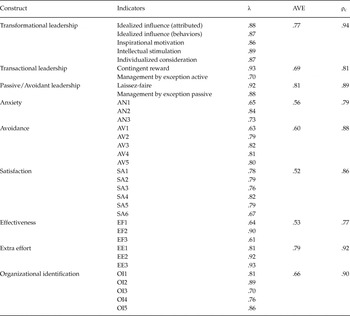
Individual Loadings (λ), Composite Reliabilities (ρc), and AVE for Measures Used in this Study

Attachment to the leader
Attachment to the leader was assessed with a Spanish adaptation of Smith et al.’s (Reference Smith, Murphy and Coats1999) “Social Group Attachment Scale,” which was originally designed to measure people’s attachment to social groups. The original scale showed good reliability, validity, and over-time stability (Smith et al., Reference Smith, Murphy and Coats1999). In the present study, we changed the words “social groups” to “leader or supervisor” to create a subordinate’s attachment scale. To improve reliability, some items were removed. The anxiety scale that we used (measuring anxious attachment to the leader) contained three items: “I often worry that my leader does not really accept me,” “I find my leader is reluctant to get as close as I would like,” and “My desire to feel completely at one sometimes scares my leader away”. The avoidance scale contained five items: “I find it difficult to allow myself to depend on my leader”, “My leader is never there when I need him/her”, “I find it difficult to completely trust my leader”, “I know that my leader will be there when I need him/her” (reversed), and “I find it relatively easy to get close to my leader” (reversed). The reliability of the anxiety and avoidant attachment subscales was good (see Table 1), so the items of each scale were averaged. Scores ranged from 1 to 5 with higher scores indicating that this style of attachment to the leader was stronger.
Leadership outcomes
Three variables related to leadership outcomes were taken into account: subordinates’ satisfaction, perceived leader effectiveness, and subordinates’ extra effort. To assess subordinates’ satisfaction we used a 7-item scale focused on different aspects of work (e.g., satisfaction with co-workers, the organizational climate, the salary, the work in general, the customers, being a member of the organization, and the methods of leadership). A version of this scale was used in a previous study, where it exhibited good reliability and validity (Molero, Cuadrado, Navas, & Morales, Reference Molero, Cuadrado, Navas and Morales2007). To assess perceived leader effectiveness, we used a 4-item subscale included in the MLQ (e.g., “[My manager] is effective in meeting organizational requirements”). To assess subordinates’ extra effort we used a 3-item subscale of the MLQ (e.g., “[My manager] heightens my desire to succeed”).The reliabilities of the subordinates’ satisfaction, perceived leader effectiveness, and subordinate’s extra effort scales were good (see Table 1), so the items of each scale were averaged. Scores ranged from 1 to 5 with higher scores indicating that the satisfaction, leader effectiveness, and extra effort levels were higher.
Organizational identification
This variable was assessed with Doosjee, Ellemers, and Spears’ (1995) four-item measure (e.g., “I feel strong ties with this organization”). The scale’s brevity and global nature make it suitable as a measure of both social identification and social identity salience. In a study by Haslam (Reference Haslam2004), the scale yielded a Cronbach’s alpha of .83. We also included one item from Haslam, Oakes, Reynolds, and Turner’s (Reference Haslam, Oakes, Reynolds and Turner1999) scale, which assesses the importance of being a member of the organization. The reliability of the organizational identification scale was good (see Table 1), so the items were averaged. Scores ranged from 1 to 5 with higher scores indicating that the level of organizational identification was higher.
Data Analysis
Data were analyzed using SmartPLS (Ringle, Wende, & Will, 2005), a recent software implementation of the Partial Least Squares (PLS) analysis approach. The objective of PLS is to predict dependent variables, latent and manifest, while maximizing the explained variance (R 2) in the dependent variables and minimizing the residual variance (Wold, Reference Wold, Nijkamp, Leitner and Wrigley1985). To evaluate the model against observed data, we used an iterative procedure that fit observed measures to corresponding latent variables, and then estimated relations among the latent variables. At each iteration a least squares fit between observed and modeled parameters was computed and the model was considered to be a best-fit solution when the least squares function stabilized between iterations.
PLS has two strengths that make it well-suited for this study. First, PLS was developed to avoid the necessity of large sample sizes and unrealistic assumptions of normality. For this reason it is often referred to as a form of soft modeling (Falk & Miller, Reference Falk and Miller1992). Although PLS can be used for theory confirmation, it is generally recommended in situations where the theory or model is to be built, rather than for confirmation proposes (Chin, Reference Chin and Marcoulides1998). Second, PLS accounts for measurement error and should provide more accurate estimates of interaction effects. Significance was evaluated using bootstrapping of 500 samples of 225 cases, which led to a critical t-value of 1.96 for p < .05.
Results
PLS results are presented in two parts: tests of reliability and validity of the measures (the outer model) and tests of hypotheses (the inner model). Tables 1 and 2 present results concerning the reliability and validity of the scales, and Figures 1 and 2 show the path coefficients relevant to hypothesis testing.
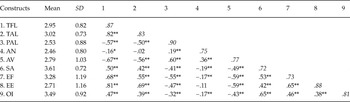
Means, Standard Deviations, Correlations, and Discriminant Validity

Note:
Scores could range from 1 to 5.* p < .05 ** p < .01. Diagonal elements are the square root of AVE between the constructs and their indicators. For discriminant validity, diagonal elements should be greater than off-diagonal elements in the same row and column.
TFL = Transformational leadership, TAL = Transactional leadership, PAL = Passive-avoidant leadership, AN = Anxious attachment, AV = Avoidant attachment, SA = subordinates’ satisfaction, EF = Perceived leader efficacy, EE = subordinates’ extra-effort, OI= Organizational identification.
Outer Model
The outer model concerns relationships between the manifest indicators and the hypothesized latent constructs. The proposed model involved 34 manifest indicators (measures) loading on 9 latent constructs (see Table 1). The analysis reveals how well the measures reflect the latent variables.
Reliability
First, the reliability of each indicator is indicated by its loading on the appropriate latent construct (λ). The latent variable should explain a substantial part of each indicator’s variance, indicated by standardized outer loadings larger than .60 (Hair, Black, Babin, Anderson, & Tatham, Reference Hair, Black, Babin, Anderson and Tatham2006). Second, the coherence of the indicators in relation to the latent construct is a measure of composite reliability (ρc). This index is preferred to Cronbach’s alpha as a measure of internal consistency reliability because PLS prioritizes indicators according to their relation to the latent construct (Henseler, Ringle, & Sinkovics, Reference Henseler, Ringle and Sinkovics2009). The ρc value should be above .70, and a value below .60 indicates poor reliability (Nunnally, Reference Nunnally1978). Table 1 shows that our outer model exceeds all of the minimum requirements.
Convergent and discriminant validity
Convergent validity refers to the common variance between the indicators and their construct, which signifies that a set of indicators represent a single underlying construct (Henseler et al., 2009). Fornell and Lacker (1981) recommended using the average variance extracted (AVE) as a criterion. The higher the AVE value, the more representative are the indicators of the construct on which they load. In general, the value should be above .50 (Fornell & Larcker, Reference Fornell and Larcker1981). As shown in Table 1, the AVE for each construct was satisfactory. To assess discriminant validity among constructs, the AVE square root should be higher than the squared correlations with all other constructs (Fornell & Larcker, Reference Fornell and Larcker1981). Thereby, each construct should share more variance with its own block of indicators than with other constructs representing different blocks of indicators (Henseler et al., Reference Henseler, Ringle and Sinkovics2009). Table 2 shows the correlations between the constructs and, along the diagonal, the AVE square root. These results support the discriminant validity of the constructs in the model, although transformational and transactional leadership are highly correlated, which accords with previous studies (Epitropaki & Martin, Reference Epitropaki and Martin2005; Pillai, Schriesheim, & Williams, Reference Pillai, Schriesheim and Williams1999).
Inner Model
The inner model concerns the structure of the group of latent constructs (Chin, Reference Chin and Marcoulides1998). Linear regression analysis is used to evaluate the pathways between the latent constructs, indicated by standardized beta coefficients. The confidence intervals of the path coefficients are based on bootstrapping with 500 samples and computing a Student t statistic for each hypothesis. The criterion for assessing the structural model is the coefficient of determination (R 2 ) of each latent variable (Henseler et al., Reference Henseler, Ringle and Sinkovics2009), which should exceed .10 (Falk & Miller, Reference Falk and Miller1992).
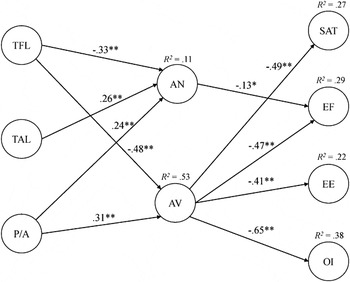
Figure 2 shows the effects of leadership styles on subordinates’ attachment to their leader. Transformational leadership has a significant negative influence on both anxious and avoidant attachment to the leader. Hence, H1a and H1b are supported. Passive-avoidant leadership has a positive and significant effect on both anxious and avoidant attachment to the leader. Thus, H2a and H2b are also supported. Transactional leadership has a significant and positive effect on anxious attachment. However, there is not a significant effect of transactional leadership on employees’ avoidant attachment. Together, the leadership styles accounted for 11% and 53% of the variance in anxious and avoidant attachment to a leader, respectively. Moreover, avoidant attachment to one’s leader was negatively associated with all of the outcome variables, accounting for 27% of the variance in employee’s job satisfaction, 29% of the variance in perceived leader effectiveness, 22% of the variance in extra-effort, and 38% of the variance in organizational identification. Hence, H3b, H4b, H5b, and H6b are supported. Anxious attachment was only marginally associated with perceived leader effectiveness. Of all the control variables, only job tenure (seniority) was found to relate to an outcome of interest, organizational identification (β = .19; t = 2.88; p < .01).
Inner model showing significant paths between latent constructs. (Insignificant paths have been omitted to make the final model easier to examine.)

Discussion
According to several authors (e.g., Mayseless & Popper, Reference Mayseless and Popper2007), the follower-leader relationship is analogous in important ways to the attachment relationship between a child and his or her primary parental figure. If this is a correct inference, then followers should develop attachments to their leaders, and the quality, or security, of these attachments should be affected by perceptions of the leader’s behavior (Popper & Mayseless, Reference Popper and Mayseless2003). In support of our predictions (Hypotheses 1a, 1b), transformational leadership was negatively associated with insecure (anxious and avoidant) attachment to one’s leader.
As predicted by Hypotheses 2a and 2b, passive/avoidant leadership was positively associated with subordinates’ attachment insecurities. Passive/avoidant leaders are characterized by Avolio and Bass (Reference Avolio and Bass2004) as tending to react only after problems have become serious enough to require corrective action and may avoid making any decision at all. It is not surprising that this kind of leadership produces insecure attachment on the part of subordinates.
We did not formulate a hypothesis about the relations between transactional leadership and the attachment dimensions. Indeed a leader who rewards or punishes employees’ behavior may be seen by them in ways that depend on several factors (e.g., the fairness of the reward, the severity of the punishment). In the present study, transactional leadership was positively associated with employee’s anxious attachment but not their avoidant attachment. It seems, therefore, that the expectation of being rewarded or punished, perhaps inconsistently or erratically, makes employees more anxious.
After verifying the existence of attachment ties between followers and their leaders in organizational settings, our second objective was to explore relations between subordinates’ attachment insecurities and several important outcome variables, including organizational identification.
As predicted by Hypotheses 3b, 4b, 5b, and 6b, avoidant attachment to the leader was associated negatively with employee satisfaction, perceived leader effectiveness, employee’s extra-effort, and organizational identification. This is consistent with a large body of leadership research linking lack of leadership, or perceiving the leader as absent, with several undesirable organizational outcomes (Avolio & Bass, Reference Avolio and Bass2004).
We did not find significant relations (although there was a negative tendency) between anxious attachment to the leader and the outcome variables we examined, including organizational identification. This suggests that a certain level of employee anxiety may be acceptable to a supervisor and may not have a large effect on employees’ work satisfaction, perception of a leader’s effectiveness, employees’ extra-effort, or organizational identification. Research on close relationships has shown that both anxious and avoidant attachment are detrimental to relationship satisfaction (Mikulincer & Shaver, Reference Mikulincer and Shaver2007). More research is needed to determine the effects of anxious attachment on the follower-leader relationship.
Mayseless and Popper (Reference Mayseless and Popper2007) claimed that attachment to a leader is more likely in times of crisis, when people seek safety, protection, and hope for a good outcome. However, we found that, even when there is no crisis, attachment bonds between subordinates and leaders are possible.
In line with claims by other authors (e.g., Bass & Bass, Reference Bass and Bass2008), our results underline the importance of the quality of the leader-follower relationship for organizational performance and employee’s work satisfaction. The present study explores one important relationship feature, attachment bonds between subordinates and leaders, which has not been studied previously in organizational settings. Our results show that a secure bond between subordinates and leaders is positive for both the employee and the organization. For this reason, leader’s behaviors that facilitate a secure attachment (i.e., behaviors associated with transformational leadership) should be encouraged by organizations.
Several issues should be tackled in future research. The measure of subordinates’ attachment to leaders should be revised and refined. We used a scale that was designed originally to assess individuals’ attachment to a group, and some of the anxiety items may have been less than ideal for our purposes. A new scale focused on the specific characteristics of the relationships between employees’ and leaders is needed. It would also be instructive in future studies to take into account situational variables such as organizational crises or stresses that may influence the strength and kind of employee attachment to a leader. It would also be important to determine whether a person’s attachment to a romantic or marital partner is similar, or not, to his or her attachment to a work leader. Mikulincer and Shaver (2007, p. 145) have said that although adult attachment patterns are rooted in early experiences with parents, they are also affected by a broad array of contextual factors. For this reason, further studies of employees’ attachment to their leaders may contribute to the further development of both attachment theory and leadership theories.