


Introduction
One of the most prominent and longstanding biological theories of depression is the catecholamine hypothesis (Schildkraut, Reference Schildkraut1965), which states that a dysregulation in the catecholamine neurotransmitters norepinephrine (NE) and dopamine (DA) is a cause of depression. Subsequent research involving both animal models and human trials, and incorporating a range of methodologies, has established that the pathophysiology of depression involves a complex interplay of the monoamine neurotransmitters, in particular NE, DA and serotonin, with a number of hormones and neuromodulators (Nemeroff and Vale, Reference Nemeroff and Vale2005). Elevated urinary excretion of norepinephrine and its metabolites has been found in healthy adults with symptoms of depression and anxiety (Hughes, Watkins, Blumenthal, Kuhn and Sherwood, Reference Hughes, Watkins, Blumenthal, Kuhn and Sherwood2004) and in a significant subgroup of clinically depressed adults (Davis et al., Reference Davis, Koslow, Gibbons, Maas, Bowden, Casper, Hanin, Javaid, Chang and Stokes1988). These findings have important implications for the treatment of depression. We know that the treatment of depressed patients with antidepressant medication reduces their NE turnover (Nemeroff and Vale, Reference Nemeroff and Vale2005). As yet however, it is not known whether depressed people with high catecholamine excretion can benefit from a psychological treatment – such as the well established cognitive behaviour therapy (CBT). The treatment guidelines are complicated. The American Psychiatric Association Practice Guidelines for the treatment of patients with major depressive disorder (2000) suggested that severely depressed patients (i.e. with biological features) may respond poorly to CBT. An update to the APA guidelines (Fochtmann and Gelenberg, Reference Fochtmann and Gelenberg2005) stated that some studies of CBT support its use either alone or in combination with medication in treating recurrent depression, and that women in particular may respond better to sequential treatment with interpersonal therapy followed by medication in the non-responders.
This study is designed to investigate whether depressed patients with elevated 24-hour urinary catecholamines respond as well to psychotherapy as depressed patients without this biological marker. It is hypothesized that depressed patients with elevated urinary catecholamines throughout a course of group cognitive behaviour therapy will respond less well than depressed subjects with normal levels of urinary catecholamines. A third group of participants whose catecholamines are high at one time-point and normal at the other (denoted “Mixed”) are expected to respond to group CBT in an intermediate manner between the high and low catecholamine participants. A second issue for investigation in this study is whether high catecholamine excreters demonstrate improvements in their cognitive measures following group CBT. The amelioration of negative and distorted cognitions is known to be protective against relapse into depression and so it is important to determine whether high catecholamine excreters are at a disadvantage in terms of learning cognitive strategies for mood management in comparison with other depressed individuals.
Method
Participants
Seventy adults with depressed mood (41% male) were recruited from the Brisbane community by means of a media release (radio, community newspapers) requesting individuals suffering from depression to participate in a research project. The sample had an average age of 43 years, with ages ranging from 22 to 70 years. Registered psychologists diagnosed participants according to the Structured Clinical Interview Schedule for DSM diagnosis (SCID). The intake process was designed to include participants with unipolar depression, and exclude those with bipolar depression, an identifiable personality disorder, current drug and/or alcohol abuse, major physical illness, those with a history of organically-based cognitive dysfunction, and those with reading difficulties or lacking fluency in English. Forty-five (64%) of the patients met a diagnosis for major-depressive disorder (recurrent), 15 (21%) met a diagnosis of a major depressive episode, 5 (7%) met a diagnosis for adjustment disorder with mixed anxiety and depression and 5 (7%) met the criteria for dysthymic disorder. Twelve of the participants were inpatients and 58 were day patients. The average duration of the current depressed episode was more than one year (13 months). Precise data were not available on antidepressant medication; however, one-third of the sample stated that they were taking antidepressant medication throughout the study as per their treating doctor's instructions.
Participants were classified as “High” (N = 10), “Mixed” (N = 27) or “Low” (N = 33) catecholamine excreters according to the procedure described in the measures section below.
Measures
Well established self-report measures of mood and negative cognitions were used in this study, including the Beck Depression Inventory (BDI), the Zung Self Rating Scale for Depression (Zung), the Automatic Thoughts Questionnaire (ATQ), the Dysfunctional Attitudes Scale (DAS), and the Beck Hopelessness Scale (BHS). Further information on these measures and their psychometric properties is available in the full report.
Urinary catecholamines were selected for use as a biochemical measure of depression because of the existence of norms and cut-off scores (Davis et al., Reference Davis, Koslow, Gibbons, Maas, Bowden, Casper, Hanin, Javaid, Chang and Stokes1988) and due to the non-invasive method of collection. Subjects were asked to provide 24-hour urine samples for the detection of catecholamine levels. These were collected into clean containers containing 10 ml of 6M HCl that acts as a stabilizing preservative, and were then refrigerated until assay at the Queensland Medical Laboratory. The samples were assayed for levels of norepinephrine (NE), epinephrine (E), metanephrine (MET) and normetanephrine (NM) simultaneously, using High Performance Liquid Chromatography on a C18RC cartridge with electrochemical detection after a two stage clean-up process.
Urine creatinine values (that are relatively constant and related to the muscle mass of the individual) were used as a standard for checking compliance with the urine collection protocol. That is, samples with creatinine values substantially outside of the normal range were likely to have incomplete collection over the 24-hour period, and the catecholamine levels could be adjusted accordingly.
Patients were classified into three groups on the basis of their catecholamine values. The values of E, NE, MET and NM for each subject were categorized at pre-treatment and at post-treatment as high, borderline or low according to cut-off scores one standard deviation above the mean for healthy control persons (Davis et al., Reference Davis, Koslow, Gibbons, Maas, Bowden, Casper, Hanin, Javaid, Chang and Stokes1988). Catecholamine values that exceeded this cut-off were classified as high and those below as low. Those patients with two or more catecholamines in the high range were called high, and all others were called in the low range for each time point. Participants whose catecholamine excretion was high at both pre- and post-treatment were classified as “High” excreters, those who were low at both times were classified as “Low” excreters, and those whose catecholamines were high at one timepoint and low at the other were classified as “Mixed”.
Procedure
Patients underwent a 12-week group psycho-educational cognitive behaviour therapy facilitated by registered psychologists experienced in this type of therapy. The content of the program was consistent with Beck and colleagues’ CBT for depression, including behavioural activation, identification and restructuring of negative and distorted thoughts. Each program comprised weekly 2-hour sessions for 12 weeks, with approximately 10 people in each group. Cognitive measures and biochemical measures were taken at pre-treatment (week one) and at post-treatment (week twelve). The study followed a 3 (catecholamine level) × 2 (time) mixed repeated measures analysis of variance, with catecholamine level serving as the between subjects variable and time serving as the within subjects variable
Results
Results of the two-way repeated measures ANOVA on BDI scores showed a significant main effect for treatment, F (1, 67) = 86.73, p < .001, indicating that all groups showed significant change in their depressive symptoms over the course of treatment. There was also a significant main effect for group, F (2, 67) = 4.82, p < .01, revealing significant differences between the groups in their level of depression. Post hoc comparisons using a Bonferroni adjustment to alpha of .01 revealed that the High catecholamine excreters scored higher on the BDI than the Low group (p < .05) and the Mixed group (p < .05) (M = 25.44, 17.70, 17.09); however, these comparisons failed to reach significance at the more stringent alpha level. Importantly, there was no interaction between group and treatment, F (2, 67) = .68, p = .51. The results of a two-way repeated measures ANOVA on the Zung Self-Rating Scale were similar to those found for the BDI. There was a significant main effect for treatment, F (1, 67) = 29.9, p < .001, and a significant main effect for group, F (2, 67) = 5.71, p < .01, indicating significant reductions in symptoms of depression over treatment, and significant differences between groups in their depressive symptomatology. A post hoc comparison using a Bonferroni adjustment revealed that the High group was significantly higher on the Zung than the Low group (p < .01) and the Mixed group (p < .01) (Ms = 65.46, 52.17, 51.80). However, there was no significant group by treatment interaction, F (2, 67) = .105, p = .90.
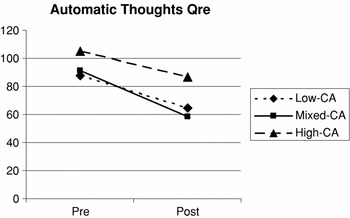
A similar pattern of results was found for the measures of negative cognition. A two-way repeated measures ANOVA on the ATQ found a significant main effect for treatment, F (1,67) = 45.86, p < .001, indicating that all groups showed a reduction in automatic thoughts over the course of treatment (Figure 1); however, there was no main effect of group and no significant group by time interaction. The same pattern of results was found for the DAS, with a significant main effect for treatment, F (2, 67) = 31.32, p < .001, indicating that all groups showed significant reduction in dysfunctional attitudes over the treatment period. No group effect and no group by time interaction was found. Finally, levels of hopelessness measured by the BHS reduced in all groups over the treatment period, F (1, 67) = 50.05, p < .001. There was no significant main effect for group, and no significant group by time interaction.
Mean scores on the Automatic Thoughts Questionnaire for the Low-catecholamine, Mixed-catecholamine and High-catecholamine patients at pre- and post-therapy

Discussion
Results from the current study showed that despite the fact that the high catecholamine excreting participants were more depressed throughout the CBT treatment, the rate at which their mood improved was equal to the mixed and low catecholamine excreting participants. Furthermore, the high catecholamine excreters improved in measures of negative thinking at the same rate as other participants. This was the case for surface level thoughts (automatic thoughts), hopeless thoughts, and deeper level dysfunctional attitudes. The findings indicate that patients with evidence of depression-related catecholamine dysfunction responded well to a GCBT program that targeted their psychological functioning. Extrapolating from the results of this study, it appears that high catecholamine excreters require longer (than 12 sessions) in therapy to reach a non-clinical mood state. These results have important theoretical implications for the understanding of depression, as they are consistent with previous research that supports an interactive model of biochemical and cognitive variables in depression (Oei and Dingle, Reference Oei and Dingle2001). Furthermore, the findings help to clarify the guidelines for the treatment of depression given by the American Psychiatric Association (Fochtmann and Gelenberg, Reference Fochtmann and Gelenberg2005) in that it is shown that elevated catecholamine levels are not associated with a poor response to CBT for depression. Further research is required to replicate the results of this study, and to address the limitation of the small sub-sample with high catecholamine excretion in this study.




Comments
No Comments have been published for this article.