Most of the literature on child maltreatment and victimization focuses on separate, fairly narrow categories of experiences, such as sexual abuse, physical abuse, bullying, or dating violence. However, there are many reasons to believe that children who suffer one of these victimizations also suffer from others (Saunders, 2003). First, the sheer frequency of victimizations in childhood suggests some of these victimizations should overlap (Nishina & Juvonen, 2005). Second, many of these victimizations seem to have common risk factors, like family instability and family substance abuse. Third, the clustering of victimization among some high risk individuals is a well-established finding in the study of crime victimization among adults (Outlaw, Ruback, & Britt, 2002; Saunders, 2003).
Unfortunately, studies of children rarely assess the intersection of a broad range of victimization, tending to constrain themselves to narrow categories like school victimization, family victimization, or exposure to community violence. Moreover, to the extent that the literature has been interested in the intersection of victimizations, it has been the intersection of only a few victimization types (e.g., sexual abuse and rape), and frequently has considered these events only at widely displaced points in time (Messman & Long, 2000).
Using an instrument designed to assess a much more comprehensive range of childhood victimizations, the Juvenile Victimization Questionnaire (JVQ; Hamby, Finkelhor, Ormrod, & Turner, 2004a), we have demonstrated that multiple contemporaneous victimization is the norm for victimized children (Finkelhor, Ormrod, & Turner, in press-a). Half of a national sample of youth ages 2–17 experienced two or more different kinds of victimization over the course of a single year, and among victims, the median number of victimizations was 3.
The clustering of victimizations almost certainly has multiple explanations. There are common risk factors for different kinds of victimization, both in children's environments (families and neighborhoods) as well as in their personal and behavioral characteristics. It is also very likely the case that some victimizations create vulnerability for other victimizations, through mechanisms like lowered self-esteem, learned helplessness, and distorted cognitions. In the criminology literature these two particular classes of explanation have been contrasted with the terms: “population heterogeneity” versus “event dependence.” In more colloquial terms, these have been described as “flags” (of enduring risk) versus “boosts” (increased vulnerability resulting from victimization; Tseloni & Pease, 2003). Unfortunately, neither set of terms seems well designed as descriptions of the process or as mnemonic devices. Instead of contrasts between these two large categories of explanation, what is more needed is evidence about specific mechanisms and pathways that lead to high levels of victimization exposure (Finkelhor, Ormrod, & Turner, in press-b). An example is Perry, Hodges, and Egan (2001), who give an account of how cognitive schemas acquired in aggressive family interactions create a vulnerability for extrafamilial victimization. The “ecological–transactional” model in child development has also been used by several authors to explain how mechanisms at different ecological levels promote the simultaneous development of child maltreatment and exposure to community violence as well as the contagion from one form of victimization to another (Cicchetti & Lynch, 1993; Lynch & Cicchetti, 1998; Overstreet & Mazza, 2003).
The evidence about the frequency and conceptual importance of intersecting victimizations draws attention to important conceptual and methodological weaknesses that plague much of the research on child maltreatment and child victimization. Typical studies that look at only one kind of victimization, like sexual abuse, bullying, or exposure to dating violence, generally fail to assess how much other victimization these narrowly categorized victims have also experienced. In efforts to examine trauma and other negative consequences from victimization, this can lead to a serious overestimation of the impact of individual victimization experiences, because much or all the trauma may be related to the other victimizations or the combination, rather than individual victimization (Saunders, 2003).
In our earlier study, in fact, we found that when other victimizations were accounted for, the effect of individual victimizations virtually disappeared (Finkelhor et al., in press-a). Thus, although, as in a typical multivariate assessment, sexual victimization was highly predictive of psychological symptoms, when the multiple victimizations were controlled, there was no significant contribution of sexual victimization by itself. This meant that the youth who were experiencing multiple victimizations were the ones manifesting the traumatic responses, whereas youth with just a single type of victimization had much less or in some cases no detectable trauma.
The conceptual issue that parallels the methodological problems concerns whether victimization is best thought of for some children as a condition rather than an event. Much of the literature on victimization impact grows out of a theoretical framework based on the concept of traumatic stress (Finkelhor, 1988), which began with observations of rape victims (Burgess & Holmstrom, 1975). The prototypical traumatic victimization in this literature was a terrifying, unpredictable event, occurring to an otherwise unsuspecting and unafflicted person. However, the literature on victimization in childhood has painted a much more complicated picture of many victimized children, who suffer from not an individual traumatizing event but from a pattern of on-going and multiple victimizations (Clausen & Crittenden, 1991; Duncan, 1999a, 1999b; Perry et al., 2001). For such children, victimization may be better conceptualized as a condition. Assessing multiple types of victimization may be important for distinguishing this group for whom victimization has become a condition.
We have coined the terms polyvictim and polyvictimization (PV) to draw attention to this multiply victimized group of youth who experience so much victimization, so much of the serious victimization, and who manifest so much of the traumatic symptomatology. The findings about the serious consequences of multiple victimization parallel work done on intersecting adversities in other fields, such as substance abuse and mental health, which have led to useful concepts such as dual diagnosis, comorbidity (Sacks, 2003), and polydrug use (Bower, 1985; Kaufman, 1977).
As Rutter (1983) and others have pointed out, cumulative, threshold and synergistic effects are relatively common in the research on stress, adversity, and psychopathology. That is, stresses and adversities combine and interact in important and different ways. Unfortunately, many of the mechanisms behind such effects are not always clear, and have not generally been delineated. It is not always or only the case that each bad thing makes the experience of childhood a little bit worse. Some adversities may potentiate the bad effects of other adversities. In addition, children may have resilience and coping mechanisms that are adequate to deal with stressors up to a threshold, after which the stresses take a toll.
Several mechanisms may account for the effect of PVs. For example, self-blame seems to be an important component to victimization trauma (Mannarino & Cohen, 1996). It may be that children have a much harder time resisting this negative self-attribution when they experience victimization from multiple sources. Another possibility is that because victimization is so common, children do not see themselves as deviant or disadvantaged on this dimension, unless they are experiencing multiple sorts of victimization. A recent study suggested that seeing other children being victimized actually serves as a buffer against humiliation and anger, perhaps because it helped children discount their personal culpability and deviance (Nishina & Juvonen, 2005).
One of the curious findings from our previous work was that PV was associated with considerably more severe symptoms than repeated or chronic victimizations of the same sort (Finkelhor et al., in press-a). One interpretation could be that the generalization of self-blame or other inadequacy may be easier for children to make when victimizations occur in more disparate contexts, in different ways and at the hands of more diverse categories of offenders.
Unfortunately, there is very little research on the characteristics of children who suffer from PV. In our prior research we reported that in addition to the large number and severe nature of their victimizations, such children were also characterized by an unusual number of other adversities. They were more likely to come from single-parent or stepparent families, but were not strongly differentiated by race, gender, or socioeconomic status (SES; Finkelhor et al., in press-a).
One of the limitations of our earlier analyses of PV, however, was that the research was cross-sectional and not longitudinal. This prevented us from excluding two important potentially confounding factors in the understanding of PV: prior victimization and prior traumatic symptoms. The first concerns the contribution of earlier lifetime victimization experiences to the impact of later victimizations. Many of the children who were victimized during the span of an individual year almost certainly had victimization experiences prior to that time. When we found in our cross-sectional study that PV in the last year overrode the impact of individual victimizations in the last year, we could not control for such differential prior victimization histories that might have explained the findings.
A second limitation of our prior analysis, shared by virtually all victimization impact research, was its failure to account for previctimization symptomatology. There is a strong likelihood that negative mental health conditions and other problems thought to be consequences of victimization are rather often the precursors or causes of victimization. Thus, depressed, anxious or angry people may be more likely to get victimized, for a variety of reasons, including impairments of their self protective capacities or risky behavior patterns. Their preexisting condition may explain some or all of the association between victimization and symptoms. In one study that did address this issue, Boney-McCoy and Finkelhor (1996) found that, although preexisting distress did not fully explain the association between victimization and subsequent symptoms, it did greatly temper the association.
The present study is an effort to extend the earlier work on PV by taking into account a longitudinal dimension. It is based on a national sample of youth for whom we have 2 years of mental health measures, as well as recent and lifetime victimization assessments. Drawing on our earlier work, we propose the following hypotheses:
- Hypothesis 1: recent PV is associated with a net decline in mental health status controlling for a wide variety of prior adversities and prior victimizations.
- Hypothesis 2: recent PV is associated with considerably more of a net decline in mental health status than recent episodes of individual types of victimization assessed independently.
- Hypothesis 3: Although individual recent victimization types appear to be associated with a decline in mental health status even controlling for prior victimizations and adversities, the contribution of most individual victimization types disappears when current PV status is taken into account.
- Hypothesis 4: PV is a stronger predictor of a net decline in mental health indicators than a variety of presumed other victimization severity indicators like injury or the presence of a weapon. (This hypothesis is based on the idea that it is not so much individual episode characteristics, as in the traumatic stress events model, that predict harmfulness, but rather it is a condition of generalized victimization exposure.)
Methods
Participants
This research uses data from the Developmental Victimization Survey, a longitudinal study designed to assess a comprehensive range of childhood victimizations across gender, race, and developmental stage. Analyses are based on a sample of 1467 respondents who participated in two waves of data collection obtained approximately 1 year apart.
The first wave (Wave 1) of the survey, conducted between December 2002 and February 2003, assessed the experiences of a nationally representative sample of 2030 children age 2–17 living in the contiguous United States. Interviews with parents and youth were conducted over the phone by the employees of an experienced survey research firm specially trained to talk with children and parents. Telephone interviewing is a cost-effective methodology (Weeks, Kulka, Lessler, & Whitmore, 1983) that has been demonstrated to be comparable in reliability and validity with in-person interviews, even for sensitive topics (Bajos, Spira, Ducot, & Messiah, 1992; Bermack, 1989; Czaja, 1987; Marin & Marin, 1989) and even under recent conditions of the changing telecommunications environment (Curtin, Presser, & Singer, 2005; Keeter, Miller, Kohut, Groves, & Presser, 2000). The methodology is also used to interview youth in the US Department of Justice's National Crime Victimization Survey (Bureau of Justice Statistics, various years), and in a variety of other epidemiological studies of youth concerning violence exposure (Hausman, Spivak, Prothrow-Stith, & Roeber, 1992).
The sample selection procedures were based on a random digit dial telephone survey design. A short interview was conducted with an adult caregiver (usually a parent) to obtain family demographic information. One child was randomly selected from all eligible children living in a household by selecting the child with the most recent birthday. If the selected child was 10–17 years old, the primary interview was conducted with the child. If the selected child was 2–9 years old, it was conducted with the caregiver who “is most familiar with the child's daily routine and experiences.” Caregivers were interviewed as proxies for this younger age group because the ability of children under the age of 10 to be recruited and participate in phone interviews of this nature has not been well established, yet such children are still at an age when parents tend to be well informed about their experiences both at and away from home. In 68% of these first wave caregiver interviews, the caregiver was the biological mother, in 24% the biological father, and in 8% some other relative or caretaker.
Up to 13 callbacks were made to select and contact a respondent, and up to 25 callbacks were made to complete the interview. Verbal consent was obtained prior to the interview. In the case of a child interview, verbal consent was obtained from both the parent and the child. Respondents were promised confidentiality, and were paid $10 for their participation. Children or parents who disclosed a situation of serious threat or ongoing victimization were recontacted by a clinical member of the research team, trained in telephone crisis counseling, whose responsibility was to stay in contact with the respondent until the situation was resolved or brought to the attention of appropriate authorities. Recontacting occurred in fewer than 1% of all interviews in Waves 1 and 2. All procedures were authorized by the Institutional Review Board of the University of New Hampshire. Data were collected using a computer-assisted telephone interview (CATI) system. The use of CATI minimizes recording errors and provides substantial quality control benefits. Only interviewers with extensive experience interviewing children and in addressing sensitive topics were chosen. Interviewers then went through extensive training on the questionnaire and interview protocol. The final Wave 1 sample consisted of 2030 respondents: 1000 children (age 10–17) and 1030 caregivers of children age 2–9. Interviews were completed with 79.5% of the eligible persons contacted. Child refusals constituted 16% of all refusals, parents prevented access to youth for 14% of all refusals, and the rest (70%) were cases of parents unwilling to participate.
Wave 2 of the survey was conducted between December 2003 and May 2004, approximately 1 year after the baseline interview (the mean number of months between interviews was 12.8, with a standard deviation of 1.1). The same careful interviewing procedures and human subjects' protocol used in Wave 1 were implemented in this second wave of data collection. Although some of the interviewers were the same as in Wave 1, no effort was made to rematch interviewers and interviewees.
Respondents were again paid $10 for their participation. A total of 1467 respondents (72.3% of the baseline sample) were reinterviewed in Wave 2.
All Wave 1 questions about victimization types and circumstances were repeated in Wave 2 to ensure that comparable data were collected for the 2 years surveyed. Information on children who were 9 years old and younger in Wave 1 was gathered through the same proxy interview procedures in Wave 2. Further information about the child's behavior, attitudes, and emotional status, the child's family, living circumstances, nonvictimization experiences, and other characteristics were gathered by additional questions. Some of these additional questions were repeated in both Wave 1 and Wave 2, and some were unique to a single interview wave. Interviews lasted an average of 37 min in Wave 1 and 50 min in Wave 2.
Attrition analyses show that respondents lost to follow-up were more likely to be Hispanic, lower in SES (as assessed by a composite of income and parent education), and younger (i.e., children in the 2- to 9-year-old sample). However, there were no significant differences between Wave 2 respondents and those lost to follow-up on level of victimization reported at baseline. The disproportionate loss of Hispanic and low SES respondents more often occurred among lower risk respondents.
Poststratification weights were applied to adjust the sample identified in Wave 1 for race and Hispanic ethnicity proportion differences between our sample and national statistics. Weights were also applied to adjust for within household probability of selection due to variation in the number of eligible children across households and the fact that the experiences of only one child per household were included in the study. The use of these weights was continued with Wave 2 data.
Measurement
Victimization
Victimization exposure was obtained using the JVQ (Hamby et al., 2004a). The JVQ was designed to be a more comprehensive instrument than has typically been used in past research, screening for 34 specified victimizations that cover five general areas of concern: conventional crime, child maltreatment, peer and sibling victimization, sexual assault, and witnessing and indirect victimization (Hamby, Finkelhor, Ormrod, & Turner, 2004b; Appendix A). Follow-up questions for each screener item gathered additional information needed to describe events in greater detail, including perpetrator characteristics, the presence of a weapon, whether injury resulted, and whether the event occurred jointly with another screener event. Although there is some concern about whether caregivers have adequate knowledge about child victimizations, comparison of caregiver and youth reports suggest no systematic underreporting by caregivers for younger children (Finkelhor, Hamby, Ormrod, & Turner, 2005a).
Six aggregate victimization categories were also constructed from the Wave 2 screener responses, indicating whether respondents were exposed to any victimization within each category: sexual victimization, maltreatment, property victimization, physical assault, peer/sibling victimization, and witnessed/indirect victimization.
A multiple victimization measure was also developed that summed the number of different forms of victimization across all 34 specific types in Year 2. Multiple victimization was defined as the number of victimizations of a different type (a different screener) occurring as part of a separate incident (separate time and place of occurrence) during the Year 2 data collection time frame. Children with higher levels of multiple victimization were labeled as “polyvictims” (children with 4 or more different types within the same year; that is, those above the Year 1 average of 3). The development and utility of this PV measure is discussed in more detail elsewhere (Finkelhor et al., in press-a). Although all victimization items were given an equivalent weight, tests of differential weighting of the items did not produce measurably different results (Finkelhor, Ormrod, Turner, & Hamby, 2005b).
Finally, a summary measure of lifetime victimization was constructed to account for all victimizations that occurred prior to the Year 2 study period. These included all Year 1 victimizations, as well as any pre-Year 1 victimizations reported in the Wave 1 interview. All Wave 1 interviewees had been asked about past year victimizations as well as victimizations prior to that year using the same screening questions. The lifetime victimization measure was simply the sum total of separate screener endorsements (affirmative responses) that occurred in regard to either Year 1 or earlier. Although not all these were temporally separate incidents, this measure is similar to the Year 2 multiple victimization measure defined above in that it assessed the number of different types of victimizations a child experienced within the defined time period.
Child mental health
A primary goal of this study was to assess the effects of victimization on children's mental health. Mental health status was measured through the use of trauma symptom scores for the anger, depression, and anxiety scales of two closely related measures: the Trauma Symptoms Checklist for Children (TSCC; Briere, 1996), which was used with the 10- to 17-year-old self-report interviews, and the Trauma Symptom Checklist for Young Children (TSCYC; Briere et al., 2001), used in the caregiver interviews for the 2- to 9-year-olds. All item responses for the three scales together were summed to create an aggregate trauma symptom scores. Up to three missing individual item responses were replaced with the case's mean for the remaining nonmissing responses. Replacement affected 4% of the 2- to 9-year-olds' scores and less than 1% of the 10- to 17-year-olds' scores. Because the specific items for each age group differed, a child trauma symptom score was created for the 2- to 9-year-olds and a youth trauma symptom score for the 10- to 17-year-olds. Although the items differed, the mean trauma symptom scores for younger and older children were similar (35.1 for 2- to 9-year-olds, 34.8 for 10- to 17-year-olds). Older youth showed somewhat more variation in scores than younger children, with standard deviations of 9.1 and 6.9, respectively.
The TSCC and TSCYC items were repeated for both Wave 1 and Wave 2, allowing the construction of symptom scores for each of the 2 years. All components of the TSCC have shown very good reliability and validity in both population-based and clinical samples (Briere, 1996). Although more recently developed, the TSCYC caregiver report has also shown good psychometric properties (Briere et al., 2001). In the present study, the TSCC α coefficients are .92 for both the Wave 1 and Wave 2 youth trauma symptom items, whereas the TSCYC α coefficients are .86 for both the Wave 1 and Wave 2 child trauma symptom items.
Victimization character
In addition to identifying specific types of victimization (described above), a number of variables, based on follow-up questions to the screeners, were constructed that captured details of the victimizations suffered in Year 2. These included whether an injury or weapon was part of any reported victimization, and whether there was chronic victimization of any one type (defined as at least 10 repeat victimizations of the same type in the past year—a threshold that identifies the upper quartile of children in the sample in terms of number of repeat victimizations). These variables were used to reflect dimensions of victimization severity.
Nonvictimization adversity
Nonvictimization adversity, another possible influence on child mental health, was assessed by a comprehensive measure that included 15 nonviolent traumatic events and chronic stressors. Items included were serious illnesses, accidents, parent imprisonment, and natural disasters, substance abuse by family members, parental arguing, and chronic teasing about physical appearance. If a specific stressor had been experienced or was present at least once in the respondent's lifetime (prior to the Wave 2 study period), it was given a code of 1. A lifetime adversity score was constructed by summing the total of trauma events and stressors endorsed. Higher scores indicate greater exposure to different forms of adversity.
Sociodemographic factors
All demographic information was obtained in the initial parent interview in Wave 1, including the child's gender, age (years), and race/ethnicity (coded into four groups: White non-Hispanic, Black non-Hispanic, other race non-Hispanic, and Hispanic any race). SES is a composite based on the sum of the standardized household income and standardized parental education (for the parent with the highest education) scores, which was then restandardized. In cases where the data for one of the SES indicators (most often income) was missing, the SES score was based on the standard score of the remaining indicator.
Type of place discriminated among children living in (a) a large city (population over 300,000), (b) a small city (population about 100,000–300,000), or (c) a suburb, small town, or rural area. Family structure was defined by the composition of the household reported in Year 1. Specifically, three household types were identified, those with (a) two biological or adoptive parents, (b) one biological parent plus partner (spouse or nonspouse), and (c) single biological parent or other caregiver.
Data Analysis
Because the focus of this research was to separate out the effect of PV (high levels of multiple victimization) on child well-being, we identified associations between PV and other possible predictor variables whose effects might be confounded with PV. To illustrate potential sociodemographic differences in tabular format, the rate of polyvictims (defined as four or more victimizations in the present year) were calculated for various subgroups. PV was represented as a continuous measure of the number of Year 2 victimizations in bivariate correlations and regression analyses with children's trauma symptoms (measured at Year 2). Because the trauma symptom measures were different for younger children and older youth, two sets of correlations were calculated: one for the 2- to 9-year-olds, the other for the 10- to 17-year-olds. Comparison of the victimization data from the self-reports of the 10- to 17-year-olds and proxy reports for the younger children suggested an equivalent level of validity (Finkelhor et al., 2005a).
A number of the possible predictor variables, including sociodemographic measures, lifetime adversity score, Year 1 trauma symptom score, lifetime victimization score, and number of Year 2 victimization incidents (PV) were then entered into two age-specific multiple regression models predicting Year 2 trauma symptom score. These initial multivariate models act to isolate the effect of PV on symptoms when a large number of other important factors are controlled.
To further compare the relative contribution of specific victimization types and the total level of victimization or PV, each Year 2 aggregate victimization measure and each Year 2 victimization characteristic was then added individually to the initial age-specific multivariate models. These further models allowed a direct comparison of the effects of PV on child well-being when each additional factor was included. All analyses were conducted with SPSS 8.0.
Results
Multiple victimization during a single year was a common experience for children in this national sample. Of the 70% who had experienced any victimization during the present year, 64% had experienced at least one additional, different kind of victimization during the same year. The mean number of different kinds of victimization was 2.8, with a range that extended to 16. Children who had experienced four or more victimizations during the year, whom we have termed the polyvictims, constituted 18% of all the children assessed in this year and 26% of all victims (Table 1). (Four or more was chosen as the cutoff based on Year 1 analyses showing that this represented children with above the mean [3.0] numbers of victimizations.)
Levels of polyvictimization among children with various types

Children with certain kinds of victimization were particularly likely to have other additional kinds of victimization (Table 1). Thus, of those reporting a sexual victimization during the present year, 94% had other different kinds of victimizations in the same year and 73% were in the polyvictim category, meaning they had four or more. The mean number of present year victimizations (of a different sort) among those with any sexual victimization was 6.0. The mean number of different present year victimizations for children who reported some type of child maltreatment was 5.7. This illustrates how important it may be to assess children with one kind of victimization for the possibility of additional victimizations.
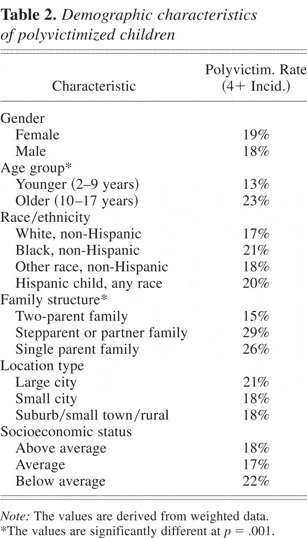
The polyvictimized children had a very diverse and serious array of victimizations. Thirty-five percent had a sexual victimization during the year, 37% a form of maltreatment, and 39% a victimization resulting in an injury. Seventy percent had both family and nonfamily perpetrators, 53% had both peer and adult perpetrators, and 72% both male and female perpetrators. The polyvictimized children were not distinguished by their gender, ethnicity, place of residence, or interestingly, SES (Table 2). However, they were older than the other children and more likely to live in a single-parent or stepparent family. They also reported considerably more nonvictimization, adverse life events such as illnesses, accidents, and family problems, as indicated by a correlation between PV and lifetime adversity of .36 (p < .001). Although there were polyvictims at every developmental level, the percentage increased with age from 12% for the 2- to 5-year-olds, to 14% for the 6- to 9-year-olds, to 22% for the 10- to 13-year-olds, and 24% for the 14- to 17-year-olds.
Demographic characteristics of polyvictimized children

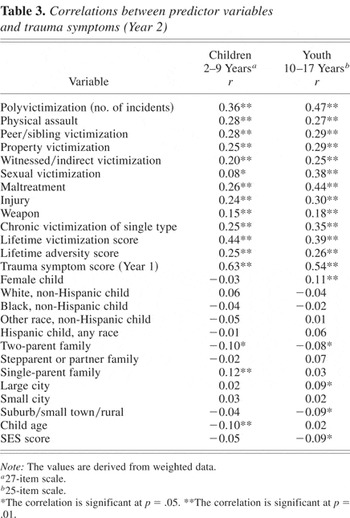
PV, measured continuously by the total number of different victimization incidents, was strongly correlated with trauma symptoms for both the younger children, ages 2–9, and older youth, ages 10–17 (Table 3: two age groups were analyzed separately because of somewhat different trauma symptom measures). However, all forms of present year victimization were associated with trauma symptoms (although not so strongly as PV), as was lifetime victimization prior to the present year. This illustrates that, consistent with so much of the previous literature, victimizations measured individually or collectively, in the present or in the past, tend to be associated with distress measures. Two potential confounding factors were also associated with trauma symptoms: lifetime adversities, and the level of trauma symptoms measured a year earlier. Illustrating the point that children with more symptoms to start with are then more likely to be victimized, the correlations between prior symptoms and subsequent victimization was .31 (p < .001) for the younger children and .41 (p < .001) for the older children (not shown in Table 3). Most of the demographic factors were only weakly correlated with trauma symptoms.
Correlations between predictor variables and trauma symptoms (Year 2)

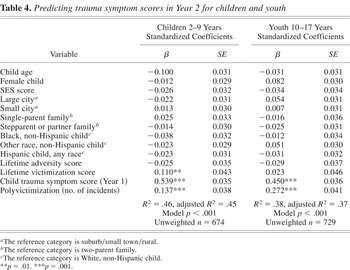
PV in the present year was associated with a worsening in symptoms net of all these other factors. In a multiple regression analysis (Table 4), PV in the present year predicted trauma symptoms while controlling for prior symptoms, prior victimization, and other life adversities, as well as basic demographic factors. The prediction was particularly strong for the older children, for whom prior victimization and prior adversity made no contribution in the multivariate model. Further analysis, based on models using narrower age ranges (not shown), also provided evidence that the effect of PV on trauma symptoms grew stronger with increasing age: 2- to 5-year-old β = .113 (.05), 6- to 9-year-old β = .184 (.06), 10- to 13-year-old β = .251 (.06), and 14- to 17-year-old β = .311 (.06). The use of different trauma symptom measures for different age groups (2- to 9- vs. 10- to 17-year-olds), as well as separate age-based samples, precluded testing these differences for significance.
Predicting trauma symptom scores in Year 2 for children and youth

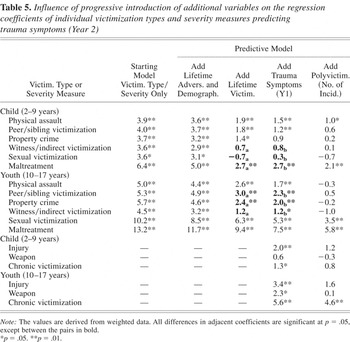
Table 5 illustrates the importance of the PV in comparison to the influence of individual victimization types. The first column in Table 5, for example, shows the bivariate association between individual types of victimization, like physical assault or sexual victimization, and trauma symptoms. Then, subsequent columns show how the progressive addition of various other variables to the model reduced the original association. All the changes in adjacent coefficients between columns 2 and 3, 3 and 4, and 4 and 5 were assessed for significance using a method described by Holmbeck (2002), and are significant unless otherwise indicated. Thus, for physical assault in the present year among youth, the originally strong coefficient (5.0) is reduced a bit by the entry of lifetime adversities and other demographic variables, a substantial amount by the entry of prior lifetime victimization, still more by the entry of prior year symptoms, but then reduced to virtually zero (−0.3) after the entry of PV.
Influence of progressive introduction of additional variables on the regression coefficients of individual victimization types and severity measures predicting trauma symptoms (Year 2)

The reductions are most dramatic for the youth models. Although all individual forms of victimization remained significantly associated with trauma symptoms in Model 4 after controls for prior adversity, prior victimization, and prior trauma symptoms, the addition of PV in the final model, however, significantly reduced all the associations, leaving four of them indistinguishable from 0. Notably, the two that remained significantly associated with symptoms were present year sexual victimization and present year child maltreatment. In both cases, however, the various additions to the models reduced the coefficients by more than half over their original bivariate level.
In the models for children (2–9), the coefficients for individual victimization types were also all significantly reduced by the entry of PV (Table 5, column 5). Several of these coefficients were not significantly different from 0 after the entry of lifetime victimization and prior trauma symptoms. Two of them, maltreatment and physical assault, remained significant, however, even after the introduction of PV.
Table 5 includes a section testing whether several indicators of victimization seriousness continued to be associated with trauma symptoms when PV was controlled. In the models for children (2–9), none of the seriousness measures were significantly different from 0 after controlling for PV. However, for youth (10–17), one of the seriousness measures, whether an individual form of victimization was repeated on a chronic basis during the course of the year, did remain powerful and significant even after controlling for PV. Thus, even though chronic victimization (number of repeat victimizations of the same sort) was moderately correlated (r = .64, p = .000) with PV (number of separate incidents of different kinds of victimization), chronic victimization exercised an independent effect on trauma symptoms.
Discussion
Children who experienced many different kinds of victimization within a single year, or what we call polyvictims, made up 18% of a general population sample of children. Moreover, polyvictims comprised a large percentage of children who screened positive for many kinds of victimization, such as sexual abuse. These polyvictimized children tended to have more serious victimizations than other child victims, and also have more nonvictimization adversities than other children.
PV within a 1-year period was also associated with a net increase in trauma symptoms during that period. Moreover, it was the strongest victimization-related variable associated with this increase. This suggests how important and valuable it can be to assess children for their full range of victimizations. The PV rate was particularly high among very symptomatic children. For example, in Year 1, 86% of the children in the clinical range on the depression measure qualified as polyvictims. This additionally underlines the importance of assessing for PV among symptomatic children.
Moreover, this study illustrates why it is important to assess for and take into account additional kinds of victimizations in the study of any particular victimization. Because many children who are sexually victimized, for example, are experiencing other contemporaneous victimizations, the associations between that individual victimization and an outcome measure can be inflated by these additional victimizations, if they are not accounted for (Lynch & Cicchetti, 1998). In our analyses, when PV was taken into account, it generally resulted in a substantial reduction, or in some cases the elimination, of the association between the individual victimization and the outcome. This suggests that the existing research on individual types of victimization, to the extent that it has not accounted for PV, may have to some degree exaggerated the strength and consistency of the association of symptoms with individual victimizations. This does not mean that individual victimizations have no impact (assuming the associations imply some causal connection). However, the dramatic elevations that are often found among such victimized children may actually be the result of an accumulation of victimizations (many of which have not been assessed in previous studies).
This study also provides a perspective on another important confounding variable in victimization impact studies: preexisting symptoms. Although in traumatic stress theory, stressful events cause traumatic symptoms, there are also good theoretical reasons to presume that previously symptomatic individuals will encounter more stressors and be vulnerable to more victimization in particular (Lynch & Cicchetti, 1998). This raises the question of how much the association between victimization and trauma symptoms may be a spurious effect of preexisting symptoms. Unfortunately, very few studies of the impact of traumatic stressors have had good measures of preexisting symptoms. The longitudinal design of the current study has established that prior symptoms are bivariately associated with subsequent victimization risk (Finkelhor et al., in press-b). The current analyses showed, however, that accounting for these prior symptoms reduced somewhat but did not eliminate the association between victimization and later symptoms. This clearly demonstrates that victimization-symptom associations are not a spurious effect of prior symptoms.
This study also offers some perspective on the relative contribution of current versus past victimizations to mental health symptoms. For younger children, lifetime victimization prior to the present year made an independent contribution to current trauma symptoms. However, for older children, victimizations prior to the present year provided no additional predictive power over and above what was predicted by present year victimization. One possible explanation of this divergence across age groups is the different temporal proximity of the prior victimizations. For older children, more of the prior victimizations will have occurred in the more distant past, and because of its temporal remoteness may have less influence on the present. Hence, for that group, prior victimization is not a significant predictor. Another explanation could be that victimizations at a younger age are more consequential, but they are being underreported by the older youth whose memory window is constrained to more recent events.
It should be noted, however, that prior victimization among older youth, even though it had no independent predictive power in the ultimate multivariate analysis, did nonetheless show initially a strong bivariate association with current trauma symptoms. This corresponds to the finding of many studies of teenagers or adults that ask about lifetime victimization histories and find that they have strong associations with current symptoms or adjustment. These studies often do not offer any theory about how such distant events contributed to current functioning. The present study suggests that past victimization has much of its primary effect indirectly by leading to a cascade of adversities, symptoms, and subsequent victimizations that end in high levels of current victimization, a life course perspective proposed by Browning and Laumann (1995) in relation to sexual abuse (see also, Noll, Horowitz, Bonanno, Trickett, & Putnam, 2003). It raises the question of whether victimization impact studies should do a better job of distinguishing the contribution of recent from that of past victimization. The disentangling of these direct and indirect effects, and the ultimate influence they assign to long past victimization events, has important implications for both treatment and prevention, and the extent to which both screening and intervention should primarily focus on current victimization. The need for such disentangling is an important argument for more longitudinal research. The current study's two waves of information are not sufficient to adequately represent what are certainly complicated sequences.
Although this study does confirm the findings of our earlier cross-sectional analysis about the important contribution of PV in comparison to individual victimization types, it also, unlike the earlier analysis, gives support to the more conventional emphasis that certain individual forms of victimization like sexual victimization and child maltreatment may be particularly traumatic. In the multivariate models, the occurrence of current year child maltreatment both for younger and older children, made an independent contribution to symptoms over and above PV. Current year sexual victimization also made an independent contribution over and above PV, but only for the older youth. (The absence of a finding for younger children may be due to the very small numbers of sexual victims in the younger sample, and the fact that caregivers, who provided the information for younger children, may not have been aware of sexual victimization; see Finkelhor et al., 2005a.) This is consistent with a clinical perspective that child maltreatment and sexual victimization are particularly high impact forms of child victimization. It also raises the possibility that these kinds of victimization may serve as “gateway” victimizations that inaugurate a heightened level of the exposure to victimization in general.
Although this study has a number of strengths including its large national sample, its longitudinal design, and its well-developed instrumentation, there are important limitations that need to be kept in mind in interpreting its findings. The study was done with only English-speaking families (3.4% of screenings in Wave 1 were not completed because of language barriers), so the findings may not generalize to other cultural groups. Although its longitudinal design and large number of variables allow the exclusion of some spurious relationships, it is possible that methodological factors or unmeasured variables may explain some of the findings. For example, about a quarter of the original sample was unavailable for follow-up, and patterns of attrition could affect the findings. In addition, associations between PV and symptoms could possibly be explained by some respondents' unmeasured proclivity to respond more thoroughly to both inventories of victimization and symptomatology.
In addition, the time frame within which victimization was measured for this study was 1 year. This is a long time period to recall victimizations of some types and their frequencies, like bullying or sibling assault, but it is also a short time period to estimate other less frequent victimizations. There was almost certainly considerable underreporting of some kinds of victimizations, due to a combination of forgetting and embarrassment, as well as overreporting due to telescoping. It is very likely that parent interviewees underreported maltreatment that they themselves have inflicted. One possible threat to the validity of findings from this study would occur if distressed and/or victimized children (or their caregivers) were more likely to overreport victimizations because of some sensitization mechanisms. Another limitation of the study is that some of the most severe kinds of child victimizations, like sexual assaults, are relatively rare in the sample, and typically occur in conjunction with high levels of PV. As a result, it was hard to assess the individual impact of such victimizations independently of PV.
Conclusion
This study has confirmed the important role that PV plays in the understanding of child victimization trauma. Research and clinical work now need to explore the experiences of these multiply victimized children in more detail. More needs to be understood about how children come to this highly victimized condition. Additional insights about the backgrounds and characteristics of PV children in the sample are available in other articles (Cuevas, Finkelhor, Turner, & Ormrod, in press; Finkelhor et al., in press-b).
Different literatures have emphasized different processes in explaining multiple victimization. Some have tended to emphasize how family influences, including attachment and childrearing patterns, set up internalized cognitive “victim schemas” in some children (Perry et al., 2001). Some have emphasized the debilitating and disorienting emotional effects of victimization that undermine self-protective capacities (Scott, Wolfe, & Wekerle, 2003). Still others highlight the high-risk activities and social environments that typify some youth (Lauritsen & Quinet, 1995; Outlaw et al., 2002). All such influences have empirical support, but none is likely to be a sufficient explanation alone, given the diversity of contexts in which PV occur.
To answer these kinds of questions, more efforts need to be made to identify the polyvictimized youth in research and clinical samples of children. Although the JVQ provides several possibilities for such identification (Finkelhor et al., 2005b), a great deal more work could be done on the best way to assess and describe this high-risk group. In particular, there may be a considerable amount to be learned from clinical samples, which include a high density and variety of such youth.
In addition, efforts need to be made to rethink prevention and intervention programs in light of findings about PV. Much of child victimization prevention, for example, is organized around distinct forms of victimization such as bullying prevention (Olweus, 1991; Wurtele, Kast, & Melzer, 1992), sexual abuse prevention (Downer, 1986; Wurtele et al., 1992), and dating violence prevention (Avery-Leaf, Cascardi, O'Leary, & Cano, 1997; Lavoie, Vezina, Piche, & Boivin, 1995; Macgowan, 1997). Perhaps many of these programs are generic enough to provide protection against multiple forms of victimization. However, it is also possible that such programs fail to provide broad protection, and may also be particularly ineffective for children and youth with extremely high levels of victimization exposure. Similarly, many of the empirically supported intervention programs for victimized children target relatively narrow victim groups, such as sexually abused children (Cohen & Mannarino, 1997, 1998) or children who witnessed domestic violence (Graham-Bermann & Hughes, 2003). Are such programs successful with polyvictimized children in their current formats, or is an enhanced format needed to accommodate such children? To prevent child victimization and its various consequences, it may be very important to rethink conventional approaches that target narrow victim populations to see how they might be able to assist some of the most vulnerable and victimized children in the population.
AppendixAppendix A: JVQ: Basic Screen Questions, Child Self-Report Version
Now we are going to ask you about some things that might have happened in the last year.
Module A: Conventional crime
C1. Robbery
In the last year, did anyone use force to take something away from you that you were carrying or wearing?
C2. Personal theft
In the last year, did anyone steal something from you and never give it back? Things like a backpack, money, watch, clothing, bike, stereo, or anything else?
C3. Vandalism
In the last year, did anyone break or ruin any of your things on purpose?
C4. Assault with weapon
Sometimes people are attacked WITH sticks, rocks, guns, knives, or other things that would hurt. In the last year, did anyone hit or attack you on purpose WITH an object or weapon? Somewhere like: at home, at school, at a store, in a car, on the street, or anywhere else?
C5. Assault without weapon
In the last year, did anyone hit or attack you WITHOUT using an object or weapon?
C6. Attempted assault
In the last year, did someone start to attack you, but for some reason, it didn't happen? For example, someone helped you or you got away?
C7. Kidnapping
When a person is kidnapped, it means they were made to go somewhere, like into a car, by someone who they thought might hurt them. In the last year, did anyone try to kidnap you?
C8. Bias attack
In the last year, were you hit or attacked because of your skin color, religion, or where your family comes from? Because of a physical problem you have? Or because someone said you are gay?
Module B: Child maltreatment
Next, we ask about grown-ups who take care of you. This means parents, babysitters, adults who live with you, or others who watch you.
M1. Physical abuse by caregiver
Not including spanking on your bottom, in the last year, did a grown-up in your life hit, beat, kick, or physically hurt you in any way?
M2. Psychological/emotional abuse
In the last year, did you get scared or feel really bad because grown-ups in your life called you names, said mean things to you, or said they didn't want you?
M3. Neglect
When someone is neglected, it means that the grown-ups in their life didn't take care of them the way they should. They might not get them enough food, take them to the doctor when they are sick, or make sure they have a safe place to stay. In the last year, did you get neglected?
M4. Custodial interference/family abduction
Sometimes a family fights over where a child should live. In the last year, did a parent take, keep, or hide you to stop you from being with another parent?
Module C: Peer and sibling victimization
P1. Gang or group assault
Sometimes groups of kids or gangs attack people. In the last year, did a group of kids or a gang hit, jump, or attack you?
P2. Peer or sibling assault
(If yes to P1, say: “Other than what you just told me about …”) In the last year, did any kid, even a brother or sister, hit you? Somewhere like: at home, at school, out playing, in a store, or anywhere else?
P3. Nonsexual genital assault
In the last year, did any kids try to hurt your private parts on purpose by hitting or kicking you there?
P4. Bullying
In the last year, did any kids, even a brother or sister, pick on you by chasing you or grabbing your hair or clothes or by making you do something you didn't want to do?
P5. Emotional bullying
In the last year, did you get scared or feel really bad because kids were calling you names, saying mean things to you, or saying they didn't want you around?
P6. Dating violence
In the last year, did a boyfriend or girlfriend or anyone you went on a date with slap or hit you?
Module D: Sexual victimizations
S1. Sexual assault by known adult
In the last year, did a grown-up YOU KNOW touch your private parts when you didn't want it or make you touch their private parts? Or did a grown-up YOU KNOW force you to have sex?
S2. Nonspecific sexual assault
In the last year, did a grown-up you did NOT KNOW touch your private parts when you didn't want it, make you touch their private parts or force you to have sex?
S3. Sexual assault by peer
Now think about kids your age, like from school, a boy friend or girl friend, or even a brother or sister. In the last year, did another child or teen make you do sexual things?
S4. Rape: Attempted or completed
In the last year, did anyone TRY to force you to have sex; that is, sexual intercourse of any kind, even if it didn't happen?
S5. Flashing/sexual exposure
In the last year, did anyone make you look at their private parts by using force or surprise, or by “flashing” you?
S6. Verbal sexual harassment
In the last year, did anyone hurt your feelings by saying or writing something sexual about you or your body?
S7. Statutory rape and sexual misconduct
In the last year, did you do sexual things with anyone 18 or older, even things you both wanted?
Module E: Witnessing and indirect victimization
Sometimes these things don't happen to you but you see them happen to other people. This means to other people in real life. Not people on TV, video games, movies, or that you just heard about.
W1. Witness to domestic violence
In the last year, did you SEE one of your parents get hit by another parent, or their boyfriend or girlfriend? How about slapped, punched, or beat up?
W2. Witness to parent assault of sibling
In the last year, did you SEE your parent hit, beat, kick, or physically hurt your brothers or sisters, not including a spanking on the bottom?
W3. Witness to assault with weapon
In the last year, in real life, did you SEE anyone get attacked on purpose WITH a stick, rock, gun, knife, or other thing that would hurt? Somewhere like: at home, at school, at a store, in a car, on the street, or anywhere else?
W4. Witness to assault without weapon
In the last year, in real life, did you SEE anyone get attacked or hit on purpose WITHOUT using a stick, rock, gun, knife, or something that would hurt?
W5. Burglary of family household
In the last year, did anyone steal some thing from your house that belongs to your family or someone you live with? Things like a TV, stereo, car, or anything else?
W6. Murder of family member or friend
When a person is murdered, it means someone killed them on purpose. In the last year, was anyone close to you murdered, like a friend, neighbor or someone in your family?
W7. Witness to murder
In the last year, did you SEE someone murdered in real life? This means not on TV, video games, or in the movies?
W8. Exposure to random shootings, terrorism, or riots
In the last year, were you in any place in real life where you could see or hear people being shot, bombs going off, or street riots?
W9. Exposure to war or ethnic conflict
In the last year, were you in the middle of a war where you could hear real fighting with guns or bombs?