INTRODUCTION
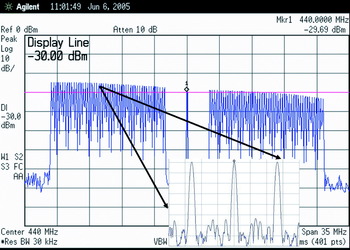
Indoor positioning and tracking without the support of GNSS is one of the challenging problems being faced today which has numerous applications, especially in the field of emergency services like law enforcement and fire and rescue operations. Figure 1 provides an overview of a RF-based precise positioning system being developed at Worcester Polytechnic Institute. The goal of this system is to provide a robust real-time indoor location system that does not require any pre-existing infrastructure. As shown in Figure 1, the fire trucks and fire fighters reporting at the scene of an incident will each be fitted with hardware components which, in aggregate, form the envisioned location system. The fire fighters carry a transmitter which continuously transmits a radio signal. The radio signal used is a Multi-Carrier-Ultra-Wideband (MC-UWB) signal structure shown in Figure 2. Such a MC-UWB signal is much easier to adapt to existing spectral assignments [Reference Cyganski, Orr and Michalson1, Reference Cyganski, Orr and Michalson2] than other proposed signals [Reference Fontana3, Reference Han and Nguyen4]. The MC-UWB signal is received by multiple receivers mounted on the emergency vehicles. The signals received at the vehicles are then used to calculate the relative positions of fire fighters in and around the building using a time difference of arrival (TDOA)-based position estimation algorithm.
Precise Positioning System Application Overview.

MC-UWB Signal Structure.

The position information for each fire fighter is then sent to a central command and control display which provides the incident commander situation awareness information on the site around the fire. The positioning accuracy requirements for such an indoor positioning system are high, with better than 3 m being ideal, and 3 m to 6 m being acceptable. In addition to providing position information, it is also desirable to provide health and vital sign information along with environment sensing and temperature monitoring.
RF PROTOTYPE TEST SETUP
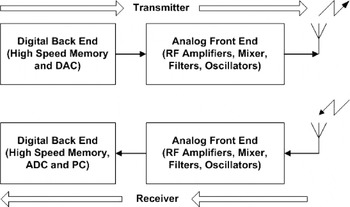
The system architecture of the developed prototype system is shown in Figure 3. The prototype system consists of a single transmitter and five receivers, resulting in four TDOA equations. The MC-UWB baseband transmit signal is generated using a field-programmable gate array (FPGA). It undergoes digital to analogue conversion and is then up-converted to the required RF frequency. The receiver down-converts and then digitizes the signal. The FPGA at all the five receivers contains the buffered data that is then transferred to the PC for further signal processing. The TDOA-based algorithms implemented in the PC calculate a position estimate for each transmitter.
Overview of the RF Prototype System Architecture.

The multi-carrier signal structure consists of multiple sinusoids which makes the RF design of such a positioning system difficult compared to conventional single carrier or narrowband RF system designs. The prototype system was developed to operate over 148 MHz centred at 625 MHz (550 MHz to 698 MHz). Thus, the RF fractional bandwidth is 25% and designing the RF transmitter and receiver for such large fractional bandwidths becomes challenging as the RF components are stressed using multi-carrier signal in a way not anticipated by the designers.
The 148 MHz bandwidth transmitter consists of a Low Pass Filter (LPF), Up Conversion Mixer, Gain Block, Power Amplifier (PA) and Band Pass Filter (BPF). The Low Pass Filter is realized by a 7th order elliptical LC filter, providing the sharp roll off required to eliminate the DAC aliasing signal. It is desired to use a LPF based on an LC design, as it has low insertion loss, high power handling and flexible design. A high performance passive mixer is used to implement the up-converter. A mixer with wide bandwidth, very low intermodulation distortion, and good LO-RF rejection is used. The mixer used in the transmitter is suitable for high intercept point applications.
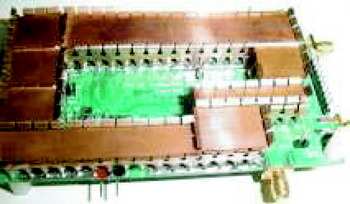
An onboard RF phase locked loop frequency synthesizer is used to generate the required mixer local oscillator. The crystal oscillator used in the PLL implementation provides a 10 MHz reference frequency, and a phase noise of −143 dBc/Hz at 1 MHz offset from the required carrier. The Band Pass Filter is a seven-section Chebychev LC filter which is hand tuned and optimized over the 148 MHz RF spectrum. Multiple stages of highly linear amplifiers are tuned to provide a total transmitter output power of 10 dBm. The custom-made RF transmitter PCB is shown in Figure 4. The transmitter was optimized to achieve magnitude flatness of approximately ±1 dB across most of the 550 MHz to 698 MHz spectrum.
RF Transmitter Front End PCB.

The 148 MHz bandwidth receiver consists of four antenna input ports, Band Pass Filter (BPF), Low Noise Amplifier (LNA), Down Conversion Mixer, Variable Gain Control (VGC), and Low Pass Filter. The band pass and low pass filters are a custom-made seven-section LC filter configuration. The selection of the LNA is crucial as the noise figure of the LNA sets the noise figure of the receiver. The LNA chosen has a high gain of 20 dB and a low noise figure of 1·6 dB. The wideband mixer that follows the LNA is a high performance active mixer.
Similarly to the transmitter, the PLL frequency synthesizer provides the mixer with the required local oscillator signal. The output of the mixer drives a digitally controlled variable gain amplifier. The four antenna input ports support spatial diversity as four antennas can be connected to the receiver. A custom receiver PCB similar to the transmitter PCB shown in Figure 4, was also designed. The receiver was optimized to achieve a magnitude flatness of approximately ±1 dB across the 550 MHz to 698 MHz spectrum.
NLOS FIELD TEST SETUP AND POSITIONING RESULTS
The 148 MHz bandwidth system discussed in the previous section was used to perform NLOS indoor tests. The transmitted multi-carrier signal consisting of 51 subcarriers, spans from 550 MHz to 698 MHz and the down-converted signal spans from 30 MHz to 178 MHz. Field tests were performed at various indoor locations, one of which is shown in Figure 5, which is approximately a 20 m×20 m brick walled building. The test setup uses a single transmitter inside this building with five receivers placed outside with their directional antennas looking inside the building through the brick walls. Each of the five receivers has four antenna input ports, making the system capable of deploying up to 20 antennas. For the test venue shown in Figure 5 a total of 16 receiving antennas were carefully placed around the three sides of the brick building, to optimize the geometry.
Indoor Positioning Field Test Venue.

The transmitter was moved inside the brick walled building at eight different locations and the position estimate at each of the eight transmitter locations calculated. The average error from all the eight locations was 2·84 m, with the maximum error being as high as 6·6 m. The position estimation results are calculated using super-resolution algorithms [Reference Rao and Arun5] to separate the direct path from the multipath. The multi-carrier signal offers frequency diversity; multiple antennas offer spatial diversity and were deployed to optimize the receiver geometry. Also note that the operating area of the testing venue was such that the signal received at all the antennas maintained a high SNR. Implementing all of the above optimization techniques resulted in improving the positioning errors and bringing them in the range of 3 m to 6 m. It is desired to further improve the error and bring it as close as possible to 1 m, which is ideal for the fire fighter user community. Thus, it becomes important to identify the remaining sources of errors that could be causing the observed 3 m to 6 m errors in position estimates.
ERROR SOURCES
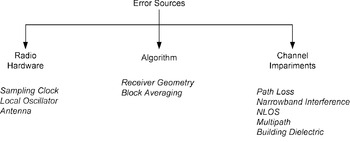
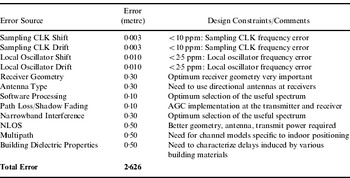
After extensive simulations, bench tests and field tests the error sources and their contribution in the field tests were determined and are tabulated in Table 1. The errors affecting the accuracy of location estimates can be broadly divided into three groups: errors due to the radio hardware; errors in the estimation algorithm; and errors due to the channel impairments. This classification of error sources is illustrated in Figure 6. Radio hardware error sources include factors such as sampling clock offsets and drifts as well as local oscillator offsets and drifts. The performance of the location estimation algorithm depends upon many factors such as receiver geometry and number of blocks used to compute the estimates [Reference Cyganski, Orr and Michalson2]. The most commonly discussed channel impairment includes effects of path loss, NLOS components and multipath. However another prominent source of error, which has often been neglected, is that due to the dielectric properties of the materials used to construct the building itself.
Types of Error Sources.

Error Budget.

Discrepancies in the transmitter and receiver sampling clocks result in degradation of the positioning estimate. Using a sampling clock crystal of 10 ppm or better minimized this error to less than 0·003 m. Similarly, the local oscillator frequency shift and drift results in error and using the crystal that was 2·5 ppm or better resulted in it contributing less than 0·003 m error. Receiver geometry and dilution of precision (DOP) plays an important role in minimizing errors in TDOA-based systems and should be optimized. For example, having receivers on three sides of the brick building and not all four sides contributes to errors of up to 0·3 m. Antenna polarization, radiation pattern and antenna type also affect the position estimate by up to 0·3 m. Directional antennas are desirable at the receivers, which along with optimum receiver geometry will result in less error.
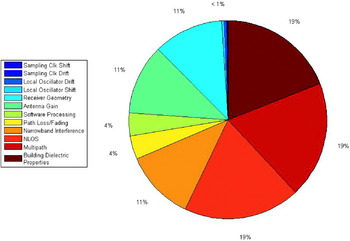
High range of variable gain control implementation both at the transmitter and at the receiver could be useful in combating severe path loss and shadow fading in NLOS indoor conditions. Narrowband interference from in-band TV stations can add an 0·3 m error in the position estimate. Signal processing algorithms that could optimally select only useful spectrum by eliminating the narrowband interference portion of the spectrum can help reduce this error. It is well known that multipath and NLOS are the two major contributors for indoor positioning with each adding error of 0·5 m or more. In addition to the above mentioned error sources, there is one error source that is less well known and can result in adding errors of 2 m or more. The building material dielectric properties result in adding delay to the transmitted signal as the RF wave inside the material is going to be slower than the propagation of the RF wave in free space. Accounting for these identified sources of error results in an RSS error of about 2·62 m. Contributions of individual error sources in the cumulative error budget are shown in Figure 7. The materials used in the construction of a building do have an effect on position estimation inside the building. The most common building materials are concrete, brick and wood. Simulations [Reference Friedlander6] were performed to better understand the expected errors introduced by the dielectric properties of the building materials used.
Contributions of Error Sources.

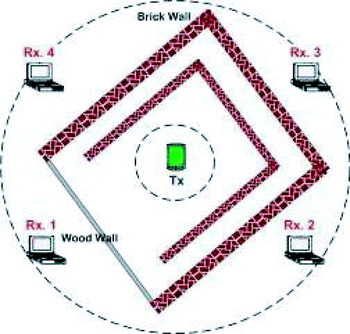
Consider a NLOS, multipath-free example of positioning inside a brick building as shown in Figure 8. The four receivers are outside the building and are equidistant from the transmitter located inside the building. Three sides of the building consist of brick walls and one side consists of a wooden wall. The transmitter inside the building transmits the signal and for three sides, this signal penetrates through two brick walls and is received by receivers outside. The transmitter position was estimated for this NLOS, multipath-free simulation setup. The simulation results do not consider the errors due to SNR degradation or due to multipath. The simulated position estimation error for the example depicted in Figure 8 was 0·923 m.
Indoor Positioning in Residential Area.

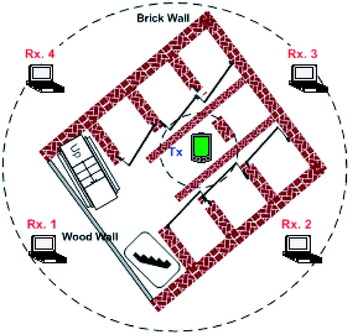
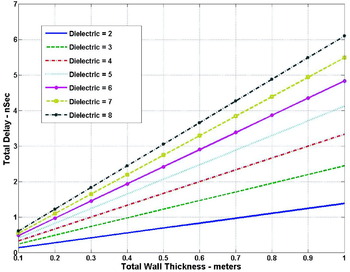
This error of 0·932 m is purely due to the delay introduced in the transmitted signal inside the brick walls due to a different relative dielectric constant compared to that in free space. In the simulations, the dielectric constant for brick wall was set to 4·5 and that for the wooden wall was set to 3. The dielectric constants of these building materials are frequency and weather dependent. For example depending on the type of wood, its dielectric will vary from 2 to 5 and depending on the carrier frequency of the transmitted signal, the dielectric for concrete varies from 26 to 10 over 50 MHz to 1 GHz [Reference Antoine7]. For the same transmitter and receiver positions, the simulations were repeated to include effects of a few more brick walls as shown in Figure 9, similar to what one would find in a typical office building. The resulting error was 3·48 m, which is again only due to the effect of signal being delayed by the brick walls, causing errors in the TDOA estimates. Figure 10 shows the delay for various wall thicknesses due to different dielectric constants that will depend on the building material.
Indoor Positioning in Office Area.

Wall Thickness vs. Signal Delay for Various Dielectric Constants.

CONCLUSION
From the error analysis, it is clear that in addition to the well known error sources multipath and NLOS, the dielectric properties of the building materials add to the positioning error. To the best of author's knowledge no indoor positioning papers recognize and address this issue. The indoor environment typically has more than two walls and this could lead to indoor positioning errors of more than 3 m, depending on the number of walls, the dielectric constant of the wall material, frequency and weather. The frequency dependent and weather dependent dielectric constant characterization for commonly used building materials are unavailable. There is a need to perform tests that will result in such data which can then be used to calibrate the system, thus minimizing the errors on indoor position estimates due to building dielectric material properties. This not-so-well-known source of error needs to be considered in designing an indoor positioning system if accuracies of less than 3 m are desired.