1. Introduction
In 2009, Elinor Ostrom earned the Sveriges Riksbank Prize in Economic Sciences in Memory of Alfred Nobel for challenging the conventional wisdom that to avoid the over-consumption of common-pool resources (CPRs), the solutions were either privatizing the commons or giving the power to regulate the commons to central authorities (Ostrom, Reference Ostrom1990). Ostrom and coworkers demonstrated that local users often effectively manage many CPRs.Footnote 1 They developed the Institutional Analysis and Development (IAD) framework to facilitate scholars' understanding of human interactions and outcomes in many common-pool settings.Footnote 2
Beginning in the 1960s, architect and design methodologist John Habraken became concerned that the efforts to solve the housing shortage through ‘mass housing’ were producing uniformity and unsustainable rigidity. Habraken's observations convinced him that the built environment's uniformity and rigidity were caused by not including many of the eventual inhabitants of the built environment from any decision-making role, not from technology or design.Footnote 3 Centralized control was the leading cause of uniformity and rigidity. He argued that a balanced distribution of control between what the community decided and what the individual inhabitant could decide would create healthy, sustainable, and regenerative environments. If inhabitants have no control, uniformity and rigidity result. If the community has no control, chaos and conflict result. Habraken became convinced that individual responsibility for one's own immediate environment was an essential precondition for environmental health.
Habraken (Reference Habraken1998) later argued in The Structure of the Ordinary (SOTO) that built environment is an autonomous, organic entity distinct from the societies and natural environments that created it and that flourishing environments can persist only through change and adaptation.Footnote 4 He further argued that studying these transformations would allow us to better understand the laws that govern built environment behavior, giving professionals the knowledge needed to cultivate environments successfully.
Jacobs (Reference Jacobs1993) argued that architects and urban planners were responsible for the decline of many American city neighborhoods. Jacobs (Reference Jacobs1993) wrote that diverse and vital communities need mixed residential, commercial, and retail space, a mixture of old and new buildings, many good connections such as through short blocks and ‘eyes on the street’ so that strangers could be accommodated without sacrificing safety.
Habraken, Ostrom, and Jacobs focus on key elements and relationships essential for effective governance. Habraken, Ostrom, and Jacobs view the environment as self-organizing. However, they have different perspectives regarding what is necessary for successful self-organization. In Habraken's, Ostrom's, and Jacobs's frameworks, governance is used to create order, reduce conflict, and thus realize mutual net gains. Control is the underlying mechanism.Footnote 5 Habraken defines control as an agent's ability to change part of the built environment (Habraken, Reference Habraken1998).
Habraken, Jacobs, and Ostrom viewed the balance between collective and individual rights and responsibilities as important to effective governance. In Habraken's framework, agents exercise control of built environment transformation through three interwoven orders: physical, territorial, and understanding. Jacobs viewed balancing the Guardian Moral Syndrome's collective rights with the individual rights from the Commercial Moral Syndrome as crucial for cities and society's health and survival. In Ostrom's framework, actors exercise control in action situations, and those actors are themselves constrained by institutions through various rules that affect actors' interactions.
The excessive uniformity observed by Habraken and Jacobs made them consider control in the built environment, while the tragedy of the commons made Ostrom consider control in the natural environment. For Habraken, uniformity exists when a single agent controls many spatial and physical configurations, while varied similarity (conformity) exists when parties independently agree to use the same systems, types, and patterns. In SOTO, mutual understanding means that agents have a common understanding of physical configurations (patterns, types, systems), which creates coherent variety. Thus, agents exercising their individual preferences typically conform to a given culture. For both Habraken and Jacobs, the danger of excessive, and ultimately unsustainable, uniformity tends to occur because of centralized control. For Ostrom, the danger is that agents may not work together to reduce a resource's overuse through polycentric governance.
For Habraken, public space and private space are relative terms; a space can be private in a larger territory and public relative to included territories. Whether a space is public or private depends on the person's access rights. The combined principles of selective entry (moving downward in the hierarchy) and unrestricted exit (moving upward in the hierarchy) mean that an agent can freely move upward from the bedroom to the house and from the house to the street. However, moving downward, the agent is examined at each ‘gate’. An agent cannot enter any house without permission, and permission to enter one's house does not give permission to enter a bedroom or use the desk.
This article applies Ostrom's IAD framework and design principles, Habraken's SOTO framework, and Jacobs' views on cities to Common Interest Developments (CIDs) to compare and contrast what Ostrom, Habraken, and Jacobs view as necessary for successful self-organization. Section 2 discusses CIDs and Jacobs' perspective. Section 3 discusses Ostrom's IAD framework and design principles and Habraken's SOTO. Section 4 discusses control of the built environment. Section 5 discusses controlling territory, and section 6 outlines how mutual understanding affects social control.
2. Common interest developments
The three most common types of CIDs are Home Owner Associations (HOAs), condominiums, and housing cooperatives (McKenzie, Reference McKenzie2019). CIDs common characteristics include (1) property ownership that is combined between common ownership of real property called the common areas or common elements and individual ownership of the housing units; (2) private governing documents that usually include deed restrictions, articles of incorporation, association bylaws, and often an additional set of rules for architectural modifications, recreational facilities, and parking among other things; (3) automatic mandatory membership in the CID when purchasing a housing unit; and (4) a residential private government (McKenzie, Reference McKenzie2019).
The CID's private government has the power to act on behalf of all owners as a legal entity, collect and spend revenues, and regulate both land use, exterior architectural and landscape features even on private property, and social behavior (McKenzie, Reference McKenzie2019). The residential private government is typically a not-for-profit corporation. The board of directors is controlled by representatives of the real estate developer during planning, construction, and the first few years of the CID. Then the developer turns control over to the unit owners who elect directors from among the CID membership (McKenzie, Reference McKenzie2019). Membership includes all owners of the CID units. Unlike municipal governments, renters do not have voting rights, but owners do even if they are not citizens or are nonresident owners (Nelson, Reference Nelson2011).
CIDs were originally developed by theorists and practitioners of government and progressive public policy to improve local governance and the built environment (McKenzie, Reference McKenzie2011).Footnote 6 Ebenezer Howard published Garden Cities of To-morrow in 1902 (Howard, Reference Howard1902). Howard advocated creating self-sufficient master-planned communities with managerial governments that provided both urban life and nature at a low cost (McKenzie, Reference McKenzie2011).
In the early 1900s, Charles Ascher became general counsel for Alexander Bing, a socially conscious real estate developer who sought to bring to the United States the utopian ideas of Ebenezer Howard. Bing tasked Ascher with designing the private government for Radburn, a planned community in New Jersey. Ascher worked with Luther Gulick, Louis Brownlow, Richard Childs, and others at the National Municipal League. The National Municipal League (now known as the National Civic League) promoted the council-manager form of government in its Model City Charters. Radburn had a privatized version of the council-manager model with the city council called the corporate board of directors, and a city manager called a property manager or community manager (McKenzie, Reference McKenzie2011).
Jacobs (Reference Jacobs1993) felt that Ebenezer Howard's Garden Cities model was city-destroying. Jacobs (Reference Jacobs1993: 23) writes that Howard hated living conditions in the late 19th-century city and wanted ‘to do the city in’. From her perspective, he wanted to stop London's growth and repopulate the countryside with self-sufficient small towns and paternalistic political and economic societies. Sir Patrick Geddes expanded Howard's ideas to regional planning. Later, a group that Catherine Bauer called the decentrists effectively championed Howard's and Geddes' ideas. Jacobs (Reference Jacobs1993: 28–29) writes that the decentrists stressed cities' failures and ignored the successes, emphasizing that cities were morbid, dirty, and villainous. They were not interested in how cities police themselves, operate politically, exchange ideas, and develop new economic opportunities.
From Jacobs' perspective, the decentrists stressed that cities are negative externalities that need to be dealt with and that Garden Cities were one of their misguided policy interventions. Horowitz (Reference Horowitz2013) wrote that social entrepreneurs, such as the decentrists, increase the probability that something is perceived as an externality by creating simple examples that easily communicate the nature of the externality, disseminating stories about villains causing extreme harm to innocent victims, and expressing social approval for those who agree and social disapproval for those who disagree. Garrett et al. (Reference Garrett, González-Garzón, Foulkes, Levita and Sharot2018) write that people tend to underestimate risk and fail to take precautionary action unless they perceive a threat. Trying to ensure that people perceive a threat may be one reason why social entrepreneurs follow this pattern. Unfortunately, as Horowitz (Reference Horowitz2013) points out, examples that easily communicate the nature of the externality tend to create simplistic views of the externality, horror stories tend to stimulate fight or flight responses that make it more challenging to solve externality issues, and social disapproval discourages people from expressing disagreement so that uninformed people will assume that even false externalities are real because there is little or no disagreement.Footnote 7
MacCallum (Reference MacCallum, Beito, Gordon and Tabarrok2002: 378–379) supported Howard's Garden Cities model but adds that the Garden Cities were not initially built as subdivisions but rather as land leases where the land's revenue financed the city administration.Footnote 8 MacCallum argued that Howard's Garden Cities were similar to hotels that are funded from leasing revenue. However, MacCallum (Reference MacCallum, Beito, Gordon and Tabarrok2002: 279) adds that when the Garden City concept was applied to the United States, properties were subdivided. Since subdividing left the CID without a revenue source or management, the developers of Radburn, applying Progressive Era political science, created a homeowners' association, a compulsory membership government with regulatory and taxing powers.
Radburn and the Garden Cities model were the primary models for the private communities that have proliferated since the 1960s (McKenzie, Reference McKenzie2011). These communities usually had superblocks where houses were grouped around open green spaces with curvilinear streets and had private corporate governments. Jacobs (Reference Jacobs1993) said that this design hurt cities' health. She felt that city planners designed and managed these communities to resist future change and that they created the illusion of isolation and suburban privacy by facing houses toward green spaces and away from the street, the basic unit not being the street with its street-facing buildings, but the inward-looking block, especially the superblock, and segregating commerce from residents (Jacobs, Reference Jacobs1993). Jacobs (Reference Jacobs1993) argued that diverse and vital communities need mixed residential, commercial, and retail space, a mixture of old and new buildings, many good connections such as through short blocks and ‘eyes on the street’ so that strangers could be accommodated without sacrificing safety.Footnote 9
Since the 1930s, United States Federal government agencies have promoted Radburn and the Garden City model (McKenzie, Reference McKenzie2011). This culminated in the practice of federal agencies and government-sponsored agencies such as the Federal Housing Administration (FHE), the Veterans Administration, Fannie Mae, and others dictating the standardized terms of association governing documents. Also, legislation created mechanisms for the federal government to act as a guarantor for private builders and assumed much of the risk for building master-planned communities (McKenzie, Reference McKenzie2011).
CIDs have become the predominant form of new housing construction in the United States (McKenzie, Reference McKenzie2006). This form of housing has dramatically increased because local jurisdictions need additional revenue, developers liked the higher density, which increases profits, and many homeowners enjoyed the increased amenities and control over the neighborhood. Also, as discussed above, government and government-sponsored agencies promoted CIDs and guaranteed loans.
In most jurisdictions, CID homeowners pay for their infrastructure through their homeowner association dues in addition to paying full property tax bills (McKenzie, Reference McKenzie2019). Paying for their own infrastructure in addition to paying property taxes is one reason why many local governments require all new housing construction be CIDs (McKenzie, Reference McKenzie2019). Developers can increase density because CID streets can be narrower than public streets, and buyers are more likely to accept small lots when there are commonly owned open spaces and other amenities managed by the homeowner association (McKenzie, Reference McKenzie2006). Homeowner benefits include increased security, high property maintenance levels, more local control over the neighborhood, and privatized amenities (McKenzie, Reference McKenzie2006).
3. Ostrom's IAD framework and design principles and Habraken's SOTO
In Ostrom's IAD framework, agents exercise control through action situations (McGinnis and Ostrom, Reference McGinnis and Ostrom2014). Action situations are those in which individuals interact and jointly affect outcomes, though individuals may have different values for the outcomes.Footnote 10 Actors in action situations seek to achieve their personal and community goals subject to three contextual factors: biophysical conditions, attributes of community, and rules in use.Footnote 11 Biophysical conditions include the biological, chemical, and physical nature of the relevant resource. Biophysical conditions and available technologies determine whether the resource is a CPR, a private good, a public good, or a toll/club good.Footnote 12 Attributes of community include levels of trust and shared norms of reciprocity. Rules-in-use include not just recorded formal rules but also unwritten and informal rules.
Actors' decisions in action situations, interactions between actors, and contextual factors create outcomes. Individuals and other observers evaluate these interactions and outcomes. Interactions and outcomes affect all the other components resulting in a continuous feedback process.
Ostrom's (Reference Ostrom1990) book Governing the Commons discusses eight design principles that tend to lead to long-enduring CPR institutions (Wilson et al., Reference Wilson, Ostrom and Cox2013). According to Ostrom (Reference Ostrom1990) and Wilson et al. (Reference Wilson, Ostrom and Cox2013), the eight design principles are:
(1) Clearly defined boundaries: The resource has clearly defined boundaries so that the boundaries of the shared resource and which agents have the right to use the resource are clearly defined.
(2) Proportional equivalence between benefits and costs: There is a proportional equivalence between benefits and costs where agents in the group negotiate a system that rewards members for their contributions.
(3) Collective-choice arrangements: There are collective choice arrangements so that group member users have input to create and modify at least some of their rules and make their own decisions by consensus. Group members are more likely to work for group goals that they have agreed on.
(4) Monitoring: There is regular monitoring of users and resource conditions by users or those accountable to users. Monitoring is essential because to avoid the tragedy of the commons, active exploitation of the resource and free-riding need to be detected at relatively low cost by norm-abiding members of the group.
(5) Graduated sanctions: There are graduated sanctions that punish rule violators with increasing severity. Often gossip or gentle reminders are sufficient at first, with more severe punishment available when necessary.
(6) Conflict resolution mechanisms: There are low-cost conflict resolution mechanisms so that it is possible to resolve conflicts quickly, at low cost, and in ways that are perceived as fair by the group members.
(7) Minimal recognition of the right to organize: There is at least minimal recognition of the groups' right to organize, and external government officials do not challenge users' rights to create their own institutions. The group has the authority to conduct their own affairs and adapt rules to local conditions.
(8) Groups that are part of larger social systems have nested enterprises and appropriate coordination among relevant groups. When groups are nested in larger systems, polycentric governance in large-scale governance systems requires finding the optimal scale for each sphere of activity and groups appropriately coordinating their activities. In nested governance systems, essential governance functions, such as enforcement and monitoring, are organized into many reinforcing layers (Kashwan and Holahan, Reference Kashwan and Holahan2014). Governance tasks are assigned to the lowest jurisdiction unless that is explicitly determined to be ineffective.
The following list applies Ostrom's eight design principles to CIDs.
1. Clearly defined boundaries: CIDs have clearly defined boundaries since (individual property) unit owners are the members, and property boundaries are well-defined. Likewise, CIDs have clearly defined rules about the use of common assets and member units.
2. Proportional equivalence between benefits and costs: Homeowners are expected to be willing and able to participate in association governance, pay their assessments, and tax themselves to set aside enough reserve funds for future repairs (McKenzie, Reference McKenzie2019). However, owners who get involved in running the associations often need to devote considerable uncompensated time. Even participating in association elections and learning about the candidates and the issues take time and effort. McKenzie (Reference McKenzie2019) writes that many associations cannot find enough volunteers to staff the board of directors. Major decision-making is generally handed-off to hired property managers and lawyers, especially since few directors have the training, experience, or time. In many associations, most owners pay little attention to association activities, know little about association finances, and do not vote in association elections (McKenzie, Reference McKenzie2019).
3. Collective choice arrangements: Webster (Reference Webster2003) wrote that since neighbors' collective aggregate actions can seriously jeopardize a property's value, the efficient allocation of property rights requires that all property owners on a street have a claim on the value of every other property. From Webster's perspective, CID owners are co-residual claimants who have an incentive to increase positive externalities and decrease negative externalities. On the other hand, Warner (Reference Warner2011) writes that CIDs internalize benefits but create negative externalities because they exclude members of the broader community and potentially weaken the collective bonds to the broader city. Boudreaux and Holcombe (Reference Boudreaux, Holcombe, Beito, Gordon and Tabarrok2002: 291–293) wrote that CID developers are residual claimants who create a contractual government to increase the parcels' value that will eventually be sold. On the other hand, Federal government agencies and lending institutions often prescribe much of the associations' governing documents. CID governance allows individuals to participate in modifying some collective choice rules depending on state legislation and rules. Owners have more input on modifying operational rules. However, McKenzie (Reference McKenzie2006) wrote that historically, housing association directors often portrayed members of activist homeowner groups as malcontents who were victimizing innocent board members, which caused homeowner rights group's concerns to be ignored and homeowner rights groups publicized horror stories of CID boards mistreating innocent homeowners leading to legislation in several states that restricts the power of CID boards.
4. Monitoring: Those who monitor the association are either owners themselves or are accountable to the owners. However, McKenzie (Reference McKenzie2019) writes that there is almost no meaningful government oversight of CIDs' financial health, and no states require systematic public dissemination of information on association finances so potential buyers can take that information into account when they shop for a home. Monitoring is also difficult since owners often have limited information on association leaders' or managers' actions (McKenzie, Reference McKenzie2019). However, there is a balance between governments taking steps to ensure CIDs' financial and organizational stability and overregulation that makes governance even worse because every new statute and court decision increases the burden on volunteer directors (McKenzie, Reference McKenzie2011).
5. Graduated sanctions: In CIDs, the association leadership determines the sanctions. However, MacCallum (Reference MacCallum, Beito, Gordon and Tabarrok2002) reports that, rather than graduated sanctions, some boards impose excessive punishment for minimal infractions. On the other hand, sanctions that appear excessive may efficiently induce other unit owners to pay their association assessments. Large sanctions can also cause unit owners with few assets to lose their homes, and in complexes with many defaults, owners may be restricted to selling to cash buyers (McKenzie, Reference McKenzie2019).
6. Conflict resolution mechanisms: McKenzie (Reference McKenzie2006) writes that only a few states have low-cost conflict resolution mechanisms. Some states created ombudsman positions because so many lawsuits were going to high-cost judicial review, and associations file most of the lawsuits since they have access to association dues (McKenzie, Reference McKenzie2006).
7. Minimal recognition of the right to organize: Because of standardized documents, association rules tend to be uniform rather than adapted to local conditions. Privatized local CID governance usually increases restrictions on personal freedom (Nelson, Reference Nelson2011). Developers and eventually homeowners can regulate many details of a neighborhood, such as houses' color, placement of trees and shrubbery, minor building alterations, and parking rules. They can also regulate alcohol use in common facilities, dress-codes, playing music, and other individual behavior that public governments are less likely to regulate. Likewise, MacCallum (Reference MacCallum, Beito, Gordon and Tabarrok2002) wrote that association boards act as quasi-criminal courts since they can levy fines for misconduct. Unlike public governments, the CID can discriminate and restrict membership to specific groups, such as people aged 55 and older (McKenzie, Reference McKenzie2019). Breit and Horowitz (Reference Breit and Horowitz1995) write that agents may self-segregate because they enjoy diversity. But more diversity increases social distance, and social distance raises the costs of interacting and communicating with other people. The tradeoff between diversity and social distance means that, in a multicultural world, agents may choose to segregate themselves with other people who are somewhat similar to themselves. Also, Alesina et al. (Reference Alesina, Baqir and Easterly1999), Putnam (Reference Putnam2007), Habyarimana et al. (Reference Habyarimana, Humphreys, Posner and Weinstein2007) find that diversity tends to reduce trust and the production of public goods. As CIDs become the dominant form of housing ownership in many parts of the United States, those who want to avoid tight restrictions can have difficulty finding traditionally governed neighborhoods. A variety of preferences means that we could see a Tiebout solution with some associations with lite regulation and others catering to those who want tighter restrictions. However, Nelson (Reference Ostrom2011) notes that a diversity of private regulatory regimes is not ordinarily available.
8. Groups that are part of larger social systems have nested enterprises and appropriate coordination among relevant groups. CIDs are part of polycentric governance systems where the associations are nested in larger systems such as municipalities or counties.
Ostrom focused on long-enduring CPR institutions. CIDs are also designed to be long-enduring institutions, and ending the CID is designed to be difficult. However, unlike municipal governments, which can declare bankruptcy when they cannot pay their debt, bankruptcy is difficult for CIDs (McKenzie, Reference McKenzie2019). CIDs cannot avoid judgments by claiming they have no assets because judges view the CIDs' power to assess owners as valuable assets that they can use to pay judgments. Filing for bankruptcy puts the associations' main asset, the power to assess, in the hands of bankruptcy judges. If an association board refuses to assess the owners to pay a judgment, the judge can appoint a receiver to run the association, and the receiver will impose the assessment. If owners fail to pay their share of any such judgment, they will lose their homes in foreclosure. Government policies to encourage CID homeownership may be risky for homeowners with little or no savings since the power to assess means that owners can find themselves required to contribute large sums for judgments against the association and special assessments for major repairs (McKenzie, Reference McKenzie2019).
In Habraken's SOTO framework, an agent's actions always encompass three orders: the Physical Order, the Territorial Order, and the Order of Understanding. The Physical Order considers the built environment from the perspective of agents' control and transformation of different levels of physical forms and live configurations.Footnote 13 SOTO's Territorial Order considers agents' control of spaces and territories, such as decisions about what spaces agents should occupy, territorial arrangement, how to distribute agents, the movement of things between agents within and across territorial boundaries, and boundary stability. In other words, the Territorial Order deals with what enters and is excluded in a hierarchy of spatial/territorial levels.
SOTO's Order of Understanding concerns the exercise of control of form and space based on rules, selecting agents, and agreements of understanding.Footnote 14 There are two parts to the Order of Understanding: First, the Order of Understanding considers the shared understandings and preferences of agents in transforming or moving things and controlling territory. Second, the Order of Understanding is about the formal and informal agreements related to the control of space and physical configurations. These agreements – consensuses, habits, rules, and rules-in-use – underlie the control of territory and transformation of things. The built environment is the result of agents' actions reflecting their common understanding creating mutual preferences and coherent environments.
In SOTO (0.1 and 0.2), control is the operational relationship between agents and physical matter and space that creates and transforms the built environment. Control is the ability to transform part of the built environment, and transformation indicates that an agent exercised control. Agents exercise control when they set up their office space, fix up their homes, or construct a building. On the other hand, introducing, changing, displacing, or removing physical parts from a site (at any scale, from an iPhone to a city block) reveals the controlling agents. In SOTO, there is no absolute distinction between creators of the built environment and users of it (SOTO 0.1). For example, office workers, renters, and students arrange their furniture, pictures, and books, thus exercising control.
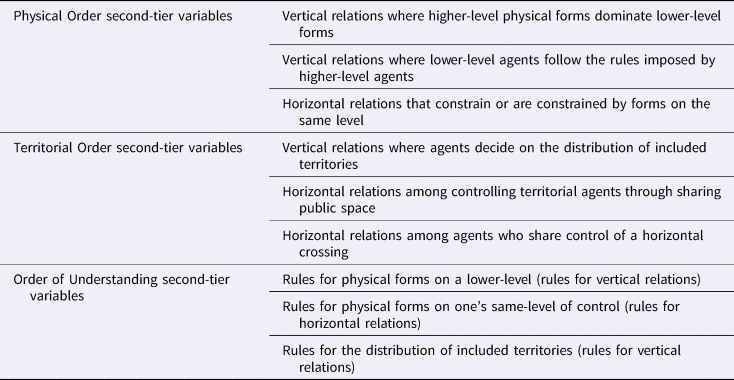
Table 1 shows the second-tier variables for SOTO's three orders. The three second-tier variables in SOTO's Physical Order are: (1) vertical relations where higher-level forms dominate lower-level forms, (2) vertical relations where lower-level agents follow the rules imposed by higher-level agents, and (3) horizontal relations that constrain or are constrained by forms on the same level. Second-tier variables in SOTO's Territorial Order include (1) vertical relations where agents decide on the distribution of included territories, (2) horizontal relations among controlling territorial agents through sharing public space, and (3) horizontal relations among agents who share control of a horizontal crossing. Second-tier variables in the Order of Understanding include (1) rules for forms on a lower-level, (2) rules for physical forms on one's same-level of control, and (3) rules for the distribution of included territories.
SOTO's second-tier variables

In SOTO's Physical Order, horizontal relations between agents occur when agents each control a form on the same level (e.g. individual houses on a street). Interactions between agents controlling forms on different levels (e.g. the drainage pipes in my house (lower-level) related to the drainage pipes in the street (higher-level)) have a ‘vertical’ relation. In SOTO's Territorial Order, two territories relate horizontally when they are both included territories on the same-level and relate vertically when they are included in a larger territory.
4. Habraken's physical order and control of the physical environment
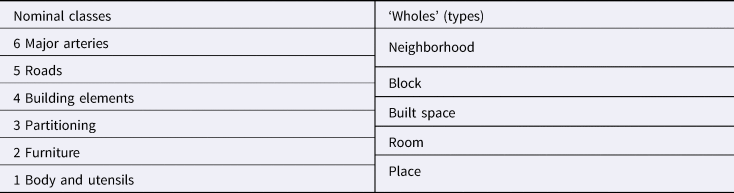
In SOTO's physical order, levels represent the domain of control (SOTO p. 23). Column A in Table 2 shows classes of physical parts. These levels ordered from highest to lowest include (6) major arteries, (5) roads, (4) building elements, (3) partitions, (2) furniture, and (1) body and utensils. Dwelling modes or environmental systems do not need to include all these levels.Footnote 15 For example, a CID may have roads, building elements, portioning, furniture, and body and utensils but not major arteries. Nubian houses have niches for sleeping and sitting, but they do not have partitioning or furniture. Traditional Japanese houses have screens for internal partitioning but do not have furniture. A CID condominium unit owner has partitioning, furniture, and body and utensils but does not control the building. Apartment renters control only the furniture and body and utensils. A person in a hotel room only controls the last level of body and utensils.
As experienced in daily life, wholes combine two levels

What we perceive as a ‘whole’ is a combination of levels. The six levels or nominal classes (column A) combine to form wholes (SOTO Table 3.5). For example, a neighborhood is a combination of (6) major arteries and (5) roads. A block is a combination of a (5) road network and (4) building elements. Built space is a mixture of (4) building elements and (3) partitioning. A person's room is a combination of the (3) partitioning/enclosure and the (2) furniture. Place is a combination of (2) furniture and (1) body and utensils.
Habraken notes that the ‘whole’ is both the context where we exercise control and the parts we control. Each level may be under the control of different individuals and groups, which means that the wholes in column B denote both spaces and configurations.
Control distribution has two meanings in SOTO. The first and usual meaning of control distribution is that control is distributed among many agents instead of unified or central control by a single agent. Built environments are usually a combination of many live configurations with widely distributed control. Control may be distributed vertically across more than one level or horizontally on the same level. Extensive distribution of control makes for deep hierarchy when vertically applied and increasing variety when horizontally applied.
The second meaning of control distribution is with a single agent. If the agent's configurations are all on the same level, then control is distributed horizontally (e.g. multiple houses on a street). If the agent's live configurations are on different levels in the form hierarchy, then that agent's control is vertically distributed (e.g. walls making a building and walls making rooms in apartments). A single agent may control more than one live configuration, and the agent's control may be distributed horizontally and vertically. When a single agent controls many configurations, related horizontally or vertically, there is more uniformity, and when control is distributed among many agents, there is usually more variety.
In Ostrom's IAD framework, positions are parallel to SOTO's control distributions. Actors occupy positions, which the actors bring into action situations. Many positions give specified actors certain powers they can use to influence or ‘control’ interactions and outcomes of action situations. These authority positions can be at different levels in polycentric urban or rural areas, or the positions can be at the same level in a village council.
The vertical control distribution in a multi-unit CID condominium is different from owner-occupied detached housing. The condominium trust specifies which configurations are under the control of which agent, which means that a condominium is split into three configurations rather than a single live configuration. These three configurations include a live configuration controlled by the condominium trust (‘common elements’), many live configurations (‘individual elements’) controlled by each of the various owner-occupants, and ‘limited common’ elements that are individual elements with specific conditions imposed on their use and/or transformation.
The concept of dominance in SOTO is the essence of the hierarchical nature of the built environment. Dominance means that configuration A dominates configuration B when the transformation of A forces B to adjust, yet B can transform without forcing A to adjust (Table 2). In SOTO, control reveals dominance. In other words, dominance means agents have to adjust to other agents' actions through the elements they control, not that others control them. If a city government (an agent) moves a street and people (agents) in the houses next to the street have to adjust their houses, then transforming the street forces the property owners next to the street to adjust.
5. Controlling territory and Habraken's territorial order
Ostrom (Reference Ostrom2007 and Reference Ostrom2010) discusses private goods, public goods, CPRs, and toll goods based on two attributes: the ability to exclude and subtractability. Subtractability is the degree to which an agent's use of a resource diminishes other agents' potential use of that resource.Footnote 16 Private goods are goods where agents can easily exclude others, and the good is highly subtractable. Public goods, the opposite of private goods, are goods for which exclusion is very difficult, and there is little if any subtractability. Toll goods, also known as club goods, are goods where agents can easily exclude others, and there is little if any subtractability. CPRs are goods where agents cannot easily exclude others, and there is high subtractability. The tragedy of the commons occurs in CPRs because agents have an incentive to overuse the resource.Footnote 17 To avoid the tragedy of the commons, Ostrom argues for governance with clear membership. Excluding non-members changes a CPR into a toll good. CIDs are toll goods, where toll goods are a hybrid of both public and private.Footnote 18
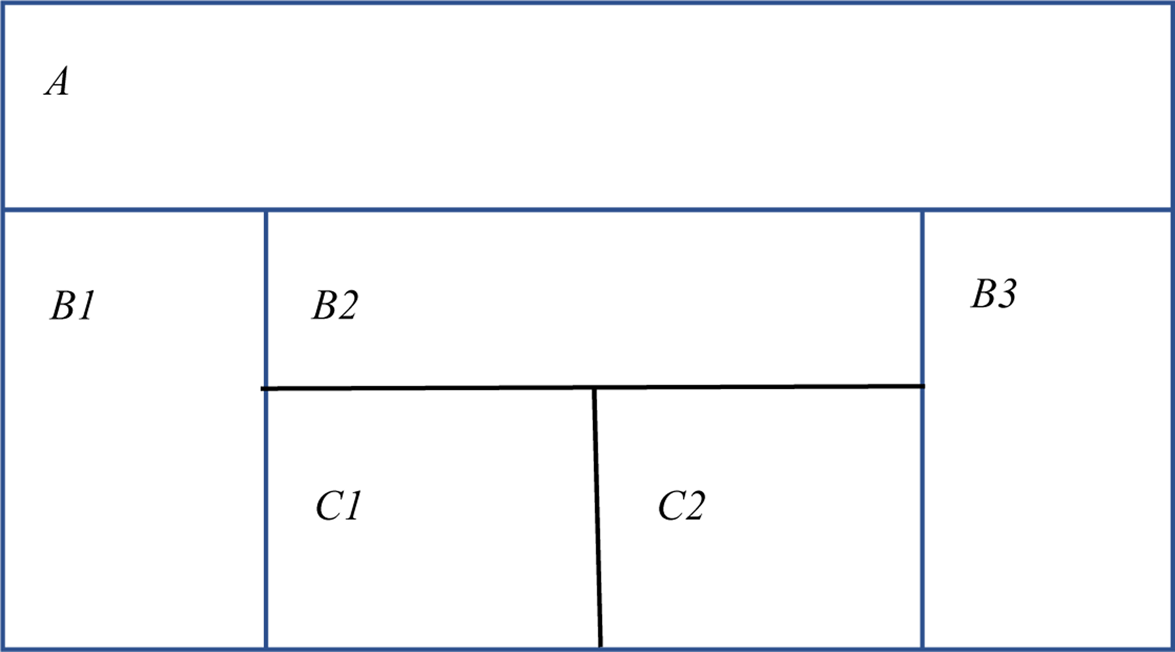
In SOTO, private space and public space are relative terms (SOTO 7.4). Public and private refer to space, but not territory. Territory is space where the controlling agent can select what comes in and what stays out (SOTO 7.1). The ultimate test of territorial control is the ability to allow things to cross a boundary in either direction, in a territorial hierarchy. Space can be both a private space in a larger (higher-level) territory and a public space relative to an included (lower-level) territory. Whether a space is private or public depends on a person's access rights. The same space is private to those who are not admitted but is public to people from included territories who are free to enter at all times. This duality occurs for all but those territories without included territory. Public space is also a space used by those who do not individually control it (SOTO 8.4). In SOTO, public space is what remains after subtracting the private space (SOTO 7.4). In Figure 1, territory B2 has two included (private) spaces C1 and C2. In this case, space B2–(C1 + C2) is public space to the included territories C1 and C2, but is private space relative to the territories that are not included in B2. Territory A includes three private spaces, B1, B2, and B3. The public space is area A–B.
Territorial inclusion resulting in public and private spaces.

Assume C1 is a condominium unit, B2 the lobby or atrium, and A the street. B2 and A are public spaces to the condominium owner and her guests but private spaces to those who are not given access. In a hotel, C1 could be a hotel guest's room, B2 the lobby, and rectangle A the street. If the guest leaves her room and joins people in the lobby, to her, the lobby is a public space. When she leaves the hotel to the street, she again enters a public space. At night, when she leaves the street to the lobby of the hotel, the lobby is a private space relative to the street. In the hotel's case, those who have rented rooms have access to the public areas, but the lobby may also be a public area to those without rooms when they are given access.
Entering public space from a private space is not only a fundamental right, but also those in private spaces (C1 and C2) need to be able to exit to a ‘higher level’ public space (B) before moving again into public space (A). Those from included territories communally share ‘public’ space. Household members access the shared living room. Residents in a CID share a clubhouse. A country's citizens share the interstate highways and national parks. People move upward to use increasingly public spaces, such as moving from the bedroom to the living room and from the house to the park. The inability to move upward in the territorial hierarchy is equivalent to being in prison.
6. Mutual understanding and social control
Mutual understanding is essential to the functioning of both the IAD and SOTO frameworks. According to Kiser and Ostrom (Reference Kiser, Ostrom and Ostrom1982: 202), agents must have a common understanding to make interdependent decisions. Otherwise, there is no social cohesion. Individuals cannot play a game without a common understanding of the rules. Likewise, North (Reference North2005: 48) argues that all organized activity involves a structure derived from common beliefs, which defines how to play the game. Ostrom and Hess (Reference Ostrom and Hess2007) write that mutual understanding increases the likelihood that agents will choose norms, rules, and property rights that enhance common-property systems' performance.
In SOTO, mutual understanding means that agents desire to relate their exercise of control to their fellow agents' control through shared patterns, types, and systems, creating coherence and variety (SOTO 13.1). We do not differentiate or recognize spaces formed by architectural elements without common names (SOTO 13.4). For example, Romans shared a common understanding of what an atrium was; alley and boulevard also have a shared social meaning. Mutual understanding about form ranges from the extremes of explicit codes and standards to implicit customs and habits (SOTO 13.2). Between these extremes are various rules, agreements, and customs. Built environments exist with laws and codes as well as implicit customs, habits, and conventions.
A common understanding between the specialist and the layperson also diminishes the need for a great deal of explicit agreement (SOTO 18.1). In SOTO, a system is a set of parts with rules for their arrangement (SOTO 15.1). Once the agents agree on a configuration's design, the system allows for efficient detailing and specification because they have a common understanding. For example, once a steel structure and its configuration are selected, professional construction follows regular rules and verification paths. Once agents choose a classical design and configuration, they also choose to follow the rules for that design and configuration. Choosing this configuration requires creativity, taste, skill, and knowledge.
Through shared types, systems, and patterns, agents share a common understanding of making value judgments (SOTO 18.1). However, specialists have expert knowledge, craft skills, and professional expertise. For example, in a Japanese house, the number of tatami mats needed to cover the floor determines room size. Tatami mats are a communication tool between experts and laypeople about the size of the whole. Once the number of tatami mats is agreed to, carpenters then translate the tatamis into sizing the house's different parts.
On the other hand, social agreement makes assumptions and conventions self-evident and thus obscures alternatives. Conventions usually seem so self-evident that outsiders are necessary to articulate and clarify the principles that define them (SOTO 13.2). For example, American suburban dwellers usually do not think about building walls around their yards, which is the norm almost everywhere else in the world.
With respect to mutual understanding, Ostrom (Reference Ostrom1980) stated that messages rely on language, and language relies on a shared understanding of symbols that identify entities, stand for classes, and express simpler relationships than the actual objects to which they refer. A shared understanding of the symbols that convey messages is crucial for stability in rule-ordered transformations. Ambiguity and garbled messages can arise because individuals have different understandings when they formulate rules, apply the rules to particular circumstances, monitor compliance, and enforce the rules. Ambiguity also increases as language and meaning change over time. Predicting behavior based on shared rules is imprecise and depends upon procedures to resolve conflicting interpretations of rules. These mechanisms increase the shared meaning of rules and contracts, and reduce variation in behavior (Kiser and Ostrom, Reference Kiser, Ostrom and Ostrom1982: 203).
Similarly, Habraken (Reference Habraken1998) wrote that while words can be translated into another language, the implicit understanding of form itself cannot be fully translated. In distilling and translating the common meaning of form in words, we share only our individual experience. If neighbors together plant a tree in a common courtyard, their agreement is on the tree and placement, not necessarily on the meaning or rationale. An agreement on form does not imply further consensus.
According to Kiser and Ostrom (Reference Kiser, Ostrom and Ostrom1982: 204), when agents agree on the moral correctness and fairness of the rules that constrain their actions, enforcement costs decrease, and the system's stability improves. When agents disagree on the rules, they often seek to evade or change the rules, making decisions less predictable. This evasion causes authorities to invest more heavily to monitor the community and impose sanctions on those found evading the rules. This agreement not only increases stability but also can reduce variation. In SOTO, uniformity exists either because a single agent controls several configurations or because agents choose to use shared patterns, types, and systems.
Likewise, CIDs usually have a standard set of documents following prescribed patterns and rules, which helps increase common understanding as long as the language does not change. When people purchase a home in a CID, they are expected to understand the rules and responsibilities that come with membership in the association. There is significant agreement among unit owners in many CIDs, which reduces enforcement costs, increases trust, and makes it easier to govern the CID. On the other hand, there is significant conflict in many CIDs because of financial issues and the lack of low-cost conflict resolution mechanisms.
Rather than one mutual understanding, Jacobs (Reference Jacobs1994) wrote that balancing two mutual understandings, the Commercial Moral Syndrome and the Guardian Moral Syndrome, is crucial for cities and society's health and survival.Footnote 19 A key focus of the Guardian Moral Syndrome is controlling territory. Guardians are expected to exercise power by using persuasion and custom to effectively accomplish their goals, but effective guardians use physical force when persuasion and custom fail. The attributes of discipline, obedience, and loyalty enable guardians to exercise effective power. Loyalty obligations ensure that guardians are obedient to their superiors and that superiors are devoted to their subordinates, creating bonds of mutual support and protection against betrayals. However, loyalty can also cause an entire hierarchy to become corrupted. Prohibiting trading also protects against betrayals and corruption, such as prohibiting selling national secrets or accepting bribes, whether monetary bribes or the promise of future employment. Obedience and discipline help guardians keep enforcing the rules rather than let their personal feelings of mercy and moderation stop them.Footnote 20 However, obedience does not excuse crimes against humanity. The attribute of tradition serves as a substitute for conscience in the guardian role. It also serves as a protection against the arbitrariness of individual judges and juries.
The object of the guardian attribute of largesse is territorial control. Jacobs (Reference Jacobs1994: 85) writes that all funds allocated by the government tend to be determined by largesse even if they were initially intended as productive investments or as insurance. Largesse can buy loyalty, dependence, and a measure of tranquility. Largesse may finance territorial amenities and well-being, such as preserving historical buildings, national parks, population health, unemployment payments, or support the population during times of natural disasters. The purpose of largesse is not productive investment but distribution. Largesse helps ensure local support. Largesse creates dependency, and dependency creates both conformity and defiance. Conformity is necessary for survival, and defiance is necessary for self-regard (Jacobs, Reference Jacobs1994: 86). The attribute of being ostentatious is designed to evoke feelings of tradition, continuity, and stability. Examples include elaborate public buildings, flags, banners, prescribed memoranda, and hearings. These procedures also help substitute for individual conscience.
Commercial Moral Syndrome morals include the expectation that transactions are through voluntary contractual agreements that are respected and enforced. People are expected to be honest and not steal, defraud, or use force against each other. They should be able to collaborate easily with strangers and aliens. Real choice requires competition. Competition creates the incentive to be efficient and provide customers with comfort and conveniences. Competition also gives people the incentive to dissent from previous ways of doing things, innovating new, more effective ways. Having new effective ways of doing things requires being industrious and thrifty to create the surpluses to invest in the new ways of doing things.
Jacobs (Reference Jacobs1994) writes that the two syndromes are separate but symbiotic. People have to be careful to avoid improperly mixing the two syndromes though people can move from one syndrome to another, such as a lawyer who may act in the commercial syndrome when working with contract law but in the guardian syndrome when practicing criminal law or a merchant who volunteers to work with a non-profit that provides largesse for the arts or the poor. Mixing the two syndromes is dangerous and leads to corruption. For example, the Mafia and gangs are guardian organizations that protected their territory but trade using force to reduce competition. Communism was a guardian organization that protected territory and controlled the means of production through government edict. Jacobs also expressed concern that commercial ethics are corrupted when mixed with guardian attributes. Her examples included governmental organizations encouraging commercial banks to make loans for largesse rather than investment, firms reducing competition through collusion or mergers and acquisitions, and consultants who improperly recommend applying guardian attributes to business or business attributes to guardians. Jacobs noted that real estate seems especially prone to corruption from mixing guardian and commercial attributes.
7. Conclusions
This article applies John Habraken's, Jane Jacobs', and Elinor Ostrom's perspectives to CIDs. Habraken, Jacobs, and Ostrom agree actors can cooperate in organizing the shared environment with minimal external control, the importance of how agents are involved, and that the environment reflects the common understanding of agents constrained by material, technical, social, and economic conditions. Rather than one mutual understanding, Jacobs (Reference Jacobs1994) viewed balancing the individual values of the Commercial Moral Syndrome and the collective values of the Guardian Moral Syndrome as crucial for society's health and survival. The Guardian Moral Syndrome focuses on controlling territory. Jacobs expressed concern that real estate seems especially prone to corruption from mixing guardian and commercial values and that the originators of CIDs designed CIDs to be destructive to cities.
Ostrom's and Jacobs' design approach considers proposals, agents, and institutions that help create a healthy living environment. Habraken's SOTO does not try to decide what a successful healthy living environment looks like. SOTO's structural approach offers three orders (Physical Order, Territorial Order, and Order of Understanding) and their relation to the exercise of power as tools that make comparison possible and allows prediction of the results of a proposed intervention.
CIDs have become the predominant form of new housing construction in the United States because local jurisdictions need additional revenue and often require new housing development to be CIDs, developers like the higher density, which increases profits, and many homeowners enjoy the increased amenities and control over the neighborhood. Also, government and government-sponsored agencies promoted CIDs and guaranteed loans.
Mutual understanding and significant agreement among CID unit owners reduce enforcement costs, increase trust, and make it easier to govern the CID. On the other hand, financial issues and the lack of low-cost conflict resolution mechanisms create significant conflict in many CIDs. Nelson (Reference Nelson2011) expresses concern about balancing collective rights to control individual behavior in a neighborhood with individual freedom.
Unlike Jacobs and Ostrom, Habraken views public space and private space as relative terms. A space could be private relative to the larger territories but public to those in the included territories. In a CID, an owner's housing unit's living room is public to those who live in the bedrooms but private to those from larger territories. The CID common areas are public for the CID owners but private to people who are not from the included territories.
Habraken either focuses on separating configurations to reduce conflicts or focuses on vertical and horizontal relations to improve cooperation. Vertical relations mean looking both upward and downward in the built environment hierarchy. Looking upward means observing the constraints imposed at the higher-level and how they limit the agent's freedom to act on the elements under their control. Looking downward in the hierarchy means considering what constraints the agent's decisions will impose on the level below them. In other words, ‘higher-level’ design decisions dominate ‘lower-level’ design decisions. The lower-level configuration can change without forcing change on the higher level, but a change on the higher level will force an adjustment to the lower level. Horizontal relations are the relationships between live configurations on the same level. In Habraken's Territorial Order, two territories relate horizontally when they are both included territories on the same level and relate vertically when they are included in a larger territory.
Future research on these frameworks can improve our understanding of the creation and transformation of natural and built environments. Future research may be especially beneficial in studying relative public goods, the benefits and costs of different ways to design an environment, and what effect dividing and/or integrating configurations has on resilience, diversity, cooperation, and innovation.
Acknowledgement
The author thanks William Blomquist, John Habraken, Stephen Kendall, John Nye, Nathaniel Snow, Richard Wagner, and seminar participants at IU Southeast, Public Choice Meetings, APEE Meetings, and Workshop on the Ostrom Workshop (WOW6) for comments.