

Introduction
Seabirds are one of the most threatened groups of birds, with an estimated 70% decline in the global population monitored over the past 60 years (Croxall et al. Reference Croxall, Butchart, Lascelles, Stattersfield, Sullivan, Symes and Taylor2012, Paleczny et al. Reference Paleczny, Hammill, Karpouzi and Pauly2015). Among them, Procellariids are considered the most endangered order (Vié et al. Reference Vié and Hilton-Taylor2009). Their decline is mainly due to invasive species (cats Felis catus and rats Rattus spp.), bycatch and destruction of nesting habitats (Croxall et al. Reference Croxall, Butchart, Lascelles, Stattersfield, Sullivan, Symes and Taylor2012, Dias et al. Reference Dias, Martin, Pearmain, Burfield, Small, Phillips, Yates, Lascelles, Borboroglu and Croxall2019).
The Tahiti Petrel Pseudobulweria rostrata is a Procellariid seabird species whose breeding populations are known from only a few islands in the tropical Pacific, particularly in American Samoa, Fiji, French Polynesia and New Caledonia (Brooke Reference Brooke2004, BirdLife International 2020). The genus Pseudobulweria includes only four extant species. Three of them, Beck’s Petrel P. becki, Fiji Petrel P. macgillivrayi and Mascarene Petrel P. aterrima, are considered on the verge of extinction and classified as ‘Critically Endangered’ on the IUCN Red List. The Tahiti Petrel is currently classified as ‘Near Threatened’ due to limited data and studies (Bretagnolle Reference Bretagnolle2001, Brooke Reference Brooke2004, Gangloff et al. Reference Gangloff, Shirihai, Watling, Cruaud, Couloux, Tillier, Pasquet and Bretagnolle2012, BirdLife International 2020). However, as highlighted by recent studies, this species has to cope with several at-sea and on-land threats such as invasive species, light pollution, bycatch, human disturbance, habitat destruction and plastic ingestion (Mareschal Reference Mareschal2009, Faulquier Reference Faulquier2014, Palmas et al. Reference Palmas, Jourdan, Rigault, Debar, De Meringo, Bourguet, Mathivet, Lee, Adjouhgniope, Papillon, Bonnaud and Vidal2017, Berr et al. Reference Berr, Naudet, Lagourge, Vuibert, Bourgeois and Vidal2020). These threats undoubtedly contribute to its overall population decline (BirdLife International 2018).
In New Caledonia, Tahiti Petrels nest in three types of habitat: high elevation areas within forest or scrub on steep mountain slopes, rocky hill islets, and less frequently on sandy beaches (Pandolfi-Benoit and Bretagnolle Reference Pandolfi-Benoit and Bretagnolle2002). Most breeding individuals are found across the large mountainous regions of Grande Terre (main island), especially in ultramafic (nickel-rich) areas (Villard et al. Reference Villard, Dano and Bretagnolle2006). Nickel mining is a significant economic sector in New Caledonia (Wacaster Reference Wacaster2017). Open-pit mining has steadily developed and mechanised since its beginnings in the second half of the 19th century and is expected to keep growing over the next 30 years (Baille and Jegat Reference Baille, Jegat, Bonvallot, Gay and Habert2012, Wacaster Reference Wacaster2017). Due to the overlap of petrel-inhabited and mineral-rich areas, this industry poses severe threats to the local Tahiti Petrel population (Pascal et al. Reference Pascal, De Forges, Le Guyader and Simberloff2008). These threats include habitat fragmentation and destruction (Reville et al. Reference Reville, Tranter and Yorkston1990, L’Huillier et al. Reference L’Huillier, Jaffre and Wulff2010), light and noise pollution (Bayne et al. Reference Bayne, Habib and Boutin2008, Francis et al. Reference Francis, Ortega and Cruz2009, Saha and Padhy Reference Saha and Padhy2011, Duarte et al. Reference Duarte, Sousa-Lima, Young, Farina, Vasconcelos, Rodrigues and Pieretti2015, Rodríguez et al. Reference Rodríguez, Rodríguez and Negro2015), and a facilitated spread of invasive species, especially mammalian predators (Croxall et al. Reference Croxall, Butchart, Lascelles, Stattersfield, Sullivan, Symes and Taylor2012, Rodríguez et al. Reference Rodríguez, Arcos, Bretagnolle, Dias, Holmes, Louzao, Provencher, Raine, Ramírez, Rodríguez, Ronconi, Taylor, Bonnaud, Borrelle, Cortés, Descamps, Friesen, Genovart, Hedd, Hodum, Humphries, Le Corre, Lebarbenchon, Martin, Melvin, Montevecchi, Pinet, Pollet, Ramos, Russell, Ryan, Sanz-Aguilar, Spatz, Travers, Votier, Wanless, Woehler and Chiaradia2019). Despite the known sensitivity of seabird colonies to such disturbances worldwide (Croxall et al. Reference Croxall, Butchart, Lascelles, Stattersfield, Sullivan, Symes and Taylor2012, Dias et al. Reference Dias, Martin, Pearmain, Burfield, Small, Phillips, Yates, Lascelles, Borboroglu and Croxall2019, Rodríguez et al. Reference Rodríguez, Arcos, Bretagnolle, Dias, Holmes, Louzao, Provencher, Raine, Ramírez, Rodríguez, Ronconi, Taylor, Bonnaud, Borrelle, Cortés, Descamps, Friesen, Genovart, Hedd, Hodum, Humphries, Le Corre, Lebarbenchon, Martin, Melvin, Montevecchi, Pinet, Pollet, Ramos, Russell, Ryan, Sanz-Aguilar, Spatz, Travers, Votier, Wanless, Woehler and Chiaradia2019), the mechanisms underlying the observed population declines are rarely described. The lack of knowledge about the impacts of mining on the Tahiti Petrel, particularly on its biology, ecology, and population dynamics, hinders the development of appropriate restoration actions.
Nocturnal vocalisations can provide useful information on the relative abundance and general activity of night-active seabird colonies (Keitt Reference Keitt2005, Buxton and Jones Reference Buxton and Jones2012a). Because calling rates and seabird nest density are positively correlated (Oppel et al. Reference Oppel, Cassini, Fenton, Daley and Gray2014a), call count techniques are one of the most useful methods for monitoring long-terms trends in change in populations of nocturnal burrow-nesting seabirds (Borker et al. Reference Borker, Mckown, Ackerman, Eagles-Smith, Tershy and Croll.2014, Oppel et al. Reference Oppel, Hervias, Oliveira, Pipa, Silva, Geraldes, Goh, Immler and McKown2014b). Here, we examined the changes that may have occurred on the Tahiti Petrel population at Koniambo massif after 10 years of developing nickel-mining activities and evaluated the current status of this population. We conducted temporal monitoring of the onsite vocal activity by call count stations, coupled with a ground survey of suspected breeding sites. Our results are discussed in light of the limited scientific information available for the species and argue for the urgent implementation of an adapted management strategy.
Methods
Study site
New Caledonia is an oceanic archipelago in the south-west Pacific. It is composed of the main island, Grande Terre, and several surrounding islands and islets. Grande Terre is a large elongated island (c.400 km long; 16,600 km2) with a central lengthwise mountain range (highest elevation: 1,627m above sea level) of which about a third of the surface is nickel-rich ultramafic soils (Jaffré Reference Jaffré1992, Grandcolas et al. Reference Grandcolas, Murienne, Robillard, Desutter-Grandcolas, Jourdan, Guilbert and Deharveng2008).
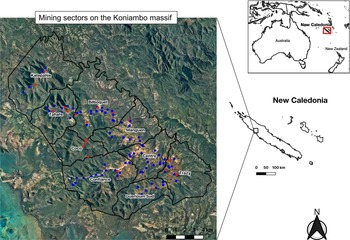
This study was carried out on the ultramafic Koniambo massif (20 km long and 6–10 km wide), located in the north-west (21°30’S, 165°30’E) and culminating at 930 m above sea level. The Koniambo massif was mined from 1888 to 1947 by several small companies, resulting in only slight modifications of the massif (Bird et al. Reference Bird, Dubois and Iltis1984, Nakache Reference Nakache1999). The massif was kept as a reserve between 1947 and 2008 when Koniambo Nickel SAS started exploiting it again. More modern mechanized and automated mining techniques allowed them to process larger volumes of ore. The industry reached its full operating capacity in 2014 (Horowitz Reference Horowitz2004). The massif is currently subdivided into eight operating sectors (Bilboquet, Centre, Confiance, Guerioum Sud, Manguen, Tahafe, Trazy and Katepahie) and one non-operating sector (Coco) (Figure 1). Tahiti Petrels have been reported breeding on steep slopes at the highest altitudes of the massif, which also coincides with exploited areas (Villard et al. Reference Villard, Dano and Bretagnolle2006, BirdLife International 2020, authors’ pers. obs.).
Location of the Koniambo massif in New Caledonia and spatial distribution of call count stations (n = 114) along the massif. Blue dots represent call count stations created in 2004–2007 (n = 95). Red dots represent new call count stations set in 2017–2018 (n = 19). Black lines delineate the nine mining sectors of the massif.

Study species
The Tahiti Petrel is a cryptic and under-studied seabird species in New Caledonia and the Pacific, with a little-known breeding phenology and distribution. The few studies available provide preliminary data on its breeding behaviour, biology and phenology (Villard et al. Reference Villard, Dano and Bretagnolle2006), describe its vocal repertoire (Rauzon and Rudd Reference Rauzon and Rudd2014) or refer to on-land spatio-temporal distribution and habitat use (Titmus Reference Titmus2017). Like most petrels, this species is nocturnal with hypogeous nesting, digging a burrow under rocks or tree roots in high elevation forests (up to around 1,000 m asl) or on rocky slopes (Villard et al. Reference Villard, Dano and Bretagnolle2006, Titmus Reference Titmus2017). Nocturnal vocal activity is by far the dominant form of communication for these petrels. A higher peak of activity is observed at the beginning of the night and near breeding sites as adults return to their colonies for mating, chick-rearing or to find a mate (Bretagnolle Reference Bretagnolle, Kroodsma and Miller1996, Rauzon and Rudd Reference Rauzon and Rudd2014, Titmus Reference Titmus2017). Tahiti Petrels nest in small and loose colonies of up to 10 pairs, with sometimes isolated pairs, rather than in dense and large colonies. The species is suspected to be philopatric (i.e. individuals tend to return to breed where they had been reared as chicks) and to demonstrate nest-site fidelity (i.e. adult breeders use the same burrow for several years) like most Procellariids (Warham Reference Warham1990, Villard et al. Reference Villard, Dano and Bretagnolle2006). In New Caledonia, the species is considered to have an extended breeding cycle throughout the year (including the austral winter), with breeding pairs and colonies exhibiting an asynchronous phenology (Ravache et al. Reference Ravache, Bourgeois, Thibault, Dromzée, Weimerskirch, de Grissac, Prudor, Lorrain, Menkes, Allain, Bustamante, Letourneur and Vidal2020), which is atypical among Procellariids that generally have a synchronous breeding behaviour (Brooke Reference Brooke2004).
Vocal activity assessment
The call count method was used to approximate changes in the Tahiti Petrel population size in the Koniambo massif between the early pre-mining (2004–2007) and intensive mining (2017–2018) activity periods. Due to multiple reasons (logistics, mine access, weather conditions), study periods were not strictly identical from one year to another (2004: January to February; 2007: January to March; 2017: February to May; and 2018: January to March). However, this did not compromise data reliability since i) Tahiti Petrels have an extended breeding cycle (which lasts for about five months) (Villard et al. Reference Villard, Dano and Bretagnolle2006), and ii) they have been proved to exhibit an asynchronous phenology (i.e. throughout the year) (Ravache et al. Reference Ravache, Bourgeois, Weimerskirch, Pagenaud, De Grissac, Miller, Dromzée, Lorrain, Allain, Bustamante, Bylemans, Gleeson, Letourneur and Vidal2020), meaning this species does not show any particular peak of vocal activity.
Tahiti Petrel calls were counted at 114 call count stations distributed among nine different sectors of the Koniambo massif (Figure 1). A call count consisted of counting all Tahiti Petrel calls for 10 minutes. At the beginning of the study (2004 and 2007), 95 call count stations were set up across eight different sectors. In 2017–2018, 15 of these stations could not be reached again or located precisely, and 15 new stations had to be set up as close as possible to the old ones. Four new call count stations were created for the Coco sector, which was not surveyed in 2004. Eleven of the call count stations of the pre-mining period became unreachable because of mining impact and could not be re-surveyed. A total of 159 and 128 call counts were monitored and repeated during the pre- and full-mining periods, respectively. All 10-minute call counts were conducted during night-time, from 30 minutes after sunset until about 01h00 i.e. during the species’ night-time peak of vocal activity (Titmus Reference Titmus2017, authors’ pers. obs). Given the large area of the Koniambo massif, the 10 minutes of listening was the appropriate time to perform the maximum call counts during the peak of vocal activity of this species. For each call count, the number, as well as start and end times of calls heard from the ground and/or in flight, were recorded. The number of calls recorded during 10-minute counts was then averaged for each call count station in 2004–2007 (n = 95) and 2017–2018 (n = 103) to describe and compare vocal activities between the pre-mining and full-mining periods respectively, following the method of Borker et al. (Reference Borker, Mckown, Ackerman, Eagles-Smith, Tershy and Croll.2014) and Oppel et al. (Reference Oppel, Hervias, Oliveira, Pipa, Silva, Geraldes, Goh, Immler and McKown2014b). For each year of study, the same listening effort could not be made for logistical and/or weather-related reasons. Therefore, not all call counts stations were strictly repeated for each year of the study. Analyses were first performed on the full dataset, i.e. all call counts stations combined, regardless of listening effort and time period (n = 114), but for more refined results and to avoid time-related biases, we then compared only the 25 call counts stations repeated year-to-year. From those 25 repeated call counts stations, a total of 182 call counts were collected (2004: n = 25, 2007: n = 75, 2017: n = 57, 2018: n = 25). This implied considering only data from Bilboquet, Centre, Guerioum Sud, Manguen and Trazy sectors for annual comparisons.
Our field surveys were carried out under quite homogeneous conditions to avoid potential bias from different factors such as poor weather (Jones et al. Reference Jones, Gaston and Falls1990, McKown Reference McKown2008) or moonlight avoidance by nocturnal seabirds returning to their breeding sites (Mougeot and Bretagnolle Reference Mougeot and Bretagnolle2000, Bourgeois et al. Reference Bourgeois, Dromzée, Vidal and Legrand2008, Ravache et al. Reference Ravache, Bourgeois, Thibault, Dromzée, Weimerskirch, de Grissac, Prudor, Lorrain, Menkes, Allain, Bustamante, Letourneur and Vidal2020), which could affect colony attendance.
Estimation of habitat change
Mining leads to the destruction of the vegetation cover and the development of bare ground. To assess the overall habitat change on the Koniambo massif due to the intensification of mining activities, we compared the Percentage of Bare Soil Cover (PBSC) between 2001 (before industrial mining) and 2016 (during full mining activity). The PBSC around each call count station was estimated using orthophotos (geometrically corrected satellite imagery of the Earth’s surface) of the Koniambo massif obtained from the KNS Environment Department and using QGIS software 2.18 (QGIS Development Team 2016). A 400-m radius buffer was applied around each call count station, corresponding to the maximum detection distance estimated for Tahiti Petrel calls (700 m; authors’ pers. obs) and precluding any buffer overlap. The PBSC at each station was then estimated visually using the National Vegetation Classification method (Rodwell Reference Rodwell2006). We used eight of the 10 Domin scale values: 3 = <4%, 4 = 4–10%, 5 = 11–25%, 6 = 26–33%, 7 = 34–50%, 8 = 51–75%, 9 = 76–90%, 10 = 91–100%. Given the limited availability of bare soil percentage data, the years 2001 and 2016 were used as proxies for the pre-mining and full-mining periods, respectively.
Location of breeding sites
In 2004 and 2007, Tahiti Petrel burrows were searched on the day following the night-time call count survey in areas with high vocal activity, and/or where landings were observed, using a burrowscope (Turbotech TTBS050 model and LCD7TFTHV (LED B/L) with dominator V3 modular 3D FPV headset model). A probability index of active breeding burrows was assigned to each breeding site based on the evidence found. The status “Certain” was assigned to areas with at least one burrow showing clear and fresh signs of digging, with one or two adults present, or containing an egg, a chick, eggshells, or regurgitation residues. The status “Possible” was assigned to areas where Tahiti Petrel vocal activity was recorded repeatedly on the ground (i.e. at least during two call counts) but where none of the previous evidence was found. All nesting areas identified in 2004 and 2007 (January to March, recorded with a GPS) were reassessed in 2017 and 2018 (January to May) through extensive and repeated ground searches.
Statistical analysis
All statistical analyses were conducted using R software version 3.4.4 (R Core Team 2016). The non-parametric Kruskal-Wallis (K-W) test was used to compare Tahiti Petrel vocal activity between all call counts. Variation in the vocal activity of the Tahiti Petrel were then studied using a generalised linear mixed effect model assuming a Poisson distribution using the package “lm4” v.1.1-21 (Bates et al. Reference Bates, Spotswood and Russel2014). The number of calls was considered the numerical response variable, and the period (i.e. “pre-mining” for 2004–2007 and “full-mining” for 2017–2018), time categories, sectors, and PBSC index were all included as categorical fixed effects. Call count stations were also included as a random effect. The usefulness of the random effect was tested by computing an ANOVA test on two full models, including the effect or not. Model assumptions were checked both graphically and statistically (following Zuur et al. Reference Zuur, Ieno and Elphick2010, Zuur and Ieno Reference Zuur and Ieno2016), with the correlation matrix of the model, a Shapiro-Wilk normality test, the calculation of the overdispersion index and a Levene variance homogeneity test with the package “car” v3.0.8 (Fox and Weisberg Reference Fox and Weisberg2019). The relative contribution of each categorical variable to variations in call counts was assessed through an analysis of deviance on the fitted model. Post hoc pairwise comparisons with Tukey p value correction were conducted with the package “emmeans” v1.4.7 (Lenth Reference Lenth2020).
Results
Variations in Tahiti Petrel vocal activity
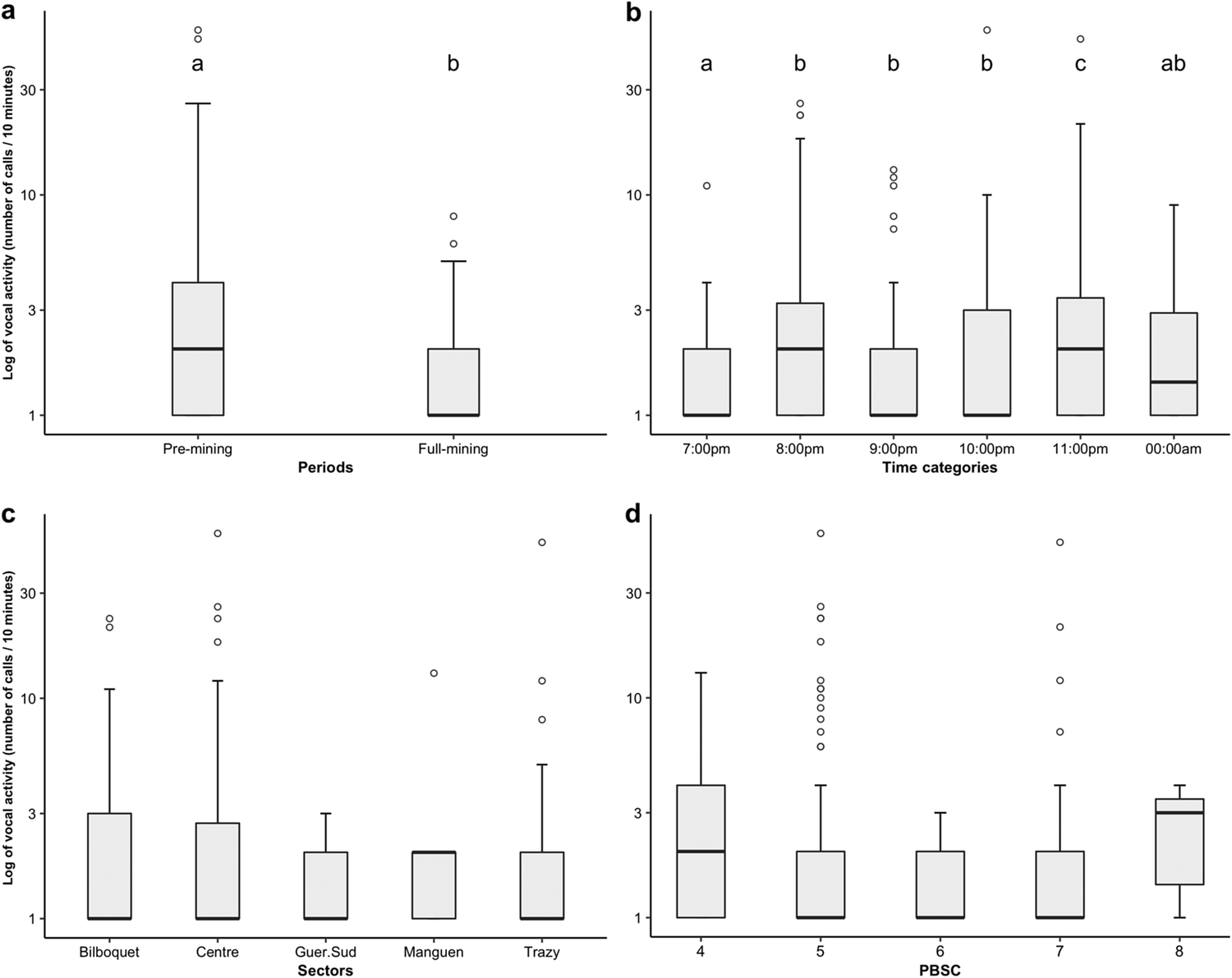
Call counts were performed across five different years of field survey, for a total of 65 nights and 107 hours of listening. The average number of Tahiti Petrel calls per 10 min, all sectors and years combined, was 2.26 ± 0.24. Based on the full dataset (n = 114), the vocal activity was significantly higher during the pre-mining period compared to the full mining period (K-W χ2 = 31.9, df = 1, P = 0.001). On the basis of annual data (n = 182), the period and time categories had a significant impact on the vocal activity (χ2 = 118.245, P < 0.001 and χ2 = 111.771, P < 0.001, respectively, Table 1). Again, the overall vocal activity was significantly higher during the pre-mining compared to the full mining period (mean = 3.8 ± 8.8 calls per 10 min, n = 372 and mean = 0.6 ± 1.2, n = 53, respectively, Tukey post-hoc test: + 1.8 ± 0.2, P <0.001, Figure 2a). Time categories also contributed to explain the vocal activity (Figure 2b), with a significantly higher “peak” of contacts between 23h00 and 00h00 (mean = 6.7 ± 14.7, n = 80) compared to 19h00–20h00 (mean = 0.6 ± 1.7, n = 25, Tukey post-hoc test: + 2.7 ± 0.3, P < 0.001), 20h00–21h00 (mean = 3.1 ± 6.3, n = 138, Tukey post-hoc test: + 1.6 ± 0.2, P <0.001), 21h00–22h00 (mean = 1.6 ± 3.0, n = 69, Tukey post-hoc test: + 1.2 ± 0.2, P <0.001), 22h00–23h00 (mean = 2.9 ± 9.2, n = 104, Tukey post-hoc test: + 1.4 ± 0.2, P < 0.001), and 00h00–01h00 (mean = 2.2 ± 3.9, n = 9, Tukey post-hoc test: + 2.2 ± 0.4, P < 0.001; Figure 2b). However, the vocal activity was lower at the beginning of the night (19h00–20h00) compared to the following hours (20h00–23h00, Tukey post-hoc test: -1.1 ± 0.2 to -1.5± 0.3, P <0.001; Figure 2b). If a slightly higher vocal activity was recorded in two sectors (Centre and Trazy, Figure 2c) and very few contacts were recorded at one site (Guerioum Sud), these differences were not significant while accounting for the other effects. Similarly, slightly fewer vocal activities were recorded at call count stations with a PBSC index of 4 and 6 (Figure 2d), but these differences were not significant in our model. Our model had an R2 of 0.58 for fixed effects only, and of 0.83 for the full model.
Summary of the analysis of deviance on the fitted model

Results of the Tahiti Petrel vocal activity (call counts n = 25): (a) represents the log of vocal activity per period, (b) represents the log of vocal activity per time category, (c) represents the log of vocal activity depending on sectors and (d) represents the log of vocal activity depending on the Percentage of Bare Soil Cover (PBSC). For (a) and (b), different letters indicate a significant difference in vocal activity. No significant difference in vocal activity was detected for sectors and the PBSC index. White dots represent extreme values.

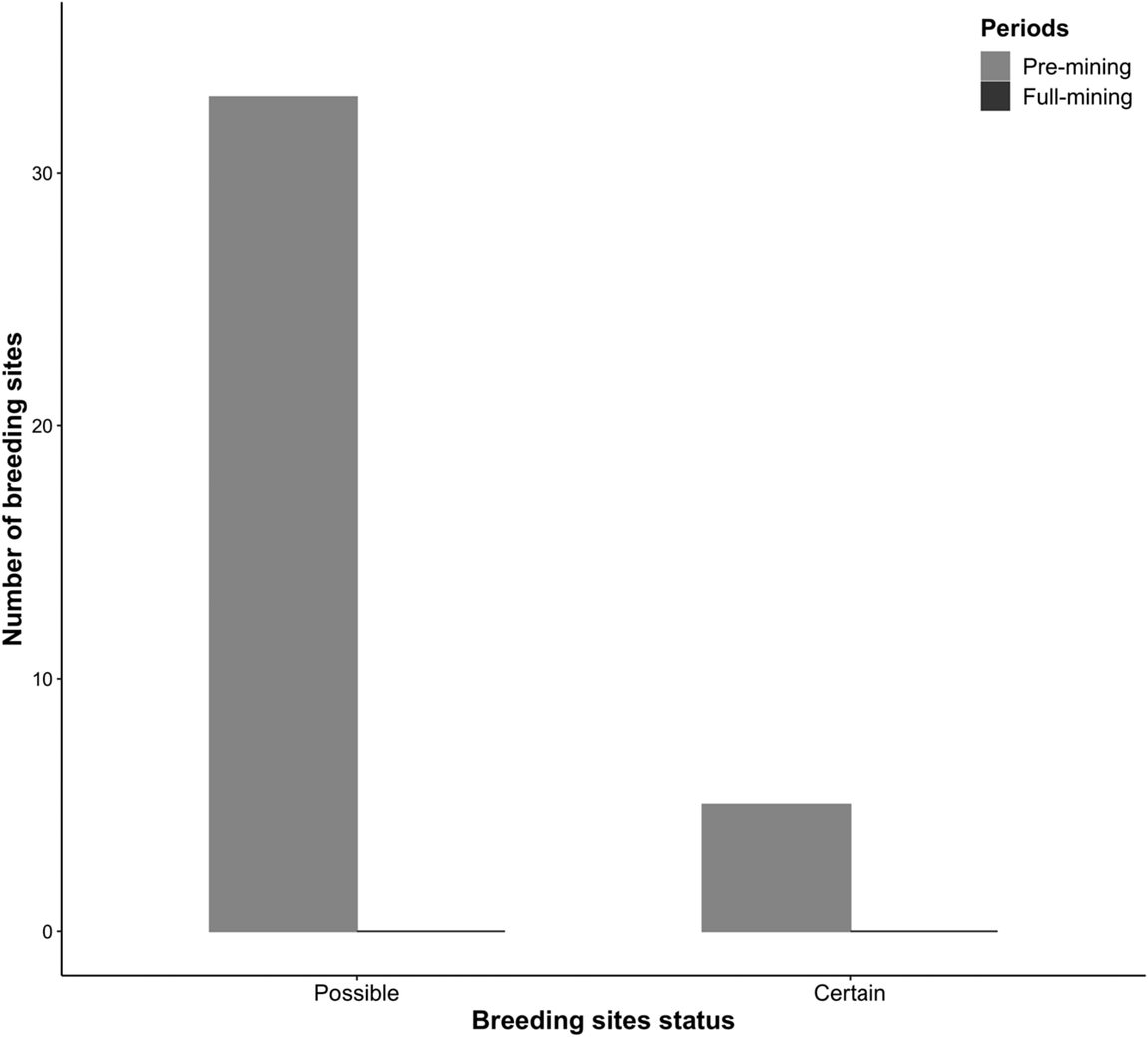
Number of breeding sites depending of the breeding sites status (“possible” or “certain”) during the pre- and full-mining periods.

Assessment of Tahiti Petrel breeding sites
In 2004–2007, five “certain” and 33 “possible” breeding areas were identified. In 2017–2018, no conclusive evidence of Tahiti Petrel breeding was observed, neither in the previously identified breeding areas nor at any new site despite intensive effort (34 days of search for a total of c.272 hours of field survey) (Figure 3).
Discussion
Petrel vocal activity and habitat degradation
Our results show a significant decline in the vocal activity of Tahiti Petrels in the Koniambo massif after 10 years of developing nickel-mining activities. The same general trend is observed whether comparing the full or repeated annual dataset. To the best of our knowledge, this result is the first temporal assessment of vocal activity change for the species worldwide. As suggested in previous studies (e.g. Buxton et al. Reference Buxton, Major, Jones and Williams2013, Oppel et al. Reference Oppel, Hervias, Oliveira, Pipa, Silva, Geraldes, Goh, Immler and McKown2014b), vocal activity can be considered a proxy of population size, since it can be positively correlated with nest density. Therefore, we suggest that the dramatic decrease in vocal activity revealed by this study could reflect a substantial and rapid decrease in the Tahiti Petrel breeding populations.
Despite standardised conditions to avoid biases we acknowledge that the listening effort was likely not the same every year as experience and detection skills may vary among investigators. Working on industrial sites also involves a lot of constraints with little control over the intervention schedule, which depends on many other parameters dictated by the industrialist. However, we are confident that we took all necessary precautions to avoid these potential biases and strongly believe the decline in vocal activity is a good proxy for a decline in population size, such as suggested by Oppel et al. (Reference Oppel, Hervias, Oliveira, Pipa, Silva, Geraldes, Goh, Immler and McKown2014b).
After 10 years of mining activity, and consequently a direct modification or destruction of the habitat, our data did not reveal a significant correlation between PSBC and Tahiti Petrel vocal activity. There are two possible explanations. First, the philopatric behaviour of the Tahiti Petrel and its high nest-site fidelity imply that adult breeders return to the same burrows each year, even if they are not suitable for reproduction anymore. However, Procellariid breeders can take several years to build another burrow and nest again (Brooke Reference Brooke2004). A time lag could then occur between the destruction of the Tahiti Petrel habitat and when it starts nesting again. Second, the noise, light or particulate pollution linked to the mining activity possibly represent additional disturbances that prevent petrels from finding alternative nesting sites and may lead to desertion of the breeding site (Reville et al. Reference Reville, Tranter and Yorkston1990, Saha and Padhy Reference Saha and Padhy2011, Smith et al. Reference Smith, Virgl, Panayi, Armstrong and Panayi2012, Duarte et al. Reference Duarte, Sousa-Lima, Young, Farina, Vasconcelos, Rodrigues and Pieretti2015). Intense light pollution can also disorient Tahiti Petrels, as burrow-nesting seabirds are guided and attracted by lights when they fly at night. On the ground, this can lead to increased mortality by increasing predation risk on stranded individuals (Le Corre et al. Reference Le Corre, Ollivier, Ribes and Jouventin2002, Rodríguez et al. Reference Rodríguez, Holmes, Ryan, Wilson, Faulquier, Murillo, Raine, Penniman, Neves, Rodríguez, Negro, Chiaradia, Dann, Anderson, Metzger, Shirai, Deppe, Wheeler, Hodum, Gouveia, Carmo, Carreira, Delgado-Alburqueque, Guerra-Correa, Couzi, Travers and Le Corre2017). In addition, road building for mining operations, presence of buildings and food at mines can indirectly facilitate the spread of invasive species such as feral cats and rats (Croxall et al. Reference Croxall, Butchart, Lascelles, Stattersfield, Sullivan, Symes and Taylor2012), which are both predators of the Tahiti Petrel. In New Caledonia, feral cats have been reported to prey on Tahiti Petrels on mine sites (Palmas et al. Reference Palmas, Jourdan, Rigault, Debar, De Meringo, Bourguet, Mathivet, Lee, Adjouhgniope, Papillon, Bonnaud and Vidal2017).
Finally, population structure may also influence Procellariid vocal activity. A population of such nocturnal seabirds is generally composed of breeders (which return to their burrows each year to breed), non-breeders (young birds not engaged in reproduction but physiologically able to do so) and pre-breeders (those which have not yet reached sexual maturity) (Warham Reference Warham1996). Studies on nocturnal petrels have suggested that non-breeders are responsible for the majority of call rates within the colony (Warham Reference Warham1996). In contrast, breeders tend to remain silent until they enter their burrows, especially when the breeding season is well advanced (Warham Reference Warham1996, Schreiber and Burger Reference Schreiber and Burger2001). The vocal activity of the studied Tahiti Petrel population suggests that it may now be composed mainly of non-breeders with high vocal activity, especially near breeding sites, but who only occasionally return to the ground (James Reference James1985, Warham Reference Warham1990, Monteiro et al. Reference Monteiro, Ramos, Pereira, Monteiro, Feio, Thompson, Bearhop, Furness, Laranjo, Hilton, Neves, Groz and Thompson1999, Arneill et al. Reference Arneill, Critchley, Wischnewski, Jessopp and Quinn2019). However, it is difficult to establish a link between a net population decline and a temporal change in population structure associated with the reproductive status of individuals, based solely on the temporal monitoring of vocal activity. This is why we coupled our approach to a temporal monitoring of the nesting sites.
Evolution of petrel breeding sites
A total of 38 breeding sites (five “certain” and 33 “probable”) were identified in 2004–2007 in the Koniambo massif thanks to high vocal activity. However, in 2017–2018, no active breeding burrows, breeding pairs or chicks were found in these potential breeding sites despite the persistence of vocal activity. These results suggest that the calls that are still recorded could be due to non-breeding individuals flying around but not nesting. Although our data indicate a decrease of the breeding population of Tahiti Petrels on the Koniambo massif (based on burrows search), the remaining vocal activity suggests that, because of the philopatric behaviour of the species, a small population still visits and frequents this area but fails to find suitable nesting sites. This remaining population probably consists – in addition to non-breeders – of former breeding individuals whose burrows were destroyed or turned unsuitable by mining activities. It is likely that they are now unable to find suitable novel breeding sites in their area of hatching (Brooke Reference Brooke2004, Arneill et al. Reference Arneill, Critchley, Wischnewski, Jessopp and Quinn2019). According to our results, we believe that the extirpation of the species from the Koniambo massif is likely to occur soon and we call for urgent conservation effort focused on offering suitable nesting sites to the few remaining individuals.
Implications for conservation strategies
The positive relationship between the vocal activity and time categories from 20h00 to 00h00 suggests a higher vocal activity around 23h00. This new information about the vocal activity pattern of the Tahiti Petrel should be taken into account in future acoustic studies and for more effective breeding site searches.
Assuming that adult Tahiti Petrels looking for breeding sites still regularly visit the area, providing them with new favourable and attractive breeding sites or mates would represent an efficient conservation strategy to prevent their extirpation. This means creating artificial breeding sites to provide favourable and attractive conditions for breeding (Kildaw et al. Reference Kildaw, Irons, Nysewander and Buck2005, Jones and Kress Reference Jones and Kress2012), including artificial burrows (Bolton et al. Reference Bolton, Medeiros, Hothersall and Campos2004, Carlile et al. Reference Carlile, Priddel and Madeiros2012, Bourgeois et al. Reference Bourgeois, Dromzée and Vidal2015), absence of introduced predators (Miskelly et al. Reference Miskelly, Taylor, Gummer and Williams2009, Jones et al. Reference Jones, Towns, Bodey, Miskelly, Ellis, Rauzon, Kress, McKown, Mulder, Anderson, Towns and Bellingham2011) as well as vocal and olfactory stimulation (Podolsky Reference Podolsky1990, Parker et al. Reference Parker, Kress, Golightly, Carter, Parsons, Schubel, Boyce, McChesney and Wisely2007, Buxton and Jones Reference Buxton and Jones2012b). These artificial breeding sites should ideally be located in reserves (i.e. unaltered and protected areas) or in sectors where operations have ceased and are being ecologically rehabilitated (i.e. reconstitution of soil and revegetation). These ecological refuges should be selected based on several characteristics derived from field measurements and observations: physical parameters, vegetation and substrate cover, level of disruption (light and noise pollution), etc. Such an effort could rapidly stop the decline of the Tahiti Petrel population in the Koniambo massif. For population rehabilitation, artificial breeding sites could also be created outside the mining concessions in locations offering new safe breeding areas to prospecting individuals and former breeders. However, without the urgent implementation of appropriate conservation measures, the Tahiti Petrel population of the massif will be extirpated, as this is probably also the case on many other mining massifs in New Caledonia.
Acknowledgements
This study was carried out on the Koniambo massif was commissioned by the mining company to understand and mitigate the impacts that its activities may have on the Tahiti Petrel population, but also to develop appropriate conservation and restoration strategies. Funds and support for this study were mainly provided by Koniambo Nickel SAS, with additional support by the CNRT “Nickel et son Environnement” (Transloc-Petrel project), the DAFE-NC and by the Province Sud (PhD scholarship to A.P.). We warmly thank the many collaborators and students involved in the fieldwork, especially Andreas Ravache, Malik Oedin, Jean-Yve Meunier, Yves Papillon, Mathieu Matthivet and Edouard Bourget.